Improving fieldwork with GIS
quantitative exploration, data
management and digital mapping
Wouter Marra1, Koko Alberti1, Liesbeth van de Grint2 &
Derek Karssenberg1
1 Dep. Physical Geography
2 Centre for education and learning
Faculty of Geosciences
Funders:
Stimuleringsfonds Onderwijs, Utrecht University and Faculty of Geosciences
Introduction
• Fieldwork is essential for Geosciences
• GIS is valuable tool for spatial analysis and mapping
Goals
• Blend classic fieldwork with quantitative GIS methods
• Easy-to-use GIS methods during fieldwork
• No prior GIS experience and not about teaching GIS
Pilot – Evaluation – Improvements / tips
2
Fieldwork French Alps
• First-year BSc, final quarter
• Individual research areas (~16 km²)
• Geology and geomorphology
• Staff visits students occasionally
3
Fieldwork French Alps
• First-year BSc, final quarter
• Individual research areas (~16 km²)
• Geology and geomorphology
• Staff visits students occasionally
4
Learning goals – changed workflow
Learning goal Change Benefit
Preparation
Explore area remotely GoogleEarth & QGIS More ways to view area
Formulate hypothesis Use GIS data Quantitative evidence
Fieldwork
Collect field data Unchanged Freedom and creativity in fieldbook
Analyse Excel & QGIS Spatial patterns, make map
Interpret QGIS Sat. image and DEM - extra data
Map QGIS Use data sources, logical workflow
Preparation
6
Learning goals – changed workflow
Learning goal Change Benefit
Preparation
Explore area remotely GoogleEarth & QGIS More ways to view area
Formulate hypothesis Use GIS data Quantitative evidence
Fieldwork
Collect field data Unchanged Freedom and creativity in fieldbook
Analyse Excel & QGIS Spatial patterns, make map
Interpret QGIS Sat. image and DEM - extra data
Map QGIS Use data sources, logical workflow
Paper maps Fieldbook
Fieldmap
Digital fieldbook (excel)
+
++
+
Neat map
+
++
+
Digital map QGIS
Field Accommodation
ObservationsGPS
GIS DataMapping workflow
Evaluations
• All students had new preparation (70)
• 23 students used GIS in the field
• Questionnaires before and after fieldwork
• Interview after fieldwork
• Difference between groups?
• Easier acquainted, useful hypotheses?
• Problems / drawbacks
• Attitude towards GIS
• Staff opinions
9
Preparation
10
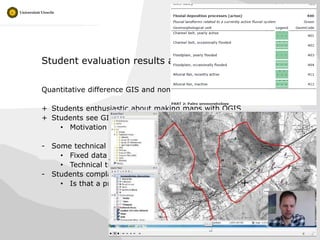
Student evaluation results after the fieldwork
Quantitative difference GIS and non-GIS users was hard to tell
+ Students enthusiastic about making maps with QGIS
+ Students see GIS as a relevant skill (also some that don’t like it)
• Motivation
- Some technical issues
• Fixed data structure, prescribed legend,
• Technical tutorial, and screencasts
- Students complain that hypotheses are superseded
• Is that a problem or a valuable lesson?
11
Staff evaluation
+ Results above expectation
- Same technical issues as students
- A few have doubts in their ability to help students with QGIS
• Screencasts for students – no supervisor required
Lots of discussions on type of legend: drawn symbols vs. polygons
12
Summary / lessons learned
• Hybrid approach – paper and GIS – was a success
• QGIS – useful in the field and for students without prior experience
• Technical instructions are required (screencasts)
• GIS was supporting the fieldwork not the focus
13
w.a.marra@uu.nl – fieldwork.geo.uu.nl
14
fwo.geo.uu.nl (EGU2016 – Vienna2016)
web-gis to supervise students on fieldwork
15
gems.geo.uu.nl (demo – demo)
online spatial modelling tool
see PICO by Baarsma et al.,ESSI3.5/GI1.5, friday at 15:30
16
ArcGIS online
GIS withouth thousands of buttons
17

Improving fieldwork with GIS (EGU 2016_

  • 1.
    Improving fieldwork withGIS quantitative exploration, data management and digital mapping Wouter Marra1, Koko Alberti1, Liesbeth van de Grint2 & Derek Karssenberg1 1 Dep. Physical Geography 2 Centre for education and learning Faculty of Geosciences Funders: Stimuleringsfonds Onderwijs, Utrecht University and Faculty of Geosciences
  • 2.
    Introduction • Fieldwork isessential for Geosciences • GIS is valuable tool for spatial analysis and mapping Goals • Blend classic fieldwork with quantitative GIS methods • Easy-to-use GIS methods during fieldwork • No prior GIS experience and not about teaching GIS Pilot – Evaluation – Improvements / tips 2
  • 3.
    Fieldwork French Alps •First-year BSc, final quarter • Individual research areas (~16 km²) • Geology and geomorphology • Staff visits students occasionally 3
  • 4.
    Fieldwork French Alps •First-year BSc, final quarter • Individual research areas (~16 km²) • Geology and geomorphology • Staff visits students occasionally 4
  • 5.
    Learning goals –changed workflow Learning goal Change Benefit Preparation Explore area remotely GoogleEarth & QGIS More ways to view area Formulate hypothesis Use GIS data Quantitative evidence Fieldwork Collect field data Unchanged Freedom and creativity in fieldbook Analyse Excel & QGIS Spatial patterns, make map Interpret QGIS Sat. image and DEM - extra data Map QGIS Use data sources, logical workflow
  • 6.
  • 7.
    Learning goals –changed workflow Learning goal Change Benefit Preparation Explore area remotely GoogleEarth & QGIS More ways to view area Formulate hypothesis Use GIS data Quantitative evidence Fieldwork Collect field data Unchanged Freedom and creativity in fieldbook Analyse Excel & QGIS Spatial patterns, make map Interpret QGIS Sat. image and DEM - extra data Map QGIS Use data sources, logical workflow
  • 8.
    Paper maps Fieldbook Fieldmap Digitalfieldbook (excel) + ++ + Neat map + ++ + Digital map QGIS Field Accommodation ObservationsGPS GIS DataMapping workflow
  • 9.
    Evaluations • All studentshad new preparation (70) • 23 students used GIS in the field • Questionnaires before and after fieldwork • Interview after fieldwork • Difference between groups? • Easier acquainted, useful hypotheses? • Problems / drawbacks • Attitude towards GIS • Staff opinions 9
  • 10.
  • 11.
    Student evaluation resultsafter the fieldwork Quantitative difference GIS and non-GIS users was hard to tell + Students enthusiastic about making maps with QGIS + Students see GIS as a relevant skill (also some that don’t like it) • Motivation - Some technical issues • Fixed data structure, prescribed legend, • Technical tutorial, and screencasts - Students complain that hypotheses are superseded • Is that a problem or a valuable lesson? 11
  • 12.
    Staff evaluation + Resultsabove expectation - Same technical issues as students - A few have doubts in their ability to help students with QGIS • Screencasts for students – no supervisor required Lots of discussions on type of legend: drawn symbols vs. polygons 12
  • 13.
    Summary / lessonslearned • Hybrid approach – paper and GIS – was a success • QGIS – useful in the field and for students without prior experience • Technical instructions are required (screencasts) • GIS was supporting the fieldwork not the focus 13 w.a.marra@uu.nl – fieldwork.geo.uu.nl
  • 14.
  • 15.
    fwo.geo.uu.nl (EGU2016 –Vienna2016) web-gis to supervise students on fieldwork 15
  • 16.
    gems.geo.uu.nl (demo –demo) online spatial modelling tool see PICO by Baarsma et al.,ESSI3.5/GI1.5, friday at 15:30 16
  • 17.
    ArcGIS online GIS withouththousands of buttons 17