Improving classification accuracy for
customer contact transcriptions
Data Science Lab – Text Analytics Group
Maria Vechtomova
Why do we want to automatically classify calls and chats?
● We receive 7M service calls per year
● Calls are expensive
● Service call reduction is an everlasting target
● Calls/chats are manually categorized by call agents
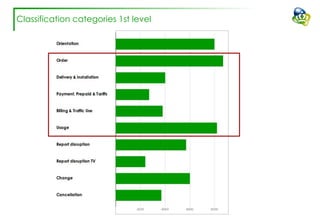
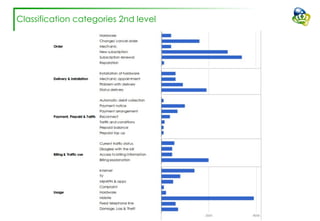
● Classification tree has 3 levels (with ~10, 70 and >400
categories on each level respectively)
● Manual call/chat classification is used to spot issues
affecting large number of customers, distribute the
workload and plan the capacity
Manual classification has number of problems:
● Only 60% of the calls are labelled (much less for chat)
● Agents are not particularly motivated in doing proper
labelling -> we doubt the accuracy of their
classification
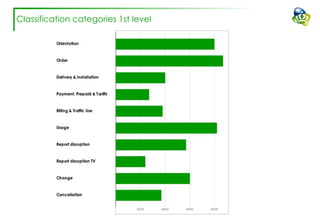
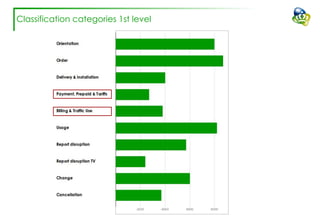
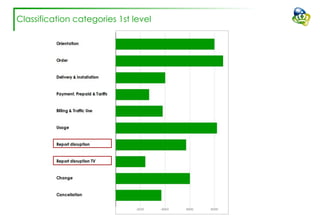
Classification categories 1st level
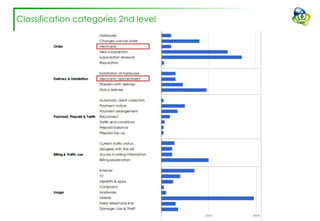
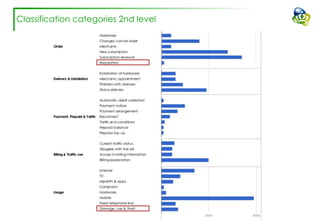
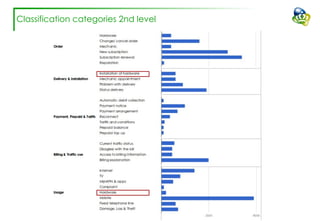
Classification categories 2nd level
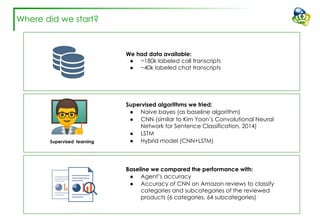
Where did we start?
We had data available:
● ~180k labeled call transcripts
● ~40k labeled chat transcripts
Supervised algorithms we tried:
● Naive bayes (as baseline algorithm)
● CNN (similar to Kim Yoon’s Convolutional Neural
Network for Sentence Classification, 2014)
● LSTM
● Hybrid model (CNN+LSTM)
Baseline we compared the performance with:
● Agent’s accuracy
● Accuracy of CNN on Amazon reviews to classify
categories and subcategories of the reviewed
products (6 categories, 64 subcategories)
Supervised learning
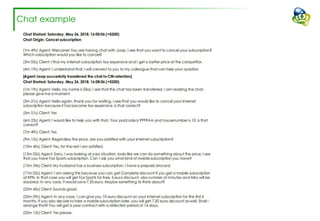
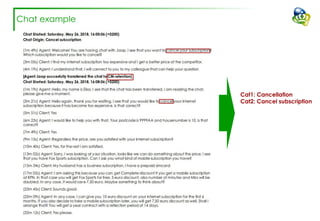
Chat example
Chat example
Cat1: Cancellation
Cat2: Cancel subscription
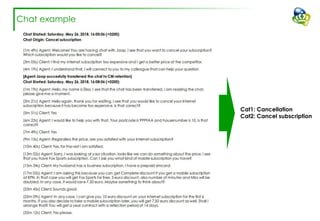
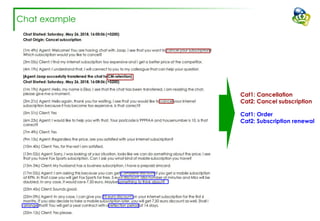
Chat example
Cat1: Cancellation
Cat2: Cancel subscription
Chat example
Cat1: Cancellation
Cat2: Cancel subscription
Cat1: Order
Cat2: Subscription renewal
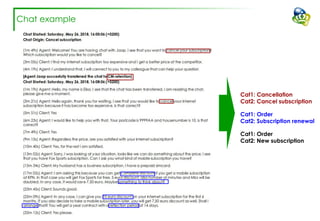
Chat example
Cat1: Cancellation
Cat2: Cancel subscription
Cat1: Order
Cat2: Subscription renewal
Cat1: Order
Cat2: New subscription
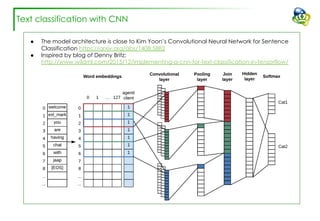
Text classification with CNN
● The model architecture is close to Kim Yoon’s Convolutional Neural Network for Sentence
Classification https://arxiv.org/abs/1408.5882
● Inspired by blog of Denny Britz:
http://www.wildml.com/2015/12/implementing-a-cnn-for-text-classification-in-tensorflow/
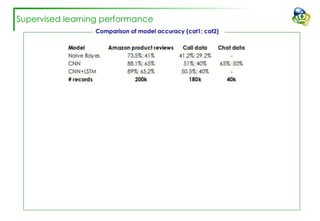
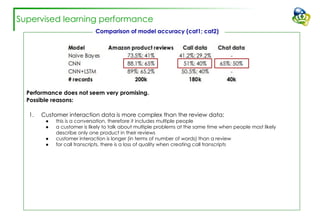
Supervised learning performance
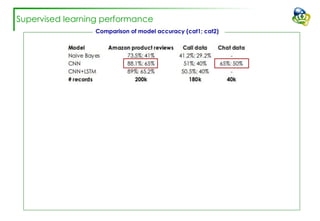
Comparison of model accuracy (cat1; cat2)
Supervised learning performance
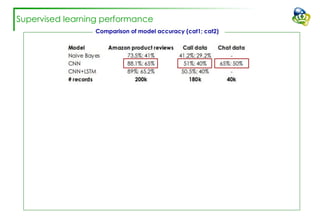
Comparison of model accuracy (cat1; cat2)
Supervised learning performance
Comparison of model accuracy (cat1; cat2)
Supervised learning performance
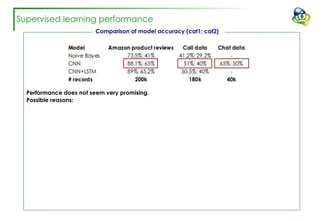
Performance does not seem very promising.
Possible reasons:
Comparison of model accuracy (cat1; cat2)
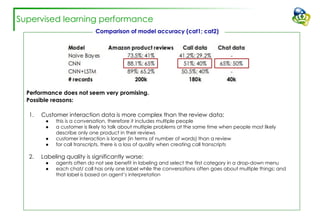
Supervised learning performance
Performance does not seem very promising.
Possible reasons:
1. Customer interaction data is more complex than the review data:
● this is a conversation, therefore it includes multiple people
● a customer is likely to talk about multiple problems at the same time when people most likely
describe only one product in their reviews
● customer interaction is longer (in terms of number of words) than a review
● for call transcripts, there is a loss of quality when creating call transcripts
Comparison of model accuracy (cat1; cat2)
Supervised learning performance
Performance does not seem very promising.
Possible reasons:
1. Customer interaction data is more complex than the review data:
● this is a conversation, therefore it includes multiple people
● a customer is likely to talk about multiple problems at the same time when people most likely
describe only one product in their reviews
● customer interaction is longer (in terms of number of words) than a review
● for call transcripts, there is a loss of quality when creating call transcripts
2. Labeling quality is significantly worse:
● agents often do not see benefit in labeling and select the first category in a drop-down menu
● each chat/ call has only one label while the conversations often goes about multiple things; and
that label is based on agent’s interpretation
Comparison of model accuracy (cat1; cat2)
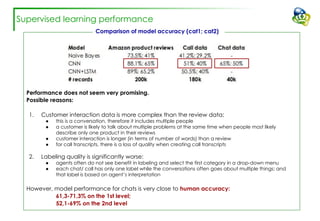
Supervised learning performance
Performance does not seem very promising.
Possible reasons:
1. Customer interaction data is more complex than the review data:
● this is a conversation, therefore it includes multiple people
● a customer is likely to talk about multiple problems at the same time when people most likely
describe only one product in their reviews
● customer interaction is longer (in terms of number of words) than a review
● for call transcripts, there is a loss of quality when creating call transcripts
2. Labeling quality is significantly worse:
● agents often do not see benefit in labeling and select the first category in a drop-down menu
● each chat/ call has only one label while the conversations often goes about multiple things; and
that label is based on agent’s interpretation
However, model performance for chats is very close to human accuracy:
61,3-71,3% on the 1st level;
52,1-69% on the 2nd level
Comparison of model accuracy (cat1; cat2)
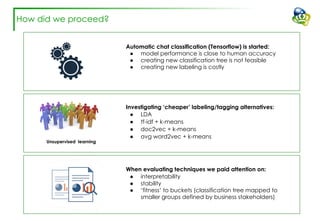
How did we proceed?
Automatic chat classification (Tensorflow) is started:
● model performance is close to human accuracy
● creating new classification tree is not feasible
● creating new labeling is costly
Investigating ‘cheaper’ labeling/tagging alternatives:
● LDA
● tf-idf + k-means
● doc2vec + k-means
● avg word2vec + k-means
When evaluating techniques we paid attention on:
● interpretability
● stability
● ‘fitness’ to buckets (classification tree mapped to
smaller groups defined by business stakeholders)
Unsupervised learning
LDA
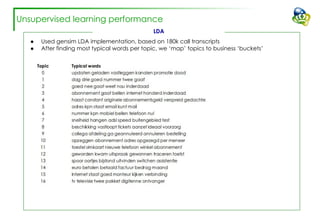
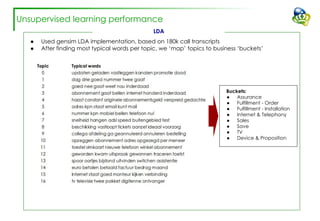
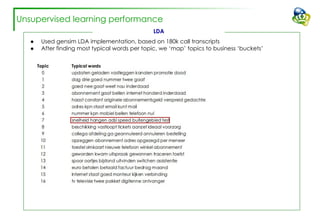
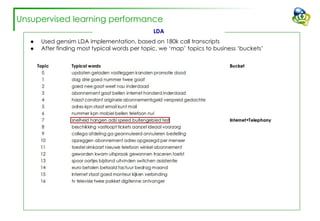
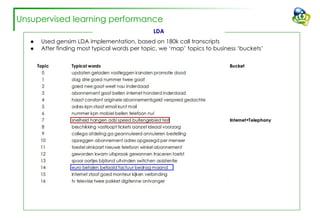
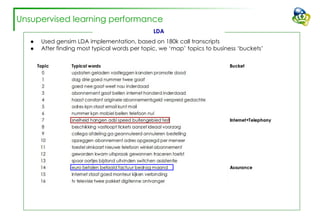
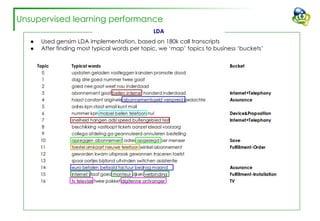
● Used gensim LDA implementation, based on 180k call transcripts
● After finding most typical words per topic, we ‘map’ topics to business ‘buckets’
Unsupervised learning performance
LDA
● Used gensim LDA implementation, based on 180k call transcripts
● After finding most typical words per topic, we ‘map’ topics to business ‘buckets’
Buckets:
● Assurance
● Fulfillment - Order
● Fulfillment - Installation
● Internet & Telephony
● Sales
● Save
● TV
● Device & Proposition
Unsupervised learning performance
LDA
● Used gensim LDA implementation, based on 180k call transcripts
● After finding most typical words per topic, we ‘map’ topics to business ‘buckets’
Unsupervised learning performance
● Used gensim LDA implementation, based on 180k call transcripts
● After finding most typical words per topic, we ‘map’ topics to business ‘buckets’
LDA
Unsupervised learning performance
LDA
● Used gensim LDA implementation, based on 180k call transcripts
● After finding most typical words per topic, we ‘map’ topics to business ‘buckets’
Unsupervised learning performance
LDA
● Used gensim LDA implementation, based on 180k call transcripts
● After finding most typical words per topic, we ‘map’ topics to business ‘buckets’
Unsupervised learning performance
LDA
● Used gensim LDA implementation, based on 180k call transcripts
● After finding most typical words per topic, we ‘map’ topics to business ‘buckets’
Unsupervised learning performance
LDA
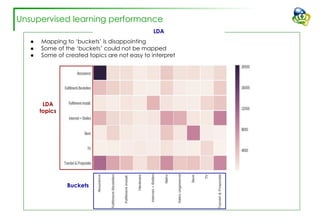
● Mapping to ‘buckets’ is disappointing
● Some of the ‘buckets’ could not be mapped
● Some of created topics are not easy to interpret
LDA
topics
Buckets
Unsupervised learning performance
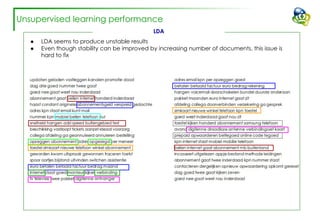
● LDA seems to produce unstable results
● Even though stability can be improved by increasing number of documents, this issue is
hard to fix
Unsupervised learning performance
LDA
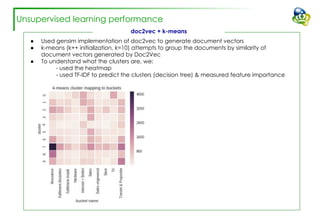
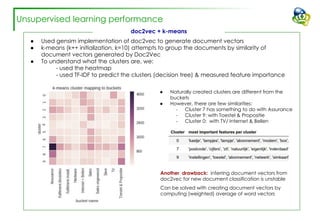
● Used gensim implementation of doc2vec to generate document vectors
● k-means (k++ initialization, k=10) attempts to group the documents by similarity of
document vectors generated by Doc2Vec
● To understand what the clusters are, we:
- used the heatmap
- used TF-IDF to predict the clusters (decision tree) & measured feature importance
doc2vec + k-means
Unsupervised learning performance
● Used gensim implementation of doc2vec to generate document vectors
● k-means (k++ initialization, k=10) attempts to group the documents by similarity of
document vectors generated by Doc2Vec
● To understand what the clusters are, we:
- used the heatmap
- used TF-IDF to predict the clusters (decision tree) & measured feature importance
doc2vec + k-means
Unsupervised learning performance
● Used gensim implementation of doc2vec to generate document vectors
● k-means (k++ initialization, k=10) attempts to group the documents by similarity of
document vectors generated by Doc2Vec
● To understand what the clusters are, we:
- used the heatmap
- used TF-IDF to predict the clusters (decision tree) & measured feature importance
doc2vec + k-means
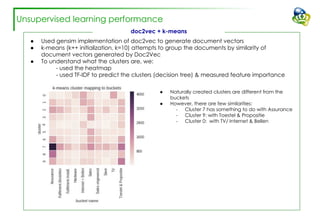
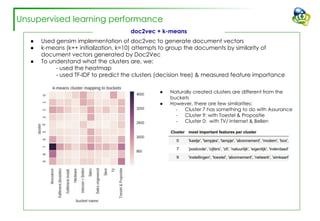
● Naturally created clusters are different from the
buckets
● However, there are few similarities:
- Cluster 7 has something to do with Assurance
- Cluster 9: with Toestel & Propositie
- Cluster 0: with TV/ Internet & Bellen
Unsupervised learning performance
● Used gensim implementation of doc2vec to generate document vectors
● k-means (k++ initialization, k=10) attempts to group the documents by similarity of
document vectors generated by Doc2Vec
● To understand what the clusters are, we:
- used the heatmap
- used TF-IDF to predict the clusters (decision tree) & measured feature importance
doc2vec + k-means
● Naturally created clusters are different from the
buckets
● However, there are few similarities:
- Cluster 7 has something to do with Assurance
- Cluster 9: with Toestel & Propositie
- Cluster 0: with TV/ Internet & Bellen
Unsupervised learning performance
● Used gensim implementation of doc2vec to generate document vectors
● k-means (k++ initialization, k=10) attempts to group the documents by similarity of
document vectors generated by Doc2Vec
● To understand what the clusters are, we:
- used the heatmap
- used TF-IDF to predict the clusters (decision tree) & measured feature importance
doc2vec + k-means
● Naturally created clusters are different from the
buckets
● However, there are few similarities:
- Cluster 7 has something to do with Assurance
- Cluster 9: with Toestel & Propositie
- Cluster 0: with TV/ Internet & Bellen
Unsupervised learning performance
Another drawback: inferring document vectors from
doc2vec for new document classification is unstable
Can be solved with creating document vectors by
computing (weighted) average of word vectors
Unsupervised learning: main results & next steps
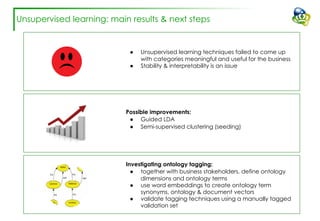
● Unsupervised learning techniques failed to come up
with categories meaningful and useful for the business
● Stability & interpretability is an issue
Possible improvements:
● Guided LDA
● Semi-supervised clustering (seeding)
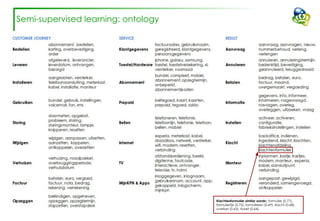
Investigating ontology tagging:
● together with business stakeholders, define ontology
dimensions and ontology terms
● use word embeddings to create ontology term
synonyms, ontology & document vectors
● validate tagging techniques using a manually tagged
validation set
Semi-supervised learning: ontology
Klachtenformulier similar words:: formulier (0.77),
formuliertje (0.75), formulieren (0.69), klacht (0.68),
overlast (0.65), ticket (0.64),
Semi-supervised learning: ontology
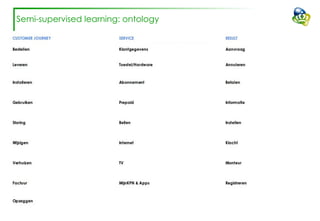
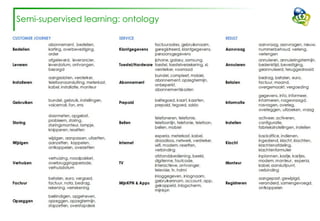
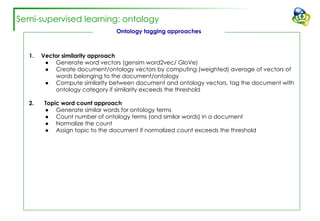
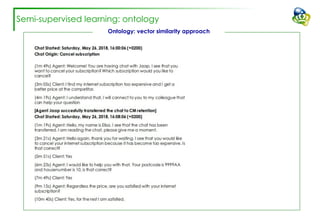
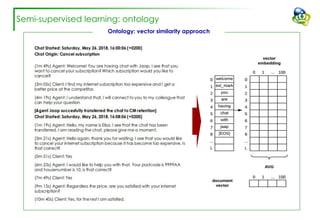
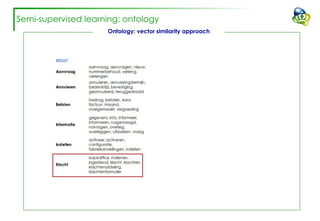
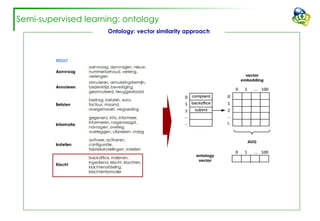
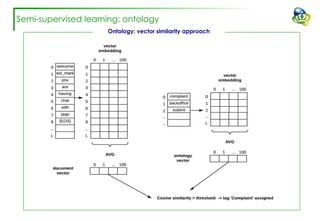
1. Vector similarity approach
● Generate word vectors (gensim word2vec/ GloVe)
● Create document/ontology vectors by computing (weighted) average of vectors of
words belonging to the document/ontology
● Compute similarity between document and ontology vectors, tag the document with
ontology category if similarity exceeds the threshold
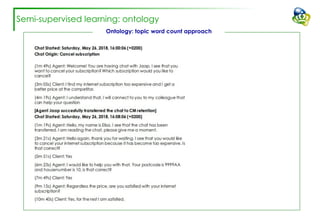
2. Topic word count approach
● Generate similar words for ontology terms
● Count number of ontology terms (and similar words) in a document
● Normalize the count
● Assign topic to the document if normalized count exceeds the threshold
Ontology tagging approaches
Semi-supervised learning: ontology
Ontology: vector similarity approach
Semi-supervised learning: ontology
Ontology: vector similarity approach
Semi-supervised learning: ontology
Ontology: vector similarity approach
Semi-supervised learning: ontology
Ontology: vector similarity approach
Semi-supervised learning: ontology
Ontology: vector similarity approach
Semi-supervised learning: ontology
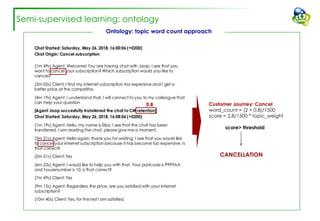
Ontology: topic word count approach
Semi-supervised learning: ontology
Ontology: topic word count approach
Customer Journey: Cancel
word_count = (2 + 0.8)/1500
score = 2.8/1500 * topic_weight
score> threshold
CANCELLATION
0.8
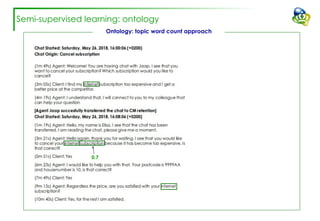
Semi-supervised learning: ontology
Ontology: topic word count approach
0.7
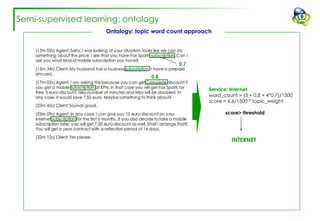
Semi-supervised learning: ontology
Ontology: topic word count approach
Service: Internet
word_count = (3 + 0.8 + 4*0.7)/1500
score = 6.6/1500 * topic_weight
score> threshold
INTERNET
0.8
0.7
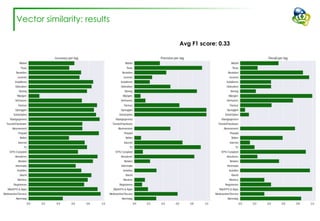
Vector similarity: results
Avg F1 score: 0.33
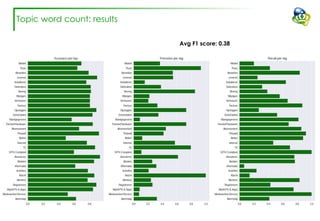
Topic word count: results
Avg F1 score: 0.38
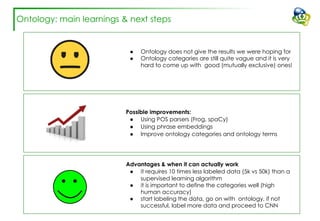
Ontology: main learnings & next steps
● Ontology does not give the results we were hoping for
● Ontology categories are still quite vague and it is very
hard to come up with good (mutually exclusive) ones!
Possible improvements:
● Using POS parsers (Frog, spaCy)
● Using phrase embeddings
● Improve ontology categories and ontology terms
Advantages & when it can actually work
● it requires 10 times less labeled data (5k vs 50k) than a
supervised learning algorithm
● it is important to define the categories well (high
human accuracy)
● start labeling the data, go on with ontology, if not
successful, label more data and proceed to CNN

Improving classification accuracy for customer contact transcriptions

  • 1.
    Improving classification accuracyfor customer contact transcriptions Data Science Lab – Text Analytics Group Maria Vechtomova
  • 2.
    Why do wewant to automatically classify calls and chats? ● We receive 7M service calls per year ● Calls are expensive ● Service call reduction is an everlasting target ● Calls/chats are manually categorized by call agents ● Classification tree has 3 levels (with ~10, 70 and >400 categories on each level respectively) ● Manual call/chat classification is used to spot issues affecting large number of customers, distribute the workload and plan the capacity Manual classification has number of problems: ● Only 60% of the calls are labelled (much less for chat) ● Agents are not particularly motivated in doing proper labelling -> we doubt the accuracy of their classification
  • 3.
  • 4.
  • 5.
  • 6.
  • 7.
  • 8.
  • 9.
  • 10.
  • 11.
    Where did westart? We had data available: ● ~180k labeled call transcripts ● ~40k labeled chat transcripts Supervised algorithms we tried: ● Naive bayes (as baseline algorithm) ● CNN (similar to Kim Yoon’s Convolutional Neural Network for Sentence Classification, 2014) ● LSTM ● Hybrid model (CNN+LSTM) Baseline we compared the performance with: ● Agent’s accuracy ● Accuracy of CNN on Amazon reviews to classify categories and subcategories of the reviewed products (6 categories, 64 subcategories) Supervised learning
  • 12.
  • 13.
  • 14.
  • 15.
    Chat example Cat1: Cancellation Cat2:Cancel subscription Cat1: Order Cat2: Subscription renewal
  • 16.
    Chat example Cat1: Cancellation Cat2:Cancel subscription Cat1: Order Cat2: Subscription renewal Cat1: Order Cat2: New subscription
  • 17.
    Text classification withCNN ● The model architecture is close to Kim Yoon’s Convolutional Neural Network for Sentence Classification https://arxiv.org/abs/1408.5882 ● Inspired by blog of Denny Britz: http://www.wildml.com/2015/12/implementing-a-cnn-for-text-classification-in-tensorflow/
  • 18.
    Supervised learning performance Comparisonof model accuracy (cat1; cat2)
  • 19.
    Supervised learning performance Comparisonof model accuracy (cat1; cat2)
  • 20.
    Supervised learning performance Comparisonof model accuracy (cat1; cat2)
  • 21.
    Supervised learning performance Performancedoes not seem very promising. Possible reasons: Comparison of model accuracy (cat1; cat2)
  • 22.
    Supervised learning performance Performancedoes not seem very promising. Possible reasons: 1. Customer interaction data is more complex than the review data: ● this is a conversation, therefore it includes multiple people ● a customer is likely to talk about multiple problems at the same time when people most likely describe only one product in their reviews ● customer interaction is longer (in terms of number of words) than a review ● for call transcripts, there is a loss of quality when creating call transcripts Comparison of model accuracy (cat1; cat2)
  • 23.
    Supervised learning performance Performancedoes not seem very promising. Possible reasons: 1. Customer interaction data is more complex than the review data: ● this is a conversation, therefore it includes multiple people ● a customer is likely to talk about multiple problems at the same time when people most likely describe only one product in their reviews ● customer interaction is longer (in terms of number of words) than a review ● for call transcripts, there is a loss of quality when creating call transcripts 2. Labeling quality is significantly worse: ● agents often do not see benefit in labeling and select the first category in a drop-down menu ● each chat/ call has only one label while the conversations often goes about multiple things; and that label is based on agent’s interpretation Comparison of model accuracy (cat1; cat2)
  • 24.
    Supervised learning performance Performancedoes not seem very promising. Possible reasons: 1. Customer interaction data is more complex than the review data: ● this is a conversation, therefore it includes multiple people ● a customer is likely to talk about multiple problems at the same time when people most likely describe only one product in their reviews ● customer interaction is longer (in terms of number of words) than a review ● for call transcripts, there is a loss of quality when creating call transcripts 2. Labeling quality is significantly worse: ● agents often do not see benefit in labeling and select the first category in a drop-down menu ● each chat/ call has only one label while the conversations often goes about multiple things; and that label is based on agent’s interpretation However, model performance for chats is very close to human accuracy: 61,3-71,3% on the 1st level; 52,1-69% on the 2nd level Comparison of model accuracy (cat1; cat2)
  • 25.
    How did weproceed? Automatic chat classification (Tensorflow) is started: ● model performance is close to human accuracy ● creating new classification tree is not feasible ● creating new labeling is costly Investigating ‘cheaper’ labeling/tagging alternatives: ● LDA ● tf-idf + k-means ● doc2vec + k-means ● avg word2vec + k-means When evaluating techniques we paid attention on: ● interpretability ● stability ● ‘fitness’ to buckets (classification tree mapped to smaller groups defined by business stakeholders) Unsupervised learning
  • 26.
    LDA ● Used gensimLDA implementation, based on 180k call transcripts ● After finding most typical words per topic, we ‘map’ topics to business ‘buckets’ Unsupervised learning performance
  • 27.
    LDA ● Used gensimLDA implementation, based on 180k call transcripts ● After finding most typical words per topic, we ‘map’ topics to business ‘buckets’ Buckets: ● Assurance ● Fulfillment - Order ● Fulfillment - Installation ● Internet & Telephony ● Sales ● Save ● TV ● Device & Proposition Unsupervised learning performance
  • 28.
    LDA ● Used gensimLDA implementation, based on 180k call transcripts ● After finding most typical words per topic, we ‘map’ topics to business ‘buckets’ Unsupervised learning performance
  • 29.
    ● Used gensimLDA implementation, based on 180k call transcripts ● After finding most typical words per topic, we ‘map’ topics to business ‘buckets’ LDA Unsupervised learning performance
  • 30.
    LDA ● Used gensimLDA implementation, based on 180k call transcripts ● After finding most typical words per topic, we ‘map’ topics to business ‘buckets’ Unsupervised learning performance
  • 31.
    LDA ● Used gensimLDA implementation, based on 180k call transcripts ● After finding most typical words per topic, we ‘map’ topics to business ‘buckets’ Unsupervised learning performance
  • 32.
    LDA ● Used gensimLDA implementation, based on 180k call transcripts ● After finding most typical words per topic, we ‘map’ topics to business ‘buckets’ Unsupervised learning performance
  • 33.
    LDA ● Mapping to‘buckets’ is disappointing ● Some of the ‘buckets’ could not be mapped ● Some of created topics are not easy to interpret LDA topics Buckets Unsupervised learning performance
  • 34.
    ● LDA seemsto produce unstable results ● Even though stability can be improved by increasing number of documents, this issue is hard to fix Unsupervised learning performance LDA
  • 35.
    ● Used gensimimplementation of doc2vec to generate document vectors ● k-means (k++ initialization, k=10) attempts to group the documents by similarity of document vectors generated by Doc2Vec ● To understand what the clusters are, we: - used the heatmap - used TF-IDF to predict the clusters (decision tree) & measured feature importance doc2vec + k-means Unsupervised learning performance
  • 36.
    ● Used gensimimplementation of doc2vec to generate document vectors ● k-means (k++ initialization, k=10) attempts to group the documents by similarity of document vectors generated by Doc2Vec ● To understand what the clusters are, we: - used the heatmap - used TF-IDF to predict the clusters (decision tree) & measured feature importance doc2vec + k-means Unsupervised learning performance
  • 37.
    ● Used gensimimplementation of doc2vec to generate document vectors ● k-means (k++ initialization, k=10) attempts to group the documents by similarity of document vectors generated by Doc2Vec ● To understand what the clusters are, we: - used the heatmap - used TF-IDF to predict the clusters (decision tree) & measured feature importance doc2vec + k-means ● Naturally created clusters are different from the buckets ● However, there are few similarities: - Cluster 7 has something to do with Assurance - Cluster 9: with Toestel & Propositie - Cluster 0: with TV/ Internet & Bellen Unsupervised learning performance
  • 38.
    ● Used gensimimplementation of doc2vec to generate document vectors ● k-means (k++ initialization, k=10) attempts to group the documents by similarity of document vectors generated by Doc2Vec ● To understand what the clusters are, we: - used the heatmap - used TF-IDF to predict the clusters (decision tree) & measured feature importance doc2vec + k-means ● Naturally created clusters are different from the buckets ● However, there are few similarities: - Cluster 7 has something to do with Assurance - Cluster 9: with Toestel & Propositie - Cluster 0: with TV/ Internet & Bellen Unsupervised learning performance
  • 39.
    ● Used gensimimplementation of doc2vec to generate document vectors ● k-means (k++ initialization, k=10) attempts to group the documents by similarity of document vectors generated by Doc2Vec ● To understand what the clusters are, we: - used the heatmap - used TF-IDF to predict the clusters (decision tree) & measured feature importance doc2vec + k-means ● Naturally created clusters are different from the buckets ● However, there are few similarities: - Cluster 7 has something to do with Assurance - Cluster 9: with Toestel & Propositie - Cluster 0: with TV/ Internet & Bellen Unsupervised learning performance Another drawback: inferring document vectors from doc2vec for new document classification is unstable Can be solved with creating document vectors by computing (weighted) average of word vectors
  • 40.
    Unsupervised learning: mainresults & next steps ● Unsupervised learning techniques failed to come up with categories meaningful and useful for the business ● Stability & interpretability is an issue Possible improvements: ● Guided LDA ● Semi-supervised clustering (seeding) Investigating ontology tagging: ● together with business stakeholders, define ontology dimensions and ontology terms ● use word embeddings to create ontology term synonyms, ontology & document vectors ● validate tagging techniques using a manually tagged validation set
  • 41.
  • 42.
  • 43.
    Semi-supervised learning: ontology Klachtenformuliersimilar words:: formulier (0.77), formuliertje (0.75), formulieren (0.69), klacht (0.68), overlast (0.65), ticket (0.64),
  • 44.
    Semi-supervised learning: ontology 1.Vector similarity approach ● Generate word vectors (gensim word2vec/ GloVe) ● Create document/ontology vectors by computing (weighted) average of vectors of words belonging to the document/ontology ● Compute similarity between document and ontology vectors, tag the document with ontology category if similarity exceeds the threshold 2. Topic word count approach ● Generate similar words for ontology terms ● Count number of ontology terms (and similar words) in a document ● Normalize the count ● Assign topic to the document if normalized count exceeds the threshold Ontology tagging approaches
  • 45.
  • 46.
  • 47.
  • 48.
  • 49.
  • 50.
  • 51.
    Semi-supervised learning: ontology Ontology:topic word count approach Customer Journey: Cancel word_count = (2 + 0.8)/1500 score = 2.8/1500 * topic_weight score> threshold CANCELLATION 0.8
  • 52.
    Semi-supervised learning: ontology Ontology:topic word count approach 0.7
  • 53.
    Semi-supervised learning: ontology Ontology:topic word count approach Service: Internet word_count = (3 + 0.8 + 4*0.7)/1500 score = 6.6/1500 * topic_weight score> threshold INTERNET 0.8 0.7
  • 54.
  • 55.
    Topic word count:results Avg F1 score: 0.38
  • 56.
    Ontology: main learnings& next steps ● Ontology does not give the results we were hoping for ● Ontology categories are still quite vague and it is very hard to come up with good (mutually exclusive) ones! Possible improvements: ● Using POS parsers (Frog, spaCy) ● Using phrase embeddings ● Improve ontology categories and ontology terms Advantages & when it can actually work ● it requires 10 times less labeled data (5k vs 50k) than a supervised learning algorithm ● it is important to define the categories well (high human accuracy) ● start labeling the data, go on with ontology, if not successful, label more data and proceed to CNN