Practical
Research 2
WEEK 2 | 1ST
QUARTER
JOSEPH Z. RIZON, MAED
Learning Competency
Differentiates kinds of variables and their
uses
KINDS OF VARIABLES AND
THEIR USES
What is a Variable?
It refers to a characteristics or attribute of an
individual or an organization that can be
measured or observed and that varies among
people or organization being studied.
The most common variables in social
research are age, sex, gender, education,
income, marital status and occupation.
What is a Variable?
refers to characteristics, or attribute
of an individual or an organization
that can be measured or observed
and that varies among the people or
organization being studied (Creswell,
2002).
What is a Variable?
refers to characteristics, or attribute
of an individual or an organization
that can be measured or observed
and that varies among the people or
organization being studied (Creswell,
2002).
If you are going to conduct research which
field are you going to focus on? Why?
The Nature of Variables and
Data
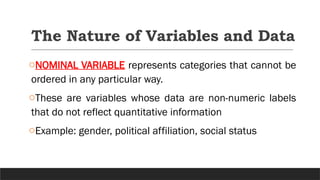
The Nature of Variables and Data
oNOMINAL VARIABLE represents categories that cannot be
ordered in any particular way.
oThese are variables whose data are non-numeric labels
that do not reflect quantitative information
oExample: gender, political affiliation, social status
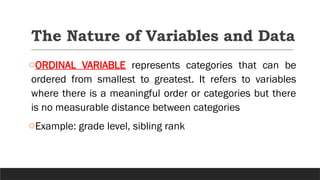
The Nature of Variables and Data
oORDINAL VARIABLE represents categories that can be
ordered from smallest to greatest. It refers to variables
where there is a meaningful order or categories but there
is no measurable distance between categories
oExample: grade level, sibling rank
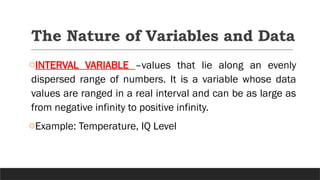
The Nature of Variables and Data
oINTERVAL VARIABLE –values that lie along an evenly
dispersed range of numbers. It is a variable whose data
values are ranged in a real interval and can be as large as
from negative infinity to positive infinity.
oExample: Temperature, IQ Level
The Nature of Variables and Data
oRATIO VARIABLES have values that lie along an evenly
dispersed range of numbers when there is an absolute
zero.
Kinds of Variables
Kinds of Variables
oIndependent Variables- those that probably cause
influence or affect outcomes. They are invariably called
treatment, manipulated, antecedent or predictor variables.
Research & ANTHROPOLOGY
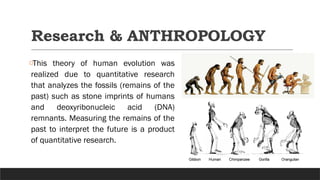
oThis theory of human evolution was
realized due to quantitative research
that analyzes the fossils (remains of the
past) such as stone imprints of humans
and deoxyribonucleic acid (DNA)
remnants. Measuring the remains of the
past to interpret the future is a product
of quantitative research.
Research & COMMUNICATION
ois the act of conveying
meanings from one entity or
group to another through the
use of mutually understood
signs, symbols, and semiotic
rules.
Research & COMMUNICATION
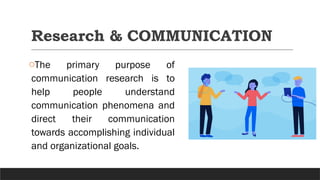
oThe primary purpose of
communication research is to
help people understand
communication phenomena and
direct their communication
towards accomplishing individual
and organizational goals.
Research & COMMUNICATION
oThrough quantitative research,
people can communicate with each
other from distant places because of
telephones and internet connections.
oThe invention of modern
communication devices is a product
of quantitative research.
Research & COMMUNICATION
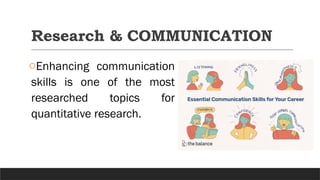
oEnhancing communication
skills is one of the most
researched topics for
quantitative research.
Research & MEDICINE
ois the science and practice of
establishing the diagnosis,
prognosis, treatment, and
prevention of disease. It
encompasses a variety of health
care practices to maintain and
restore health through the
prevention and treatment of illness.
Research & MEDICINE
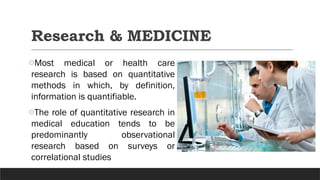
oMost medical or health care
research is based on quantitative
methods in which, by definition,
information is quantifiable.
oThe role of quantitative research in
medical education tends to be
predominantly observational
research based on surveys or
correlational studies
Research & BEHAVIORAL SCIENCE
oContemporary researchers are
interested in two types of
questions namely, questions of
relationship and questions of
differences
oExample: Are certain supervisor
communication skills related to
emotional experiences of
employees?
Research & PSYCHOLOGY
oPsychologists study the mental
process and human behavior by
interpreting and recording how
people relate to one another and
the environment.
oWithout quantitative research, our
mental and emotional problems
will not be properly attended to.
Research & PSYCHOLOGY
oResearch Areas:
oProblems encountered by individuals,
groups and families
oMemory and thinking, conscious
processes, perceptions, problem
solving, and creativity
oIntellectual development, emerging
personality, and the acquisition of
language
Research & EDUCATION
oIn deductive type of research, SHS
students develop critical thinking
capability and effective analytical
research, and communication
skills that are incredibly beneficial
oEnhances both reading and
writing
Research & EDUCATION
oResearch areas
oLearning strategies
oAcademic Performance
oMastery
oCurriculum Development
oAssessment
Research & SOCIAL SCIENCE
ois the study of society and how
people behave and influence the
world around them.
oScientific study of human society
and social relationships
oResearch conducted to determine
the extent of leadership competence
of organizational leaders
Research & BUSINESS
oImprove the overall marketing
strategy, help the company make
informed decisions on how to move
forward with a particular product or
service, and even solicit consumers'
opinions for productivity.
Research & BUSINESS
oResearch areas:
oProduce consumer goods or mass-
market items
oProduct innovation and advancement
and to improve improving services
oBusiness strategies
Research & AGRICULTURE
oThe significance of quantitative
research in agriculture and fisheries
cannot be overstated because it aids
in the detection of disease trends in
crops, the elimination of threats, and
the prevention of future outbreaks
oEssential for sustainable and
inclusive agricultural development
Research & ICT
oQuantitative approaches are frequently
used in the field of ICT to compute findings
and analyze systems using a scientific
approach.
oproven to be a major driver for innovation
and growth in many countries around the
world and is therefore the focus of policies
to strengthen research, collaboration and
application of research results
Any
Questions?
References
Alcosaba, L. (2021). Characteristics, Strengths, Weakness, and Kinds of
Quantitative Research |SHS| Practical Research 2 [Video]. YouTube.
https://www.youtube.com/watch?v=12Q_5Q8Kjjs
https://www.coursehero.com/file/135266682/LESSON-2docx/
Wow Math (2022). IMPORTANCE OF QUANTITATIVE RESEARCH ACROSS FIELDS ||
PRACTICAL RESEARCH 2 [Video]. YouTube.
https://www.youtube.com/watch?v=dCgy3wZYxE4
Creswell, J.W (2012). Planning, Conducting, and Evaluating Quantitative and
Qualitative Research. ISBN-13: 978-0-13-136739-5 (alk. paper)

Importance of Research Across Different Fields

  • 1.
    Practical Research 2 WEEK 2| 1ST QUARTER JOSEPH Z. RIZON, MAED
  • 2.
    Learning Competency Differentiates kindsof variables and their uses
  • 3.
    KINDS OF VARIABLESAND THEIR USES
  • 4.
    What is aVariable? It refers to a characteristics or attribute of an individual or an organization that can be measured or observed and that varies among people or organization being studied. The most common variables in social research are age, sex, gender, education, income, marital status and occupation.
  • 5.
    What is aVariable? refers to characteristics, or attribute of an individual or an organization that can be measured or observed and that varies among the people or organization being studied (Creswell, 2002).
  • 6.
    What is aVariable? refers to characteristics, or attribute of an individual or an organization that can be measured or observed and that varies among the people or organization being studied (Creswell, 2002).
  • 7.
    If you aregoing to conduct research which field are you going to focus on? Why?
  • 8.
    The Nature ofVariables and Data
  • 9.
    The Nature ofVariables and Data oNOMINAL VARIABLE represents categories that cannot be ordered in any particular way. oThese are variables whose data are non-numeric labels that do not reflect quantitative information oExample: gender, political affiliation, social status
  • 10.
    The Nature ofVariables and Data oORDINAL VARIABLE represents categories that can be ordered from smallest to greatest. It refers to variables where there is a meaningful order or categories but there is no measurable distance between categories oExample: grade level, sibling rank
  • 11.
    The Nature ofVariables and Data oINTERVAL VARIABLE –values that lie along an evenly dispersed range of numbers. It is a variable whose data values are ranged in a real interval and can be as large as from negative infinity to positive infinity. oExample: Temperature, IQ Level
  • 12.
    The Nature ofVariables and Data oRATIO VARIABLES have values that lie along an evenly dispersed range of numbers when there is an absolute zero.
  • 13.
  • 14.
    Kinds of Variables oIndependentVariables- those that probably cause influence or affect outcomes. They are invariably called treatment, manipulated, antecedent or predictor variables.
  • 15.
    Research & ANTHROPOLOGY oThistheory of human evolution was realized due to quantitative research that analyzes the fossils (remains of the past) such as stone imprints of humans and deoxyribonucleic acid (DNA) remnants. Measuring the remains of the past to interpret the future is a product of quantitative research.
  • 16.
    Research & COMMUNICATION oisthe act of conveying meanings from one entity or group to another through the use of mutually understood signs, symbols, and semiotic rules.
  • 17.
    Research & COMMUNICATION oTheprimary purpose of communication research is to help people understand communication phenomena and direct their communication towards accomplishing individual and organizational goals.
  • 18.
    Research & COMMUNICATION oThroughquantitative research, people can communicate with each other from distant places because of telephones and internet connections. oThe invention of modern communication devices is a product of quantitative research.
  • 19.
    Research & COMMUNICATION oEnhancingcommunication skills is one of the most researched topics for quantitative research.
  • 20.
    Research & MEDICINE oisthe science and practice of establishing the diagnosis, prognosis, treatment, and prevention of disease. It encompasses a variety of health care practices to maintain and restore health through the prevention and treatment of illness.
  • 21.
    Research & MEDICINE oMostmedical or health care research is based on quantitative methods in which, by definition, information is quantifiable. oThe role of quantitative research in medical education tends to be predominantly observational research based on surveys or correlational studies
  • 22.
    Research & BEHAVIORALSCIENCE oContemporary researchers are interested in two types of questions namely, questions of relationship and questions of differences oExample: Are certain supervisor communication skills related to emotional experiences of employees?
  • 23.
    Research & PSYCHOLOGY oPsychologistsstudy the mental process and human behavior by interpreting and recording how people relate to one another and the environment. oWithout quantitative research, our mental and emotional problems will not be properly attended to.
  • 24.
    Research & PSYCHOLOGY oResearchAreas: oProblems encountered by individuals, groups and families oMemory and thinking, conscious processes, perceptions, problem solving, and creativity oIntellectual development, emerging personality, and the acquisition of language
  • 25.
    Research & EDUCATION oIndeductive type of research, SHS students develop critical thinking capability and effective analytical research, and communication skills that are incredibly beneficial oEnhances both reading and writing
  • 26.
    Research & EDUCATION oResearchareas oLearning strategies oAcademic Performance oMastery oCurriculum Development oAssessment
  • 27.
    Research & SOCIALSCIENCE ois the study of society and how people behave and influence the world around them. oScientific study of human society and social relationships oResearch conducted to determine the extent of leadership competence of organizational leaders
  • 28.
    Research & BUSINESS oImprovethe overall marketing strategy, help the company make informed decisions on how to move forward with a particular product or service, and even solicit consumers' opinions for productivity.
  • 29.
    Research & BUSINESS oResearchareas: oProduce consumer goods or mass- market items oProduct innovation and advancement and to improve improving services oBusiness strategies
  • 30.
    Research & AGRICULTURE oThesignificance of quantitative research in agriculture and fisheries cannot be overstated because it aids in the detection of disease trends in crops, the elimination of threats, and the prevention of future outbreaks oEssential for sustainable and inclusive agricultural development
  • 31.
    Research & ICT oQuantitativeapproaches are frequently used in the field of ICT to compute findings and analyze systems using a scientific approach. oproven to be a major driver for innovation and growth in many countries around the world and is therefore the focus of policies to strengthen research, collaboration and application of research results
  • 32.
  • 33.
    References Alcosaba, L. (2021).Characteristics, Strengths, Weakness, and Kinds of Quantitative Research |SHS| Practical Research 2 [Video]. YouTube. https://www.youtube.com/watch?v=12Q_5Q8Kjjs https://www.coursehero.com/file/135266682/LESSON-2docx/ Wow Math (2022). IMPORTANCE OF QUANTITATIVE RESEARCH ACROSS FIELDS || PRACTICAL RESEARCH 2 [Video]. YouTube. https://www.youtube.com/watch?v=dCgy3wZYxE4 Creswell, J.W (2012). Planning, Conducting, and Evaluating Quantitative and Qualitative Research. ISBN-13: 978-0-13-136739-5 (alk. paper)