Implementing Voice OverIp 1st Bhumip Khasnabish
download
https://ebookbell.com/product/implementing-voice-over-ip-1st-
bhumip-khasnabish-978232
Explore and download more ebooks at ebookbell.com
2.
Here are somerecommended products that we believe you will be
interested in. You can click the link to download.
Implementing Cisco Unified Communications Voice Over Ip And Qos Cvoice
Foundation Learning Guide Ccnp Voice Cvoice 642437 4th Edition
Foundation Learning Guides 4th Edition Kevin Wallace
https://ebookbell.com/product/implementing-cisco-unified-
communications-voice-over-ip-and-qos-cvoice-foundation-learning-guide-
ccnp-voice-cvoice-642437-4th-edition-foundation-learning-guides-4th-
edition-kevin-wallace-2471620
Cvoice 80 With Cd Implementing Cisco Unified Communications Voice Over
Ip And Qos V80 Exam 642437 1st Edition Andrew Froehlich
https://ebookbell.com/product/cvoice-80-with-cd-implementing-cisco-
unified-communications-voice-over-ip-and-qos-v80-exam-642437-1st-
edition-andrew-froehlich-2375614
Implementing Cisco Unified Communications Manager Part 2 Cipt2
Foundation Learning Guide Ccnp Voice Cipt2 642457 2nd Edition
Foundation Learning Guides 2nd Edition Chris Olsen
https://ebookbell.com/product/implementing-cisco-unified-
communications-manager-part-2-cipt2-foundation-learning-guide-ccnp-
voice-cipt2-642457-2nd-edition-foundation-learning-guides-2nd-edition-
chris-olsen-2405570
Implementing Data Analytics And Architectures For Next Generation
Wireless Communications Mamoun Alazab
https://ebookbell.com/product/implementing-data-analytics-and-
architectures-for-next-generation-wireless-communications-mamoun-
alazab-46082624
3.
Implementing Biometric SecurityJohn Chirillo Scott Blaul
https://ebookbell.com/product/implementing-biometric-security-john-
chirillo-scott-blaul-46085954
Implementing The Whole Curriculum For Pupils With Learning
Difficulties Richard Rose
https://ebookbell.com/product/implementing-the-whole-curriculum-for-
pupils-with-learning-difficulties-richard-rose-46173098
Implementing The Mediterranean Diet Nutrition In Practice And Public
Health Richard Hoffman
https://ebookbell.com/product/implementing-the-mediterranean-diet-
nutrition-in-practice-and-public-health-richard-hoffman-46431462
Implementing Data Analytics And Architectures For Next Generation
Wireless Communications Chintan Bhatt
https://ebookbell.com/product/implementing-data-analytics-and-
architectures-for-next-generation-wireless-communications-chintan-
bhatt-46470160
Implementing Universal Socialemotional Programs A Stepbystep Guide For
Schools Gary E Schaffer Stacy L Bender
https://ebookbell.com/product/implementing-universal-socialemotional-
programs-a-stepbystep-guide-for-schools-gary-e-schaffer-stacy-l-
bender-46490954
Copyright 6 2003by John Wiley & Sons, Inc. All rights reserved.
Published by John Wiley & Sons, Inc., Hoboken, New Jersey.
Published simultaneously in Canada.
No part of this publication may be reproduced, stored in a retrieval system, or transmitted in any
form or by any means, electronic, mechanical, photocopying, recording, scanning, or otherwise,
except as permitted under Section 107 or 108 of the 1976 United States Copyright Act, without
either the prior written permission of the Publisher, or authorization through payment of the
appropriate per-copy fee to the Copyright Clearance Center, Inc., 222 Rosewood Drive, Danvers,
MA 01923, 978-750-8400, fax 978-750-4470, or on the web at www.copyright.com. Requests to
the Publisher for permission should be addressed to the Permissions Department, John Wiley &
Sons, Inc., 111 River Street, Hoboken, NJ 07030, (201) 748-6011, fax (201) 748-6008, e-mail:
permreq@wiley.com.
Limit of Liability/Disclaimer of Warranty: While the publisher and author have used their best
e¤orts in preparing this book, they make no representations or warranties with respect to the
accuracy or completeness of the contents of this book and specifically disclaim any implied
warranties of merchantability or fitness for a particular purpose. No warranty may be created or
extended by sales representatives or written sales materials. The advice and strategies contained
herein may not be suitable for your situation. You should consult with a professional where
appropriate. Neither the publisher nor author shall be liable for any loss of profit or any other
commercial damages, including but not limited to special, incidental, consequential, or other
damages.
For general information on our other products and services please contact our Customer Care
Department within the U.S. at 877-762-2974, outside the U.S. at 317-572-3993 or fax 317-572-
4002.
Wiley also publishes its books in a variety of electronic formats. Some content that appears in
print, however, may not be available in electronic format.
Library of Congress Cataloging-in-Publication Data is available.
ISBN 0-471-21666-6
Printed in the United States of America
10 9 8 7 6 5 4 3 2 1
8.
This book isdedicated to:
Srijesa, Inrava, and Ashmita;
My parents, sisters, and brothers;
My teachers, present and past
Colleagues, and friends; and
All of those who consciously and
honestly contributed to
making me what I am today.
9.
CONTENTS
Preface xi
Acknowledgments xv
1Background and Introduction 1
The Paradigms, 2
VoIP for Residential Customers, 2
VoIP for Enterprise Customers, 3
Functionally Layered Architectures, 6
Organization of the Book, 12
Epilogue, 14
References, 14
2 Technologies Supporting VoIP 15
Voice Signal Processing, 15
Low-Bit-Rate Voice Signal Encoding, 16
Voice Signal Framing and Packetization, 16
Packet Voice Transmission, 18
Mechanisms and Protocols, 18
Packet Voice Bu¤ering for Delay Jitter Compensation, 25
QoS Enforcement and Impairment Mitigation Techniques, 26
Preventive Mechanisms, 27
Reactive Mechanisms, 27
Future Directions, 29
Epilogue, 30
References, 30
vii
10.
3 Evolution ofVoIP Signaling Protocols 32
Switch-Based versus Server-Based VoIP, 34
H.225 and H.245 Protocols, 34
Session Initiation Protocol (SIP), 35
MGCP and H.248/Megaco, 39
Stream Control Transmission Protocol (SCTP), 41
Bearer Independent Call Control (BICC), 42
Future Directions, 43
The Promising Protocols, 43
Interworking of PSTN and IP Domain Services, 45
Hybrid Signaling Model, 45
References, 47
4 Criteria for Evaluating VoIP Service 49
Service Requirements Before Call Setup Attempts, 50
Service Requirements During Call Setup Attempts, 50
Service Requirements During a VoIP Session, 51
Voice Coding and Processing Delay, 52
Voice Envelop Delay, 53
Voice Packet Loss, 55
Voice Frame Unpacking and Packet Delay Jitter Bu¤er, 55
Management of Voice Quality During a VoIP Session, 56
Service Requirements After a VoIP Session Is Complete, 57
References, 58
5 A Testbed for Evaluating VoIP Service 59
Description of the Testbed/Network Configuration, 60
PSTN Emulation, 63
IP Network and Emulation of Network Impairments, 64
SS7 Network Emulation and Connectivity, 65
Network Time Server, 65
Telephone Call Emulation Suites, 65
Epilogue, 67
References, 67
6 VoIP Deployment in Enterprises 68
IP-Based Endpoints: Desktop and Conference Phones, 69
IP-PBX, IP Centrex, and IP-Based PBX Tie Lines, 71
IP-VPN and VoIP for Tele-Workers, 77
Web-Based Call and Contact Centers, 79
Next-Generation Enterprise Networks, 81
Customers’ Expectations, 81
Process Reengineering and Consolidation, 83
viii CONTENTS
11.
Proactive Maintenance, 83
Supportfor QoS, 84
Support for Multimedia, 84
Improving Wired Access, 85
Wireless Access, 86
Enterprise Network Management, 88
Epilogue, 88
References, 91
7 VoIP in the Public Networks 93
IP-Based Tandem or CLASS-4 or Long-Distance Services, 93
Elements Required to O¤er VoIP-Based LD Service, 95
A Simple Call Flow, 96
Network Evolution Issues, 98
VoIP in the Access or Local Loop, 99
PSTN Networks, 102
An Architectural Option, 104
An Alternative Architectural Option, 105
CATV Networks, 107
Broadband Wireless Access (Local Loop) Networks, 110
IP-Based Centrex and PBX Services, 111
Epilogue, 113
References, 116
8 VoIP for Global Communications 117
VoIP in Multinational Corporate Networks, 117
VoIP for Consumers’ International Telephone Calls, 122
Epilogue, 125
References, 125
9 Conclusions and Challenges 127
Guidelines for Implementing VoIP, 129
VoIP Implementation Challenges, 132
Simplicity and Ease of Use, 133
Nonstop Service, 133
High-Quality Service, 133
Scalable Solutions, 133
Interoperability, 134
Authentication and Security, 134
Legal and Public Safety–Related Services, 134
Cost-E¤ective Implementation, 135
Epilogue, 135
References, 136
CONTENTS ix
12.
Appendix A CallProgress Time Measurement in IP Telephony 137
Appendix B Automation of Call Setup in IP Telephony for Tests and
Measurements 152
Appendix C Evaluation of VoIP Services 169
Glossary of Acronyms and Terms 178
Index 205
x CONTENTS
13.
PREFACE
In general, voicetransmission over the Internet protocol (IP), or VoIP, means
transmission of real-time voice signals and associated call control information
over an IP-based (public or private) network. The term IP telephony is com-
monly used to specify delivery of a superset of the advanced public switched
telephone network (PSTN) services using IP phones and IP-based access,
transport, and control networks. These networks can be either logically over-
layed on the public Internet or connected to the Internet via one or more gate-
ways or edge routers with appropriate service protection functions embedded
in them. In this book, I use VoIP and IP telephony synonymously, most of the
times.
This book grew out of my participation in many VoIP-related projects over
the past several years. Some of the early projects were exploratory in nature;
oscillators had to be used to generate certain tones or signals, and oscilloscopes
were used to measure the dial-tone delay, call setup time, and voice transmis-
sion delay. However, as the technology matured, a handful of test and mea-
surement devices became available. Consequently, we turned out to be better
equipped to make more informed decisions regarding the computing and net-
working infrastructures that are required to implement the VoIP service. Many
of the recent VoIP-related projects in the enterprise and public network indus-
tries involve specifying a VoIP service design or upgrading an existing VoIP
service platform to satisfy the growth and/or additional feature requirements of
the customers. These are living proof of the facts that all-distance voice trans-
mission service providers (retailers and wholesalers) and enterprise network
designers are seriously deploying or considering the deployment of VoIP ser-
vices in their networks.
xi
14.
This book discussesvarious VoIP-related call control, signaling, and trans-
mission technologies including architectures, devices, protocols, and service
requirements. A testbed and the necessary test scripts to evaluate the VoIP ser-
vice and the devices are also included. These provide the essential knowledge
and tools required for successful implementation of the VoIP service in both
service providers’ networks and enterprise networks. I have organized this
information into nine chapters and three appendixes.
Chapter 1 provides some background and preliminary information on in-
troducing the VoIP service for both residential and enterprise customers. I also
discuss the evolution of the monolithic PSTN switching and networking infra-
structures to more modular, distributed, and open-interface-based architec-
tures. These help rapid rollout of value-added services very quickly and cost-
e¤ectively.
Chapter 2 reviews the emerging protocols, hardware, and related standards
that can be used to implement the VoIP service. These include the bandwidth
e‰cient voice coding algorithms, advanced packet queueing, routing, and
quality of service delivery mechanisms, intelligent network design and dimen-
sioning techniques, and others.
No service can be maintained and managed without proper signaling and
control information, and VoIP is no exception. The problems become more
challenging when one attempts to deliver real-time services over a routed
packet-based network. Chapter 3 discusses the VoIP signaling and call control
protocols designed to provide PSTN-like call setup, performance, and avail-
ability of services.
Next, I discuss the criteria for evaluating the VoIP service. In traditional
PSTN networks, the greater the end-to-end delay, the more significant or
audible becomes the return path and talker echo, resulting in unintelligible
speech quality. Therefore, hardware-based echo cancellers have been developed
and are commonly used in PSTN switches to improve voice quality. In packet
networks, in addition to delay, packet loss and variation of delay (or delay jit-
ter) are common impairments. These impairments cause degradation of voice
quality and must be taken into consideration when designing an IP-based
network for delivering the VoIP service. I discuss these and related issues in
Chapter 4.
Various computing and networking elements of a recently developed VoIP
testbed are considered in Chapter 5. This testbed has been used both to proto-
type and develop operational engineering rules to deliver high-quality VoIP
service over an IP network.
Chapters 6, 7, and 8 focus on various possible VoIP deployment scenarios
in enterprise networks, public networks, and global enterprises. Enterprise net-
works can utilize VoIP technology to o¤er voice communications services both
within and between corporate sites, irrespective of whether these sites are with-
in the national boundary or anywhere in the world. In the public networking
arena, the VoIP service can be introduced in PSTN, cable TV, and wireless
local loop–based networks for local, long-distance, and international calls.
xii PREFACE
15.
Chapter 9 isthe final chapter. In addition to presenting some concluding
remarks and future research topics, I provide some guidelines for implement-
ing the VoIP service in any operational IP network. These include the refer-
ence architectures, implementation agreements, and recommendations for net-
work design and operations from a handful of telecom, datacom, and cable TV
network/system standardization organizations.
Implementation of a few techniques that can be utilized to measure the call
set performance and bulk call-handling performance of the VoIP network ele-
ments (e.g., IP-PSTN gateways, the VoIP call server) are presented in Appen-
dixes A and B. Appendix C illustrates experimental evaluation of the quality of
transmission of voice signal and DTMF digits in both PSTN-like and IP net-
works with added packet delay, delay jitter, and packet loss scenarios.
In the Glossary of Acronyms and Terms, definitions and explanations of
widely used VoIP terms and abbreviations are presented.
Finally, I hope that you will enjoy reading this book, and find its contents
useful for your VoIP implementation projects. As the technologies mature
or change, much of the information presented in this book will need to be
updated. I look forward to your comments and suggestions so that I can
incorporate them in the next edition of this book. In addition, I welcome your
constructive criticisms and remarks. My e-mail addresses are b.khasnabish@
ieee.org and bhumip@acm.org (www1.acm.org/~bhumip).
Bhumip Khasnabish
Battle Green
Lexington, Massachusetts, USA
PREFACE xiii
16.
ACKNOWLEDGMENTS
My hat goeso¤ to my children who inspired me to write this book. They
naively interpreted the VoIP network elements as the legos during their visits
with me to many of the VoIP Labs. This elucidation is more realistic when one
considers the flexibility of the VoIP network elements to help rapid rollout of
new and advanced services.
By posing the issues from many di¤erent viewpoints, my friends and col-
leagues from GTE Laboratories (now a part of Verizon) and Verizon Labo-
ratories helped me understand many of the emerging VoIP related matters.
Accordingly, my special thanks are due to—among others—Esi Arshadnia,
Nabeel Cocker, Gary Crosbie, John DeLawder, Elliot Eichen, Ron Ferrazzani,
Bill Goodman, Kathie Jarosinski, Naseem Khan, Alex Laparidis, Steve Lei-
den, Harry Mussman, Winston Pao, Edd Rauba, Gary Trotter, and George
Yum. I have touched on several topics in this book, and many of them may
need further investigations for network evolution.
This book would not have been possible without the support and encour-
agements I received from Dean Casey, Roger Nucho, Prodip Sen, and Mike
Weintraub of Verizon Laboratories. I am really indebted to them for the chal-
lenging environment they provide here in the Labs.
The acquisition, editorial, and production sta¤ of the Scientific, Technical,
and Medical (STM) division of the John Wiley and Sons, Inc. deserves recog-
nition for their extraordinary patience and perseverance. My special thanks go
to Brendan Codey, Philip Meyler (who helped me at the initial phases of this
project), Val Moliere (Editor), Andrew Prince, Christine Punzo, Kirsten Roh-
stedt, and George Telecki.
Finally, my wife, children, and relatives at home and abroad spared me
xv
17.
of many dutiesand responsibilities when I was preparing the manuscript for
this book. Their patience, heartfelt kindness, and sincere forgiveness cannot be
expressed in words. I am not only grateful to them, but also earnestly hope that
they will undertake such endeavors sometime in the future.
Bhumip Khasnabish
Barnstable Harbor
Cape Cod, Massachusetts, USA
xvi ACKNOWLEDGMENTS
18.
1
BACKGROUND AND
INTRODUCTION1
Implementation ofreal-time telephone-quality voice2 transmission using the
Internet protocol (IP, the Internet Engineering Task Force’s [IETF’s] request
for comment [RFC] 2460 and RFC 791) is no longer as challenging a task as it
was a few years ago [1,2]. In this introductory chapter, I define the instances
and interfaces of both public switched telephone networks (PSTN) and corpo-
rate or enterprise communication networks where voice over IP (VoIP) can be
implemented. The goals of VoIP implementation are to achieve (a) significant
savings in network maintenance and operations costs and (b) rapid rollout of
new services. The objective is to utilize open, flexible, and distributed imple-
mentation of PSTN-type services using IP-based signaling, routing, protocol,
and interface technologies. To achieve this, it is necessary to change the mind-
set of those responsible for the design and operations of traditional voice ser-
vices networks. Furthermore, one has to be ready to face the challenging prob-
lems of achieving reliability, availability, quality of service (QoS), and security
up to the levels that are equivalent to those of the PSTN networks.
I discuss two paradigms for implementing the VoIP service in the next sec-
tion, and then present a few scenarios in which VoIP-based telephone service
can be achieved for both residential and enterprise customers. A functionally
layered architecture is then presented that can be utilized to facilitate the sepa-
ration of call control, media adaptation, and applications and feature hosts.
Finally, I describe the organization of the rest of the book.
1
1The ideas and viewpoints presented here belong solely to Bhumip Khasnabish, Massachusetts,
USA.
2300 to 3400 Hz (or 3.4 KHz) of analog speech signal.
Implementing Voice over IP. Bhumip Khasnabish
Copyright 2003 John Wiley & Sons, Inc.
ISBN: 0-471-21666-6
19.
THE PARADIGMS
The followingtwo paradigms are most prevalent for implementation of the
VoIP service:
Server, router, and personal computer (PC)/plain old telephone service
(POTS) phone-based (mostly) flat network and
PSTN switch and mainframe computers, VoIP gateway (GW)3 and gate-
keeper (GK),4 SS7 signaling gateway (SG),5 and the POTS-phone/PC-
based (mostly) hierarchical network.
In order to provide VoIP and IP telephony services, PCs need to be equip-
ped with a full-duplex audio or sound card, a modem or network interface card
(NIC) such as an Ethernet6 card, a stereo speaker, a microphone, and a soft-
ware package for telephone (keypad, display, feature buttons, etc.) emulation.
Hardware-based IP phones can be used with a traditional PSTN network
using special adapter cards—to convert the IP packets into appropriate TDM-
formatted voice signals and call control messages—as well.
In the server-router-based networking paradigm, the servers are used for
hosting telephony applications and services, and call routing is provided by
traditional packet routing mechanisms. In the other case, the telephone features
and services can still reside in the PSTN switch and/or the adjacent mainframe
computer, and the packet-based network elements—for example, the VoIP
GW, GK, and SG—can o¤er a su‰cient amount of signaling, control, and
transport mediation services. Call routing in this case follows mainly the tradi-
tional hierarchical call routing architecture commonly utilized in the PSTN
networks.
The details of network evolution and service, network, control, and man-
agement architectures depend on the existing infrastructures and on technical,
strategic, and budgetary constrains.
VoIP FOR RESIDENTIAL CUSTOMERS
In the traditional PSTN networks, the network elements and their intercon-
nections are usually organized into five hierarchical layers [3] or tiers, as shown
3VoIP GW translates time division multiplex (TDM) formatted voice signals into a real-time
transport protocol (RTP) over a user datagram protocol (UDP) over IP packets.
4The GK controls one or more GWs and can interwork with the billing and management system of
the PSTN network.
5The SG o¤ers a mechanism for carrying SS7 signaling (mainly integrated services digital network
[ISDN] user part [ISUP] and transaction capabilities application part [TCAP] messages over an IP
network. IETF’s RFC 2960 defines the stream control transmission protocol (SCTP) to facilitate this.
6Ethernet is the protocol of choice for local area networking (LAN). It has been standardized by
the IEEE as its 802.3 protocol for media access control (MAC).
2 BACKGROUND AND INTRODUCTION
20.
in Figure 1-1.The fifth layer contains end-o‰ce switches called CLASS-5
switches; examples are Lucent’s 5ESSS, Nortel’s DMS-100, and Siemens’
EWSD. These switches provide connectivity to the end users via POTS or a
black phone over the local copper plant or loop. In the United States, the
regional Bell operating companies (RBOCs) such Verizon, Bell-South, SBC,
and Qwest provide traditional POTS service to the residential and business
customers (or users) in di¤erent local access and transport areas (LATAs).
Implementation of VoIP for CLASS-5 switch replacement for intra-LATA
communication would require a breakdown of the PSTN switching system in a
fashion similar to breaking down the mainframe computing model into a PC-
based computing model. Therefore, one needs to think in terms of distributed
implementation of control of call, service, and information transmission. Ser-
vices that are hosted in the mainframe computer or in the CLASS-5 switches
could be gradually migrated to server-based platforms and could be made
available to end users inexpensively over IP-based networks.
VoIP can be implemented for inter-LATA (CLASS-4) and long-distance
(both national and international, CLASS-3, -2, and -1) transmission of the
voice signal as well. Figure 1-2 shows an implementation of long-distance voice
transmission using the IP network for domestic long-distance services, assum-
ing that the same company is allowed to o¤er both local and long-distance
services in the LATAs that are being interconnected by an IP network. Here
the network access from the terminal device (e.g., a black phone) can still be
provided by a traditional CLASS-5 switch, but the inter-LATA transmission of
a voice signal is o¤ered over an IP network. The resulting architecture demands
VoIP GWs to convert the TDM-formatted voice signal into IP packets at
the ingress and vice versa at the egress. The VoIP GK controls call authentica-
tion, billing, and routing on the basis of the called phone number (E.164
address) and the IP address of the terminating VoIP GK. This is a classical
implementation of VoIP service using the International Telecommunications
Union’s (ITU-T’s) H.323 [4] umbrella protocols. The same architecture can be
utilized or extended for international VoIP services, except that now the call-
originating and call-terminating VoIP GWs would be located in two countries.
Di¤erent countries usually deploy di¤erent voice signal companding schemes,
use di¤erent formatting of voice signal compression mechanisms, and prefer
di¤erent kinds of coding of signaling messages [5]. Therefore, the details of this
type of design need to be carefully considered on a case-by-case basis.
VoIP FOR ENTERPRISE CUSTOMERS
Some form of data communication network usually exists within any enterprise
or corporation. These networks commonly utilize X.25, IP, frame relay (FR),
and asynchronous transfer mode (ATM) technologies. However, recently, most
of these networks have migrated to or are planning to use IP-based networks.
Figure 1-3 shows such a network.
VoIP FOR ENTERPRISE CUSTOMERS 3
For voice communicationswithin the logical boundaries of an enterprise
or corporation, VoIP can be implemented in buildings and on campuses both
nationally and internationally. For small o‰ce home o‰ce (SOHO)-type ser-
vices, multiple (e.g., two to four) derived phone lines with a moderately high
(e.g., sub-T1 rate) speed would probably be su‰cient. VoIP over the digital
subscriber line (DSL; see, e.g., www.dsllife.com, 2001) channels or over coaxial
cable can easily satisfy the technical and service requirements of the SOHOs.
These open up new revenue opportunities for both telecom and cable TV ser-
vice providers.
Most medium-sized and large enterprises have their own private branch
exchanges (PBXs) for POTS/voice communication service, and hence they use
sub-T1 or T1 rate physical connections to the telephone service providers’ net-
works. They also have T1 rate and/or digital subscriber line (DSL)-type con-
nections to facilitate data communications over the Internet. This current mode
Figure 1-2 A network configuration for supporting phone-to-phone, PC-to-phone, and
PC-to-PC real-time voice telephony calls using a variety of VoIP protocols including the
session initiation protocol (SIP) and H.323 Protocols. The call control complex hosts
elements like the H.323 GK, SIP servers, Media Gateway Controller, SS7 SG, and so
on, and contains all of the packet domain call control and routing intelligence. Appli-
cations and feature servers host the applications and services required by the clients. The
network time server can be used for synchronizing the communicating clients with the
IP-based Intranet/Internet.
VoIP FOR ENTERPRISE CUSTOMERS 5
23.
of operation ofseparate data and voice communication infrastructures is
shown in Figure 1-3. In an integrated communication environment, when VoIP
is implemented, the same physical T1 and/or DSL link to the service provider’s
network can be used for both voice and data communications. The integrated
infrastructure is shown in Figure 1-4. The details are discussed in the context
of next-generation enterprise networks in Reference 6. One possible enter-
prise networking scenario that utilizes both IP and various types of DSL tech-
nologies for integrated voice, data, and video communications is shown in
Figure 1-5 [6].
For very large corporations with nationwide branch o‰ces and for multi-
national corporations with international o‰ces, VoIP implementation may be
preferable because such corporations may already have a large operational IP
or overlay-IP network in place. The addition of VoIP service in such networks
may need some incremental investments and has the potential to save the sig-
nificant amount of money that is paid for leasing traditional telephone lines.
FUNCTIONALLY LAYERED ARCHITECTURES
The traditional PSTN switching system is monolithic in nature, that is, almost
all of its functionalities are contained in and integrated into one network ele-
ment. This paradigm encourages vendors to use as many proprietary interfaces
Figure 1-3 The elements and their interconnection in a traditional enterprise network.
6 BACKGROUND AND INTRODUCTION
24.
Figure 1-4 Theelements and their interconnection in an emerging enterprise network.
Figure 1-5 Next-generation enterprise networking using DSL- and IP-based technol-
ogies to support multimedia communications.
FUNCTIONALLY LAYERED ARCHITECTURES 7
25.
and protocols aspossible, as long as they deliver an integrated system that
functions as per the specifications, which have been developed by Telcordia
(formerly Bellcore, www.saic.com/about/companies/telcordia.html). However,
this mode of operation also binds the PSTN service providers to the leniency of
the vendors for (a) creation and management of services and (b) evolution and
expansion of the network and system.
There have been many attempts in industry forums to standardize the logical
partitioning of PSTN switching and control functions. Intelligent network-
ing (IN) and advanced intelligent networking (AIN) were two such industry
attempts. The AIN model is shown in Figure 1-6. AIN was intended to support
at least the open application programming interface (API) for service creation
and management so that the service providers could quickly customize and
deliver the advanced call control features and related services that customers
demand most often. However, many PSTN switch vendors either could not
develop an open API or did not want to do so because they thought that they
might lose market share. As a result, the objectives of the AIN e¤orts were
never fully achieved, and PSTN service providers continued to be at the mercy
of PSTN switch vendors for rolling out novel services and applications.
But then came the Internet revolution. The use of open/standardized inter-
faces, protocols, and technologies in every aspects of Internet-based computing
and communications attempted to change the way people live and work. PSTN
switching-based voice communication service was no exception. Many new
standards groups were formed, and the standards industry pioneers such as
ITU-T and IETF formed special study groups and work groups to develop
standards for evolution of the PSTN systems. The purpose of all of these e¤orts
was to make the PSTN system embrace openness not only in service cre-
Figure 1-6 PSTN switch evolution using the AIN model. (Note: Elements such as SSP,
SCP, SS7, and API are defined in the Glossary.)
8 BACKGROUND AND INTRODUCTION
26.
ation and managementbut also in switching and call control. As a result, the
softswitch-based architecture was developed for PSTN evolution, as shown
in Figure 1-7. A softswitch is a software-based network element that provides
call control functions for real-time packet-voice (e.g., RTP over UDP over IP-
based data streams) communications. This architecture enables incremental
service creation and deployment, and encourages service innovation because it
uses open APIs at the service layer. A softswitch uses a general-purpose com-
puter server for hosting and executing its functions. Therefore, it supports some
level of vendor independence that enables migration of PSTN switching system
toward component-based architecture to support competitive procurement of
network elements.
In general, a three-layer model, as shown in Figure 1-8, can be utilized for
rolling out VoIP and other relevant enhanced IP-based communication services
in an environment where the existing PSTN-based network elements have
not yet fully depreciated. In this model, the elements on the right side represent
the existing monolithic switching, transmission, and call control and feature
delivery infrastructures. The elements on the left side represent a simplistic
separation of bearer or media, signaling and control, and call feature delivery
infrastructures. This separation paradigm closely follows the development of
PC-based computing in contrast to mainframe-based computing. Therefore, it
allows mixing and matching of elements from di¤erent vendors as long as the
openness of the interfaces is maintained. In addition, it helps reduce system
Figure 1-7 PSTN Switch evolution from using the AIN model to using softswitch-
based architecture (Note: elements such as SSP, SCP, SS7, and API are defined in the
Glossary.)
FUNCTIONALLY LAYERED ARCHITECTURES 9
development and upgradingtime cycles, facilitates rapid rollout of value-added
services, and encourages openness in system-level management and mainte-
nance mechanisms. For example, the call feature development and rollout time
may be reduced from years in the traditional CLASS-5 switching system to a
few weeks in the new paradigm. This opens up new revenue opportunities for
the existing telecom and emerging competitive service providers. In addition,
this architecture allows the telecom service providers to use both data trans-
mission and voice transmission technologies in their networks to o¤er cost-
e¤ective transmission of data-grade voice and voice-grade data services [7],
according to per customers’ requirements.
The Multiservice Switching Forum (MSF at www.msforum.org, 2001)
has recommended a more general multilayer model in their reference architec-
ture implementation agreement (IA; available at www.msforum.org/techinfo/
approved.shtml). This reference architecture is shown in Figure 1-9. This model
essentially defines the functional elements or blocks in each layer and the ref-
erence interface points, with the objective of standardizing the functions and
Figure 1-9 MSF reference architecture for functional separation of call control, media
adaptation, and application hosting. (Reproduced with permission from MSF’s Release-
1 Implementation Agreement, available at www.msforum.org/techinfo/approved.shtml,
2001.)
FUNCTIONALLY LAYERED ARCHITECTURES 11
29.
interface of thenetwork elements. Networks developed using this architecture
can support voice, data, and video services using existing and emerging trans-
mission, switching, and signaling protocols.
A variety of other organizations are also working toward supporting sim-
ilar open interface and protocol-based architectures for PSTN evolution. These
include the International Softswitch Consortium (www.softswitch.org, 2001);
various works groups (WGs) within IETF (www.ietf.org, 2001), including the
PSTN/Internet interworking (PINT) and services in the PSTN/IN requesting
Internet services (SPIRITS) WGs; various study groups (SGs) within the ITU-
T (www.itu.int, 2001), including the SG11, which is currently working on evo-
lution of the bearer independent call control protocols; and so on. Many web-
sites also maintain up-to-date information on the latest development of IP
telephony; for example, see the IP-Tel (www.iptel.org, 2001) website.
ORGANIZATION OF THE BOOK
The rest of the book consists of eight chapters and three appendixes.
Chapter 2 discusses the existing and emerging voice coding and Internet
technologies that are making the implementation of VoIP a reality. These
include development of (a) low-bit-rate voice coding algorithms, (b) e‰cient
encapsulation and transmission of packetized voice signal, (c) novel routing
and management protocols for voice calls, (d) QoS delivery mechanisms for
real-time tra‰c transmission over IP, and so on.
Chapter 3 presents the evolution of the VoIP call control and signaling pro-
tocols, beginning with the ones that assume that interworking with the tradi-
tional switch-based infrastructure (PSTN) is mandatory. I then discuss the
procedures that use totally Internet-based protocols and the paradigm that uses
server-router-based network architecture. Throughout the discussion, special
emphasis is placed on the activities focused on making the PSTN domain-
enhanced telephone call features available to IP domain clients like those using
PC-based soft phones or hardware-based IP phones (e.g., session initiation
protocol [SIP] phones) and vice versa.
Chapter 4 discusses a set of criteria that can be used to evaluate VoIP service
irrespective of whether it is implemented in enterprise or residential networks.
It appears that many of the PSTN domain reliability, availability, voice quality
parameters, and call setup characteristics are either di‰cult to achieve or too
costly to implement in an operational IP-based network unless one controls
both the call-originating (or ingress) and call-terminating (or egress) sides of the
network.
Chapter 5 reviews the architecture, hardware, and software elements of a
recently developed testbed that can be used for subjective and objective evalu-
ation of VoIP services. A special routing configuration of the access switch
(e.g., a PBX) is utilized to route a telephone call over either a circuit-switched
(PSTN) network or an internal IP-based network or Intranet. We used this
12 BACKGROUND AND INTRODUCTION
30.
testbed for evaluatingthe quality of transmission of real-time voice signal and
dual-tone multifrequency (DTMF) digits over the Intranet with and without IP
layer impairments. The NIST-Net impairment emulator (www.antd.nist.gov/
itg/nistnet/, 2001) of the National Institute of Standards and Technology is
utilized in the testbed to introduce impairments such as delay, delay jitter,
packet loss, and bandwidth constraints.
Chapter 6 describes the advantages and techniques used in implementing the
VoIP service in enterprise networks. It is possible to roll out easily the VoIP
service in single-location enterprises. The network must be highly reliable and
available to provide service even during interruption of the electric power sup-
ply and failure of one or more network servers. Customers should be able to
use both IP phones and traditional POTS phones (with adapters) to make
and receiver phone calls. Multimedia communication server and IP-PBX can
be easily deployed in such a scenario, and these provide a real opportunity
to integrate the corporate datacom and telecom infrastructures. For multisite
medium-sized to large enterprises, implementation of access and transmission-
level security and QoS may pose some challenges. However, many innovative
solutions to these problems are available today.
Chapter 7 discusses a few technologies—such as DSL, cable TV, wireless
local loop, and so on—and scenarios—for example, Web-based calling while
surfing the Internet, flat-rate-based worldwide calling—in which the VoIP ser-
vice can be implemented in public or residential networks. Introduction of
the VoIP service in these networks would not only reduce operational and
transmission costs, but also would accelerate deployment of many emerging
networked host-based services. These next-generation services include unified
communications, instant messaging and conferencing, Internet games, and
others. I discuss the challenges of achieving PSTN-grade reliability, availabil-
ity, security, and service quality using computer servers and IP-based network
elements. Some reference implementation architectures and mechanisms are
also mentioned in this chapter.
Chapter 8 illustrates how IP-based voice communication can be deployed
in global enterprises. In traditional PSTN networks, various countries use their
own version of the ITU-T standards for signaling or for bearer or informa-
tion transmission. When IP-based networks, protocols, interfaces, and termi-
nals (PCs, IP phones, Web clients, etc.) are used, unification of transmission,
signaling, management, and interfaces can be easily accomplished. I discuss a
possible hierarchical architecture for control of IP-based global communica-
tions for a hypothetical multinational organization.
In Chapter 9, based on experiences and experiments, I o¤er some recom-
mendations to guide the implementation of VoIP services using any operational
IP network. A list of the most challenging future research topics is then pre-
sented, followed by a discussion of industry e¤orts to resolve these issues.
Appendix A presents methodologies to measure the call progress time and to
automate VoIP call setup for tests and measurements. Appendix B explains a
technique that can be used to evaluate the bulk call handling performance of
ORGANIZATION OF THE BOOK 13
31.
the VoIP GWsor IP-PSTN MGWs. Appendix C presents experimental evalu-
ation of the quality of transmission of voice signal and DTMF digits under
both impairment-free (i.e., typical PSTN) and impaired—that is, with added
IP-level packet delay, delay jitter, and packet loss—networking conditions.
EPILOGUE
Implementation of VoIP has reached a level of maturity that allows it to
migrate easily from laboratory and prototype implementations to deployment
in both residential and enterprise networks. Many new Internet protocol- and
paradigm-based call control, signaling, and QoS guaranteeing techniques have
been developed, and these are continuously evolving. Undoubtedly, they will
accelerate the convergence of both voice and data services and the related net-
work infrastructures, resulting in ubiquitous availability of the VoIP service.
REFERENCES
1. G.177 Recommendation, Transmission Planning for Voiceband Services over Hybrid
Internet/PSTN Connections, ITU-T, Geneva, 1999.
2. G. Thomsen and Y. Jani, ‘‘Internet Telephony: Going Like Crazy,’’ IEEE Spectrum,
Vol. 37, No. 5, pp. 52–58, May 2000.
3. R. J. Bates and D. W. Gregory, Voice and Data Communications Handbook,
McGraw-Hill Book Companies, New York, 1998.
4. H.323 Recommendation, Packet-Based Multimedia Communications Systems, ITU-
T, Geneva, 1999.
5. M. Tatipamula, and B. Khasnabish (Editors), Multimedia Communications Net-
works: Technologies and Services, Artech House Publishers, Boston, 1998.
6. B. Khasnabish, ‘‘Next-Generation Corporate Networks,’’ IEEE IT Pro Magazine,
Vol. 2, No. 1, pp. 56–60, January/February 2000.
7. B. Khasnabish, ‘‘Optical Networking Issues and Opportunities: Service Providers’
Perspectives,’’ Optical Networks Magazine, Vol. 3, No. 1, pp. 53–58, January/
February 2002.
14 BACKGROUND AND INTRODUCTION
32.
2
TECHNOLOGIES SUPPORTING
VoIP1
In thischapter, we discuss and review various standard and emerging coding,
packetization, and transmission technologies that are needed to support voice
transmission using the IP technologies. Limitations of the current technologies
and some possible extensions or modifications to support high-quality—that is,
near-PSTN grade—real-time voice communications services using IP are then
presented.
VOICE SIGNAL PROCESSING
For traditional telephony or voice communications services, the base-band sig-
nal between 0.3 and 3.4 KHz is considered the telephone-band voice or speech
signal. This band exhibits a wide dynamic amplitude range of at least 40 dB.
In order to achieve nearly perfect reproduction after switching and transmis-
sion, this voice-band signal needs to be sampled—as per the Nyquist sampling
criteria—at more than or equal to twice the maximum frequency of the signal.
Usually, an 8 KHz (or 8000 samples per second) sampling rate is used. Each
of these samples can now be quantized uniformly or nonuniformly using a
predetermined number of quantization levels; for example, 8 bits are needed to
support 28
or 256 quantization levels. Accordingly, a bit stream of (8000 8)
or 64,000 bits/sec (64 Kbps) is generated. This mechanism is known as the
pulse code modulation (PCM) encoding of voice signal as defined in ITU-T’s
G.711 standard [1], and it is widely used in the traditional PSTN networks.
15
1The ideas and viewpoints presented here belong solely to Bhumip Khasnabish, Massachusetts,
USA.
Implementing Voice over IP. Bhumip Khasnabish
Copyright 2003 John Wiley Sons, Inc.
ISBN: 0-471-21666-6
33.
Low-Bit-Rate Voice SignalEncoding
With the advancement of processor, memory, and DSP technologies, re-
searchers have developed a large number of low-bit-rate voice signal encod-
ing algorithms or schemes. Many of these coding techniques have been stand-
ardized by the ITU-T. The most popular frame-based vocoders that utilize
linear prediction with analysis-by-synthesis are the G.723 standard [2], gen-
erating a bit stream of 5.3 to 6.4 Kbps, and the G.729 standard [3], producing
a bit stream of 8 Kbps. Both G.723 and G.729 have a few variants that sup-
port lower bit rate and/or robust coding of the voice signal. G.723 and G.723.1
coders process the voice signal in 30-msec frames. G.729 and G.729A utilize
a speech frame duration of 10 msec. Consequently, the algorithmic portion
of codec delay (including look-ahead) for G.723.1-based systems becomes
approximately 37.5 msec compared to only 15 msec for G.729A implementa-
tions. This reduction in coding delay can be useful when developing a system
where the end-to-end (ETE) delay must be minimized, for example, less than
150 msec to achieve a higher quality of voice.
An output frame of the G.723.1 coding consists of 159 bits when operating
at the 5.3 Kbps rate and 192 bits in the 6.4 Kbps option, while G.729A gen-
erates 80 bits per frame. However, the G.729A coders produce three times as
many coded output frames per second as G.723.1 implementations. Note that
the amount of processing delay contributed by an encoder usually poses more
of a challenge to the packet voice communication system designer.
Annex-B of G.729 or G.729B describes a voice or speech activity detection
(VAD or SAD) method that can be used with either G.729 or its reduced
complexity version, G.729A. The VAD algorithm enables silence suppression
and comfort noise generation (CNG). It predicts the presence of speech using
current and past statistics. G.729B allows insertion of 15-bit silence insertion
descriptor (SID) frames during the silence intervals. Although the insertion of
SID allows low-complexity processing of silence frames, it increases the e¤ec-
tive bit rate. Consequently, although in a typical conversation, suppression of
silence reduces the amount of data by almost 60%, G.729B generates a data
stream of speed of little more than 4 Kbps.
The G.729A coder-decoder (CODEC) is simpler to implement than the one
built according to the G.723.1 algorithm. Both designs utilize approximately
2K and 10K words of RAM and ROM storage, respectively, but G.729A
requires only 10 MIPS, while G.723.1 requires 16 MIPS of processing capacity.
The voice quality delivered by these CODECs is considered acceptable in
a variety of network impairment scenarios. Therefore, most VoIP product
manufacturers support G.723, G.729, and G.711 voice coding options in their
products.
Voice Signal Framing and Packetization
PSTN uses the traditional circuit switching method to transmit the voice
encoder’s output (described above) from the caller’s phone to the destination
16 TECHNOLOGIES SUPPORTING VoIP
34.
phone. The circuitswitching method is very reliable, but it is neither flexible
nor e‰cient for voice signal transmission, where almost 60% of the time the
channel or circuit remains idle [4]. This happens either because of the user’s
silence or because the user—the caller or the party called—toggles between
silence and talk modes.
In the packet switching method, the information (e.g., the voice signal) to be
transmitted is first divided into small fixed or variably sized pieces called pay-
loads, and then one or more of these pieces can be packed together for trans-
mission. These packs are then encapsulated using one or more appropriate sets
of headers to generate packets for transmission. These packets are called IP
packets in the Internet, frames in frame relay networks, ATM cells in ATM
networks [4], and so on. The header of each packet contains information on
destination, routing, control, and management, and therefore each packet can
find its own destination node and application/session port. This avoids the
needs for preset circuits for transmission of information and hence gives the
flexibility and e‰ciency of information transmission.
However, the additional bandwidth, processing, and memory space needed
for packet headers, header processing, and packet bu¤ering at the intermediate
nodes call for incorporation of additional tra‰c and resource management
schemes in network operations, especially for real-time communications ser-
vices like VoIP. These are discussed in later chapters.
In G.711 coding, a waveform coder processes the speech signal, and hence
generates a stream of numeric values. A prespecified number of these numeric
values need to be grouped together to generate a speech frame suitable for
transmission. By contrast, the G.723 and G.729 coding schemes use analysis-
synthesis algorithms-based vocoders and hence generate a stream of speech
fames, which can be easily adapted for transmission using packet-switched
networks.
As mentioned earlier, it is possible to pack one or more speech frames into
one packet. The smaller the number of voice or speech frames packed into one
packet, the greater the protocol/encapsulation overhead and processing delay.
The larger the number of voice or speech frames packed into one packet, the
greater the packet processing/storing and transmission delay. Additional net-
work delay not only causes the receiver’s playout bu¤er to wait longer before
reconstructing voice signal, it can also a¤ect the liveliness/real-timeness of a
speech signal during a telephone conversation. In addition, in real-time tele-
phone conversation, loss of a larger number of contiguous speech frames may
give the impression of connection dropout to the communicating parties. The
designer and/or network operator must therefore be very cautious in designing
the acceptable ranges of these parameters.
ITU-T recommends the specifications in G.764 and G.765 standards [5,6]
for carrying packetized voice over ISDN-compatible networks. For voice
transmission over the Internet, the IETF recommends encapsulation of voice
frames using the RTP (RFC 1889) for UDP (RFC 768)-based transfer of
information over an IP network. We discuss these in later sections.
VOICE SIGNAL PROCESSING 17
35.
PACKET VOICE TRANSMISSION
Asimple high-level packet voice transmission model is presented in this section.
The schematic diagram is shown in Figure 2-1.
At the ingress side, the analog voice signal is first digitized and packetized
(voice frame) using the techniques presented in the previous sections. One or
more voice frames are then packed into one data packet for transmission. This
involves mostly UDP encapsulation of RTP packets, as described in later sec-
tions. The UDP packets are then transmitted over a packet-switched (IP) net-
work. This network adds (a) switching, routing, and queuing delay, (b) delay
jitter, and (c) probably packet loss.
At the egress side, in addition to decoding, deframing, and depacking, a
number of data/packet processing mechanisms need to be incorporated to mit-
igate the e¤ects of network impairments such as delay, loss, delay jitter, and so
on. The objective is to maintain the real-timeness, liveliness, or interactive
behavior of the voice streams. This processing may cause additional delay.
ITU-T’s G.114 [7] states that the one-way ETE delay must be less than 150
msec, and the packet loss must remain low (e.g., less than 5%) in order to
maintain the toll quality of the voice signal [8].
Mechanisms and Protocols
As mentioned earlier, the commonly used voice coding options are ITU-
T’s G.7xx series recommendations (www.itu.int/itudoc/itu-t/rec/g/g700-799/),
Figure 2-1 A high-level packet voice transmission model.
18 TECHNOLOGIES SUPPORTING VoIP
36.
three of whichare G.711, G.723, and G.729. G.711 uses pulse code modulation
(PCM) technique and generates a 64 Kbps voice stream. G.723 uses (CELP)
technique to produce a 5.3 Kbps voice stream, and G.723.1 uses (MP-MLQ)
technique to produce a 6.4 Kbps voice stream. Both G.729 and G.729A use
(CS-ACELP) technique to produce an 8 Kbps voice stream.
Usually a 5 to 48 msec voice frame sample is encoded, and sometimes mul-
tiple voice frames are packed into one packet before encapsulating voice signal
in an RTP packet. For example, a 30 msec G.723.1 sample produces 192 bits of
payload, and addition of all of the required headers and forward error correc-
tion (FEC) codes may produce a packet size of @600 bits, resulting in a bit rate
of approximately 20 Kbps. Thus, a 300% increase in the bandwidth require-
ments may not seem unusual unless appropriate header compression mecha-
nisms are incorporated while preparing the voice signal for transmission over
the Internet.
For example, a 7 msec sample of a G.711 (64 Kbps) encoded voice produces
a 128 byte packet for VoIP application including an 18 byte MAC header and
an 8 byte Ethernet (Eth) header (Hdr), as shown in Figure 2-2. Note that the
26 byte Ethernet header consists of 7 bytes of preamble, which is needed for
synchronization, 12 bytes for source and destination addresses (6 bytes each), 1
byte to indicate the start of the frame, 2 bytes for the length indicator field, and
4 bytes for the frame check sequence.
The RTP/UDP/IP headers together add up to 20 þ 8 þ 12, or 40 bytes
of header. The IETF therefore recommends compressing the headers using a
technique (as described in RFC 1144) similar to the TCP/IP header compres-
sion mechanism. This mechanism, commonly referred to as compressed RTP
(CRTP, RFC 2508), can help reduce the header size from (12 to 40) bytes of
RTP/UDP/IP header to 2 to 4 bytes of header. This can substantially reduce
the overall packet size and help improve the quality of transmission.
Note that the larger the packet, the greater the processing, queueing,
switching, transmission, and routing delays. Thus, the total ETE delay could
become as high as 300 msec [8], although ITU-T’s G.114 standard [7] states
that for toll-quality voice, the one-way ETE delay should be less that 150 msec.
The mean opinion score (MOS) measure of voice quality is usually more sensi-
tive to packet loss and delay jitter than to packet transmission delay. Some
information on various voice coding schemes and quality degradation because
Figure 2-2 Encapsulation of a voice frame for transmission over the Internet.
PACKET VOICE TRANSMISSION 19
37.
of transmission canbe found at the following website: www.voiceage.com/
products/spbybit.htm
The specification of the IETF’s (at www.ietf.org) Internet protocol version
4 (IPv4) is described in RFC 791, and the format of the header is shown in
Figure 2-3. IP supports both reliable and unreliable transmission of packets.
The transmission control protocol (TCP, RFC 793; the header format is shown
in Figure 2-4) uses window-based transmission (flow control) and explicit
acknowledgment mechanisms to achieve reliable transfer of information. UDP
(RFC 768; the header format is shown in Figure 2-5) uses the traditional
‘‘send-and-forget’’ or ‘‘send and pray’’ mechanism for transmission of packets.
There is no explicit feedback mechanism to guarantee delivery of informa-
tion, let alone the timeliness of delivery. TCP can be used for signaling,
parameter negotiations, path setup, and control for real-time communications
like VoIP. For example, ITU-T’s H.225 and H.245 (described below) and
IETF’s domain name system (DNS) use the TCP-based communication pro-
Figure 2-3 IP version 4 (IPv4) header format. (Source: IETF’s RFC 791.)
Control Bits ) U: Urgent Pointer; A: Ack.; P: Push function; R: Reset the connection;
S: Synchronize the sequence number; F: Finish, means no more data from sender
Figure 2-4 TCP header format. (Source: IETF’s RFC 793.)
20 TECHNOLOGIES SUPPORTING VoIP
38.
tocol. UDP canbe used for transmission of payload (tra‰c) from sources gen-
erating real-time packet tra‰c. For example, ITU-T’s H.225, IETF’s DNS,
IETF’s RTP (RFC 1889; the header format is shown in Figure 2-5), and the
real-time transport control protocol (RTCP, RFC 1890) use UDP-based com-
munications.
ITU-T’s H.323 uses RTP for transfer of media or bearer tra‰c from the
calling party to the destination party, and vice versa once a connection is
established. RTP is an application layer protocol for ETE communications,
and it does not guarantee any quality of service for transmission. RTCP can
be used along with RTP to identify the users in a session. RTCP also allows
receiver report, sender report, and source descriptors to be sent in the same
packet. The receiver report contains information on the reception quality that
the senders can use to adapt the transmission rates or encoding schemes
dynamically during a session. These may help reduce the probability of session-
level tra‰c congestion in the network.
Even though IPv4 is the most widely used version of IP in the world, the
IETF is already developing the next generation of IP (IPv6, RFC 1883; the
header format is shown in Figure 2-6). It is expected [9] that the use of IPv6
will alleviate the problems of security, authentication, and address space limi-
tation (a 128 bit address is used) of IPv4. Note that proliferation of the use of
the dynamic host control protocol (DHCP, RFC 3011) may delay widespread
implementation of the IPv6 protocol.
Although there are many protocols and standards for control and transmis-
sion of VoIP, ITU-T’s H.22x and H.32x recommendations (details are avail-
able at www.itu.int/itudoc/itu-t/rec/h/) are by far the most widely used. The
H.225 standard [10] defines Q.931 protocol-based call setup and RAS (reg-
istration, administration, and status) messaging from an end device/unit or
terminal device to a GK. H.245 [11] defines in-band call parameter (e.g.,
audiovisual mode and channel, bit rate, data integrity, delay) exchange and
Figure 2-5 UDP and RTP header formats. (Source: IETF’s RFC 768 and 1889.)
PACKET VOICE TRANSMISSION 21
39.
negotiation mechanisms. H.320defines the narrowband video telephony system
and terminal; H.321 defines the video telephony (over an asynchronous transfer
mode [ATM]) terminal; H.322 defines the terminal for video telephony over a
LAN where the QoS can be guaranteed; H.323 [12] defines a packet-based
multimedia communications system using a GW, a GK, a multipoint control
unit (MCU), and a terminal over a network where the QoS cannot be guaran-
teed; and H.324 defines low-bit-rate multimedia communications using a PSTN
terminal. Over the past few years, a number of updated versions of H.323 have
appeared. H.235 [13] defines some relevant security and encryption mechanisms
that can be applied to guarantee a certain level of privacy and authentication of
the H-series multimedia terminals. H.323v2 allows fast call setup; it has been
ratified and is available from many vendors. H.323v3 provides only minor
improvements over H.323v2. Currently, work is in progress on H.323v4 and
H.323v5. Because of its widespread deployment, H.323 is currently considered
the legacy VoIP protocol. Figure 2-7 shows the protocol layers for real-time
services like VoIP using the H.323 protocol.
Other emerging VoIP protocols are IETF’s session initiation protocol (SIP,
RFC 2543), media gateway control protocol (MGCP, RFC 2805), and IETF’s
Megaco (RFC 3015)/ITU-T’s H.248 standards. SIP defines call-processing
language (CPL), common gateway interface (CGI), and server-based applets.
It allows encapsulation of traditional PSTN signaling messages as a MIME
attachment to a SIP (e-mail) message and is capable of handling PSTN-to-
PSTN calls through an IP network. MGCP attempts to decompose the call
control and media control, and focuses on centralized control of distributed
gateways. Megaco is a superset of MGCP in the sense that it adds support for
media control between TDM (PSTN) and ATM networks, and can operate
over either UDP or TCP. Figure 2-8 shows the protocol layers for VoIP call
control and signaling using the SIP protocol. Figure 2-9 depicts the elements of
MGCP and Megaco/H/248 for signaling and control of the media gateway.
The details of these protocols are discussed in the next chapter.
Figure 2-6 IP version 6 (IPv6) header format. (Source: IETF’s RFC 1883.)
22 TECHNOLOGIES SUPPORTING VoIP
40.
For survivability, allof these protocols must interwork gracefully with
H.323- and/or SIP-based VoIP systems. Industry forums like the International
Multimedia Telecommunications Consortium (IMTC, at www.imtc.org, 2001),
the Multiservice Switching Forum (MSF, at www.msforum.org, 2001), the
Open Voice over Broadband Forum (OpenVoB, at www.openvob.com, 2001),
and the International Softswitch Consortium (www.softswitch.org, 2001) are
actively looking into these issues, and proposing and demonstrating feasible
solutions. OpenVoB is initially focusing on packet voice transmission over dig-
ital subscriber lines (DSL). Depending on the capabilities of the DSL modem
Figure 2-7 Protocol layers for H.323v1-based real-time voice services using the IP.
RAS: registration, administration, status; GK: gatekeeper. Note that H.323v2 allows
fast call setup by using H.245 within Q.931, and can run on both UDP and TCP.
Figure 2-8 Protocol layers for SIP-based real-time voice services using the IP.
PACKET VOICE TRANSMISSION 23
41.
or the integratedaccess device (IAD), it is possible to use either voice over
ATM or VoIP over ATM to support the VoDSL service. If VoIP is used for
VoDSL, then it is highly likely that the IAD has to support SIP or MGCP
(migrating to H.248/Megaco)-based clients as voice terminals.
Finally, Figure 2-10, shows various existing and emerging services that use
IP as the network layer protocol along with their RFC numbers. A detailed
Figure 2-9 Protocol layers for MGCP and Megaco/H.248-based real-time voice ser-
vices using IP.
Figure 2-10 The internet protocol layers.
24 TECHNOLOGIES SUPPORTING VoIP
42.
description of eachof these RFCs can be found at IETF’s website (www.ietf.
org/rfc.html).
Packet Voice Bu¤ering for Delay Jitter Compensation
In packet-switched networks, bu¤ering serves many useful and repugnant pur-
poses. At the access domain, a bu¤er provides temporary storage space for
packets before they are routed to the appropriate transport network. The
amount of delay su¤ered by packets at the access networks depends on bu¤er
size, tra‰c density, and packet priority if it is supported.
At the transport domain, bu¤ering is needed to support proper routing
and multiplexing of packets, which help improve utilization of network links.
Packet transport delay depends on the following factors:
a. Bu¤er sizes at ingress and egress of transport link(s). These depend on
link transmission capacity; for example, T1, T3, OC-3, and OC-12 links
have 1.544, 45.736, 155.52, and 622.08 Mbps of capacity, respectively
[14];
b. Packet propagation time. This depends on the physical length of the
transmission link—for example, 5.0 msec/km if the signal (electrical or
optical) travels at a speed of 2 108
m/s;
c. Transmission capacity or bandwidth of the link, as mentioned earlier;
and
d. Packet storing and header processing delays at the intermediate nodes.
Finally, at the packet delivery domain, the packets that arrive earlier than
the expected time need to be stored temporarily before being delivered for
playout (for voice) or display (for video). Similarly, packets that arrive later
than the expected time may need to be stored for a certain amount of time. The
expected time is the mean or average value of a large sample of observed values
of packet transfer delay from the source port or node to the destination port or
node under nominal network tra‰c load.
For non-real-time data communications, delayed packets can be stored for
an indefinite amount of time at local bu¤ers. For real-time applications like
VoIP service, delayed packets may become useless after a prespecified amount
of time. The delay jitter bu¤er holds these ‘‘precocious’’ and delayed packets
in an attempt to neutralize the e¤ects of packet interarrival jitter. This helps
maintain the real-timeness or liveliness of real-time communication over
packet-switched networks. The delay jitter bu¤er must be neither too small nor
too large. If it is too small, it will not serve its purpose, and if it is too large, it
may remain filled with useless packets (i.e., that cannot be sent to the playout
bu¤er) for a log time.
Ideally, the size of the delay jitter bu¤er should vary from a few to several
speech frames, and its threshold—to prevent underflow and overflow—should
PACKET VOICE TRANSMISSION 25
43.
adapt to changingnetwork tra‰c conditions. Consequently, the additional
delay due to this bu¤er would not adversely a¤ect voice quality.
As defined in IETF’s RFC 1889, the interarrival jitter J is the mean devia-
tion of the di¤erence D in packet spacing at the destination compared to the
source for a pair of packets. This is equivalent to the di¤erence in the relative
transit time for the two packets. The relative transit time is the di¤erence
between a packet’s RTP timestamp and the receiver’s clock at the time of
arrival, measured in the same units. For example, if Si is the RTP time-
stamp from packet i and Ri is the time of arrival in RTP timestamp units for
packet i, then for two packets i and j, D is expressed as D(i, j) ¼ [(Rj Ri)
(Sj Si)] ¼ [(Rj Sj) (Ri Si)].
The interarrival jitter is calculated regularly as each data packet i is received
from the source SSRC n, using this di¤erence D for that packet and the pre-
vious packet i 1 in order of arrival (not necessarily in sequence) using the
following first-order estimator:
Ji ¼ Ji1 þ
jDi Di1j Ji1
16
The gain parameter 1/16 is used because it provides a reasonable noise reduc-
tion ratio while maintaining a reasonable rate of convergence. The current
value of J is sampled when a reception report is issued.
QoS Enforcement and Impairment Mitigation Techniques
The parameters that define the service level agreement (SLA) and QoS are
tightly coupled with the applications they are supporting. For example, the
QoS parameters for access and transport networks may be di¤erent; the QoS
parameters for real-time and non-real-time communications are di¤erent, and
so on. In order to maintain liveliness or a certain degree of interactivity, real-
time tra‰c (data or packet) must reach the destination within a preset time
interval (delay) with some tolerance ( jitter). Otherwise, it would be considered
lost tra‰c. Some critical (important) non-real-time tra‰c, such as topology and
routing related information, is loss-sensitive. Entire network could collapse if
these packets are lost!
The following two techniques can be used to satisfy the QoS requirements of
real-time packet tra‰c: (a) overallocation of bandwidth and (b) prioritization
and scheduling of packets for service. Although these methods can be deployed
independently, the best results can probably be achieved when a combination
of them is used. The most e¤ective solution would include the use of preventive
and/or proactive tra‰c management schemes at Access, Network, and Nodal
operation levels, and the use of reactive tra‰c management schemes at Nodal,
Access, and Network operation levels [15].
26 TECHNOLOGIES SUPPORTING VoIP
44.
Preventive Mechanisms Preventivecontrol mechanisms at the Access level
include the use tra‰c descriptor, tra‰c contract, conformance testing, and so
on to exercise control.
At the Network level, overprovisioning of link capacity, sharing and/or
spreading of tra‰c across various routes to a destination (most useful for non-
real-time tra‰c) can be used.
At the Nodal (queueing) operations, judicious use tra‰c shaping at the
intermediate nodes can be used to exercise control. The ATM technology has
well-defined mechanisms built into it to support most of these features [4,16–
18]. The IETF is making e¤orts to incorporate similar tra‰c management
mechanisms in IP. Examples are the activities related to MPLS, integrated
services (IntServ), di¤erentiated services (Di¤Serv), and so on in IETF’s
transport area working groups (www.ietf.org/html.charters/wg-dir.html#
Transport_Area).
Reactive Mechanisms Reactive control mechanisms, at the Nodal (queueing)
operations include discarding packets if the queue size is growing quickly and
the incoming packets are neither important nor urgent. At the Access level, the
packets can be marked, for example by using the IP type of service (TOS) byte,
or discarded on the basis of port or connection type if oversubscription persists
in a session.
In the Network, the tra‰c flow rate can be controlled in physical and virtual
connections using the route congestion information flowing back and forth.
The criterion here is that the response or reaction time must be fast enough
for the control to be e¤ective and useful. Table 2-1 shows one possible method
of categorizing control, signaling, and media tra‰c for supporting VoIP ser-
vice. The corresponding mechanism for multipriority queueing and servicing of
packets is presented in Figure 2-11.
The following mathematical formulation (see, e.g., Ref. 19) can be used
for dimensioning the size of each of the bu¤ers or queues shown in Figure
2-11.
TABLE 2-1 An Example of Tra‰c Prioritization for Supporting Real-Time VoIP
Type of
Information
Emission
Priority Discard Priority Comments
@ Urgent and
important
Low Mostly nondiscardable;
(occasionally set loss
priority [LP] ¼ 0)
Session-level control and
signaling tra‰c
Urgent and
important
Medium Nondiscardable;
(LP ¼ 0)
Network management and
control tra‰c
Urgent and
@important
High Discardable (LP ¼ 1) Bearer or media tra‰c (e.g.,
voice or speech signal)
PACKET VOICE TRANSMISSION 27
45.
Queue Size (MTUs)¼
[ln(Ploss) ln(r(1 r))]F
[(MTU)g]
g ¼
[2(r 1)]
[rC2
a þ C2
s ]
where
Ploss is the probability of loss of MTU (message transmission unit); for
example, 104
r is the tra‰c intensity or link utilization (e.g., 0.85)
C2
a is [variance/(mean or average)2
] of the packet (F MTUs) arrival process
C2
s is [variance/(mean or average)2
] of the packet service process
Typical values or ranges of the bu¤er dimensioning parameters are as follows:
The probability of packet loss Ploss is 106
for real-time (high- or medium-
priority tra‰c) and 104
for non-real-time (medium- or low-priority tra‰c)
tra‰c.
The utilization r varies from 0.80 to 0.99.
The MTU is usually 64 bytes for high-priority tra‰c, 128 bytes for
medium-priority tra‰c, and 512 bytes or higher for low-priority tra‰c.
The coe‰cient of variation C2
a for the arrival process varies (from experi-
ments) from 1.0 to 1.5 for high-priority tra‰c, from 1.0 to 3.24 for
medium-priority tra‰c, and from 2.4 to 5.00 for low-priority tra‰c.
Figure 2-11 An example of multipriority queueing for supporting real-time VoIP.
28 TECHNOLOGIES SUPPORTING VoIP
46.
The coe‰cient ofvariation C2
s for the service process varies (from experi-
ments) from 0.8 to @1.0 for high-priority tra‰c, from 0.5 to 0.6 for
medium-priority tra‰c, and from 0.2 to 0.3 for low-priority tra‰c.
An example of bu¤er size computation for medium-priority tra‰c is as fol-
lows: Let {Ploss, r, MTU,C2
a ,C2
s } ¼ {106
, 0:95,128, 3:24, 0:60}, and using the
previously cited formulations, the bu¤er size become approximately 50 KB, as
shown below.
Qsize (bytes) ¼
[lne(106
) lne(0:95(1 0:95))] 128
g
g ¼
2 (0:95 1:0)
(0:95 3:24) þ 0:6
¼
0:10
3:678
¼ 0:02719
Qsize (bytes) ¼
[lne(106
) lne(0:0475)] 128
0:02719
Qsize (bytes) ¼
[13:81551 þ 3:047] 128
0:02719
Qsize ¼
10:76851 128
0:02719
¼ 50 KB
This 50 KB of bu¤er space is equivalent to 270 msec of maximum delay on a
T1 (1.544 Mbps) link. To minimize the maximum queueing delay, the network
design should consider minimizing the number of active nodes crossed from
source to destination. Consequently, the concept of virtual (private) networking
(VPN) comes into the picture.
Future Directions A number of e¤orts are currently underway in the stan-
dards organizations that incorporate mechanisms to support QoS in IP-based
networks. In general, for IP, packet prioritization using the TOS byte, queue
dimensioning, and scheduling (as discussed earlier) including the weighted fair
queueing (WFQ) technique—as proposed by some vendors—can be used.
IETF’s Di¤Serv uses the TOS byte in IPv4 or the DS byte in IPv6 to define the
per hop behavior (PHB) of tra‰c, the tra‰c marker in PHB, and so on. The
ETE QoS can also be defined by IETF’s IntServ, and using the resource reser-
vation protocol (RSVP, RFC 2205), it can be signaled from source to destina-
tion. This mechanism is useful especially in network backbones. IETF is cur-
rently addressing the scalability of this mechanism.
Another evolving mechanism for supporting ETE QoS is the multiprotocol
label switching (MPLS) technique. In MPLS a 32-bit label, for example, is
added in the IP packet to maintain the desired ETE QoS. Both IETF (see,
e.g., RFCs 3031, 3032, 3035, 3036, etc. at www.ietf.org/rfc.html, 2001) and the
MPLS forum (see www.mplsforum.org, 2001, for details) are currently consid-
PACKET VOICE TRANSMISSION 29
47.
ering various techniquesfor distribution of labels (LDP) and for setting up a
label switched path (LSP) in an IP network. In order to accelerate the deploy-
ment of VoIP in multiservice networks, the MPLS forum has recently released
its implementation agreement to support real-time voice transmission over
MPLS (VoMPLS). Interested readers can download that document from the
MPLS forum’s website (www.mplsforum.org, 2001).
EPILOGUE
Recent advances in computing, DSP, and memory technologies have allowed
the development of many sophisticated low-bit-rate speech coding algorithms.
These processor- and memory-intensive techniques further delay the digitiza-
tion and packetization of the voice signal, which commonly results in degrada-
tion of voice quality. Additional hardware-based echo-canceller and higher-
speed transmission mechanisms are generally required to improve voice quality
in such scenarios.
As shown in Figure 2-2, IP-based transmission of a digitized voice signal
for (real-time) telephony service requires the addition of multiple levels of
encapsulation overheads. This causes an increase in the bandwidth require-
ment for a voice session (or call) unless a header compression mechanism is
utilized. In addition, when both real-time voice and non-real-time data tra‰c
are transported over the same IP network, proactive tra‰c management tech-
niques need to be incorporated in the routers and switches in order to maintain
timely—evenly spaced and with low loss—transmission of voice tra‰c. Other-
wise, the voice quality will be degraded. Many of the existing Internet pro-
tocols and networking techniques are currently being modernized (see, e.g.,
www.internet2.edu, www.ipv6forum.org, www.mplsforum.org, etc.) to support
directly the transmission of real-time tra‰c for audio and video applications.
REFERENCES
1. G.711 Recommendation, Pulse Code Modulation (PCM) of Voice Frequencies,
ITU-T, Geneva, 1988.
2. G.723.1 Recommendation, Dual Rate Speech Coder for Multimedia Telecommu-
nication Transmitting at 5.3 and 6.4 kbit/s, ITU-T, Geneva, 1996.
3. G.729A Recommendation. (1996). Coding of Speech at 8 kbit/s Using Conjugate
Structure Algebraic Code Excited Linear Prediction (CS-ACELP)—Annex A:
Reduced Complexity 8 kbit/s CS-ACELP Speech Codec, ITU-T, Geneva, 1996.
4. D. Minoli and E. Minoli, Delivering Voice over Frame Relay and ATM, John
Wiley Sons, New York, 1998.
5. G.764 Recommendation, Voice Packetization—Packetized Voice Protocols, ITU-T,
Geneva, 1990.
30 TECHNOLOGIES SUPPORTING VoIP
48.
6. G.765 Recommendation,Packet Circuit Multiplication Equipment, ITU-T, Gen-
eva, 1992.
7. G.114 Recommendation, One-Way Transmission Time, ITU-T, Geneva, 1996.
8. IEEE, IEEE Network Magazine, IEEE Press/Publishers, New York, Vol. 12, No. 1,
January/February 1998.
9. C. Huitema, IPv6—The New Internet Protocol, Prentice-Hall, Upper Saddle River,
New Jersey, 1998.
10. H.225 Recommendation, Call Signaling Protocols and Media Stream Packetization
for Packet-Based Multimedia Communication Systems, ITU-T, Geneva, 2000.
11. H.245 Recommendation, Control Protocol for Multimedia Communication, ITU-
T, Geneva, 1998.
12. H.323 Recommendation, Packet-Based Multimedia Communications Systems,
ITU-T, Geneva, 1999.
13. H.235 Recommendation, Security and Encryption for H-Series (H.323 and Other
H.245-Based) Multimedia Terminals, ITU-T, Geneva, 1998.
14. W. Stallings, Data and Computer Communications, 6th edition, Prentice Hall,
Upper Saddle River, New Jersey, 2000.
15. B. Khasnabish and R. Saracco (editors), ‘‘Intranets: Technologies, Services, and
Management,’’ IEEE Communications Magazine, Vol. 35, No. 10, pp. 78–121,
October 1997.
16. ATM Forum, ATM Tra‰c Management Specifications, Version 4.0, 1996.
17. ATM Forum, Voice and Telephony Over ATM to the Desktop Specification, AF-
VTOA-0083.001, 1999.
18. M. Tatipamula and B. Khasnabish (editors), Multimedia Communications Net-
works: Technologies and Services, Artech House Publishers, Boston, 1998.
19. M. C. Springer and P. K. Maken, ‘‘Queueing Models for Performance Analysis:
Selection of Single Station Models,’’ European Journal of Operational Research,
#58, 1991.
REFERENCES 31
49.
3
EVOLUTION OF VoIPSIGNALING
PROTOCOLS1
This chapter reviews the existing and emerging VoIP signaling and call control
protocols. In PSTN networks, ISUP (ISDN user part) and TCAP (transaction
capabilities application part) messages of the SS7 protocol [1] are commonly
used for call control and interworking of services.
The first generation (released in 1996) of VoIP signaling and media con-
trol protocols, such as ITU-T’s H.225/H.245—defined under ITU-T’s H.323
umbrella protocol [2]—was intended to o¤er LAN-based real-time VoIP ser-
vices. These protocols already had the proper ingredients (such as support of
ISUP messaging for call control) to support interworking with PSTN networks
as well. Consequently, there was a flurry of networking activities to deliver
VoIP services in LAN or within enterprises and to o¤er long-haul (inter-LATA
and international) transport of VoIP. The latter is also known as cheap and
wireless quality long-distance voice service over wireline network using IP. How-
ever, the telecom service providers found the following two problems with ver-
sion 1 of the H.323 protocol:
a. Many of the desired and advanced PSTN-domain call features and ser-
vices could not be easily implemented using H.323v1 because of its lack
of openness (i.e., all of the procedures are internally defined), and
b. Scalable implementation was neither feasible nor cost-e¤ective because it
needed call state full proxies.
32
1The ideas and viewpoints presented here belong solely to Bhumip Khasnabish, Massachusetts,
USA.
Implementing Voice over IP. Bhumip Khasnabish
Copyright 2003 John Wiley Sons, Inc.
ISBN: 0-471-21666-6
50.
These problems motivatedITU-T to release the second version of H.323 in
1998. H.323-v2 supports lightweight call setup—runs over UDP instead of
using multiple TCP sessions per call—and declares many of the mandatory
features and protocols of H.323v1 to be optional [3]. But in 1999, IETF
released the first version of its Internet paradigm, Web protocol (i.e., HTTP),
and well-defined semantics-based session initial protocol (SIP, RFC 3261) for
VoIP call control, and service (a superset of the PSTN domain) creation and
management. In addition, SIP supports call stateless proxies and allows tra-
versal of call states over many proxy hops [4,5]. These make scalable imple-
mentation of VoIP more feasible than was possible using H.323.
The race to catch up continued. ITU-T announced versions 3 and 4 of
H.323 and then certified H.323v4 in late 2000. H.323v4 supports the following
features: (a) extensive support of UDP, SCTP (defined later in this chapter),
and making H.245 optional; (b) enhanced support of security as defined in
H.235v2; (c) support of H.323 (URL) for a network-based presence and instant
messaging; and (d) support of tunnel-based signaling like ISUP, Q.SIG, and so
on and HTTP commands and stimulus-based call control.
IETF is also working on extending the service creation, security, and call
routing features of SIP (RFCs 3261, 3262, 3263, 3264, 3265, and 3266). Some
of these features are (a) instant messaging and presence management, (b)
advanced call routing and messaging features, and (c) support of SIP/SDP/
RTP message traversal over network address translation (NAT) and firewall
devices.
In parallel to the above-mentioned activities related to H.323v2 (and
beyond) and SIPv2, researchers at Cisco, Level 3 Communications, and Tel-
cordia developed a call/media control architecture for the next-generation
(packet-based) network that supports both IP telephony and evolution of
PSTN from a monolithic system to one that supports distributed call pro-
cessing. That architecture enables physical separation of call control intelli-
gence that resides in the media gateway controller (MGC) from the media-
adaptation/translation gateways (MGs). It also recommends a protocol called
MGCP (media gateway control protocol, RFC 2705, 1999), which was the
result of a merger of SGCP (simple gateway control protocol) and IPDC (IP
device control) protocol. MGCP supports PSTN evolution by allowing inter-
working with circuit-switched networks and devices (analog and digital POTS
phones) via the following predefined endpoints: (a) access and residential GWs,
and integrated network access server and VoIP GWs; (b) GWs supporting
ISUP and multifrequency-type trunks; and (c) announcement servers and net-
work access servers.
In order to provide seamless interoperability of call and service control
between PSTN and next-generation (packet-based) network domains, the
MGC needs to exchange control messages reliably and securely to the SS7
network via the signaling gateway (SG; it can use the SCTP protocol, RFC
2960, as discussed later). Note that in the PSTN network, the call control and
signaling intelligence reside in the SS7 network.
EVOLUTION OF VoIP SIGNALING PROTOCOLS 33
51.
MGCP is currentlyenjoying the widespread approval of cable TV (CATV)-
based VoIP service providers (e.g., see PKT-SP-EC-MGCP-I04-011221.pdf at
www.packetcable.com/specifications/). Both IETF and ITU-T’s study group 9
(Integrated Broadband Cable and Television Networks Study Group) are con-
sidering approval of the extensions of MGCP (MGCP v2, RFC 2705-bis, etc.).
MGCP is also evolving to ITU-T’s H.248 recommendation [6,7] and IETF’s
Media gateway control protocol (RFCs 3054, 3015, and 2805).
SWITCH-BASED VERSUS SERVER-BASED VoIP
For switch-based VoIP services, interworking with the existing PSTN switches,
networks, and terminals is desirable. In such scenarios, H.225 and H.245 are
well-established signaling and media control protocols under the H.323
umbrella protocol. Note that H.323 defines IP-PSTN GWs, call controller or
GK, terminal equipment (TE), and multipoint control units (MCUs) as the
elements of the system architecture. H.248/Megaco appears to be the most
promising emerging protocol that can complement both H.323 and SIP when
SIP/H.323 is used for communication between TEs, and between TE and MG
or GW.
For server-based VoIP services, the intended network consists of servers and
IP routers. In these scenarios, SIP and its many variants are most useful. For
large networks, IETF suggests the use of the TRIP (it defines telephony routing
over IP in a fashion similar to that of the BGP; RFC 2871, a work in progress
in IETF’s IPTel WG, RFC 2871) protocol to locate the server to which a call
should be routed. For routing a call from an SIP or IP phone to a PSTN ter-
minal (analog or digital POTS phone), one must use the IP-PSTN GW, call
controller, and an ENUM server. ENUM (electronic numbering, RFC 2916)
converts the E.164 telephony address to an IP address and vice versa using an
enhanced domain name system (DNS) server.
H.225 AND H.245 PROTOCOLS
Although there are a large number of protocols and standards for signaling and
control of real-time VoIP calls, ITU-T’s H.22x and H.32x recommendations
(details are available at www.itu.int/itu-t/) are by far the most widely deployed
first-generation VoIP protocols, especially for international VoIP calls. The key
network elements for operation of the H.323 protocol are the IP-PSTN media
gateway (MG), a call controller or GK, a multipoint control unit (MCU), and
TEs. All of these elements are connected to form the zone shown in Figure 3-1,
using a LAN where the quality of transmission cannot be controlled.
The H.225 standard defines ITU-T’s Q.931 protocol (a variation of ISDN
user network interface layer-3 specifications for basic call control) based call
setup and RAS (registration, admission/administration, and status) messaging
34 EVOLUTION OF VoIP SIGNALING PROTOCOLS
52.
from a GWor end device/unit or TE to a GK. RAS messages are carried over
UDP packets; these contain a number of request/reply (confirmation or reject)
messages exchanged between the TE/GW and the GK. TEs can use RAS for
discovering a GK or to register/deregister with a GK. A GK uses the RAS
messages to monitor the endpoints within a zone and to manage the associated
resources.
H.245 defines in-band media and conference control protocols for call
parameter exchange and negotiation. These parameters include audiovisual
mode and channel, bit rate, data integrity, delay, and so on. They provide a
set of control functions for multiparty multimedia conferencing, and can also
determine the master/slave relationship between parties to open/close logical
channels between the endpoints. In Figure 2-7 I showed the functions and rel-
ative positions of H.225 and H.245 with reference to ISO’s open system inter-
connection (OSI) stack [1]. Figure 3-2 shows the protocol sequence for estab-
lishment of a real-time H.323 voice communication session from one PSTN
phone to another over an IP network. Note that in this diagram, ARQ stands
for Admission Request, ACF for Admission Confirm, LRQ for Location
Request, and LCF for Location Confirm. Ingress and egress gateways are
indicated by IGW and EGW, respectively. Ingress and egress gatekeepers are
indicated by IGK and EGK, respectively.
SESSION INITIATION PROTOCOL (SIP)
SIP (IETF’s RFC 3261) refers to a suite of call setup and media mapping pro-
tocols for multimedia (including voice) communications over a wide area net-
Figure 3-1 Network elements and their interconnection using a LAN in an H.323 zone.
Note that the PBX (PSTN) is outside the scope of H.323 and is shown to demonstrate
the interoperability of H.323 with PSTN.
SESSION INITIATION PROTOCOL 35
53.
work (WAN). Itincludes definitions of the SIP, Session Announcement Pro-
tocol (SAP), and Session Description Protocol (SDP; RFCs 3266, 3108, and
2327).
SIP supports flexible addressing. The called party’s address can be an e-mail
address, a URL, or ITU-T’s E.164-based telephone number. It uses a simple
request-response protocol with syntax and semantics that are very similar to
those of the HTTP protocol used in the World Wide Web (WWW). As the
name suggests, SIP is used to initiate a session between users, but it does so in a
lightweight fashion. This is because SIP performs location service, call partici-
pant management, and call establishment but not resource reservation for the
circuit or tunnel that is to be used for transmission of information. These
characteristics of SIP appear to be very similar to the features of the H.225
protocol. SAP is used along with SDP to announce the session descriptions
proactively (via UDP packets) to the users.
SDP includes information about the media streams, attributes of the
receiver’s capability, destination address(es) for unicast or multicast, UDP port,
payload type, and so on. The receiver’s capability may include a list of en-
coders that the sender can use during a session. These attributes can also be
renegotiated dynamically during a session to reduce the probability of conges-
tion. These characteristics of SDP appear to be very similar to the features of
the H.245 protocol.
Figure 3-2 Message exchange for setting up an H.323-based VoIP session from one
PSTN phone to another over an IP network.
36 EVOLUTION OF VoIP SIGNALING PROTOCOLS
54.
SIP architectural elementsinclude (a) user agents (UA): client (UAC) or
server (UAS) and (b) network servers: redirection, proxy, or registrar. The
client or end device in SIP includes both the client and the server; hence, a call
participant (end device) may either generate or receive requests. SIP requests
can traverse many proxy servers. Each proxy server may receive a request and
then forward it to the next-hop server, which may be another proxy server or
the destination UA server. A SIP server may act as a redirect server as well. A
redirect server informs the client about the next-hop server so that the client
can contact it directly.
Figure 3-3 shows the message exchange for a SIP-based call setup. Note that
the number of messages that need to be exchanged to set up a SIP session is
smaller than that for an H.323 session (Fig. 3-2). As of 2001, both software-
based (running in a PC) and hardware-based SIP and IP phones were available.
For call routing over a large IP network, SIP may use the TRIP (telephony
routing over IP, a work-in-progress in IETF’s IPTel WG, RFC 2871) protocol
to locate the server to which a call should be routed. For routing a call to a
PSTN terminal (POTS phone), it may be necessary to use the ENUM (elec-
tronic numbering, RFC 2916) protocol. ENUM converts E.164 telephony
address to IP address (using an enhanced DNS server) and vice versa.
Figure 3-3 Message exchange for setting up a SIP-based voice communication session
from one IP or SIP phone to another.
SESSION INITIATION PROTOCOL 37
that he couldrun along beside his captor, the latter would touch his
horse with his spurs, and the animal would spring forward so
suddenly that Frank would be thrown back again. It was a most
uncomfortable and painful situation to be in, but, strange as it may
appear, Frank made no attempt at escape; indeed, he scarcely
bestowed a thought upon himself. A scene which he had witnessed
just after his enemy seized him, had deprived him of every particle
of courage and strength. He had seen the friend who had stood by
him through innumerable dangers strangled before his very eyes.
We said that, when Frank ran toward the woods, the trapper
started off in the opposite direction. He had done this, hoping to
draw the attention of the Mexicans to himself, and thus give Frank a
chance for escape. He had succeeded in one part of his object, and
failed in the other. Three of the Rancheros wheeled their horses and
started in pursuit of him, while the others kept on after Frank. They
had no desire to take the trapper alive, for the Don had not offered
a reward of fifty thousand dollars for him; but they believed that he
was quite as dangerous to them as Frank was, for he was
acquainted with their secret. They had tried their best to shoot him
when they met him in the woods, but Dick had escaped unhurt. Now
they had caught him on the open prairie, where they could use their
lassos, and they were determined that he should not return home to
tell his friends what he knew about Don Carlos and his rancho. They
charged toward the trapper with loud yells, discharging their pistols
at him with one hand, and swinging their lariats around their heads
with the other. One of their number rode to his death, for when
Dick’s rifle cracked, the foremost Mexican threw up his arms, and fell
heavily from his saddle; but before the trapper could turn to run, a
lasso was thrown over his head, and he was pulled to the ground. A
yell of defiance rang out on the air, and then the Ranchero wheeled
his horse and galloped off, dragging his victim after him.
Frank could scarcely credit his senses. Was it possible that the
redoubtable Dick Lewis, the hero of a thousand desperate
encounters, had met his match at last, and in these cowardly
Mexicans, too? It did not seem to him that it could be so, and yet
the whole thing had transpired in plain view. If Dick had possessed
57.
the strength ofa dozen men, he could not have escaped while that
lasso was around his neck. Beyond a doubt, Frank had seen the last
of him. The brave fellow had lost his life in trying to save him, and
the boy could not have been more horrified if he had heard his own
doom pronounced. He closed his eyes, that he might not see the
terrible sight; and when he opened them again, his captor was on
the point of dragging him into the woods. Still urging his horse
forward with reckless speed, he now lifted Frank from the ground
and laid him across the horn of his saddle and held him there with
one hand, while, with the other, he guided his horse through the
bushes. Arriving at the creek, he dashed in, and upon reaching the
opposite bank, again entered the woods, and continued his flight as
rapidly as ever.
All this while the prisoner’s mind had been so fully occupied with
the scene he had witnessed on the prairie, that he scarcely knew
what was going on; but now he became aware that his captor was
not taking him to the rancho, but that he was making the best of his
way toward the mountains. Frank was at a loss how to account for
this, until he glanced at the dark, lowering face above him. Could he
believe his eyes? He raised his head and looked again; and it is hard
to tell whether he was the more astonished or alarmed. That one
look was enough to satisfy him that his troubles were but just
beginning. He would much rather have found himself in the power of
Don Carlos, than in the hands of the man who was bending over
him.
“Ah! You know me, do you?” exclaimed the Mexican, glancing
triumphantly down at his captive. “I’m glad to meet you again.”
“Pierre Costello!” cried Frank, in dismay.
“Ay! It’s Pierre, alive and well, no thanks to you or your friends!”
Frank gazed long and earnestly at the Ranchero. The last time
he saw him he was on his way to the prison at San Diego, bound
hand and foot, and guarded by trusty men; but here he was, in full
possession of his liberty, and ready to carry out the scheme in which
he had been foiled a few weeks before.
“Oh, it’s I,” said the robber, seeing that his prisoner was looking
at him in utter bewilderment. “We were pretty well acquainted at
58.
one time, andit is strange that you do not recognize me.”
“I would know that villainous face of yours among a thousand,”
replied Frank. “I was wondering how you escaped from the prison.”
“Easy enough. It wasn’t strong enough to hold me—that’s all. I
didn’t stay there three days. I came back here, and set myself to
watch you; and now that I have found you, I do not intend to lose
sight of you very soon. When the Don gives me the reward he has
offered for you, I will deliver you up to him. I am taking you to the
mountains, because I want to see the color of the money, before I
give you up; and because I don’t want to be compelled to divide
with any one.”
There was no need that Pierre should take the trouble to explain
his plans. Frank knew what they were before he said a word about
them, and he could see no way to prevent them from being carried
out. He was satisfied that it was quite useless to think of escape,
and knowing that it would be the height of folly to provoke Pierre’s
anger, he did not make the slightest show of resistance.
“I shall always hold a grudge against you,” said the Ranchero,
tightening his grasp on Frank’s collar, “and, if it were not for the
money you are worth, I would settle accounts with you in a hurry.
I’ve had two chances to make myself rich, but you knocked my
calculations higher than a kite. I am all right now, however, and if I
ever meet you, after I deliver you up to Don Carlos, you are a goner.
But that is not at all likely,” added the Mexican, “for when the gate of
that rancho once closes upon you, it will never open for you again.
The Don knows how to deal with men who learn his secrets. You are
always meddling with other people’s business, but you have done it
now for the last time.”
Frank listened in silence to this disheartening speech, and told
himself that this was the worst predicament he had ever got into.
When he was delivered into the Don’s hands, the latter would make
an end of him; and if he did not, Pierre would. It was plain that if his
captor could have his own way in the matter, Frank had not much
longer to live.
The course which Pierre was taking to reach the mountains, lay
through a dense forest, which, even in the day-time, was almost
59.
impassable for horsemen.He might have chosen an easier route, but
knowing that he would be followed by his companions, who would
not willingly surrender their claims to a share of the reward, he kept
in the deepest part of the woods to elude their pursuit. His horse
went at the top of his speed, and Frank was jolted about, and
dashed against the trees, until it seemed to him that he could not
possibly survive a moment longer. To his great relief, Pierre brought
him to the edge of the woods at last; and after carrying him some
distance up a ravine, stopped his horse, and began making
preparations to bind his captive.
“I shall leave you here for an hour or two,” said he. “I am going
back to the Don, and, if he comes down with the fifty thousand, I’ll
turn you over to him; and if he doesn’t, you and I will lead a free
and easy life here in the mountains, until your uncle ransoms you.
I’ve got two strings to my bow this time.”
Pierre pulled his prisoner to a tree, to which he tied him
securely with his lasso, Frank offering no resistance. He was too
weak to lift a finger in his defense, and, as for remonstrance, he
knew that would be useless, and so he held his peace.
“You take it very coolly,” remarked Pierre. “Why don’t you say
something?”
“If I hadn’t been knocked about until the strength was all
beaten out of me, I should have done something before this time,”
replied Frank, boldly. “Give me my liberty, and fifteen minutes’ rest,
and I’ll make trouble for you.”
“H’m!” said Pierre. “I can’t see it. You have made trouble
enough for me already.”
“And you haven’t seen the last of me yet,” added Frank.
“I know it. I told you that I should come back to you, didn’t I?”
“I mean that you will meet me under very different
circumstances. We will change places in less than twenty-four
hours.”
Frank said this with no other object in view, than to let Pierre
know that he still kept up a brave heart, if the future was dark
before him. There was nothing in his prospects, just then, to
encourage the hope that he and his enemy would “change places,”
60.
and he littledreamed that such would be the case; but, after all,
something very like it did happen, and in less than half the time
Frank had mentioned. Pierre, however, happy in the belief that his
dreams of wealth were about to be realized, had no misgivings. He
laughed at his prisoner’s warning, and springing into his saddle,
disappeared in the darkness. Frank listened to the sound of his
horse’s feet until it died away in the distance, and then rested his
aching head against the tree, and thought over his situation. What
an eventful day it had been! What astonishing adventures had been
crowded into the short space of ten hours! Frank’s mind was in a
perfect whirl; and, if he could have freed his hands, he would have
pinched himself to see if he was really wide awake. But, after all, he
knew that the events of the day were no dream—his aching limbs
and throbbing head assured him of that. The fight with Old Davy,
Archie’s mishap, and his mysterious disappearance at Don Carlos’
rancho, the death of the trapper, and the unexpected encounter with
Pierre Costello—all were realities. It was no dream, either, that he
had been bound to a tree and left in those dark woods; and it was
equally certain that he was not the only living thing there. He heard
a stealthy step on the leaves, and a moment afterward, saw a pair
of eyes, which shone like two coals of fire, glaring at him from a
thicket not far distant.
“It’s a panther!” exclaimed Frank, trembling all over with terror,
and much more alarmed now than he had been when he found
himself in the power of his old enemy; “and here I am perfectly
helpless. Hi! hi!”
Acting upon his first impulse, which was to frighten away his
disagreeable neighbor, he uttered a series of yells which awoke the
echoes far and near. The result greatly astonished him. An
answering shout came from the farther end of the ravine, and hasty
footsteps were heard approaching. Frank’s heart beat high with
hope. Had friends been following him? More likely they were some
of the settlers, who had been out hunting, and were returning to
their homes. In either case he would soon be free once more, and
his first care would be to show Pierre that, if he had come back to
the settlement, expecting to have things all his own way, he had
61.
reckoned without hishost. He shouted again, and the eyes in the
bushes disappeared, and he heard the panther bounding up the
mountain.
“Hallo!” called a voice through the darkness.
“Hallo!” replied Frank. “This way. Here I am.”
The unknown persons were prompt to answer the call, and
came through the bushes with all possible speed. Presently, Frank
saw two dark forms approaching, and in a few seconds they were
close at his side, and peering into his face. Why was it that he did
not speak to them and tell them what had happened to him? Simply
because there was no need of it. The men knew quite as much
about it as he did. He had seen them before, and knew that they
were members of Don Carlos’ band. The first words they uttered
explained their presence there, and told Frank that they perfectly
understood the matter.
“Pierre thinks he is smart,” said one, untying the lasso with
which Frank was bound to the tree; “but he will find that there are
men in the world as sharp as he is. We knew what was up when we
saw him ride into the woods, instead of going toward the rancho. He
tried to swindle us out of our share of the money, and now we will
see how much of it he’ll get.”
In less time than it takes to tell it, Frank had been tied upon a
horse behind one of the Mexicans, and was being carried back to the
rancho. He did not experience much inconvenience from the ride, for
the Mexicans traveled slowly, and avoided the woods altogether. At
the end of half an hour they stopped in front of the walls of the
rancho; and when the ponderous gate closed behind him, Frank
shuddered and thought of the prediction Pierre had made. He
glanced around the court, and saw that it was lighted up by
numerous dark-lanterns, and filled with men, who seemed to be
highly excited and enraged about something. They were all talking
at the top of their voices, and the babel of English and Spanish was
almost deafening. Archie had been the cause of this disturbance. Not
more than half an hour before he had been flying about that court
with all the speed his horse could command; and, having failed in
his attempt at escape, he had taken refuge in the house. The
62.
Mexicans had seenhim run through the hall, and into the Don’s
reception-room, and had, of course, expected to capture him there;
but they found the room empty, and could not imagine where Archie
had gone. His disappearance astonished and alarmed them. They
did not know that he was acquainted with the secret of that spring
in the painting of the Indian warrior.
Conspicuous among a group of men who occupied the center of
the court, stood the Don, who was, if possible, more excited and
noisy than any of his band. He looked up when Frank’s captors
stopped in front of him, and rubbed his hands gleefully together.
“Ach! Here is von of dese leetle poys,” said he. “Now dis ish all
right!”
As soon as the lasso, with which Frank was confined to the
horse, had been untied, he was assisted rather roughly to the
ground. He put on a bold front, and unflinchingly met the angry
glances that were directed toward him from all sides; but his heart
was sinking within him, and he waited anxiously for the chief to
speak.
“Vel,” said the latter, at length, “you peen trying to shpy out
somethings about mine house, aint it? You peen von grand, leetle
rascal. Vare ish dis other leetle poys?
“Who—Archie? I don’t know where he is; and, if I did, it is not
likely that I should tell you. I hope he is safe at home.”
“Oh no, he don’t peen at home,” said the Don, shaking his head
vehemently; “he ish somevares in dis house. Dake him down and
lock him up.”
The chief’s looks had prepared Frank for some terrible sentence.
He would not have been much surprised if he had heard that he was
to be hanged or shot immediately; but, when he found that he was
to be locked up, his courage rose again, and he began to indulge in
the hope that a chance for escape might yet be offered him. In
obedience to the Don’s order, the Rancheros conducted him to one
of the rooms in the underground portion of the rancho, and after
tying him hand and foot, left him to his meditations. But he was not
destined to remain there long, for Archie fortunately stumbled upon
him and released him.
63.
We left theboys struggling with the Ranchero who had come in
to satisfy himself that Frank had not yet found means to effect his
escape. Archie was holding fast to his legs, and Frank had grasped
him by the throat and stifled his cry for help.
“I can hold him now,” said the latter. “Shut that door, and get
something to tie him with.”
The ropes with which Frank had been bound were brought into
requisition, and in a few seconds, the Mexican, in spite of his furious
struggles, was helpless. Archie had shown considerable generalship
in the part he had played in this transaction. If the Ranchero had
been permitted to return to his friends, he would, of course, have
informed them that Frank had been liberated by somebody, and that
would have told the Don just where to search for Archie. He knew
that Archie was somewhere in the rancho, but thus far he had been
unable to get on the track of him. The building was large, the
underground rooms and passage-ways numerous, the doors all
locked, and as long as the boys could keep their enemies from
learning their exact whereabouts, there was little danger of capture.
“Now, then, what is to be done with this fellow?” asked Frank,
when his cousin had securely bound the prisoner.
“Let’s give him one for Dick Lewis,” said Archie, brandishing his
heavy pistol in the air. “A crack over the head with this would do him
a wonderful sight of good.”
“No! no!” exclaimed Frank. “He took no part in that affair.”
“No doubt he would if he had had the chance. Let’s lock him in
here, and leave him.”
“He’ll call for help, won’t he?”
“We don’t care if he does. Even if he succeeds in making himself
heard through these thick walls, his friends can’t release him until
they have cut down one of these doors; and by the time they get
that done, we may be out of this den of robbers, and half way
home.”
Archie began trying his keys in the lock of of the door, and
finally found one that would fit it. Then, after the prisoner had been
pulled into one corner, the cousins passed out of the room, locking
the door after them.
65.
“W
CHAPTER XIV.
THE DONIN TROUBLE.
HAT is to be done now?” asked Frank, as he and Archie
walked slowly along the dark passage-way.
“There’s only one thing we can do,” replied the latter, “and that
is, to explore every room we come to until we find our way out of
the rancho. Of course there is danger in it, but—There’s one of the
rascals!”
A slight noise, a little in advance of them, attracted the attention
of Archie, who elevated his lantern, and peered through the
darkness just in time to catch a glimpse of a Ranchero, running
swiftly toward the other end of the passage. Frank’s revolver was
cocked and leveled in an instant, but he was too late to stop the
man, who had no sooner been discovered than he vanished from
their sight. He did not go far, however, but stopped at the end of the
passage, and keeping his eyes fastened upon Archie’s lantern, called
loudly for help.
“We’re discovered at last,” whispered Frank.
“But we’re not caught,” was Archie’s encouraging reply. “Let’s go
into this room.”
Archie had noticed one thing that night, and that was, that the
greater the hurry he was in to find a key to open any of the doors,
the more time he wasted in finding it. There must have been twenty-
five or thirty keys on the bunch, and he tried nearly all of them,
before he found one that would turn the bolt. His hand trembled so
violently that he could scarcely insert the keys into the lock, and, in
his haste, he dropped the bunch more than once.
“How thankful I would be if that fellow should lose the power of
speech for about five minutes,” said Archie, who seemed to be very
much disconcerted by the Mexican’s furious yells. “I might as well
66.
give it up,”he added, in despair. “If the right key is on this bunch, I
can’t find it.”
“Never say die,” replied Frank, who stood close at his cousin’s
side, holding the lantern in one hand, and his revolver in the other.
“We’ll not give up until we are bound hand and foot.”
All this while the Mexican had never once ceased his calls for
assistance. He kept up a continuous roar, and presently answering
shouts, and the tramping of numerous feet, told the fugitives that he
had succeeded in attracting the attention of some of his
companions. The reinforcements came on rapidly, and arrived in
sight, and Archie had not yet been able to find a key that would
open the door.
“Take it easy,” said Frank, who began to fear that his cousin’s
nervousness and impatience would prove their ruin. He spoke calmly
enough, but his face was very pale, and the lantern trembled in his
grasp. This was the severest test that had been applied to his
courage since he stood at that log awaiting the approach of the
wounded and enraged grizzly; and yet he could speak in his ordinary
tone of voice, without the least impatience, and advise his terrified
and excited cousin to “take it easy.” It showed what nerve he had.
He was getting desperate; and while he kept one eye upon Archie,
and the other turned toward the farther end of the passage, he was
calculating his chances for emptying his six-shooter among the
Mexicans, before they could close around him. “There is nothing to
be gained by being in such a hurry,” he added, as his cousin once
more dropped the keys. “The more haste the less speed, you know.”
At this moment lights flashed in the passage, and dark forms
came on at a rapid run. The prospect was certainly disheartening.
Their only chance for escape was through that door, which refused
to open for them, and there were their enemies, at least half a
dozen of them, not more than twenty feet distant. But their good
fortune had not yet deserted them. The right key was found, just in
the nick of time—not a single instant too soon—the door flew open,
and Frank and Archie, uttering a simultaneous cry of joy, slipped
through and slammed it behind them. The moment it was closed
Frank braced himself against it, and Archie inserted the key into the
67.
lock; but, beforehe could turn the bolt, a strong hand grasped the
latch, and a stalwart Mexican threw his weight against the door,
which was forced partly open, in spite of all Frank’s efforts to
prevent it. A moment afterward, a hand holding a murderous looking
bowie-knife appeared, followed first by a dark, scowling face, and
then by a pair of broad shoulders. One of the Mexicans, who had
reached the door a little in advance of his companions, was trying to
squeeze himself into the the room; and he seemed in a fair way to
accomplish his object.
“Here’s fifty thousand dollars,” said he, exultingly. “Come here,
somebody. He’s got a pistol.”
The boys jammed the door against the Ranchero, with all their
strength, but he was a match for both of them, and besides he had
a great advantage. Frank and Archie could find no foothold upon the
hard dirt floor. Their feet slipped about in every direction, and the
Mexican, having braced himself against the door-post, was slowly
but surely pushing them back. He would certainly have succeeded in
working his way into the room, had it not been for Frank’s revolver.
The sight of the cocked weapon, thrust full in his face, drove him
back, and before the rest of the Mexicans could come to his
assistance, the door was closed and fastened.
“Whew!” whispered Archie, drawing a long breath, and wiping
the big drops of perspiration from his forehead, “that was a close
shave, wasn’t it? It doesn’t seem to suit them very well.”
If one might judge by the uproar that arose in the passage, the
Mexicans were certainly very much disappointed. They yelled at the
top of their lungs, and some struck the door with their knives, while
others threw themselves against it and tried to burst it open. But
that door was not a common door. It was made of heavy planks, and
was strong enough to successfully resist all their attacks. There was
but one way in which they could effect an entrance, and that was by
cutting the door down with an ax. Before that could be done, the
fugitives would have ample time to hunt up a new hiding-place.
The boys had been so terrified by their recent danger, and so
intent on preventing their enemies from following them into the
room, that they had not thought of any thing else. They had not had
68.
time to lookabout the apartment in which they had taken refuge;
and if there had been a dozen men in there, they would not have
known it. As soon as they had somewhat recovered their composure,
and satisfied themselves that their enemies in the passage-way
could not immediately effect an entrance, they began an
examination of the room, and found that, like most of the others in
the underground portion of the rancho, it was used as a receptacle
for various odds and ends, being filled with boxes, bales of goods,
and articles of like description. They noticed also that the room
communicated with another, and that the door between them stood
wide open; and scarcely had they observed these points, before they
became aware that there were men on the opposite side of that
door. They could not see them, but they could distinctly hear their
voices. One was angrily demanding something, and another was
answering in an imploring tone. The men, whoever they were, had
evidently got into some difficulty; for, with the voices, was
occasionally mingled the sounds of a furious struggle.
“There’s a fight going on in there,” whispered Archie. “I hope
they will keep one another employed until we can get out of here.
Which way shall we go?”
That was the very question Frank was asking himself, and it was
one he could not answer. If they went back into the passage, they
would run directly into the clutches of their enemies; and if they
retreated into the adjoining room, they would be captured by the
men who were quarreling there. It would be useless for them to
conceal themselves among the boxes and bales of goods, for two
men could thoroughly ransack the room in half a minute’s time, and
their hiding-place would speedily be discovered.
“Oh, we are caught at last,” said Archie, after he had thought
the matter over. “We can’t stir a step, for our enemies are all around
us.”
Thump! thump! Both boys jumped as if some one had suddenly
fired a pistol close to their ears. The Rancheros in the passage had
secured an ax, and were beginning the work of cutting down the
door. The blows fell fast and furiously, and before the cousins had
fairly made up their minds what was going on, the door began to
69.
shake and trembleviolently. Something must be done at once; for in
two minutes more the room would be filled with Rancheros. The
boys looked at each other, and both seemed to have decided upon
the same course of action; for, with one accord, they started toward
the opposite side of the room. They moved swiftly, but noiselessly,
and when they reached the door, they stopped and looked in and
beheld a scene that filled them with astonishment. By the light of a
lantern, which stood on a table in the center of the room, they saw a
man lying upon the floor, and another kneeling upon his breast, and
holding him by the throat with one hand, while, with the other, he
flourished a knife in the air. The prostrate man was the chief of the
robber band, and his antagonist was Pierre Costello. They were
talking in angry, excited tones, and during the few seconds the
cousins stood at the door, undecided how to act, they caught
enough of the conversation to understand the cause of the trouble.
Pierre had boasted to Frank, before he left him in the ravine,
that he had two strings to his bow this time. In case Don Carlos
refused to pay him the reward he had offered for Frank’s capture, he
would keep his prisoner safe, until his uncle ransomed him. If one
failed, the other would not, for Mr. Winters would willingly give every
cent he was worth, rather than permit harm to befall his nephew.
But something was always happening to upset Pierre’s plans. The
Rancheros, whom he had tried to cheat out of their share of the
money, had followed him to the mountains, and taken charge of the
prisoner themselves. Pierre was in the court when Frank was
brought in, and although he said nothing, he was highly enraged. He
could, of course, have claimed a portion of the reward, but that
would not satisfy him—he wanted it all; and he mentally resolved
that, before morning, he would smuggle Frank out of the rancho,
and carry him back to the mountains.
While thinking the matter over, and trying to decide upon the
best plan for accomplishing his object, he came to the conclusion
that it would be well to make a change in his programme. He was
satisfied that the events of the night had broken up the robber band
(the disappearance of Frank and Archie would create a great
commotion in the settlement, and the Don’s secret would be certain
70.
to leak outsomewhere), and Pierre determined to secure his own
safety by deserting his friends, and leaving the country. He would
not, however, go empty handed. The Don had plenty of gold stowed
away in some secret cavern; Pierre wanted some of it; and the only
way he could get it was to compel the chief to conduct him to its
place of concealment. This he had decided to do; and when the Don
went below to renew his search for Archie, Pierre accompanied him;
and after leading him into a deserted room in a remote corner of the
rancho (one of the few which happened to be unlocked), he ordered
the Don to show him where the coveted gold was hidden.
Frightened by the sight of the knife which Pierre brandished before
his eyes, the chief would have gladly complied with the demand,
but, for the simple reason, that he could not get into the room
where his treasure was concealed. The key was attached to the
bunch in Archie’s pocket. He had long ago missed the keys from
their accustomed nail in his room, but he did not know what had
become of them.
“I don’t can do it, Meester Bierre,” groaned the Don, for the
twentieth time. “I don’t got de key. It’s lost.”
“You can’t make me believe that story,” replied Pierre, tightening
his grasp on the Don’s throat, and raising his knife as he spoke.
“Once more, and for the last time, where is it?”
The Don’s answer was cut short by an interruption that was as
sudden as it was unexpected. Two figures glided quickly into the
room, and while one stopped to close and lock the door, the other
ran straight up to Pierre, and presented a cocked revolver in his
face. The robber, who had been so fully occupied with the Don that
he had not heard the sounds of the ax, or the noise occasioned by
the struggle at the door, was astonished beyond measure. The hand
in which he held the knife fell slowly to his side, his under jaw
dropped down, and he shrunk away from the muzzle of the revolver
without uttering a word.
“Ach!” exclaimed the Don, who was no less amazed than Pierre,
“here ish von of dese leetle poys!”
“Here are both of them,” said Archie, who, having succeeded in
finding a key to lock the door, now hurried up with a pistol in each
71.
hand. “Well—by—gracious! PierreCostello!”
Archie was as much astonished at finding himself in the
presence of his old enemy, as his cousin had been. He bent down
and gazed earnestly into Pierre’s face, and then straightened up and
leveled both his pistols at the robber’s head. “Why, Frank!” he
exclaimed, “it’s he, sure enough.”
“I know it. This is not the first time I have met him to-night.
Drop that knife,” he added, sternly, addressing himself to Pierre.
“Now, stretch yourself out on the floor, face downward, and put your
hands behind your back.”
The Ranchero, at this moment, did not act much like the
reckless, desperate man he had appeared a short time before. The
sight of the pistols took all the courage out of him; and he obeyed
both Frank’s commands without an instant’s hesitation. The sash,
which the latter wore around his waist, answered all the purposes of
a rope, and Pierre speedily found himself as helpless as though he
had been in double-irons.
The Don, in the meantime, had regained his feet, and stood
watching all that was going on with a smile of great satisfaction on
his face. The astonishment occasioned by the unexpected
appearance of the boys, was, for the moment, lost sight of in the
delight and thankfulness he felt at finding himself released from the
power of his enemy.
“Now, dis ish all right,” said he, gleefully. “It’s petter you makes
dat rope pooty fast, leetle poys. Ach! I fix you, Meester Bierre,” he
added, shaking his clenched hand at the prostrate robber; “I makes
blenty droubles for you, mine friend. Come mit me, leetle poys; I
shows you de way out, now.”
Frank and Archie were not in the least surprised at this
proposition. It was a part of their plan to compel the Don to guide
them out of the rancho, and they knew that he would readily
consent. They knew, too, that he was as treacherous as an Indian,
and that he would bear watching. It was their intention to keep as
close to him as possible.
“Go ahead, Don,” said Archie, taking the lantern from the table;
“but bear one thing in mind, and that is, at the very first exhibition
72.
of treachery onyour part, we will shoot you with as little hesitation
as we shot Old Davy this morning.”
The chief earnestly protested that the boys need have no fears
on that score. They had done him a great service in saving him from
the knife of Pierre Costello, and he would repay it by showing them
the way out of the rancho. Besides, he was not foolish enough to
attempt any treachery, while those three loaded pistols were so near
him. The boys listened to all he said, but did not believe a word of it.
It was not reasonable to suppose that he would permit them to
escape, when he knew that, as soon as they reached home, they
would tell their friends every thing that had happened at the rancho.
They were as well satisfied that he had some plan in his head, as if
he had told them so; but they were resolved to watch him so closely
that he would have no opportunity to carry it out.
When Archie picked up the lantern, the Don started toward a
door at the farther end of the room, which, upon being opened,
revealed a narrow stone stairway leading up to the rooms above. As
they were about to ascend these stairs, a loud crash in the adjoining
room, followed by a chorus of hoarse yells, told the boys that the
Rancheros had at last succeeded in cutting down the door. The Don
would have stopped to inquire into the cause of the disturbance, but
his companions pushed him on; and while Frank watched him to see
that he did not escape, Archie overhauled his keys until he found
one that would lock the door. This done, the Don led the way up the
stairs, the boys following close at his heels.
73.
T
CHAPTER XV.
THE BRIDGEOF CLOUDS.
HERE seemed to be no end to the stairway. It wound and
twisted about in a bewildering fashion, and, before they reached
the top, Frank and Archie came to the conclusion that they had
either been a long way under the ground, or else that the rancho
was a much taller building than they had imagined it to be. At last,
however, their guide pushed open a door, and the boys found
themselves in the same room to which he had conducted them when
they first arrived at the rancho. Still closely followed by his watchful
companions, the Don went straight across the room, and stopped in
front of a wardrobe.
“Now, leetle poys,” said he, addressing himself to Archie, “you
got the keys. Make dis door open.”
Archie quickly found a key that would fit the lock, and when the
boys entered the wardrobe, they discovered that, although it was
used as a receptacle for clothing, it was intended to conceal a door
that led into some secret apartment. When this door had been
opened—it was so heavy that it taxed Archie’s strength to the
utmost to move it—the cousins found themselves in a room, about
twenty feet square, which had one peculiarity that they noticed as
soon as they crossed the threshold. There was not a single opening
in it; and when Archie had shut the door, they found themselves
surrounded on all sides by rough stone walls. Even the door itself,
which closed behind them with the sharp click of a spring lock, could
not be seen.
“I say, Don,” exclaimed Frank, “what use do you make of this
dungeon? I don’t see any thing stowed away here.”
The chief’s answer was not given in words. He was standing
close by Frank’s side, and before the latter could move, he had
suddenly jerked the lantern from his hand, and dashed it upon the
74.
floor, smashing itinto a thousand pieces, and extinguishing the light.
As quick as thought Frank bounded forward, and made a blind clutch
at the place where he had last seen the Don, but with no other
result than to come in violent contact with the wall. A moment
afterward, the astonished and bewildered boys heard a grating
sound at the other side of the room, and the Don’s voice calling to
them through the darkness.
“Dis ish all right,” said he. “Dere’s somethings shtowed away
here now, ain’t it? It’s petter you shtays here awhile.”
The truth flashed through the boys’ minds at once—they were
prisoners again. In spite of all their vigilance, the chief had
succeeded in carrying out the plan he had formed while he was
watching the operation of binding Pierre Costello. His movements
had been so rapid, that, even had his captives been aware of his
intention, they could not have prevented him from carrying it into
execution. Before they could tell what was the matter, the lantern
had been smashed, their treacherous enemy had made his exit from
the room in some mysterious manner, and they were alone in the
darkness.
“We’re in for it now,” panted Archie, sinking down upon the floor
all in a heap. “We’ve got out of some tight places to-night, but there
is no escape from this predicament. The Don will soon be back with
his men.”
“And if they once get their hands upon us, we need never
expect to see home again,” said Frank. “Give me some of your
matches, and we will examine the walls of this dungeon. There’s a
spring to that door, and if we can find it, we can get out.”
After the matches had been lighted, the boys found that the
first difficulty to be overcome was the finding of the door. They did
not know where to look for it, for the walls appeared to be as solid
as the ground. They made the circuit of the room several times,
lighting new matches as fast as the old ones were consumed, and
carefully examining each separate stone in the wall, from the floor
up to a level with their heads; but nothing in the shape of a spring
or lock rewarded their search. Then they turned their attention to
the floor; but, if there was any opening in the solid oak planks, it
75.
could not befound. Five minutes—it seemed much longer to the
frightened and excited boys—were passed in this way, and then, for
the first time that night, Frank’s courage and fortitude were utterly
exhausted.
“It’s no use,” said he. “The Don got out somewhere, but it is
very evident that we can’t. We might as well sit down, and wait for
him to come in and dispose of us. Do you see any thing
encouraging?” he added, noticing that his cousin was holding a
match above his head, and closely examining the roof of the
dungeon.
“I believe I do,” replied Archie. “Isn’t that a scuttle?”
“That’s just what it is,” exclaimed Frank, joyfully; “and it is
fastened with hooks.”
“Oh, if we could only get up there,” cried Archie. “But there isn’t
a thing here for a fellow to stand upon.”
“I’ve got a pair of shoulders. Come here, and I will hold you up.”
After burning another match to determine the exact position of
the scuttle, Frank took his stand directly beneath it, and in a
moment more, Archie was balanced on his shoulders, and panting
loudly, as he strove with nervous haste to unfasten the hooks. Every
thing bothers when one is in a hurry, and one’s fingers are all
thumbs. It was awkward working in that intense darkness, and,
besides, the hooks had been driven into the staples so tightly, that it
required the outlay of all Archie’s strength to start them. But
patience and perseverance conquered at last, and in an excited voice
he informed his cousin that he had unfastened the scuttle, and
asked him if he should open it.
“Of course,” replied Frank.
“But how do we know what we shall find on the other side?
Perhaps it leads into a room full of Mexicans.”
“We must run that risk. Venture nothing, gain nothing, you
know.”
Frank awaited the issue of events with a good deal of anxiety.
He heard the heavy scuttle lifted slowly and cautiously from its
place, then a smothered cry of exultation, and the weight was
suddenly lifted from his shoulders. Upon looking up, he saw the
76.
stars shining downupon him through the scuttle-hole, and his
cousin’s heels disappearing over the combings.
“We are safe now,” whispered Archie, thrusting his head into the
opening, and extending his hand down into the darkness. “I am on
the roof of the rancho. Give us your fist.”
“I can’t reach you,” replied Frank.
Archie hesitated a moment, and then pulled off his jacket, and
firmly grasping one of the sleeves, threw the other down to his
cousin. One hundred and fifty pounds was no light weight for a boy
of his size to sustain, but he clung manfully to the jacket, while
Frank went up, hand-over-hand, as a sailor goes up a rope. He soon
ascended high enough to seize the combings of the scuttle, and in a
moment more stood safe upon the roof.
The cousins did not stop to congratulate themselves upon their
good fortune. Time was much too precious for that, and, besides,
they did not yet regard their escape as a settled thing. There was
the creek to be crossed; a belt of timber to be passed; and five miles
of lonely prairie to be traversed, before they reached their uncle’s
rancho; and there was no knowing what might happen to them
while they were making this journey. Their first care was to put the
scuttle back in its place, so that the Don, when he returned to the
dungeon, should not immediately discover the manner of their
escape, and the next to reconnoiter the ground before them. They
found themselves on the roof of a wing of the rancho—a space
about twenty feet square. On three sides was a stone parapet, two
feet high, and on the fourth loomed up the walls of the main
building. In this wall was a door, which opened upon the wing. The
boys merely glanced at it, and scarcely thought of it again; but they
afterward had good cause to remember it. They looked all around
them, but there was no one in sight; they listened intently, but could
hear nothing.
“The coast seems to be clear,” said Archie, walking to the
parapet and looking cautiously over, “and we had better be off. It
isn’t more than fifteen or twenty feet to the ground, and we can
hang by our hands and drop without much danger of injuring
ourselves.”
77.
“Be careful,” saidFrank. “A sprained ankle wouldn’t be a funny
thing, just now.”
The boys jumped upon the wall, and were on the point of
swinging themselves over, when an interruption they had not
dreamed of arrested their movements. Frank’s quick ear caught the
faint tramping of horses’ hoofs. He laid his hand upon his cousin’s
arm, and they sprang back to the roof, and concealed themselves
behind the parapet.
“Something is always bothering us,” said Archie, straining his
eyes through the darkness in the direction from which the sound
came. “What’s up now, I wonder!”
If Frank had known just what was about to transpire, he could
not have described it in less time than the scene occupied in taking
place. While Archie was speaking, the sound of the horses’ hoofs
ceased, and a faint light, like that emitted by a match, blazed up in
the bushes on the opposite side of the creek. The signal (for the
boys were sure it was a signal) was repeated twice, and then arose
a commotion in the house, as if men were running hurriedly about.
This continued for a few seconds, and then a flatboat suddenly
made its appearance in the creek. Where it came from, the boys
could not imagine; but there it was, and there was a man in it, who
was sculling it toward the opposite bank.
“By—gracious!” whispered Archie, in great excitement. “We are
going to witness the very scene that frightened old Bob so badly.”
“But Bob must have been dreaming,” answered Frank. “He said
the boat was ferried across without hands, and that man is using an
oar.”
Our heroes were too deeply interested in what was going on to
continue the conversation. Archie pulled off his sombrero, and
pushed back his sleeves, as if he were preparing for a trial of
strength with somebody, while Frank settled himself into a
comfortable position behind the parapet, after the manner of a boy
who had selected his favorite book from the library, and seated
himself in an easy chair to enjoy it. They kept a sharp lookout, for
they were determined that not even the smallest incident should
escape their notice. They had an opportunity now to learn the secret
78.
of these strangedoings, and, when they were over, they would know
as much about them as Don Carlos himself.
At the same moment that the flatboat appeared, the boys heard
the grating noise below them, and suddenly the banks of the creek
and the woods, for two hundred yards around, which had been
shrouded in darkness an instant before, were flooded with light.
“I know what Bob’s ‘streaks of fire’ are now,” said Frank.
“That light comes from a dark-lantern,” chimed in Archie.
“There’s only one thing, so far, that I can’t understand, and that is,
where that boat came from in such a hurry. What’s that?”
Just then a large white object, which appeared to unfold itself
as it moved along, came into view, and rolled down the bank toward
the creek. It stopped when it reached the water’s edge, thus forming
a walk, which extended from the creek to the walls of the rancho.
This was another thing that Archie could not understand, and
neither could Frank. They knew that it was what the trapper had
called the “bridge of clouds,”—and there it was, “rolling and
tumbling, like the smoke from the mouth of a cannon,” just as Dick
had described it to them—but what was it made of? that was the
question. Of course it couldn’t be a cloud, but it certainly looked like
one. Archie sank lower behind the parapet, and muttered his favorite
expression a good many times, and Frank puffed out his cheeks, and
scratched his head to stir up his ideas.
While the bridge of clouds (the boys did not know what else to
call it) was placing itself in position on that side of the creek, a
similar operation had been going on on the opposite bank. The boat
had by this time crossed the creek, and a white object, like the one
just described—another bridge of clouds—extended from it into the
woods. Presently, two horsemen appeared, riding down the bridge
toward the boat. One was mounted on Roderick, and the other on
King James; and each led a horse which had doubtless been stolen
that night. They rode upon the flatboat, the bridge along which they
had just passed rolled itself up after them, and the boat began to
move across the creek. It was plain, now, that the old trapper had
not been dreaming. The horsemen were still in their saddles; the
Mexican, who had gone over in the boat, was standing quietly in the
79.
stern; the oarlay upon the bottom where he had thrown it; and yet
the boat moved rapidly through the water. There was no mistake
about it, for the boys could see the whole proceeding as plainly as
though it had been broad daylight. The boat was certainly coming
across the creek, and it was equally certain that not one of its three
passengers was propelling it. A dozen oarsmen could not have sent
it through the water as rapidly as it was moved by that invisible
power. It was not more than half-a-minute in crossing the creek, and
as soon as it touched the bank, the horsemen rode out on the bridge
of clouds, and came toward the rancho. Frank and Archie kept close
watch of their movements, thrusting their heads as far over the
parapet as they dared, and it seemed to them that the horsemen
went into the wall. They suddenly disappeared somewhere very
suddenly; and no sooner were they out of sight, than the bridge of
clouds rolled itself up behind them, the light was extinguished, and
darkness once more settled down over the rancho.
These various incidents followed one another with a rapidity
that was utterly bewildering. The horsemen had crossed the creek,
and were safe in the rancho, almost before the boys knew it. They
had moved as swiftly and silently as spirits; and when they had
passed out of sight, Archie struck the parapet with his fist, to make
sure that he was awake. He felt the cold chills creeping along his
back, and he did not wonder now that old Bob had been frightened.
He was willing to confess that he was frightened himself.
“Well!” said Frank, after a moment’s pause.
“Don’t ask me any questions,” replied Archie. “I don’t know any
more about it now than I did before. Where did those fellows go?”
“What was that white thing the horses walked on, and what
moved it? I didn’t see any one near it!”
“Where did that flatboat come from, and where could it have
gone so suddenly? It disappeared the instant the horsemen left it.”
“No doubt we shall know all about it some day,” said Frank
—“that is, if we succeed in making our escape. I wonder if the coast
is clear now?”
“No, it isn’t,” answered Archie. “See there!”
80.
Frank looked overthe parapet, and saw a Mexican standing in
the shadow of the wall beneath them. He had doubtless been
stationed there to see if the horsemen were pursued. The boys
wished him a thousand miles away, for he was sadly interfering with
their arrangements. They waited impatiently for him to follow the
robbers into the rancho, but he seemed to have no such intention.
He stood there as upright as a post, and as silent and motionless.
“Are we not having miserable luck?” asked Archie, impatiently.
“Let’s jump down on him, before he knows it. We can both manage
him.”
“But we would alarm the rest of the band,” replied Frank. “Let’s
drop down on the other side, and go around the rancho.”
The attention of the boys had been so fully occupied with what
had just transpired, that they had not thought of looking for enemies
in their rear. While they were watching the Mexican beneath them,
the door in the wall of the main building, of which we have before
spoken, was noiselessly opened, and several Rancheros, headed by
Don Carlos, came out and approached the boys on tip-toe. As the
latter arose to their feet to carry out the plan Frank had suggested,
Archie’s collar was seized in a strong grasp, and his cousin looked up
just in time to see a long, bony hand stretching out toward him. It
was the robber chief’s hand; but it was much too slow in its
movements to make a prisoner of Frank Nelson. The boy lingered
just long enough to see that the Don was backed up by a force too
strong to be successfully resisted, and then, striking up the
threatening hand, he jumped to the parapet and swung himself over.
He did not immediately let go his hold, but looked down to take a
survey of the ground beneath him. He wanted to strike squarely on
his feet, in order to be on equal terms with the sentinel who would
doubtless pounce upon him at once. He hung suspended in the air
but a moment, but that was long enough for the Don to reach the
parapet, and bend over and seize him by the collar.
“Hold on, leetle poys,” exclaimed the chief. “It’s petter you
comes back here. Ach! Dis ish von grand shwindle,” he yelled,
changing his tone very suddenly. “Vat you making here, leetle poys?”
81.
Welcome to ourwebsite – the perfect destination for book lovers and
knowledge seekers. We believe that every book holds a new world,
offering opportunities for learning, discovery, and personal growth.
That’s why we are dedicated to bringing you a diverse collection of
books, ranging from classic literature and specialized publications to
self-development guides and children's books.
More than just a book-buying platform, we strive to be a bridge
connecting you with timeless cultural and intellectual values. With an
elegant, user-friendly interface and a smart search system, you can
quickly find the books that best suit your interests. Additionally,
our special promotions and home delivery services help you save time
and fully enjoy the joy of reading.
Join us on a journey of knowledge exploration, passion nurturing, and
personal growth every day!
ebookbell.com








![1
BACKGROUND AND
INTRODUCTION1
Implementation of real-time telephone-quality voice2 transmission using the
Internet protocol (IP, the Internet Engineering Task Force’s [IETF’s] request
for comment [RFC] 2460 and RFC 791) is no longer as challenging a task as it
was a few years ago [1,2]. In this introductory chapter, I define the instances
and interfaces of both public switched telephone networks (PSTN) and corpo-
rate or enterprise communication networks where voice over IP (VoIP) can be
implemented. The goals of VoIP implementation are to achieve (a) significant
savings in network maintenance and operations costs and (b) rapid rollout of
new services. The objective is to utilize open, flexible, and distributed imple-
mentation of PSTN-type services using IP-based signaling, routing, protocol,
and interface technologies. To achieve this, it is necessary to change the mind-
set of those responsible for the design and operations of traditional voice ser-
vices networks. Furthermore, one has to be ready to face the challenging prob-
lems of achieving reliability, availability, quality of service (QoS), and security
up to the levels that are equivalent to those of the PSTN networks.
I discuss two paradigms for implementing the VoIP service in the next sec-
tion, and then present a few scenarios in which VoIP-based telephone service
can be achieved for both residential and enterprise customers. A functionally
layered architecture is then presented that can be utilized to facilitate the sepa-
ration of call control, media adaptation, and applications and feature hosts.
Finally, I describe the organization of the rest of the book.
1
1The ideas and viewpoints presented here belong solely to Bhumip Khasnabish, Massachusetts,
USA.
2300 to 3400 Hz (or 3.4 KHz) of analog speech signal.
Implementing Voice over IP. Bhumip Khasnabish
Copyright 2003 John Wiley & Sons, Inc.
ISBN: 0-471-21666-6](https://image.slidesharecdn.com/489116-250521185057-e415fcb8/85/Implementing-Voice-Over-Ip-1st-Bhumip-Khasnabish-18-320.jpg)
![THE PARADIGMS
The following two paradigms are most prevalent for implementation of the
VoIP service:
Server, router, and personal computer (PC)/plain old telephone service
(POTS) phone-based (mostly) flat network and
PSTN switch and mainframe computers, VoIP gateway (GW)3 and gate-
keeper (GK),4 SS7 signaling gateway (SG),5 and the POTS-phone/PC-
based (mostly) hierarchical network.
In order to provide VoIP and IP telephony services, PCs need to be equip-
ped with a full-duplex audio or sound card, a modem or network interface card
(NIC) such as an Ethernet6 card, a stereo speaker, a microphone, and a soft-
ware package for telephone (keypad, display, feature buttons, etc.) emulation.
Hardware-based IP phones can be used with a traditional PSTN network
using special adapter cards—to convert the IP packets into appropriate TDM-
formatted voice signals and call control messages—as well.
In the server-router-based networking paradigm, the servers are used for
hosting telephony applications and services, and call routing is provided by
traditional packet routing mechanisms. In the other case, the telephone features
and services can still reside in the PSTN switch and/or the adjacent mainframe
computer, and the packet-based network elements—for example, the VoIP
GW, GK, and SG—can o¤er a su‰cient amount of signaling, control, and
transport mediation services. Call routing in this case follows mainly the tradi-
tional hierarchical call routing architecture commonly utilized in the PSTN
networks.
The details of network evolution and service, network, control, and man-
agement architectures depend on the existing infrastructures and on technical,
strategic, and budgetary constrains.
VoIP FOR RESIDENTIAL CUSTOMERS
In the traditional PSTN networks, the network elements and their intercon-
nections are usually organized into five hierarchical layers [3] or tiers, as shown
3VoIP GW translates time division multiplex (TDM) formatted voice signals into a real-time
transport protocol (RTP) over a user datagram protocol (UDP) over IP packets.
4The GK controls one or more GWs and can interwork with the billing and management system of
the PSTN network.
5The SG o¤ers a mechanism for carrying SS7 signaling (mainly integrated services digital network
[ISDN] user part [ISUP] and transaction capabilities application part [TCAP] messages over an IP
network. IETF’s RFC 2960 defines the stream control transmission protocol (SCTP) to facilitate this.
6Ethernet is the protocol of choice for local area networking (LAN). It has been standardized by
the IEEE as its 802.3 protocol for media access control (MAC).
2 BACKGROUND AND INTRODUCTION](https://image.slidesharecdn.com/489116-250521185057-e415fcb8/85/Implementing-Voice-Over-Ip-1st-Bhumip-Khasnabish-19-320.jpg)
![in Figure 1-1. The fifth layer contains end-o‰ce switches called CLASS-5
switches; examples are Lucent’s 5ESSS, Nortel’s DMS-100, and Siemens’
EWSD. These switches provide connectivity to the end users via POTS or a
black phone over the local copper plant or loop. In the United States, the
regional Bell operating companies (RBOCs) such Verizon, Bell-South, SBC,
and Qwest provide traditional POTS service to the residential and business
customers (or users) in di¤erent local access and transport areas (LATAs).
Implementation of VoIP for CLASS-5 switch replacement for intra-LATA
communication would require a breakdown of the PSTN switching system in a
fashion similar to breaking down the mainframe computing model into a PC-
based computing model. Therefore, one needs to think in terms of distributed
implementation of control of call, service, and information transmission. Ser-
vices that are hosted in the mainframe computer or in the CLASS-5 switches
could be gradually migrated to server-based platforms and could be made
available to end users inexpensively over IP-based networks.
VoIP can be implemented for inter-LATA (CLASS-4) and long-distance
(both national and international, CLASS-3, -2, and -1) transmission of the
voice signal as well. Figure 1-2 shows an implementation of long-distance voice
transmission using the IP network for domestic long-distance services, assum-
ing that the same company is allowed to o¤er both local and long-distance
services in the LATAs that are being interconnected by an IP network. Here
the network access from the terminal device (e.g., a black phone) can still be
provided by a traditional CLASS-5 switch, but the inter-LATA transmission of
a voice signal is o¤ered over an IP network. The resulting architecture demands
VoIP GWs to convert the TDM-formatted voice signal into IP packets at
the ingress and vice versa at the egress. The VoIP GK controls call authentica-
tion, billing, and routing on the basis of the called phone number (E.164
address) and the IP address of the terminating VoIP GK. This is a classical
implementation of VoIP service using the International Telecommunications
Union’s (ITU-T’s) H.323 [4] umbrella protocols. The same architecture can be
utilized or extended for international VoIP services, except that now the call-
originating and call-terminating VoIP GWs would be located in two countries.
Di¤erent countries usually deploy di¤erent voice signal companding schemes,
use di¤erent formatting of voice signal compression mechanisms, and prefer
di¤erent kinds of coding of signaling messages [5]. Therefore, the details of this
type of design need to be carefully considered on a case-by-case basis.
VoIP FOR ENTERPRISE CUSTOMERS
Some form of data communication network usually exists within any enterprise
or corporation. These networks commonly utilize X.25, IP, frame relay (FR),
and asynchronous transfer mode (ATM) technologies. However, recently, most
of these networks have migrated to or are planning to use IP-based networks.
Figure 1-3 shows such a network.
VoIP FOR ENTERPRISE CUSTOMERS 3](https://image.slidesharecdn.com/489116-250521185057-e415fcb8/85/Implementing-Voice-Over-Ip-1st-Bhumip-Khasnabish-20-320.jpg)
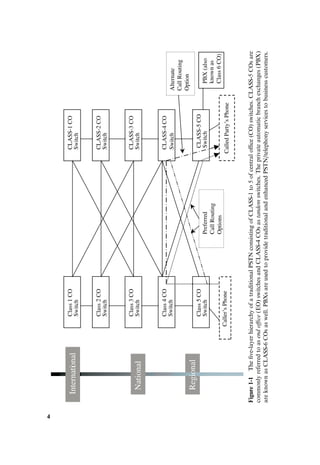
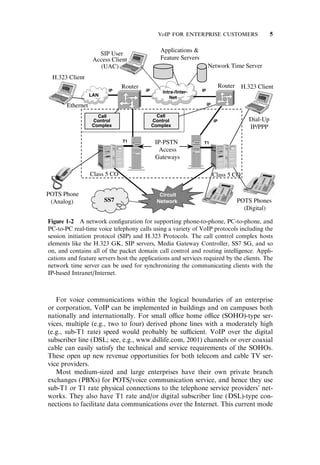
![of operation of separate data and voice communication infrastructures is
shown in Figure 1-3. In an integrated communication environment, when VoIP
is implemented, the same physical T1 and/or DSL link to the service provider’s
network can be used for both voice and data communications. The integrated
infrastructure is shown in Figure 1-4. The details are discussed in the context
of next-generation enterprise networks in Reference 6. One possible enter-
prise networking scenario that utilizes both IP and various types of DSL tech-
nologies for integrated voice, data, and video communications is shown in
Figure 1-5 [6].
For very large corporations with nationwide branch o‰ces and for multi-
national corporations with international o‰ces, VoIP implementation may be
preferable because such corporations may already have a large operational IP
or overlay-IP network in place. The addition of VoIP service in such networks
may need some incremental investments and has the potential to save the sig-
nificant amount of money that is paid for leasing traditional telephone lines.
FUNCTIONALLY LAYERED ARCHITECTURES
The traditional PSTN switching system is monolithic in nature, that is, almost
all of its functionalities are contained in and integrated into one network ele-
ment. This paradigm encourages vendors to use as many proprietary interfaces
Figure 1-3 The elements and their interconnection in a traditional enterprise network.
6 BACKGROUND AND INTRODUCTION](https://image.slidesharecdn.com/489116-250521185057-e415fcb8/85/Implementing-Voice-Over-Ip-1st-Bhumip-Khasnabish-23-320.jpg)

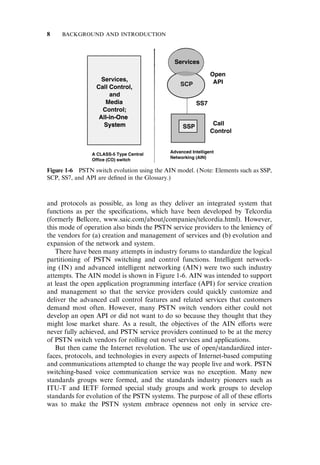
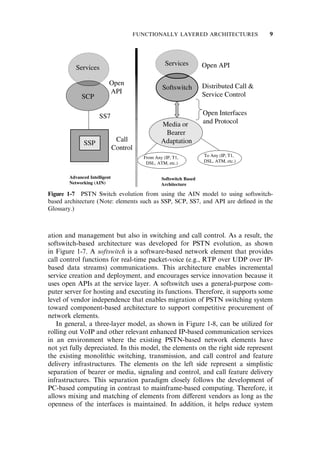
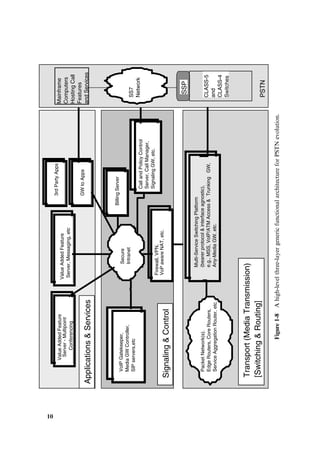
![development and upgrading time cycles, facilitates rapid rollout of value-added
services, and encourages openness in system-level management and mainte-
nance mechanisms. For example, the call feature development and rollout time
may be reduced from years in the traditional CLASS-5 switching system to a
few weeks in the new paradigm. This opens up new revenue opportunities for
the existing telecom and emerging competitive service providers. In addition,
this architecture allows the telecom service providers to use both data trans-
mission and voice transmission technologies in their networks to o¤er cost-
e¤ective transmission of data-grade voice and voice-grade data services [7],
according to per customers’ requirements.
The Multiservice Switching Forum (MSF at www.msforum.org, 2001)
has recommended a more general multilayer model in their reference architec-
ture implementation agreement (IA; available at www.msforum.org/techinfo/
approved.shtml). This reference architecture is shown in Figure 1-9. This model
essentially defines the functional elements or blocks in each layer and the ref-
erence interface points, with the objective of standardizing the functions and
Figure 1-9 MSF reference architecture for functional separation of call control, media
adaptation, and application hosting. (Reproduced with permission from MSF’s Release-
1 Implementation Agreement, available at www.msforum.org/techinfo/approved.shtml,
2001.)
FUNCTIONALLY LAYERED ARCHITECTURES 11](https://image.slidesharecdn.com/489116-250521185057-e415fcb8/85/Implementing-Voice-Over-Ip-1st-Bhumip-Khasnabish-28-320.jpg)
![interface of the network elements. Networks developed using this architecture
can support voice, data, and video services using existing and emerging trans-
mission, switching, and signaling protocols.
A variety of other organizations are also working toward supporting sim-
ilar open interface and protocol-based architectures for PSTN evolution. These
include the International Softswitch Consortium (www.softswitch.org, 2001);
various works groups (WGs) within IETF (www.ietf.org, 2001), including the
PSTN/Internet interworking (PINT) and services in the PSTN/IN requesting
Internet services (SPIRITS) WGs; various study groups (SGs) within the ITU-
T (www.itu.int, 2001), including the SG11, which is currently working on evo-
lution of the bearer independent call control protocols; and so on. Many web-
sites also maintain up-to-date information on the latest development of IP
telephony; for example, see the IP-Tel (www.iptel.org, 2001) website.
ORGANIZATION OF THE BOOK
The rest of the book consists of eight chapters and three appendixes.
Chapter 2 discusses the existing and emerging voice coding and Internet
technologies that are making the implementation of VoIP a reality. These
include development of (a) low-bit-rate voice coding algorithms, (b) e‰cient
encapsulation and transmission of packetized voice signal, (c) novel routing
and management protocols for voice calls, (d) QoS delivery mechanisms for
real-time tra‰c transmission over IP, and so on.
Chapter 3 presents the evolution of the VoIP call control and signaling pro-
tocols, beginning with the ones that assume that interworking with the tradi-
tional switch-based infrastructure (PSTN) is mandatory. I then discuss the
procedures that use totally Internet-based protocols and the paradigm that uses
server-router-based network architecture. Throughout the discussion, special
emphasis is placed on the activities focused on making the PSTN domain-
enhanced telephone call features available to IP domain clients like those using
PC-based soft phones or hardware-based IP phones (e.g., session initiation
protocol [SIP] phones) and vice versa.
Chapter 4 discusses a set of criteria that can be used to evaluate VoIP service
irrespective of whether it is implemented in enterprise or residential networks.
It appears that many of the PSTN domain reliability, availability, voice quality
parameters, and call setup characteristics are either di‰cult to achieve or too
costly to implement in an operational IP-based network unless one controls
both the call-originating (or ingress) and call-terminating (or egress) sides of the
network.
Chapter 5 reviews the architecture, hardware, and software elements of a
recently developed testbed that can be used for subjective and objective evalu-
ation of VoIP services. A special routing configuration of the access switch
(e.g., a PBX) is utilized to route a telephone call over either a circuit-switched
(PSTN) network or an internal IP-based network or Intranet. We used this
12 BACKGROUND AND INTRODUCTION](https://image.slidesharecdn.com/489116-250521185057-e415fcb8/85/Implementing-Voice-Over-Ip-1st-Bhumip-Khasnabish-29-320.jpg)
![2
TECHNOLOGIES SUPPORTING
VoIP1
In this chapter, we discuss and review various standard and emerging coding,
packetization, and transmission technologies that are needed to support voice
transmission using the IP technologies. Limitations of the current technologies
and some possible extensions or modifications to support high-quality—that is,
near-PSTN grade—real-time voice communications services using IP are then
presented.
VOICE SIGNAL PROCESSING
For traditional telephony or voice communications services, the base-band sig-
nal between 0.3 and 3.4 KHz is considered the telephone-band voice or speech
signal. This band exhibits a wide dynamic amplitude range of at least 40 dB.
In order to achieve nearly perfect reproduction after switching and transmis-
sion, this voice-band signal needs to be sampled—as per the Nyquist sampling
criteria—at more than or equal to twice the maximum frequency of the signal.
Usually, an 8 KHz (or 8000 samples per second) sampling rate is used. Each
of these samples can now be quantized uniformly or nonuniformly using a
predetermined number of quantization levels; for example, 8 bits are needed to
support 28
or 256 quantization levels. Accordingly, a bit stream of (8000 8)
or 64,000 bits/sec (64 Kbps) is generated. This mechanism is known as the
pulse code modulation (PCM) encoding of voice signal as defined in ITU-T’s
G.711 standard [1], and it is widely used in the traditional PSTN networks.
15
1The ideas and viewpoints presented here belong solely to Bhumip Khasnabish, Massachusetts,
USA.
Implementing Voice over IP. Bhumip Khasnabish
Copyright 2003 John Wiley Sons, Inc.
ISBN: 0-471-21666-6](https://image.slidesharecdn.com/489116-250521185057-e415fcb8/85/Implementing-Voice-Over-Ip-1st-Bhumip-Khasnabish-32-320.jpg)
![Low-Bit-Rate Voice Signal Encoding
With the advancement of processor, memory, and DSP technologies, re-
searchers have developed a large number of low-bit-rate voice signal encod-
ing algorithms or schemes. Many of these coding techniques have been stand-
ardized by the ITU-T. The most popular frame-based vocoders that utilize
linear prediction with analysis-by-synthesis are the G.723 standard [2], gen-
erating a bit stream of 5.3 to 6.4 Kbps, and the G.729 standard [3], producing
a bit stream of 8 Kbps. Both G.723 and G.729 have a few variants that sup-
port lower bit rate and/or robust coding of the voice signal. G.723 and G.723.1
coders process the voice signal in 30-msec frames. G.729 and G.729A utilize
a speech frame duration of 10 msec. Consequently, the algorithmic portion
of codec delay (including look-ahead) for G.723.1-based systems becomes
approximately 37.5 msec compared to only 15 msec for G.729A implementa-
tions. This reduction in coding delay can be useful when developing a system
where the end-to-end (ETE) delay must be minimized, for example, less than
150 msec to achieve a higher quality of voice.
An output frame of the G.723.1 coding consists of 159 bits when operating
at the 5.3 Kbps rate and 192 bits in the 6.4 Kbps option, while G.729A gen-
erates 80 bits per frame. However, the G.729A coders produce three times as
many coded output frames per second as G.723.1 implementations. Note that
the amount of processing delay contributed by an encoder usually poses more
of a challenge to the packet voice communication system designer.
Annex-B of G.729 or G.729B describes a voice or speech activity detection
(VAD or SAD) method that can be used with either G.729 or its reduced
complexity version, G.729A. The VAD algorithm enables silence suppression
and comfort noise generation (CNG). It predicts the presence of speech using
current and past statistics. G.729B allows insertion of 15-bit silence insertion
descriptor (SID) frames during the silence intervals. Although the insertion of
SID allows low-complexity processing of silence frames, it increases the e¤ec-
tive bit rate. Consequently, although in a typical conversation, suppression of
silence reduces the amount of data by almost 60%, G.729B generates a data
stream of speed of little more than 4 Kbps.
The G.729A coder-decoder (CODEC) is simpler to implement than the one
built according to the G.723.1 algorithm. Both designs utilize approximately
2K and 10K words of RAM and ROM storage, respectively, but G.729A
requires only 10 MIPS, while G.723.1 requires 16 MIPS of processing capacity.
The voice quality delivered by these CODECs is considered acceptable in
a variety of network impairment scenarios. Therefore, most VoIP product
manufacturers support G.723, G.729, and G.711 voice coding options in their
products.
Voice Signal Framing and Packetization
PSTN uses the traditional circuit switching method to transmit the voice
encoder’s output (described above) from the caller’s phone to the destination
16 TECHNOLOGIES SUPPORTING VoIP](https://image.slidesharecdn.com/489116-250521185057-e415fcb8/85/Implementing-Voice-Over-Ip-1st-Bhumip-Khasnabish-33-320.jpg)
![phone. The circuit switching method is very reliable, but it is neither flexible
nor e‰cient for voice signal transmission, where almost 60% of the time the
channel or circuit remains idle [4]. This happens either because of the user’s
silence or because the user—the caller or the party called—toggles between
silence and talk modes.
In the packet switching method, the information (e.g., the voice signal) to be
transmitted is first divided into small fixed or variably sized pieces called pay-
loads, and then one or more of these pieces can be packed together for trans-
mission. These packs are then encapsulated using one or more appropriate sets
of headers to generate packets for transmission. These packets are called IP
packets in the Internet, frames in frame relay networks, ATM cells in ATM
networks [4], and so on. The header of each packet contains information on
destination, routing, control, and management, and therefore each packet can
find its own destination node and application/session port. This avoids the
needs for preset circuits for transmission of information and hence gives the
flexibility and e‰ciency of information transmission.
However, the additional bandwidth, processing, and memory space needed
for packet headers, header processing, and packet bu¤ering at the intermediate
nodes call for incorporation of additional tra‰c and resource management
schemes in network operations, especially for real-time communications ser-
vices like VoIP. These are discussed in later chapters.
In G.711 coding, a waveform coder processes the speech signal, and hence
generates a stream of numeric values. A prespecified number of these numeric
values need to be grouped together to generate a speech frame suitable for
transmission. By contrast, the G.723 and G.729 coding schemes use analysis-
synthesis algorithms-based vocoders and hence generate a stream of speech
fames, which can be easily adapted for transmission using packet-switched
networks.
As mentioned earlier, it is possible to pack one or more speech frames into
one packet. The smaller the number of voice or speech frames packed into one
packet, the greater the protocol/encapsulation overhead and processing delay.
The larger the number of voice or speech frames packed into one packet, the
greater the packet processing/storing and transmission delay. Additional net-
work delay not only causes the receiver’s playout bu¤er to wait longer before
reconstructing voice signal, it can also a¤ect the liveliness/real-timeness of a
speech signal during a telephone conversation. In addition, in real-time tele-
phone conversation, loss of a larger number of contiguous speech frames may
give the impression of connection dropout to the communicating parties. The
designer and/or network operator must therefore be very cautious in designing
the acceptable ranges of these parameters.
ITU-T recommends the specifications in G.764 and G.765 standards [5,6]
for carrying packetized voice over ISDN-compatible networks. For voice
transmission over the Internet, the IETF recommends encapsulation of voice
frames using the RTP (RFC 1889) for UDP (RFC 768)-based transfer of
information over an IP network. We discuss these in later sections.
VOICE SIGNAL PROCESSING 17](https://image.slidesharecdn.com/489116-250521185057-e415fcb8/85/Implementing-Voice-Over-Ip-1st-Bhumip-Khasnabish-34-320.jpg)
![PACKET VOICE TRANSMISSION
A simple high-level packet voice transmission model is presented in this section.
The schematic diagram is shown in Figure 2-1.
At the ingress side, the analog voice signal is first digitized and packetized
(voice frame) using the techniques presented in the previous sections. One or
more voice frames are then packed into one data packet for transmission. This
involves mostly UDP encapsulation of RTP packets, as described in later sec-
tions. The UDP packets are then transmitted over a packet-switched (IP) net-
work. This network adds (a) switching, routing, and queuing delay, (b) delay
jitter, and (c) probably packet loss.
At the egress side, in addition to decoding, deframing, and depacking, a
number of data/packet processing mechanisms need to be incorporated to mit-
igate the e¤ects of network impairments such as delay, loss, delay jitter, and so
on. The objective is to maintain the real-timeness, liveliness, or interactive
behavior of the voice streams. This processing may cause additional delay.
ITU-T’s G.114 [7] states that the one-way ETE delay must be less than 150
msec, and the packet loss must remain low (e.g., less than 5%) in order to
maintain the toll quality of the voice signal [8].
Mechanisms and Protocols
As mentioned earlier, the commonly used voice coding options are ITU-
T’s G.7xx series recommendations (www.itu.int/itudoc/itu-t/rec/g/g700-799/),
Figure 2-1 A high-level packet voice transmission model.
18 TECHNOLOGIES SUPPORTING VoIP](https://image.slidesharecdn.com/489116-250521185057-e415fcb8/85/Implementing-Voice-Over-Ip-1st-Bhumip-Khasnabish-35-320.jpg)
![three of which are G.711, G.723, and G.729. G.711 uses pulse code modulation
(PCM) technique and generates a 64 Kbps voice stream. G.723 uses (CELP)
technique to produce a 5.3 Kbps voice stream, and G.723.1 uses (MP-MLQ)
technique to produce a 6.4 Kbps voice stream. Both G.729 and G.729A use
(CS-ACELP) technique to produce an 8 Kbps voice stream.
Usually a 5 to 48 msec voice frame sample is encoded, and sometimes mul-
tiple voice frames are packed into one packet before encapsulating voice signal
in an RTP packet. For example, a 30 msec G.723.1 sample produces 192 bits of
payload, and addition of all of the required headers and forward error correc-
tion (FEC) codes may produce a packet size of @600 bits, resulting in a bit rate
of approximately 20 Kbps. Thus, a 300% increase in the bandwidth require-
ments may not seem unusual unless appropriate header compression mecha-
nisms are incorporated while preparing the voice signal for transmission over
the Internet.
For example, a 7 msec sample of a G.711 (64 Kbps) encoded voice produces
a 128 byte packet for VoIP application including an 18 byte MAC header and
an 8 byte Ethernet (Eth) header (Hdr), as shown in Figure 2-2. Note that the
26 byte Ethernet header consists of 7 bytes of preamble, which is needed for
synchronization, 12 bytes for source and destination addresses (6 bytes each), 1
byte to indicate the start of the frame, 2 bytes for the length indicator field, and
4 bytes for the frame check sequence.
The RTP/UDP/IP headers together add up to 20 þ 8 þ 12, or 40 bytes
of header. The IETF therefore recommends compressing the headers using a
technique (as described in RFC 1144) similar to the TCP/IP header compres-
sion mechanism. This mechanism, commonly referred to as compressed RTP
(CRTP, RFC 2508), can help reduce the header size from (12 to 40) bytes of
RTP/UDP/IP header to 2 to 4 bytes of header. This can substantially reduce
the overall packet size and help improve the quality of transmission.
Note that the larger the packet, the greater the processing, queueing,
switching, transmission, and routing delays. Thus, the total ETE delay could
become as high as 300 msec [8], although ITU-T’s G.114 standard [7] states
that for toll-quality voice, the one-way ETE delay should be less that 150 msec.
The mean opinion score (MOS) measure of voice quality is usually more sensi-
tive to packet loss and delay jitter than to packet transmission delay. Some
information on various voice coding schemes and quality degradation because
Figure 2-2 Encapsulation of a voice frame for transmission over the Internet.
PACKET VOICE TRANSMISSION 19](https://image.slidesharecdn.com/489116-250521185057-e415fcb8/85/Implementing-Voice-Over-Ip-1st-Bhumip-Khasnabish-36-320.jpg)
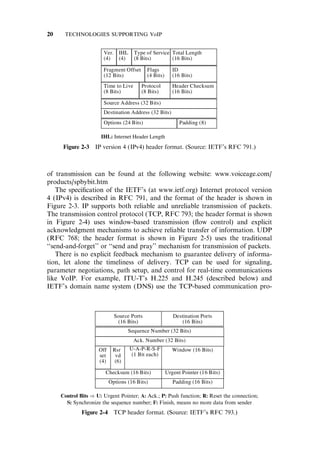
![tocol. UDP can be used for transmission of payload (tra‰c) from sources gen-
erating real-time packet tra‰c. For example, ITU-T’s H.225, IETF’s DNS,
IETF’s RTP (RFC 1889; the header format is shown in Figure 2-5), and the
real-time transport control protocol (RTCP, RFC 1890) use UDP-based com-
munications.
ITU-T’s H.323 uses RTP for transfer of media or bearer tra‰c from the
calling party to the destination party, and vice versa once a connection is
established. RTP is an application layer protocol for ETE communications,
and it does not guarantee any quality of service for transmission. RTCP can
be used along with RTP to identify the users in a session. RTCP also allows
receiver report, sender report, and source descriptors to be sent in the same
packet. The receiver report contains information on the reception quality that
the senders can use to adapt the transmission rates or encoding schemes
dynamically during a session. These may help reduce the probability of session-
level tra‰c congestion in the network.
Even though IPv4 is the most widely used version of IP in the world, the
IETF is already developing the next generation of IP (IPv6, RFC 1883; the
header format is shown in Figure 2-6). It is expected [9] that the use of IPv6
will alleviate the problems of security, authentication, and address space limi-
tation (a 128 bit address is used) of IPv4. Note that proliferation of the use of
the dynamic host control protocol (DHCP, RFC 3011) may delay widespread
implementation of the IPv6 protocol.
Although there are many protocols and standards for control and transmis-
sion of VoIP, ITU-T’s H.22x and H.32x recommendations (details are avail-
able at www.itu.int/itudoc/itu-t/rec/h/) are by far the most widely used. The
H.225 standard [10] defines Q.931 protocol-based call setup and RAS (reg-
istration, administration, and status) messaging from an end device/unit or
terminal device to a GK. H.245 [11] defines in-band call parameter (e.g.,
audiovisual mode and channel, bit rate, data integrity, delay) exchange and
Figure 2-5 UDP and RTP header formats. (Source: IETF’s RFC 768 and 1889.)
PACKET VOICE TRANSMISSION 21](https://image.slidesharecdn.com/489116-250521185057-e415fcb8/85/Implementing-Voice-Over-Ip-1st-Bhumip-Khasnabish-38-320.jpg)
![negotiation mechanisms. H.320 defines the narrowband video telephony system
and terminal; H.321 defines the video telephony (over an asynchronous transfer
mode [ATM]) terminal; H.322 defines the terminal for video telephony over a
LAN where the QoS can be guaranteed; H.323 [12] defines a packet-based
multimedia communications system using a GW, a GK, a multipoint control
unit (MCU), and a terminal over a network where the QoS cannot be guaran-
teed; and H.324 defines low-bit-rate multimedia communications using a PSTN
terminal. Over the past few years, a number of updated versions of H.323 have
appeared. H.235 [13] defines some relevant security and encryption mechanisms
that can be applied to guarantee a certain level of privacy and authentication of
the H-series multimedia terminals. H.323v2 allows fast call setup; it has been
ratified and is available from many vendors. H.323v3 provides only minor
improvements over H.323v2. Currently, work is in progress on H.323v4 and
H.323v5. Because of its widespread deployment, H.323 is currently considered
the legacy VoIP protocol. Figure 2-7 shows the protocol layers for real-time
services like VoIP using the H.323 protocol.
Other emerging VoIP protocols are IETF’s session initiation protocol (SIP,
RFC 2543), media gateway control protocol (MGCP, RFC 2805), and IETF’s
Megaco (RFC 3015)/ITU-T’s H.248 standards. SIP defines call-processing
language (CPL), common gateway interface (CGI), and server-based applets.
It allows encapsulation of traditional PSTN signaling messages as a MIME
attachment to a SIP (e-mail) message and is capable of handling PSTN-to-
PSTN calls through an IP network. MGCP attempts to decompose the call
control and media control, and focuses on centralized control of distributed
gateways. Megaco is a superset of MGCP in the sense that it adds support for
media control between TDM (PSTN) and ATM networks, and can operate
over either UDP or TCP. Figure 2-8 shows the protocol layers for VoIP call
control and signaling using the SIP protocol. Figure 2-9 depicts the elements of
MGCP and Megaco/H/248 for signaling and control of the media gateway.
The details of these protocols are discussed in the next chapter.
Figure 2-6 IP version 6 (IPv6) header format. (Source: IETF’s RFC 1883.)
22 TECHNOLOGIES SUPPORTING VoIP](https://image.slidesharecdn.com/489116-250521185057-e415fcb8/85/Implementing-Voice-Over-Ip-1st-Bhumip-Khasnabish-39-320.jpg)
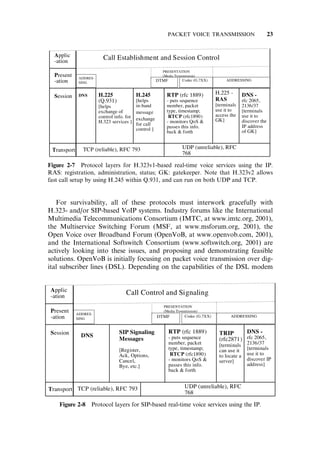
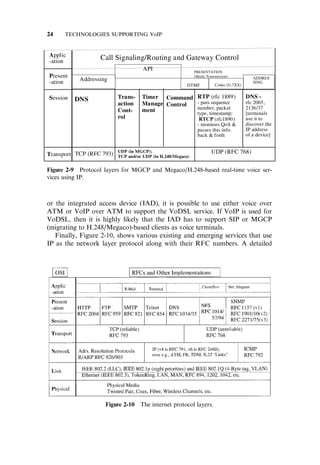
![description of each of these RFCs can be found at IETF’s website (www.ietf.
org/rfc.html).
Packet Voice Bu¤ering for Delay Jitter Compensation
In packet-switched networks, bu¤ering serves many useful and repugnant pur-
poses. At the access domain, a bu¤er provides temporary storage space for
packets before they are routed to the appropriate transport network. The
amount of delay su¤ered by packets at the access networks depends on bu¤er
size, tra‰c density, and packet priority if it is supported.
At the transport domain, bu¤ering is needed to support proper routing
and multiplexing of packets, which help improve utilization of network links.
Packet transport delay depends on the following factors:
a. Bu¤er sizes at ingress and egress of transport link(s). These depend on
link transmission capacity; for example, T1, T3, OC-3, and OC-12 links
have 1.544, 45.736, 155.52, and 622.08 Mbps of capacity, respectively
[14];
b. Packet propagation time. This depends on the physical length of the
transmission link—for example, 5.0 msec/km if the signal (electrical or
optical) travels at a speed of 2 108
m/s;
c. Transmission capacity or bandwidth of the link, as mentioned earlier;
and
d. Packet storing and header processing delays at the intermediate nodes.
Finally, at the packet delivery domain, the packets that arrive earlier than
the expected time need to be stored temporarily before being delivered for
playout (for voice) or display (for video). Similarly, packets that arrive later
than the expected time may need to be stored for a certain amount of time. The
expected time is the mean or average value of a large sample of observed values
of packet transfer delay from the source port or node to the destination port or
node under nominal network tra‰c load.
For non-real-time data communications, delayed packets can be stored for
an indefinite amount of time at local bu¤ers. For real-time applications like
VoIP service, delayed packets may become useless after a prespecified amount
of time. The delay jitter bu¤er holds these ‘‘precocious’’ and delayed packets
in an attempt to neutralize the e¤ects of packet interarrival jitter. This helps
maintain the real-timeness or liveliness of real-time communication over
packet-switched networks. The delay jitter bu¤er must be neither too small nor
too large. If it is too small, it will not serve its purpose, and if it is too large, it
may remain filled with useless packets (i.e., that cannot be sent to the playout
bu¤er) for a log time.
Ideally, the size of the delay jitter bu¤er should vary from a few to several
speech frames, and its threshold—to prevent underflow and overflow—should
PACKET VOICE TRANSMISSION 25](https://image.slidesharecdn.com/489116-250521185057-e415fcb8/85/Implementing-Voice-Over-Ip-1st-Bhumip-Khasnabish-42-320.jpg)
![adapt to changing network tra‰c conditions. Consequently, the additional
delay due to this bu¤er would not adversely a¤ect voice quality.
As defined in IETF’s RFC 1889, the interarrival jitter J is the mean devia-
tion of the di¤erence D in packet spacing at the destination compared to the
source for a pair of packets. This is equivalent to the di¤erence in the relative
transit time for the two packets. The relative transit time is the di¤erence
between a packet’s RTP timestamp and the receiver’s clock at the time of
arrival, measured in the same units. For example, if Si is the RTP time-
stamp from packet i and Ri is the time of arrival in RTP timestamp units for
packet i, then for two packets i and j, D is expressed as D(i, j) ¼ [(Rj Ri)
(Sj Si)] ¼ [(Rj Sj) (Ri Si)].
The interarrival jitter is calculated regularly as each data packet i is received
from the source SSRC n, using this di¤erence D for that packet and the pre-
vious packet i 1 in order of arrival (not necessarily in sequence) using the
following first-order estimator:
Ji ¼ Ji1 þ
jDi Di1j Ji1
16
The gain parameter 1/16 is used because it provides a reasonable noise reduc-
tion ratio while maintaining a reasonable rate of convergence. The current
value of J is sampled when a reception report is issued.
QoS Enforcement and Impairment Mitigation Techniques
The parameters that define the service level agreement (SLA) and QoS are
tightly coupled with the applications they are supporting. For example, the
QoS parameters for access and transport networks may be di¤erent; the QoS
parameters for real-time and non-real-time communications are di¤erent, and
so on. In order to maintain liveliness or a certain degree of interactivity, real-
time tra‰c (data or packet) must reach the destination within a preset time
interval (delay) with some tolerance ( jitter). Otherwise, it would be considered
lost tra‰c. Some critical (important) non-real-time tra‰c, such as topology and
routing related information, is loss-sensitive. Entire network could collapse if
these packets are lost!
The following two techniques can be used to satisfy the QoS requirements of
real-time packet tra‰c: (a) overallocation of bandwidth and (b) prioritization
and scheduling of packets for service. Although these methods can be deployed
independently, the best results can probably be achieved when a combination
of them is used. The most e¤ective solution would include the use of preventive
and/or proactive tra‰c management schemes at Access, Network, and Nodal
operation levels, and the use of reactive tra‰c management schemes at Nodal,
Access, and Network operation levels [15].
26 TECHNOLOGIES SUPPORTING VoIP](https://image.slidesharecdn.com/489116-250521185057-e415fcb8/85/Implementing-Voice-Over-Ip-1st-Bhumip-Khasnabish-43-320.jpg)
![Preventive Mechanisms Preventive control mechanisms at the Access level
include the use tra‰c descriptor, tra‰c contract, conformance testing, and so
on to exercise control.
At the Network level, overprovisioning of link capacity, sharing and/or
spreading of tra‰c across various routes to a destination (most useful for non-
real-time tra‰c) can be used.
At the Nodal (queueing) operations, judicious use tra‰c shaping at the
intermediate nodes can be used to exercise control. The ATM technology has
well-defined mechanisms built into it to support most of these features [4,16–
18]. The IETF is making e¤orts to incorporate similar tra‰c management
mechanisms in IP. Examples are the activities related to MPLS, integrated
services (IntServ), di¤erentiated services (Di¤Serv), and so on in IETF’s
transport area working groups (www.ietf.org/html.charters/wg-dir.html#
Transport_Area).
Reactive Mechanisms Reactive control mechanisms, at the Nodal (queueing)
operations include discarding packets if the queue size is growing quickly and
the incoming packets are neither important nor urgent. At the Access level, the
packets can be marked, for example by using the IP type of service (TOS) byte,
or discarded on the basis of port or connection type if oversubscription persists
in a session.
In the Network, the tra‰c flow rate can be controlled in physical and virtual
connections using the route congestion information flowing back and forth.
The criterion here is that the response or reaction time must be fast enough
for the control to be e¤ective and useful. Table 2-1 shows one possible method
of categorizing control, signaling, and media tra‰c for supporting VoIP ser-
vice. The corresponding mechanism for multipriority queueing and servicing of
packets is presented in Figure 2-11.
The following mathematical formulation (see, e.g., Ref. 19) can be used
for dimensioning the size of each of the bu¤ers or queues shown in Figure
2-11.
TABLE 2-1 An Example of Tra‰c Prioritization for Supporting Real-Time VoIP
Type of
Information
Emission
Priority Discard Priority Comments
@ Urgent and
important
Low Mostly nondiscardable;
(occasionally set loss
priority [LP] ¼ 0)
Session-level control and
signaling tra‰c
Urgent and
important
Medium Nondiscardable;
(LP ¼ 0)
Network management and
control tra‰c
Urgent and
@important
High Discardable (LP ¼ 1) Bearer or media tra‰c (e.g.,
voice or speech signal)
PACKET VOICE TRANSMISSION 27](https://image.slidesharecdn.com/489116-250521185057-e415fcb8/85/Implementing-Voice-Over-Ip-1st-Bhumip-Khasnabish-44-320.jpg)
![Queue Size (MTUs) ¼
[ln(Ploss) ln(r(1 r))]F
[(MTU)g]
g ¼
[2(r 1)]
[rC2
a þ C2
s ]
where
Ploss is the probability of loss of MTU (message transmission unit); for
example, 104
r is the tra‰c intensity or link utilization (e.g., 0.85)
C2
a is [variance/(mean or average)2
] of the packet (F MTUs) arrival process
C2
s is [variance/(mean or average)2
] of the packet service process
Typical values or ranges of the bu¤er dimensioning parameters are as follows:
The probability of packet loss Ploss is 106
for real-time (high- or medium-
priority tra‰c) and 104
for non-real-time (medium- or low-priority tra‰c)
tra‰c.
The utilization r varies from 0.80 to 0.99.
The MTU is usually 64 bytes for high-priority tra‰c, 128 bytes for
medium-priority tra‰c, and 512 bytes or higher for low-priority tra‰c.
The coe‰cient of variation C2
a for the arrival process varies (from experi-
ments) from 1.0 to 1.5 for high-priority tra‰c, from 1.0 to 3.24 for
medium-priority tra‰c, and from 2.4 to 5.00 for low-priority tra‰c.
Figure 2-11 An example of multipriority queueing for supporting real-time VoIP.
28 TECHNOLOGIES SUPPORTING VoIP](https://image.slidesharecdn.com/489116-250521185057-e415fcb8/85/Implementing-Voice-Over-Ip-1st-Bhumip-Khasnabish-45-320.jpg)
![The coe‰cient of variation C2
s for the service process varies (from experi-
ments) from 0.8 to @1.0 for high-priority tra‰c, from 0.5 to 0.6 for
medium-priority tra‰c, and from 0.2 to 0.3 for low-priority tra‰c.
An example of bu¤er size computation for medium-priority tra‰c is as fol-
lows: Let {Ploss, r, MTU,C2
a ,C2
s } ¼ {106
, 0:95,128, 3:24, 0:60}, and using the
previously cited formulations, the bu¤er size become approximately 50 KB, as
shown below.
Qsize (bytes) ¼
[lne(106
) lne(0:95(1 0:95))] 128
g
g ¼
2 (0:95 1:0)
(0:95 3:24) þ 0:6
¼
0:10
3:678
¼ 0:02719
Qsize (bytes) ¼
[lne(106
) lne(0:0475)] 128
0:02719
Qsize (bytes) ¼
[13:81551 þ 3:047] 128
0:02719
Qsize ¼
10:76851 128
0:02719
¼ 50 KB
This 50 KB of bu¤er space is equivalent to 270 msec of maximum delay on a
T1 (1.544 Mbps) link. To minimize the maximum queueing delay, the network
design should consider minimizing the number of active nodes crossed from
source to destination. Consequently, the concept of virtual (private) networking
(VPN) comes into the picture.
Future Directions A number of e¤orts are currently underway in the stan-
dards organizations that incorporate mechanisms to support QoS in IP-based
networks. In general, for IP, packet prioritization using the TOS byte, queue
dimensioning, and scheduling (as discussed earlier) including the weighted fair
queueing (WFQ) technique—as proposed by some vendors—can be used.
IETF’s Di¤Serv uses the TOS byte in IPv4 or the DS byte in IPv6 to define the
per hop behavior (PHB) of tra‰c, the tra‰c marker in PHB, and so on. The
ETE QoS can also be defined by IETF’s IntServ, and using the resource reser-
vation protocol (RSVP, RFC 2205), it can be signaled from source to destina-
tion. This mechanism is useful especially in network backbones. IETF is cur-
rently addressing the scalability of this mechanism.
Another evolving mechanism for supporting ETE QoS is the multiprotocol
label switching (MPLS) technique. In MPLS a 32-bit label, for example, is
added in the IP packet to maintain the desired ETE QoS. Both IETF (see,
e.g., RFCs 3031, 3032, 3035, 3036, etc. at www.ietf.org/rfc.html, 2001) and the
MPLS forum (see www.mplsforum.org, 2001, for details) are currently consid-
PACKET VOICE TRANSMISSION 29](https://image.slidesharecdn.com/489116-250521185057-e415fcb8/85/Implementing-Voice-Over-Ip-1st-Bhumip-Khasnabish-46-320.jpg)
![3
EVOLUTION OF VoIP SIGNALING
PROTOCOLS1
This chapter reviews the existing and emerging VoIP signaling and call control
protocols. In PSTN networks, ISUP (ISDN user part) and TCAP (transaction
capabilities application part) messages of the SS7 protocol [1] are commonly
used for call control and interworking of services.
The first generation (released in 1996) of VoIP signaling and media con-
trol protocols, such as ITU-T’s H.225/H.245—defined under ITU-T’s H.323
umbrella protocol [2]—was intended to o¤er LAN-based real-time VoIP ser-
vices. These protocols already had the proper ingredients (such as support of
ISUP messaging for call control) to support interworking with PSTN networks
as well. Consequently, there was a flurry of networking activities to deliver
VoIP services in LAN or within enterprises and to o¤er long-haul (inter-LATA
and international) transport of VoIP. The latter is also known as cheap and
wireless quality long-distance voice service over wireline network using IP. How-
ever, the telecom service providers found the following two problems with ver-
sion 1 of the H.323 protocol:
a. Many of the desired and advanced PSTN-domain call features and ser-
vices could not be easily implemented using H.323v1 because of its lack
of openness (i.e., all of the procedures are internally defined), and
b. Scalable implementation was neither feasible nor cost-e¤ective because it
needed call state full proxies.
32
1The ideas and viewpoints presented here belong solely to Bhumip Khasnabish, Massachusetts,
USA.
Implementing Voice over IP. Bhumip Khasnabish
Copyright 2003 John Wiley Sons, Inc.
ISBN: 0-471-21666-6](https://image.slidesharecdn.com/489116-250521185057-e415fcb8/85/Implementing-Voice-Over-Ip-1st-Bhumip-Khasnabish-49-320.jpg)
![These problems motivated ITU-T to release the second version of H.323 in
1998. H.323-v2 supports lightweight call setup—runs over UDP instead of
using multiple TCP sessions per call—and declares many of the mandatory
features and protocols of H.323v1 to be optional [3]. But in 1999, IETF
released the first version of its Internet paradigm, Web protocol (i.e., HTTP),
and well-defined semantics-based session initial protocol (SIP, RFC 3261) for
VoIP call control, and service (a superset of the PSTN domain) creation and
management. In addition, SIP supports call stateless proxies and allows tra-
versal of call states over many proxy hops [4,5]. These make scalable imple-
mentation of VoIP more feasible than was possible using H.323.
The race to catch up continued. ITU-T announced versions 3 and 4 of
H.323 and then certified H.323v4 in late 2000. H.323v4 supports the following
features: (a) extensive support of UDP, SCTP (defined later in this chapter),
and making H.245 optional; (b) enhanced support of security as defined in
H.235v2; (c) support of H.323 (URL) for a network-based presence and instant
messaging; and (d) support of tunnel-based signaling like ISUP, Q.SIG, and so
on and HTTP commands and stimulus-based call control.
IETF is also working on extending the service creation, security, and call
routing features of SIP (RFCs 3261, 3262, 3263, 3264, 3265, and 3266). Some
of these features are (a) instant messaging and presence management, (b)
advanced call routing and messaging features, and (c) support of SIP/SDP/
RTP message traversal over network address translation (NAT) and firewall
devices.
In parallel to the above-mentioned activities related to H.323v2 (and
beyond) and SIPv2, researchers at Cisco, Level 3 Communications, and Tel-
cordia developed a call/media control architecture for the next-generation
(packet-based) network that supports both IP telephony and evolution of
PSTN from a monolithic system to one that supports distributed call pro-
cessing. That architecture enables physical separation of call control intelli-
gence that resides in the media gateway controller (MGC) from the media-
adaptation/translation gateways (MGs). It also recommends a protocol called
MGCP (media gateway control protocol, RFC 2705, 1999), which was the
result of a merger of SGCP (simple gateway control protocol) and IPDC (IP
device control) protocol. MGCP supports PSTN evolution by allowing inter-
working with circuit-switched networks and devices (analog and digital POTS
phones) via the following predefined endpoints: (a) access and residential GWs,
and integrated network access server and VoIP GWs; (b) GWs supporting
ISUP and multifrequency-type trunks; and (c) announcement servers and net-
work access servers.
In order to provide seamless interoperability of call and service control
between PSTN and next-generation (packet-based) network domains, the
MGC needs to exchange control messages reliably and securely to the SS7
network via the signaling gateway (SG; it can use the SCTP protocol, RFC
2960, as discussed later). Note that in the PSTN network, the call control and
signaling intelligence reside in the SS7 network.
EVOLUTION OF VoIP SIGNALING PROTOCOLS 33](https://image.slidesharecdn.com/489116-250521185057-e415fcb8/85/Implementing-Voice-Over-Ip-1st-Bhumip-Khasnabish-50-320.jpg)
![MGCP is currently enjoying the widespread approval of cable TV (CATV)-
based VoIP service providers (e.g., see PKT-SP-EC-MGCP-I04-011221.pdf at
www.packetcable.com/specifications/). Both IETF and ITU-T’s study group 9
(Integrated Broadband Cable and Television Networks Study Group) are con-
sidering approval of the extensions of MGCP (MGCP v2, RFC 2705-bis, etc.).
MGCP is also evolving to ITU-T’s H.248 recommendation [6,7] and IETF’s
Media gateway control protocol (RFCs 3054, 3015, and 2805).
SWITCH-BASED VERSUS SERVER-BASED VoIP
For switch-based VoIP services, interworking with the existing PSTN switches,
networks, and terminals is desirable. In such scenarios, H.225 and H.245 are
well-established signaling and media control protocols under the H.323
umbrella protocol. Note that H.323 defines IP-PSTN GWs, call controller or
GK, terminal equipment (TE), and multipoint control units (MCUs) as the
elements of the system architecture. H.248/Megaco appears to be the most
promising emerging protocol that can complement both H.323 and SIP when
SIP/H.323 is used for communication between TEs, and between TE and MG
or GW.
For server-based VoIP services, the intended network consists of servers and
IP routers. In these scenarios, SIP and its many variants are most useful. For
large networks, IETF suggests the use of the TRIP (it defines telephony routing
over IP in a fashion similar to that of the BGP; RFC 2871, a work in progress
in IETF’s IPTel WG, RFC 2871) protocol to locate the server to which a call
should be routed. For routing a call from an SIP or IP phone to a PSTN ter-
minal (analog or digital POTS phone), one must use the IP-PSTN GW, call
controller, and an ENUM server. ENUM (electronic numbering, RFC 2916)
converts the E.164 telephony address to an IP address and vice versa using an
enhanced domain name system (DNS) server.
H.225 AND H.245 PROTOCOLS
Although there are a large number of protocols and standards for signaling and
control of real-time VoIP calls, ITU-T’s H.22x and H.32x recommendations
(details are available at www.itu.int/itu-t/) are by far the most widely deployed
first-generation VoIP protocols, especially for international VoIP calls. The key
network elements for operation of the H.323 protocol are the IP-PSTN media
gateway (MG), a call controller or GK, a multipoint control unit (MCU), and
TEs. All of these elements are connected to form the zone shown in Figure 3-1,
using a LAN where the quality of transmission cannot be controlled.
The H.225 standard defines ITU-T’s Q.931 protocol (a variation of ISDN
user network interface layer-3 specifications for basic call control) based call
setup and RAS (registration, admission/administration, and status) messaging
34 EVOLUTION OF VoIP SIGNALING PROTOCOLS](https://image.slidesharecdn.com/489116-250521185057-e415fcb8/85/Implementing-Voice-Over-Ip-1st-Bhumip-Khasnabish-51-320.jpg)
![from a GW or end device/unit or TE to a GK. RAS messages are carried over
UDP packets; these contain a number of request/reply (confirmation or reject)
messages exchanged between the TE/GW and the GK. TEs can use RAS for
discovering a GK or to register/deregister with a GK. A GK uses the RAS
messages to monitor the endpoints within a zone and to manage the associated
resources.
H.245 defines in-band media and conference control protocols for call
parameter exchange and negotiation. These parameters include audiovisual
mode and channel, bit rate, data integrity, delay, and so on. They provide a
set of control functions for multiparty multimedia conferencing, and can also
determine the master/slave relationship between parties to open/close logical
channels between the endpoints. In Figure 2-7 I showed the functions and rel-
ative positions of H.225 and H.245 with reference to ISO’s open system inter-
connection (OSI) stack [1]. Figure 3-2 shows the protocol sequence for estab-
lishment of a real-time H.323 voice communication session from one PSTN
phone to another over an IP network. Note that in this diagram, ARQ stands
for Admission Request, ACF for Admission Confirm, LRQ for Location
Request, and LCF for Location Confirm. Ingress and egress gateways are
indicated by IGW and EGW, respectively. Ingress and egress gatekeepers are
indicated by IGK and EGK, respectively.
SESSION INITIATION PROTOCOL (SIP)
SIP (IETF’s RFC 3261) refers to a suite of call setup and media mapping pro-
tocols for multimedia (including voice) communications over a wide area net-
Figure 3-1 Network elements and their interconnection using a LAN in an H.323 zone.
Note that the PBX (PSTN) is outside the scope of H.323 and is shown to demonstrate
the interoperability of H.323 with PSTN.
SESSION INITIATION PROTOCOL 35](https://image.slidesharecdn.com/489116-250521185057-e415fcb8/85/Implementing-Voice-Over-Ip-1st-Bhumip-Khasnabish-52-320.jpg)
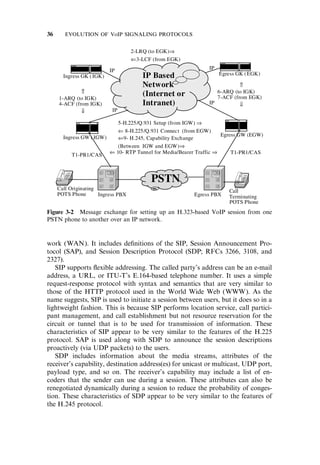
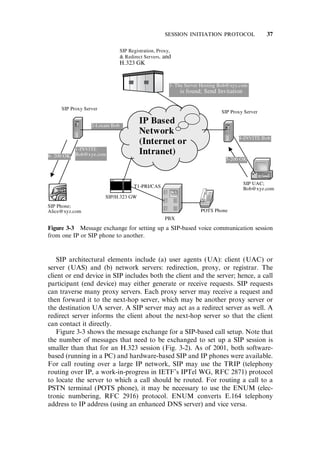
















![Network Readiness[1]](https://cdn.slidesharecdn.com/ss_thumbnails/networkreadiness1-12734967205915-phpapp02-thumbnail.jpg?width=640&height=640&fit=bounds)


