Implementing Cyber
security Best
Practices and New
Technology
Damilola Ishola
Best Practices
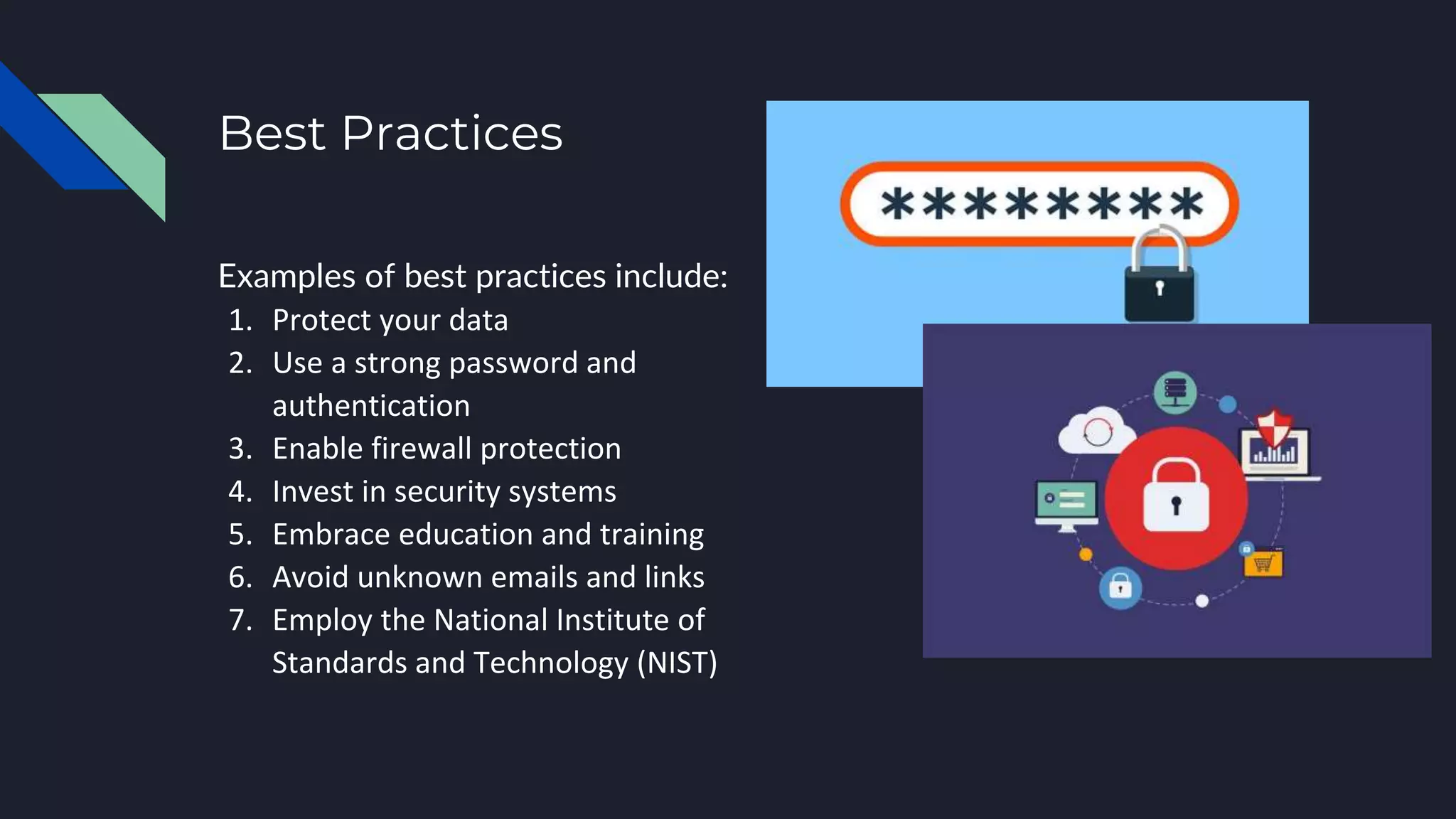
Examples of best practices include:
1. Protect your data
2. Use a strong password and
authentication
3. Enable firewall protection
4. Invest in security systems
5. Embrace education and training
6. Avoid unknown emails and links
7. Employ the National Institute of
Standards and Technology (NIST)
Importance of Cyber Security Best Practices
To protect the digital asset and
reduce the likelihood and impact of
hackers and attacks (Garden state
cyber threat highlight, 2021)
Common Cyber Attacks
1. Malware attacks: “malicious software” such as
ransomware, spyware, and viruses that disrupt
computer operations
2. SQL Injections: This is a deceptive website
programming code that gets entered into the
network database
3. Denial of Service attacks (DoS): This is high traffic
flooding that shuts servers, network and website
4. Password attacks: This is an attempt to breach
password protection
5. Phishing scams: Trustworthy websites and emails that
entice users into clicking a dangerous link
6. Spear phishing scams: This type of attack targets
organizations and companies, majorly directors and
executives (McGee, 2021)
Common Best Practice Implementations for
an Organization
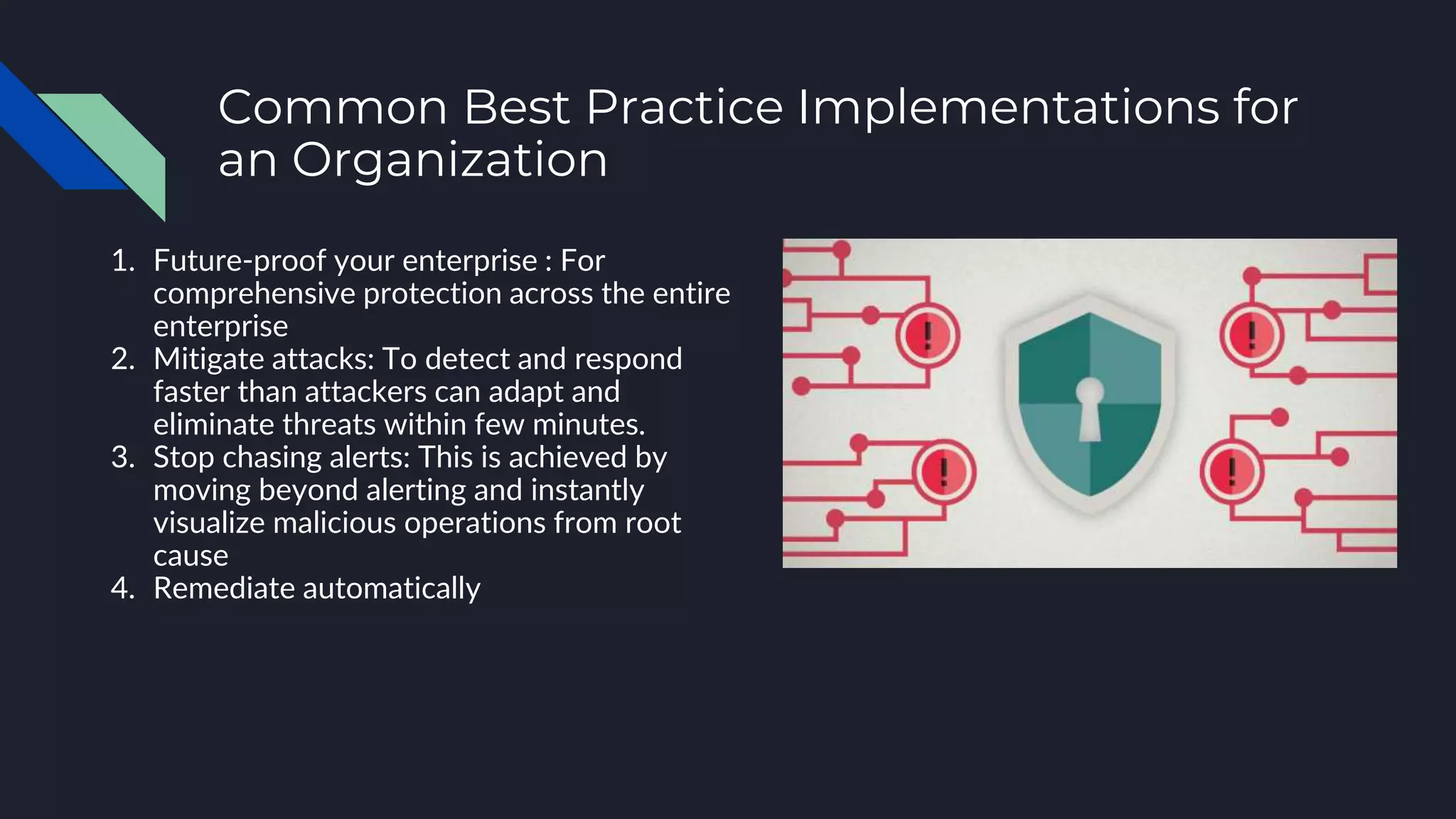
1. Future-proof your enterprise : For
comprehensive protection across the entire
enterprise
2. Mitigate attacks: To detect and respond
faster than attackers can adapt and
eliminate threats within few minutes.
3. Stop chasing alerts: This is achieved by
moving beyond alerting and instantly
visualize malicious operations from root
cause
4. Remediate automatically
Other Cyber Security Implementations
1. Use a firewall
2. Enforce safe password policies
3. Document cyber security
policies
4. Backup company data regularly
5. Use multifactor identification
6. Install anti-malware software
User Experience for Implementing New
Technology
1. Emotions: The study of human
experiences. Examples are anger,
happiness, excitement, and anxiety.
2. Psychological needs: This is an
important role in predicting motivation
for the use
3. Values
4. Wellbeing
5. Task Load (Partala & Saari, 2015)
Plan For Implementing New Technology
●DEMAND CONTROL SUPPLY
●Business context IT principles IT services
●Business success IT governance Architecture
●Business capabilities IT Financial Management People
●IT contribution Metrics Sourcing
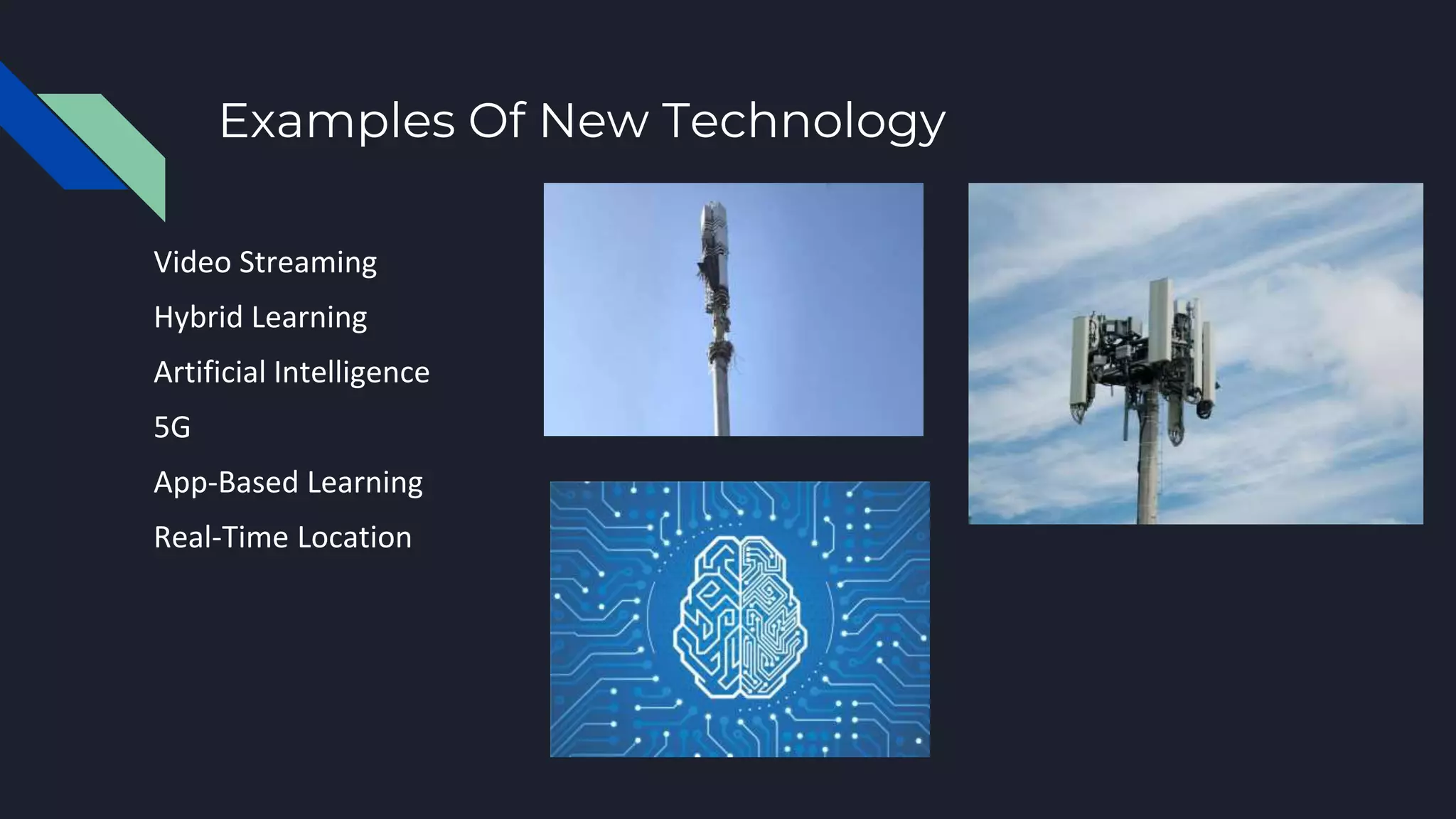
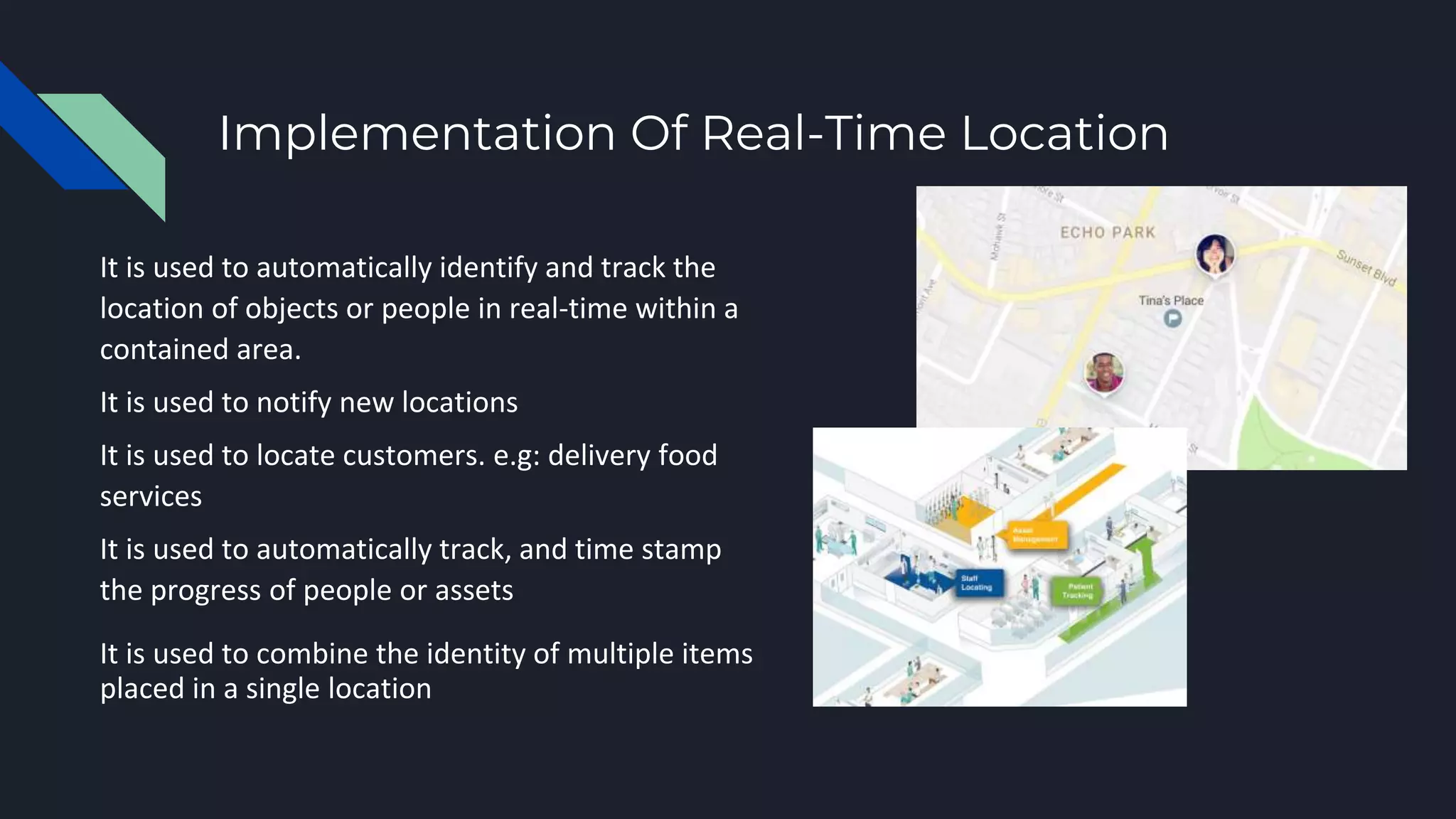
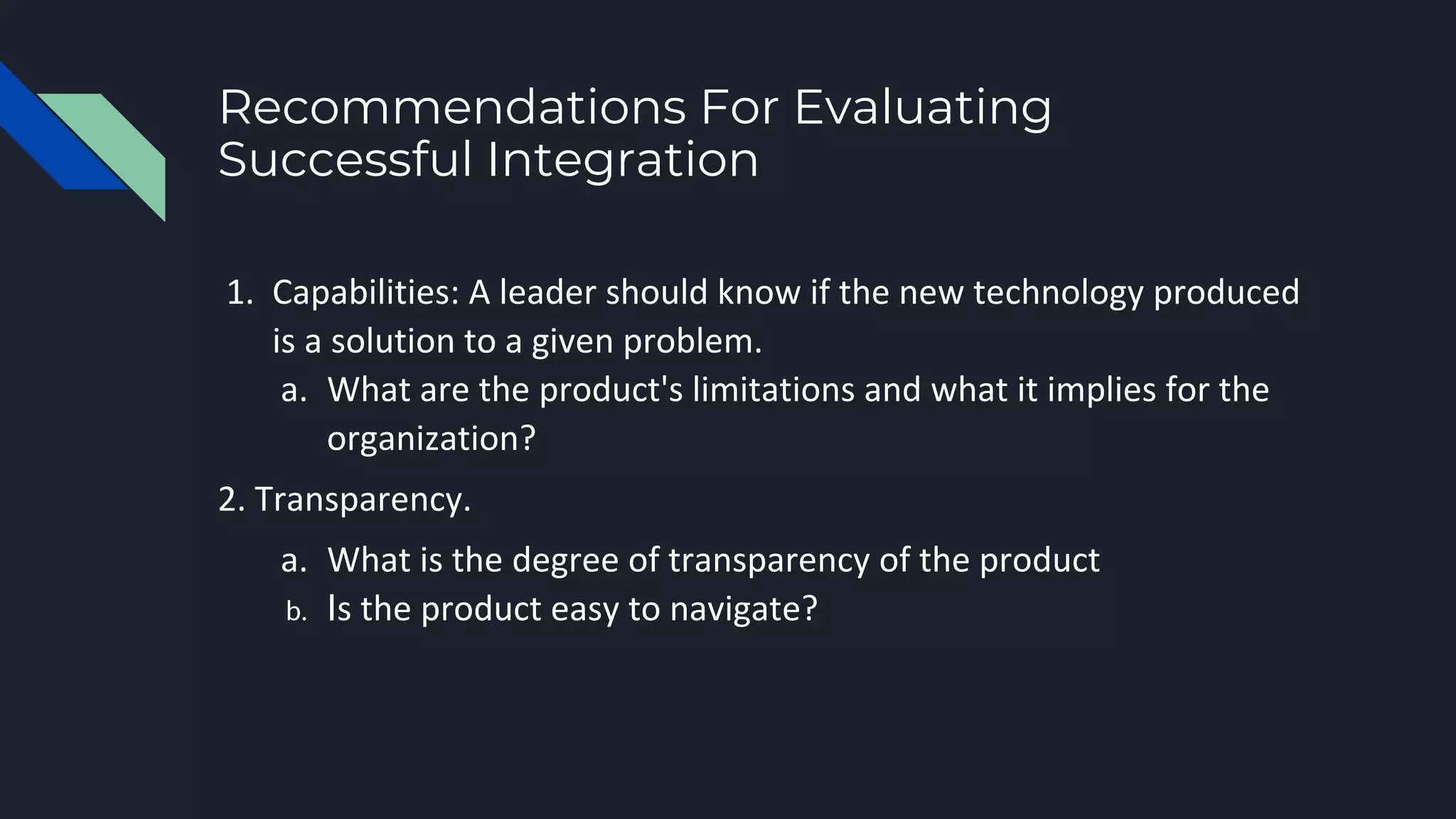
Examples Of New Technology
Video Streaming
Hybrid Learning
Artificial Intelligence
5G
App-Based Learning
Real-Time Location
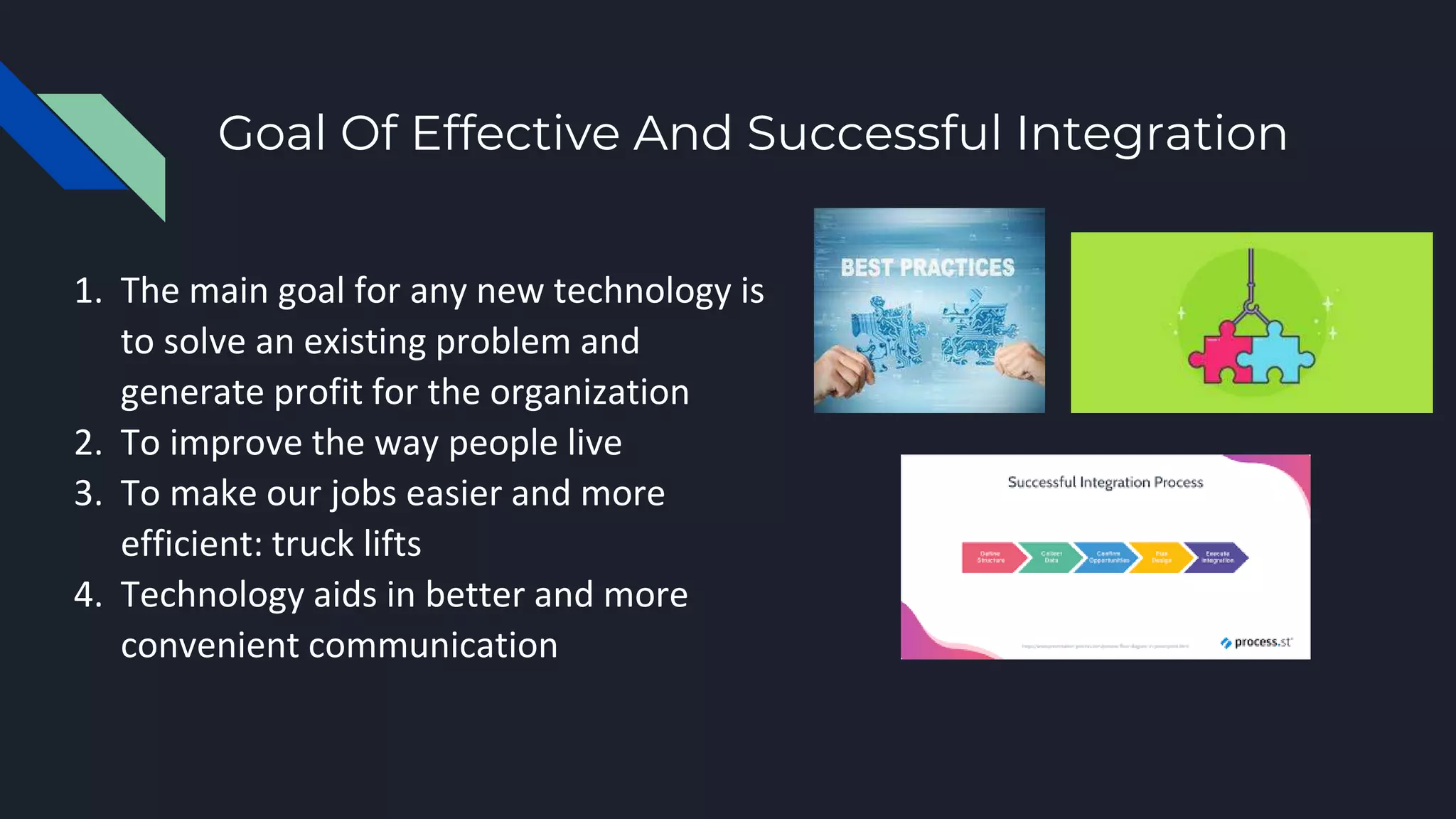
Implementation Of Real-Time Location
It is used to automatically identify and track the
location of objects or people in real-time within a
contained area.
It is used to notify new locations
It is used to locate customers. e.g: delivery food
services
It is used to automatically track, and time stamp
the progress of people or assets
It is used to combine the identity of multiple items
placed in a single location
Recommendations For Evaluating
Successful Integration
1. Capabilities: A leader should know if the new technology produced
is a solution to a given problem.
a. What are the product's limitations and what it implies for the
organization?
2. Transparency.
a. What is the degree of transparency of the product
b. Is the product easy to navigate?
Goal Of Effective And Successful Integration
1. The main goal for any new technology is
to solve an existing problem and
generate profit for the organization
2. To improve the way people live
3. To make our jobs easier and more
efficient: truck lifts
4. Technology aids in better and more
convenient communication
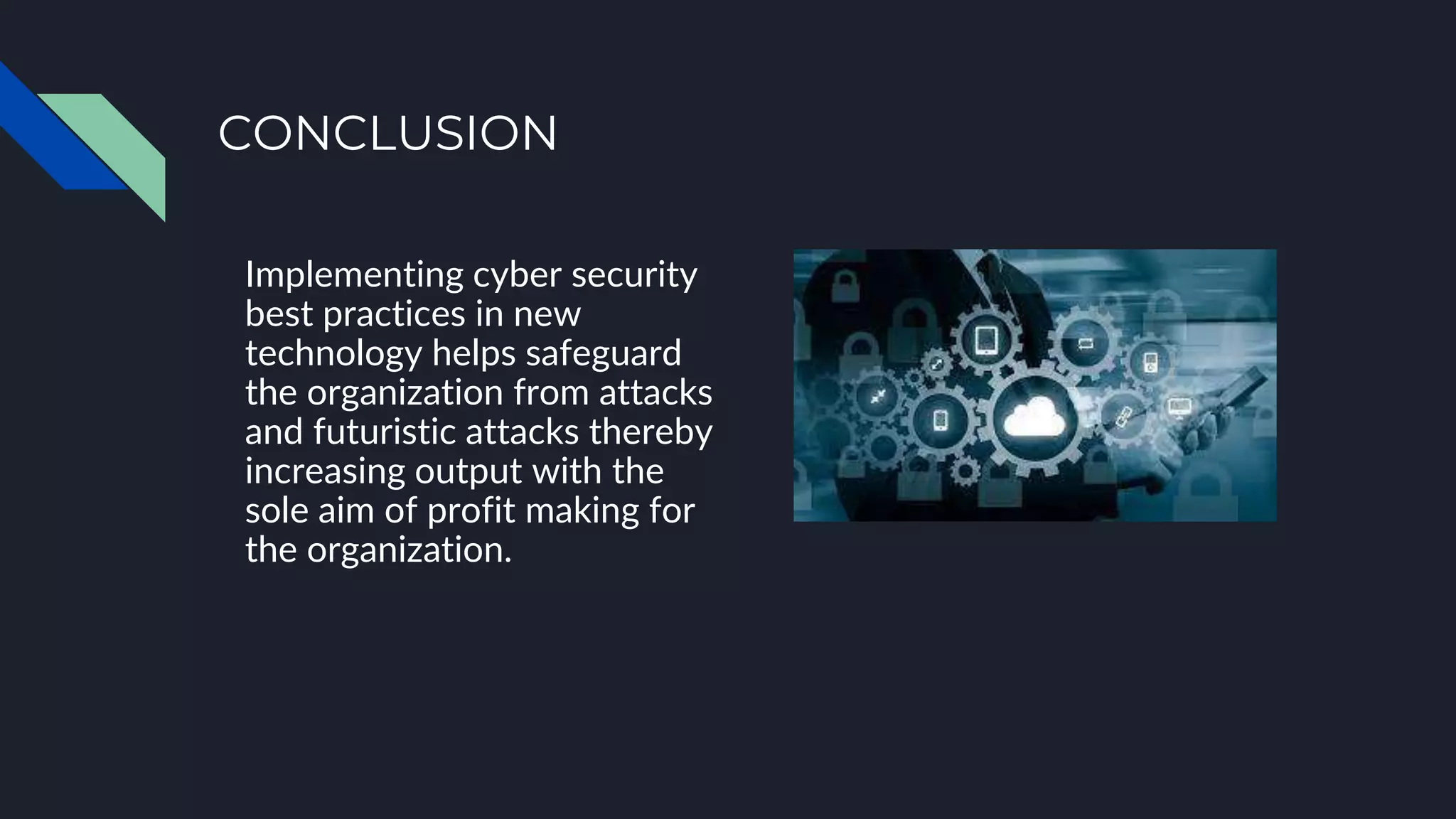
CONCLUSION
●Implementing cyber security
best practices in new
technology helps safeguard
the organization from attacks
and futuristic attacks thereby
increasing output with the
sole aim of profit making for
the organization.
References
●Johansen, A.G. (2019 April, 09). 10 Cybersecurity Best Practices That Every Employee Should Know. Retrieved
from: 10 Cybersecurity Best Practices that Every Employee Should Know | Norton
●Ljungquist, U. (2014). Unbalanced dynamic capabilities as obstacles of organizational efficiency:
Implementation issues in innovative technology adoption. Innovation: Management, Policy & Practice, 16(1),
82–95. https://doi.org/10.5172/impp.2014.16.1.82
●Partala, T., & Saari, T. (2015). Understanding The Most Influential User Experiences In Successful And
Unsuccessful Technology Adoptions. Retrieved from: Tim7001v3
●Garden State Cyber Threat Highlight. (2021 Jan, 14). The Importance of Physical Security and Its Implications
On Cyber Security/NJCCIC. Retrieved from: The Importance of Physical Security and Its Implications on
Cybersecurity | New Jersey Cybersecurity & Communications Integration Cell (nj.gov)
●McGee, V. (2021 September,29). Most Common Cyberattacks in 2021/ Cyber Degrees. Retrieved from: Top
10 Most Common Cyberattacks in 2021 and How to Avoid Them (cyberdegrees.org)
References
Segal, C. (2021). 8 Cyber Security Best Practices For Your Small To Medium- Size Business/Cox BLUE.
Retrieved from: 8 Cyber Security Best Practices For Your Small To Medium-Size Business (coxblue.com)
Griffin, J. M., Hellmich, T. R., Pasupathy, K. S., Funni, S. A., Pagel, S. M., Srinivasan, S. S., Heaton, H. A., Sir,
M. Y., Nestler, D. M., Blocker, R. C., Hawthorne, H. J., Koenig, K. R., Herbst, K. M., & Hallbeck, M. S. (2020).
Attitudes and Behavior of Health Care Workers Before, During, and After Implementation of Real-Time
Location System Technology. Mayo Clinic Proceedings: Innovations, Quality & Outcomes, 4(1), 90–98.
https://doi.org/10.1016/j.mayocpiqo.2019.10.007
Tetef, S. (2017). Successful Implementation of New Technology Using an Interdepartmental Collaborative
Approach. Journal of Perianesthesia Nursing : Official Journal of the American Society of PeriAnesthesia
Nurses, 32(3), 225–230. https://doi.org/10.1016/j.jopan.2015.05.118
Rosenthal, J., Balakrishnan, K., Bruce, N., Chambers, D., Graham, J., Jack, D., Kline, L., Masera, O., Mehta,
S., Mercado, I. R., Neta, G., Pattanayak, S., Puzzolo, E., Petach, H., Punturieri, A., Rubinstein, A., Sage, M.,
Sturke, R., Shankar, A., & Sherr, K. (2017). Implementation Science to Accelerate Clean Cooking for Public
Health. Environmental Health Perspectives, 125(1), A3–A7. https://doi.org/10.1289/EHP1018
References
Wood, S. (1987). The Deskilling Debate, New Technology and Work Organization. Acta Sociologica (Taylor
& Francis Ltd), 30(1), 3–24. https://doi.org/10.1177/000169938703000101

Implementing Best Practices.pptx

  • 1.
    Implementing Cyber security Best Practicesand New Technology Damilola Ishola
  • 2.
    Best Practices Examples ofbest practices include: 1. Protect your data 2. Use a strong password and authentication 3. Enable firewall protection 4. Invest in security systems 5. Embrace education and training 6. Avoid unknown emails and links 7. Employ the National Institute of Standards and Technology (NIST)
  • 3.
    Importance of CyberSecurity Best Practices To protect the digital asset and reduce the likelihood and impact of hackers and attacks (Garden state cyber threat highlight, 2021)
  • 4.
    Common Cyber Attacks 1.Malware attacks: “malicious software” such as ransomware, spyware, and viruses that disrupt computer operations 2. SQL Injections: This is a deceptive website programming code that gets entered into the network database 3. Denial of Service attacks (DoS): This is high traffic flooding that shuts servers, network and website 4. Password attacks: This is an attempt to breach password protection 5. Phishing scams: Trustworthy websites and emails that entice users into clicking a dangerous link 6. Spear phishing scams: This type of attack targets organizations and companies, majorly directors and executives (McGee, 2021)
  • 5.
    Common Best PracticeImplementations for an Organization 1. Future-proof your enterprise : For comprehensive protection across the entire enterprise 2. Mitigate attacks: To detect and respond faster than attackers can adapt and eliminate threats within few minutes. 3. Stop chasing alerts: This is achieved by moving beyond alerting and instantly visualize malicious operations from root cause 4. Remediate automatically
  • 6.
    Other Cyber SecurityImplementations 1. Use a firewall 2. Enforce safe password policies 3. Document cyber security policies 4. Backup company data regularly 5. Use multifactor identification 6. Install anti-malware software
  • 7.
    User Experience forImplementing New Technology 1. Emotions: The study of human experiences. Examples are anger, happiness, excitement, and anxiety. 2. Psychological needs: This is an important role in predicting motivation for the use 3. Values 4. Wellbeing 5. Task Load (Partala & Saari, 2015)
  • 8.
    Plan For ImplementingNew Technology ●DEMAND CONTROL SUPPLY ●Business context IT principles IT services ●Business success IT governance Architecture ●Business capabilities IT Financial Management People ●IT contribution Metrics Sourcing
  • 9.
    Examples Of NewTechnology Video Streaming Hybrid Learning Artificial Intelligence 5G App-Based Learning Real-Time Location
  • 10.
    Implementation Of Real-TimeLocation It is used to automatically identify and track the location of objects or people in real-time within a contained area. It is used to notify new locations It is used to locate customers. e.g: delivery food services It is used to automatically track, and time stamp the progress of people or assets It is used to combine the identity of multiple items placed in a single location
  • 11.
    Recommendations For Evaluating SuccessfulIntegration 1. Capabilities: A leader should know if the new technology produced is a solution to a given problem. a. What are the product's limitations and what it implies for the organization? 2. Transparency. a. What is the degree of transparency of the product b. Is the product easy to navigate?
  • 12.
    Goal Of EffectiveAnd Successful Integration 1. The main goal for any new technology is to solve an existing problem and generate profit for the organization 2. To improve the way people live 3. To make our jobs easier and more efficient: truck lifts 4. Technology aids in better and more convenient communication
  • 13.
    CONCLUSION ●Implementing cyber security bestpractices in new technology helps safeguard the organization from attacks and futuristic attacks thereby increasing output with the sole aim of profit making for the organization.
  • 14.
    References ●Johansen, A.G. (2019April, 09). 10 Cybersecurity Best Practices That Every Employee Should Know. Retrieved from: 10 Cybersecurity Best Practices that Every Employee Should Know | Norton ●Ljungquist, U. (2014). Unbalanced dynamic capabilities as obstacles of organizational efficiency: Implementation issues in innovative technology adoption. Innovation: Management, Policy & Practice, 16(1), 82–95. https://doi.org/10.5172/impp.2014.16.1.82 ●Partala, T., & Saari, T. (2015). Understanding The Most Influential User Experiences In Successful And Unsuccessful Technology Adoptions. Retrieved from: Tim7001v3 ●Garden State Cyber Threat Highlight. (2021 Jan, 14). The Importance of Physical Security and Its Implications On Cyber Security/NJCCIC. Retrieved from: The Importance of Physical Security and Its Implications on Cybersecurity | New Jersey Cybersecurity & Communications Integration Cell (nj.gov) ●McGee, V. (2021 September,29). Most Common Cyberattacks in 2021/ Cyber Degrees. Retrieved from: Top 10 Most Common Cyberattacks in 2021 and How to Avoid Them (cyberdegrees.org)
  • 15.
    References Segal, C. (2021).8 Cyber Security Best Practices For Your Small To Medium- Size Business/Cox BLUE. Retrieved from: 8 Cyber Security Best Practices For Your Small To Medium-Size Business (coxblue.com) Griffin, J. M., Hellmich, T. R., Pasupathy, K. S., Funni, S. A., Pagel, S. M., Srinivasan, S. S., Heaton, H. A., Sir, M. Y., Nestler, D. M., Blocker, R. C., Hawthorne, H. J., Koenig, K. R., Herbst, K. M., & Hallbeck, M. S. (2020). Attitudes and Behavior of Health Care Workers Before, During, and After Implementation of Real-Time Location System Technology. Mayo Clinic Proceedings: Innovations, Quality & Outcomes, 4(1), 90–98. https://doi.org/10.1016/j.mayocpiqo.2019.10.007 Tetef, S. (2017). Successful Implementation of New Technology Using an Interdepartmental Collaborative Approach. Journal of Perianesthesia Nursing : Official Journal of the American Society of PeriAnesthesia Nurses, 32(3), 225–230. https://doi.org/10.1016/j.jopan.2015.05.118 Rosenthal, J., Balakrishnan, K., Bruce, N., Chambers, D., Graham, J., Jack, D., Kline, L., Masera, O., Mehta, S., Mercado, I. R., Neta, G., Pattanayak, S., Puzzolo, E., Petach, H., Punturieri, A., Rubinstein, A., Sage, M., Sturke, R., Shankar, A., & Sherr, K. (2017). Implementation Science to Accelerate Clean Cooking for Public Health. Environmental Health Perspectives, 125(1), A3–A7. https://doi.org/10.1289/EHP1018
  • 16.
    References Wood, S. (1987).The Deskilling Debate, New Technology and Work Organization. Acta Sociologica (Taylor & Francis Ltd), 30(1), 3–24. https://doi.org/10.1177/000169938703000101