Sustaining Reading and
Numeracy Programs and
Evaluating Effectiveness
JAIRO C. GORDA
Resource Speaker
Session Objectives
•Develop a comprehensive reading and
numeracy intervention plan tailored to their
students’ needs.
•Explore strategies for sustaining and
evaluating reading and numeracy programs.
•Utilize Phil-IRI tool to measure and describe
student’s reading performance in English and
Filipino
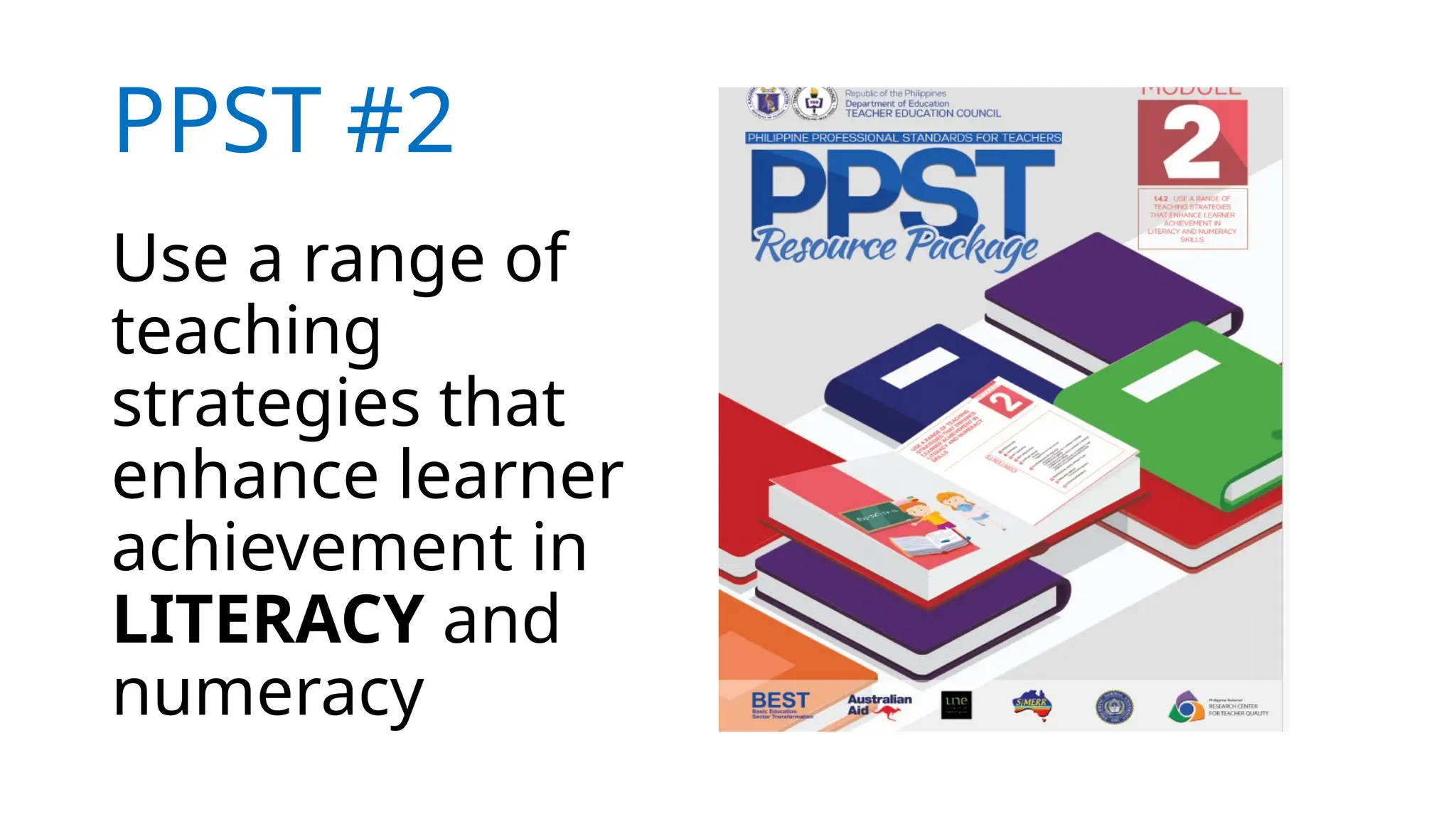
PPST #2
Use a range of
teaching
strategies that
enhance learner
achievement in
LITERACY and
numeracy
Every teacher is a READING
teacher! Reading teachers help
young students become
PROFICIENT in reading not only in
the subject itself, but the
contextual component of
comprehending subject areas.
Preliminary Activity
Case Me!
Participants will be divided according to
5 groups. Group 1 will be the Filipino
and English department, group 2, will
be the math and science department,
group 3 will be the TLE and EsP
department, group 4 will be AP and
MAPEH department, group 5 will be the
SHS department respectively.
Take time to read the case. Reflect on it. Then answer the guide
questions that follow:
1.Based on Teacher Dan’s case, how important are the
fundamental skills to our learners?
2.What is/are your role/s to help these learners gain these
fundamental skills in order to enjoy success in learning?
3.What is/are your role/s to further strengthen these
fundamental skills in each of your learners for them to thrive
further?
4.What have you realized about your impact on your learners’
literacy and numeracy skills development regardless of their
grade level?
ACTIVITY PROPER
Group 1 (Filipino and English Department)
Analyzing Teacher Lea’s Case
Group 2 (Math & Science Department)
Analyzing the Practice of Teacher Jonalyn
Group 3 (TLE & EsP Department)
Analyzing the strategy used by a grade 2 teacher and a junior high
school teacher in literacy instruction
Group 4 (AP & MAPEH Department)
Analyzing the case of a Social Studies Teacher
Group 5 (SHS Department)
Analyzing Teacher Andrew’s teaching strategy
Presentation of Group Activity
Analyzing Teacher Lea’s Case
Teacher Lea’s activities did not require
many resources or much extra time,
but made the learning of new terms
and vocabulary more interesting and
relevant to the learners. This would
undoubtedly enhance their learning.
As a teacher, you can explore varied
ways to develop your learners’ literacy
and life skills. In developing your
lessons, you just have to consider your
learners’ level, learning goals and the
appropriate teaching resources.
Analyzing the Practice of Teacher
Jonalyn
It can be observed that Teacher Jonalyn used
flashcards and working together to develop the
learners’ literacy skills, as well as to extend their ways
of learning by seeing, drawing, writing, singing and
working together.
This practice of emphasizing key content such as the
terminology of the subject, will improve your learners’
subject knowledge and literacy skills
Other ways of learning might include
encouraging them to observe and search for
resources, or using storytelling, role play or
brainstorming, all of which involve literacy skills.
Understanding that you need to use a variety of
teaching strategies in your class to cater to
individual needs is very important
Analyzing the strategy used by a grade 2 teacher and a
junior high school teacher in literacy instruction
Literacy instruction for the young learners focus on
vocabulary building and making meaning of what they
read. This is important to help them develop skills and
strategies to access the content of the simple texts they
are reading. Meanwhile, as they become more proficient
readers, the skills of skimming, questioning and
reviewing texts become much more important. As a
teacher, you will need to plan and adapt activities to
match their levels and skills in reading depending on
your learners’ age and needs
Analyzing the case of a Social Studies
Teacher
All teachers have a responsibility for promoting
numeracy subjects.
In the sample teacher practice, the social studies
teacher demonstrates knowledge of the key areas of
numeracy that makes her explore within the subject
the opportunities for extending and complementing
numeracy teaching and learning in mathematics
lessons
Analyzing Teacher Andrew’s teaching
strategy
According to studies, in a meaningful
and fun-filled context, children can
acquire skills without the pressure and
fear of failure in quite the same way as
they might feel in a more structured
learning environment.
ADMINISTRATION OF
PHIL-IRI
For Junior High School and
Senior High School
SAMUEL A. REPELENTE
MT-III/TIC, CADSEV
The Phil-IRI may be used to…
a. Group Reading Level
 The Phil-IRI GST can be used to determine a whole class’s
reading level, and identify particular students who may
need more assistance in performing reading tasks.
b. Individual Reading Level
 The individually administered Phil-IRI Graded Passages can
be used to determine a student’s independent,
instructional and frustration levels for three types of
literacy tasks: Oral Reading, Silent Reading, and Listening
Comprehension.
c. Monitor Growth and Response to Intervention
 Pretest and Posttest results of the Phil-IRI can be compared to
monitor growth in students’ reading skills & determine the
efficacy of the program or reading interventions conducted by
the teachers.
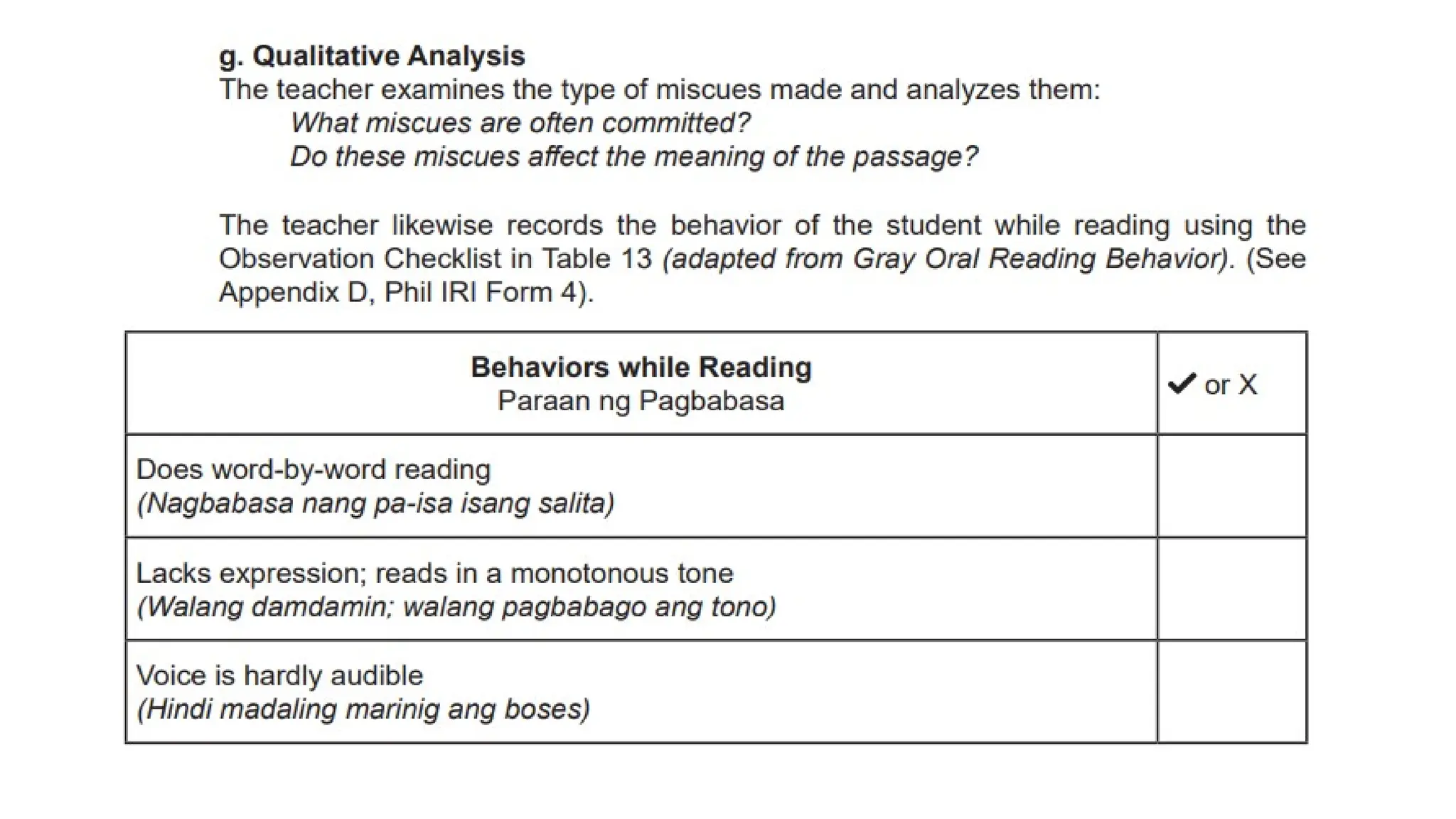
d. Describe Reading Behaviors
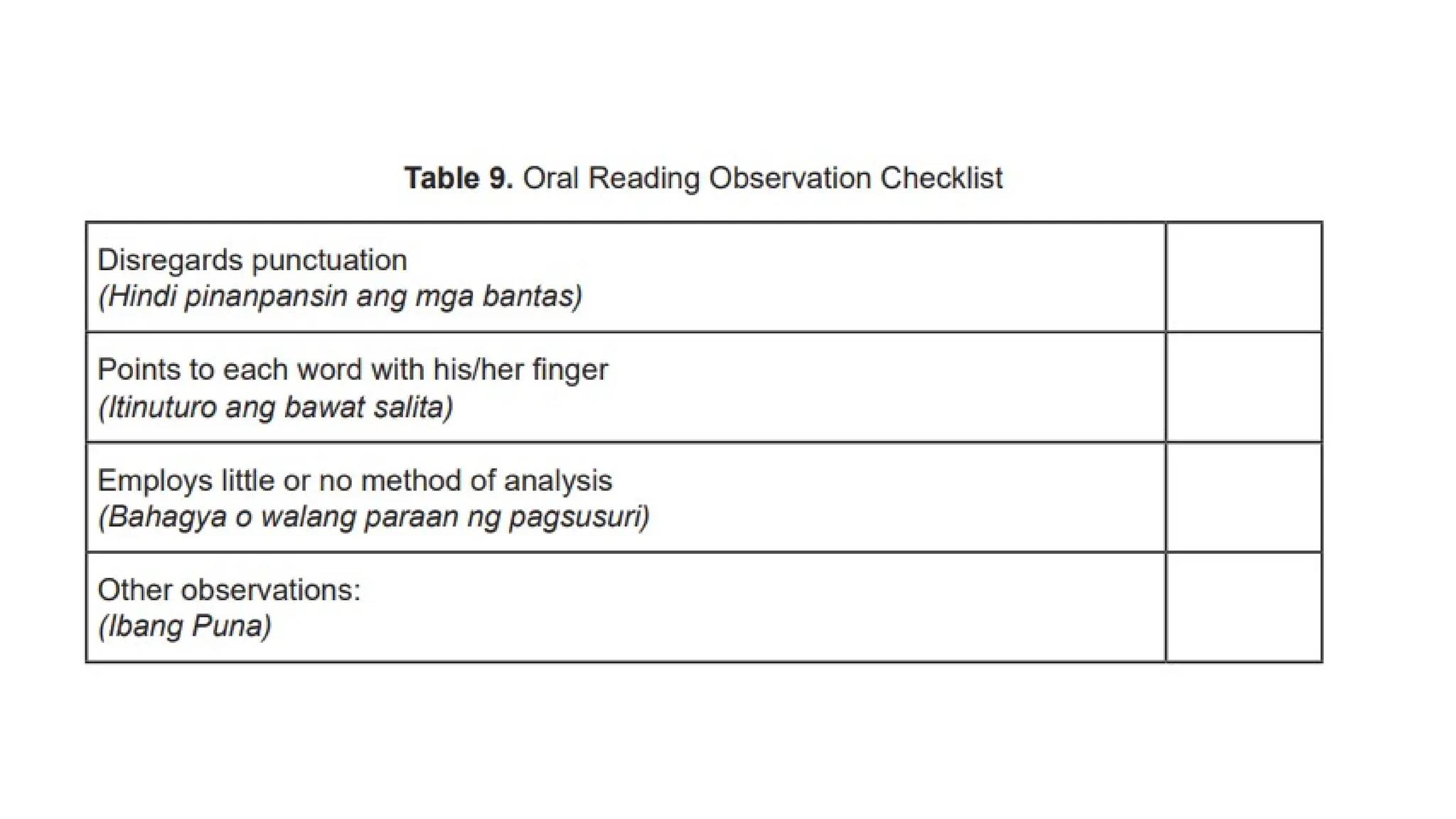
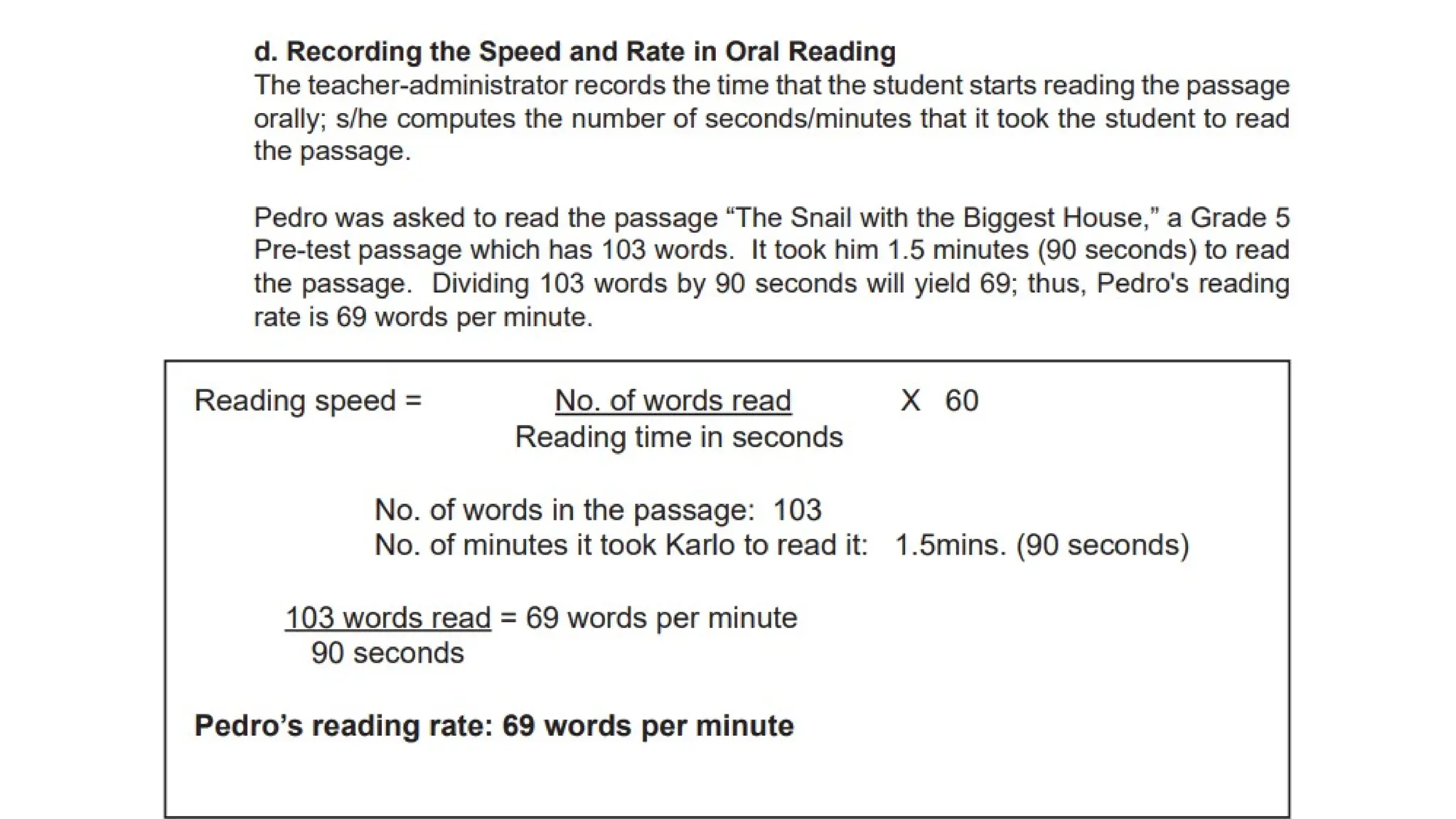
 It specifies the number of words read per minute, the cues
used for identifying or recognizing words, manner of reading,
etc. Types of miscues as well as types of comprehension
questions answered correctly can also be analyzed by the
teacher to help him/her design appropriate reading lessons or
interventions.
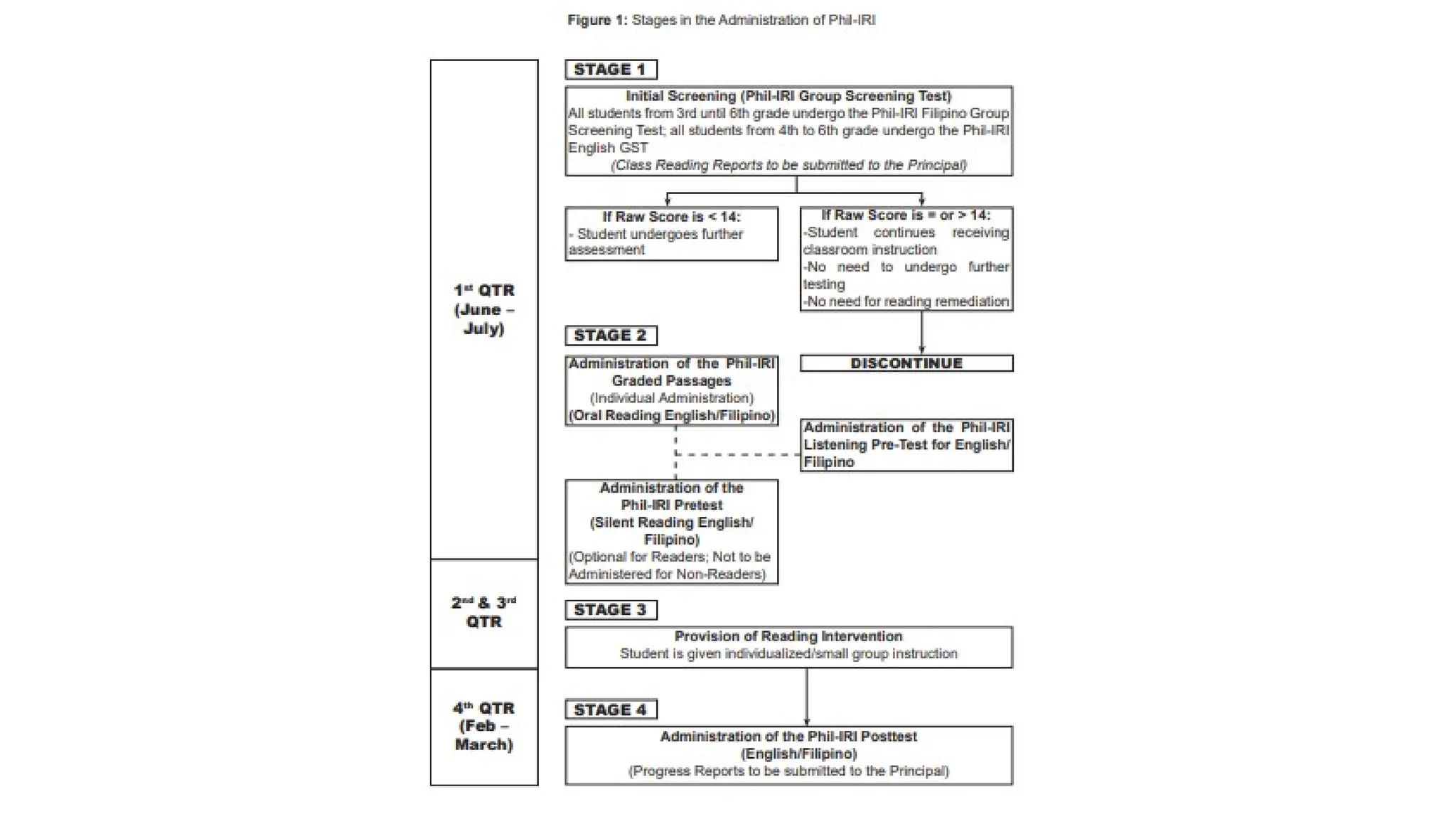
The Phil-IRI Oral Reading Test is administered in
order to:
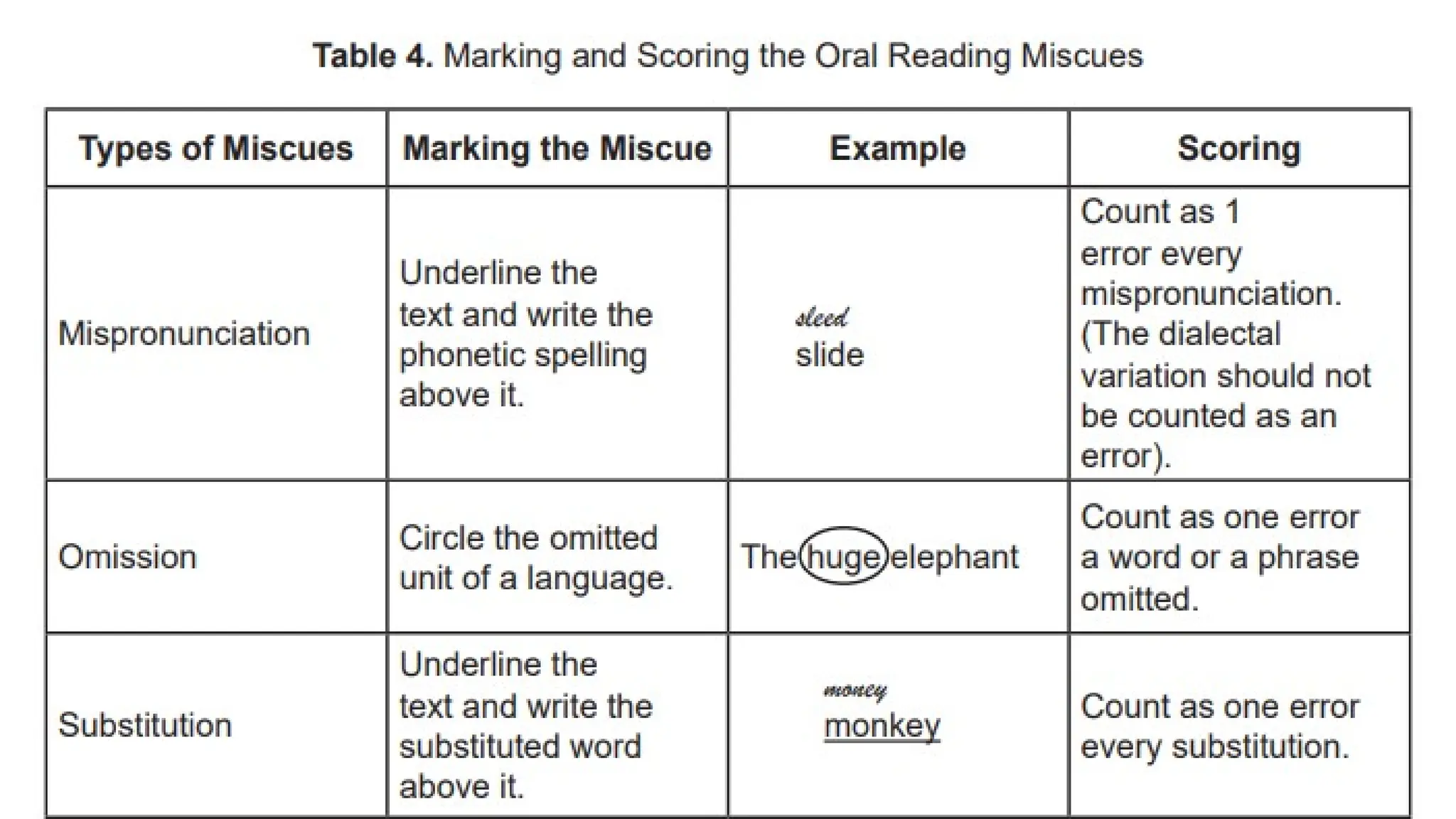
identify the student’s miscues in oral reading;
record the number of words that a student reads
per minute; and
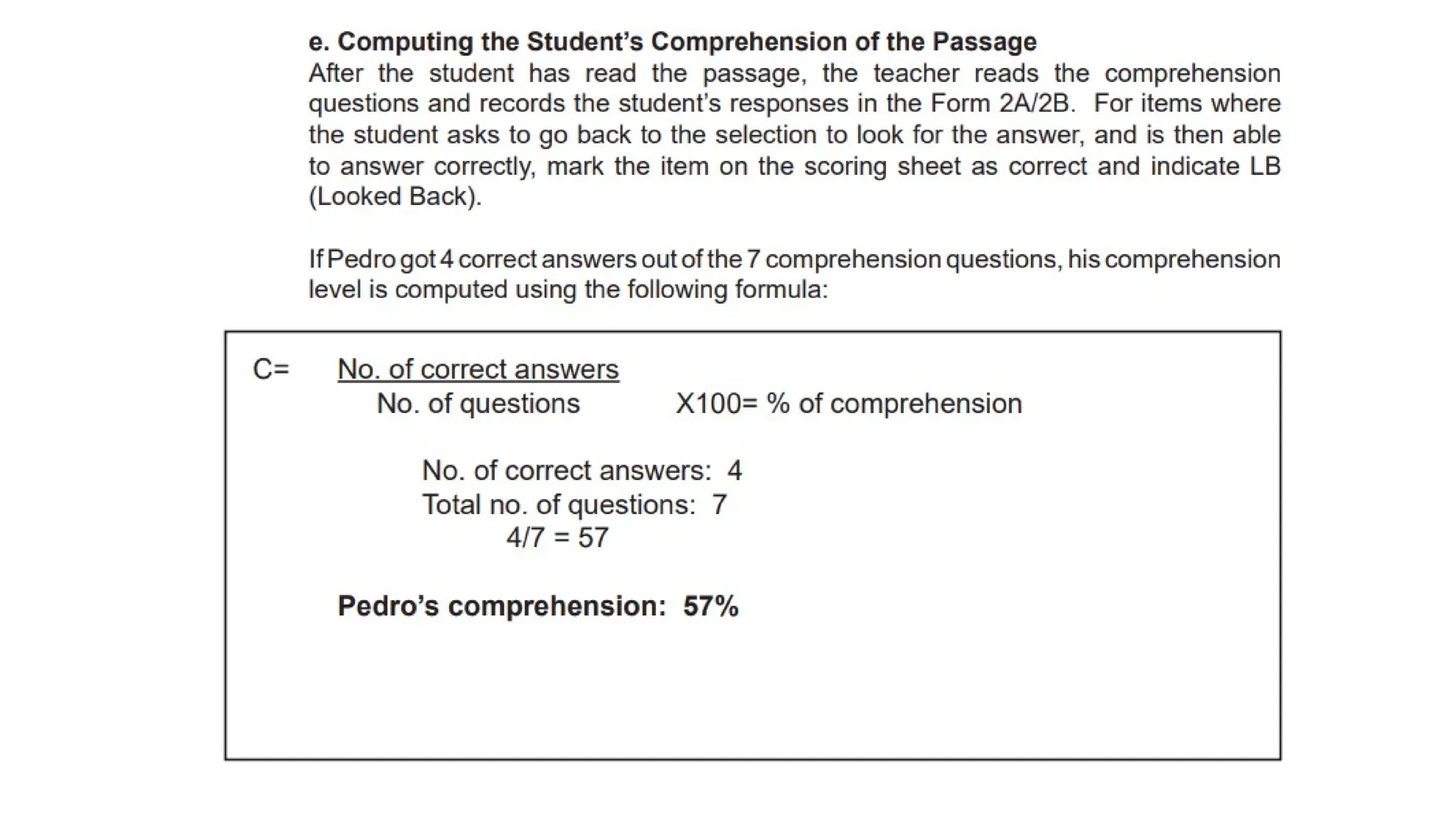
find out how well a student understands the
passage read.
The Phil-IRI Listening Comprehension
is administered when the student is identified as
a nonreader. The purpose is to find out how well a
student understands the selection which will be
read by the test administrator. Then the test
administrator reads the multiple choice questions
and the student answers them orally.
The Phil-IRI Silent Reading Test may be
administered after the Oral Reading Test is
conducted to further check the student’s
comprehension skill. This is an optional activity.
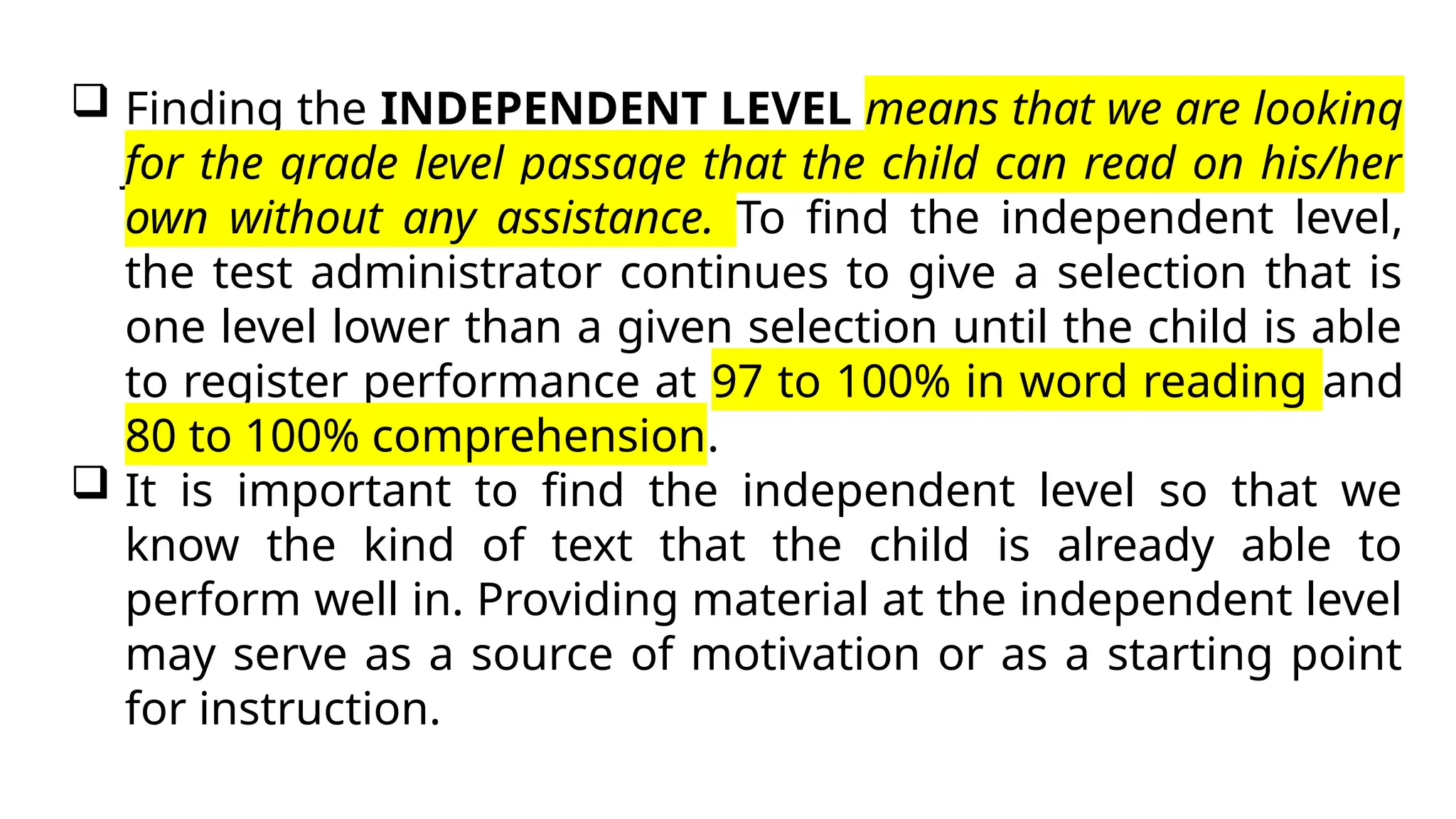
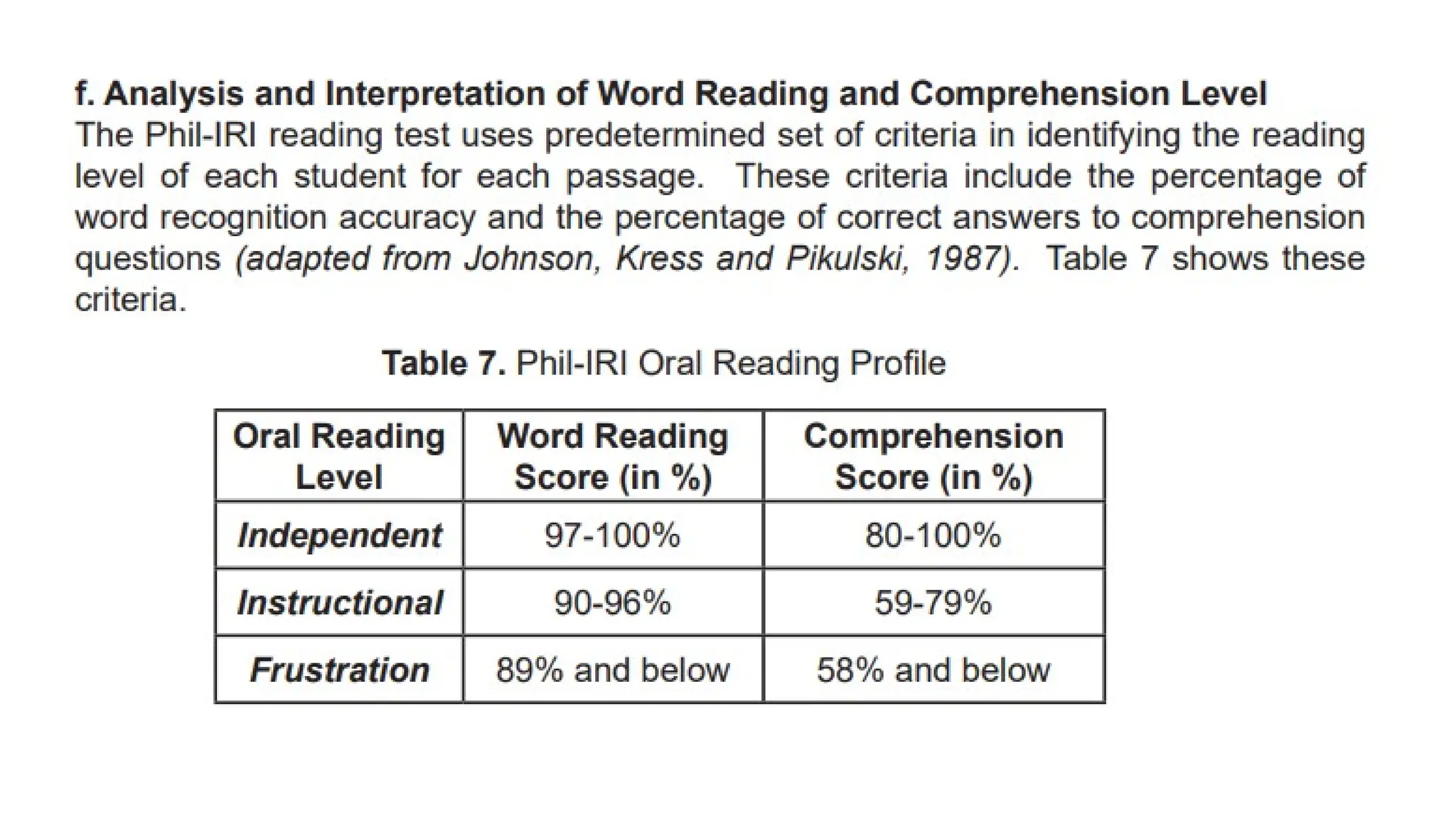
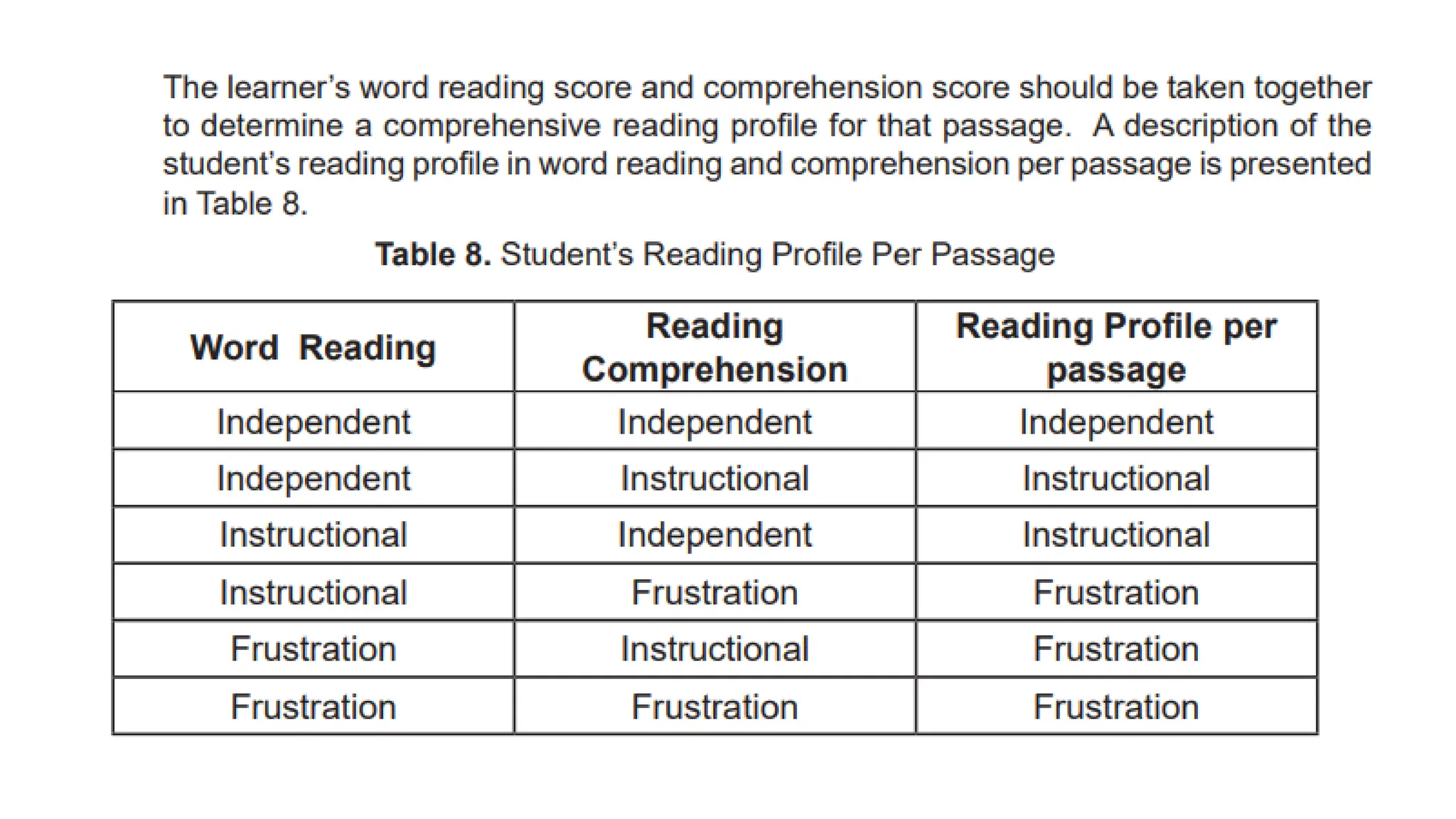
 Finding the INDEPENDENT LEVEL means that we are looking
for the grade level passage that the child can read on his/her
own without any assistance. To find the independent level,
the test administrator continues to give a selection that is
one level lower than a given selection until the child is able
to register performance at 97 to 100% in word reading and
80 to 100% comprehension.
 It is important to find the independent level so that we
know the kind of text that the child is already able to
perform well in. Providing material at the independent level
may serve as a source of motivation or as a starting point
for instruction.
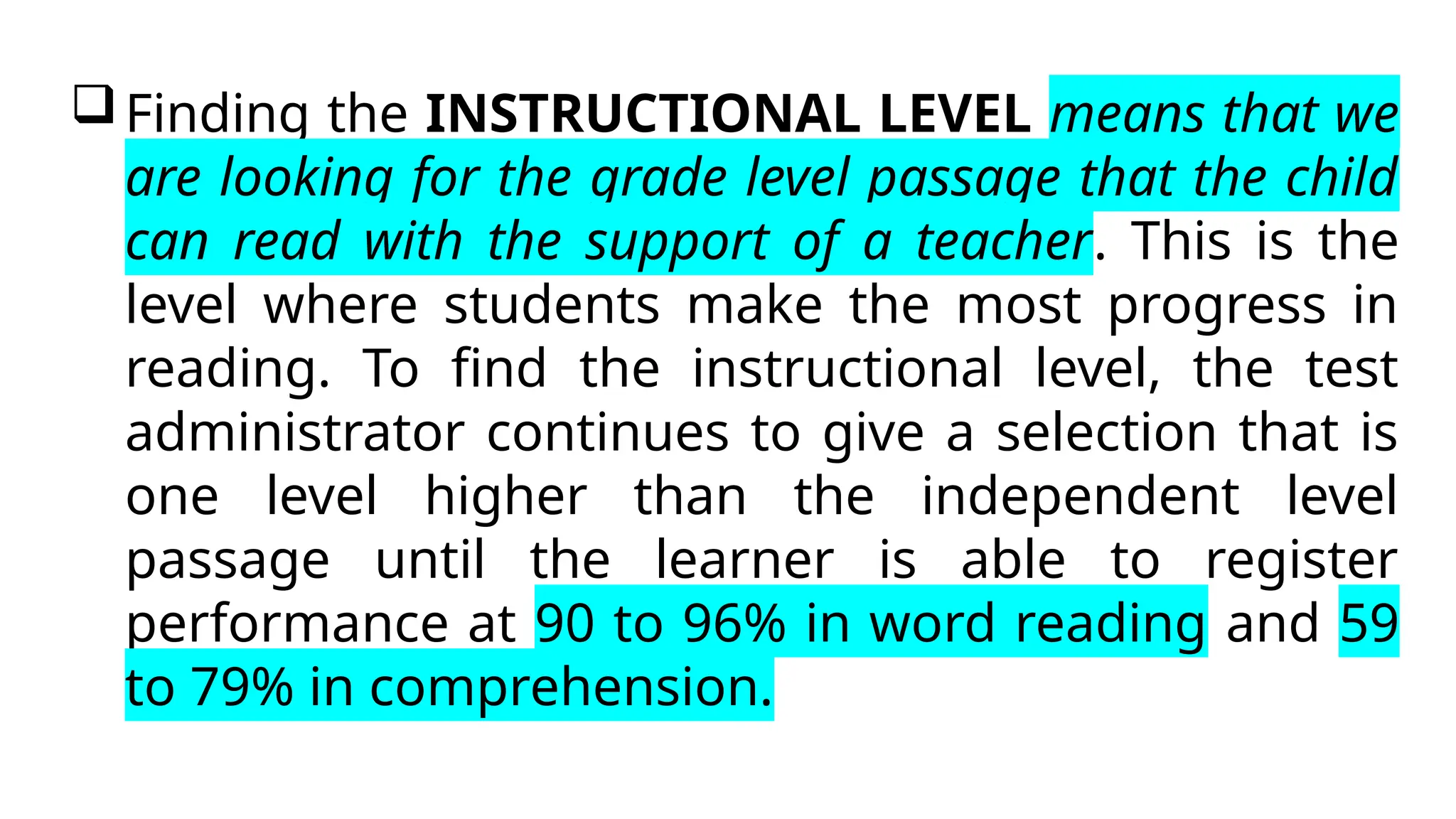
Finding the INSTRUCTIONAL LEVEL means that we
are looking for the grade level passage that the child
can read with the support of a teacher. This is the
level where students make the most progress in
reading. To find the instructional level, the test
administrator continues to give a selection that is
one level higher than the independent level
passage until the learner is able to register
performance at 90 to 96% in word reading and 59
to 79% in comprehension.
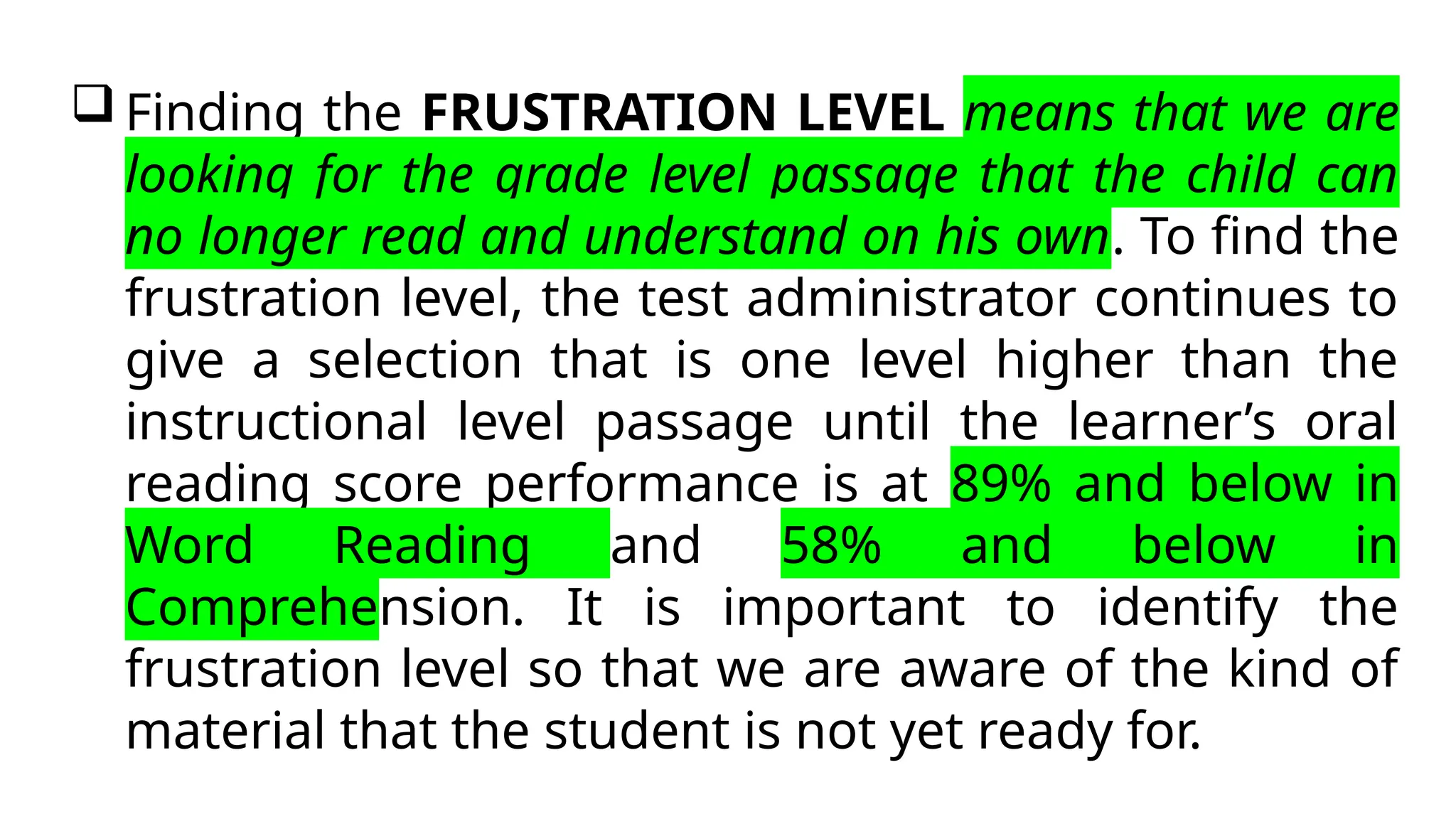
 Finding the FRUSTRATION LEVEL means that we are
looking for the grade level passage that the child can
no longer read and understand on his own. To find the
frustration level, the test administrator continues to
give a selection that is one level higher than the
instructional level passage until the learner’s oral
reading score performance is at 89% and below in
Word Reading and 58% and below in
Comprehension. It is important to identify the
frustration level so that we are aware of the kind of
material that the student is not yet ready for.
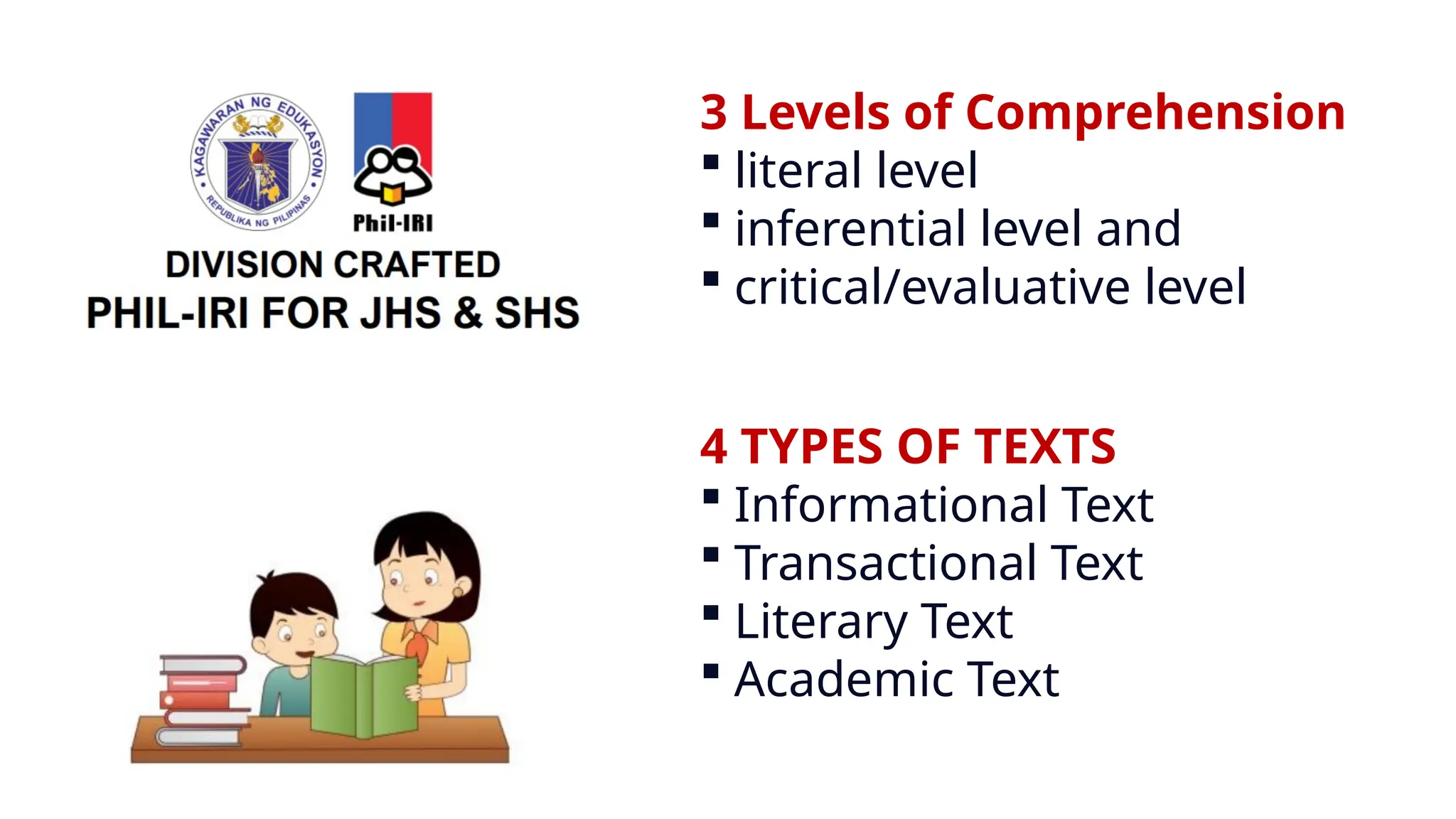
3 Levels of Comprehension
 literal level
 inferential level and
 critical/evaluative level
4 TYPES OF TEXTS
 Informational Text
 Transactional Text
 Literary Text
 Academic Text
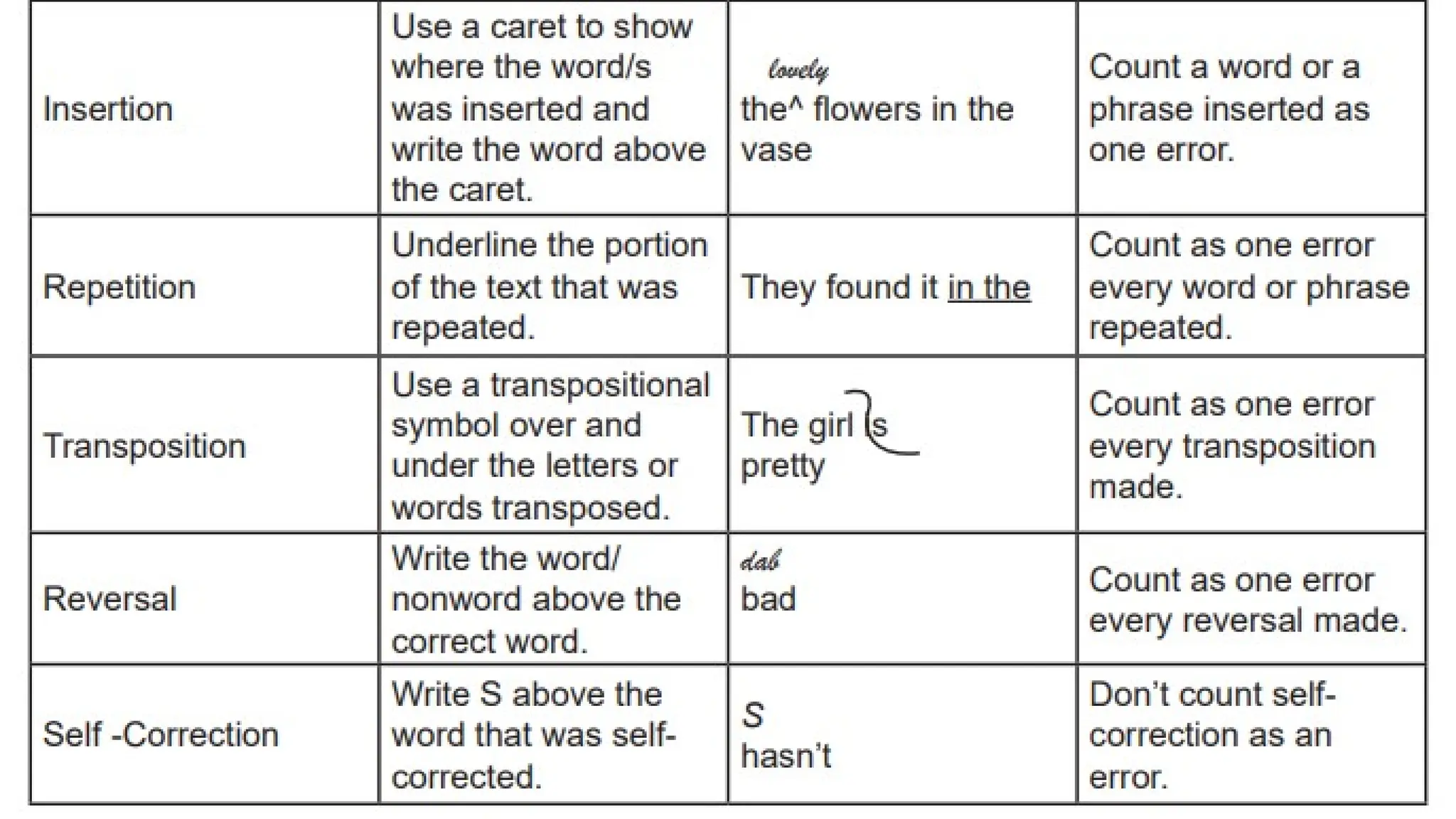
A. MARKING MISCUES
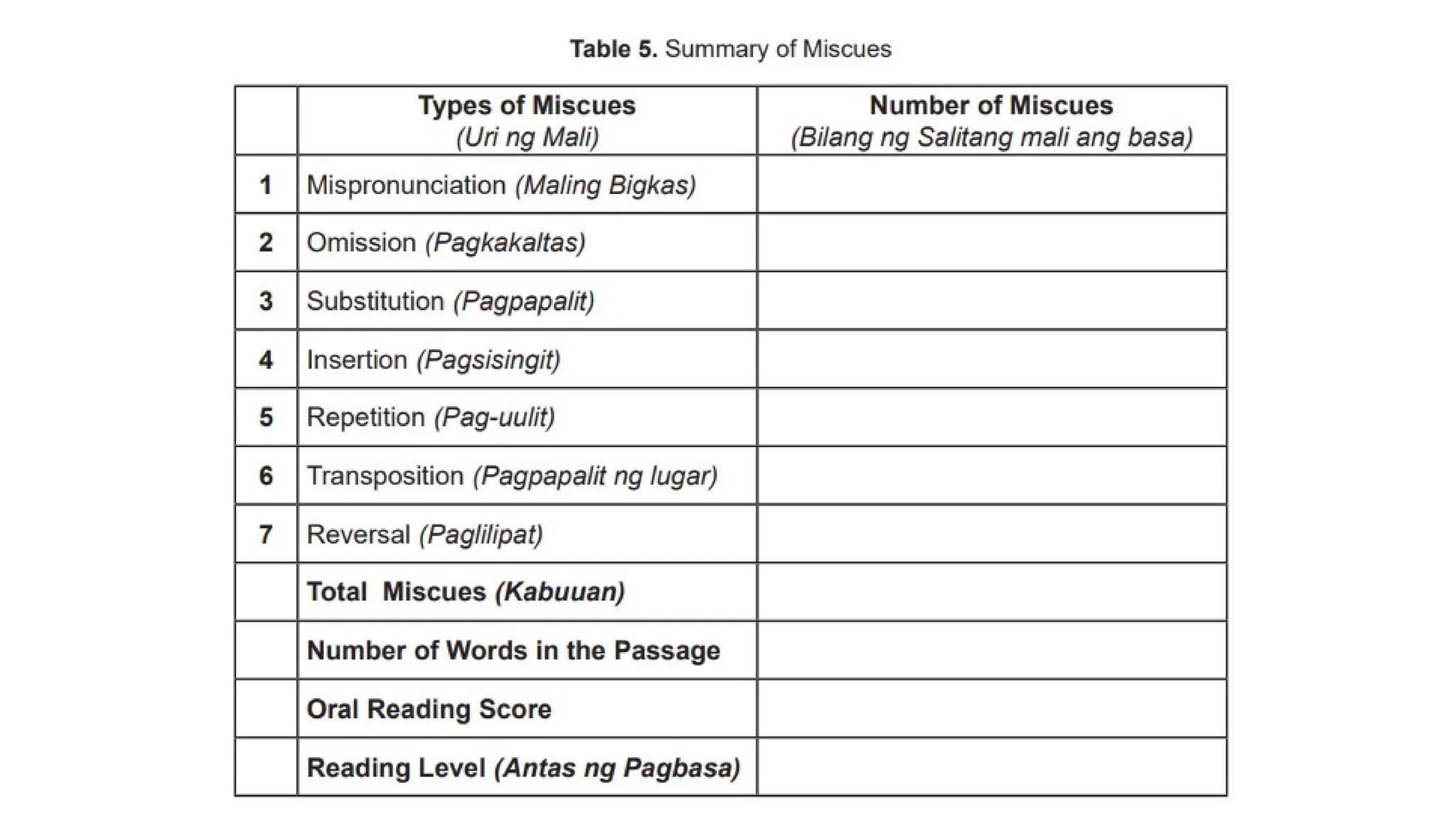
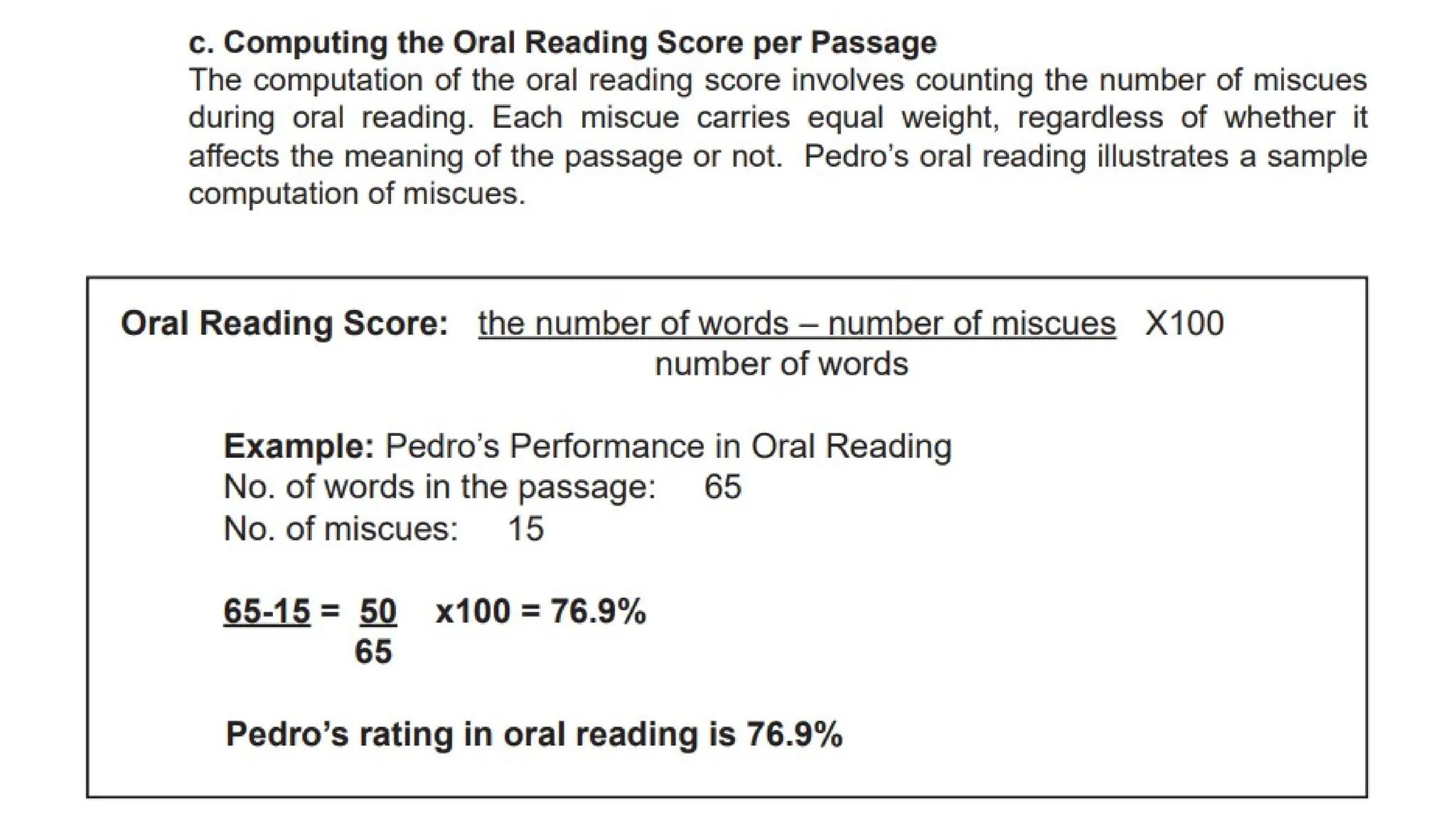
B. RECORDING THE MISCUES
& COMPUTATION
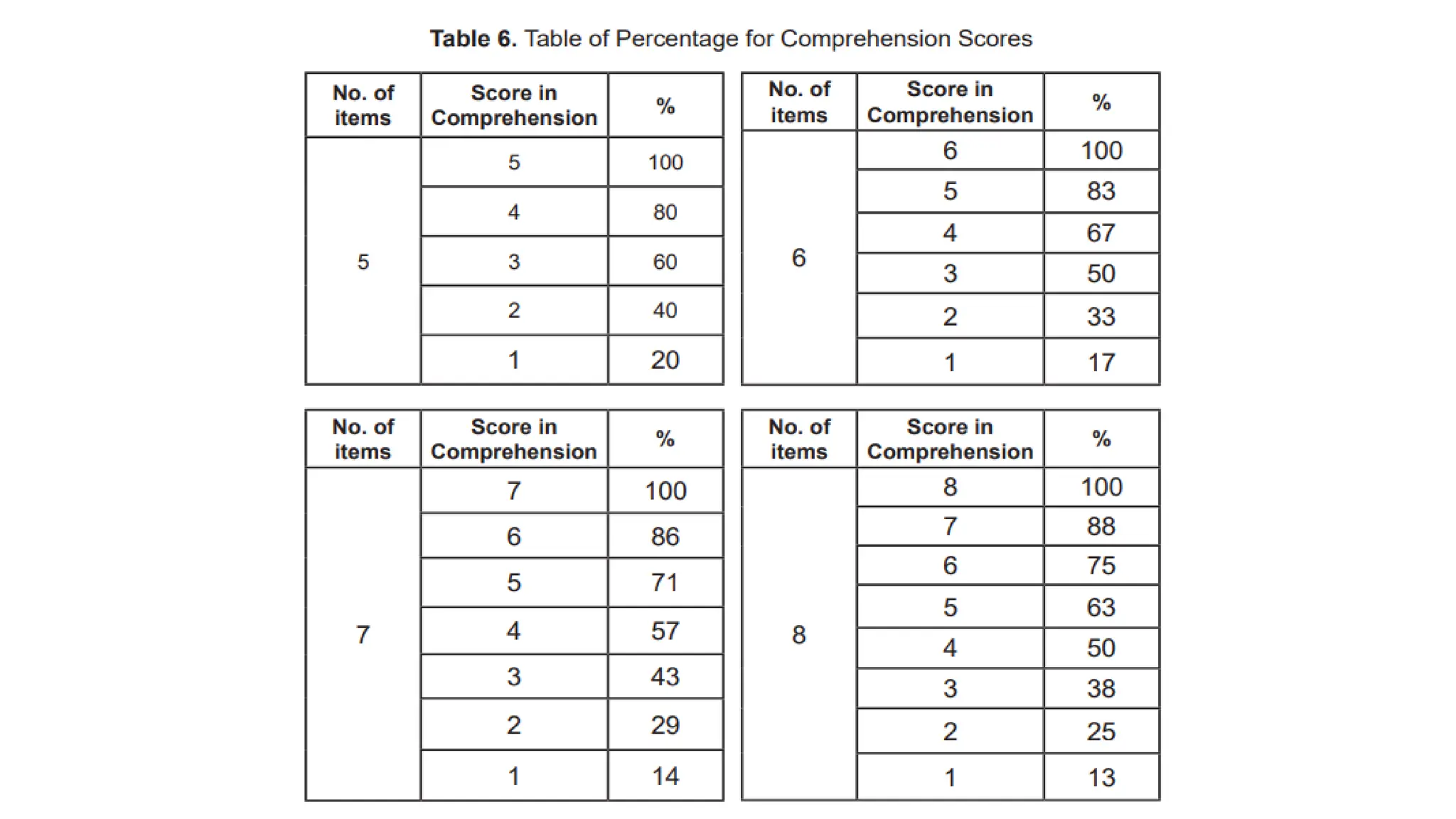
RECOMMENDED
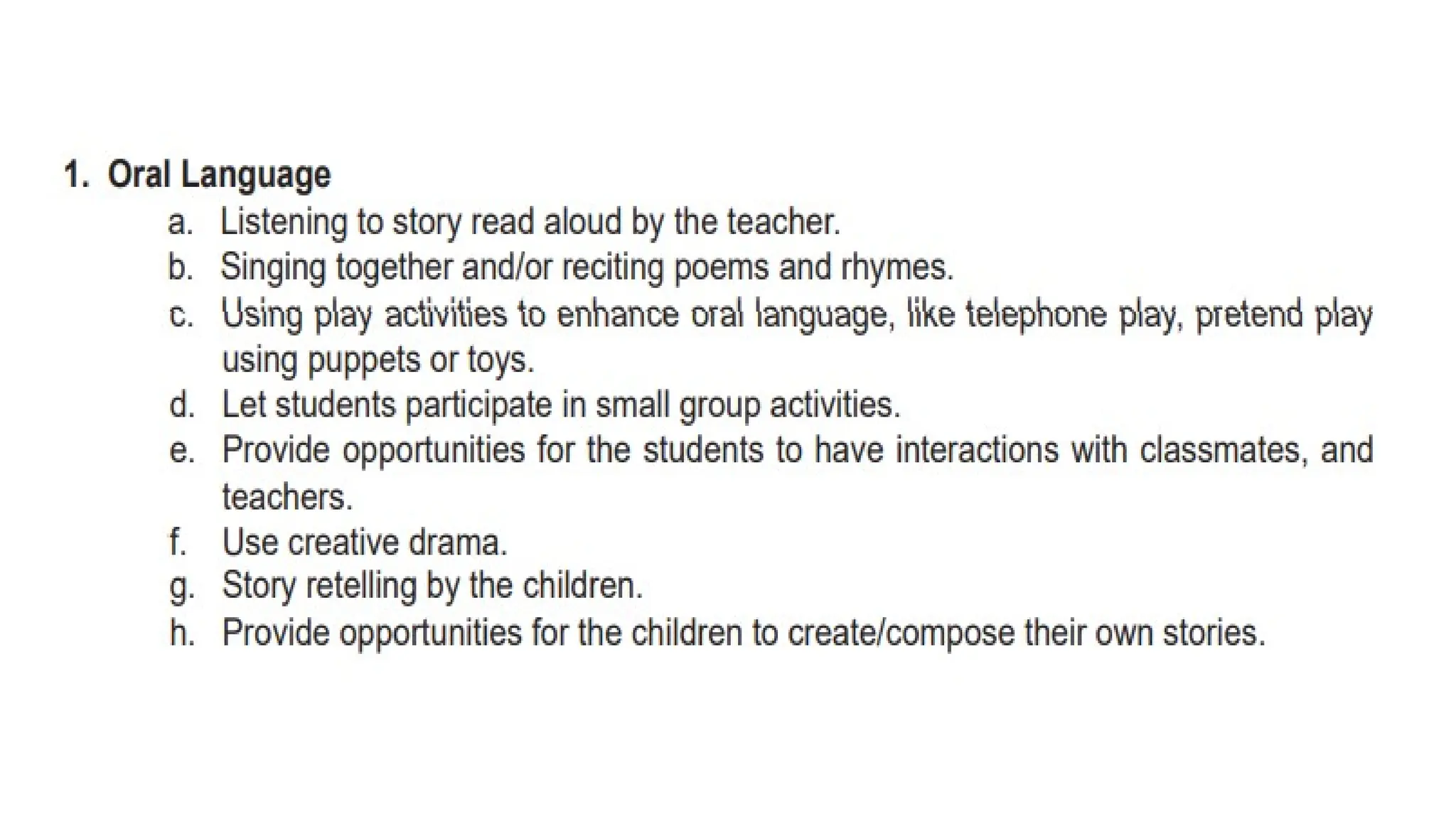
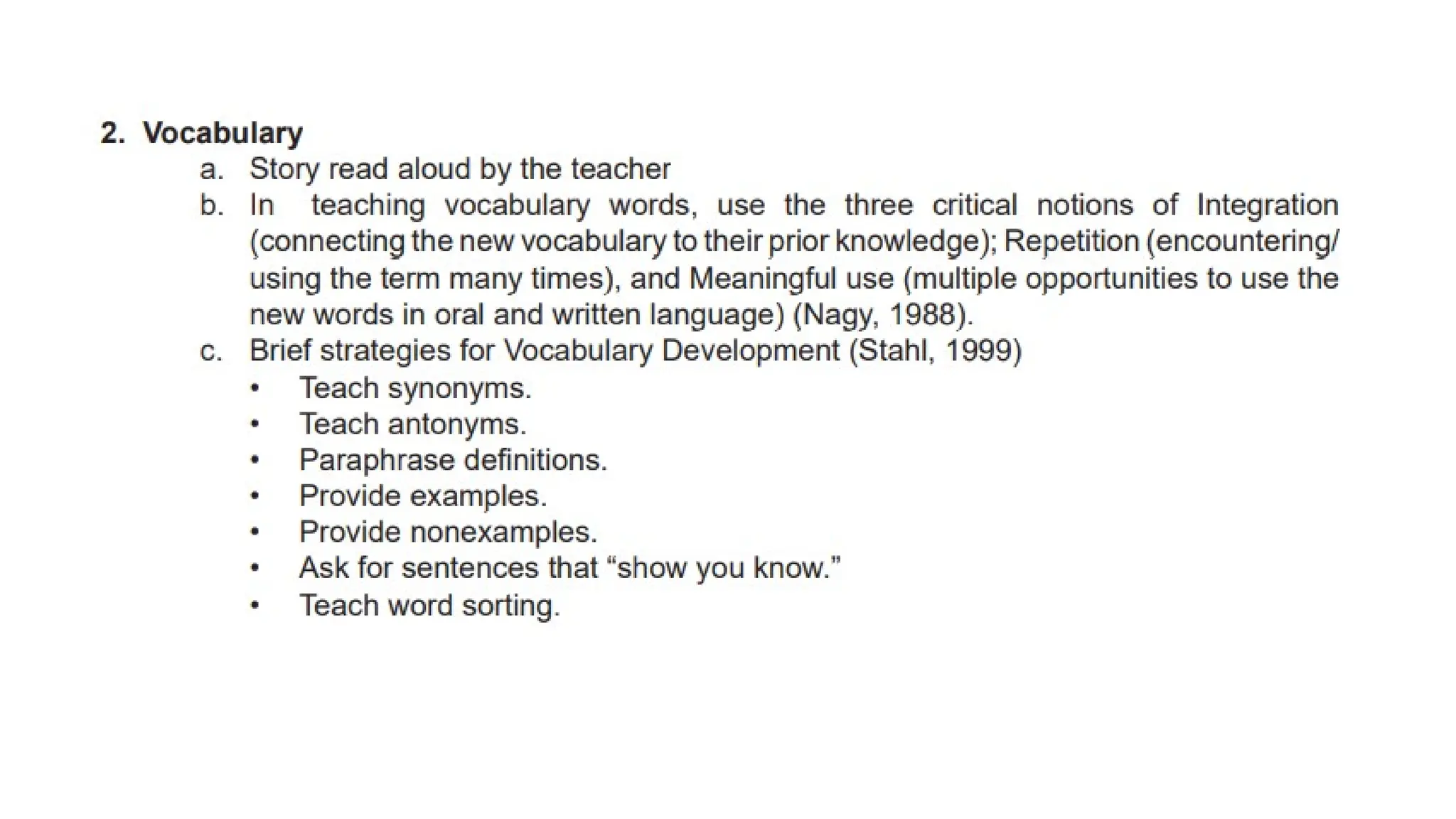
INTERVENTION PER DOMAIN
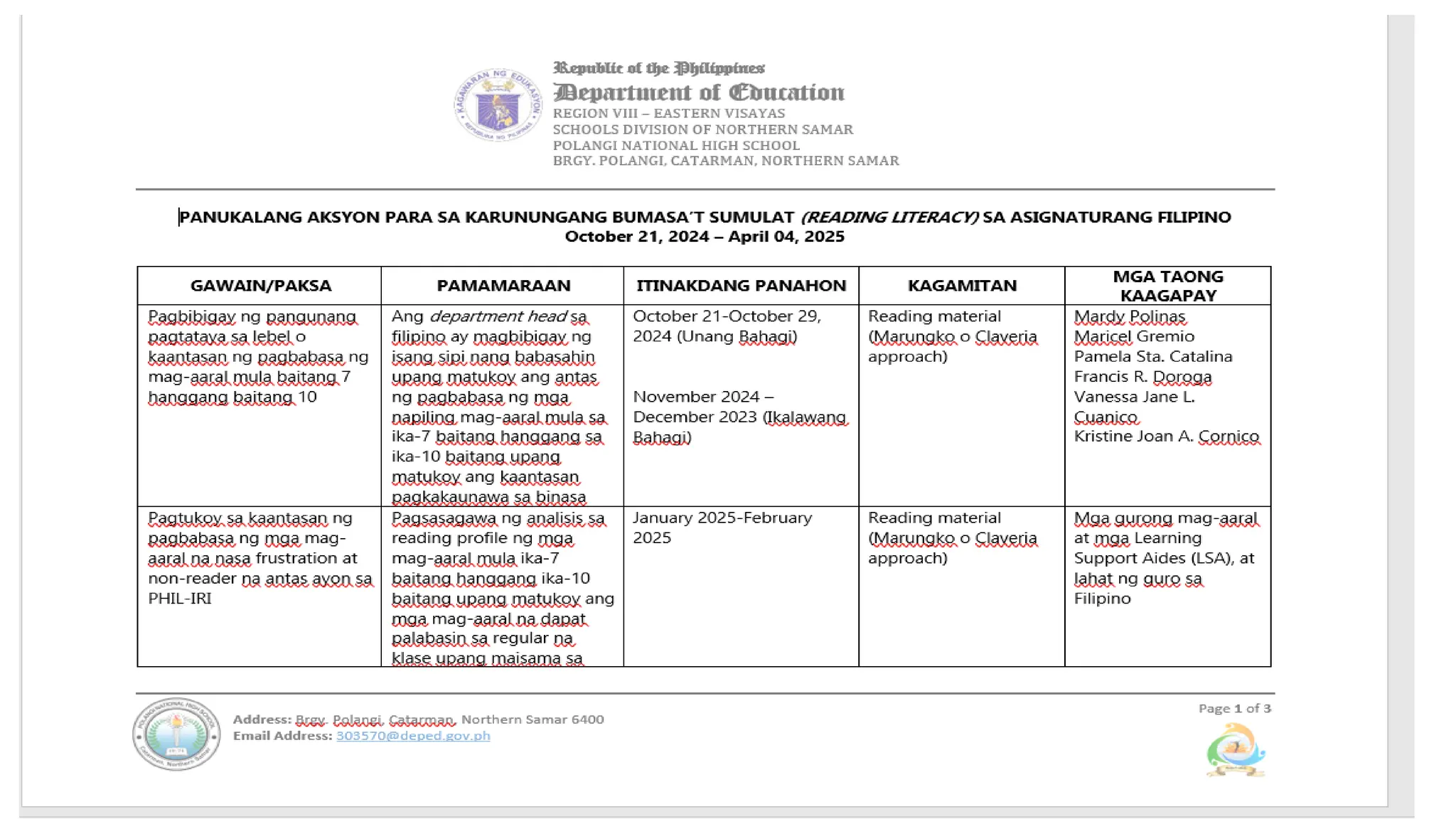
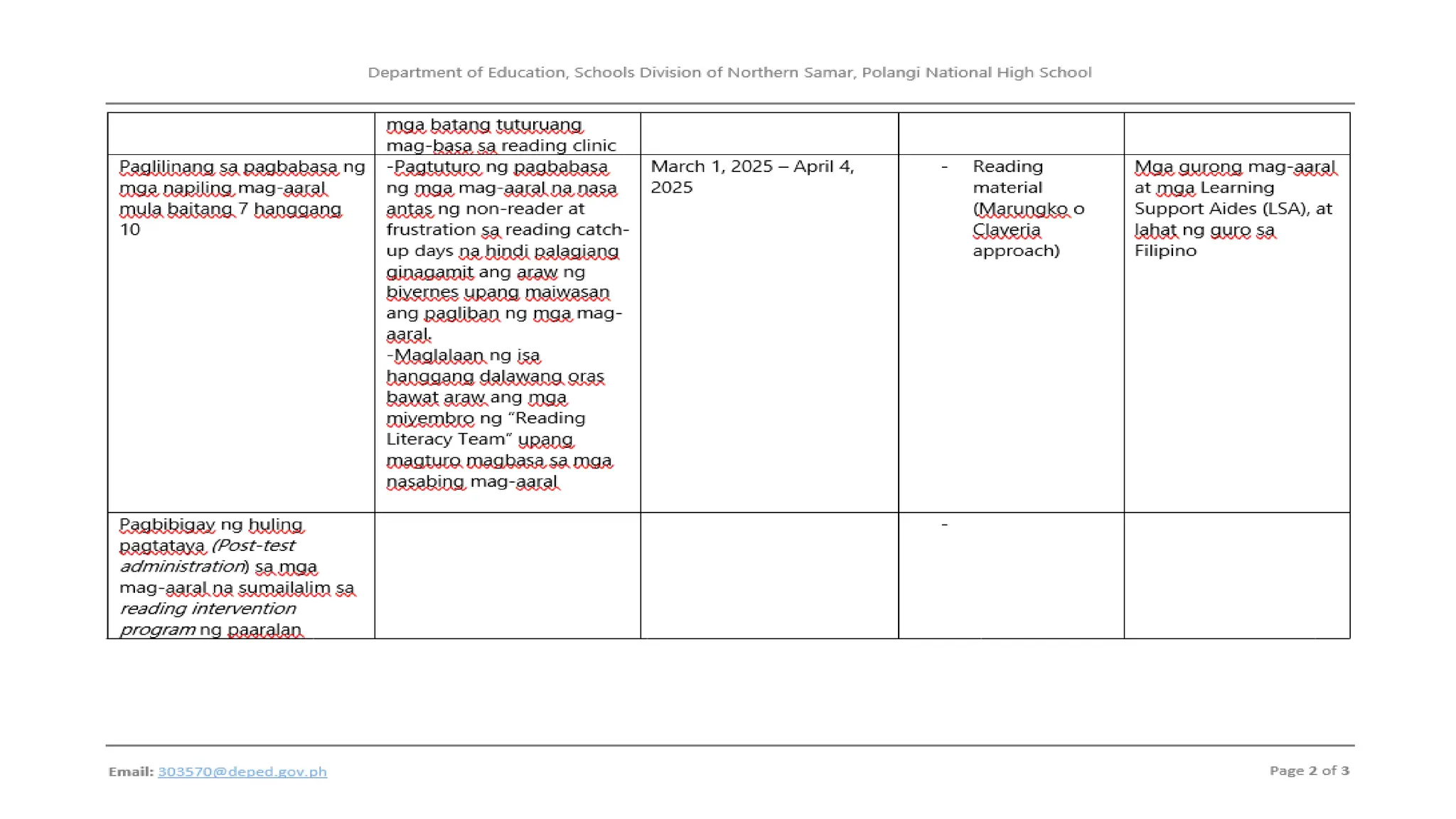
Comprehensive Reading
Intervention Plan
Write shop
Proper
Comprehensive Reading Intervention Plan
“The more that you READ
The more things that you will KNOW
The more that you LEARN
The more places that you’ll go”

Implementing and Sustaining Effective Literacy and Numeracy Programs.pptx

  • 1.
    Sustaining Reading and NumeracyPrograms and Evaluating Effectiveness JAIRO C. GORDA Resource Speaker
  • 2.
    Session Objectives •Develop acomprehensive reading and numeracy intervention plan tailored to their students’ needs. •Explore strategies for sustaining and evaluating reading and numeracy programs. •Utilize Phil-IRI tool to measure and describe student’s reading performance in English and Filipino
  • 3.
    PPST #2 Use arange of teaching strategies that enhance learner achievement in LITERACY and numeracy
  • 5.
    Every teacher isa READING teacher! Reading teachers help young students become PROFICIENT in reading not only in the subject itself, but the contextual component of comprehending subject areas.
  • 6.
  • 7.
    Participants will bedivided according to 5 groups. Group 1 will be the Filipino and English department, group 2, will be the math and science department, group 3 will be the TLE and EsP department, group 4 will be AP and MAPEH department, group 5 will be the SHS department respectively.
  • 8.
    Take time toread the case. Reflect on it. Then answer the guide questions that follow: 1.Based on Teacher Dan’s case, how important are the fundamental skills to our learners? 2.What is/are your role/s to help these learners gain these fundamental skills in order to enjoy success in learning? 3.What is/are your role/s to further strengthen these fundamental skills in each of your learners for them to thrive further? 4.What have you realized about your impact on your learners’ literacy and numeracy skills development regardless of their grade level?
  • 9.
    ACTIVITY PROPER Group 1(Filipino and English Department) Analyzing Teacher Lea’s Case Group 2 (Math & Science Department) Analyzing the Practice of Teacher Jonalyn Group 3 (TLE & EsP Department) Analyzing the strategy used by a grade 2 teacher and a junior high school teacher in literacy instruction Group 4 (AP & MAPEH Department) Analyzing the case of a Social Studies Teacher Group 5 (SHS Department) Analyzing Teacher Andrew’s teaching strategy
  • 10.
  • 14.
    Analyzing Teacher Lea’sCase Teacher Lea’s activities did not require many resources or much extra time, but made the learning of new terms and vocabulary more interesting and relevant to the learners. This would undoubtedly enhance their learning.
  • 15.
    As a teacher,you can explore varied ways to develop your learners’ literacy and life skills. In developing your lessons, you just have to consider your learners’ level, learning goals and the appropriate teaching resources.
  • 16.
    Analyzing the Practiceof Teacher Jonalyn It can be observed that Teacher Jonalyn used flashcards and working together to develop the learners’ literacy skills, as well as to extend their ways of learning by seeing, drawing, writing, singing and working together. This practice of emphasizing key content such as the terminology of the subject, will improve your learners’ subject knowledge and literacy skills
  • 17.
    Other ways oflearning might include encouraging them to observe and search for resources, or using storytelling, role play or brainstorming, all of which involve literacy skills. Understanding that you need to use a variety of teaching strategies in your class to cater to individual needs is very important
  • 18.
    Analyzing the strategyused by a grade 2 teacher and a junior high school teacher in literacy instruction Literacy instruction for the young learners focus on vocabulary building and making meaning of what they read. This is important to help them develop skills and strategies to access the content of the simple texts they are reading. Meanwhile, as they become more proficient readers, the skills of skimming, questioning and reviewing texts become much more important. As a teacher, you will need to plan and adapt activities to match their levels and skills in reading depending on your learners’ age and needs
  • 19.
    Analyzing the caseof a Social Studies Teacher All teachers have a responsibility for promoting numeracy subjects. In the sample teacher practice, the social studies teacher demonstrates knowledge of the key areas of numeracy that makes her explore within the subject the opportunities for extending and complementing numeracy teaching and learning in mathematics lessons
  • 20.
    Analyzing Teacher Andrew’steaching strategy According to studies, in a meaningful and fun-filled context, children can acquire skills without the pressure and fear of failure in quite the same way as they might feel in a more structured learning environment.
  • 21.
    ADMINISTRATION OF PHIL-IRI For JuniorHigh School and Senior High School SAMUEL A. REPELENTE MT-III/TIC, CADSEV
  • 22.
    The Phil-IRI maybe used to… a. Group Reading Level  The Phil-IRI GST can be used to determine a whole class’s reading level, and identify particular students who may need more assistance in performing reading tasks. b. Individual Reading Level  The individually administered Phil-IRI Graded Passages can be used to determine a student’s independent, instructional and frustration levels for three types of literacy tasks: Oral Reading, Silent Reading, and Listening Comprehension.
  • 23.
    c. Monitor Growthand Response to Intervention  Pretest and Posttest results of the Phil-IRI can be compared to monitor growth in students’ reading skills & determine the efficacy of the program or reading interventions conducted by the teachers. d. Describe Reading Behaviors  It specifies the number of words read per minute, the cues used for identifying or recognizing words, manner of reading, etc. Types of miscues as well as types of comprehension questions answered correctly can also be analyzed by the teacher to help him/her design appropriate reading lessons or interventions.
  • 24.
    The Phil-IRI OralReading Test is administered in order to: identify the student’s miscues in oral reading; record the number of words that a student reads per minute; and find out how well a student understands the passage read.
  • 25.
    The Phil-IRI ListeningComprehension is administered when the student is identified as a nonreader. The purpose is to find out how well a student understands the selection which will be read by the test administrator. Then the test administrator reads the multiple choice questions and the student answers them orally.
  • 26.
    The Phil-IRI SilentReading Test may be administered after the Oral Reading Test is conducted to further check the student’s comprehension skill. This is an optional activity.
  • 28.
     Finding theINDEPENDENT LEVEL means that we are looking for the grade level passage that the child can read on his/her own without any assistance. To find the independent level, the test administrator continues to give a selection that is one level lower than a given selection until the child is able to register performance at 97 to 100% in word reading and 80 to 100% comprehension.  It is important to find the independent level so that we know the kind of text that the child is already able to perform well in. Providing material at the independent level may serve as a source of motivation or as a starting point for instruction.
  • 29.
    Finding the INSTRUCTIONALLEVEL means that we are looking for the grade level passage that the child can read with the support of a teacher. This is the level where students make the most progress in reading. To find the instructional level, the test administrator continues to give a selection that is one level higher than the independent level passage until the learner is able to register performance at 90 to 96% in word reading and 59 to 79% in comprehension.
  • 30.
     Finding theFRUSTRATION LEVEL means that we are looking for the grade level passage that the child can no longer read and understand on his own. To find the frustration level, the test administrator continues to give a selection that is one level higher than the instructional level passage until the learner’s oral reading score performance is at 89% and below in Word Reading and 58% and below in Comprehension. It is important to identify the frustration level so that we are aware of the kind of material that the student is not yet ready for.
  • 31.
    3 Levels ofComprehension  literal level  inferential level and  critical/evaluative level 4 TYPES OF TEXTS  Informational Text  Transactional Text  Literary Text  Academic Text
  • 32.
  • 35.
    B. RECORDING THEMISCUES & COMPUTATION
  • 45.
  • 48.
  • 52.
  • 53.
    “The more thatyou READ The more things that you will KNOW The more that you LEARN The more places that you’ll go”