
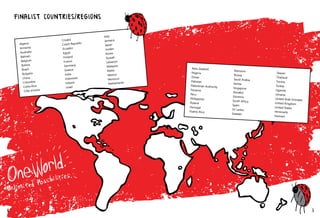
Countries/Regions the Finalists Represent………………..……………………………………………………..4
Letters of Encouragement……………………………………………………………………………………………….6
About the Imagine Cup…………………………………………………………………………………………………12
Imagine Cup Theme and the United Nations Millennium Development Goals……………16
Welcome to Poland!………………………………………………………………………………………………………19
Event Schedule……………………………………………………………………………………………………………..20
Worldwide Finals Judges………………………………………………………………………………………………22
Meet the Finalists
	 •	 Software Design...……….….………………………………………………………………………………25
	 •	 Envisioning 2020 Award..……………….………………………………………………………………94
	 •	 Internet Explorer 8 Award....…………………………………………………………………………101
	 •	 Interoperability Award.…………………………………………………………………………………108
	 •	 Next Generation Web Award………………………………………………………………………112
	 •	 Touch & Tablet Accessibility Award………………………………………………………………116
	 •	 Windows Phone 7 “Rockstar” Award………………………………………………………………119
	 •	 Embedded Development..……………………………………………………………………………123
	 •	 Game Design..………………………………………………………………………………………………139
	 •	 Digital Media..………………………………………………………………………………………………146
	 •	 IT Challenge..………………………………………………………………………………………………..153
The Microsoft Academic Team…………………………………………………………………………………....158
Our Sponsors………………………………………………………………………………………………………………160
Imagine Cup 2011 Revealed!………………………………………………………………………………………169
Table of Contents
TableOfContents
Algeria
Armenia
Australia
Bahrain
Belgium
Bolivia
Brazil
Bulgaria
China
Colombia
Costa Rica
Côte d’Ivoire
Croatia
Czech Republic
Ecuador
Egypt
Finland
France
Germany
Greece
India
Indonesia
Ireland
Israel
Italy
Jamaica
Japan
Jordan
Korea
Kuwait
Lebanon
Malaysia
Malta
Mexico
Morocco
Netherlands
Finalist Countries/Regions
New Zealand
Nigeria
Oman
Pakistan
Palestinian Authority
Panama
Peru
Philippines
Poland
Portugal
Puerto Rico
Romania
Russia
Saudi Arabia
Serbia
Singapore
Slovakia
Slovenia
South Africa
Spain
Sri Lanka
Sweden
Taiwan
Thailand
Tunisia
Turkey
Uganda
Ukraine
United Arab Emirates
United Kingdom
United States
Venezuela
Vietnam
MJ
4 5
Message from S. Somasegar
We are excited to be hosting the eighth Imagine Cup worldwide finals in Warsaw, Poland, a city
that has continually rebuilt and redefined itself in the face of adversity. It’s truly a privilege to
welcome the world’s brightest young students here to recognize their talents and passion for
using technology and software to solve real-world problems.
Over the past eight years we have watched in awe the growth of this competition. Starting in
Spain in 2003 we have circled the globe, each year building participation and excitement for
development and technology. Not only does Imagine Cup give of fantastic forum for students
but also provides a different cultural experience each year for all who participate. From Spain to
Brazil, Japan to India, Korea to France, the Pyramids at Giza to Warsaw’s historical opera house,
Imagine Cup is truly an adventure.
This competition continues to challenge students around the globe to imagine a better world
empowered by technology and created by their talent and innovation. Microsoft supports this
vision through this competition as well as our student program, Microsoft DreamSpark, which
provides professional-level tools that we hope will inspire students to explore the power of
software and encourage them to forge the next wave of software-driven breakthroughs. Microsoft
DreamSpark makes available, at no charge, a broad range of development and design software
for download to millions of high school and college students around the world.
The Imagine Cup showcases the dreams, ideas and creative energy of young leaders in technology
and gives them the exposure, resources, and connections to focus their passion into projects
that benefit the society of tomorrow. This year we invite students to “imagine a world where
technology helps solve the toughest problems facing us today”. This theme urges finalists to truly
tackle some of the world’s issues where solutions are desperately needed, more now than ever.
Whether it is economic or environmental, social or political, we have a set of challenges currently
facing our world that may be surmounted by creative technological solutions.
I would personally like to thank the city of Warsaw for hosting this event. A city full of rich culture
and reflective spaces, Warsaw has been a gracious host and an inspiring backdrop for the Imagine
Cup. Finally, I look forward to experiencing the creativity and brilliance of our group of worldwide
finalists. Their work will inspire us all to see how technology can make a lasting change for the
better in how we think, work, and live. Please join me in welcoming the finalists of Imagine Cup
2010, and in wishing them the very best in all of their future endeavors.
S. Somasegar
Sr. Vice President, Developer Division
Microsoft Corporation
MessagefromS.Somasegar
Message from Waldemar Pawlak
Ladies and Gentlemen,
Steve Ballmer, Microsoft Chief Executive Officer, during his stay in our country over a year ago
announced that Poland will be the host country for the Worldwide Finals of Imagine Cup 2010.
During the first week of July 2010 Warsaw will become the European capital of modern
technologies. Hundreds of talented, young people from all over the world will present their
solutions addressing real modern world issues, using the achievements of the latest technology.
It is a great honor for us to be the host of the competition which develops imagination, creativity
and passion for the latest technologies. Along with Microsoft Poland and Imagine Cup Partner
in Poland – Institute of Industrial Design we made efforts which resulted in organization of this
international event.
I am pleased to welcome all of you to Warsaw and to Poland – the very heart of Europe, the
country of Copernicus, Chopin, Curie – Skłodowska and many outstanding mathematicians,
including Banach and Ulam, who have created foundations of numerical analysis usage.
Waldemar Pawlak
Deputy Prime Minister, Minister of Economy
MessagefromWaldemarPawlak
6 7
Message from Walid Abu-Hadba
Welcome Imagine Cup 2010 World Finalists! It is a great honor for Microsoft to host you here
in Warsaw, Poland for the Worldwide Finals of Imagine Cup 2010. I hope that you are ready to
compete for the title of World Champion in your chosen competition or award.
The Imagine Cup demonstrates Microsoft’s continued commitment to inspire the next generation
of technology leaders to apply their imagination, passion, and creativity to solving real world
problems and having a lasting impact on the world.
The mission of the Imagine Cup is to make the world a better place using the power of software.
In every category of the Imagine Cup, you have the opportunity to transform the world for the
better through technology.
I have already had the chance to review some of your work and it has been inspiring to see how
you are using your creativity and knowledge to change the world. Projects range from a software
design of a remote sensor that analyzes water quality, a game experience that educates children
about recycling, an inspirational digital media submission showing the effect of world hunger and
an embedded development project that created a board that enables the blind to improve their
knowledge by visualizing and touching images.
The competition will be tough. By reaching the finals of the world’s premier student technology
competition, you have already shown yourself to be one of the world’s most gifted technology
students. To me, you are all already winners and I congratulate you on your remarkable
achievements.
Best of luck in the Imagine Cup 2010 Worldwide Finals.
Walid Abu-Hadba
Corporate Vice President
Developer & Platform Evangelism Group
Microsoft Corporation
Message from Jon Perera
Welcome to the Imagine Cup Poland!
We are honored and humbled to have you here. Each of you has done so much work, innovation,
and creativity to advance to the worldwide finals. I would like to invite you to take a moment to
reflect on this amazing achievement: You and your team are here in Poland as the representatives
of your country and your university. You have been recognized by industry and technical leaders
from around the world for your work. You have a vision for how we can change the world through
the power of technology. Congratulations!
This is the eighth annual Imagine Cup, and is poised to be the largest university student competition
of its kind in the world. With more than 100 countries, and more than 300,000 registered students,
the event asks competitors to solve the world’s toughest problems through technology. We
have been blown away by your innovations and work to help save the environment, to improve
healthcare and education, to address famine, and more.
Together you are the best the world has to offer. Together you represent the world. At Microsoft,
we know that the single greatest resource we have on our planet is its people. And when people
come together around a common cause, dream big, and take risks, anything is possible. Your
innovation will help people around the world realize their full potential.
Plan to spend a great deal of your time connecting with students from all over the world: share
information, share cultures, share stories but make sure to… connect. Exchange ideas, innovations,
and e-mails! And ensure that you take away something from your visit to Warsaw.
Most importantly, let the Imagine Cup be a beginning for you, and for the world. As our world’s
future innovators and technology leaders, our planet will look to you to lead the way on solving
some of our greatest challenges. Lead with your mind but also lead with your heart, as both are
required to make a difference. Ask yourself, your team-mates, and your new friends, “how will we
continue to take this important work forward in the world, together?”
Follow your dreams, take risks, dare to make a difference.
Jon Perera
General Manager, Education Group
Microsoft Corporation
8 9
MessagefromWalidAbu-Hadba
MessagefromJonPerera
Message from Jacek Murawski
This is a real honor to host Worldwide Finals of Imagine Cup 2010 in Poland. I am personally very
excited about it and I have been waiting for this for several reasons. The competition gathers
YOU - the most talented and skilled students who, as I believe, will be leading the way in the
future technology innovation. It is the event of great energy and passion, which inspires all of us
to search for new solutions. The Worldwide Finals, for the first time in the eight-year long history
of Imagine Cup, is held in Eastern Europe.
Poland is a country of rich history and culture, fatherland of great people like Copernicus, Chopin
and Maria Curie. With the sea shore of 770 km, access to the mountain and great lake region of
Mazuria, Poland is a very attractive destination, where one can dive deep into a thousand year
history and enjoy the beauty of the country in the same time. I hope you will have a chance to
taste all what’s best about Poland during your Imagine Cup week in Warsaw. This is the city, which
had experienced many tragic events over the past, but has grown into a modern capital city,
where everyone can discover something interesting.
Imagine Cup finals is an experience of a lifetime. I hope this competition week in Poland will be
a memorable one for you, bringing positive emotions, satisfaction and success, excitement and
new friendships. Poland welcomes YOU all to 2010 Imagine Cup worldwide finals! Have a great
stay in Warsaw – learn, share and have fun!
Jacek Murawski
General Manager
Microsoft Poland
Welcome from the Imagine Cup Team
Welcome to Warsaw, Poland and to the Imagine Cup 2010 Worldwide Finals. Yes, just like you,
we have been preparing all year for this moment. It’s been great connecting through the forums
and newsletters, answering your questions, and reading your inspiring finalist questionnaires. We
are delighted that we now have the chance to meet each of you in person. We already feel like
we know YOU!
You have indeed given your all to be here today. We asked you to research, brainstorm, design,
and develop potential solutions that address the toughest problems facing our world today. You
did indeed imagine a world with less poverty, hunger and disease, greater survival prospects for
mothers and their babies, better educated children, equal opportunities for all, and a healthier
environment; a world in which developed and developing countries work in partnership for the
betterment of all. You skillfully stepped up to this challenge!
We know you will give your best while competing at the Worldwide Finals and that you take time
to get to know your fellow finalists, share ideas, exchange e–mails/Twitters, “friend” each other on
Facebook and forge new lasting friendships. With the exciting events we have planned, you will
have time to experience and take in the history and awe of Warsaw.
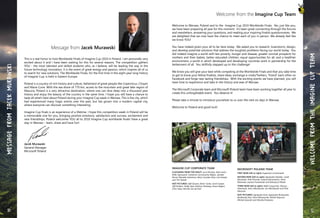
The Microsoft Corporate team and Microsoft Poland team have been working together all year to
create this unforgettable event. You deserve it!
Please take a minute to introduce yourselves to us over the next six days in Warsaw.
Welcome to Poland and good luck!
Imagine Cup Corporate Team
CLOCKWISE FROM TOP RIGHT: Luca Peruzzo, Steve Levin,
Millo Ognissanti, Catherine Cormoreche-Meljac, Jennifer
Perret, Monette Johnstone, Mary Corrales-Diaz, Lisa Harper,
and Tim Heikell
NOT PICTURED: Jeff Clausen, Brian Conte, Carol Cooper,
Jeff Dickens, Toddy Dyer, Kathryn Stenberg, Aaron Rogers,
Chris Yates, Michiel van de Poel
Microsoft Poland Team
FIRST ROW (left to right): Eugeniusz Licznarowski
SECOND ROW (left to right): Agnieszka Dziedzic, Jacek
Murawski, Piotr Kramek, Justyna Muranowicz, Anna
RĂłzanska, Joanna Frackowiak and Katarzyna Pekala
THIRD ROW (left to right): Rafał Czuprynski, Dariusz
Piotrowski, Artur Mackowiak, Jan Kleczkowski and Piotr
Marczuk
NOT PICTURED: Agnieszka Kruk, Agnieszka Rynkowska,
Bartłomiej Zass, Karol Wituszynski, Marek Kosycarz,
Michał Jaworski and Monika Kretowicz
10 11
MessagefromJacekMurawski
WelcomefromtheImagineCupTeam
About the Imagine Cup
Welcome to the Imagine Cup 2010 Worldwide Finals!
As the world’s premier student technology competition, the Imagine Cup is one way Microsoft is
encouraging young people around the world to apply their imagination, their passion, and their
creativity to technology innovations that can make a difference– today!
Now in its eighth year, the Imagine Cup has grown to become a truly global competition focused
on finding solutions to real-world problems.
Every year the Imagine Cup continues to expand and touch the lives of competitors all over the
world. In 2010, more than 300,000 students registered for the Imagine Cup competitions and
awards.
With the United Nations Millennium Development Goals as their guiding light, we invited
students around the world to harness their creative energy, their technical know-how and most
of all, their personal passion to take part in an urgent mission: "Imagine a world where technology
helps solve the toughest problems."
Teams were formed in a total of 124 countries/regions from Algeria to Vietnam and everywhere
in between. Each team and each individual student envisioned new ways to approach the world’s
problems and drawing on their unique skills and experience, they created stellar possible solutions.
Competitors chose to compete in one of the 5 competitions including: Software Design, Embedded
Development, Game Design, IT Challenge and Digital Media.
Each year the Imagine Cup also provides a chance to compete in specialized areas for additional
recognition. This year’s awards are:
	 •	 Envisioning 2020 Award entries expressed a vision for how technology could transform
		 people’s lives by the year 2020.
	 •	 Internet Explorer 8 Award competitors designed software applications that enhanced a
		 user experience by leveraging Web Slices, Accelerators and Search Providers in Internet
		 Explorer.
	 •	 Interoperability Award finalists devised solutions that leveraged out-of-the-box
		 Microsoft technologies and blended them with other technologies to connect people,
		 data, or diverse systems in new ways.
	 •	 Next Generation Web Award teams created an Open Source Web Application using
		 modern technologies such as ASP.NET and registered it for use in the Web Application
		 Gallery.
	 •	 Touch & Tablet Accessibility Award finalists created new education applications that
		 used Tablet technology while expanding the possibilities about how users can interact
		 with the computer.
	 •	 Windows Phone 7 “Rockstar” Award competitors were challenged to create a Windows
		 Phone 7 consumer application (app) in either Silverlight or XNA.
The Imagine Cup 2010 Finalists showcased in this publication have presented unique technology-
based solutions. These finalists have investigated the deepest problems in their countries, regions
and throughout the world and envisioned ground-breaking ways to solve these issues. Their
creativity demonstrates that technology is indeed the most crucial tool for a changing world.
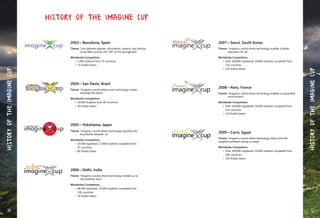
The Imagine Cup was founded in 2003 and has traveled the world westward from Barcelona, Spain
to Sao Paolo, Brazil to Yokohama, Japan to New Delhi, India to Seoul, South Korea to Paris, France
and down to Cairo, Egypt before heading up, this year, to Warsaw, Poland. The “cup” itself, a
trophy first awarded in 2003 when Software Design was the only category, has spent time with the
Software Design champions in the United States (2003-2004), France (2004-2005), Russia (2005-
2006), Italy (2006-2007), Thailand (2007-2008) Australia (2008-2009) and Romania (2009-2010).
This year the cup will travel from Romania to Poland and will be awarded to the winning Software
Design team on 8 July, 2010.
12 13
AbouttheImagineCup
AbouttheImagineCup
2003—Barcelona, Spain
Theme:	"Link between people, information, systems, and devices,
			 using Web services and .NET as the springboard."
Worldwide Competitors:
	 •	 1,000 students from 25 countries
	 •	 15 finalist teams
2004—Sao Paulo, Brazil
Theme:	"Imagine a world where smart technology makes
			 everyday life easier."
Worldwide Competitors:
	 •	 10,000 students from 90 Countries
	 •	 50 finalist teams
2005—Yokohama, Japan
Theme:	“Imagine a world where technology dissolves the
			 boundaries between us.”
Worldwide Competitors:
	 •	 30,000 registered, 17,000 students competed from
		 97 countries
	 •	 86 finalist teams
2006—Delhi, India
Theme:	“Imagine a world where technology enables us to
			 live healthier lives.”
Worldwide Competitors:
	 •	 68,000 registered, 24,000 students competed from
		 100 countries
	 •	 76 finalist teams
History of the Imagine Cup
2007—Seoul, South Korea
Theme:	“Imagine a world where technology enables a better
			 education for all.”
Worldwide Competitors:
	 •	 Over 100,000 registered, 59,000 students competed from
		 126 countries
	 •	 120 finalist teams
2008—Paris, France
Theme: “Imagine a world where technology enables a sustainable
			 environment.”
Worldwide Competitors:
	 •	 Over 200,000 registered, 59,000 students competed from
		 124 countries
	 •	 124 finalist teams
2009—Cairo, Egypt
Theme: “Imagine a world where technology helps solve the
toughest problems facing us today.
Worldwide Competitors:
	 •	 Over 300,000 registered, 59,000 students competed from
		 140 countries
	 •	 143 finalist teams
14 15
HistoryoftheImagineCup
In 2010, we once again asked all of the world’s most talented students - software programmers,
hardware developers, video enthusiasts and dreamers to "Imagine a world where technology
helps solve the toughest problems." The United Nations identified some of these tough problems
in its Millennium Development Goals. Imagine Cup 2010 uses these ambitious challenges as a
guiding light to inspire students to create change all over the world.
Everyone involved in the Imagine Cup 2010 at Microsoft is looking forward to witnessing another
year of the mind-blowing innovations from teams that stepped up to the challenge. We are
astonished by the resourcefulness and creative thinking students bring each year to the Imagine
Cup competition. And no matter who comes up with the
The Eight United Nations
Millennium Development Goals
The Millennium Development Goals were agreed upon by 189 nations around the world more
than nine years ago. They encompass universally accepted human rights such as freedom from
hunger, the right to basic education, the right to health, and a responsibility to future generations.
We are now less than 4 years from the target date – 2015 – by which the Millennium Development
Goals are to be achieved.
Imagine a world with less poverty, hunger and disease, greater survival prospects for mothers
and their infants, better educated children, equal opportunities for women, and a healthier
environment; a world in which developed and developing countries worked in partnership for
the betterment of all. Now imagine that you are part of the solution.
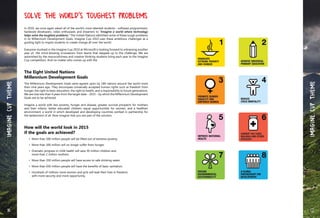
How will the world look in 2015
if the goals are achieved?
	 •	 More than 500 million people will be lifted out of extreme poverty.
	 •	 More than 300 million will no longer suffer from hunger.
	 •	 Dramatic progress in child health will save 30 million children and
		 more than 2 million mothers.
	 •	 More than 350 million people will have access to safe drinking water.
	 •	 More than 650 million people will have the benefits of basic sanitation.
	 •	 Hundreds of millions more women and girls will lead their lives in freedom,
		 with more security and more opportunity.
Solve the World's Toughest Problems
16 17
ImagineCupTheme
ImagineCupTheme
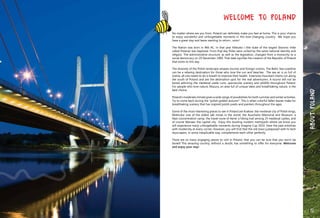
Welcome to POLAND
No matter where are you from, Poland can definitely make you feel at home. This is your chance
to enjoy wonderful and unforgettable moments in this ever-changing country. We hope you
have a great stay and leave wanting to return…soon!
The Nation was born in 966 AC. In that year Mieszko I (the duke of the largest Slavonic tribe
called Polanie) was baptized. From that day Poles were united by the same national identity and
religion. The administrative structure, as well as the legislation, changed from a monarchy to a
social democracy on 29 December 1989. That date signifies the creation of the Republic of Poland
that exists to this day.
The diversity of the Polish landscape amazes tourists and foreign visitors. The Baltic Sea coastline
can be a relaxing destination for those who love the sun and beaches. The sea air is so full of
iodine, all one needs to do is breath to improve their health. Extensive mountain chains run along
the south of Poland and are the destination spot for the real adventurers. A tourist will not be
bored admiring the medieval castle ruins, spectacular scenery and wildlife throughout Poland.
For people who love nature, Mazury, an area full of unique lakes and breathtaking nature, is the
best choice.
Poland’s moderate climate gives a wide range of possibilities for both summer and winter activities.
Try to come back during the “polish golden autumn”. This is when colorful fallen leaves make for
breathtaking scenery that has inspired polish poets and painters throughout the ages.
Some of the most interesting places to see in Poland are Krakow: the medieval city of Polish kings,
Wieliczka: one of the oldest salt mines in the world, the Auschwitz Memorial and Museum: a
Nazi concentration camp, the travel route of Aerie: a hiking trail among 25 medieval castles, and
of course Warsaw: the capital city. Enjoy this bustling modern metropolis where we know you
will experience many unforgettable moments during Imagine Cup 2010. Here the past entwines
with modernity at every corner. However, you will find that the old town juxtaposed with hi-tech
skyscrapers, in some inexplicable way, complements each other perfectly.
There are so many engaging places to visit in Poland, that you can be sure that you won’t be
bored! This amazing country, without a doubt, has something to offer for everyone. Welcome
and enjoy your stay!
19
AboutPOLAND
Event Schedule
Saturday 3 July
Arrivals and Registration
Group Photo and Opening Ceremony
The Imagine Cup Opening Ceremony will take place at the
Palace of Culture followed by Dinner at the Novotel.
Sunday 4 July
All Competition and Award Briefings
Competitions Commence
Monday 5 July
Award Competitions Commence
Competitions Continue
Finalist Announcement
Tuesday 6 July
Cultural Day at Castle of Pultusk
Finalist Presentation Rehearsals
Wednesday 7 July
Finalist Presentations
Thursday 8 July
Competitor Workshops
Showcase and World Festival
Party!!
Friday 9 July
Departures
20
EventSchedule
SOFTWARE DESIGN
Captains	Rob Miles	 Lecturer in Computer Science at the University of Hull 	 United Kingdom
	 Roger Lawrence	 Product Marketing Manager, Readify	 Australia
Judges	 Talal Al Rahbi	 Chief – Marketing and Awareness Division Technology Department 	 Oman
	 Dennis Anderson	 Professor, Information Systems, Pace University	 United States
	 Mauricio Angulo Sillas	 User Experience Advisor, Microsoft	 Mexico
	 JosĂŠ Barata	 Professor, New University of Lisbon	 Angola
	Guillaume Belmas	 Business Unit Manager, Wygwam	 France
	 Valentino Berti	 Chairman, IAMCP Microsoft Partner Association	 Sweden
	 Maria Bielikova	 Professor, Slovak University of Technology in Bratislava	 Slovakia
	 Sally Buberman	 Director, Wormhole IT	 Argentina
	 Tiago Cardoso	 Professor, New University of Lisbon	 Portugal
	Nannette Cutliff	 VP and CIO Technology Solutions, Pacific Service	 United States
	 Anil Dhawan	 Program Manager II, Microsoft	 United States
	 Ann Gates	 VP of Research, University of Texas El Paso	 United States
	 Tadeusz Golonka	 Independent Consultant and Coach, CDN-SA	 Poland
	 Sergei Golubev	 Co-founder, Creative Director at VerySoftware	 United Kingdom
	 Felienne Hermans	 AIO Lead, Delft University of Technology	 Netherlands
	 Jeffrey Huang	 Professor, Ph. D, Computer Science	 Switzerland
	 Andreas Judt 	 Professor, Ph.D., InformationTechnology, Duale Hochschule
		 BW Ravensburg	 Germany
	 Viktor Kauk	 MIC Director Kharkiv National University of Radioelectronics	 Ukraine
	 Martin Kulov	 Microsoft MVP, VSTS / Head of Development, ProPeople	 Bulgaria
	Guo Li	 Professor, Beijing University of Posts and Telecommunications	 China
	 Fernando Llopis Pascual	 Director of Polytechnic University, University of Alicante	 Spain
	 Ignacio LĂłpez	 Director, Wormhole IT	 Argentina
	 Kotaro Nakayama	 Assistant Professor, University of Tokyo	 Japan
	 Kerem Ozsu	 CEO, i-con Istanbul	 Turkey
	Nick Randolph	 Technical Consultant, Developer, Built to Roam	 Australia
	Gregory Renard	 CTO, R&D Manager, Wygwam 	 Belgium
	 Adam Skorek	 Professor, University of Quebec at Trois-Rivieres, Department of
		 Electrical and Computer Engineering	 Canada
	 K R Srivathsan	 Pro Vice Chancellor, Indira Gandhi National Open University	 India
	 Andrew Sterland	 Program Manager II, Microsoft	 United States
	Gwendolyn Tan	 Co-Founder, SGEntrepreneurs.com & Partner, Thymos Capital BD	 Singapore
	Etienne Tremblay	 Directeur AssociĂŠ, Technologie Microsoft	 Canada
	 Andrey Ustyuzhanin	 Associate Professor, Moscow Institute of Physics and Technology	 Russia
	 Tony Wasserman	 Professor, Software Management MS Program,
		 Carnegie Mellon Silicon Valley (CMSV)	 United States
	 Ahmad Yusoff	 Professor Datuk, Ph. D.,Vice Chancellor, Universiti Teknikal
		 Malaysia Melaka	 Malaysia
	 Bronwen Zande	 Director, Soul Solutions	 Australia
Microsoftwouldliketothank
thefollowingjudgesfortheirsupportof
theImagineCup2010WorldFinals
EMBEDDED DEVELOPMENT
Captains	 Scott Davis		 Group Marketing Manager, US-WEB Marketing, Microsoft	 United States
	 Gitte-Lena Andersen	 Program Manager, Prime 8	 United States
Judges	 Tien-Fu Chen	 Professor, Ph. D., National Chung Chen University	 Taiwan
	 Kevin Grey		 Software Development Engineer, Microsoft	 United States
	 Jim Hamblen	 Professor, Georgia Tech	 United States
	 Thierry Joubert	 Theoris	 France
	 Sam Phung		 Vice President, Sales and Marketing for ICOP Technology	 United States
	 Tao Pin		 Ph.D. Researcher Tsinghua University	 China
GAME DESIGN
Captain	 Andrew Parsons	 Academic Initiative Lead for Microsoft	 Australia
Judges	 Lea Bartlett		 Head of School Canberra Campus and Programming Course
			 Coordinator at Academy of Interactive Entertainment	 Australia
	 Petri Lankoski	 MA, Lecturer, School of Art and Design, Aalto University	 Finland
	 Gregg Mayles	 Game Designer, Rare	 United Kingdom
	 Peter Raad		 Founding Director of the Linda and Mitch Hart eCenter at SMU	 United States
	 David Wildgoose	 Editor, Kotaku	 Australia
DIGITAL MEDIA
Captain	 Paolo Tosolini 	 Social Media and Online Video Consultant	 United States
Judges	 Chai Wah Wu	 IEEE Fellow	
	 Beata Bochinska	 President, Institute of Industrial Design	 Poland
	 Michael Johnstone	 Director of Operations and Business Strategy, DECE, LLC	 United States
ENVISIONING 2020 Award 			
	
	 Steve Clayton	 Senior, Director, Future of Technology, Microsoft 	 United States
	 Walt McGraw	 Director of Corporate Vision & Innovation	 United States
	 Ian Sands		 Senior Director of Envisioning, Microsoft	 United Kingdom
				
INTEROPERABILITY award
	 Dennis Anderson	 Professor, Information Systems, Pace University	 United States
	 Tiago Cardoso	 Professor, New University of Lisbon	 Portugal
	 Rob Miles		 Lecturer in Computer Science at the University of Hull 	 United Kingdom
	 Jas Sandhu		 Technical Evangelist, Interoperability Strategy Team, Microsoft	 United States
				
TOUCH & TABLET accessability award 	
	 Lora Heiny		 Business Development Consultant, Projectline Services	 United States
	 Mark Hopkins	 Senior Programming Writer, Microsoft	 United States
	 Annuska Perkins	 Sr. Accessibility Program Manager, Microsoft	 United States
	 Jane Prey		 Senior Research Program Manager, Microsoft Research External Research	 United States
	 Joseph Tront	 Professor of Electrical and Computer Engineering, Virginia Tech	 United States
22 23
WorldwideFinalsJudges
MeeTtheFINALISTS!
The Software Design competition pitches student teams from around
the world up against some of the toughest problems of the age. The
United Nations Millennium Development Goals serve as a backdrop for
innovative technical solutions that address real-world problems.
The teams described in the following pages are all real winners whose
technical ability and innovative ideas have got them here to show off
their solutions and represent their country/region in the Imagine Cup
Worldwide Finals.
For the students in these teams the Imagine Cup Worldwide Finals
represent a huge step on the road to a great future. Many of them will
start their own companies, work at major corporations, begin a non-
profit organization or even integrate their solutions into key programs
for government agencies. One thing is certain – more than one of
these teams is definitely on their way to changing the world.
25
26 27
BilyLand Team
Team Members:
Chambi Abderraouf
Chegrane Ibrahim
Seghier Athmane
Redouane Billel
Mentor:
Elkindi Rezig
TITLE OF PROJECT: VIHM (Vision Interaction Between the Man and the Machine)
Project Overview: Our project developed a system capable of capturing simple movements (or signs) from the user
with any part of their body (hands, head or eyes), and then translating them into instructions that can be executed by
a computer. For example, choosing a file, scrolling through documents, playing music, movies etc. This works because
one part is based on a camera connected to the computer (webcam) and then a database that contains the various
movements and recognizes signs and their meanings. This application can make life much easier for handicapped
people and that was the focus of our idea.
United Nations Millennium Development Goal (MDG): Promoting equality between people. Helping people
with disabilities.
Inspiration: Our inspiration was a computer vision license project. Detecting any abnormal movements in a crowded
area.
Why Imagine Cup? We chose to compete in the Imagine Cup to show and improve upon our skills and abilities, and
of course, to win!
Imagine Cup Experience: This one is our first Imagine Cup.
Lessons Learned: Learning new technologies and new methods of team work and speaking in public and defending
our ideas. Those were the lessons learned.
Advice: Never underestimate your abilities, always participate, have the will and make the change on your side.
Algeria
Casper
Team Members:
Sona Aramyan
Artur Mkrtchyan
Erik Ghonyan
Harutyun Terteryan
TITLE OF PROJECT: Baby Care
Project Overview: Baby Care is a powerful monitoring system that enables health organizations to identify and alarm
observable baby's health imbalance before the beginning of a critical situation. Using different kinds of health devices,
Baby Care monitors babies (patients) to ensure temperature, pulse and other parameters are properly in check. All
kind of health devices and measured output parameters can be easily integrated with Baby Care. In the event of non
standard temperature and other parameters, Baby Care can alert health staff about these problems, allowing them to
begin appropriate processes before achieving a critical situation. With Baby Care you'll have chance to see historical
data related to different diseases, regions etc. Baby Care has an integrated Map and Reporting module. The device will
have embedded GPS module so health stuff can identify patient's location. Baby Care allows parents and health staff
to see a baby's health status in near real-time, from any web browser and sends them notification in case a threshold
is met or exceeded.
United Nations Millennium Development Goal (MDG): Reduce child mortality.
Inspiration: The inspiration of this project was a sick one year old baby, who died from a simple flu because of the
mother being unaware.
Why Imagine Cup? Our goal was to reduce child mortality from simple diseases which are more or less easy and
able to be monitored.
Imagine Cup Experience: This one is our first Imagine Cup.
Lessons Learned: The biggest lesson was the integration of our project in to a business.
Armenia
1337
Team Members:
Trung Le
Phuoc Nguyen
Tan Nguyen
Duc Nguyen
Mentor:
Dat Tran
TITLE OF PROJECT: KidDev Studio
Project Overview: Our KidDev Studio project allows teachers and parents the ability to create their own interactive
stories as well as literacy quizzes that work even for those who are still learning how to spell and recognize words.
KidDev Studio supports vision impaired and blind kids through providing a multi-touch screen monitor, text-to-speech
capabilities and speech recognizer to communicate with the system. KidDev Studio also supports kids in developing
countries through using multi-point mouse technique to build interactive applications that allow many kids, each with
their own mouse, to simultaneously learn and play on a single PC.
United Nations Millennium Development Goal (MDG): Achieve universal primary education
Inspiration: Reducing childhood illiteracy in accordance with the United Nations' Millennium Development Goals and
ensuring by 2015 children everywhere, boys and girls alike, will be able to complete a full course of primary school.
Why Imagine Cup? This is the great chance to meet friends around the world who are interested in creating helpful
software products, to learn new knowledge and skills, and to show our solution to the world in Poland. Also to win the
prize of $25,000.
Imagine Cup Experience: This is our first Imagine Cup
Lessons Learned: The biggest lesson we have learned is how to equally share our work among team members.
Advice: Beside good ideas, students should prepare software related knowledge to deploy those ideas on time.
Contact Information:
http://ise.canberra.edu.au/dtran/activities/imaginecup2010/
Australia
Genius Touch
Team Members:
Ahmed Majdi
Abdulrahman Al Jowder
Ghassan Ali
Ahmed Al Tayeb
Mentor:
Alauddin Al Omary
TITLE OF PROJECT: Cash Trash
Project Overview: Cash Trash is simply a multi functional smart recycle bin that will be used by the public to dispose
of any recyclable materials. The device will contain a system that will count points for users every time they use the
device. Points will be exchanged later for valuable vouchers in favour for that user. The main idea of the Cash Trash
project is to spread the knowledge about the advantages of recycling among people and to encourage them to
take reasonable steps to prevent such problems. Cash Trash objective is to create a solution that provides the road
to achieve a stable, clean and pollution free environment, an environment that suits the existence of current and
future generations. The mission cannot be accomplished unless all the factors that cause the environmental pollution
are eliminated, and people are encouraged to use healthy methods in the process of wastes disposal.Recycling also
effectively reduces environmental pollution.
United Nations Millennium Development Goal (MDG): Environmental sustainability
Inspiration: We have reached a point where the pollution has become a threat to human existence (results of the
Copenhagen Climate Change Conference 2009). The solution for the pollution problem is recycling. But the problem
is that, people don't care about recycling because they are not aware of the size of the problem and they lack the
motivation to use recycling. We knew that we can and we have to do something to solve this problem. And this is why
we invented Cash Trash
Why Imagine Cup? To show the world that any idea even if it was simple, can change the world. And because we believe
in our idea and ourselves, we know that real hard work can make the impossible turn in to the possible. 	
Imagine Cup Experience: This is the third year for us in Imagine Cup. We have competed in 2008,2009, and now in
2010. 	
Lessons Learned: If you have never failed, you have never lived. Life equals risk. 	
Advice: Believe in yourself and never give-up.	
Contact Information: www.cashtrash.net
Bahrain
28 29
Team Belgium
Team Members:
Wouter Devinck
Niels Derdaele
Jeroen Verhulst
Sebastiaan Polfliet
TITLE OF PROJECT: Biamori
Project Overview: We have built an extensible social networking platform for partnerships, on top of existing
networks such as Facebook and Twitter.
United Nations Millennium Development Goal (MDG): Global partnership, but we believe our project directly
influences most other MDGs as well. 	
Inspiration: The existing partnerships that members of our team are involved in. Examples being the partnerships
between schools, hospitals in Ostend, Belgium and in Banjul, Gambia, West-Africa. The language exchange partnerships
between schools in Flanders (Dutch) and in the Walloon Region (French) was also inspiration. 	
Why Imagine Cup? The Imagine Cup is a great way to think about the world's problems and try to solve those
problems using our passion, and technology. In addition to this, the Imagine Cup is an amazing opportunity to learn
teamwork and presentation skills. 	
Imagine Cup Experience: For most of our team it is our first. Wouter is the only exception, he participated in
Imagine Cup 2007 too. 	
Lessons Learned: Working in a small team isn't as easy as it seems, it's important to clearly describe each task, who
will take care of it and set deadlines. 	
Advice: Start early and make sure to define your ideas properly. 	
Contact Information: www.biamori.be
Belgium
Proativa Team
Team Members:
Amirton Bezerra Chagas
JoĂŁo Paulo dos Santos Oliveira
Lucas AraĂşjo Mello Soares
Edgar JosĂŠ CĂŠsar de Figueiredo Neto
Mentor:
FlĂĄvio Almeida AraĂşjo Sobrinho
TITLE OF PROJECT: Pro@Edu
Project Overview: Pro@Edu is a Software + Services solution for Distance Learning that integrates the learning
process into the students' day-by-day activities. By turning the learning process into a social, fun, and ubiquitous
experience, we bring Distance Learning one step closer to achieving its true potential as a tool to bring education to
places it has never been before, thus achieving its true potential as an educational paradigm.
United Nations Millennium Development Goal (MDG): Achieve universal primary education 	
Inspiration: Distance Learning is a promising educational paradigm but it's still needs to achieve its full potential.
Distance-based courses tend to have unacceptably large evasion rates. We identified this problem by seeing it happen
with family and friends. They would quit their courses, and give up on learning. We started to look further into the
subject and identified that using the right technologies in the right way can help this paradigm. Breaking the barriers
of education.
Why Imagine Cup? Initially, we found great the social commitment that Microsoft performs, and its initiative on
revealing new talents on technology through Imagine Cup. It’s a competition that adds immeasurable values to a
student’s team, inspiring us to study new technologies and develop our ideas from design to marketing, always focusing
on solving the problems the world needs the most. 	
Imagine Cup Experience: This is our second Imagine Cup. Our team won 1st place for the Interoperabilty Award at
Imagine Cup 2009. Our new teammate is from the team that was awarded 1st place in Game Development that same
year.	
Lessons Learned: Creating and maturating the ideas behind a new product is always fascinating. While developing
our Imagine Cup project, we were always faced with problems that required much imagination and a lot of effort to let
the ideas take their final form. This process, which involves interviewing specialists, acting directly with possible users,
trying and evaluating processes and products is very motivating, and finally brings great growth to us, as professionals
and individuals altogether.	
Advice: Never give up. Believe in your yourself and, most importantly, believe in your idea. Work together with your
friends and teachers and improve your initial draft. Don't be afraid to demonstrate it to other people, because they can
contribute to the evolution of your project! 	
Contact Information: http://www.proativasolucoes.com/
Brazil
30 31
IThink
Team Members:
Veronica Milcheva,
Evgenia Milcheva
Evelina Dimova
Mentor:
Martin Damyanov
TITLE OF PROJECT: Health Guide
Project Overview: Our team IThink has developed a Silverlight Web Application that solves some of the UN
Millennium Development Goals. The project developed two modules – Traveler’s Health Guide & Children Interactive
Guide. The project can be applied for many types of society. We can help people be healthier by using our application.
Users can access actual information (with or without Internet) about most common diseases, epidemics and allergies
when they travel or protect their children by educating them with our interactive book.
United Nations Millennium Development Goal (MDG): Achieve universal primary education, Reduce child
mortality, Improve maternal health, Combat HIV/AIDS, malaria and other diseases, Develop a global partnership for
development 	
Imagine Cup Experience: This is the second time we participated in the Imagine Cup. Last year, 2009 was our first
time competing. However this is the first time we have won and are participating in the Worldwide Finals.
Advice: You must be ambitious and not give up no matter what problem appears	
Contact Information: http://ithink.imaginecup2010.net/
Bulgaria
GNG: "Glows and Glories"
Team Members:
Wen Lu
Chao Wang
Han Zhou
Ting Yu
Mentor:
Zheng Zhang
TITLE OF PROJECT: Palantir
Project Overview: Palantir is an intelligence public transportation system enhancing the travelling experience, bus
dispatching efficiency and road conditions. The vision of Palantir is that "Everyone explores a "Healthy and Sustainable
world with Public Transportation". Public transportation has been advocated and highly praised for years when it comes
to environmental and traffic congestion problems. But it still has a bunch of problems which make it not the first
choice for many citizens. Then GNG came up with 3 main approaches to this problem: a deeper sense, wider interaction
and further application. We designed a bus vehicular system and a kind of intelligent street lamp and traffic light. We
connected this design to other parts of the transportation infrastructure incorporated with a wireless network.
United Nations Millennium Development Goal (MDG): Promote environmental sustainability
Inspiration: Public transportation has been advocated for and highly praised for years as a solution to environmental
and traffic congestion problems. But it still has many disadvantages which often makes it not the first choice for many
citizens. A lot of countries promote taking a public bus instead of the private car. We wanted to find a way for everyone
to love taking the bus instead of being pushed to take it.
Why Imagine Cup? I think everyone has dreams to make the world better, by technology, art,or other means. And
hope to make it come true. This is a platform for you to realize your dream when you are still young! Meanwhile, the
Imagine Cup is a chance to exchange our dreams and ideas. Also it will be a amazing and mysterious trip!	
Imagine Cup Experience: Yes for most of us it is our first Imagine Cup. We have a teammate who had an Imagine
Cup journey last year. He made it to 3rd place in the Multipoint Award. His experience has helped us a lot. 	
Lessons Learned: It is very hard to make a reliable timeline for a project. If you don't take everything you need into
consideration when you are making the timeline, your timeline may not be useful at all. At the same time, you should
learn from each other. A team makes everything become true.
Advice: It is not only just a game about the technology, but a chance for you to come up with a product which meets
the needs of the market and society or an idea which can be achieved in future to make a positive impact on the whole
world. So, you need to take almost everything into consideration, the technology, the vision, the strategy, the business
plan, and even the promotion plan. Last but not the least, make it become true.
Contact Information: http://glowsandglories.com/
China
32 33
TITLE OF PROJECT: Be A Fighter
Project Overview: Our project is called "Be A Fighter". It's an application aimed to aid in the rehabilitation of people
affected by landmines and other war weapons. It is specially geared toward people living in rural areas since they
can't afford a treatment in an urban center. These people found, in their way home, that one of these artifacts could
change their life in seconds. Most of these people live in extreme poverty. Through "Be A Fighter" the therapist will
have several tools to manage treatments, in this way patients will have an efficient remote rehabilitation. The treatment
will be customized for each person, due to possible restrictions based on their conditions after the accident. Once
rehabilitation is done, survivors will be able to be back to perform activities they used to perform before the accident.
And they will be able to take an ICT's course (which is the second module of "Be A Fighter").
United Nations Millennium Development Goal (MDG): Eradicate extreme hunger and poverty.	
Inspiration: Our inspiration is based on a reality that we see in our country, and in many others. We live in a country
seriously affected by landmines. Our solution will greatly impact the lives of those affected by these devices that bring
disastrous consequences for physical and mental health. Our inspiration also stems from the lack of hope that these
victims face. Hope we believe we can achieve with our technology solution.
Why Imagine Cup? We signed up for Imagine Cup because we wanted to apply our knowledge to solve real
problems, which often appear to be unrelated to our major.
Imagine Cup Experience: This is our first time competing in the Imagine Cup. We are so excited that our first project
was good enough to make it to the Finals. It shows that great ideas do not have restrictions.
Lessons Learned: We have learned that challenges in life are full of ups and downs, moments when everything goes
well and others where it seems there's no light at the end of the tunnel. But faith must always remain there, and you
have to believe that dreams come true. 	
Advice: The most important issue of this initiative is to compete with innovative ideas, dream how to solve real
problems with technology and realiza it is possible to go far. Beyond using technology to create applications it is
important to solve real problems in an easy way. 	
Mindhood
Team Members:
Luis Miguel GonzĂĄlez Burgos
Catalina Sierra Zamudio
Lina Marcela Quintero Villareal
Nathaly RamĂ­rez SolĂ­s
Mentor:
Andrea RamĂ­rez Salgado
Colombia
TITLE OF PROJECT: Quantum Quest
Project Overview: Our project is a social network to share content for free, using a paradox of RPG video games.
We strive for this knowledge to be fun, and interesting to children. We offer in our app, rewards for efforts, and the
opportunity to trade in the rewards (like coins) for personal things, for app environment, like skins, pets for your
avatar, clothes and other things. On the other hand, we created another interface for professors where they can track
the results, upload content and create their own guides, and support material for their classes. And all can be shared,
creating a peer to peer network.
United Nations Millennium Development Goal (MDG): Universal primary education
Inspiration: Costa Rica has fee public education for primary and secondary schooling. College students have good
opportunities in public universities, with low prices and options for scholarship. This is our opportunity to thank our
country for these opportunities they have provided to society.
Why Imagine Cup? Last year, 3 of us thought about competing in Imagine Cup 2009, but in that moment, we did
not create a project. For this year a friend decided to join us, and we all accepted the challenge
Imagine Cup Experience: It's our first time, and the second for our country.
Lessons Learned: Teamwork. In a situation like ours it can be difficult to do. Everybody has good ideas, but in some
cases we needed to negotiate and find a common point view.	
Advice: Believe in your potentials, if you want - you can!
Contact Information: http://projectquantum.net
Quantum
Team Members:
Manuel Araya
Ricardo Estrada
Francisco Jimenez
Stephan Torres
Mentor:
Javier Loria
Costa Rica
34 35
TITLE OF PROJECT: UbiquityHealth
Project Overview: UbiquityHealth intends to create a world where people are safe and healthy wherever they live,
whoever they are or how rich or poor they are. It creates accesibility for both patients and health professionals to critical
information about health and provides a strong framework of exchange of knowlegde (regardless of the language
people speak) and the decision making of disease tracking.
United Nations Millennium Development Goal (MDG): Ameliorate child health; Improve maternal health;
Combat hiv/aids, malaria and other deseases; and Implement global partnership.	
Inspiration: Our inspiration was based on the difficulty for health technicians to keep information about patients, and
the lack of knowledge and mastering in some fields of health.
Why Imagine Cup? Our motivation is to win the Imagine Cup Worldwide Finals. We also wanted to learn more about
technology and create something out of our imagination that can really help.
Imagine Cup Experience: No, it is not our first time. We are competing for the second time. This year (2010) and in
the year before (2009). 	
Lessons Learned: We have got a deeper knowledge about working as a group and how to design a vast project when
every member of the team has his own unique view. Each of us had a different understanding of the project and strived
to make the others accept their ideas. We were able to do something right - because we are on our way!
Advice: Never give up. What you do is limited to your imagination and yourdetermination to achieve something even
if difficult. I don't think striving with a lost semi-colon in a code is a pleasant situation. Where there is difficulty, there
is a way. My greatest regret is that sometimes people get good ideas but have no means to make it work.
Contact Information: www.ubiquityhealth.comyr.com
ULTeam
Team Members:
Marc AndrĂŠ Attemene
Souleymane Cisse
Kevin Aurel Gratias Olayinka Gougou
KouamÊ Jean-François Yoboue
Mentor:
KouamĂŠ BenoĂŽt Yao
CĂ´te d'Ivoire
TITLE OF PROJECT: Think Green
Project Overview: The current global economic slowdown, which follows and partly overlaps with the food and fuel
crisis, is at the core of the sharp increase in world hunger. It has reduced incomes and employment opportunities of
the poor and significantly lowered their access to food. The incidence of both lower incomes due to the economic
crisis and persisting high food prices has proved to be a devastating combination for the world's most vulnerable
populations. Think Green is a system design to bring technology and knowledge to the farmers, helping them to
increase food production. Undeveloped and poor parts of the world would be the ones to benefit the most with Think
Green, making a small step towards ending hunger. The system is used for monitoring and regulating conditions in a
greenhouse. The greatest feature of all is its ability to circle the geographical limitations that numerous cultures have,
allowing growth of required cultures virtually anywhere. Another exceptional feature is that the know-how comes from
top experts all over the world who provide the system with their knowledge from their workplace and remotely load its
database with the wealth of their experiences. The user doesn't need to be an expert food grower because the system
guides them through the process of food production.
United Nations Millennium Development Goal (MDG): Eradicate extreme poverty and hunger.
Inspiration: We stumbled upon some daunting facts. Although we are living in an era of great technological
advancements, hunger is still a vast problem. More than a billion people are hungry and undernourished around the
world. Every day, almost 16,000 children die from hunger-related causes. That is why we decided to contact the experts
who deal with this problem and with them, we designed a system that will help to solve this problem.
Why Imagine Cup? As young people with fresh ideas, we wanted to put them into action and try to make a
difference in the world and our community. Imagine Cup is an ideal place for that. On one side we wanted to learn
new things, explore new technologies and ideas. On the other side we wanted to meet experts from this area, and learn
more about this problem and how to help solve it.
Imagine Cup Experience: Yes, this is our first Imagine Cup. 	
Lessons Learned: This was a great opportunity to see how things work in real life, how to be a good team member,
and how to solve concrete problems. We have learned so much from each other and especially from our mentors. We
are grateful for the chance to make a difference and use technology in a rewarding and positive way.
Advice: It's a lot of work, but it's worth it!
Contact Information: http://thinkgreen.dump.hr
Think Green Team
Team Members:
Ivana Bilus
Frane Roje
Mislav Tomic
Nebojsa Veron
Mentor:
Marko Matijevic
Croatia
36 37
GINA Team
Team Members:
Zbynek Poulicek
Petra Bacikova
Boris Prochazka
Mentor:
Adam Herout
Czech Republic
Falcon Dev
Team Members:
Vicente Anilema
Henry Paca
Juan Morales
Manuel Moreta
Mentor:
IvĂĄn Menes
Ecuador
38 39
TITLE OF PROJECT: GINA
Project Overview: The GINA (Geographical INformation Assistant) Project introduces an innovative software system
for mobile equipment offering navigation in difficult terrain, co-ordination of teams and the efficient exchange of
geographical information. Its features make it an ideal tool for rescue teams, expeditions and other groups operating
in extreme environments. GINA is an ambitious project aimed at becoming an internationally recognized framework
for managing and co-ordinating rescue missions around the world. For this reason, a business plan has been created,
a safety policy determined, and several humanitarian organisations and rescue services contacted. We have been
co-operating in this project with "Hand For Help", an organisation with extensive experience in foreign humanitarian
missions. They have prepared a mission to build a field hospital in Haiti. The GINA system will assist in finding the most
suitable location for the hospital and will also be used for detailed monitoring of reconnaissance units as the area is still
affected by frequent riots and a high risk of kidnapping.
United Nations Millennium Development Goal (MDG): Ensure environmental sustainability
Inspiration: The first inspiration was a long tradition of Imagine Cup at our school. The Haiti apocalypse motivated
us to push harder and make software that could help in such situations. From the outset, we have been co-operating
with experts in life saving operations. We work closely with Hand for Help, an organisation that is testing our system
in the field in Haiti. The use of the application in real situations motivates us to keep pressing on and to continue with
further development of the GINA system.
Why Imagine Cup? We have always wanted to participate in some international competition and Imagine Cup is a
great opportunity and challenge for us. The competition gave us the motivation to work on a meaningful project and
meet interesting people.
Imagine Cup Experience: Yes, it is our first Imagine Cup.
Lessons Learned: Cooperation with the police, fire brigades, mountain rescue service and Hand for Help, who assisted
us by sharing their experience and thus helping us to create the most useful application.
Advice: Go and try it! For us, Imagine Cup was the biggest professional experience in our lives.
Contact Information: http://www.ginasystem.com/
TITLE OF PROJECT: EASY
Project Overview: Aided Education Software (EASY) is a project that translates voice to sign language, with the aim
of contributing to children who have hearing problems and also with schools, organizations and foundations that
support them, so that these children can attend regular schools. EASY helps hearing impaired children receive their
lessons because the teacher's voice translates the sign language through a computer or other electronic device, such as
a mobile telephone. With a simple interface, students with hearing impairments can be fully integrated into a regular
school. As part of the integration of hearing impaired children outside the classroom, students with a smart phone also
can communicate more easily with people who do not know sign language. Currently the system is running as a pilot
in the "College of the Deaf of Chimborazo" in Ecuador, with excellent results for the community.
United Nations Millennium Development Goal (MDG): Achieve universal primary education
Inspiration: Our inspiration was the difficult access that the hearing disabled children have and to try to better
integrate them into a regular classroom.
Why Imagine Cup? Because we want to demonstrate that our country has potential. Our challenge was to help the
children all around us.
Imagine Cup Experience: This is our first Imagine Cup 	
Lessons Learned: We got in touch with many people that have disabilities. They showed us that we can keep on
going no matter what problems we may have.
Advice: Follow your dreams and never give up.
Contact Information: www.espoch.edu.ec
TITLE OF PROJECT: Gesture Talks
Project Overview: It started from an idea in our graduation project, this year. We found that vocally challenged
people face many problems. They can't communicate with the public. They can't easily deal with textual language,
because they are more familiar with sign language. Also teaching vocally challenged students is a very challenging
task. The project, Gesture Talks, tries to overcome these three main obstacles and help the vocally challenged with their
needs. It presents an accessibility feature that integrates with Windows, so that a user can have any text translated in to
sign language. Also, it provides an add-in that enables users to use sign language instead of using the keyboard when
chatting with messenger. Finally, it offers an educational application that targets vocally challenged students and their
teachers. Therefore providing an easier way to navigate the education process. Finally, we hope that our project really
has a positive effect on our society.
United Nations Millennium Development Goal (MDG): Achieve universal prime education and promote gender
equality and empower women.
Inspiration: Once, at the beginning of our final studying year, we were waiting for the metro in the metro station. We
saw a boy, standing on our side, talking to a girl on the opposite side in sign language. We decided to find a way to
translate sign language to text and vice versa using a computer. And that was just the start.
Why Imagine Cup? Because we are driven by the love of our country, desire to change, passion of youth and the
need to prove that we are good men. Yes, that's it. We wanted to prove we are good men. We wanted to do a project
that will have a postitive effect on society.
Imagine Cup Experience: One of our members, competed in Imagine Cup 2009 in the Software Design category.
Lessons Learned: Be positive, be proactive, take part, participate, and compete. If you don't try you'll never know.
Finally, life is a matter of give and take.
Advice: Time is your biggest enemy, so watch out. Also every single tiny point counts.
Team19
Team Members:
Fadi Fawzi Nasief
Mohamed Mostafa Ismail
Nour El-Dien Mahmoud
Walied Salah Ismail
Mentor:
Hazem Abbas
Egypt
TITLE OF PROJECT: Signbook
Project Overview: The concrete objective of Signbook is to develop an easy to use multilingual open platform for
signs, where registered users can share signs, learn, comment and evaluate them through social media. Signbook is
made to produce educational easy-to-use materials about the linguistic study and terminology work in the field of sign
languages (SL). This will also increase the general knowledge of the structure of sign language.
United Nations Millennium Development Goal (MDG): Achieve universal primary education and Global
partnerships.
Inspiration: Solving problems that affect sign language learning and sharing.
Why Imagine Cup? We wanted to present our technical abilities by solving a real problem and possibly succeeding
in a worldwide competition.
Imagine Cup Experience: This is our first Imagine Cup.
Lessons Learned: Working as a team to build a real application on a tight deadline.
Advice: Get a good team together that can work together even when stressed to the limit.
Contact Information: http://twitter.com/teamsignbook
Signbook
Team Members:
Petteri Lehtonen
Kimmo Koski
Johannes Maliranta
Tomi HärkÜnen
Finland
40 41
TITLE OF PROJECT: Babies' Angel
Project Overview: Babies' Angel helps young parents by proposing the first real-time monitoring system capable of
sending alerts on to a mobile phone. In case of an incident, receive in real time on your mobile phone all necessary
information to save your baby, and be put in quick connecti on to emergency medical services.
United Nations Millennium Development Goal (MDG): Reduce child mortality
Inspiration: The mother of a team member works in a maternity hospital and he is regularly touched by the stories of
infant deaths. It's the reason why this theme was very important to us. So we decided to try to decrease the number
of sudden infant deaths.
Why Imagine Cup? We saw in the Imagine Cup a way to make our project known and to find a good chance to
market it. If we succeed and are able to save just one and only one life, our work will not have been vain.
Imagine Cup Experience: Yes, it's our first Imagine Cup!
Lessons Learned: We all learned that each of us can participate to the conception of the application! It's hard to have
all of us agree on the same topic! So the team collaboration and ability to compromise was the hardest thing we have
done.
Advice: Find a good topic! Believe in your project and make the competition a good experience.
Contact Information: www.facebook.com/profile.php?id=100001092694010&ref=ts
Babies' Angel
Team Members:
Fabien Deknuydt
Arthur Tarlay
Julien Roche
France
TITLE OF PROJECT: Mediator
Project Overview: Despite the intensive effort and commitment by relief organizations and governments, the state
of health care in developing countries is in a critical state. To improve the weak medical supply in developing countries,
many systems have been developed that detect supply gaps and make them apparent. Mediator is a web portal
that makes a contribution to sustainable medical supply by supporting the setup and the strengthening of a local
medical infrastructure in these developing countries. The exact demand for essential medicines is determined and
the relevant relief organizations are notified. Based on the speed, affordability and reliability Mediator determines
which local medicine suppliers are best suited to satisfy a given need. Because the system is focused on a medical
supply via local suppliers, the dependence on external help is minimized and the local infrastructure of the affected
regions is invigorated. Through targeted networking and the expansion of the collaboration of relief organizations,
aid organizations and medical suppliers, a fundamental supply of essential medicines is guaranteed. Furthermore, an
important part of the Mediator system is a prediction system, which predicts the demand on essential medicines that
is likely to arise.
United Nations Millennium Development Goal (MDG): Reduce child mortality, Improve Maternal Health,
Combat HIV/AIDS, Malaria and other diseases, Global partnership for development
Inspiration: We want to empower the people in developing countries to help themselves and not be dependant on
drug donations.
Why Imagine Cup? At first, we decided to compete in the Imagine Cup, because we could combine the participation
with a mandatory course in our studies. As we were gathering information to come up with an idea on how to support
the Millennium Goals, we understood that help is needed and necessary. The deeper we entered the area of development
aid the more we got involved emotionally. From the moment we presented our idea to relief organizations for the first
time, we felt like we could really change something.
Imagine Cup Experience: Yes, this is our first Imagine Cup competition. 	
Lessons Learned: It is very important to contact the parties that are involved in the domain and ask them for
feedback and suggestions. You might not get feedback from all parties, but you should never give up seeking support
from them. And in a complex domain, it is most important to have a flexible architecture, so that one can react very
fast to that feedback and change the application in a way, that works best for all.
Advice: Although the theme of the Imagine Cup can be very challenging, it is most important to face the challenge.
You should remain patient when you are working on the general idea and you shouldn't rush things. Another important
thing is to get team members who can work together over a long time. Creating a good solution takes a lot of time and
effort and everybody should be ready to step in and help a teammate when time is running out.
Contact Information: http://de-de.facebook.com/pages/Mediator/112989092068847
Mediator
Team Members:
Sina Jafarzadeh
Ronny Kaiser
Christian Piechnick
Maria Tschierske
Mentor:
Sebastian Richly
Germany
42 43
Megadodo
Team Members:
Giorgos Karakatsiotis
Vangos Pterneas
Greece
Invisible Ideas
Team Member:
Supreeth Selvaraj
India
44 45
TITLE OF PROJECT: Touring Machine
Project Overview: Touring Machine is a personal tour guide that can be used for educational purposes. It is available
in two editions: web edition and Windows Phone edition. Using a Natural Language Generation System, Touring
Machine produces personalized descriptions for the exhibits. The descriptions are not pre-written, but are generated
on the fly. That way, we can bind the descriptions to that user's specific needs. For example, descriptions addressing
children use easier to understand language with more commonly used words. Also, the system produces comparisons
between the exhibits that have already been described and the one currently being described ("Like the "stoa" that you
saw earlier, this temple..."). The web edition creates a 3D representation of the place which the user can navigate using
a keyboard, a mouse or a touch screen. Finally, regarding the Windows Phone edition, the system is location aware and
it reorganizes the list of the exhibits according to the user's current position (it can also produce spatial expressions).
This way, each tour is a unique experience for each user!
United Nations Millennium Development Goal (MDG): Achieve universal primary education.
Inspiration: Millions of people (especially children) never have the chance to learn about archeological exhibitions,
sites and monuments. Furthermore, many of them cannot visit museums due to many different reasons (poverty,
distance, etc). Touring Machine offers free (or low-cost) education for everyone.
Why Imagine Cup? Imagine Cup encourages innovative ideas.
Imagine Cup Experience: Yes, it is our first Imagine Cup.
Lessons Learned: The limits of innovation are the limits of our imagination.
Advice: Find a good topic! Express yourself and have fun.
Contact Information: www.vangos.eu
TITLE OF PROJECT: FleX
Project Overview: My project is called Fun Learning Experience (FleX) and as the name suggests its aim is to make
learning fun. While incorporating educational content in to games is one way of making learning fun, schools in
countries like India cannot afford to provide each student with a computer. Therefore 3 or 4 students are made to share
one computer. In such a scenario a dominating kid takes control of the computer and does not let the others use it. The
others have to simply sit around and watch, and hence lose interest in learning. FleX solves this problem by using the
Windows Multipoint SDK to provide each user (having a mouse) with an individual mouse cursor, enabling everyone to
interact with the application simultaneously. It fosters learning in a collaborative as well as competitive environment.
The software consists of educational games and activities to keep students interested while they learn. Questions and
other content for the games are created by the instructor using the teacher module of the system. The content for
the games can be shared among teachers anywhere in the world and used wherever FleX has been deployed thus
providing a large collection of question sets and also enabling collaboration among teachers.
United Nations Millennium Development Goal (MDG): Achieve universal primary education.
Inspiration: There are nearly 120 million children that attend school in India and 700,000 of these schools are located
in rural areas. These areas which cannot afford to provide each student with computer access. The opportunity to make
an impact on such a large scale was enticing and this is what inspired the theme of my project.
Why Imagine Cup? I signed up to compete for the Imagine Cup because it is an excellent platform for students to
showcase their technical skills and innovation.
Imagine Cup Experience: This is my first Imagine Cup. 	
Lessons Learned: Being a one person team, I had to do everything on my own, right from conception of the idea to
implementation and testing of the software. I also had to do the preparation of all documents and shooting the videos
on my own. I had to manage multiple tasks under extremely stressful conditions. The biggest lesson I learned was to
never give up.
Advice: I would advise students interested in competing in the Imagine Cup to spend a lot of time doing research
about the problem they want to solve and also speak to people who are involved in the field before they start designing
their solutions.
Contact Information: http://invisibleideas.wordpress.com/
TITLE OF PROJECT: Mosaic
Project Overview: Our project, Mosaic, is basically a solution to accelerate the process of providing treatment when
flu pandemics occur through Early Detection, Early Warning, and Early Response. We revolutionize the way to do
early detection by using search queries data and various social networking sites. With this data we can model and
predict the possibilities of an upcoming flu outbreak. This early detection will lead to early warning and early response.
Mosaic can help broadcast the warning through our information centric website and subscribe information (SMSs and
E-mails). In addition people can also help us spread the warning via Twitter and Facebook. People can easily find the
nearest healthcare provider through Mosaic early response system. Mosaic also provides recommendation system for
stakeholders, like the most vulnerable countries encountering flu pandemics, hospital resources usage estimation, and
total of work days lost. Mosaic also has a great collaboration platform where people can provide their thoughts via
editorial, videos, blog posts, etc. regarding a flu pandemic. Last but not least, we open Mosaic API so any developers in
the world can build any apps to connect to Mosaic thus allowing Mosaic key features to be spread wider. More people
can then benefit from Mosaic.
United Nations Millennium Development Goal (MDG): Global partnership and health problems.
Inspiration: Our inspiration is from a TV series that we're fond of called Flash Forward. In this series there's a website
called Mosaic which gathers tiny bits of information from everyone regarding their flash forwards so it can show the
big picture of how their future will look. We decided to build that kind of application that can help the world see the
future or the potential disasters such as a flu pandemic. That is how our version of 'Mosaic' was born.
Why Imagine Cup? There are many problems in this world. As the agent of future we would like to contribute our
vision to solve one of them. Imagine Cup provides us the opportunity to do so.
Imagine Cup Experience: Last year, each of our team members had their own experience in the local imagine cup
event, but unfortunately none of us made it to the worldwide final. This year, we would like to compete again and
hopefully we can bring 'The Cup' to Indonesia for the first time.
Lessons Learned: During our two years of our participation in Imagine Cup, we learned that the most integral part
of the process is how to define the problems that we are going to tackle and also the more important thing is how we
combined the available technology and built our solution accordingly. In short: problem then technology then solution.
Not the other way around.
Advice: FOCUS! Whatever you do remember your goal and do whatever it takes to reach it.
Contact Information: http://students.netindonesia.net/blogs/itb_ganesh/
Ganesh
Team Members:
Puja Pramudya
Kaisar Siregar
Andru Putra Twinanda
Aloysius Adrian
Mentor:
Tito Daniswara
Indonesia
TITLE OF PROJECT: Imaginote
Project Overview: Imaginote is a game utilizing sound beam technology, where interaction with the sound beam
allows the generation of sound and visuals. There are two main game modes; rhythm game, and free play. Rhythm
game play involves the user playing musical notes on the sound beam in correlation to notation appearing on the
screen. The aim of the game is to play the tune accurately and in good time, and the reward is a matching visual. Free
play mode allows the user to freely interact with the sound beam and develop their own melody and visual set using
any of the sound schemes available.
United Nations Millennium Development Goal (MDG): Achieve universal primary education.
Inspiration: Education is one of the most important parts life. Victor Hugo once said: “He who opens a school door,
closes a prison”. Education means freedom to think and making education accessible to everyone means making
everyone equal to each other.
Why Imagine Cup? We truly believe that the software we are developing can make a difference. We couldn't miss
participating in the Imagine Cup to show our entry to people with a lot of experience in the industry and get feedback
about it. Also the Imagine Cup gives us the opportunity of sharing ideas and meeting other teams from all over the
world.
Imagine Cup Experience: It's the first time!
Lessons Learned: The biggest lesson we have learned is just how easy it is to take an idea from documentation to
a real functioning prototype using XNA Game Studio. The collaborative and creative atmosphere found on-line with
regards to XNA development makes game design less of a far off dream, and more of a doable reality.
Advice: It’s a great occasion for you making your idea to come reality. Be ready, because it’s a competitive environment
and you’ll be required to do give your best to prove your project is better. It’s not only about technology and line of
codes, but also about presentation, having clear who your audience is and, mostly important, why you’re doing it.
Contact Information: http://seriousgames.ie/wordpress/eportfolios/2009-2010/undergraduate/nikola-nevin/
ImagiNote
Team Members:
Nikola Nevin
Marco Castorina
Phillip Kavanagh
Jonathan Lynch
Mentor:
Bryan Duggan
Ireland
46 47
TITLE OF PROJECT: Help!
Project Overview: In case of an emergency, your phone can become your lifeline. Even if making a call is not a
possibility. Help! application with a press of a button, will notify a set of chosen contacts and can then surround,
record, and transmit all of the important information. This information is made available to the responders in real time.
As a design decision, the system was built to be easily extendable to include new emergency scenarios, triggers and
modules.
United Nations Millennium Development Goal (MDG): Help! application helps in fighting crime and increases
personal security.
Inspiration: When we came to think about ideas for this project each person brought his own set of problems. Such
as elderly parents living by themselves, criminal activity in our area, nephew getting lost. We set out to build a solution
for all those problems and more.
Why Imagine Cup? We heard great things about this competition, and we believe that our project can help people
all around the world making imagine cup a great way to advance and promote our project.
Imagine Cup Experience: This is our first Imagine Cup
Help!
Team Members:
Amit Gil
Keren Gorinshtein
Yoav Kantor
Israel
TITLE OF PROJECT: Lift4u
Project Overview: Global warming and sustainability are big buzz topics, particularly in terms of individuals wanting
to make a conscious effort to reduce their carbon emissions. 31% of carbon emissions are generated by cars and this
figure increases dramatically in urban areas. Carpooling is a system recognized in many European countries as a way
of helping people to lower their emissions. However, despite several attempts, it has failed to take off in Italy due to
locals being wary of sharing their cars with strangers. The Error 404 V 2.0 team developed the Lift4u software which
searches a number of data paths allowing users to find the ideal route, mode of transport (public and private) or people
to carpool with and provide useful feedback and ratings such as as those seen on Facebook and Ebay.
Imagine Cup Experience: We also participated in Imagine Cup 2009.
Contact Information: www.lift4ucarpooling.com
Error 404 v2.0
Team Members:
Raffaele Galiero
Clemente Giorio
Giulio D’Angelo
Ivana Cipolletta
Mentor:
Sergio Di Martino
Italy
48 49
TEAM EDUC8
Team Members:
Trevoir Williams
Warren Robbinson
Caray Mckenzie
Trecia Thompson
Mentor:
Henry Osborne
Jamaica
Paken
Team Members:
Osamu Ishimura
Taiji Nagano
Shu Sekigawa
Masahiro Kanai
Mentor:
Michikazu Ichikawa
Japan
50 51
TITLE OF PROJECT: eSCAPE
Project Overview: The name of our project is eSCAPE which stands for Electronic School Computer Aid For Primary
Education. eSCAPE offers a sustainable education system, delivering quality educational services to students while
retaining a professional staff. With this system, universal coverage in primary education is provided. Due to the
extensibility and portability of this system, students will not need to leave their homes, thus reducing the need for
transportation. Teachers set up lessons and activities for their students and have to option to share same with their
colleague. eSCAPe is designed to ensure that children have access to quality basic education; gender disparity in
education is reduced; there is a steady increase in adult literacy; and communities have a greater capacity to support
basic education and literacy.
United Nations Millennium Development Goal (MDG): Achieve universal primary education.
Inspiration: After careful analysis of the education system in the world, it was obvious that there is much to be desired.
This all starts with high levels of illiteracy. Without literacy, no child can operate at a sufficient level in any other subject
area. What aids illiteracy are: the inability for children to attend school on a regular basis, and lack of fundamental tools
and resources. eSCAPE is designed to meet all these needs and cater to what is lacking in those departments.
Why Imagine Cup? It has always been a dream to compete in this prestigious competition. Especially since our
school has successfully qualified for the international finals 3 previous years.
Imagine Cup Experience: This is the first time for three of the four members: Caray McKenzie, Warren Robinson and
Trecia Thompson. This is however, the second year competing for Trevoir Williams as he competed in 2009.
Lessons Learned: This process has brought us into the arena of full scale team development. We have had to work
together, with our different strengths and weakness, and evenly distribute work across the board. It has really been a
challenging, yet life changing experience for each of us.
Advice: It is a lucrative opportunity to showcase your life and world changing ideas and talents to be used for the
greater good. It also forces you to push yourself further than you would normally and be the best you can be. It is a
wonderful experience, especially to compete at the Worldwide Finals.
Contact Information: http://teameduc8.blogspot.com/
TITLE OF PROJECT: Bazzaruino
Project Overview: Our project, Bazzaruino, concentrates especially on the issue of transporting relief supplies and
provides a solution to inspect the progressing supportive activities. In the world today, there are many groups and
organizations that are attempting to support developing countries, but they are facing a large number of problems.
Bazzaruino will help these support organizations try to eradicate extreme hunger and poverty.
United Nations Millennium Development Goal (MDG): Eradicate extreme hunger and poverty
Inspiration: We have a lot of Hardtacks at school for an emergency. But the sad truth is that we often have to trash
the whole lot when the expiration date arrives. We were trying to think of a way to use these in an effective way and
came up with this idea.
Why Imagine Cup? Our old boys at school had joined Imagine Cup before. For example, Naohiro TAKAHASHI won
3rd place in Imagine Cup 2008 Algorithm Competition, and there was also a group that competed in the Software
Design Regional Competition. They inspired us to join Imagine Cup and make this program.
Imagine Cup Experience: Yes. This is our first time competing in the Imagine Cup.
Lessons Learned: This is the first time we have developed a project together. So we have learned a lot of communication
tips and about the group software development process, and overall schedule management, etc.
Advice: There is nothing more important than a quick correct decision.
TITLE OF PROJECT: Project Oasys
Project Overview: Project Oasys is a project that aims to help solve desertification. The project originated from a
team in Amman, Jordan as an effort to try to monitor, analyze and predict desertification. The idea was to create a
global database that has readings of all land's desertification factors, then analyze this data and produce a prediction
of how the land will look like after years to come. This can help environmentalists work effectively and understand the
global changes occurring. The system picks up the data using a wireless sensor network mesh, the data is then sent
to the satellites over to the internet. The sensors sense many factors of the land that can come up with a good idea of
how the land is doing. It also uses Artificial Intillegence to give an accurate analysis of the land and prediction. Now
the team has managed to get a partnership with the Ministry of Environment to start working on getting the project
up and running in Jordan.
United Nations Millennium Development Goal (MDG): Eradicate extreme hunger and poverty.
Inspiration: The idea originated from trying to monitor everything on earth on a central database and virtualize the
world in a digital world. But since this is a massive scale project, we decided to take it one part at a time and start by
predicting one of the most important global threat "Desertification and Drought". And then we implemented some
plugins to allow the whole world to pitch in and help provide a monitoring system for the planet.
Why Imagine Cup? Simply to try to get the world aware of our project, try to take it to the next level, and to really
try to have people envolved from all around the world.
Imagine Cup Experience: This is the teams first Imagine Cup.
Lessons Learned: Never give up, and that there is always a solution for anything. That's because we have reached
many points where it seemed the project reached a dead end, and after weeks of work, we found a solution.
Advice: Go in with a passion, and try to make a difference in the world. Try to make that dream come true for all of
humanity.
Contact Information: http://projectoasys.co.cc/
OaSysSoft
Team Members:
Monir Abu Hilal
Alexander Viktorov
Yousef Wadi
Hani AbuHuwaij
Mentor:
Mohammad Saleh
Jordan
TITLE OF PROJECT: Phone 'N Use
Project Overview: Birth registration is a key that opens the door to human rights. There are approximately 23 million
children who are not registered in the database in South Asia and 20 million in Africa. This is a very serious matter
since it causes those unregistered children to be vulnerable to exploitation and abuse. Phone 'N Use software solution
will give out great advantages to those who are not registered. People could simply register themselves to our system
either by using telephones or cell phones. Phone 'N Use database enables NGOs and governments to reach out
unregistered children who are living in poverty in remote areas. Moreover, mobile registration units which are operated
by NGOs can use Phone'N Use application to register people. We definitely believe that Phone'N Use can help solving
these problems with unregistered children. Plus, it will provide people with easy access to the system which will reduce
the costs and time of operating mobile registration units.
United Nations Millennium Development Goal (MDG): Eradicate extreme hunger and poverty; Reduce child
mortality and Develop a global partnership for development inspired our project.
Inspiration: There was an article saying that 51 million children are unregistered each year. After reading it, we
thought that it will be great if we could provide a solution. There are several reasons why people are not being
registered. First, the majority of unregistered people are poor and living in remote areas. Second, often the registration
process is complicated. Third, Governments and NGOs operate Mobile Registration Units to increase birth registration.
But, their system is still inefficient and expensive. We set out to help with these issues.
Why Imagine Cup? First of all, all our team members are interested in Information and Telecommunication
Engineering. Imagine Cup is one of the most challenging and extraordinary competition in IT. It is obvious that students
who are interested in IT want a chance to participate in Imagine Cup. We would like to have a valuable experience
during our school years. Participating Imagine Cup is the most memorable and amazing experience for us.
Imagine Cup Experience: It is our first time and we want to do it well.
Lessons Learned: Not only IT development ability is important but also creative and realistic solutions are extremely
important to solve social problems. Moreover, we have found that there are many social problems out there which
possibly can be solved with IT technologies.
Contact Information: http://pnux.cloudapp.net/
WeRain
Team Members:
Jung-Hyun Nam
Dae-Woong Kang
Jae-Young Myo
Jong-Hyun Jung
Mentor:
Seong-Eun Kim
Korea
52 53
TITLE OF PROJECT: TWTD
Project Overview: TWTD is educational software that uses markers and web-cams as a method of interacting with
computers. The markers are defined according to the level of disability. The users receive education via computers in
different subjects. The aim of this solution is to help physically challenged students who were not able to use computers
access education in a creative way. Also the solution is economically feasible since it only requires a web-cam and a
layer of software for interactions.
United Nations Millennium Development Goal (MDG): Eradicate extreme hunger and poverty; Achieve
universal primary education.
Inspiration: We were inspired by the students withspecial needs at schools. They were part of an education
environment that included other students, who had the privilege of using computers and these special needs students
were left out of classes related to the computer - often when they were just as smart and talented as any of the other
students. They had the potential to do more, despite their disability.
Why Imagine Cup? This competition required creativity and an idea that will change the world just like Microsoft has
changed the world and our project is looking to solve a problem that has never been looked at and with our project
these students are gaining hope to have that ability to be just like all the other students around them . Therefore our
project fits perfectly with the requirements that Microsoft imagine cup is looking for.
Imagine Cup Experience: Yes, it's our first time.
Lessons Learned: That whatever challenge or difficulties got in our way during the whole process of this project
and competition, we overcome and succeeded by believing in the project and working hard. This made not only the
project grow but us as well. We learned to always listen to the other and to work with each other to gain the best results
for the sake of our project.
Advice: Work hard, be creative, and if you want to be the best, then you have to beat the best.
MAA
Team Members:
Mariam Al-Najdi
Abrar Amin
Aysha Al-Rowaished
Mentor:
Amir Zeid
Kuwait
TITLE OF PROJECT: CO2 Numbers
Project Overview: Our project is a CO2 monitoring and measurement system that is remote and can be accessed
from virtually anywhere.
United Nations Millennium Development Goal (MDG): Ensure enviromental sustainability.
Inspiration: The planet is getting warmer very fast, and the mere idea of everyone dying at the same time due to
global warming inspired us to react in order to survive.
Why Imagine Cup? We felt we could make a difference and that we should not miss an opportunity where almost
the whole world would be listening to us and where we could propose an idea that could change the world.
Imagine Cup Experience: This is our first Imagine Cup.
Lessons Learned: We have learned a lesson in teamwork and coordinating with each other.
Advice: Participate, compete and give it all they've got since it is the only real opportunity of its kind that will help
them go from average random students to people who changed something in the world, who made a difference
towards the best.
USEK Team
Team Members:
Georges Noun
Jeffrey Khater
Touma Chams
Mentor:
Ziad Eid
Lebanon
54 55
Team HDC
Team Members:
Keith Khoo Lay Kit
Lee Chong Yang
Choong Yen Yen
Mentor:
Ngan Seok Chern
Malaysia
Dice
Team Members:
Claire Dimech
Daniela Cauchi
Kurt Farrugia
Stefan Lia
Mentor:
Kristian Guillaumier
Malta
56 57
TITLE OF PROJECT: Project Apple
Project Overview: Project Apple aims to improve health and well being by promoting good eating habits and making
them easy to accomplish on a daily basis. With the help of recipes and meal-plan recommendations according to
users' various lifestyles, Project Apple enables people to make informed dietary and nutrition choices. The application
serves not only the mass consumer, but can act as a consultative tool for dieticians and doctors in underlining dietary
guidelines and creating suitable meal plans for patients of various medical conditions. Project Apple wasn't built as
a sole application to solve the widespread amount of unhealthy eating. It's a part of an initial approach to kick start
a healthier lifestyle that each of us must adopt, in order to change the way we live. Through this platform, we hope
that in the long run, people will eat healthily and collaborate with organic food suppliers. Quality assured food will be
accessible to all.
Inspiration: The entire idea was based on housewives who are basically the ones that prepare most of our meals.
We realized that healthy eating is crucial. Research conducted by our team uncovered the truth behind cases such as
chronic diseases and diabetes. The are often based on the fact that we are what we eat.
Why Imagine Cup? Imagine Cup is a platform for us students, to realize our dreams and having it a make believe.
Imagine Cup Experience: We actually participated in Imagine Cup 2009, but we didn't manage to qualify for the
proposal round of the local competition.
Lessons Learned: Always be on the lookout for areas that can be improved. Even the best needles are not sharp at
both ends.
Advice: Dare to dream.
TITLE OF PROJECT: myDerm
Project Overview: Our project aims to make the world a better place. We tackle the issue of lack of communication
between doctors in developed countries and health care workers and volunteers in 3rd World countries. By designing
an infrastructure for communication between people, our aim is to move the knowledge across the globe.
United Nations Millennium Development Goal (MDG): Reduce child mortality, Improve maternal health,
Combat HIV/AIDS, malaria and other diseases, Develop a global partnership for development.
Inspiration: Initially we considered various areas for our project. After consulting various experts, we concluded that
improving dermatological care in third world countries can really leave an impact on their lifestyle. Furthermore,
dermatology is one of the very few areas where scanning devices are not required, therefore proving that our solution
can be actually put in practice.
Why Imagine Cup? It's something all young developers wish to be part of. We think the competition has a good
cause, and we wished to contribute to it. We also like challenges and this was the perfect opportunity to put our skills
to the test. We were very enthusiastic about the idea and decided to give it our best shot.
Imagine Cup Experience: Yes, this is our first Imagine Cup.
Lessons Learned: Supporting each other as a team.
Advice: Go for it. You will learn a lot. You will manage to develop things which you haven't dreamt you could do.
Enjoy!
Contact Information: www.mydermonline.com
TITLE OF PROJECT: LifePlant
Project Overview: Our project provides a business model that allows the participation of people around the world
and business collaboration through social networks to promote the development of the plant Artemisia Annua. This
plant is able to cure 90% of malaria infection, among other diseases.
United Nations Millennium Development Goal (MDG): Combat HIV/AIDS, malaria and other diseases.
Inspiration: As students, we are very committed to contribute to the society in our country and throughout the world.
We decided to create a project that would radically change the way to help people who suffer malaria by implementing
a technology solution with innovation and a business model geared to make this happen. That’s the way our project
was born. For us, everyone can make a difference in the fight against malaria. With the help of society committed to
help our world, we are sure we can find a solution.
Why Imagine Cup? Imagine cup for us is the best and a very high standard competition in Mexico. We think that
this space brings us the opportunity to learn and also provide benefits to the world’s society, and we can prove that the
technology is very important to develop solutions and solve the human’s tough problems.
Imagine Cup Experience: In this case the team is mixed, this means we are 4 competitors from two education
institutes, two of us has competed 3 years, other one 2 years and we have two new members in the team.
Lessons Learned: Technology doesn´t have limits, with a little effort everything you dream can be possible.
Advice: Imagine Cup is the most important competition in the world, don't think about it and take part of this amazing
experiences and unique moment of your life. If you love technology this is the right place and time to show your
passion by doing something for the planet.
Contact Information: www.livesify.com
Savant
Team Members:
Gabriela Guevara Silvestre
Miguel Ángel Justo Gil
Oscar Salado Vega
Edgar HernĂĄndez Espinoza
Mentor:
Jorge Manuel LĂłpez Telis
Mexico
TITLE OF PROJECT: e-Solidarity
Project Overview: e-Solidarity is a collaborative platform for solidarity and exchanges between individuals and
NGOs in the world. Our solution is an interactive tool for communication and cooperation between NGOs and various
solidarity actors: donors, media, potential members etc. It is an innovative and simple idea that will allow effective
interaction between all actors of solidarity through an intuitive interface. Our solution allows the localization of NGOs
and groups their needs accordingly so that people can provide the right help.
United Nations Millennium Development Goal (MDG): All of them.
Inspiration: We wanted our project to combine technology and humanism. Our team is very concerned about all of
the issues that our world is facing, we simply wanted to help people. So we thought that by helping NGOs we could
make a difference. Make people realize that solidarity is the solution to our problems. If we help the NGO of our
neighboorhood, our city or our country, all together,hand in hand, we can... make things better.
Why Imagine Cup? Imagine cup is a unique experience that allows us to compete with thousands of students
from all around the world in order to find solutions to the world thoughest problems.It gives us the oppurtunity to
learn,practice our skills but also makes each one of us a better person.We are proud of taking part in solving global
issues.And this competition gives us this unique opportunity.It is something that we could not miss!
Imagine Cup Experience: No, we have competed in the 2009 Imagine Cup. We were second in Morocco.
Lessons Learned: Team work, to never give up, and that technology can really be a part of solving major problems
in our world.
Advice: Look for what is really needed and try to imagine something new, something that is missing but really
importantin order to solve the world's issues.
EmsImagine
Team Members:
Kawtar Soussi
Amine Jaagoub
Abdelaziz Benjelloun
Mentor:
Anas Belabass
Morocco
58 59
TITLE OF PROJECT: wEarth-IT
Project Overview: wEarth-IT provides a label to products that have an overall 'green' lifecycle, so that a consumer
knows which products are really green, and which are only partially green. We also offer several services to the consumers
to communicate the importance of green lifecycle products. With these services our project also includes the following:
an informative website, the ability to scan products with both a mobile phone and a webcam, integration with retailers
to show consumers the labels when they're shopping, and integration with social networks to communicate the
importance of responsible choices.
United Nations Millennium Development Goal (MDG): Ensure environmental sustainability.
Inspiration: We noticed that due to often the wrong presentation of information, people who whant to make "green'
decisions" make the wrong ones. We wanted to do something to help those people make the right decision.
Why Imagine Cup? We wanted to create a way to help people to make the right decision if they want to increase
the sustainability of the environment, and imagine cup created an opputunity to lear how to change a 'nice idea' into
a product.
Imagine Cup Experience: This is our first year competing in Imagine Cup.
Lessons Learned: Imagine Cup had taught us how you can change an idea into a product and what you need to know
and do to set-up a successful company.
Advice: Don't be affraid to compete, just go for it and make it something you're proud of. If you're proud of your idea,
and you let everyone see how proud you are, people will believe you can make it work.
Contact Information: www.wearth-it.com
wEarth-IT
Team Members:
DaniĂŤlla Bal
Malissa Bal
Jasper Baljeu
Johan Laanstra
Mentor:
Tom Verhoef
Netherlands
TITLE OF PROJECT: OneBeep
Project Overview: OneBeep has developed an inexpensive and robust method to send educational content to
computers anywhere in the world using the power of radio. The solution has targeted in particular the One Laptop Per
Child (OLPC) initiative which has already deployed 1.4 million laptops to remote communities around the globe and
plans to deploy 30 million more over the next 5 years. The focus is on these laptops due to the problem of being in such
remote areas they are still digitally disconnected and cannot currently receive updated information. OneBeep's solution
contains software in 2 parts; sending and receiving; On the sending end: a file of educational material which could
be from the Ministry of Education, Ministry of Health or from NGOs, is converted to audio using OneBeep Publisher.
This file is then sent via radio waves to the OLPC laptops. On the receiving end: Using just any AM/FM radio, this is
connected to an OLPC laptop. The audio is received through the radio and OneBeep receiving software then converts
the audio back to its original form. Once in its original form the material is displayed to the children using OneBeep
Library. As every village has AM/FM radios, you can now have a low-cost way to beam out daily lessons, health material,
etc; over long distances to thousands of children simultaneously. The OneBeep solution is deceptively simple, yet has a
far reaching and powerful impact to help the problem of primary education worldwide.
United Nations Millennium Development Goal (MDG): Universal primary education.
Inspiration: Team OneBeep believes education is the fundamental solution to all other problems. With more people
educated, then there will consequently be more solutions to other problems globally. We are all electrical and computer
engineering students, therefore we wanted to incorporate some of our specialized knowledge to come up with a
solution that was innovative, low-cost, universal and also had a huge impact. We now believe we have a solution which
satisfies exactly those requirements.
Why Imagine Cup? Imagine Cup was an opportunity to get some experience with a real world, real impact project.
It gave us the ability to learn and use state of the art technologies for a gloabal impact cause. Whilst improving many
personal qualities such as people skills, networking, and an understanding of how the world works outside of university.
However, what really stood out was, it was an opportunity to be creative and come up with a solution we believed could
help solve one of the worlds toughest issues.
Imagine Cup Experience: This is our first time competing in Imagine Cup.
Advice: Competing in Imagine Cup really is an opportunity which no one should pass up. It is a gateway that can let
you truly make a difference on the quality of life anywhere. Imagine Cup allows anybody with any crazy idea to work
as a team to develop and evolve that idea into a reality. That reality could change the world.
Contact Information: http://twitter.com/onebeep
OneBeep
Team Members:
Vinny Kumar
Kayo Lakadia
Chanyeol Yoo
Steve Ward
Mentor:
Nirmal Nair
New Zealand
60 61
TITLE OF PROJECT: Brain Media
Project Overview: Providing access to quality education for all. This is an extensible platform that allows the
development of computer educational applications. The system includes a desktop application, a web application, and
a central XML Application Programming Interface (API). One of the components of the system is a desktop application
that assists teachers while preparing class materials for students. These materials will be extracted to a central xml API.
The desktop application made possible a totally new concept of virtual classroom for both teachers and students after
school hours. Teachers from any part of the world can connect and learn from each other. Obviously, this is going to
improve the quality of education throughout the world. This system also includes a carefully designed web application
which can be accessed with common mobile phones. The Web application has some great features like Artificial
intelligence (for guiding and counseling students), a search engine where students can search for class materials (about
the topics they specify) in other schools around the world and also students get a series of quizzes in which they are
graded upon (weekly, or daily), and the profiles of the best students are shown on the web page.
United Nations Millennium Development Goal (MDG): Universal Education and Gender Equity
Inspiration: The desire to change the current state of education in my country was my inspiration.
Why Imagine Cup? I belive is a way to make my solution effective globally.
Imagine Cup Experience: No, we competed in Imagine Cup 2009.
Lessons Learned: Action really speaks louder than voice.
Advice: Think, speak, and implement.
Contact Information: olaniran_abiola@yahoo.com
Indwell
Team Members:
Abiola Olaniran
Adeboye Oshinaga
Akinbiyi Omole
Nigeria
TITLE OF PROJECT: Show Me The Traffic
Project Overview: "Show Me The Traffic" is a web application that provides graphical information that describes the
level of the traffic on roads using Microsoft Bing Maps. The web server of the solution will receive data from traffic
detectors. With this solution and the alerts it provides, drivers will no longer be stuck in traffic. Also, the traffic itself will
start to be resolved because of the decrease in the number of cars on the road at that set time.
Inspiration: The effects of bad traffic has become part of almost everyone's daily life. We wanted to find a
comprehensive, fully fledged solution that evaluates traffic and the negative effects like accidents and delays.
Why Imagine Cup? To get an X-Box, but we didnt get it in the regionals, we got something else. So, ... we decided
to carry on to the finals in hope of getting the X-Box :D
Imagine Cup Experience: Yes
Lessons Learned: Teamwork! We compliment each other.
Advice: With a bit of dedication, you can achieve the impossible.
Contact Information: www.ita.gov.om
HAQ Team
Team Members:
Irkan Al Faraji
Hamed Al Hinai
Alwaleed Al Rashdi
Ahmed Al Arafati
Mentor:
Qais Al Arafati
Oman
62 63
PAKTech
Team Members:
Asma Farhat
Iram Nawaz
Saba Sarwat
Sobia Amjad
Mentor:
Awais Hassan
Pakistan
Master PPU Team
Team Members:
Osama Dweik
Bilal Tamimi
Sami Salamin
Mentor:
Tareq Tamimi
Palestinian Authority
64 65
TITLE OF PROJECT: Magno Touch
Project Overview: We have developed an economical MultiTouch surface that can detect single and multiple fingers
simultaneously. Single touch can operate the Windows mouse and through MultiTouch we can perform various
collaborative and interactivetasks that improve the quality of primary education. Keeping the spirit of learning alive
among our youth.
United Nations Millennium Development Goal (MDG): Universal primary education.
Inspiration: Microsoft Surface was the inspiration.
Why Imagine Cup? To reveal to the world that Pakistan is all about advancement and modernistaion.
Imagine Cup Experience: We are competing for the first time in Imagine Cup.
Lessons Learned: Nothing is impossible.
Advice: Hard work is the key to success.
Contact Information: http://magnotouch.computerscience.pk
TITLE OF PROJECT: Mobile Emergency System (MES)
Project Overview: The vital factor in such emergency cases is time. People who call in to report an emergency often
try to explain the type the type of emergency and the location. What if the person in an emergency is unable to make
the call or speak? What if they are a tourist and speak a different language? We set out to simplify these difficulties
and make information received more accurate and clearer. Most importantly, we wanted to save time. Every second
can make a big difference and can be a defining second in life or death. The objective is to simplify and expedite the
emergency request procedure, by providing the user with simple mobile application form where the buttons each have
a type name and image. Then with just one click they can report the situation to the emergency service server and
his location will be sent through the GPS feature automatically. The system also helps authorities in managing their
recourses in case of disasters (e.g. earthquake) by identifying the distribution of requests on the map and deciding how
best to handle the situation and use of current resources. The system also has a filter method to discard unreal requests
in order to insure the usefulness of the system, and a database to be used to store data and requests for historical
reporting advantages.
United Nations Millennium Development Goal (MDG): Global partnership and development, reduce mortality,
and health.
Inspiration: All the team members have had to request emergency service at some time in their life. They have each
had a hard time in communicating and describing the situation and location to the operator. Time has been a major
factor in their life in these cases. One Team member mother's had an emergency and couldnt speak to the emergency
operator and stayed on the floor for 30 minutes until the team member came home to find her and called the
emergency number for help. He wanted to come up with a solution that would have been something his mom could
have used to request help.
Why Imagine Cup? To contribute to saving and improving people's life by shedding light on this problem that touch
most of people's life.
Imagine Cup Experience: Yes, it is our first Imagine Cup.
Lessons Learned: Team work and giving back to people that we share the same earth with.
Advice: Never underestimate your ideas that may have a great impact on solving the worlds problems.
Contact Information: www.facebook.com/group.php?gid=129411083736621
TITLE OF PROJECT: AlerIn
Project Overview: AlerIn is an early alert system to prevent human and material loss caused by floods, It provides an
immediate alert for other natural disasters, and a support system for the collection of all necessary provisions.
United Nations Millennium Development Goal (MDG): Develop a global partnership for development.
Inspiration: The project idea arises when Edmanuel Cruz, Ani-Tec group member, and volunteer firefighter, provided
assistance in a flood that occurred where he lives. Edmanuel noticed the lack of a means to quickly and easily inform
people who may be affected by a natural disaster.
Why Imagine Cup? To accept the challenge and test our ability.
Lessons Learned: That effort and dedication, along with a touch of innovation, can take you to develop projects to
help solve the world's biggest problems.
Advice: Look for real problems, develop a solution and then be proud that you advanced in a competition of this
magnitude.
Contact Information: www.alerin.org.pa/
ANI-TEC
Team Members:
Edmanuel Cruz
JosĂŠ Abrego
Tomas GonzĂĄlez
Carlos Bonilla
Mentor:
Wilfredo Uribe
Panama
TITLE OF PROJECT: APWT LIVE
Project Overview: Our project is to automate processes for the treatment of water that comes from Rios. We strive
to systemative the treatment plant with the help of sensors that we have created and create better water quality for all.
To lower the price of water for everyone is a goal as well.
United Nations Millennium Development Goal (MDG): Ensure environmental sustainability.
Inspiration: Our inspiration comes from the lack of water supply provided to people with low resources, and also we
wanted to analyze the state of water so that water treatment plants can provide better water and decrease diseases.
Why Imagine Cup? To demonstrate that with the help of the technology that we can give gander Microsoft offers
solutions to the world's major problems.
Imagine Cup Experience: This is the second year we have participated but the first time that we are in the Finals.
Lessons Learned: We have no limitations in terms of the technology solutions to the world's problems.
Contact Information: http://ingvicjoe.spaces.live.com/blog/
APWT LIVE—Autotatizacion Of
Process Water Treatment
Team Members:
Victor Joe Saravia Vilchez
Jonathan Daniel Inga Fernandez
Lois Alexander Sandoval Perez
Christian Enzo Levano Avalos
Mentor:
John Paul Suarez Reymondo
Peru
66 67
TITLE OF PROJECT: Project L.I.G.T.A.S
Project Overview: Project L.I.G.T.A.S (Location-based Information Gathering for Tragedy Alleviation System) is a
web-based disaster control and coordination system. It provides a wide range of features and functionalities that are
mission-critical for better relief and service operations, heightened prevention and remedy mechanisms for the Filipino
community in disaster-related incidents. It links up citizens, volunteers, government and non-governmental agencies,
and private sector organizations to empower them in all utilizing an enhanced disaster coordination information system.
United Nations Millennium Development Goal (MDG): Ensure environmental sustainability and Develop a
global partnership for development.
Inspiration: We were originally compelled by the upshots of Typhoon Ondoy that struck our country during the
previous year. It was the overwhelming sense of nationhood and 'bayanihan' amongst the Filipino people that gave us
the idea that this is one challenge and opportunity that we should definitely look upon.
Why Imagine Cup? At the onsent, we had a very strong gut-feel that we had stumbled on a superb idea that was
timely, realistic, and viable. We had no expectations whatsoever about this; we just submitted our entry to give it a try,
to really gauge if the 'experts' would feel the same way as we do about this. Surprisingly, we found ourselves heading
off to the World Finals to realize this vision.
Imagine Cup Experience: This is our first (and perhaps the last) time to officially submit an entry for Imagine Cup.
Merely representing our country, Philippines, for this is already an epic win for our team.
Lessons Learned: Follow your instincts! This has worked very well for us in two ways. First, we had the inkling that our
idea was really competitive, and we followed through with the vision that brought us at this point. Second, we were on
the brink of giving up when we were finalizing the entry for the online qualifiers. However, we felt that we really had
a great chance for the Finals, and following that feeling has surprised us in ways we didn't even imagine. Intuition was
really a key lesson.
Advice: Just IMAGINE! Focus more on 'idea' than the 'implementation'. At the end of the day, a groundbreaking
application coupled with a lackluster vision will just defeat the purpose of the contest. There are lots of developers out
there, but few visionaries that standout amongst the crowd.
Contact Information: http://khronos.ueuo.com/
Team Khronos
Team Members:
Luigi Dollosa
Gian Torres
Marion Pilande
Nobel Polinag
Mentor:
Ben Uy
Philippines
TITLE OF PROJECT: InterPeter
Project Overview: Our project is revolutionary in the communication between people with hearing impairments and
the hearing. InterPeter is able to recognize special sign language used by deaf people without any special markers and
at the same time it can translate natural language in to sign language.
Inspiration: Our inspiration is the life experience of one of our team members who has deaf and mute friends.
Why Imagine Cup? This is our third start in Imagine Cup so we can say that we are addicted to Imagine Cup :)
Imagine Cup Experience: We've competed in 2008 and 2009. In 2009 we won 2nd prize in Interoperability Award
at the Worldwide Finals.
Lessons Learned: Team work, a lot of new technical skills, and now we better understand deaf people in our society.
Advice: Impossible is nothing!
Poland
fteams
Team Members:
Tomasz Ciejka
Grzegorz Glonek
Daniel Molinski
Jacek Pintera
Mentor:
Jarosław Koszuk
68 69
Ubilert
Team Members:
Tiago Ferreira
Nuno Machado
SĂŠrgio Viana
Xavier Vilaça
Mentor:
Paulo Ferreira
Portugal
Exolt
Team Members:
Francisco J. Fernandez
Amarylis Mendez
Jose Medero
Lourdes Figueroa
Mentor:
Pedro M. Maldonado
Puerto Rico
70 71
TITLE OF PROJECT: Ubilert
Project Overview: Ubilert brings technology to those emergency entities whose mission is to save lives. By empowering
these emergency entities with new ways of communicating and obtaining vital information, Ubilert adds value to both
of the end users groups of the system—the citizens in the emergency situation and the agencies. Ubilert is a software
system that doesn't require any special hardware to run, only a Windows Mobile capable equipment and a desktop PC
with access to cell networks.
United Nations Millennium Development Goal (MDG): Reduce child mortality, Improve maternal health,
Combat HIV/AIDS, malaria and other diseases.
Inspiration: We saw that throughout the world insecurity is infesting societies with breaking news about war, crime
and natural disasters. We also saw that the current interface with emergency systems is outdated and is responsible
for millions of lost lives. This is not because resources aren't prepared, but because the length of time it takes them to
understand the situations and get really ready to help, can be too long and end in fatal situations.
Why Imagine Cup? To help for a better world and empower people with valuable tools that can improve quality of
life.
Imagine Cup Experience: For this group it's the first time. However, some of the elements have already participated
in Imagine Cup 2008 and 2009.
Lessons Learned: Good ideas can only be put into real life—if you keep the concept simple and intuitive.
Advice: Don't stop chasing your dreams. Imagine Cup provides an unique opportunity to make your ideas work. So
put your hands to work and don't give up with every curve ball the developing process throws at you.
Contact Information: http://ubilert.pt.to/
TITLE OF PROJECT: Together We Ride
Project Overview: Our project is a web based and windows mobile 6.5 application that allows its user to find people
who are willing to give them a ride. It's a new way of carpooling that should help reduce the amount of traffic and
pollution caused by too many cars on the road.
United Nations Millennium Development Goal (MDG): Ensure environmental sustainability.
Inspiration: Our inspiration was simply that there is too much traffic on our roads here in Puerto Rico. We are rapidly
loosing green space. Something had to be done.
Why Imagine Cup? The Challenge, to see if we had the right stuff. Actually it was an excuse to learn lots of new stuff
not taught in any of my classes.
Imagine Cup Experience: It is our first Imagine Cup. We were going to try last year but we never got organized as
a team.
Lessons Learned: That we can learn anything if we set our minds to it. Secondly how little sleep one really needs.
Advice: Start early, everybody in the team has to be committed to the project, and find a good mentor or two. Get
support from your university. Mix in some free time and exercise a little. We all got fatter.
Contact Information: www.TogetherWeRide.com
TITLE OF PROJECT: Caregamer
Project Overview: Caregamer is an innovative web application which uses entertainment and games popularity
worldwide to proactively solve some of the world's toughest problems. An increased number of users will be the base
for obtaining sponsorships from companies in order to fund the Non-Governmental Organizations’ (NGOs) cases
resolution. Even if they might not know it, people hold in their hands the resources the NGOs need in order to solve the
problems around the world. Attracted by the entertainment offered by Caregamer, people will create a community that
raises interest to any company wishing to invest in advertising. Thus, Caregamer offers a good advertising platform,
and the funds raised from here will be redirected to the NGOs that solve the problems. Finally, people can decide
what problems to aid in the easiest way: by "playing a game for it", they raise points for the problem and based on the
number of points raised, a percentage of all the funds received from advertising on Caregamer goes to that problem.
In other words, helping has never been easier!
United Nations Millennium Development Goal (MDG): Solve all the United Nations Millennium Development
Goals.
Inspiration: One of us has participated in other web projects and in other competitions, two members of our team
performed as volunteers in different NGOs, and another team mate has a great passion for games. All of these,
combined, gave us the inspiration to create Caregamer.
Why Imagine Cup? We want "the World to save the World" in the easiest way, using entertainment to persuade
people to help, by offering a large amount of games that anyone can enjoy.
Imagine Cup Experience: It's the first time we have competed in this competition.
Lessons Learned: The biggest lesson we learned is that work can be fun.
Advice: Participating in a competition like Imagine Cup can sometimes be very demanding, but don't ever give
up. Your effort will surely be worth it! Also, be a team player and don't forget about the fun-factor: you are creating
something that can change the world and this should always keep you excited.
Contact Information: www.caregamer.com
Romania
Simplex
Team Members:
Alina Calin
Andrei Cantea
Andrei Dascalu
Cosmin Mihaiu
Mentor:
Dan Suciu
TITLE OF PROJECT: Polarvision
Project Overview: Our project entitled "Polarvision" is devoted to the remote sensing of water quality in real time.
The primary aim is to develop a cheap but effective monitoring system of water quality of rivers, seas, and oceans.
United Nations Millennium Development Goal (MDG): Access for people to clean water.
Inspiration: Our inspiration was the desire to be useful for other people.
Lessons Learned: Participating in Imagine Cup taught us how to work in a team environment.
Advice: First of all you should imagine solution to the global problems. You should find original solution of current
problem. And, the main thing, only having a good, highly motivated team you can achieve success.
NLO
Team Members:
Anatolii Ivanov
Timur Sharaftinov
Alexandr Gerasimov
Egor Tsekhanovich
Mentor:
Dmitry Andreev
Russia
72 73
TITLE OF PROJECT: Solidarity
Project Overview: The team’s “Solidarity” application for Windows Phone 7 was designed to battle poverty through
global awareness. Using cutting-edge technology we provide a ubiquitous electronic means for donating to charities
operating all over the world. The application allows users to closely follow up the situation in poverty hotspots and get
immediate feedback regarding their donations. In order to achieve its goals, “Solidarity” utilizes the latest technological
advances, such as smart phones, cloud computing and social networking to raise awareness for charitable projects.
United Nations Millennium Development Goal (MDG): Eradicate extreme hunger and poverty, Achieve universal
primary education, Combat HIV/AIDS, malaria and other diseases.
Why Imagine Cup? Because we believe that we can really help to solves the world's most toughest problems...and
we hope by our solution "Solidarity" make it happened.
Imagine Cup Experience: This is our first Imagine Cup.
Lessons Learned: To learn how to work as a team and how to make our ideas comes true.
Advice: If you have the chance to contribute in this competition, contribute even if you are busy. You don't know what
will happen. What if your idea can change the life of other people?
Contact Information: http://csharper.me/
Infinite Motion
Team Members:
Othman Alhukail
Mohammad Alshehri
Suliman Alzamil
Anas Abahussain
Mentor:
Jalal Almuhtadi
Saudi Arabia
TITLE OF PROJECT: Neural Communicator
Project Overview: Our project is a program that enables patients with extreme disabilities, such as not being able
to move or speak, to communicate by using speech synthesis, SMS or Windows Live Messenger. We used BCI (Brain
Computer Interface) device to control our application. It is also known as "Mind Reader", even though it does not read
the user's thoughts. The application is controlled hands free and character input is enabled. Patients "type" the words
which are further processed by speech synthesis and then forwarded through SMS or Windows Live Messenger. Also
we implemented the Book Reader feature, which lists the books on a remote server that are read to a patient by speech
synthesis. All these features give new opportunities to patients that are severely handicapped, and provides them the
opportunity to socialize and improve their lives with communication.
United Nations Millennium Development Goal (MDG): Combating diseases.
Inspiration: We were inspired by the fact that there are medical conditions which affect patients in such a way that
they cannot communicate. Since they need help badly, and cannot help themselves, we decided to do something
about it.
Why Imagine Cup? We wanted to experience the most prestigious IT competition in the World. This was also a great
opportunity to make a difference and to help people in need.
Imagine Cup Experience: This is our first Imagine Cup.
Lessons Learned: Put in your best effort, work hard, keep a positive attitude, and you will succeed.
Advice: Find things that you are good at, things that you love doing, and look for opportunities to put your talents
to good use. If you think differently it does not mean that you are wrong, it means that you are unique in some way.
Contact Information: http://twitter.com/mkojadinovic
TFZR Team
Team Members:
Milan Kojadinovic
Zlatibor Veljkovic
Vanja Zavisin
Goran Nikolic
Mentor:
Dejan Lacmanovic
Serbia
74 75
Mama-Bear
Team Members:
Wei Hao Kwan
Kang Long Trex Lim
Li Ping Debbie Lim
Satrughan Kumar Singh
Mentor:
Shaw Wen Yeak
Singapore Slovakia
Team FuTuRe
Team Members:
Anton Bencic
Roman MĂŠszĂĄroĹĄ
Roman Panenka
MĂĄrius Ĺ ajgalĂ­k
Mentor:
Michal Barla
76 77
TITLE OF PROJECT: Teacher's Think Tank (T3)
Project Overview: Teacher's Think Tank (T3) is a website and SMS system that provides a support network for teachers.
T3 hopes to do three things: improve the quality of teaching in schools through harnessing the collective wisdom of
the online community, motivate teachers to improve their teaching methods, and finally reduce the rate of attrition
and repetition in primary schools. This system enables teachers to SMS questions to other like-minded professionals
in another region about subject matters and teaching methodology in their native language. Responses are generated
and sent as an answer, in the teacher's native language, via SMS. This way, teachers are able to share their problems,
learn from the suggestions and teach their students better. In addition, T3 serves as a one-stop center for organizations
to assist schools/teachers to receive targeted aid. Schools and teachers may publicize their needs for resources via SMS.
A Bing Map is used to display these requests, and filters information according to the needs of that school or teacher.
When organizations learn about these needs, resources could be shared more efficiently, allowing faster access of these
resources for teaching. T3 will improve the quality of education.
United Nations Millennium Development Goal (MDG): Achieving universal primary education.
Inspiration: After doing much research, we realised that the attrition rate and repetition rate in developing countries
are high and we thus feel that there is a need to address these problems.
Why Imagine Cup? We wish to benchmark ourselves against the international standards.
Imagine Cup Experience: For Trex, Wei Hao and Debbie it is their first time participating in Imagine Cup. Satrughan
participated in Imagine Cup 2009.
Lessons Learned: Perseverance.
Advice: When coming up with a solution, have the user in mind.
TITLE OF PROJECT: Present
Project Overview: There are plenty of items that go unused, and yet they could still helpful for somebody else. Many
of these items end up in the garbage or they are just left forgotten in some old cabinet. The aim of our project is to
motivate people to reuse these items. Reusing is a good way of saving natural resources and our environment and
people can help each other as well. We provide people a way to give and lend items all around the world. We use map
interface to show them where an unused item is situated and we let them invite their friends or let their friends know
about their activities via all of the largest social networks. We use Facebook, Windows Live and Twitter to post user
activities online and to allow them to share ideas.
United Nations Millennium Development Goal (MDG): Environmental sustainability and global partnership.
Inspiration: We were inspired by the topic of the competition and we wanted to explore the possibilities of how we
can help the world using technology. On the other hand the Imagine Cup is a very good way to learn about many new
technologies and it was our first experience in team development.
Imagine Cup Experience: This is the first Imagine Cup for our team. For the past three years, our university has had
a team advance to the Imagine Cup Worldwide Finals in software design.
TITLE OF PROJECT: MedTime
Project Overview: If one wants to be healthy and medicated properly, they have to take the pills and drugs, exactly as
their doctor orders. But, people often forget to take medicine or forget the correct dosage. Often people get so busy,
have so much on their minds, that they simply forget to take care of their health. Our solution allows people to freely
garden, fix their cars, or play cards and meanwhile, their phone would ring and remind them to take their medication
and exactly how much. Data of the drugs and dosage would be saved to a database for use by both the patient and
doctor. The doctor would also have full control over treatment. This application is not based on profit but on savings.
United Nations Millennium Development Goal (MDG): End poverty and hunger, universal education, child
health, maternal health, combat HIV/AIDS. All goals connected with health.
Inspiration: Nowadays we are facing many issues with many diseases and pandemic outbreaks. In the time of the
bird flu outbreak, Slovenia spend 120 000 € on Tamiflu and we didn`t end up needing to use even 70 000 € worth of
Tamiflu. So we actually ended up throwing all that money away. Our application prevent`s that from happening again.
Why Imagine Cup? We think that our application could really help the world. And also, we love new opportunities,
meeting new people and gaining experiences and new knowledge.
Imagine Cup Experience: Yes, this year is our first Imagine Cup.
Lessons Learned: We think, that the biggest lesson is,that we all have to work as a team. Supporting and helping each
other. Together we can achieve everything.
Advice: Just take the chance. It is a good opportunity to meet new people, and learn new skills. You will get a chance
to present your ideas to people who can and are willing to help you. Definitely you can make a difference if you are
prepared to share your dreams.
Contact Information: www.medtime.mobi
Slovenia
MedTime
Team Members:
Katja Tripkovic
Mojca BĂśrc
Marko Debejkak
Peter Golob
Mentor:
Daniel Belinger
TITLE OF PROJECT: Simulacrum
Project Overview: The goal of our project is to simulate the behavior of crowds and extract information that can be
used to assist in planning for disaster recovery, minimizing effects of crowd disasters and improve the layout of new
building designs. Knowledge of crowd behavior can also be used to assist in managing crowds in existing buildings.
We provide a graphical environment editor for creating plans to run simulations on, a comprehensive and extensible
agent customization interface for configuring crowd behaviors, and an analysis tool for extracting information and
generating reports.
United Nations Millennium Development Goal (MDG): Environmental sustainability and develop a global
partnership for development.
Inspiration: The inspiration of our project was the uppcoming World Cup that is being hosted in South Africa.
Why Imagine Cup? The Academy for Information Technology always encourages the top projects to compete in the
local Imagine Cup.
Imagine Cup Experience: This is our first time competing at the international finals. We have participated at the
South African local finals twice before (2008 & 2009) and we won in 2009.
Lessons Learned: Start early and plan ahead.
Advice: Start early and plan ahead. Before coding, perform a thorough study to find tools and methods that can be
helpful in solving the problem.
Contact Information: http://twitter.com/SimulacrumZA
Simulacrum
Team Members:
Kieron Ekron
Jaco Bijker
Mentor:
Elizabeth Ehlers
South Africa
78 79
TITLE OF PROJECT: IMAHE
Project Overview: IMAHE (Improving MAternal HEalth) consists of two applications which, thanks to the extension
of information technology, allow pregnant women and people the choose to access a range of services specially
designed for them. The first of these applications is IMAHE Advance. It is oriented for people in developed countries
and it includes: a social network, healthy exercises monitored by webcam, healthy recipes, access to news about their
pregnancy, a calendar with dates of doctor visits, a system of Widgets which allows the user to remove or add new
features with only a few clicks. Thanks to this system of Widgets, the user will be able to include in their personalized
version of IMAHE the services that will be developed in the future. This application contains advertising and marketing,
and with the incomes obtained from those avenues, we will deploy the second application, IMAHE Lite. IMAHE Lite
is the application that will be deployed in developing countries that have some technological development. This
application tries to make people aware of the importance of healthy pregnancy. It can advise women about risky
situations when pregnant, and give advice. Some sections of this application are adapted to the language and the
level of education of the user. It can be localized with information on the emergency centers in the area , emergency
guidelines, and information about family planning and more.
United Nations Millennium Development Goal (MDG): Improving maternal and child health.
Inspiration: Friends were working as voluntary doctors in developing countries. They told us of their experiences,
problems and needs that they found and how they think key issues can be minimized. With this information, we
decided to work with them and create a project which could really help to improve maternal and child health, paying
special attention in creating a realistic project. Our project is one that could be used within a short time in every country
where there is some technological development in place.
Why Imagine Cup? Imagine Cup is an incredible opportunity to work in a real Project and to live an unforgettable
experience. Moreover, it's the perfect situation to give visibility to a project that we think that will be able to help to a
lot of people.
Imagine Cup Experience: Two of us, Gonzalo and Luis, were in Imagine Cup 2009 edition, in Egypt, with another
project, APADYT. For the other two, Cesar and Pedro, it is their first time in an Imagine Cup Worldwide Finals.
Lessons Learned: Perhaps that the work and the effort, mixed with some luck, can be rewarded. When this happens,
one feels really good.
Advice: We aren't going to deceive you: it's not easy and if you want to reach far, you must work hard. But also, they
must know that, while advancing in the competition, the experience becomes even more enriching. We won't change
it for anything.
Contact Information: www.imahe.es
Software4life
Team Members:
Gonzalo Rubio Torrente
Luis CaĂąamares Ramos
Cesar Reneses Carcamo
Pedro GonzĂĄlez Villanueva
Mentor:
Cristian Manteiga Pacios
Spain
TITLE OF PROJECT: Speak Up!
Project Overview: Speak Up! The solution Speak Up! is all about making a platform where people who do not
have a voice use a "microphone" to speak louder to the global community and get people all over the world actively
participating in achieving MDGs. The modern world is rich with technology we can use to address a wider audience
in just one click. This is the first step of Speak Up. Our mission is to blend these technologies and tools in to a new
platform where people in the world can inspire each other. They can share information about what sort of a project
they are trying to deploy in their region in order to achieve a particular MDG and how the global community can
help them in this endeavor. This information will inspire the world to give a helping hand. We give this step the tag
line - Be Inspired! The second step of Speak Up! comes in to action when we blend technology with an inspired heart.
Someone will find, with just a few clicks, that they can help a project in another corner of the world. It may be financial
assistance or help securing goods. Speak Up! provides the facilities to act. It's that simple. We give this step the tag
line—Be Active!
United Nations Millennium Development Goal (MDG): How technology can help communicate the thousands
of projects happening at the moment and allowing people around the globe to actively participate in those projects
to achieve them by 2015.
Inspiration: The real inspiration to this solution came with reviewing how many of us in the world really know about
the MDGs, and how many people in the world are actively participate in achieving these goals. The problem area is
that although there are millions of projects happening at the moment, there is no central communication about these
projects to the global civilians. And even if there is communication, there is no way people can actively participate to
these projects.
Why Imagine Cup? Imagine Cup gives us an extra opportunity to actively participate in a global level competition
where our creative thinking and imaginations can be given a life. It challenges us to think differently and think globally
where one good thought will make a global difference for a better tomorrow for all of us. It gives different platforms
for us to think creatively.
Imagine Cup Experience: For all the team members this was not our first time with Imagine Cup. Gayan and Hasini
were active competitors in 2007 and were one of the best 30 teams in the Short Film category. In 2008 they were in
the Sri Lankan finals for the Software Design category. In 2009 again they participated in Short Film. Now in 2010, here
they are in the Worldwide Finals. Chanaka and Sudam were part of the 2008 Sri Lankan finalist list for Software Design.
Lessons Learned: Think OUT of the box, you will be IN the "Cup".
Advice: Our advice is to make it a enjoyable session and to participate in Imagine Cup. Really break your limitations
of thinking so that you will find wonderful thoughts where you can later bring them to life via technology.
Contact Information: www.facebook.com/group.php?gid=127852413893089
Collectivists
Team Members:
Gayan Garusinghe
Hasini Adhikari
Chanaka Upendra
Sudam Liyanage
Sri Lanka
80 81
TITLE OF PROJECT: CreditMobile
Project Overview: India, Bangladesh, Africa, China and Brazil are the fastest growing telecom markets on the planet.
Developing countries like India have a high mobile penetration, but the full potential of this technology in easing and
improving the lives of millions has not been realized yet. Credit Mobile offers a unique, cost effective and scalable
solution for using the mobile revolution to empower banks so they can help people in developing countries.
United Nations Millennium Development Goal (MDG): Eradicate extreme poverty and hunger.
Inspiration: Inspiration comes from the strangest of places! Ours came from a realization of existing technologies
which were not being adopted in developing countries with the same speed as they were in the developed ones. A
Windows Live chat lead to another and another and eventually it led to Credit Mobile.
Why Imagine Cup? It gives me an enormous platform to test the feasibility of the project and see how far we can
take it.
Imagine Cup Experience: For most of the team, this is the first time we have competed in the Imagine Cup.
Lessons Learned: How to collaborate effectively while taking into account time differences and other pressures of
student life.
Advice: Try to be as specific with your solution as possible while addressing a larger problem, try to focus on one area
instead of trying to solve the whole problem itself.
Contact Information: www.mosync.com/blog
Credit Mobile
Team Members:
Sivasankar Ramasubramanian
Shahan Lilja
Ankita Gupta
Nishanth Sudharsanam
Sweden
TITLE OF PROJECT: SEED
Project Overview: SEED stands for "Secure Electronic Donation System". SEED provides related information to assist
the donation processes. There are four important functionalities to achieve our goals. First is the Donation Matching.
SEED empowers donors to choose where the donation should go. The donor chooses the donation either for the
individuals or for the charities. It increases flexibility and the donors' involvement with their donation. Second, SEED
improves the financial transparency with our secure transaction protocol. SEED attempts to provide a trusty and secure
means of donating and eliminates the doubts of a donation flow from donors. SEED puts donation processes and
results in the public domain for better transparency. Third, SEED provides the donation tracking functionality. The
tracking list can be provided to the donors, the charities and government to investigate or monitor the impacts of the
donations. This is a very important issue which had been pointed out as an issue in several research papers. We adopted
the postpaid donation model to achieve this function. Finally, we want to integrate the most popular social network
platform, such as Facebook, into our system. Through this feature, we want more and more people to join us to make
easy contributions for people in need.
United Nations Millennium Development Goal (MDG): Those goals that can be improved by donations.
Inspiration: Last year, a serious natural calamity, Typhoon Morakot, caused heavy casualties in Taiwan. It became the
major reason and inspiration for us to develop a system to help people as much as possible.
Why Imagine Cup? To convey our ideal to the people in Taiwan even the whole world is the most important reason
we joined this competition. The possibility of visiting Poland also inspired us to enter the Imagine Cup.
Imagine Cup Experience: One of our members, Wang, has attended the Software Design competition for Imagine
Cup 2008 and 2009, where he won locally and competed in the Worldwide finals in Paris and Cairo. His experience was
very useful for us and in the development of our project.
Lessons Learned: We have learned not only how to complete our own project and idea via questioning and improving
but also how to integrate different views.
Advice: First and the most important, find out what you want to solve. With a good idea, you may win.
Contact Information: www.pcs.csie.ntu.edu.tw
E-Donors
Team Members:
Kelvin Lau
Ting-Yu Wang
Tsung-Che Yu
Hou-Chun Chen
Mentor:
Phone Lin
Taiwan
82 83
TITLE OF PROJECT: eyeFeel
Project Overview: eyeFeel is software project which aims to help hearing-impaired people communicate effectively
with normal people in the classroom by showing conversation balloons and sign language animation of what people
say. This allows every hearing-impaired person to enter a regular school or university. Our project consists of speech
recognition system, text-to-sign language translator and a face detection system.
United Nations Millennium Development Goal (MDG): Achieve universal primary education.
Inspiration: We wanted to create an innovative application which had never been created before and was also fun
to use. We wanted to focus on equality of humans. That is why our project is education of hearing-impaired people.
Why Imagine Cup? We wanted to create an innovative application which never been created before and fun to
use. And we wanted to focus on equality of human-being that's why our project is for education of hearing-impaired
people.
Imagine Cup Experience: One of our team members competed in Imagine Cup 2008.
Lessons Learned: Teamwork!
Advice: You should do your best to improve your potential and be patient in the process and you'll get much more
experience in this competition. Finally you win, we all win.
Contact Information: www.facebook.com/Skeekteam
Skeek
Team Members:
Krithee Sirisith
Pichai Sodsai
Thanasunn Dilokpinitnun
Nonthawat Srichad
Mentor:
Asanee Kawtrakul
Thailand
TITLE OF PROJECT: The Nature Protector
Project Overview: Our project is basically geared toward governments in order to improve the quality of life for
all. It aims to prevent disaster, help with better transportation issues and prevent ozone hole dangers. Our solution is
a Silverlight Business project which runs on Web, desktop, cloud and Windows Phone 7. It collects information such
as weather, pollution percentages and many other things from reliable sources for governmental administrations. It
also works in conjunction with social networks like Twitter, Facebook, Bing and Google. It shows alerts of incidents to
government administrators before they happen. It is not only for government use but also for a simple user who can
choose a specific region and have access to all the requested information they need.
United Nations Millennium Development Goal (MDG): Ensure environmental sustainability, combat the spread
of diseases, and achieve universal primary education.
Inspiration: What inspires us are the problems that we are facing each day like transport, the ozone hole and the
problems that we had to face like H1N1, and Iceland's volcano eruption. So we conclude that we have to preserve our
environment and most importantly LIFE! We thought of a solution for those problems: "the Nature Protector".
Why Imagine Cup? We sign in the imagine cup competition to prove that we are talented and that we can change
our world for the better while using Microsoft Technologies.
Imagine Cup Experience: For Rabeb and Hani it's the first time but for Marwen and Soumow it's their second time,
last year they competed in Imagine Cup 2009 and got to second place in the local competition.
Lessons Learned: The biggest lessons that we learned are: passion, patience and confidence.
Advice: Go Ahead! Register and compete! Don't be scared of losing! Do your best! We are all here to learn! This is a
unique experience that you will never regret!
Contact Information: http://dotnetchampions.spaces.live.com
.NETChampions
Team Members:
Marwen Boughattas
Soumow Atitallah
Hani Chalouati
Rabeb Othmani
Mentor:
Samir Moalla
Tunisia
84 85
TITLE OF PROJECT: BabyRC
Project Overview: The aim of the BabyRC is to minimize the maternal- infant deaths or the health problems resulting
from unawareness and irregular visits to the doctors. It aims to to help early diagnosis and treatment; and also, to help
children grow up for many healthy generations to come. The project helps to raise the awareness and increase the
number of checks and balances in pre-pregnancy, during pregnancy and post-pregnancy periods.
United Nations Millennium Development Goal (MDG): Reduce child mortality, improve maternal health,
develop a global partnership for development
Inspiration: Unfortunately, maternal and infant deaths have recently reached a serious level all around the world.
We know that future mothers must be healthy in the first place to provide many healthy generations. They were our
inspiration and the reason we developed BabyRC.
Lessons Learned: United we stand and united we are stronger.
Contact Information: www.babyrc.com
BabyRC Team
Team Members:
Fatih Coskun
Ibrahim KĹvanç
Yasemin Çelik
Burak Kanmaz
Mentor:
Mete Çelik
Turkey
TITLE OF PROJECT: Saving Tomorrow
Project Overview: Saving tomorrow is an SMS based system that focuses on improving prenatal and postnatal care
of expectant mothers in the developing world. Our solution allows doctors to predict the date of birth, automatically
schedule both postnatal and prenatal visits and automatically sends SMS reminders 2 days before a visit. It also
automatically guides the mother on the proper nutrition during pregnancy and after pregnancy, and simplifies the way
a patient communicates with their doctor regarding her health and the health of the child by use of SMS. It also aids
the doctors to keep track of the postnatal and prenatal progress by providing data from previous visits.
United Nations Millennium Development Goal (MDG): Reduce child mortality, and improve maternal health in
developing countries. Many women never have the opportunity of becoming mothers. It was estimated in 2005 that
every minute a woman dies of a complication related to child birth and pregnancy due to poor follow-up of antenatal
and normal postnatal care, feeding culture and lack of proper IPT care. In Uganda estimates show that 505 per 100,000
babies die at birth: some due to poor feeding culture, redundancy in immunization and vaccination.
Inspiration: Our source of inspiration came from the Luganda proverb "Emiti emito gyejigumizza ecibira" (young trees
make the forest grow stronger). By saving the young generations, we ensure stronger and better generations for the
future.
Why Imagine Cup? To discover more of what we didn't have and try present our ideas of saving tomorrow's
generations.
Imagine Cup Experience: Yes, this is our first Imagine Cup.
Lessons Learned: Team work pays off. Working together yields different ideas.
Advice: All brilliant ideas can come from simple ideas. When ideas are generated by a group, do not under estimate
any of them, weak as you may think they are, for brilliant ideas can come out of them. Brainstorm through all ideas for
it is from all of those ideas that you will get the best.
Contact Information: http://lgskills.blogspot.com
Zenj Coders
Team Members:
Mwanje Musa
Lutwama Geofrey
Lutaaya Sulaiman
Arinaitwe Sophia
Mentor:
Seth Kigen Kibet
Uganda
86 87
CoreInvader
Team Members:
Philip Vasilchenko
Andrey Gavrilov
Alexey Denisov
Sergey Milko
Mentor:
Dmitry Samoilenko
Ukraine
EM
Team Members:
Bhavik Salvi
Rashida Daruwala
Ronak Dave
Shawn Frank
Mentor:
Catherine Todd
United Arab Emirates
88 89
TITLE OF PROJECT: CrossView
Project Overview: The main goal of the CrossView project is to give disabled people the opportunity to use a
computer without anyone's help. We do not offer new treatment methods. But, for instance, using our system, paralyzed
patients can get an opportunity to communicate with the outside world using only eyes! This will help them feel more
independent.
United Nations Millennium Development Goal (MDG): Universal education Combat HIV/AIDS, malaria and
other diseases.
Inspiration: Our friend was left paralyzed in an accident (displacement of cervical vertebrae). We wanted him to feel
more comfortable being able to communicate with friends, and to facilitate care for him. He was our inspiration.
Why Imagine Cup? That's interesting and gives us great experience of team development.
Imagine Cup Experience: It is our first Imagine Cup.
Lessons Learned: We understand that serious results can be achieved only if the team works as a whole.
Advice: Do not waste your time!
Contact Information: www.coreinvader.com
TITLE OF PROJECT: Ear-it
Project Overview: Our project addresses an important health issue- hearing impairment. Hearing Impairment is
an invisible handicap and it is often sidelined. In the US alone, there are 48 million disabled people and 28 million
of these people have a hearing impairment. This fact related to the US is daunting because in other areas including
the Gulf countries, there are no statistics about hearing impairment available. Statistics such as these are important
because current production of hearing aids meet less than 10% of global needs. If such statistics were present, then
proper aid could be delivered to those who need it. Ear-it is an audiometer on your mobile phone. Ear-it was made
in collaboration with a hospital and hence works the same way as a normal audiometer. Ear-it is low cost, easy to use
application that will tell you if you have hearing impairment or not. Ear-it functions in such a way that it will make you
hear sounds at different frequencies and at different DBs and accordingly analyze your hearing. Ear-it has a feature of
sending user's information to a central database. This could help generate statistics about prevalence of hearing loss in
different regions. Ear-it is also a white noise generator that filters out loud noise in your surrounding and prevents you
from getting hearing impaired.
United Nations Millennium Development Goal (MDG): Poverty, education, global partnership, and economic
development.
Inspiration: Imagine Cup inspired us to make a solution that would make a difference. We researched about hearing
impairment and realized it's importance yet we couldn't figure out why this disability is often sidelined. Today, people,
especially kids, are exposed to loud noises. If they do not take care of their hearing, impairment will take its toll. Hence,
we decided to create a diagnostic tool that would not only test hearing but also spread awareness about this disability.
Why Imagine Cup? Microsoft's approach to our University encouraged us and made us excited about participating
for the Imagine Cup. We brainstormed and came up with a novel idea of a mobile audiometer and decided to compete.
Thanks to Microsoft for giving us this wonderful opportunity to make some that would help people! It's a beautiful
feeling
Imagine Cup Experience: We tried last year with the same projectbut we did not make it to the regionals for
Software Design. However we did it make it to the local competition with the Mobile Development award which was
sponsored by du telecom in the UAE. It was a good experience
Lessons Learned: Dedicated and good teamwork skills. Since we are full time university students, we were busy with
our university work, but we learned to manage our time effectively and were able to work on Imagine Cup. We also
learnedt a lot about UN MDGs and a whole lot about hearing impairment. We could almost be experts now in that
field! Besides that we also learned about all of the different Microsoft technologies.
Advice: Just go for it! Even if you are not sure of what you are going to do, if you have the skills to do it or whatever.
Give it a shot! Everything else will just fall into place and the best part of it all is making something that will help people!
That's something you will always be proud about throughout your life.
Contact Information: https://twitter.com/EM_team
TITLE OF PROJECT: Reunite
Project Overview: Every year, thousands are separated from their homes and loved ones by war or natural disaster,
such as the recent Haiti earthquake or the Boxing Day tsunami. These individuals often flee to refugee camps, where
relief organizations, such as the Red Cross and Tearfund, can provide food and shelter. A major challenge is how
then to reunite families. This can be difficult as camps may house up to a million people and there may be little or
no communication infrastructure. In addition, families may be separated between different camps or even different
countries. Currently, people hope by pinning a photograph of those they are seeking to a notice board, someone
who knows of their whereabouts will see it. Using crowd sourcing techniques and social networks, Reunite allows the
global community to work together to reunite families. Through Reunite's Relief Worker App, relief workers create rich-
media profiles (audio interviews and photographs) of individuals and those they are seeking and uploads them to the
web. Through our Facebook App, the global online community transcribes these rich-media profiles into a machine
searchable format and then matches these profiles together. Finally, the matches are reported back to the relief workers,
who can inform the appropriate individuals. This system massively reduces the amount of worked preformed by the
relief workers in the camps and gives relief organizations access to the language skill set of a global community.
United Nations Millennium Development Goal (MDG): Achieving global partnerships.
Inspiration: We wanted to create as solution that approached the difficult problem of reuniting refugees in an
innovative manner. We spent an evening locked in our living room with nothing but Mars Bars, Wotsits and Vimto,
listening to the Gladiator soundtrack on full whack. It was in this haze of sugar and thunderous drums that we had an
epiphany - what if we could use the power of the worldwide web community to solve our problem.
Why Imagine Cup? We had insatiable appetite for work, our course just wasn't enough, we needed to a stretch
ourselves. So "the world's premier student technology competition" seemed a good place to start...
Imagine Cup Experience: We're fresh faced first timers.
Lessons Learned: Don't re-invent the wheel; Tabasco olives are the best.
Advice: Pick your programming supplements carefully; sure those sweets seem appealing, but just one fizzy cola
bottle over the limit and you'll be out for days. Stick with dried fruits and olives, however be wary of those prunes.
Contact Information: www.reuniteproject.org.uk
The Olive Appreciation Society
Team Members:
Peter Robert Sutton
Lloyd Wallace Henning
United Kingdom
TITLE OF PROJECT: Mobile Computer Assisted Intravital
			 Microscopy (mCAIM)
Project Overview: The Mobilife project introduces innovative application technologies into the market of mobile
medicine by pairing the widely-available Windows Mobile platform with computer-assisted intra-vital microscopy to
provide on-field analysis of the human microcirculation to detect developing micro-angiopathy in children using a cell
phone. This non-invasive, in-vivo procedure will provide doctors with information on a patient – enough to pre-diagnose
different vascular diseases such as type-1 diabetes mellitus, pediatric hypertension, and sickle cell anemia. Although
these disorders are normally easy to diagnose in a modern hospital, there is a lack of tools that are readily available to
doctors who work in developing regions like Sub-Saharan Africa, Southern Asia, and Oceania. As a result of an inability
to detect diseases, child mortality rates remain unacceptably high. Mobilife’s technology offers a scientifically-validated
approach that cost-effectively provides accurate microcirculatory information to diagnose vascular diseases in children.
United Nations Millennium Development Goal (MDG): Reducing child mortality.
Inspiration: The idea of integrating various areas of academia to synergize into a collective idea inspired the Mobilife
team to collaborate on this project. "Take a picture, save a life" — the team was inspired by the conviction that simple
solutions, with proper technology, have the possibilites of creating tremendous changes and ripples in the world.
Why Imagine Cup? Wilson's undergraduate coursework at the Rady School of Management, coupled with a Pathology
Research Fellowship, provided a foundation to form a diverse team. Helena was recruited to provide financial expertise
and support. Kayvon demonstrated superb programming skills through application development projects. Jason was
asked to advise the team because of his industry expertise in software development. The team whole-heartedly believes
in being able to reduce child mortality rates.
Imagine Cup Experience: This is the team's first entry to the Imagine Cup competition.
Lessons Learned: One of the biggest lessons learned throughout this project has been the importance of time
management and flexibility in the sacrifice for completing a common goal. If the only available time for all members
was at 1 am in the morning, the team would realize that these changes to personal work-schedules were sacrifices well
worth to take in order for all members to be able to collaborate and work as a cohesive unit.
Advice: Surround yourself with a strong, well-balanced team who has a passion for what they do. It also helps if you are
all in the same area. More than anything however, is the idea that this competition positions every team to effectively
help in addressing the UN Millennium Development goals. Regardless of your win or loss in the competition, we all
win in the grand scheme of things.
Contact Information: www.mobilife.us
Mobilife
Team Members:
Kayvon Ghaffari
Wilson To
Helena Xu
Mentor:
Jason Wakizaka
United States of America
90 91
TITLE OF PROJECT: Learning Together
Project Overview: Our project is software to integrate people with hearing problems to regular schools, without
specialized teachers. From our website, the schools can download the application to use it locally in their school's
computers. The main idea is that the teacher talks to the computer, then our application with the Microsoft Speech
Recognition API understands what they said and sends the text string to the client. Then the client application looks
for the appropriate sign language video in the local hard drive and shows it; if the video isn't found then the program
looks for the right synonym using Microsoft Office Interop Assemblies and finally finds the corresponding video. The
hearing impaired students can ask questions to the teachers through the application; they also can interact with other
students using the chat module. The students can talk or write their messages and they can read, hear, or watch the
sign video of the received messages. The students can also save the class and play it later in video. From our website,
the user around the world can search for a word or phrase in sign language and view it, they can also download an
Internet Explorer 8 accelerator in order to learn the sign language video of any words or phrases from a website. On our
website we also have an RSS news client with news related to hearing impaired issues. Users can share thier experience
througout our siteor using their Twitter account.
United Nations Millennium Development Goal (MDG): Achieve universal primary education.
Inspiration: Our inspiration was friends of ours related to people with hearing problems. We often commented on
the difficulty to reach them and be understood by them. We went to a special school, interacted with hearing impaired
children and proved the complexity of the existing communication problem. From this idea we began to research
on the Internet for software that can help our friends and we couldn't find anything. The most we found were signs
language videos. We knew then that we could contribute a project inspired by the second Millennium Developmen
Goal.
Why Imagine Cup? There were various aspects: - Last year the Venezuelan team was from our University (UNET)
and we were very excited about it. - Because is a very important competition. - We wanted to contribute to achieve
universal primary education.
Imagine Cup Experience: Yes, it's our first Imagine Cup.
Lessons Learned: We learned that there are deaf people capable of achieving tasks just as if they were a regular
person. They have been traditionally left out of receiving education and jobs. With the help of technology, we can
provide a platform to integrate them to the advances being made in the world.
Advice: This is a unforgettable experience, and a unique opportunity. Just create an innovative idea, believe in it and
develop it. This is the opportunity to show your work around the world and relate with people from different cultures.
Your imagination is your limit.
Contact Information: http://learning.unet.edu.ve
UNET TEAM
Team Members:
Luis Adrian Gonzalez Benavides
Deiby Dayans Ramos Avila
Jessi Nathaly Ramirez Gomez
Eduardo Luis Barreto Romero
Mentor:
Giancarlo Colmenares Sayago
Venezuela
TITLE OF PROJECT: Dream Search
Project Overview: A social network Dream Search that helps you turn your dream into reality in the way you want.
We want to create a working environment where you can share your dreams and work with your friends to make your
dreams come true. Moreover, we try to organize the useful resources which are produced when doing dream projects.
Therefore, the dreams you are doing are contributing knowledge to the whole world's information network through
Dream Search.
United Nations Millennium Development Goal (MDG): Global partnership development.
Inspiration: Since we were children, we have had many dreams. However, if we keep our dreams in our minds, they
will flow out of your mind but it will take time. Therefore, sharing your dreams with other people is the first important
step to make your dreams come true. After that, you need to manage your dreams with other people to make your
"Dream" come true in the "Way" you want.
Why Imagine Cup? The first reason is that it is the good way to study and apply Microsoft Technology into life
solutions. When doing this project we have had learned a lot knowledge of technology. Moreover, when see our efforts
can help society in reality, it's our happiness. "To live is to give".
Imagine Cup Experience: Yes, this is the first time our team iDream win the round in Vietnam to have the invitation
to ImagineCup world final.
Lessons Learned: Thinking carefully before doing things well is better than doing things fast. Doing things fast can
often equal bad performance.
Advice: You should have passion when coding and researching technology. Pour all your heart into the technology.
Share knowledge with other people, so you can learn more from yourself and your friends. Don't ever hesitate to share
what you know. Dare to dream, dare to do. You can have dreams when learning a impressive technology. If so, give it
a chance, try your best to make it real. Imagine Cup is a good choice.
Contact Information: http://idreamway.spaces.live.com/
Idream
Team Members:
Anh Nguyen Manh Quoc
Vu Le Dinh Quoc
Phuc Le Duong Cong
Mentor:
Triet Tran Minh
Vietnam
92 93
TITLE OF PROJECT: Electronic Lavatories
Project Overview: Our project focuses mainly on using electronics to bring about change in society. We identified
the core problems that millions of people face around the world and these problems involve the lack of basic facilities
that everyone in the world needs. We linked all these problems as a chain so when we tackle the first problem we
ensured that it acts as the input to solve the second problem and likewise all the problems should be tackled one after
the other. We took into consideration problems like sanitation, hygiene, hunger, poverty, girl's education, green energy,
clean environment and manure for agriculture. We were able to tackle them when we tried meeting the sanitation
needs. We call the solution Electronic Lavatories. The fecal waste collected after usage by every individual is analyzed
by the sensors fitted on the lavatory. The amount of fecal waste detected is compared with two sets of threshold values.
If the value lies below the lower threshold, no money is paid to the user. If the value lies between the two thresholds
an amount of 1 INR (.02 USD) is paid to the user and if it exceeds 2 INR (.04 USD) is paid to the user by the system
automatically which makes the system "PAY YOU AFTER USE". Our design also brings down the water wasted during
flushes from 7 to 2 liters.
United Nations Millennium Development Goal (MDG): We couldn't narrow down to a particular Millennium
Development Goal that inspired our project. I would say it was the last goal, environmental sustainability, which inspired
us. Since we all live in an environment where we share things and have grown things together, i feel it was us who
intervened in nature's privacy thereby polluting the world. So we decided to come up with a solution by connecting
problems. We have connected the seven MGD's of United Nations.
Inspiration: The main source of inspiration came when I walked through the slums and stepped on the openly
defecated fecal matter. A few girls ran away at the sight of a guy and had to control their urgency. I saw people suffering
without proper sanitation and the disturbing amount of poor hygiene spread across the entire region. Our team ended
up exploring and chatting with many individuals from various slums across our city which gave us the facts which were
considered as root problems.
Why Imagine Cup? Imagine Cup is a very big stage to showcase your ideas and this year the theme was totally
suitable for our project. We considered this to be the best platform to bring out our idea in the form of a model in
front of the entire world for a noble cause. We seek no profit out of our idea. All we want is a better world to live; that
is why we applied no patent or rights for the project and are ready to reveal it.
Imagine Cup Experience: This is our first Imagine Cup.i registered last year for 2009 edition at cairo but never
participated or sent in my entry for any event under any category. We are happy to be as a part of this grand finale.
Lessons Learned: The biggest lesson our team learned during this project was time management. As we all had our
final university semester exams, we could only spend the last week fully working on the project. In the last week we had
to utilize all our resources in making this video.
Advice: Think simple...keep it simple...it’s your stage... try hard you innovate only if there is a need. Bring in the need
by sheer observance, think different. Focus more on society oriented projects and environmental stability. Make earth
a better place to live.
Contact Information: www.prathyusha.in
KOLA
Team Members:
Koushik Vaidhinathan
Lalitha Ashok
Kiran Sridharan
India
95
Thinking big and having a long-term vision play an important
role in defining how technology transforms the way people
work, play, and live. Over the past two decades, technology has
changed our lives in amazing ways. The next decade promises
an even more profound impact.
The Envisioning 2020 Award challenged students to express
their vision for how technology will transform our lives by the
year 2020. The videos depicting their dreams are as inspiring as
they are exciting.
Central Marketing
Office of the
Chief Software Architect
Office Labs
SLV
94
TITLE OF PROJECT: X-Hunger
Project Overview: We take inspiration from highly optimized networks of global companies and implement the
concept for the cause of hunger. By combining technology with collaborative logistics and inventory we fight food
wastage and theft. Darfur, Nigeria, Congo, Gaza Strip, Indian subcontinent, Kampuchea, Iraq, Latin America, and Eastern
Europe – the story doesn’t change much. Either the food doesn’t reach them thanks to war lords and military regimes,
or the price to pay for the food is too high. The one thing that’s common to all these places however is that they
are covered by digital surveillance, although their purpose is either military or climate monitoring. Instead, what if
we were to use ground and satellite surveillance coupled with GPS monitoring for tracking food carrying vehicles?
The idea is fairly simple. Long range ground surveillance along highways and food routes along with geo-stationary
satellite images would be able to detect not just changes in weather conditions but also formations for ambushes and
terrorist activities that could prevent the carrier from reaching its destination. This information transmitted to the GPS
monitoring devices in the carriers will alert the driver beforehand of impending obstruction and divert its route to
ensure that it reaches its destination safely. Food Surveillance - tracking food with technology is what it's about!
United Nations Millennium Development Goal (MDG): Hunger: That is the MDG motivating our Team. Contrary
to what the general population believes, the world as a whole produces enough to feed everyone. It is the wastage
and ineffective distribution of food that leaves millions hungry every day. We believe that, irrespective of a person’s
ability and will to earn and support himself, it his birth right to have access to food when there is plenty and with a little
collaborative effort we can easily eradicate hunger.
Inspiration: A huge population of this world goes hungry to bed every day. While poverty is a reason, much of the
hungry populace are direct victims of war ravaged nations, with war lords who raid and take away even the much
awaited relief food, or worse, people who live under military regimes. For us, it's very difficult to go hungry to bed,
even by choice and to think these people don't really have a choice while their nations fight civil wars. We realized we
wanted to imagine this world without hunger in 2020!
Why Imagine Cup? As undergraduates we needed a stimulus which made us question everything that we ever
thought about. Imagine Cup, by giving challenges which look at the bigger picture yet need solutions at an elementary
level really opened up our minds and attracted us to this competition.
Imagine Cup Experience: This is the first time for our team... so we're all very thrilled!
Lessons Learned: When we started we were thinking: "What's going to make us qualify?" By the time we were done,
we were thinking: "How many lives can this change?" Total belief in what you imagine - and the passion to "Heal the
World" as Michael Jackson reminds us time and again - got our voices heard. And then there was team work - without
which we wouldn't be here at all!
Advice: Motive: When you create don't think what's in it for you. Think why you're doing this and how many lives could
it change. Plan and Execute: Plan ahead and make sure you meet all deadlines. Voices in your heart: Not those in your
head, but those in your heart - be original.
Contact Information: http://targetlockedxh.blogspot.com
Target Locked
Team Members:
Anwesha Bhattacharjee
Monisha Saggi
Ramya Balasubramaniam
India
TITLE OF PROJECT: Baby Magic Table
Project Overview: Lack and/or late attention to children's health conditions are a major cause of infant death. This
is often caused by the lack of medical facilities, especially in remote areas. This is the starting point of our solution.
We imagine a device which can be placed in those remote areas. This device can diagnose a child's health condition
automatically based on medical parameters which are received from sensors in the device and combined with a few
manual inputs, such as age, temperature, weight, breath frequency, heartbeat frequency, etc. After the diagnosis is
finished, the device will explain the health condition of the patient with text and animation to aid in giving a better
understanding for the parents. It also will give recommendations for first aid and the available methods of treatment
i.e.: available medicine, herbal medicine, strategies for dealing with fever, etc. The recommendation is also submitted in
an interactive way with text and animation. The device provides a collaborative tool which transfers the information to a
device located in a larger city that has doctors specializing in the condition to provide advanced diagnose. The doctors
will analyze the problem and give the recommendations to the health caretaker in the remote area. Baby Magic Table
can be one of the solutions to reducing child mortality.
United Nations Millennium Development Goal (MDG): This project is aimed at reducing child mortality and
improving child healthcare as stated in the 4th MDG.
Inspiration: Our project is inspired by our imagination about how Microsoft surface can be utilized in the future.
Why Imagine Cup? Imagine Cup is the largest student competition carried out worldwide. We want to do something
for the world related to our field, IT. So this is absolutely the right place for this.
Imagine Cup Experience: Yes, it is the first time for our team, but one of our team member (Ardiansyah) also
competed in the last Imagine Cup 2009 in Egypt.
Lessons Learned: We learned that teamwork is something that really matters. We also learned that sciences/
knowledge in this world are interrelated, and may be combined for a better life of human being.
Advice: Dream, imagine, as high as you can. Learn, compete, and change the world!
Contact Information: http://simantri.blogspot.com
Si Mantri
Team Members:
Alfa Sheffildi Manaf
Ardiansyah
Burhan Adi Wicaksana
Bayu Sri Ananto
Indonesia
96 97
TITLE OF PROJECT: Tech for us, Tech for life
Project Overview: We envision that advancement in technology will foster interaction between humans, animals, and
plants in the next 10 years. At that time we will be able to have a more intimate relationship with other living entities.
By understanding the message which our partners, animals and plants, are trying to tell us, we are able to evaluate our
technology impacts towards the environment by judging their perspectives. We are not doing man-like talking with
them but rather listening, for respect and harmony with the environment. Therefore technology advancement in next
10 years will be focusing on integrating animals and plants abilities in developing a new trend of technology which
takes into consideration all life as a whole. Humans will not only think from human perspectives, but also listen to the
needs and views of other living entities by measuring their messages like movement and other bio-parameters. We
categorized "us" in a broad category which includes all the living entities on this earth. We call this “Tech for us, Tech
for life”
United Nations Millennium Development Goal (MDG): Environment
Inspiration: To solve the toughest problem as well as to maintain the sustainability of the earth. We take into account
the plants and animals as they are also living creatures. By knowing that plants and animals may provide useful
information to humans, humans will be more aware and will care about these living entities.
Why Imagine Cup? We would like to give it a try in sharing our ideas and to be able to meet various people from
all over the world. At the same time, we would like to make our university and country proud by having the chance to
show that we and everybody can do!
Imagine Cup Experience: Yes
Lessons Learned: We learned to be able to work together as a group and to make decisions based on several
different opinions. Critics and comments are taken into consideration to make things better and better.
Advice: Never give up and try your best in achieving your dreams.
TEC4Life
Team Members:
Wong Poh Lee
Lee Heng Wei
Wu Kuan Herng
Chim Jeng Yang
Mentor:
Mohd. Azam Osman
Malaysia
TITLE OF PROJECT: Caduceus
Project Overview: Caduceus is a Health Information System Integration Platform (HISIP) that provides data storage,
transport and analysis for a nationwide electronic health record system (EHRS). By providing researchers and policy-
makers with tailored information, Caduceus enables sound decisions: helping to combat infectious diseases, improving
child and maternal health, providing equity amongst classes, and advancing national healthcare. Furthermore, by
building a comprehensive health profile of the nation, Caduceus opens up new possibilities for a global health
partnership.
United Nations Millennium Development Goal (MDG): Three of the eight Millennium Development Goals are
health-related, so we thought about addressing them with an overarching solution: Caduceus.
Inspiration: To avoid making a solution in search of a problem, our team sought to approach a real and concrete issue.
The head of our university's Health Sciences Department, which is affiliated with a major hospital, met with us to discuss
the needs and problems of the Philippine healthcare system.
Why Imagine Cup? The Imagine Cup is an excellent opportunity for students like us to develop applications and
systems that can tackle real-world problems. Often, the scope of student software is limited to the academic setting, so
this competition provides an exciting venue for software design and development.
Imagine Cup Experience: No. Rodrick and Wilhansen participated in the world finals of the 2008 Imagine Cup in
France, and Philip joined them in the 2009 world finals in Egypt.
Lessons Learned: Technology is only one part of the solution. Building partnerships with people, agencies, and
organizations may be difficult at times, but it is a necessary step in addressing large-scale issues and problems.
Advice: Nothing important in life is ever easy. Deadlines are violated, commitments break down, enthusiasm wanes;
this is, unfortunately, just the way things are. Under such conditions, it is all too easy for even the most inspired project
to break down. Raw, unyielding determination is your only defense. Find an idea worth fighting for. Scar it onto your
mind and heart. Follow your idea wherever it takes you.
Contact Information: www.byimplication.com
By Implication
Team Members:
Philip Cheang
Wilhansen Li
Rodrick Tan
Levi Tan-Ong
Mentor:
Kenneth Yu
Philippines
98 99
Jigga-Dongxi
Team Members:
Maria Barbara Safianowska
Marta Magdalena Pucuła
Robert Gdowski
Pranay Sharma
Mentor:
Serge PanogobnĂŠan Nabyoure
Taiwan
100
The Internet Explorer Awards is designed to recognize
software applications that create enhanced user experience
by leveraging Web Slices, Accelerators and Search Providers
in Internet Explorer. The ability to create user experiences
that go beyond the norm is important in building user
bases, generating buzz and keeping users engaged. The
experience the competitors gained by participating in this
Award has enabled them and their team to build important
technical skills that are highly valued in the job market.
JP
TITLE OF PROJECT: Project GAIA
Project Overview: Small farm owners in remote locations strive for survival in deprivation of agricultural information
and technology. We have proposed a model for delivery of agricultural information to poor and uneducated farmers in
direct and understandable way. This model introduces cooperation between technologies, and performs: information
collection (e.g. via remote sensing), information processing (e.g. via grid computing, cloud computing), and information
delivery (e.g. via smartphones, app-stores). Agricultural data for this model will be released by companies and
governments. Using open source APIs, independent developers from around the world will create apps which analyze
data and provide solutions. Using online app-stores farmers will have access to these low-cost mobile applications
which will help them with efficient farming. Farmers will also collect data about their specific environments and make it
available to large agricultural companies for research and new product development, who in turn will provide farmers
with solutions. Among the possible applications would be analysis of satellite imagery and delivery of exact solutions
to farmers using smartphones. Because of this more than 800 million small farm owners will improve their agricultural
practices. Their farms will be more efficient and they will not suffer hunger or poverty. Billions more will be affected
indirectly by improved food production and environmental sustainability.
United Nations Millennium Development Goal (MDG): Eradicate extreme hunger and poverty, Ensure
environmental sustainability, Develop a global partnership for development
Inspiration: We were inspired by watching videos of Paul Polak and his engagement in solving problems of small
farm owners in remote locations of the globe. The information that 90% of the market is poor people made us think
about how we can deliver modern agricultural solutions to that market using technology that is already surrounding us.
Why Imagine Cup? We like to challenge ourselves.
Imagine Cup Experience: This is Marta's, Maria's and Robert's first Imagine Cup. Pranay had previously represented
India in the finals of Imagine Cup 2008, Paris in the Embedded Development competition.
Lessons Learned: Good team cooperation and division of tasks is the key to success, even when the team members
are scattered around the world.
Advice: Imagine BIG and don't underestimate yourself. It's worth trying for a spot on a Finalist team at Imagine Cup's
Worldwide Finals and if you do, stay dedicated to your project.
101
TITLE OF PROJECT: MACAW
Project Overview: A collaborative and playful learning environment, that aims to facilitate and increase interest
in learning through activities created in an environment familiar to teachers and used by students on a touchscreen
interface. A PowerPoint add-in that helps the teacher create educational activities, a portal for sharing/collaborating/
using them, and a Windows multi-touch application (WPF) with which any student can use and interact with the
activities, alone or collaboratively.
United Nations Millennium Development Goal (MDG): Achieve universal primary education. We believe that
with education we can reach the other goals.
Inspiration: We got inspiration in our current educational system and in new technologies and design trends.
Why Imagine Cup? We wanted to continue developing our Imagine Cup 2009 project, we were very optimistic about
it.
Imagine Cup Experience: We participated in 2009: Henrique in Interface Design (1st place), Pedro, Thiago and Joao
in Embedded Development Competition (Finalists in Egypt).
Lessons Learned: In 2009, we learned to be more prepared in our presentation and to have more educational content
for the judges. This year, we had more planning and we reached more objectives in our software development.
Advice: Brainstorm, get an idea, analyze it and search technologies. Allow time for good planning and most important,
make things that you like with techniques and technologies you want to learn.
Contact Information: http://sambasamba-ie.imaginecup2010.net
Samba Samba
Team Members:
JoĂŁo Bernardini De Franco
Henrique Manetta Perticarati
Pedro RogĂŠrio Cavalca Moreira
Thiago Neves Fabre
Eduardo Martins Morgado
Mentor:
Eduardo Martins Morgado
Brazil
TITLE OF PROJECT: Chess Monitor
Project Overview: These Add-Ons’ simplifies the playing of chess by two people who are away from each other. It
shows when an opponent does their move and when it's the other player’s turn. It's a simple ASP.NET webpage, with
the url address of game stored as a cookie; no other registration/account is required. Website uses http://szachy.helion.
pl as game server and information is obtained by HTTP requests. Frequent chess playing helps with thinking and
analytical skills and overall intelligence.
United Nations Millennium Development Goal (MDG): Achieve Universal Primary Education
Inspiration: I like playing chess and I needed something that would inform me about my turn.
Why Imagine Cup? I wanted to test my skills and to win attractive prizes.
Imagine Cup Experience: I competed in 2007 and 2008 in Project Hoshimi, and in 2009 in Robotics & Algorithm
and Software Development
Lessons Learned: I learned to work under time pressure.
Advice: It is worth it to take part, even just for fun.
Contact Information: http://cieszak.eu/
Poland
CieszakTeam
Team Member:
Dawid Cieszynski
Mentor:
Bogumiła Kłosowska
102 103
TITLE OF PROJECT: How To Help
Project Overview: “How To Help” is a real Web 2.0 website, where the user collects information and distributes it to
others.
United Nations Millennium Development Goal (MDG): Develop a global partnership for development, inspired
us to create Web 2.0 site where all users can share informations (global partnership).
Inspiration: We wanted to make an international webpage, where net surfers are allowed to share information about
charities, events, and actions provided around the world to help people or develop environment. It should be very well
integrated with web browsers (especially IE8 because of its new features) to simplify the usage of our site.
Why Imagine Cup? Imagine Cup provides opportunities to challenge, learn, and gain experience in team work. We
wanted to create something together, making applications that would be useful for others.
Imagine Cup Experience: Adam and Łukasz competed in Imagine Cup 2009 in Software Design (advanced to Round
2). It's the first Imagine Cup for Bogumiła.
Lessons Learned: Team communication and proper tasks assignment are the most important parts of team work.
Advice: Talk about your project with your family and friends, collect suggestions or new ideas and analyze them
BEFORE you start application development.
Contact Information: http://inventiontaskforce.imaginecup2010.net/HowToHelp/
Poland
Invention Task Force
Team Members:
Bogumiła Kochanska
Łukasz Nawojczyk
Adam Walkowski
TITLE OF PROJECT: Ritle
Project Overview: Nowadays, with all the information around us, we have to filter and decide what is worth reading.
Sometimes we encounter a really interesting article, but don’t have enough time to read it immediately. As a result, we
postpone it and in most cases, totally forget about it. Ritle is a web application which is intended to solve this problem.
Thanks to the use of new Internet Explorer 8 features like Web Accelerators, Web Slices and Search Providers, users
can easily add new sites to their read-it-later list, annotate, categorize into sessions and quickly search for them! If we
are collecting interesting sites for some project, Ritle offers us the possibility to share them with our coworkers. After
receiving the collaboration invitation, they can not only view currently added sites, but also edit them and add new
ones as they do their own research sessions. The crucial thing here is the ability to exchange information. To make the
process of tracking the articles easier, Ritle gives us instant notifications about new entries using distinct Web Slices for
each session. Whenever anyone recommends new article, all their project members receive a report in their browser.
United Nations Millennium Development Goal (MDG): To make available the benefits of new technologies,
especially information and communications.
Inspiration: We have always had problems with handling all the interesting articles we encountered in the web. The
idea of Ritle came to us in quite a natural way; we simply needed such tool for our own need. And if it's useful for us,
why not to share it with others.
Why Imagine Cup? As a former competitor, I am fully aware of the benefits offered by the Imagine Cup and simply
couldn't resist registering again encouraging Marta to do the same.
Imagine Cup Experience: Marta: yes, it's my first Imagine Cup Karol: I have participated in Imagine Cup 2008
(category: Project Hoshimi) and in Imagine Cup 2009 (category: MashUp - 2nd place).
Lessons Learned: We think working against the deadline and of course many technical skills.
Contact Information: www.karolkaczmarek.com
Poland
LittleRitle
Team Members:
Karol Kaczmarek
Marta Kaczmarek
104 105
TITLE OF PROJECT: Kite Surfer
Project Overview: Kite Surfer is a visual search which breaks the standards of a typical web searcher. It seeks
information using Microsoft Bing engine and visualizes it in Silverlight using 3D space. It allows one to browse through
text data, graphics and videos in the new, innovative way. We believe that improved access to information sources,
directly contribute to develop better quality education. Reliable sources and easy access are key aspects during an
educational period.
United Nations Millennium Development Goal (MDG): Help with achieving primary education and developing
a global partnership for development.
Inspiration: Our project inspiration was raised from personal beliefs and convictions. We were brought up in a
developed country and during our childhood we understood the value of information. We've observed that information
is the foundation of a good education and it should be accessible without limits and everyone has equal right to
possess it. Those observations led us to create Kite Surfer – new dynamic web searcher.
Why Imagine Cup? Personally we believe that Imagine Cup is great opportunity for young people who soon will
be finishing their education and facing real world problems. This kind of competition opens our eyes and prepares us
for essential world issues by make us be more responsive and open to other peoples’ need. It shows us how to help
by applying what we have learned so far. Thanks to Imagine Cup we can use our knowledge and abilities for noble
purposes.
Imagine Cup Experience: It's our second time that we participated. Last year we were trying to solve world's
toughest problem by creating software which would decrease child mortality rate. This year we have new ideas and
new problems to solve.
Lessons Learned: The most important lesson we learned is that a team of only two programmers can influence lives
significantly and that a single person, if they have a strong will, can change the world.
Advice: Take the challenge because more is still needed to be done in the field of world problems.
Rhea
Team Members:
Jacek Ciereszko
Joanna Waclaw
Mentor:
Marcin Czajkowski
Poland
TITLE OF PROJECT: Wildlife Online
Project Overview: Wildlife Online is a social network for people who love animals. Our goal is to tell everyone about
the problem of animal extinction and gather funds for saving them.
United Nations Millennium Development Goal (MDG): Environmental sustainability and reduce biodiversity
loss, achieving by 2010 a significant reduction in the rate of loss.
Inspiration: Animal Planet (TV), news, Wikipedia.
Why Imagine Cup? We wanted to share our knowledge of the problem with others.
Imagine Cup Experience: 2007 (Algorithm), 2008 (Algorithm, IT, Game Development), 2009 (Game Development,
Robotics & Algorithm, Design, IT), 2010 (Software Design, 3 Awards, Game Development).
Lessons Learned: We learned a lot about the problem of animal extinction.
Advice: My main advice—compete! It's fun and helpful for your future. Also do everything in time, paying attention
to small things.
Contact Information: www.gotdotnet.ru/blogs/vanka
Russia
BigTurtle
Team Members:
Ivan Andreev
Elena Kochurova
106 107
TITLE OF PROJECT: BioRider
Project Overview: BioRider allows the average citizen to decrease the harm they cause to the environment. Traffic
is a critical problem on most large cities of the world. The excess of vehicles on the streets causes great environmental
damage, health problems, reduction in quality of life, and economical losses to people and governments. Air pollution
is connected to heavy traffic. Mass transportation minimizes emissions and unloads the traffic flow. However, people
that have a car will generally use it, due to its comfort and commodity. So, why not improve the use of private vehicles?
BioRider provides a way for people to leave their cars at home and share a ride with a friend that has a similar route,
reducing the number of cars on the streets and the damage to the environment. BioRider also builds a real-time
GeoSocial Network with data retrieved from the cars (during the trip), exposing traffic and roads problems, best places
to refuel, amplifying the advantages for the environment and for the user as a carpooler. As an incentive for people
to adopt the system, it also acts as a business opportunity: partners and sponsors can offer prizes and discounts to the
"green" riders. By giving or getting rides users receive points (Biopoints) that can be used to get discounts and special
offers. This way both users and sponsors benefit from the system.
United Nations Millennium Development Goal (MDG): Environmental Sustainability
Inspiration: Mainly the desire to enable average people like ourselves to help in decreasing the harm humans’ cause
the environment. As our cities (Recife and SĂŁo Paulo) have developed we realize how harmful cars can be to human
health and to the world itself.
Why Imagine Cup? A mix of desire to help build a better world, passion for technology and the opportunity of
showing how creative, effective and innovative we can be when given a chance.
Imagine Cup Experience: This is our first Imagine Cup as Uptiva Dreams IT team; however some of us have competed
in other years.
Lessons Learned: First, we've learned that a team is not only a group of people working on a project. We have
to accept different opinions and perspectives and most of all, we must respect each other’s limitations and abilities
because this mix is what makes of our team successful.
Advice: We would say just do it! It is fun and challenging, will test your limits, and also builds skills and friendships
that will last a lifetime.
Contact Information: www.micetepam.pe.gov.br
Brazil
Uptiva Dreams IT
Team Members:
Hugo Rodrigues
Edmiel Leandro
Daniel Ferreira
Eduardo Sonnino
Mentor:
Lucas Mello
109
The Interoperability Award is sponsored by the Microsoft
Interoperability Strategy Team in the Developer and
Platform Evangelism organization. The award is designed
to recognize the software application that best leverages
out-of-the-box Microsoft technologies and blends
them with other technologies to connect people, data,
or diverse systems in a new way. The ability to build
technical bridges and blend technologies from different
vendors, including free and open source software, has
great value in the industry. The experience the teams
gain by participating in this Award will help students and
their peers build important technical skills that are highly
valued in the job market.
108
TITLE OF PROJECT: LIFE
Project Overview: Our project LIFE is designed to diminish the problem of malnutrition in Indonesia. LIFE will map
the number of malnourished victims by combining Microsoft and non-Microsoft technologies and mobile phones.
There are three users who will play a role in our project:
	 1.	Health officer in a health post: officer will send text messages of child growth data to our server. This data,
		 through formulation of World Health Organization (WHO), will be processed to identify the number of
		 malnourished children across the nation and will be displayed on a website.
	
	 2.	Government: the government can access this site and see the rank of malnourished region that have been
		 prioritized based on the percentage of victims and economic condition. They will be given suggestions toward
		 appropriate actions in handling the cases.
	
	 3.	Society: they can contribute by donating funds directly for malnourished children by accessing the LIFE site. As
		 our slogan is Unite All to End Malnutrition, we hope that every person in Indonesia and the world will be more
		 aware of the existence of malnourished children and start doing something to fight against it.
United Nations Millennium Development Goal (MDG): Child health, ending poverty and hunger.
Inspiration: Our inspiration is the poverty of some of the regions in my nation. I hope I can make a better tomorrow
and am confident it will be done by technology.
Why Imagine Cup? Malnutrition is one of the critical world problems. By joining this competition, we want to
present our problem solving to all people to help solve this problem together. We can do nothing if we can't unite to
end malnutrition.
Imagine Cup Experience: Yes, this is our first Imagine Cup.
Lessons Learned: Regarding the process: I can do anything by myself and without technology.
Advice: Don't be afraid to dream!
Contact Information: http://students.netindonesia.net/blogs/itt_chandradimuka/
Chandradimuka
Team Members:
Yudha Antawiryawan
Kania Audrint
Anggunmeka Luhur Prasasti
Widyafira Desgita
Mentor:
Dody Qori Utama
Indonesia
TITLE OF PROJECT: Xormis
Project Overview: Xormis is a match maker; it couples significant and pervasive problems with the right solution
providers. This concept can not only be used to fix all of the United Nations Millennium Development Goals. Xormis is
extremely flexible and can be used to assist in major events such as natural disasters (earthquakes, hurricanes, etc.), by
providing charities and emergency management agencies with critical logistics based information. It can also be used
to aid in solving community issues, or for entrepreneurs with starting new business. Xormis redefines the way problems
are solved by utilizing cutting edge web technologies, advanced mapping and web based geographic information
systems, as well as an efficient inference algorithm to connect known issues, problems or resource requirements
to solutions and relevant resource providers. We also use a very simple and minimalistic interface with a highly
complicated and secure backend that utilizes multiple technologies from various vendors.
Inspiration: From watching the news, being online from day to day and seeing persons who have been affected by
problems.
Why Imagine Cup? Job opportunities and gaining the technical experience from creating real world applications.
Imagine Cup Experience: Shawn and Dwayne competed in Interface Design in 2008. Together with Derron, they
competed in Worldwide Finals for Software Design in 2009. This year, our project spanned across Software Design and
multiple awards, reaching the semi-finals for Internet Explorer 8 Award and Next Generation Web Award and 2nd place
in Software Design—Regional Finals.
Lessons Learned: We have learned how to properly target our audience.
Advice: Try to think out of the box. Thinking traditionally will get you nowhere in this competition and in the real
world will only make you look like everyone else.
Contact Information: www.xormis.com
Jamaica
Xormis
Team Members:
Shawn Mclean
Derron Brown
Dwayne Samuels
Markel Mairs
Mentor:
Kenrie Hylton
110 111
Brazil
113
The Next Generation Web Award is sponsored by the Microsoft Web
Platform Team in the Server and Tools organization at Microsoft. This
award is designed to recognize the challenges web developers face
and the needs of those who use the web in a myriad of ways today.
Microsoft recognizes that a superior web experience is based upon a
combination of the right technologies and the right design that come
together to solve a specific problem. The ability to combine these two
elements is the most important skill for the next generation of web
developers. It is our goal that the experience gained by the participants
in this award will not only help other students and their peers but also
build the technical and design insights and skills that are in highest
demand in today's and tomorrow's job markets.
Samba Samba
Team Members:
JoĂŁo Bernardini De Franco
Henrique Manetta Perticarati
Pedro RogĂŠrio Cavalca Moreira
Thiago Neves Fabre
Eduardo Martins Morgado
Mentor:
Eduardo Martins Morgado
TITLE OF PROJECT: MACAW
Project Overview: A collaborative and playful learning environment, that aims to facilitate and increase interest
in learning through activities created in an environment familiar to teachers and used by students on a touchscreen
interface. A PowerPoint add-in that helps the teacher create educational activities, a portal for sharing/collaborating/
using them, and a Windows multi-touch application (WPF) with which any student can use and interact with the
activities, alone or collaboratively.
United Nations Millennium Development Goal (MDG): Achieve universal primary education. We believe that
with education we can reach the other goals.
Inspiration: We got inspiration in our current educational system and in new technologies and design trends.
Why Imagine Cup? We wanted to continue developing our Imagine Cup 2009 project, we were very optimistic about
it.
Imagine Cup Experience: We participated in 2009: Henrique in Interface Design (1st place), Pedro, Thiago and Joao
in Embedded Development Competition (Finalists in Egypt).
Lessons Learned: In 2009, we learned to be more prepared in our presentation and to have more educational content
for the judges. This year, we had more planning and we reached more objectives in our software development.
Advice: Brainstorm, get an idea, analyze it and search technologies. Allow time for good planning and most important,
make things that you like with techniques and technologies you want to learn.
Contact Information: http://sambasamba-ie.imaginecup2010.net/About.aspx
112
TITLE OF PROJECT: WannaBeAlice
Project Overview: Imagine a world where people regularly "make someone else's day." A world full of good people
with warm hearts. A world where everyone lives everyday with immense joy from giving and receiving kindness – this
is the world we are dreaming of and the world you too, will soon be falling in love with. Famine, poverty, diseases:
problems affecting many people and are seemingly impossible to solve. However, we firmly believe that if people
pass the goodness of their hearts forward by helping others, one step at a time, the world will become a better place.
You can start by helping someone and passing them a card, suggesting to them to pass it forward and to visit http://
www.wannabealice.imaginecup2010.net. On the website, they will find out how others have received kindness from
someone who was "passing it forward" and be able to share their story. We believe that it is essential to find and attack
the root of the problems instead of seeking temporary alleviation for such problems. In order for this to be achieved,
we need a place of communication where people can gather, share their thoughts, and act together. We created a fun
webpage and we hope that it can be use as a connector for good people to solve the world's toughest problems and
to make the world a better place. In the Next Generation Web area, the feature of our web site is to show how easy it
is to connect information using web visualization technology.
United Nations Millennium Development Goal (MDG): Actually, all of them.
Inspiration: The world is warm because of warm people. We cannot solve our problems by ourselves, but we can solve
our problems with people.
Why Imagine Cup? We want to accomplish some good things. When we found the Imagine Cup, we thought it could
be one of way of showing our thoughts.
Imagine Cup Experience: This is first Imagine Cup for two of us and the other two competed in the 2009 Imagine
Cup.
Lessons Learned: The biggest lesson was Silverlight and its various techniques.
Advice: If you have any idea to solve a problem don't just stay or hesitate, do something. This is your time.
Contact Information: www.wannabealice.imaginecup2010.net
Korea
Wanna Be Alice
Team Members:
Jeonggeun Kim
Siwon Choi
Hana Kim
Seongbu Kim
TITLE OF PROJECT: Kite Surfer
Project Overview: Kite Surfer is a visual search which breaks the standards of a typical web searcher. It seeks
information using Microsoft Bing engine and visualizes it in Silverlight using 3D space. It allows one to browse through
text data, graphics and videos in the new, innovative way. We believe that improved access to information sources,
directly contribute to develop better quality education. Reliable sources and easy access are key aspects during an
educational period.
United Nations Millennium Development Goal (MDG): Help with achieving primary education and developing
a global partnership for development.
Inspiration: Our project inspiration was raised from personal beliefs and convictions. We were brought up in a
developed country and during our childhood we understood the value of information. We've observed that information
is the foundation of a good education and it should be accessible without limits and everyone has equal right to
possess it. Those observations led us to create Kite Surfer – new dynamic web searcher.
Why Imagine Cup? Personally we believe that Imagine Cup is great opportunity for young people who soon will
be finishing their education and facing real world problems. This kind of competition opens our eyes and prepares us
for essential world issues by make us be more responsive and open to other peoples’ need. It shows us how to help
by applying what we have learned so far. Thanks to Imagine Cup we can use our knowledge and abilities for noble
purposes.
Imagine Cup Experience: It's our second time that we participated. Last year we were trying to solve world's
toughest problem by creating software which would decrease child mortality rate. This year we have new ideas and
new problems to solve.
Lessons Learned: The most important lesson we learned is that a team of only two programmers can influence lives
significantly and that a single person, if they have a strong will, can change the world.
Advice: Take the challenge because more is still needed to be done in the field of world problems.
Rhea
Team Members:
Jacek Ciereszko
Joanna Waclaw
Mentor:
Marcin Czajkowski
Poland
114 115
United States
OneView
Team Members:
Shaun Kane
Kristen Shinohara
Mentor:
Jacob O Wobbrock
117
Webelievethatanexcellenteducationisabasicright,andthattechnology
can not only accelerate insight and impact, but also create richer and
more immersive learning experiences. Often though, these benefits are
not available to those that have physical or cognitive disabilities. This
competition focuses on the use of Tablet technology as a means to
explore ways to expand the learning potential of technology for those
that require improved accessibility.
Accessible applications must help overcome many kinds of challenges,
including but not limited to vision, dexterity, learning, hearing, language,
communication, and ageing-related difficulties. Successful participants
will use their imagination, personal inspiration, external resources and
their own technical prowess to develop a solution using Tablet (ink and
touch) technologies to achieve breakthrough learning for someone
with a temporary or permanent disability.
Submissions were evaluated based on applicability to one or more
specific learning scenarios and one or more disabilities; creative use of
Tablet technologies; and the overall brilliance and creativity of the team
and their solution.
TITLE OF PROJECT: OneView
Project Overview: OneView is a Tablet PC application that enables blind and sighted students to collaboratively
solve problems. It combines a sketching interface with a synchronized audio-based interface to enable students with
different abilities to effectively work together.
United Nations Millennium Development Goal (MDG): We were inspired by Goal 2, "Achieve universal primary
education." Achieving universal access in the classroom is necessary to give students with disabilities the education that
they deserve, and to enable to them to succeed in higher education and the workplace.
Inspiration: In our research, we've worked closely with blind and visually impaired people on a number of technology
projects. Our research participants have shown great interest in using Tablet PCs and other cool new technologies, and
so this project aims to make touch more accessible. We've also seen how a classroom full of students with laptops can
isolate students, and wanted to explore more collaborative ways of using technology in the classroom.
Why Imagine Cup? We're excited about the work we've done, and hope that the Imagine Cup will enable us to share
our ideas with a larger audience.
Imagine Cup Experience: This is our first time competing in the Imagine Cup.
Lessons Learned: It's important to sweat the details. Even great ideas need to be carefully polished and refined if they
are going to fulfill their potential. Getting our prototype working was 20 percent of the work, and getting it to work
well was the other 80 percent.
Advice: Spend a lot of time talking to the people who might eventually use your project. Users understand their own
world and experiences in ways that designers can't.
Contact Information: http://students.washington.edu/skane/oneview/
116
Team Note-Taker
Team Members:
David S Hayden
Andrew R Kelley
Mentor:
John A. Black
United States
118
The Windows Phone 7 Rockstar Award is sponsored by the Windows
Phone Team. The award is designed to recognize the Silverlight or XNA
application that best leverages Microsoft’s newest phone platform.
Mobile applications are “all the” buzz today. Windows Phone 7 is a
revolutionary new platform that teams will have the opportunity to be
a part of it. The experience the teams gain from participation in this
Award provides students a chance to think of something that is truly
outside the box and be one of the first developers, ever, to be building
apps for Windows Phone 7.
TITLE OF PROJECT: Note-Taker
Project Overview: To take notes in class, students with visual impairments must rapidly switch between writing
their notes (a near-sight task) and viewing a board at the front of the classroom (a far-sight task). Current assistive
technologies provide magnification for near-sight tasks, or for far-sight tasks, but none support rapid switching between
the two. Alternatives such as human note-takers and audio/video lecture recorders force dependence on others, and
do not facilitate the student’s interaction within the classroom. The Note-Taker Project solves these problems by
combining a custom-designed pan/tilt/zoom camera and a Tablet PC that supports both pen and multi-touch input.
Users simultaneously view live video and take notes on a split screen interface. The camera may be aimed and zoomed
by dragging, tapping, and pinching on the Tablet PC display surface. Notes can be typed and/or handwritten. Work
continues on audio/video recording that allows synchronized playback of lectures with handwritten or typed notes, for
later review of the classroom lecture. By making the lecture presentation accessible to students with visual disabilities
(in the form of a zoomed video on the Tablet PC screen) the Note-Taker allows students to take their own notes – a
process that is well known to benefit retention. The Note-Taker requires no adaptation of lecture material, or reliance
on any support personnel. It is portable, can be carried in a backpack and be set up within one minute.
United Nations Millennium Development Goal (MDG): The Note-Taker Project is most inspired by MDG #2:
Achieve universal primary education. However, we also want opportunities for universal education at secondary and
post-secondary levels. Universal education includes people with disabilities, and the World Health Organization says
that nearly half of the 650 million people with disabilities worldwide are visually impaired. Their chances for success in
education are greatly limited if they are not able to take notes in the classroom.
Inspiration: The Note-Taker Project began when our legally blind team leader David Hayden was unable to keep
up with note-taking in his upper-division undergraduate math courses. Determined to complete majors in computer
science and math, he sought out commercially available assistive technologies. None were sufficient and so, with
support from the Center for Cognitive Ubiquitous Computing, a prototype Note-Taker was developed. Thanks to that
prototype, David finished the course work for both degrees!
Why Imagine Cup? We believe that Tablet PCs (specifically those including both pen and touch input) have a largely
untapped potential for improving the educational process for all students – particularly in STEM fields. Interactive
textbooks, multimodal note-taking interfaces, and collaborative white-boarding are becoming increasingly feasible
with advances in tablets and personal computing. We signed up for Imagine Cup to observe and demonstrate how
Tablet PC technology can be used to support education.
Imagine Cup Experience: This is our first Imagine Cup competition.
Lessons Learned: Perhaps the biggest lesson the team has learned is the importance of including the user in the
development process, to define the problems that must be solved, to use each proposed design, and to determine to
what degree that design solves the problem. We found that users can describe problems that need to be solved, but
often cannot specify how to solve them. We needed to implement functional prototypes to allow potential users to
evaluate them, and to provide us with useful feedback.
Advice: The world is ripe with engineering challenges. Identify a problem that you are passionate about solving,
become intimately familiar with the state of the art technologies, work hard to find a better solution, and subject your
ideas (both internally and externally) to critical analyses of their merit and impact. In all things, clearly define your
purpose, work hard, and find others who share your passion.
Contact Information: http://cubic.asu.edu/index.php
119
TITLE OF PROJECT: Maaron
Project Overview: Our project is a manga reader application. Manga is similar to comic, but has a few differences. Our
application provides the user with so many features that help them to read manga. The have the ability to download
the newest manga, read it on their Windows Phone 7, and then share their opinions through Twitter. We also provide
the reader with natural swipe feature to turn the page of the manga, a magnifier to zoom in to the interesting parts of
the manga, and other cool features.
United Nations Millennium Development Goal (MDG): Achieving universal education, in a really fun way.
Inspiration: it's really hard to take our manga collection to be able to read on the go. So we tried to 'fit' it on the
Windows Phone 7.
Why Imagine Cup? At first, we wanted to represent Indonesia for Software Design, but thing's didn't work out that
way. So we decided to go on our own journey and enter in to this award competition.
Imagine Cup Experience: Nope, some of us competed in 2009.
Lessons Learned: Sometimes bad luck occurs in unbelievable times. Keep moving forward.
Advice: When your concept doesn't get accepted by the local judges, just go to the international submission as soon
as possible. Sometimes they just don't get it.
Contact Information: http://dominikus.web.id/
Tselina
Team Members:
Dominikus Damas Putranto
David Samuel
Kevin Tanadi
Yosef Sukianto
Mentor:
Petrus Narwastu
Indonesia
TITLE OF PROJECT: Butcher's Survival Diary
Project Overview: It's a 2D mini game played with just a few touches. It challenges the player’s hand-eye coordination
on their Window Mobile 7.
United Nations Millennium Development Goal (MDG): Universal education
Inspiration: Well, we got our idea for our project from a game we played called Defense of the Ancient(DotA). In this
game, the player takes the role of an abomination attached to a chained metal hook that takes on the crows in the
forest.
Why Imagine Cup? It allows us to use our experience as well as not let what we've learned over the 2 years go to
waste.
Imagine Cup Experience: Two of our team members are first timers and the other two participated in 2009.
Lessons Learned: We learned about different ways a game can be played on different platforms with specialized
input devices, and in this case, using hand touches. There were also lots of ideas we would have liked to apply in our
game (i.e. using gravity sensors to move right and left). We were unable to due to our lack of knowledge on how to
apply it, as well as limited test functionality with the emulator.
Advice: Think of your wildest ideas and then realize it. The world always craves for something new.
Malaysia
Hypo Team
Team Members:
Charlie Cheng Yen Hui (babycharlie)
Chiang Zi Jun
Choy Woon Chung
Chui Khong Ming (krotoc)
Mentor:
Wong Yoke Seng (tarcys)
120 121
TITLE OF PROJECT: Droid Assault
Project Overview: Our project is a 2D game that involves the player controlling a machine that destroys other
machines by using the accelerometer. The objective of the game is to destroy as many enemies as possible before the
health runs out. The player has three different actions they can perform: shoot, repair, and defense. The shoot action
fires bullets in the direction of the machine. The repair action restores a small amount of health instantly. The defense
action reduces the amount of damage taken for a short period of time.
Inspiration: Most of our game ideas were not inspired by anything, although there were some elements inspired by
existing games. The energy gauge was an idea inspired by Final Fantasy XIII made by Square Enix. The button design
was inspired by the simplicity of Portal's icon made by Valve. The help menu followed the Metro concept that was
introduced in the MIX10 keynote. The character designs were doodles from scratch.
Why Imagine Cup? We won first place in 2009 for the Microsoft Blink Web Design competition (Clark County) and
were waiting for another competition that we could enter. That is when we found out about the Imagine Cup. We
wanted to compete in Game Design, but we didn't plan on entering until next year. However, we recently found the
Windows Phone 7 "Rockstar" Award and decided to give it a shot.
Imagine Cup Experience: Yes, this is our first Imagine Cup.
Lessons Learned: The biggest lesson our team learned is to stop procrastinating! We did just that for the last two
contests we entered.
Advice: We would tell them to avoid procrastination, think outside the box while at the same time using existing items
for inspiration, and to enjoy the time creating the project.
Contact Information: http://beastware.co.cc
Beastware
Team Members:
Christian Hood
Eric Lo
United States
122
The Embedded Development competition unleashes students’ creativity
in an effort to solve the World’s toughest problems. The Embedded
Development competition challenges students to get out there, go
beyond the desktop, and work to build an embedded solution using
Windows Embedded CE 6.0 and the embedded HW platform provided
to them. The Embedded Development competition offers students the
unique opportunity to develop their own embedded solution using
both software development skills and hardware considerations.
The 15 finalist teams in the Embedded Development category - selected
among the many entries from around the world – represent an amazing
demonstration of innovative thinking and technical mastery, and these
teams will represent their country and compete for the Grand Prize title
at the WW Finals Event in Poland!
EO
123
TITLE OF PROJECT: Recycle-Box
Project Overview: In order to automatically select recyclable garbage in a fast, efficient and uninterruptable way, we
designed and planned the Recycle-Box. With the use of sensors it can identify every object in the garbage as paper,
plastic, glass or metal. The main features of this device are velocity and versatility. Besides quickly processing garbage,
the Recycle-Box can be adapted to different work environments, from covered sheds to wide open trash deposits. The
equipment can be fixed to a system with treadmills and robotic arms, or it can be connected to a mobile robot that is
able to move around the ground transporting one trash deposit to another. The recycling process works best at places
where the recovery of resources can be transformed into profitable industry. On its supervisory module the Recycle-Box
has an "analysis module" that can create and store data while performing the work of selecting what type of recyclable
material. In addition it can generate business intelligence information through the data that helps to empower a
profitable industry around landfill environments.
United Nations Millennium Development Goal (MDG): As we are solving a general problem, our project
touches on all of the United Nations Millennium Development Goals.
Inspiration: The inspiration was that we wanted to solve a problem faced every day by the entire world population,
particularly in Brazil, our country.
Why Imagine Cup? It is not the first time we entered the competition. We believe in our project and our ideas of
promoting change through technology.
Imagine Cup Experience: This team has been competing since 2007. Our mentor competed in 2005 and 2006.
Lessons Learned: Besides all the technical lessons, we mainly learned about interpersonal relationships in competitions
and when pressured can be very challenging.
Advice: If you can imagine it, you can do it!
Contact Information: http://diogoburgos.spaces.live.com
T.M.D
Team Members:
Diogo Romero Burgos do Nascimento
Murilo Rebelo Pontes
Thiago Teixeira Seixas
Mentor:
Madson Menezes Costa
Brazil
TITLE OF PROJECT: The Green Monitor
Project Overview: Our project is called: "The Green Monitor". It is an embedded system, which monitors, in real time,
poisonous gases that result from car combustion. We worked on developing a system that has unique features and has
no analogy to anything that is currently on the market.
United Nations Millennium Development Goal (MDG): Ensure environmental sustainability
Inspiration: Our inspiration was the large and increasing number of old and broken cars. Smog "monsters". In the last
10 years, the number of cars on the roads in our country dramatically increased. We, as pedestrians and bicycle riders,
feel that the air is no longer the same.
Why Imagine Cup? Because we want to breath cleaner air, when we walk on the streets. And because we enjoy
competing against the best students.
Imagine Cup Experience: No, it is our second Imagine Cup. Our previous Imagine Cup project was EBAS
(Environmental Behavior Analysis System) in 2009.
Lessons Learned: To be a team.
Advice: Do not hesitate! Enter in to this competion immediately!
Contact Information: http://kralimarko.spaces.live.com
Krali Marko
Team Members:
Kamen Avramov
Tsvetan Shoshkov
Zdravko Georgiev
Mentor:
Ivan Evgeniev Ivanov
Bulgaria
124 125
TITLE OF PROJECT: Carbon Footprint
Project Overview: In order to solve the worst climate problems caused by excessive carbon dioxide emissions, we
established a personal carbon emissions value calculating and trading platform. This is then added to the standards
promulgated by the government and the environmental protection agencies. This system can realize the functions of
calculating the amount of personal daily life of carbon emissions, monitoring the statistics, and put forth environmental
protection suggestions to the user. Finally it can promote enterprise production of low carbon products to reduce
carbon emissions in general.
United Nations Millennium Development Goal (MDG): We wanted to solve the worse climate problems caused
by the excessive carbon dioxide emissions.
Inspiration: In order to solve the worst climate problems caused by the excessive carbon dioxide emissions, we
established a personal carbon emissions value calculating and trading platform.
Why Imagine Cup? We are competing to let more people know our project.
Imagine Cup Experience: Yes, this is our first Imagine Cup.
Lessons Learned: Effective cooperation between different team members is the most important factor.
Advice: Keep trying for your own project and you will finally get success in the Imagine Cup.
Carbon Footprint
Team Members:
Jiangchen Li
Hao Peng
Wei Huang
Mentor:
Shi Yin
China
GERAS
Team Members:
Fabien Heracles
Olivier Conort
Matthieu Perraud
Mentor:
Yannick Balere
France
TITLE OF PROJECT: GERAS
Project Overview: The GERAS system's goal is to provide a way to detect if an elderly person is in a case of emergency
by detecting their fall. It is composed of three main sub-systems: a motion detector, an intelligent carpet and the ebox.
The motion detector is used to detect the presence of the person and to distinguish a person from a small animal or a
piece of furniture. The intelligent carpet is our main sub-system, it is made of captors that are used to detect the fall.
These two components are linked to the ebox through an Arduino Board that converts the data collected into usable
information for our application. Our program analyzes the data in order to recognize an emergency situation and then
call 911.
United Nations Millennium Development Goal (MDG): We decided to work on solving health issues especially
issues related to maternal health.
Inspiration: All of us have had a grandparent that needed immediate assistance at some point. We are trying to find
a way to procure that assistance without interfering at all with their daily life or their home.
Why Imagine Cup? We learned about the competition through our school which recommended that we participate.
Imagine Cup Experience: Yes, it is our first time participating and we are very excited to be a part of the Imagine
Cup!
Lessons Learned: Hope for the best, but prepare for the worst.
Advice: Do not think like a student, think like a salesman.
126 127
SmartTT
Team Members:
Johannes Hoppe
Johannes Hofmeister
Sascha Dech
Mentor:
Christoph Hahn
Germany
TITLE OF PROJECT: SmartTT
Project Overview: SmartTT allows you to intelligently track supplies in areas of crisis. Whatever may be needed, food,
water or medical supplies, SmartTT helps you organize those deliveries and track their current state and position. Each
package in a delivery can be marked with a non-expensive RFID tag. When the package is loaded onto a truck, a central
unit in the truck registers that package. During the actual delivery the truck sends messages about its position and the
state of the package to a central station. In the central station the information is aggreagted and published, so that
differnent NGOs can then quickly use it's contents.
United Nations Millennium Development Goal (MDG): Goals related to: hunger, child mortality, maternal
health, HIV/Aids and malaria and global partnership.
Inspiration: The inspiration for the project was natural catastrophes such as the recent earthquake in Haiti. We were
trying to come up with an idea on how to support aid organizations in such areas.
Why Imagine Cup? It is our belief, that technology is not used at its full potential. We were trying to prove that
software is very capable of improving situations in third world countries and areas in crisis.
Imagine Cup Experience: Some of our members competed in Imagine Cup 2009. It is the first time for this team
working together.
Lessons Learned: Share victory. Share defeat. But only as a team will you succeed.
Advice: Be natural, and be yourselves! Be honest and critical towards your own ideas!
Contact Information: www.smarttt.de
Wizminds
Team Members:
Rajeev Rai Bhatia
Tushar Chugh
Adeel Kidwai
Mentor:
M.S. Giri
India
TITLE OF PROJECT: Wizitank (Unmanned Ground Vehicle)
Project Overview: The wizitank (Unmanned Ground Vehicle) will be part of the future combat force to carry out tasks
that would otherwise be difficult for a conventional manned vehicle. This vehicle will be innovative and cost-effective
in situational awareness systems that serve and protect military, law enforcement and security professionals engaged in
low-intensity conflict and anti- terrorism activities in urban & unstructured environments. This will be part of the Low
Intensity Conflict / Explosive Ordinance Disposal program and Homeland Security to carry out tasks into a variety of
undesirable, hazardous, and potentially life-threatening environments in stealth and NBC threats. In order to navigate
autonomously, the vehicle will be mounted with sensors for evaluating the terrain and have software for interpreting
the data, path planning to decide a safe course of action, and control to oversee that plan. Sensing and interpretation
of the terrain and environment are the most challenging tasks. Generation of the terrain profile, detection of positive
and negative obstacles, lethal drop off, safe down slope, pothole, waterhole, geometric profile, penetrability and
compressibility are to be understood for autonomous navigation.
United Nations Millennium Development Goal (MDG): Develop a global partnership for development in
cooperation with the private sector.
Inspiration: This inspiration came to us from a video showing soldiers sacrificing their lives for their countries, like true
heroes. Their lives are precious, and we can surely save them with this project idea.
Why Imagine Cup? Because Imagine Cup brings the best minds together, and gives us this wonderful opportunity
to prove ourselves to the world.
Imagine Cup Experience: Yes, this is our first Imagine Cup.
Lessons Learned: Team spirit is key.
Advice: All the world is a stage, just do your best!
Contact Information: www.wizminds.in
128 129
Tselina
Team Members:
Dominikus Damas Putranto
David Samuel
Kevin Tanadi
Yosef Sukianto
Mentor:
Petrus Narwastu
Indonesia
TITLE OF PROJECT: Aaron
Project Overview: Aaron is actually proposed to solve the problems concentrated in education. It is an embedded
system for every education based application built by developers from all over the world. Basically, it accepts the apps
that come from all platforms, such as Silverlight or Flash. It provides services that can be used by developers to make
their apps become much more interesting. We provide them with the easiest exchange data format, such as XML and
AMF. It's also very useful for multiplayer apps. The points accumulated by the users, developers, or mentors from all
areas can be viewed on a map to see where exactly the most productive aresa in education are located.
United Nations Millennium Development Goal (MDG): Universal education and global partnership.
Inspiration: Inspired by the film Iron Man and Tony Stark's workplace.
Why Imagine Cup? To represent Indonesia
Imagine Cup Experience: We competed in 2009.
Lessons Learned: Sometimes bad luck occur in unbelievable times, but keep moving forward.
Advice: When your concept doesn't get accepted by a local judging panel, just go the international submission route
as soon as possible.
Contact Information: http://dominikus.web.id/
CLFS
Team Members:
Yuki Aruga
Shouhei Hisano
Lydia Ling
Mentor:
Katsushi Matsubayashi
Japan
TITLE OF PROJECT: The Electronic Maternal and
			 Child Healthcare Handbook
Project Overview: In Japan, there is a "Maternal and Child Healthcare Handbook" which has substantially contributed
society. According to the Millennium Development Goals, however infant mortality and parent health conditions are
still major issues worldwide. Therefore we propose a project called "The Electronic Maternal and Child Healthcare
Handbook" which is an embedded device from the functions in the successful "Maternal and Child Healthcare
Handbook" and includes additional functions such as a simple medical checkup system.
United Nations Millennium Development Goal (MDG): Reduce child mortality and improve maternal health.
Inspiration: The mortality rate of infants in Japan is low. We thought of introducing the idea of using the Maternal
And Child Health Handbook (which is widely used in Japan) to the world. We hope to improve the health condition of
mothers and children around the world with our project.
Why Imagine Cup? From the website, we came to know that the winning team of 2009 had a lot of interest and
supports from organizations and companies through their participation in the Imagine Cup. By competing in the
Imagine Cup, our idea might just not be idea. Our project could come to to life if we can just let more people know
about it.
Imagine Cup Experience: We competed in 2009.
Lessons Learned: Our team has grown tremendously through participating in Imagine Cup. We participated once
and it was a great experience for us. From the Imagine Cup, we have become more alert to issues around the world.
Advice: Imagine Cup is so much fun and the experience is beyond our imagination. Our advice is to enjoy the fun of
the competition and share your ideas with the world. Believe us you won't regret it.
130 131
RU Gentle
Team Members:
Yuki Aruga
Shouhei Hisano
Lydia Ling
Mentor:
Sang Hoon Lee
Korea
TITLE OF PROJECT: RU Gentle
Project Overview: Our goal is to reduce Carbon Dioxide emitted from cars by changing drivers' incorrect driving
habits.
United Nations Millennium Development Goal (MDG): Ensure Environmental Sustainability
Inspiration: Carbon Dioxide from cars influences environmental disruption. Automobile companies are trying to
reduce it by improving fuel efficiency and nations are trying to reduce it through energy efficient car campaigns.
However the amount of Carbon Dioxide from cars is still increasing annually.
Why Imagine Cup? We want to clean the earth with our system and also, compete against other students.
Imagine Cup Experience: Yes. This is our first Imagine Cup.
Lessons Learned: Most of all, we learned to work as part of a group.
Advice: Believe in yourself and your ideas, and then... just do it!
EcoSynthesis
Team Members:
Valentin Stangaciu
Alexandru Topirceanu
Daniel Volcinschi
Mentor:
Marius Marcu
Romania
TITLE OF PROJECT: ECoMAP
Project Overview: ECoMAP (Energy Control, Monitoring, Analysis and Predictability System) is our project. It
addresses the problem of energy waste found in every home, every office building and in most data centers. This
waste is caused by the irresponsible usage of computers, mobile devices, as well as wastes encouraged by companies
or firms that do not implement power awareness plans. Our project promotes and increases power usage efficiency in
the locations it is installed, by completing an extensive survey of power usage patterns over a short period, and then
presenting clear expressive power consumption results of the monitored location. Together with predictions of future
usage and recommendations of action plans it drastically saves energy if applied.
United Nations Millennium Development Goal (MDG): Environmental sustainability: integrate the principles of
sustainable development into country policies and programs and reverse the loss of environmental resources.
Inspiration: A first spark may have been ignited by various Discovery Channel and National Geographic documentaries
about the future of our planet's climate and resources. We know that many resources are wasted. We wanted people
to think twice before needlessly leaving equipment and electricity on.
Why Imagine Cup? It represented a new and harder challenge than what we have experienced, during the 4 years
of study, in local competitions. The idea of having to solve a problem (real-life problem) for society and the planet had
motivated us even more.
Imagine Cup Experience: One team member (Valentin Stangaciu) participated at last year's Worldwide Finals in
Egypt. The other two members are new to the competition.
Lessons Learned: The world needs simple solutions to it's common problems. During our studies, we were always
keen on using nothing but the latest soft and hard technologies, but here, we have to view the proposed problem
from higher levels.
Advice: Find simple and efficient solutions to simple yet common problems. You don't have to use the latest, most
complicated and most expensive technology. Plan everything in advance, determine what can be done and what can't
be done in the given time.
132 133
MCPU
Team Members:
Valentin Stangaciu
Alexandru Topirceanu
Daniel Volcinschi
Mentor:
Pavlovsky Vladimir
Russia
TITLE OF PROJECT: Project Robonanny
Project Overview: Project Robonanny introduces the new technology of carrying out of the employment and
education of children. This technology connects modern achievements in information technology, robot technologies,
and the best teaching strategies for training and educating children.
United Nations Millennium Development Goal (MDG): Problem of interest of children in educational process
Inspiration: Children
Why Imagine Cup? Imagine Cup seemed like a powerful competition that we wanted to be a part of, and we were
interested in meeting other students and seeing their ideas.
Imagine Cup Experience: This first our time and we hope participate in the future.
Lessons Learned: The power of the creative spirit when joined together.
Advice: Learn as much as you can so you can create new projects that will better the futures of all people.
SmarterME
Team Members:
Yung-Chi Chen
Yi-Sheng Lai
Ming-Chun Lin
Mentor:
Shiao-Li Tsao
Taiwan
TITLE OF PROJECT: Smarter Meter
Project Overview: We propose a smarter meter in your home or office. It is a low cost embedded system, easy to
install, and most importantly, you only need one meter. And, the meter will provide you with your detailed power
consumption information including what appliances consume power and when, and where the power is most greatly
consumed. By knowing this detailed information, we can advise users why appliances consume power, and come up
with better configurations to save power. Moreover, it can suggest to people how to improve the power efficiency by
changing their power usage habits.
United Nations Millennium Development Goal (MDG): Ensure environmental sustainability
Inspiration: One day, when I received the electricity bill I saw that I spent too much money over the last two months.
Therefore, I discussed with my friends a way to try to find a smarter way to get details of the bill. So, this is how the
idea comes started.
Why Imagine Cup? Based on our inspiration, we found that there are many power waste moments in our daily life.
These produce unnecessary CO2 emissions. Therefore, we have strong motivation to use power efficiently. We hope
we can show our project to the world.
Imagine Cup Experience: Yes, this is the first Imagine Cup.
Lessons Learned: Do not underestimate your power to affect the world.
Advice: Imagining is not just in your imagination. It can be realized.
Contact Information: tbd
134 135
SuperLove Factory
Team Members:
Sruit Angkavanitsuk
Suthat Rongraung
Jootharphim Pongschatmane
Mentor:
Chonlameth Arpnikanondt
Thailand
TITLE OF PROJECT: Braille Eye Project
Project Overview: Braille Eye Project is an innovative technology to generate a simulation image through real time
display board. It was made for the learning purpose to simply let blind people improve their skills and knowledge, and
let them visualize by touching and feeling images.
United Nations Millennium Development Goal (MDG): End poverty and hunger, universal education, global
partnership, human equality and improve resources for people with disabilities.
Inspiration: This project idea was begun when we were going to teach blind kids as volunteers. The idea was moved
by many kid’s questions like “Am I beautiful?” or “What does it look like?” This became the beginning idea of Braille Eye.
Why Imagine Cup? In our opinions, the Braille Eye project can create hope for blind people and Imagine Cup can
give us a chance to present our project to the world. Also, we believe that, after we hopefully win the Imagine Cup, we
can use the prize reward to make our project become true.
Imagine Cup Experience: Yes, this our first Imagine Cup.
Lessons Learned: Sometime, we have different thinking, but we realized how to best share and combine our thoughts
to complete the work required.
Advice: When you think it is a good thing, do not hesitate.
Contact Information: www.blogplusequals.blogspot.com
eyeSight
Team Member:
Kevin Pfister
United Kingdom
TITLE OF PROJECT: Senses
Project Overview: Our project is an augmented reality system for blind and partially sighted people, incorporating
visual, tactile and audio interfaces. Utilizing the latest Windows Embedded, mobile and cloud technologies, this project
aims to improve overall quality of life. This is achieved by providing a means to better perform day to day tasks.
United Nations Millennium Development Goal (MDG): A combination of universal education and global
partnership.
Inspiration: Knowing people with visual impediments, I know how difficult simple tasks can be for them. I was amazed
that so little help was available via technology and thought this could be changed.
Why Imagine Cup? I wanted to change the world.
Imagine Cup Experience: I competed for a short period two years ago, however had to withdraw due to my
university work pressures.
Lessons Learned: You can never think too big. Small ideas don't change the world.
Advice: Think big. Think of an original idea. Think of how it can help the most people.
136 137
United States
138
We put the Game Design teams to the ultimate test: create a game
that is not only entertaining but also illustrates the Imagine Cup theme:
"Imagine a world where technology helps solve the toughest
problems”.
The finalist teams, profiled on the following pages, were given the
choice to build their games using Microsoft's XNA Game Studio 3.0 or
3.1 or Silverlight 3.0 with Visual Studio 2008 and Expression Studio 3 as
their development environments.
This year’s competition was incredibly fierce with almost 400 teams from
all over the world competing with not only enthusiasm but the highest
quality game creations the competition has ever seen. The Game
Design competition is seen by industry and students alike as a terrific
opportunity for learning and advancement towards an important step
in these team’s budding careers either as a game developer or as an
entrepreneur in the game business.
team vaccine
Team Members:
Patricia Day
Shawn McGhee
Mentor:
Janet Bailey
TITLE OF PROJECT: Project Vaccine Tracker
Project Overview: It is a project from our heart to help children around the world. There is a potential to save
tens of thousands (or more) children from preventable diseases by providing a mechanism to WHO, Unicef, Doctors
Without Borders, Kenya Partnership, and others to effectively record and track immunizations in remote regions of less
developed and developing countries.
United Nations Millennium Development Goal (MDG): Reduce child mortality
Inspiration: Simply: to save children
Why Imagine Cup? We signed up as a class assignment. We are competing and working on it because we believe
in our idea.
Imagine Cup Experience: We submitted in the fall in the Software Development competition and we were not
chosen. When the US decided to enter the embedded divisions, our mentor, suggested that we re-enter. She was
correct. Thank you Dr Bailey!
Lessons Learned: To work together, communicate openly, and stay focused on the goal.
Advice: Be prepared for it to consume your life.
139
NomNom Productions
Team Members:
Jerry Verhoeven
Leslie Van den Broeck
Rob De Reycke
Jeroen Tavernier.
Mentor:
Mike Ptacek
Belgium
TITLE OF PROJECT: Shift
Project Overview: Shift is a unique puzzle game that features new and exhilarating game play. This is combined with
neat 3D graphics and a mission to solve the biggest problems in the world of today. Shift consists of a village and the
problems that its inhabitants face, represented by "problem islands". The problems are poured into the puzzle form. It
is up to the player to solve these puzzles and thus solve the problems in this world. Shift is special because the player
has to divide his attention between multiple "overwrite puzzles". These puzzles provide fresh game play, making every
game as exciting as the last one. All puzzles must be solved in time under the pressure of an ever worsening condition.
Players will go head to head with the threats in the various puzzles. Armed with new technology to help solve these
problems: can they help to turn the tide?
United Nations Millennium Development Goal (MDG): We try to reach multiple goals. Our project so far
reaches out to the goals realted to hunger, poverty and environment goals.
Inspiration: We were able to participate in the Imagine Cup competition as part of our Integration module at our
university. The cool thing about entering the Game Design competition is competing on a worldwide scale in addition
to getting good grades. The Game Design competition is most closely related to our work as students of Digital Arts
and Entertainment.
Why Imagine Cup? We chose the Imagine Cup for the unique experience, to make connections, to possibly win and
to hopefully make people aware of the problems in the world via our game.
Imagine Cup Experience: We were at Imagine Cup 2009 in Egypt, competing in the Game Design category.
Lessons Learned: Be sure to judge your own work and in the end it's all about teamwork and dedication.
Advice: During development there will always be ups and downs, just hang in there and make it happen.
Contact Information: www.shiftgame.net
PapaPurĂŞ
Team Members:
Alexandre Nacari Eduardo Motta
Danilo Balzaque Silveira Netto Junior
Fernanda Rodrigues de Paula
Pedro RogĂŠrio Cavalca Moreira
Mentor:
Eduardo Martins Morgado
Brazil
TITLE OF PROJECT: Morg's Adventure
Project Overview: Morg's adventures is about a boy who, lost in an unknown world, tries to help civilizations solve
their problems. Eventually, he realizes that the problems are interconnected and that their solutions alone do not bring
harmony to the world. This becomes visible to the player by the mechanical set up. The player faces a map containing
3 games, and they have to find a specific order to conclude each of them, since each problem has a direct influence on
the outcome of the next. In game A, the civilization causes deforestation when trying to get food. Trash and all of the
logs go right to the waterfall, affecting game B. Game C is also then affected by all this trash that, if not cleaned up,
goes straight to the river. Morg will face hardships such as hunger, deforestation, pollution, pests, diseases, and more.
Morg will have to deal with all this and in the end promote sustainability and effective global partnerships.
United Nations Millennium Development Goal (MDG): Our project is inspired by all of the United Nations
Millennium Development Goals
Inspiration: To create this game we got inspiration from games we already knew and liked. We knew that we had to
create a new game that had different dynamics. Based on the MDGs, we tried to create a game that could teach and
encourage new habits to solve common problems of our society.
Why Imagine Cup? We liked the theme of competition and in addition, we had already participated at other times.
Therefore, we believed that this would be a good opportunity to develop a game where we could gather knowledge
and learn new technologies.
Imagine Cup Experience: No, the team members have competed in diferent teams and competitions in 2007 (Short
Film), 2008 (Short Film, Software Design), and 2009 (Design, Embedded Development).
Lessons Learned: When developing the game, we were able to learn teamwork, learn how to better organize ourselves
to perform the tasks of the project, and share knowledge to solve the problems that we found during the project.
Advice: Everyone should try and compete because it is always great fun and great growth, personally and for the team
as a whole. In addition, you can get lots of ideas and help solve major world problems.
Contact Information: www.ltia.fc.unesp.br
140 141
Gears Studio
Team Members:
Adrien Cayrac
Alexandre Bardelot
Luc Aubert
Romain Bousquet
France
TITLE OF PROJECT: Green Gears
Project Overview: Green Gears is an adventure game in 3D with the spirit of a cartoon. It brings the player into a
challenging world where they take the control of a team of three to solve critical problems using technology. The first
level gives the opportunity to the player to face the problems of pollution on the island of Nazeth. While the player
is involved in a game each of his actions can have a negative or positive impact on their environment. The player will
have to take part in different challenging and fun adventures including a fight against hostile robots!
United Nations Millennium Development Goal (MDG): Environmnental substainability is clearly the main MDG
that we focused on. During the adventure, our three characters must solve problems to eradicate hunger and disease
too.
Inspiration: We wanted a fun game, that had an arcade feel. But we also wanted a game with a deep gameplay. So
we ended up choosing to make a game that is a mix between a classic action RPG like "Diablo" and an adventure-game
like "Banjo and Kazooie". We added the multi-character system to add a strategic dimension, and we tried to make the
whole thing feel as arcade-like as possible. The graphic aspect was inspired by games such as "Ratchet & Clank", and
"Sonic". We really wanted the game to keep a strong personality.
Why Imagine Cup? We all wanted to learn how to build a 3D game. Two of us also want to continue with careers in
the video game industry and the Imagine Cup is a very good springboard towards the professional world!
Imagine Cup Experience: Yes, this is our first experience in the Imagine Cup competition and it is also the first time
that we have used the Microsoft XNA technology. Unfortunately it is our final year of engineering school so we won't
be able to partipate in the Imagine cup next year. It is an amazing challenge.
Lessons Learned: One of the biggest lessons our team has learned is that project management is really important to
create a game in time.
Advice: One important thing is to create the game you want, you must always have fun when playing and building
your game.
Contact Information: www.green-gears.com
Fomis Team
Team Members:
Hector Adrian Diaz Furlong
Marco Angel Vela Garay
Mentor:
Mentor:
Manuel Isidro Martin Ortiz
Mexico
TITLE OF PROJECT: The Chronicle of Balam: The Noble Eightfold Path
Project Overview: The Chronicles of Balam: The Noble Eightfold Path is an RPG (Role-Playing Game) in 3D. The
player assumes the role of Balam, a young and adventurous jaguar, that must help harvest rice and procure food for his
community. Throughout this quest, the player will learn about the actual situation on Africa regarding rice crops, and
the development of the New Rice for Africa (NERICA). The game is based on item gathering, information gathering
and world exploration. The game was developed using Microsoft XNA 3.1.
United Nations Millennium Development Goal (MDG): The game was inspired by the United Nations MDG
Success Stories. In particular, a success story of the development of The New Rice For Africa (NERICA) – a hybrid
between the Asian and African rice – a high-yielding, drought resistant and protein-rich variety that has contributed to
food security and improved nutrition in several countries on the continent, including Congo Brazzaville, Cote d’Ivoire,
the Democratic Republic of the Congo, Guinea, Kenya, Mali, Nigeria, Togo and Uganda.
Inspiration: We wanted to make a game that appealed, in particular, to children, so we made an adventure role
playing game. There are many elements that influenced the design of the game, like the boy scouts organizations
around the world and their insignia based system. The character design was inspired by endangered species, in order
to convey a message of respect for nature.
Why Imagine Cup? The Imagine Cup is the perfect way to express our ideas and develop our game design and
programming skills. Moreover, this competition is an excellent opportunity to meet very talented people from all
around the world which share the same passion for video games. Last but not least, the contest makes us aware of the
most difficult problems of the world and the steps that are being taken to solve them.
Imagine Cup Experience: Yes, this is our first time we enter the competition, and we hope it won´t be the last.
Lessons Learned: Through our work and everybody else's, we've learned that technology is a key factor for the
solution of the problems of our time. Also, we've learned a lot of programming techniques and acquired many design
skills (modeling, texturing, and animation).
Advice: Our advice will be to work really hard from the beginning, but always enjoying the whole process. Is a great
experience, and they should strive to surpass all expectations. Be creative, work constantly and enjoy what you do.
142 143
By Implication
Team Members:
Philip Cheang
Wilhansen Li
Rodrick Tan
Levi Tan-Ong
Mentor:
Kenneth Yu
Philippines
TITLE OF PROJECT: Wildfire
Project Overview: Wildfire is a game about saving the world. In this game, opponents such as rampant poverty,
gender inequality, inadequate education and environmental degradation cannot be defeated by marching armies,
secret potions or magic swords. This is a game that educates on how they can be defeated. Through volunteerism, social
interaction, and nonviolent activism, players will explore a sprawling urban landscape, build grassroots support and seek
legislation on key Millennium Development Goals. Standing in their way are the menacing “agents,” representing the
various forces opposing positive societal change. Wildfire’s ultimate goal is not only to offer a challenging, immersive
gameplay experience, but also to promote universal awareness of the UN MDG’s, and how they can be achieved
through concrete action.
United Nations Millennium Development Goal (MDG): While Wildfire seeks to address all of the MDGs, to
eliminate extreme poverty and hunger was really what started our thought processes. We were wondering how it
would be possible to realistically address these MDGs as citizens, when soup kitchens and homeless shelters came to
mind. They all depend on volunteerism. This idea was further strengthened by a host of local examples, such as the
massive volunteer effort generated in response to Typhoon Ketsana, and the social works of Efren Penaflorida.
Inspiration: On September 26th, 2009, Typhoon Ketsana created one of the most destructive floods in Philippine
history. It left 246 people dead and 38 missing, ruined the lives of untold thousands and cost roughly $100M in
damage. This calamity was remarkable for two things, the first of which was the aforementioned destruction; the
second was the awe-inspiring level of volunteerism across the country. This drove us to make this game to show just
how much people can do when they work together.
Why Imagine Cup? Firstly, we wanted the challenge. We've always wanted to create games, but the lack of pressure
to meet deadlines allowed our earlier games to die stillborn. Joining a competition was a sure way to whip us into
shape, and it looks like we were right. Secondly, it was a chance to do something meaningful, and that's always
something people should go for. Lastly, it was a potentially valuable learning experience that we just couldn't resist.
Imagine Cup Experience: No. Rodrick and Wilhansen have participated in the Worldwide Finals of the 2008 Imagine
Cup in France, and Philip joined them in the 2009 Imagine Cup in Egypt.
Lessons Learned: Game design is a tremendous undertaking. It isn't just programming; it incorporates art, design,
music, creative writing, research, and a whole lot of other disciplines. That being said, bringing it all together requires
massive planning and organization, and that's pretty much the biggest thing we've learned. It's exhausting and tedious
to pick apart the design document before you even start making the game, but no pain, no game.
Advice: Nothing important in life is ever easy. Deadlines are violated, commitments break down, enthusiasm wanes;
this is, unfortunately, just the way things are. Under such conditions, it is all too easy for even the most inspired project
to break down. Raw, unyielding determination is your only defense. Find an idea worth fighting for. Burn it into your
mind, and heart. Follow your idea wherever it takes you.
Contact Information: www.byimplication.com
Jubjub
Team Members:
Wasin Thonkaew
Akara Supratak
Nicha Jaijadesuk
Manusporn Srimake
Mentor:
Srisupa Palakvangsa Na Ayudhya
Thailand
TITLE OF PROJECT: Junk Master
Project Overview: We set out to design a game that was fun but could also teach players a very important lesson.
Our game "Junk Master" allows us to take the environmental issue into play. Each of us on the team has individual
talents and interests that we joined together in our game entry. Our varied skills include cg painting, video editing and
programming. We are pleased with the way we performed and what we have achieved so far. We hope to "rasie the
bar" on our quality of work as we progress trhough the competition.
United Nations Millennium Development Goal (MDG): Ensure environmental sustainability
Inspiration: Our very first thought for our game is that we would like to teach the players the importance of garbage
classification is. It's the starting point that could change many of the world's problems if we do it just right. After nailing
down the concept, we added more fun. We always have fun playing our game.
Why Imagine Cup? We were eager to create our own game from the very beginning. The Imagine Cup is the chance
for us to follow our heart. It not only fulfills our main goal, but it has many benefits that can never be overlooked.
Imagine Cup Experience: Nope, this is our second time. Both were in the Game Design competition. For our
first time in 2009, we didn't manage to submit the entry due to lack of time management, and also it's completely
different game. But for this time 2010, we wanted to revive ourselves with a unique style of game play targeting critical
environmental issues. It's Junk Master: The Journey to Junk Lord.
Advice: Be prepared, and make sure everyone in the team has the similar level of motivation to create the game. With
combined motivation, you can progress further and further!
Contact Information: http://haxpor.org
144 145
LiveMind
Team Members:
Luiz Felipe da Costa Ratti
Rafael Rodrigo Pereira Antonio
Mentor:
Cristian Mario Fialho Ferreira
Brazil
TITLE OF PROJECT: Beyond A Dream
Project Overview: We developed a short-feature movie based global warming, which has increasingly become part
of our daily routine. It was performed in 3D animation and the aim of the movie is to spread awareness to solve the
problem. This is shown in our short – feature movie in an imaginary way; a dream takes place in which a child dreams
about machines that help in fighting pollution of planet Earth.
United Nations Millennium Development Goal (MDG): Our short – feature movie “Beyond a Dream” was
produced based on the concept of sustainability and environment preservation.
Inspiration: Our inspiration was finding creative ways to solve environmental issues, such as global warming, around
the world.
Why Imagine Cup? Due to the opportunity offered by the Imagine Cup, we developedand produced a short –
feature movie. The competition promote all students' knowledge.
Imagine Cup Experience: Yes, this is our first Imagine Cup.
Lessons Learned: The development of a workflow is key. Through the creation of a short – feature movie, we learned
how to use all of the necessary software for video editing and 3D animation. We now have an even deeper knowledge
about all of those tools.
Advice: Never give up and believe that it's possible.
147
The world sees video everywhere. People post photos online for friends
to view and every day millions spend time checking out the latest cool
media files. These Digital Media Finalists went beyond simple media
sharing and used the internet and their video editing knowhow to
communicate their point of view, explain, and touch on issues in our
global society that relate to the 2010 Theme.
From concept to footage and editing, the Digital Media finalists put it all
together! Unique perspectives and creativity abounded in the process.
The videos they brought to life have a strong purpose and meaning
inspired by the Millennium Development Goals. Take a minute to learn
more about each of these talented Digital Media finalists.
146
Dreaming Spirits
Team Members:
Almuhannad Alkadam
Mohammad Al-Masri
Saudi Arabia
TITLE OF PROJECT: Let Us Eat Together
Project Overview: Our project: Let Us Eat Together is a short film about suffering and hope, pain and salvation, death
and life. it speaks to you emotionally and logically, and shows you the problem and solution using dramatic scenes,
motion graphics and life interviews with people just like you and me.
United Nations Millennium Development Goal (MDG): Eradicate extreme povertyt and hunger
Inspiration: We found our inspiration when we read a number of terrifying statistics about hunger and poverty, and
saw pictures of really hungry people. People who are so poor and so sick you can count their ribs from far away. We
started to think of a method to help them. Through out our search we noticed the ratio 5:1, which means 20 cents from
5 people would save a person. Finally we reached our goal and it felt as if we are really eating together.
Why Imagine Cup? We wanted to go through the challenge that brings out the best of what we all have. We wanted
to be pushed beyond what we expected to be our limits.
Imagine Cup Experience: Yes, this is our first Imagine Cup.
Lessons Learned: You think you can do it. You may know how to do it. You would say: "I will do it ". But to pass
through all the uncertainty, hesitation and fears, and actually do it, is a whole new feeling and a good one indeed. Just
start doing and you are going to find your way.
Advice: Start, start then just start. For every problem you face search for a solution. For every question you might have,
look for an answer. it is really important to start, even if you are standing at the zero line.
Contact Information: www.imaginecup-ar.com
Serbia
TITLE OF PROJECT: Food Toss, Everybody's Loss
Project Overview: This video is dedicated to all of us and should be a reminder that we need to pay more attention
to our environment. The slogan for this video says "Recycle today, keep catastrophe away!". Teamwerkz hopes you will
enjoy this video as much as we did making it! All of the materials used to create this video (video footage, pictures,
animations, music etc.) is created and owned by the authors - Teamwerkz.
United Nations Millennium Development Goal (MDG): Our 2 videos were inspired by eradicate extreme
hunger and poverty (Round 1) and ensure environmental sustainability (Round 2).
Inspiration: Initally we were inspired by all of the poverty in the world. That is why we dealt with the problem of world
hunger in our first project. Since there are so many problems on our planet, we decided to then take on the problem
of environmental sustainability. If we don't take care of what tomorrow brings, tomorrow won't take care of us. That's
how we got to idea of making this funny plastic bag which should raise the voice and warn people of potential danger
if not used properly.
Why Imagine Cup? We wanted to raise awareness on some of the most important issues the world has to deal with.
For us the right way was to promote recycling and keeping our enviroment safe.
Imagine Cup Experience: Yes, this is our first Imagine Cup.
Lessons Learned: The biggest lesson we learned is to combine different approaches and to compromise. The most
important thing is that we had a lot of fun during the making of both of our entries.
Advice: It is a one of a kind competiton, but when you enter it, you don't see it as a competition any more. You see it
as a way of helping others around you. It's about making great friendships and learning something new!
Teamwerkz
Team Members:
Goran Jovanovic
Nikola Vukovic
148 149
TITLE OF PROJECT: Endangered
Project Overview: Global warming has gradually reached an exorbitant level that has become so apparent to us
today. The polar bears are becoming endangered due to habitat loss brought on by our excessive reliance of energy
which produces greenhouse gases, resulting in climate change. Our solution is a global effort to invest in solar power
technology to go about our daily activities. Through this highly innovative technology, we are able to sustain our
environment for everyone here today and for the generations to come. The focus is on how every individual can do
their part to develop the change we want for our world. All we need is a little effort and a big heart.
United Nations Millennium Development Goal (MDG): Ensure environmental sustainability
Inspiration: We are both environmentalists, so eventually our common interests and strong views on issues related to
the earth brought us together. It also inspired us to come up with the theme for the project, 'Small effort, Big impact',
as we believe every effort we take makes an impact on the world and our environment.
Why Imagine Cup? We had a marvelous experience when we tried out for the Imagine Cup last year, so we thought
it would be really fun to do it again this year!
Imagine Cup Experience: This is our 2nd Imagine Cup. We competed in the Photography competition in 2009.
Lessons Learned: Never be afraid to try.
Advice: To be daring and different from the others. Just go for it because you won't know what will happen unless
you give it a try!
Woolgathering
Team Members:
Lio Shilei
Lim Shi En Chessa
Singapore
Ka-Chi
Team Members:
Chiao-Jo Lin
Chi-Hui Yao
Taiwan
TITLE OF PROJECT: The EVA project 3.0
Project Overview: It is a little project concerning humanity, the environment, robots, biology, the future, and us.
United Nations Millennium Development Goal (MDG): Ensure environmental sustainability
Inspiration: Every little thing is our inspiration.
Why Imagine Cup? To save the planet.
Imagine Cup Experience: We competed in Imagine Cup 2009 as well.
Lessons Learned: About love, saving time, and our planet
150 151
Taiwan
152
The IT Challenge competition highlights the art and science of
developing, deploying, and maintaining IT systems that are efficient,
functional, robust and secure. In most scenarios, IT professionals have a
base set of tools and techniques, but still have to work through custom
needs and configurations that require an intimate understanding of
how all of the pieces fit together. They also have to know how far the
systems can be pushed before they might break. This means that every
business, organization, university, and government agency requires IT
professionals who are proficient in these skills and abilities. The finalists
in this category have already demonstrated great proficiency in the
science of networks, databases, and servers, along with their ability
to analyze and make critical decisions in the implementation of these
technologies.
TITLE OF PROJECT: For Kids in the Future
Project Overview: The aim of "For Kids in the Future" animation series is to remind people that everyone has the
power to make the world better. We all have been kids once, we all have cared and been curious about the world
around us. We will find that the answer to the toughest problems of the world are in our mind, and see this from the
point of view of a child. As long as we use our imagination and let our mind open wide, we can think of the kindest,
the friendliest and the best technology to change the world.
United Nations Millennium Development Goal (MDG): Ensure environmental sustainability
Inspiration: There were two inspirations. First, of course, was inspiration from the children. Kids are like angels and
they are so creative and full of incredible imaginations. We believe that kids always have the best answer to the world.
Second was from the founder of "Kids Can Free the Children", Craig Kielburger. He said that everyone has the power
to change the world, even kids. We love this enthusiastic concept, so we combined these two and created "For Kids in
the Future".
Why Imagine Cup? Imagine Cup is a perfect place for students to show their ideas to the world. We thought this
was a very good way to speak up and advocate our idea. Think like a child, use your imagination and don't be afraid
to take action!
Imagine Cup Experience: Yes.
Lessons Learned: We think it is vital to relax yourself during the competition. As long as you take it easy, you will have
clear thoughts and you'll find that ideas keep coming like flood! And it's also very important to be optimistic!
Advice: Just express your idea, say what you want to say, and be yourself!
Contact Information: www.wretch.cc/blog/mirrorsu
Mirror Vita
Team Members:
Ching-Cheng Su
Yun-Lun Su
Mentor:
Tsau Saiau-Yue
153
Why Imagine Cup? I participated in Imagine Cup 2009, and was in the top 3. I really liked the experience, so signed
up again. I was not expecting to be in the Worldwide Finals, but sometimes good things happen.
Imagine Cup Experience: No, this is not my first time, I competed in 2008, and again in 2009.
Lessons Learned: The biggest lesson is that you always need to manage your deadlines, even if you think that you
have experience doing it. Since I already participated in the previous IT Challenge, I was expecting to have enough
knowledge to compete. I left until the end, and finally when the time was over, I almost did not qualify in Round 1!
In Round 2, the proposal was ready a few hours before the deadline. I realize now that being better organized makes
things a lot better!
Advice: My advice for IT Challenge competitors in the future is to give it a try! It is more than what you think, and it is
not as difficult as it appears. Do your homework: study, learn, test, write and you will do great! Imagine Cup in general
is an amazing thing!, if you can, you MUST try it!
Contact Information: http://msmvps.com/blogs/miklos/
Miklos Cari Sivila
Bolivia
Why Imagine Cup? This competition is really challenging and it's an individual competition. Rather than the other
competitions, I have spent more time and found more interest in the IT Challenge.
Imagine Cup Experience: No, I also competed in the IT Challenge last year.
Lessons Learned: Practice makes perfect.
Advice: Keep trying and everyone can have a chance to succeed.
WeiQiu Wen (NBRanger)
China
154 155
Why Imagine Cup? I have a keen interest in infrastructure design and configuration, and like to know more about
Microsoft technologies and how they can benefit the current market.
Imagine Cup Experience: No, I participated in the Software Design competition in 2009.
Lessons Learned: I still have so much more to learn.
Advice: You'll never know until you TRY! Sign up now and experience the difference!
Zhengbin Hu (zxc1984)
Singapore
156 157
It’s been a long journey to the Imagine Cup Worldwide Finals and chances are you’ve
already met someone on the Microsoft Academic team along the way. We are a worldwide
team of over 100 people who spend our days working with students and faculty to
develop Microsoft’s relationship with academia.
Our mission is to empower students to achieve their hopes and dreams in both their
personal and professional lives. The Imagine Cup is just one of the programs that we work
on throughout the year.
Other programs include:
MSDN Academic Alliance offers easy, complete, and inexpensive solutions to keep academic labs,
faculty, and students on the leading edge of technology. MSDN AA’s Developer Academic Alliance
(AA) and Designer Academic Alliance (AA) subscription programs are specifically designed for
higher-education departments that use technology in support of science, technology, engineering,
mathematics, and design (STEMD) courses. Memberships provide access to MicrosoftÂŽ platforms,
servers, and developer and designer tools.
www.msdnaa.com
DreamSpark is simple; it's all about giving students Microsoft professional-level developer and
designer tools and training - at no charge.
www.dreamspark.com
Faculty Connection is a resource site for technology educators that offer access to MicrosoftÂŽ
software, curriculum resources, the latest research and videos of academic relevant topics.
www.microsoft.com/faculty
Microsoft Student Partners is a global initiative that provides university students with a passion
for technology with real-world skills and resources to help them prepare for successful careers.
student-partners.com
Microsoft Students to Business Program helps students obtain the skills and competencies
needed for an IT career through learning resources and connections to local Microsoft industry
partners.
www.microsoft.com/studentstobusiness/home
Microsoft IT Academy Student Pass is a special no-cost online learning resource for students. IT
Academy Student Pass provides free e-learning courses to verified students who are interested in
learning Microsoft technologies.
www.itastudentpass.com
Cool programs for students
Microsoft IT Academy connects the world of education to the world of work by enabling students
to acquire new technology skills in an academic setting. Find the IT Academy contact at your
school
www.microsoft.com/Education/MSITAcademy/ITAPLocator.mspx
Student Tech Clubs is the place where people just like you get together to learn about the latest
technology, share ideas and have fun. You can start a Student Tech Club at your school today. You
get access to information on the latest technology, local speakers and support materials to make
your club a success. It’s your opportunity to be a leader while you explore new technology.
www.studenttechclubs.com
We also give regular technical presentations on school campuses throughout the world and bring
your feedback to the product development team, giving guidance on Microsoft’s next generation
technologies.
We wish you all luck, but most of all, we hope that you have a great experience.
The Microsoft Academic Team
Learn.
Collaborate.
Change the World.
158 159
TheMicrosoftAcademicTeam
theMicrosoftAcademicTeam
160 161
OURSPONSORS
Microsoft Corporation
Founded in 1975, Microsoft (Nasdaq ”MSFT”) is the worldwide leader in software, services and solutions
that help people and businesses realize their full potential.
For more information, visit www.microsoft.com.
At Microsoft, we believe in the potential of software and technology to help people and businesses around
the world foster environmental sustainability. To discover how Microsoft and its partners use innovative
technologies and responsible business practices to address environmental challenges worldwide, please
visit www.microsoft.com/environment.
Windows Embedded
Windows Embedded is a family of operating systems that offer familiar tools and technologies for developers
to quickly bring the next generation of smart, connected, service-oriented devices to market.
Global Imagine Cup Sponsors
We would like to thank the following companies and
organizations who have made the 2010 Imagine Cup possible.
OURSPONSORS
Microsoft Accessible Technology Business Unit
Microsoft Accessibility makes it easier for anyone to see, hear, and use a computer, and to customize
their computing environment according to their own preferences, needs, and abilities. For many people,
accessibility is what makes computer use possible. At Microsoft, our mission is to enable people and
businesses throughout the world to realize their full potential. We consider our mission statement a
promise to our customers. We deliver on that promise by striving to create technology that is accessible
to everyoneincluding people who experience the world in different ways because of impairments and
disabilities.
Windows Phone
Windows Phone brings your people, photos, music, and video into an unrivaled mobile experience. With
a holistic design that brings together web content, applications and services into a single view, phones
worship you now, not the other way around. A different kind of phone designed to keep your life in Motion.
Coming Holiday 2010. http://WIndowsPhone7.com
Interoperability
Interoperability enables innovation and opportunity. Job market success comes easily to those who can
recognize the opportunity for a mixed-technology solution and effectively leverage the interoperability of
Microsoft products with other products. Bright minds are constantly developing solutions that enable new
interoperability scenarios, such as sharing media any format across any number of devices, or mashing up
new cross-platform applications and services on the Internet"
The Microsoft Interoperability team works with Customers, Partners and the Community to solve
interoperability challenges in the Industry. They create technical bridges and solutions that show Microsoft
working with other technologies, including open source and commercial vendors. The team is chartered to
coordinate the technical interoperability activities across Microsoft. The Interoperability team sponsors the
Interoperability Award.
To learn more visit http://blogs.msdn.com/interoperability and http://interoperabilitybridges.com.
162 163
Microsoft Web
The Microsoft Web Platform Team's mission is to provide the best platform for building and hosting web
applications by making available the very best tools, frameworks, databases and web server available for
free today. Our goal is to make all web developers productive on the Microsoft Web Platform and ensure
they are able to meet their needs as well as the needs of their customers.
www.microsoft.com/web
Windows Internet Explorer 8
Windows Internet Explorer 8 includes applications that create enhanced user experiences by leveraging
Web Slices, Accelerators and Search Providers in Internet Explorer. The ability to create user experiences
that go beyond the norm is important in building user bases, generating buzz and keeping users engaged.
www.microsoft.com/windows/internet-explorer/
Central Marketing
Office of the Chief Software Architect
Office Labs
OURSPONSORS
Bradesco
Bradesco is one of the leading banks in the financial sector in Latin America and has more than 57
million clients. It is present in 100% of Brazil´s 5,564 municipalities and has a wide Attendance Network
and a complete attendance system through the Internet, telephone and self-service machine channels.
Its management model is committed to good corporate governance practices, a dividend policy which
provides an attractive return to its shareholders and the recognition of its responsibility in relation to social
and environmental issues. www.bradesco.com.br
Lenovo
Lenovo is dedicated to enhancing education through the innovative use of technology. Lenovo’s
business model is built on innovation, operational efficiency and customer satisfaction as well as a focus
on investment in emerging markets. Formed by Lenovo Group’s acquisition of the former IBM Personal
Computing Division, the company develops, manufactures and markets reliable, high-quality, secure and
easy-to-use technology products and services worldwide. Lenovo has major technical research centers in
Yamato, Japan; Beijing, Shanghai and Shenzhen, China; and Raleigh, North Carolina. For more information,
see www.lenovo.com
Energa
Energa Group is one of the Polish electric power holdings. The group’s activity focuses on production,
distribution, trade and transmission of the power. Energa serves over 2.7 mln customers supplying electricity
to the households of more than 7 mln Polish along with over 200 thousand companies. ENERGA as a strong
and modern holding, an industry leader in distribution of electricity and one of the largest employers in
northern and central Poland, he feels responsible for the design and development of an environment in
which it operates. For many years involved in various initiatives - cultural, social, charitable, educational, and
health education. www.energagroup.pl
OURSPONSORS
164 165
Ministry of Economy
The Ministry of Economy is a professional, effective and reliable institution that is based on new technologies
and which performs the government's economic policy in a dialog with social partners, also through active
participation in the work of the European Union and international organizations. Our mission is to create
the best conditions for business activity in Europe. Our website: www.mg.gov.pl
Strategic priorities of the Ministry of Economy
	 1. Support of entrepreneurship, innovation and competitiveness.
	 2. Better legal regulations.
	 3. Partnership for economic growth.
	 4. Activity on the international market.
	 5. Economic safety of the state.
	 6. Efficient administration.
Institute of Industrial Design
Instytut Wzornictwa Przemysłowego Sp. z o.o. is the only enterprise in Poland enjoying the status of a
scientific unit that deals with design and operates to stimulate – through design – innovation and
competitiveness of Polish companies. On 16 October 2009, the Minister of the Economy awarded the
Institute the status of a research and development centre. The Institute of Industrial Design (IWP) boasts
60 years of experience in the promotion and management of design and new product development.
Its implements research projects in design and ergonomics. The Institute provides consultation on the
strategy and management of design, preparation of new product launches, including the preparation and
implementation of competitions for design service providers. The Institute is a member of the International
Council of Societies of Industrial Design (ICSID). www.iwp.com.pl
OURSPONSORS
Taking IT Global
TakingITGlobal is the world's leading social network for social change, engaging millions of young people in
educational programs and an award-winning online community (www.tigweb.org) that inspire, inform, and
involve them in taking action to make their communities, countries, and the world a better place.
www.tigweb.org
TSPA/Orange
Orange is a global brand which has been present in Poland for 5 years. We offer products which give our
clients much more than just a telephone: navigation services, mobile television or mobile internet. We
are focused on people. We want to inspire them through our solutions, innovative products and services.
Thanks to Orange it is easier to be together, to share and create new ideas, to change the world.
New technologies have pushed away the borders between us – in our modern, digital world we can easily
contact each other, from almost any place, any time. Sharing information, ideas, emotions has never been
so easy. Everyone can become a part of the global society, cooperate, entertain and together achieve more
than alone. At Orange we believe that through our relationships and interactions with others we can be
better an achieve more. We believe in the power of community. Together we can do more.
www.orange.pl
XL Energy Drink
XL’s ambition is to become a leader on the world’s energy drinks market – above all we want to provide
our customers with great mood, strength and vitality, improvement of concentration and clarity of mind.
In XL team we believe in great flavor, excellent quality and functionality of our drinks joined with high
motivation, creativity and involvement of our employees it caused that XL brand achieved spectacular
success on many markets worldwide. We make great efforts to make further expansion of XL Energy Drink
to be equally effective.
XL Energy Drink was created in 2000. XL brand achieved immediate success and soon conquered foreign
markets. XL Energy Drink headquarters are located in Warsaw and New York. Our drinks are sold in more
than 50 countries all over the world, including the largest countries in Eastern and Western Europe, United
States, Australia, Arab and African countries. Over 200 million cans of XL are consumed each year all over
the world. www.xl-energy.com
OURSPONSORS
166 167
Country/Region	 Sponsor Name 	 Website
Algeria	 ANPT	 www.anpt.dz
Algeria	 ESI	 www.esi.dz
Algeria	 Nedjma	 www.nedjma.dz
Algeria	 NTIC Magazine	 www.nticweb.com
Algeria	 Samsung	 dz.samsungmobile.com
Armenia	 Competitive Armenian Private Sector (CAPS)	 www.caps.am
Armenia	 Enterprise Incubator Foundation (EIF)	 www.eif.am
Brazil	 Bradesco	 www.bradesco.com.br
Brazil	 ISIC 	 www.carteiradoestudante.com.br
Brazil	 ELCOMA	 www.elcoma.com.br/web
Brazil	 Instituto Ressoar 	 www.ressoar.org.br
Brazil	 CIEE	 www.ciee.org.br
Croatia	 T-HT Croatian Telekom	 www.t.ht.hr
Finland	 Avanade Finland Oy	 www.avanade.com
Finland	 eCraft Oy Ab 	 ecraft.com
Finland	 The Designer Who Loved Me	 www.tdwlm.fi
France 	 Agence Nouvelle des SolidaritĂŠs Actives (ANSA)	 www.solidarites-actives.com
France 	 Avanade	 www.avanade.com/fr
France 	 Groupe SOS	 www.groupe-sos.org
France 	 Microsoft Technology Center (MTC)	 www.microsoft.com/france/
		 aproposmicrosoft-technology-center
France 	 Regards Sur Le NumĂŠrique (RSLN)	 www.regardssurlenumerique.com
Germany	 Beckhoff Automation GmbH 	 www.beckhoff.com
Gulf	 du 	 www.du.ae
Gulf	 PluralSight Training 	 www.pluralsight.com
Italy	 Avanade	 www.avanade.com
Ireland	 Enterprise Ireland 	 www.enterprise-ireland.com
Jordan	 El-Hassan Science City (Royal Scientific Society)	 www.elhassansciencecity.com
Jordan	 Meydan	 www.meydanjo.com
Jordan	 Younivate	 www.younivate.com
Malaysia / APAC	 Ministry of Higher Education	 www.mohe.gov.my
Malaysia / APAC	 Universiti Teknikal Malaysia Melaka	 www.utem.edu.my
Mexico 	 Papalote Museo del NiĂąo	 www.papalote.mx
Mexico 	 VAIO	 www.sony.com.mx/vaio
Netherlands	 Avanade	 www.avanade.nl
Oman	 Information Technology Authority—
	 Sultanate of Oman	 www.ita.gov.om
Pakistan	 Pakistan Software Houses Association for IT
	 and ITES (P@SHA)	 www.pasha.org.pk
Palestinian Territories	 National Institute for Information Technology
	 (NI-IT)	 www.ni-it.org
OURSPONSORS
Palestinian Territories	 Palestine Polytechnic University 	 www.ppu.edu
Palestinian Territories	 Palestinian IT Association (PITA), 	 www.pita.ps
Palestinian Territories	 The Palestine Information and Communications
	 Technology Incubator (PICTI)	 www.picti.ps
Palestinian Territories	 USAid—Palestine	 www.usaid.org
Portugal	 Caixa Geral de DepĂłsitos	 www.cgd.pt
Portugal	 Liberty Seguros	 www.libertyseguros.pt
Portugal	 Siemens	 www.siemens.pt
Russia	 Hacker Magazine	 www.xakep.ru
Russia	 Innovate Russia 	 www.innovaterussia.ru
Russia	 Intel	 www.intel.com
Russia	 MERA	 www.meranetworks.com
Russia	 Nizhny Novgorod Regional Government	 government.nnov.ru
Russia	 Nizhny Novgorod State University 	 www.unn.ru
Russia	 PC World Russia	 www.osp.ru/pcworld
Russia	 Rossijskaja Gazeta 	 www.rg.ru
Russia	 Russian Venture Company 	 rusventure.ru/en
Russia	 TEKAMA	 www.tekama.com
Serbia	 Ministry of Youth and Sport	 www.mos.gov.rs
Serbia	 Telekom Srbija	 www.telekom.rs
Serbia 	 University of Belgrade	 www.bg.ac.rs
South Africa	 Derivco	 www.derivco.com
South Africa 	 itintellect	 www.itintellect.com
Spain	 Movilforum 	 www.movilforum.es
Spain	 Mybyte	 www.mybyte.es
Taiwan	 Ming Chuan University	 www1.mcu.edu.tw
Taiwan	 Singapore Airlines	 www.singaporeair.com
Thailand	 ECS	 www.value.co.th/en
Thailand	 Kasikorn Bank	 www.kasikornbank.com
Thailand	 Wall Street Institute—School of English	 www.wallstreet.in.th/en
Tunisia	 Ability Informatique	 www.iabilityinformatique.com
Tunisia	 The Ministry of Higher Education and
	 Scientific Research	 www.mes.tn
Tunisia	 University of Manouba - Tunisia	 www.uma.rnu.tn
Turkey 	 CASPER	 www.casper.com.tr
Ukraine	 Infostroy Ltd.	 www.infostroy-software.com
Ukraine	 SoftServe	 www.softservecom.com
OURSPONSORS
LOCAL Imagine Cup Sponsors
169
Message from New York
Welcome to the Imagine Cup, an inspiring program I am proud to support. This Microsoft event
is the world’s premiere student technology competition and empowers students to use their
creativity to change the world. As someone who has enjoyed technology since a very young
age, I cannot think of a more important program to be a part of.
By participating in the Imagine Cup, students develop important real-world skills and are also
encouraged to study and explore career opportunities in Science, Technology, Engineering,
Mathematics and Design (STEM-D). These students are developing software applications, video
games and mobile solutions that solve challenges in education, healthcare, disaster relief and
environmental sustainability. As an example, in the U.S. students are creating tools to reduce
child mortality rates and analyze the electrical consumption of computer networks. They are
also creating digital data systems for hospitals to share knowledge and educational games for
children to interact with peers around the world. This is phenomenal work from our future
workforce who will be competing and sharing ideas with peers from around the world in
Warsaw, Poland this week. Next year, we couldn’t be more excited to continue this tradition in
New York City as the host for the Imagine Cup Worldwide Finals in July 2011.
Our younger generations have the power to change the world and bring a brighter tomorrow.
With programs such as DreamSpark, BizSpark, Students2Business and the Imagine Cup,
Microsoft has had an amazing opportunity to partner with education, community and
government partners to inspire students and provide real world experiences that could change
their lives forever.
Tomorrow’s workforce needs our support today to realize their full potential. Let’s continue
to work together to encourage innovation and help equip the next generation to grow
academically and develop companies that thrive and impact their communities and the world
around us.
I look forward to hosting this remarkable event next year.
Robert Youngjohns
President, Microsoft North America
IMAGINECUP2011
Š 2010 Microsoft Corporation. All rights reserved. Microsoft and the Microsoft logo are either trademarks or
registered trademarks of Microsoft Corporation in the United States and/or other countries.
Want to work in IT? Take advantage of the
Microsoft Students to Business (S2B) program
to help you find your dream job at one of
the company’s 395,000 partners. Follow the
Career Channel to learn which positions are
in demand before choosing your career path
in the Student Career Portal. Let S2B help you
land your dream job!
www.microsoft.com/studentstobusiness
Microsoft.com/Student is the digital center for
students wanting to see what Microsoft has to
offer.
www.microsoft.com/student
The Imagine Cup is the world’s premier student
technology competition. While competing
for cash and prizes, students gain real life
experiences, make new friends, and turn their
ideas into reality. The brightest young minds
join together and, using technology, take on the
toughest problems facing our world today.
www.imaginecup.com
Microsoft Student Rally is a digital competition
where students share their creativity, learn new
stuff, have fun and win some great prizes.
www.microsoftstudentrally.com
DreamSpark is simple; it’s all about giving
students Microsoft professional-level developer
and designer tools at no charge so you can
chase your dreams and create the next big
breakthrough in technology – or just get a head
start on your career.
www.dreamspark.com
LP
178
notes and contact information
179
180
notes and contact information
181
Imagine cup 2010 yearbook compressed

Imagine cup 2010 yearbook compressed

  • 3.
    Countries/Regions the FinalistsRepresent………………..……………………………………………………..4 Letters of Encouragement……………………………………………………………………………………………….6 About the Imagine Cup…………………………………………………………………………………………………12 Imagine Cup Theme and the United Nations Millennium Development Goals……………16 Welcome to Poland!………………………………………………………………………………………………………19 Event Schedule……………………………………………………………………………………………………………..20 Worldwide Finals Judges………………………………………………………………………………………………22 Meet the Finalists • Software Design...……….….………………………………………………………………………………25 • Envisioning 2020 Award..……………….………………………………………………………………94 • Internet Explorer 8 Award....…………………………………………………………………………101 • Interoperability Award.…………………………………………………………………………………108 • Next Generation Web Award………………………………………………………………………112 • Touch & Tablet Accessibility Award………………………………………………………………116 • Windows Phone 7 “Rockstar” Award………………………………………………………………119 • Embedded Development..……………………………………………………………………………123 • Game Design..………………………………………………………………………………………………139 • Digital Media..………………………………………………………………………………………………146 • IT Challenge..………………………………………………………………………………………………..153 The Microsoft Academic Team…………………………………………………………………………………....158 Our Sponsors………………………………………………………………………………………………………………160 Imagine Cup 2011 Revealed!………………………………………………………………………………………169 Table of Contents TableOfContents
  • 4.
    Algeria Armenia Australia Bahrain Belgium Bolivia Brazil Bulgaria China Colombia Costa Rica Côte d’Ivoire Croatia CzechRepublic Ecuador Egypt Finland France Germany Greece India Indonesia Ireland Israel Italy Jamaica Japan Jordan Korea Kuwait Lebanon Malaysia Malta Mexico Morocco Netherlands Finalist Countries/Regions New Zealand Nigeria Oman Pakistan Palestinian Authority Panama Peru Philippines Poland Portugal Puerto Rico Romania Russia Saudi Arabia Serbia Singapore Slovakia Slovenia South Africa Spain Sri Lanka Sweden Taiwan Thailand Tunisia Turkey Uganda Ukraine United Arab Emirates United Kingdom United States Venezuela Vietnam MJ 4 5
  • 5.
    Message from S.Somasegar We are excited to be hosting the eighth Imagine Cup worldwide finals in Warsaw, Poland, a city that has continually rebuilt and redefined itself in the face of adversity. It’s truly a privilege to welcome the world’s brightest young students here to recognize their talents and passion for using technology and software to solve real-world problems. Over the past eight years we have watched in awe the growth of this competition. Starting in Spain in 2003 we have circled the globe, each year building participation and excitement for development and technology. Not only does Imagine Cup give of fantastic forum for students but also provides a different cultural experience each year for all who participate. From Spain to Brazil, Japan to India, Korea to France, the Pyramids at Giza to Warsaw’s historical opera house, Imagine Cup is truly an adventure. This competition continues to challenge students around the globe to imagine a better world empowered by technology and created by their talent and innovation. Microsoft supports this vision through this competition as well as our student program, Microsoft DreamSpark, which provides professional-level tools that we hope will inspire students to explore the power of software and encourage them to forge the next wave of software-driven breakthroughs. Microsoft DreamSpark makes available, at no charge, a broad range of development and design software for download to millions of high school and college students around the world. The Imagine Cup showcases the dreams, ideas and creative energy of young leaders in technology and gives them the exposure, resources, and connections to focus their passion into projects that benefit the society of tomorrow. This year we invite students to “imagine a world where technology helps solve the toughest problems facing us today”. This theme urges finalists to truly tackle some of the world’s issues where solutions are desperately needed, more now than ever. Whether it is economic or environmental, social or political, we have a set of challenges currently facing our world that may be surmounted by creative technological solutions. I would personally like to thank the city of Warsaw for hosting this event. A city full of rich culture and reflective spaces, Warsaw has been a gracious host and an inspiring backdrop for the Imagine Cup. Finally, I look forward to experiencing the creativity and brilliance of our group of worldwide finalists. Their work will inspire us all to see how technology can make a lasting change for the better in how we think, work, and live. Please join me in welcoming the finalists of Imagine Cup 2010, and in wishing them the very best in all of their future endeavors. S. Somasegar Sr. Vice President, Developer Division Microsoft Corporation MessagefromS.Somasegar Message from Waldemar Pawlak Ladies and Gentlemen, Steve Ballmer, Microsoft Chief Executive Officer, during his stay in our country over a year ago announced that Poland will be the host country for the Worldwide Finals of Imagine Cup 2010. During the first week of July 2010 Warsaw will become the European capital of modern technologies. Hundreds of talented, young people from all over the world will present their solutions addressing real modern world issues, using the achievements of the latest technology. It is a great honor for us to be the host of the competition which develops imagination, creativity and passion for the latest technologies. Along with Microsoft Poland and Imagine Cup Partner in Poland – Institute of Industrial Design we made efforts which resulted in organization of this international event. I am pleased to welcome all of you to Warsaw and to Poland – the very heart of Europe, the country of Copernicus, Chopin, Curie – Skłodowska and many outstanding mathematicians, including Banach and Ulam, who have created foundations of numerical analysis usage. Waldemar Pawlak Deputy Prime Minister, Minister of Economy MessagefromWaldemarPawlak 6 7
  • 6.
    Message from WalidAbu-Hadba Welcome Imagine Cup 2010 World Finalists! It is a great honor for Microsoft to host you here in Warsaw, Poland for the Worldwide Finals of Imagine Cup 2010. I hope that you are ready to compete for the title of World Champion in your chosen competition or award. The Imagine Cup demonstrates Microsoft’s continued commitment to inspire the next generation of technology leaders to apply their imagination, passion, and creativity to solving real world problems and having a lasting impact on the world. The mission of the Imagine Cup is to make the world a better place using the power of software. In every category of the Imagine Cup, you have the opportunity to transform the world for the better through technology. I have already had the chance to review some of your work and it has been inspiring to see how you are using your creativity and knowledge to change the world. Projects range from a software design of a remote sensor that analyzes water quality, a game experience that educates children about recycling, an inspirational digital media submission showing the effect of world hunger and an embedded development project that created a board that enables the blind to improve their knowledge by visualizing and touching images. The competition will be tough. By reaching the finals of the world’s premier student technology competition, you have already shown yourself to be one of the world’s most gifted technology students. To me, you are all already winners and I congratulate you on your remarkable achievements. Best of luck in the Imagine Cup 2010 Worldwide Finals. Walid Abu-Hadba Corporate Vice President Developer & Platform Evangelism Group Microsoft Corporation Message from Jon Perera Welcome to the Imagine Cup Poland! We are honored and humbled to have you here. Each of you has done so much work, innovation, and creativity to advance to the worldwide finals. I would like to invite you to take a moment to reflect on this amazing achievement: You and your team are here in Poland as the representatives of your country and your university. You have been recognized by industry and technical leaders from around the world for your work. You have a vision for how we can change the world through the power of technology. Congratulations! This is the eighth annual Imagine Cup, and is poised to be the largest university student competition of its kind in the world. With more than 100 countries, and more than 300,000 registered students, the event asks competitors to solve the world’s toughest problems through technology. We have been blown away by your innovations and work to help save the environment, to improve healthcare and education, to address famine, and more. Together you are the best the world has to offer. Together you represent the world. At Microsoft, we know that the single greatest resource we have on our planet is its people. And when people come together around a common cause, dream big, and take risks, anything is possible. Your innovation will help people around the world realize their full potential. Plan to spend a great deal of your time connecting with students from all over the world: share information, share cultures, share stories but make sure to… connect. Exchange ideas, innovations, and e-mails! And ensure that you take away something from your visit to Warsaw. Most importantly, let the Imagine Cup be a beginning for you, and for the world. As our world’s future innovators and technology leaders, our planet will look to you to lead the way on solving some of our greatest challenges. Lead with your mind but also lead with your heart, as both are required to make a difference. Ask yourself, your team-mates, and your new friends, “how will we continue to take this important work forward in the world, together?” Follow your dreams, take risks, dare to make a difference. Jon Perera General Manager, Education Group Microsoft Corporation 8 9 MessagefromWalidAbu-Hadba MessagefromJonPerera
  • 7.
    Message from JacekMurawski This is a real honor to host Worldwide Finals of Imagine Cup 2010 in Poland. I am personally very excited about it and I have been waiting for this for several reasons. The competition gathers YOU - the most talented and skilled students who, as I believe, will be leading the way in the future technology innovation. It is the event of great energy and passion, which inspires all of us to search for new solutions. The Worldwide Finals, for the first time in the eight-year long history of Imagine Cup, is held in Eastern Europe. Poland is a country of rich history and culture, fatherland of great people like Copernicus, Chopin and Maria Curie. With the sea shore of 770 km, access to the mountain and great lake region of Mazuria, Poland is a very attractive destination, where one can dive deep into a thousand year history and enjoy the beauty of the country in the same time. I hope you will have a chance to taste all what’s best about Poland during your Imagine Cup week in Warsaw. This is the city, which had experienced many tragic events over the past, but has grown into a modern capital city, where everyone can discover something interesting. Imagine Cup finals is an experience of a lifetime. I hope this competition week in Poland will be a memorable one for you, bringing positive emotions, satisfaction and success, excitement and new friendships. Poland welcomes YOU all to 2010 Imagine Cup worldwide finals! Have a great stay in Warsaw – learn, share and have fun! Jacek Murawski General Manager Microsoft Poland Welcome from the Imagine Cup Team Welcome to Warsaw, Poland and to the Imagine Cup 2010 Worldwide Finals. Yes, just like you, we have been preparing all year for this moment. It’s been great connecting through the forums and newsletters, answering your questions, and reading your inspiring finalist questionnaires. We are delighted that we now have the chance to meet each of you in person. We already feel like we know YOU! You have indeed given your all to be here today. We asked you to research, brainstorm, design, and develop potential solutions that address the toughest problems facing our world today. You did indeed imagine a world with less poverty, hunger and disease, greater survival prospects for mothers and their babies, better educated children, equal opportunities for all, and a healthier environment; a world in which developed and developing countries work in partnership for the betterment of all. You skillfully stepped up to this challenge! We know you will give your best while competing at the Worldwide Finals and that you take time to get to know your fellow finalists, share ideas, exchange e–mails/Twitters, “friend” each other on Facebook and forge new lasting friendships. With the exciting events we have planned, you will have time to experience and take in the history and awe of Warsaw. The Microsoft Corporate team and Microsoft Poland team have been working together all year to create this unforgettable event. You deserve it! Please take a minute to introduce yourselves to us over the next six days in Warsaw. Welcome to Poland and good luck! Imagine Cup Corporate Team CLOCKWISE FROM TOP RIGHT: Luca Peruzzo, Steve Levin, Millo Ognissanti, Catherine Cormoreche-Meljac, Jennifer Perret, Monette Johnstone, Mary Corrales-Diaz, Lisa Harper, and Tim Heikell NOT PICTURED: Jeff Clausen, Brian Conte, Carol Cooper, Jeff Dickens, Toddy Dyer, Kathryn Stenberg, Aaron Rogers, Chris Yates, Michiel van de Poel Microsoft Poland Team FIRST ROW (left to right): Eugeniusz Licznarowski SECOND ROW (left to right): Agnieszka Dziedzic, Jacek Murawski, Piotr Kramek, Justyna Muranowicz, Anna Rózanska, Joanna Frackowiak and Katarzyna Pekala THIRD ROW (left to right): Rafał Czuprynski, Dariusz Piotrowski, Artur Mackowiak, Jan Kleczkowski and Piotr Marczuk NOT PICTURED: Agnieszka Kruk, Agnieszka Rynkowska, Bartłomiej Zass, Karol Wituszynski, Marek Kosycarz, Michał Jaworski and Monika Kretowicz 10 11 MessagefromJacekMurawski WelcomefromtheImagineCupTeam
  • 8.
    About the ImagineCup Welcome to the Imagine Cup 2010 Worldwide Finals! As the world’s premier student technology competition, the Imagine Cup is one way Microsoft is encouraging young people around the world to apply their imagination, their passion, and their creativity to technology innovations that can make a difference– today! Now in its eighth year, the Imagine Cup has grown to become a truly global competition focused on finding solutions to real-world problems. Every year the Imagine Cup continues to expand and touch the lives of competitors all over the world. In 2010, more than 300,000 students registered for the Imagine Cup competitions and awards. With the United Nations Millennium Development Goals as their guiding light, we invited students around the world to harness their creative energy, their technical know-how and most of all, their personal passion to take part in an urgent mission: "Imagine a world where technology helps solve the toughest problems." Teams were formed in a total of 124 countries/regions from Algeria to Vietnam and everywhere in between. Each team and each individual student envisioned new ways to approach the world’s problems and drawing on their unique skills and experience, they created stellar possible solutions. Competitors chose to compete in one of the 5 competitions including: Software Design, Embedded Development, Game Design, IT Challenge and Digital Media. Each year the Imagine Cup also provides a chance to compete in specialized areas for additional recognition. This year’s awards are: • Envisioning 2020 Award entries expressed a vision for how technology could transform people’s lives by the year 2020. • Internet Explorer 8 Award competitors designed software applications that enhanced a user experience by leveraging Web Slices, Accelerators and Search Providers in Internet Explorer. • Interoperability Award finalists devised solutions that leveraged out-of-the-box Microsoft technologies and blended them with other technologies to connect people, data, or diverse systems in new ways. • Next Generation Web Award teams created an Open Source Web Application using modern technologies such as ASP.NET and registered it for use in the Web Application Gallery. • Touch & Tablet Accessibility Award finalists created new education applications that used Tablet technology while expanding the possibilities about how users can interact with the computer. • Windows Phone 7 “Rockstar” Award competitors were challenged to create a Windows Phone 7 consumer application (app) in either Silverlight or XNA. The Imagine Cup 2010 Finalists showcased in this publication have presented unique technology- based solutions. These finalists have investigated the deepest problems in their countries, regions and throughout the world and envisioned ground-breaking ways to solve these issues. Their creativity demonstrates that technology is indeed the most crucial tool for a changing world. The Imagine Cup was founded in 2003 and has traveled the world westward from Barcelona, Spain to Sao Paolo, Brazil to Yokohama, Japan to New Delhi, India to Seoul, South Korea to Paris, France and down to Cairo, Egypt before heading up, this year, to Warsaw, Poland. The “cup” itself, a trophy first awarded in 2003 when Software Design was the only category, has spent time with the Software Design champions in the United States (2003-2004), France (2004-2005), Russia (2005- 2006), Italy (2006-2007), Thailand (2007-2008) Australia (2008-2009) and Romania (2009-2010). This year the cup will travel from Romania to Poland and will be awarded to the winning Software Design team on 8 July, 2010. 12 13 AbouttheImagineCup AbouttheImagineCup
  • 9.
    2003—Barcelona, Spain Theme: "Link betweenpeople, information, systems, and devices, using Web services and .NET as the springboard." Worldwide Competitors: • 1,000 students from 25 countries • 15 finalist teams 2004—Sao Paulo, Brazil Theme: "Imagine a world where smart technology makes everyday life easier." Worldwide Competitors: • 10,000 students from 90 Countries • 50 finalist teams 2005—Yokohama, Japan Theme: “Imagine a world where technology dissolves the boundaries between us.” Worldwide Competitors: • 30,000 registered, 17,000 students competed from 97 countries • 86 finalist teams 2006—Delhi, India Theme: “Imagine a world where technology enables us to live healthier lives.” Worldwide Competitors: • 68,000 registered, 24,000 students competed from 100 countries • 76 finalist teams History of the Imagine Cup 2007—Seoul, South Korea Theme: “Imagine a world where technology enables a better education for all.” Worldwide Competitors: • Over 100,000 registered, 59,000 students competed from 126 countries • 120 finalist teams 2008—Paris, France Theme: “Imagine a world where technology enables a sustainable environment.” Worldwide Competitors: • Over 200,000 registered, 59,000 students competed from 124 countries • 124 finalist teams 2009—Cairo, Egypt Theme: “Imagine a world where technology helps solve the toughest problems facing us today. Worldwide Competitors: • Over 300,000 registered, 59,000 students competed from 140 countries • 143 finalist teams 14 15 HistoryoftheImagineCup HistoryoftheImagineCup
  • 10.
    In 2010, weonce again asked all of the world’s most talented students - software programmers, hardware developers, video enthusiasts and dreamers to "Imagine a world where technology helps solve the toughest problems." The United Nations identified some of these tough problems in its Millennium Development Goals. Imagine Cup 2010 uses these ambitious challenges as a guiding light to inspire students to create change all over the world. Everyone involved in the Imagine Cup 2010 at Microsoft is looking forward to witnessing another year of the mind-blowing innovations from teams that stepped up to the challenge. We are astonished by the resourcefulness and creative thinking students bring each year to the Imagine Cup competition. And no matter who comes up with the The Eight United Nations Millennium Development Goals The Millennium Development Goals were agreed upon by 189 nations around the world more than nine years ago. They encompass universally accepted human rights such as freedom from hunger, the right to basic education, the right to health, and a responsibility to future generations. We are now less than 4 years from the target date – 2015 – by which the Millennium Development Goals are to be achieved. Imagine a world with less poverty, hunger and disease, greater survival prospects for mothers and their infants, better educated children, equal opportunities for women, and a healthier environment; a world in which developed and developing countries worked in partnership for the betterment of all. Now imagine that you are part of the solution. How will the world look in 2015 if the goals are achieved? • More than 500 million people will be lifted out of extreme poverty. • More than 300 million will no longer suffer from hunger. • Dramatic progress in child health will save 30 million children and more than 2 million mothers. • More than 350 million people will have access to safe drinking water. • More than 650 million people will have the benefits of basic sanitation. • Hundreds of millions more women and girls will lead their lives in freedom, with more security and more opportunity. Solve the World's Toughest Problems 16 17 ImagineCupTheme ImagineCupTheme
  • 11.
    Welcome to POLAND Nomatter where are you from, Poland can definitely make you feel at home. This is your chance to enjoy wonderful and unforgettable moments in this ever-changing country. We hope you have a great stay and leave wanting to return…soon! The Nation was born in 966 AC. In that year Mieszko I (the duke of the largest Slavonic tribe called Polanie) was baptized. From that day Poles were united by the same national identity and religion. The administrative structure, as well as the legislation, changed from a monarchy to a social democracy on 29 December 1989. That date signifies the creation of the Republic of Poland that exists to this day. The diversity of the Polish landscape amazes tourists and foreign visitors. The Baltic Sea coastline can be a relaxing destination for those who love the sun and beaches. The sea air is so full of iodine, all one needs to do is breath to improve their health. Extensive mountain chains run along the south of Poland and are the destination spot for the real adventurers. A tourist will not be bored admiring the medieval castle ruins, spectacular scenery and wildlife throughout Poland. For people who love nature, Mazury, an area full of unique lakes and breathtaking nature, is the best choice. Poland’s moderate climate gives a wide range of possibilities for both summer and winter activities. Try to come back during the “polish golden autumn”. This is when colorful fallen leaves make for breathtaking scenery that has inspired polish poets and painters throughout the ages. Some of the most interesting places to see in Poland are Krakow: the medieval city of Polish kings, Wieliczka: one of the oldest salt mines in the world, the Auschwitz Memorial and Museum: a Nazi concentration camp, the travel route of Aerie: a hiking trail among 25 medieval castles, and of course Warsaw: the capital city. Enjoy this bustling modern metropolis where we know you will experience many unforgettable moments during Imagine Cup 2010. Here the past entwines with modernity at every corner. However, you will find that the old town juxtaposed with hi-tech skyscrapers, in some inexplicable way, complements each other perfectly. There are so many engaging places to visit in Poland, that you can be sure that you won’t be bored! This amazing country, without a doubt, has something to offer for everyone. Welcome and enjoy your stay! 19 AboutPOLAND
  • 12.
    Event Schedule Saturday 3July Arrivals and Registration Group Photo and Opening Ceremony The Imagine Cup Opening Ceremony will take place at the Palace of Culture followed by Dinner at the Novotel. Sunday 4 July All Competition and Award Briefings Competitions Commence Monday 5 July Award Competitions Commence Competitions Continue Finalist Announcement Tuesday 6 July Cultural Day at Castle of Pultusk Finalist Presentation Rehearsals Wednesday 7 July Finalist Presentations Thursday 8 July Competitor Workshops Showcase and World Festival Party!! Friday 9 July Departures 20 EventSchedule
  • 13.
    SOFTWARE DESIGN Captains Rob Miles Lecturer in Computer Science at the University of Hull United Kingdom Roger Lawrence Product Marketing Manager, Readify Australia Judges Talal Al Rahbi Chief – Marketing and Awareness Division Technology Department Oman Dennis Anderson Professor, Information Systems, Pace University United States Mauricio Angulo Sillas User Experience Advisor, Microsoft Mexico José Barata Professor, New University of Lisbon Angola Guillaume Belmas Business Unit Manager, Wygwam France Valentino Berti Chairman, IAMCP Microsoft Partner Association Sweden Maria Bielikova Professor, Slovak University of Technology in Bratislava Slovakia Sally Buberman Director, Wormhole IT Argentina Tiago Cardoso Professor, New University of Lisbon Portugal Nannette Cutliff VP and CIO Technology Solutions, Pacific Service United States Anil Dhawan Program Manager II, Microsoft United States Ann Gates VP of Research, University of Texas El Paso United States Tadeusz Golonka Independent Consultant and Coach, CDN-SA Poland Sergei Golubev Co-founder, Creative Director at VerySoftware United Kingdom Felienne Hermans AIO Lead, Delft University of Technology Netherlands Jeffrey Huang Professor, Ph. D, Computer Science Switzerland Andreas Judt Professor, Ph.D., InformationTechnology, Duale Hochschule BW Ravensburg Germany Viktor Kauk MIC Director Kharkiv National University of Radioelectronics Ukraine Martin Kulov Microsoft MVP, VSTS / Head of Development, ProPeople Bulgaria Guo Li Professor, Beijing University of Posts and Telecommunications China Fernando Llopis Pascual Director of Polytechnic University, University of Alicante Spain Ignacio López Director, Wormhole IT Argentina Kotaro Nakayama Assistant Professor, University of Tokyo Japan Kerem Ozsu CEO, i-con Istanbul Turkey Nick Randolph Technical Consultant, Developer, Built to Roam Australia Gregory Renard CTO, R&D Manager, Wygwam Belgium Adam Skorek Professor, University of Quebec at Trois-Rivieres, Department of Electrical and Computer Engineering Canada K R Srivathsan Pro Vice Chancellor, Indira Gandhi National Open University India Andrew Sterland Program Manager II, Microsoft United States Gwendolyn Tan Co-Founder, SGEntrepreneurs.com & Partner, Thymos Capital BD Singapore Etienne Tremblay Directeur Associé, Technologie Microsoft Canada Andrey Ustyuzhanin Associate Professor, Moscow Institute of Physics and Technology Russia Tony Wasserman Professor, Software Management MS Program, Carnegie Mellon Silicon Valley (CMSV) United States Ahmad Yusoff Professor Datuk, Ph. D.,Vice Chancellor, Universiti Teknikal Malaysia Melaka Malaysia Bronwen Zande Director, Soul Solutions Australia Microsoftwouldliketothank thefollowingjudgesfortheirsupportof theImagineCup2010WorldFinals EMBEDDED DEVELOPMENT Captains Scott Davis Group Marketing Manager, US-WEB Marketing, Microsoft United States Gitte-Lena Andersen Program Manager, Prime 8 United States Judges Tien-Fu Chen Professor, Ph. D., National Chung Chen University Taiwan Kevin Grey Software Development Engineer, Microsoft United States Jim Hamblen Professor, Georgia Tech United States Thierry Joubert Theoris France Sam Phung Vice President, Sales and Marketing for ICOP Technology United States Tao Pin Ph.D. Researcher Tsinghua University China GAME DESIGN Captain Andrew Parsons Academic Initiative Lead for Microsoft Australia Judges Lea Bartlett Head of School Canberra Campus and Programming Course Coordinator at Academy of Interactive Entertainment Australia Petri Lankoski MA, Lecturer, School of Art and Design, Aalto University Finland Gregg Mayles Game Designer, Rare United Kingdom Peter Raad Founding Director of the Linda and Mitch Hart eCenter at SMU United States David Wildgoose Editor, Kotaku Australia DIGITAL MEDIA Captain Paolo Tosolini Social Media and Online Video Consultant United States Judges Chai Wah Wu IEEE Fellow Beata Bochinska President, Institute of Industrial Design Poland Michael Johnstone Director of Operations and Business Strategy, DECE, LLC United States ENVISIONING 2020 Award Steve Clayton Senior, Director, Future of Technology, Microsoft United States Walt McGraw Director of Corporate Vision & Innovation United States Ian Sands Senior Director of Envisioning, Microsoft United Kingdom INTEROPERABILITY award Dennis Anderson Professor, Information Systems, Pace University United States Tiago Cardoso Professor, New University of Lisbon Portugal Rob Miles Lecturer in Computer Science at the University of Hull United Kingdom Jas Sandhu Technical Evangelist, Interoperability Strategy Team, Microsoft United States TOUCH & TABLET accessability award Lora Heiny Business Development Consultant, Projectline Services United States Mark Hopkins Senior Programming Writer, Microsoft United States Annuska Perkins Sr. Accessibility Program Manager, Microsoft United States Jane Prey Senior Research Program Manager, Microsoft Research External Research United States Joseph Tront Professor of Electrical and Computer Engineering, Virginia Tech United States 22 23 WorldwideFinalsJudges WorldwideFinalsJudges
  • 14.
    MeeTtheFINALISTS! The Software Designcompetition pitches student teams from around the world up against some of the toughest problems of the age. The United Nations Millennium Development Goals serve as a backdrop for innovative technical solutions that address real-world problems. The teams described in the following pages are all real winners whose technical ability and innovative ideas have got them here to show off their solutions and represent their country/region in the Imagine Cup Worldwide Finals. For the students in these teams the Imagine Cup Worldwide Finals represent a huge step on the road to a great future. Many of them will start their own companies, work at major corporations, begin a non- profit organization or even integrate their solutions into key programs for government agencies. One thing is certain – more than one of these teams is definitely on their way to changing the world. 25
  • 15.
    26 27 BilyLand Team TeamMembers: Chambi Abderraouf Chegrane Ibrahim Seghier Athmane Redouane Billel Mentor: Elkindi Rezig TITLE OF PROJECT: VIHM (Vision Interaction Between the Man and the Machine) Project Overview: Our project developed a system capable of capturing simple movements (or signs) from the user with any part of their body (hands, head or eyes), and then translating them into instructions that can be executed by a computer. For example, choosing a file, scrolling through documents, playing music, movies etc. This works because one part is based on a camera connected to the computer (webcam) and then a database that contains the various movements and recognizes signs and their meanings. This application can make life much easier for handicapped people and that was the focus of our idea. United Nations Millennium Development Goal (MDG): Promoting equality between people. Helping people with disabilities. Inspiration: Our inspiration was a computer vision license project. Detecting any abnormal movements in a crowded area. Why Imagine Cup? We chose to compete in the Imagine Cup to show and improve upon our skills and abilities, and of course, to win! Imagine Cup Experience: This one is our first Imagine Cup. Lessons Learned: Learning new technologies and new methods of team work and speaking in public and defending our ideas. Those were the lessons learned. Advice: Never underestimate your abilities, always participate, have the will and make the change on your side. Algeria Casper Team Members: Sona Aramyan Artur Mkrtchyan Erik Ghonyan Harutyun Terteryan TITLE OF PROJECT: Baby Care Project Overview: Baby Care is a powerful monitoring system that enables health organizations to identify and alarm observable baby's health imbalance before the beginning of a critical situation. Using different kinds of health devices, Baby Care monitors babies (patients) to ensure temperature, pulse and other parameters are properly in check. All kind of health devices and measured output parameters can be easily integrated with Baby Care. In the event of non standard temperature and other parameters, Baby Care can alert health staff about these problems, allowing them to begin appropriate processes before achieving a critical situation. With Baby Care you'll have chance to see historical data related to different diseases, regions etc. Baby Care has an integrated Map and Reporting module. The device will have embedded GPS module so health stuff can identify patient's location. Baby Care allows parents and health staff to see a baby's health status in near real-time, from any web browser and sends them notification in case a threshold is met or exceeded. United Nations Millennium Development Goal (MDG): Reduce child mortality. Inspiration: The inspiration of this project was a sick one year old baby, who died from a simple flu because of the mother being unaware. Why Imagine Cup? Our goal was to reduce child mortality from simple diseases which are more or less easy and able to be monitored. Imagine Cup Experience: This one is our first Imagine Cup. Lessons Learned: The biggest lesson was the integration of our project in to a business. Armenia
  • 16.
    1337 Team Members: Trung Le PhuocNguyen Tan Nguyen Duc Nguyen Mentor: Dat Tran TITLE OF PROJECT: KidDev Studio Project Overview: Our KidDev Studio project allows teachers and parents the ability to create their own interactive stories as well as literacy quizzes that work even for those who are still learning how to spell and recognize words. KidDev Studio supports vision impaired and blind kids through providing a multi-touch screen monitor, text-to-speech capabilities and speech recognizer to communicate with the system. KidDev Studio also supports kids in developing countries through using multi-point mouse technique to build interactive applications that allow many kids, each with their own mouse, to simultaneously learn and play on a single PC. United Nations Millennium Development Goal (MDG): Achieve universal primary education Inspiration: Reducing childhood illiteracy in accordance with the United Nations' Millennium Development Goals and ensuring by 2015 children everywhere, boys and girls alike, will be able to complete a full course of primary school. Why Imagine Cup? This is the great chance to meet friends around the world who are interested in creating helpful software products, to learn new knowledge and skills, and to show our solution to the world in Poland. Also to win the prize of $25,000. Imagine Cup Experience: This is our first Imagine Cup Lessons Learned: The biggest lesson we have learned is how to equally share our work among team members. Advice: Beside good ideas, students should prepare software related knowledge to deploy those ideas on time. Contact Information: http://ise.canberra.edu.au/dtran/activities/imaginecup2010/ Australia Genius Touch Team Members: Ahmed Majdi Abdulrahman Al Jowder Ghassan Ali Ahmed Al Tayeb Mentor: Alauddin Al Omary TITLE OF PROJECT: Cash Trash Project Overview: Cash Trash is simply a multi functional smart recycle bin that will be used by the public to dispose of any recyclable materials. The device will contain a system that will count points for users every time they use the device. Points will be exchanged later for valuable vouchers in favour for that user. The main idea of the Cash Trash project is to spread the knowledge about the advantages of recycling among people and to encourage them to take reasonable steps to prevent such problems. Cash Trash objective is to create a solution that provides the road to achieve a stable, clean and pollution free environment, an environment that suits the existence of current and future generations. The mission cannot be accomplished unless all the factors that cause the environmental pollution are eliminated, and people are encouraged to use healthy methods in the process of wastes disposal.Recycling also effectively reduces environmental pollution. United Nations Millennium Development Goal (MDG): Environmental sustainability Inspiration: We have reached a point where the pollution has become a threat to human existence (results of the Copenhagen Climate Change Conference 2009). The solution for the pollution problem is recycling. But the problem is that, people don't care about recycling because they are not aware of the size of the problem and they lack the motivation to use recycling. We knew that we can and we have to do something to solve this problem. And this is why we invented Cash Trash Why Imagine Cup? To show the world that any idea even if it was simple, can change the world. And because we believe in our idea and ourselves, we know that real hard work can make the impossible turn in to the possible. Imagine Cup Experience: This is the third year for us in Imagine Cup. We have competed in 2008,2009, and now in 2010. Lessons Learned: If you have never failed, you have never lived. Life equals risk. Advice: Believe in yourself and never give-up. Contact Information: www.cashtrash.net Bahrain 28 29
  • 17.
    Team Belgium Team Members: WouterDevinck Niels Derdaele Jeroen Verhulst Sebastiaan Polfliet TITLE OF PROJECT: Biamori Project Overview: We have built an extensible social networking platform for partnerships, on top of existing networks such as Facebook and Twitter. United Nations Millennium Development Goal (MDG): Global partnership, but we believe our project directly influences most other MDGs as well. Inspiration: The existing partnerships that members of our team are involved in. Examples being the partnerships between schools, hospitals in Ostend, Belgium and in Banjul, Gambia, West-Africa. The language exchange partnerships between schools in Flanders (Dutch) and in the Walloon Region (French) was also inspiration. Why Imagine Cup? The Imagine Cup is a great way to think about the world's problems and try to solve those problems using our passion, and technology. In addition to this, the Imagine Cup is an amazing opportunity to learn teamwork and presentation skills. Imagine Cup Experience: For most of our team it is our first. Wouter is the only exception, he participated in Imagine Cup 2007 too. Lessons Learned: Working in a small team isn't as easy as it seems, it's important to clearly describe each task, who will take care of it and set deadlines. Advice: Start early and make sure to define your ideas properly. Contact Information: www.biamori.be Belgium Proativa Team Team Members: Amirton Bezerra Chagas João Paulo dos Santos Oliveira Lucas Araújo Mello Soares Edgar José César de Figueiredo Neto Mentor: Flávio Almeida Araújo Sobrinho TITLE OF PROJECT: Pro@Edu Project Overview: Pro@Edu is a Software + Services solution for Distance Learning that integrates the learning process into the students' day-by-day activities. By turning the learning process into a social, fun, and ubiquitous experience, we bring Distance Learning one step closer to achieving its true potential as a tool to bring education to places it has never been before, thus achieving its true potential as an educational paradigm. United Nations Millennium Development Goal (MDG): Achieve universal primary education Inspiration: Distance Learning is a promising educational paradigm but it's still needs to achieve its full potential. Distance-based courses tend to have unacceptably large evasion rates. We identified this problem by seeing it happen with family and friends. They would quit their courses, and give up on learning. We started to look further into the subject and identified that using the right technologies in the right way can help this paradigm. Breaking the barriers of education. Why Imagine Cup? Initially, we found great the social commitment that Microsoft performs, and its initiative on revealing new talents on technology through Imagine Cup. It’s a competition that adds immeasurable values to a student’s team, inspiring us to study new technologies and develop our ideas from design to marketing, always focusing on solving the problems the world needs the most. Imagine Cup Experience: This is our second Imagine Cup. Our team won 1st place for the Interoperabilty Award at Imagine Cup 2009. Our new teammate is from the team that was awarded 1st place in Game Development that same year. Lessons Learned: Creating and maturating the ideas behind a new product is always fascinating. While developing our Imagine Cup project, we were always faced with problems that required much imagination and a lot of effort to let the ideas take their final form. This process, which involves interviewing specialists, acting directly with possible users, trying and evaluating processes and products is very motivating, and finally brings great growth to us, as professionals and individuals altogether. Advice: Never give up. Believe in your yourself and, most importantly, believe in your idea. Work together with your friends and teachers and improve your initial draft. Don't be afraid to demonstrate it to other people, because they can contribute to the evolution of your project! Contact Information: http://www.proativasolucoes.com/ Brazil 30 31
  • 18.
    IThink Team Members: Veronica Milcheva, EvgeniaMilcheva Evelina Dimova Mentor: Martin Damyanov TITLE OF PROJECT: Health Guide Project Overview: Our team IThink has developed a Silverlight Web Application that solves some of the UN Millennium Development Goals. The project developed two modules – Traveler’s Health Guide & Children Interactive Guide. The project can be applied for many types of society. We can help people be healthier by using our application. Users can access actual information (with or without Internet) about most common diseases, epidemics and allergies when they travel or protect their children by educating them with our interactive book. United Nations Millennium Development Goal (MDG): Achieve universal primary education, Reduce child mortality, Improve maternal health, Combat HIV/AIDS, malaria and other diseases, Develop a global partnership for development Imagine Cup Experience: This is the second time we participated in the Imagine Cup. Last year, 2009 was our first time competing. However this is the first time we have won and are participating in the Worldwide Finals. Advice: You must be ambitious and not give up no matter what problem appears Contact Information: http://ithink.imaginecup2010.net/ Bulgaria GNG: "Glows and Glories" Team Members: Wen Lu Chao Wang Han Zhou Ting Yu Mentor: Zheng Zhang TITLE OF PROJECT: Palantir Project Overview: Palantir is an intelligence public transportation system enhancing the travelling experience, bus dispatching efficiency and road conditions. The vision of Palantir is that "Everyone explores a "Healthy and Sustainable world with Public Transportation". Public transportation has been advocated and highly praised for years when it comes to environmental and traffic congestion problems. But it still has a bunch of problems which make it not the first choice for many citizens. Then GNG came up with 3 main approaches to this problem: a deeper sense, wider interaction and further application. We designed a bus vehicular system and a kind of intelligent street lamp and traffic light. We connected this design to other parts of the transportation infrastructure incorporated with a wireless network. United Nations Millennium Development Goal (MDG): Promote environmental sustainability Inspiration: Public transportation has been advocated for and highly praised for years as a solution to environmental and traffic congestion problems. But it still has many disadvantages which often makes it not the first choice for many citizens. A lot of countries promote taking a public bus instead of the private car. We wanted to find a way for everyone to love taking the bus instead of being pushed to take it. Why Imagine Cup? I think everyone has dreams to make the world better, by technology, art,or other means. And hope to make it come true. This is a platform for you to realize your dream when you are still young! Meanwhile, the Imagine Cup is a chance to exchange our dreams and ideas. Also it will be a amazing and mysterious trip! Imagine Cup Experience: Yes for most of us it is our first Imagine Cup. We have a teammate who had an Imagine Cup journey last year. He made it to 3rd place in the Multipoint Award. His experience has helped us a lot. Lessons Learned: It is very hard to make a reliable timeline for a project. If you don't take everything you need into consideration when you are making the timeline, your timeline may not be useful at all. At the same time, you should learn from each other. A team makes everything become true. Advice: It is not only just a game about the technology, but a chance for you to come up with a product which meets the needs of the market and society or an idea which can be achieved in future to make a positive impact on the whole world. So, you need to take almost everything into consideration, the technology, the vision, the strategy, the business plan, and even the promotion plan. Last but not the least, make it become true. Contact Information: http://glowsandglories.com/ China 32 33
  • 19.
    TITLE OF PROJECT:Be A Fighter Project Overview: Our project is called "Be A Fighter". It's an application aimed to aid in the rehabilitation of people affected by landmines and other war weapons. It is specially geared toward people living in rural areas since they can't afford a treatment in an urban center. These people found, in their way home, that one of these artifacts could change their life in seconds. Most of these people live in extreme poverty. Through "Be A Fighter" the therapist will have several tools to manage treatments, in this way patients will have an efficient remote rehabilitation. The treatment will be customized for each person, due to possible restrictions based on their conditions after the accident. Once rehabilitation is done, survivors will be able to be back to perform activities they used to perform before the accident. And they will be able to take an ICT's course (which is the second module of "Be A Fighter"). United Nations Millennium Development Goal (MDG): Eradicate extreme hunger and poverty. Inspiration: Our inspiration is based on a reality that we see in our country, and in many others. We live in a country seriously affected by landmines. Our solution will greatly impact the lives of those affected by these devices that bring disastrous consequences for physical and mental health. Our inspiration also stems from the lack of hope that these victims face. Hope we believe we can achieve with our technology solution. Why Imagine Cup? We signed up for Imagine Cup because we wanted to apply our knowledge to solve real problems, which often appear to be unrelated to our major. Imagine Cup Experience: This is our first time competing in the Imagine Cup. We are so excited that our first project was good enough to make it to the Finals. It shows that great ideas do not have restrictions. Lessons Learned: We have learned that challenges in life are full of ups and downs, moments when everything goes well and others where it seems there's no light at the end of the tunnel. But faith must always remain there, and you have to believe that dreams come true. Advice: The most important issue of this initiative is to compete with innovative ideas, dream how to solve real problems with technology and realiza it is possible to go far. Beyond using technology to create applications it is important to solve real problems in an easy way. Mindhood Team Members: Luis Miguel GonzĂĄlez Burgos Catalina Sierra Zamudio Lina Marcela Quintero Villareal Nathaly RamĂ­rez SolĂ­s Mentor: Andrea RamĂ­rez Salgado Colombia TITLE OF PROJECT: Quantum Quest Project Overview: Our project is a social network to share content for free, using a paradox of RPG video games. We strive for this knowledge to be fun, and interesting to children. We offer in our app, rewards for efforts, and the opportunity to trade in the rewards (like coins) for personal things, for app environment, like skins, pets for your avatar, clothes and other things. On the other hand, we created another interface for professors where they can track the results, upload content and create their own guides, and support material for their classes. And all can be shared, creating a peer to peer network. United Nations Millennium Development Goal (MDG): Universal primary education Inspiration: Costa Rica has fee public education for primary and secondary schooling. College students have good opportunities in public universities, with low prices and options for scholarship. This is our opportunity to thank our country for these opportunities they have provided to society. Why Imagine Cup? Last year, 3 of us thought about competing in Imagine Cup 2009, but in that moment, we did not create a project. For this year a friend decided to join us, and we all accepted the challenge Imagine Cup Experience: It's our first time, and the second for our country. Lessons Learned: Teamwork. In a situation like ours it can be difficult to do. Everybody has good ideas, but in some cases we needed to negotiate and find a common point view. Advice: Believe in your potentials, if you want - you can! Contact Information: http://projectquantum.net Quantum Team Members: Manuel Araya Ricardo Estrada Francisco Jimenez Stephan Torres Mentor: Javier Loria Costa Rica 34 35
  • 20.
    TITLE OF PROJECT:UbiquityHealth Project Overview: UbiquityHealth intends to create a world where people are safe and healthy wherever they live, whoever they are or how rich or poor they are. It creates accesibility for both patients and health professionals to critical information about health and provides a strong framework of exchange of knowlegde (regardless of the language people speak) and the decision making of disease tracking. United Nations Millennium Development Goal (MDG): Ameliorate child health; Improve maternal health; Combat hiv/aids, malaria and other deseases; and Implement global partnership. Inspiration: Our inspiration was based on the difficulty for health technicians to keep information about patients, and the lack of knowledge and mastering in some fields of health. Why Imagine Cup? Our motivation is to win the Imagine Cup Worldwide Finals. We also wanted to learn more about technology and create something out of our imagination that can really help. Imagine Cup Experience: No, it is not our first time. We are competing for the second time. This year (2010) and in the year before (2009). Lessons Learned: We have got a deeper knowledge about working as a group and how to design a vast project when every member of the team has his own unique view. Each of us had a different understanding of the project and strived to make the others accept their ideas. We were able to do something right - because we are on our way! Advice: Never give up. What you do is limited to your imagination and yourdetermination to achieve something even if difficult. I don't think striving with a lost semi-colon in a code is a pleasant situation. Where there is difficulty, there is a way. My greatest regret is that sometimes people get good ideas but have no means to make it work. Contact Information: www.ubiquityhealth.comyr.com ULTeam Team Members: Marc AndrÊ Attemene Souleymane Cisse Kevin Aurel Gratias Olayinka Gougou KouamÊ Jean-François Yoboue Mentor: KouamÊ BenoÎt Yao Côte d'Ivoire TITLE OF PROJECT: Think Green Project Overview: The current global economic slowdown, which follows and partly overlaps with the food and fuel crisis, is at the core of the sharp increase in world hunger. It has reduced incomes and employment opportunities of the poor and significantly lowered their access to food. The incidence of both lower incomes due to the economic crisis and persisting high food prices has proved to be a devastating combination for the world's most vulnerable populations. Think Green is a system design to bring technology and knowledge to the farmers, helping them to increase food production. Undeveloped and poor parts of the world would be the ones to benefit the most with Think Green, making a small step towards ending hunger. The system is used for monitoring and regulating conditions in a greenhouse. The greatest feature of all is its ability to circle the geographical limitations that numerous cultures have, allowing growth of required cultures virtually anywhere. Another exceptional feature is that the know-how comes from top experts all over the world who provide the system with their knowledge from their workplace and remotely load its database with the wealth of their experiences. The user doesn't need to be an expert food grower because the system guides them through the process of food production. United Nations Millennium Development Goal (MDG): Eradicate extreme poverty and hunger. Inspiration: We stumbled upon some daunting facts. Although we are living in an era of great technological advancements, hunger is still a vast problem. More than a billion people are hungry and undernourished around the world. Every day, almost 16,000 children die from hunger-related causes. That is why we decided to contact the experts who deal with this problem and with them, we designed a system that will help to solve this problem. Why Imagine Cup? As young people with fresh ideas, we wanted to put them into action and try to make a difference in the world and our community. Imagine Cup is an ideal place for that. On one side we wanted to learn new things, explore new technologies and ideas. On the other side we wanted to meet experts from this area, and learn more about this problem and how to help solve it. Imagine Cup Experience: Yes, this is our first Imagine Cup. Lessons Learned: This was a great opportunity to see how things work in real life, how to be a good team member, and how to solve concrete problems. We have learned so much from each other and especially from our mentors. We are grateful for the chance to make a difference and use technology in a rewarding and positive way. Advice: It's a lot of work, but it's worth it! Contact Information: http://thinkgreen.dump.hr Think Green Team Team Members: Ivana Bilus Frane Roje Mislav Tomic Nebojsa Veron Mentor: Marko Matijevic Croatia 36 37
  • 21.
    GINA Team Team Members: ZbynekPoulicek Petra Bacikova Boris Prochazka Mentor: Adam Herout Czech Republic Falcon Dev Team Members: Vicente Anilema Henry Paca Juan Morales Manuel Moreta Mentor: IvĂĄn Menes Ecuador 38 39 TITLE OF PROJECT: GINA Project Overview: The GINA (Geographical INformation Assistant) Project introduces an innovative software system for mobile equipment offering navigation in difficult terrain, co-ordination of teams and the efficient exchange of geographical information. Its features make it an ideal tool for rescue teams, expeditions and other groups operating in extreme environments. GINA is an ambitious project aimed at becoming an internationally recognized framework for managing and co-ordinating rescue missions around the world. For this reason, a business plan has been created, a safety policy determined, and several humanitarian organisations and rescue services contacted. We have been co-operating in this project with "Hand For Help", an organisation with extensive experience in foreign humanitarian missions. They have prepared a mission to build a field hospital in Haiti. The GINA system will assist in finding the most suitable location for the hospital and will also be used for detailed monitoring of reconnaissance units as the area is still affected by frequent riots and a high risk of kidnapping. United Nations Millennium Development Goal (MDG): Ensure environmental sustainability Inspiration: The first inspiration was a long tradition of Imagine Cup at our school. The Haiti apocalypse motivated us to push harder and make software that could help in such situations. From the outset, we have been co-operating with experts in life saving operations. We work closely with Hand for Help, an organisation that is testing our system in the field in Haiti. The use of the application in real situations motivates us to keep pressing on and to continue with further development of the GINA system. Why Imagine Cup? We have always wanted to participate in some international competition and Imagine Cup is a great opportunity and challenge for us. The competition gave us the motivation to work on a meaningful project and meet interesting people. Imagine Cup Experience: Yes, it is our first Imagine Cup. Lessons Learned: Cooperation with the police, fire brigades, mountain rescue service and Hand for Help, who assisted us by sharing their experience and thus helping us to create the most useful application. Advice: Go and try it! For us, Imagine Cup was the biggest professional experience in our lives. Contact Information: http://www.ginasystem.com/ TITLE OF PROJECT: EASY Project Overview: Aided Education Software (EASY) is a project that translates voice to sign language, with the aim of contributing to children who have hearing problems and also with schools, organizations and foundations that support them, so that these children can attend regular schools. EASY helps hearing impaired children receive their lessons because the teacher's voice translates the sign language through a computer or other electronic device, such as a mobile telephone. With a simple interface, students with hearing impairments can be fully integrated into a regular school. As part of the integration of hearing impaired children outside the classroom, students with a smart phone also can communicate more easily with people who do not know sign language. Currently the system is running as a pilot in the "College of the Deaf of Chimborazo" in Ecuador, with excellent results for the community. United Nations Millennium Development Goal (MDG): Achieve universal primary education Inspiration: Our inspiration was the difficult access that the hearing disabled children have and to try to better integrate them into a regular classroom. Why Imagine Cup? Because we want to demonstrate that our country has potential. Our challenge was to help the children all around us. Imagine Cup Experience: This is our first Imagine Cup Lessons Learned: We got in touch with many people that have disabilities. They showed us that we can keep on going no matter what problems we may have. Advice: Follow your dreams and never give up. Contact Information: www.espoch.edu.ec
  • 22.
    TITLE OF PROJECT:Gesture Talks Project Overview: It started from an idea in our graduation project, this year. We found that vocally challenged people face many problems. They can't communicate with the public. They can't easily deal with textual language, because they are more familiar with sign language. Also teaching vocally challenged students is a very challenging task. The project, Gesture Talks, tries to overcome these three main obstacles and help the vocally challenged with their needs. It presents an accessibility feature that integrates with Windows, so that a user can have any text translated in to sign language. Also, it provides an add-in that enables users to use sign language instead of using the keyboard when chatting with messenger. Finally, it offers an educational application that targets vocally challenged students and their teachers. Therefore providing an easier way to navigate the education process. Finally, we hope that our project really has a positive effect on our society. United Nations Millennium Development Goal (MDG): Achieve universal prime education and promote gender equality and empower women. Inspiration: Once, at the beginning of our final studying year, we were waiting for the metro in the metro station. We saw a boy, standing on our side, talking to a girl on the opposite side in sign language. We decided to find a way to translate sign language to text and vice versa using a computer. And that was just the start. Why Imagine Cup? Because we are driven by the love of our country, desire to change, passion of youth and the need to prove that we are good men. Yes, that's it. We wanted to prove we are good men. We wanted to do a project that will have a postitive effect on society. Imagine Cup Experience: One of our members, competed in Imagine Cup 2009 in the Software Design category. Lessons Learned: Be positive, be proactive, take part, participate, and compete. If you don't try you'll never know. Finally, life is a matter of give and take. Advice: Time is your biggest enemy, so watch out. Also every single tiny point counts. Team19 Team Members: Fadi Fawzi Nasief Mohamed Mostafa Ismail Nour El-Dien Mahmoud Walied Salah Ismail Mentor: Hazem Abbas Egypt TITLE OF PROJECT: Signbook Project Overview: The concrete objective of Signbook is to develop an easy to use multilingual open platform for signs, where registered users can share signs, learn, comment and evaluate them through social media. Signbook is made to produce educational easy-to-use materials about the linguistic study and terminology work in the field of sign languages (SL). This will also increase the general knowledge of the structure of sign language. United Nations Millennium Development Goal (MDG): Achieve universal primary education and Global partnerships. Inspiration: Solving problems that affect sign language learning and sharing. Why Imagine Cup? We wanted to present our technical abilities by solving a real problem and possibly succeeding in a worldwide competition. Imagine Cup Experience: This is our first Imagine Cup. Lessons Learned: Working as a team to build a real application on a tight deadline. Advice: Get a good team together that can work together even when stressed to the limit. Contact Information: http://twitter.com/teamsignbook Signbook Team Members: Petteri Lehtonen Kimmo Koski Johannes Maliranta Tomi HärkÜnen Finland 40 41
  • 23.
    TITLE OF PROJECT:Babies' Angel Project Overview: Babies' Angel helps young parents by proposing the first real-time monitoring system capable of sending alerts on to a mobile phone. In case of an incident, receive in real time on your mobile phone all necessary information to save your baby, and be put in quick connecti on to emergency medical services. United Nations Millennium Development Goal (MDG): Reduce child mortality Inspiration: The mother of a team member works in a maternity hospital and he is regularly touched by the stories of infant deaths. It's the reason why this theme was very important to us. So we decided to try to decrease the number of sudden infant deaths. Why Imagine Cup? We saw in the Imagine Cup a way to make our project known and to find a good chance to market it. If we succeed and are able to save just one and only one life, our work will not have been vain. Imagine Cup Experience: Yes, it's our first Imagine Cup! Lessons Learned: We all learned that each of us can participate to the conception of the application! It's hard to have all of us agree on the same topic! So the team collaboration and ability to compromise was the hardest thing we have done. Advice: Find a good topic! Believe in your project and make the competition a good experience. Contact Information: www.facebook.com/profile.php?id=100001092694010&ref=ts Babies' Angel Team Members: Fabien Deknuydt Arthur Tarlay Julien Roche France TITLE OF PROJECT: Mediator Project Overview: Despite the intensive effort and commitment by relief organizations and governments, the state of health care in developing countries is in a critical state. To improve the weak medical supply in developing countries, many systems have been developed that detect supply gaps and make them apparent. Mediator is a web portal that makes a contribution to sustainable medical supply by supporting the setup and the strengthening of a local medical infrastructure in these developing countries. The exact demand for essential medicines is determined and the relevant relief organizations are notified. Based on the speed, affordability and reliability Mediator determines which local medicine suppliers are best suited to satisfy a given need. Because the system is focused on a medical supply via local suppliers, the dependence on external help is minimized and the local infrastructure of the affected regions is invigorated. Through targeted networking and the expansion of the collaboration of relief organizations, aid organizations and medical suppliers, a fundamental supply of essential medicines is guaranteed. Furthermore, an important part of the Mediator system is a prediction system, which predicts the demand on essential medicines that is likely to arise. United Nations Millennium Development Goal (MDG): Reduce child mortality, Improve Maternal Health, Combat HIV/AIDS, Malaria and other diseases, Global partnership for development Inspiration: We want to empower the people in developing countries to help themselves and not be dependant on drug donations. Why Imagine Cup? At first, we decided to compete in the Imagine Cup, because we could combine the participation with a mandatory course in our studies. As we were gathering information to come up with an idea on how to support the Millennium Goals, we understood that help is needed and necessary. The deeper we entered the area of development aid the more we got involved emotionally. From the moment we presented our idea to relief organizations for the first time, we felt like we could really change something. Imagine Cup Experience: Yes, this is our first Imagine Cup competition. Lessons Learned: It is very important to contact the parties that are involved in the domain and ask them for feedback and suggestions. You might not get feedback from all parties, but you should never give up seeking support from them. And in a complex domain, it is most important to have a flexible architecture, so that one can react very fast to that feedback and change the application in a way, that works best for all. Advice: Although the theme of the Imagine Cup can be very challenging, it is most important to face the challenge. You should remain patient when you are working on the general idea and you shouldn't rush things. Another important thing is to get team members who can work together over a long time. Creating a good solution takes a lot of time and effort and everybody should be ready to step in and help a teammate when time is running out. Contact Information: http://de-de.facebook.com/pages/Mediator/112989092068847 Mediator Team Members: Sina Jafarzadeh Ronny Kaiser Christian Piechnick Maria Tschierske Mentor: Sebastian Richly Germany 42 43
  • 24.
    Megadodo Team Members: Giorgos Karakatsiotis VangosPterneas Greece Invisible Ideas Team Member: Supreeth Selvaraj India 44 45 TITLE OF PROJECT: Touring Machine Project Overview: Touring Machine is a personal tour guide that can be used for educational purposes. It is available in two editions: web edition and Windows Phone edition. Using a Natural Language Generation System, Touring Machine produces personalized descriptions for the exhibits. The descriptions are not pre-written, but are generated on the fly. That way, we can bind the descriptions to that user's specific needs. For example, descriptions addressing children use easier to understand language with more commonly used words. Also, the system produces comparisons between the exhibits that have already been described and the one currently being described ("Like the "stoa" that you saw earlier, this temple..."). The web edition creates a 3D representation of the place which the user can navigate using a keyboard, a mouse or a touch screen. Finally, regarding the Windows Phone edition, the system is location aware and it reorganizes the list of the exhibits according to the user's current position (it can also produce spatial expressions). This way, each tour is a unique experience for each user! United Nations Millennium Development Goal (MDG): Achieve universal primary education. Inspiration: Millions of people (especially children) never have the chance to learn about archeological exhibitions, sites and monuments. Furthermore, many of them cannot visit museums due to many different reasons (poverty, distance, etc). Touring Machine offers free (or low-cost) education for everyone. Why Imagine Cup? Imagine Cup encourages innovative ideas. Imagine Cup Experience: Yes, it is our first Imagine Cup. Lessons Learned: The limits of innovation are the limits of our imagination. Advice: Find a good topic! Express yourself and have fun. Contact Information: www.vangos.eu TITLE OF PROJECT: FleX Project Overview: My project is called Fun Learning Experience (FleX) and as the name suggests its aim is to make learning fun. While incorporating educational content in to games is one way of making learning fun, schools in countries like India cannot afford to provide each student with a computer. Therefore 3 or 4 students are made to share one computer. In such a scenario a dominating kid takes control of the computer and does not let the others use it. The others have to simply sit around and watch, and hence lose interest in learning. FleX solves this problem by using the Windows Multipoint SDK to provide each user (having a mouse) with an individual mouse cursor, enabling everyone to interact with the application simultaneously. It fosters learning in a collaborative as well as competitive environment. The software consists of educational games and activities to keep students interested while they learn. Questions and other content for the games are created by the instructor using the teacher module of the system. The content for the games can be shared among teachers anywhere in the world and used wherever FleX has been deployed thus providing a large collection of question sets and also enabling collaboration among teachers. United Nations Millennium Development Goal (MDG): Achieve universal primary education. Inspiration: There are nearly 120 million children that attend school in India and 700,000 of these schools are located in rural areas. These areas which cannot afford to provide each student with computer access. The opportunity to make an impact on such a large scale was enticing and this is what inspired the theme of my project. Why Imagine Cup? I signed up to compete for the Imagine Cup because it is an excellent platform for students to showcase their technical skills and innovation. Imagine Cup Experience: This is my first Imagine Cup. Lessons Learned: Being a one person team, I had to do everything on my own, right from conception of the idea to implementation and testing of the software. I also had to do the preparation of all documents and shooting the videos on my own. I had to manage multiple tasks under extremely stressful conditions. The biggest lesson I learned was to never give up. Advice: I would advise students interested in competing in the Imagine Cup to spend a lot of time doing research about the problem they want to solve and also speak to people who are involved in the field before they start designing their solutions. Contact Information: http://invisibleideas.wordpress.com/
  • 25.
    TITLE OF PROJECT:Mosaic Project Overview: Our project, Mosaic, is basically a solution to accelerate the process of providing treatment when flu pandemics occur through Early Detection, Early Warning, and Early Response. We revolutionize the way to do early detection by using search queries data and various social networking sites. With this data we can model and predict the possibilities of an upcoming flu outbreak. This early detection will lead to early warning and early response. Mosaic can help broadcast the warning through our information centric website and subscribe information (SMSs and E-mails). In addition people can also help us spread the warning via Twitter and Facebook. People can easily find the nearest healthcare provider through Mosaic early response system. Mosaic also provides recommendation system for stakeholders, like the most vulnerable countries encountering flu pandemics, hospital resources usage estimation, and total of work days lost. Mosaic also has a great collaboration platform where people can provide their thoughts via editorial, videos, blog posts, etc. regarding a flu pandemic. Last but not least, we open Mosaic API so any developers in the world can build any apps to connect to Mosaic thus allowing Mosaic key features to be spread wider. More people can then benefit from Mosaic. United Nations Millennium Development Goal (MDG): Global partnership and health problems. Inspiration: Our inspiration is from a TV series that we're fond of called Flash Forward. In this series there's a website called Mosaic which gathers tiny bits of information from everyone regarding their flash forwards so it can show the big picture of how their future will look. We decided to build that kind of application that can help the world see the future or the potential disasters such as a flu pandemic. That is how our version of 'Mosaic' was born. Why Imagine Cup? There are many problems in this world. As the agent of future we would like to contribute our vision to solve one of them. Imagine Cup provides us the opportunity to do so. Imagine Cup Experience: Last year, each of our team members had their own experience in the local imagine cup event, but unfortunately none of us made it to the worldwide final. This year, we would like to compete again and hopefully we can bring 'The Cup' to Indonesia for the first time. Lessons Learned: During our two years of our participation in Imagine Cup, we learned that the most integral part of the process is how to define the problems that we are going to tackle and also the more important thing is how we combined the available technology and built our solution accordingly. In short: problem then technology then solution. Not the other way around. Advice: FOCUS! Whatever you do remember your goal and do whatever it takes to reach it. Contact Information: http://students.netindonesia.net/blogs/itb_ganesh/ Ganesh Team Members: Puja Pramudya Kaisar Siregar Andru Putra Twinanda Aloysius Adrian Mentor: Tito Daniswara Indonesia TITLE OF PROJECT: Imaginote Project Overview: Imaginote is a game utilizing sound beam technology, where interaction with the sound beam allows the generation of sound and visuals. There are two main game modes; rhythm game, and free play. Rhythm game play involves the user playing musical notes on the sound beam in correlation to notation appearing on the screen. The aim of the game is to play the tune accurately and in good time, and the reward is a matching visual. Free play mode allows the user to freely interact with the sound beam and develop their own melody and visual set using any of the sound schemes available. United Nations Millennium Development Goal (MDG): Achieve universal primary education. Inspiration: Education is one of the most important parts life. Victor Hugo once said: “He who opens a school door, closes a prison”. Education means freedom to think and making education accessible to everyone means making everyone equal to each other. Why Imagine Cup? We truly believe that the software we are developing can make a difference. We couldn't miss participating in the Imagine Cup to show our entry to people with a lot of experience in the industry and get feedback about it. Also the Imagine Cup gives us the opportunity of sharing ideas and meeting other teams from all over the world. Imagine Cup Experience: It's the first time! Lessons Learned: The biggest lesson we have learned is just how easy it is to take an idea from documentation to a real functioning prototype using XNA Game Studio. The collaborative and creative atmosphere found on-line with regards to XNA development makes game design less of a far off dream, and more of a doable reality. Advice: It’s a great occasion for you making your idea to come reality. Be ready, because it’s a competitive environment and you’ll be required to do give your best to prove your project is better. It’s not only about technology and line of codes, but also about presentation, having clear who your audience is and, mostly important, why you’re doing it. Contact Information: http://seriousgames.ie/wordpress/eportfolios/2009-2010/undergraduate/nikola-nevin/ ImagiNote Team Members: Nikola Nevin Marco Castorina Phillip Kavanagh Jonathan Lynch Mentor: Bryan Duggan Ireland 46 47
  • 26.
    TITLE OF PROJECT:Help! Project Overview: In case of an emergency, your phone can become your lifeline. Even if making a call is not a possibility. Help! application with a press of a button, will notify a set of chosen contacts and can then surround, record, and transmit all of the important information. This information is made available to the responders in real time. As a design decision, the system was built to be easily extendable to include new emergency scenarios, triggers and modules. United Nations Millennium Development Goal (MDG): Help! application helps in fighting crime and increases personal security. Inspiration: When we came to think about ideas for this project each person brought his own set of problems. Such as elderly parents living by themselves, criminal activity in our area, nephew getting lost. We set out to build a solution for all those problems and more. Why Imagine Cup? We heard great things about this competition, and we believe that our project can help people all around the world making imagine cup a great way to advance and promote our project. Imagine Cup Experience: This is our first Imagine Cup Help! Team Members: Amit Gil Keren Gorinshtein Yoav Kantor Israel TITLE OF PROJECT: Lift4u Project Overview: Global warming and sustainability are big buzz topics, particularly in terms of individuals wanting to make a conscious effort to reduce their carbon emissions. 31% of carbon emissions are generated by cars and this figure increases dramatically in urban areas. Carpooling is a system recognized in many European countries as a way of helping people to lower their emissions. However, despite several attempts, it has failed to take off in Italy due to locals being wary of sharing their cars with strangers. The Error 404 V 2.0 team developed the Lift4u software which searches a number of data paths allowing users to find the ideal route, mode of transport (public and private) or people to carpool with and provide useful feedback and ratings such as as those seen on Facebook and Ebay. Imagine Cup Experience: We also participated in Imagine Cup 2009. Contact Information: www.lift4ucarpooling.com Error 404 v2.0 Team Members: Raffaele Galiero Clemente Giorio Giulio D’Angelo Ivana Cipolletta Mentor: Sergio Di Martino Italy 48 49
  • 27.
    TEAM EDUC8 Team Members: TrevoirWilliams Warren Robbinson Caray Mckenzie Trecia Thompson Mentor: Henry Osborne Jamaica Paken Team Members: Osamu Ishimura Taiji Nagano Shu Sekigawa Masahiro Kanai Mentor: Michikazu Ichikawa Japan 50 51 TITLE OF PROJECT: eSCAPE Project Overview: The name of our project is eSCAPE which stands for Electronic School Computer Aid For Primary Education. eSCAPE offers a sustainable education system, delivering quality educational services to students while retaining a professional staff. With this system, universal coverage in primary education is provided. Due to the extensibility and portability of this system, students will not need to leave their homes, thus reducing the need for transportation. Teachers set up lessons and activities for their students and have to option to share same with their colleague. eSCAPe is designed to ensure that children have access to quality basic education; gender disparity in education is reduced; there is a steady increase in adult literacy; and communities have a greater capacity to support basic education and literacy. United Nations Millennium Development Goal (MDG): Achieve universal primary education. Inspiration: After careful analysis of the education system in the world, it was obvious that there is much to be desired. This all starts with high levels of illiteracy. Without literacy, no child can operate at a sufficient level in any other subject area. What aids illiteracy are: the inability for children to attend school on a regular basis, and lack of fundamental tools and resources. eSCAPE is designed to meet all these needs and cater to what is lacking in those departments. Why Imagine Cup? It has always been a dream to compete in this prestigious competition. Especially since our school has successfully qualified for the international finals 3 previous years. Imagine Cup Experience: This is the first time for three of the four members: Caray McKenzie, Warren Robinson and Trecia Thompson. This is however, the second year competing for Trevoir Williams as he competed in 2009. Lessons Learned: This process has brought us into the arena of full scale team development. We have had to work together, with our different strengths and weakness, and evenly distribute work across the board. It has really been a challenging, yet life changing experience for each of us. Advice: It is a lucrative opportunity to showcase your life and world changing ideas and talents to be used for the greater good. It also forces you to push yourself further than you would normally and be the best you can be. It is a wonderful experience, especially to compete at the Worldwide Finals. Contact Information: http://teameduc8.blogspot.com/ TITLE OF PROJECT: Bazzaruino Project Overview: Our project, Bazzaruino, concentrates especially on the issue of transporting relief supplies and provides a solution to inspect the progressing supportive activities. In the world today, there are many groups and organizations that are attempting to support developing countries, but they are facing a large number of problems. Bazzaruino will help these support organizations try to eradicate extreme hunger and poverty. United Nations Millennium Development Goal (MDG): Eradicate extreme hunger and poverty Inspiration: We have a lot of Hardtacks at school for an emergency. But the sad truth is that we often have to trash the whole lot when the expiration date arrives. We were trying to think of a way to use these in an effective way and came up with this idea. Why Imagine Cup? Our old boys at school had joined Imagine Cup before. For example, Naohiro TAKAHASHI won 3rd place in Imagine Cup 2008 Algorithm Competition, and there was also a group that competed in the Software Design Regional Competition. They inspired us to join Imagine Cup and make this program. Imagine Cup Experience: Yes. This is our first time competing in the Imagine Cup. Lessons Learned: This is the first time we have developed a project together. So we have learned a lot of communication tips and about the group software development process, and overall schedule management, etc. Advice: There is nothing more important than a quick correct decision.
  • 28.
    TITLE OF PROJECT:Project Oasys Project Overview: Project Oasys is a project that aims to help solve desertification. The project originated from a team in Amman, Jordan as an effort to try to monitor, analyze and predict desertification. The idea was to create a global database that has readings of all land's desertification factors, then analyze this data and produce a prediction of how the land will look like after years to come. This can help environmentalists work effectively and understand the global changes occurring. The system picks up the data using a wireless sensor network mesh, the data is then sent to the satellites over to the internet. The sensors sense many factors of the land that can come up with a good idea of how the land is doing. It also uses Artificial Intillegence to give an accurate analysis of the land and prediction. Now the team has managed to get a partnership with the Ministry of Environment to start working on getting the project up and running in Jordan. United Nations Millennium Development Goal (MDG): Eradicate extreme hunger and poverty. Inspiration: The idea originated from trying to monitor everything on earth on a central database and virtualize the world in a digital world. But since this is a massive scale project, we decided to take it one part at a time and start by predicting one of the most important global threat "Desertification and Drought". And then we implemented some plugins to allow the whole world to pitch in and help provide a monitoring system for the planet. Why Imagine Cup? Simply to try to get the world aware of our project, try to take it to the next level, and to really try to have people envolved from all around the world. Imagine Cup Experience: This is the teams first Imagine Cup. Lessons Learned: Never give up, and that there is always a solution for anything. That's because we have reached many points where it seemed the project reached a dead end, and after weeks of work, we found a solution. Advice: Go in with a passion, and try to make a difference in the world. Try to make that dream come true for all of humanity. Contact Information: http://projectoasys.co.cc/ OaSysSoft Team Members: Monir Abu Hilal Alexander Viktorov Yousef Wadi Hani AbuHuwaij Mentor: Mohammad Saleh Jordan TITLE OF PROJECT: Phone 'N Use Project Overview: Birth registration is a key that opens the door to human rights. There are approximately 23 million children who are not registered in the database in South Asia and 20 million in Africa. This is a very serious matter since it causes those unregistered children to be vulnerable to exploitation and abuse. Phone 'N Use software solution will give out great advantages to those who are not registered. People could simply register themselves to our system either by using telephones or cell phones. Phone 'N Use database enables NGOs and governments to reach out unregistered children who are living in poverty in remote areas. Moreover, mobile registration units which are operated by NGOs can use Phone'N Use application to register people. We definitely believe that Phone'N Use can help solving these problems with unregistered children. Plus, it will provide people with easy access to the system which will reduce the costs and time of operating mobile registration units. United Nations Millennium Development Goal (MDG): Eradicate extreme hunger and poverty; Reduce child mortality and Develop a global partnership for development inspired our project. Inspiration: There was an article saying that 51 million children are unregistered each year. After reading it, we thought that it will be great if we could provide a solution. There are several reasons why people are not being registered. First, the majority of unregistered people are poor and living in remote areas. Second, often the registration process is complicated. Third, Governments and NGOs operate Mobile Registration Units to increase birth registration. But, their system is still inefficient and expensive. We set out to help with these issues. Why Imagine Cup? First of all, all our team members are interested in Information and Telecommunication Engineering. Imagine Cup is one of the most challenging and extraordinary competition in IT. It is obvious that students who are interested in IT want a chance to participate in Imagine Cup. We would like to have a valuable experience during our school years. Participating Imagine Cup is the most memorable and amazing experience for us. Imagine Cup Experience: It is our first time and we want to do it well. Lessons Learned: Not only IT development ability is important but also creative and realistic solutions are extremely important to solve social problems. Moreover, we have found that there are many social problems out there which possibly can be solved with IT technologies. Contact Information: http://pnux.cloudapp.net/ WeRain Team Members: Jung-Hyun Nam Dae-Woong Kang Jae-Young Myo Jong-Hyun Jung Mentor: Seong-Eun Kim Korea 52 53
  • 29.
    TITLE OF PROJECT:TWTD Project Overview: TWTD is educational software that uses markers and web-cams as a method of interacting with computers. The markers are defined according to the level of disability. The users receive education via computers in different subjects. The aim of this solution is to help physically challenged students who were not able to use computers access education in a creative way. Also the solution is economically feasible since it only requires a web-cam and a layer of software for interactions. United Nations Millennium Development Goal (MDG): Eradicate extreme hunger and poverty; Achieve universal primary education. Inspiration: We were inspired by the students withspecial needs at schools. They were part of an education environment that included other students, who had the privilege of using computers and these special needs students were left out of classes related to the computer - often when they were just as smart and talented as any of the other students. They had the potential to do more, despite their disability. Why Imagine Cup? This competition required creativity and an idea that will change the world just like Microsoft has changed the world and our project is looking to solve a problem that has never been looked at and with our project these students are gaining hope to have that ability to be just like all the other students around them . Therefore our project fits perfectly with the requirements that Microsoft imagine cup is looking for. Imagine Cup Experience: Yes, it's our first time. Lessons Learned: That whatever challenge or difficulties got in our way during the whole process of this project and competition, we overcome and succeeded by believing in the project and working hard. This made not only the project grow but us as well. We learned to always listen to the other and to work with each other to gain the best results for the sake of our project. Advice: Work hard, be creative, and if you want to be the best, then you have to beat the best. MAA Team Members: Mariam Al-Najdi Abrar Amin Aysha Al-Rowaished Mentor: Amir Zeid Kuwait TITLE OF PROJECT: CO2 Numbers Project Overview: Our project is a CO2 monitoring and measurement system that is remote and can be accessed from virtually anywhere. United Nations Millennium Development Goal (MDG): Ensure enviromental sustainability. Inspiration: The planet is getting warmer very fast, and the mere idea of everyone dying at the same time due to global warming inspired us to react in order to survive. Why Imagine Cup? We felt we could make a difference and that we should not miss an opportunity where almost the whole world would be listening to us and where we could propose an idea that could change the world. Imagine Cup Experience: This is our first Imagine Cup. Lessons Learned: We have learned a lesson in teamwork and coordinating with each other. Advice: Participate, compete and give it all they've got since it is the only real opportunity of its kind that will help them go from average random students to people who changed something in the world, who made a difference towards the best. USEK Team Team Members: Georges Noun Jeffrey Khater Touma Chams Mentor: Ziad Eid Lebanon 54 55
  • 30.
    Team HDC Team Members: KeithKhoo Lay Kit Lee Chong Yang Choong Yen Yen Mentor: Ngan Seok Chern Malaysia Dice Team Members: Claire Dimech Daniela Cauchi Kurt Farrugia Stefan Lia Mentor: Kristian Guillaumier Malta 56 57 TITLE OF PROJECT: Project Apple Project Overview: Project Apple aims to improve health and well being by promoting good eating habits and making them easy to accomplish on a daily basis. With the help of recipes and meal-plan recommendations according to users' various lifestyles, Project Apple enables people to make informed dietary and nutrition choices. The application serves not only the mass consumer, but can act as a consultative tool for dieticians and doctors in underlining dietary guidelines and creating suitable meal plans for patients of various medical conditions. Project Apple wasn't built as a sole application to solve the widespread amount of unhealthy eating. It's a part of an initial approach to kick start a healthier lifestyle that each of us must adopt, in order to change the way we live. Through this platform, we hope that in the long run, people will eat healthily and collaborate with organic food suppliers. Quality assured food will be accessible to all. Inspiration: The entire idea was based on housewives who are basically the ones that prepare most of our meals. We realized that healthy eating is crucial. Research conducted by our team uncovered the truth behind cases such as chronic diseases and diabetes. The are often based on the fact that we are what we eat. Why Imagine Cup? Imagine Cup is a platform for us students, to realize our dreams and having it a make believe. Imagine Cup Experience: We actually participated in Imagine Cup 2009, but we didn't manage to qualify for the proposal round of the local competition. Lessons Learned: Always be on the lookout for areas that can be improved. Even the best needles are not sharp at both ends. Advice: Dare to dream. TITLE OF PROJECT: myDerm Project Overview: Our project aims to make the world a better place. We tackle the issue of lack of communication between doctors in developed countries and health care workers and volunteers in 3rd World countries. By designing an infrastructure for communication between people, our aim is to move the knowledge across the globe. United Nations Millennium Development Goal (MDG): Reduce child mortality, Improve maternal health, Combat HIV/AIDS, malaria and other diseases, Develop a global partnership for development. Inspiration: Initially we considered various areas for our project. After consulting various experts, we concluded that improving dermatological care in third world countries can really leave an impact on their lifestyle. Furthermore, dermatology is one of the very few areas where scanning devices are not required, therefore proving that our solution can be actually put in practice. Why Imagine Cup? It's something all young developers wish to be part of. We think the competition has a good cause, and we wished to contribute to it. We also like challenges and this was the perfect opportunity to put our skills to the test. We were very enthusiastic about the idea and decided to give it our best shot. Imagine Cup Experience: Yes, this is our first Imagine Cup. Lessons Learned: Supporting each other as a team. Advice: Go for it. You will learn a lot. You will manage to develop things which you haven't dreamt you could do. Enjoy! Contact Information: www.mydermonline.com
  • 31.
    TITLE OF PROJECT:LifePlant Project Overview: Our project provides a business model that allows the participation of people around the world and business collaboration through social networks to promote the development of the plant Artemisia Annua. This plant is able to cure 90% of malaria infection, among other diseases. United Nations Millennium Development Goal (MDG): Combat HIV/AIDS, malaria and other diseases. Inspiration: As students, we are very committed to contribute to the society in our country and throughout the world. We decided to create a project that would radically change the way to help people who suffer malaria by implementing a technology solution with innovation and a business model geared to make this happen. That’s the way our project was born. For us, everyone can make a difference in the fight against malaria. With the help of society committed to help our world, we are sure we can find a solution. Why Imagine Cup? Imagine cup for us is the best and a very high standard competition in Mexico. We think that this space brings us the opportunity to learn and also provide benefits to the world’s society, and we can prove that the technology is very important to develop solutions and solve the human’s tough problems. Imagine Cup Experience: In this case the team is mixed, this means we are 4 competitors from two education institutes, two of us has competed 3 years, other one 2 years and we have two new members in the team. Lessons Learned: Technology doesn´t have limits, with a little effort everything you dream can be possible. Advice: Imagine Cup is the most important competition in the world, don't think about it and take part of this amazing experiences and unique moment of your life. If you love technology this is the right place and time to show your passion by doing something for the planet. Contact Information: www.livesify.com Savant Team Members: Gabriela Guevara Silvestre Miguel Ángel Justo Gil Oscar Salado Vega Edgar Hernández Espinoza Mentor: Jorge Manuel López Telis Mexico TITLE OF PROJECT: e-Solidarity Project Overview: e-Solidarity is a collaborative platform for solidarity and exchanges between individuals and NGOs in the world. Our solution is an interactive tool for communication and cooperation between NGOs and various solidarity actors: donors, media, potential members etc. It is an innovative and simple idea that will allow effective interaction between all actors of solidarity through an intuitive interface. Our solution allows the localization of NGOs and groups their needs accordingly so that people can provide the right help. United Nations Millennium Development Goal (MDG): All of them. Inspiration: We wanted our project to combine technology and humanism. Our team is very concerned about all of the issues that our world is facing, we simply wanted to help people. So we thought that by helping NGOs we could make a difference. Make people realize that solidarity is the solution to our problems. If we help the NGO of our neighboorhood, our city or our country, all together,hand in hand, we can... make things better. Why Imagine Cup? Imagine cup is a unique experience that allows us to compete with thousands of students from all around the world in order to find solutions to the world thoughest problems.It gives us the oppurtunity to learn,practice our skills but also makes each one of us a better person.We are proud of taking part in solving global issues.And this competition gives us this unique opportunity.It is something that we could not miss! Imagine Cup Experience: No, we have competed in the 2009 Imagine Cup. We were second in Morocco. Lessons Learned: Team work, to never give up, and that technology can really be a part of solving major problems in our world. Advice: Look for what is really needed and try to imagine something new, something that is missing but really importantin order to solve the world's issues. EmsImagine Team Members: Kawtar Soussi Amine Jaagoub Abdelaziz Benjelloun Mentor: Anas Belabass Morocco 58 59
  • 32.
    TITLE OF PROJECT:wEarth-IT Project Overview: wEarth-IT provides a label to products that have an overall 'green' lifecycle, so that a consumer knows which products are really green, and which are only partially green. We also offer several services to the consumers to communicate the importance of green lifecycle products. With these services our project also includes the following: an informative website, the ability to scan products with both a mobile phone and a webcam, integration with retailers to show consumers the labels when they're shopping, and integration with social networks to communicate the importance of responsible choices. United Nations Millennium Development Goal (MDG): Ensure environmental sustainability. Inspiration: We noticed that due to often the wrong presentation of information, people who whant to make "green' decisions" make the wrong ones. We wanted to do something to help those people make the right decision. Why Imagine Cup? We wanted to create a way to help people to make the right decision if they want to increase the sustainability of the environment, and imagine cup created an opputunity to lear how to change a 'nice idea' into a product. Imagine Cup Experience: This is our first year competing in Imagine Cup. Lessons Learned: Imagine Cup had taught us how you can change an idea into a product and what you need to know and do to set-up a successful company. Advice: Don't be affraid to compete, just go for it and make it something you're proud of. If you're proud of your idea, and you let everyone see how proud you are, people will believe you can make it work. Contact Information: www.wearth-it.com wEarth-IT Team Members: DaniĂŤlla Bal Malissa Bal Jasper Baljeu Johan Laanstra Mentor: Tom Verhoef Netherlands TITLE OF PROJECT: OneBeep Project Overview: OneBeep has developed an inexpensive and robust method to send educational content to computers anywhere in the world using the power of radio. The solution has targeted in particular the One Laptop Per Child (OLPC) initiative which has already deployed 1.4 million laptops to remote communities around the globe and plans to deploy 30 million more over the next 5 years. The focus is on these laptops due to the problem of being in such remote areas they are still digitally disconnected and cannot currently receive updated information. OneBeep's solution contains software in 2 parts; sending and receiving; On the sending end: a file of educational material which could be from the Ministry of Education, Ministry of Health or from NGOs, is converted to audio using OneBeep Publisher. This file is then sent via radio waves to the OLPC laptops. On the receiving end: Using just any AM/FM radio, this is connected to an OLPC laptop. The audio is received through the radio and OneBeep receiving software then converts the audio back to its original form. Once in its original form the material is displayed to the children using OneBeep Library. As every village has AM/FM radios, you can now have a low-cost way to beam out daily lessons, health material, etc; over long distances to thousands of children simultaneously. The OneBeep solution is deceptively simple, yet has a far reaching and powerful impact to help the problem of primary education worldwide. United Nations Millennium Development Goal (MDG): Universal primary education. Inspiration: Team OneBeep believes education is the fundamental solution to all other problems. With more people educated, then there will consequently be more solutions to other problems globally. We are all electrical and computer engineering students, therefore we wanted to incorporate some of our specialized knowledge to come up with a solution that was innovative, low-cost, universal and also had a huge impact. We now believe we have a solution which satisfies exactly those requirements. Why Imagine Cup? Imagine Cup was an opportunity to get some experience with a real world, real impact project. It gave us the ability to learn and use state of the art technologies for a gloabal impact cause. Whilst improving many personal qualities such as people skills, networking, and an understanding of how the world works outside of university. However, what really stood out was, it was an opportunity to be creative and come up with a solution we believed could help solve one of the worlds toughest issues. Imagine Cup Experience: This is our first time competing in Imagine Cup. Advice: Competing in Imagine Cup really is an opportunity which no one should pass up. It is a gateway that can let you truly make a difference on the quality of life anywhere. Imagine Cup allows anybody with any crazy idea to work as a team to develop and evolve that idea into a reality. That reality could change the world. Contact Information: http://twitter.com/onebeep OneBeep Team Members: Vinny Kumar Kayo Lakadia Chanyeol Yoo Steve Ward Mentor: Nirmal Nair New Zealand 60 61
  • 33.
    TITLE OF PROJECT:Brain Media Project Overview: Providing access to quality education for all. This is an extensible platform that allows the development of computer educational applications. The system includes a desktop application, a web application, and a central XML Application Programming Interface (API). One of the components of the system is a desktop application that assists teachers while preparing class materials for students. These materials will be extracted to a central xml API. The desktop application made possible a totally new concept of virtual classroom for both teachers and students after school hours. Teachers from any part of the world can connect and learn from each other. Obviously, this is going to improve the quality of education throughout the world. This system also includes a carefully designed web application which can be accessed with common mobile phones. The Web application has some great features like Artificial intelligence (for guiding and counseling students), a search engine where students can search for class materials (about the topics they specify) in other schools around the world and also students get a series of quizzes in which they are graded upon (weekly, or daily), and the profiles of the best students are shown on the web page. United Nations Millennium Development Goal (MDG): Universal Education and Gender Equity Inspiration: The desire to change the current state of education in my country was my inspiration. Why Imagine Cup? I belive is a way to make my solution effective globally. Imagine Cup Experience: No, we competed in Imagine Cup 2009. Lessons Learned: Action really speaks louder than voice. Advice: Think, speak, and implement. Contact Information: olaniran_abiola@yahoo.com Indwell Team Members: Abiola Olaniran Adeboye Oshinaga Akinbiyi Omole Nigeria TITLE OF PROJECT: Show Me The Traffic Project Overview: "Show Me The Traffic" is a web application that provides graphical information that describes the level of the traffic on roads using Microsoft Bing Maps. The web server of the solution will receive data from traffic detectors. With this solution and the alerts it provides, drivers will no longer be stuck in traffic. Also, the traffic itself will start to be resolved because of the decrease in the number of cars on the road at that set time. Inspiration: The effects of bad traffic has become part of almost everyone's daily life. We wanted to find a comprehensive, fully fledged solution that evaluates traffic and the negative effects like accidents and delays. Why Imagine Cup? To get an X-Box, but we didnt get it in the regionals, we got something else. So, ... we decided to carry on to the finals in hope of getting the X-Box :D Imagine Cup Experience: Yes Lessons Learned: Teamwork! We compliment each other. Advice: With a bit of dedication, you can achieve the impossible. Contact Information: www.ita.gov.om HAQ Team Team Members: Irkan Al Faraji Hamed Al Hinai Alwaleed Al Rashdi Ahmed Al Arafati Mentor: Qais Al Arafati Oman 62 63
  • 34.
    PAKTech Team Members: Asma Farhat IramNawaz Saba Sarwat Sobia Amjad Mentor: Awais Hassan Pakistan Master PPU Team Team Members: Osama Dweik Bilal Tamimi Sami Salamin Mentor: Tareq Tamimi Palestinian Authority 64 65 TITLE OF PROJECT: Magno Touch Project Overview: We have developed an economical MultiTouch surface that can detect single and multiple fingers simultaneously. Single touch can operate the Windows mouse and through MultiTouch we can perform various collaborative and interactivetasks that improve the quality of primary education. Keeping the spirit of learning alive among our youth. United Nations Millennium Development Goal (MDG): Universal primary education. Inspiration: Microsoft Surface was the inspiration. Why Imagine Cup? To reveal to the world that Pakistan is all about advancement and modernistaion. Imagine Cup Experience: We are competing for the first time in Imagine Cup. Lessons Learned: Nothing is impossible. Advice: Hard work is the key to success. Contact Information: http://magnotouch.computerscience.pk TITLE OF PROJECT: Mobile Emergency System (MES) Project Overview: The vital factor in such emergency cases is time. People who call in to report an emergency often try to explain the type the type of emergency and the location. What if the person in an emergency is unable to make the call or speak? What if they are a tourist and speak a different language? We set out to simplify these difficulties and make information received more accurate and clearer. Most importantly, we wanted to save time. Every second can make a big difference and can be a defining second in life or death. The objective is to simplify and expedite the emergency request procedure, by providing the user with simple mobile application form where the buttons each have a type name and image. Then with just one click they can report the situation to the emergency service server and his location will be sent through the GPS feature automatically. The system also helps authorities in managing their recourses in case of disasters (e.g. earthquake) by identifying the distribution of requests on the map and deciding how best to handle the situation and use of current resources. The system also has a filter method to discard unreal requests in order to insure the usefulness of the system, and a database to be used to store data and requests for historical reporting advantages. United Nations Millennium Development Goal (MDG): Global partnership and development, reduce mortality, and health. Inspiration: All the team members have had to request emergency service at some time in their life. They have each had a hard time in communicating and describing the situation and location to the operator. Time has been a major factor in their life in these cases. One Team member mother's had an emergency and couldnt speak to the emergency operator and stayed on the floor for 30 minutes until the team member came home to find her and called the emergency number for help. He wanted to come up with a solution that would have been something his mom could have used to request help. Why Imagine Cup? To contribute to saving and improving people's life by shedding light on this problem that touch most of people's life. Imagine Cup Experience: Yes, it is our first Imagine Cup. Lessons Learned: Team work and giving back to people that we share the same earth with. Advice: Never underestimate your ideas that may have a great impact on solving the worlds problems. Contact Information: www.facebook.com/group.php?gid=129411083736621
  • 35.
    TITLE OF PROJECT:AlerIn Project Overview: AlerIn is an early alert system to prevent human and material loss caused by floods, It provides an immediate alert for other natural disasters, and a support system for the collection of all necessary provisions. United Nations Millennium Development Goal (MDG): Develop a global partnership for development. Inspiration: The project idea arises when Edmanuel Cruz, Ani-Tec group member, and volunteer firefighter, provided assistance in a flood that occurred where he lives. Edmanuel noticed the lack of a means to quickly and easily inform people who may be affected by a natural disaster. Why Imagine Cup? To accept the challenge and test our ability. Lessons Learned: That effort and dedication, along with a touch of innovation, can take you to develop projects to help solve the world's biggest problems. Advice: Look for real problems, develop a solution and then be proud that you advanced in a competition of this magnitude. Contact Information: www.alerin.org.pa/ ANI-TEC Team Members: Edmanuel Cruz José Abrego Tomas González Carlos Bonilla Mentor: Wilfredo Uribe Panama TITLE OF PROJECT: APWT LIVE Project Overview: Our project is to automate processes for the treatment of water that comes from Rios. We strive to systemative the treatment plant with the help of sensors that we have created and create better water quality for all. To lower the price of water for everyone is a goal as well. United Nations Millennium Development Goal (MDG): Ensure environmental sustainability. Inspiration: Our inspiration comes from the lack of water supply provided to people with low resources, and also we wanted to analyze the state of water so that water treatment plants can provide better water and decrease diseases. Why Imagine Cup? To demonstrate that with the help of the technology that we can give gander Microsoft offers solutions to the world's major problems. Imagine Cup Experience: This is the second year we have participated but the first time that we are in the Finals. Lessons Learned: We have no limitations in terms of the technology solutions to the world's problems. Contact Information: http://ingvicjoe.spaces.live.com/blog/ APWT LIVE—Autotatizacion Of Process Water Treatment Team Members: Victor Joe Saravia Vilchez Jonathan Daniel Inga Fernandez Lois Alexander Sandoval Perez Christian Enzo Levano Avalos Mentor: John Paul Suarez Reymondo Peru 66 67
  • 36.
    TITLE OF PROJECT:Project L.I.G.T.A.S Project Overview: Project L.I.G.T.A.S (Location-based Information Gathering for Tragedy Alleviation System) is a web-based disaster control and coordination system. It provides a wide range of features and functionalities that are mission-critical for better relief and service operations, heightened prevention and remedy mechanisms for the Filipino community in disaster-related incidents. It links up citizens, volunteers, government and non-governmental agencies, and private sector organizations to empower them in all utilizing an enhanced disaster coordination information system. United Nations Millennium Development Goal (MDG): Ensure environmental sustainability and Develop a global partnership for development. Inspiration: We were originally compelled by the upshots of Typhoon Ondoy that struck our country during the previous year. It was the overwhelming sense of nationhood and 'bayanihan' amongst the Filipino people that gave us the idea that this is one challenge and opportunity that we should definitely look upon. Why Imagine Cup? At the onsent, we had a very strong gut-feel that we had stumbled on a superb idea that was timely, realistic, and viable. We had no expectations whatsoever about this; we just submitted our entry to give it a try, to really gauge if the 'experts' would feel the same way as we do about this. Surprisingly, we found ourselves heading off to the World Finals to realize this vision. Imagine Cup Experience: This is our first (and perhaps the last) time to officially submit an entry for Imagine Cup. Merely representing our country, Philippines, for this is already an epic win for our team. Lessons Learned: Follow your instincts! This has worked very well for us in two ways. First, we had the inkling that our idea was really competitive, and we followed through with the vision that brought us at this point. Second, we were on the brink of giving up when we were finalizing the entry for the online qualifiers. However, we felt that we really had a great chance for the Finals, and following that feeling has surprised us in ways we didn't even imagine. Intuition was really a key lesson. Advice: Just IMAGINE! Focus more on 'idea' than the 'implementation'. At the end of the day, a groundbreaking application coupled with a lackluster vision will just defeat the purpose of the contest. There are lots of developers out there, but few visionaries that standout amongst the crowd. Contact Information: http://khronos.ueuo.com/ Team Khronos Team Members: Luigi Dollosa Gian Torres Marion Pilande Nobel Polinag Mentor: Ben Uy Philippines TITLE OF PROJECT: InterPeter Project Overview: Our project is revolutionary in the communication between people with hearing impairments and the hearing. InterPeter is able to recognize special sign language used by deaf people without any special markers and at the same time it can translate natural language in to sign language. Inspiration: Our inspiration is the life experience of one of our team members who has deaf and mute friends. Why Imagine Cup? This is our third start in Imagine Cup so we can say that we are addicted to Imagine Cup :) Imagine Cup Experience: We've competed in 2008 and 2009. In 2009 we won 2nd prize in Interoperability Award at the Worldwide Finals. Lessons Learned: Team work, a lot of new technical skills, and now we better understand deaf people in our society. Advice: Impossible is nothing! Poland fteams Team Members: Tomasz Ciejka Grzegorz Glonek Daniel Molinski Jacek Pintera Mentor: Jarosław Koszuk 68 69
  • 37.
    Ubilert Team Members: Tiago Ferreira NunoMachado Sérgio Viana Xavier Vilaça Mentor: Paulo Ferreira Portugal Exolt Team Members: Francisco J. Fernandez Amarylis Mendez Jose Medero Lourdes Figueroa Mentor: Pedro M. Maldonado Puerto Rico 70 71 TITLE OF PROJECT: Ubilert Project Overview: Ubilert brings technology to those emergency entities whose mission is to save lives. By empowering these emergency entities with new ways of communicating and obtaining vital information, Ubilert adds value to both of the end users groups of the system—the citizens in the emergency situation and the agencies. Ubilert is a software system that doesn't require any special hardware to run, only a Windows Mobile capable equipment and a desktop PC with access to cell networks. United Nations Millennium Development Goal (MDG): Reduce child mortality, Improve maternal health, Combat HIV/AIDS, malaria and other diseases. Inspiration: We saw that throughout the world insecurity is infesting societies with breaking news about war, crime and natural disasters. We also saw that the current interface with emergency systems is outdated and is responsible for millions of lost lives. This is not because resources aren't prepared, but because the length of time it takes them to understand the situations and get really ready to help, can be too long and end in fatal situations. Why Imagine Cup? To help for a better world and empower people with valuable tools that can improve quality of life. Imagine Cup Experience: For this group it's the first time. However, some of the elements have already participated in Imagine Cup 2008 and 2009. Lessons Learned: Good ideas can only be put into real life—if you keep the concept simple and intuitive. Advice: Don't stop chasing your dreams. Imagine Cup provides an unique opportunity to make your ideas work. So put your hands to work and don't give up with every curve ball the developing process throws at you. Contact Information: http://ubilert.pt.to/ TITLE OF PROJECT: Together We Ride Project Overview: Our project is a web based and windows mobile 6.5 application that allows its user to find people who are willing to give them a ride. It's a new way of carpooling that should help reduce the amount of traffic and pollution caused by too many cars on the road. United Nations Millennium Development Goal (MDG): Ensure environmental sustainability. Inspiration: Our inspiration was simply that there is too much traffic on our roads here in Puerto Rico. We are rapidly loosing green space. Something had to be done. Why Imagine Cup? The Challenge, to see if we had the right stuff. Actually it was an excuse to learn lots of new stuff not taught in any of my classes. Imagine Cup Experience: It is our first Imagine Cup. We were going to try last year but we never got organized as a team. Lessons Learned: That we can learn anything if we set our minds to it. Secondly how little sleep one really needs. Advice: Start early, everybody in the team has to be committed to the project, and find a good mentor or two. Get support from your university. Mix in some free time and exercise a little. We all got fatter. Contact Information: www.TogetherWeRide.com
  • 38.
    TITLE OF PROJECT:Caregamer Project Overview: Caregamer is an innovative web application which uses entertainment and games popularity worldwide to proactively solve some of the world's toughest problems. An increased number of users will be the base for obtaining sponsorships from companies in order to fund the Non-Governmental Organizations’ (NGOs) cases resolution. Even if they might not know it, people hold in their hands the resources the NGOs need in order to solve the problems around the world. Attracted by the entertainment offered by Caregamer, people will create a community that raises interest to any company wishing to invest in advertising. Thus, Caregamer offers a good advertising platform, and the funds raised from here will be redirected to the NGOs that solve the problems. Finally, people can decide what problems to aid in the easiest way: by "playing a game for it", they raise points for the problem and based on the number of points raised, a percentage of all the funds received from advertising on Caregamer goes to that problem. In other words, helping has never been easier! United Nations Millennium Development Goal (MDG): Solve all the United Nations Millennium Development Goals. Inspiration: One of us has participated in other web projects and in other competitions, two members of our team performed as volunteers in different NGOs, and another team mate has a great passion for games. All of these, combined, gave us the inspiration to create Caregamer. Why Imagine Cup? We want "the World to save the World" in the easiest way, using entertainment to persuade people to help, by offering a large amount of games that anyone can enjoy. Imagine Cup Experience: It's the first time we have competed in this competition. Lessons Learned: The biggest lesson we learned is that work can be fun. Advice: Participating in a competition like Imagine Cup can sometimes be very demanding, but don't ever give up. Your effort will surely be worth it! Also, be a team player and don't forget about the fun-factor: you are creating something that can change the world and this should always keep you excited. Contact Information: www.caregamer.com Romania Simplex Team Members: Alina Calin Andrei Cantea Andrei Dascalu Cosmin Mihaiu Mentor: Dan Suciu TITLE OF PROJECT: Polarvision Project Overview: Our project entitled "Polarvision" is devoted to the remote sensing of water quality in real time. The primary aim is to develop a cheap but effective monitoring system of water quality of rivers, seas, and oceans. United Nations Millennium Development Goal (MDG): Access for people to clean water. Inspiration: Our inspiration was the desire to be useful for other people. Lessons Learned: Participating in Imagine Cup taught us how to work in a team environment. Advice: First of all you should imagine solution to the global problems. You should find original solution of current problem. And, the main thing, only having a good, highly motivated team you can achieve success. NLO Team Members: Anatolii Ivanov Timur Sharaftinov Alexandr Gerasimov Egor Tsekhanovich Mentor: Dmitry Andreev Russia 72 73
  • 39.
    TITLE OF PROJECT:Solidarity Project Overview: The team’s “Solidarity” application for Windows Phone 7 was designed to battle poverty through global awareness. Using cutting-edge technology we provide a ubiquitous electronic means for donating to charities operating all over the world. The application allows users to closely follow up the situation in poverty hotspots and get immediate feedback regarding their donations. In order to achieve its goals, “Solidarity” utilizes the latest technological advances, such as smart phones, cloud computing and social networking to raise awareness for charitable projects. United Nations Millennium Development Goal (MDG): Eradicate extreme hunger and poverty, Achieve universal primary education, Combat HIV/AIDS, malaria and other diseases. Why Imagine Cup? Because we believe that we can really help to solves the world's most toughest problems...and we hope by our solution "Solidarity" make it happened. Imagine Cup Experience: This is our first Imagine Cup. Lessons Learned: To learn how to work as a team and how to make our ideas comes true. Advice: If you have the chance to contribute in this competition, contribute even if you are busy. You don't know what will happen. What if your idea can change the life of other people? Contact Information: http://csharper.me/ Infinite Motion Team Members: Othman Alhukail Mohammad Alshehri Suliman Alzamil Anas Abahussain Mentor: Jalal Almuhtadi Saudi Arabia TITLE OF PROJECT: Neural Communicator Project Overview: Our project is a program that enables patients with extreme disabilities, such as not being able to move or speak, to communicate by using speech synthesis, SMS or Windows Live Messenger. We used BCI (Brain Computer Interface) device to control our application. It is also known as "Mind Reader", even though it does not read the user's thoughts. The application is controlled hands free and character input is enabled. Patients "type" the words which are further processed by speech synthesis and then forwarded through SMS or Windows Live Messenger. Also we implemented the Book Reader feature, which lists the books on a remote server that are read to a patient by speech synthesis. All these features give new opportunities to patients that are severely handicapped, and provides them the opportunity to socialize and improve their lives with communication. United Nations Millennium Development Goal (MDG): Combating diseases. Inspiration: We were inspired by the fact that there are medical conditions which affect patients in such a way that they cannot communicate. Since they need help badly, and cannot help themselves, we decided to do something about it. Why Imagine Cup? We wanted to experience the most prestigious IT competition in the World. This was also a great opportunity to make a difference and to help people in need. Imagine Cup Experience: This is our first Imagine Cup. Lessons Learned: Put in your best effort, work hard, keep a positive attitude, and you will succeed. Advice: Find things that you are good at, things that you love doing, and look for opportunities to put your talents to good use. If you think differently it does not mean that you are wrong, it means that you are unique in some way. Contact Information: http://twitter.com/mkojadinovic TFZR Team Team Members: Milan Kojadinovic Zlatibor Veljkovic Vanja Zavisin Goran Nikolic Mentor: Dejan Lacmanovic Serbia 74 75
  • 40.
    Mama-Bear Team Members: Wei HaoKwan Kang Long Trex Lim Li Ping Debbie Lim Satrughan Kumar Singh Mentor: Shaw Wen Yeak Singapore Slovakia Team FuTuRe Team Members: Anton Bencic Roman MĂŠszĂĄroĹĄ Roman Panenka MĂĄrius Ĺ ajgalĂ­k Mentor: Michal Barla 76 77 TITLE OF PROJECT: Teacher's Think Tank (T3) Project Overview: Teacher's Think Tank (T3) is a website and SMS system that provides a support network for teachers. T3 hopes to do three things: improve the quality of teaching in schools through harnessing the collective wisdom of the online community, motivate teachers to improve their teaching methods, and finally reduce the rate of attrition and repetition in primary schools. This system enables teachers to SMS questions to other like-minded professionals in another region about subject matters and teaching methodology in their native language. Responses are generated and sent as an answer, in the teacher's native language, via SMS. This way, teachers are able to share their problems, learn from the suggestions and teach their students better. In addition, T3 serves as a one-stop center for organizations to assist schools/teachers to receive targeted aid. Schools and teachers may publicize their needs for resources via SMS. A Bing Map is used to display these requests, and filters information according to the needs of that school or teacher. When organizations learn about these needs, resources could be shared more efficiently, allowing faster access of these resources for teaching. T3 will improve the quality of education. United Nations Millennium Development Goal (MDG): Achieving universal primary education. Inspiration: After doing much research, we realised that the attrition rate and repetition rate in developing countries are high and we thus feel that there is a need to address these problems. Why Imagine Cup? We wish to benchmark ourselves against the international standards. Imagine Cup Experience: For Trex, Wei Hao and Debbie it is their first time participating in Imagine Cup. Satrughan participated in Imagine Cup 2009. Lessons Learned: Perseverance. Advice: When coming up with a solution, have the user in mind. TITLE OF PROJECT: Present Project Overview: There are plenty of items that go unused, and yet they could still helpful for somebody else. Many of these items end up in the garbage or they are just left forgotten in some old cabinet. The aim of our project is to motivate people to reuse these items. Reusing is a good way of saving natural resources and our environment and people can help each other as well. We provide people a way to give and lend items all around the world. We use map interface to show them where an unused item is situated and we let them invite their friends or let their friends know about their activities via all of the largest social networks. We use Facebook, Windows Live and Twitter to post user activities online and to allow them to share ideas. United Nations Millennium Development Goal (MDG): Environmental sustainability and global partnership. Inspiration: We were inspired by the topic of the competition and we wanted to explore the possibilities of how we can help the world using technology. On the other hand the Imagine Cup is a very good way to learn about many new technologies and it was our first experience in team development. Imagine Cup Experience: This is the first Imagine Cup for our team. For the past three years, our university has had a team advance to the Imagine Cup Worldwide Finals in software design.
  • 41.
    TITLE OF PROJECT:MedTime Project Overview: If one wants to be healthy and medicated properly, they have to take the pills and drugs, exactly as their doctor orders. But, people often forget to take medicine or forget the correct dosage. Often people get so busy, have so much on their minds, that they simply forget to take care of their health. Our solution allows people to freely garden, fix their cars, or play cards and meanwhile, their phone would ring and remind them to take their medication and exactly how much. Data of the drugs and dosage would be saved to a database for use by both the patient and doctor. The doctor would also have full control over treatment. This application is not based on profit but on savings. United Nations Millennium Development Goal (MDG): End poverty and hunger, universal education, child health, maternal health, combat HIV/AIDS. All goals connected with health. Inspiration: Nowadays we are facing many issues with many diseases and pandemic outbreaks. In the time of the bird flu outbreak, Slovenia spend 120 000 € on Tamiflu and we didn`t end up needing to use even 70 000 € worth of Tamiflu. So we actually ended up throwing all that money away. Our application prevent`s that from happening again. Why Imagine Cup? We think that our application could really help the world. And also, we love new opportunities, meeting new people and gaining experiences and new knowledge. Imagine Cup Experience: Yes, this year is our first Imagine Cup. Lessons Learned: We think, that the biggest lesson is,that we all have to work as a team. Supporting and helping each other. Together we can achieve everything. Advice: Just take the chance. It is a good opportunity to meet new people, and learn new skills. You will get a chance to present your ideas to people who can and are willing to help you. Definitely you can make a difference if you are prepared to share your dreams. Contact Information: www.medtime.mobi Slovenia MedTime Team Members: Katja Tripkovic Mojca Börc Marko Debejkak Peter Golob Mentor: Daniel Belinger TITLE OF PROJECT: Simulacrum Project Overview: The goal of our project is to simulate the behavior of crowds and extract information that can be used to assist in planning for disaster recovery, minimizing effects of crowd disasters and improve the layout of new building designs. Knowledge of crowd behavior can also be used to assist in managing crowds in existing buildings. We provide a graphical environment editor for creating plans to run simulations on, a comprehensive and extensible agent customization interface for configuring crowd behaviors, and an analysis tool for extracting information and generating reports. United Nations Millennium Development Goal (MDG): Environmental sustainability and develop a global partnership for development. Inspiration: The inspiration of our project was the uppcoming World Cup that is being hosted in South Africa. Why Imagine Cup? The Academy for Information Technology always encourages the top projects to compete in the local Imagine Cup. Imagine Cup Experience: This is our first time competing at the international finals. We have participated at the South African local finals twice before (2008 & 2009) and we won in 2009. Lessons Learned: Start early and plan ahead. Advice: Start early and plan ahead. Before coding, perform a thorough study to find tools and methods that can be helpful in solving the problem. Contact Information: http://twitter.com/SimulacrumZA Simulacrum Team Members: Kieron Ekron Jaco Bijker Mentor: Elizabeth Ehlers South Africa 78 79
  • 42.
    TITLE OF PROJECT:IMAHE Project Overview: IMAHE (Improving MAternal HEalth) consists of two applications which, thanks to the extension of information technology, allow pregnant women and people the choose to access a range of services specially designed for them. The first of these applications is IMAHE Advance. It is oriented for people in developed countries and it includes: a social network, healthy exercises monitored by webcam, healthy recipes, access to news about their pregnancy, a calendar with dates of doctor visits, a system of Widgets which allows the user to remove or add new features with only a few clicks. Thanks to this system of Widgets, the user will be able to include in their personalized version of IMAHE the services that will be developed in the future. This application contains advertising and marketing, and with the incomes obtained from those avenues, we will deploy the second application, IMAHE Lite. IMAHE Lite is the application that will be deployed in developing countries that have some technological development. This application tries to make people aware of the importance of healthy pregnancy. It can advise women about risky situations when pregnant, and give advice. Some sections of this application are adapted to the language and the level of education of the user. It can be localized with information on the emergency centers in the area , emergency guidelines, and information about family planning and more. United Nations Millennium Development Goal (MDG): Improving maternal and child health. Inspiration: Friends were working as voluntary doctors in developing countries. They told us of their experiences, problems and needs that they found and how they think key issues can be minimized. With this information, we decided to work with them and create a project which could really help to improve maternal and child health, paying special attention in creating a realistic project. Our project is one that could be used within a short time in every country where there is some technological development in place. Why Imagine Cup? Imagine Cup is an incredible opportunity to work in a real Project and to live an unforgettable experience. Moreover, it's the perfect situation to give visibility to a project that we think that will be able to help to a lot of people. Imagine Cup Experience: Two of us, Gonzalo and Luis, were in Imagine Cup 2009 edition, in Egypt, with another project, APADYT. For the other two, Cesar and Pedro, it is their first time in an Imagine Cup Worldwide Finals. Lessons Learned: Perhaps that the work and the effort, mixed with some luck, can be rewarded. When this happens, one feels really good. Advice: We aren't going to deceive you: it's not easy and if you want to reach far, you must work hard. But also, they must know that, while advancing in the competition, the experience becomes even more enriching. We won't change it for anything. Contact Information: www.imahe.es Software4life Team Members: Gonzalo Rubio Torrente Luis Cañamares Ramos Cesar Reneses Carcamo Pedro González Villanueva Mentor: Cristian Manteiga Pacios Spain TITLE OF PROJECT: Speak Up! Project Overview: Speak Up! The solution Speak Up! is all about making a platform where people who do not have a voice use a "microphone" to speak louder to the global community and get people all over the world actively participating in achieving MDGs. The modern world is rich with technology we can use to address a wider audience in just one click. This is the first step of Speak Up. Our mission is to blend these technologies and tools in to a new platform where people in the world can inspire each other. They can share information about what sort of a project they are trying to deploy in their region in order to achieve a particular MDG and how the global community can help them in this endeavor. This information will inspire the world to give a helping hand. We give this step the tag line - Be Inspired! The second step of Speak Up! comes in to action when we blend technology with an inspired heart. Someone will find, with just a few clicks, that they can help a project in another corner of the world. It may be financial assistance or help securing goods. Speak Up! provides the facilities to act. It's that simple. We give this step the tag line—Be Active! United Nations Millennium Development Goal (MDG): How technology can help communicate the thousands of projects happening at the moment and allowing people around the globe to actively participate in those projects to achieve them by 2015. Inspiration: The real inspiration to this solution came with reviewing how many of us in the world really know about the MDGs, and how many people in the world are actively participate in achieving these goals. The problem area is that although there are millions of projects happening at the moment, there is no central communication about these projects to the global civilians. And even if there is communication, there is no way people can actively participate to these projects. Why Imagine Cup? Imagine Cup gives us an extra opportunity to actively participate in a global level competition where our creative thinking and imaginations can be given a life. It challenges us to think differently and think globally where one good thought will make a global difference for a better tomorrow for all of us. It gives different platforms for us to think creatively. Imagine Cup Experience: For all the team members this was not our first time with Imagine Cup. Gayan and Hasini were active competitors in 2007 and were one of the best 30 teams in the Short Film category. In 2008 they were in the Sri Lankan finals for the Software Design category. In 2009 again they participated in Short Film. Now in 2010, here they are in the Worldwide Finals. Chanaka and Sudam were part of the 2008 Sri Lankan finalist list for Software Design. Lessons Learned: Think OUT of the box, you will be IN the "Cup". Advice: Our advice is to make it a enjoyable session and to participate in Imagine Cup. Really break your limitations of thinking so that you will find wonderful thoughts where you can later bring them to life via technology. Contact Information: www.facebook.com/group.php?gid=127852413893089 Collectivists Team Members: Gayan Garusinghe Hasini Adhikari Chanaka Upendra Sudam Liyanage Sri Lanka 80 81
  • 43.
    TITLE OF PROJECT:CreditMobile Project Overview: India, Bangladesh, Africa, China and Brazil are the fastest growing telecom markets on the planet. Developing countries like India have a high mobile penetration, but the full potential of this technology in easing and improving the lives of millions has not been realized yet. Credit Mobile offers a unique, cost effective and scalable solution for using the mobile revolution to empower banks so they can help people in developing countries. United Nations Millennium Development Goal (MDG): Eradicate extreme poverty and hunger. Inspiration: Inspiration comes from the strangest of places! Ours came from a realization of existing technologies which were not being adopted in developing countries with the same speed as they were in the developed ones. A Windows Live chat lead to another and another and eventually it led to Credit Mobile. Why Imagine Cup? It gives me an enormous platform to test the feasibility of the project and see how far we can take it. Imagine Cup Experience: For most of the team, this is the first time we have competed in the Imagine Cup. Lessons Learned: How to collaborate effectively while taking into account time differences and other pressures of student life. Advice: Try to be as specific with your solution as possible while addressing a larger problem, try to focus on one area instead of trying to solve the whole problem itself. Contact Information: www.mosync.com/blog Credit Mobile Team Members: Sivasankar Ramasubramanian Shahan Lilja Ankita Gupta Nishanth Sudharsanam Sweden TITLE OF PROJECT: SEED Project Overview: SEED stands for "Secure Electronic Donation System". SEED provides related information to assist the donation processes. There are four important functionalities to achieve our goals. First is the Donation Matching. SEED empowers donors to choose where the donation should go. The donor chooses the donation either for the individuals or for the charities. It increases flexibility and the donors' involvement with their donation. Second, SEED improves the financial transparency with our secure transaction protocol. SEED attempts to provide a trusty and secure means of donating and eliminates the doubts of a donation flow from donors. SEED puts donation processes and results in the public domain for better transparency. Third, SEED provides the donation tracking functionality. The tracking list can be provided to the donors, the charities and government to investigate or monitor the impacts of the donations. This is a very important issue which had been pointed out as an issue in several research papers. We adopted the postpaid donation model to achieve this function. Finally, we want to integrate the most popular social network platform, such as Facebook, into our system. Through this feature, we want more and more people to join us to make easy contributions for people in need. United Nations Millennium Development Goal (MDG): Those goals that can be improved by donations. Inspiration: Last year, a serious natural calamity, Typhoon Morakot, caused heavy casualties in Taiwan. It became the major reason and inspiration for us to develop a system to help people as much as possible. Why Imagine Cup? To convey our ideal to the people in Taiwan even the whole world is the most important reason we joined this competition. The possibility of visiting Poland also inspired us to enter the Imagine Cup. Imagine Cup Experience: One of our members, Wang, has attended the Software Design competition for Imagine Cup 2008 and 2009, where he won locally and competed in the Worldwide finals in Paris and Cairo. His experience was very useful for us and in the development of our project. Lessons Learned: We have learned not only how to complete our own project and idea via questioning and improving but also how to integrate different views. Advice: First and the most important, find out what you want to solve. With a good idea, you may win. Contact Information: www.pcs.csie.ntu.edu.tw E-Donors Team Members: Kelvin Lau Ting-Yu Wang Tsung-Che Yu Hou-Chun Chen Mentor: Phone Lin Taiwan 82 83
  • 44.
    TITLE OF PROJECT:eyeFeel Project Overview: eyeFeel is software project which aims to help hearing-impaired people communicate effectively with normal people in the classroom by showing conversation balloons and sign language animation of what people say. This allows every hearing-impaired person to enter a regular school or university. Our project consists of speech recognition system, text-to-sign language translator and a face detection system. United Nations Millennium Development Goal (MDG): Achieve universal primary education. Inspiration: We wanted to create an innovative application which had never been created before and was also fun to use. We wanted to focus on equality of humans. That is why our project is education of hearing-impaired people. Why Imagine Cup? We wanted to create an innovative application which never been created before and fun to use. And we wanted to focus on equality of human-being that's why our project is for education of hearing-impaired people. Imagine Cup Experience: One of our team members competed in Imagine Cup 2008. Lessons Learned: Teamwork! Advice: You should do your best to improve your potential and be patient in the process and you'll get much more experience in this competition. Finally you win, we all win. Contact Information: www.facebook.com/Skeekteam Skeek Team Members: Krithee Sirisith Pichai Sodsai Thanasunn Dilokpinitnun Nonthawat Srichad Mentor: Asanee Kawtrakul Thailand TITLE OF PROJECT: The Nature Protector Project Overview: Our project is basically geared toward governments in order to improve the quality of life for all. It aims to prevent disaster, help with better transportation issues and prevent ozone hole dangers. Our solution is a Silverlight Business project which runs on Web, desktop, cloud and Windows Phone 7. It collects information such as weather, pollution percentages and many other things from reliable sources for governmental administrations. It also works in conjunction with social networks like Twitter, Facebook, Bing and Google. It shows alerts of incidents to government administrators before they happen. It is not only for government use but also for a simple user who can choose a specific region and have access to all the requested information they need. United Nations Millennium Development Goal (MDG): Ensure environmental sustainability, combat the spread of diseases, and achieve universal primary education. Inspiration: What inspires us are the problems that we are facing each day like transport, the ozone hole and the problems that we had to face like H1N1, and Iceland's volcano eruption. So we conclude that we have to preserve our environment and most importantly LIFE! We thought of a solution for those problems: "the Nature Protector". Why Imagine Cup? We sign in the imagine cup competition to prove that we are talented and that we can change our world for the better while using Microsoft Technologies. Imagine Cup Experience: For Rabeb and Hani it's the first time but for Marwen and Soumow it's their second time, last year they competed in Imagine Cup 2009 and got to second place in the local competition. Lessons Learned: The biggest lessons that we learned are: passion, patience and confidence. Advice: Go Ahead! Register and compete! Don't be scared of losing! Do your best! We are all here to learn! This is a unique experience that you will never regret! Contact Information: http://dotnetchampions.spaces.live.com .NETChampions Team Members: Marwen Boughattas Soumow Atitallah Hani Chalouati Rabeb Othmani Mentor: Samir Moalla Tunisia 84 85
  • 45.
    TITLE OF PROJECT:BabyRC Project Overview: The aim of the BabyRC is to minimize the maternal- infant deaths or the health problems resulting from unawareness and irregular visits to the doctors. It aims to to help early diagnosis and treatment; and also, to help children grow up for many healthy generations to come. The project helps to raise the awareness and increase the number of checks and balances in pre-pregnancy, during pregnancy and post-pregnancy periods. United Nations Millennium Development Goal (MDG): Reduce child mortality, improve maternal health, develop a global partnership for development Inspiration: Unfortunately, maternal and infant deaths have recently reached a serious level all around the world. We know that future mothers must be healthy in the first place to provide many healthy generations. They were our inspiration and the reason we developed BabyRC. Lessons Learned: United we stand and united we are stronger. Contact Information: www.babyrc.com BabyRC Team Team Members: Fatih Coskun Ibrahim Kıvanç Yasemin Çelik Burak Kanmaz Mentor: Mete Çelik Turkey TITLE OF PROJECT: Saving Tomorrow Project Overview: Saving tomorrow is an SMS based system that focuses on improving prenatal and postnatal care of expectant mothers in the developing world. Our solution allows doctors to predict the date of birth, automatically schedule both postnatal and prenatal visits and automatically sends SMS reminders 2 days before a visit. It also automatically guides the mother on the proper nutrition during pregnancy and after pregnancy, and simplifies the way a patient communicates with their doctor regarding her health and the health of the child by use of SMS. It also aids the doctors to keep track of the postnatal and prenatal progress by providing data from previous visits. United Nations Millennium Development Goal (MDG): Reduce child mortality, and improve maternal health in developing countries. Many women never have the opportunity of becoming mothers. It was estimated in 2005 that every minute a woman dies of a complication related to child birth and pregnancy due to poor follow-up of antenatal and normal postnatal care, feeding culture and lack of proper IPT care. In Uganda estimates show that 505 per 100,000 babies die at birth: some due to poor feeding culture, redundancy in immunization and vaccination. Inspiration: Our source of inspiration came from the Luganda proverb "Emiti emito gyejigumizza ecibira" (young trees make the forest grow stronger). By saving the young generations, we ensure stronger and better generations for the future. Why Imagine Cup? To discover more of what we didn't have and try present our ideas of saving tomorrow's generations. Imagine Cup Experience: Yes, this is our first Imagine Cup. Lessons Learned: Team work pays off. Working together yields different ideas. Advice: All brilliant ideas can come from simple ideas. When ideas are generated by a group, do not under estimate any of them, weak as you may think they are, for brilliant ideas can come out of them. Brainstorm through all ideas for it is from all of those ideas that you will get the best. Contact Information: http://lgskills.blogspot.com Zenj Coders Team Members: Mwanje Musa Lutwama Geofrey Lutaaya Sulaiman Arinaitwe Sophia Mentor: Seth Kigen Kibet Uganda 86 87
  • 46.
    CoreInvader Team Members: Philip Vasilchenko AndreyGavrilov Alexey Denisov Sergey Milko Mentor: Dmitry Samoilenko Ukraine EM Team Members: Bhavik Salvi Rashida Daruwala Ronak Dave Shawn Frank Mentor: Catherine Todd United Arab Emirates 88 89 TITLE OF PROJECT: CrossView Project Overview: The main goal of the CrossView project is to give disabled people the opportunity to use a computer without anyone's help. We do not offer new treatment methods. But, for instance, using our system, paralyzed patients can get an opportunity to communicate with the outside world using only eyes! This will help them feel more independent. United Nations Millennium Development Goal (MDG): Universal education Combat HIV/AIDS, malaria and other diseases. Inspiration: Our friend was left paralyzed in an accident (displacement of cervical vertebrae). We wanted him to feel more comfortable being able to communicate with friends, and to facilitate care for him. He was our inspiration. Why Imagine Cup? That's interesting and gives us great experience of team development. Imagine Cup Experience: It is our first Imagine Cup. Lessons Learned: We understand that serious results can be achieved only if the team works as a whole. Advice: Do not waste your time! Contact Information: www.coreinvader.com TITLE OF PROJECT: Ear-it Project Overview: Our project addresses an important health issue- hearing impairment. Hearing Impairment is an invisible handicap and it is often sidelined. In the US alone, there are 48 million disabled people and 28 million of these people have a hearing impairment. This fact related to the US is daunting because in other areas including the Gulf countries, there are no statistics about hearing impairment available. Statistics such as these are important because current production of hearing aids meet less than 10% of global needs. If such statistics were present, then proper aid could be delivered to those who need it. Ear-it is an audiometer on your mobile phone. Ear-it was made in collaboration with a hospital and hence works the same way as a normal audiometer. Ear-it is low cost, easy to use application that will tell you if you have hearing impairment or not. Ear-it functions in such a way that it will make you hear sounds at different frequencies and at different DBs and accordingly analyze your hearing. Ear-it has a feature of sending user's information to a central database. This could help generate statistics about prevalence of hearing loss in different regions. Ear-it is also a white noise generator that filters out loud noise in your surrounding and prevents you from getting hearing impaired. United Nations Millennium Development Goal (MDG): Poverty, education, global partnership, and economic development. Inspiration: Imagine Cup inspired us to make a solution that would make a difference. We researched about hearing impairment and realized it's importance yet we couldn't figure out why this disability is often sidelined. Today, people, especially kids, are exposed to loud noises. If they do not take care of their hearing, impairment will take its toll. Hence, we decided to create a diagnostic tool that would not only test hearing but also spread awareness about this disability. Why Imagine Cup? Microsoft's approach to our University encouraged us and made us excited about participating for the Imagine Cup. We brainstormed and came up with a novel idea of a mobile audiometer and decided to compete. Thanks to Microsoft for giving us this wonderful opportunity to make some that would help people! It's a beautiful feeling Imagine Cup Experience: We tried last year with the same projectbut we did not make it to the regionals for Software Design. However we did it make it to the local competition with the Mobile Development award which was sponsored by du telecom in the UAE. It was a good experience Lessons Learned: Dedicated and good teamwork skills. Since we are full time university students, we were busy with our university work, but we learned to manage our time effectively and were able to work on Imagine Cup. We also learnedt a lot about UN MDGs and a whole lot about hearing impairment. We could almost be experts now in that field! Besides that we also learned about all of the different Microsoft technologies. Advice: Just go for it! Even if you are not sure of what you are going to do, if you have the skills to do it or whatever. Give it a shot! Everything else will just fall into place and the best part of it all is making something that will help people! That's something you will always be proud about throughout your life. Contact Information: https://twitter.com/EM_team
  • 47.
    TITLE OF PROJECT:Reunite Project Overview: Every year, thousands are separated from their homes and loved ones by war or natural disaster, such as the recent Haiti earthquake or the Boxing Day tsunami. These individuals often flee to refugee camps, where relief organizations, such as the Red Cross and Tearfund, can provide food and shelter. A major challenge is how then to reunite families. This can be difficult as camps may house up to a million people and there may be little or no communication infrastructure. In addition, families may be separated between different camps or even different countries. Currently, people hope by pinning a photograph of those they are seeking to a notice board, someone who knows of their whereabouts will see it. Using crowd sourcing techniques and social networks, Reunite allows the global community to work together to reunite families. Through Reunite's Relief Worker App, relief workers create rich- media profiles (audio interviews and photographs) of individuals and those they are seeking and uploads them to the web. Through our Facebook App, the global online community transcribes these rich-media profiles into a machine searchable format and then matches these profiles together. Finally, the matches are reported back to the relief workers, who can inform the appropriate individuals. This system massively reduces the amount of worked preformed by the relief workers in the camps and gives relief organizations access to the language skill set of a global community. United Nations Millennium Development Goal (MDG): Achieving global partnerships. Inspiration: We wanted to create as solution that approached the difficult problem of reuniting refugees in an innovative manner. We spent an evening locked in our living room with nothing but Mars Bars, Wotsits and Vimto, listening to the Gladiator soundtrack on full whack. It was in this haze of sugar and thunderous drums that we had an epiphany - what if we could use the power of the worldwide web community to solve our problem. Why Imagine Cup? We had insatiable appetite for work, our course just wasn't enough, we needed to a stretch ourselves. So "the world's premier student technology competition" seemed a good place to start... Imagine Cup Experience: We're fresh faced first timers. Lessons Learned: Don't re-invent the wheel; Tabasco olives are the best. Advice: Pick your programming supplements carefully; sure those sweets seem appealing, but just one fizzy cola bottle over the limit and you'll be out for days. Stick with dried fruits and olives, however be wary of those prunes. Contact Information: www.reuniteproject.org.uk The Olive Appreciation Society Team Members: Peter Robert Sutton Lloyd Wallace Henning United Kingdom TITLE OF PROJECT: Mobile Computer Assisted Intravital Microscopy (mCAIM) Project Overview: The Mobilife project introduces innovative application technologies into the market of mobile medicine by pairing the widely-available Windows Mobile platform with computer-assisted intra-vital microscopy to provide on-field analysis of the human microcirculation to detect developing micro-angiopathy in children using a cell phone. This non-invasive, in-vivo procedure will provide doctors with information on a patient – enough to pre-diagnose different vascular diseases such as type-1 diabetes mellitus, pediatric hypertension, and sickle cell anemia. Although these disorders are normally easy to diagnose in a modern hospital, there is a lack of tools that are readily available to doctors who work in developing regions like Sub-Saharan Africa, Southern Asia, and Oceania. As a result of an inability to detect diseases, child mortality rates remain unacceptably high. Mobilife’s technology offers a scientifically-validated approach that cost-effectively provides accurate microcirculatory information to diagnose vascular diseases in children. United Nations Millennium Development Goal (MDG): Reducing child mortality. Inspiration: The idea of integrating various areas of academia to synergize into a collective idea inspired the Mobilife team to collaborate on this project. "Take a picture, save a life" — the team was inspired by the conviction that simple solutions, with proper technology, have the possibilites of creating tremendous changes and ripples in the world. Why Imagine Cup? Wilson's undergraduate coursework at the Rady School of Management, coupled with a Pathology Research Fellowship, provided a foundation to form a diverse team. Helena was recruited to provide financial expertise and support. Kayvon demonstrated superb programming skills through application development projects. Jason was asked to advise the team because of his industry expertise in software development. The team whole-heartedly believes in being able to reduce child mortality rates. Imagine Cup Experience: This is the team's first entry to the Imagine Cup competition. Lessons Learned: One of the biggest lessons learned throughout this project has been the importance of time management and flexibility in the sacrifice for completing a common goal. If the only available time for all members was at 1 am in the morning, the team would realize that these changes to personal work-schedules were sacrifices well worth to take in order for all members to be able to collaborate and work as a cohesive unit. Advice: Surround yourself with a strong, well-balanced team who has a passion for what they do. It also helps if you are all in the same area. More than anything however, is the idea that this competition positions every team to effectively help in addressing the UN Millennium Development goals. Regardless of your win or loss in the competition, we all win in the grand scheme of things. Contact Information: www.mobilife.us Mobilife Team Members: Kayvon Ghaffari Wilson To Helena Xu Mentor: Jason Wakizaka United States of America 90 91
  • 48.
    TITLE OF PROJECT:Learning Together Project Overview: Our project is software to integrate people with hearing problems to regular schools, without specialized teachers. From our website, the schools can download the application to use it locally in their school's computers. The main idea is that the teacher talks to the computer, then our application with the Microsoft Speech Recognition API understands what they said and sends the text string to the client. Then the client application looks for the appropriate sign language video in the local hard drive and shows it; if the video isn't found then the program looks for the right synonym using Microsoft Office Interop Assemblies and finally finds the corresponding video. The hearing impaired students can ask questions to the teachers through the application; they also can interact with other students using the chat module. The students can talk or write their messages and they can read, hear, or watch the sign video of the received messages. The students can also save the class and play it later in video. From our website, the user around the world can search for a word or phrase in sign language and view it, they can also download an Internet Explorer 8 accelerator in order to learn the sign language video of any words or phrases from a website. On our website we also have an RSS news client with news related to hearing impaired issues. Users can share thier experience througout our siteor using their Twitter account. United Nations Millennium Development Goal (MDG): Achieve universal primary education. Inspiration: Our inspiration was friends of ours related to people with hearing problems. We often commented on the difficulty to reach them and be understood by them. We went to a special school, interacted with hearing impaired children and proved the complexity of the existing communication problem. From this idea we began to research on the Internet for software that can help our friends and we couldn't find anything. The most we found were signs language videos. We knew then that we could contribute a project inspired by the second Millennium Developmen Goal. Why Imagine Cup? There were various aspects: - Last year the Venezuelan team was from our University (UNET) and we were very excited about it. - Because is a very important competition. - We wanted to contribute to achieve universal primary education. Imagine Cup Experience: Yes, it's our first Imagine Cup. Lessons Learned: We learned that there are deaf people capable of achieving tasks just as if they were a regular person. They have been traditionally left out of receiving education and jobs. With the help of technology, we can provide a platform to integrate them to the advances being made in the world. Advice: This is a unforgettable experience, and a unique opportunity. Just create an innovative idea, believe in it and develop it. This is the opportunity to show your work around the world and relate with people from different cultures. Your imagination is your limit. Contact Information: http://learning.unet.edu.ve UNET TEAM Team Members: Luis Adrian Gonzalez Benavides Deiby Dayans Ramos Avila Jessi Nathaly Ramirez Gomez Eduardo Luis Barreto Romero Mentor: Giancarlo Colmenares Sayago Venezuela TITLE OF PROJECT: Dream Search Project Overview: A social network Dream Search that helps you turn your dream into reality in the way you want. We want to create a working environment where you can share your dreams and work with your friends to make your dreams come true. Moreover, we try to organize the useful resources which are produced when doing dream projects. Therefore, the dreams you are doing are contributing knowledge to the whole world's information network through Dream Search. United Nations Millennium Development Goal (MDG): Global partnership development. Inspiration: Since we were children, we have had many dreams. However, if we keep our dreams in our minds, they will flow out of your mind but it will take time. Therefore, sharing your dreams with other people is the first important step to make your dreams come true. After that, you need to manage your dreams with other people to make your "Dream" come true in the "Way" you want. Why Imagine Cup? The first reason is that it is the good way to study and apply Microsoft Technology into life solutions. When doing this project we have had learned a lot knowledge of technology. Moreover, when see our efforts can help society in reality, it's our happiness. "To live is to give". Imagine Cup Experience: Yes, this is the first time our team iDream win the round in Vietnam to have the invitation to ImagineCup world final. Lessons Learned: Thinking carefully before doing things well is better than doing things fast. Doing things fast can often equal bad performance. Advice: You should have passion when coding and researching technology. Pour all your heart into the technology. Share knowledge with other people, so you can learn more from yourself and your friends. Don't ever hesitate to share what you know. Dare to dream, dare to do. You can have dreams when learning a impressive technology. If so, give it a chance, try your best to make it real. Imagine Cup is a good choice. Contact Information: http://idreamway.spaces.live.com/ Idream Team Members: Anh Nguyen Manh Quoc Vu Le Dinh Quoc Phuc Le Duong Cong Mentor: Triet Tran Minh Vietnam 92 93
  • 49.
    TITLE OF PROJECT:Electronic Lavatories Project Overview: Our project focuses mainly on using electronics to bring about change in society. We identified the core problems that millions of people face around the world and these problems involve the lack of basic facilities that everyone in the world needs. We linked all these problems as a chain so when we tackle the first problem we ensured that it acts as the input to solve the second problem and likewise all the problems should be tackled one after the other. We took into consideration problems like sanitation, hygiene, hunger, poverty, girl's education, green energy, clean environment and manure for agriculture. We were able to tackle them when we tried meeting the sanitation needs. We call the solution Electronic Lavatories. The fecal waste collected after usage by every individual is analyzed by the sensors fitted on the lavatory. The amount of fecal waste detected is compared with two sets of threshold values. If the value lies below the lower threshold, no money is paid to the user. If the value lies between the two thresholds an amount of 1 INR (.02 USD) is paid to the user and if it exceeds 2 INR (.04 USD) is paid to the user by the system automatically which makes the system "PAY YOU AFTER USE". Our design also brings down the water wasted during flushes from 7 to 2 liters. United Nations Millennium Development Goal (MDG): We couldn't narrow down to a particular Millennium Development Goal that inspired our project. I would say it was the last goal, environmental sustainability, which inspired us. Since we all live in an environment where we share things and have grown things together, i feel it was us who intervened in nature's privacy thereby polluting the world. So we decided to come up with a solution by connecting problems. We have connected the seven MGD's of United Nations. Inspiration: The main source of inspiration came when I walked through the slums and stepped on the openly defecated fecal matter. A few girls ran away at the sight of a guy and had to control their urgency. I saw people suffering without proper sanitation and the disturbing amount of poor hygiene spread across the entire region. Our team ended up exploring and chatting with many individuals from various slums across our city which gave us the facts which were considered as root problems. Why Imagine Cup? Imagine Cup is a very big stage to showcase your ideas and this year the theme was totally suitable for our project. We considered this to be the best platform to bring out our idea in the form of a model in front of the entire world for a noble cause. We seek no profit out of our idea. All we want is a better world to live; that is why we applied no patent or rights for the project and are ready to reveal it. Imagine Cup Experience: This is our first Imagine Cup.i registered last year for 2009 edition at cairo but never participated or sent in my entry for any event under any category. We are happy to be as a part of this grand finale. Lessons Learned: The biggest lesson our team learned during this project was time management. As we all had our final university semester exams, we could only spend the last week fully working on the project. In the last week we had to utilize all our resources in making this video. Advice: Think simple...keep it simple...it’s your stage... try hard you innovate only if there is a need. Bring in the need by sheer observance, think different. Focus more on society oriented projects and environmental stability. Make earth a better place to live. Contact Information: www.prathyusha.in KOLA Team Members: Koushik Vaidhinathan Lalitha Ashok Kiran Sridharan India 95 Thinking big and having a long-term vision play an important role in defining how technology transforms the way people work, play, and live. Over the past two decades, technology has changed our lives in amazing ways. The next decade promises an even more profound impact. The Envisioning 2020 Award challenged students to express their vision for how technology will transform our lives by the year 2020. The videos depicting their dreams are as inspiring as they are exciting. Central Marketing Office of the Chief Software Architect Office Labs SLV 94
  • 50.
    TITLE OF PROJECT:X-Hunger Project Overview: We take inspiration from highly optimized networks of global companies and implement the concept for the cause of hunger. By combining technology with collaborative logistics and inventory we fight food wastage and theft. Darfur, Nigeria, Congo, Gaza Strip, Indian subcontinent, Kampuchea, Iraq, Latin America, and Eastern Europe – the story doesn’t change much. Either the food doesn’t reach them thanks to war lords and military regimes, or the price to pay for the food is too high. The one thing that’s common to all these places however is that they are covered by digital surveillance, although their purpose is either military or climate monitoring. Instead, what if we were to use ground and satellite surveillance coupled with GPS monitoring for tracking food carrying vehicles? The idea is fairly simple. Long range ground surveillance along highways and food routes along with geo-stationary satellite images would be able to detect not just changes in weather conditions but also formations for ambushes and terrorist activities that could prevent the carrier from reaching its destination. This information transmitted to the GPS monitoring devices in the carriers will alert the driver beforehand of impending obstruction and divert its route to ensure that it reaches its destination safely. Food Surveillance - tracking food with technology is what it's about! United Nations Millennium Development Goal (MDG): Hunger: That is the MDG motivating our Team. Contrary to what the general population believes, the world as a whole produces enough to feed everyone. It is the wastage and ineffective distribution of food that leaves millions hungry every day. We believe that, irrespective of a person’s ability and will to earn and support himself, it his birth right to have access to food when there is plenty and with a little collaborative effort we can easily eradicate hunger. Inspiration: A huge population of this world goes hungry to bed every day. While poverty is a reason, much of the hungry populace are direct victims of war ravaged nations, with war lords who raid and take away even the much awaited relief food, or worse, people who live under military regimes. For us, it's very difficult to go hungry to bed, even by choice and to think these people don't really have a choice while their nations fight civil wars. We realized we wanted to imagine this world without hunger in 2020! Why Imagine Cup? As undergraduates we needed a stimulus which made us question everything that we ever thought about. Imagine Cup, by giving challenges which look at the bigger picture yet need solutions at an elementary level really opened up our minds and attracted us to this competition. Imagine Cup Experience: This is the first time for our team... so we're all very thrilled! Lessons Learned: When we started we were thinking: "What's going to make us qualify?" By the time we were done, we were thinking: "How many lives can this change?" Total belief in what you imagine - and the passion to "Heal the World" as Michael Jackson reminds us time and again - got our voices heard. And then there was team work - without which we wouldn't be here at all! Advice: Motive: When you create don't think what's in it for you. Think why you're doing this and how many lives could it change. Plan and Execute: Plan ahead and make sure you meet all deadlines. Voices in your heart: Not those in your head, but those in your heart - be original. Contact Information: http://targetlockedxh.blogspot.com Target Locked Team Members: Anwesha Bhattacharjee Monisha Saggi Ramya Balasubramaniam India TITLE OF PROJECT: Baby Magic Table Project Overview: Lack and/or late attention to children's health conditions are a major cause of infant death. This is often caused by the lack of medical facilities, especially in remote areas. This is the starting point of our solution. We imagine a device which can be placed in those remote areas. This device can diagnose a child's health condition automatically based on medical parameters which are received from sensors in the device and combined with a few manual inputs, such as age, temperature, weight, breath frequency, heartbeat frequency, etc. After the diagnosis is finished, the device will explain the health condition of the patient with text and animation to aid in giving a better understanding for the parents. It also will give recommendations for first aid and the available methods of treatment i.e.: available medicine, herbal medicine, strategies for dealing with fever, etc. The recommendation is also submitted in an interactive way with text and animation. The device provides a collaborative tool which transfers the information to a device located in a larger city that has doctors specializing in the condition to provide advanced diagnose. The doctors will analyze the problem and give the recommendations to the health caretaker in the remote area. Baby Magic Table can be one of the solutions to reducing child mortality. United Nations Millennium Development Goal (MDG): This project is aimed at reducing child mortality and improving child healthcare as stated in the 4th MDG. Inspiration: Our project is inspired by our imagination about how Microsoft surface can be utilized in the future. Why Imagine Cup? Imagine Cup is the largest student competition carried out worldwide. We want to do something for the world related to our field, IT. So this is absolutely the right place for this. Imagine Cup Experience: Yes, it is the first time for our team, but one of our team member (Ardiansyah) also competed in the last Imagine Cup 2009 in Egypt. Lessons Learned: We learned that teamwork is something that really matters. We also learned that sciences/ knowledge in this world are interrelated, and may be combined for a better life of human being. Advice: Dream, imagine, as high as you can. Learn, compete, and change the world! Contact Information: http://simantri.blogspot.com Si Mantri Team Members: Alfa Sheffildi Manaf Ardiansyah Burhan Adi Wicaksana Bayu Sri Ananto Indonesia 96 97
  • 51.
    TITLE OF PROJECT:Tech for us, Tech for life Project Overview: We envision that advancement in technology will foster interaction between humans, animals, and plants in the next 10 years. At that time we will be able to have a more intimate relationship with other living entities. By understanding the message which our partners, animals and plants, are trying to tell us, we are able to evaluate our technology impacts towards the environment by judging their perspectives. We are not doing man-like talking with them but rather listening, for respect and harmony with the environment. Therefore technology advancement in next 10 years will be focusing on integrating animals and plants abilities in developing a new trend of technology which takes into consideration all life as a whole. Humans will not only think from human perspectives, but also listen to the needs and views of other living entities by measuring their messages like movement and other bio-parameters. We categorized "us" in a broad category which includes all the living entities on this earth. We call this “Tech for us, Tech for life” United Nations Millennium Development Goal (MDG): Environment Inspiration: To solve the toughest problem as well as to maintain the sustainability of the earth. We take into account the plants and animals as they are also living creatures. By knowing that plants and animals may provide useful information to humans, humans will be more aware and will care about these living entities. Why Imagine Cup? We would like to give it a try in sharing our ideas and to be able to meet various people from all over the world. At the same time, we would like to make our university and country proud by having the chance to show that we and everybody can do! Imagine Cup Experience: Yes Lessons Learned: We learned to be able to work together as a group and to make decisions based on several different opinions. Critics and comments are taken into consideration to make things better and better. Advice: Never give up and try your best in achieving your dreams. TEC4Life Team Members: Wong Poh Lee Lee Heng Wei Wu Kuan Herng Chim Jeng Yang Mentor: Mohd. Azam Osman Malaysia TITLE OF PROJECT: Caduceus Project Overview: Caduceus is a Health Information System Integration Platform (HISIP) that provides data storage, transport and analysis for a nationwide electronic health record system (EHRS). By providing researchers and policy- makers with tailored information, Caduceus enables sound decisions: helping to combat infectious diseases, improving child and maternal health, providing equity amongst classes, and advancing national healthcare. Furthermore, by building a comprehensive health profile of the nation, Caduceus opens up new possibilities for a global health partnership. United Nations Millennium Development Goal (MDG): Three of the eight Millennium Development Goals are health-related, so we thought about addressing them with an overarching solution: Caduceus. Inspiration: To avoid making a solution in search of a problem, our team sought to approach a real and concrete issue. The head of our university's Health Sciences Department, which is affiliated with a major hospital, met with us to discuss the needs and problems of the Philippine healthcare system. Why Imagine Cup? The Imagine Cup is an excellent opportunity for students like us to develop applications and systems that can tackle real-world problems. Often, the scope of student software is limited to the academic setting, so this competition provides an exciting venue for software design and development. Imagine Cup Experience: No. Rodrick and Wilhansen participated in the world finals of the 2008 Imagine Cup in France, and Philip joined them in the 2009 world finals in Egypt. Lessons Learned: Technology is only one part of the solution. Building partnerships with people, agencies, and organizations may be difficult at times, but it is a necessary step in addressing large-scale issues and problems. Advice: Nothing important in life is ever easy. Deadlines are violated, commitments break down, enthusiasm wanes; this is, unfortunately, just the way things are. Under such conditions, it is all too easy for even the most inspired project to break down. Raw, unyielding determination is your only defense. Find an idea worth fighting for. Scar it onto your mind and heart. Follow your idea wherever it takes you. Contact Information: www.byimplication.com By Implication Team Members: Philip Cheang Wilhansen Li Rodrick Tan Levi Tan-Ong Mentor: Kenneth Yu Philippines 98 99
  • 52.
    Jigga-Dongxi Team Members: Maria BarbaraSafianowska Marta Magdalena Pucuła Robert Gdowski Pranay Sharma Mentor: Serge Panogobnéan Nabyoure Taiwan 100 The Internet Explorer Awards is designed to recognize software applications that create enhanced user experience by leveraging Web Slices, Accelerators and Search Providers in Internet Explorer. The ability to create user experiences that go beyond the norm is important in building user bases, generating buzz and keeping users engaged. The experience the competitors gained by participating in this Award has enabled them and their team to build important technical skills that are highly valued in the job market. JP TITLE OF PROJECT: Project GAIA Project Overview: Small farm owners in remote locations strive for survival in deprivation of agricultural information and technology. We have proposed a model for delivery of agricultural information to poor and uneducated farmers in direct and understandable way. This model introduces cooperation between technologies, and performs: information collection (e.g. via remote sensing), information processing (e.g. via grid computing, cloud computing), and information delivery (e.g. via smartphones, app-stores). Agricultural data for this model will be released by companies and governments. Using open source APIs, independent developers from around the world will create apps which analyze data and provide solutions. Using online app-stores farmers will have access to these low-cost mobile applications which will help them with efficient farming. Farmers will also collect data about their specific environments and make it available to large agricultural companies for research and new product development, who in turn will provide farmers with solutions. Among the possible applications would be analysis of satellite imagery and delivery of exact solutions to farmers using smartphones. Because of this more than 800 million small farm owners will improve their agricultural practices. Their farms will be more efficient and they will not suffer hunger or poverty. Billions more will be affected indirectly by improved food production and environmental sustainability. United Nations Millennium Development Goal (MDG): Eradicate extreme hunger and poverty, Ensure environmental sustainability, Develop a global partnership for development Inspiration: We were inspired by watching videos of Paul Polak and his engagement in solving problems of small farm owners in remote locations of the globe. The information that 90% of the market is poor people made us think about how we can deliver modern agricultural solutions to that market using technology that is already surrounding us. Why Imagine Cup? We like to challenge ourselves. Imagine Cup Experience: This is Marta's, Maria's and Robert's first Imagine Cup. Pranay had previously represented India in the finals of Imagine Cup 2008, Paris in the Embedded Development competition. Lessons Learned: Good team cooperation and division of tasks is the key to success, even when the team members are scattered around the world. Advice: Imagine BIG and don't underestimate yourself. It's worth trying for a spot on a Finalist team at Imagine Cup's Worldwide Finals and if you do, stay dedicated to your project. 101
  • 53.
    TITLE OF PROJECT:MACAW Project Overview: A collaborative and playful learning environment, that aims to facilitate and increase interest in learning through activities created in an environment familiar to teachers and used by students on a touchscreen interface. A PowerPoint add-in that helps the teacher create educational activities, a portal for sharing/collaborating/ using them, and a Windows multi-touch application (WPF) with which any student can use and interact with the activities, alone or collaboratively. United Nations Millennium Development Goal (MDG): Achieve universal primary education. We believe that with education we can reach the other goals. Inspiration: We got inspiration in our current educational system and in new technologies and design trends. Why Imagine Cup? We wanted to continue developing our Imagine Cup 2009 project, we were very optimistic about it. Imagine Cup Experience: We participated in 2009: Henrique in Interface Design (1st place), Pedro, Thiago and Joao in Embedded Development Competition (Finalists in Egypt). Lessons Learned: In 2009, we learned to be more prepared in our presentation and to have more educational content for the judges. This year, we had more planning and we reached more objectives in our software development. Advice: Brainstorm, get an idea, analyze it and search technologies. Allow time for good planning and most important, make things that you like with techniques and technologies you want to learn. Contact Information: http://sambasamba-ie.imaginecup2010.net Samba Samba Team Members: João Bernardini De Franco Henrique Manetta Perticarati Pedro Rogério Cavalca Moreira Thiago Neves Fabre Eduardo Martins Morgado Mentor: Eduardo Martins Morgado Brazil TITLE OF PROJECT: Chess Monitor Project Overview: These Add-Ons’ simplifies the playing of chess by two people who are away from each other. It shows when an opponent does their move and when it's the other player’s turn. It's a simple ASP.NET webpage, with the url address of game stored as a cookie; no other registration/account is required. Website uses http://szachy.helion. pl as game server and information is obtained by HTTP requests. Frequent chess playing helps with thinking and analytical skills and overall intelligence. United Nations Millennium Development Goal (MDG): Achieve Universal Primary Education Inspiration: I like playing chess and I needed something that would inform me about my turn. Why Imagine Cup? I wanted to test my skills and to win attractive prizes. Imagine Cup Experience: I competed in 2007 and 2008 in Project Hoshimi, and in 2009 in Robotics & Algorithm and Software Development Lessons Learned: I learned to work under time pressure. Advice: It is worth it to take part, even just for fun. Contact Information: http://cieszak.eu/ Poland CieszakTeam Team Member: Dawid Cieszynski Mentor: Bogumiła Kłosowska 102 103
  • 54.
    TITLE OF PROJECT:How To Help Project Overview: “How To Help” is a real Web 2.0 website, where the user collects information and distributes it to others. United Nations Millennium Development Goal (MDG): Develop a global partnership for development, inspired us to create Web 2.0 site where all users can share informations (global partnership). Inspiration: We wanted to make an international webpage, where net surfers are allowed to share information about charities, events, and actions provided around the world to help people or develop environment. It should be very well integrated with web browsers (especially IE8 because of its new features) to simplify the usage of our site. Why Imagine Cup? Imagine Cup provides opportunities to challenge, learn, and gain experience in team work. We wanted to create something together, making applications that would be useful for others. Imagine Cup Experience: Adam and Łukasz competed in Imagine Cup 2009 in Software Design (advanced to Round 2). It's the first Imagine Cup for Bogumiła. Lessons Learned: Team communication and proper tasks assignment are the most important parts of team work. Advice: Talk about your project with your family and friends, collect suggestions or new ideas and analyze them BEFORE you start application development. Contact Information: http://inventiontaskforce.imaginecup2010.net/HowToHelp/ Poland Invention Task Force Team Members: Bogumiła Kochanska Łukasz Nawojczyk Adam Walkowski TITLE OF PROJECT: Ritle Project Overview: Nowadays, with all the information around us, we have to filter and decide what is worth reading. Sometimes we encounter a really interesting article, but don’t have enough time to read it immediately. As a result, we postpone it and in most cases, totally forget about it. Ritle is a web application which is intended to solve this problem. Thanks to the use of new Internet Explorer 8 features like Web Accelerators, Web Slices and Search Providers, users can easily add new sites to their read-it-later list, annotate, categorize into sessions and quickly search for them! If we are collecting interesting sites for some project, Ritle offers us the possibility to share them with our coworkers. After receiving the collaboration invitation, they can not only view currently added sites, but also edit them and add new ones as they do their own research sessions. The crucial thing here is the ability to exchange information. To make the process of tracking the articles easier, Ritle gives us instant notifications about new entries using distinct Web Slices for each session. Whenever anyone recommends new article, all their project members receive a report in their browser. United Nations Millennium Development Goal (MDG): To make available the benefits of new technologies, especially information and communications. Inspiration: We have always had problems with handling all the interesting articles we encountered in the web. The idea of Ritle came to us in quite a natural way; we simply needed such tool for our own need. And if it's useful for us, why not to share it with others. Why Imagine Cup? As a former competitor, I am fully aware of the benefits offered by the Imagine Cup and simply couldn't resist registering again encouraging Marta to do the same. Imagine Cup Experience: Marta: yes, it's my first Imagine Cup Karol: I have participated in Imagine Cup 2008 (category: Project Hoshimi) and in Imagine Cup 2009 (category: MashUp - 2nd place). Lessons Learned: We think working against the deadline and of course many technical skills. Contact Information: www.karolkaczmarek.com Poland LittleRitle Team Members: Karol Kaczmarek Marta Kaczmarek 104 105
  • 55.
    TITLE OF PROJECT:Kite Surfer Project Overview: Kite Surfer is a visual search which breaks the standards of a typical web searcher. It seeks information using Microsoft Bing engine and visualizes it in Silverlight using 3D space. It allows one to browse through text data, graphics and videos in the new, innovative way. We believe that improved access to information sources, directly contribute to develop better quality education. Reliable sources and easy access are key aspects during an educational period. United Nations Millennium Development Goal (MDG): Help with achieving primary education and developing a global partnership for development. Inspiration: Our project inspiration was raised from personal beliefs and convictions. We were brought up in a developed country and during our childhood we understood the value of information. We've observed that information is the foundation of a good education and it should be accessible without limits and everyone has equal right to possess it. Those observations led us to create Kite Surfer – new dynamic web searcher. Why Imagine Cup? Personally we believe that Imagine Cup is great opportunity for young people who soon will be finishing their education and facing real world problems. This kind of competition opens our eyes and prepares us for essential world issues by make us be more responsive and open to other peoples’ need. It shows us how to help by applying what we have learned so far. Thanks to Imagine Cup we can use our knowledge and abilities for noble purposes. Imagine Cup Experience: It's our second time that we participated. Last year we were trying to solve world's toughest problem by creating software which would decrease child mortality rate. This year we have new ideas and new problems to solve. Lessons Learned: The most important lesson we learned is that a team of only two programmers can influence lives significantly and that a single person, if they have a strong will, can change the world. Advice: Take the challenge because more is still needed to be done in the field of world problems. Rhea Team Members: Jacek Ciereszko Joanna Waclaw Mentor: Marcin Czajkowski Poland TITLE OF PROJECT: Wildlife Online Project Overview: Wildlife Online is a social network for people who love animals. Our goal is to tell everyone about the problem of animal extinction and gather funds for saving them. United Nations Millennium Development Goal (MDG): Environmental sustainability and reduce biodiversity loss, achieving by 2010 a significant reduction in the rate of loss. Inspiration: Animal Planet (TV), news, Wikipedia. Why Imagine Cup? We wanted to share our knowledge of the problem with others. Imagine Cup Experience: 2007 (Algorithm), 2008 (Algorithm, IT, Game Development), 2009 (Game Development, Robotics & Algorithm, Design, IT), 2010 (Software Design, 3 Awards, Game Development). Lessons Learned: We learned a lot about the problem of animal extinction. Advice: My main advice—compete! It's fun and helpful for your future. Also do everything in time, paying attention to small things. Contact Information: www.gotdotnet.ru/blogs/vanka Russia BigTurtle Team Members: Ivan Andreev Elena Kochurova 106 107
  • 56.
    TITLE OF PROJECT:BioRider Project Overview: BioRider allows the average citizen to decrease the harm they cause to the environment. Traffic is a critical problem on most large cities of the world. The excess of vehicles on the streets causes great environmental damage, health problems, reduction in quality of life, and economical losses to people and governments. Air pollution is connected to heavy traffic. Mass transportation minimizes emissions and unloads the traffic flow. However, people that have a car will generally use it, due to its comfort and commodity. So, why not improve the use of private vehicles? BioRider provides a way for people to leave their cars at home and share a ride with a friend that has a similar route, reducing the number of cars on the streets and the damage to the environment. BioRider also builds a real-time GeoSocial Network with data retrieved from the cars (during the trip), exposing traffic and roads problems, best places to refuel, amplifying the advantages for the environment and for the user as a carpooler. As an incentive for people to adopt the system, it also acts as a business opportunity: partners and sponsors can offer prizes and discounts to the "green" riders. By giving or getting rides users receive points (Biopoints) that can be used to get discounts and special offers. This way both users and sponsors benefit from the system. United Nations Millennium Development Goal (MDG): Environmental Sustainability Inspiration: Mainly the desire to enable average people like ourselves to help in decreasing the harm humans’ cause the environment. As our cities (Recife and São Paulo) have developed we realize how harmful cars can be to human health and to the world itself. Why Imagine Cup? A mix of desire to help build a better world, passion for technology and the opportunity of showing how creative, effective and innovative we can be when given a chance. Imagine Cup Experience: This is our first Imagine Cup as Uptiva Dreams IT team; however some of us have competed in other years. Lessons Learned: First, we've learned that a team is not only a group of people working on a project. We have to accept different opinions and perspectives and most of all, we must respect each other’s limitations and abilities because this mix is what makes of our team successful. Advice: We would say just do it! It is fun and challenging, will test your limits, and also builds skills and friendships that will last a lifetime. Contact Information: www.micetepam.pe.gov.br Brazil Uptiva Dreams IT Team Members: Hugo Rodrigues Edmiel Leandro Daniel Ferreira Eduardo Sonnino Mentor: Lucas Mello 109 The Interoperability Award is sponsored by the Microsoft Interoperability Strategy Team in the Developer and Platform Evangelism organization. The award is designed to recognize the software application that best leverages out-of-the-box Microsoft technologies and blends them with other technologies to connect people, data, or diverse systems in a new way. The ability to build technical bridges and blend technologies from different vendors, including free and open source software, has great value in the industry. The experience the teams gain by participating in this Award will help students and their peers build important technical skills that are highly valued in the job market. 108
  • 57.
    TITLE OF PROJECT:LIFE Project Overview: Our project LIFE is designed to diminish the problem of malnutrition in Indonesia. LIFE will map the number of malnourished victims by combining Microsoft and non-Microsoft technologies and mobile phones. There are three users who will play a role in our project: 1. Health officer in a health post: officer will send text messages of child growth data to our server. This data, through formulation of World Health Organization (WHO), will be processed to identify the number of malnourished children across the nation and will be displayed on a website. 2. Government: the government can access this site and see the rank of malnourished region that have been prioritized based on the percentage of victims and economic condition. They will be given suggestions toward appropriate actions in handling the cases. 3. Society: they can contribute by donating funds directly for malnourished children by accessing the LIFE site. As our slogan is Unite All to End Malnutrition, we hope that every person in Indonesia and the world will be more aware of the existence of malnourished children and start doing something to fight against it. United Nations Millennium Development Goal (MDG): Child health, ending poverty and hunger. Inspiration: Our inspiration is the poverty of some of the regions in my nation. I hope I can make a better tomorrow and am confident it will be done by technology. Why Imagine Cup? Malnutrition is one of the critical world problems. By joining this competition, we want to present our problem solving to all people to help solve this problem together. We can do nothing if we can't unite to end malnutrition. Imagine Cup Experience: Yes, this is our first Imagine Cup. Lessons Learned: Regarding the process: I can do anything by myself and without technology. Advice: Don't be afraid to dream! Contact Information: http://students.netindonesia.net/blogs/itt_chandradimuka/ Chandradimuka Team Members: Yudha Antawiryawan Kania Audrint Anggunmeka Luhur Prasasti Widyafira Desgita Mentor: Dody Qori Utama Indonesia TITLE OF PROJECT: Xormis Project Overview: Xormis is a match maker; it couples significant and pervasive problems with the right solution providers. This concept can not only be used to fix all of the United Nations Millennium Development Goals. Xormis is extremely flexible and can be used to assist in major events such as natural disasters (earthquakes, hurricanes, etc.), by providing charities and emergency management agencies with critical logistics based information. It can also be used to aid in solving community issues, or for entrepreneurs with starting new business. Xormis redefines the way problems are solved by utilizing cutting edge web technologies, advanced mapping and web based geographic information systems, as well as an efficient inference algorithm to connect known issues, problems or resource requirements to solutions and relevant resource providers. We also use a very simple and minimalistic interface with a highly complicated and secure backend that utilizes multiple technologies from various vendors. Inspiration: From watching the news, being online from day to day and seeing persons who have been affected by problems. Why Imagine Cup? Job opportunities and gaining the technical experience from creating real world applications. Imagine Cup Experience: Shawn and Dwayne competed in Interface Design in 2008. Together with Derron, they competed in Worldwide Finals for Software Design in 2009. This year, our project spanned across Software Design and multiple awards, reaching the semi-finals for Internet Explorer 8 Award and Next Generation Web Award and 2nd place in Software Design—Regional Finals. Lessons Learned: We have learned how to properly target our audience. Advice: Try to think out of the box. Thinking traditionally will get you nowhere in this competition and in the real world will only make you look like everyone else. Contact Information: www.xormis.com Jamaica Xormis Team Members: Shawn Mclean Derron Brown Dwayne Samuels Markel Mairs Mentor: Kenrie Hylton 110 111
  • 58.
    Brazil 113 The Next GenerationWeb Award is sponsored by the Microsoft Web Platform Team in the Server and Tools organization at Microsoft. This award is designed to recognize the challenges web developers face and the needs of those who use the web in a myriad of ways today. Microsoft recognizes that a superior web experience is based upon a combination of the right technologies and the right design that come together to solve a specific problem. The ability to combine these two elements is the most important skill for the next generation of web developers. It is our goal that the experience gained by the participants in this award will not only help other students and their peers but also build the technical and design insights and skills that are in highest demand in today's and tomorrow's job markets. Samba Samba Team Members: JoĂŁo Bernardini De Franco Henrique Manetta Perticarati Pedro RogĂŠrio Cavalca Moreira Thiago Neves Fabre Eduardo Martins Morgado Mentor: Eduardo Martins Morgado TITLE OF PROJECT: MACAW Project Overview: A collaborative and playful learning environment, that aims to facilitate and increase interest in learning through activities created in an environment familiar to teachers and used by students on a touchscreen interface. A PowerPoint add-in that helps the teacher create educational activities, a portal for sharing/collaborating/ using them, and a Windows multi-touch application (WPF) with which any student can use and interact with the activities, alone or collaboratively. United Nations Millennium Development Goal (MDG): Achieve universal primary education. We believe that with education we can reach the other goals. Inspiration: We got inspiration in our current educational system and in new technologies and design trends. Why Imagine Cup? We wanted to continue developing our Imagine Cup 2009 project, we were very optimistic about it. Imagine Cup Experience: We participated in 2009: Henrique in Interface Design (1st place), Pedro, Thiago and Joao in Embedded Development Competition (Finalists in Egypt). Lessons Learned: In 2009, we learned to be more prepared in our presentation and to have more educational content for the judges. This year, we had more planning and we reached more objectives in our software development. Advice: Brainstorm, get an idea, analyze it and search technologies. Allow time for good planning and most important, make things that you like with techniques and technologies you want to learn. Contact Information: http://sambasamba-ie.imaginecup2010.net/About.aspx 112
  • 59.
    TITLE OF PROJECT:WannaBeAlice Project Overview: Imagine a world where people regularly "make someone else's day." A world full of good people with warm hearts. A world where everyone lives everyday with immense joy from giving and receiving kindness – this is the world we are dreaming of and the world you too, will soon be falling in love with. Famine, poverty, diseases: problems affecting many people and are seemingly impossible to solve. However, we firmly believe that if people pass the goodness of their hearts forward by helping others, one step at a time, the world will become a better place. You can start by helping someone and passing them a card, suggesting to them to pass it forward and to visit http:// www.wannabealice.imaginecup2010.net. On the website, they will find out how others have received kindness from someone who was "passing it forward" and be able to share their story. We believe that it is essential to find and attack the root of the problems instead of seeking temporary alleviation for such problems. In order for this to be achieved, we need a place of communication where people can gather, share their thoughts, and act together. We created a fun webpage and we hope that it can be use as a connector for good people to solve the world's toughest problems and to make the world a better place. In the Next Generation Web area, the feature of our web site is to show how easy it is to connect information using web visualization technology. United Nations Millennium Development Goal (MDG): Actually, all of them. Inspiration: The world is warm because of warm people. We cannot solve our problems by ourselves, but we can solve our problems with people. Why Imagine Cup? We want to accomplish some good things. When we found the Imagine Cup, we thought it could be one of way of showing our thoughts. Imagine Cup Experience: This is first Imagine Cup for two of us and the other two competed in the 2009 Imagine Cup. Lessons Learned: The biggest lesson was Silverlight and its various techniques. Advice: If you have any idea to solve a problem don't just stay or hesitate, do something. This is your time. Contact Information: www.wannabealice.imaginecup2010.net Korea Wanna Be Alice Team Members: Jeonggeun Kim Siwon Choi Hana Kim Seongbu Kim TITLE OF PROJECT: Kite Surfer Project Overview: Kite Surfer is a visual search which breaks the standards of a typical web searcher. It seeks information using Microsoft Bing engine and visualizes it in Silverlight using 3D space. It allows one to browse through text data, graphics and videos in the new, innovative way. We believe that improved access to information sources, directly contribute to develop better quality education. Reliable sources and easy access are key aspects during an educational period. United Nations Millennium Development Goal (MDG): Help with achieving primary education and developing a global partnership for development. Inspiration: Our project inspiration was raised from personal beliefs and convictions. We were brought up in a developed country and during our childhood we understood the value of information. We've observed that information is the foundation of a good education and it should be accessible without limits and everyone has equal right to possess it. Those observations led us to create Kite Surfer – new dynamic web searcher. Why Imagine Cup? Personally we believe that Imagine Cup is great opportunity for young people who soon will be finishing their education and facing real world problems. This kind of competition opens our eyes and prepares us for essential world issues by make us be more responsive and open to other peoples’ need. It shows us how to help by applying what we have learned so far. Thanks to Imagine Cup we can use our knowledge and abilities for noble purposes. Imagine Cup Experience: It's our second time that we participated. Last year we were trying to solve world's toughest problem by creating software which would decrease child mortality rate. This year we have new ideas and new problems to solve. Lessons Learned: The most important lesson we learned is that a team of only two programmers can influence lives significantly and that a single person, if they have a strong will, can change the world. Advice: Take the challenge because more is still needed to be done in the field of world problems. Rhea Team Members: Jacek Ciereszko Joanna Waclaw Mentor: Marcin Czajkowski Poland 114 115
  • 60.
    United States OneView Team Members: ShaunKane Kristen Shinohara Mentor: Jacob O Wobbrock 117 Webelievethatanexcellenteducationisabasicright,andthattechnology can not only accelerate insight and impact, but also create richer and more immersive learning experiences. Often though, these benefits are not available to those that have physical or cognitive disabilities. This competition focuses on the use of Tablet technology as a means to explore ways to expand the learning potential of technology for those that require improved accessibility. Accessible applications must help overcome many kinds of challenges, including but not limited to vision, dexterity, learning, hearing, language, communication, and ageing-related difficulties. Successful participants will use their imagination, personal inspiration, external resources and their own technical prowess to develop a solution using Tablet (ink and touch) technologies to achieve breakthrough learning for someone with a temporary or permanent disability. Submissions were evaluated based on applicability to one or more specific learning scenarios and one or more disabilities; creative use of Tablet technologies; and the overall brilliance and creativity of the team and their solution. TITLE OF PROJECT: OneView Project Overview: OneView is a Tablet PC application that enables blind and sighted students to collaboratively solve problems. It combines a sketching interface with a synchronized audio-based interface to enable students with different abilities to effectively work together. United Nations Millennium Development Goal (MDG): We were inspired by Goal 2, "Achieve universal primary education." Achieving universal access in the classroom is necessary to give students with disabilities the education that they deserve, and to enable to them to succeed in higher education and the workplace. Inspiration: In our research, we've worked closely with blind and visually impaired people on a number of technology projects. Our research participants have shown great interest in using Tablet PCs and other cool new technologies, and so this project aims to make touch more accessible. We've also seen how a classroom full of students with laptops can isolate students, and wanted to explore more collaborative ways of using technology in the classroom. Why Imagine Cup? We're excited about the work we've done, and hope that the Imagine Cup will enable us to share our ideas with a larger audience. Imagine Cup Experience: This is our first time competing in the Imagine Cup. Lessons Learned: It's important to sweat the details. Even great ideas need to be carefully polished and refined if they are going to fulfill their potential. Getting our prototype working was 20 percent of the work, and getting it to work well was the other 80 percent. Advice: Spend a lot of time talking to the people who might eventually use your project. Users understand their own world and experiences in ways that designers can't. Contact Information: http://students.washington.edu/skane/oneview/ 116
  • 61.
    Team Note-Taker Team Members: DavidS Hayden Andrew R Kelley Mentor: John A. Black United States 118 The Windows Phone 7 Rockstar Award is sponsored by the Windows Phone Team. The award is designed to recognize the Silverlight or XNA application that best leverages Microsoft’s newest phone platform. Mobile applications are “all the” buzz today. Windows Phone 7 is a revolutionary new platform that teams will have the opportunity to be a part of it. The experience the teams gain from participation in this Award provides students a chance to think of something that is truly outside the box and be one of the first developers, ever, to be building apps for Windows Phone 7. TITLE OF PROJECT: Note-Taker Project Overview: To take notes in class, students with visual impairments must rapidly switch between writing their notes (a near-sight task) and viewing a board at the front of the classroom (a far-sight task). Current assistive technologies provide magnification for near-sight tasks, or for far-sight tasks, but none support rapid switching between the two. Alternatives such as human note-takers and audio/video lecture recorders force dependence on others, and do not facilitate the student’s interaction within the classroom. The Note-Taker Project solves these problems by combining a custom-designed pan/tilt/zoom camera and a Tablet PC that supports both pen and multi-touch input. Users simultaneously view live video and take notes on a split screen interface. The camera may be aimed and zoomed by dragging, tapping, and pinching on the Tablet PC display surface. Notes can be typed and/or handwritten. Work continues on audio/video recording that allows synchronized playback of lectures with handwritten or typed notes, for later review of the classroom lecture. By making the lecture presentation accessible to students with visual disabilities (in the form of a zoomed video on the Tablet PC screen) the Note-Taker allows students to take their own notes – a process that is well known to benefit retention. The Note-Taker requires no adaptation of lecture material, or reliance on any support personnel. It is portable, can be carried in a backpack and be set up within one minute. United Nations Millennium Development Goal (MDG): The Note-Taker Project is most inspired by MDG #2: Achieve universal primary education. However, we also want opportunities for universal education at secondary and post-secondary levels. Universal education includes people with disabilities, and the World Health Organization says that nearly half of the 650 million people with disabilities worldwide are visually impaired. Their chances for success in education are greatly limited if they are not able to take notes in the classroom. Inspiration: The Note-Taker Project began when our legally blind team leader David Hayden was unable to keep up with note-taking in his upper-division undergraduate math courses. Determined to complete majors in computer science and math, he sought out commercially available assistive technologies. None were sufficient and so, with support from the Center for Cognitive Ubiquitous Computing, a prototype Note-Taker was developed. Thanks to that prototype, David finished the course work for both degrees! Why Imagine Cup? We believe that Tablet PCs (specifically those including both pen and touch input) have a largely untapped potential for improving the educational process for all students – particularly in STEM fields. Interactive textbooks, multimodal note-taking interfaces, and collaborative white-boarding are becoming increasingly feasible with advances in tablets and personal computing. We signed up for Imagine Cup to observe and demonstrate how Tablet PC technology can be used to support education. Imagine Cup Experience: This is our first Imagine Cup competition. Lessons Learned: Perhaps the biggest lesson the team has learned is the importance of including the user in the development process, to define the problems that must be solved, to use each proposed design, and to determine to what degree that design solves the problem. We found that users can describe problems that need to be solved, but often cannot specify how to solve them. We needed to implement functional prototypes to allow potential users to evaluate them, and to provide us with useful feedback. Advice: The world is ripe with engineering challenges. Identify a problem that you are passionate about solving, become intimately familiar with the state of the art technologies, work hard to find a better solution, and subject your ideas (both internally and externally) to critical analyses of their merit and impact. In all things, clearly define your purpose, work hard, and find others who share your passion. Contact Information: http://cubic.asu.edu/index.php 119
  • 62.
    TITLE OF PROJECT:Maaron Project Overview: Our project is a manga reader application. Manga is similar to comic, but has a few differences. Our application provides the user with so many features that help them to read manga. The have the ability to download the newest manga, read it on their Windows Phone 7, and then share their opinions through Twitter. We also provide the reader with natural swipe feature to turn the page of the manga, a magnifier to zoom in to the interesting parts of the manga, and other cool features. United Nations Millennium Development Goal (MDG): Achieving universal education, in a really fun way. Inspiration: it's really hard to take our manga collection to be able to read on the go. So we tried to 'fit' it on the Windows Phone 7. Why Imagine Cup? At first, we wanted to represent Indonesia for Software Design, but thing's didn't work out that way. So we decided to go on our own journey and enter in to this award competition. Imagine Cup Experience: Nope, some of us competed in 2009. Lessons Learned: Sometimes bad luck occurs in unbelievable times. Keep moving forward. Advice: When your concept doesn't get accepted by the local judges, just go to the international submission as soon as possible. Sometimes they just don't get it. Contact Information: http://dominikus.web.id/ Tselina Team Members: Dominikus Damas Putranto David Samuel Kevin Tanadi Yosef Sukianto Mentor: Petrus Narwastu Indonesia TITLE OF PROJECT: Butcher's Survival Diary Project Overview: It's a 2D mini game played with just a few touches. It challenges the player’s hand-eye coordination on their Window Mobile 7. United Nations Millennium Development Goal (MDG): Universal education Inspiration: Well, we got our idea for our project from a game we played called Defense of the Ancient(DotA). In this game, the player takes the role of an abomination attached to a chained metal hook that takes on the crows in the forest. Why Imagine Cup? It allows us to use our experience as well as not let what we've learned over the 2 years go to waste. Imagine Cup Experience: Two of our team members are first timers and the other two participated in 2009. Lessons Learned: We learned about different ways a game can be played on different platforms with specialized input devices, and in this case, using hand touches. There were also lots of ideas we would have liked to apply in our game (i.e. using gravity sensors to move right and left). We were unable to due to our lack of knowledge on how to apply it, as well as limited test functionality with the emulator. Advice: Think of your wildest ideas and then realize it. The world always craves for something new. Malaysia Hypo Team Team Members: Charlie Cheng Yen Hui (babycharlie) Chiang Zi Jun Choy Woon Chung Chui Khong Ming (krotoc) Mentor: Wong Yoke Seng (tarcys) 120 121
  • 63.
    TITLE OF PROJECT:Droid Assault Project Overview: Our project is a 2D game that involves the player controlling a machine that destroys other machines by using the accelerometer. The objective of the game is to destroy as many enemies as possible before the health runs out. The player has three different actions they can perform: shoot, repair, and defense. The shoot action fires bullets in the direction of the machine. The repair action restores a small amount of health instantly. The defense action reduces the amount of damage taken for a short period of time. Inspiration: Most of our game ideas were not inspired by anything, although there were some elements inspired by existing games. The energy gauge was an idea inspired by Final Fantasy XIII made by Square Enix. The button design was inspired by the simplicity of Portal's icon made by Valve. The help menu followed the Metro concept that was introduced in the MIX10 keynote. The character designs were doodles from scratch. Why Imagine Cup? We won first place in 2009 for the Microsoft Blink Web Design competition (Clark County) and were waiting for another competition that we could enter. That is when we found out about the Imagine Cup. We wanted to compete in Game Design, but we didn't plan on entering until next year. However, we recently found the Windows Phone 7 "Rockstar" Award and decided to give it a shot. Imagine Cup Experience: Yes, this is our first Imagine Cup. Lessons Learned: The biggest lesson our team learned is to stop procrastinating! We did just that for the last two contests we entered. Advice: We would tell them to avoid procrastination, think outside the box while at the same time using existing items for inspiration, and to enjoy the time creating the project. Contact Information: http://beastware.co.cc Beastware Team Members: Christian Hood Eric Lo United States 122 The Embedded Development competition unleashes students’ creativity in an effort to solve the World’s toughest problems. The Embedded Development competition challenges students to get out there, go beyond the desktop, and work to build an embedded solution using Windows Embedded CE 6.0 and the embedded HW platform provided to them. The Embedded Development competition offers students the unique opportunity to develop their own embedded solution using both software development skills and hardware considerations. The 15 finalist teams in the Embedded Development category - selected among the many entries from around the world – represent an amazing demonstration of innovative thinking and technical mastery, and these teams will represent their country and compete for the Grand Prize title at the WW Finals Event in Poland! EO 123
  • 64.
    TITLE OF PROJECT:Recycle-Box Project Overview: In order to automatically select recyclable garbage in a fast, efficient and uninterruptable way, we designed and planned the Recycle-Box. With the use of sensors it can identify every object in the garbage as paper, plastic, glass or metal. The main features of this device are velocity and versatility. Besides quickly processing garbage, the Recycle-Box can be adapted to different work environments, from covered sheds to wide open trash deposits. The equipment can be fixed to a system with treadmills and robotic arms, or it can be connected to a mobile robot that is able to move around the ground transporting one trash deposit to another. The recycling process works best at places where the recovery of resources can be transformed into profitable industry. On its supervisory module the Recycle-Box has an "analysis module" that can create and store data while performing the work of selecting what type of recyclable material. In addition it can generate business intelligence information through the data that helps to empower a profitable industry around landfill environments. United Nations Millennium Development Goal (MDG): As we are solving a general problem, our project touches on all of the United Nations Millennium Development Goals. Inspiration: The inspiration was that we wanted to solve a problem faced every day by the entire world population, particularly in Brazil, our country. Why Imagine Cup? It is not the first time we entered the competition. We believe in our project and our ideas of promoting change through technology. Imagine Cup Experience: This team has been competing since 2007. Our mentor competed in 2005 and 2006. Lessons Learned: Besides all the technical lessons, we mainly learned about interpersonal relationships in competitions and when pressured can be very challenging. Advice: If you can imagine it, you can do it! Contact Information: http://diogoburgos.spaces.live.com T.M.D Team Members: Diogo Romero Burgos do Nascimento Murilo Rebelo Pontes Thiago Teixeira Seixas Mentor: Madson Menezes Costa Brazil TITLE OF PROJECT: The Green Monitor Project Overview: Our project is called: "The Green Monitor". It is an embedded system, which monitors, in real time, poisonous gases that result from car combustion. We worked on developing a system that has unique features and has no analogy to anything that is currently on the market. United Nations Millennium Development Goal (MDG): Ensure environmental sustainability Inspiration: Our inspiration was the large and increasing number of old and broken cars. Smog "monsters". In the last 10 years, the number of cars on the roads in our country dramatically increased. We, as pedestrians and bicycle riders, feel that the air is no longer the same. Why Imagine Cup? Because we want to breath cleaner air, when we walk on the streets. And because we enjoy competing against the best students. Imagine Cup Experience: No, it is our second Imagine Cup. Our previous Imagine Cup project was EBAS (Environmental Behavior Analysis System) in 2009. Lessons Learned: To be a team. Advice: Do not hesitate! Enter in to this competion immediately! Contact Information: http://kralimarko.spaces.live.com Krali Marko Team Members: Kamen Avramov Tsvetan Shoshkov Zdravko Georgiev Mentor: Ivan Evgeniev Ivanov Bulgaria 124 125
  • 65.
    TITLE OF PROJECT:Carbon Footprint Project Overview: In order to solve the worst climate problems caused by excessive carbon dioxide emissions, we established a personal carbon emissions value calculating and trading platform. This is then added to the standards promulgated by the government and the environmental protection agencies. This system can realize the functions of calculating the amount of personal daily life of carbon emissions, monitoring the statistics, and put forth environmental protection suggestions to the user. Finally it can promote enterprise production of low carbon products to reduce carbon emissions in general. United Nations Millennium Development Goal (MDG): We wanted to solve the worse climate problems caused by the excessive carbon dioxide emissions. Inspiration: In order to solve the worst climate problems caused by the excessive carbon dioxide emissions, we established a personal carbon emissions value calculating and trading platform. Why Imagine Cup? We are competing to let more people know our project. Imagine Cup Experience: Yes, this is our first Imagine Cup. Lessons Learned: Effective cooperation between different team members is the most important factor. Advice: Keep trying for your own project and you will finally get success in the Imagine Cup. Carbon Footprint Team Members: Jiangchen Li Hao Peng Wei Huang Mentor: Shi Yin China GERAS Team Members: Fabien Heracles Olivier Conort Matthieu Perraud Mentor: Yannick Balere France TITLE OF PROJECT: GERAS Project Overview: The GERAS system's goal is to provide a way to detect if an elderly person is in a case of emergency by detecting their fall. It is composed of three main sub-systems: a motion detector, an intelligent carpet and the ebox. The motion detector is used to detect the presence of the person and to distinguish a person from a small animal or a piece of furniture. The intelligent carpet is our main sub-system, it is made of captors that are used to detect the fall. These two components are linked to the ebox through an Arduino Board that converts the data collected into usable information for our application. Our program analyzes the data in order to recognize an emergency situation and then call 911. United Nations Millennium Development Goal (MDG): We decided to work on solving health issues especially issues related to maternal health. Inspiration: All of us have had a grandparent that needed immediate assistance at some point. We are trying to find a way to procure that assistance without interfering at all with their daily life or their home. Why Imagine Cup? We learned about the competition through our school which recommended that we participate. Imagine Cup Experience: Yes, it is our first time participating and we are very excited to be a part of the Imagine Cup! Lessons Learned: Hope for the best, but prepare for the worst. Advice: Do not think like a student, think like a salesman. 126 127
  • 66.
    SmartTT Team Members: Johannes Hoppe JohannesHofmeister Sascha Dech Mentor: Christoph Hahn Germany TITLE OF PROJECT: SmartTT Project Overview: SmartTT allows you to intelligently track supplies in areas of crisis. Whatever may be needed, food, water or medical supplies, SmartTT helps you organize those deliveries and track their current state and position. Each package in a delivery can be marked with a non-expensive RFID tag. When the package is loaded onto a truck, a central unit in the truck registers that package. During the actual delivery the truck sends messages about its position and the state of the package to a central station. In the central station the information is aggreagted and published, so that differnent NGOs can then quickly use it's contents. United Nations Millennium Development Goal (MDG): Goals related to: hunger, child mortality, maternal health, HIV/Aids and malaria and global partnership. Inspiration: The inspiration for the project was natural catastrophes such as the recent earthquake in Haiti. We were trying to come up with an idea on how to support aid organizations in such areas. Why Imagine Cup? It is our belief, that technology is not used at its full potential. We were trying to prove that software is very capable of improving situations in third world countries and areas in crisis. Imagine Cup Experience: Some of our members competed in Imagine Cup 2009. It is the first time for this team working together. Lessons Learned: Share victory. Share defeat. But only as a team will you succeed. Advice: Be natural, and be yourselves! Be honest and critical towards your own ideas! Contact Information: www.smarttt.de Wizminds Team Members: Rajeev Rai Bhatia Tushar Chugh Adeel Kidwai Mentor: M.S. Giri India TITLE OF PROJECT: Wizitank (Unmanned Ground Vehicle) Project Overview: The wizitank (Unmanned Ground Vehicle) will be part of the future combat force to carry out tasks that would otherwise be difficult for a conventional manned vehicle. This vehicle will be innovative and cost-effective in situational awareness systems that serve and protect military, law enforcement and security professionals engaged in low-intensity conflict and anti- terrorism activities in urban & unstructured environments. This will be part of the Low Intensity Conflict / Explosive Ordinance Disposal program and Homeland Security to carry out tasks into a variety of undesirable, hazardous, and potentially life-threatening environments in stealth and NBC threats. In order to navigate autonomously, the vehicle will be mounted with sensors for evaluating the terrain and have software for interpreting the data, path planning to decide a safe course of action, and control to oversee that plan. Sensing and interpretation of the terrain and environment are the most challenging tasks. Generation of the terrain profile, detection of positive and negative obstacles, lethal drop off, safe down slope, pothole, waterhole, geometric profile, penetrability and compressibility are to be understood for autonomous navigation. United Nations Millennium Development Goal (MDG): Develop a global partnership for development in cooperation with the private sector. Inspiration: This inspiration came to us from a video showing soldiers sacrificing their lives for their countries, like true heroes. Their lives are precious, and we can surely save them with this project idea. Why Imagine Cup? Because Imagine Cup brings the best minds together, and gives us this wonderful opportunity to prove ourselves to the world. Imagine Cup Experience: Yes, this is our first Imagine Cup. Lessons Learned: Team spirit is key. Advice: All the world is a stage, just do your best! Contact Information: www.wizminds.in 128 129
  • 67.
    Tselina Team Members: Dominikus DamasPutranto David Samuel Kevin Tanadi Yosef Sukianto Mentor: Petrus Narwastu Indonesia TITLE OF PROJECT: Aaron Project Overview: Aaron is actually proposed to solve the problems concentrated in education. It is an embedded system for every education based application built by developers from all over the world. Basically, it accepts the apps that come from all platforms, such as Silverlight or Flash. It provides services that can be used by developers to make their apps become much more interesting. We provide them with the easiest exchange data format, such as XML and AMF. It's also very useful for multiplayer apps. The points accumulated by the users, developers, or mentors from all areas can be viewed on a map to see where exactly the most productive aresa in education are located. United Nations Millennium Development Goal (MDG): Universal education and global partnership. Inspiration: Inspired by the film Iron Man and Tony Stark's workplace. Why Imagine Cup? To represent Indonesia Imagine Cup Experience: We competed in 2009. Lessons Learned: Sometimes bad luck occur in unbelievable times, but keep moving forward. Advice: When your concept doesn't get accepted by a local judging panel, just go the international submission route as soon as possible. Contact Information: http://dominikus.web.id/ CLFS Team Members: Yuki Aruga Shouhei Hisano Lydia Ling Mentor: Katsushi Matsubayashi Japan TITLE OF PROJECT: The Electronic Maternal and Child Healthcare Handbook Project Overview: In Japan, there is a "Maternal and Child Healthcare Handbook" which has substantially contributed society. According to the Millennium Development Goals, however infant mortality and parent health conditions are still major issues worldwide. Therefore we propose a project called "The Electronic Maternal and Child Healthcare Handbook" which is an embedded device from the functions in the successful "Maternal and Child Healthcare Handbook" and includes additional functions such as a simple medical checkup system. United Nations Millennium Development Goal (MDG): Reduce child mortality and improve maternal health. Inspiration: The mortality rate of infants in Japan is low. We thought of introducing the idea of using the Maternal And Child Health Handbook (which is widely used in Japan) to the world. We hope to improve the health condition of mothers and children around the world with our project. Why Imagine Cup? From the website, we came to know that the winning team of 2009 had a lot of interest and supports from organizations and companies through their participation in the Imagine Cup. By competing in the Imagine Cup, our idea might just not be idea. Our project could come to to life if we can just let more people know about it. Imagine Cup Experience: We competed in 2009. Lessons Learned: Our team has grown tremendously through participating in Imagine Cup. We participated once and it was a great experience for us. From the Imagine Cup, we have become more alert to issues around the world. Advice: Imagine Cup is so much fun and the experience is beyond our imagination. Our advice is to enjoy the fun of the competition and share your ideas with the world. Believe us you won't regret it. 130 131
  • 68.
    RU Gentle Team Members: YukiAruga Shouhei Hisano Lydia Ling Mentor: Sang Hoon Lee Korea TITLE OF PROJECT: RU Gentle Project Overview: Our goal is to reduce Carbon Dioxide emitted from cars by changing drivers' incorrect driving habits. United Nations Millennium Development Goal (MDG): Ensure Environmental Sustainability Inspiration: Carbon Dioxide from cars influences environmental disruption. Automobile companies are trying to reduce it by improving fuel efficiency and nations are trying to reduce it through energy efficient car campaigns. However the amount of Carbon Dioxide from cars is still increasing annually. Why Imagine Cup? We want to clean the earth with our system and also, compete against other students. Imagine Cup Experience: Yes. This is our first Imagine Cup. Lessons Learned: Most of all, we learned to work as part of a group. Advice: Believe in yourself and your ideas, and then... just do it! EcoSynthesis Team Members: Valentin Stangaciu Alexandru Topirceanu Daniel Volcinschi Mentor: Marius Marcu Romania TITLE OF PROJECT: ECoMAP Project Overview: ECoMAP (Energy Control, Monitoring, Analysis and Predictability System) is our project. It addresses the problem of energy waste found in every home, every office building and in most data centers. This waste is caused by the irresponsible usage of computers, mobile devices, as well as wastes encouraged by companies or firms that do not implement power awareness plans. Our project promotes and increases power usage efficiency in the locations it is installed, by completing an extensive survey of power usage patterns over a short period, and then presenting clear expressive power consumption results of the monitored location. Together with predictions of future usage and recommendations of action plans it drastically saves energy if applied. United Nations Millennium Development Goal (MDG): Environmental sustainability: integrate the principles of sustainable development into country policies and programs and reverse the loss of environmental resources. Inspiration: A first spark may have been ignited by various Discovery Channel and National Geographic documentaries about the future of our planet's climate and resources. We know that many resources are wasted. We wanted people to think twice before needlessly leaving equipment and electricity on. Why Imagine Cup? It represented a new and harder challenge than what we have experienced, during the 4 years of study, in local competitions. The idea of having to solve a problem (real-life problem) for society and the planet had motivated us even more. Imagine Cup Experience: One team member (Valentin Stangaciu) participated at last year's Worldwide Finals in Egypt. The other two members are new to the competition. Lessons Learned: The world needs simple solutions to it's common problems. During our studies, we were always keen on using nothing but the latest soft and hard technologies, but here, we have to view the proposed problem from higher levels. Advice: Find simple and efficient solutions to simple yet common problems. You don't have to use the latest, most complicated and most expensive technology. Plan everything in advance, determine what can be done and what can't be done in the given time. 132 133
  • 69.
    MCPU Team Members: Valentin Stangaciu AlexandruTopirceanu Daniel Volcinschi Mentor: Pavlovsky Vladimir Russia TITLE OF PROJECT: Project Robonanny Project Overview: Project Robonanny introduces the new technology of carrying out of the employment and education of children. This technology connects modern achievements in information technology, robot technologies, and the best teaching strategies for training and educating children. United Nations Millennium Development Goal (MDG): Problem of interest of children in educational process Inspiration: Children Why Imagine Cup? Imagine Cup seemed like a powerful competition that we wanted to be a part of, and we were interested in meeting other students and seeing their ideas. Imagine Cup Experience: This first our time and we hope participate in the future. Lessons Learned: The power of the creative spirit when joined together. Advice: Learn as much as you can so you can create new projects that will better the futures of all people. SmarterME Team Members: Yung-Chi Chen Yi-Sheng Lai Ming-Chun Lin Mentor: Shiao-Li Tsao Taiwan TITLE OF PROJECT: Smarter Meter Project Overview: We propose a smarter meter in your home or office. It is a low cost embedded system, easy to install, and most importantly, you only need one meter. And, the meter will provide you with your detailed power consumption information including what appliances consume power and when, and where the power is most greatly consumed. By knowing this detailed information, we can advise users why appliances consume power, and come up with better configurations to save power. Moreover, it can suggest to people how to improve the power efficiency by changing their power usage habits. United Nations Millennium Development Goal (MDG): Ensure environmental sustainability Inspiration: One day, when I received the electricity bill I saw that I spent too much money over the last two months. Therefore, I discussed with my friends a way to try to find a smarter way to get details of the bill. So, this is how the idea comes started. Why Imagine Cup? Based on our inspiration, we found that there are many power waste moments in our daily life. These produce unnecessary CO2 emissions. Therefore, we have strong motivation to use power efficiently. We hope we can show our project to the world. Imagine Cup Experience: Yes, this is the first Imagine Cup. Lessons Learned: Do not underestimate your power to affect the world. Advice: Imagining is not just in your imagination. It can be realized. Contact Information: tbd 134 135
  • 70.
    SuperLove Factory Team Members: SruitAngkavanitsuk Suthat Rongraung Jootharphim Pongschatmane Mentor: Chonlameth Arpnikanondt Thailand TITLE OF PROJECT: Braille Eye Project Project Overview: Braille Eye Project is an innovative technology to generate a simulation image through real time display board. It was made for the learning purpose to simply let blind people improve their skills and knowledge, and let them visualize by touching and feeling images. United Nations Millennium Development Goal (MDG): End poverty and hunger, universal education, global partnership, human equality and improve resources for people with disabilities. Inspiration: This project idea was begun when we were going to teach blind kids as volunteers. The idea was moved by many kid’s questions like “Am I beautiful?” or “What does it look like?” This became the beginning idea of Braille Eye. Why Imagine Cup? In our opinions, the Braille Eye project can create hope for blind people and Imagine Cup can give us a chance to present our project to the world. Also, we believe that, after we hopefully win the Imagine Cup, we can use the prize reward to make our project become true. Imagine Cup Experience: Yes, this our first Imagine Cup. Lessons Learned: Sometime, we have different thinking, but we realized how to best share and combine our thoughts to complete the work required. Advice: When you think it is a good thing, do not hesitate. Contact Information: www.blogplusequals.blogspot.com eyeSight Team Member: Kevin Pfister United Kingdom TITLE OF PROJECT: Senses Project Overview: Our project is an augmented reality system for blind and partially sighted people, incorporating visual, tactile and audio interfaces. Utilizing the latest Windows Embedded, mobile and cloud technologies, this project aims to improve overall quality of life. This is achieved by providing a means to better perform day to day tasks. United Nations Millennium Development Goal (MDG): A combination of universal education and global partnership. Inspiration: Knowing people with visual impediments, I know how difficult simple tasks can be for them. I was amazed that so little help was available via technology and thought this could be changed. Why Imagine Cup? I wanted to change the world. Imagine Cup Experience: I competed for a short period two years ago, however had to withdraw due to my university work pressures. Lessons Learned: You can never think too big. Small ideas don't change the world. Advice: Think big. Think of an original idea. Think of how it can help the most people. 136 137
  • 71.
    United States 138 We putthe Game Design teams to the ultimate test: create a game that is not only entertaining but also illustrates the Imagine Cup theme: "Imagine a world where technology helps solve the toughest problems”. The finalist teams, profiled on the following pages, were given the choice to build their games using Microsoft's XNA Game Studio 3.0 or 3.1 or Silverlight 3.0 with Visual Studio 2008 and Expression Studio 3 as their development environments. This year’s competition was incredibly fierce with almost 400 teams from all over the world competing with not only enthusiasm but the highest quality game creations the competition has ever seen. The Game Design competition is seen by industry and students alike as a terrific opportunity for learning and advancement towards an important step in these team’s budding careers either as a game developer or as an entrepreneur in the game business. team vaccine Team Members: Patricia Day Shawn McGhee Mentor: Janet Bailey TITLE OF PROJECT: Project Vaccine Tracker Project Overview: It is a project from our heart to help children around the world. There is a potential to save tens of thousands (or more) children from preventable diseases by providing a mechanism to WHO, Unicef, Doctors Without Borders, Kenya Partnership, and others to effectively record and track immunizations in remote regions of less developed and developing countries. United Nations Millennium Development Goal (MDG): Reduce child mortality Inspiration: Simply: to save children Why Imagine Cup? We signed up as a class assignment. We are competing and working on it because we believe in our idea. Imagine Cup Experience: We submitted in the fall in the Software Development competition and we were not chosen. When the US decided to enter the embedded divisions, our mentor, suggested that we re-enter. She was correct. Thank you Dr Bailey! Lessons Learned: To work together, communicate openly, and stay focused on the goal. Advice: Be prepared for it to consume your life. 139
  • 72.
    NomNom Productions Team Members: JerryVerhoeven Leslie Van den Broeck Rob De Reycke Jeroen Tavernier. Mentor: Mike Ptacek Belgium TITLE OF PROJECT: Shift Project Overview: Shift is a unique puzzle game that features new and exhilarating game play. This is combined with neat 3D graphics and a mission to solve the biggest problems in the world of today. Shift consists of a village and the problems that its inhabitants face, represented by "problem islands". The problems are poured into the puzzle form. It is up to the player to solve these puzzles and thus solve the problems in this world. Shift is special because the player has to divide his attention between multiple "overwrite puzzles". These puzzles provide fresh game play, making every game as exciting as the last one. All puzzles must be solved in time under the pressure of an ever worsening condition. Players will go head to head with the threats in the various puzzles. Armed with new technology to help solve these problems: can they help to turn the tide? United Nations Millennium Development Goal (MDG): We try to reach multiple goals. Our project so far reaches out to the goals realted to hunger, poverty and environment goals. Inspiration: We were able to participate in the Imagine Cup competition as part of our Integration module at our university. The cool thing about entering the Game Design competition is competing on a worldwide scale in addition to getting good grades. The Game Design competition is most closely related to our work as students of Digital Arts and Entertainment. Why Imagine Cup? We chose the Imagine Cup for the unique experience, to make connections, to possibly win and to hopefully make people aware of the problems in the world via our game. Imagine Cup Experience: We were at Imagine Cup 2009 in Egypt, competing in the Game Design category. Lessons Learned: Be sure to judge your own work and in the end it's all about teamwork and dedication. Advice: During development there will always be ups and downs, just hang in there and make it happen. Contact Information: www.shiftgame.net PapaPurĂŞ Team Members: Alexandre Nacari Eduardo Motta Danilo Balzaque Silveira Netto Junior Fernanda Rodrigues de Paula Pedro RogĂŠrio Cavalca Moreira Mentor: Eduardo Martins Morgado Brazil TITLE OF PROJECT: Morg's Adventure Project Overview: Morg's adventures is about a boy who, lost in an unknown world, tries to help civilizations solve their problems. Eventually, he realizes that the problems are interconnected and that their solutions alone do not bring harmony to the world. This becomes visible to the player by the mechanical set up. The player faces a map containing 3 games, and they have to find a specific order to conclude each of them, since each problem has a direct influence on the outcome of the next. In game A, the civilization causes deforestation when trying to get food. Trash and all of the logs go right to the waterfall, affecting game B. Game C is also then affected by all this trash that, if not cleaned up, goes straight to the river. Morg will face hardships such as hunger, deforestation, pollution, pests, diseases, and more. Morg will have to deal with all this and in the end promote sustainability and effective global partnerships. United Nations Millennium Development Goal (MDG): Our project is inspired by all of the United Nations Millennium Development Goals Inspiration: To create this game we got inspiration from games we already knew and liked. We knew that we had to create a new game that had different dynamics. Based on the MDGs, we tried to create a game that could teach and encourage new habits to solve common problems of our society. Why Imagine Cup? We liked the theme of competition and in addition, we had already participated at other times. Therefore, we believed that this would be a good opportunity to develop a game where we could gather knowledge and learn new technologies. Imagine Cup Experience: No, the team members have competed in diferent teams and competitions in 2007 (Short Film), 2008 (Short Film, Software Design), and 2009 (Design, Embedded Development). Lessons Learned: When developing the game, we were able to learn teamwork, learn how to better organize ourselves to perform the tasks of the project, and share knowledge to solve the problems that we found during the project. Advice: Everyone should try and compete because it is always great fun and great growth, personally and for the team as a whole. In addition, you can get lots of ideas and help solve major world problems. Contact Information: www.ltia.fc.unesp.br 140 141
  • 73.
    Gears Studio Team Members: AdrienCayrac Alexandre Bardelot Luc Aubert Romain Bousquet France TITLE OF PROJECT: Green Gears Project Overview: Green Gears is an adventure game in 3D with the spirit of a cartoon. It brings the player into a challenging world where they take the control of a team of three to solve critical problems using technology. The first level gives the opportunity to the player to face the problems of pollution on the island of Nazeth. While the player is involved in a game each of his actions can have a negative or positive impact on their environment. The player will have to take part in different challenging and fun adventures including a fight against hostile robots! United Nations Millennium Development Goal (MDG): Environmnental substainability is clearly the main MDG that we focused on. During the adventure, our three characters must solve problems to eradicate hunger and disease too. Inspiration: We wanted a fun game, that had an arcade feel. But we also wanted a game with a deep gameplay. So we ended up choosing to make a game that is a mix between a classic action RPG like "Diablo" and an adventure-game like "Banjo and Kazooie". We added the multi-character system to add a strategic dimension, and we tried to make the whole thing feel as arcade-like as possible. The graphic aspect was inspired by games such as "Ratchet & Clank", and "Sonic". We really wanted the game to keep a strong personality. Why Imagine Cup? We all wanted to learn how to build a 3D game. Two of us also want to continue with careers in the video game industry and the Imagine Cup is a very good springboard towards the professional world! Imagine Cup Experience: Yes, this is our first experience in the Imagine Cup competition and it is also the first time that we have used the Microsoft XNA technology. Unfortunately it is our final year of engineering school so we won't be able to partipate in the Imagine cup next year. It is an amazing challenge. Lessons Learned: One of the biggest lessons our team has learned is that project management is really important to create a game in time. Advice: One important thing is to create the game you want, you must always have fun when playing and building your game. Contact Information: www.green-gears.com Fomis Team Team Members: Hector Adrian Diaz Furlong Marco Angel Vela Garay Mentor: Mentor: Manuel Isidro Martin Ortiz Mexico TITLE OF PROJECT: The Chronicle of Balam: The Noble Eightfold Path Project Overview: The Chronicles of Balam: The Noble Eightfold Path is an RPG (Role-Playing Game) in 3D. The player assumes the role of Balam, a young and adventurous jaguar, that must help harvest rice and procure food for his community. Throughout this quest, the player will learn about the actual situation on Africa regarding rice crops, and the development of the New Rice for Africa (NERICA). The game is based on item gathering, information gathering and world exploration. The game was developed using Microsoft XNA 3.1. United Nations Millennium Development Goal (MDG): The game was inspired by the United Nations MDG Success Stories. In particular, a success story of the development of The New Rice For Africa (NERICA) – a hybrid between the Asian and African rice – a high-yielding, drought resistant and protein-rich variety that has contributed to food security and improved nutrition in several countries on the continent, including Congo Brazzaville, Cote d’Ivoire, the Democratic Republic of the Congo, Guinea, Kenya, Mali, Nigeria, Togo and Uganda. Inspiration: We wanted to make a game that appealed, in particular, to children, so we made an adventure role playing game. There are many elements that influenced the design of the game, like the boy scouts organizations around the world and their insignia based system. The character design was inspired by endangered species, in order to convey a message of respect for nature. Why Imagine Cup? The Imagine Cup is the perfect way to express our ideas and develop our game design and programming skills. Moreover, this competition is an excellent opportunity to meet very talented people from all around the world which share the same passion for video games. Last but not least, the contest makes us aware of the most difficult problems of the world and the steps that are being taken to solve them. Imagine Cup Experience: Yes, this is our first time we enter the competition, and we hope it won´t be the last. Lessons Learned: Through our work and everybody else's, we've learned that technology is a key factor for the solution of the problems of our time. Also, we've learned a lot of programming techniques and acquired many design skills (modeling, texturing, and animation). Advice: Our advice will be to work really hard from the beginning, but always enjoying the whole process. Is a great experience, and they should strive to surpass all expectations. Be creative, work constantly and enjoy what you do. 142 143
  • 74.
    By Implication Team Members: PhilipCheang Wilhansen Li Rodrick Tan Levi Tan-Ong Mentor: Kenneth Yu Philippines TITLE OF PROJECT: Wildfire Project Overview: Wildfire is a game about saving the world. In this game, opponents such as rampant poverty, gender inequality, inadequate education and environmental degradation cannot be defeated by marching armies, secret potions or magic swords. This is a game that educates on how they can be defeated. Through volunteerism, social interaction, and nonviolent activism, players will explore a sprawling urban landscape, build grassroots support and seek legislation on key Millennium Development Goals. Standing in their way are the menacing “agents,” representing the various forces opposing positive societal change. Wildfire’s ultimate goal is not only to offer a challenging, immersive gameplay experience, but also to promote universal awareness of the UN MDG’s, and how they can be achieved through concrete action. United Nations Millennium Development Goal (MDG): While Wildfire seeks to address all of the MDGs, to eliminate extreme poverty and hunger was really what started our thought processes. We were wondering how it would be possible to realistically address these MDGs as citizens, when soup kitchens and homeless shelters came to mind. They all depend on volunteerism. This idea was further strengthened by a host of local examples, such as the massive volunteer effort generated in response to Typhoon Ketsana, and the social works of Efren Penaflorida. Inspiration: On September 26th, 2009, Typhoon Ketsana created one of the most destructive floods in Philippine history. It left 246 people dead and 38 missing, ruined the lives of untold thousands and cost roughly $100M in damage. This calamity was remarkable for two things, the first of which was the aforementioned destruction; the second was the awe-inspiring level of volunteerism across the country. This drove us to make this game to show just how much people can do when they work together. Why Imagine Cup? Firstly, we wanted the challenge. We've always wanted to create games, but the lack of pressure to meet deadlines allowed our earlier games to die stillborn. Joining a competition was a sure way to whip us into shape, and it looks like we were right. Secondly, it was a chance to do something meaningful, and that's always something people should go for. Lastly, it was a potentially valuable learning experience that we just couldn't resist. Imagine Cup Experience: No. Rodrick and Wilhansen have participated in the Worldwide Finals of the 2008 Imagine Cup in France, and Philip joined them in the 2009 Imagine Cup in Egypt. Lessons Learned: Game design is a tremendous undertaking. It isn't just programming; it incorporates art, design, music, creative writing, research, and a whole lot of other disciplines. That being said, bringing it all together requires massive planning and organization, and that's pretty much the biggest thing we've learned. It's exhausting and tedious to pick apart the design document before you even start making the game, but no pain, no game. Advice: Nothing important in life is ever easy. Deadlines are violated, commitments break down, enthusiasm wanes; this is, unfortunately, just the way things are. Under such conditions, it is all too easy for even the most inspired project to break down. Raw, unyielding determination is your only defense. Find an idea worth fighting for. Burn it into your mind, and heart. Follow your idea wherever it takes you. Contact Information: www.byimplication.com Jubjub Team Members: Wasin Thonkaew Akara Supratak Nicha Jaijadesuk Manusporn Srimake Mentor: Srisupa Palakvangsa Na Ayudhya Thailand TITLE OF PROJECT: Junk Master Project Overview: We set out to design a game that was fun but could also teach players a very important lesson. Our game "Junk Master" allows us to take the environmental issue into play. Each of us on the team has individual talents and interests that we joined together in our game entry. Our varied skills include cg painting, video editing and programming. We are pleased with the way we performed and what we have achieved so far. We hope to "rasie the bar" on our quality of work as we progress trhough the competition. United Nations Millennium Development Goal (MDG): Ensure environmental sustainability Inspiration: Our very first thought for our game is that we would like to teach the players the importance of garbage classification is. It's the starting point that could change many of the world's problems if we do it just right. After nailing down the concept, we added more fun. We always have fun playing our game. Why Imagine Cup? We were eager to create our own game from the very beginning. The Imagine Cup is the chance for us to follow our heart. It not only fulfills our main goal, but it has many benefits that can never be overlooked. Imagine Cup Experience: Nope, this is our second time. Both were in the Game Design competition. For our first time in 2009, we didn't manage to submit the entry due to lack of time management, and also it's completely different game. But for this time 2010, we wanted to revive ourselves with a unique style of game play targeting critical environmental issues. It's Junk Master: The Journey to Junk Lord. Advice: Be prepared, and make sure everyone in the team has the similar level of motivation to create the game. With combined motivation, you can progress further and further! Contact Information: http://haxpor.org 144 145
  • 75.
    LiveMind Team Members: Luiz Felipeda Costa Ratti Rafael Rodrigo Pereira Antonio Mentor: Cristian Mario Fialho Ferreira Brazil TITLE OF PROJECT: Beyond A Dream Project Overview: We developed a short-feature movie based global warming, which has increasingly become part of our daily routine. It was performed in 3D animation and the aim of the movie is to spread awareness to solve the problem. This is shown in our short – feature movie in an imaginary way; a dream takes place in which a child dreams about machines that help in fighting pollution of planet Earth. United Nations Millennium Development Goal (MDG): Our short – feature movie “Beyond a Dream” was produced based on the concept of sustainability and environment preservation. Inspiration: Our inspiration was finding creative ways to solve environmental issues, such as global warming, around the world. Why Imagine Cup? Due to the opportunity offered by the Imagine Cup, we developedand produced a short – feature movie. The competition promote all students' knowledge. Imagine Cup Experience: Yes, this is our first Imagine Cup. Lessons Learned: The development of a workflow is key. Through the creation of a short – feature movie, we learned how to use all of the necessary software for video editing and 3D animation. We now have an even deeper knowledge about all of those tools. Advice: Never give up and believe that it's possible. 147 The world sees video everywhere. People post photos online for friends to view and every day millions spend time checking out the latest cool media files. These Digital Media Finalists went beyond simple media sharing and used the internet and their video editing knowhow to communicate their point of view, explain, and touch on issues in our global society that relate to the 2010 Theme. From concept to footage and editing, the Digital Media finalists put it all together! Unique perspectives and creativity abounded in the process. The videos they brought to life have a strong purpose and meaning inspired by the Millennium Development Goals. Take a minute to learn more about each of these talented Digital Media finalists. 146
  • 76.
    Dreaming Spirits Team Members: AlmuhannadAlkadam Mohammad Al-Masri Saudi Arabia TITLE OF PROJECT: Let Us Eat Together Project Overview: Our project: Let Us Eat Together is a short film about suffering and hope, pain and salvation, death and life. it speaks to you emotionally and logically, and shows you the problem and solution using dramatic scenes, motion graphics and life interviews with people just like you and me. United Nations Millennium Development Goal (MDG): Eradicate extreme povertyt and hunger Inspiration: We found our inspiration when we read a number of terrifying statistics about hunger and poverty, and saw pictures of really hungry people. People who are so poor and so sick you can count their ribs from far away. We started to think of a method to help them. Through out our search we noticed the ratio 5:1, which means 20 cents from 5 people would save a person. Finally we reached our goal and it felt as if we are really eating together. Why Imagine Cup? We wanted to go through the challenge that brings out the best of what we all have. We wanted to be pushed beyond what we expected to be our limits. Imagine Cup Experience: Yes, this is our first Imagine Cup. Lessons Learned: You think you can do it. You may know how to do it. You would say: "I will do it ". But to pass through all the uncertainty, hesitation and fears, and actually do it, is a whole new feeling and a good one indeed. Just start doing and you are going to find your way. Advice: Start, start then just start. For every problem you face search for a solution. For every question you might have, look for an answer. it is really important to start, even if you are standing at the zero line. Contact Information: www.imaginecup-ar.com Serbia TITLE OF PROJECT: Food Toss, Everybody's Loss Project Overview: This video is dedicated to all of us and should be a reminder that we need to pay more attention to our environment. The slogan for this video says "Recycle today, keep catastrophe away!". Teamwerkz hopes you will enjoy this video as much as we did making it! All of the materials used to create this video (video footage, pictures, animations, music etc.) is created and owned by the authors - Teamwerkz. United Nations Millennium Development Goal (MDG): Our 2 videos were inspired by eradicate extreme hunger and poverty (Round 1) and ensure environmental sustainability (Round 2). Inspiration: Initally we were inspired by all of the poverty in the world. That is why we dealt with the problem of world hunger in our first project. Since there are so many problems on our planet, we decided to then take on the problem of environmental sustainability. If we don't take care of what tomorrow brings, tomorrow won't take care of us. That's how we got to idea of making this funny plastic bag which should raise the voice and warn people of potential danger if not used properly. Why Imagine Cup? We wanted to raise awareness on some of the most important issues the world has to deal with. For us the right way was to promote recycling and keeping our enviroment safe. Imagine Cup Experience: Yes, this is our first Imagine Cup. Lessons Learned: The biggest lesson we learned is to combine different approaches and to compromise. The most important thing is that we had a lot of fun during the making of both of our entries. Advice: It is a one of a kind competiton, but when you enter it, you don't see it as a competition any more. You see it as a way of helping others around you. It's about making great friendships and learning something new! Teamwerkz Team Members: Goran Jovanovic Nikola Vukovic 148 149
  • 77.
    TITLE OF PROJECT:Endangered Project Overview: Global warming has gradually reached an exorbitant level that has become so apparent to us today. The polar bears are becoming endangered due to habitat loss brought on by our excessive reliance of energy which produces greenhouse gases, resulting in climate change. Our solution is a global effort to invest in solar power technology to go about our daily activities. Through this highly innovative technology, we are able to sustain our environment for everyone here today and for the generations to come. The focus is on how every individual can do their part to develop the change we want for our world. All we need is a little effort and a big heart. United Nations Millennium Development Goal (MDG): Ensure environmental sustainability Inspiration: We are both environmentalists, so eventually our common interests and strong views on issues related to the earth brought us together. It also inspired us to come up with the theme for the project, 'Small effort, Big impact', as we believe every effort we take makes an impact on the world and our environment. Why Imagine Cup? We had a marvelous experience when we tried out for the Imagine Cup last year, so we thought it would be really fun to do it again this year! Imagine Cup Experience: This is our 2nd Imagine Cup. We competed in the Photography competition in 2009. Lessons Learned: Never be afraid to try. Advice: To be daring and different from the others. Just go for it because you won't know what will happen unless you give it a try! Woolgathering Team Members: Lio Shilei Lim Shi En Chessa Singapore Ka-Chi Team Members: Chiao-Jo Lin Chi-Hui Yao Taiwan TITLE OF PROJECT: The EVA project 3.0 Project Overview: It is a little project concerning humanity, the environment, robots, biology, the future, and us. United Nations Millennium Development Goal (MDG): Ensure environmental sustainability Inspiration: Every little thing is our inspiration. Why Imagine Cup? To save the planet. Imagine Cup Experience: We competed in Imagine Cup 2009 as well. Lessons Learned: About love, saving time, and our planet 150 151
  • 78.
    Taiwan 152 The IT Challengecompetition highlights the art and science of developing, deploying, and maintaining IT systems that are efficient, functional, robust and secure. In most scenarios, IT professionals have a base set of tools and techniques, but still have to work through custom needs and configurations that require an intimate understanding of how all of the pieces fit together. They also have to know how far the systems can be pushed before they might break. This means that every business, organization, university, and government agency requires IT professionals who are proficient in these skills and abilities. The finalists in this category have already demonstrated great proficiency in the science of networks, databases, and servers, along with their ability to analyze and make critical decisions in the implementation of these technologies. TITLE OF PROJECT: For Kids in the Future Project Overview: The aim of "For Kids in the Future" animation series is to remind people that everyone has the power to make the world better. We all have been kids once, we all have cared and been curious about the world around us. We will find that the answer to the toughest problems of the world are in our mind, and see this from the point of view of a child. As long as we use our imagination and let our mind open wide, we can think of the kindest, the friendliest and the best technology to change the world. United Nations Millennium Development Goal (MDG): Ensure environmental sustainability Inspiration: There were two inspirations. First, of course, was inspiration from the children. Kids are like angels and they are so creative and full of incredible imaginations. We believe that kids always have the best answer to the world. Second was from the founder of "Kids Can Free the Children", Craig Kielburger. He said that everyone has the power to change the world, even kids. We love this enthusiastic concept, so we combined these two and created "For Kids in the Future". Why Imagine Cup? Imagine Cup is a perfect place for students to show their ideas to the world. We thought this was a very good way to speak up and advocate our idea. Think like a child, use your imagination and don't be afraid to take action! Imagine Cup Experience: Yes. Lessons Learned: We think it is vital to relax yourself during the competition. As long as you take it easy, you will have clear thoughts and you'll find that ideas keep coming like flood! And it's also very important to be optimistic! Advice: Just express your idea, say what you want to say, and be yourself! Contact Information: www.wretch.cc/blog/mirrorsu Mirror Vita Team Members: Ching-Cheng Su Yun-Lun Su Mentor: Tsau Saiau-Yue 153
  • 79.
    Why Imagine Cup?I participated in Imagine Cup 2009, and was in the top 3. I really liked the experience, so signed up again. I was not expecting to be in the Worldwide Finals, but sometimes good things happen. Imagine Cup Experience: No, this is not my first time, I competed in 2008, and again in 2009. Lessons Learned: The biggest lesson is that you always need to manage your deadlines, even if you think that you have experience doing it. Since I already participated in the previous IT Challenge, I was expecting to have enough knowledge to compete. I left until the end, and finally when the time was over, I almost did not qualify in Round 1! In Round 2, the proposal was ready a few hours before the deadline. I realize now that being better organized makes things a lot better! Advice: My advice for IT Challenge competitors in the future is to give it a try! It is more than what you think, and it is not as difficult as it appears. Do your homework: study, learn, test, write and you will do great! Imagine Cup in general is an amazing thing!, if you can, you MUST try it! Contact Information: http://msmvps.com/blogs/miklos/ Miklos Cari Sivila Bolivia Why Imagine Cup? This competition is really challenging and it's an individual competition. Rather than the other competitions, I have spent more time and found more interest in the IT Challenge. Imagine Cup Experience: No, I also competed in the IT Challenge last year. Lessons Learned: Practice makes perfect. Advice: Keep trying and everyone can have a chance to succeed. WeiQiu Wen (NBRanger) China 154 155
  • 80.
    Why Imagine Cup?I have a keen interest in infrastructure design and configuration, and like to know more about Microsoft technologies and how they can benefit the current market. Imagine Cup Experience: No, I participated in the Software Design competition in 2009. Lessons Learned: I still have so much more to learn. Advice: You'll never know until you TRY! Sign up now and experience the difference! Zhengbin Hu (zxc1984) Singapore 156 157
  • 81.
    It’s been along journey to the Imagine Cup Worldwide Finals and chances are you’ve already met someone on the Microsoft Academic team along the way. We are a worldwide team of over 100 people who spend our days working with students and faculty to develop Microsoft’s relationship with academia. Our mission is to empower students to achieve their hopes and dreams in both their personal and professional lives. The Imagine Cup is just one of the programs that we work on throughout the year. Other programs include: MSDN Academic Alliance offers easy, complete, and inexpensive solutions to keep academic labs, faculty, and students on the leading edge of technology. MSDN AA’s Developer Academic Alliance (AA) and Designer Academic Alliance (AA) subscription programs are specifically designed for higher-education departments that use technology in support of science, technology, engineering, mathematics, and design (STEMD) courses. Memberships provide access to Microsoft® platforms, servers, and developer and designer tools. www.msdnaa.com DreamSpark is simple; it's all about giving students Microsoft professional-level developer and designer tools and training - at no charge. www.dreamspark.com Faculty Connection is a resource site for technology educators that offer access to Microsoft® software, curriculum resources, the latest research and videos of academic relevant topics. www.microsoft.com/faculty Microsoft Student Partners is a global initiative that provides university students with a passion for technology with real-world skills and resources to help them prepare for successful careers. student-partners.com Microsoft Students to Business Program helps students obtain the skills and competencies needed for an IT career through learning resources and connections to local Microsoft industry partners. www.microsoft.com/studentstobusiness/home Microsoft IT Academy Student Pass is a special no-cost online learning resource for students. IT Academy Student Pass provides free e-learning courses to verified students who are interested in learning Microsoft technologies. www.itastudentpass.com Cool programs for students Microsoft IT Academy connects the world of education to the world of work by enabling students to acquire new technology skills in an academic setting. Find the IT Academy contact at your school www.microsoft.com/Education/MSITAcademy/ITAPLocator.mspx Student Tech Clubs is the place where people just like you get together to learn about the latest technology, share ideas and have fun. You can start a Student Tech Club at your school today. You get access to information on the latest technology, local speakers and support materials to make your club a success. It’s your opportunity to be a leader while you explore new technology. www.studenttechclubs.com We also give regular technical presentations on school campuses throughout the world and bring your feedback to the product development team, giving guidance on Microsoft’s next generation technologies. We wish you all luck, but most of all, we hope that you have a great experience. The Microsoft Academic Team Learn. Collaborate. Change the World. 158 159 TheMicrosoftAcademicTeam theMicrosoftAcademicTeam
  • 82.
    160 161 OURSPONSORS Microsoft Corporation Foundedin 1975, Microsoft (Nasdaq ”MSFT”) is the worldwide leader in software, services and solutions that help people and businesses realize their full potential. For more information, visit www.microsoft.com. At Microsoft, we believe in the potential of software and technology to help people and businesses around the world foster environmental sustainability. To discover how Microsoft and its partners use innovative technologies and responsible business practices to address environmental challenges worldwide, please visit www.microsoft.com/environment. Windows Embedded Windows Embedded is a family of operating systems that offer familiar tools and technologies for developers to quickly bring the next generation of smart, connected, service-oriented devices to market. Global Imagine Cup Sponsors We would like to thank the following companies and organizations who have made the 2010 Imagine Cup possible. OURSPONSORS Microsoft Accessible Technology Business Unit Microsoft Accessibility makes it easier for anyone to see, hear, and use a computer, and to customize their computing environment according to their own preferences, needs, and abilities. For many people, accessibility is what makes computer use possible. At Microsoft, our mission is to enable people and businesses throughout the world to realize their full potential. We consider our mission statement a promise to our customers. We deliver on that promise by striving to create technology that is accessible to everyoneincluding people who experience the world in different ways because of impairments and disabilities. Windows Phone Windows Phone brings your people, photos, music, and video into an unrivaled mobile experience. With a holistic design that brings together web content, applications and services into a single view, phones worship you now, not the other way around. A different kind of phone designed to keep your life in Motion. Coming Holiday 2010. http://WIndowsPhone7.com Interoperability Interoperability enables innovation and opportunity. Job market success comes easily to those who can recognize the opportunity for a mixed-technology solution and effectively leverage the interoperability of Microsoft products with other products. Bright minds are constantly developing solutions that enable new interoperability scenarios, such as sharing media any format across any number of devices, or mashing up new cross-platform applications and services on the Internet" The Microsoft Interoperability team works with Customers, Partners and the Community to solve interoperability challenges in the Industry. They create technical bridges and solutions that show Microsoft working with other technologies, including open source and commercial vendors. The team is chartered to coordinate the technical interoperability activities across Microsoft. The Interoperability team sponsors the Interoperability Award. To learn more visit http://blogs.msdn.com/interoperability and http://interoperabilitybridges.com.
  • 83.
    162 163 Microsoft Web TheMicrosoft Web Platform Team's mission is to provide the best platform for building and hosting web applications by making available the very best tools, frameworks, databases and web server available for free today. Our goal is to make all web developers productive on the Microsoft Web Platform and ensure they are able to meet their needs as well as the needs of their customers. www.microsoft.com/web Windows Internet Explorer 8 Windows Internet Explorer 8 includes applications that create enhanced user experiences by leveraging Web Slices, Accelerators and Search Providers in Internet Explorer. The ability to create user experiences that go beyond the norm is important in building user bases, generating buzz and keeping users engaged. www.microsoft.com/windows/internet-explorer/ Central Marketing Office of the Chief Software Architect Office Labs OURSPONSORS Bradesco Bradesco is one of the leading banks in the financial sector in Latin America and has more than 57 million clients. It is present in 100% of Brazil´s 5,564 municipalities and has a wide Attendance Network and a complete attendance system through the Internet, telephone and self-service machine channels. Its management model is committed to good corporate governance practices, a dividend policy which provides an attractive return to its shareholders and the recognition of its responsibility in relation to social and environmental issues. www.bradesco.com.br Lenovo Lenovo is dedicated to enhancing education through the innovative use of technology. Lenovo’s business model is built on innovation, operational efficiency and customer satisfaction as well as a focus on investment in emerging markets. Formed by Lenovo Group’s acquisition of the former IBM Personal Computing Division, the company develops, manufactures and markets reliable, high-quality, secure and easy-to-use technology products and services worldwide. Lenovo has major technical research centers in Yamato, Japan; Beijing, Shanghai and Shenzhen, China; and Raleigh, North Carolina. For more information, see www.lenovo.com Energa Energa Group is one of the Polish electric power holdings. The group’s activity focuses on production, distribution, trade and transmission of the power. Energa serves over 2.7 mln customers supplying electricity to the households of more than 7 mln Polish along with over 200 thousand companies. ENERGA as a strong and modern holding, an industry leader in distribution of electricity and one of the largest employers in northern and central Poland, he feels responsible for the design and development of an environment in which it operates. For many years involved in various initiatives - cultural, social, charitable, educational, and health education. www.energagroup.pl OURSPONSORS
  • 84.
    164 165 Ministry ofEconomy The Ministry of Economy is a professional, effective and reliable institution that is based on new technologies and which performs the government's economic policy in a dialog with social partners, also through active participation in the work of the European Union and international organizations. Our mission is to create the best conditions for business activity in Europe. Our website: www.mg.gov.pl Strategic priorities of the Ministry of Economy 1. Support of entrepreneurship, innovation and competitiveness. 2. Better legal regulations. 3. Partnership for economic growth. 4. Activity on the international market. 5. Economic safety of the state. 6. Efficient administration. Institute of Industrial Design Instytut Wzornictwa Przemysłowego Sp. z o.o. is the only enterprise in Poland enjoying the status of a scientific unit that deals with design and operates to stimulate – through design – innovation and competitiveness of Polish companies. On 16 October 2009, the Minister of the Economy awarded the Institute the status of a research and development centre. The Institute of Industrial Design (IWP) boasts 60 years of experience in the promotion and management of design and new product development. Its implements research projects in design and ergonomics. The Institute provides consultation on the strategy and management of design, preparation of new product launches, including the preparation and implementation of competitions for design service providers. The Institute is a member of the International Council of Societies of Industrial Design (ICSID). www.iwp.com.pl OURSPONSORS Taking IT Global TakingITGlobal is the world's leading social network for social change, engaging millions of young people in educational programs and an award-winning online community (www.tigweb.org) that inspire, inform, and involve them in taking action to make their communities, countries, and the world a better place. www.tigweb.org TSPA/Orange Orange is a global brand which has been present in Poland for 5 years. We offer products which give our clients much more than just a telephone: navigation services, mobile television or mobile internet. We are focused on people. We want to inspire them through our solutions, innovative products and services. Thanks to Orange it is easier to be together, to share and create new ideas, to change the world. New technologies have pushed away the borders between us – in our modern, digital world we can easily contact each other, from almost any place, any time. Sharing information, ideas, emotions has never been so easy. Everyone can become a part of the global society, cooperate, entertain and together achieve more than alone. At Orange we believe that through our relationships and interactions with others we can be better an achieve more. We believe in the power of community. Together we can do more. www.orange.pl XL Energy Drink XL’s ambition is to become a leader on the world’s energy drinks market – above all we want to provide our customers with great mood, strength and vitality, improvement of concentration and clarity of mind. In XL team we believe in great flavor, excellent quality and functionality of our drinks joined with high motivation, creativity and involvement of our employees it caused that XL brand achieved spectacular success on many markets worldwide. We make great efforts to make further expansion of XL Energy Drink to be equally effective. XL Energy Drink was created in 2000. XL brand achieved immediate success and soon conquered foreign markets. XL Energy Drink headquarters are located in Warsaw and New York. Our drinks are sold in more than 50 countries all over the world, including the largest countries in Eastern and Western Europe, United States, Australia, Arab and African countries. Over 200 million cans of XL are consumed each year all over the world. www.xl-energy.com OURSPONSORS
  • 85.
    166 167 Country/Region SponsorName Website Algeria ANPT www.anpt.dz Algeria ESI www.esi.dz Algeria Nedjma www.nedjma.dz Algeria NTIC Magazine www.nticweb.com Algeria Samsung dz.samsungmobile.com Armenia Competitive Armenian Private Sector (CAPS) www.caps.am Armenia Enterprise Incubator Foundation (EIF) www.eif.am Brazil Bradesco www.bradesco.com.br Brazil ISIC www.carteiradoestudante.com.br Brazil ELCOMA www.elcoma.com.br/web Brazil Instituto Ressoar www.ressoar.org.br Brazil CIEE www.ciee.org.br Croatia T-HT Croatian Telekom www.t.ht.hr Finland Avanade Finland Oy www.avanade.com Finland eCraft Oy Ab ecraft.com Finland The Designer Who Loved Me www.tdwlm.fi France Agence Nouvelle des Solidarités Actives (ANSA) www.solidarites-actives.com France Avanade www.avanade.com/fr France Groupe SOS www.groupe-sos.org France Microsoft Technology Center (MTC) www.microsoft.com/france/ aproposmicrosoft-technology-center France Regards Sur Le Numérique (RSLN) www.regardssurlenumerique.com Germany Beckhoff Automation GmbH www.beckhoff.com Gulf du www.du.ae Gulf PluralSight Training www.pluralsight.com Italy Avanade www.avanade.com Ireland Enterprise Ireland www.enterprise-ireland.com Jordan El-Hassan Science City (Royal Scientific Society) www.elhassansciencecity.com Jordan Meydan www.meydanjo.com Jordan Younivate www.younivate.com Malaysia / APAC Ministry of Higher Education www.mohe.gov.my Malaysia / APAC Universiti Teknikal Malaysia Melaka www.utem.edu.my Mexico Papalote Museo del Niño www.papalote.mx Mexico VAIO www.sony.com.mx/vaio Netherlands Avanade www.avanade.nl Oman Information Technology Authority— Sultanate of Oman www.ita.gov.om Pakistan Pakistan Software Houses Association for IT and ITES (P@SHA) www.pasha.org.pk Palestinian Territories National Institute for Information Technology (NI-IT) www.ni-it.org OURSPONSORS Palestinian Territories Palestine Polytechnic University www.ppu.edu Palestinian Territories Palestinian IT Association (PITA), www.pita.ps Palestinian Territories The Palestine Information and Communications Technology Incubator (PICTI) www.picti.ps Palestinian Territories USAid—Palestine www.usaid.org Portugal Caixa Geral de Depósitos www.cgd.pt Portugal Liberty Seguros www.libertyseguros.pt Portugal Siemens www.siemens.pt Russia Hacker Magazine www.xakep.ru Russia Innovate Russia www.innovaterussia.ru Russia Intel www.intel.com Russia MERA www.meranetworks.com Russia Nizhny Novgorod Regional Government government.nnov.ru Russia Nizhny Novgorod State University www.unn.ru Russia PC World Russia www.osp.ru/pcworld Russia Rossijskaja Gazeta www.rg.ru Russia Russian Venture Company rusventure.ru/en Russia TEKAMA www.tekama.com Serbia Ministry of Youth and Sport www.mos.gov.rs Serbia Telekom Srbija www.telekom.rs Serbia University of Belgrade www.bg.ac.rs South Africa Derivco www.derivco.com South Africa itintellect www.itintellect.com Spain Movilforum www.movilforum.es Spain Mybyte www.mybyte.es Taiwan Ming Chuan University www1.mcu.edu.tw Taiwan Singapore Airlines www.singaporeair.com Thailand ECS www.value.co.th/en Thailand Kasikorn Bank www.kasikornbank.com Thailand Wall Street Institute—School of English www.wallstreet.in.th/en Tunisia Ability Informatique www.iabilityinformatique.com Tunisia The Ministry of Higher Education and Scientific Research www.mes.tn Tunisia University of Manouba - Tunisia www.uma.rnu.tn Turkey CASPER www.casper.com.tr Ukraine Infostroy Ltd. www.infostroy-software.com Ukraine SoftServe www.softservecom.com OURSPONSORS LOCAL Imagine Cup Sponsors
  • 86.
    169 Message from NewYork Welcome to the Imagine Cup, an inspiring program I am proud to support. This Microsoft event is the world’s premiere student technology competition and empowers students to use their creativity to change the world. As someone who has enjoyed technology since a very young age, I cannot think of a more important program to be a part of. By participating in the Imagine Cup, students develop important real-world skills and are also encouraged to study and explore career opportunities in Science, Technology, Engineering, Mathematics and Design (STEM-D). These students are developing software applications, video games and mobile solutions that solve challenges in education, healthcare, disaster relief and environmental sustainability. As an example, in the U.S. students are creating tools to reduce child mortality rates and analyze the electrical consumption of computer networks. They are also creating digital data systems for hospitals to share knowledge and educational games for children to interact with peers around the world. This is phenomenal work from our future workforce who will be competing and sharing ideas with peers from around the world in Warsaw, Poland this week. Next year, we couldn’t be more excited to continue this tradition in New York City as the host for the Imagine Cup Worldwide Finals in July 2011. Our younger generations have the power to change the world and bring a brighter tomorrow. With programs such as DreamSpark, BizSpark, Students2Business and the Imagine Cup, Microsoft has had an amazing opportunity to partner with education, community and government partners to inspire students and provide real world experiences that could change their lives forever. Tomorrow’s workforce needs our support today to realize their full potential. Let’s continue to work together to encourage innovation and help equip the next generation to grow academically and develop companies that thrive and impact their communities and the world around us. I look forward to hosting this remarkable event next year. Robert Youngjohns President, Microsoft North America IMAGINECUP2011
  • 90.
    © 2010 MicrosoftCorporation. All rights reserved. Microsoft and the Microsoft logo are either trademarks or registered trademarks of Microsoft Corporation in the United States and/or other countries. Want to work in IT? Take advantage of the Microsoft Students to Business (S2B) program to help you find your dream job at one of the company’s 395,000 partners. Follow the Career Channel to learn which positions are in demand before choosing your career path in the Student Career Portal. Let S2B help you land your dream job! www.microsoft.com/studentstobusiness Microsoft.com/Student is the digital center for students wanting to see what Microsoft has to offer. www.microsoft.com/student The Imagine Cup is the world’s premier student technology competition. While competing for cash and prizes, students gain real life experiences, make new friends, and turn their ideas into reality. The brightest young minds join together and, using technology, take on the toughest problems facing our world today. www.imaginecup.com Microsoft Student Rally is a digital competition where students share their creativity, learn new stuff, have fun and win some great prizes. www.microsoftstudentrally.com DreamSpark is simple; it’s all about giving students Microsoft professional-level developer and designer tools at no charge so you can chase your dreams and create the next big breakthrough in technology – or just get a head start on your career. www.dreamspark.com
  • 91.
    LP 178 notes and contactinformation 179
  • 92.
    180 notes and contactinformation 181