IJSRD - International Journal for Scientific Research & Development| Vol. 1, Issue 3, 2013 | ISSN (online): 2321-0613
All rights reserved by www.ijsrd.com 576
Remotely Secured Device Automation using Infrared
Yogesh Joshi1
Prof. Vishal Vora2
1
P. G. Student 2
Assistant Professor
1
G.T.U., Ahmadabad, Gujarat, India
2
A.I.T.S., Rajkot, Gujarat, India
Abstract—Imagine the convenience of selecting TV
channels using your remote. Same as Switch on/off the fan
or the tube light with Remote Control Here is a simple
encoder and decoder based switching circuit for remotely
switch on/off any electrical device through a relay. It works
up to a distance of about 10 meters. The project is built
around a 3-pin IR IC receiver TSOP 1738 that can detect 38
kHz burst frequency generated by an encoder based remote.
The output pin of IR sensor goes low when it detects IR
light. This IR remote control can use to control 4 devices.
I. INTRODUCTION
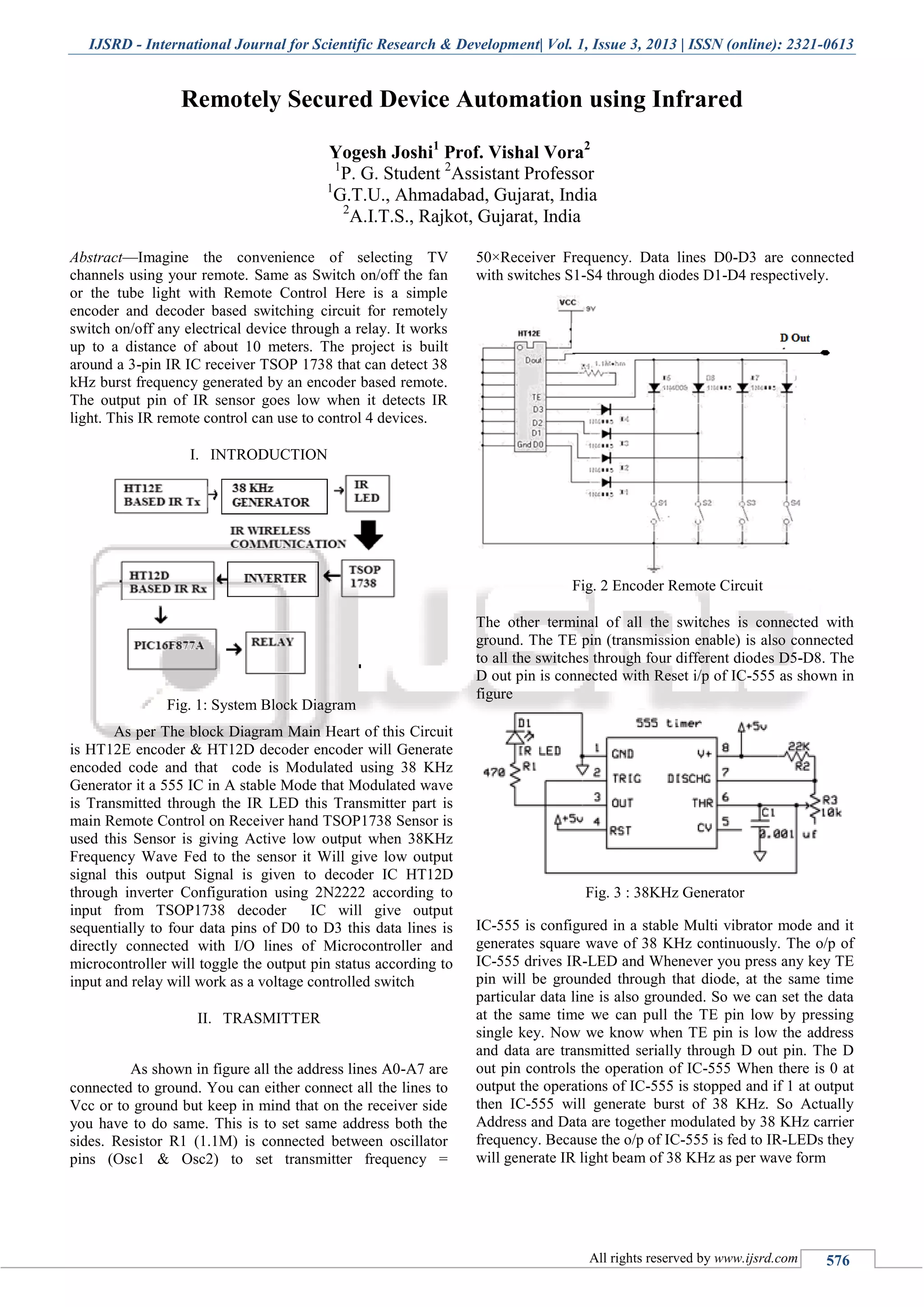
Fig. 1: System Block Diagram
As per The block Diagram Main Heart of this Circuit
is HT12E encoder & HT12D decoder encoder will Generate
encoded code and that code is Modulated using 38 KHz
Generator it a 555 IC in A stable Mode that Modulated wave
is Transmitted through the IR LED this Transmitter part is
main Remote Control on Receiver hand TSOP1738 Sensor is
used this Sensor is giving Active low output when 38KHz
Frequency Wave Fed to the sensor it Will give low output
signal this output Signal is given to decoder IC HT12D
through inverter Configuration using 2N2222 according to
input from TSOP1738 decoder IC will give output
sequentially to four data pins of D0 to D3 this data lines is
directly connected with I/O lines of Microcontroller and
microcontroller will toggle the output pin status according to
input and relay will work as a voltage controlled switch
II. TRASMITTER
As shown in figure all the address lines A0-A7 are
connected to ground. You can either connect all the lines to
Vcc or to ground but keep in mind that on the receiver side
you have to do same. This is to set same address both the
sides. Resistor R1 (1.1M) is connected between oscillator
pins (Osc1 & Osc2) to set transmitter frequency =
50×Receiver Frequency. Data lines D0-D3 are connected
with switches S1-S4 through diodes D1-D4 respectively.
Fig. 2 Encoder Remote Circuit
The other terminal of all the switches is connected with
ground. The TE pin (transmission enable) is also connected
to all the switches through four different diodes D5-D8. The
D out pin is connected with Reset i/p of IC-555 as shown in
figure
Fig. 3 : 38KHz Generator
IC-555 is configured in a stable Multi vibrator mode and it
generates square wave of 38 KHz continuously. The o/p of
IC-555 drives IR-LED and Whenever you press any key TE
pin will be grounded through that diode, at the same time
particular data line is also grounded. So we can set the data
at the same time we can pull the TE pin low by pressing
single key. Now we know when TE pin is low the address
and data are transmitted serially through D out pin. The D
out pin controls the operation of IC-555 When there is 0 at
output the operations of IC-555 is stopped and if 1 at output
then IC-555 will generate burst of 38 KHz. So Actually
Address and Data are together modulated by 38 KHz carrier
frequency. Because the o/p of IC-555 is fed to IR-LEDs they
will generate IR light beam of 38 KHz as per wave form
Remotely Secured Device Automation using Infrared
(IJSRD/Vol. 1/Issue 3/2013/0045)
All rights reserved by www.ijsrd.com
577
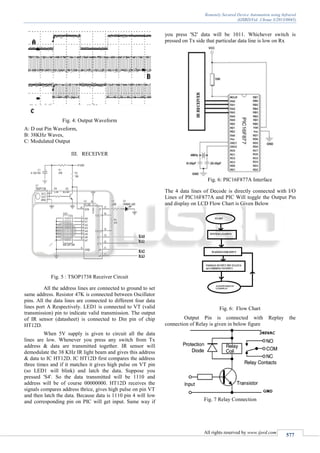
Fig. 4: Output Waveform
A: D out Pin Waveform,
B: 38KHz Waves,
C: Modulated Output
III. RECEIVER
Fig. 5 : TSOP1738 Receiver Circuit
All the address lines are connected to ground to set
same address. Resistor 47K is connected between Oscillator
pins. All the data lines are connected to different four data
lines port A Respectively. LED1 is connected to VT (valid
transmission) pin to indicate valid transmission. The output
of IR sensor (datasheet) is connected to Din pin of chip
HT12D.
When 5V supply is given to circuit all the data
lines are low. Whenever you press any switch from Tx
address & data are transmitted together. IR sensor will
demodulate the 38 KHz IR light beam and gives this address
& data to IC HT12D. IC HT12D first compares the address
three times and if it matches it gives high pulse on VT pin
(so LED1 will blink) and latch the data. Suppose you
pressed 'S4'. So the data transmitted will be 1110 and
address will be of course 00000000. HT12D receives the
signals compares address thrice, gives high pulse on pin VT
and then latch the data. Because data is 1110 pin 4 will low
and corresponding pin on PIC will get input. Same way if
you press 'S2' data will be 1011. Whichever switch is
pressed on Tx side that particular data line is low on Rx
Fig. 6: PIC16F877A Interface
The 4 data lines of Decode is directly connected with I/O
Lines of PIC16F877A and PIC Will toggle the Output Pin
and display on LCD Flow Chart is Given Below
Fig. 6: Flow Chart
Output Pin is connected with Replay the
connection of Relay is given in below figure
Fig. 7 Relay Connection
Remotely Secured Device Automation using Infrared
(IJSRD/Vol. 1/Issue 3/2013/0045)
All rights reserved by www.ijsrd.com
578
At the end of the receiver circuit, after the
microcontroller unit, a relay circuit is needed to supply
voltage to the appliances. The relay will be triggered on by a
transistor which acts as a switch to increase its stability
figure shows a general circuit of the relay unit.
The transistor is acting as a switch to turn on the
relay unit. The input to turn on the transistor is 5V from the
output pin of microcontroller. This means when the
microcontroller receives a command to switch on the
appliance, it will supply 5V to the transistor to turn on the
transistor. As the transistor is on, the relay which built at the
collector of transistor will be triggered on. The relay
contacts will go from NC (Normally closed) to NO
(Normally On). Hence, the 240VAC will be supplied to the
appliance that connected to the NO pin of the relay. A diode
is connected in parallel with the relay in order to protect the
relay circuit.
REFERENCES
[1]. B. Srinivasa Rao, S.D.V. Prasad and R. Madan Mohan”
A Proto-Type for Home Automation” Beijing
Consumer Electronics, IEEE Transactions vol. 54 pp.
567 – 572, 2012.
[2]. Y.Usha Devi “Wireless Home Automation System
Using ZigBee” International Journal of Scientific &
Engineering Research Volume 3, Issue 8, August-2012
[3]. Mike James Microcontroller Cookbook PIC & 8051,
Butterworth-Heinemann, 2nd
Edition Oxford 2007

Remotely Secured Device Automation using Infrared

  • 1.
    IJSRD - InternationalJournal for Scientific Research & Development| Vol. 1, Issue 3, 2013 | ISSN (online): 2321-0613 All rights reserved by www.ijsrd.com 576 Remotely Secured Device Automation using Infrared Yogesh Joshi1 Prof. Vishal Vora2 1 P. G. Student 2 Assistant Professor 1 G.T.U., Ahmadabad, Gujarat, India 2 A.I.T.S., Rajkot, Gujarat, India Abstract—Imagine the convenience of selecting TV channels using your remote. Same as Switch on/off the fan or the tube light with Remote Control Here is a simple encoder and decoder based switching circuit for remotely switch on/off any electrical device through a relay. It works up to a distance of about 10 meters. The project is built around a 3-pin IR IC receiver TSOP 1738 that can detect 38 kHz burst frequency generated by an encoder based remote. The output pin of IR sensor goes low when it detects IR light. This IR remote control can use to control 4 devices. I. INTRODUCTION Fig. 1: System Block Diagram As per The block Diagram Main Heart of this Circuit is HT12E encoder & HT12D decoder encoder will Generate encoded code and that code is Modulated using 38 KHz Generator it a 555 IC in A stable Mode that Modulated wave is Transmitted through the IR LED this Transmitter part is main Remote Control on Receiver hand TSOP1738 Sensor is used this Sensor is giving Active low output when 38KHz Frequency Wave Fed to the sensor it Will give low output signal this output Signal is given to decoder IC HT12D through inverter Configuration using 2N2222 according to input from TSOP1738 decoder IC will give output sequentially to four data pins of D0 to D3 this data lines is directly connected with I/O lines of Microcontroller and microcontroller will toggle the output pin status according to input and relay will work as a voltage controlled switch II. TRASMITTER As shown in figure all the address lines A0-A7 are connected to ground. You can either connect all the lines to Vcc or to ground but keep in mind that on the receiver side you have to do same. This is to set same address both the sides. Resistor R1 (1.1M) is connected between oscillator pins (Osc1 & Osc2) to set transmitter frequency = 50×Receiver Frequency. Data lines D0-D3 are connected with switches S1-S4 through diodes D1-D4 respectively. Fig. 2 Encoder Remote Circuit The other terminal of all the switches is connected with ground. The TE pin (transmission enable) is also connected to all the switches through four different diodes D5-D8. The D out pin is connected with Reset i/p of IC-555 as shown in figure Fig. 3 : 38KHz Generator IC-555 is configured in a stable Multi vibrator mode and it generates square wave of 38 KHz continuously. The o/p of IC-555 drives IR-LED and Whenever you press any key TE pin will be grounded through that diode, at the same time particular data line is also grounded. So we can set the data at the same time we can pull the TE pin low by pressing single key. Now we know when TE pin is low the address and data are transmitted serially through D out pin. The D out pin controls the operation of IC-555 When there is 0 at output the operations of IC-555 is stopped and if 1 at output then IC-555 will generate burst of 38 KHz. So Actually Address and Data are together modulated by 38 KHz carrier frequency. Because the o/p of IC-555 is fed to IR-LEDs they will generate IR light beam of 38 KHz as per wave form
  • 2.
    Remotely Secured DeviceAutomation using Infrared (IJSRD/Vol. 1/Issue 3/2013/0045) All rights reserved by www.ijsrd.com 577 Fig. 4: Output Waveform A: D out Pin Waveform, B: 38KHz Waves, C: Modulated Output III. RECEIVER Fig. 5 : TSOP1738 Receiver Circuit All the address lines are connected to ground to set same address. Resistor 47K is connected between Oscillator pins. All the data lines are connected to different four data lines port A Respectively. LED1 is connected to VT (valid transmission) pin to indicate valid transmission. The output of IR sensor (datasheet) is connected to Din pin of chip HT12D. When 5V supply is given to circuit all the data lines are low. Whenever you press any switch from Tx address & data are transmitted together. IR sensor will demodulate the 38 KHz IR light beam and gives this address & data to IC HT12D. IC HT12D first compares the address three times and if it matches it gives high pulse on VT pin (so LED1 will blink) and latch the data. Suppose you pressed 'S4'. So the data transmitted will be 1110 and address will be of course 00000000. HT12D receives the signals compares address thrice, gives high pulse on pin VT and then latch the data. Because data is 1110 pin 4 will low and corresponding pin on PIC will get input. Same way if you press 'S2' data will be 1011. Whichever switch is pressed on Tx side that particular data line is low on Rx Fig. 6: PIC16F877A Interface The 4 data lines of Decode is directly connected with I/O Lines of PIC16F877A and PIC Will toggle the Output Pin and display on LCD Flow Chart is Given Below Fig. 6: Flow Chart Output Pin is connected with Replay the connection of Relay is given in below figure Fig. 7 Relay Connection
  • 3.
    Remotely Secured DeviceAutomation using Infrared (IJSRD/Vol. 1/Issue 3/2013/0045) All rights reserved by www.ijsrd.com 578 At the end of the receiver circuit, after the microcontroller unit, a relay circuit is needed to supply voltage to the appliances. The relay will be triggered on by a transistor which acts as a switch to increase its stability figure shows a general circuit of the relay unit. The transistor is acting as a switch to turn on the relay unit. The input to turn on the transistor is 5V from the output pin of microcontroller. This means when the microcontroller receives a command to switch on the appliance, it will supply 5V to the transistor to turn on the transistor. As the transistor is on, the relay which built at the collector of transistor will be triggered on. The relay contacts will go from NC (Normally closed) to NO (Normally On). Hence, the 240VAC will be supplied to the appliance that connected to the NO pin of the relay. A diode is connected in parallel with the relay in order to protect the relay circuit. REFERENCES [1]. B. Srinivasa Rao, S.D.V. Prasad and R. Madan Mohan” A Proto-Type for Home Automation” Beijing Consumer Electronics, IEEE Transactions vol. 54 pp. 567 – 572, 2012. [2]. Y.Usha Devi “Wireless Home Automation System Using ZigBee” International Journal of Scientific & Engineering Research Volume 3, Issue 8, August-2012 [3]. Mike James Microcontroller Cookbook PIC & 8051, Butterworth-Heinemann, 2nd Edition Oxford 2007