International Health Regulations
1 |
International
Health Regulations
Building international public health security
International Health Regulations
2 |
Why revised International Health Regulations?
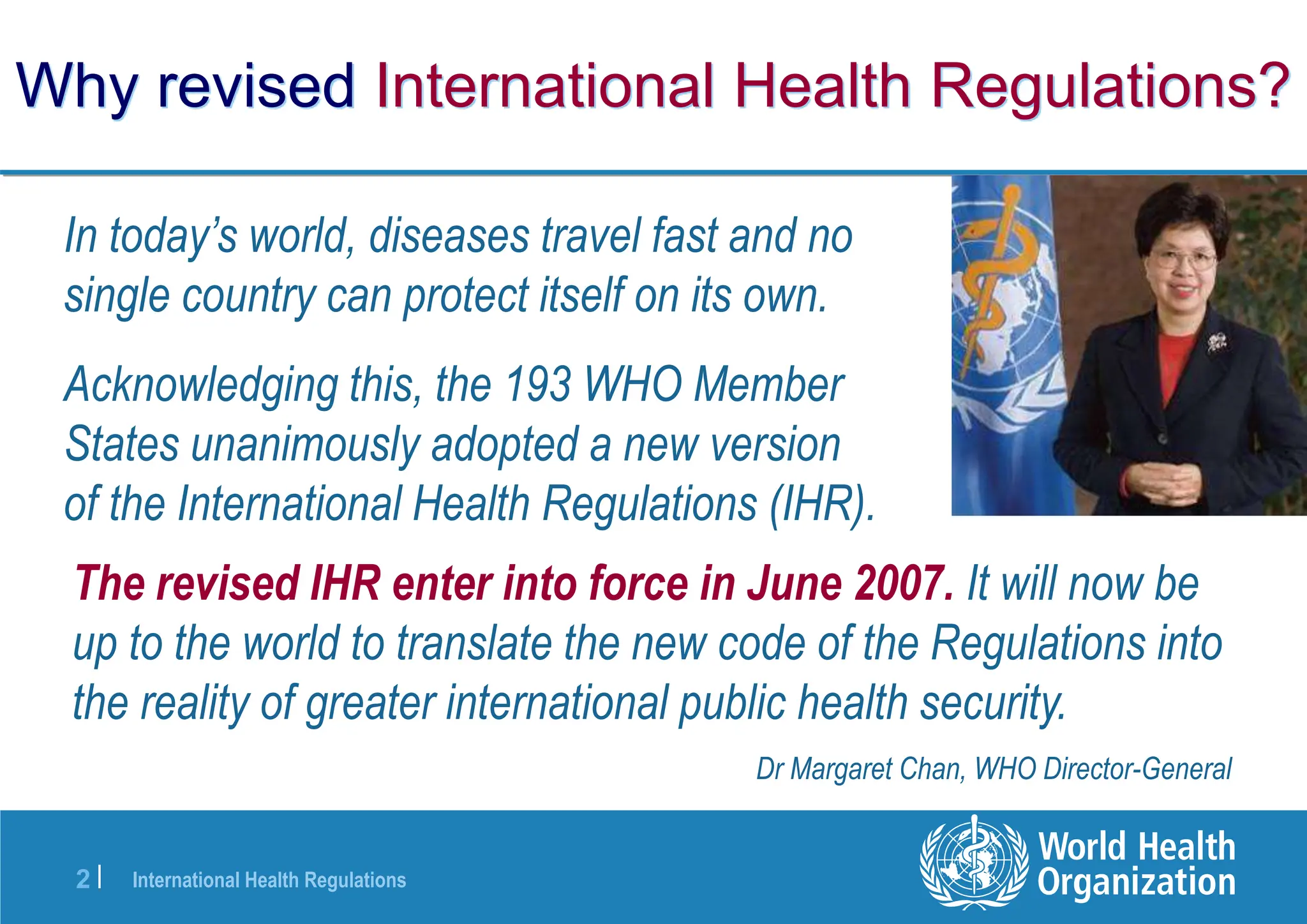
In today’s world, diseases travel fast and no
single country can protect itself on its own.
Acknowledging this, the 193 WHO Member
States unanimously adopted a new version
of the International Health Regulations (IHR).
The revised IHR enter into force in June 2007. It will now be
up to the world to translate the new code of the Regulations into
the reality of greater international public health security.
Dr Margaret Chan, WHO Director-General
International Health Regulations
3 |
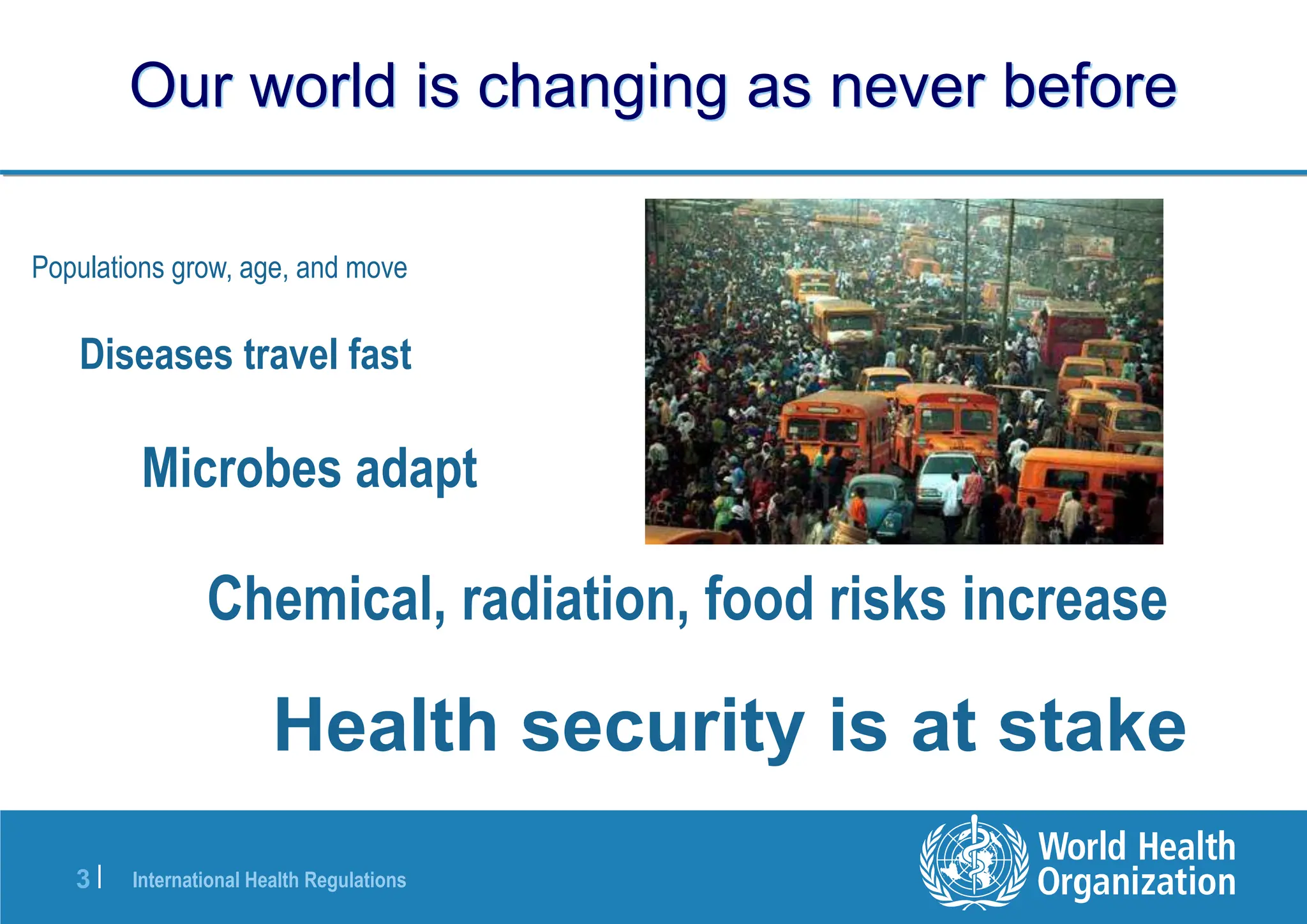
Our world is changing as never before
Populations grow, age, and move
Diseases travel fast
Microbes adapt
Chemical, radiation, food risks increase
Health security is at stake
International Health Regulations
4 |
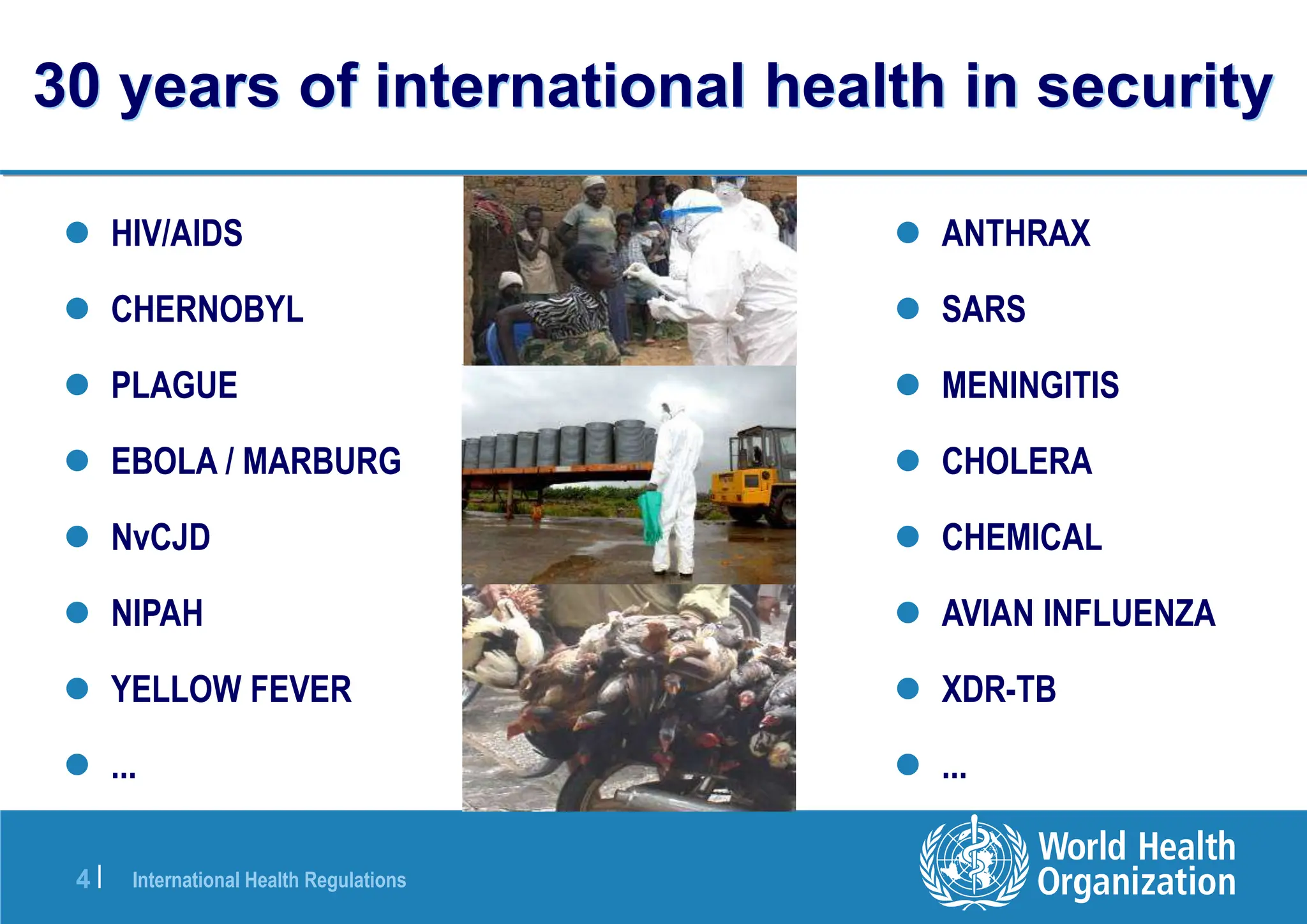
30 years of international health in security
 HIV/AIDS
 CHERNOBYL
 PLAGUE
 EBOLA / MARBURG
 NvCJD
 NIPAH
 YELLOW FEVER
 ...
 ANTHRAX
 SARS
 MENINGITIS
 CHOLERA
 CHEMICAL
 AVIAN INFLUENZA
 XDR-TB
 ...
International Health Regulations
5 |
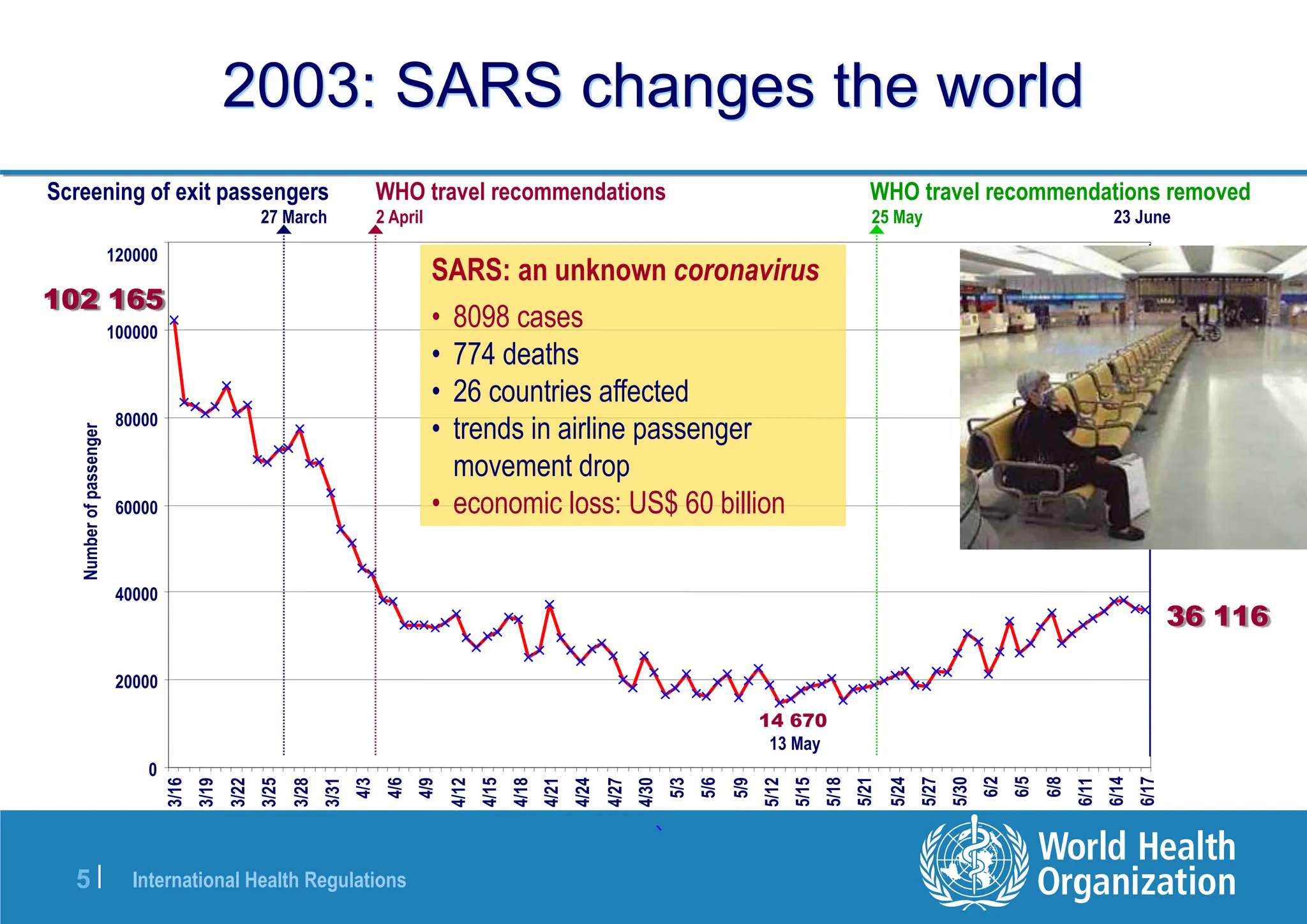
0
20000
40000
60000
80000
100000
120000
3/16
3/19
3/22
3/25
3/28
3/31
4/3
4/6
4/9
4/12
4/15
4/18
4/21
4/24
4/27
4/30
5/3
5/6
5/9
5/12
5/15
5/18
5/21
5/24
5/27
5/30
6/2
6/5
6/8
6/11
6/14
6/17
Number
of
passenger
WHO travel recommendations removed
36 116
WHO travel recommendations
2 April
14 670
13 May
102 165
25 May
27 March 23 June
Screening of exit passengers
SARS: an unknown coronavirus
• 8098 cases
• 774 deaths
• 26 countries affected
• trends in airline passenger
movement drop
• economic loss: US$ 60 billion
2003: SARS changes the world
International Health Regulations
6 |
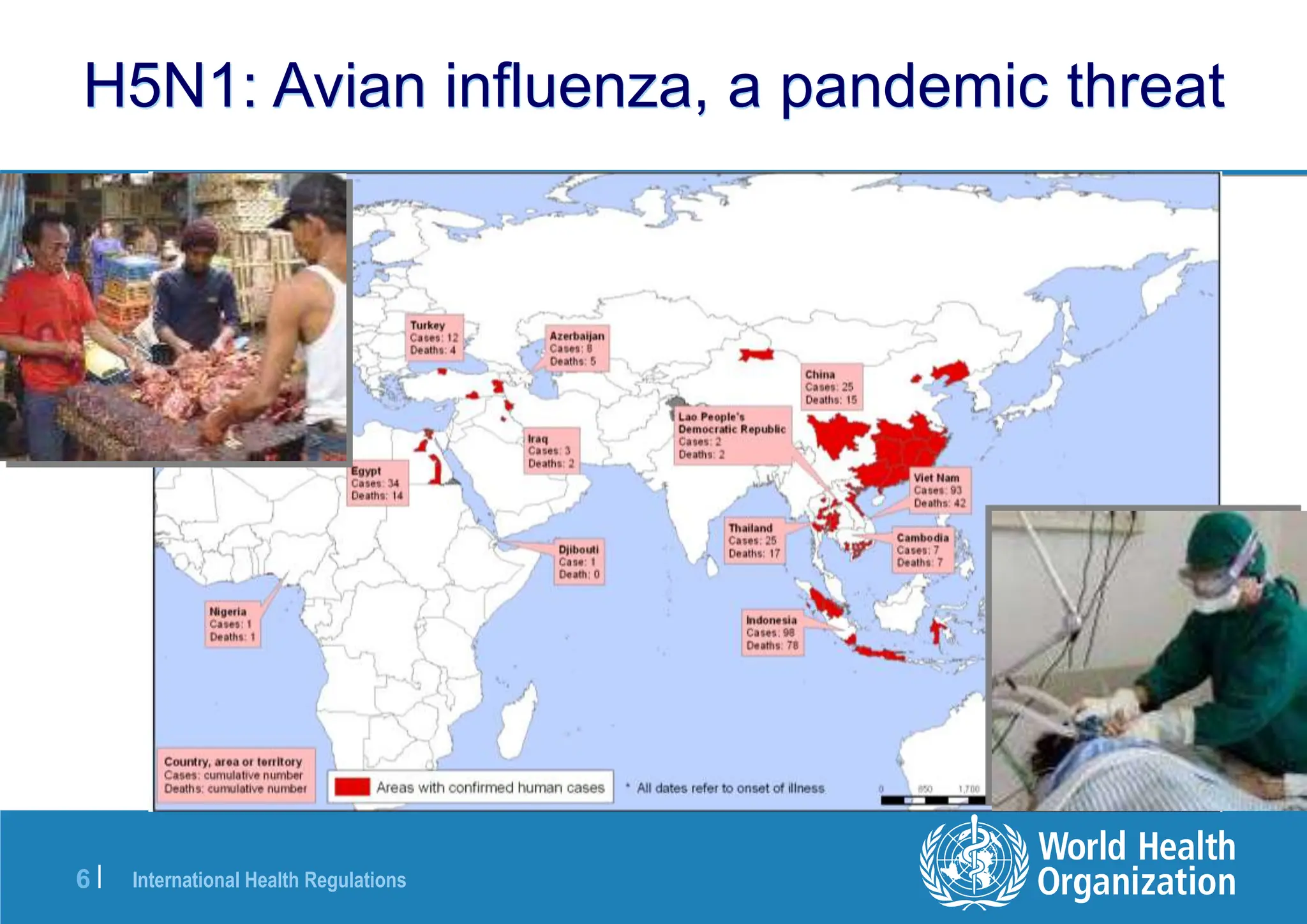
H5N1: Avian influenza, a pandemic threat
International Health Regulations
7 |
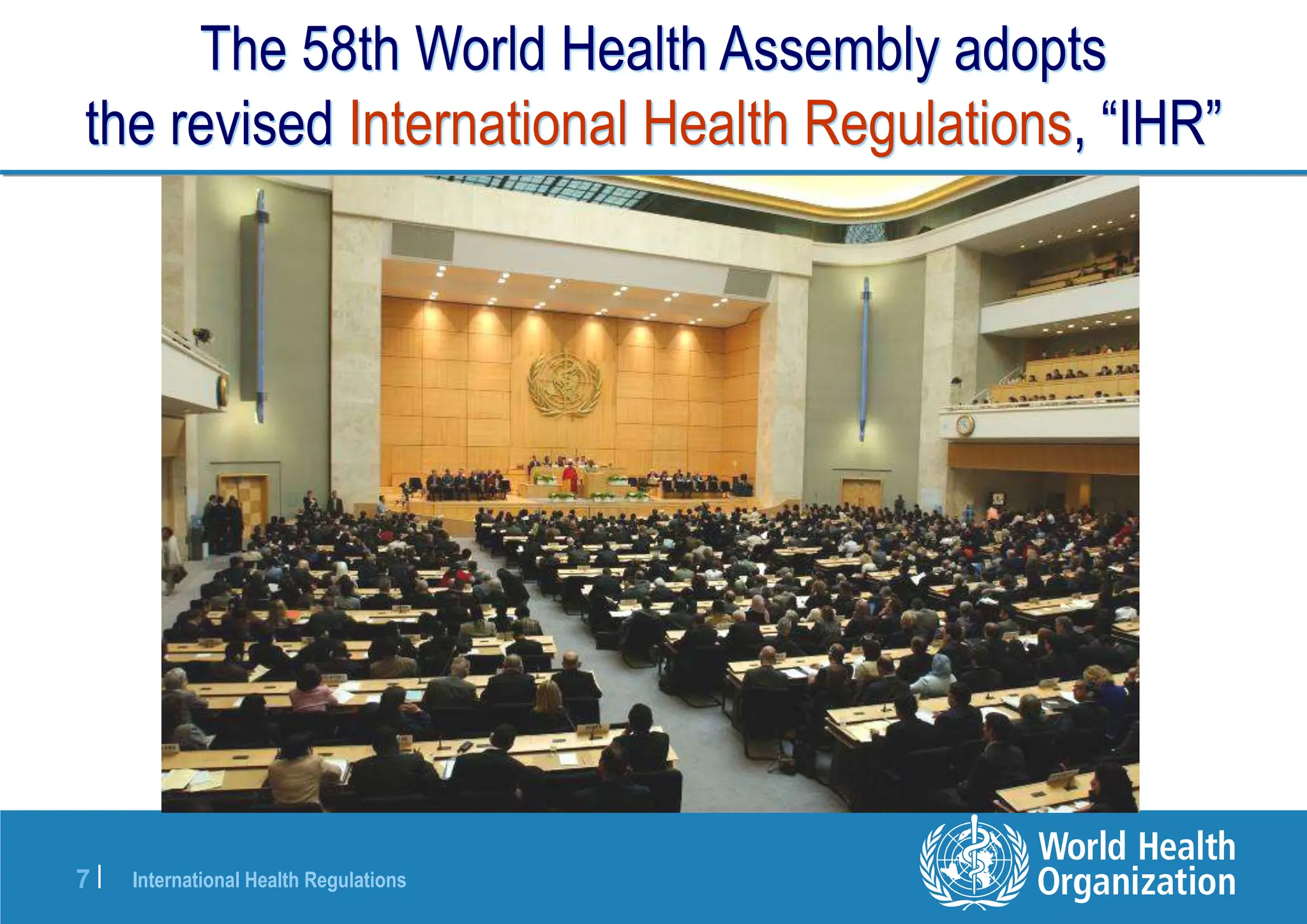
The 58th World Health Assembly adopts
the revised International Health Regulations, “IHR”
International Health Regulations
8 |
International public health security is the goal
Ensuring maximum public health security
while minimizing interference with international
transport and trade
Come into force on 15 June 2007*
* A later date applies to States that have submitted reservations
Legally binding for WHO and the world’s countries that have agreed
to play by the same rules to secure international health.
International Health Regulations
9 |
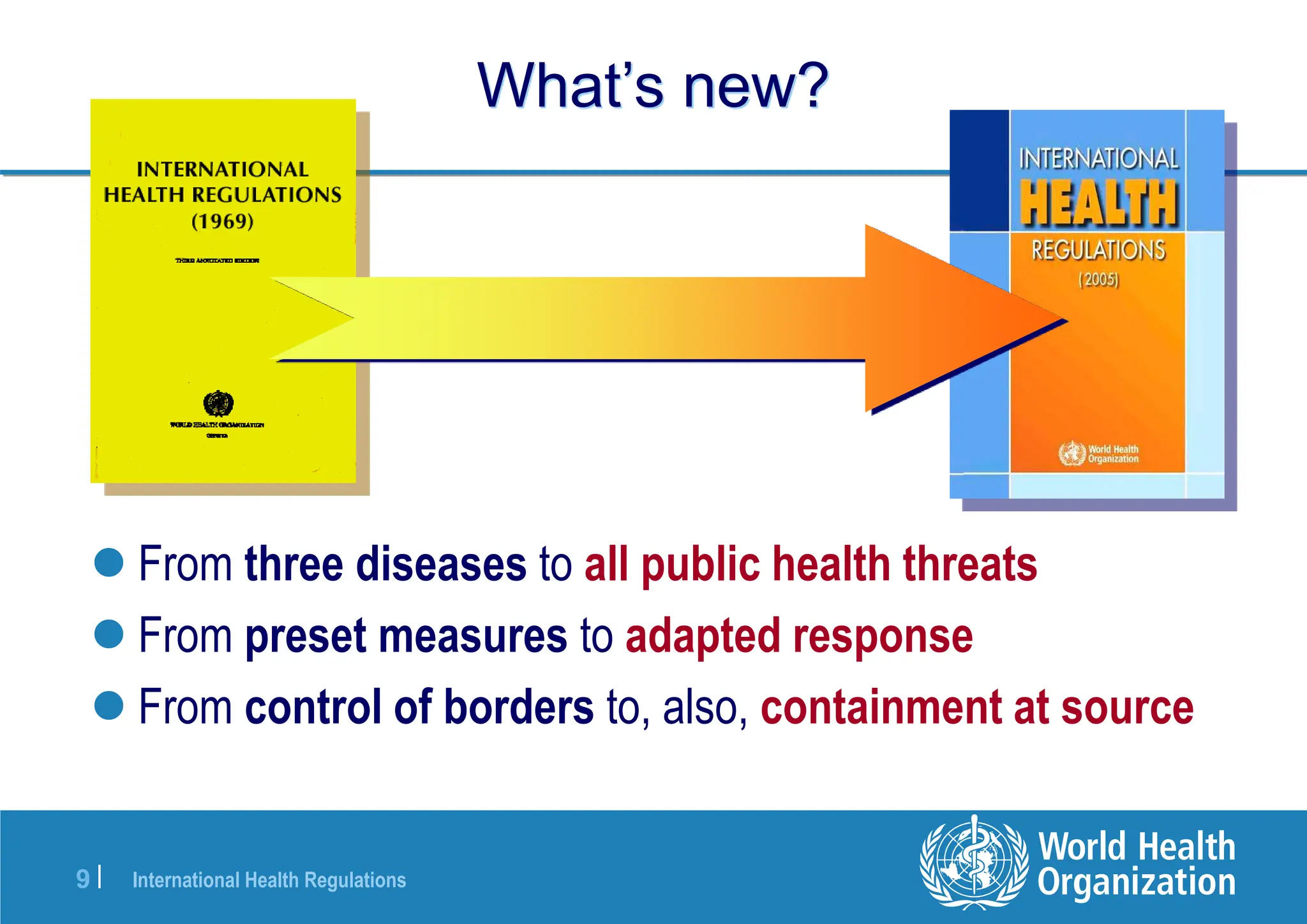
What’s new?
 From three diseases to all public health threats
 From preset measures to adapted response
 From control of borders to, also, containment at source
International Health Regulations
10 |
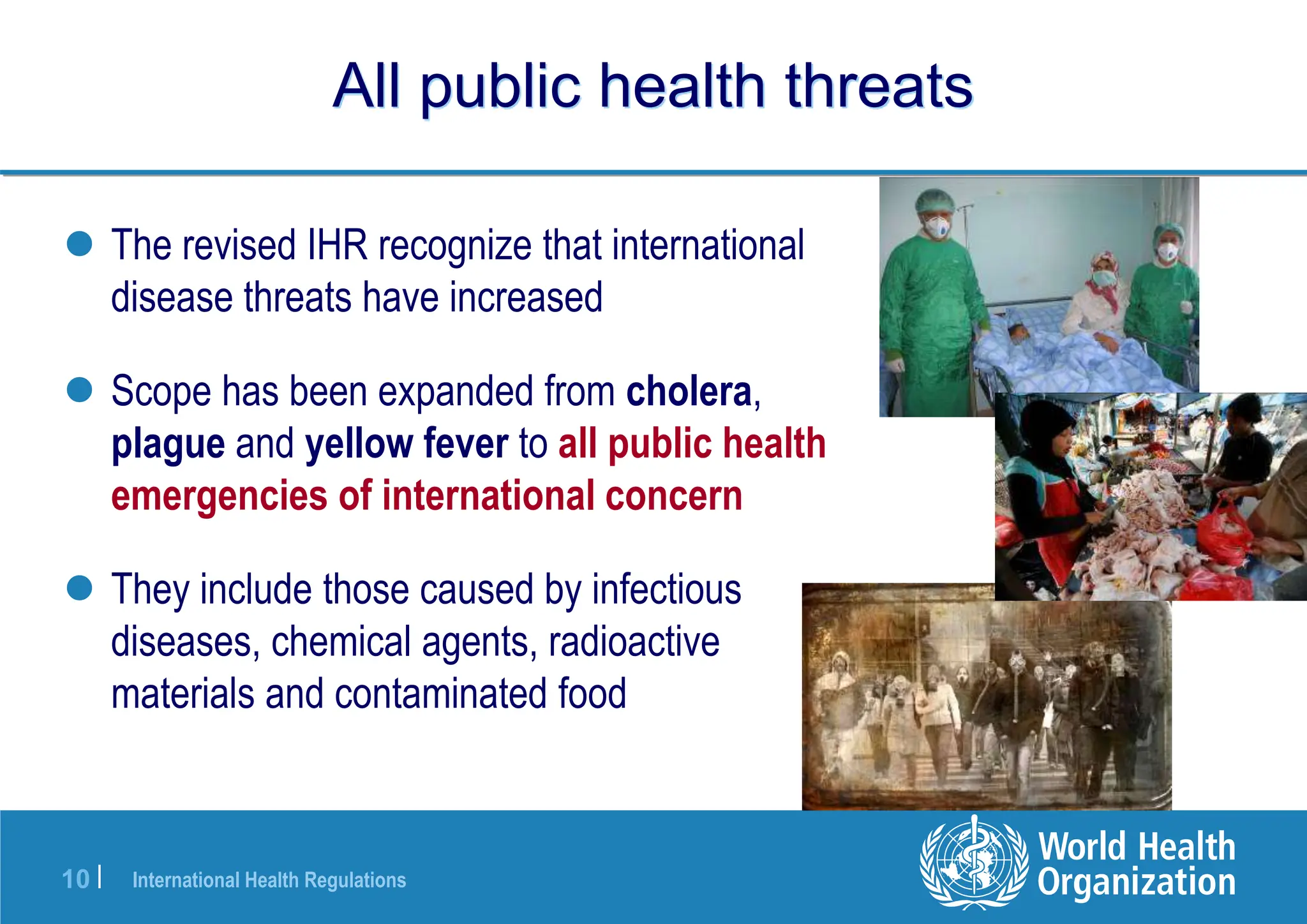
All public health threats
 The revised IHR recognize that international
disease threats have increased
 Scope has been expanded from cholera,
plague and yellow fever to all public health
emergencies of international concern
 They include those caused by infectious
diseases, chemical agents, radioactive
materials and contaminated food
International Health Regulations
11 |
Adapted response
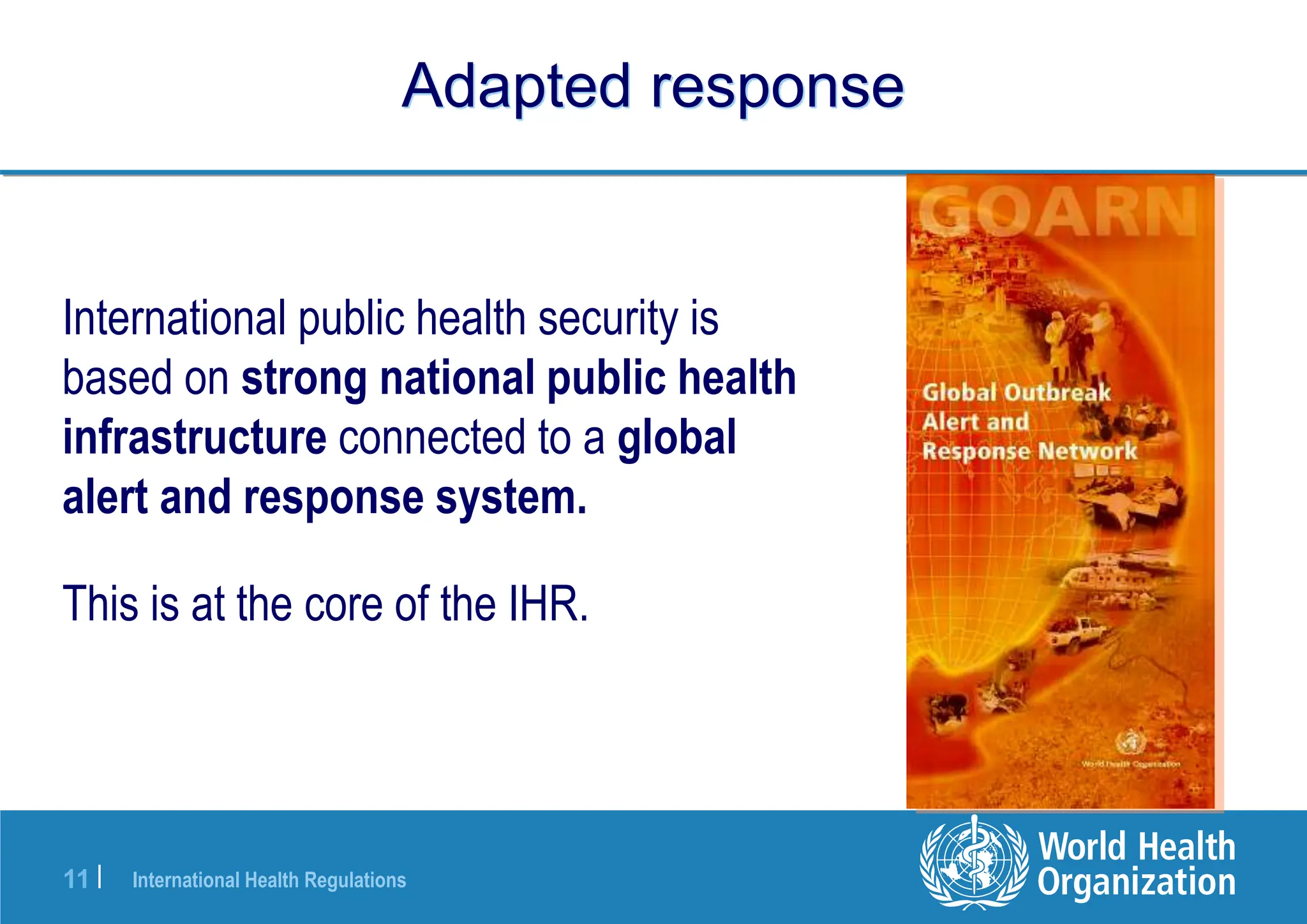
International public health security is
based on strong national public health
infrastructure connected to a global
alert and response system.
This is at the core of the IHR.
International Health Regulations
12 |
Containment at source
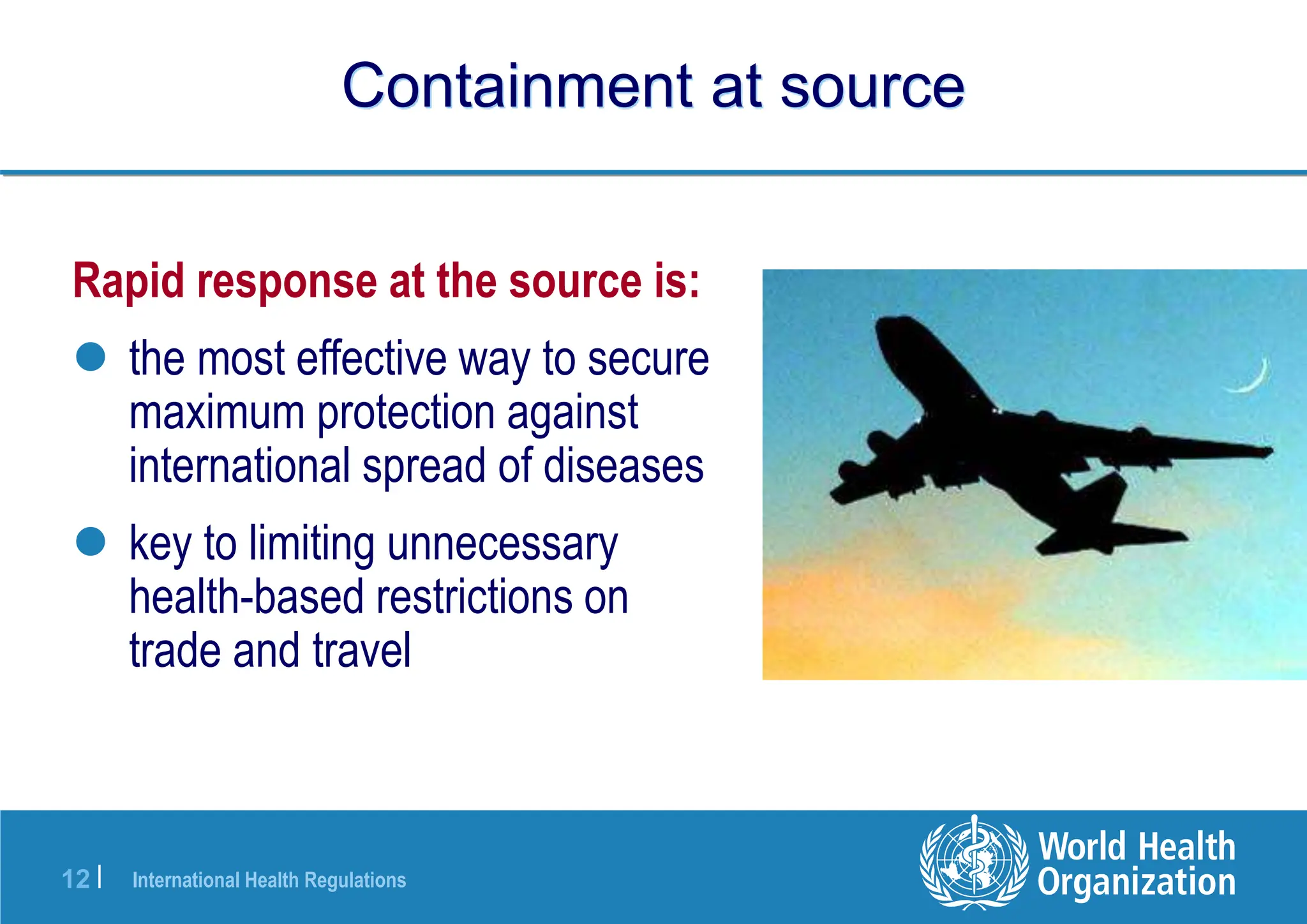
Rapid response at the source is:
 the most effective way to secure
maximum protection against
international spread of diseases
 key to limiting unnecessary
health-based restrictions on
trade and travel
International Health Regulations
13 |
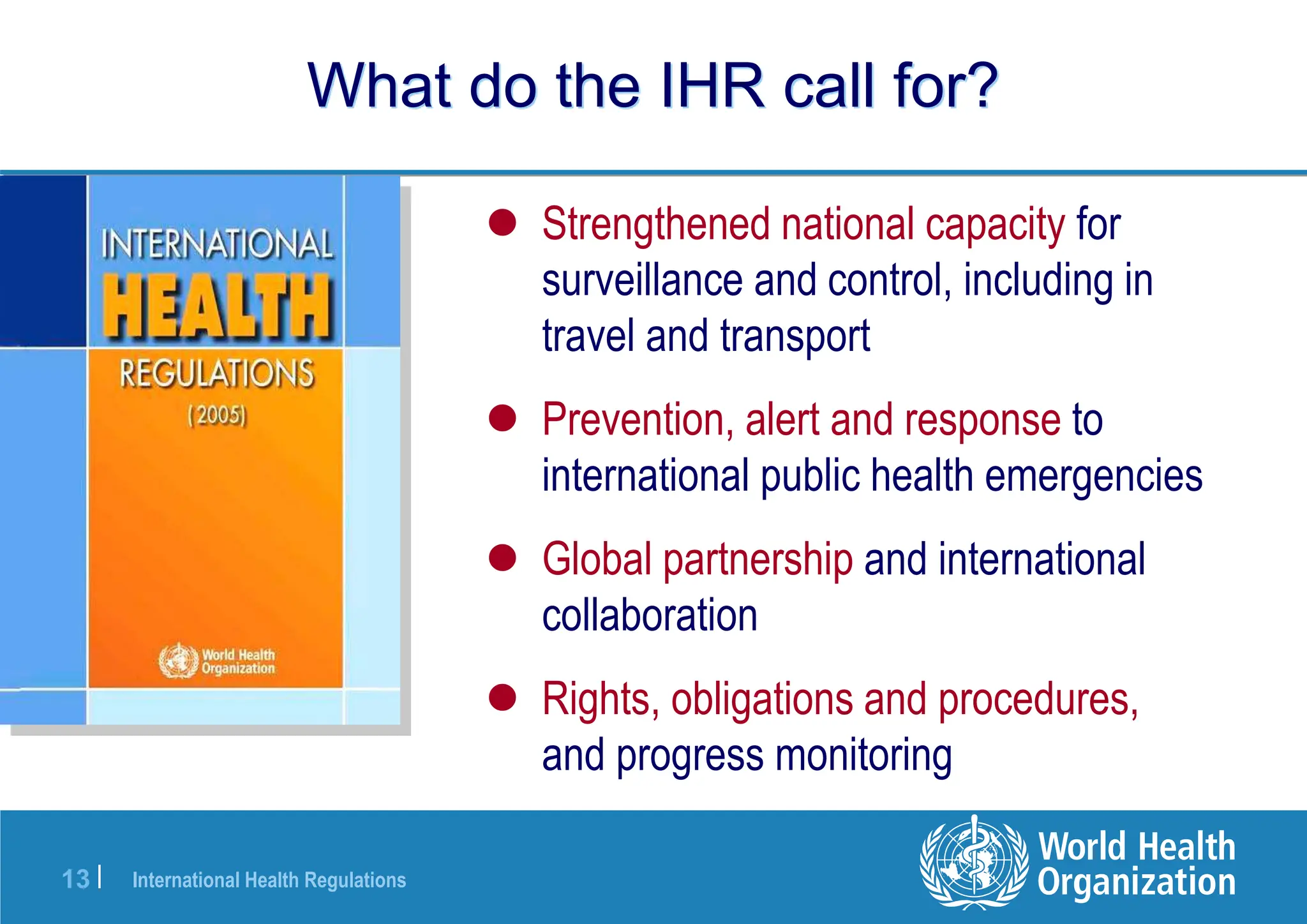
What do the IHR call for?
 Strengthened national capacity for
surveillance and control, including in
travel and transport
 Prevention, alert and response to
international public health emergencies
 Global partnership and international
collaboration
 Rights, obligations and procedures,
and progress monitoring
International Health Regulations
14 |
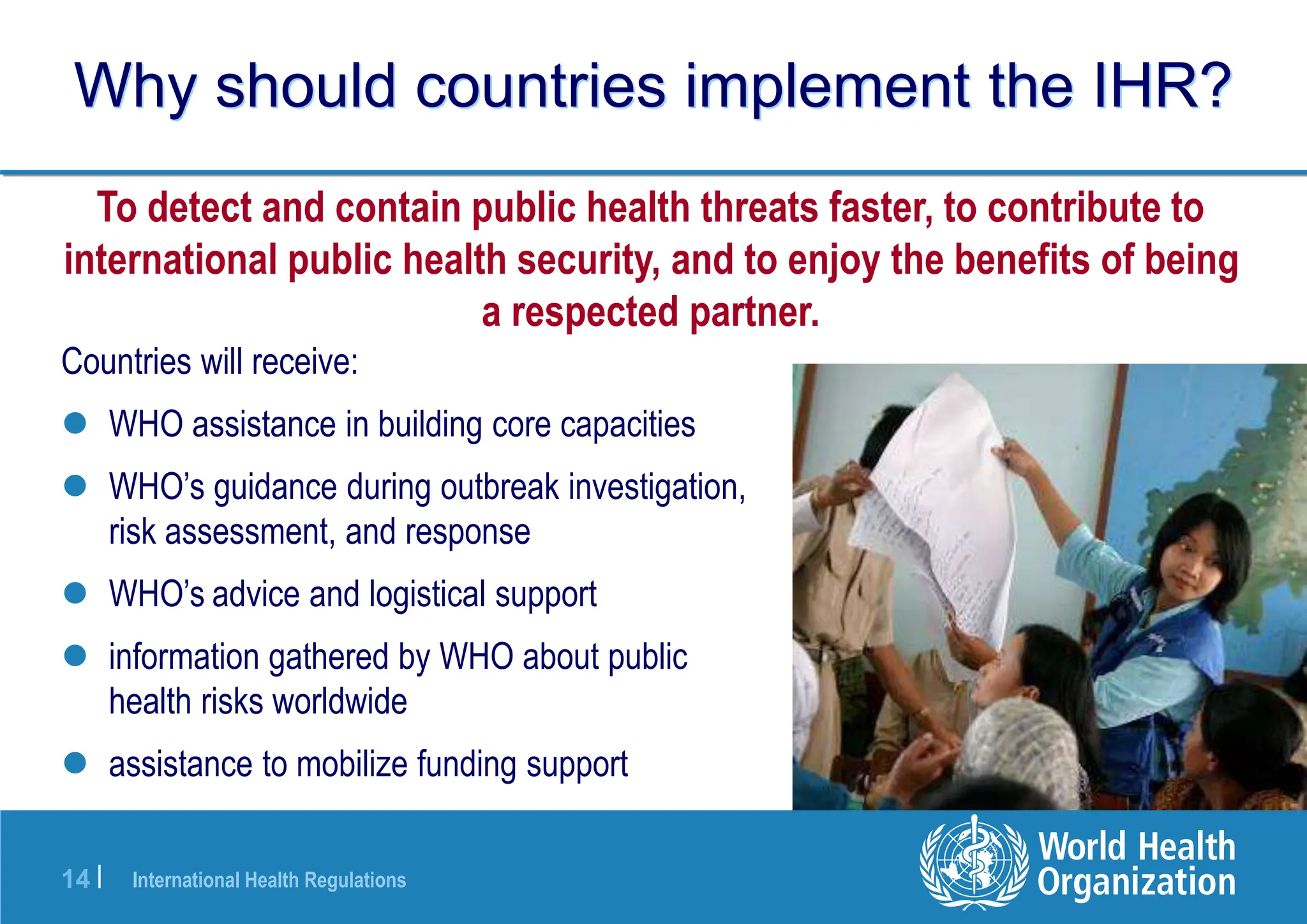
Why should countries implement the IHR?
Countries will receive:
 WHO assistance in building core capacities
 WHO’s guidance during outbreak investigation,
risk assessment, and response
 WHO’s advice and logistical support
 information gathered by WHO about public
health risks worldwide
 assistance to mobilize funding support
To detect and contain public health threats faster, to contribute to
international public health security, and to enjoy the benefits of being
a respected partner.
International Health Regulations
15 |
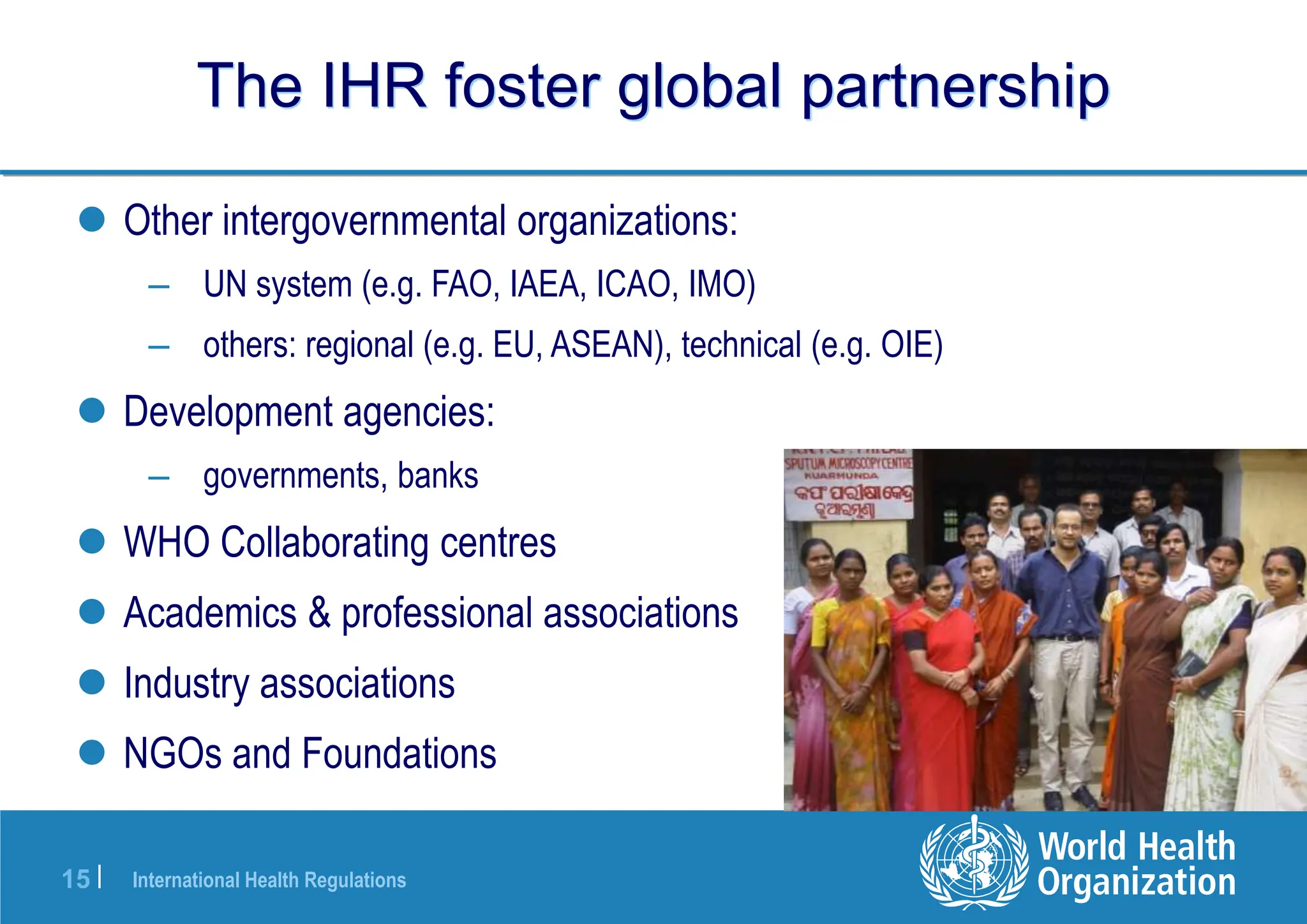
The IHR foster global partnership
 Other intergovernmental organizations:
– UN system (e.g. FAO, IAEA, ICAO, IMO)
– others: regional (e.g. EU, ASEAN), technical (e.g. OIE)
 Development agencies:
– governments, banks
 WHO Collaborating centres
 Academics & professional associations
 Industry associations
 NGOs and Foundations
International Health Regulations
16 |
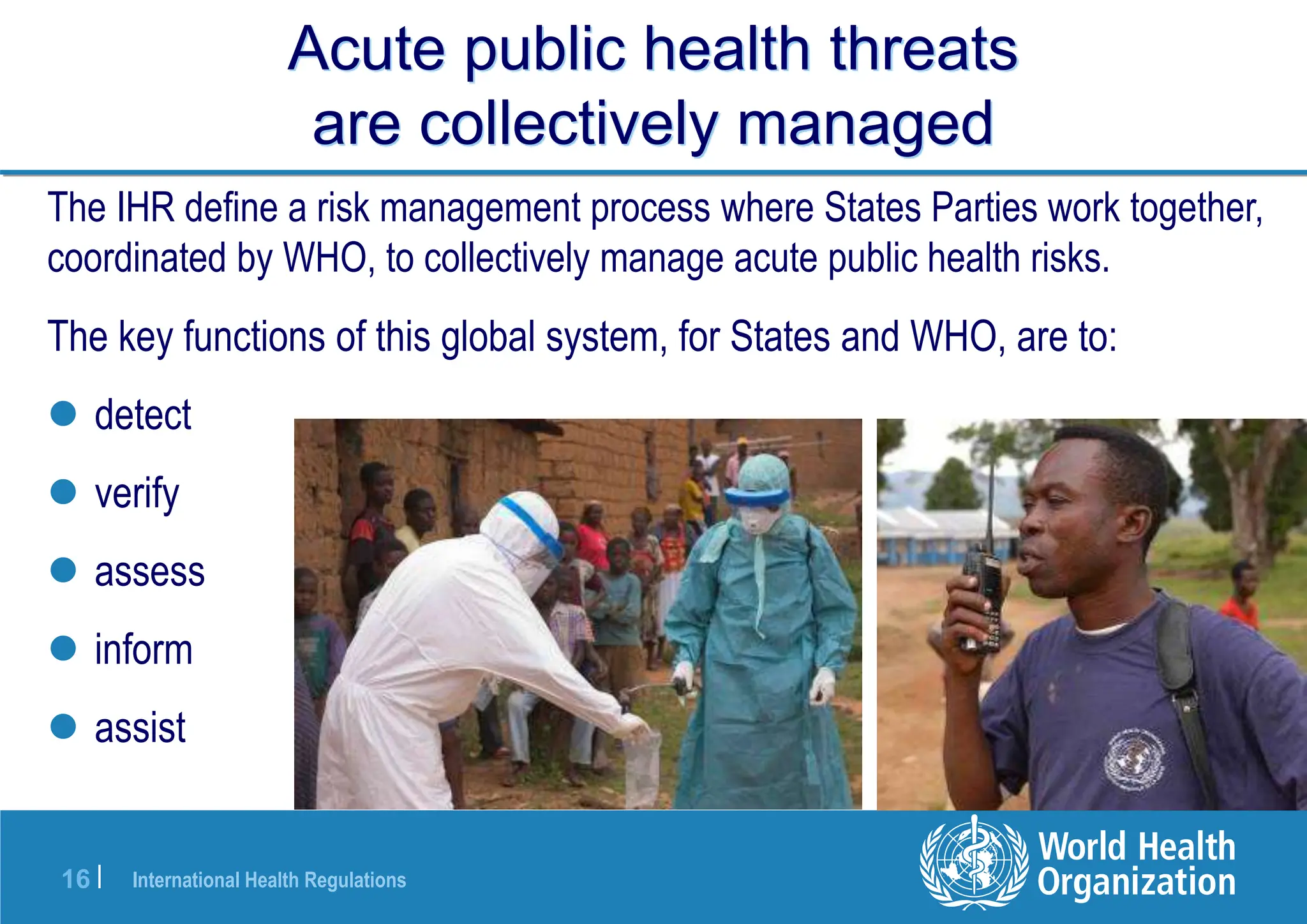
Acute public health threats
are collectively managed
The key functions of this global system, for States and WHO, are to:
 detect
 verify
 assess
 inform
 assist
The IHR define a risk management process where States Parties work together,
coordinated by WHO, to collectively manage acute public health risks.
International Health Regulations
17 |
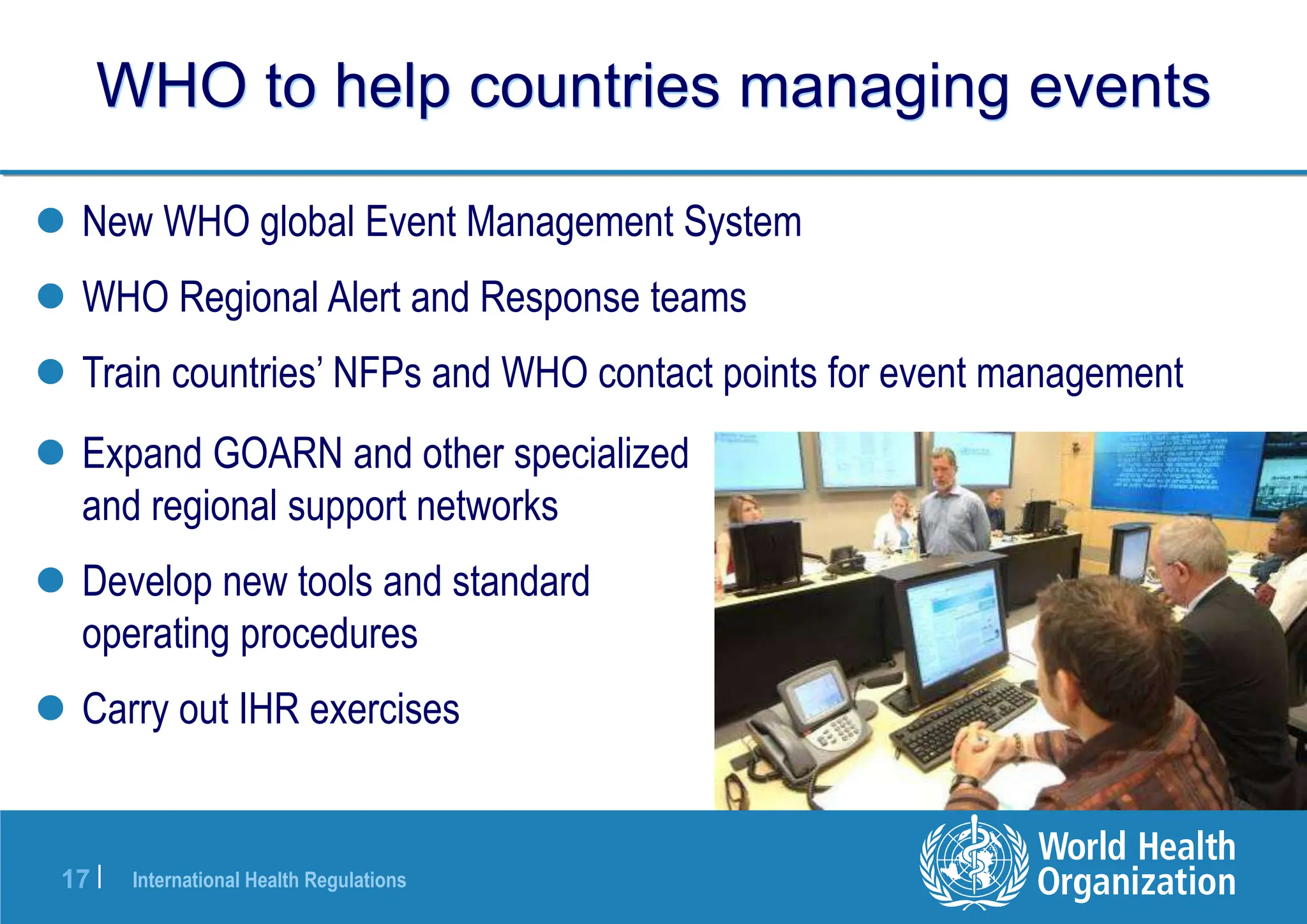
WHO to help countries managing events
 New WHO global Event Management System
 WHO Regional Alert and Response teams
 Train countries’ NFPs and WHO contact points for event management
 Expand GOARN and other specialized
and regional support networks
 Develop new tools and standard
operating procedures
 Carry out IHR exercises
International Health Regulations
18 |
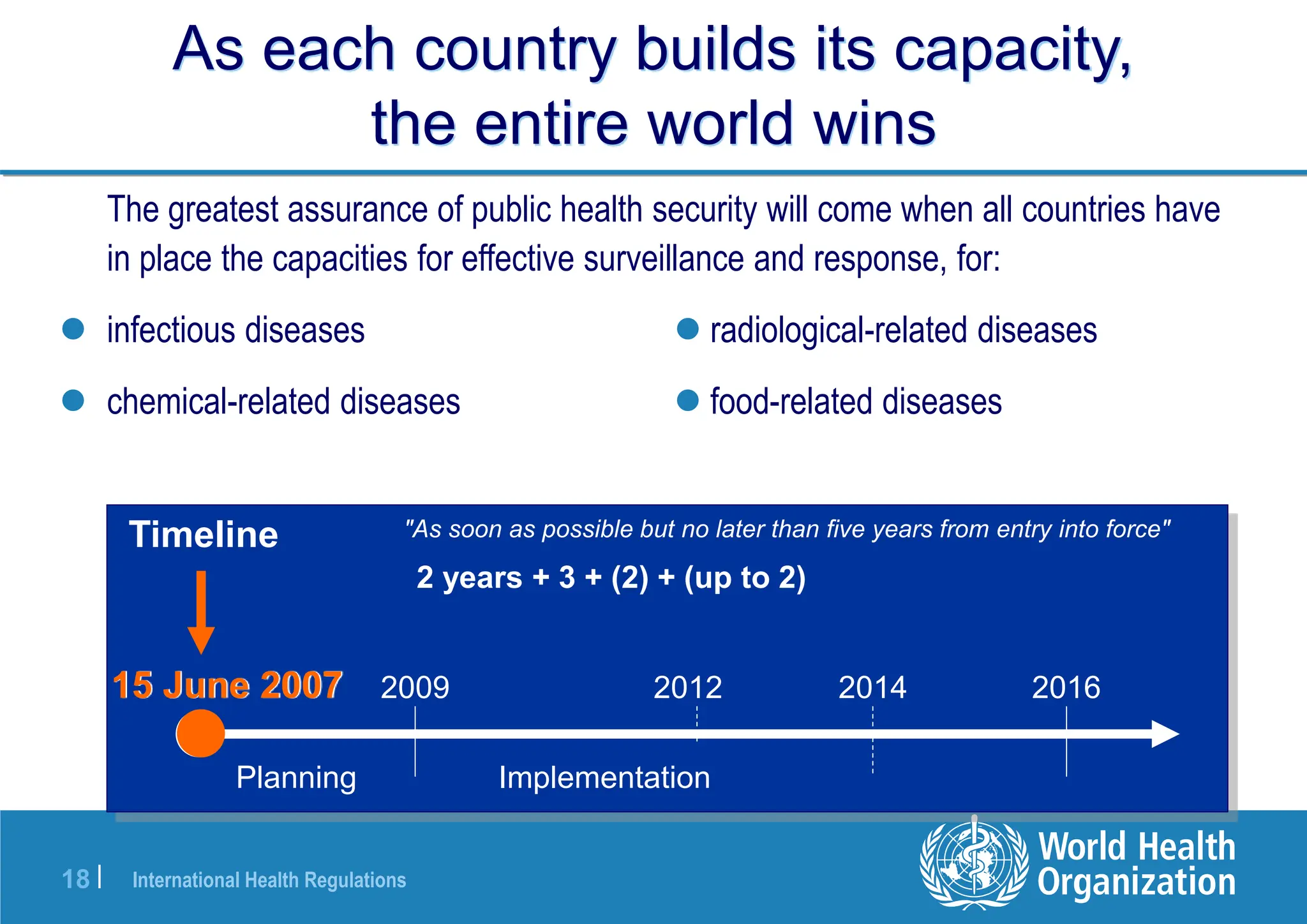
As each country builds its capacity,
the entire world wins
The greatest assurance of public health security will come when all countries have
in place the capacities for effective surveillance and response, for:
 infectious diseases  radiological-related diseases
 chemical-related diseases  food-related diseases
Timeline
15 June 2007 2009 2012 2014 2016
Planning Implementation
2 years + 3 + (2) + (up to 2)
"As soon as possible but no later than five years from entry into force"
International Health Regulations
19 |
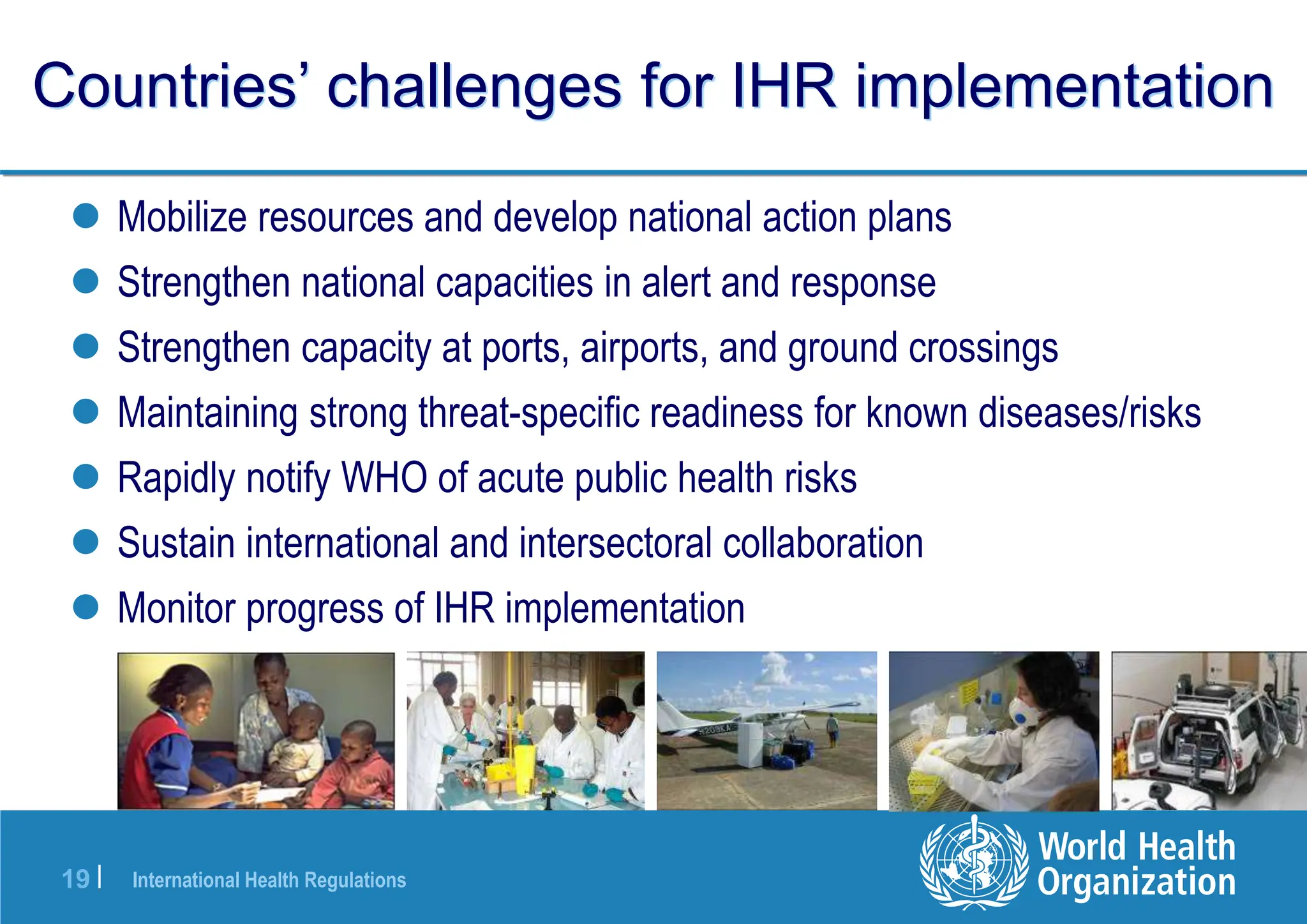
Countries’ challenges for IHR implementation
 Mobilize resources and develop national action plans
 Strengthen national capacities in alert and response
 Strengthen capacity at ports, airports, and ground crossings
 Maintaining strong threat-specific readiness for known diseases/risks
 Rapidly notify WHO of acute public health risks
 Sustain international and intersectoral collaboration
 Monitor progress of IHR implementation
International Health Regulations
20 |
What will WHO do under the IHR?
 Designate WHO IHR contact points
 Support States Parties in assessing their public health risks, through
the notification, consultation, and verification processes
 Inform State Parties of relevant international public health risks
 Recommend adapted public health measures
 Assist States Parties in their efforts to investigate outbreaks and
meet the IHR national requirements for surveillance and response
International Health Regulations
21 |
 Lives saved
 Good international image
 No unilateral travel and trade restrictions
 Public trust
 No political and social turmoil
Benefit from IHR implementation
International Health Regulations
22 |
International
Health Regulations
Building international public health security
w w w . w h o . i n t / i h r

IHR_Overview.ppt

  • 1.
    International Health Regulations 1| International Health Regulations Building international public health security
  • 2.
    International Health Regulations 2| Why revised International Health Regulations? In today’s world, diseases travel fast and no single country can protect itself on its own. Acknowledging this, the 193 WHO Member States unanimously adopted a new version of the International Health Regulations (IHR). The revised IHR enter into force in June 2007. It will now be up to the world to translate the new code of the Regulations into the reality of greater international public health security. Dr Margaret Chan, WHO Director-General
  • 3.
    International Health Regulations 3| Our world is changing as never before Populations grow, age, and move Diseases travel fast Microbes adapt Chemical, radiation, food risks increase Health security is at stake
  • 4.
    International Health Regulations 4| 30 years of international health in security  HIV/AIDS  CHERNOBYL  PLAGUE  EBOLA / MARBURG  NvCJD  NIPAH  YELLOW FEVER  ...  ANTHRAX  SARS  MENINGITIS  CHOLERA  CHEMICAL  AVIAN INFLUENZA  XDR-TB  ...
  • 5.
    International Health Regulations 5| 0 20000 40000 60000 80000 100000 120000 3/16 3/19 3/22 3/25 3/28 3/31 4/3 4/6 4/9 4/12 4/15 4/18 4/21 4/24 4/27 4/30 5/3 5/6 5/9 5/12 5/15 5/18 5/21 5/24 5/27 5/30 6/2 6/5 6/8 6/11 6/14 6/17 Number of passenger WHO travel recommendations removed 36 116 WHO travel recommendations 2 April 14 670 13 May 102 165 25 May 27 March 23 June Screening of exit passengers SARS: an unknown coronavirus • 8098 cases • 774 deaths • 26 countries affected • trends in airline passenger movement drop • economic loss: US$ 60 billion 2003: SARS changes the world
  • 6.
    International Health Regulations 6| H5N1: Avian influenza, a pandemic threat
  • 7.
    International Health Regulations 7| The 58th World Health Assembly adopts the revised International Health Regulations, “IHR”
  • 8.
    International Health Regulations 8| International public health security is the goal Ensuring maximum public health security while minimizing interference with international transport and trade Come into force on 15 June 2007* * A later date applies to States that have submitted reservations Legally binding for WHO and the world’s countries that have agreed to play by the same rules to secure international health.
  • 9.
    International Health Regulations 9| What’s new?  From three diseases to all public health threats  From preset measures to adapted response  From control of borders to, also, containment at source
  • 10.
    International Health Regulations 10| All public health threats  The revised IHR recognize that international disease threats have increased  Scope has been expanded from cholera, plague and yellow fever to all public health emergencies of international concern  They include those caused by infectious diseases, chemical agents, radioactive materials and contaminated food
  • 11.
    International Health Regulations 11| Adapted response International public health security is based on strong national public health infrastructure connected to a global alert and response system. This is at the core of the IHR.
  • 12.
    International Health Regulations 12| Containment at source Rapid response at the source is:  the most effective way to secure maximum protection against international spread of diseases  key to limiting unnecessary health-based restrictions on trade and travel
  • 13.
    International Health Regulations 13| What do the IHR call for?  Strengthened national capacity for surveillance and control, including in travel and transport  Prevention, alert and response to international public health emergencies  Global partnership and international collaboration  Rights, obligations and procedures, and progress monitoring
  • 14.
    International Health Regulations 14| Why should countries implement the IHR? Countries will receive:  WHO assistance in building core capacities  WHO’s guidance during outbreak investigation, risk assessment, and response  WHO’s advice and logistical support  information gathered by WHO about public health risks worldwide  assistance to mobilize funding support To detect and contain public health threats faster, to contribute to international public health security, and to enjoy the benefits of being a respected partner.
  • 15.
    International Health Regulations 15| The IHR foster global partnership  Other intergovernmental organizations: – UN system (e.g. FAO, IAEA, ICAO, IMO) – others: regional (e.g. EU, ASEAN), technical (e.g. OIE)  Development agencies: – governments, banks  WHO Collaborating centres  Academics & professional associations  Industry associations  NGOs and Foundations
  • 16.
    International Health Regulations 16| Acute public health threats are collectively managed The key functions of this global system, for States and WHO, are to:  detect  verify  assess  inform  assist The IHR define a risk management process where States Parties work together, coordinated by WHO, to collectively manage acute public health risks.
  • 17.
    International Health Regulations 17| WHO to help countries managing events  New WHO global Event Management System  WHO Regional Alert and Response teams  Train countries’ NFPs and WHO contact points for event management  Expand GOARN and other specialized and regional support networks  Develop new tools and standard operating procedures  Carry out IHR exercises
  • 18.
    International Health Regulations 18| As each country builds its capacity, the entire world wins The greatest assurance of public health security will come when all countries have in place the capacities for effective surveillance and response, for:  infectious diseases  radiological-related diseases  chemical-related diseases  food-related diseases Timeline 15 June 2007 2009 2012 2014 2016 Planning Implementation 2 years + 3 + (2) + (up to 2) "As soon as possible but no later than five years from entry into force"
  • 19.
    International Health Regulations 19| Countries’ challenges for IHR implementation  Mobilize resources and develop national action plans  Strengthen national capacities in alert and response  Strengthen capacity at ports, airports, and ground crossings  Maintaining strong threat-specific readiness for known diseases/risks  Rapidly notify WHO of acute public health risks  Sustain international and intersectoral collaboration  Monitor progress of IHR implementation
  • 20.
    International Health Regulations 20| What will WHO do under the IHR?  Designate WHO IHR contact points  Support States Parties in assessing their public health risks, through the notification, consultation, and verification processes  Inform State Parties of relevant international public health risks  Recommend adapted public health measures  Assist States Parties in their efforts to investigate outbreaks and meet the IHR national requirements for surveillance and response
  • 21.
    International Health Regulations 21|  Lives saved  Good international image  No unilateral travel and trade restrictions  Public trust  No political and social turmoil Benefit from IHR implementation
  • 22.
    International Health Regulations 22| International Health Regulations Building international public health security w w w . w h o . i n t / i h r

Editor's Notes