Moments of joy: creating augmented reality experiences for a children’s hospital
#UXofAR
It’s full of stars…

Ignite mi ux2016_cyork

Editor's Notes

  • #2 My name is Christina York and my whole life I’ve been fascinated with the wondrous. When I was little, I called it magic. When I was older, I called it science fiction. So it is no surprise that I started my own augmented reality company.
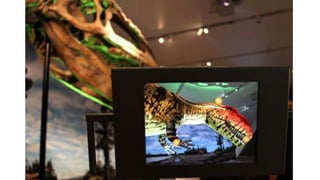
  • #3 Augmented reality is the closest technology I can imagine to magic. It combines things that are “real” with things that are ”imaginary”. Like looking at a dinosaur skeleton through your phone camera and seeing it come to 3D life. You know, MAGIC.
  • #4 For a kid, their whole life is filled with magic. How a car operates is INEXPLICABLE. Everything is full of wonder. That’s part of being a kid. So AR is a really good fit for kids: they accept it as possible.
  • #5 I want you to imagine that you are 5 years old. You have a heart defect and will be living in THIS room for the next 9 months. You’re surrounded by buttons you’re not allowed to press, equipment that beeps and alarms at all hours, and you have to endure a lot of pokes and prods.
  • #6 You are exhausted, anxious, and overwhelmed. You’re scared: you have no control over what happens. You have no idea what to expect. And this is what many hospitals give you to combat all those crazy feelings.
  • #7 We can all agree that no child should have to go through this We can’t change the fact that kids will have to be in hospitals but we can create better tools for them to have a more kid-like experience
  • #8 To have this more kid-like experience requires three things: We need to change… perception of the moment Perception of the environment Their Engagement with treatment
  • #9 The first strategy is to use AR to alter the perception of the moment. One of our products makes paper books come to 3D life, where the characters move and dance, the story is read aloud, and kids can engage with the world of the book in ways never imagined.
  • #10 This can be used to distract from scary or painful moments. When you’re focused on making your book come to 3D life, having 27 leads glued to your head and legs isn’t something to fuss over, and the technicians can get their job done much more quickly.
  • #11 The second strategy is to use AR to alter perception of the environment. We can turn an entire room into a scene from a book. Trees grow, a river gurgles nearby, you’re in a forest, not a 10x13 room in a strange bed.
  • #12 Or, As you’re being wheeled to the OR, we can turn the hallway into an amazing underwater adventure. When the trip to the OR isn’t so scary, you can be more relaxed and ready for surgery.
  • #13 The third strategy is to get kids more engaged with their treatment. We can help kids understand what its like to be inside an MRI machine before their procedure, so that they know what to expect, hold still, and get the scan done right the first time.
  • #14 We can create virtual equipment so kids can manipulate it, play with it safely. They can exert control in a situation where there is so little and better understand what’s happening around them. We are using AR to alter perception, not reality.
  • #15 We’re not going to change the fact that your medication makes you nauseous. But we can design experiences that evoke awe and wonder, and overshadow the nausea.
  • #16 Through AR we can offer a child a world of imagination so they can cope with the realities of their illness, disease, or treatment. We want them to continue to ’be a kid’, and we want them to have good memories of their time at the hospital, the place that is helping them to be well.
  • #17 To do this, we work with certified therapists, child life specialists, whose job it is to help children understand the experience they are going through, to help them cope.
  • #18 Through the child life specialists we can better understand the hospital experience and what its like for kids. We can also understand what therapists want the experience to be for their patients.
  • #19 So whether it is 3D pop up books, rooms that turn into a life-sized scene from a book, or virtual equipment that can be operated, we are creating two things simultaneously with augmented reality: tools for therapists and magical moments for kids.
  • #20 By transforming the environment and the moment, and improving understanding we are changing the way kids feel about their hospital experience. We are augmenting feeling. Using AR we can create moments of joy and escape for kids facing an illness or disease or procedure.
  • #21 Children always have magic in their eyes and I want to maintain that even in the face of harsh reality. I also want to live in a world where it is entirely possible to base your career on science fiction AND make a difference.