INTERFERENTIAL CURRENTS
• Medium frequency currents are the currents
whose frequency falls between the range of
1000 to 10,000 Hz.
• They are being used therapeutically due to
their advantage of greater penetration and
with a higher tolerance and comfort over the
low frequency current.
INTRODUCTION
• The principles of Interferential Therapy were first
introduced by Ho Nemec(an Austrian scientist).
• Interferential currents are also known as Nemec’s
currents. In this two medium frequency currents
are used to produce a low frequency current
effect.
• It may be described as the transcutaneous
application of alternating medium frequency
electrical currents, amplitude modulated at low
frequency for therapeutic purposes
• Since direct application of faradic current results in
pain due to high impedance of tissues, so to have a low
frequency effect two medium frequency currents are
used.
• Out of these two medium frequency currents one
current is usually of 4000Hz because there is minimum
impedance generated by the tissues against this
frequency current.
• The other current can be varied accordingly
SKIN IMPEDENCE
• The word impedance comes from the Latin impedire
meaning to prevent, to stop from going on.
• 􏰀 Impedance signifies the resistance of a conductor
when an electric current passes.
• 􏰀 Conventionally speaking, the term resistance refers
to the obstacle to the direct current, and it is
represented by the letter R.
• 􏰀 The terms impedance refers to the obstacle to the
alternating current and it is represented by the letter Z
• Impedance Z, as resistance R, is expressed in ohms
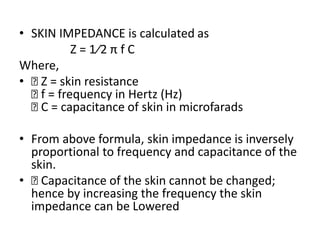
• SKIN IMPEDANCE is calculated as
Z = 1⁄2 π f C
Where,
• 􏰀 Z = skin resistance
􏰀 f = frequency in Hertz (Hz)
􏰀 C = capacitance of skin in microfarads
• From above formula, skin impedance is inversely
proportional to frequency and capacitance of the
skin.
• 􏰀 Capacitance of the skin cannot be changed;
hence by increasing the frequency the skin
impedance can be Lowered
PRINCIPLE
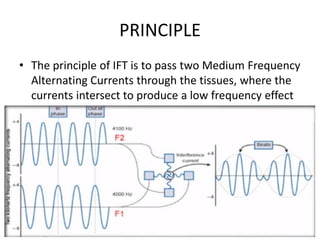
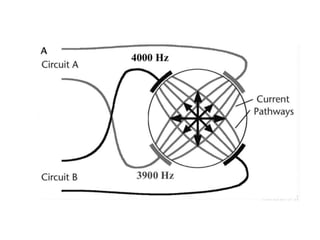
• The principle of IFT is to pass two Medium Frequency
Alternating Currents through the tissues, where the
currents intersect to produce a low frequency effect
• The Interferential therapy depends upon the
principles of Interferential effect of two medium
frequency currents crossing in the patient’s
tissues.
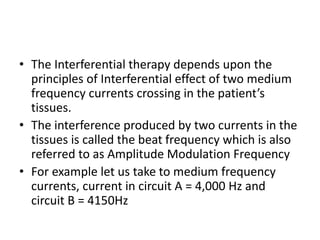
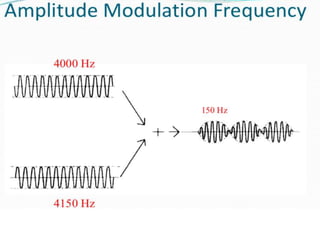
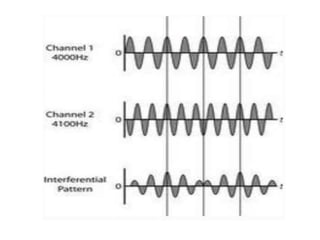
• The interference produced by two currents in the
tissues is called the beat frequency which is also
referred to as Amplitude Modulation Frequency
• For example let us take to medium frequency
currents, current in circuit A = 4,000 Hz and
circuit B = 4150Hz
• Thus it is possible to produce any desired
frequency in the range of 1-250 Hz by varying
the frequency difference of the carrier
currents
• One of the major advantages by the use of
interferential therapy is that the effects are
produced in the tissues where they are
required, without unnecessary or
uncomfortable skin stimulation
• The advantage of IFT is that it can be used for
pain relief as well as for muscle stimulation
• The principle of reduction in pain is because of
gate control theory and stimulated release of
pain reducing substances (endorphine and
enkephalin)
SWEEP
• The principle of using the sweep is that the machine is
set to automatically vary the effective stimulation
frequency using either pre-set or user set sweep ranges
• Such sweep prevents accommodation of nerves.
Example:
• 􏰀An AMF of 20 Hz is set and a 50 Hz spectrum is added.
• 􏰀 The current begins with an AMF of 20 Hz and passes
successively through all frequencies up to 70 Hz, after
which it decreases gradually to 20 Hz.
• 􏰀 This process is repeated automatically
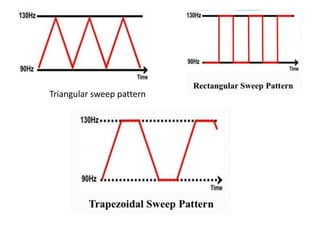
Triangular sweep pattern
ELECTRODES
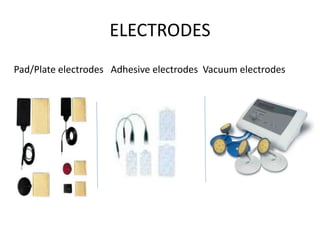
Pad/Plate electrodes Adhesive electrodes Vacuum electrodes
Plate/Pad Electrodes
• Made of conducting rubber which are
comfortable and long lasting
• 􏰀 larger plates electrodes give more
comfortable treatment and deeper effect
• 􏰀 Smaller electrodes are used for a localized
effect, but this effect is more superficial
• 􏰀 Attached to the patient by means of straps
to assure a good contact and greater tolerance
of treatment
Vacuum Electrodes
• Made from a vacuum unit plug into a rubber
suction cup connected to a machine capable of
producing a vacuum,
• 􏰀Suction should not be constant because it can
be uncomfortable and causes bruising
• 􏰀Wet sponges are placed in the cups and moisten
the edges of the cups for better adherence,
• 􏰀Excellent for treating flat smooth areas for
example back or a plump knee
• 􏰀Not indicated for treatment of the hairy areas
because can’t get an airtight seal
• Suction electrodes are seen to be much more beneficial as it
is useful in delivering the currents in uneven surfaces
• Carbon pad electrodes are the most commonly used
electrodes and are easier to apply
METHODS OF APPLICATION
• There are 3 different ways of applying IFT
1. Bipolar interference
2. Static interference
3. Dynamic interference
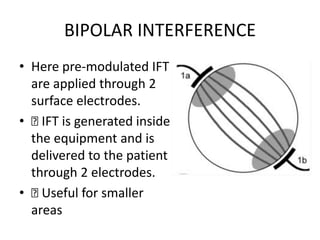
BIPOLAR INTERFERENCE
• Here pre-modulated IFT
are applied through 2
surface electrodes.
• 􏰀 IFT is generated inside
the equipment and is
delivered to the patient
through 2 electrodes.
• 􏰀 Useful for smaller
areas
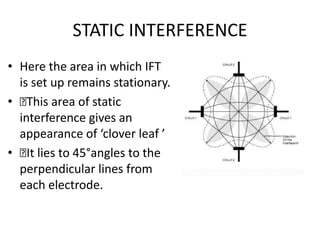
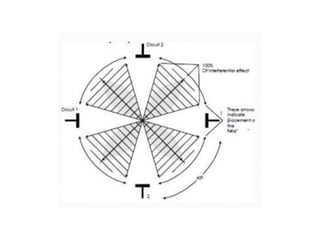
STATIC INTERFERENCE
• Here the area in which IFT
is set up remains stationary.
• 􏰀This area of static
interference gives an
appearance of ‘clover leaf ’
• 􏰀It lies to 45°angles to the
perpendicular lines from
each electrode.
DYNAMIC INTERFERENCE
• This is moving the area of interference
current in a to and fro manner through
45°.
• 􏰀 It is obtained by varying the current
intensity from 50 to 100%.
• 􏰀 The dynamic area of interference is also
called as vector sweep, vector scan,
rotating vector, etc.
PHYSIOLOGICAL EFFECTS
Main clinical applications are :
• Pain relief
• Muscle stimulation
• Increased local blood flow
• Reduction of edema
• Various specialised application – e.g. stress
incontinence
PAIN RELIEF
• Electrical stimulation for pain relief has
widespread clinical use, thought the direct
research evidence for the use of IFT in this role is
limited.
• Logically one could use the higher frequencies
(90-130Hz) to stimulate the pain gate
mechanisms & thereby mask the pain symptoms.
• Alternatively, stimulation with lower frequencies
(<5Hz) can be used to activate the opioid
mechanisms, again providing a degree of relief.
Muscle stimulation
• For patients who can not generate useful
voluntary contraction, IFT may be beneficial.
• 􏰀 Most effective motor nerve stimulation
range is between 10-25Hz
• 􏰀When employing IFT it is possible to continue
to stimulate the muscle beyond its point of
fatigue.
• Some machines employ a ‘surged’ mode to
overcome this.
BLOOD FLOW
• Experimentation demonstrated vascular
changes at 10-25Hz.
• 􏰀 Effects of blood flow is believed to be due
to:
1. Effects of suction electrodes on tissues
2. Effects of muscle stimulation on circulation.
3. Deep tissue penetration stimulates
parasympathetic nerve fibers for increased blood
flow
OEDEMA
• Local muscle contraction combined with its
local vascular changes encourages the
reabsorbtion of tissue fluid.
• 􏰀The use of suction electrodes may also be
beneficial.
MANDATORY STEPS
• RUKE NO 1: Assess the patient
• RULE NO 2: Know your equipment
• RULE NO 3: Complete the patient preparation
and machine preparation
• RULE NO 4: Choose appropriate programs
• RULE NO 5: Keep taking feedback from the
patient during the treatment
• RULE NO 6 : Cleanliness before and after
TREATMENT PARAMETERES
1. Method of application:
– Depends on the area being treated
– Pain pattern
2. Frequency sweep:
– Triangular - Acute
– Rectangular/Square: Sub Acute
– Trepizoidal: Chronic
• Duration:
– In acute conditions, shorter treatment times of 5-
10 minutes may be sufficient to achieve the effect.
– In other circumstances like chronic conditions or
long standing cases, it may be necessary to
stimulate the tissues for 20-30 minutes.
Contra Indications
• Cardiac pacemaker
• Advanced cardiac disease
• Hypertension
• Thrombosis
• Hemorrhage
• Pregnancy
• Neoplasm
• Fever
• Infections
• The eyes
• Skin disorders
• Epiphyseal region in children
Precautions
• IFT apparatus must be at least 6 meters away
from SWD machine
• 􏰀Patients with febrile conditions 􏰀Epileptic
patients
􏰀Over anterior chest wall
• 􏰀Position suction electrode below the level of
damage or discomfort.
IFT.pptx

IFT.pptx

  • 1.
  • 2.
    • Medium frequencycurrents are the currents whose frequency falls between the range of 1000 to 10,000 Hz. • They are being used therapeutically due to their advantage of greater penetration and with a higher tolerance and comfort over the low frequency current.
  • 3.
    INTRODUCTION • The principlesof Interferential Therapy were first introduced by Ho Nemec(an Austrian scientist). • Interferential currents are also known as Nemec’s currents. In this two medium frequency currents are used to produce a low frequency current effect. • It may be described as the transcutaneous application of alternating medium frequency electrical currents, amplitude modulated at low frequency for therapeutic purposes
  • 4.
    • Since directapplication of faradic current results in pain due to high impedance of tissues, so to have a low frequency effect two medium frequency currents are used. • Out of these two medium frequency currents one current is usually of 4000Hz because there is minimum impedance generated by the tissues against this frequency current. • The other current can be varied accordingly
  • 5.
    SKIN IMPEDENCE • Theword impedance comes from the Latin impedire meaning to prevent, to stop from going on. • 􏰀 Impedance signifies the resistance of a conductor when an electric current passes. • 􏰀 Conventionally speaking, the term resistance refers to the obstacle to the direct current, and it is represented by the letter R. • 􏰀 The terms impedance refers to the obstacle to the alternating current and it is represented by the letter Z • Impedance Z, as resistance R, is expressed in ohms
  • 6.
    • SKIN IMPEDANCEis calculated as Z = 1⁄2 π f C Where, • 􏰀 Z = skin resistance 􏰀 f = frequency in Hertz (Hz) 􏰀 C = capacitance of skin in microfarads • From above formula, skin impedance is inversely proportional to frequency and capacitance of the skin. • 􏰀 Capacitance of the skin cannot be changed; hence by increasing the frequency the skin impedance can be Lowered
  • 7.
    PRINCIPLE • The principleof IFT is to pass two Medium Frequency Alternating Currents through the tissues, where the currents intersect to produce a low frequency effect
  • 8.
    • The Interferentialtherapy depends upon the principles of Interferential effect of two medium frequency currents crossing in the patient’s tissues. • The interference produced by two currents in the tissues is called the beat frequency which is also referred to as Amplitude Modulation Frequency • For example let us take to medium frequency currents, current in circuit A = 4,000 Hz and circuit B = 4150Hz
  • 12.
    • Thus itis possible to produce any desired frequency in the range of 1-250 Hz by varying the frequency difference of the carrier currents • One of the major advantages by the use of interferential therapy is that the effects are produced in the tissues where they are required, without unnecessary or uncomfortable skin stimulation
  • 13.
    • The advantageof IFT is that it can be used for pain relief as well as for muscle stimulation • The principle of reduction in pain is because of gate control theory and stimulated release of pain reducing substances (endorphine and enkephalin)
  • 14.
    SWEEP • The principleof using the sweep is that the machine is set to automatically vary the effective stimulation frequency using either pre-set or user set sweep ranges • Such sweep prevents accommodation of nerves. Example: • 􏰀An AMF of 20 Hz is set and a 50 Hz spectrum is added. • 􏰀 The current begins with an AMF of 20 Hz and passes successively through all frequencies up to 70 Hz, after which it decreases gradually to 20 Hz. • 􏰀 This process is repeated automatically
  • 15.
  • 16.
    ELECTRODES Pad/Plate electrodes Adhesiveelectrodes Vacuum electrodes
  • 17.
    Plate/Pad Electrodes • Madeof conducting rubber which are comfortable and long lasting • 􏰀 larger plates electrodes give more comfortable treatment and deeper effect • 􏰀 Smaller electrodes are used for a localized effect, but this effect is more superficial • 􏰀 Attached to the patient by means of straps to assure a good contact and greater tolerance of treatment
  • 18.
    Vacuum Electrodes • Madefrom a vacuum unit plug into a rubber suction cup connected to a machine capable of producing a vacuum, • 􏰀Suction should not be constant because it can be uncomfortable and causes bruising • 􏰀Wet sponges are placed in the cups and moisten the edges of the cups for better adherence, • 􏰀Excellent for treating flat smooth areas for example back or a plump knee • 􏰀Not indicated for treatment of the hairy areas because can’t get an airtight seal
  • 19.
    • Suction electrodesare seen to be much more beneficial as it is useful in delivering the currents in uneven surfaces • Carbon pad electrodes are the most commonly used electrodes and are easier to apply
  • 20.
    METHODS OF APPLICATION •There are 3 different ways of applying IFT 1. Bipolar interference 2. Static interference 3. Dynamic interference
  • 21.
    BIPOLAR INTERFERENCE • Herepre-modulated IFT are applied through 2 surface electrodes. • 􏰀 IFT is generated inside the equipment and is delivered to the patient through 2 electrodes. • 􏰀 Useful for smaller areas
  • 22.
    STATIC INTERFERENCE • Herethe area in which IFT is set up remains stationary. • 􏰀This area of static interference gives an appearance of ‘clover leaf ’ • 􏰀It lies to 45°angles to the perpendicular lines from each electrode.
  • 23.
    DYNAMIC INTERFERENCE • Thisis moving the area of interference current in a to and fro manner through 45°. • 􏰀 It is obtained by varying the current intensity from 50 to 100%. • 􏰀 The dynamic area of interference is also called as vector sweep, vector scan, rotating vector, etc.
  • 25.
  • 26.
    Main clinical applicationsare : • Pain relief • Muscle stimulation • Increased local blood flow • Reduction of edema • Various specialised application – e.g. stress incontinence
  • 27.
    PAIN RELIEF • Electricalstimulation for pain relief has widespread clinical use, thought the direct research evidence for the use of IFT in this role is limited. • Logically one could use the higher frequencies (90-130Hz) to stimulate the pain gate mechanisms & thereby mask the pain symptoms. • Alternatively, stimulation with lower frequencies (<5Hz) can be used to activate the opioid mechanisms, again providing a degree of relief.
  • 28.
    Muscle stimulation • Forpatients who can not generate useful voluntary contraction, IFT may be beneficial. • 􏰀 Most effective motor nerve stimulation range is between 10-25Hz • 􏰀When employing IFT it is possible to continue to stimulate the muscle beyond its point of fatigue. • Some machines employ a ‘surged’ mode to overcome this.
  • 29.
    BLOOD FLOW • Experimentationdemonstrated vascular changes at 10-25Hz. • 􏰀 Effects of blood flow is believed to be due to: 1. Effects of suction electrodes on tissues 2. Effects of muscle stimulation on circulation. 3. Deep tissue penetration stimulates parasympathetic nerve fibers for increased blood flow
  • 30.
    OEDEMA • Local musclecontraction combined with its local vascular changes encourages the reabsorbtion of tissue fluid. • 􏰀The use of suction electrodes may also be beneficial.
  • 31.
    MANDATORY STEPS • RUKENO 1: Assess the patient • RULE NO 2: Know your equipment • RULE NO 3: Complete the patient preparation and machine preparation • RULE NO 4: Choose appropriate programs • RULE NO 5: Keep taking feedback from the patient during the treatment • RULE NO 6 : Cleanliness before and after
  • 32.
    TREATMENT PARAMETERES 1. Methodof application: – Depends on the area being treated – Pain pattern 2. Frequency sweep: – Triangular - Acute – Rectangular/Square: Sub Acute – Trepizoidal: Chronic
  • 33.
    • Duration: – Inacute conditions, shorter treatment times of 5- 10 minutes may be sufficient to achieve the effect. – In other circumstances like chronic conditions or long standing cases, it may be necessary to stimulate the tissues for 20-30 minutes.
  • 34.
    Contra Indications • Cardiacpacemaker • Advanced cardiac disease • Hypertension • Thrombosis • Hemorrhage • Pregnancy • Neoplasm • Fever • Infections • The eyes • Skin disorders • Epiphyseal region in children
  • 35.
    Precautions • IFT apparatusmust be at least 6 meters away from SWD machine • 􏰀Patients with febrile conditions 􏰀Epileptic patients 􏰀Over anterior chest wall • 􏰀Position suction electrode below the level of damage or discomfort.