INTERFERENTIAL
THERAPY -
Electrodiagnosis &
Physical agents
Course Code: MPT19205
GUIDED BY : Prof. P. Kamalanathan
PRESENTED BY : BATCH – 06.
Masters Of Physiotherapy, 2nd Semester ( 1st YEAR ),
2021 BATCH, SRMIST, COLLEGE OF PHYSIOTHERAPY,
KATTANKULATHUR, TAMIL NADU.
INTRODUCTION
5/27/2023 GROUP 06 2
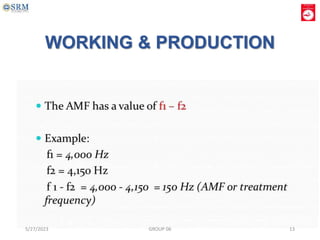
Medium frequency currents : frequency falls between
1000 Hz to 10,000 Hz with therapeutic range of 50 –
150 Hz depending upon the conditions and stages of
the pathology. So the advantages of application of IFT
are :
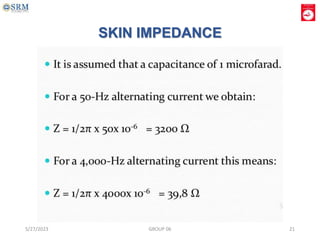
• MF Current associated with lower skin impedance
• More comfortable than low frequency currents
• More tolerable current penetration through the skin is
possible.
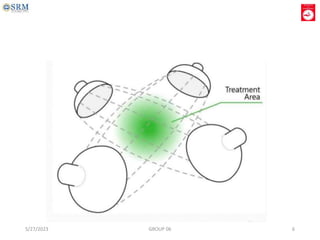
It is the production of low frequency currents in the body
by the simultaneous application of two different medium
frequency currents.
INTRODUCTION
5/27/2023 GROUP 06 3
SKIN IMPEDANCE
5/27/2023 GROUP 06 4
PRINCIPLES
5/27/2023 GROUP 06 5
5/27/2023 GROUP 06 6
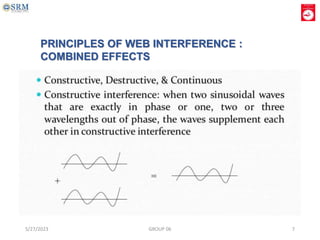
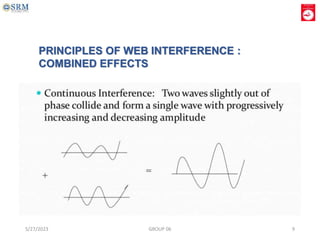
PRINCIPLES OF WEB INTERFERENCE :
COMBINED EFFECTS
5/27/2023 GROUP 06 7
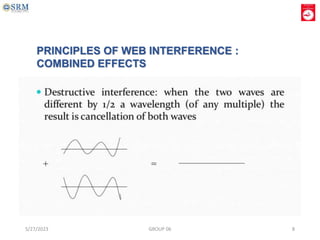
PRINCIPLES OF WEB INTERFERENCE :
COMBINED EFFECTS
5/27/2023 GROUP 06 8
PRINCIPLES OF WEB INTERFERENCE :
COMBINED EFFECTS
5/27/2023 GROUP 06 9
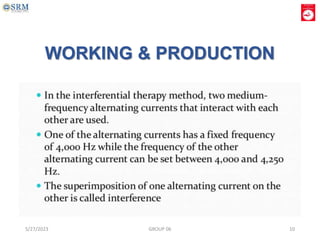
WORKING & PRODUCTION
5/27/2023 GROUP 06 10
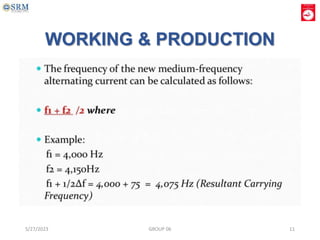
WORKING & PRODUCTION
5/27/2023 GROUP 06 11
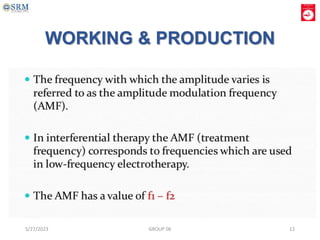
WORKING & PRODUCTION
5/27/2023 GROUP 06 12
WORKING & PRODUCTION
5/27/2023 GROUP 06 13
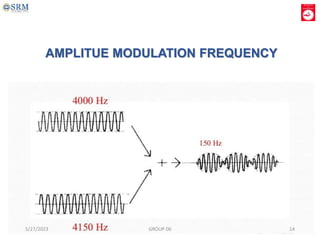
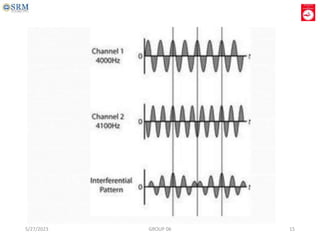
AMPLITUE MODULATION FREQUENCY
5/27/2023 GROUP 06 14
5/27/2023 GROUP 06 15
5/27/2023 GROUP 06 16
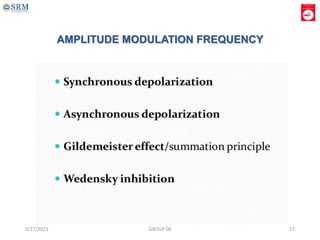
AMPLITUDE MODULATION FREQUENCY
5/27/2023 GROUP 06 17
5/27/2023 GROUP 06 18
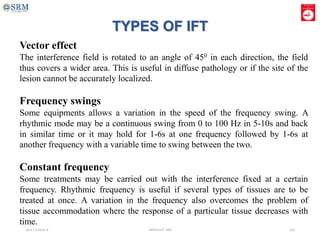
Vector effect
The interference field is rotated to an angle of 450 in each direction, the field
thus covers a wider area. This is useful in diffuse pathology or if the site of the
lesion cannot be accurately localized.
Frequency swings
Some equipments allows a variation in the speed of the frequency swing. A
rhythmic mode may be a continuous swing from 0 to 100 Hz in 5-10s and back
in similar time or it may hold for 1-6s at one frequency followed by 1-6s at
another frequency with a variable time to swing between the two.
Constant frequency
Some treatments may be carried out with the interference fixed at a certain
frequency. Rhythmic frequency is useful if several types of tissues are to be
treated at once. A variation in the frequency also overcomes the problem of
tissue accommodation where the response of a particular tissue decreases with
time.
TYPES OF IFT
APPLICATION OF
INTERFERENTIAL THERAPY
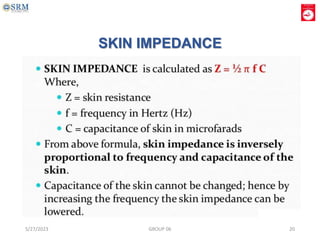
SKIN IMPEDANCE
5/27/2023 GROUP 06 20
SKIN IMPEDANCE
5/27/2023 GROUP 06 21
METHODS OF IFT APPLICATION:
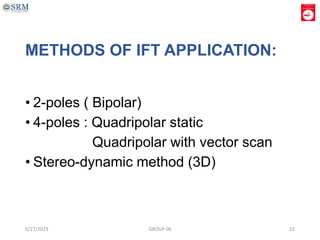
• 2-poles ( Bipolar)
• 4-poles : Quadripolar static
Quadripolar with vector scan
• Stereo-dynamic method (3D)
5/27/2023 GROUP 06 22
BIPOLAR METHOD:
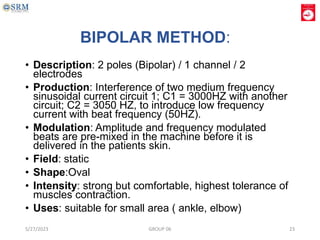
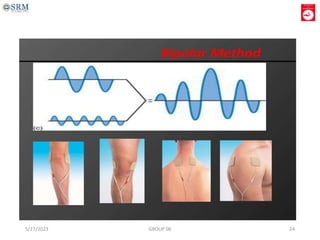
• Description: 2 poles (Bipolar) / 1 channel / 2
electrodes
• Production: Interference of two medium frequency
sinusoidal current circuit 1; C1 = 3000HZ with another
circuit; C2 = 3050 HZ, to introduce low frequency
current with beat frequency (50HZ).
• Modulation: Amplitude and frequency modulated
beats are pre-mixed in the machine before it is
delivered in the patients skin.
• Field: static
• Shape:Oval
• Intensity: strong but comfortable, highest tolerance of
muscles contraction.
• Uses: suitable for small area ( ankle, elbow)
5/27/2023 GROUP 06 23
5/27/2023 GROUP 06 24
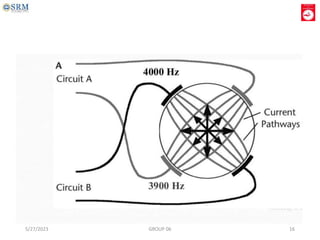
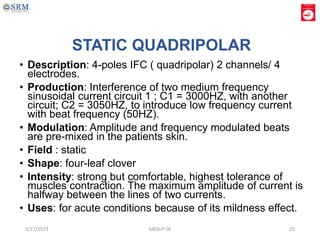
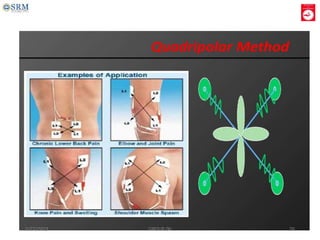
STATIC QUADRIPOLAR
• Description: 4-poles IFC ( quadripolar) 2 channels/ 4
electrodes.
• Production: Interference of two medium frequency
sinusoidal current circuit 1 ; C1 = 3000HZ, with another
circuit; C2 = 3050HZ, to introduce low frequency current
with beat frequency (50HZ).
• Modulation: Amplitude and frequency modulated beats
are pre-mixed in the patients skin.
• Field : static
• Shape: four-leaf clover
• Intensity: strong but comfortable, highest tolerance of
muscles contraction. The maximum amplitude of current is
halfway between the lines of two currents.
• Uses: for acute conditions because of its mildness effect.
5/27/2023 GROUP 06 25
5/27/2023 GROUP 06 26
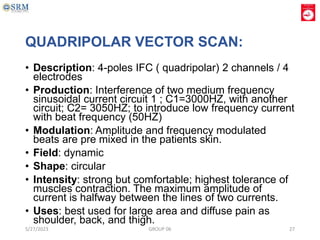
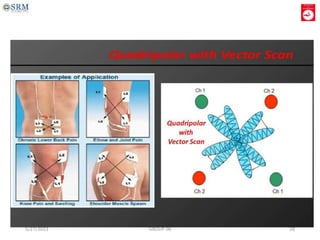
QUADRIPOLAR VECTOR SCAN:
• Description: 4-poles IFC ( quadripolar) 2 channels / 4
electrodes
• Production: Interference of two medium frequency
sinusoidal current circuit 1 ; C1=3000HZ, with another
circuit; C2= 3050HZ; to introduce low frequency current
with beat frequency (50HZ)
• Modulation: Amplitude and frequency modulated
beats are pre mixed in the patients skin.
• Field: dynamic
• Shape: circular
• Intensity: strong but comfortable; highest tolerance of
muscles contraction. The maximum amplitude of
current is halfway between the lines of two currents.
• Uses: best used for large area and diffuse pain as
shoulder, back, and thigh.
5/27/2023 GROUP 06 27
5/27/2023 GROUP 06 28
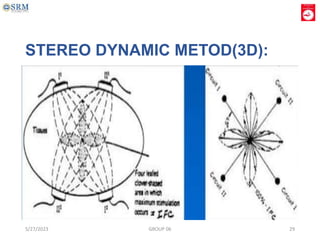
STEREO DYNAMIC METOD(3D):
5/27/2023 GROUP 06 29
IFT APPLICATION PARAMETERS
• STIMULATOR TYPES: 1) Desk cabinet (line- powered)
2) portable (battery –powered)
• METHODS OF DELIVERY:
1) BIPOLAR: for localized
tissue
2) QUADRIPOLAR: for deeper
tissue
3) QUADRIPOLAR WITH VECTOR:
for deeper tissue with enlarged
area
• CURRENT MODES : constant current modes
sweep current ( rhythmic current modes)
• ELECTRODE TYPES: pad, rubber, carbon-impregnated.
5/27/2023 GROUP 06 30
Dosage of interferential therapy
• For pain relief = 80-100 Hz
• For reduce swelling = 1-10Hz
•Reduce edema = 100 Hz
• For partial tetany contraction = 30-
100 Hz
•Apply for 15 minutes
5/27/2023 GROUP 06 31
CONTD;
• INTENSITY OF CURRENT: use an intensity of current
which produces a strong but comfortable prickling
sensation without a muscular contraction.
1 ) Increase current until the patient feels a definite
prickling, and leave for 1-5 minute for it to decrease.
2) increase current again until the patient reports a slight
muscular contraction, then decrease until contraction
stops.
• DURATION OF TREATMENT:
• IFC usually applied for 10-20 minutes treatment at a
normal intensity.
• should not be given to one area for longer than 20
minutes.
• If more than one area is to be treated a total time
should not exceed 30min.
5/27/2023 GROUP 06 32
CONTD;
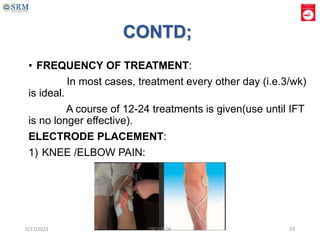
• FREQUENCY OF TREATMENT:
In most cases, treatment every other day (i.e.3/wk)
is ideal.
A course of 12-24 treatments is given(use until IFT
is no longer effective).
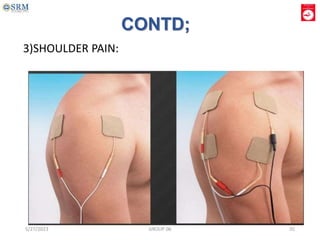
ELECTRODE PLACEMENT:
1) KNEE /ELBOW PAIN:
5/27/2023 GROUP 06 33
CONTD;
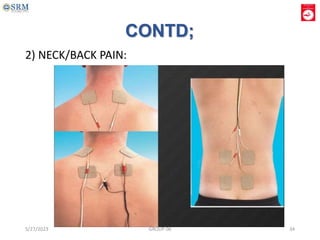
2) NECK/BACK PAIN:
5/27/2023 GROUP 06 34
3)SHOULDER PAIN:
CONTD;
5/27/2023 GROUP 06 35
PHYSIOLOGICAL EFFECTS
The physiological effect of IFT depends upon
1. Magnitude of current
2. Type of mode used – rhythmic or constant
3. Frequency range used
4. Accuracy of electrode positioning
Different beat frequencies lead to different effects
• Higher beat frequencies ( around 100 Hz) used for
analgesic effect
• Lower beat frequencies (around 10 Hz ) used for
contraction of innervated muscles
5/27/2023 GROUP 06 36
Main clinical application are:
1. Pain relief
2. Muscle stimulation
3. Increased local blood flow
4. Reduction of edema
1. PAIN RELIEF
It is the most important effect and can be achieved by several mechanism
 ACTIVATION OF PAIN GATE CONTROL MECHANISM
Large diameter afferent nerve fibers stimulate closes the gate of
nociceptive impulses in posterior horn of spinal cord
 ACTIVATION OF NOCICEPTIVE FIBERS
Nociceptive fibers activation diminish pain by descending pain
suppressor system
5/27/2023 GROUP 06 37
 PHYSIOLOGICAL BLOCK
High frequency electrical stimuli above 50 Hz cause temporary
physiological block in myelinated and unmyelinated nociceptor nerve fibers
(Aẟ + C fibers)
 INCREASED BLOOD FLOW
Pain suppression due to - increased blood flow
- tissue fluid exchange
( blood flow increases it removes chemical irritants which stimulate nerve
endings)
 ABSORPTION OF EXUDATES
Exudates is accelerated by frequency of 1 – 10 Hz with rhythmical
pumping action produced by muscle contraction
Helps to absorb exudates and reduce swelling
5/27/2023 GROUP 06 38
 MUSCLE CONTRACTION
Low beat frequency stimulate motor nerves ( 10 – 50Hz) causes
contraction of voluntary muscles and smooth muscles contraction
reduces oedema
2. MUSCLE STIMULATION
Stimulation of the motor nerves can be achieved with a wide range of frequencies.
Clearly, stimulation at low frequency (e.g. 1Hz) will result in a series of twitches,
whist stimulation at 50Hz will result in a tetanic contraction. patients who cannot
generate useful voluntary contraction, IFT may be beneficial. The most effective
motor nerve stimulation range with IFT lie between approximately 10 and 20, maybe
10 and 25Hz. Stimulation below 10Hz results in a series of coarse twitches which
may be of clinical benefit. Stimulation at higher frequencies that bring about a partial
tetany (usually around 20 or 25Hz) can generate a strong tetanic contraction, which
might be considered beneficial to assist patient appreciation of the required muscle
work,
5/27/2023 GROUP 06 39
3. BLOOD FLOW
Effect of blood flow is believed to be due to
- Effects of suction electrodes on tissues
- Effects of muscle stimulation on circulation
- Deep tissue penetration stimulates parasympathetic nerve
fibers for increased blood flow.
4. OEDEMA
Local muscle contraction combined with its local vascular
changes encourages the reabsorption of Tissue fluid. The use of
suction electrodes may also be beneficial .
5/27/2023 GROUP 06 40
Therapeutic effects
Pain Relief – A frequency of 100HZ reduces pain effectively by
closing the gait to pain
stimulation of large diameter afferents .
e.g. Osteoarthritis , LBP , Frozen shoulder ,
rheumatic arthritis , spondylosis , neuralgia
etc.
Edema – AMF – 1- 10 HZ generally used. It activates the
musculoskeletal pump to
activate lymphatic and venous return. 100HZ cause
vasodilation to reduce edema
e.g. – edema of foot
Stress incontinence – Male – stress incontinence following prostatectomy
2 electrodes placed on either side of gluteal cleft,
under ischial tuberosities anterior to anus.
Female – women following multiple vaginal delivery,
Older age during coughing , One electrode
under both ischial tuberosities and one over
anterior perineum.
• Muscle injury
• Muscle stimulation – Prevents muscle wastage , re- education ,
10 – 15 Hz rhythmic, they produce stimulation
deep innervated muscle tissue.
• Ligament injury
5/27/2023 GROUP 06 42
1. Pain Relief in conditions such as causalgia,
2. herpes zoster,
3. neuralgia.
4. Cervical spondylosis.
5. Osteoarthritis of the knee.
6. Ankylosing spondylitis
7. Rheumatoid arthritis.
8. Frozen shoulder.
9. Disc herniation.
10.Spinal canal stenosis.
11.Incontinence
12.Reduction of Edema
13.Muscle injuries
14.Ligamentous injuries
INDICATIONS
5/27/2023 GROUP 06 43
CONTRA-INDICATIONS
5/27/2023 GROUP 06 44
PRECAUTIONS OF IFT
• IFT apparatus must be 6 meters away from the
SWD machine.
• Abnormal skin sensation.
• For patients with febrile conditions outcome of
the first treatment must be monitored.
• Patients with epilepsy, advanced cardio
vascular conditions or cardiac arrhythmias
should be treated in the direction of the
physiotherapist.
• Treatment which involves placement of
electrodes over the anterior chest wall.
5/27/2023 GROUP 06 45
• This treatment is Not eligible for athletes during
their Endurance training, but it can be applicable
only after their training events get over.
• during pregnancy this therapy is generally not
given, as it may cause harm to the mother and
child both.
• this therapy is not used in any muscle regaining
strategy.
• infants or children below 12 years of age are
generally not eligible for this therapy.
ADVERSE AFFECTS OF IFT
5/27/2023 GROUP 06 46
5/27/2023 GROUP 06 47
Interferential current therapy works by sending small amounts of electrical stimulation to
damaged tissues in the body. The therapy is meant to boost the body's natural process of
responding to pain, by increasing circulation thus produces hormones that promote healing.
IFT delivers intermittent pulses to stimulate surface nerves and block the pain signal, by
delivering continuous deep stimulation into the affected tissue. IFT relieves pain, increases
circulation, decreases edema, and stimulates the muscles. A frequency of 100Hz may
stimulate the large diameter A-beta fibers, which have an effect on the pain gate, and inhibit
the transmission of small-diameter nociceptive traffic ( C and A-delta fiber), which effectively
closes the gait to painful impulses. Interferential current Increases the circulation of blood
thus reduces swelling, by washing away the chemicals that stimulate the nociceptive nerve
endings.
The frequency between 1 and 100 Hz is used to contract the normal innervated muscles.
Different types of frequencies cause different contractions, a low frequency, causes a twitch,
frequency between 5 and 20 Hz causes a partial tetany contraction and frequency from 30 to
100 Hz causes a tetanic contraction. IFT also helps to reduce edema 100Hz frequency
promotes vasodilation, thus decreases edema. And a frequency of 10 Hz activates the
musculoskeletal pump, used to promote venous and lymphatic return causing reduction of
edema. The neurons that make the autonomic nervous system, are small and poorly
myelinated like the Aδ and C fibers of the peripheral nervous system and to stimulate the
autonomic nervous system, lower frequencies are utilized to increase the blood flow.
SUMMARY
THANK YOU
5/27/2023 GROUP 06 48

BATCH 06 - IFT PRESENTATION.pptx

  • 1.
    INTERFERENTIAL THERAPY - Electrodiagnosis & Physicalagents Course Code: MPT19205 GUIDED BY : Prof. P. Kamalanathan PRESENTED BY : BATCH – 06. Masters Of Physiotherapy, 2nd Semester ( 1st YEAR ), 2021 BATCH, SRMIST, COLLEGE OF PHYSIOTHERAPY, KATTANKULATHUR, TAMIL NADU.
  • 2.
  • 3.
    Medium frequency currents: frequency falls between 1000 Hz to 10,000 Hz with therapeutic range of 50 – 150 Hz depending upon the conditions and stages of the pathology. So the advantages of application of IFT are : • MF Current associated with lower skin impedance • More comfortable than low frequency currents • More tolerable current penetration through the skin is possible. It is the production of low frequency currents in the body by the simultaneous application of two different medium frequency currents. INTRODUCTION 5/27/2023 GROUP 06 3
  • 4.
  • 5.
  • 6.
  • 7.
    PRINCIPLES OF WEBINTERFERENCE : COMBINED EFFECTS 5/27/2023 GROUP 06 7
  • 8.
    PRINCIPLES OF WEBINTERFERENCE : COMBINED EFFECTS 5/27/2023 GROUP 06 8
  • 9.
    PRINCIPLES OF WEBINTERFERENCE : COMBINED EFFECTS 5/27/2023 GROUP 06 9
  • 10.
  • 11.
  • 12.
  • 13.
  • 14.
  • 15.
  • 16.
  • 17.
  • 18.
    5/27/2023 GROUP 0618 Vector effect The interference field is rotated to an angle of 450 in each direction, the field thus covers a wider area. This is useful in diffuse pathology or if the site of the lesion cannot be accurately localized. Frequency swings Some equipments allows a variation in the speed of the frequency swing. A rhythmic mode may be a continuous swing from 0 to 100 Hz in 5-10s and back in similar time or it may hold for 1-6s at one frequency followed by 1-6s at another frequency with a variable time to swing between the two. Constant frequency Some treatments may be carried out with the interference fixed at a certain frequency. Rhythmic frequency is useful if several types of tissues are to be treated at once. A variation in the frequency also overcomes the problem of tissue accommodation where the response of a particular tissue decreases with time. TYPES OF IFT
  • 19.
  • 20.
  • 21.
  • 22.
    METHODS OF IFTAPPLICATION: • 2-poles ( Bipolar) • 4-poles : Quadripolar static Quadripolar with vector scan • Stereo-dynamic method (3D) 5/27/2023 GROUP 06 22
  • 23.
    BIPOLAR METHOD: • Description:2 poles (Bipolar) / 1 channel / 2 electrodes • Production: Interference of two medium frequency sinusoidal current circuit 1; C1 = 3000HZ with another circuit; C2 = 3050 HZ, to introduce low frequency current with beat frequency (50HZ). • Modulation: Amplitude and frequency modulated beats are pre-mixed in the machine before it is delivered in the patients skin. • Field: static • Shape:Oval • Intensity: strong but comfortable, highest tolerance of muscles contraction. • Uses: suitable for small area ( ankle, elbow) 5/27/2023 GROUP 06 23
  • 24.
  • 25.
    STATIC QUADRIPOLAR • Description:4-poles IFC ( quadripolar) 2 channels/ 4 electrodes. • Production: Interference of two medium frequency sinusoidal current circuit 1 ; C1 = 3000HZ, with another circuit; C2 = 3050HZ, to introduce low frequency current with beat frequency (50HZ). • Modulation: Amplitude and frequency modulated beats are pre-mixed in the patients skin. • Field : static • Shape: four-leaf clover • Intensity: strong but comfortable, highest tolerance of muscles contraction. The maximum amplitude of current is halfway between the lines of two currents. • Uses: for acute conditions because of its mildness effect. 5/27/2023 GROUP 06 25
  • 26.
  • 27.
    QUADRIPOLAR VECTOR SCAN: •Description: 4-poles IFC ( quadripolar) 2 channels / 4 electrodes • Production: Interference of two medium frequency sinusoidal current circuit 1 ; C1=3000HZ, with another circuit; C2= 3050HZ; to introduce low frequency current with beat frequency (50HZ) • Modulation: Amplitude and frequency modulated beats are pre mixed in the patients skin. • Field: dynamic • Shape: circular • Intensity: strong but comfortable; highest tolerance of muscles contraction. The maximum amplitude of current is halfway between the lines of two currents. • Uses: best used for large area and diffuse pain as shoulder, back, and thigh. 5/27/2023 GROUP 06 27
  • 28.
  • 29.
  • 30.
    IFT APPLICATION PARAMETERS •STIMULATOR TYPES: 1) Desk cabinet (line- powered) 2) portable (battery –powered) • METHODS OF DELIVERY: 1) BIPOLAR: for localized tissue 2) QUADRIPOLAR: for deeper tissue 3) QUADRIPOLAR WITH VECTOR: for deeper tissue with enlarged area • CURRENT MODES : constant current modes sweep current ( rhythmic current modes) • ELECTRODE TYPES: pad, rubber, carbon-impregnated. 5/27/2023 GROUP 06 30
  • 31.
    Dosage of interferentialtherapy • For pain relief = 80-100 Hz • For reduce swelling = 1-10Hz •Reduce edema = 100 Hz • For partial tetany contraction = 30- 100 Hz •Apply for 15 minutes 5/27/2023 GROUP 06 31
  • 32.
    CONTD; • INTENSITY OFCURRENT: use an intensity of current which produces a strong but comfortable prickling sensation without a muscular contraction. 1 ) Increase current until the patient feels a definite prickling, and leave for 1-5 minute for it to decrease. 2) increase current again until the patient reports a slight muscular contraction, then decrease until contraction stops. • DURATION OF TREATMENT: • IFC usually applied for 10-20 minutes treatment at a normal intensity. • should not be given to one area for longer than 20 minutes. • If more than one area is to be treated a total time should not exceed 30min. 5/27/2023 GROUP 06 32
  • 33.
    CONTD; • FREQUENCY OFTREATMENT: In most cases, treatment every other day (i.e.3/wk) is ideal. A course of 12-24 treatments is given(use until IFT is no longer effective). ELECTRODE PLACEMENT: 1) KNEE /ELBOW PAIN: 5/27/2023 GROUP 06 33
  • 34.
  • 35.
  • 36.
    PHYSIOLOGICAL EFFECTS The physiologicaleffect of IFT depends upon 1. Magnitude of current 2. Type of mode used – rhythmic or constant 3. Frequency range used 4. Accuracy of electrode positioning Different beat frequencies lead to different effects • Higher beat frequencies ( around 100 Hz) used for analgesic effect • Lower beat frequencies (around 10 Hz ) used for contraction of innervated muscles 5/27/2023 GROUP 06 36
  • 37.
    Main clinical applicationare: 1. Pain relief 2. Muscle stimulation 3. Increased local blood flow 4. Reduction of edema 1. PAIN RELIEF It is the most important effect and can be achieved by several mechanism  ACTIVATION OF PAIN GATE CONTROL MECHANISM Large diameter afferent nerve fibers stimulate closes the gate of nociceptive impulses in posterior horn of spinal cord  ACTIVATION OF NOCICEPTIVE FIBERS Nociceptive fibers activation diminish pain by descending pain suppressor system 5/27/2023 GROUP 06 37
  • 38.
     PHYSIOLOGICAL BLOCK Highfrequency electrical stimuli above 50 Hz cause temporary physiological block in myelinated and unmyelinated nociceptor nerve fibers (Aẟ + C fibers)  INCREASED BLOOD FLOW Pain suppression due to - increased blood flow - tissue fluid exchange ( blood flow increases it removes chemical irritants which stimulate nerve endings)  ABSORPTION OF EXUDATES Exudates is accelerated by frequency of 1 – 10 Hz with rhythmical pumping action produced by muscle contraction Helps to absorb exudates and reduce swelling 5/27/2023 GROUP 06 38
  • 39.
     MUSCLE CONTRACTION Lowbeat frequency stimulate motor nerves ( 10 – 50Hz) causes contraction of voluntary muscles and smooth muscles contraction reduces oedema 2. MUSCLE STIMULATION Stimulation of the motor nerves can be achieved with a wide range of frequencies. Clearly, stimulation at low frequency (e.g. 1Hz) will result in a series of twitches, whist stimulation at 50Hz will result in a tetanic contraction. patients who cannot generate useful voluntary contraction, IFT may be beneficial. The most effective motor nerve stimulation range with IFT lie between approximately 10 and 20, maybe 10 and 25Hz. Stimulation below 10Hz results in a series of coarse twitches which may be of clinical benefit. Stimulation at higher frequencies that bring about a partial tetany (usually around 20 or 25Hz) can generate a strong tetanic contraction, which might be considered beneficial to assist patient appreciation of the required muscle work, 5/27/2023 GROUP 06 39
  • 40.
    3. BLOOD FLOW Effectof blood flow is believed to be due to - Effects of suction electrodes on tissues - Effects of muscle stimulation on circulation - Deep tissue penetration stimulates parasympathetic nerve fibers for increased blood flow. 4. OEDEMA Local muscle contraction combined with its local vascular changes encourages the reabsorption of Tissue fluid. The use of suction electrodes may also be beneficial . 5/27/2023 GROUP 06 40
  • 41.
    Therapeutic effects Pain Relief– A frequency of 100HZ reduces pain effectively by closing the gait to pain stimulation of large diameter afferents . e.g. Osteoarthritis , LBP , Frozen shoulder , rheumatic arthritis , spondylosis , neuralgia etc. Edema – AMF – 1- 10 HZ generally used. It activates the musculoskeletal pump to activate lymphatic and venous return. 100HZ cause vasodilation to reduce edema e.g. – edema of foot
  • 42.
    Stress incontinence –Male – stress incontinence following prostatectomy 2 electrodes placed on either side of gluteal cleft, under ischial tuberosities anterior to anus. Female – women following multiple vaginal delivery, Older age during coughing , One electrode under both ischial tuberosities and one over anterior perineum. • Muscle injury • Muscle stimulation – Prevents muscle wastage , re- education , 10 – 15 Hz rhythmic, they produce stimulation deep innervated muscle tissue. • Ligament injury 5/27/2023 GROUP 06 42
  • 43.
    1. Pain Reliefin conditions such as causalgia, 2. herpes zoster, 3. neuralgia. 4. Cervical spondylosis. 5. Osteoarthritis of the knee. 6. Ankylosing spondylitis 7. Rheumatoid arthritis. 8. Frozen shoulder. 9. Disc herniation. 10.Spinal canal stenosis. 11.Incontinence 12.Reduction of Edema 13.Muscle injuries 14.Ligamentous injuries INDICATIONS 5/27/2023 GROUP 06 43
  • 44.
  • 45.
    PRECAUTIONS OF IFT •IFT apparatus must be 6 meters away from the SWD machine. • Abnormal skin sensation. • For patients with febrile conditions outcome of the first treatment must be monitored. • Patients with epilepsy, advanced cardio vascular conditions or cardiac arrhythmias should be treated in the direction of the physiotherapist. • Treatment which involves placement of electrodes over the anterior chest wall. 5/27/2023 GROUP 06 45
  • 46.
    • This treatmentis Not eligible for athletes during their Endurance training, but it can be applicable only after their training events get over. • during pregnancy this therapy is generally not given, as it may cause harm to the mother and child both. • this therapy is not used in any muscle regaining strategy. • infants or children below 12 years of age are generally not eligible for this therapy. ADVERSE AFFECTS OF IFT 5/27/2023 GROUP 06 46
  • 47.
    5/27/2023 GROUP 0647 Interferential current therapy works by sending small amounts of electrical stimulation to damaged tissues in the body. The therapy is meant to boost the body's natural process of responding to pain, by increasing circulation thus produces hormones that promote healing. IFT delivers intermittent pulses to stimulate surface nerves and block the pain signal, by delivering continuous deep stimulation into the affected tissue. IFT relieves pain, increases circulation, decreases edema, and stimulates the muscles. A frequency of 100Hz may stimulate the large diameter A-beta fibers, which have an effect on the pain gate, and inhibit the transmission of small-diameter nociceptive traffic ( C and A-delta fiber), which effectively closes the gait to painful impulses. Interferential current Increases the circulation of blood thus reduces swelling, by washing away the chemicals that stimulate the nociceptive nerve endings. The frequency between 1 and 100 Hz is used to contract the normal innervated muscles. Different types of frequencies cause different contractions, a low frequency, causes a twitch, frequency between 5 and 20 Hz causes a partial tetany contraction and frequency from 30 to 100 Hz causes a tetanic contraction. IFT also helps to reduce edema 100Hz frequency promotes vasodilation, thus decreases edema. And a frequency of 10 Hz activates the musculoskeletal pump, used to promote venous and lymphatic return causing reduction of edema. The neurons that make the autonomic nervous system, are small and poorly myelinated like the Aδ and C fibers of the peripheral nervous system and to stimulate the autonomic nervous system, lower frequencies are utilized to increase the blood flow. SUMMARY
  • 48.