A.THANGAMANI RAMALINGAM
 Electricity is an
  element of PT
  modalities most
  frightening and least
  understood.
 Understanding the
  basis principles will
  later aid you in
  establishing treatment
  protocols.
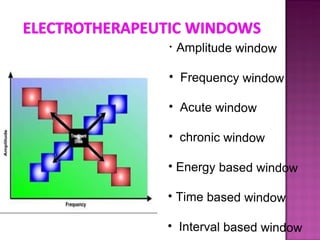
•   Amplitude window

• Frequency window

• Acute window

• chronic window

• Energy based window

• Time based window

• Interval based window
 420B.C-hippocrates-in torpaedo   fish
 46A.D-scribonius largus-gout/headache
 1700-luigi galvani & alessantro volta
 1745-leyden jar for ES
 1831-michael faraday
 1850s-duchene-motor points(father of ES)
 1909-rheo/chron-louis
 1916-SD curve-Adrian
 FES-1961-liberson
 1962-HVPC-robert becker
 Introduction
 Definition
 Physical characteristics
 Therapeutic uses
 Treatment   regimes
 Practical application
 Contra-indications
 Dangers
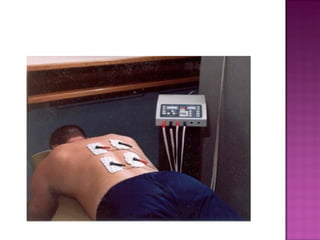
 Widely used electrotherapy modality
 Used since the 1950s to utilise the therapeutic
  aspects of low frequency currents without the
  discomfort
 Two  medium frequency currents of slightly
  differing frequency are applied to the body
  in such a manner to produce;
 an amplitude modulated medium frequency
  current within the body.
 Amplitude modulation provides a beat
  frequency that is within the biological
  frequency range
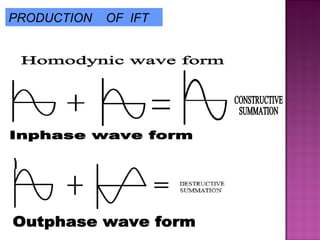
PRODUCTION   OF IFT
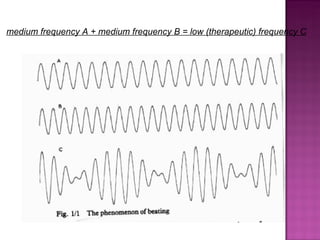
medium frequency A + medium frequency B = low (therapeutic) frequency C
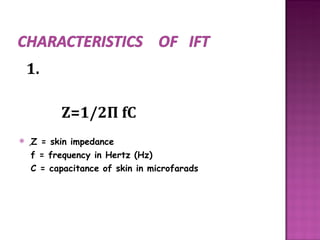
1.

           Z=1/2Π fC
   ,Z = skin impedance
    f = frequency in Hertz (Hz)
    C = capacitance of skin in microfarads
Skin impedance is of two types
 ohmic resistance and
 capacitive resistance.



    Capacitive resistance is developed deep in the tissues due to
    electrolytic potential difference generated in the cell membrane
   2.Accomodation is delayed.

   3.Current can travel at the depth of the tissue.

   4.Alternating current can be used

   5. Stimulus asynchronous stimulation is applied for production of interferential
    current so Wedensky inhibition doesn’t takes place and thereby there is no
    accommodation phenomenon.
   Stimulus asynchronous produces Gilde-Meister effect.


     (In low-frequency currents, stimulus synchronous is used which causes
    Wedensky inhibition and thus nerve or muscle gets accommodated to that
    current.
     Inability of tissue to respond during the refractory period due to stimulus
    synchronus current is known as Wedensky inhibition)
PlateElectrodes
Vacuum Electrodes
Combined Electrodes(probe electrode)
Quadripolar/bipolar method
Scannig/static
Constant/variable frequency
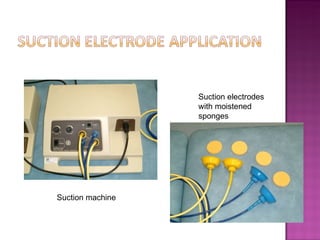
Suction electrodes
                  with moistened
                  sponges


Suction machine
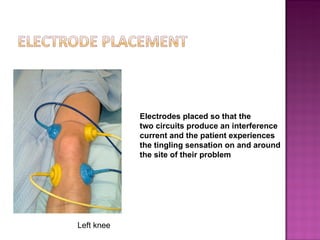
Electrodes placed so that the
            two circuits produce an interference
            current and the patient experiences
            the tingling sensation on and around
            the site of their problem


Left knee
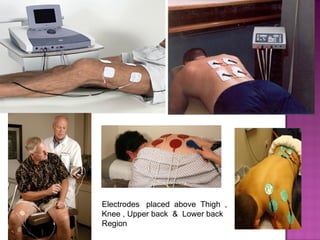
Electrodes placed above Thigh ,
Knee , Upper back & Lower back
Region
 4KHZ-pain  relief
 2KHZ-muscle stimulation
 Pre modulated/4EL
 Able to penetrate tissues with little resistance
 No accomadation/gildemeister effect
 100Hz  - pain relief
 50-60 Hz = muscle contraction
 1-50 Hz = increased circulation
 The higher the frequency (Hz) the more quickly
  the muscle will fatigue
 1-4 Hz-beta endorphin
 40-100Hz-enkepalin,serotonin
 Interferential   current is commonly used for pain
  relief
 Relief of muscle spasm
 Promote tissue healing
 Relief from edema
 Re-education of deeply situated

Muscles.
 Facialnerve neuritis
 Orthopedic conditions
 Pain-LBP.jaw pain,OA pain,fibromyalgia

( same like tens)
 Gynecological problems-incontinence
 DOMS
 Edema
 Post surgical pain
 Bone healing
 Vasoconstrictive disease
 Venous insufficiency
 Delayed union
 Pseudo arthrosis
 Sudeck’s atrophy
 Muscle reeducation(PFM)
Relief of pain – pain gate theory
 80-140Hz (higher IFT frequencies)
 Stimulates Aβ fibres
 To inhibit impulse transmission in A∂ and C
  fibres
 Used for both acute and chronic pain
 Temporary pain relief
Relief of pain – Ascending pain suppression,
  2-30Hz (lower frequencies)
 Stimulates A∂ fibres:
 To inhibit C fibre transmission
 Via the release of encephalins and endorphins
 More longer lasting pain relief
 Only effective on chronic pain
Reduction of oedema 0-100 Hz
 Stimulates autonomic nerves to produce
  vasodilatation
 Increases circulation
Motor stimulation
 0-25 Hz - twitch
 25-100 Hz - muscle contraction
 Can be used to treat incontinence or
  muscle weakness secondary to trauma/
  surgery (in conjunction with active
  exercise).
 Acute sepsis - ↑ risk of spread of infection
 Tumours - ↑ risk of increased growth of activity
 Pregnancy – no treatment over uterus or its’
  nerve supply
 Cardiac disease – no treatment over the heart,
  cervical ganglia or vagus nerve
 Cardiac pacemakers
 Febrileconditions
 Large open wounds
 Menstruation - ↑ risk of bleeding or pain if treatin
  abdominal of lumbar region
 Dermatological conditions-open wound,cuts or
  eczema
 Thrombophlebitis – risk of embolus being
  dislodged
 Severe ↑ or ↓ BP – avoid lower cervical
  region – BP control via cervical ganglia
 Acute inflammation, oedema, haemorrhage
  or haematoma when using suction cups
 Hypersensitivity or fear of electrical
  treatment
 Patients who are unable to understand the
  treatment or what is required of them
 Aesthenic individuals/children for rib cage
  placements
 Acute trauma
 Near by SWD
 Senile and confused patients
 Burns – high intensity currents can cause sufficient
  heating to cause a burn.
 Mains current shock – faulty equipment
 Electric shock – abrupt application of high intensity
  current – turn current up/ down slowly
 General malaise
 Nausea
 Vomiting
 Dizziness / Faintness
 Migraine / Headache
 Neurological effects
Metal  implants are not the
 contraindications of
 interferential therapy
 Pain

80-140 Hz 15 minutes
4 Hz constant 15 minutes

 Circulation

0-100Hz 20-30 minutes
 Musclestimulation
10-50 Hz 15 minutes
50Hz constant with surge

 Incontinence

Stress incontinence - 10-50Hz, surge
15 minutes.
Urge incontinence - 5-10Hz 10 minutes
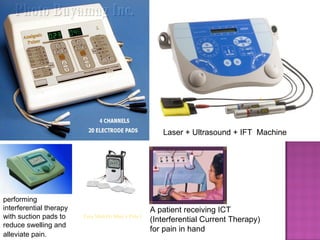
Laser + Ultrasound + IFT Machine


performing
interferential therapy                                 A patient receiving ICT
with suction pads to     Tens Med Fit Mini 4 Pole Inferential Stimulator (IF)
                                                       (Interferential Current Therapy)
reduce swelling and
                                                       for pain in hand
alleviate pain.
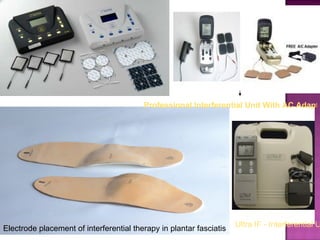
Professional Interferential Unit With AC Adapte


                                                                     Ultra IF - Interferential U
Electrode placement of interferential therapy in plantar fasciatis
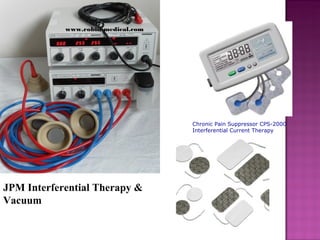
Chronic Pain Suppressor CPS-2000
                               Interferential Current Therapy


JPM Interferential Therapy &
Vacuum
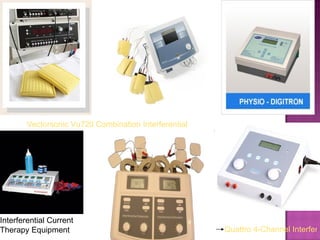
Vectorsonic Vu720 Combination Interferential


Interferential Current
Therapy Equipment                                      Quattro 4-Channel Interfere
    Russian currents are alternating currents (AC)
    at a frequency of 2.5 kHz that are burst
    modulated at a frequency of 50 Hz with a 50%
    duty cycle. The stimulus is applied for a 10-
    second “on” period followed by a 50-second
    “off” or rest period, with a recommended
    treatment time of 10 minutes per stimulation
    session.1 This stimulation regimen (called the
    “10/50/10” regimen), applied once daily over a
    period of weeks, has been claimed to result in
    force gains, but many of the claims appear to be
    anecdotal
 We believe some of the popularity of Russian
 electrical stimulation stemmed from a talk
 given by Russian scientist Dr Yakov Kots13 at
 a conference in 1977. Kots is reported to have
 advocated a stimulus regimen for increasing
 muscle force that he claimed was able to
 increase the maximum voluntary contraction
 (MVC) of elite athletes by up to 40%.
 Unfortunately, the only details of Kots'work
 were brief conference notes, translated from
 Russian and not readily accessible.13
A  monophasic/unipolar current
 50to 250 micro seconds
 3000hz
 Czechoslovakia in1970
Frequency Analysis Method
       The external currents with different
  frequencies are considered to cause different
  effects in tissues. Thus we assume that tissue
  reactions on different frequencies in different
  states of the body will also differ from each other.
 Measuring the sensory, motor and pain thresholds
  by stimulating the tissue with the interference
  current may offer a diagnostic tool in
  physiotherapy and rehabilitation
 Pain control treatment
 Can cause   muscle contractions, but that is not why
  it is used
 Decreases patient’s pain perception by decreasing
  the conductivity & transmission of noxious
  impulses from small pain fibers (effects large
  diameter fibers)
 Moderate caffeine levels (200 mg, approx 2-3 c.
  coffee) may decrease effectiveness of TENS
Introduce yourself to patient
Give assurance/confidence
 Go through the medical reports
 Find out diagnosis/general contra-indications/
  previous physiotherapy treatment
 Hyper pyrexia
 Epilepsy
 Severe renal and cardiac problems
 Severe hypo/hypertension
 Cardiac pacemakers
 Infections
 Pregnant women
 Metal implants
 Mentally retarded/upset patients
 Malignancy
 Anterior aspect of neck/carotid sinus/eyes
Skin resistance               Treatment tray
 lowering/testing tray           Pillows
   Pillows                      Towel
   Cotton                       Bed sheet
   Soap                         Cotton
   Towel                        Adhesive tapes
   Mackintosh                   Straps/goggles
   Petroleum jelly              Salt/Powder
   Test tubes ( hot &cold)      Scissor/ Inch tape
   U-pin (sharp &blunt)         Paper
   Clips                        Graph paper
   Bowl of water                Pencil/scale/eraser
   IR lamp                      Machine& accessories
   Hot &cold packs              Sand bags/crepe bandages
 Open    wounds
 Scars
 Local   skin infections
 Cuts
 Abrasions
 Eczema
 Local hemorrhagic spots
 Skin sensitivity (testing)
 Check the apparatus& accessories like
 electrodes, leads, cables, plugs, power sockets,
 switches, controls, dials and others
 Demonstration   of the treatment
 Check the functioning of machine in front of the
  patient
 Explanation of treatment
 Comfortable
 Relaxed
 appropriate
 Do skin resistance lowering
 Neatly &perfectly
 Use items required in an orderly manner
 Use   proper technique of application
 Appropriate  placement according to the
  condition &patient
 Use adhesives &straps
 Apply gel evenly on electrode
 Maintain good contact with the skin
 No leads crossing each other
 Confirm connections &above all
Instructions             Warnings
 Don’t move              Inform more
 Don’t sleep              heating/uncomfort
 Don’t touch leads,       able sensations
                          Inform burning
  apparatus, therapist
  and any other metal      sensation
  near by you              immediately
 Proper  execution of treatment
 Appropriate intensity should be used
 Set duration of treatment acc. to condition
  status
 Supervise the treatment through out the
  session
 Put knobs to zero
 Remove electrodes
 Switch off the machine &mains
 Clean the area &inspect for adverse reactions
 Manage if anything &give instruction regarding
  next coming
 Windup procedure
Accurate record of all parameters of
 treatment including area treated , technique,
 dosage and the outcomes
   Low J. and Reed A. (1992) Electrotherapy Explained: Principles and Practice.
    Oxford
   Watson T. (2000) The role of electrotherapy in contemporary physiotherapy
    practice. Manual Therapy Aug:5(3);132-41
Ift russian

Ift russian

  • 1.
  • 3.
     Electricity isan element of PT modalities most frightening and least understood.  Understanding the basis principles will later aid you in establishing treatment protocols.
  • 5.
    Amplitude window • Frequency window • Acute window • chronic window • Energy based window • Time based window • Interval based window
  • 6.
     420B.C-hippocrates-in torpaedo fish  46A.D-scribonius largus-gout/headache  1700-luigi galvani & alessantro volta  1745-leyden jar for ES  1831-michael faraday  1850s-duchene-motor points(father of ES)  1909-rheo/chron-louis  1916-SD curve-Adrian  FES-1961-liberson  1962-HVPC-robert becker
  • 7.
     Introduction  Definition Physical characteristics  Therapeutic uses  Treatment regimes  Practical application  Contra-indications  Dangers
  • 8.
     Widely usedelectrotherapy modality  Used since the 1950s to utilise the therapeutic aspects of low frequency currents without the discomfort
  • 10.
     Two medium frequency currents of slightly differing frequency are applied to the body in such a manner to produce;  an amplitude modulated medium frequency current within the body.  Amplitude modulation provides a beat frequency that is within the biological frequency range
  • 11.
  • 12.
    medium frequency A+ medium frequency B = low (therapeutic) frequency C
  • 14.
    1. Z=1/2Π fC  ,Z = skin impedance f = frequency in Hertz (Hz) C = capacitance of skin in microfarads
  • 15.
    Skin impedance isof two types  ohmic resistance and  capacitive resistance.  Capacitive resistance is developed deep in the tissues due to electrolytic potential difference generated in the cell membrane
  • 16.
    2.Accomodation is delayed.  3.Current can travel at the depth of the tissue.  4.Alternating current can be used  5. Stimulus asynchronous stimulation is applied for production of interferential current so Wedensky inhibition doesn’t takes place and thereby there is no accommodation phenomenon.  Stimulus asynchronous produces Gilde-Meister effect. (In low-frequency currents, stimulus synchronous is used which causes Wedensky inhibition and thus nerve or muscle gets accommodated to that current. Inability of tissue to respond during the refractory period due to stimulus synchronus current is known as Wedensky inhibition)
  • 17.
    PlateElectrodes Vacuum Electrodes Combined Electrodes(probeelectrode) Quadripolar/bipolar method Scannig/static Constant/variable frequency
  • 18.
    Suction electrodes with moistened sponges Suction machine
  • 19.
    Electrodes placed sothat the two circuits produce an interference current and the patient experiences the tingling sensation on and around the site of their problem Left knee
  • 20.
    Electrodes placed aboveThigh , Knee , Upper back & Lower back Region
  • 21.
     4KHZ-pain relief  2KHZ-muscle stimulation  Pre modulated/4EL  Able to penetrate tissues with little resistance  No accomadation/gildemeister effect
  • 22.
     100Hz - pain relief  50-60 Hz = muscle contraction  1-50 Hz = increased circulation  The higher the frequency (Hz) the more quickly the muscle will fatigue  1-4 Hz-beta endorphin  40-100Hz-enkepalin,serotonin
  • 23.
     Interferential current is commonly used for pain relief  Relief of muscle spasm  Promote tissue healing  Relief from edema  Re-education of deeply situated Muscles.
  • 24.
     Facialnerve neuritis Orthopedic conditions  Pain-LBP.jaw pain,OA pain,fibromyalgia ( same like tens)  Gynecological problems-incontinence  DOMS  Edema  Post surgical pain  Bone healing
  • 25.
     Vasoconstrictive disease Venous insufficiency  Delayed union  Pseudo arthrosis  Sudeck’s atrophy  Muscle reeducation(PFM)
  • 26.
    Relief of pain– pain gate theory  80-140Hz (higher IFT frequencies)  Stimulates Aβ fibres  To inhibit impulse transmission in A∂ and C fibres  Used for both acute and chronic pain  Temporary pain relief
  • 27.
    Relief of pain– Ascending pain suppression, 2-30Hz (lower frequencies)  Stimulates A∂ fibres:  To inhibit C fibre transmission  Via the release of encephalins and endorphins  More longer lasting pain relief  Only effective on chronic pain
  • 28.
    Reduction of oedema0-100 Hz  Stimulates autonomic nerves to produce vasodilatation  Increases circulation
  • 29.
    Motor stimulation  0-25Hz - twitch  25-100 Hz - muscle contraction  Can be used to treat incontinence or muscle weakness secondary to trauma/ surgery (in conjunction with active exercise).
  • 30.
     Acute sepsis- ↑ risk of spread of infection  Tumours - ↑ risk of increased growth of activity  Pregnancy – no treatment over uterus or its’ nerve supply  Cardiac disease – no treatment over the heart, cervical ganglia or vagus nerve
  • 31.
     Cardiac pacemakers Febrileconditions  Large open wounds  Menstruation - ↑ risk of bleeding or pain if treatin abdominal of lumbar region  Dermatological conditions-open wound,cuts or eczema  Thrombophlebitis – risk of embolus being dislodged
  • 32.
     Severe ↑or ↓ BP – avoid lower cervical region – BP control via cervical ganglia  Acute inflammation, oedema, haemorrhage or haematoma when using suction cups  Hypersensitivity or fear of electrical treatment  Patients who are unable to understand the treatment or what is required of them
  • 33.
     Aesthenic individuals/childrenfor rib cage placements  Acute trauma  Near by SWD  Senile and confused patients
  • 34.
     Burns –high intensity currents can cause sufficient heating to cause a burn.  Mains current shock – faulty equipment  Electric shock – abrupt application of high intensity current – turn current up/ down slowly  General malaise  Nausea  Vomiting  Dizziness / Faintness  Migraine / Headache  Neurological effects
  • 35.
    Metal implantsare not the contraindications of interferential therapy
  • 36.
     Pain 80-140 Hz15 minutes 4 Hz constant 15 minutes  Circulation 0-100Hz 20-30 minutes
  • 37.
     Musclestimulation 10-50 Hz15 minutes 50Hz constant with surge  Incontinence Stress incontinence - 10-50Hz, surge 15 minutes. Urge incontinence - 5-10Hz 10 minutes
  • 38.
    Laser + Ultrasound+ IFT Machine performing interferential therapy A patient receiving ICT with suction pads to Tens Med Fit Mini 4 Pole Inferential Stimulator (IF) (Interferential Current Therapy) reduce swelling and for pain in hand alleviate pain.
  • 39.
    Professional Interferential UnitWith AC Adapte Ultra IF - Interferential U Electrode placement of interferential therapy in plantar fasciatis
  • 40.
    Chronic Pain SuppressorCPS-2000 Interferential Current Therapy JPM Interferential Therapy & Vacuum
  • 41.
    Vectorsonic Vu720 CombinationInterferential Interferential Current Therapy Equipment Quattro 4-Channel Interfere
  • 42.
    Russian currents are alternating currents (AC) at a frequency of 2.5 kHz that are burst modulated at a frequency of 50 Hz with a 50% duty cycle. The stimulus is applied for a 10- second “on” period followed by a 50-second “off” or rest period, with a recommended treatment time of 10 minutes per stimulation session.1 This stimulation regimen (called the “10/50/10” regimen), applied once daily over a period of weeks, has been claimed to result in force gains, but many of the claims appear to be anecdotal
  • 43.
     We believesome of the popularity of Russian electrical stimulation stemmed from a talk given by Russian scientist Dr Yakov Kots13 at a conference in 1977. Kots is reported to have advocated a stimulus regimen for increasing muscle force that he claimed was able to increase the maximum voluntary contraction (MVC) of elite athletes by up to 40%. Unfortunately, the only details of Kots'work were brief conference notes, translated from Russian and not readily accessible.13
  • 44.
    A monophasic/unipolarcurrent  50to 250 micro seconds  3000hz  Czechoslovakia in1970
  • 45.
    Frequency Analysis Method  The external currents with different frequencies are considered to cause different effects in tissues. Thus we assume that tissue reactions on different frequencies in different states of the body will also differ from each other.  Measuring the sensory, motor and pain thresholds by stimulating the tissue with the interference current may offer a diagnostic tool in physiotherapy and rehabilitation
  • 46.
     Pain controltreatment  Can cause muscle contractions, but that is not why it is used  Decreases patient’s pain perception by decreasing the conductivity & transmission of noxious impulses from small pain fibers (effects large diameter fibers)  Moderate caffeine levels (200 mg, approx 2-3 c. coffee) may decrease effectiveness of TENS
  • 50.
    Introduce yourself topatient Give assurance/confidence
  • 51.
     Go throughthe medical reports  Find out diagnosis/general contra-indications/ previous physiotherapy treatment
  • 52.
     Hyper pyrexia Epilepsy  Severe renal and cardiac problems  Severe hypo/hypertension  Cardiac pacemakers  Infections  Pregnant women  Metal implants  Mentally retarded/upset patients  Malignancy  Anterior aspect of neck/carotid sinus/eyes
  • 53.
    Skin resistance Treatment tray lowering/testing tray  Pillows  Pillows  Towel  Cotton  Bed sheet  Soap  Cotton  Towel  Adhesive tapes  Mackintosh  Straps/goggles  Petroleum jelly  Salt/Powder  Test tubes ( hot &cold)  Scissor/ Inch tape  U-pin (sharp &blunt)  Paper  Clips  Graph paper  Bowl of water  Pencil/scale/eraser  IR lamp  Machine& accessories  Hot &cold packs  Sand bags/crepe bandages
  • 54.
     Open wounds  Scars  Local skin infections  Cuts  Abrasions  Eczema  Local hemorrhagic spots  Skin sensitivity (testing)
  • 55.
     Check theapparatus& accessories like electrodes, leads, cables, plugs, power sockets, switches, controls, dials and others
  • 56.
     Demonstration of the treatment  Check the functioning of machine in front of the patient  Explanation of treatment
  • 57.
  • 58.
     Do skinresistance lowering  Neatly &perfectly  Use items required in an orderly manner
  • 59.
     Use proper technique of application
  • 60.
     Appropriate placement according to the condition &patient  Use adhesives &straps  Apply gel evenly on electrode  Maintain good contact with the skin  No leads crossing each other  Confirm connections &above all
  • 61.
    Instructions Warnings  Don’t move  Inform more  Don’t sleep heating/uncomfort  Don’t touch leads, able sensations  Inform burning apparatus, therapist and any other metal sensation near by you immediately
  • 62.
     Proper execution of treatment  Appropriate intensity should be used  Set duration of treatment acc. to condition status  Supervise the treatment through out the session
  • 63.
     Put knobsto zero  Remove electrodes  Switch off the machine &mains  Clean the area &inspect for adverse reactions  Manage if anything &give instruction regarding next coming  Windup procedure
  • 64.
    Accurate record ofall parameters of treatment including area treated , technique, dosage and the outcomes
  • 65.
    Low J. and Reed A. (1992) Electrotherapy Explained: Principles and Practice. Oxford  Watson T. (2000) The role of electrotherapy in contemporary physiotherapy practice. Manual Therapy Aug:5(3);132-41