IDENTIFYING SYSTEM OF MEASUREMENT
II. Metric System of Linear Measure
In this system of measurement, a linear quantity may be expressed in
millimeters (mm), centimeters (cm), meter (m), decimeter (dm), kilometer (km),
dekameter (dam).
A system measurement is a set of standard units which is acceptable
internationally, and which is used to express the magnitudes of the various
physical quantities, like length and width of fabric ( linear measure ).
I. English System of Linear Measure
A linear quantity may be expressed in terms of inches, foot
and yard.
Equivalent Denomination:
1 yard = 3 feet
1 foot = 12 inches
1 yard = 36 inches
1 mile = 1760 yard
1 mile = 5280 feet
Prepared by:
JOVENCIO F. PANIDA
Sr. TESD Specialist
IDENTIFYING SYSTEM OF MEASUREMENT
III Conversion of English to Metric Linear Measure
In the advent of the newly released “Presidential Decree Metrication” all
measurements must be expressed in terms of metric units. But since most of our
present production machines come from America which traditionally uses the
English system, then it becomes necessary for us to be able to change from English
to Metric and vice versa.
The basic advantage of this system over the previous one, is that it is more
accurate and convenient to use because the denomination are multiples of ten with
respect to the meter.
Equivalent Denominations:
1 meter = 100 cm
1 cm = 10 mm
1 m = 10 dm
1 dam = 10 m
1 km = 1000 m
IDENTIFYING SYSTEM OF MEASUREMENT
Conversion Factor:
1 inch = 2.54 cm
1.09 yard = 1 m
3.28 ft = 1 m
1 mile = 1.609 km
1 m = 39.37 in
1 km = 0.62137 mi
Prepared by:
JOVENCIO F. PANIDA
Sr. TESD Specialist
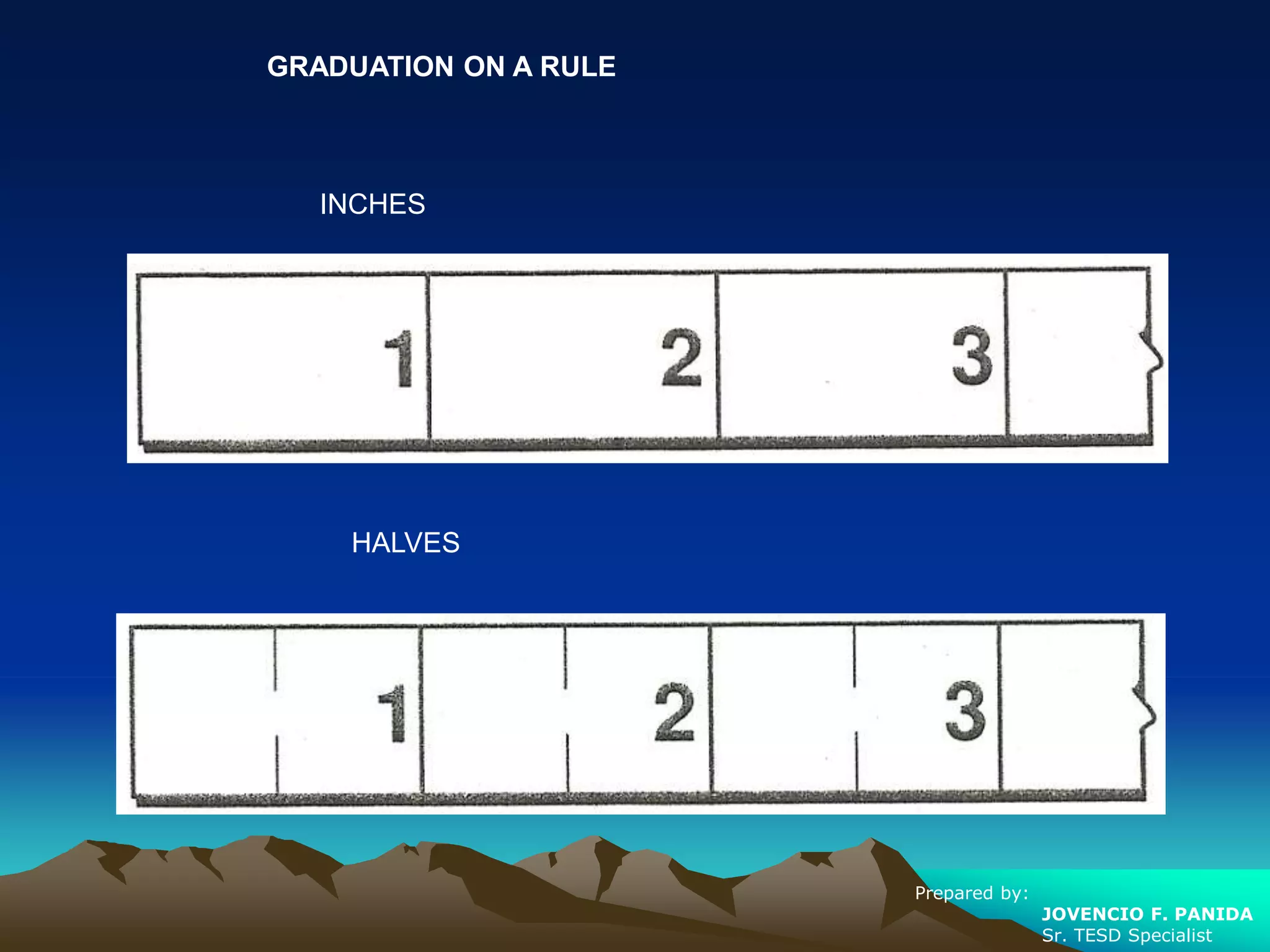
GRADUATION ON A RULE
INCHES
HALVES
Prepared by:
JOVENCIO F. PANIDA
Sr. TESD Specialist
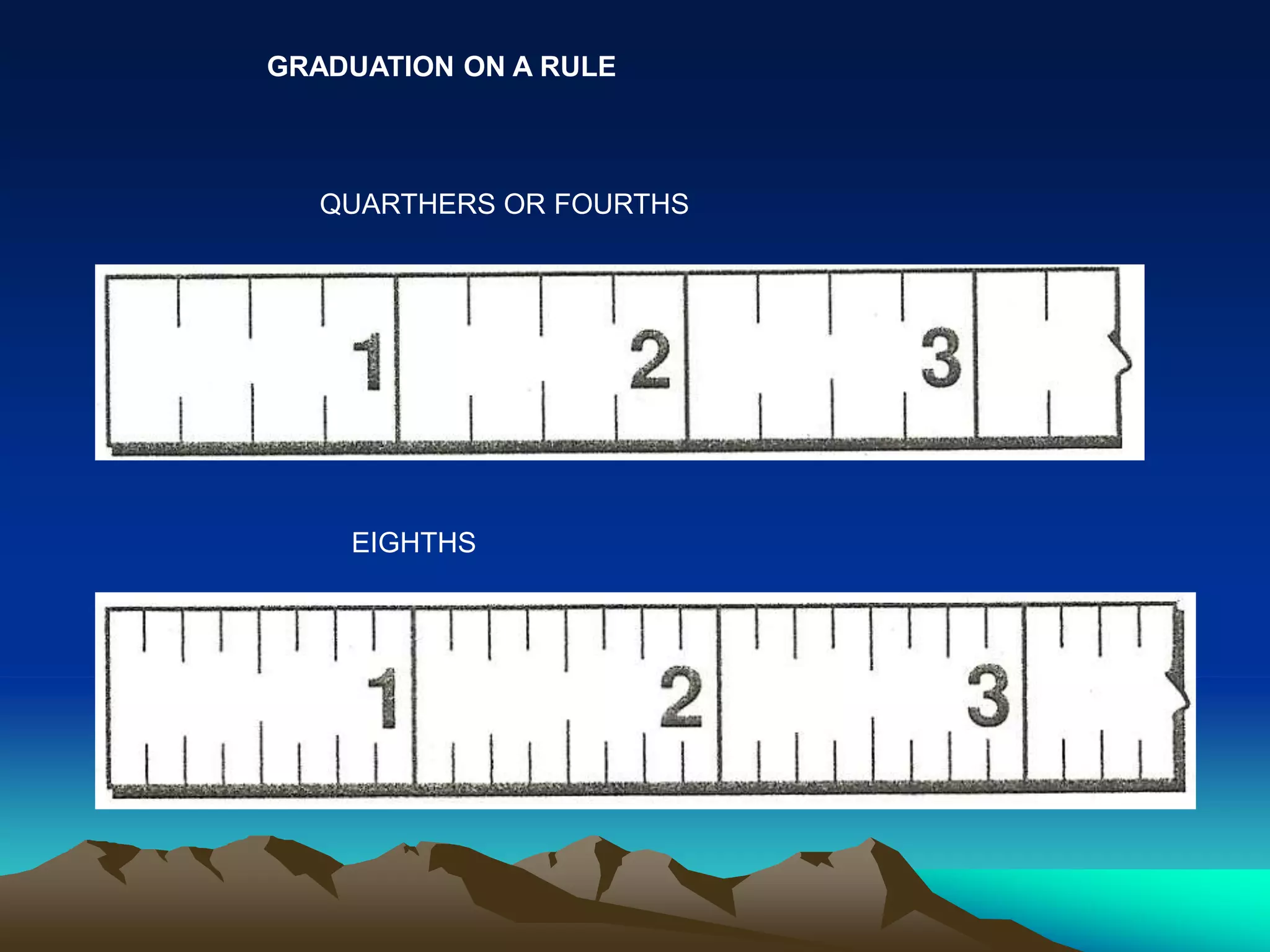
GRADUATION ON A RULE
QUARTHERS OR FOURTHS
EIGHTHS
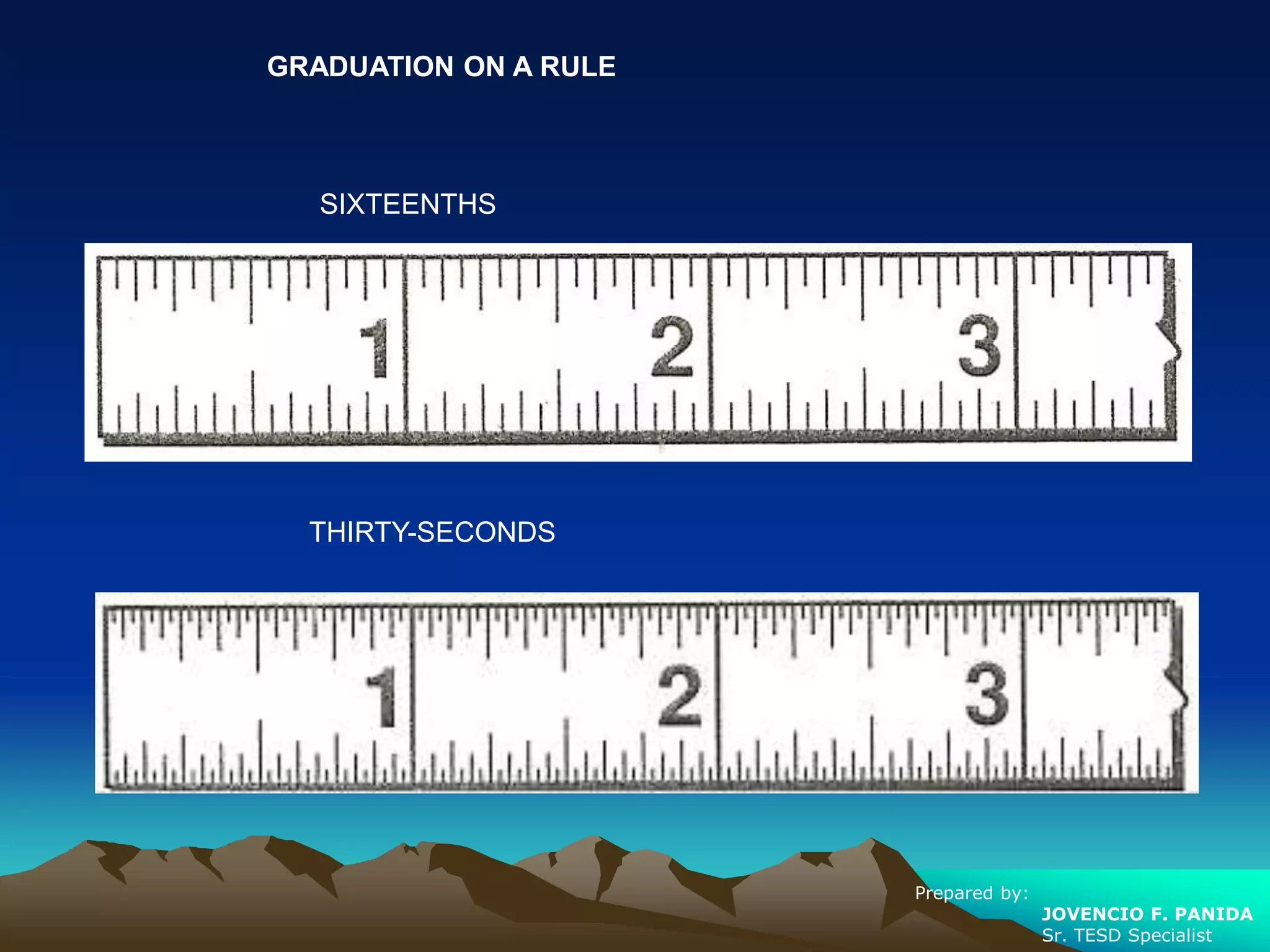
GRADUATION ON A RULE
SIXTEENTHS
THIRTY-SECONDS
Prepared by:
JOVENCIO F. PANIDA
Sr. TESD Specialist
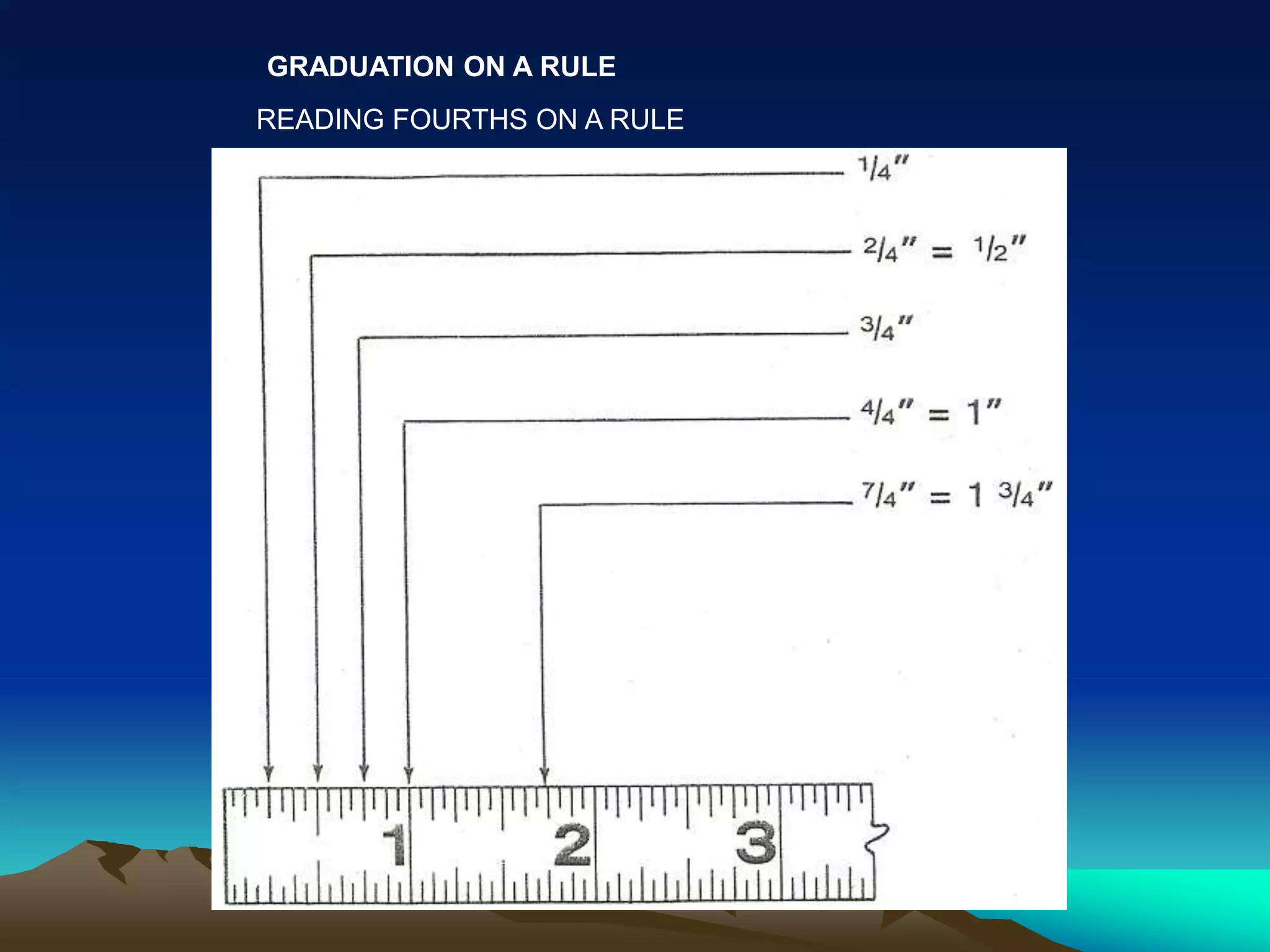
GRADUATION ON A RULE
READING FOURTHS ON A RULE
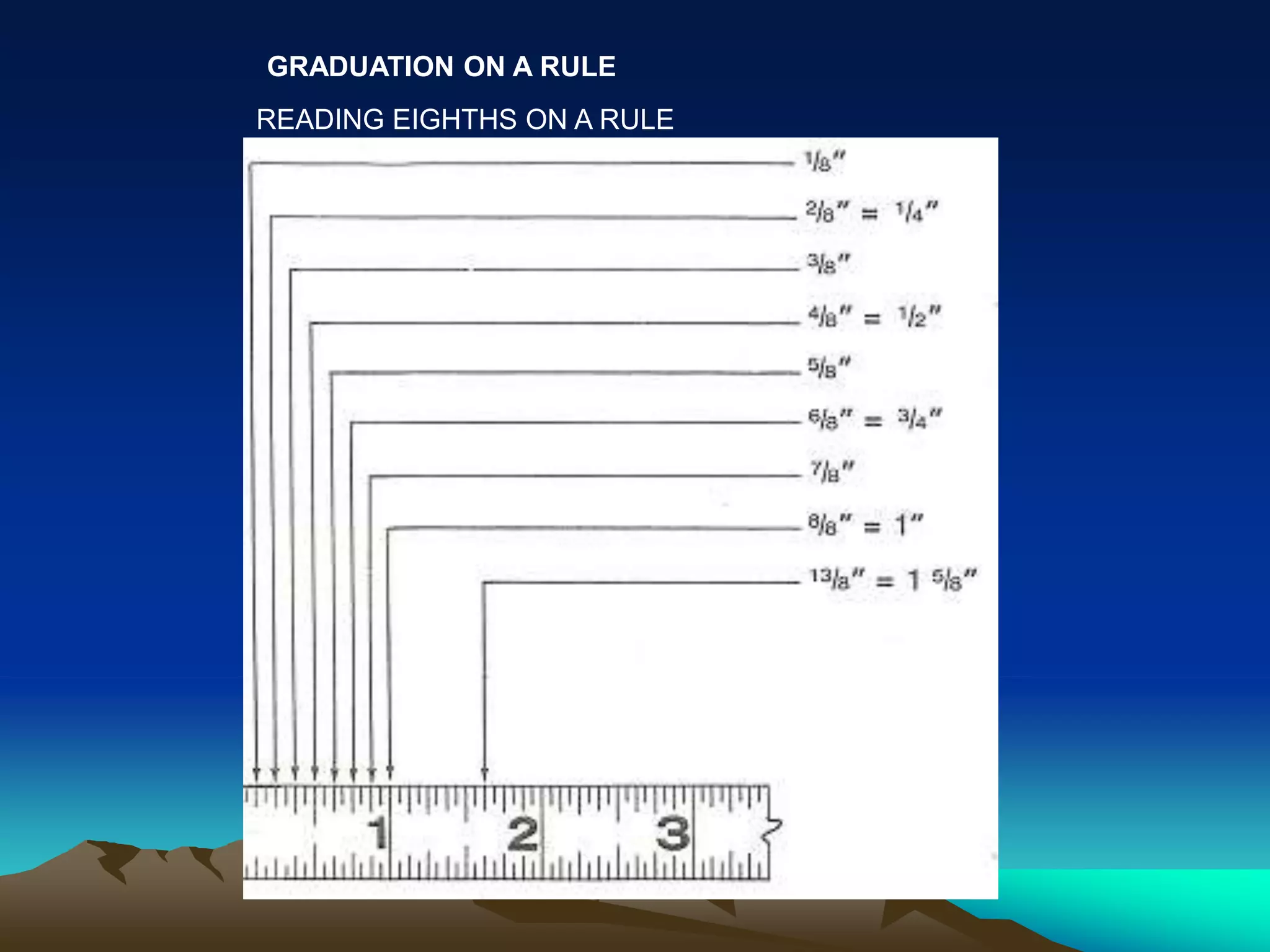
GRADUATION ON A RULE
READING EIGHTHS ON A RULE
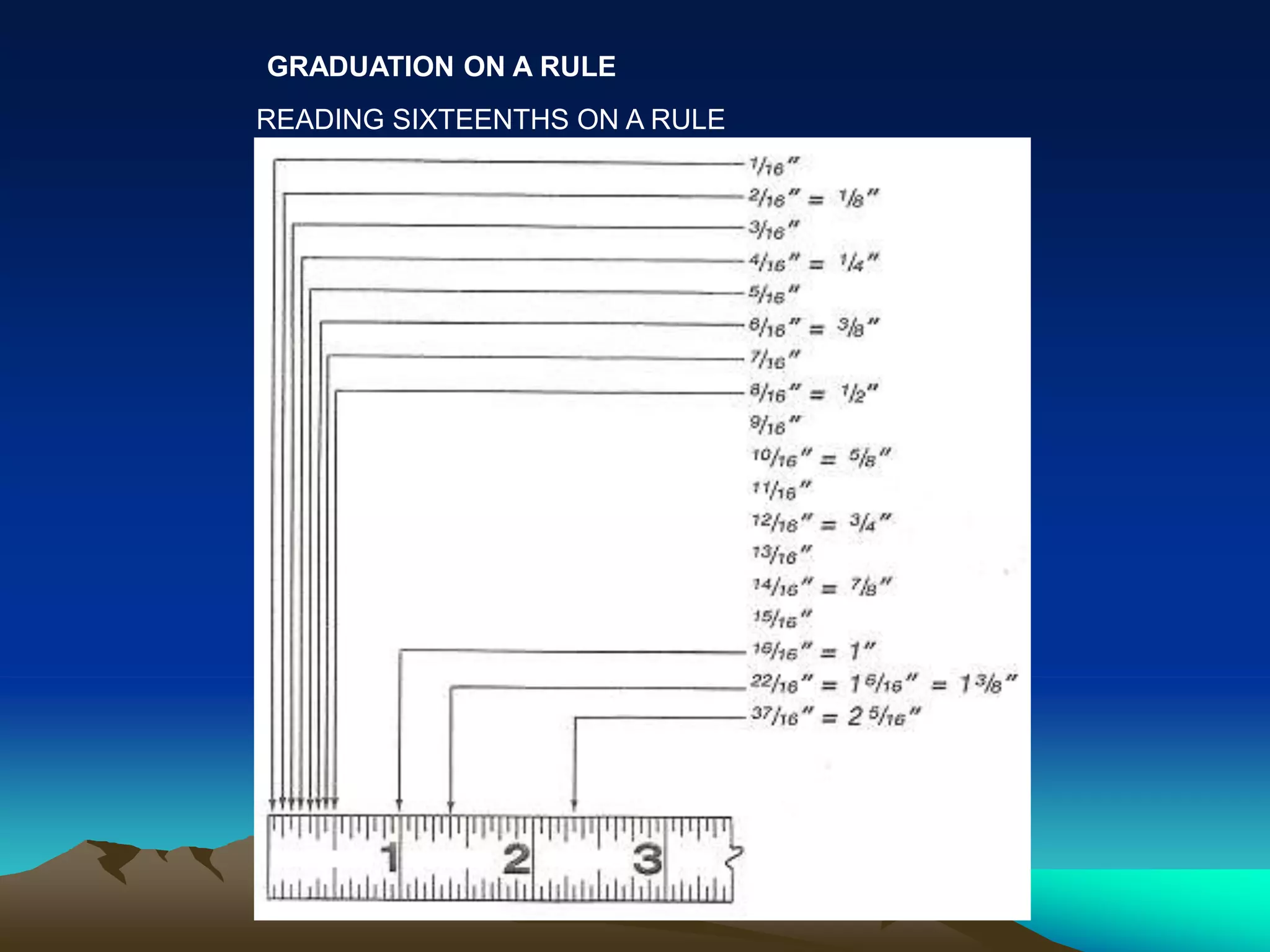
GRADUATION ON A RULE
READING SIXTEENTHS ON A RULE
GRADUATION ON A RULE
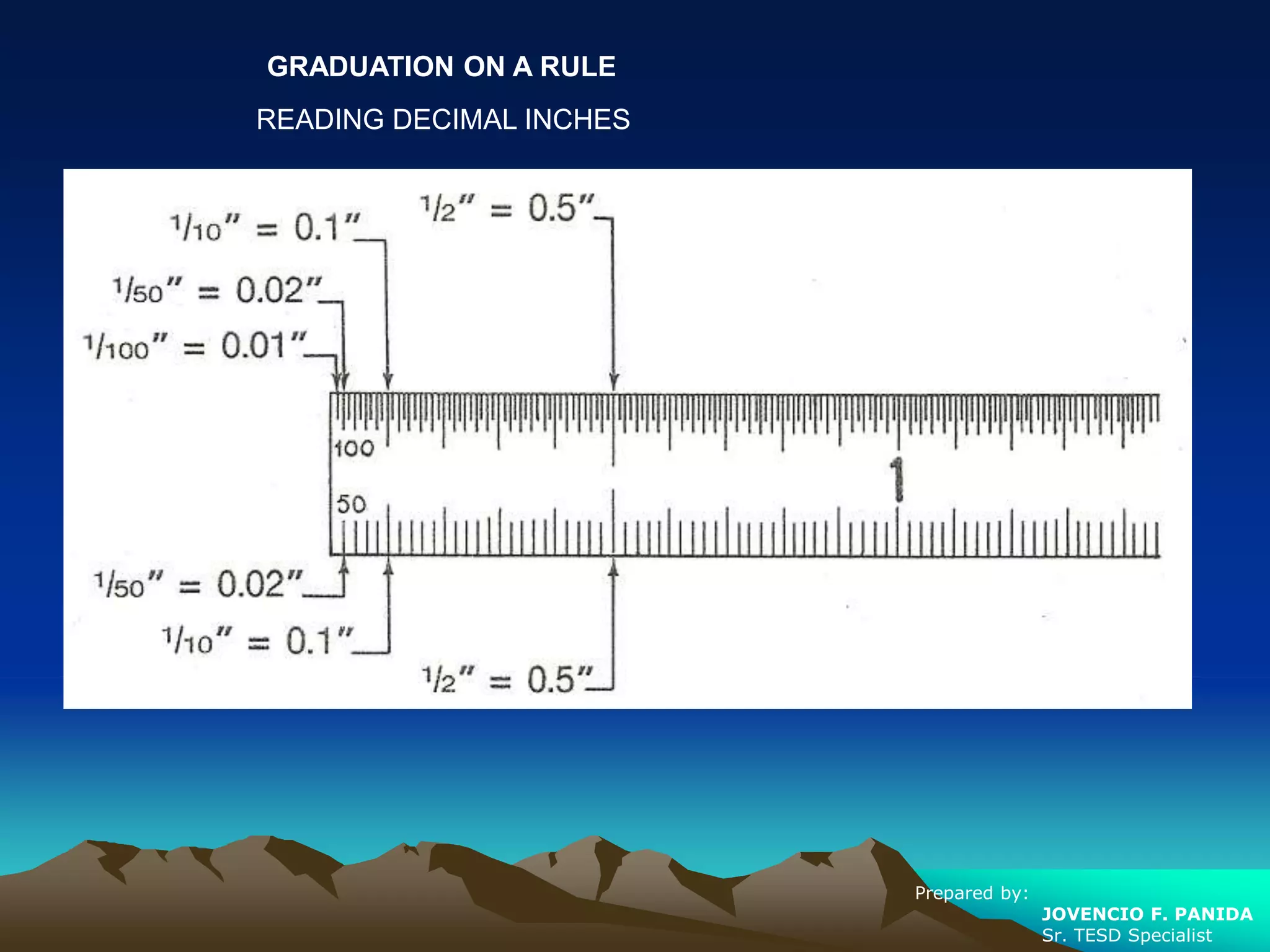
READING DECIMAL INCHES
Prepared by:
JOVENCIO F. PANIDA
Sr. TESD Specialist
GRADUATION ON A RULE
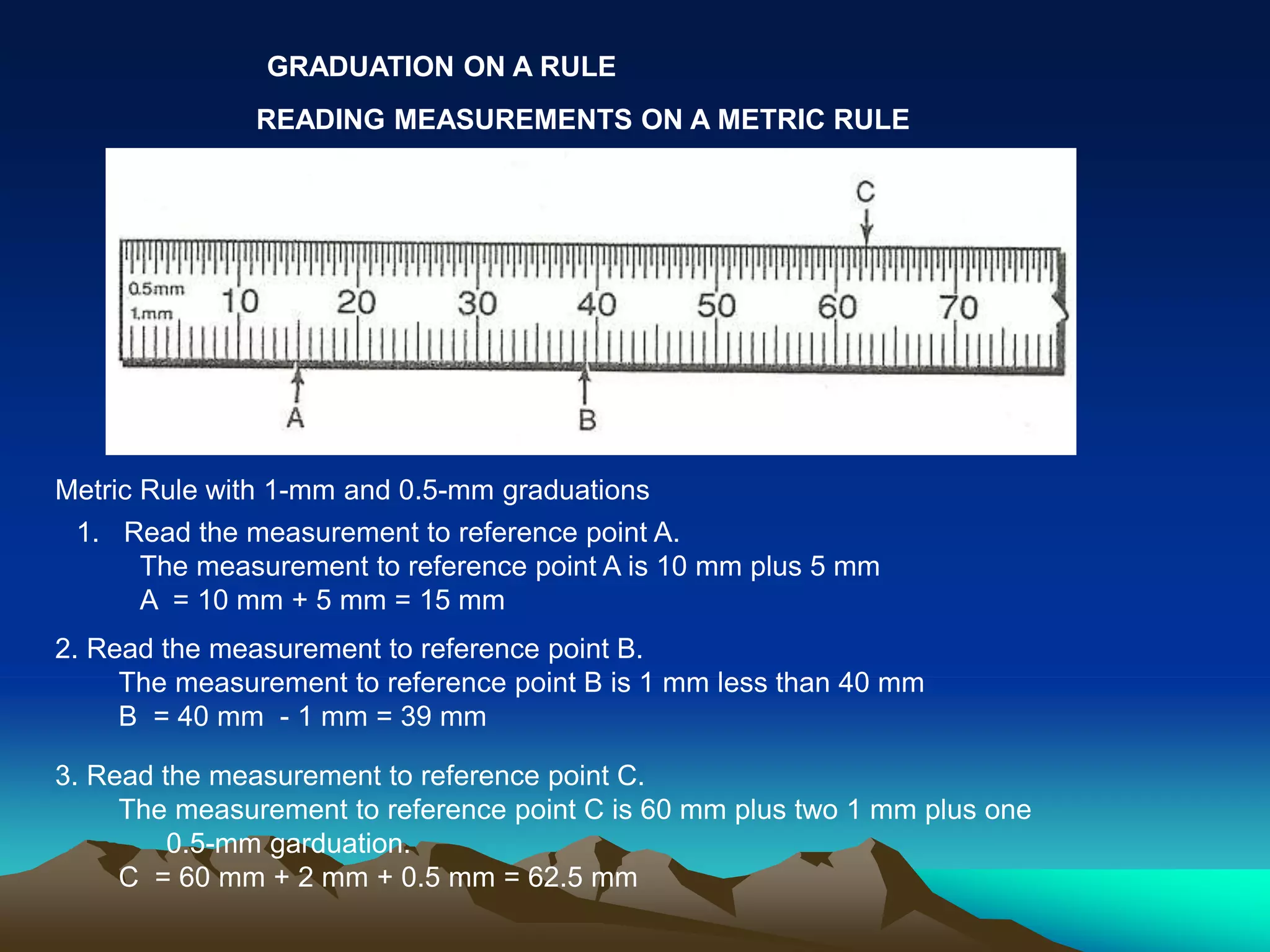
READING MEASUREMENTS ON A METRIC RULE
Metric Rule with 1-mm and 0.5-mm graduations
1. Read the measurement to reference point A.
The measurement to reference point A is 10 mm plus 5 mm
A = 10 mm + 5 mm = 15 mm
2. Read the measurement to reference point B.
The measurement to reference point B is 1 mm less than 40 mm
B = 40 mm - 1 mm = 39 mm
3. Read the measurement to reference point C.
The measurement to reference point C is 60 mm plus two 1 mm plus one
0.5-mm garduation.
C = 60 mm + 2 mm + 0.5 mm = 62.5 mm
TERMS AND DEFINITIONS ASSOCIATED WITH MATH AND MEASURING
1. Whole number (integer) –any of the natural numbers, both positive and negative,
that represents a complete item.
Example: 25 is a whole number as opposed to ¾, a fraction or a part of a whole.
2. Digit – any of the ten symbols, 0 to 9, by which all numbers can be expressed.
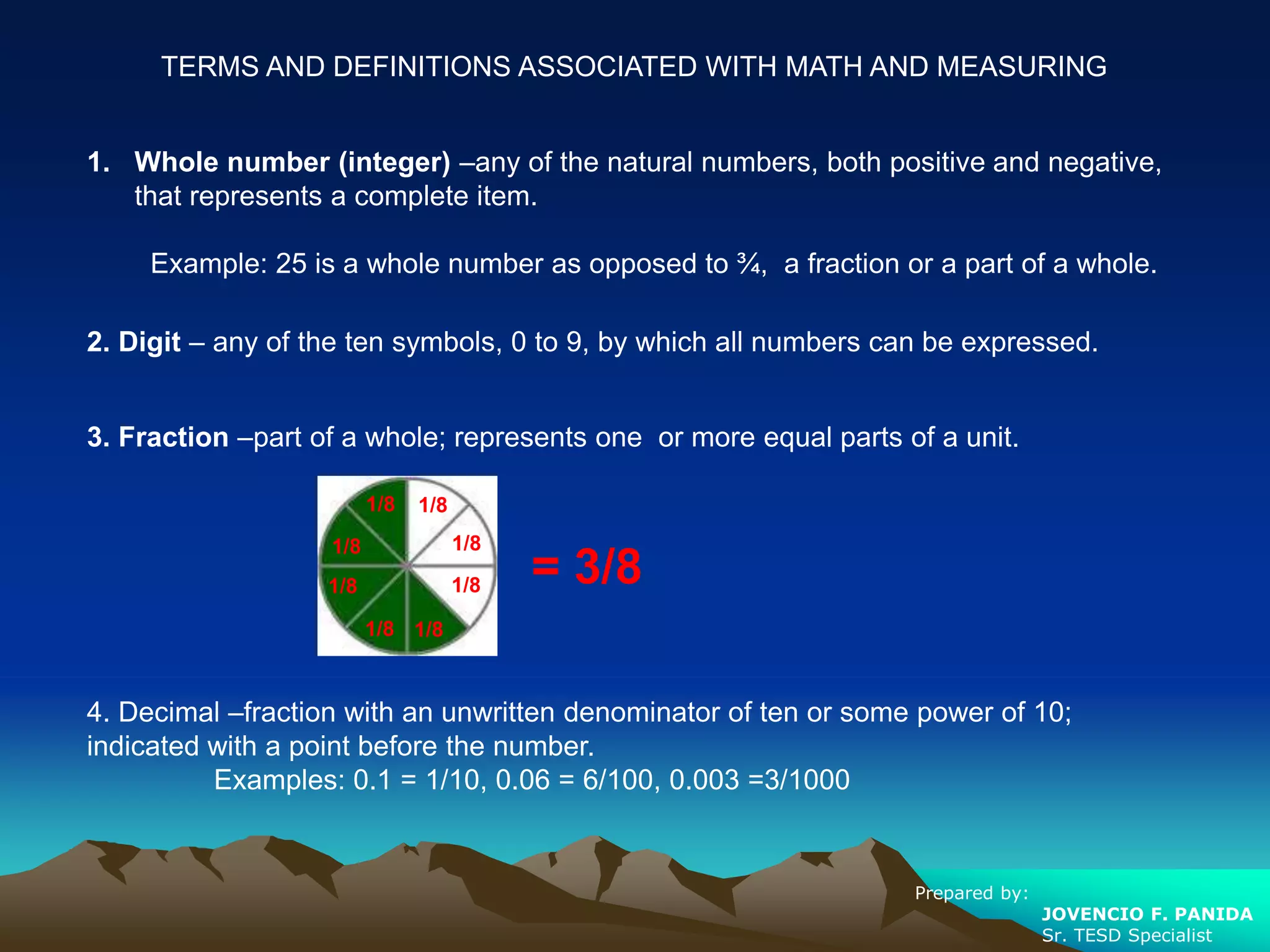
3. Fraction –part of a whole; represents one or more equal parts of a unit.
1/8
1/8
1/8
1/8
1/8
1/8
1/8
1/8
= 3/8
4. Decimal –fraction with an unwritten denominator of ten or some power of 10;
indicated with a point before the number.
Examples: 0.1 = 1/10, 0.06 = 6/100, 0.003 =3/1000
Prepared by:
JOVENCIO F. PANIDA
Sr. TESD Specialist
5. Addition –process of totaling two or more numbers to find another number called sum.
Example: 3+5+9 = 17
6. Subtraction –opposite operation to addition.
Example: 8-4 = 4 as opposed to 4+4 =8
7. Multiplication –abbreviated process of adding a number to itself a specified
number of times.
Example: 6x3 =18 as opposed to 6+6+6 =18
8. Division –abbreviated operation of multiplication.
Example: 16/2 =8 as opposed to 8x2 =16
9. Ratio –relationship in quantity, amount, or size between two or more things.
10. Percent –one part in a hundred, reckoned on the basis of a whole divided into
one hundred parts
11. Proportional –being ralatively equal in size or quantity.
Example: 1:1:3 =0.5:0.5:1.5
12. Meter –metric unit used to measure length
Prepared by:
JOVENCIO F. PANIDA
Sr. TESD Specialist

IDENTIFYIING SYSTEM OF MEASUREMENT final.ppt

  • 1.
    IDENTIFYING SYSTEM OFMEASUREMENT II. Metric System of Linear Measure In this system of measurement, a linear quantity may be expressed in millimeters (mm), centimeters (cm), meter (m), decimeter (dm), kilometer (km), dekameter (dam). A system measurement is a set of standard units which is acceptable internationally, and which is used to express the magnitudes of the various physical quantities, like length and width of fabric ( linear measure ). I. English System of Linear Measure A linear quantity may be expressed in terms of inches, foot and yard. Equivalent Denomination: 1 yard = 3 feet 1 foot = 12 inches 1 yard = 36 inches 1 mile = 1760 yard 1 mile = 5280 feet Prepared by: JOVENCIO F. PANIDA Sr. TESD Specialist
  • 2.
    IDENTIFYING SYSTEM OFMEASUREMENT III Conversion of English to Metric Linear Measure In the advent of the newly released “Presidential Decree Metrication” all measurements must be expressed in terms of metric units. But since most of our present production machines come from America which traditionally uses the English system, then it becomes necessary for us to be able to change from English to Metric and vice versa. The basic advantage of this system over the previous one, is that it is more accurate and convenient to use because the denomination are multiples of ten with respect to the meter. Equivalent Denominations: 1 meter = 100 cm 1 cm = 10 mm 1 m = 10 dm 1 dam = 10 m 1 km = 1000 m
  • 3.
    IDENTIFYING SYSTEM OFMEASUREMENT Conversion Factor: 1 inch = 2.54 cm 1.09 yard = 1 m 3.28 ft = 1 m 1 mile = 1.609 km 1 m = 39.37 in 1 km = 0.62137 mi Prepared by: JOVENCIO F. PANIDA Sr. TESD Specialist
  • 4.
    GRADUATION ON ARULE INCHES HALVES Prepared by: JOVENCIO F. PANIDA Sr. TESD Specialist
  • 5.
    GRADUATION ON ARULE QUARTHERS OR FOURTHS EIGHTHS
  • 6.
    GRADUATION ON ARULE SIXTEENTHS THIRTY-SECONDS Prepared by: JOVENCIO F. PANIDA Sr. TESD Specialist
  • 7.
    GRADUATION ON ARULE READING FOURTHS ON A RULE
  • 8.
    GRADUATION ON ARULE READING EIGHTHS ON A RULE
  • 9.
    GRADUATION ON ARULE READING SIXTEENTHS ON A RULE
  • 10.
    GRADUATION ON ARULE READING DECIMAL INCHES Prepared by: JOVENCIO F. PANIDA Sr. TESD Specialist
  • 11.
    GRADUATION ON ARULE READING MEASUREMENTS ON A METRIC RULE Metric Rule with 1-mm and 0.5-mm graduations 1. Read the measurement to reference point A. The measurement to reference point A is 10 mm plus 5 mm A = 10 mm + 5 mm = 15 mm 2. Read the measurement to reference point B. The measurement to reference point B is 1 mm less than 40 mm B = 40 mm - 1 mm = 39 mm 3. Read the measurement to reference point C. The measurement to reference point C is 60 mm plus two 1 mm plus one 0.5-mm garduation. C = 60 mm + 2 mm + 0.5 mm = 62.5 mm
  • 12.
    TERMS AND DEFINITIONSASSOCIATED WITH MATH AND MEASURING 1. Whole number (integer) –any of the natural numbers, both positive and negative, that represents a complete item. Example: 25 is a whole number as opposed to ¾, a fraction or a part of a whole. 2. Digit – any of the ten symbols, 0 to 9, by which all numbers can be expressed. 3. Fraction –part of a whole; represents one or more equal parts of a unit. 1/8 1/8 1/8 1/8 1/8 1/8 1/8 1/8 = 3/8 4. Decimal –fraction with an unwritten denominator of ten or some power of 10; indicated with a point before the number. Examples: 0.1 = 1/10, 0.06 = 6/100, 0.003 =3/1000 Prepared by: JOVENCIO F. PANIDA Sr. TESD Specialist
  • 13.
    5. Addition –processof totaling two or more numbers to find another number called sum. Example: 3+5+9 = 17 6. Subtraction –opposite operation to addition. Example: 8-4 = 4 as opposed to 4+4 =8 7. Multiplication –abbreviated process of adding a number to itself a specified number of times. Example: 6x3 =18 as opposed to 6+6+6 =18 8. Division –abbreviated operation of multiplication. Example: 16/2 =8 as opposed to 8x2 =16 9. Ratio –relationship in quantity, amount, or size between two or more things. 10. Percent –one part in a hundred, reckoned on the basis of a whole divided into one hundred parts 11. Proportional –being ralatively equal in size or quantity. Example: 1:1:3 =0.5:0.5:1.5 12. Meter –metric unit used to measure length Prepared by: JOVENCIO F. PANIDA Sr. TESD Specialist