To: Professor Ross 
From: Macey Pool, Chase Eastland, Pauline Pena, Jose Chapa 
Date: July 1, 2015 
Subject: Zumiez/Blue Tomato International Strategy 
 
 
Faced with the decision on whether or not to enter the Spanish market, our team analyzed the 
risk and cultural tendencies of the market, the overall risk, current environment of the Spanish 
apparel and non apparel industry, and Zumiez, Inc. current ability to make such a move. After 
discovering the market was suitable, we then developed a strategy to enter the international 
market and manage internal operations.  
 
Recently, Zumiez, Inc. acquired Austrian­based Blue Tomato retail franchise, an established 
brand in Europe. For the majority, Zumiez and Blue Tomato share the same product strategy, 
business philosophies, and cultural values. Both brands share a passion for actively supporting 
and promoting all types of sports. Currently, Blue Tomato only has store locations in German 
speaking countries (i.e. Germany and Austria), and is planning to expand to 23 stores in these 
countries soon. With an established brand, logistics, and warehouse in Europe, Zumiez should 
plan to expand into the Spanish market under the brand name of Blue Tomato. The following 
strategies and operations suggest methods under the assumption that Zumiez will only be 
opening stores under the Blue Tomato brand in Spain. 
 
Market Analysis 
 
Economical Environment 
 
Spain is the fourth largest economy in the eurozone measuring 1358.26 trillion dollars for their 
Gross Domestic Product (GDP) in the first quarter of 2014. Services account for 58.4 percent of 
the total economy, whereas industry accounts for 15 percent. The leading industries for the 
Spanish market are textiles and apparels, food and beverage, and tourism. While displaying 
promising growth figures for GDP the past year, Spain is still attempting to recover from the 
financial crisis in 2008.  
 
In 2008, Spain gained massive debt from bailing out major banks in the financial crisis of 2008 
and their housing bubble burst. Austerity measures have been implemented to pay off this debt, 
but have hit the economy hard. The poor have been hit the hardest with the government cuts, and 
the income gap is widening. Although the the economy has seen some growth figures, the 
country is still in a recession and growth remains slow. The current unemployment rate is 
estimated at 25 percent and 53.2 percent for younger generation citizens.  
 
The Spanish Central Bank (Banco de España) is part of the European System of Central Banks, 
as well as the Eurosystem. Not to be confused, the Eurosystem (consisting of the European 
Central Bank) applies monetary policy decided by the European Central Bank to all member 
banks on the Euro currency (i.e. the eurozone), whereas the European System of Central Banks 
includes member banks not on the Euro currency. The goal of the European System of Central 
1 
Banks is to to obtain price stability throughout the European Union and improve monetary and 
financial cooperation between the Eurosystem and member states outside of the eurozone. 
Because of this system, the currency in Spain is relatively safe because it is very unlikely to 
dramatically inflate. The risk that comes with the EU is the economic measures imposed on a 
country that is in debt with the EU. Strict rules of austerity and other European countries' major 
influence over the economy govern a country bailed out by the European Union. The apparel 
industry is very sensitive to these measures because it affects consumer spending behavior in the 
industry. 
 
Political Environment 
 
Spain currently runs their government under a constitutional monarchy. The king maintains little 
governing power, whereas the democratically elected president and his selected officials rule the 
country. Corruption with government officials and well­known, successful business is very 
commonly witnessed in Spain. The political party PP (Partido Popular), who currently governs 
Spain, recently received backlash from Spanish newspapers and citizens for being involved in 
this type of activity. This issue is one of the largest political risks that must be considered before 
entering the market.  
 
Unless Podemos wins the upcoming election, the country is unlikely to see any significant 
change in this area. They are an anti­austerity group who strive to rid of “la casta”, the close 
relationship between politicians, oligopolist business interests, and inert bureaucracy. In addition, 
Podemos advocates to reform the mandate of the European Central Bank to introduce growth and 
employment objectives, and reconsider austerity policies. However, the European Central Bank’s 
goal is to maintain the Euro while keeping fiscal union at a minimum. The European Central 
Bank is unlikely to grant significant financial support for the new reforms (i.e. improved health 
benefits, education, pensions, salaries) the political party wants to engage. 
 
According to the latest poll, Podemos would win 27.7 percent of the popular vote at the 2015 
general election, passing the current governing party Popular Party (PP) at 20.7 percent and the 
main opposition Spanish Socialist Workers' Party (PSOE) at 26.2 percent. However, the 
confidence that Podemos will be elected is shaky. Their young age, lack of government 
experience, and the fact that their initial charm of rebellion against the two major parties could 
wear off could interfere with their chance at the election. When it comes down to the wire, it is 
uncertain who will govern Spain next, but most people can be confident it will most likely not be 
PP.  
 
Spanish tariffs are relatively in line with the EU's reasonable tariffs which were measured at 1.3 
percent in 2008. Taxes are measured as reasonable as well, and there are a few normal non­tariff 
barriers such as import quotas and subsidies. Overall, nothing concerns the ability of Blue 
Tomato to enter the Spanish market in this regard.  
 
Social Environment 
 
2 
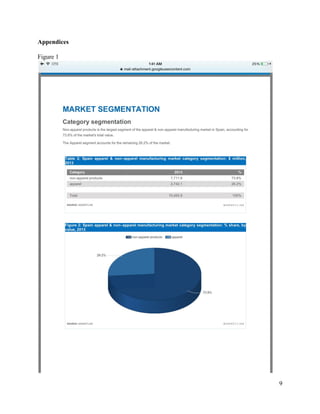
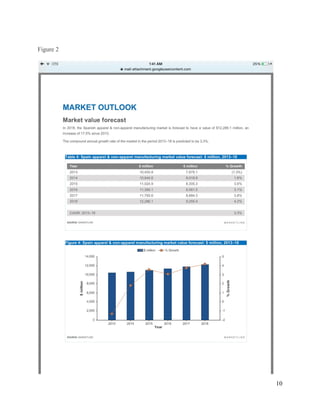
The apparel and non apparel sector accounts for about 10.5 billion dollars of the Spanish market. 
Non apparel sales make up 73.8 percent of this sector (Figure 1). According to market research, 
this figure should grow to about 12.3 billion dollars by 2018, a 17.5 percent growth from 2013 
(Figure 2). In addition, in a period where apparel sales offline had declined, online sales had 
actually increased in Spain (Kantar Worldpanel). Therefore, entering this growing market seems 
promising. 
 
The population of Spain, last measured in July 2014, was 47,737,941 people, 9.6 percent 
(4,582,800 people) of whom are between the ages of 15 and 24. Unfortunately, the population 
growth rate is around 0.81 percent and shrinking. The population is generally well educated with 
a 98 percent literacy rate, and 5 percent of GDP spent on education expenditures. 
 
The gross national income (GNI) for a Spanish citizen is around 29,940 US dollars. According to 
a Kantar Worldpanel report, about 785 dollars of this income is spent on apparel. In recent years, 
the consumer spending habits of citizens have changed dramatically because of the economic 
recession. Many spaniards were saving more money because in fear of the economy continuing 
to downturn. Compared to the United States, however, the Spanish market is slightly more ideal 
for an apparel retailer. 
 
Market research has found that Spanish citizens are more fashionable than United States citizens 
and shop more frequently during the year in order to keep up with current trends. This can be 
explained by many Spaniards spending the majority of their day outside in the streets where 
spaces are wider and constantly exposing themselves to new storefronts. Because much time is 
spent outside, Spaniards are geared towards more activity. Active lifestyles and participation in 
sports also became more popular when the Olympic Games were held in Barcelona in 1992. The 
Olympic Games increased the frequency, quality, and popularity of sports facilities in the area. 
Since this time, the sparked interest in sports activities has grown and more Spaniards have taken 
advantage of the more than suitable terrain. We believe that we can capitalize on this trend by 
entering our store in the Spanish market. 
 
Whereas the active lifestyles of Spaniards is encouraging for Blue Tomato, some cultural 
differences have downsides. Family time is deeply integrated into society and often valued over 
work. It is extremely common for businesses to close from 2:30 p.m. to 5:00 p.m. to allow 
employees to return home and enjoy a large lunch with their family. Additionally, the Spanish 
concept of time is less strict than the United States and many people are usually non­chalant 
about time deadlines. 
 
As far as technology, Spain is a developed country that is very up­to­date on logistical and 
communication systems. There are few influences or factors that would significantly affect the 
apparel or retail industry, especially since Zumiez and Blue Tomato are not in the production and 
manufacturing business. Risks in this category are very low. 
 
Industry Analysis  
 
Rivalry / Threat of New Entrants 
3 
 
The apparel and non­apparel industry of Spain has low barriers to entry; as a result, there is a 
high risk of new entrants when entering the market. The low cost of non­designer apparel, low 
requirement for capital in addition to high economies of scale, and easy access to distribution 
make way for a highly increased level of rivalry within the apparel industry. However, barriers to 
entry could include a large untrained workforce and no product differentiation. Blue Tomato will 
offer different products within their store, but some are the same brands being sold elsewhere. 
 
Currently, Blue Tomato’s biggest competitors are Inditex stores such as Pull & Bear and Zara as 
well as H&M. The competition in these companies comes from the fact that they target the same 
age demographic more than offering the same type of products. Additionally, sports stores that 
offer snowboards, skateboards, and surfboards also pose competition for Blue Tomato in Spain.  
 
Threat of Substitutes 
 
The threat of substitutes is low as there are not any substitutes for apparel. However, consumers 
do have different options when it comes to price points. The same Blue Tomato products may 
have different price scales when purchasing through the individual brand's own stores, online, or 
a second hand outlet like eBay. 
 
Buyer Power 
 
The buying power of individual consumers in the apparel industry is moderate. While there are 
many consumers in the Spanish market, individually, each consumer purchases so little that the 
decisions of one does not have an overall effect on the market. Still, individuals do have choices 
when shopping that can influence buyer power. These choices include fashion, branding, and 
advertising. Consumers in this industry are more sensitive to price and therefore are less brand 
loyal than other individuals. Instead, they tend to make purchasing decisions based on price and 
style. 
 
Supplier Power 
 
Industry wise, there are many foreign manufacturers available for the production of apparel and 
non­apparel items. As a result, this creates low switching costs and low wages. The choice of 
suppliers can also provide improved efficiency, product standardization, and costs savings. 
Therefore, suppliers in this market compete for business by offering the best services at the best 
prices. As a result, supplier power in this industry is low. 
 
Company Analysis & Strategy  
 
International Strategy 
Founded more than 25 years ago, Blue Tomato has developed into one of Europe's largest 
boardsport and fashion shops. We carry over 650 brands of apparel, footwear, boards, and 
accessories in stores in Germany and Austria, as well as online. Our desire for quality, as well as 
4 
professionalism and competency sets us apart. We value respect and friendliness as well as team 
spirit and a passion for the sports that we support. We sponsor seven snowparks in Europe, and 
frequently sponsor Europe’s biggest snowboard, skate, and surf events.  
A global entry strategy would best benefit Blue Tomato because of the variety of brands that we 
carry. Most brands for our targeted demographic are world wide and do not require specific 
tailoring for each country. However, targeting each store’s inventory to the more popular sport in 
that area can be beneficial. For example, a city closer to the beach and farther from the 
mountains will stock more surfboards than snowboards.  
With Zumiez’s recent acquisition of Blue Tomato, it is obvious that we are pursuing a corporate 
growth strategy. This acquisition gave us the ability to expand into Europe through an already 
established brand and market. Additionally, our focus­differentiated strategy helps to set us apart 
from competition. Above all, we are focused on our male and female target audience between the 
ages of 12­24. This focus is differentiated because of our offering of both apparel and board 
products in the same store.  
 
Spain Market Entry Strategy 
 
Keeping with Blue Tomato and Zumiez’s current strategy, we plan to continue importing 
products from our suppliers upon entering Spain as well as continuing to stock the Blue Tomato 
brand and various Zumiez in­house brands. With over 650 brands to manage, this is the easiest 
and most cost­effective option. However, we are open to the thought of carrying local brands in 
the stores if they receive approval. We have had success bringing smaller European brands into 
Blue Tomato, such as Colour Wear from Sweden and Muckefuck from Austria, that are not 
available in Zumiez stores and want to test this out in the Spanish market as well.  
 
Spain Marketing Strategy 
 
We plan to continue marketing in the same way as other Blue Tomato stores in Europe. The 
adaptation in this strategy occurs for geographical location. For a store that is closer to the 
mountains, we will do more marketing for snowboards and cold weather gear than a store that is 
closer to the beach. Because these stores will stock more of what suits their location, the 
marketing materials should also agree.  
 
Our marketing strategy will be primarily a push strategy. We plan to continue the use of Blue 
Tomato’s social media and newsletter advertising, while also employing some strategies that 
Zumiez currently uses. Zumiez has the Best Foot Forward Ameteur contest series every summer 
around the United States. The contest is free to enter and the winners from states across the 
country have the chance to compete for a sponsorship. We believe that creating a contest like 
this, or one centered around snowboarding or surfing would not only give Blue Tomato a chance 
to market their brand in Spain, but also to gain some exposure for a positive and exciting event 
that they are putting on.  
 
5 
Because Blue Tomato already has a 5,000 square meter distribution center located in Graz, 
Austria, we can easily get products from the facility to stores in a day’s drive. This centrally 
located European distribution center allows us the ability to expand across Europe without 
having to build new warehouses up front. Because of this low cost distribution channel, we do 
not plan on increasing the prices much from what they currently are in Germany and Austria. 
Depending on shipping costs, prices could fluctuate slightly in Spanish stores, but no more than 
10 Euros. This allows us to keep our competitive low cost advantage.  
 
Managing Internal Operations 
 
Production Strategy 
 
As previously mentioned, our warehouse will be located in Austria, therefore shipping to our 
European locations will be easy due to the Eurozone and EU policies. This will be significantly 
cheaper in comparison to products being shipped from the United States. 
 
Our production strategy will mainly focus on the locations of our facilities. We want to focus on 
opening our first store in a location that has a large population of young people who are 
geographically close to both the water and mountains. Upon considering major Spanish cities, 
our team decided that Barcelona would best fit those needs. 
 
We plan on primarily opening up in Barcelona, specifically in the downtown/centre area.   Due 
to the 4.7 million inhabitants, we believe that Barcelona will offer a large pool of young people 
for us to target. Barcelona is both located right on the coast and remains very close to the 
mountains, allowing for a prevalent surfing and snowboarding demographic. 
 
Our next location that we plan on entering, if Barcelona is successful, is Granada. This location 
remains appealing since many students reside there. Granda is a college town, an hour away 
from the coast, whose main transportation includes walking, skating and biking. Since Blue 
Tomato targets the younger generation who enjoys skating, we believe that Granada will be a 
promising location to enter.  
 
We do not plan on stocking much inventory in the back of each store, rather a variety of items 
and a wider selection for our customers.  This will make our items more unique and valuable 
since not many will be in stock.  This strategy will hopefully improve our sales and distinguish 
us from our competitors. 
 
All of our items will be categorized and sectioned by apparel, footwear, snow, skate and surf. 
Our surf section will include boards on the wall, along with gear and accessories (wax, grip, 
decals … etc.) featured close by. The skate and snowboard sections will have the same layout. 
We want our customers to have the ability to take both the boards and shoes down from display 
and have hands­on access to our products.   
 
Acquiring Physical Resources 
 
6 
We plan on leasing the stores in the desired locations, therefore we would not have any fixed 
assets. We would only need fixed assets if we needed local warehousing later down the road in 
order to have a central distribution area in Spain; as of today, this will not be needed. Raw 
materials would not be needed since the Blue Tomato and Zumiez brand, produced by the 
company, outsource their own products and the rest of the products are provided by other 
retailers.   
 
Hiring and Managing Employees 
 
We first plan on polycentric staffing at the managerial level, hopefully hiring someone from the 
Germany or Austria stores to lead the new team. This ensures that local employees receive 
adequate training based on Blue Tomato’s strategy. Then, we would quickly find a Spanish 
assistant manager so that they can be trained and educated enough to open the next Spanish 
store, or to eventually become a manager of the first store.   
 
We would ethnocentric staff at the store worker level. Our store would over staff at first, 
consuming some additional labor costs up front. Additionally, we would accept up to 1,000 
resumes, guaranteeing a selection of the best possible employees. When selecting, we would 
ideally look for a someone who is training to become a professional or connected with the X 
Games, who knows the industry well.   
 
We plan on hiring people from the ages 17­29 to work in the store. The employees will model 
our gear and will be very interested and have extensive knowledge in skating, surfing and 
snowboarding. They will have to know, at a minimum, both English and Spanish, and possibly 
other languages since Barcelona is a tourist city. Primarily for our first store, our store managers 
will be older, more experienced workers from Germany or Austria. We prefer that these workers 
have some sort of business degree and several years of experience in other Blue Tomato stores.  
 
Our training will come from older, more experienced veterans in the store. In our first store, our 
veterans will come from Germany or Austria, so that the principles and values of the store are 
immediately solidified. Training will consist of watching the environment and the creation of 
sales for 3 weeks. Our other option consists of shipping some experienced managers to work in 
another store for a week to train new employees.  The new employees will originally need to be 
knowledgeable and familiar with most of the brands being sold. 
 
We do not plan on giving these employees any contracts, but instead pay an hourly wage and 
offer an employee discount for all employees. We hope this will encourage the employees to 
work harder in order to maintain their employment as well as potentially advance into 
managerial roles or help with the creation of a new store.   
 
Conclusion 
 
We recommend that Blue Tomato should proceed with entering the Spanish market. Due to the 
market and industry analysis factors discussed above, as well as our individual company 
7 
analysis, we believe that this is an opportune time to continue our European expansion. We 
believe that Blue Tomato’s unique brand identity, paired with its strong supplier relationships 
and efficient distribution strategy will prosper in Barcelona. Although the Spanish economy is 
still recovering from 2008, we see this as an advantage to enter the market now as consumer 
confidence is growing. Our strong European presence and logistics will allow us to compete with 
other established competitors in Spain. We believe that this first step outside of Austria and 
Germany will allow Blue Tomato to grow and open other stores in Spain and other parts of 
Europe.  


8 
Appendices 
 
Figure 1 
 
9 
 
Figure 2 
 
 
10 
Figure 3 
 
SWOT Analysis 


11 

IB-Zumiez