© 2009 IBM Corporation 
Matthew B White (whitemat@uk.ibm.com) – MQ Integration Connectivity and Scale 
September 2014 
IBM MQ v8 and JMS 2.0 
An Introduction 
slideshare.net/calanais/ibm-mq-v8-and-jms-20
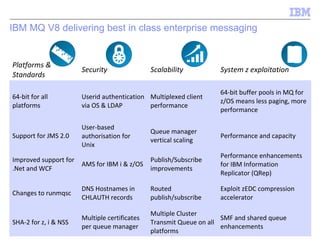
IBM MQ V8 delivering best in class enterprise messaging 
Platforms & 
Standards 
Security Scalability System z exploitation 
64-bit for all 
platforms 
Userid authentication 
via OS & LDAP 
Multiplexed client 
performance 
64-bit buffer pools in MQ for 
z/OS means less paging, more 
performance 
Support for JMS 2.0 
User-based 
authorisation for 
Unix 
Queue manager 
vertical scaling 
Performance and capacity 
Improved support for 
.Net and WCF 
AMS for IBM i & z/OS 
Publish/Subscribe 
improvements 
Performance enhancements 
for IBM Information 
Replicator (QRep) 
Changes to runmqsc 
DNS Hostnames in 
CHLAUTH records 
Routed 
publish/subscribe 
Exploit zEDC compression 
accelerator 
SHA-2 for z, i & NSS 
Multiple certificates 
per queue manager 
Multiple Cluster 
Transmit Queue on all 
platforms 
SMF and shared queue 
enhancements 
© 2014 2 IBM Corporation
Agenda 
 Introduction to the changes in the WMQ v8 JMS and Java Clients 
 Introduction to JMS2.0 and how this has been implemented in v8 
© 2014 3 IBM Corporation
WMQ v8 – Summary of Changes 
 New version of the Java Runtime – version 7 
 Packaging Changes 
– Fewer JARs 
– Simpler and quicker access to the just the JARs 
 Removal of DirectIP function 
 Username and Password updates 
 Improved Control of Tracing 
© 2014 4 IBM Corporation
New Java Runtime: Java 7 
 JMS 2.0 – pre-reqs use of java.lang.AutoCloseable 
 Interfaces in jms.jar built using Java 7 class file format 
 JRE how shipped with MQ v8 is IBM (or hybrid depending on platform) Java 7 
 Features: 
– http://radar.oreilly.com/2011/09/java7-features.html 
– Try-with-resources specifically as JMS objects are 'resources' now 
– Try-with-multiple-catch block of specific interest for coding exception handling 
– not adopted the new i-o classes 
© 2014 September 24, 2014 IBM Corporation
Packaging: DirectIP Removal 
 Ability to create a DirectIP (TCP or HTTP) connection has been removed. 
 Function not supported exception thrown 
 APIs controlling properties retain settings – specifically so administration of objects is possible via 
JMSAdmin or Explorer 
– Settings have no functional behaviour however 
 Any IBM Message Broker that supported this function is now out of normal support 
© 2014 September 24, 2014 IBM Corporation
Packaging: JAR files 
 Files that have gone: 
–ldap.jar jndi.jar 
•Both now included in the standard class libaries 
– connector.jar 
•Outdated dependency – not required 
–CL3Export.jar CL3NonExport.jar dhbcore.jar 
•DirectIP support - removed 
 Files that are new 
– com.ibm.mq.allclient.jar 
•Base Java, JMS, Headers and PCF classes 
– com.ibm.mq.traceControl.jar 
•Remote trace control 
 Changes 
– jms.jar is the new JMS 2 version 
– no distinguishing features except the size – now 57kb 
© 2014 September 24, 2014 IBM Corporation
Obtaining and using the JAR files 
 No longer need to install the server or full client support pac to get the RA or JMS/Java client JARs 
 Self-extracting JARs available on Fix Central for 
– IBM MQ Resource Adapter 
– IBM MQ JMS and Java Clients 
 Knowledge Centre has been updated to include comments about moving com.ibm.mq.allclient.jar into 
for example Maven repositories. 
 Full details in Technote 1683398 
– http://www-01.ibm.com/support/docview.wss?uid=swg21683398 
© 2014 September 24, 2014 IBM Corporation
Security: Username and password passing 
 Motivation: Start to properly use username and password for authentication in Client mode 
 Compatibility: We haven't historically done this, so we make it optional 
 Enabling the option 
–Globally – configuration option Configuration.USE_MQCSP_AUTHENTICATION 
(boolean, Y/N) 
•Environment Variable com.ibm.mq.jmqi.useMQCSPauthentication 
•System property com.ibm.mq.cfg.jmqi.useMQCSPauthentication 
•Client ini file stanza JMQI, attribute useMQCSPauthentication 
 Effect if option is set 
–Flow the username and password data in the MQCSP as part of the CONAUTH flow 
–Flow the “real” username in the UID flow 
© 2014 September 24, 2014 IBM Corporation
Security: Password Protection Configuration 
 Configuration.PASSWORD_PROTECTION 
–Choices - "Compatible", "Always", "Optional" 
–Environment Variable com.ibm.mq.jmqi.PasswordProtection 
–System Property com.ibm.mq.cfg.jmqi.PasswordProtection 
–Client ini file Stanza Channels, attribute PasswordProtection 
–Only “Always” is really relevant to Clients 
If set, then the list offered to the QM only allows for 3DES 
If unset, the list allows for 3DES and NULL encryption 
 Configuration AMQ_RANDOM_NUMBER_TYPE 
–Choices - “Standard", "Fast" 
–Environment Variable AMQ_RANDOM_NUMBER_TYPE 
–System Property com.ibm.mq.cfg.jmqi.AmqRandomNumberType 
–Standard – use java.security.SecureRandom 
–Fast – use java.util.Random 
 This is only relevant if the previous “flow userid and password in the CONAUTH flow” options are in 
force, otherwise the userid and password is in the ID flow which will not be encrypted. 
© 2014 September 24, 2014 IBM Corporation
Dynamic Trace Control 
http://www-01.ibm.com/support/knowledgecenter/api/content/SSFKSJ_8.0.0/com.ibm.mq.tro.doc/q115930_.htm 
C:>java -jar MQ_INSTALLATION_PATH/java/lib/com.ibm.mq.traceControl.jar -list 
10008 : 'MQSample' 
9004 : 'MQ_INSTALLATION_PATH/java/lib/com.ibm.mq.traceControl.jar -list' 
C:>java -jar MQ_INSTALLATION_PATH/java/lib/com.ibm.mq.traceControl.jar -i 10008 -status 
Tracing enabled : false 
User Directory : C:UsersIBM_ADMINRTCworkspacesandpit 
Trace File Name : mqjms.trc 
Package Include/Exclude tree 
root - Included 
C:>java -jar MQ_INSTALLATION_PATH/java/lib/com.ibm.mq.traceControl.jar -i 10008 -enable 
Enabling trace 
Tracing enabled : true 
C:>java -jar MQ_INSTALLATION_PATH/java/lib/com.ibm.mq.traceControl.jar -i 10008 -status 
Tracing enabled : true 
User Directory : C:UsersIBM_ADMINRTCworkspacesandpit 
Trace File Name : mqjms_10008.trc 
Package Include/Exclude tree 
root - Included 
© 2014 11 IBM Corporation
Introduction and Aims – JMS 2.0 
 Aims for you: 
– Get some education on what's new and different in JMS 2.0 
– Additional information about Java related changes in MQ v8 
 Aims for us: 
– Gauge adoption of JMS 2.0 and in what environments? 
– What business use cases for the new features can you think of? 
References: 
– JMS 2.0 – JSR 343 Java Message Service (JMS 2.0) 
• http://jcp.org/en/jsr/detail?id=343 
– Final release on 21 May 2013. 
• https://java.net/projects/jms-spec/pages/JMS20FinalRelease 
© 2014 12 IBM Corporation
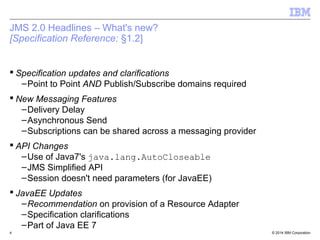
JMS 2.0 Headlines – What's new? 
[Specification Reference: §1.2] 
 Specification updates and clarifications 
–Point to Point AND Publish/Subscribe domains required 
 New Messaging Features 
–Delivery Delay 
–Asynchronous Send 
–Subscriptions can be shared across a messaging provider 
 API Changes 
–Use of Java7's java.lang.AutoCloseable 
–JMS Simplified API 
–Session doesn't need parameters (for JavaEE) 
 JavaEE Updates 
–Recommendation on provision of a Resource Adapter 
–Specification clarifications 
–Part of Java EE 7 
© 2014 13 IBM Corporation
Simplified API 
Messaging Features 
JavaEE 
Updates 
© 2014 September 24, 2014 IBM Corporation
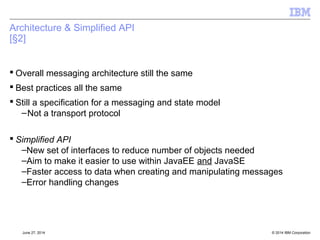
Architecture & Simplified API 
[§2] 
 Overall messaging architecture still the same 
 Best practices all the same 
 Still a specification for a messaging and state model 
–Not a transport protocol 
 Simplified API 
–New set of interfaces to reduce number of objects needed 
–Aim to make it easier to use within JavaEE and JavaSE 
–Faster access to data when creating and manipulating messages 
–Error handling changes 
© 2014 September 24, 2014 IBM Corporation
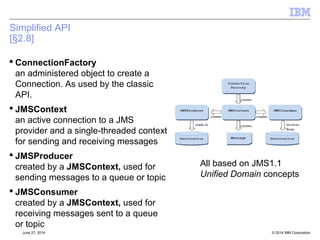
Simplified API 
[§2.8] 
 ConnectionFactory 
an administered object to create a 
Connection. As used by the classic 
API. 
 JMSContext 
an active connection to a JMS 
provider and a single-threaded context 
for sending and receiving messages 
 JMSProducer 
created by a JMSContext, used for 
sending messages to a queue or topic 
 JMSConsumer 
created by a JMSContext, used for 
receiving messages sent to a queue 
or topic 
All based on JMS1.1 
Unified Domain concepts 
© 2014 September 24, 2014 IBM Corporation
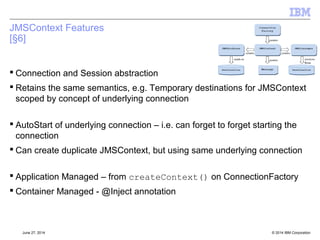
JMSContext Features 
[§6] 
 Connection and Session abstraction 
 Retains the same semantics, e.g. Temporary destinations for JMSContext 
scoped by concept of underlying connection 
 AutoStart of underlying connection – i.e. can forget to forget starting the 
connection 
 Can create duplicate JMSContext, but using same underlying connection 
 Application Managed – from createContext() on ConnectionFactory 
 Container Managed - @Inject annotation 
© 2014 September 24, 2014 IBM Corporation
Producing Messages 
[§7] 
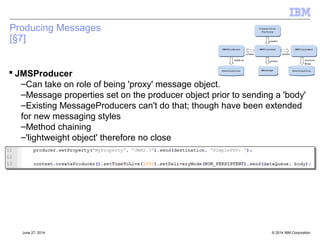
 JMSProducer 
–Can take on role of being 'proxy' message object. 
–Message properties set on the producer object prior to sending a 'body' 
–Existing MessageProducers can't do that; though have been extended 
for new messaging styles 
–Method chaining 
–'lightweight object' therefore no close 
© 2014 September 24, 2014 IBM Corporation
Consuming messages 
[§8] 
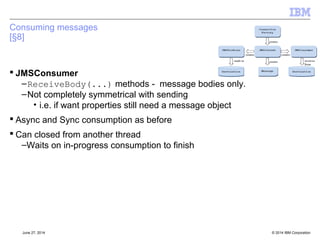
 JMSConsumer 
–ReceiveBody(...) methods - message bodies only. 
–Not completely symmetrical with sending 
• i.e. if want properties still need a message object 
 Async and Sync consumption as before 
 Can closed from another thread 
–Waits on in-progress consumption to finish 
© 2014 September 24, 2014 IBM Corporation
Messages 
[§3] 
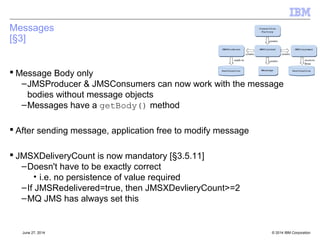
 Message Body only 
–JMSProducer & JMSConsumers can now work with the message 
bodies without message objects 
–Messages have a getBody() method 
 After sending message, application free to modify message 
 JMSXDeliveryCount is now mandatory [§3.5.11] 
–Doesn't have to be exactly correct 
• i.e. no persistence of value required 
–If JMSRedelivered=true, then JMSXDevlieryCount>=2 
–MQ JMS has always set this 
© 2014 September 24, 2014 IBM Corporation
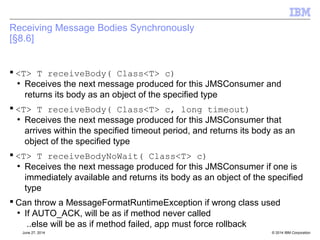
Receiving Message Bodies Synchronously 
[§8.6] 
 <T> T receiveBody( Class<T> c) 
● Receives the next message produced for this JMSConsumer and 
returns its body as an object of the specified type 
 <T> T receiveBody( Class<T> c, long timeout) 
● Receives the next message produced for this JMSConsumer that 
arrives within the specified timeout period, and returns its body as an 
object of the specified type 
 <T> T receiveBodyNoWait( Class<T> c) 
● Receives the next message produced for this JMSConsumer if one is 
immediately available and returns its body as an object of the specified 
type 
 Can throw a MessageFormatRuntimeException if wrong class used 
● If AUTO_ACK, will be as if method never called 
..else will be as if method failed, app must force rollback 
© 2014 September 24, 2014 IBM Corporation
Message Body Conversions 
Message Type Parameter 
TextMessage String.class 
ObjectMessage Java.io.Serializable 
MapMessage Java.util.Map or java.lang.Object 
BytesMessage byte[].class 
Message Always returns null 
<nobody> Always returns null 
© 2014 September 24, 2014 IBM Corporation
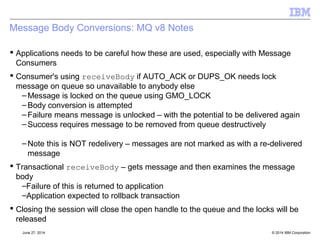
Message Body Conversions: MQ v8 Notes 
 Applications needs to be careful how these are used, especially with Message 
Consumers 
 Consumer's using receiveBody if AUTO_ACK or DUPS_OK needs lock 
message on queue so unavailable to anybody else 
–Message is locked on the queue using GMO_LOCK 
– Body conversion is attempted 
– Failure means message is unlocked – with the potential to be delivered again 
– Success requires message to be removed from queue destructively 
– Note this is NOT redelivery – messages are not marked as with a re-delivered 
message 
 Transactional receiveBody – gets message and then examines the message 
body 
–Failure of this is returned to application 
–Application expected to rollback transaction 
 Closing the session will close the open handle to the queue and the locks will be 
released 
© 2014 September 24, 2014 IBM Corporation
JMS 1.1 Interfaces Updates 
[§6.1] 
 Connections 
–New methods for creating session with no transaction arguments 
–Shared Connection Consumers 
 Sessions 
–Creating share consumers 
–Creating JMS1.1 MessageConsumer for durable subscriptions 
 Message Producer 
–New set/get for Delivery Delay 
–Send methods extended to supply Completion Listener 
 Message Consumer 
–No change 
 Message 
–For delivery delay – getJMSDeliveryTime() 
–New methods to directly access body data, getBody() 
isBodyAssignableTo() 
© 2014 September 24, 2014 IBM Corporation
Java 7 - Auto-Closeable 
 Java 7 gives large variety of 
–new functions – class libraries 
–Java Language enhancements 
–New class file version 
 JMS2.0 drives Java 7 specifically because of the try-with-resources 
enhancement 
© 2014 September 24, 2014 IBM Corporation
Exceptions and Exception Listeners 
[§10] 
 New exception JMSRuntimeException thrown from new API calls 
 JavaDoc shows mandatory cases 
–...but... provider may thrown these for other cases as well 
 Exceptions thrown on a JMS calls, must not be delivered to an 
ExceptionListener 
 Compiler will not force you to do error checking 
 Must take responsibility for doing it at suitable points 
© 2014 September 24, 2014 IBM Corporation
Simplified API 
Messaging Features 
JavaEE 
Updates 
© 2014 September 24, 2014 IBM Corporation
New messaging features - recap 
 Asynchronous Send 
–Application sends messages via API that returns before server has 
processed messages 
–Confirmation via listener 
 Delayed Delivery 
–Allow delivery at a later point in time 
–(remember this is not a database) 
 Shared Subscriptions 
–Subscription which can opened by multiple consumers 
–Messages shared amongst consumers (no fairness rules provided) 
© 2014 September 24, 2014 IBM Corporation
Subscriptions 
[§8.3 §4.2] 
 Unshared non-durable subscriptions 
–As per JMS 1.1. non-durable subscription 
 Shared non-durable subscription 
–Identified by 'sharedSubscriptionName' and 'clientId' if set 
–If clientId is set, all consumers must share the same clientId 
–Subscription/undelivered messages deleted when last consumer is 
closed 
 Unshared Durable Subscriptions 
–As per JMS 1.1 Durable subscriptions 
 Shared Durable Subscriptions 
–Has the features of a durable subscription but pulls in multiple 
consumers aspect 
–ClientId is optional 
 Same 'sharedSubscriptionName' can be used for durable and non-durable 
© 2014 September 24, 2014 IBM Corporation
Asynchronous Send 
[§7.3] 
 Synchronous Send means 
–Send message and wait for a response before returning from send call 
 Asynchronous Send means 
–Send message and return from the send call before response from 
server 
 Closing must wait for failure or completion of async sends 
 Callbacks made in the same order the messages where sent 
 Message objects not multi-threaded – don't modify until onCompletion 
 CompletionListener called when response has been received. 
–Does not work like message listener in terms of thread of control 
 Quality of Service 
–After onCompletion equal to sync send(...) 
© 2014 September 24, 2014 IBM Corporation
Message Delivery Delay 
[§7.9] 
 Earliest Time JMS provider may give message to consumer 
 Sets the minimum length of time (in ms) that must elapse after a message 
is sent before the JMS provider may deliver the message to a consumer 
 For transacted sends, this time starts when the client sends the message, 
not when the transaction is committed. 
 Delivery Delay set longer than expiry is an error! 
–Will throw an exception 
© 2014 September 24, 2014 IBM Corporation
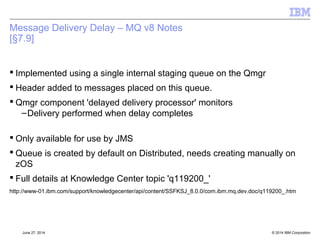
Message Delivery Delay – MQ v8 Notes 
[§7.9] 
 Implemented using a single internal staging queue on the Qmgr 
 Header added to messages placed on this queue. 
 Qmgr component 'delayed delivery processor' monitors 
–Delivery performed when delay completes 
 Only available for use by JMS 
 Queue is created by default on Distributed, needs creating manually on 
zOS 
 Full details at Knowledge Center topic 'q119200_' 
http://www-01.ibm.com/support/knowledgecenter/api/content/SSFKSJ_8.0.0/com.ibm.mq.dev.doc/q119200_.htm 
© 2014 September 24, 2014 IBM Corporation
Simplified API 
Messaging Features 
JavaEE 
Updates 
© 2014 September 24, 2014 IBM Corporation
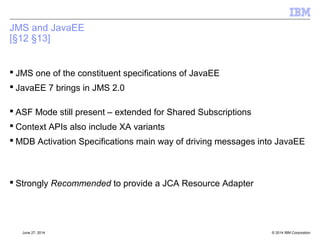
JMS and JavaEE 
[§12 §13] 
 JMS one of the constituent specifications of JavaEE 
 JavaEE 7 brings in JMS 2.0 
 ASF Mode still present – extended for Shared Subscriptions 
 Context APIs also include XA variants 
 MDB Activation Specifications main way of driving messages into JavaEE 
 Strongly Recommended to provide a JCA Resource Adapter 
© 2014 September 24, 2014 IBM Corporation
JMS and JavaEE – API updates 
[§12 §13] 
 Prescriptive list of APIs that can not be called in the containers 
–No message listeners 
–Single session / connection 
–No connection consumers 
–No Asynchronous Send 
–Transaction control etc. 
 Session/Context APIs - No local transactions or client acknowledgement 
–javax.jms.Connection.createSession() 
–javax.jms.ConnectionFactory.createContext() 
© 2014 September 24, 2014 IBM Corporation
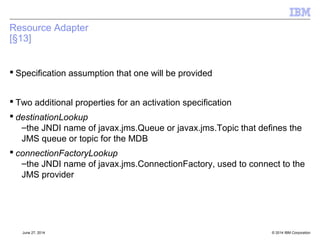
Resource Adapter 
[§13] 
 Specification assumption that one will be provided 
 Two additional properties for an activation specification 
 destinationLookup 
–the JNDI name of javax.jms.Queue or javax.jms.Topic that defines the 
JMS queue or topic for the MDB 
 connectionFactoryLookup 
–the JNDI name of javax.jms.ConnectionFactory, used to connect to the 
JMS provider 
© 2014 September 24, 2014 IBM Corporation
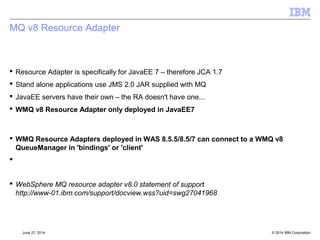
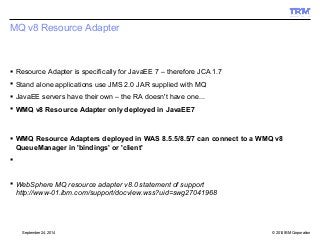
MQ v8 Resource Adapter 
 Resource Adapter is specifically for JavaEE 7 – therefore JCA 1.7 
 Stand alone applications use JMS 2.0 JAR supplied with MQ 
 JavaEE servers have their own – the RA doesn't have one... 
 WMQ v8 Resource Adapter only deployed in JavaEE7 
 WMQ Resource Adapters deployed in WAS 8.5.5/8.5/7 can connect to a WMQ v8 
QueueManager in 'bindings' or 'client' 
 
 WebSphere MQ resource adapter v8.0 statement of support 
http://www-01.ibm.com/support/docview.wss?uid=swg27041968 
© 2014 September 24, 2014 IBM Corporation
Simplified API 
Messaging Features 
JavaEE 
Updates 
© 2014 September 24, 2014 IBM Corporation
Migration of applications 
 JMS 2.0 supports all the JMS1.1 APIs 
– The JMS2.0 version of the specification though defines the JMS1.1 usage 
 Existing applications, with recompile, can run with a JMS2.0 implementation 
 JMS1.1 apps though written against a JMS2.0 implement will not work 
– Existing interfaces reference some new JMS2.0 interfaces 
 Note that the JVM for JMS2.0 implementations and Java7 runtime is needed 
 Some API behavior changes... 
© 2014 39 IBM Corporation
JMS and the compliance test suite 
 To ensure that the JMS provider has implemented the specification 
correctly there is a compliance test suite that has to be run. 
 This has been updated together with the JMS 2.0 specification 
 To meet compliance with this new spec – some minor functional behavior 
will change from previous implementations. 
 'out of the box' MQ JMS needs to comply but old behavior can be 
switched in. 
–the property com.ibm.mq.jms.SupportMQExtensions, which can 
be set to TRUE, to revert these changed behaviors back to previous 
implementations. 
© 2014 September 24, 2014 IBM Corporation
SuportMQExtensions 
 Three areas of functionality are reverted by setting SupportMQExtensions to True: 
 Message priority 
 Messages can be assigned a priority, 0 - 9. Before JMS 2.0, messages could also use the value -1, 
indicating that a queue’s default priority is used. JMS 2.0 does not allow a message priority of -1 to be 
set. Turning on SupportMQExtensions allows the value of -1 to be used. 
 Client id 
 The JMS 2.0 specification requires that non-null client ids are checked for uniqueness when they 
make a connection. Turning on SupportMQExtensions, means that this requirement is disregarded, 
and that a client id can be reused. 
 NoLocal 
 The JMS 2.0 specification requires that when this constant is turned on, a consumer cannot receive 
messages that are published by the same client id. Before JMS 2.0, this attribute was set on a 
subscriber to prevent it receiving messages that are published by its own connection. Turning on 
SupportMQExtensions reverts this behavior to its previous implementation. 
© 2014 September 24, 2014 IBM Corporation
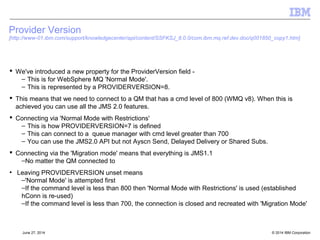
Provider Version 
http://www-01.ibm.com/support/knowledgecenter/SSFKSJ_8.0.0/com.ibm.mq.mig.doc/q001850_.htm 
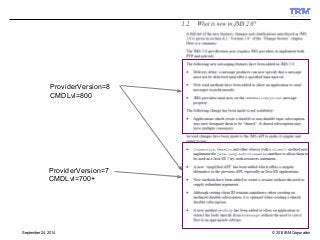
 We've introduced a new property for the ProviderVersion field - 
– This is for 'Normal Mode'. 
– This is represented by a PROVIDERVERSION=8. 
 This means that we need to connect to a QM that has a cmd level of 800 (WMQ v8). When this is 
achieved you can use all the JMS 2.0 features. 
 Connecting via 'Normal Mode with Restrictions' 
– This is how PROVIDERVERSION=7 is defined 
– This can connect to a queue manager with cmd level greater than 700 
– You can use the JMS2.0 API but not Ayscn Send, Delayed Delivery or Shared Subs. 
 Connecting via the 'Migration mode' means that everything is JMS1.1 
–No matter the QM connected to 
● Leaving PROVIDERVERSION unset means 
–'Normal Mode' is attempted first 
–If the command level is less than 800 then 'Normal Mode with Restrictions' is used (established 
hConn is re-used) 
–If the command level is less than 700, the connection is closed and recreated with 'Migration Mode' 
© 2014 September 24, 2014 IBM Corporation
ProviderVersion=8 
CMDLvl=800 
ProviderVersion=7 
CMDLvl=700+ 
© 2014 September 24, 2014 IBM Corporation
Error messages when using Provider Version 
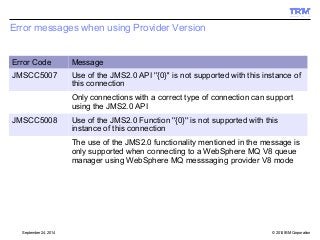
Error Code Message 
JMSCC5007 Use of the JMS2.0 API ''{0}'' is not supported with this instance of 
this connection 
Only connections with a correct type of connection can support 
using the JMS2.0 API 
JMSCC5008 Use of the JMS2.0 Function ''{0}'' is not supported with this 
instance of this connection 
The use of the JMS2.0 functionality mentioned in the message is 
only supported when connecting to a WebSphere MQ V8 queue 
manager using WebSphere MQ messsaging provider V8 mode 
© 2014 September 24, 2014 IBM Corporation

IBM MQ v8 and JMS 2.0

  • 1.
    © 2009 IBMCorporation Matthew B White (whitemat@uk.ibm.com) – MQ Integration Connectivity and Scale September 2014 IBM MQ v8 and JMS 2.0 An Introduction slideshare.net/calanais/ibm-mq-v8-and-jms-20
  • 2.
    IBM MQ V8delivering best in class enterprise messaging Platforms & Standards Security Scalability System z exploitation 64-bit for all platforms Userid authentication via OS & LDAP Multiplexed client performance 64-bit buffer pools in MQ for z/OS means less paging, more performance Support for JMS 2.0 User-based authorisation for Unix Queue manager vertical scaling Performance and capacity Improved support for .Net and WCF AMS for IBM i & z/OS Publish/Subscribe improvements Performance enhancements for IBM Information Replicator (QRep) Changes to runmqsc DNS Hostnames in CHLAUTH records Routed publish/subscribe Exploit zEDC compression accelerator SHA-2 for z, i & NSS Multiple certificates per queue manager Multiple Cluster Transmit Queue on all platforms SMF and shared queue enhancements © 2014 2 IBM Corporation
  • 3.
    Agenda  Introductionto the changes in the WMQ v8 JMS and Java Clients  Introduction to JMS2.0 and how this has been implemented in v8 © 2014 3 IBM Corporation
  • 4.
    WMQ v8 –Summary of Changes  New version of the Java Runtime – version 7  Packaging Changes – Fewer JARs – Simpler and quicker access to the just the JARs  Removal of DirectIP function  Username and Password updates  Improved Control of Tracing © 2014 4 IBM Corporation
  • 5.
    New Java Runtime:Java 7  JMS 2.0 – pre-reqs use of java.lang.AutoCloseable  Interfaces in jms.jar built using Java 7 class file format  JRE how shipped with MQ v8 is IBM (or hybrid depending on platform) Java 7  Features: – http://radar.oreilly.com/2011/09/java7-features.html – Try-with-resources specifically as JMS objects are 'resources' now – Try-with-multiple-catch block of specific interest for coding exception handling – not adopted the new i-o classes © 2014 September 24, 2014 IBM Corporation
  • 6.
    Packaging: DirectIP Removal  Ability to create a DirectIP (TCP or HTTP) connection has been removed.  Function not supported exception thrown  APIs controlling properties retain settings – specifically so administration of objects is possible via JMSAdmin or Explorer – Settings have no functional behaviour however  Any IBM Message Broker that supported this function is now out of normal support © 2014 September 24, 2014 IBM Corporation
  • 7.
    Packaging: JAR files  Files that have gone: –ldap.jar jndi.jar •Both now included in the standard class libaries – connector.jar •Outdated dependency – not required –CL3Export.jar CL3NonExport.jar dhbcore.jar •DirectIP support - removed  Files that are new – com.ibm.mq.allclient.jar •Base Java, JMS, Headers and PCF classes – com.ibm.mq.traceControl.jar •Remote trace control  Changes – jms.jar is the new JMS 2 version – no distinguishing features except the size – now 57kb © 2014 September 24, 2014 IBM Corporation
  • 8.
    Obtaining and usingthe JAR files  No longer need to install the server or full client support pac to get the RA or JMS/Java client JARs  Self-extracting JARs available on Fix Central for – IBM MQ Resource Adapter – IBM MQ JMS and Java Clients  Knowledge Centre has been updated to include comments about moving com.ibm.mq.allclient.jar into for example Maven repositories.  Full details in Technote 1683398 – http://www-01.ibm.com/support/docview.wss?uid=swg21683398 © 2014 September 24, 2014 IBM Corporation
  • 9.
    Security: Username andpassword passing  Motivation: Start to properly use username and password for authentication in Client mode  Compatibility: We haven't historically done this, so we make it optional  Enabling the option –Globally – configuration option Configuration.USE_MQCSP_AUTHENTICATION (boolean, Y/N) •Environment Variable com.ibm.mq.jmqi.useMQCSPauthentication •System property com.ibm.mq.cfg.jmqi.useMQCSPauthentication •Client ini file stanza JMQI, attribute useMQCSPauthentication  Effect if option is set –Flow the username and password data in the MQCSP as part of the CONAUTH flow –Flow the “real” username in the UID flow © 2014 September 24, 2014 IBM Corporation
  • 10.
    Security: Password ProtectionConfiguration  Configuration.PASSWORD_PROTECTION –Choices - "Compatible", "Always", "Optional" –Environment Variable com.ibm.mq.jmqi.PasswordProtection –System Property com.ibm.mq.cfg.jmqi.PasswordProtection –Client ini file Stanza Channels, attribute PasswordProtection –Only “Always” is really relevant to Clients If set, then the list offered to the QM only allows for 3DES If unset, the list allows for 3DES and NULL encryption  Configuration AMQ_RANDOM_NUMBER_TYPE –Choices - “Standard", "Fast" –Environment Variable AMQ_RANDOM_NUMBER_TYPE –System Property com.ibm.mq.cfg.jmqi.AmqRandomNumberType –Standard – use java.security.SecureRandom –Fast – use java.util.Random  This is only relevant if the previous “flow userid and password in the CONAUTH flow” options are in force, otherwise the userid and password is in the ID flow which will not be encrypted. © 2014 September 24, 2014 IBM Corporation
  • 11.
    Dynamic Trace Control http://www-01.ibm.com/support/knowledgecenter/api/content/SSFKSJ_8.0.0/com.ibm.mq.tro.doc/q115930_.htm C:>java -jar MQ_INSTALLATION_PATH/java/lib/com.ibm.mq.traceControl.jar -list 10008 : 'MQSample' 9004 : 'MQ_INSTALLATION_PATH/java/lib/com.ibm.mq.traceControl.jar -list' C:>java -jar MQ_INSTALLATION_PATH/java/lib/com.ibm.mq.traceControl.jar -i 10008 -status Tracing enabled : false User Directory : C:UsersIBM_ADMINRTCworkspacesandpit Trace File Name : mqjms.trc Package Include/Exclude tree root - Included C:>java -jar MQ_INSTALLATION_PATH/java/lib/com.ibm.mq.traceControl.jar -i 10008 -enable Enabling trace Tracing enabled : true C:>java -jar MQ_INSTALLATION_PATH/java/lib/com.ibm.mq.traceControl.jar -i 10008 -status Tracing enabled : true User Directory : C:UsersIBM_ADMINRTCworkspacesandpit Trace File Name : mqjms_10008.trc Package Include/Exclude tree root - Included © 2014 11 IBM Corporation
  • 12.
    Introduction and Aims– JMS 2.0  Aims for you: – Get some education on what's new and different in JMS 2.0 – Additional information about Java related changes in MQ v8  Aims for us: – Gauge adoption of JMS 2.0 and in what environments? – What business use cases for the new features can you think of? References: – JMS 2.0 – JSR 343 Java Message Service (JMS 2.0) • http://jcp.org/en/jsr/detail?id=343 – Final release on 21 May 2013. • https://java.net/projects/jms-spec/pages/JMS20FinalRelease © 2014 12 IBM Corporation
  • 13.
    JMS 2.0 Headlines– What's new? [Specification Reference: §1.2]  Specification updates and clarifications –Point to Point AND Publish/Subscribe domains required  New Messaging Features –Delivery Delay –Asynchronous Send –Subscriptions can be shared across a messaging provider  API Changes –Use of Java7's java.lang.AutoCloseable –JMS Simplified API –Session doesn't need parameters (for JavaEE)  JavaEE Updates –Recommendation on provision of a Resource Adapter –Specification clarifications –Part of Java EE 7 © 2014 13 IBM Corporation
  • 14.
    Simplified API MessagingFeatures JavaEE Updates © 2014 September 24, 2014 IBM Corporation
  • 15.
    Architecture & SimplifiedAPI [§2]  Overall messaging architecture still the same  Best practices all the same  Still a specification for a messaging and state model –Not a transport protocol  Simplified API –New set of interfaces to reduce number of objects needed –Aim to make it easier to use within JavaEE and JavaSE –Faster access to data when creating and manipulating messages –Error handling changes © 2014 September 24, 2014 IBM Corporation
  • 16.
    Simplified API [§2.8]  ConnectionFactory an administered object to create a Connection. As used by the classic API.  JMSContext an active connection to a JMS provider and a single-threaded context for sending and receiving messages  JMSProducer created by a JMSContext, used for sending messages to a queue or topic  JMSConsumer created by a JMSContext, used for receiving messages sent to a queue or topic All based on JMS1.1 Unified Domain concepts © 2014 September 24, 2014 IBM Corporation
  • 17.
    JMSContext Features [§6]  Connection and Session abstraction  Retains the same semantics, e.g. Temporary destinations for JMSContext scoped by concept of underlying connection  AutoStart of underlying connection – i.e. can forget to forget starting the connection  Can create duplicate JMSContext, but using same underlying connection  Application Managed – from createContext() on ConnectionFactory  Container Managed - @Inject annotation © 2014 September 24, 2014 IBM Corporation
  • 18.
    Producing Messages [§7]  JMSProducer –Can take on role of being 'proxy' message object. –Message properties set on the producer object prior to sending a 'body' –Existing MessageProducers can't do that; though have been extended for new messaging styles –Method chaining –'lightweight object' therefore no close © 2014 September 24, 2014 IBM Corporation
  • 19.
    Consuming messages [§8]  JMSConsumer –ReceiveBody(...) methods - message bodies only. –Not completely symmetrical with sending • i.e. if want properties still need a message object  Async and Sync consumption as before  Can closed from another thread –Waits on in-progress consumption to finish © 2014 September 24, 2014 IBM Corporation
  • 20.
    Messages [§3] Message Body only –JMSProducer & JMSConsumers can now work with the message bodies without message objects –Messages have a getBody() method  After sending message, application free to modify message  JMSXDeliveryCount is now mandatory [§3.5.11] –Doesn't have to be exactly correct • i.e. no persistence of value required –If JMSRedelivered=true, then JMSXDevlieryCount>=2 –MQ JMS has always set this © 2014 September 24, 2014 IBM Corporation
  • 21.
    Receiving Message BodiesSynchronously [§8.6]  <T> T receiveBody( Class<T> c) ● Receives the next message produced for this JMSConsumer and returns its body as an object of the specified type  <T> T receiveBody( Class<T> c, long timeout) ● Receives the next message produced for this JMSConsumer that arrives within the specified timeout period, and returns its body as an object of the specified type  <T> T receiveBodyNoWait( Class<T> c) ● Receives the next message produced for this JMSConsumer if one is immediately available and returns its body as an object of the specified type  Can throw a MessageFormatRuntimeException if wrong class used ● If AUTO_ACK, will be as if method never called ..else will be as if method failed, app must force rollback © 2014 September 24, 2014 IBM Corporation
  • 22.
    Message Body Conversions Message Type Parameter TextMessage String.class ObjectMessage Java.io.Serializable MapMessage Java.util.Map or java.lang.Object BytesMessage byte[].class Message Always returns null <nobody> Always returns null © 2014 September 24, 2014 IBM Corporation
  • 23.
    Message Body Conversions:MQ v8 Notes  Applications needs to be careful how these are used, especially with Message Consumers  Consumer's using receiveBody if AUTO_ACK or DUPS_OK needs lock message on queue so unavailable to anybody else –Message is locked on the queue using GMO_LOCK – Body conversion is attempted – Failure means message is unlocked – with the potential to be delivered again – Success requires message to be removed from queue destructively – Note this is NOT redelivery – messages are not marked as with a re-delivered message  Transactional receiveBody – gets message and then examines the message body –Failure of this is returned to application –Application expected to rollback transaction  Closing the session will close the open handle to the queue and the locks will be released © 2014 September 24, 2014 IBM Corporation
  • 24.
    JMS 1.1 InterfacesUpdates [§6.1]  Connections –New methods for creating session with no transaction arguments –Shared Connection Consumers  Sessions –Creating share consumers –Creating JMS1.1 MessageConsumer for durable subscriptions  Message Producer –New set/get for Delivery Delay –Send methods extended to supply Completion Listener  Message Consumer –No change  Message –For delivery delay – getJMSDeliveryTime() –New methods to directly access body data, getBody() isBodyAssignableTo() © 2014 September 24, 2014 IBM Corporation
  • 25.
    Java 7 -Auto-Closeable  Java 7 gives large variety of –new functions – class libraries –Java Language enhancements –New class file version  JMS2.0 drives Java 7 specifically because of the try-with-resources enhancement © 2014 September 24, 2014 IBM Corporation
  • 26.
    Exceptions and ExceptionListeners [§10]  New exception JMSRuntimeException thrown from new API calls  JavaDoc shows mandatory cases –...but... provider may thrown these for other cases as well  Exceptions thrown on a JMS calls, must not be delivered to an ExceptionListener  Compiler will not force you to do error checking  Must take responsibility for doing it at suitable points © 2014 September 24, 2014 IBM Corporation
  • 27.
    Simplified API MessagingFeatures JavaEE Updates © 2014 September 24, 2014 IBM Corporation
  • 28.
    New messaging features- recap  Asynchronous Send –Application sends messages via API that returns before server has processed messages –Confirmation via listener  Delayed Delivery –Allow delivery at a later point in time –(remember this is not a database)  Shared Subscriptions –Subscription which can opened by multiple consumers –Messages shared amongst consumers (no fairness rules provided) © 2014 September 24, 2014 IBM Corporation
  • 29.
    Subscriptions [§8.3 §4.2]  Unshared non-durable subscriptions –As per JMS 1.1. non-durable subscription  Shared non-durable subscription –Identified by 'sharedSubscriptionName' and 'clientId' if set –If clientId is set, all consumers must share the same clientId –Subscription/undelivered messages deleted when last consumer is closed  Unshared Durable Subscriptions –As per JMS 1.1 Durable subscriptions  Shared Durable Subscriptions –Has the features of a durable subscription but pulls in multiple consumers aspect –ClientId is optional  Same 'sharedSubscriptionName' can be used for durable and non-durable © 2014 September 24, 2014 IBM Corporation
  • 30.
    Asynchronous Send [§7.3]  Synchronous Send means –Send message and wait for a response before returning from send call  Asynchronous Send means –Send message and return from the send call before response from server  Closing must wait for failure or completion of async sends  Callbacks made in the same order the messages where sent  Message objects not multi-threaded – don't modify until onCompletion  CompletionListener called when response has been received. –Does not work like message listener in terms of thread of control  Quality of Service –After onCompletion equal to sync send(...) © 2014 September 24, 2014 IBM Corporation
  • 31.
    Message Delivery Delay [§7.9]  Earliest Time JMS provider may give message to consumer  Sets the minimum length of time (in ms) that must elapse after a message is sent before the JMS provider may deliver the message to a consumer  For transacted sends, this time starts when the client sends the message, not when the transaction is committed.  Delivery Delay set longer than expiry is an error! –Will throw an exception © 2014 September 24, 2014 IBM Corporation
  • 32.
    Message Delivery Delay– MQ v8 Notes [§7.9]  Implemented using a single internal staging queue on the Qmgr  Header added to messages placed on this queue.  Qmgr component 'delayed delivery processor' monitors –Delivery performed when delay completes  Only available for use by JMS  Queue is created by default on Distributed, needs creating manually on zOS  Full details at Knowledge Center topic 'q119200_' http://www-01.ibm.com/support/knowledgecenter/api/content/SSFKSJ_8.0.0/com.ibm.mq.dev.doc/q119200_.htm © 2014 September 24, 2014 IBM Corporation
  • 33.
    Simplified API MessagingFeatures JavaEE Updates © 2014 September 24, 2014 IBM Corporation
  • 34.
    JMS and JavaEE [§12 §13]  JMS one of the constituent specifications of JavaEE  JavaEE 7 brings in JMS 2.0  ASF Mode still present – extended for Shared Subscriptions  Context APIs also include XA variants  MDB Activation Specifications main way of driving messages into JavaEE  Strongly Recommended to provide a JCA Resource Adapter © 2014 September 24, 2014 IBM Corporation
  • 35.
    JMS and JavaEE– API updates [§12 §13]  Prescriptive list of APIs that can not be called in the containers –No message listeners –Single session / connection –No connection consumers –No Asynchronous Send –Transaction control etc.  Session/Context APIs - No local transactions or client acknowledgement –javax.jms.Connection.createSession() –javax.jms.ConnectionFactory.createContext() © 2014 September 24, 2014 IBM Corporation
  • 36.
    Resource Adapter [§13]  Specification assumption that one will be provided  Two additional properties for an activation specification  destinationLookup –the JNDI name of javax.jms.Queue or javax.jms.Topic that defines the JMS queue or topic for the MDB  connectionFactoryLookup –the JNDI name of javax.jms.ConnectionFactory, used to connect to the JMS provider © 2014 September 24, 2014 IBM Corporation
  • 37.
    MQ v8 ResourceAdapter  Resource Adapter is specifically for JavaEE 7 – therefore JCA 1.7  Stand alone applications use JMS 2.0 JAR supplied with MQ  JavaEE servers have their own – the RA doesn't have one...  WMQ v8 Resource Adapter only deployed in JavaEE7  WMQ Resource Adapters deployed in WAS 8.5.5/8.5/7 can connect to a WMQ v8 QueueManager in 'bindings' or 'client'   WebSphere MQ resource adapter v8.0 statement of support http://www-01.ibm.com/support/docview.wss?uid=swg27041968 © 2014 September 24, 2014 IBM Corporation
  • 38.
    Simplified API MessagingFeatures JavaEE Updates © 2014 September 24, 2014 IBM Corporation
  • 39.
    Migration of applications  JMS 2.0 supports all the JMS1.1 APIs – The JMS2.0 version of the specification though defines the JMS1.1 usage  Existing applications, with recompile, can run with a JMS2.0 implementation  JMS1.1 apps though written against a JMS2.0 implement will not work – Existing interfaces reference some new JMS2.0 interfaces  Note that the JVM for JMS2.0 implementations and Java7 runtime is needed  Some API behavior changes... © 2014 39 IBM Corporation
  • 40.
    JMS and thecompliance test suite  To ensure that the JMS provider has implemented the specification correctly there is a compliance test suite that has to be run.  This has been updated together with the JMS 2.0 specification  To meet compliance with this new spec – some minor functional behavior will change from previous implementations.  'out of the box' MQ JMS needs to comply but old behavior can be switched in. –the property com.ibm.mq.jms.SupportMQExtensions, which can be set to TRUE, to revert these changed behaviors back to previous implementations. © 2014 September 24, 2014 IBM Corporation
  • 41.
    SuportMQExtensions  Threeareas of functionality are reverted by setting SupportMQExtensions to True:  Message priority  Messages can be assigned a priority, 0 - 9. Before JMS 2.0, messages could also use the value -1, indicating that a queue’s default priority is used. JMS 2.0 does not allow a message priority of -1 to be set. Turning on SupportMQExtensions allows the value of -1 to be used.  Client id  The JMS 2.0 specification requires that non-null client ids are checked for uniqueness when they make a connection. Turning on SupportMQExtensions, means that this requirement is disregarded, and that a client id can be reused.  NoLocal  The JMS 2.0 specification requires that when this constant is turned on, a consumer cannot receive messages that are published by the same client id. Before JMS 2.0, this attribute was set on a subscriber to prevent it receiving messages that are published by its own connection. Turning on SupportMQExtensions reverts this behavior to its previous implementation. © 2014 September 24, 2014 IBM Corporation
  • 42.
    Provider Version http://www-01.ibm.com/support/knowledgecenter/SSFKSJ_8.0.0/com.ibm.mq.mig.doc/q001850_.htm  We've introduced a new property for the ProviderVersion field - – This is for 'Normal Mode'. – This is represented by a PROVIDERVERSION=8.  This means that we need to connect to a QM that has a cmd level of 800 (WMQ v8). When this is achieved you can use all the JMS 2.0 features.  Connecting via 'Normal Mode with Restrictions' – This is how PROVIDERVERSION=7 is defined – This can connect to a queue manager with cmd level greater than 700 – You can use the JMS2.0 API but not Ayscn Send, Delayed Delivery or Shared Subs.  Connecting via the 'Migration mode' means that everything is JMS1.1 –No matter the QM connected to ● Leaving PROVIDERVERSION unset means –'Normal Mode' is attempted first –If the command level is less than 800 then 'Normal Mode with Restrictions' is used (established hConn is re-used) –If the command level is less than 700, the connection is closed and recreated with 'Migration Mode' © 2014 September 24, 2014 IBM Corporation
  • 43.
    ProviderVersion=8 CMDLvl=800 ProviderVersion=7 CMDLvl=700+ © 2014 September 24, 2014 IBM Corporation
  • 44.
    Error messages whenusing Provider Version Error Code Message JMSCC5007 Use of the JMS2.0 API ''{0}'' is not supported with this instance of this connection Only connections with a correct type of connection can support using the JMS2.0 API JMSCC5008 Use of the JMS2.0 Function ''{0}'' is not supported with this instance of this connection The use of the JMS2.0 functionality mentioned in the message is only supported when connecting to a WebSphere MQ V8 queue manager using WebSphere MQ messsaging provider V8 mode © 2014 September 24, 2014 IBM Corporation

Editor's Notes

  • #2 Presentation aims to introduce JMS2.0 to people who have a familiarity with JMS already – and show how this has been implemented within WMQ v8. It introduces some of the features are a new to the MQ v8 Java Implementation as well. Updated copies of the this presentation will be available on SlideShare at the address given
  • #3 Re-cap on what WMQ v8 offers... though we are only talking about 1 specific part.
  • #13 JMS2.0 is still relatively new specification so the aims are to introduce it to people – but also to get some input on business problems solved by these new features. Will help us optimize the implementation in future releases.
  • #14 Any new spec has updates; JM2.0 focus on the new features and the new simplified API.
  • #17 Reduction of number of objects used. Quicker to get to the actually messaging operations Both Java SE and Java EE – better APIs without transactional arguments – so no longer confusion of creating a session with the transacted arguments Simplify Messages objects – see later Tendancy to push to towards good error handling..