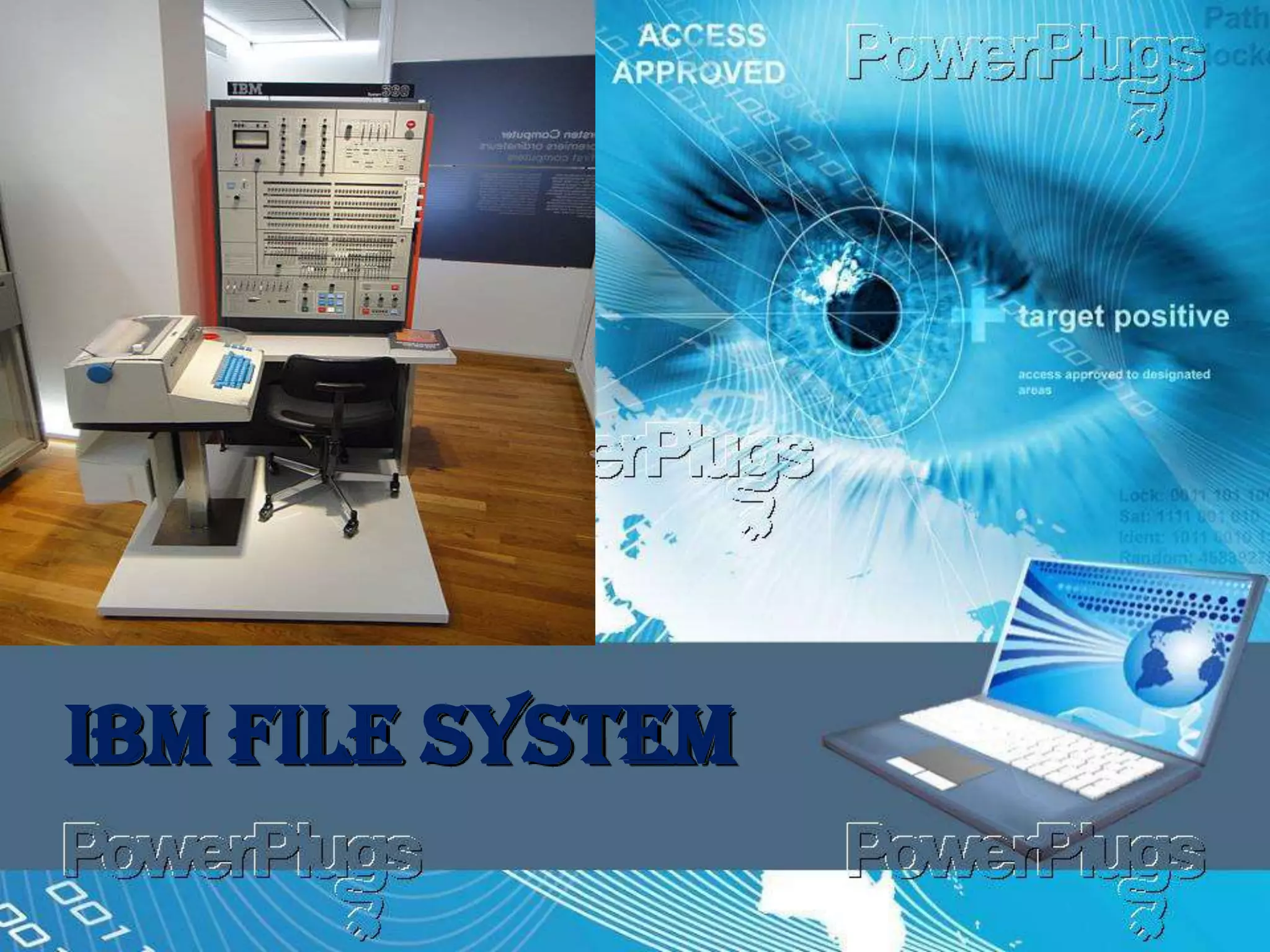
IBM FILE SYSTEM
Memory management
The memory management component is responsible for the
efficient use of system memory by a java application.
Java programs run in a managed execution environment.
When a java program requires storage, the memory
management component allocates the application a discrete
region of unused memory. After the application no longer
refers to the storage, the memory management component
must recognize that the storage is unused and reclaim the
memory for subsequent reuse by the application or return it
to the operating system.
• Memory management on IBM i is based on
  temporary, dynamic memory. Both single-level
  storage (SLS) and teraspace are used. In
  addition, for extended memory the so called
  undefined memory mapped files (including
  memory protection) are used. The memory
  type is implemented in the same way as for
  UNIX.
• In the single-level storage concept main
  memory and auxiliary storage (for
  example, disk storage) are considered as
  a single large address space, whose
  linearly addressable areas can grow to a
  maximum size of 16 MB.
• A teraspace is temporary dynamic storage, that
  provides an address space of 1 terabyte for
  each process (that is, IBM i job). A teraspace
  can consist of a number of separately allocated
  and deallocated storage areas. Between these
  areas, "addressability holes" can exist, that
  is, storage areas that are not allocated. Although
  teraspace is also based on single-level
  storage, it is completely transparent to the
  processes (IBM i jobs). This memory type is
  used for the so called roll area.
• For memory mapped files, the storage
  area with a given size is mapped to a
  undefined file of a given size in the file
  system. All commands that access the
  memory space are redirected to file
  access by the operating system. Memory
  protection is achieved by explicit attach
  and detach instructions to the extended
  memory when activating and deactivating
  a user context.
• IBM i means implementing proven
  solutions on a platform you can trust. By
  choosing the latest Power® platform, IBM i
  applications get world class performance
  plus dynamic infrastructure flexibility, with
  the opportunity to lower monthly
  operations costs.
• IBM i integrates a trusted combination of relational
  database, security, Web services, networking and
  storage management capabilities. It provides a broad
  and highly stable database and middleware
  foundation    for efficiently     deploying   business
  processing applications, with support for over 5,000
  solutions from over 2,500 ISVs. i solutions are offered
  through an extensive, highly skilled worldwide network
  of IBM Business Partners that is backed by IBM’s
  trusted services and support infrastructure.
• IBM develops, fully tests and preloads the core
  middleware components of i together upfront, whereas
  on other platforms, operating system, database and
  middleware integration is done in the data center. The
  preintegration and testing of i is a key factor in
  enabling companies to deploy applications faster and
  maintain them with fewer staff. Virtualization and
  workload management are also built into i to enable
  you to run multiple applications and components
  together on the same system, driving up system
  utilization and delivering a better return on IT
  investments.

Ibm file system

  • 1.
  • 2.
    Memory management The memorymanagement component is responsible for the efficient use of system memory by a java application. Java programs run in a managed execution environment. When a java program requires storage, the memory management component allocates the application a discrete region of unused memory. After the application no longer refers to the storage, the memory management component must recognize that the storage is unused and reclaim the memory for subsequent reuse by the application or return it to the operating system.
  • 3.
    • Memory managementon IBM i is based on temporary, dynamic memory. Both single-level storage (SLS) and teraspace are used. In addition, for extended memory the so called undefined memory mapped files (including memory protection) are used. The memory type is implemented in the same way as for UNIX.
  • 4.
    • In thesingle-level storage concept main memory and auxiliary storage (for example, disk storage) are considered as a single large address space, whose linearly addressable areas can grow to a maximum size of 16 MB.
  • 5.
    • A teraspaceis temporary dynamic storage, that provides an address space of 1 terabyte for each process (that is, IBM i job). A teraspace can consist of a number of separately allocated and deallocated storage areas. Between these areas, "addressability holes" can exist, that is, storage areas that are not allocated. Although teraspace is also based on single-level storage, it is completely transparent to the processes (IBM i jobs). This memory type is used for the so called roll area.
  • 6.
    • For memorymapped files, the storage area with a given size is mapped to a undefined file of a given size in the file system. All commands that access the memory space are redirected to file access by the operating system. Memory protection is achieved by explicit attach and detach instructions to the extended memory when activating and deactivating a user context.
  • 7.
    • IBM imeans implementing proven solutions on a platform you can trust. By choosing the latest Power® platform, IBM i applications get world class performance plus dynamic infrastructure flexibility, with the opportunity to lower monthly operations costs.
  • 8.
    • IBM iintegrates a trusted combination of relational database, security, Web services, networking and storage management capabilities. It provides a broad and highly stable database and middleware foundation for efficiently deploying business processing applications, with support for over 5,000 solutions from over 2,500 ISVs. i solutions are offered through an extensive, highly skilled worldwide network of IBM Business Partners that is backed by IBM’s trusted services and support infrastructure.
  • 9.
    • IBM develops,fully tests and preloads the core middleware components of i together upfront, whereas on other platforms, operating system, database and middleware integration is done in the data center. The preintegration and testing of i is a key factor in enabling companies to deploy applications faster and maintain them with fewer staff. Virtualization and workload management are also built into i to enable you to run multiple applications and components together on the same system, driving up system utilization and delivering a better return on IT investments.