Ayurvedic Medicants
HSN Code: 30039011
INTERNATIONAL
BUSINESS
Amrutanjan Health Care Limited
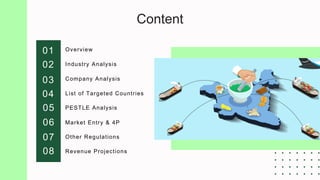
Content
01
02
03
04
05
06
07
Overview
Industry Analysis
Company Analysis
List of Targeted Countries
PESTLE Analysis
Market Entry & 4P
Other Regulations
08 Revenue Projections
01
02
03
04
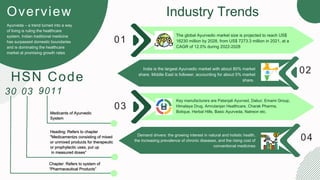
30 03 9011
Medicants of Ayurvedic
System
System
Chapter: Refers to system of
“Pharmaceutical Products”
Heading: Refers to chapter
"Medicamentzs consisting of mixed
or unmixed products for therapeutic
or prophylactic uses, put up
in measured doses”
in measured doses”
Overview
The global Ayurvedic market size is projected to reach US$
16230 million by 2028, from US$ 7273.3 million in 2021, at a
CAGR of 12.0% during 2022-2028
India is the largest Ayurvedic market with about 80% market
share. Middle East is follower, accounting for about 5% market
share.
Ayurveda – a trend turned into a way
of living is ruling the healthcare
system. Indian traditional medicine
has surpassed domestic boundaries
and is dominating the healthcare
market at promising growth rates
Key manufacturers are Patanjali Ayurved, Dabur, Emami Group,
Himalaya Drug, Amrutanjan Healthcare, Charak Pharma,
Botique, Herbal Hills, Basic Ayurveda, Natreon etc.
Demand drivers: the growing interest in natural and holistic health,
the increasing prevalence of chronic diseases, and the rising cost of
conventional medicines
Industry Trends
HSN Code
Economic Overview
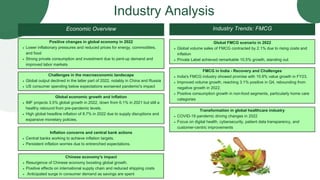
Lower inflationary pressures and reduced prices for energy, commodities,
and food
Strong private consumption and investment due to pent-up demand and
improved labor markets
Positive changes in global economy in 2022
COVID-19 pandemic driving changes in 2022
Focus on digital health, cybersecurity, patient data transparency, and
customer-centric improvements
Transformation in global healthcare industry
Industry Trends: FMCG
Global output declined in the latter part of 2022, notably in China and Russia
US consumer spending below expectations worsened pandemic's impact
Challenges in the macroeconomic landscape
Resurgence of Chinese economy boosting global growth.
Positive effects on international supply chain and reduced shipping costs
Anticipated surge in consumer demand as savings are spent
Chinese economy's impact
Central banks working to achieve inflation targets.
Persistent inflation worries due to entrenched expectations.
Inflation concerns and central bank actions
IMF projects 3.5% global growth in 2022, down from 6.1% in 2021 but still a
healthy rebound from pre-pandemic levels.
High global headline inflation of 8.7% in 2022 due to supply disruptions and
expansive monetary policies.
Global economic growth and inflation
India's FMCG industry showed promise with 10.9% value growth in FY23.
Improved volume growth, reaching 3.1% positive in Q4, rebounding from
negative growth in 2022.
Positive consumption growth in non-food segments, particularly home care
categories
FMCG in India - Recovery and Challenges
Global volume sales of FMCG contracted by 2.1% due to rising costs and
inflation
Private Label achieved remarkable 10.5% growth, standing out
Global FMCG scenario in 2022
Industry Analysis
Company: Amrutanjan Health Care Ltd.
OTC Segment Performance
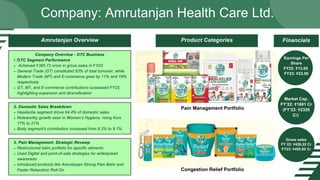
Achieved ₹385.72 crore in gross sales in FY23
General Trade (GT) constituted 83% of total turnover, while
Modern Trade (MT) and E-commerce grew by 11% and 19%
respectively
GT, MT, and E-commerce contributions surpassed FY22,
highlighting expansion and diversification
Company Overview - OTC Business
1.
Amrutanjan Overview Product Categories
Earnings Per
Share
FY22: ₹13.65
FY23: ₹23.00
Market Cap.
FY’22: ₹1681 Cr
(FY’23: ₹2320
Cr)
Gross sales
FY 22: ₹426.22 Cr
FY23: ₹455.85 Cr
Congestion Relief Portfolio
Pain Management Portfolio
Financials
Restructured balm portfolio for specific ailments
Used Digital and point-of-sale strategies for widespread
awareness
Introduced products like Amrutanjan Strong Pain Balm and
Faster Relaxation Roll-On
3. Pain Management: Strategic Revamp
Headache segment drove 64.4% of domestic sales
Noteworthy growth seen in Women’s Hygiene, rising from
17% to 21%
Body segment's contribution increased from 8.2% to 9.1%
2. Domestic Sales Breakdown
Export Overview
Company: Amrutanjan Health Care Ltd.
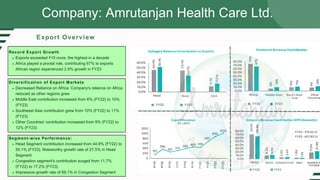
Exports exceeded ₹10 crore, the highest in a decade
Africa played a pivotal role, contributing 67% to exports
African region experienced 2.9% growth in FY23
Record Export Growth
Decreased Reliance on Africa: Company's reliance on Africa
reduced as other regions grew
Middle East contribution increased from 6% (FY22) to 10%
(FY23)
Southeast Asia contribution grew from 10% (FY22) to 11%
(FY23)
Other Countries' contribution increased from 9% (FY22) to
12% (FY23)
Diversification of Export Markets
Head Segment contribution increased from 44.9% (FY22) to
50.1% (FY23). Noteworthy growth rate of 27.5% in Head
Segment
Congestion segment's contribution surged from 11.7%
(FY22) to 17.2% (FY23)
Impressive growth rate of 69.1% in Congestion Segment
Segment-wise Performance:
United
States
List of Targeted Countries
United Arab
Emirates
Saudi
Arabia
Canada
United
Kingdom
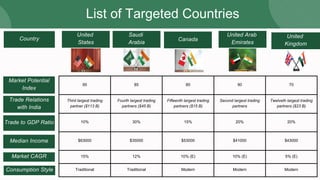
Country
Market Potential
Index
Trade Relations
with India
Trade to GDP Ratio
Median Income
Consumption Style
95 85 80 90 70
Third largest trading
partner ($113 B)
Fourth largest trading
partners ($45 B)
Fifteenth largest trading
partners ($15 B)
Second largest trading
partners
Twelveth largest trading
partners ($23 B)
10% 30% 15% 20% 20%
$63000 $35000 $53000 $41000 $43000
15% 12% 10% (E) 10% (E) 5% (E)
Traditional Traditional Modern Modern Modern
Market CAGR
Countries Selection and Reasoning
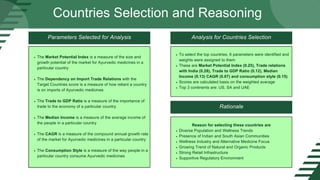
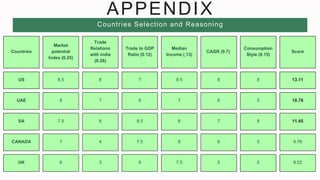
To select the top countries, 6 parameters were identified and
weights were assigned to them
These are Market Potential Index (0.25), Trade relations
with India (0.28), Trade to GDP Ratio (0.12), Median
Income (0.13) CAGR (0.07) and consumption style (0.15)
Scores are calculated basis on the weighted average
Top 3 continents are: US, SA and UAE
The Market Potential Index is a measure of the size and
growth potential of the market for Ayurvedic medicines in a
particular country
The Dependency on Import Trade Relations with the
Target Countries score is a measure of how reliant a country
is on imports of Ayurvedic medicines
The Trade to GDP Ratio is a measure of the importance of
trade to the economy of a particular country
The Median Income is a measure of the average income of
the people in a particular country
The CAGR is a measure of the compound annual growth rate
of the market for Ayurvedic medicines in a particular country
The Consumption Style is a measure of the way people in a
particular country consume Ayurvedic medicines
Parameters Selected for Analysis Analysis for Countries Selection
Rationale
Diverse Population and Wellness Trends
Presence of Indian and South Asian Communities
Wellness Industry and Alternative Medicine Focus
Growing Trend of Natural and Organic Products
Strong Retail Infrastructure
Supportive Regulatory Environment
Reason for selecting these countries are
Political Economical Sociocultural Technological
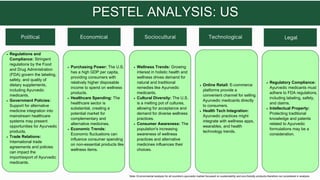
Regulations and
Compliance: Stringent
regulations by the Food
and Drug Administration
(FDA) govern the labeling,
safety, and quality of
dietary supplements,
including Ayurvedic
medicants.
Government Policies:
Support for alternative
medicine integration into
mainstream healthcare
systems may present
opportunities for Ayurvedic
products.
Trade Relations:
International trade
agreements and policies
can impact the
import/export of Ayurvedic
medicants.
Purchasing Power: The U.S.
has a high GDP per capita,
providing consumers with
relatively higher disposable
income to spend on wellness
products.
Healthcare Spending: The
healthcare sector is
substantial, creating a
potential market for
complementary and
alternative medicines.
Economic Trends:
Economic fluctuations can
influence consumer spending
on non-essential products like
wellness items.
Wellness Trends: Growing
interest in holistic health and
wellness drives demand for
natural and traditional
remedies like Ayurvedic
medicants.
Cultural Diversity: The U.S.
is a melting pot of cultures,
allowing for acceptance and
demand for diverse wellness
practices.
Consumer Awareness: The
population's increasing
awareness of wellness
practices and alternative
medicines influences their
choices.
Online Retail: E-commerce
platforms provide a
convenient channel for selling
Ayurvedic medicants directly
to consumers.
Health Tech Integration:
Ayurvedic practices might
integrate with wellness apps,
wearables, and health
technology trends.
Regulatory Compliance:
Ayurvedic medicants must
adhere to FDA regulations,
including labeling, safety,
and claims.
Intellectual Property:
Protecting traditional
knowledge and patents
related to Ayurvedic
formulations may be a
consideration.
Legal
Note: Environmental analysis for all countrie’s ayurvedic market focussed on sustainability and eco-freindly products therefore not considered in analysis.
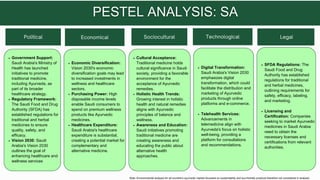
Government Support:
Saudi Arabia's Ministry of
Health has launched
initiatives to promote
traditional medicine,
including Ayurveda, as
part of its broader
healthcare strategy.
Regulatory Framework:
The Saudi Food and Drug
Authority (SFDA) has
established regulations for
traditional and herbal
medicines to ensure
quality, safety, and
efficacy.
Vision 2030: Saudi
Arabia's Vision 2030
outlines the goal of
enhancing healthcare and
wellness services
Economic Diversification:
Vision 2030's economic
diversification goals may lead
to increased investments in
wellness and healthcare
sectors.
Purchasing Power: High
disposable income levels
enable Saudi consumers to
spend on premium wellness
products like Ayurvedic
medicines.
Healthcare Expenditure:
Saudi Arabia's healthcare
expenditure is substantial,
creating a potential market for
complementary and
alternative medicine.
Cultural Acceptance:
Traditional medicine holds
cultural significance in Saudi
society, providing a favorable
environment for the
acceptance of Ayurvedic
remedies.
Holistic Health Trends:
Growing interest in holistic
health and natural remedies
aligns with Ayurvedic
principles of balance and
wellness.
Awareness and Education:
Saudi initiatives promoting
traditional medicine are
creating awareness and
educating the public about
alternative health
approaches.
Digital Transformation:
Saudi Arabia's Vision 2030
emphasizes digital
transformation, which could
facilitate the distribution and
marketing of Ayurvedic
products through online
platforms and e-commerce.
Telehealth Services:
Advancements in
telemedicine align with
Ayurveda's focus on holistic
well-being, providing a
platform for consultations
and recommendations.
SFDA Regulations: The
Saudi Food and Drug
Authority has established
regulations for traditional
and herbal medicines,
outlining requirements for
safety, efficacy, labeling,
and marketing.
Licensing and
Certification: Companies
seeking to market Ayurvedic
medicines in Saudi Arabia
need to obtain the
necessary licenses and
certifications from relevant
authorities.
Note: Environmental analysis for all countrie’s ayurvedic market focussed on sustainability and eco-freindly products therefore not considered in analysis.
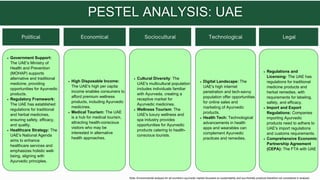
Political Economical Sociocultural Technological Legal
Government Support:
The UAE's Ministry of
Health and Prevention
(MOHAP) supports
alternative and traditional
medicine, providing
opportunities for Ayurvedic
products.
Regulatory Framework:
The UAE has established
regulations for traditional
and herbal medicines,
ensuring safety, efficacy,
and quality.
Healthcare Strategy: The
UAE's National Agenda
aims to enhance
healthcare services and
emphasizes holistic well-
being, aligning with
Ayurvedic principles.
High Disposable Income:
The UAE's high per capita
income enables consumers to
afford premium wellness
products, including Ayurvedic
medicines.
Medical Tourism: The UAE
is a hub for medical tourism,
attracting health-conscious
visitors who may be
interested in alternative
health approaches.
Cultural Diversity: The
UAE's multicultural population
includes individuals familiar
with Ayurveda, creating a
receptive market for
Ayurvedic medicines.
Wellness Tourism: The
UAE's luxury wellness and
spa industry provides
opportunities for Ayurvedic
products catering to health-
conscious tourists.
Digital Landscape: The
UAE's high internet
penetration and tech-savvy
population offer opportunities
for online sales and
marketing of Ayurvedic
products.
Health Tech: Technological
advancements in health
apps and wearables can
complement Ayurvedic
practices and remedies.
Regulations and
Licensing: The UAE has
regulations for traditional
medicine products and
herbal remedies, with
requirements for labeling,
safety, and efficacy.
Import and Export
Regulations: Companies
importing Ayurvedic
products need to adhere to
UAE's import regulations
and customs requirements.
Comprehensive Economic
Partnership Agreement
(CEPA): The FTA with UAE
Note: Environmental analysis for all countrie’s ayurvedic market focussed on sustainability and eco-freindly products therefore not considered in analysis.
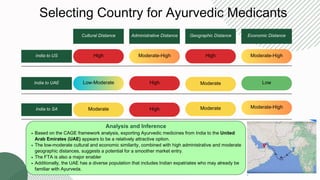
Political Economical Sociocultural Technological Legal
Administrative Distance Geographic Distance
Cultural Distance
India to US
India to UAE
India to SA
Economic Distance
High High Moderate-High
Moderate-High
Low-Moderate High Moderate Low
Moderate High Moderate Moderate-High
Based on the CAGE framework analysis, exporting Ayurvedic medicines from India to the United
Arab Emirates (UAE) appears to be a relatively attractive option.
The low-moderate cultural and economic similarity, combined with high administrative and moderate
geographic distances, suggests a potential for a smoother market entry.
The FTA is also a major enabler
Additionally, the UAE has a diverse population that includes Indian expatriates who may already be
familiar with Ayurveda.
Analysis and Inference
Selecting Country for Ayurvedic Medicants
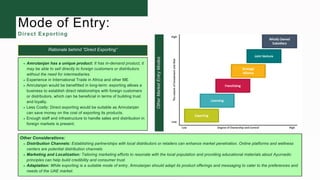
Mode of Entry:
Direct Exporting
Amrutanjan has a unique product: It has in-demand product, it
may be able to sell directly to foreign customers or distributors
without the need for intermediaries.
Experience in International Trade in Africa and other ME
Amrutanjan would be benefitted in long-term: exporting allows a
business to establish direct relationships with foreign customers
or distributors, which can be beneficial in terms of building trust
and loyalty.
Less Costly: Direct exporting would be suitable as Amrutanjan
can save money on the cost of exporting its products.
Enough staff and infrastructure to handle sales and distribution in
foreign markets is present.
Rationale behind “Direct Exporting”
Distribution Channels: Establishing partnerships with local distributors or retailers can enhance market penetration. Online platforms and wellness
centers are potential distribution channels.
Marketing and Localization: Tailoring marketing efforts to resonate with the local population and providing educational materials about Ayurvedic
principles can help build credibility and consumer trust.
Adaptation: While exporting is a suitable mode of entry, Amrutanjan should adapt its product offerings and messaging to cater to the preferences and
needs of the UAE market.
Other Considerations:
Other
Market
Entry
Modes
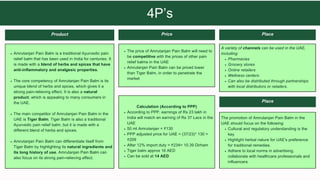
Amrutanjan Pain Balm is a traditional Ayurvedic pain
relief balm that has been used in India for centuries. It
is made with a blend of herbs and spices that have
anti-inflammatory and analgesic properties.
The core competency of Amrutanjan Pain Balm is its
unique blend of herbs and spices, which gives it a
strong pain-relieving effect. It is also a natural
product, which is appealing to many consumers in
the UAE.
The main competitor of Amrutanjan Pain Balm in the
UAE is Tiger Balm. Tiger Balm is also a traditional
Ayurvedic pain relief balm, but it is made with a
different blend of herbs and spices.
Amrutanjan Pain Balm can differentiate itself from
Tiger Balm by highlighting its natural ingredients and
its long history of use. Amrutanjan Pain Balm can
also focus on its strong pain-relieving effect.
The price of Amrutanjan Pain Balm will need to
be competitive with the prices of other pain
relief balms in the UAE
Amrutanjan Pain Balm can be priced lower
than Tiger Balm, in order to penetrate the
market
Cultural and regulatory understanding is the
key
Highlight herbal nature for UAE's preference
for traditional remedies.
Adhere to local norms in advertising,
collaborate with healthcare professionals and
influencers
The promotion of Amrutanjan Pain Balm in the
UAE should focus on the following:
Pharmacies
Grocery stores
Online retailers
Wellness centers
Can also be distributed through partnerships
with local distributors or retailers.
A variety of channels can be used in the UAE,
including:
Product Price
According to PPP, earnings of Rs 23 lakh in
India will match an earning of Rs 37 Lacs in the
UAE
50 ml Amrutanjan = ₹130
PPP adjusted price for UAE = (37/23)* 130 =
₹209
After 12% import duty = ₹234= 10.39 Dirham
Tiger balm approx 16 AED
Can be sold at 14 AED
Calculation (According to PPP)
Place
Place
4P’s
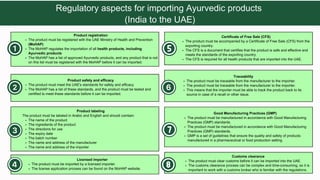
The product must meet the UAE's standards for safety and efficacy
The MoHAP has a list of these standards, and the product must be tested and
certified to meet these standards before it can be imported.
Product safety and efficacy
The product must be registered with the UAE Ministry of Health and Prevention
(MoHAP)
The MoHAP regulates the importation of all health products, including
Ayurvedic products
The MoHAP has a list of approved Ayurvedic products, and any product that is not
on this list must be registered with the MoHAP before it can be imported.
Product registration
The product must be accompanied by a Certificate of Free Sale (CFS) from the
exporting country.
The CFS is a document that certifies that the product is safe and effective and
meets the standards of the exporting country.
The CFS is required for all health products that are imported into the UAE.
Certificate of Free Sale (CFS)
The product must be manufactured in accordance with Good Manufacturing
Practices (GMP) standards.
The product must be manufactured in accordance with Good Manufacturing
Practices (GMP) standards.
GMP is a set of guidelines that ensure the quality and safety of products
manufactured in a pharmaceutical or food production setting.
Good Manufacturing Practices (GMP)
The product must be traceable from the manufacturer to the importer.
This means that the importer must be able to track the product back to its
source in case of a recall or other issue.
Traceability
The product must clear customs before it can be imported into the UAE.
The customs clearance process can be complex and time-consuming, so it is
important to work with a customs broker who is familiar with the regulations.
Customs clearance
The product must be imported by a licensed importer.
The license application process can be found on the MoHAP website.
Licensed importer
The name of the product
The ingredients of the product
The directions for use
The expiry date
The batch number
The name and address of the manufacturer
The name and address of the importer
Product labeling
The product must be labeled in Arabic and English and should comtain:
Regulatory aspects for importing Ayurvedic products
(India to the UAE)
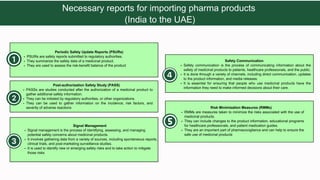
PASSs are studies conducted after the authorization of a medicinal product to
gather additional safety information.
They can be initiated by regulatory authorities, or other organizations.
They can be used to gather information on the incidence, risk factors, and
severity of adverse reactions
Post-authorization Safety Study (PASS)
PSURs are safety reports submitted to regulatory authorities.
They summarize the safety data of a medicinal product.
They are used to assess the risk-benefit balance of the product
Periodic Safety Update Reports (PSURs)
Safety communication is the process of communicating information about the
safety of medicinal products to patients, healthcare professionals, and the public.
It is done through a variety of channels, including direct communication, updates
to the product information, and media releases.
It is essential for ensuring that people who use medicinal products have the
information they need to make informed decisions about their care.
Safety Communication
RMMs are measures taken to minimize the risks associated with the use of
medicinal products.
They can include changes to the product information, educational programs
for healthcare professionals, and patient medication guides.
They are an important part of pharmacovigilance and can help to ensure the
safe use of medicinal products
Risk Minimization Measures (RMMs)
Signal management is the process of identifying, assessing, and managing
potential safety concerns about medicinal products.
It involves gathering data from a variety of sources, including spontaneous reports,
clinical trials, and post-marketing surveillance studies.
It is used to identify new or emerging safety risks and to take action to mitigate
those risks
Signal Management
Necessary reports for importing pharma products
(India to the UAE)
Projected Growth
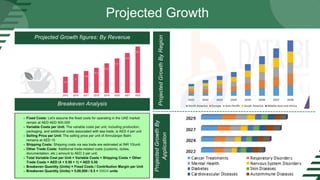
Projected Growth figures: By Revenue
Projected
Growth
By
Region
Breakeven Analysis
Projected
Growth
By
Application
Fixed Costs: Let's assume the fixed costs for operating in the UAE market
remain at AED AED 500,000
Variable Costs per Unit: The variable costs per unit, including production,
packaging, and additional costs associated with sea trade, is AED 4 per unit
Selling Price per Unit: The selling price per unit of Amrutanjan Balm
remains at AED 15
Shipping Costs: Shipping costs via sea trade are estimated at INR 10/unit.
Other Trade Costs: Additional trade-related costs (customs, duties,
documentation, etc.) amount to AED 3 per unit.
Total Variable Cost per Unit = Variable Costs + Shipping Costs + Other
Trade Costs = AED (4 + 0.50 + 1) = AED 5.50
Breakeven Quantity (Units) = Fixed Costs / Contribution Margin per Unit
Breakeven Quantity (Units) = 5,00,000 / 8.5 = 58824 units
THANK
YOU
APPENDIX
Countries Selection and Reasoning
Countries
Market
potential
Index (0.25)
Trade
Relations
with india
(0.28)
Trade to GDP
Ratio (0.12)
Median
Income (.13)
CAGR (0.7)
Consumption
Style (0.15)
Score
US 8.5 8 7 8.5 8 8 13.11
UAE 8 7 8 7 6 5 10.78
SA 7.5 6 8.5 6 7 8 11.45
CANADA 7 4 7.5 8 6 5 9.76
UK 6 3 8 7.5 5 5 8.52

IB pptx.pdf

  • 1.
    Ayurvedic Medicants HSN Code:30039011 INTERNATIONAL BUSINESS Amrutanjan Health Care Limited
  • 2.
    Content 01 02 03 04 05 06 07 Overview Industry Analysis Company Analysis Listof Targeted Countries PESTLE Analysis Market Entry & 4P Other Regulations 08 Revenue Projections
  • 3.
    01 02 03 04 30 03 9011 Medicantsof Ayurvedic Medicants of Ayurvedic System System Chapter: Refers to system of Chapter: Refers to system of “Pharmaceutical Products” “Pharmaceutical Products” Heading: Refers to chapter Heading: Refers to chapter "Medicamentzs consisting of mixed "Medicamentzs consisting of mixed or unmixed products for therapeutic or unmixed products for therapeutic or prophylactic uses, put up or prophylactic uses, put up in measured doses” in measured doses” Overview The global Ayurvedic market size is projected to reach US$ 16230 million by 2028, from US$ 7273.3 million in 2021, at a CAGR of 12.0% during 2022-2028 India is the largest Ayurvedic market with about 80% market share. Middle East is follower, accounting for about 5% market share. Ayurveda – a trend turned into a way of living is ruling the healthcare system. Indian traditional medicine has surpassed domestic boundaries and is dominating the healthcare market at promising growth rates Key manufacturers are Patanjali Ayurved, Dabur, Emami Group, Himalaya Drug, Amrutanjan Healthcare, Charak Pharma, Botique, Herbal Hills, Basic Ayurveda, Natreon etc. Demand drivers: the growing interest in natural and holistic health, the increasing prevalence of chronic diseases, and the rising cost of conventional medicines Industry Trends HSN Code
  • 4.
    Economic Overview Lower inflationarypressures and reduced prices for energy, commodities, and food Strong private consumption and investment due to pent-up demand and improved labor markets Positive changes in global economy in 2022 COVID-19 pandemic driving changes in 2022 Focus on digital health, cybersecurity, patient data transparency, and customer-centric improvements Transformation in global healthcare industry Industry Trends: FMCG Global output declined in the latter part of 2022, notably in China and Russia US consumer spending below expectations worsened pandemic's impact Challenges in the macroeconomic landscape Resurgence of Chinese economy boosting global growth. Positive effects on international supply chain and reduced shipping costs Anticipated surge in consumer demand as savings are spent Chinese economy's impact Central banks working to achieve inflation targets. Persistent inflation worries due to entrenched expectations. Inflation concerns and central bank actions IMF projects 3.5% global growth in 2022, down from 6.1% in 2021 but still a healthy rebound from pre-pandemic levels. High global headline inflation of 8.7% in 2022 due to supply disruptions and expansive monetary policies. Global economic growth and inflation India's FMCG industry showed promise with 10.9% value growth in FY23. Improved volume growth, reaching 3.1% positive in Q4, rebounding from negative growth in 2022. Positive consumption growth in non-food segments, particularly home care categories FMCG in India - Recovery and Challenges Global volume sales of FMCG contracted by 2.1% due to rising costs and inflation Private Label achieved remarkable 10.5% growth, standing out Global FMCG scenario in 2022 Industry Analysis
  • 5.
    Company: Amrutanjan HealthCare Ltd. OTC Segment Performance Achieved ₹385.72 crore in gross sales in FY23 General Trade (GT) constituted 83% of total turnover, while Modern Trade (MT) and E-commerce grew by 11% and 19% respectively GT, MT, and E-commerce contributions surpassed FY22, highlighting expansion and diversification Company Overview - OTC Business 1. Amrutanjan Overview Product Categories Earnings Per Share FY22: ₹13.65 FY23: ₹23.00 Market Cap. FY’22: ₹1681 Cr (FY’23: ₹2320 Cr) Gross sales FY 22: ₹426.22 Cr FY23: ₹455.85 Cr Congestion Relief Portfolio Pain Management Portfolio Financials Restructured balm portfolio for specific ailments Used Digital and point-of-sale strategies for widespread awareness Introduced products like Amrutanjan Strong Pain Balm and Faster Relaxation Roll-On 3. Pain Management: Strategic Revamp Headache segment drove 64.4% of domestic sales Noteworthy growth seen in Women’s Hygiene, rising from 17% to 21% Body segment's contribution increased from 8.2% to 9.1% 2. Domestic Sales Breakdown
  • 6.
    Export Overview Company: AmrutanjanHealth Care Ltd. Exports exceeded ₹10 crore, the highest in a decade Africa played a pivotal role, contributing 67% to exports African region experienced 2.9% growth in FY23 Record Export Growth Decreased Reliance on Africa: Company's reliance on Africa reduced as other regions grew Middle East contribution increased from 6% (FY22) to 10% (FY23) Southeast Asia contribution grew from 10% (FY22) to 11% (FY23) Other Countries' contribution increased from 9% (FY22) to 12% (FY23) Diversification of Export Markets Head Segment contribution increased from 44.9% (FY22) to 50.1% (FY23). Noteworthy growth rate of 27.5% in Head Segment Congestion segment's contribution surged from 11.7% (FY22) to 17.2% (FY23) Impressive growth rate of 69.1% in Congestion Segment Segment-wise Performance:
  • 7.
    United States List of TargetedCountries United Arab Emirates Saudi Arabia Canada United Kingdom Country Market Potential Index Trade Relations with India Trade to GDP Ratio Median Income Consumption Style 95 85 80 90 70 Third largest trading partner ($113 B) Fourth largest trading partners ($45 B) Fifteenth largest trading partners ($15 B) Second largest trading partners Twelveth largest trading partners ($23 B) 10% 30% 15% 20% 20% $63000 $35000 $53000 $41000 $43000 15% 12% 10% (E) 10% (E) 5% (E) Traditional Traditional Modern Modern Modern Market CAGR
  • 8.
    Countries Selection andReasoning To select the top countries, 6 parameters were identified and weights were assigned to them These are Market Potential Index (0.25), Trade relations with India (0.28), Trade to GDP Ratio (0.12), Median Income (0.13) CAGR (0.07) and consumption style (0.15) Scores are calculated basis on the weighted average Top 3 continents are: US, SA and UAE The Market Potential Index is a measure of the size and growth potential of the market for Ayurvedic medicines in a particular country The Dependency on Import Trade Relations with the Target Countries score is a measure of how reliant a country is on imports of Ayurvedic medicines The Trade to GDP Ratio is a measure of the importance of trade to the economy of a particular country The Median Income is a measure of the average income of the people in a particular country The CAGR is a measure of the compound annual growth rate of the market for Ayurvedic medicines in a particular country The Consumption Style is a measure of the way people in a particular country consume Ayurvedic medicines Parameters Selected for Analysis Analysis for Countries Selection Rationale Diverse Population and Wellness Trends Presence of Indian and South Asian Communities Wellness Industry and Alternative Medicine Focus Growing Trend of Natural and Organic Products Strong Retail Infrastructure Supportive Regulatory Environment Reason for selecting these countries are
  • 9.
    Political Economical SocioculturalTechnological Regulations and Compliance: Stringent regulations by the Food and Drug Administration (FDA) govern the labeling, safety, and quality of dietary supplements, including Ayurvedic medicants. Government Policies: Support for alternative medicine integration into mainstream healthcare systems may present opportunities for Ayurvedic products. Trade Relations: International trade agreements and policies can impact the import/export of Ayurvedic medicants. Purchasing Power: The U.S. has a high GDP per capita, providing consumers with relatively higher disposable income to spend on wellness products. Healthcare Spending: The healthcare sector is substantial, creating a potential market for complementary and alternative medicines. Economic Trends: Economic fluctuations can influence consumer spending on non-essential products like wellness items. Wellness Trends: Growing interest in holistic health and wellness drives demand for natural and traditional remedies like Ayurvedic medicants. Cultural Diversity: The U.S. is a melting pot of cultures, allowing for acceptance and demand for diverse wellness practices. Consumer Awareness: The population's increasing awareness of wellness practices and alternative medicines influences their choices. Online Retail: E-commerce platforms provide a convenient channel for selling Ayurvedic medicants directly to consumers. Health Tech Integration: Ayurvedic practices might integrate with wellness apps, wearables, and health technology trends. Regulatory Compliance: Ayurvedic medicants must adhere to FDA regulations, including labeling, safety, and claims. Intellectual Property: Protecting traditional knowledge and patents related to Ayurvedic formulations may be a consideration. Legal Note: Environmental analysis for all countrie’s ayurvedic market focussed on sustainability and eco-freindly products therefore not considered in analysis.
  • 10.
    Government Support: Saudi Arabia'sMinistry of Health has launched initiatives to promote traditional medicine, including Ayurveda, as part of its broader healthcare strategy. Regulatory Framework: The Saudi Food and Drug Authority (SFDA) has established regulations for traditional and herbal medicines to ensure quality, safety, and efficacy. Vision 2030: Saudi Arabia's Vision 2030 outlines the goal of enhancing healthcare and wellness services Economic Diversification: Vision 2030's economic diversification goals may lead to increased investments in wellness and healthcare sectors. Purchasing Power: High disposable income levels enable Saudi consumers to spend on premium wellness products like Ayurvedic medicines. Healthcare Expenditure: Saudi Arabia's healthcare expenditure is substantial, creating a potential market for complementary and alternative medicine. Cultural Acceptance: Traditional medicine holds cultural significance in Saudi society, providing a favorable environment for the acceptance of Ayurvedic remedies. Holistic Health Trends: Growing interest in holistic health and natural remedies aligns with Ayurvedic principles of balance and wellness. Awareness and Education: Saudi initiatives promoting traditional medicine are creating awareness and educating the public about alternative health approaches. Digital Transformation: Saudi Arabia's Vision 2030 emphasizes digital transformation, which could facilitate the distribution and marketing of Ayurvedic products through online platforms and e-commerce. Telehealth Services: Advancements in telemedicine align with Ayurveda's focus on holistic well-being, providing a platform for consultations and recommendations. SFDA Regulations: The Saudi Food and Drug Authority has established regulations for traditional and herbal medicines, outlining requirements for safety, efficacy, labeling, and marketing. Licensing and Certification: Companies seeking to market Ayurvedic medicines in Saudi Arabia need to obtain the necessary licenses and certifications from relevant authorities. Note: Environmental analysis for all countrie’s ayurvedic market focussed on sustainability and eco-freindly products therefore not considered in analysis. Political Economical Sociocultural Technological Legal
  • 11.
    Government Support: The UAE'sMinistry of Health and Prevention (MOHAP) supports alternative and traditional medicine, providing opportunities for Ayurvedic products. Regulatory Framework: The UAE has established regulations for traditional and herbal medicines, ensuring safety, efficacy, and quality. Healthcare Strategy: The UAE's National Agenda aims to enhance healthcare services and emphasizes holistic well- being, aligning with Ayurvedic principles. High Disposable Income: The UAE's high per capita income enables consumers to afford premium wellness products, including Ayurvedic medicines. Medical Tourism: The UAE is a hub for medical tourism, attracting health-conscious visitors who may be interested in alternative health approaches. Cultural Diversity: The UAE's multicultural population includes individuals familiar with Ayurveda, creating a receptive market for Ayurvedic medicines. Wellness Tourism: The UAE's luxury wellness and spa industry provides opportunities for Ayurvedic products catering to health- conscious tourists. Digital Landscape: The UAE's high internet penetration and tech-savvy population offer opportunities for online sales and marketing of Ayurvedic products. Health Tech: Technological advancements in health apps and wearables can complement Ayurvedic practices and remedies. Regulations and Licensing: The UAE has regulations for traditional medicine products and herbal remedies, with requirements for labeling, safety, and efficacy. Import and Export Regulations: Companies importing Ayurvedic products need to adhere to UAE's import regulations and customs requirements. Comprehensive Economic Partnership Agreement (CEPA): The FTA with UAE Note: Environmental analysis for all countrie’s ayurvedic market focussed on sustainability and eco-freindly products therefore not considered in analysis. Political Economical Sociocultural Technological Legal
  • 12.
    Administrative Distance GeographicDistance Cultural Distance India to US India to UAE India to SA Economic Distance High High Moderate-High Moderate-High Low-Moderate High Moderate Low Moderate High Moderate Moderate-High Based on the CAGE framework analysis, exporting Ayurvedic medicines from India to the United Arab Emirates (UAE) appears to be a relatively attractive option. The low-moderate cultural and economic similarity, combined with high administrative and moderate geographic distances, suggests a potential for a smoother market entry. The FTA is also a major enabler Additionally, the UAE has a diverse population that includes Indian expatriates who may already be familiar with Ayurveda. Analysis and Inference Selecting Country for Ayurvedic Medicants
  • 13.
    Mode of Entry: DirectExporting Amrutanjan has a unique product: It has in-demand product, it may be able to sell directly to foreign customers or distributors without the need for intermediaries. Experience in International Trade in Africa and other ME Amrutanjan would be benefitted in long-term: exporting allows a business to establish direct relationships with foreign customers or distributors, which can be beneficial in terms of building trust and loyalty. Less Costly: Direct exporting would be suitable as Amrutanjan can save money on the cost of exporting its products. Enough staff and infrastructure to handle sales and distribution in foreign markets is present. Rationale behind “Direct Exporting” Distribution Channels: Establishing partnerships with local distributors or retailers can enhance market penetration. Online platforms and wellness centers are potential distribution channels. Marketing and Localization: Tailoring marketing efforts to resonate with the local population and providing educational materials about Ayurvedic principles can help build credibility and consumer trust. Adaptation: While exporting is a suitable mode of entry, Amrutanjan should adapt its product offerings and messaging to cater to the preferences and needs of the UAE market. Other Considerations: Other Market Entry Modes
  • 14.
    Amrutanjan Pain Balmis a traditional Ayurvedic pain relief balm that has been used in India for centuries. It is made with a blend of herbs and spices that have anti-inflammatory and analgesic properties. The core competency of Amrutanjan Pain Balm is its unique blend of herbs and spices, which gives it a strong pain-relieving effect. It is also a natural product, which is appealing to many consumers in the UAE. The main competitor of Amrutanjan Pain Balm in the UAE is Tiger Balm. Tiger Balm is also a traditional Ayurvedic pain relief balm, but it is made with a different blend of herbs and spices. Amrutanjan Pain Balm can differentiate itself from Tiger Balm by highlighting its natural ingredients and its long history of use. Amrutanjan Pain Balm can also focus on its strong pain-relieving effect. The price of Amrutanjan Pain Balm will need to be competitive with the prices of other pain relief balms in the UAE Amrutanjan Pain Balm can be priced lower than Tiger Balm, in order to penetrate the market Cultural and regulatory understanding is the key Highlight herbal nature for UAE's preference for traditional remedies. Adhere to local norms in advertising, collaborate with healthcare professionals and influencers The promotion of Amrutanjan Pain Balm in the UAE should focus on the following: Pharmacies Grocery stores Online retailers Wellness centers Can also be distributed through partnerships with local distributors or retailers. A variety of channels can be used in the UAE, including: Product Price According to PPP, earnings of Rs 23 lakh in India will match an earning of Rs 37 Lacs in the UAE 50 ml Amrutanjan = ₹130 PPP adjusted price for UAE = (37/23)* 130 = ₹209 After 12% import duty = ₹234= 10.39 Dirham Tiger balm approx 16 AED Can be sold at 14 AED Calculation (According to PPP) Place Place 4P’s
  • 15.
    The product mustmeet the UAE's standards for safety and efficacy The MoHAP has a list of these standards, and the product must be tested and certified to meet these standards before it can be imported. Product safety and efficacy The product must be registered with the UAE Ministry of Health and Prevention (MoHAP) The MoHAP regulates the importation of all health products, including Ayurvedic products The MoHAP has a list of approved Ayurvedic products, and any product that is not on this list must be registered with the MoHAP before it can be imported. Product registration The product must be accompanied by a Certificate of Free Sale (CFS) from the exporting country. The CFS is a document that certifies that the product is safe and effective and meets the standards of the exporting country. The CFS is required for all health products that are imported into the UAE. Certificate of Free Sale (CFS) The product must be manufactured in accordance with Good Manufacturing Practices (GMP) standards. The product must be manufactured in accordance with Good Manufacturing Practices (GMP) standards. GMP is a set of guidelines that ensure the quality and safety of products manufactured in a pharmaceutical or food production setting. Good Manufacturing Practices (GMP) The product must be traceable from the manufacturer to the importer. The product must be traceable from the manufacturer to the importer. This means that the importer must be able to track the product back to its source in case of a recall or other issue. Traceability The product must clear customs before it can be imported into the UAE. The customs clearance process can be complex and time-consuming, so it is important to work with a customs broker who is familiar with the regulations. Customs clearance The product must be imported by a licensed importer. The license application process can be found on the MoHAP website. Licensed importer The name of the product The ingredients of the product The directions for use The expiry date The batch number The name and address of the manufacturer The name and address of the importer Product labeling The product must be labeled in Arabic and English and should comtain: Regulatory aspects for importing Ayurvedic products (India to the UAE)
  • 16.
    PASSs are studiesconducted after the authorization of a medicinal product to gather additional safety information. They can be initiated by regulatory authorities, or other organizations. They can be used to gather information on the incidence, risk factors, and severity of adverse reactions Post-authorization Safety Study (PASS) PSURs are safety reports submitted to regulatory authorities. They summarize the safety data of a medicinal product. They are used to assess the risk-benefit balance of the product Periodic Safety Update Reports (PSURs) Safety communication is the process of communicating information about the safety of medicinal products to patients, healthcare professionals, and the public. It is done through a variety of channels, including direct communication, updates to the product information, and media releases. It is essential for ensuring that people who use medicinal products have the information they need to make informed decisions about their care. Safety Communication RMMs are measures taken to minimize the risks associated with the use of medicinal products. They can include changes to the product information, educational programs for healthcare professionals, and patient medication guides. They are an important part of pharmacovigilance and can help to ensure the safe use of medicinal products Risk Minimization Measures (RMMs) Signal management is the process of identifying, assessing, and managing potential safety concerns about medicinal products. It involves gathering data from a variety of sources, including spontaneous reports, clinical trials, and post-marketing surveillance studies. It is used to identify new or emerging safety risks and to take action to mitigate those risks Signal Management Necessary reports for importing pharma products (India to the UAE)
  • 17.
    Projected Growth Projected Growthfigures: By Revenue Projected Growth By Region Breakeven Analysis Projected Growth By Application Fixed Costs: Let's assume the fixed costs for operating in the UAE market remain at AED AED 500,000 Variable Costs per Unit: The variable costs per unit, including production, packaging, and additional costs associated with sea trade, is AED 4 per unit Selling Price per Unit: The selling price per unit of Amrutanjan Balm remains at AED 15 Shipping Costs: Shipping costs via sea trade are estimated at INR 10/unit. Other Trade Costs: Additional trade-related costs (customs, duties, documentation, etc.) amount to AED 3 per unit. Total Variable Cost per Unit = Variable Costs + Shipping Costs + Other Trade Costs = AED (4 + 0.50 + 1) = AED 5.50 Breakeven Quantity (Units) = Fixed Costs / Contribution Margin per Unit Breakeven Quantity (Units) = 5,00,000 / 8.5 = 58824 units
  • 18.
  • 19.
    APPENDIX Countries Selection andReasoning Countries Market potential Index (0.25) Trade Relations with india (0.28) Trade to GDP Ratio (0.12) Median Income (.13) CAGR (0.7) Consumption Style (0.15) Score US 8.5 8 7 8.5 8 8 13.11 UAE 8 7 8 7 6 5 10.78 SA 7.5 6 8.5 6 7 8 11.45 CANADA 7 4 7.5 8 6 5 9.76 UK 6 3 8 7.5 5 5 8.52