IATF - InternationalAutomotive Task Force
Rules for achieving and maintaining IATF Recognition, 6th
Edition --- Sanctioned Interpretations (SIs)
www.iatfglobaloversight.org Page 1 of 16
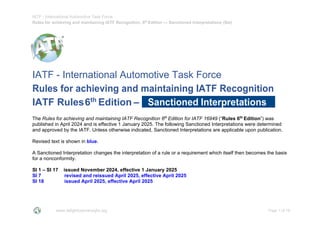
IATF - International Automotive Task Force
Rules for achieving and maintaining IATF Recognition
IATF Rules6th
Edition – Sanctioned Interpretations
The Rules for achieving and maintaining IATF Recognition 6th
Edition for IATF 16949 (“Rules 6th
Edition”) was
published in April 2024 and is effective 1 January 2025. The following Sanctioned Interpretations were determined
and approved by the IATF. Unless otherwise indicated, Sanctioned Interpretations are applicable upon publication.
Revised text is shown in blue.
A Sanctioned Interpretation changes the interpretation of a rule or a requirement which itself then becomes the basis
for a nonconformity.
SI 1 – SI 17 issued November 2024, effective 1 January 2025
SI 7 revised and reissued April 2025, effective April 2025
SI 18 issued April 2025, effective April 2025
2.
IATF - InternationalAutomotive Task Force
Rules for achieving and maintaining IATF Recognition, 6th
Edition --- Sanctioned Interpretations (SIs)
www.iatfglobaloversight.org Page 2 of 16
NUMBER RULES
REFERENCE
SANCTIONED INTERPRETATION
1 Foreword
Requests for permission to reproduce and/or translate this document or any extract from it must be
addressed to one of the organizations below:
Automotive Industry Action Group (AIAG/USA)
Associazione Nazionale Filiera Industria Automobilistica (ANFIA/Italy)
International Automotive Task Force France (IATF France/France) IATF France (France)
The Society of Motor Manufacturers and Traders Limited (SMMT/UK)
Verband der Automobilindustrie e.V. – Qualitäts Management Center (VDA QMC/Germany)
Rationale for change:
Clarified the names of the copyright owners in France, UK, and Germany.
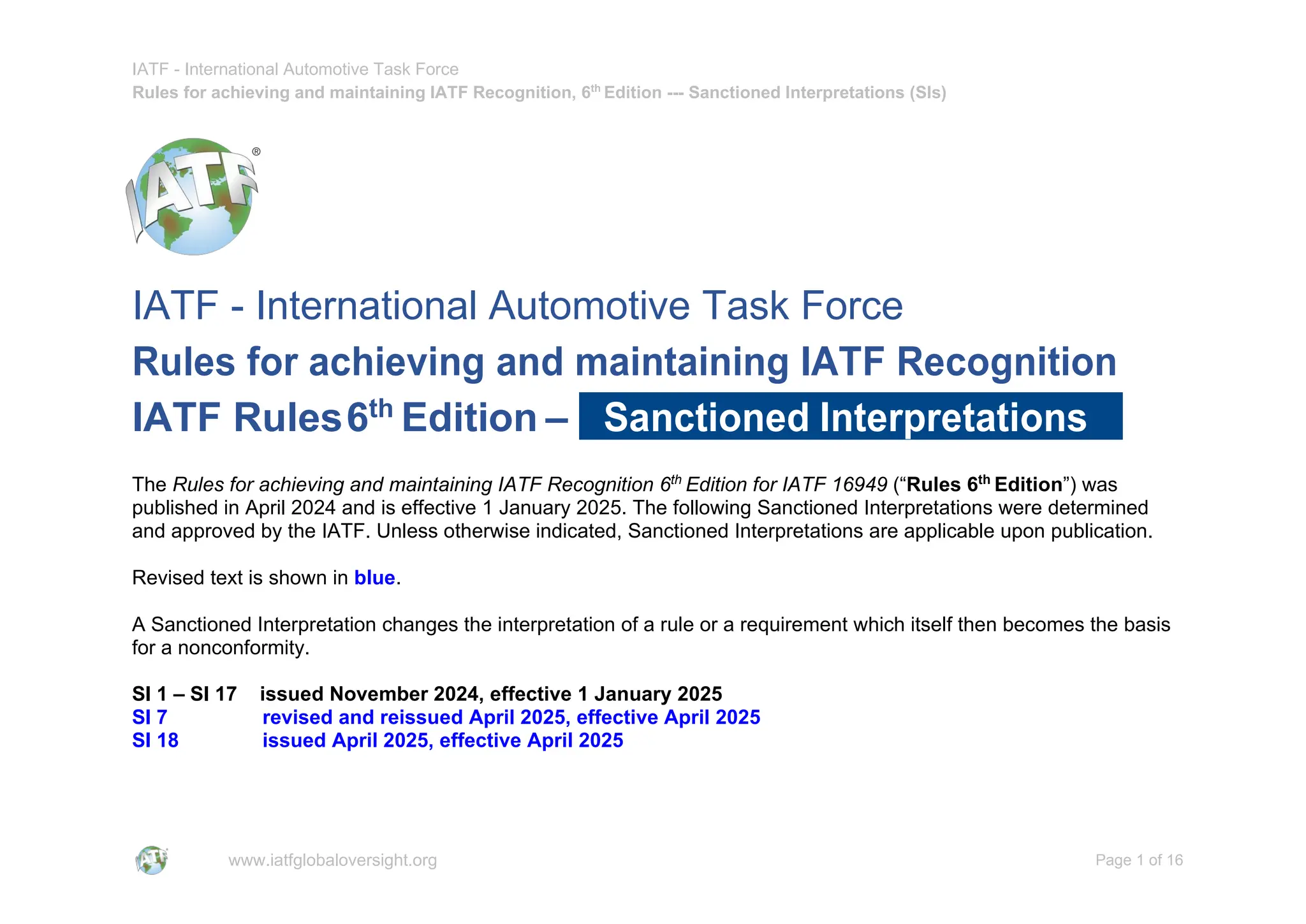
2
Global overview of
the first 3-year IATF
16949 certification
cycle
Global overview of the first 3-year IATF 16949 certification cycle
Rationale for change:
Corrected reference to 6.3 (was 6.7) in the “Conduct surveillance audit” step.
3.
IATF - InternationalAutomotive Task Force
Rules for achieving and maintaining IATF Recognition, 6th
Edition --- Sanctioned Interpretations (SIs)
www.iatfglobaloversight.org Page 3 of 16
NUMBER RULES
REFERENCE
SANCTIONED INTERPRETATION
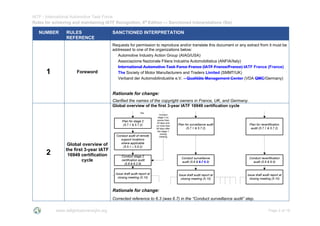
3
Table 2.10
Minimum number of
witness audits per
certification body
Table 2.10 Minimum number of witness audit days per certification body
Rationale for change:
Removed the word “Note” as the increase of one (1) witness audit per every 1,500 audit days
after 31,000 audit days is a requirement not guidance.
4.
IATF - InternationalAutomotive Task Force
Rules for achieving and maintaining IATF Recognition, 6th
Edition --- Sanctioned Interpretations (SIs)
www.iatfglobaloversight.org Page 4 of 16
NUMBER RULES
REFERENCE
SANCTIONED INTERPRETATION
4
Figure 5.1
Manufacturing site
audit and certificate
cycle
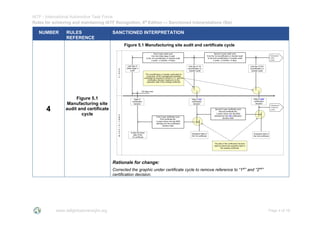
Figure 5.1 Manufacturing site audit and certificate cycle
Rationale for change:
Corrected the graphic under certificate cycle to remove reference to “1st
” and “2nd
”
certification decision.
5.
IATF - InternationalAutomotive Task Force
Rules for achieving and maintaining IATF Recognition, 6th
Edition --- Sanctioned Interpretations (SIs)
www.iatfglobaloversight.org Page 5 of 16
NUMBER RULES
REFERENCE
SANCTIONED INTERPRETATION
5
5.2
Determining the
audit duration for
initial certification,
surveillance,
recertification, and
transfer audits
When determining the audit duration and developing an audit plan (see section 5.7.2), the
certification body shall consider, at minimum, the following:
a) - p)… all other requirements of section 5.2 remain unchanged
q) When the audited client location does not meet the IATF OEM quality and/or delivery targets
specified in the IATF OEM scorecard(s) submitted with audit planning information and/or the
current scorecards reviewed in the opening meeting, the certification body shall add
“additional audit time” to the current audit plan as defined in Table 5.2 q. The “additional audit
time” shall be used to verify the effective implementation of the systemic corrective actions
associated with the IATF OEM quality and/or delivery targets that are not being met and the
associated risk to similar processes and/or products. The only exception is if the client can
provide evidence of verification of the effectiveness of the implemented systemic corrective
actions for the quality and/or delivery performance issues, in which case no increase is
applied. Where it is not possible to add the additional time to the current audit plan, the
certification body shall conduct a special audit within sixty (60) calendar days of the closing
meeting date of the audit (see section 7.2 c b]).
Rationale for change:
Corrected the cross reference from section 7.2 c) to 7.2 b).
6.
IATF - InternationalAutomotive Task Force
Rules for achieving and maintaining IATF Recognition, 6th
Edition --- Sanctioned Interpretations (SIs)
www.iatfglobaloversight.org Page 6 of 16
NUMBER RULES
REFERENCE
SANCTIONED INTERPRETATION
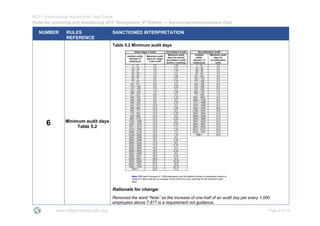
6 Minimum audit days
Table 5.2
Table 5.2 Minimum audit days
Rationale for change:
Removed the word “Note” as the increase of one-half of an audit day per every 1,000
employees above 7,677 is a requirement not guidance.
7.
IATF - InternationalAutomotive Task Force
Rules for achieving and maintaining IATF Recognition, 6th
Edition --- Sanctioned Interpretations (SIs)
www.iatfglobaloversight.org Page 7 of 16
NUMBER RULES
REFERENCE
SANCTIONED INTERPRETATION
7
(Revised)
5.7
Audit planning
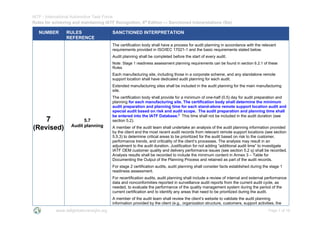
The certification body shall have a process for audit planning in accordance with the relevant
requirements provided in ISO/IEC 17021-1 and the basic requirements stated below.
Audit planning shall be completed before the start of every audit.
Note: Stage 1 readiness assessment planning requirements can be found in section 6.2.1 of these
Rules.
Each manufacturing site, including those in a corporate scheme, and any standalone remote
support location shall have dedicated audit planning for each audit.
Extended manufacturing sites shall be included in the audit planning for the main manufacturing
site.
The certification body shall provide for a minimum of one-half (0.5) day for audit preparation and
planning for each manufacturing site. The certification body shall determine the minimum
audit preparation and planning time for each stand-alone remote support location audit and
special audit based on risk and audit scope. The audit preparation and planning time shall
be entered into the IATF Database.2
This time shall not be included in the audit duration (see
section 5.2).
A member of the audit team shall undertake an analysis of the audit planning information provided
by the client and the most recent audit records from relevant remote support locations (see section
5.5.3) to determine critical areas to be prioritized for the audit based on risk to the customer,
performance trends, and criticality of the client’s processes. The analysis may result in an
adjustment to the audit duration. Justification for not adding “additional audit time” to investigate
IATF OEM customer quality and delivery performance issues (see section 5.2 q) shall be recorded.
Analysis results shall be recorded to include the minimum content in Annex 3 – Table for
Documenting the Output of the Planning Process and retained as part of the audit records.
For stage 2 certification audits, audit planning shall consider facts established during the stage 1
readiness assessment.
For recertification audits, audit planning shall include a review of internal and external performance
data and nonconformities reported in surveillance audit reports from the current audit cycle, as
needed, to evaluate the performance of the quality management system during the period of the
current certification and to identify any areas that need to be prioritized during the audit.
A member of the audit team shall review the client’s website to validate the audit planning
information provided by the client (e.g., organization structure, customers, support activities, the
8.
IATF - InternationalAutomotive Task Force
Rules for achieving and maintaining IATF Recognition, 6th
Edition --- Sanctioned Interpretations (SIs)
www.iatfglobaloversight.org Page 8 of 16
NUMBER RULES
REFERENCE
SANCTIONED INTERPRETATION
certification scope, use of the IATF logo, etc.).
Audit start and end1
dates for surveillance, recertification, and transfer audits shall be confirmed
with the client no less than ninety (90) calendar days before the audit due date (see section 10.0). If
an exceptional situation requires a change to a confirmed audit date, the certification body shall
retain justification as a part of the audit record.
The certification body and the client shall plan the audit to ensure that automotive manufacturing
processes will be running as required during the planned audit duration (see section 5.8.5). If this
requirement cannot be met, the certification body shall delay the audit until the requirement can be
met.
Note: Delaying an audit may result in loss of certification.
Rationale for change:
1
To clarify what dates must be confirmed ninety calendar days before the audit due date.
2
To allow the CB to determine the appropriate amount of time for audit preparation and
planning time for SA-RSLs.
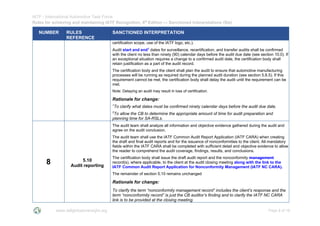
8 5.10
Audit reporting
The audit team shall analyze all information and objective evidence gathered during the audit and
agree on the audit conclusion.
The audit team shall use the IATF Common Audit Report Application (IATF CARA) when creating
the draft and final audit reports and for the issuance of nonconformities to the client. All mandatory
fields within the IATF CARA shall be completed with sufficient detail and objective evidence to allow
the reader to comprehend the audit coverage, findings, results, and conclusions.
The certification body shall issue the draft audit report and the nonconformity management
record(s), where applicable, to the client at the audit closing meeting along with the link to the
IATF Common Audit Report Application for Nonconformity Management (IATF NC CARA).
The remainder of section 5.10 remains unchanged
Rationale for change:
To clarify the term “nonconformity management record” includes the client’s response and the
term “nonconformity record” is just the CB auditor’s finding and to clarify the IATF NC CARA
link is to be provided at the closing meeting.
9.
IATF - InternationalAutomotive Task Force
Rules for achieving and maintaining IATF Recognition, 6th
Edition --- Sanctioned Interpretations (SIs)
www.iatfglobaloversight.org Page 9 of 16
NUMBER RULES
REFERENCE
SANCTIONED INTERPRETATION
9
5.11.4
Verification of major
nonconformity
In cases of a major nonconformity, the certification body shall conduct a one-time, onsite special
audit (see section 7.2 d c]) for the verification of the effective implementation of systemic corrective
actions within a maximum of ninety (90) calendar days from the closing meeting date of the audit.
The remainder of section 5.11.4 remains unchanged.
Rationale for change:
Corrected the cross reference from section 7.2 d) to 7.2 c)
10
5.12
Technical review
and certification
decision
The certification decision shall be made within a maximum of one-hundred-twenty (120) calendar
days from the last day of a special audit (see section 7.2 e), f), g) and h)) unless the special audit
is being conducted within the decertification process timing.
The remainder of section 5.12 remains unchanged.
Rationale for change:
Added clarification to which type of special audits requires a certification decision within one-
hundred-twenty (120) calendar days.
11
6.1.1
Application for
certification
The certification body shall require a representative of the applicant organization to provide the
necessary information to enable the certification body to decide on certification feasibility and to
establish a complete quotation. The information required shall include, at minimum:
a) – n) …these requirements remain unchanged
o) All IATF 16949 certifications within the last three (3) years, the status of the certificate(s), and
all final audit reports and all nonconformity management records from the last three (3)
years of certification, including evidence that all nonconformity responses have been
accepted and all verification activities that should have been completed by the previous
certification body were conducted as required (see section 5.11). If the certification body is
unable to determine the reason for the applicant organization’s certification withdrawal from
the information provided, the certification body shall contact its relevant oversight office to
obtain information on the reason for the withdrawal.
p) – r) … all other requirements remain unchanged
Rationale for change:
To clarify the term “nonconformity management record” includes the client’s response and the
10.
IATF - InternationalAutomotive Task Force
Rules for achieving and maintaining IATF Recognition, 6th
Edition --- Sanctioned Interpretations (SIs)
www.iatfglobaloversight.org Page 10 of 16
NUMBER RULES
REFERENCE
SANCTIONED INTERPRETATION
term “nonconformity record” is just the CB auditor’s finding.
12 7.1
Transfer audit
If a client chooses to change to another IATF-recognized certification body, the location(s) for which
the transfer is requested shall undergo a transfer audit with the new certification body.
Clients may apply for transfer at any point in the audit cycle.
The transfer audit shall occur within the allowable timing for the next regular audit with the previous
certification body (see sections 5.1.1 and 5.5.1).
Within seven (7) calendar days of a legal contract being signed with the client, the new certification
body shall indicate the transfer in the IATF Database by creating the client record and completing the
information required in the transfer confirmation feature.
The new certification body shall advise the client to notify the previous certification body about its
intent to transfer (see section 3.2 i j]).
The previous certification body shall not use the transfer intent notification as justification for
changing the client’s certificate status before the transfer process is complete, provided that no
other valid justification exists, and the client and the previous certification body still have a valid
contract in place.
Unless otherwise explicitly stated in these Rules, the certification activities for a transfer audit shall
be the equivalent of a recertification audit in terms of audit scope, duration, planning, and conduct,
and the relevant requirements for recertification audits apply (see section 6.4).
The new certification body shall only conduct an initial certification audit (i.e., stage 1 readiness
assessment and stage 2 certification audit) instead of a transfer audit if any of the following
conditions exist:
a) The transferring manufacturing site does not have a valid certificate or only has a letter of
conformance.
b) The transferring standalone remote support location is not referenced on a valid manufacturing site
certificate or only has a letter of conformance.
c) The allowable audit timing for the transfer audit has been exceeded.
Note: These Rules may require the new certification body to conduct special audits before the start of
the initial certification audit (see sections 6.1.1, 7.2, and 8.7).
11.
IATF - InternationalAutomotive Task Force
Rules for achieving and maintaining IATF Recognition, 6th
Edition --- Sanctioned Interpretations (SIs)
www.iatfglobaloversight.org Page 11 of 16
NUMBER RULES
REFERENCE
SANCTIONED INTERPRETATION
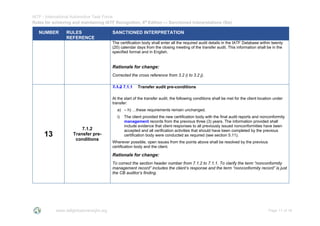
The certification body shall enter all the required audit details in the IATF Database within twenty
(20) calendar days from the closing meeting of the transfer audit. This information shall be in the
specified format and in English.
Rationale for change:
Corrected the cross reference from 3.2 i) to 3.2 j).
13
7.1.2
Transfer pre-
conditions
7.1.2 7.1.1 Transfer audit pre-conditions
At the start of the transfer audit, the following conditions shall be met for the client location under
transfer:
a) – h) …these requirements remain unchanged.
i) The client provided the new certification body with the final audit reports and nonconformity
management records from the previous three (3) years. The information provided shall
include evidence that client responses to all previously issued nonconformities have been
accepted and all verification activities that should have been completed by the previous
certification body were conducted as required (see section 5.11).
Wherever possible, open issues from the points above shall be resolved by the previous
certification body and the client.
Rationale for change:
To correct the section header number from 7.1.2 to 7.1.1. To clarify the term “nonconformity
management record” includes the client’s response and the term “nonconformity record” is just
the CB auditor’s finding.
12.
IATF - InternationalAutomotive Task Force
Rules for achieving and maintaining IATF Recognition, 6th
Edition --- Sanctioned Interpretations (SIs)
www.iatfglobaloversight.org Page 12 of 16
NUMBER RULES
REFERENCE
SANCTIONED INTERPRETATION
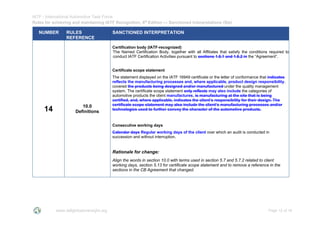
14 10.0
Definitions
Certification body (IATF-recognized)
The Named Certification Body, together with all Affiliates that satisfy the conditions required to
conduct IATF Certification Activities pursuant to sections 1.6.1 and 1.6.2 in the “Agreement”.
Certificate scope statement
The statement displayed on the IATF 16949 certificate or the letter of conformance that indicates
reflects the manufacturing processes and, where applicable, product design responsibility,
covered the products being designed and/or manufactured under the quality management
system. The certificate scope statement only reflects may also include the categories of
automotive products the client manufactures. is manufacturing at the site that is being
certified, and, where applicable, indicates the client’s responsibility for their design. The
certificate scope statement may also include the client’s manufacturing processes and/or
technologies used to further convey the character of the automotive products.
Consecutive working days
Calendar days Regular working days of the client over which an audit is conducted in
succession and without interruption.
Rationale for change:
Align the words in section 10.0 with terms used in section 5.7 and 5.7.2 related to client
working days, section 5.13 for certificate scope statement and to remove a reference in the
sections in the CB Agreement that changed.
13.
IATF - InternationalAutomotive Task Force
Rules for achieving and maintaining IATF Recognition, 6th
Edition --- Sanctioned Interpretations (SIs)
www.iatfglobaloversight.org Page 13 of 16
NUMBER RULES
REFERENCE
SANCTIONED INTERPRETATION
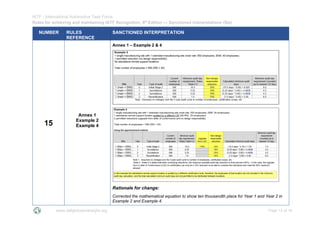
15
Annex 1
Example 2
Example 4
Annex 1 – Example 2 & 4
Rationale for change:
Corrected the mathematical equation to show ten thousandth place for Year 1 and Year 2 in
Example 2 and Example 4.
14.
IATF - InternationalAutomotive Task Force
Rules for achieving and maintaining IATF Recognition, 6th
Edition --- Sanctioned Interpretations (SIs)
www.iatfglobaloversight.org Page 14 of 16
NUMBER RULES
REFERENCE
SANCTIONED INTERPRETATION
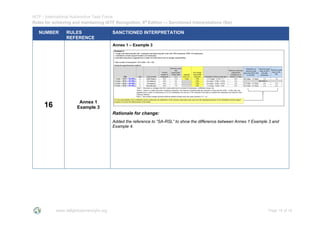
16 Annex 1
Example 3
Annex 1 – Example 3
Rationale for change:
Added the reference to “SA-RSL” to show the difference between Annex 1 Example 3 and
Example 4.
15.
IATF - InternationalAutomotive Task Force
Rules for achieving and maintaining IATF Recognition, 6th
Edition --- Sanctioned Interpretations (SIs)
www.iatfglobaloversight.org Page 15 of 16
NUMBER RULES
REFERENCE
SANCTIONED INTERPRETATION
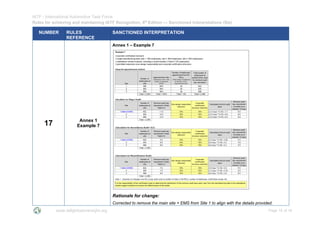
17 Annex 1
Example 7
Annex 1 – Example 7
Rationale for change:
Corrected to remove the main site + EMS from Site 1 to align with the details provided.
16.
IATF - InternationalAutomotive Task Force
Rules for achieving and maintaining IATF Recognition, 6th
Edition --- Sanctioned Interpretations (SIs)
www.iatfglobaloversight.org Page 16 of 16
NUMBER RULES
REFERENCE
SANCTIONED INTERPRETATION
18
5.5.1
Audit program
requirements for
support functions
When creating an audit program for manufacturing sites with support functions performed onsite,
the certification body shall meet the following requirements:
a) Product design functions shall be included in the initial stage 2 audit, in each surveillance
audit, and in the recertification audit. All other support functions shall be included in the initial
stage 2 audit, at least once more during the surveillance audit cycle, and in the recertification
audit.
b) Stage 2 certification audit planning for a manufacturing site shall ensure that all its support
functions performed at standalone remote support locations are audited and relevant
interfaces validated at the standalone remote support locations before the audit at the
manufacturing site.
When creating an audit program for standalone remote support locations, the certification body
shall meet the following requirements:
c) The audit program shall start with an initial certification audit—or a transfer audit, where
applicable—followed by an ongoing sequence of surveillance audits.
d) Audits shall be programmed and conducted based on audit due dates established from the
initial certification audit or transfer audit date.
e) Product design functions shall be audited annually (i.e., every twelve [12] months [-3/+3
months]).
f) Central locations within a corporate scheme shall be audited annually (i.e., every
twelve [12] months [-3/+3 months]).
g) Non-product design functions shall be audited at least every two (2) years (i.e., every twenty-
four [24] months [-3/+3 months]).
h) Failure to conduct audits of the standalone remote support location within the required timing
shall result in an initial certification audit.
Rationale for change:
Clarified the central location within a corporate scheme is required to have an annual audit.
![IATF - International Automotive Task Force
Rules for achieving and maintaining IATF Recognition, 6th
Edition --- Sanctioned Interpretations (SIs)
www.iatfglobaloversight.org Page 5 of 16
NUMBER RULES
REFERENCE
SANCTIONED INTERPRETATION
5
5.2
Determining the
audit duration for
initial certification,
surveillance,
recertification, and
transfer audits
When determining the audit duration and developing an audit plan (see section 5.7.2), the
certification body shall consider, at minimum, the following:
a) - p)… all other requirements of section 5.2 remain unchanged
q) When the audited client location does not meet the IATF OEM quality and/or delivery targets
specified in the IATF OEM scorecard(s) submitted with audit planning information and/or the
current scorecards reviewed in the opening meeting, the certification body shall add
“additional audit time” to the current audit plan as defined in Table 5.2 q. The “additional audit
time” shall be used to verify the effective implementation of the systemic corrective actions
associated with the IATF OEM quality and/or delivery targets that are not being met and the
associated risk to similar processes and/or products. The only exception is if the client can
provide evidence of verification of the effectiveness of the implemented systemic corrective
actions for the quality and/or delivery performance issues, in which case no increase is
applied. Where it is not possible to add the additional time to the current audit plan, the
certification body shall conduct a special audit within sixty (60) calendar days of the closing
meeting date of the audit (see section 7.2 c b]).
Rationale for change:
Corrected the cross reference from section 7.2 c) to 7.2 b).](https://image.slidesharecdn.com/iatf-rules-6th-editionsanctioned-interpretations-apr-2025-250617145450-2d438462/85/IATF-Rules-6th-Edition_Sanctioned-Interpretations-Apr-2025-pdf-5-320.jpg)
![IATF - International Automotive Task Force
Rules for achieving and maintaining IATF Recognition, 6th
Edition --- Sanctioned Interpretations (SIs)
www.iatfglobaloversight.org Page 9 of 16
NUMBER RULES
REFERENCE
SANCTIONED INTERPRETATION
9
5.11.4
Verification of major
nonconformity
In cases of a major nonconformity, the certification body shall conduct a one-time, onsite special
audit (see section 7.2 d c]) for the verification of the effective implementation of systemic corrective
actions within a maximum of ninety (90) calendar days from the closing meeting date of the audit.
The remainder of section 5.11.4 remains unchanged.
Rationale for change:
Corrected the cross reference from section 7.2 d) to 7.2 c)
10
5.12
Technical review
and certification
decision
The certification decision shall be made within a maximum of one-hundred-twenty (120) calendar
days from the last day of a special audit (see section 7.2 e), f), g) and h)) unless the special audit
is being conducted within the decertification process timing.
The remainder of section 5.12 remains unchanged.
Rationale for change:
Added clarification to which type of special audits requires a certification decision within one-
hundred-twenty (120) calendar days.
11
6.1.1
Application for
certification
The certification body shall require a representative of the applicant organization to provide the
necessary information to enable the certification body to decide on certification feasibility and to
establish a complete quotation. The information required shall include, at minimum:
a) – n) …these requirements remain unchanged
o) All IATF 16949 certifications within the last three (3) years, the status of the certificate(s), and
all final audit reports and all nonconformity management records from the last three (3)
years of certification, including evidence that all nonconformity responses have been
accepted and all verification activities that should have been completed by the previous
certification body were conducted as required (see section 5.11). If the certification body is
unable to determine the reason for the applicant organization’s certification withdrawal from
the information provided, the certification body shall contact its relevant oversight office to
obtain information on the reason for the withdrawal.
p) – r) … all other requirements remain unchanged
Rationale for change:
To clarify the term “nonconformity management record” includes the client’s response and the](https://image.slidesharecdn.com/iatf-rules-6th-editionsanctioned-interpretations-apr-2025-250617145450-2d438462/85/IATF-Rules-6th-Edition_Sanctioned-Interpretations-Apr-2025-pdf-9-320.jpg)
![IATF - International Automotive Task Force
Rules for achieving and maintaining IATF Recognition, 6th
Edition --- Sanctioned Interpretations (SIs)
www.iatfglobaloversight.org Page 10 of 16
NUMBER RULES
REFERENCE
SANCTIONED INTERPRETATION
term “nonconformity record” is just the CB auditor’s finding.
12 7.1
Transfer audit
If a client chooses to change to another IATF-recognized certification body, the location(s) for which
the transfer is requested shall undergo a transfer audit with the new certification body.
Clients may apply for transfer at any point in the audit cycle.
The transfer audit shall occur within the allowable timing for the next regular audit with the previous
certification body (see sections 5.1.1 and 5.5.1).
Within seven (7) calendar days of a legal contract being signed with the client, the new certification
body shall indicate the transfer in the IATF Database by creating the client record and completing the
information required in the transfer confirmation feature.
The new certification body shall advise the client to notify the previous certification body about its
intent to transfer (see section 3.2 i j]).
The previous certification body shall not use the transfer intent notification as justification for
changing the client’s certificate status before the transfer process is complete, provided that no
other valid justification exists, and the client and the previous certification body still have a valid
contract in place.
Unless otherwise explicitly stated in these Rules, the certification activities for a transfer audit shall
be the equivalent of a recertification audit in terms of audit scope, duration, planning, and conduct,
and the relevant requirements for recertification audits apply (see section 6.4).
The new certification body shall only conduct an initial certification audit (i.e., stage 1 readiness
assessment and stage 2 certification audit) instead of a transfer audit if any of the following
conditions exist:
a) The transferring manufacturing site does not have a valid certificate or only has a letter of
conformance.
b) The transferring standalone remote support location is not referenced on a valid manufacturing site
certificate or only has a letter of conformance.
c) The allowable audit timing for the transfer audit has been exceeded.
Note: These Rules may require the new certification body to conduct special audits before the start of
the initial certification audit (see sections 6.1.1, 7.2, and 8.7).](https://image.slidesharecdn.com/iatf-rules-6th-editionsanctioned-interpretations-apr-2025-250617145450-2d438462/85/IATF-Rules-6th-Edition_Sanctioned-Interpretations-Apr-2025-pdf-10-320.jpg)
![IATF - International Automotive Task Force
Rules for achieving and maintaining IATF Recognition, 6th
Edition --- Sanctioned Interpretations (SIs)
www.iatfglobaloversight.org Page 16 of 16
NUMBER RULES
REFERENCE
SANCTIONED INTERPRETATION
18
5.5.1
Audit program
requirements for
support functions
When creating an audit program for manufacturing sites with support functions performed onsite,
the certification body shall meet the following requirements:
a) Product design functions shall be included in the initial stage 2 audit, in each surveillance
audit, and in the recertification audit. All other support functions shall be included in the initial
stage 2 audit, at least once more during the surveillance audit cycle, and in the recertification
audit.
b) Stage 2 certification audit planning for a manufacturing site shall ensure that all its support
functions performed at standalone remote support locations are audited and relevant
interfaces validated at the standalone remote support locations before the audit at the
manufacturing site.
When creating an audit program for standalone remote support locations, the certification body
shall meet the following requirements:
c) The audit program shall start with an initial certification audit—or a transfer audit, where
applicable—followed by an ongoing sequence of surveillance audits.
d) Audits shall be programmed and conducted based on audit due dates established from the
initial certification audit or transfer audit date.
e) Product design functions shall be audited annually (i.e., every twelve [12] months [-3/+3
months]).
f) Central locations within a corporate scheme shall be audited annually (i.e., every
twelve [12] months [-3/+3 months]).
g) Non-product design functions shall be audited at least every two (2) years (i.e., every twenty-
four [24] months [-3/+3 months]).
h) Failure to conduct audits of the standalone remote support location within the required timing
shall result in an initial certification audit.
Rationale for change:
Clarified the central location within a corporate scheme is required to have an annual audit.](https://image.slidesharecdn.com/iatf-rules-6th-editionsanctioned-interpretations-apr-2025-250617145450-2d438462/85/IATF-Rules-6th-Edition_Sanctioned-Interpretations-Apr-2025-pdf-16-320.jpg)


