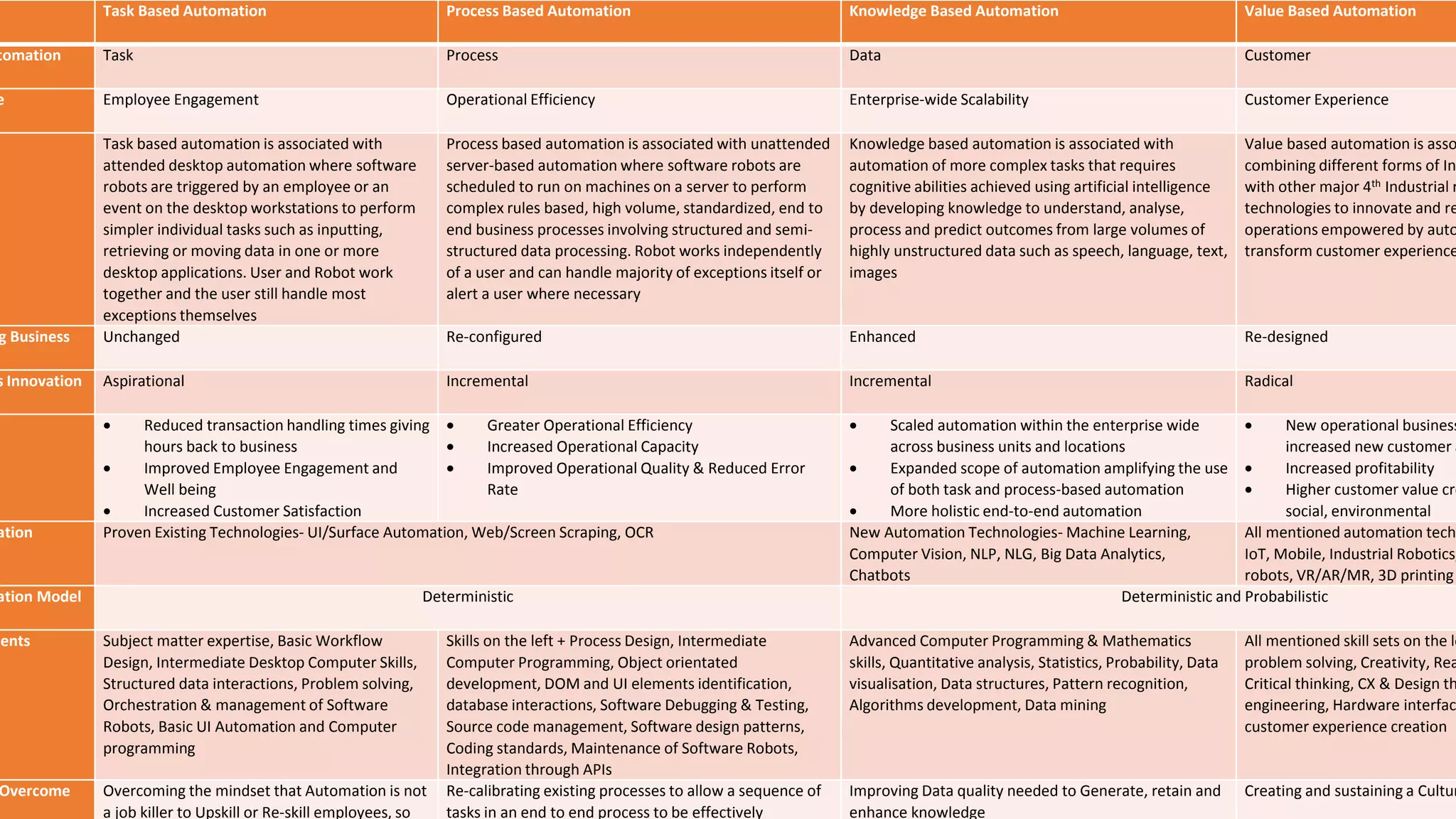
Task Based Automation Process Based Automation Knowledge Based Automation Value Based Automation
tomation Task Process Data Customer
e Employee Engagement Operational Efficiency Enterprise-wide Scalability Customer Experience
Task based automation is associated with
attended desktop automation where software
robots are triggered by an employee or an
event on the desktop workstations to perform
simpler individual tasks such as inputting,
retrieving or moving data in one or more
desktop applications. User and Robot work
together and the user still handle most
exceptions themselves
Process based automation is associated with unattended
server-based automation where software robots are
scheduled to run on machines on a server to perform
complex rules based, high volume, standardized, end to
end business processes involving structured and semi-
structured data processing. Robot works independently
of a user and can handle majority of exceptions itself or
alert a user where necessary
Knowledge based automation is associated with
automation of more complex tasks that requires
cognitive abilities achieved using artificial intelligence
by developing knowledge to understand, analyse,
process and predict outcomes from large volumes of
highly unstructured data such as speech, language, text,
images
Value based automation is asso
combining different forms of In
with other major 4th Industrial r
technologies to innovate and re
operations empowered by auto
transform customer experience
g Business Unchanged Re-configured Enhanced Re-designed
s Innovation Aspirational Incremental Incremental Radical
 Reduced transaction handling times giving
hours back to business
 Improved Employee Engagement and
Well being
 Increased Customer Satisfaction
 Greater Operational Efficiency
 Increased Operational Capacity
 Improved Operational Quality & Reduced Error
Rate
 Scaled automation within the enterprise wide
across business units and locations
 Expanded scope of automation amplifying the use
of both task and process-based automation
 More holistic end-to-end automation
 New operational business
increased new customer a
 Increased profitability
 Higher customer value cre
social, environmental
ation Proven Existing Technologies- UI/Surface Automation, Web/Screen Scraping, OCR New Automation Technologies- Machine Learning,
Computer Vision, NLP, NLG, Big Data Analytics,
Chatbots
All mentioned automation tech
IoT, Mobile, Industrial Robotics,
robots, VR/AR/MR, 3D printing
ation Model Deterministic Deterministic and Probabilistic
ments Subject matter expertise, Basic Workflow
Design, Intermediate Desktop Computer Skills,
Structured data interactions, Problem solving,
Orchestration & management of Software
Robots, Basic UI Automation and Computer
programming
Skills on the left + Process Design, Intermediate
Computer Programming, Object orientated
development, DOM and UI elements identification,
database interactions, Software Debugging & Testing,
Source code management, Software design patterns,
Coding standards, Maintenance of Software Robots,
Integration through APIs
Advanced Computer Programming & Mathematics
skills, Quantitative analysis, Statistics, Probability, Data
visualisation, Data structures, Pattern recognition,
Algorithms development, Data mining
All mentioned skill sets on the le
problem solving, Creativity, Rea
Critical thinking, CX & Design th
engineering, Hardware interfac
customer experience creation
Overcome Overcoming the mindset that Automation is not
a job killer to Upskill or Re-skill employees, so
Re-calibrating existing processes to allow a sequence of
tasks in an end to end process to be effectively
Improving Data quality needed to Generate, retain and
enhance knowledge
Creating and sustaining a Cultur

IA framework innovation_characteristics

  • 1.
    Task Based AutomationProcess Based Automation Knowledge Based Automation Value Based Automation tomation Task Process Data Customer e Employee Engagement Operational Efficiency Enterprise-wide Scalability Customer Experience Task based automation is associated with attended desktop automation where software robots are triggered by an employee or an event on the desktop workstations to perform simpler individual tasks such as inputting, retrieving or moving data in one or more desktop applications. User and Robot work together and the user still handle most exceptions themselves Process based automation is associated with unattended server-based automation where software robots are scheduled to run on machines on a server to perform complex rules based, high volume, standardized, end to end business processes involving structured and semi- structured data processing. Robot works independently of a user and can handle majority of exceptions itself or alert a user where necessary Knowledge based automation is associated with automation of more complex tasks that requires cognitive abilities achieved using artificial intelligence by developing knowledge to understand, analyse, process and predict outcomes from large volumes of highly unstructured data such as speech, language, text, images Value based automation is asso combining different forms of In with other major 4th Industrial r technologies to innovate and re operations empowered by auto transform customer experience g Business Unchanged Re-configured Enhanced Re-designed s Innovation Aspirational Incremental Incremental Radical  Reduced transaction handling times giving hours back to business  Improved Employee Engagement and Well being  Increased Customer Satisfaction  Greater Operational Efficiency  Increased Operational Capacity  Improved Operational Quality & Reduced Error Rate  Scaled automation within the enterprise wide across business units and locations  Expanded scope of automation amplifying the use of both task and process-based automation  More holistic end-to-end automation  New operational business increased new customer a  Increased profitability  Higher customer value cre social, environmental ation Proven Existing Technologies- UI/Surface Automation, Web/Screen Scraping, OCR New Automation Technologies- Machine Learning, Computer Vision, NLP, NLG, Big Data Analytics, Chatbots All mentioned automation tech IoT, Mobile, Industrial Robotics, robots, VR/AR/MR, 3D printing ation Model Deterministic Deterministic and Probabilistic ments Subject matter expertise, Basic Workflow Design, Intermediate Desktop Computer Skills, Structured data interactions, Problem solving, Orchestration & management of Software Robots, Basic UI Automation and Computer programming Skills on the left + Process Design, Intermediate Computer Programming, Object orientated development, DOM and UI elements identification, database interactions, Software Debugging & Testing, Source code management, Software design patterns, Coding standards, Maintenance of Software Robots, Integration through APIs Advanced Computer Programming & Mathematics skills, Quantitative analysis, Statistics, Probability, Data visualisation, Data structures, Pattern recognition, Algorithms development, Data mining All mentioned skill sets on the le problem solving, Creativity, Rea Critical thinking, CX & Design th engineering, Hardware interfac customer experience creation Overcome Overcoming the mindset that Automation is not a job killer to Upskill or Re-skill employees, so Re-calibrating existing processes to allow a sequence of tasks in an end to end process to be effectively Improving Data quality needed to Generate, retain and enhance knowledge Creating and sustaining a Cultur