2
SPECIFIC LEARNING OBJECTIVES
Sr.
No.
Corearea Domain Category
1 - Introduction
- Classification
- Properties of Hydrocolloid Impression
materials
- Hydrocolloid Impression materials
- Recent Advances in Irreversible Hydrocolloid
- Techniques in Hydrocolloid Impression
materials
Cognitive Must Know
2 - Conclusion
- Take home message
Affective Must Know
3.
3
CONTENT
• Introduction
• Classification
•Properties of Hydrocolloid Impression materials
• Hydrocolloid Impression materials
Reversible Hydrocolloid - Agar
Irreversible Hydrocolloid – Alginate
• Recent Advances in Irreversible Hydrocolloid
• Techniques in Hydrocolloid Impression materials
• Conclusion
• Take Home Message
• References
4.
4
INTRODUCTION
• IMPRESSION-A negativelikeness or copy in reverse of the surface of an
object; an imprint of the teeth and adjacent structures for use in dentistry.
• IMPRESSION MATERIAL- Any substance or combination of
substances used for making an impression or negative reproduction.
• The negative reproduction of the tissues given by the impression material
is filled up with dental stone or other model materials to get a positive cast.
Phillips’ Science of Dental Materials, Twelfth edition
5.
IMPRESSION MATERIAL
Elastic Non-Elastic
HydrocolloidRubber
ZOE Imp. Compound
Agar Alginate
Polysulfide Polyether Silicone
Condensation Addition
CLASSIFICATION
William J O’Brien Dental Materials and their selection, Third edition
A substance thatis microscopically dispersed
uniformly throughout another substance
HYDROCOLLOIDS
Phillips’ Science of Dental Materials, Twelfth edition
8.
True solutions
• Ifthe size of the dispersed particles are small
(<10-7
cm).
Suspension or emulsion
• If the size of the dispersed particles are larger
(>10-4
cm).
• The colloidal state is an intermediate state
between true solution and suspension.
Phillips’ Science of Dental Materials, Twelfth edition
9.
FLOWABLE STATE SOLIDSTATE
SOL-GEL TRANSFORMATION
V Shama Bhat Science of Dental Materials, Second edition
10.
SOL-GEL TRANSFORMATION
SOL STATEGEL STATE
Micelles
A suspension that behaves like
an elastic solid
V Shama Bhat Science of Dental Materials, Second edition
Tear and CompressiveStrengths
• Agar has a tear strength of 715 gm/cm2
and compressive strength of 8000 gm/
cm2
.
• Alginate tear strength varies from 350-
700gm/cm2
and compressive strength
ranges from 5000-8000gm/cm2
V Shama Bhat Science of Dental Materials, Second edition
13.
Syneresis and Imbibition(Dimensional Stability)
• Since hydrocolloids use water as the dispersion medium,
they are prone for dimensional change due to either loss or
gain of water.
• If left in a dry atmosphere, water is lost by evaporation,
and if it is immersed in water, it absorbs water by a process
known as ‘imbibition’.
• The gel may also loose water by exuding of fluid in a
process known as ‘syneresis’.
• To avoid this hydrocolloid impressions should be poured
immediately. Phillips’ Science of Dental Materials, Twelfth edition
14.
Gelation, Liquefaction andHysterisis
• Most materials melt as well as resolidify at the same temperature.
However, in agar this does not coincide.
• Gelation (solidification) occurs at 37° C approximately, whereas
liquefaction (melting) occurs at a higher temperature, i.e. 60 to 70° C
higher than the gelation temperature.
• This temperature lag between liquefaction and gelation is known as
hysterisis.
V Shama Bhat Science of Dental Materials, Second edition
15.
Flexibility
• The flexibilityof the gel is between 4-15%
• A few set materials, however, have a flexibility of
20%.
• On an average a flexibility of 11% is desirable.
16.
Elasticity and ElasticRecovery
• Hydrocolloids are highly elastic in nature and elastic recovery occurs to the
extent of 98.8% for agar, alginate 97.3% elastic recovery occurs.
• Thus permanent deformation is more for Alginate (about 1.2%)
• Permanent deformation is less if the set impression is removed from the mouth
quickly.
Phillips’ Science of Dental Materials, Twelfth edition
17.
Shelf Life andStorage
• Alginate material deteriorates rapidly at elevated
temperatures and humid environment.
• The material should be stored in a cool, dry environment.
• The lid of bulk pack a gecan, must be replaced after every
use, so as to minimize moisture contamination.
• Stock only for one year.
Phillips’ Science of Dental Materials, Twelfth edition
• Agar hydrocolloidwas the first successful elastic impression
material to be used in dentistry.
• It is an organic hydrophillic colloid extracted from certain types
of seaweed.
Agar Hydrocolloids (Cool)
GEL STATE
Agar Hydrocolloids (Heat)
SOL STATE
William J O’Brien Dental Materials and their selection, Third edition
Ingredient Weight %Function
Agar 12-17 Dispersed phase of sol and continuous fibril
of gel.
K2SO4 1.7 Plaster hardener
Borax 0.2 Improves gel strength and viscosity of sol.
Alkyl Benzoate 0.1 Preservative
Diatomaceous 0.3-0.5
Fillers
Water 85.5 Continuous phase in sol and 2nd
continuous
phase in gel.
Color & Flavors Trace Improve appearance and taste.
22.
1. Widely usedat present for cast duplication
2. For full mouth impressions without deep undercuts
William J O’Brien Dental Materials and their selection, Third edition
USES
23.
• Gelin collapsibletubes
• A number of cylinders in a glass jar
• In bulk containers
SUPPLIED
Phillips’ Science of Dental Materials, Twelfth edition
Agar hydrocolloid requiresspecial equipment's:
• Hydrocolloid conditioner
• Water cooled rim lock trays
Phillips’ Science of Dental Materials, Twelfth edition
27.
• The filledsyringes and tubes are placed in the water bath at about 100°C
for 10-15 minutes.
Liquefaction
(gel-sol)
Storage
• After the agar gel has been converted to sol, the tubes and syringes are placed in
storage bath which is maintained at 63-65°C. It can be stored at this temperature for
several hours.
Conditioning
• The stored agar sol is squeezed on to a perforated water cooled tray, a gauge
pad or glass is placed over the top of the tray and the tray is placed in
conditioning bath at 43°C or 45°C for 10-15 minutes.
28.
ADVANTAGES DISADVANATGES
It hasgood elastic properties and
reproduces undercut areas correctly.
During insertion it may be painful to
patient
It has good recovery from distortion. Tears relatively easily.
As its non-hydrophobic, it gives good
model surface.
Only one model can be poured.
It can be reused when used as a
duplicating material.
Extensive and expensive equipment is
required.
Accurate dies can be prepared It cannot be electroplated.
Phillips’ Science of Dental Materials, Twelfth edition
The wordAlginate comes from ‘Algin’ which is a
peculiar mucous extract yielded by certain brown
seaweed (Algae).
TYPES
• Type I- fast setting.
• Type II- normal setting.
Ingredient Weight %Function
Soluble salts of alginates 15% Forms sol with water
Reacts with Ca to forma gel of alginate.
Ca sulphate dihydrate
solution 16 Reactor
Trisodium phosphate 2 Retarder
Diatomaceous earth 60 Filler
Zinc Oxide 4 Filler
Potassium titanium
fluoride 3 Gypsum hardener
Colour & Flavours Trace Pleasant taste to make it more acceptable.
34.
1. For makingpreliminary impressions for complete
dentures.
2. For impressions to make study models and
working casts.
3. For duplicating models.
USES
William J O’Brien Dental Materials and their selection, Third edition
35.
A powder thatis packed
• In bulk containers
• In pre-weighed packets for single impression.
• A plastic scoop and a plastic cylinder.
SUPPLIED
William J O’Brien Dental Materials and their selection, Third edition
36.
SETTING REACTION
V ShamaBhat Science of Dental Materials, Second edition
• Calcium sulphate prefers to react with the retarder first.
• Only after the supply of the retarder is over does calcium sulphate react with
sodium alginate.
Mixing Time
1. Forfast set alginate 45 seconds.
2. For normal set alginate 60 seconds
Working Time
• Fast set alginate: 1 minutes.
• Normal set alginate: 2 minutes.
Setting Time
• Type I (fast set): 1-2.0mins.
• Type II(normal): 2-4.5mins
John J Manappallil Basic Dental Materials, Fourth edition
40.
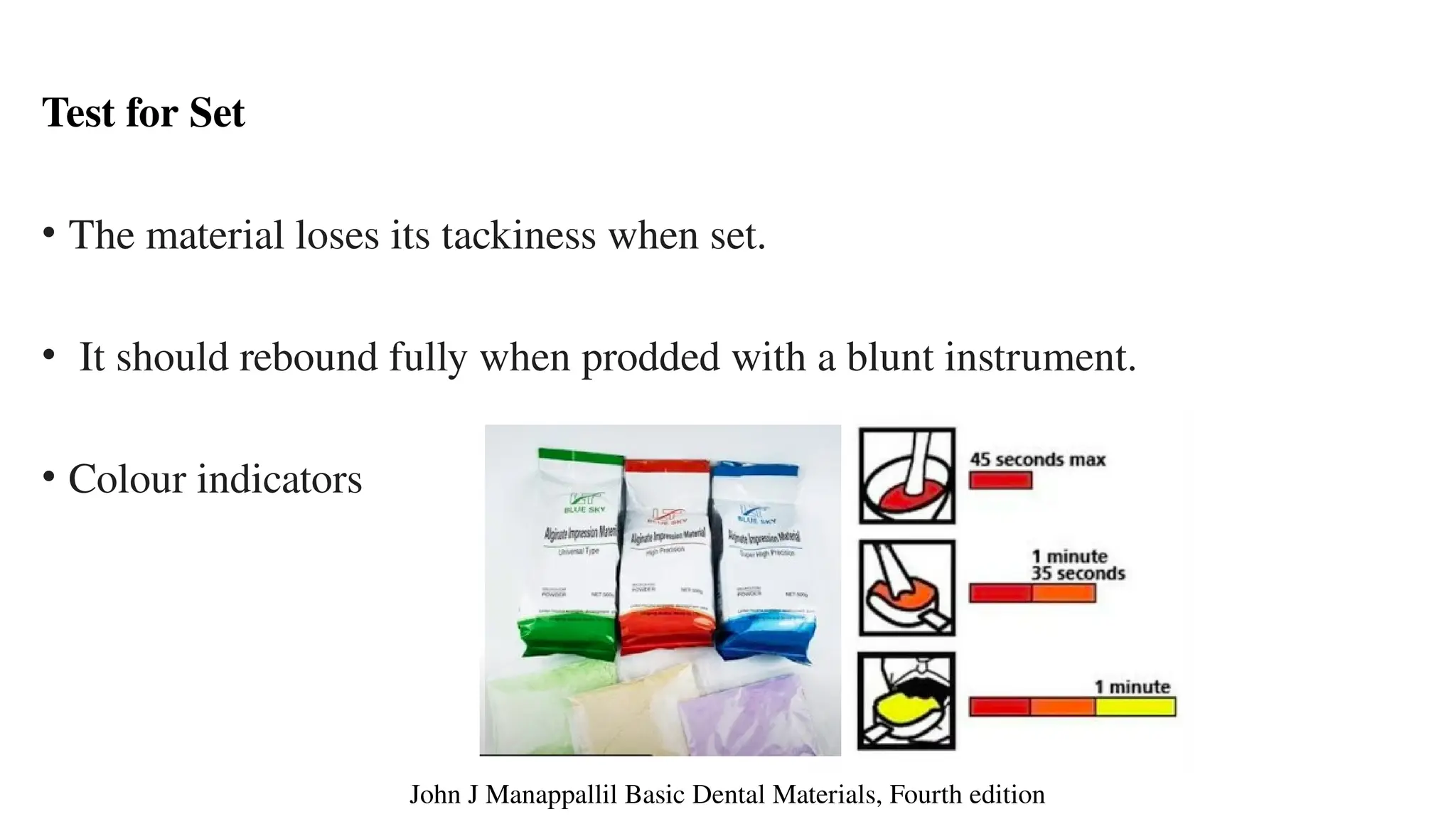
Test for Set
•The material loses its tackiness when set.
• It should rebound fully when prodded with a blunt instrument.
• Colour indicators
John J Manappallil Basic Dental Materials, Fourth edition
41.
ADVANTAGES DISADVANATGES
It iseasy to mix and manipulate. Cannot be electroplated.
Minimum requirement of equipment. It cannot be corrected.
Flexibility of the set impression Distortion may occur without it being
obvious if the material is not held steady
while it is setting.
Comfortable to the patient.
Poor dimensional stability—it cannot be
stored for long time.
It is hygienic, as fresh material must
be used for each impression.
Poor tear strength.
FAILURES CAUSES
Agar Alginate
Grainymaterial surface In adequate boiling
Too low storage temperature
Too long storage time
In homogeneous mixing
Prolonged mixing
Too low W/P
Tearing Inadequate thickness
Premature removal
Delay in seating tray material
Prolonged mixing
Inadequate thickness
Moisture contaminations
Premature removal
External bubbles Gelation of syringe material Pre-gelation before seating/ Air trapped while
mixing
Irregular voids Too cold material Water and debris on the tissues
Distortion Movement of tray during gelation
Removal before completion of gelation
Improper removal from mouth
Delay in pouring the cast
Rough and chalky stone
model surface
Inadequate cleaning, Excess water or surface hardener left
Incomplete gelation, Improper mixing or high W/P
44.
• Impressions mustbe poured as soon as possible.
• If it becomes necessary to store the impression, the following
methods may be used:
• Wrap the impression lightly in a wet paper towel and cover
with a rubber bowl Or Keep the impression in a plastic bag.
STORAGE OF HYDROCOLLOIDS
Phillips’ Science of Dental Materials, Twelfth edition
45.
• Immersion insodium hypochlorite
(1:2000), iodophors, or 2%
glutaraldehyde's.
• The manufacturer's recommendations
for proper disinfection should be
followed.
DISINFECTION OF HYDROCOLLOIDS
Phillips’ Science of Dental Materials, Twelfth edition
Dustless Alginates
• Thesefillers are low-density siliceous fibres with dimensions of
3-20 μm.
• These fibers will raise in the form of dust during usage and
inhalation of those fibers may cause respiratory problems.
• Sepiolite (natural mineral fiber-containing magnesium silicate -
20%) was added that helps in holding alginate particles together
to prevent the leaping of dust particles.
Alaghari S, Velagala S, Alla RK, Ramaraju AV. Advances in alginate impression materials: a review. Int J Dent Mater 2019;1(2): 55-59
48.
Alginate in theform of Two-paste System
• Alginates were developed in two-paste systems to prevent the
contamination of powder.
• It consists of base paste and catalyst paste.
• The base paste contains soluble alginate, water, and fillers,
whereas catalyst paste contains calcium salts, viscous liquids
like liquid paraffin and magnesium hydroxide as a pH
stabilizer.
Alaghari S, Velagala S, Alla RK, Ramaraju AV. Advances in alginate impression materials: a review. Int J Dent Mater 2019;1(2): 55-59
49.
Chromatic Alginates
• Variouscolor indicators were added to the alginate
impression materials to identify the different stages of
manipulation.
• These color indicators change the color of the alginate
mix as setting reaction taking place.
• This change in the color of the alginate mix facilitates
identification of the ideal consistency to load it into the
tray and make accurate impressions.
Alaghari S, Velagala S, Alla RK, Ramaraju AV. Advances in alginate impression materials: a review. Int J Dent Mater 2019;1(2): 55-59
50.
Self-disinfected Alginates
• Disinfectionof impression is an essential and necessary procedure in
dental practice to prevent cross- infection and safety of patients,
dentists, and dental personnel.
• The disinfectant materials incorporated include quaternary
ammonium compounds, chlorhexidine, bisquanidine compounds,
didecydimethy ammonium chloride.
• Nanoparticles were also proved to be effective self-disinfecting
agents for alginate impression materials with no adverse effect on
physical and mechanical properties.
Alaghari S, Velagala S, Alla RK, Ramaraju AV. Advances in alginate impression materials: a review. Int J Dent Mater 2019;1(2): 55-59
51.
Extended pour Alginates
•Development of two new alginate materials such as
CAVEX Color Change (Darby Dental Supply, USA)
Extend a Pour (Dux Dental Products).
• Cavex color change material can be preserved for
about 100hrs and extend a pour can be preserved up
to 4 weeks.
Alaghari S, Velagala S, Alla RK, Ramaraju AV. Advances in alginate impression materials: a review. Int J Dent Mater 2019;1(2): 55-59
52.
Alginate with PolyacrylamideIncorporation
• On mixing with water, conventional alginates may tend to form a
grainy mass with lumps of unmixed material as the water does not wet
the powder easily.
• A thickening and stabilizing agent such as 0.01- 0.25wt%
polyacrylamide were incorporated into the conventional resulted in
improving the mixing characteristics, and the formation of smooth
alginate sol with water.
Alaghari S, Velagala S, Alla RK, Ramaraju AV. Advances in alginate impression materials: a review. Int J Dent Mater 2019;1(2): 55-59
• The oraltissues are flooded with warm water.
• The syringe material is then injected in to the surface to be recorded.
• Before the syringe material undergoes gelation process, tray material is
seated.
• The hydraulic pressure of the viscous tray material forces the fluid syringe
material down in to the areas to be recorded.
• The motion displaces the syringe material as well as blood and debris
throughout the sulcus.
WET FIELD TECHNIQUE
Naveed N, Kishorekumar. Use of Agar as a Dental Impression Material. Indian Journal of Forensic Medicine &
Toxicology, 2020 October-December;. 14( 4)
55.
• The generalprocedure is to heat the agar to be placed into re-usable syringes
for about six minutes in boiling water.
• The agar is stored for at least 10 minutes at 65°C before being syringed around
the preparations.
• A mix of alginate containing 10% more water than normally recommended is
placed in a tray and it is immediately seated over the agar syringe material.
• The cool mix of alginate helps gel the agar and when the alginate has set, the
combined impression is removed.
LAMINATE TECHNIQUE
Naveed N, Kishorekumar. Use of Agar as a Dental Impression Material. Indian Journal of Forensic Medicine &
Toxicology, 2020 October-December;. 14( 4)
56.
ADVANTAGES & DISADVANTAGES
•Cost of equipment's is lower
because only the syringe material
needs to be heated.
• Less preparation time required.
• Eliminates water cooled
impression trays.
• Records all surface details very
clearly because of agar
• Cost-effective technique to
produce adequate details.
• Poor dimensional stability due
to syneresis and imbibition.
• The bond between the agar and
alginate is not always strong.
• High viscosity alginate displaces
the agar during seating.
57.
• An alginateor putty impression is used to record the complete arch.
• The region involving flabby tissues or relief areas which need to be
recorded undisturbed (mucostatic) is cut off from this first impression,
creating a window-like opening in the initial impression.
• A low viscosity light body or impression plaster is syringed onto these
areas and when set a plaster scaffold is created over this to support the low
viscosity material while pouring the cast.
WINDOW TECHNIQUE
S. Mahalaxmi Materials used in Dentistry, First edition
58.
• Despite theadvancement in science and technology,
hydrocolloids have remained relevant in dentistry,
particularly as an impression material.
• The recent modifications in the composition of alginate
impression material led to the enhancement of handling
and clinical performance.
CONCLUSION
59.
• Hydrocolloids impressionmaterial is widely used for making the
primary impression of edentulous and partially edentulous patients.
• Hydrocolloids have a high hydrophilic nature that allows this material
to capture accurate impressions even in the presence of some saliva or
blood.
TAKE HOME MESSAGE
60.
REFERENCES
• Phillips’ Scienceof Dental Materials, Twelfth edition
• S. Mahalaxmi Materials used in Dentistry, First edition
• Craig’s Restorative Dental Materials, Fourteenth edition
• William J O’Brien Dental Materials and their selection, Third edition
• John J Manappallil Basic Dental Materials, Fourth edition
• V Shama Bhat Science of Dental Materials, Second edition
61.
• Alaghari S,Velagala S, Alla RK, Ramaraju AV. Advances in alginate
impression materials: a review. Int J Dent Mater 2019;1(2): 55-59
• Onwubu S, Stellamaris Okonkwo C. Hydrocolloids in Dentistry: A Review
Colloids - Types, Preparation and Applications. IntechOpen; 2021
• Naveed N, Kishorekumar. Use of Agar as a Dental Impression
Material. Indian Journal of Forensic Medicine & Toxicology, 2020
October-December;. 14( 4)
• Nandini VV, Venkatesh KV, Nair KC. Alginate impressions: A practical
perspective. J Conserv Dent. 2008 Jan;11(1):37-41.
63.
Q n A
•Highest tear strength: Polysulphide (2500-7000 g/cm2
)
• Sodium Phosphate as Retarder: Calcium phosphate will be more
formed than calcium alginate because it has a lower solubility, so
sodium phosphate is called a retarder because it provides working time
for alginate mixtures
#9 Dispersed phase- It is a substance which is distributed in the form of colloidal particles is dispersed in a suitable dispersion medium.
• Dispersion phase-It is a medium in which colloidal particles are dispersed.
#10 and cannot be seen by a naked eye or through a microscope the system is termed as true solution
Solids distributed in liquids is called on suspension, e.g. fine saw-dust in water
- Liquid distributed in liquids is called as emulsion, e.g. oil and water
#12 SECONDARY FORCES-VANDER WALL FORCES FOR AGAR
PRIMARY VALENCY FORCES- COVALENT FORCES FOR ALGINATE
#14 is to withstand the tear/ shear stress when removal of impression
Compressive strength resists compression, whereas tensile strength resists tension.
compressive stress: the internal induced force that opposes the shortening of a material in a direction parallel to the direction of the stresses; any induced force per unit area that resists deformation caused by a load that tends to compress or shorten a body
#16 Gelation: It is a process of conversion of liquid sol, into a semifluid jelly like substance.
It is a gelation (solidification) process and is brought by either a physical change or a chemical change.
The temperature at which, sol gets converted to gel (reversible hydrocolloids) is known gelation temperature.
#23 Hardnesr-to inhibit the effect of borax n agar on setting of gypsum material
Preservative-Prevents growth of mold in impression material
during storage.
Filler-Controls strength, viscosity and rigidity.
#24 1. (during fabrication of cast metal removable partial denture, etc.
#25 for impressions
(syringe material).
(for duplication).
#27 Impression Trays
Rim lock trays with water circulating devices.
The rim-lock is a beading on the inside edge of the tray which helps to retain the material.
It also has an inlet and outlet for connecting the water tubes.
The tray should allow a space of 3 mm occlusally and laterally and extend distally to cover all teeth.
#28 Working and Setting Time
The working time ranges between 7-15 minutes and the setting time is about 5 minutes.
Both can be controlled by regulating the flow of water through the cooling tubes.
Since the cooling tubes are on the periphery, the material sets from the periphery towards the teeth surfaces.
Reproduction of Detail
A reproduction of upto 25 um (micrometers) is achievable with agar hydrocolloids.
#29 Insufficient boiling will lead to a granular stiff mass At higher altitudes, the temperature of boiling water will not reach 100°C. In such cases a pressure cooker can be used or an agent such as propylene glycol can be added to the water until a temperature of 100°C is attained
Lower temperature may result in gelation and inaccurate reproduction of details. The material in the syringe is never allowed to drop below this temperature. Otherwise, it will undergo gelation and it is then difficult to squeeze.
The purpose is to:
Increase the viscosity of the sol
Reduce the temperature of the sol
#30 (reuse is not recommended
when used as impression material).
#31 When liquefied it flows readily, (like a fluid) over the Cast to be duplicated. This makes it an ideal mould material.
Large quantities can be prepared relatively easily.
It is economical because it can be reused
#35 Reactor-releases calcium ions to react with soluble alginate to form calcium alginate gel (accelerator)
Retarder-to react preferentially with calcium ions, delay gelation and increase working time
Filler-to increase the strength and stiffness of the gel structure (that is not tacky) and controls the viscosity of the mix.
Filler-has some influence on physical properties and setting time of the gel.
Gypsum hardener-to counter act inhibiting effect of alginate on setting of dye materials and improves surface of the stone model.
#36 When there are undercuts.
— In mouth with excessive flow of saliva.
#37 (tin, bins or sachets)
is supplied for dispensing the bulk powder, is supplied for measuring the water.
#38 When alginate powder is mixed with water a sol is formed which later sets to a gel by a chemical reaction.
However, this reaction proceeds too fast. There is not enough working time. So the reaction is delayed by addition of a retarder (sodium phosphate) by the manufacturer.
The final gel, i.e. insoluble calcium alginate is produced when soluble sodium alginate reacts with calcium sulphate (reactor).
This delays the reaction and ensures adequate working time for the dentist.
#39 When alginate powder is mixed with water a sol is formed which later sets to a gel by a chemical reaction.
However, this reaction proceeds too fast. There is not enough working time. So the reaction is delayed by addition of a retarder (sodium phosphate) by the manufacturer.
The final gel, i.e. insoluble calcium alginate is produced when soluble sodium alginate reacts with calcium sulphate (reactor).
Calcium sulphate prefers to react with the retarder first. Only after the supply of the retarder is over does calcium sulphate react with sodium alginate. This delays the reaction and ensures adequate working time for the dentist.
#42 Over Mixing Results In
Reduction in final strength as the gel fibrils are destroyed.
Reduction in working time.
Under Mixing Results In
Inadequate wetting, lack of homogeneity and reduced strength.
The mix being grainy and poor recording of detail
#47 More than one hour.
Care should be taken not to use a ‘soaking wet’ paper towel as it can cause imbibition of water.
#50 These materials were developed to eradicate silicosis, which is caused by the presence of diatomaceous earth in the form of fillers in conventional alginate impression materials.
This reduced the dust generation from alginate impression materials during dispension
#52 (Alginates with col- or indicators)
The problem observed among some of the undergraduate students is difficulty in identifying the ideal consistency of alginate material during manipulation.
#54 Due to syneresis and imbibition, it is unable to store the alginate impression for a longer duration.