Introduction…
The case ofHyde vs. Wrench in 1840 is leading English
contract law case on the issue of counter-offers and their
relation to initial offers.
In this case (Hyde v Wrench [1840] 49 ER 132)
Wrench offered to sell Hyde property for $1000. Hyde said he
would pay $950 but Wrench refused. Hyde then said he would
pay $1000, but Wrench still refused. Hyde sued, saying there
was a legal agreement between the parties. This case is
important for citizen of London in the court of Rolls Court. The
sitting judge of court was judge Lord Langdale.
5.
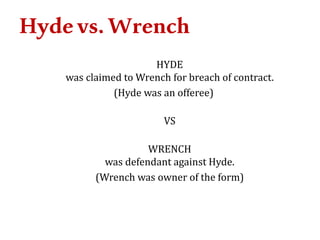
Hydevs.Wrench
HYDE
was claimed toWrench for breach of contract.
(Hyde was an offeree)
VS
WRENCH
was defendant against Hyde.
(Wrench was owner of the form)
6.
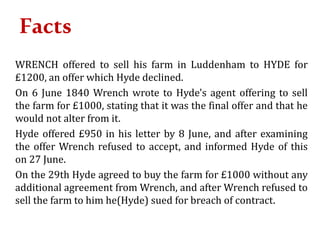
Facts
WRENCH offered tosell his farm in Luddenham to HYDE for
£1200, an offer which Hyde declined.
On 6 June 1840 Wrench wrote to Hyde's agent offering to sell
the farm for £1000, stating that it was the final offer and that he
would not alter from it.
Hyde offered £950 in his letter by 8 June, and after examining
the offer Wrench refused to accept, and informed Hyde of this
on 27 June.
On the 29th Hyde agreed to buy the farm for £1000 without any
additional agreement from Wrench, and after Wrench refused to
sell the farm to him he(Hyde) sued for breach of contract.
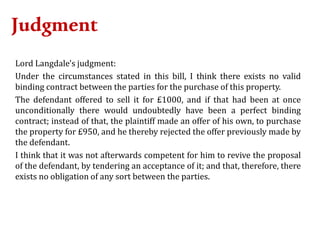
Judgment
Lord Langdale's judgment:
Underthe circumstances stated in this bill, I think there exists no valid
binding contract between the parties for the purchase of this property.
The defendant offered to sell it for £1000, and if that had been at once
unconditionally there would undoubtedly have been a perfect binding
contract; instead of that, the plaintiff made an offer of his own, to purchase
the property for £950, and he thereby rejected the offer previously made by
the defendant.
I think that it was not afterwards competent for him to revive the proposal
of the defendant, by tendering an acceptance of it; and that, therefore, there
exists no obligation of any sort between the parties.
10.
Conclusion
The court foundthat there was no contract, because acceptance had not
occurred. Where a counter offer is made this destroys the original offer so
that it is no longer open to the offeree to accept.
In it Lord Langdale ruled that any counter-offer cancels the original offer.

![Introduction…
The case of Hyde vs. Wrench in 1840 is leading English
contract law case on the issue of counter-offers and their
relation to initial offers.
In this case (Hyde v Wrench [1840] 49 ER 132)
Wrench offered to sell Hyde property for $1000. Hyde said he
would pay $950 but Wrench refused. Hyde then said he would
pay $1000, but Wrench still refused. Hyde sued, saying there
was a legal agreement between the parties. This case is
important for citizen of London in the court of Rolls Court. The
sitting judge of court was judge Lord Langdale.](https://image.slidesharecdn.com/hydevswrench-171024181438-250508091904-7309fae5/85/hydevswrenchfull-version-171024181438-pdf-4-320.jpg)