Human Resource Management Essential Perspectives 7th
Edition Mathis Solutions Manual download pdf
https://testbankdeal.com/product/human-resource-management-essential-
perspectives-7th-edition-mathis-solutions-manual/
Visit testbankdeal.com today to download the complete set of
test banks or solution manuals!
We believe these products will be a great fit for you. Click
the link to download now, or visit testbankdeal.com
to discover even more!
Human Resource Management Essential Perspectives 7th
Edition Mathis Test Bank
https://testbankdeal.com/product/human-resource-management-essential-
perspectives-7th-edition-mathis-test-bank/
Human Resource Management Essential Perspectives 6th
Edition Mathis Test Bank
https://testbankdeal.com/product/human-resource-management-essential-
perspectives-6th-edition-mathis-test-bank/
Human Resource Management 14th Edition Mathis Solutions
Manual
https://testbankdeal.com/product/human-resource-management-14th-
edition-mathis-solutions-manual/
Essentials of Psychiatric Mental Health Nursing 7th
Edition Townsend Test Bank
https://testbankdeal.com/product/essentials-of-psychiatric-mental-
health-nursing-7th-edition-townsend-test-bank/
Managerial Accounting 2nd Edition Whitecotton Test Bank
https://testbankdeal.com/product/managerial-accounting-2nd-edition-
whitecotton-test-bank/
Intermediate Accounting Reporting and Analysis 2nd Edition
Wahlen Test Bank
https://testbankdeal.com/product/intermediate-accounting-reporting-
and-analysis-2nd-edition-wahlen-test-bank/
Intermediate Algebra for College Students 7th Edition
Blitzer Solutions Manual
https://testbankdeal.com/product/intermediate-algebra-for-college-
students-7th-edition-blitzer-solutions-manual/
Introduction to Criminal Justice Systems Diversity and
Change 2nd Edition Rennison Test Bank
https://testbankdeal.com/product/introduction-to-criminal-justice-
systems-diversity-and-change-2nd-edition-rennison-test-bank/
Stats Data And Models Canadian 2nd Edition De-Veaux Test
Bank
https://testbankdeal.com/product/stats-data-and-models-canadian-2nd-
edition-de-veaux-test-bank/
Ethics and Issues in Contemporary Nursing 3rd Edition
Burkhardt Test Bank
https://testbankdeal.com/product/ethics-and-issues-in-contemporary-
nursing-3rd-edition-burkhardt-test-bank/
1
Chapter 6: Performance Management and Appraisal
© 2016 Cengage Learning. All Rights Reserved. May not be scanned, copied or duplicated, or posted to a publicly accessible website, in whole or in part.
1
Chapter 6
Performance Management and Appraisal
Chapter Overview
Performance management systems are used to identify, encourage, measure,
evaluate, improve, and reward performance. Performance appraisal is the process of
determining how well employees perform their jobs relative to a standard and then
communicating that information to them. The chapter includes discussions about the
following:
• The nature of performance management
• Identifying and measuring employee performance
• Performance appraisals
• Who conducts appraisals?
• Tools for appraising performance
• Training managers and employee in performance appraisal
• Appraisal feedback
Performance management is linked to varying corporate cultures. Globalization
requires that global organizations be aware of global cultural differences regarding
performance management issues. However, most successful organizations strive to
develop a performance-focused organizational culture rather than an entitlement
approach. Executive commitment to performance management is a crucial aspect to a
performance-focused culture.
Next, different types of performance information, relevance of performance criteria,
performance standards, and the performance metrics used in service businesses are
explored. The next section looks at performance appraisals including the use of appraisals
for administrative and development uses, important decisions about the performance
appraisal process (responsibilities, informal vs. systematic, and timing of appraisals), and
legal concerns.
Then, the issue of who conducts appraisals is covered. Traditionally, appraisals have
been conducted by an individual’s immediate supervisor, but increasingly
organizations are turning to 360o (multisource) evaluation. Managers and
supervisors may evaluate subordinates, team members may rate each other,
outsiders such as customers may do ratings, and employees may do self-appraisals.
Not to be overlooked is the possibility of employees being given the freedom to rate
2
Chapter 6: Performance Management and Appraisal
© 2016 Cengage Learning. All Rights Reserved. May not be scanned, copied or duplicated, or posted to a publicly accessible website, in whole or in part.
their managers.
Next, tools for performance appraisal are described including category scaling
methods, graphic rating scales, behaviorally anchored rating scales (BARS),
comparative methods such as ranking or forced distribution, narrative methods such
as critical incident, essay, and Management by Objectives (MBO). Each of these
methods is described with the relative advantages and limitations of each.
The chapter then presents a discussion of rater errors. Several errors are described—
recency and primacy effects, central tendency, leniency, and strictness errors; rater
bias; halo and horn effects; contrast error; similar to me/different-from-me error;
and sampling errors. The chapter ends with a discussion on appraisal feedback. Hints
for an effective appraisal interview are given, the reactions of managers and
appraised employees are discussed, and requirements for an effective performance
management system are described.
Chapter Outline
Well-designed performance management efforts greatly increase the likelihood that for
many good performance will follow and for others poor performance will be identified and
dealt with.
I. The Nature of Performance Management
The performance management process starts with identifying the goals an organization
needs to accomplish to remain competitive and profitable. Managers then determine how
they and their employees can support performance objectives by successfully completing
work. The sum of the work completed in all jobs should be what is necessary to advance
the strategic plan.
A. Strategic Performance Management
Performance management links strategy to results (Figure 6-1). However, just having a
strategic plan does not guarantee that desired results will be achieved. Strategies must
be translated into department- or unit-level actions. Then these actions must be assigned
to individuals who are then held accountable for their accomplishment.
Performance management is often confused with one of its primary components—
performance appraisal. Performance management is a series of activities designed to
ensure that the organization gets the performance it needs from its employees.
Performance appraisal is the process of determining how well employees do their jobs
3
Chapter 6: Performance Management and Appraisal
© 2016 Cengage Learning. All Rights Reserved. May not be scanned, copied or duplicated, or posted to a publicly accessible website, in whole or in part.
relative to a standard and communicating that information to them.
At a minimum a performance management system should do the following:
• Make clear what the organization expects
• Document performance for personnel records
• Identify areas of success and needed development
• Provide performance information to employees
In some countries and cultures, it is uncommon for managers to rate employees or to
give direct feedback, particularly if some points are negative. Employees may view
criticism from superiors as personally devastating rather than as useful feedback that
highlights individual training and development needs.
B. Performance-Focused Organizational Cultures
Organizational cultures can vary on many dimensions, and one of these differences
involve the degree to which performance is emphasized. Some corporate cultures are
based on an entitlement approach, which tends to mean that adequate
performance and stability dominate the organization. Employee rewards vary little
from person to person and have little to do with individual performance differences. As
a result, performance-appraisal activities are viewed as being primarily a “bureaucratic
exercise.”
At the other end of the spectrum is a performance-driven organizational culture
that is focused on results and contributions. Figure 6-2 shows the components of a
successful performance-focused culture. However, a pay-for-performance approach
can present several challenges to organizations such as the potential for creating
inequity. Despite these issues, it appears that a performance-based-pay culture is
desirable. It is sometimes argued that companies using the entitlement approach are not
doing enough about poor performers and that failure to deal with poor performance is
unfair to those who work hard.
II. Identifying and Measuring Employee Performance
Performance criteria vary from job to job, but common employee-performance measures
include the following:
• Quantity of output
• Quality of output
• Timeliness of output
• Presence/attendance on the job
• Efficiency of work completed
4
Chapter 6: Performance Management and Appraisal
© 2016 Cengage Learning. All Rights Reserved. May not be scanned, copied or duplicated, or posted to a publicly accessible website, in whole or in part.
• Effectiveness of work completed
Specific job duties from a job description should identify the important elements in a
given job and define what the organization pays employees to do. Therefore, the
performance of individuals on their job duties should be measured, compared against
appropriate standards, and the results should be communicated to the employee. Multiple
job duties are the rule rather than the exception in most jobs. An individual might
demonstrate better performance on some duties than others, and some duties might be
more important than others to the organization. Weights can be used to show the relative
importance of different duties in one job.
A. Types of Performance Information
Managers can use three different types of information about employee performance
(Figure 6-3):
• Trait-based information identifies a character trait of the employee, such as
attitude, initiative, or creativity, and may or may not be job related.
o Traits tend to be hard to identify, and biases of raters can affect how traits
are viewed, so court decisions generally have held that trait-based
performance appraisals are too vague to use when making HR decisions
such as promotions or terminations.
o Also, focusing too much on trait characteristics can lead managers to ignore
important behaviors and outcomes.
• Behavior-based information focuses on specific behaviors that lead to job success.
o Behavioral information can specify the behaviors management expects
employees to exhibit.
o A potential problem arises when any of several behaviors can lead to
successful performance, and employees rely on different behaviors to
complete work.
• Results-based information considers employee accomplishments, and for jobs in
which measurement is easy and obvious, a results-based approach works well.
B. Performance Standards
Performance standards define the expected levels of employee performance.
Sometimes they are labeled benchmarks, goals, or targets—depending on the approach
taken. Realistic, measurable, clearly understood performance standards benefit both
organizations and employees. Performance standards define how satisfactory job
performance is defined, so performance standards should be established before work is
performed. Well-defined standards ensure that everyone involved knows the
performance expectations.
5
Chapter 6: Performance Management and Appraisal
© 2016 Cengage Learning. All Rights Reserved. May not be scanned, copied or duplicated, or posted to a publicly accessible website, in whole or in part.
Both numerical and nonnumerical standards can be established. Sales quotas and
production output standards are familiar numerical performance standards. A standard
of performance can also be based on nonnumerical criteria. Assessing whether someone
has met a performance standard, especially a nonnumerical one, can be difficult.
C. Performance Metrics in Service Businesses
Measuring service performance is difficult because services are often very
individualized for customers, there is typically great variation in the services that can be
offered, and quality is somewhat subjective. Yet the performance of people in service
jobs is commonly evaluated along with the basic productivity measures used in the
industry. Some of the most useful sources of performance differences among managers
in service businesses are as follows:
• Regional differences in labor costs
• Service agreement differences
• Equipment/infrastructure differences
• Work volume
On an individual employee level, common measures might include:
• Cost per employee
• Incidents per employee per day
• Number of calls per product
• Cost per call
• Sources of demand for services
• Service calls per day
Once managers have determined appropriate measures of the service variance in their
company, they can deal with waste and service delivery.
III. Performance Appraisals
Performance appraisals are used to assess an employee’s performance and to provide a
platform for feedback about past, current, and future performance expectations. Several
terms can be used when referring to performance appraisals. These include employee
rating, employee evaluation, performance review, performance evaluation, or results
appraisal.
Performance appraisals are widely used for administering wages and salaries and for
identifying individual employee strengths and weaknesses. Performance appraisals can
provide answers to a wide array of work-related questions, and poor performance can
6
Chapter 6: Performance Management and Appraisal
© 2016 Cengage Learning. All Rights Reserved. May not be scanned, copied or duplicated, or posted to a publicly accessible website, in whole or in part.
sometimes be improved when a performance appraisal supplies a map to success. Even
after a positive appraisal, employees benefit if the feedback helped them to determine how
to improve job performance. In addition, even though an employer may not need a reason
to terminate an employee, appraisals can provide justification for such actions should that
become necessary.
But a gap may exist between actual job performance and the way it is rated. Poorly done
performance appraisals lead to disappointing results for all concerned, and there is reason
to believe that evaluations can cause bad feelings and damaged relationships if not
managed well. Indeed, performance reviews can be politically oriented and highly
subjective in nature, which will adversely impact the relationships between managers and
their employees. However, having no formal performance appraisal can weaken on-the-job
discipline and harm an employee’s ability to improve, and it is entirely possible to do an
appraisal well.
A. Performance Appraisals and Ethics
Performance appraisals may or may not focus on the ethics with which a manager
performs his or her job. Managers may be expected to take an active role in managing
ethics in their area of responsibility but often do not understand the process. Many
companies do not have a program to develop awareness of ethics and some have no
policies at all regarding ethical behavior. Discussing ethics in performance appraisals is
one way to emphasize it. Rewarding ethical behavior and punishing undesirable
behavior are also reasonable approaches for improving ethical practices in an
organization.
B. Uses of Performance Appraisals
Organizations generally use performance appraisals in two potentially conflicting ways
(Figure 6-4):
• One use is to provide a measure of performance for consideration in making pay
or other administrative decisions about employees. This administrative role often
creates stress for managers doing the appraisals and the employees being
evaluated because the rater is placed in the role of judge.
• The other use focuses on the development of individuals. In this role, the manager
acts more as a counselor and coach than as a judge.
o The developmental performance appraisal emphasizes current training and
development needs, as well as planning employees’ future opportunities and
career directions.
Administrative Uses of Appraisals
7
Chapter 6: Performance Management and Appraisal
© 2016 Cengage Learning. All Rights Reserved. May not be scanned, copied or duplicated, or posted to a publicly accessible website, in whole or in part.
Three administrative uses of appraisal impact managers and employees the most:
• Determining pay adjustments
• Making job placement decisions on promotions, transfers, and demotions
• Choosing employee disciplinary actions up to and including termination of
employment
A performance appraisal system is often the link between employee job performance
and the additional pay and rewards that the employee can receive. Performance-
based compensation affirms the idea that pay raises are given for performance
accomplishments rather than for length of service (seniority), or granted
automatically to all employees at the same percentage levels. In pay-for-performance
compensation systems, managers have evaluated the performance of individuals and
have made compensation recommendations. If any part of the appraisal process fails,
better-performing employees may not receive larger pay increases, and the result is
perceived inequity in compensation.
Many U.S. workers say that they see little connection between their performance and
the size of their pay increases due to flaws in performance appraisals. Consequently,
people argue that performance appraisals and pay discussions should be done
separately. Two realities support this view:
• One is that employees often focus more on the pay received than on the
developmental appraisal feedback.
• The other is that managers sometimes manipulate ratings to justify the pay they
wish to give individuals. As a result, many employees view the appraisal
process as a game, because compensation increases have been predetermined
before the appraisal is completed.
To address these issues, managers can first conduct performance appraisals and
discuss the results with employees, and then several weeks later hold a shorter
meeting to discuss pay issues. By adopting such an approach, the results of the
performance appraisal can be considered before the amount of the pay adjustment is
determined. Also, the performance appraisal discussions between managers and
employees can focus on issues for improvement—not just pay raises.
Developmental Uses of Appraisals
For employees, a performance appraisal can be a primary source of information and
feedback. By identifying employee strengths, weaknesses, potentials, and training
needs through performance appraisal feedback, supervisors can inform employees
about their progress, discuss areas in which additional training may be beneficial,
8
Chapter 6: Performance Management and Appraisal
© 2016 Cengage Learning. All Rights Reserved. May not be scanned, copied or duplicated, or posted to a publicly accessible website, in whole or in part.
and outline future developmental plans. It is clear that employees do not always
know where and how to perform better, and managers should not expect
improvement if they are unwilling to provide developmental feedback. The purpose
of giving feedback on performance is both to reinforce satisfactory employee
performance and to address performance deficiencies. The developmental function of
performance appraisal can also identify areas in which the employee might wish to
grow.
The use of teams provides a different set of circumstances for developmental
appraisals. The manager may not see all of an employee’s work, but the employee’s
team members do. Team members can provide important feedback. However,
whether teams can handle administrative appraisals is still subject to debate; clearly
some cannot. When teams are allowed to design appraisal systems, they tend to “get
rid of judgment” and avoid decisions based on a team member’s performance. Thus,
group appraisal may be best suited for developmental rather than administrative
purposes.
C. Decisions about the Performance-Appraisal Process
A number of decisions must be made when designing performance appraisal systems.
Some important ones involve identifying the appraisal responsibilities of the HR unit
and of the operating managers, selecting the type of appraisal system to use, and
establishing the timing of appraisals.
Appraisal Responsibilities
If done properly, the appraisal process can benefit both the organization and the
employees. The HR unit typically designs a performance appraisal system (Figure 6-
5). Managers then appraise employees using the appraisal system. During
development of the formal appraisal system, managers usually offer input on how the
final system will work.
It is important for managers to understand that appraisals are their responsibility.
Through the appraisal process, good employee performance can be made even better,
poor employee performance can be improved and poor performers can be removed
from the organization. Performance appraisal must not be simply an HR requirement
but should also be an important management process, because guiding employees’
performance is among the most important responsibilities a manager has.
Type of Appraisals: Informal versus Systematic
9
Chapter 6: Performance Management and Appraisal
© 2016 Cengage Learning. All Rights Reserved. May not be scanned, copied or duplicated, or posted to a publicly accessible website, in whole or in part.
Performance appraisals can occur in two ways: informally and/or systematically.
• A supervisor conducts an informal appraisal whenever necessary. The day-to-
day working relationship between a manager and an employee offers an
opportunity for the evaluation of individual performance.
o A manager communicates this evaluation through various conversations
on or off the job, or by on-the-spot discussion of a specific occurrence.
Although such informal feedback is useful and necessary, it should not
replace formal appraisal.
o Frequent informal feedback to employees can prevent surprises during a
formal performance review. However, informal appraisal can become too
informal.
• A systematic appraisal is used when the contact between a manager and
employee is more formal, and a system is in place to report managerial
impressions and observations on employee performance. This approach to
appraisals is quite common.
o Systematic appraisals feature a regular time interval, which distinguishes
them from informal appraisals. Both employees and managers know that
performance will be reviewed on a regular basis, and they can plan for
performance discussions.
Timing of Appraisals
Most companies require managers to conduct appraisals once or twice a year, most
often annually. Employees commonly receive an appraisal 60 to 90 days after hiring,
again at 6 months, and annually thereafter. Probationary or introductory employees,
who are new and in a trial period, should be informally evaluated often—perhaps
weekly for the first month, and monthly thereafter until the end of the introductory
period. After that, annual reviews are typical. For employees in high demand, some
employers use accelerated appraisals—every six months instead of every year. This
is done to retain those employees since more feedback can be given and pay raises
may occur more often. Meeting more frequently with employees may enhance
individual performance.
D. Legal Concerns and Performance Appraisals
Since appraisals are supposed to measure how well employees are doing their jobs, it
may seem unnecessary to emphasize that performance appraisals must be job related.
However, it is important for evaluations to adequately reflect the nature of work
performed. Companies need to have appraisal systems that satisfy the courts, as well as
performance management needs.
10
Chapter 6: Performance Management and Appraisal
© 2016 Cengage Learning. All Rights Reserved. May not be scanned, copied or duplicated, or posted to a publicly accessible website, in whole or in part.
IV. Who Conducts Appraisals?
Performance appraisals can be conducted by anyone familiar with the performance of
individual employees. Possible rating situations include the following:
• Supervisors rating their employees
• Employees rating their superiors
• Team members rating each other
• Employees rating themselves
• Outside sources rating employees
• A variety of parties providing multisource, or 360-degree, feedback
A. Supervisory Rating of Subordinates
The most widely used means of rating employees is based on the assumption that the
immediate supervisor is the person most qualified to evaluate an employee’s
performance realistically and fairly. To help provide accurate evaluations, some
supervisors keep records of employee performance so that they can reference these
notes when rating performance.
B. Employee Rating of Managers
A number of organizations ask employees to rate the performance of their immediate
managers. A variation of this type of rating takes place in colleges and universities,
where students evaluate the teaching effectiveness of professors in the classroom. These
performance appraisal ratings are generally used for management development
purposes.
Requiring employees to rate managers provides three primary advantages:
• In critical manager-employee relationships, employee ratings can be quite useful
for identifying competent managers.
• This type of rating program can help make a manager more responsive to
employees. This advantage can quickly become a disadvantage if the manager
focuses on being “nice” rather than on managing.
• Employee appraisals can contribute to career-development efforts for managers
by identifying areas for growth.
A major disadvantage of asking employees to rate managers is the negative reaction
many have to being evaluated by employees. Also, the fear of reprisals may be too great
for employees to give realistic ratings.
C. Team/Peer Rating
11
Chapter 6: Performance Management and Appraisal
© 2016 Cengage Learning. All Rights Reserved. May not be scanned, copied or duplicated, or posted to a publicly accessible website, in whole or in part.
Team/peer ratings are especially useful when supervisors do not have the opportunity to
observe each employee’s performance but work group members do. Peer evaluations
are also common in collegiate schools of business where professors commonly require
students to conduct peer evaluations after the completion of group-based projects. One
challenge of this approach is obtaining ratings for virtual or global teams, in which the
individuals work primarily through technology, not in person (i.e., an online college
class). Another challenge is obtaining ratings from and for individuals who are on many
special project teams throughout the year.
It is possible that any performance appraisal, including team/peer ratings, can negatively
affect teamwork and participative management efforts. Although team members have
good information on one another’s performance, they may not choose to share it in the
interest of sparing feelings; alternatively, they may unfairly attack other group
members. Some organizations attempt to overcome such problems by using anonymous
appraisals and/or having a consultant or HR manager interpret team/peer ratings.
D. Self-Rating
Self-appraisal requires employees to think about their strengths and weaknesses and set
goals for improvement. Employees working in isolation or possessing unique skills may
be particularly suited to self-ratings because they are the only ones qualified to rate
themselves. Overall, the use of self-appraisals in organizations has increased. However,
employees may use quite different standards and not rate themselves in the same
manner as supervisors.
E. Outsider Rating
People outside the immediate work group may be asked to participate in performance
reviews. This “field review” approach can include someone from the HR department as
a reviewer, or it may include completely independent reviewers from outside the
organization. A disadvantage of this approach is that outsiders may not know the
important demands within the work group or organization.
The customers or clients of an organization are good sources for outside appraisals. For
sales and service jobs, customers may provide useful input on the performance
behaviors of employees. This information is commonly used for job development
purposes.
F. Multisource/360-Degree Rating
12
Chapter 6: Performance Management and Appraisal
© 2016 Cengage Learning. All Rights Reserved. May not be scanned, copied or duplicated, or posted to a publicly accessible website, in whole or in part.
Multi-source feedback recognizes that for many jobs, employee performance is
multidimensional and crosses departmental, organizational, and even national
boundaries. Therefore, it is designed to capture evaluations of the employee’s different
roles from different raters to provide richer feedback during an evaluation.
Significant administrative time and paperwork are required to request, obtain, and
summarize feedback from multiple raters. Using electronic systems for the information
can greatly reduce the administrative demands of multisource ratings and increase the
effectiveness (i.e., privacy and expediency) of the process.
Developmental Use of Multisource Feedback
Multisource feedback focuses on the use of appraisals for the development of
individuals. Conflict resolution skills, decision-making abilities, team effectiveness,
communication skills, managerial styles, and technical capabilities are just some of
the developmental areas that can be evaluated.
Administrative Use of Multisource Feedback
When using 360-degree feedback for administrative purposes, managers must
anticipate the potential problems. Differences among raters can present a challenge,
especially when using 360-degree ratings for discipline or pay decisions. Bias can
just as easily be rooted in customers, subordinates, and peers as in a boss, and the
lack of accountability of those sources can affect the ratings. “Inflation” of ratings is
common when the sources know that their input will affect someone’s pay or career.
Also, issues of confidentiality and anonymity have led to lawsuits. Even though
multisource approaches offer possible solutions to some of the well-documented
dissatisfaction associated with performance appraisals, a number of other questions
have arisen as multisource appraisals have become more common.
Evaluating Multisource Feedback
Research on multisource/360-degree feedback has revealed both positives and
negatives. More variability than expected may be seen in the ratings given by the
different sources. Thus, supervisor ratings may need to carry more weight than peer
or subordinate input to resolve the differences. One concern is that those peers who
rate poor-performing coworkers tend to inflate the ratings so that the peers
themselves can get higher overall evaluation results in return.
Also, some wonder whether multisource appraisals really create sufficiently better
decisions to offset the additional time and investment required. These issues appear
13
Chapter 6: Performance Management and Appraisal
© 2016 Cengage Learning. All Rights Reserved. May not be scanned, copied or duplicated, or posted to a publicly accessible website, in whole or in part.
to be less threatening when the 360-degree feedback is used only for development, so
companies should consider using multisource feedback primarily as a developmental
tool to enhance future job performance while minimizing the use of multisource
appraisals as an administrative tool.
V. Tools for Appraising Performance
Performance can be appraised by a number of methods.
A. Category Scaling Methods
The simplest methods for appraising performance are category scaling methods, which
require a manager to mark an employee’s level of performance on a specific form
divided into categories of performance. A checklist uses a list of statements or words
from which raters check statements that are most representative of the characteristics
and performance of employees. Often, a scale indicating perceived level of
accomplishment on each statement is included with the checklist, which then becomes a
type of graphic rating scale.
B. Graphic Rating Scales
The graphic rating scale allows the rater to mark an employee’s performance on a
continuum indicating low to high levels of a particular characteristic. Because of the
straightforwardness of the process, graphic rating scales are common in performance
evaluations. Figure 6-6 shows a sample appraisal form that combines graphic rating
scales with essays. Three aspects of performance can be appraised using graphic rating
scales:
• Descriptive categories (such as quantity of work, attendance, and dependability)
• Job duties (taken from the job description)
• Behavioral dimensions (such as decision making, employee development, and
communication effectiveness)
Concerns with Graphic Rating Scales
Graphic rating scales in many forms are widely used because they are easy to
develop and provide a uniform set of criteria to evaluate the job performance of
different employees. However, the use of scales can cause rater error because the
form might not accurately reflect the relative importance of certain job
characteristics, and some factors might need to be added to the ratings for one
employee, while others might need to be dropped. If they fit the person and the job,
the scales work well. However, if they fit poorly, managers and employees who must
14
Chapter 6: Performance Management and Appraisal
© 2016 Cengage Learning. All Rights Reserved. May not be scanned, copied or duplicated, or posted to a publicly accessible website, in whole or in part.
use them frequently might complain about “the rating form.”
Regardless of the scales used, the focus should be on the job duties and
responsibilities identified in job descriptions. The closer the link between the scales
and what people actually do, as identified in current and complete job descriptions,
the stronger the relationship between the ratings and the job, as viewed by employees
and managers. Also, should the performance appraisal results be challenged legally,
the closer performance appraisals measure what people actually do, the more likely
employers are to prevail in a lawsuit.
An additional drawback to graphic rating scales is that separate traits or factors are
often grouped, and the rater is given only one box to check. Another drawback is that
the descriptive words sometimes used in scales may have different meanings to
different raters.
Behavioral Rating Scales
In an attempt to overcome some of the concerns with graphic rating scales,
employers may use behavioral rating scales designed to assess individual actions
instead of personal attributes and characteristics. Different approaches are used, but
all describe specific examples of employee job behaviors. In a behaviorally
anchored rating scale (BARS), these examples are “anchored” or measured against
a scale of performance levels.
When creating a BARS system, identifying important job dimensions, which are the
most important performance factors in a job description, is done first. Short
statements describe both desirable and undesirable behaviors (anchors). These are
then “translated,” or assigned, to one of the job dimensions. Anchor statements are
usually developed by a group of people familiar with the job.
Several problems are associated with the behavioral approaches:
• Creating and maintaining behaviorally anchored rating scales requires
extensive time and effort.
• Many appraisal forms are needed to accommodate different types of jobs in an
organization.
C. Comparative Methods
Comparative methods require that managers directly compare the performance levels of
their employees against one another, and these comparisons can provide useful
information for performance management. Comparative techniques include ranking and
15
Chapter 6: Performance Management and Appraisal
© 2016 Cengage Learning. All Rights Reserved. May not be scanned, copied or duplicated, or posted to a publicly accessible website, in whole or in part.
forced distribution.
Ranking
The ranking method lists the individuals being rated from highest to lowest based on
their performance levels and relative contributions. One disadvantage of this process
is that the sizes of the performance differences between employees are often not
clearly indicated. This limitation can be mitigated to some extent by assigning points
to indicate performance differences. Ranking also means someone must be last,
which ignores the possibility that the last-ranked individual in one group might be
equal to the top-ranked employee in a different group. Further, the ranking task
becomes unwieldy if the group of employees to be ranked is large.
Forced Distribution
Forced distribution is a technique for distributing ratings that are generated with any
of the other appraisal methods and comparing the ratings of people in a work group.
With the forced distribution method, the ratings of employees’ performance must
be distributed along a bell-shaped curve.
Advantages and Disadvantages of Forced Distribution
One reason why firms have mandated the use of forced distributions for appraisal
ratings is to deal with “rater inflation.” The use of a forced distribution system forces
managers to identify high, average, and low performers. Thus, high performers can
be rewarded and developed, while low performers can be encouraged to improve or
leave.
But the forced distribution method suffers from several drawbacks:
• One problem is that a supervisor may resist placing any individual in the
lowest (or the highest) group.
• Difficulties also arise when the rater must explain to an employee why he or
she was placed in one group while others were placed in higher groups.
D. Narrative Methods
Managers may be required to provide written appraisal narratives. Some appraisal
methods are entirely written, rather than using predetermined rating scales or ranking
structures. Documentation and descriptive text are the basic components of the critical
incident method and the essay methods.
Random documents with unrelated
content Scribd suggests to you:
The Project Gutenberg eBook of Mexican
Copper Tools: The Use of Copper by the
Mexicans Before the Conquest; and the
Katunes of Maya History, a Chapter in the
Early History of Central America, With
Special Reference to the Pio Perez
Manuscript.
This ebook is for the use of anyone anywhere in the United
States and most other parts of the world at no cost and with
almost no restrictions whatsoever. You may copy it, give it away
or re-use it under the terms of the Project Gutenberg License
included with this ebook or online at www.gutenberg.org. If you
are not located in the United States, you will have to check the
laws of the country where you are located before using this
eBook.
Title: Mexican Copper Tools: The Use of Copper by the Mexicans
Before the Conquest; and the Katunes of Maya History,
a Chapter in the Early History of Central America, With
Special Reference to the Pio Perez Manuscript.
Author: Philipp J. J. Valentini
Contributor: Juan Pío Pérez
Translator: Stephen Salisbury
Release date: September 24, 2018 [eBook #57961]
Language: English
Credits: Produced by Richard Tonsing, Julia Miller and the Online
Distributed Proofreading Team at http://www.pgdp.net
(This
file was produced from images generously made
available
by The Internet Archive/American Libraries.)
*** START OF THE PROJECT GUTENBERG EBOOK MEXICAN
COPPER TOOLS: THE USE OF COPPER BY THE MEXICANS BEFORE
THE CONQUEST; AND THE KATUNES OF MAYA HISTORY, A
CHAPTER IN THE EARLY HISTORY OF CENTRAL AMERICA, WITH
SPECIAL REFERENCE TO THE PIO PEREZ MANUSCRIPT. ***
MEXICAN COPPER TOOLS:
THE USE OF COPPER BY THE MEXICANS BEFORE THE CONQUEST;
AND
THE KATUNES OF MAYA
HISTORY,
A CHAPTER IN THE
EARLY HISTORY OF CENTRAL AMERICA,
With Special Reference to the Pio Perez Manuscript.
BY
PHILIPP J. J. VALENTINI, Ph.D.
[Translated from the German, by Stephen Salisbury, Jr.]
WORCESTER, MASS.:
PRESS OF CHARLES HAMILTON.
1880.
[Proceedings of American Antiquarian Society, April 29, and
October 21, 1879.]
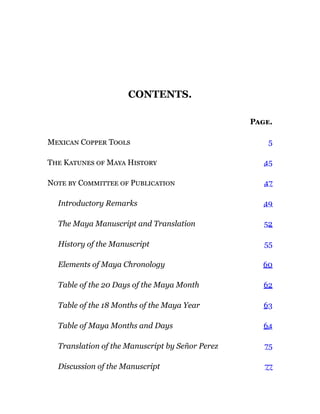
CONTENTS.
Page.
Mexican Copper Tools 5
The Katunes of Maya History 45
Note by Committee of Publication 47
Introductory Remarks 49
The Maya Manuscript and Translation 52
History of the Manuscript 55
Elements of Maya Chronology 60
Table of the 20 Days of the Maya Month 62
Table of the 18 Months of the Maya Year 63
Table of Maya Months and Days 64
Translation of the Manuscript by Señor Perez 75
Discussion of the Manuscript 77
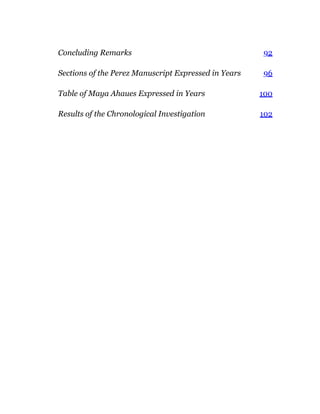
Concluding Remarks 92
Sections of the Perez Manuscript Expressed in Years 96
Table of Maya Ahaues Expressed in Years 100
Results of the Chronological Investigation 102
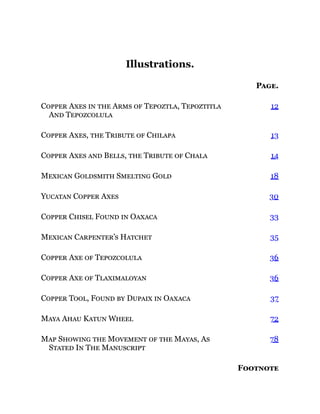
Illustrations.
Page.
Copper Axes in the Arms of Tepoztla, Tepoztitla
And Tepozcolula
12
Copper Axes, the Tribute of Chilapa 13
Copper Axes and Bells, the Tribute of Chala 14
Mexican Goldsmith Smelting Gold 18
Yucatan Copper Axes 30
Copper Chisel Found in Oaxaca 33
Mexican Carpenter’s Hatchet 35
Copper Axe of Tepozcolula 36
Copper Axe of Tlaximaloyan 36
Copper Tool, Found by Dupaix in Oaxaca 37
Maya Ahau Katun Wheel 72
Map Showing the Movement of the Mayas, As
Stated In The Manuscript
78
Footnote
Yucatan Axe, From Landa 17
Indian Battle Axe, From Oviedo 19
MEXICAN COPPER TOOLS.
By Philipp J. J. Valentini, Ph.D.
[From the German, by Stephen Salisbury, Jr.]
[From Proceedings of American Antiquarian Society, April 30, 1879.]
The subject of prehistoric copper mining, together with the trade
in the metal and the process of its manufacture into implements and
tools by the red men of North America, has engaged the attention of
numerous investigators.
It was while listening to an interesting paper on prehistoric copper
mining at Lake Superior, read by Prof. Thomas Egleston before the
Academy of Sciences, of New York, March 9, 1879, that the writer
was reminded of a number of notes which he had made, some time
previous, on the same subject. These notes, however, covered a
department of research not included in the lecture of that evening.
They were collected in order to secure all the material extant in
relation to the copper products of Mexico and Central America.
Nevertheless, this treatment of a subject so germain to ours, could
not help imparting an impulse to a rapid comparison of the results of
our own studies with those of others. It brought to light striking
agreements, as well as disagreements, which existed in connection
with the copper industries of the two widely separated races. On the
one hand it appeared that both of these ancient people were
unacquainted with iron; both were trained to the practise of war,
and, strange to say, both had invariably abstained from shaping
copper into any implement of war, the metal being appropriated
solely to the uses of peace.
But, on the other hand, whilst the northern red man attained to his
highest achievement in the production of the axe, the native of
Central America could boast of important additions to his stock of
tools. He possessed copper implements for tilling the fields, and
knew the uses of the chisel. Besides, when he wished to impart to the
copper a definite form, he showed a superior ingenuity. The northern
Indian simply took a stone, and by physical force hammered the
metal into the required shape. But the skilled workman of Tecoatega
and Tezcuco, subjecting the native copper to the heat of the furnace,
cast the woodcutter’s axe in a mould, as well as the bracelets and the
fragile earrings that adorned the princesses of Motezuma.
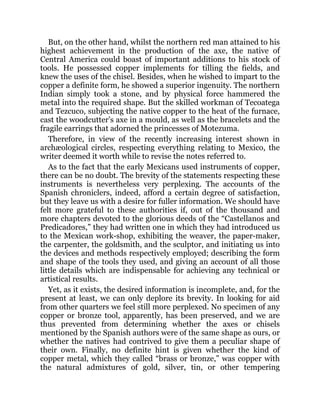
Therefore, in view of the recently increasing interest shown in
archæological circles, respecting everything relating to Mexico, the
writer deemed it worth while to revise the notes referred to.
As to the fact that the early Mexicans used instruments of copper,
there can be no doubt. The brevity of the statements respecting these
instruments is nevertheless very perplexing. The accounts of the
Spanish chroniclers, indeed, afford a certain degree of satisfaction,
but they leave us with a desire for fuller information. We should have
felt more grateful to these authorities if, out of the thousand and
more chapters devoted to the glorious deeds of the “Castellanos and
Predicadores,” they had written one in which they had introduced us
to the Mexican work-shop, exhibiting the weaver, the paper-maker,
the carpenter, the goldsmith, and the sculptor, and initiating us into
the devices and methods respectively employed; describing the form
and shape of the tools they used, and giving an account of all those
little details which are indispensable for achieving any technical or
artistical results.
Yet, as it exists, the desired information is incomplete, and, for the
present at least, we can only deplore its brevity. In looking for aid
from other quarters we feel still more perplexed. No specimen of any
copper or bronze tool, apparently, has been preserved, and we are
thus prevented from determining whether the axes or chisels
mentioned by the Spanish authors were of the same shape as ours, or
whether the natives had contrived to give them a peculiar shape of
their own. Finally, no definite hint is given whether the kind of
copper metal, which they called “brass or bronze,” was copper with
the natural admixtures of gold, silver, tin, or other tempering
elements, or whether the Mexicans had themselves discovered the
devices of hardening, and combined the elements in due
conventional proportions.
All these questions are of the highest interest, and claim an
answer. Our most renowned authorities for Mexican archæology and
history, Humboldt, Prescott and Brasseur de Bourbourg,[1]
pass over
this subject without giving any desired satisfaction. They do not go
much farther than to repeat the statements furnished by the writers
in the same language as they received them.
These early statements will form the principal portion of the
material out of which we weave the text of our discussion. In order
that the reader may be better prepared to enter into our reasoning
and judge of the correctness of our conclusions, we shall, in
translation, place the statements of these authors below the text, in
the form of foot-notes; though, in cases where it is believed that the
reader may desire to see the originals, the Spanish text is given.
Considerable help has been derived from a source hitherto very little
consulted, that of the native paintings, which represent copper
implements. As will be seen, they make up, to a certain extent, for
the deficiency of the latter in collections. The cuts we give are of the
same size as those we find copied in the Kingsborough Collection.
We shall speak first of those localities whence the natives procured
their copper and their tin; secondly, of the manner in which they
used to melt metals; thirdly, consider whether the metal was
moulded or hammered; and fourthly, discuss the various forms into
which their tools appear to have been shaped.
That the natives of the New World collected and worked other
metals besides gold and silver, seems to have become known to the
Spaniards only after their entrance into the city of Mexico, A.D. 1521.
During the first epoch, in which the West India Islands and the
Atlantic coasts of South and Central America were explored and
conquered, no specimen of utensils, tools or weapons, made of brass
or copper, was discovered to be in the possession of the inhabitants.
So also in Yucatan, Tlascalla, and on the high plateau of Anahuac,
where mechanics and industry were found to have a home, and
where the native warrior exhibited his person in the most gorgeous
military attire, their swords, javelins, lances and arrows, showed that
concerning the manufacture of arms they had, so to speak, not yet
emerged from the Stone-Age. And finally, when brass, copper, tin,
and even lead, were seen exposed for sale in the stalls of the market-
place of Mexico, it was noticed to the great astonishment of the
conquerors, that these metals had exclusively served the natives for
the manufacture of mere instruments of peace.
The Spanish leader communicates these facts to his emperor in
these few words:[2]
—“Besides all kind of merchandise, I have seen for
sale trinkets made of gold and silver, of lead, bronze, copper and tin.”
Almost the same expressions are used in the memoirs of his
companion, Bernal Diaz de Castillo:[3]
—“And I saw axes of bronze,
and copper, and tin.” Under the influences of such a revelation the
hearts of the distressed Spaniards must have been elated with joy
and courage, when they saw not only a prospect of replacing the
arms which their small band had lost, but also the source from which
to equip the faithful Indian allies of Tlascala in an efficient manner.
Immediately after having taken firm foothold on the conquered
ground, Cortes ordered the goldsmiths of Tezcuco to cast eight
thousand arrow-heads of copper, and these weapons were made
ready for delivery within a single week.[4]
At the same time, too, the
hope to have a supply of cannon made was presented to the
conqueror’s mind. The only question was from whence to procure a
sufficient quantity of the material necessary to carry out this design.
Copper is found to-day in nearly all the states of the Mexican
Republic. We abstain, therefore, from quoting the localities. But as
far as our information goes, no writer or historian has stated where
Cortes and before him the natives themselves found it. To investigate
this matter might be of direct utility, at least. We intend to use a
source hitherto little explored, but which for the history of Mexico is
of greatest importance, the picture tables, called the Codices
Mexicana. These collections contain representations of their
historical, religious, social and commercial life. The writer of this
article has made himself familiar with these sources, expecting to
find in them disclosures about the location of the ancient copper
mines, as soon as he could discover what copper was called in the
language of the natives. The answer comes in this connection.
The Mexicans had the habit of giving a name to their towns and
districts from the objects which were found in abundance in their
neighborhood. Therefore, copper regions ought to bear a name
which related to this mineral.
In Lord Kingsborough’s Collection, Vol. V., pages 115–124, there
are two printed alphabetical indices of the names of all the towns,
whose hieroglyphic symbol, or, as we term it, whose coat of arms, is
represented in the Codex Mendoza, to be found in Vol. I. of the same
collection, pages 1–72. This Codex is arranged in three sections. The
first shows the picture-annals of the ancient Aztec-Kings, and the
cities which they conquered (pages 1–17). The second reproduces
again the coats of arms of these cities, but gives in addition the
pictures of all the objects of tribute which these cities had to pay. The
third section exhibits an illustration of how Mexican children were
trained from infancy up to their 15th year. Sections first and second
will claim our interest, exclusively.
Copper, we learn from the Dictionary of Molina[5]
was named in
the language of the Nahoa speaking natives, tepuzque.[6]
Upon
searching in the above quoted Codices, we find three names of towns
which are compounds of this word tepuzque. Their names appear in
the following form: Tepoztla, Vol. I., page 8, fig. 2, and the same
name on page 26, fig. 13. Tepoztitla, page 42, fig. 10, and
Tepozcolula, page 43, fig. 3.
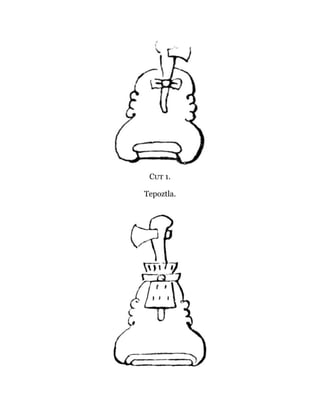
The cuts 1, 2, 3 and 4, are faithful reproductions of the coats of
arms belonging to these towns.
Cut 1.
Tepoztla.
Cut 2.
Tepoztla.
Cut 3.
Tepoztitla.
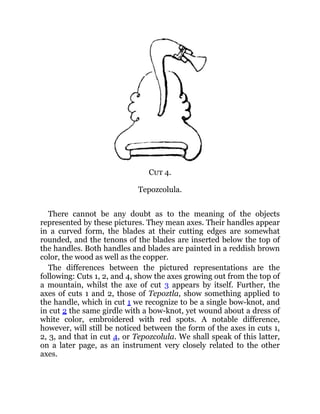
Cut 4.
Tepozcolula.
There cannot be any doubt as to the meaning of the objects
represented by these pictures. They mean axes. Their handles appear
in a curved form, the blades at their cutting edges are somewhat
rounded, and the tenons of the blades are inserted below the top of
the handles. Both handles and blades are painted in a reddish brown
color, the wood as well as the copper.
The differences between the pictured representations are the
following: Cuts 1, 2, and 4, show the axes growing out from the top of
a mountain, whilst the axe of cut 3 appears by itself. Further, the
axes of cuts 1 and 2, those of Tepoztla, show something applied to
the handle, which in cut 1 we recognize to be a single bow-knot, and
in cut 2 the same girdle with a bow-knot, yet wound about a dress of
white color, embroidered with red spots. A notable difference,
however, will still be noticed between the form of the axes in cuts 1,
2, 3, and that in cut 4, or Tepozcolula. We shall speak of this latter,
on a later page, as an instrument very closely related to the other
axes.
By means of these pictures we arrive at the knowledge of the
following facts: Copper was undoubtedly found in the neighborhood
of the three named cities. Moreover, copper in these cities was
wrought into axe-blades. Finally, the axe will turn out to be the
symbol used for copper, in general.
Let us accept these facts and see whether this picture for the
symbol for copper does not return on other pages of the same Codex,
and thereby gain more information on the subject. We notice the
picture of the axe-blade reappearing on the pages 39 and 42. Both
happen to bear the same number, that of figure 20, and both belong
to the same section of the Codex which contains the pictures of the
tributes paid by the conquered towns. Cut 5 is a reproduction of fig.
20, page 39, Codex Mendoza. It shows the metal axe without a
handle hanging on a thread from a line upon which we see five flags
are painted. Moreover, at the left side is a little picture. A flag in
Mexican symbol writing signifies the number twenty.[7]
Cut 5.
Town of Chilapa.
We may therefore conclude that by this combination one hundred
copper axes are indicated. The question now arises, what city may
have paid this tribute of copper axes? The painter has not only
omitted to connect directly these flags and axe with one of the
various coats of arms that are grouped in their neighborhood, but
even, if he had done so, the student, still unacquainted with the art of
explaining pictures, would be unable to make out the name of the
city, embodied in the picture of the coat of arms. We will overcome
this difficulty by consulting the interpretation of the Codex Mendoza,
which is printed on the pages 39–89 of Vol. V., Kingsb. Collection.
There, on page 73, the suggestion is given that the tribute objects
refer to the town of Chilapa, whose coat of arms (fig. 2), as we shall
notice on the cut, consists of a tub filled with water, and on whose
surface the chilli-fruit appears, better known as the Spanish red
pepper chilli, red pepper, atl, water, pa, in or above. For this reason
we learn that the town of Chilapa was tributary in 100 axes.
Cut 6.
Town of Chala.
In like manner we may proceed with the definition of the picture
found on page 42, fig. 20. The copy given in cut 6, shows 80 blades of
copper axes in fig. 20, and besides 40 little copper bells in fig. 19, and
the interpretation, Vol. V., page 76, informs us that it was the town of
Chala, fig. 26, which had to pay this kind of tribute.
Therefore, the towns of Tepoztla, Tepoztitla, Tepozcolula, and,
besides, those of Chilapa and Xala, must be considered to have been
connected, in one way or the other, with copper mining, copper
manufacture, and the tribute of the same.[8]
A few words on the procuring of the metal from localities where it
was discovered by the natives, may find a suitable place here.
Mining, as we understand it to-day, or as the Spaniards understood
it already at the time of the conquest, was not practised by the
natives. Gold and silver were not broken from the entrails of the
Welcome to our website – the perfect destination for book lovers and
knowledge seekers. We believe that every book holds a new world,
offering opportunities for learning, discovery, and personal growth.
That’s why we are dedicated to bringing you a diverse collection of
books, ranging from classic literature and specialized publications to
self-development guides and children's books.
More than just a book-buying platform, we strive to be a bridge
connecting you with timeless cultural and intellectual values. With an
elegant, user-friendly interface and a smart search system, you can
quickly find the books that best suit your interests. Additionally,
our special promotions and home delivery services help you save time
and fully enjoy the joy of reading.
Join us on a journey of knowledge exploration, passion nurturing, and
personal growth every day!
testbankdeal.com

Human Resource Management Essential Perspectives 7th Edition Mathis Solutions Manual

  • 1.
    Human Resource ManagementEssential Perspectives 7th Edition Mathis Solutions Manual download pdf https://testbankdeal.com/product/human-resource-management-essential- perspectives-7th-edition-mathis-solutions-manual/ Visit testbankdeal.com today to download the complete set of test banks or solution manuals!

  • 2.
    We believe theseproducts will be a great fit for you. Click the link to download now, or visit testbankdeal.com to discover even more! Human Resource Management Essential Perspectives 7th Edition Mathis Test Bank https://testbankdeal.com/product/human-resource-management-essential- perspectives-7th-edition-mathis-test-bank/ Human Resource Management Essential Perspectives 6th Edition Mathis Test Bank https://testbankdeal.com/product/human-resource-management-essential- perspectives-6th-edition-mathis-test-bank/ Human Resource Management 14th Edition Mathis Solutions Manual https://testbankdeal.com/product/human-resource-management-14th- edition-mathis-solutions-manual/ Essentials of Psychiatric Mental Health Nursing 7th Edition Townsend Test Bank https://testbankdeal.com/product/essentials-of-psychiatric-mental- health-nursing-7th-edition-townsend-test-bank/
  • 3.
    Managerial Accounting 2ndEdition Whitecotton Test Bank https://testbankdeal.com/product/managerial-accounting-2nd-edition- whitecotton-test-bank/ Intermediate Accounting Reporting and Analysis 2nd Edition Wahlen Test Bank https://testbankdeal.com/product/intermediate-accounting-reporting- and-analysis-2nd-edition-wahlen-test-bank/ Intermediate Algebra for College Students 7th Edition Blitzer Solutions Manual https://testbankdeal.com/product/intermediate-algebra-for-college- students-7th-edition-blitzer-solutions-manual/ Introduction to Criminal Justice Systems Diversity and Change 2nd Edition Rennison Test Bank https://testbankdeal.com/product/introduction-to-criminal-justice- systems-diversity-and-change-2nd-edition-rennison-test-bank/ Stats Data And Models Canadian 2nd Edition De-Veaux Test Bank https://testbankdeal.com/product/stats-data-and-models-canadian-2nd- edition-de-veaux-test-bank/
  • 4.
    Ethics and Issuesin Contemporary Nursing 3rd Edition Burkhardt Test Bank https://testbankdeal.com/product/ethics-and-issues-in-contemporary- nursing-3rd-edition-burkhardt-test-bank/
  • 5.
    1 Chapter 6: PerformanceManagement and Appraisal © 2016 Cengage Learning. All Rights Reserved. May not be scanned, copied or duplicated, or posted to a publicly accessible website, in whole or in part. 1 Chapter 6 Performance Management and Appraisal Chapter Overview Performance management systems are used to identify, encourage, measure, evaluate, improve, and reward performance. Performance appraisal is the process of determining how well employees perform their jobs relative to a standard and then communicating that information to them. The chapter includes discussions about the following: • The nature of performance management • Identifying and measuring employee performance • Performance appraisals • Who conducts appraisals? • Tools for appraising performance • Training managers and employee in performance appraisal • Appraisal feedback Performance management is linked to varying corporate cultures. Globalization requires that global organizations be aware of global cultural differences regarding performance management issues. However, most successful organizations strive to develop a performance-focused organizational culture rather than an entitlement approach. Executive commitment to performance management is a crucial aspect to a performance-focused culture. Next, different types of performance information, relevance of performance criteria, performance standards, and the performance metrics used in service businesses are explored. The next section looks at performance appraisals including the use of appraisals for administrative and development uses, important decisions about the performance appraisal process (responsibilities, informal vs. systematic, and timing of appraisals), and legal concerns. Then, the issue of who conducts appraisals is covered. Traditionally, appraisals have been conducted by an individual’s immediate supervisor, but increasingly organizations are turning to 360o (multisource) evaluation. Managers and supervisors may evaluate subordinates, team members may rate each other, outsiders such as customers may do ratings, and employees may do self-appraisals. Not to be overlooked is the possibility of employees being given the freedom to rate
  • 6.
    2 Chapter 6: PerformanceManagement and Appraisal © 2016 Cengage Learning. All Rights Reserved. May not be scanned, copied or duplicated, or posted to a publicly accessible website, in whole or in part. their managers. Next, tools for performance appraisal are described including category scaling methods, graphic rating scales, behaviorally anchored rating scales (BARS), comparative methods such as ranking or forced distribution, narrative methods such as critical incident, essay, and Management by Objectives (MBO). Each of these methods is described with the relative advantages and limitations of each. The chapter then presents a discussion of rater errors. Several errors are described— recency and primacy effects, central tendency, leniency, and strictness errors; rater bias; halo and horn effects; contrast error; similar to me/different-from-me error; and sampling errors. The chapter ends with a discussion on appraisal feedback. Hints for an effective appraisal interview are given, the reactions of managers and appraised employees are discussed, and requirements for an effective performance management system are described. Chapter Outline Well-designed performance management efforts greatly increase the likelihood that for many good performance will follow and for others poor performance will be identified and dealt with. I. The Nature of Performance Management The performance management process starts with identifying the goals an organization needs to accomplish to remain competitive and profitable. Managers then determine how they and their employees can support performance objectives by successfully completing work. The sum of the work completed in all jobs should be what is necessary to advance the strategic plan. A. Strategic Performance Management Performance management links strategy to results (Figure 6-1). However, just having a strategic plan does not guarantee that desired results will be achieved. Strategies must be translated into department- or unit-level actions. Then these actions must be assigned to individuals who are then held accountable for their accomplishment. Performance management is often confused with one of its primary components— performance appraisal. Performance management is a series of activities designed to ensure that the organization gets the performance it needs from its employees. Performance appraisal is the process of determining how well employees do their jobs
  • 7.
    3 Chapter 6: PerformanceManagement and Appraisal © 2016 Cengage Learning. All Rights Reserved. May not be scanned, copied or duplicated, or posted to a publicly accessible website, in whole or in part. relative to a standard and communicating that information to them. At a minimum a performance management system should do the following: • Make clear what the organization expects • Document performance for personnel records • Identify areas of success and needed development • Provide performance information to employees In some countries and cultures, it is uncommon for managers to rate employees or to give direct feedback, particularly if some points are negative. Employees may view criticism from superiors as personally devastating rather than as useful feedback that highlights individual training and development needs. B. Performance-Focused Organizational Cultures Organizational cultures can vary on many dimensions, and one of these differences involve the degree to which performance is emphasized. Some corporate cultures are based on an entitlement approach, which tends to mean that adequate performance and stability dominate the organization. Employee rewards vary little from person to person and have little to do with individual performance differences. As a result, performance-appraisal activities are viewed as being primarily a “bureaucratic exercise.” At the other end of the spectrum is a performance-driven organizational culture that is focused on results and contributions. Figure 6-2 shows the components of a successful performance-focused culture. However, a pay-for-performance approach can present several challenges to organizations such as the potential for creating inequity. Despite these issues, it appears that a performance-based-pay culture is desirable. It is sometimes argued that companies using the entitlement approach are not doing enough about poor performers and that failure to deal with poor performance is unfair to those who work hard. II. Identifying and Measuring Employee Performance Performance criteria vary from job to job, but common employee-performance measures include the following: • Quantity of output • Quality of output • Timeliness of output • Presence/attendance on the job • Efficiency of work completed
  • 8.
    4 Chapter 6: PerformanceManagement and Appraisal © 2016 Cengage Learning. All Rights Reserved. May not be scanned, copied or duplicated, or posted to a publicly accessible website, in whole or in part. • Effectiveness of work completed Specific job duties from a job description should identify the important elements in a given job and define what the organization pays employees to do. Therefore, the performance of individuals on their job duties should be measured, compared against appropriate standards, and the results should be communicated to the employee. Multiple job duties are the rule rather than the exception in most jobs. An individual might demonstrate better performance on some duties than others, and some duties might be more important than others to the organization. Weights can be used to show the relative importance of different duties in one job. A. Types of Performance Information Managers can use three different types of information about employee performance (Figure 6-3): • Trait-based information identifies a character trait of the employee, such as attitude, initiative, or creativity, and may or may not be job related. o Traits tend to be hard to identify, and biases of raters can affect how traits are viewed, so court decisions generally have held that trait-based performance appraisals are too vague to use when making HR decisions such as promotions or terminations. o Also, focusing too much on trait characteristics can lead managers to ignore important behaviors and outcomes. • Behavior-based information focuses on specific behaviors that lead to job success. o Behavioral information can specify the behaviors management expects employees to exhibit. o A potential problem arises when any of several behaviors can lead to successful performance, and employees rely on different behaviors to complete work. • Results-based information considers employee accomplishments, and for jobs in which measurement is easy and obvious, a results-based approach works well. B. Performance Standards Performance standards define the expected levels of employee performance. Sometimes they are labeled benchmarks, goals, or targets—depending on the approach taken. Realistic, measurable, clearly understood performance standards benefit both organizations and employees. Performance standards define how satisfactory job performance is defined, so performance standards should be established before work is performed. Well-defined standards ensure that everyone involved knows the performance expectations.
  • 9.
    5 Chapter 6: PerformanceManagement and Appraisal © 2016 Cengage Learning. All Rights Reserved. May not be scanned, copied or duplicated, or posted to a publicly accessible website, in whole or in part. Both numerical and nonnumerical standards can be established. Sales quotas and production output standards are familiar numerical performance standards. A standard of performance can also be based on nonnumerical criteria. Assessing whether someone has met a performance standard, especially a nonnumerical one, can be difficult. C. Performance Metrics in Service Businesses Measuring service performance is difficult because services are often very individualized for customers, there is typically great variation in the services that can be offered, and quality is somewhat subjective. Yet the performance of people in service jobs is commonly evaluated along with the basic productivity measures used in the industry. Some of the most useful sources of performance differences among managers in service businesses are as follows: • Regional differences in labor costs • Service agreement differences • Equipment/infrastructure differences • Work volume On an individual employee level, common measures might include: • Cost per employee • Incidents per employee per day • Number of calls per product • Cost per call • Sources of demand for services • Service calls per day Once managers have determined appropriate measures of the service variance in their company, they can deal with waste and service delivery. III. Performance Appraisals Performance appraisals are used to assess an employee’s performance and to provide a platform for feedback about past, current, and future performance expectations. Several terms can be used when referring to performance appraisals. These include employee rating, employee evaluation, performance review, performance evaluation, or results appraisal. Performance appraisals are widely used for administering wages and salaries and for identifying individual employee strengths and weaknesses. Performance appraisals can provide answers to a wide array of work-related questions, and poor performance can
  • 10.
    6 Chapter 6: PerformanceManagement and Appraisal © 2016 Cengage Learning. All Rights Reserved. May not be scanned, copied or duplicated, or posted to a publicly accessible website, in whole or in part. sometimes be improved when a performance appraisal supplies a map to success. Even after a positive appraisal, employees benefit if the feedback helped them to determine how to improve job performance. In addition, even though an employer may not need a reason to terminate an employee, appraisals can provide justification for such actions should that become necessary. But a gap may exist between actual job performance and the way it is rated. Poorly done performance appraisals lead to disappointing results for all concerned, and there is reason to believe that evaluations can cause bad feelings and damaged relationships if not managed well. Indeed, performance reviews can be politically oriented and highly subjective in nature, which will adversely impact the relationships between managers and their employees. However, having no formal performance appraisal can weaken on-the-job discipline and harm an employee’s ability to improve, and it is entirely possible to do an appraisal well. A. Performance Appraisals and Ethics Performance appraisals may or may not focus on the ethics with which a manager performs his or her job. Managers may be expected to take an active role in managing ethics in their area of responsibility but often do not understand the process. Many companies do not have a program to develop awareness of ethics and some have no policies at all regarding ethical behavior. Discussing ethics in performance appraisals is one way to emphasize it. Rewarding ethical behavior and punishing undesirable behavior are also reasonable approaches for improving ethical practices in an organization. B. Uses of Performance Appraisals Organizations generally use performance appraisals in two potentially conflicting ways (Figure 6-4): • One use is to provide a measure of performance for consideration in making pay or other administrative decisions about employees. This administrative role often creates stress for managers doing the appraisals and the employees being evaluated because the rater is placed in the role of judge. • The other use focuses on the development of individuals. In this role, the manager acts more as a counselor and coach than as a judge. o The developmental performance appraisal emphasizes current training and development needs, as well as planning employees’ future opportunities and career directions. Administrative Uses of Appraisals
  • 11.
    7 Chapter 6: PerformanceManagement and Appraisal © 2016 Cengage Learning. All Rights Reserved. May not be scanned, copied or duplicated, or posted to a publicly accessible website, in whole or in part. Three administrative uses of appraisal impact managers and employees the most: • Determining pay adjustments • Making job placement decisions on promotions, transfers, and demotions • Choosing employee disciplinary actions up to and including termination of employment A performance appraisal system is often the link between employee job performance and the additional pay and rewards that the employee can receive. Performance- based compensation affirms the idea that pay raises are given for performance accomplishments rather than for length of service (seniority), or granted automatically to all employees at the same percentage levels. In pay-for-performance compensation systems, managers have evaluated the performance of individuals and have made compensation recommendations. If any part of the appraisal process fails, better-performing employees may not receive larger pay increases, and the result is perceived inequity in compensation. Many U.S. workers say that they see little connection between their performance and the size of their pay increases due to flaws in performance appraisals. Consequently, people argue that performance appraisals and pay discussions should be done separately. Two realities support this view: • One is that employees often focus more on the pay received than on the developmental appraisal feedback. • The other is that managers sometimes manipulate ratings to justify the pay they wish to give individuals. As a result, many employees view the appraisal process as a game, because compensation increases have been predetermined before the appraisal is completed. To address these issues, managers can first conduct performance appraisals and discuss the results with employees, and then several weeks later hold a shorter meeting to discuss pay issues. By adopting such an approach, the results of the performance appraisal can be considered before the amount of the pay adjustment is determined. Also, the performance appraisal discussions between managers and employees can focus on issues for improvement—not just pay raises. Developmental Uses of Appraisals For employees, a performance appraisal can be a primary source of information and feedback. By identifying employee strengths, weaknesses, potentials, and training needs through performance appraisal feedback, supervisors can inform employees about their progress, discuss areas in which additional training may be beneficial,
  • 12.
    8 Chapter 6: PerformanceManagement and Appraisal © 2016 Cengage Learning. All Rights Reserved. May not be scanned, copied or duplicated, or posted to a publicly accessible website, in whole or in part. and outline future developmental plans. It is clear that employees do not always know where and how to perform better, and managers should not expect improvement if they are unwilling to provide developmental feedback. The purpose of giving feedback on performance is both to reinforce satisfactory employee performance and to address performance deficiencies. The developmental function of performance appraisal can also identify areas in which the employee might wish to grow. The use of teams provides a different set of circumstances for developmental appraisals. The manager may not see all of an employee’s work, but the employee’s team members do. Team members can provide important feedback. However, whether teams can handle administrative appraisals is still subject to debate; clearly some cannot. When teams are allowed to design appraisal systems, they tend to “get rid of judgment” and avoid decisions based on a team member’s performance. Thus, group appraisal may be best suited for developmental rather than administrative purposes. C. Decisions about the Performance-Appraisal Process A number of decisions must be made when designing performance appraisal systems. Some important ones involve identifying the appraisal responsibilities of the HR unit and of the operating managers, selecting the type of appraisal system to use, and establishing the timing of appraisals. Appraisal Responsibilities If done properly, the appraisal process can benefit both the organization and the employees. The HR unit typically designs a performance appraisal system (Figure 6- 5). Managers then appraise employees using the appraisal system. During development of the formal appraisal system, managers usually offer input on how the final system will work. It is important for managers to understand that appraisals are their responsibility. Through the appraisal process, good employee performance can be made even better, poor employee performance can be improved and poor performers can be removed from the organization. Performance appraisal must not be simply an HR requirement but should also be an important management process, because guiding employees’ performance is among the most important responsibilities a manager has. Type of Appraisals: Informal versus Systematic
  • 13.
    9 Chapter 6: PerformanceManagement and Appraisal © 2016 Cengage Learning. All Rights Reserved. May not be scanned, copied or duplicated, or posted to a publicly accessible website, in whole or in part. Performance appraisals can occur in two ways: informally and/or systematically. • A supervisor conducts an informal appraisal whenever necessary. The day-to- day working relationship between a manager and an employee offers an opportunity for the evaluation of individual performance. o A manager communicates this evaluation through various conversations on or off the job, or by on-the-spot discussion of a specific occurrence. Although such informal feedback is useful and necessary, it should not replace formal appraisal. o Frequent informal feedback to employees can prevent surprises during a formal performance review. However, informal appraisal can become too informal. • A systematic appraisal is used when the contact between a manager and employee is more formal, and a system is in place to report managerial impressions and observations on employee performance. This approach to appraisals is quite common. o Systematic appraisals feature a regular time interval, which distinguishes them from informal appraisals. Both employees and managers know that performance will be reviewed on a regular basis, and they can plan for performance discussions. Timing of Appraisals Most companies require managers to conduct appraisals once or twice a year, most often annually. Employees commonly receive an appraisal 60 to 90 days after hiring, again at 6 months, and annually thereafter. Probationary or introductory employees, who are new and in a trial period, should be informally evaluated often—perhaps weekly for the first month, and monthly thereafter until the end of the introductory period. After that, annual reviews are typical. For employees in high demand, some employers use accelerated appraisals—every six months instead of every year. This is done to retain those employees since more feedback can be given and pay raises may occur more often. Meeting more frequently with employees may enhance individual performance. D. Legal Concerns and Performance Appraisals Since appraisals are supposed to measure how well employees are doing their jobs, it may seem unnecessary to emphasize that performance appraisals must be job related. However, it is important for evaluations to adequately reflect the nature of work performed. Companies need to have appraisal systems that satisfy the courts, as well as performance management needs.
  • 14.
    10 Chapter 6: PerformanceManagement and Appraisal © 2016 Cengage Learning. All Rights Reserved. May not be scanned, copied or duplicated, or posted to a publicly accessible website, in whole or in part. IV. Who Conducts Appraisals? Performance appraisals can be conducted by anyone familiar with the performance of individual employees. Possible rating situations include the following: • Supervisors rating their employees • Employees rating their superiors • Team members rating each other • Employees rating themselves • Outside sources rating employees • A variety of parties providing multisource, or 360-degree, feedback A. Supervisory Rating of Subordinates The most widely used means of rating employees is based on the assumption that the immediate supervisor is the person most qualified to evaluate an employee’s performance realistically and fairly. To help provide accurate evaluations, some supervisors keep records of employee performance so that they can reference these notes when rating performance. B. Employee Rating of Managers A number of organizations ask employees to rate the performance of their immediate managers. A variation of this type of rating takes place in colleges and universities, where students evaluate the teaching effectiveness of professors in the classroom. These performance appraisal ratings are generally used for management development purposes. Requiring employees to rate managers provides three primary advantages: • In critical manager-employee relationships, employee ratings can be quite useful for identifying competent managers. • This type of rating program can help make a manager more responsive to employees. This advantage can quickly become a disadvantage if the manager focuses on being “nice” rather than on managing. • Employee appraisals can contribute to career-development efforts for managers by identifying areas for growth. A major disadvantage of asking employees to rate managers is the negative reaction many have to being evaluated by employees. Also, the fear of reprisals may be too great for employees to give realistic ratings. C. Team/Peer Rating
  • 15.
    11 Chapter 6: PerformanceManagement and Appraisal © 2016 Cengage Learning. All Rights Reserved. May not be scanned, copied or duplicated, or posted to a publicly accessible website, in whole or in part. Team/peer ratings are especially useful when supervisors do not have the opportunity to observe each employee’s performance but work group members do. Peer evaluations are also common in collegiate schools of business where professors commonly require students to conduct peer evaluations after the completion of group-based projects. One challenge of this approach is obtaining ratings for virtual or global teams, in which the individuals work primarily through technology, not in person (i.e., an online college class). Another challenge is obtaining ratings from and for individuals who are on many special project teams throughout the year. It is possible that any performance appraisal, including team/peer ratings, can negatively affect teamwork and participative management efforts. Although team members have good information on one another’s performance, they may not choose to share it in the interest of sparing feelings; alternatively, they may unfairly attack other group members. Some organizations attempt to overcome such problems by using anonymous appraisals and/or having a consultant or HR manager interpret team/peer ratings. D. Self-Rating Self-appraisal requires employees to think about their strengths and weaknesses and set goals for improvement. Employees working in isolation or possessing unique skills may be particularly suited to self-ratings because they are the only ones qualified to rate themselves. Overall, the use of self-appraisals in organizations has increased. However, employees may use quite different standards and not rate themselves in the same manner as supervisors. E. Outsider Rating People outside the immediate work group may be asked to participate in performance reviews. This “field review” approach can include someone from the HR department as a reviewer, or it may include completely independent reviewers from outside the organization. A disadvantage of this approach is that outsiders may not know the important demands within the work group or organization. The customers or clients of an organization are good sources for outside appraisals. For sales and service jobs, customers may provide useful input on the performance behaviors of employees. This information is commonly used for job development purposes. F. Multisource/360-Degree Rating
  • 16.
    12 Chapter 6: PerformanceManagement and Appraisal © 2016 Cengage Learning. All Rights Reserved. May not be scanned, copied or duplicated, or posted to a publicly accessible website, in whole or in part. Multi-source feedback recognizes that for many jobs, employee performance is multidimensional and crosses departmental, organizational, and even national boundaries. Therefore, it is designed to capture evaluations of the employee’s different roles from different raters to provide richer feedback during an evaluation. Significant administrative time and paperwork are required to request, obtain, and summarize feedback from multiple raters. Using electronic systems for the information can greatly reduce the administrative demands of multisource ratings and increase the effectiveness (i.e., privacy and expediency) of the process. Developmental Use of Multisource Feedback Multisource feedback focuses on the use of appraisals for the development of individuals. Conflict resolution skills, decision-making abilities, team effectiveness, communication skills, managerial styles, and technical capabilities are just some of the developmental areas that can be evaluated. Administrative Use of Multisource Feedback When using 360-degree feedback for administrative purposes, managers must anticipate the potential problems. Differences among raters can present a challenge, especially when using 360-degree ratings for discipline or pay decisions. Bias can just as easily be rooted in customers, subordinates, and peers as in a boss, and the lack of accountability of those sources can affect the ratings. “Inflation” of ratings is common when the sources know that their input will affect someone’s pay or career. Also, issues of confidentiality and anonymity have led to lawsuits. Even though multisource approaches offer possible solutions to some of the well-documented dissatisfaction associated with performance appraisals, a number of other questions have arisen as multisource appraisals have become more common. Evaluating Multisource Feedback Research on multisource/360-degree feedback has revealed both positives and negatives. More variability than expected may be seen in the ratings given by the different sources. Thus, supervisor ratings may need to carry more weight than peer or subordinate input to resolve the differences. One concern is that those peers who rate poor-performing coworkers tend to inflate the ratings so that the peers themselves can get higher overall evaluation results in return. Also, some wonder whether multisource appraisals really create sufficiently better decisions to offset the additional time and investment required. These issues appear
  • 17.
    13 Chapter 6: PerformanceManagement and Appraisal © 2016 Cengage Learning. All Rights Reserved. May not be scanned, copied or duplicated, or posted to a publicly accessible website, in whole or in part. to be less threatening when the 360-degree feedback is used only for development, so companies should consider using multisource feedback primarily as a developmental tool to enhance future job performance while minimizing the use of multisource appraisals as an administrative tool. V. Tools for Appraising Performance Performance can be appraised by a number of methods. A. Category Scaling Methods The simplest methods for appraising performance are category scaling methods, which require a manager to mark an employee’s level of performance on a specific form divided into categories of performance. A checklist uses a list of statements or words from which raters check statements that are most representative of the characteristics and performance of employees. Often, a scale indicating perceived level of accomplishment on each statement is included with the checklist, which then becomes a type of graphic rating scale. B. Graphic Rating Scales The graphic rating scale allows the rater to mark an employee’s performance on a continuum indicating low to high levels of a particular characteristic. Because of the straightforwardness of the process, graphic rating scales are common in performance evaluations. Figure 6-6 shows a sample appraisal form that combines graphic rating scales with essays. Three aspects of performance can be appraised using graphic rating scales: • Descriptive categories (such as quantity of work, attendance, and dependability) • Job duties (taken from the job description) • Behavioral dimensions (such as decision making, employee development, and communication effectiveness) Concerns with Graphic Rating Scales Graphic rating scales in many forms are widely used because they are easy to develop and provide a uniform set of criteria to evaluate the job performance of different employees. However, the use of scales can cause rater error because the form might not accurately reflect the relative importance of certain job characteristics, and some factors might need to be added to the ratings for one employee, while others might need to be dropped. If they fit the person and the job, the scales work well. However, if they fit poorly, managers and employees who must
  • 18.
    14 Chapter 6: PerformanceManagement and Appraisal © 2016 Cengage Learning. All Rights Reserved. May not be scanned, copied or duplicated, or posted to a publicly accessible website, in whole or in part. use them frequently might complain about “the rating form.” Regardless of the scales used, the focus should be on the job duties and responsibilities identified in job descriptions. The closer the link between the scales and what people actually do, as identified in current and complete job descriptions, the stronger the relationship between the ratings and the job, as viewed by employees and managers. Also, should the performance appraisal results be challenged legally, the closer performance appraisals measure what people actually do, the more likely employers are to prevail in a lawsuit. An additional drawback to graphic rating scales is that separate traits or factors are often grouped, and the rater is given only one box to check. Another drawback is that the descriptive words sometimes used in scales may have different meanings to different raters. Behavioral Rating Scales In an attempt to overcome some of the concerns with graphic rating scales, employers may use behavioral rating scales designed to assess individual actions instead of personal attributes and characteristics. Different approaches are used, but all describe specific examples of employee job behaviors. In a behaviorally anchored rating scale (BARS), these examples are “anchored” or measured against a scale of performance levels. When creating a BARS system, identifying important job dimensions, which are the most important performance factors in a job description, is done first. Short statements describe both desirable and undesirable behaviors (anchors). These are then “translated,” or assigned, to one of the job dimensions. Anchor statements are usually developed by a group of people familiar with the job. Several problems are associated with the behavioral approaches: • Creating and maintaining behaviorally anchored rating scales requires extensive time and effort. • Many appraisal forms are needed to accommodate different types of jobs in an organization. C. Comparative Methods Comparative methods require that managers directly compare the performance levels of their employees against one another, and these comparisons can provide useful information for performance management. Comparative techniques include ranking and
  • 19.
    15 Chapter 6: PerformanceManagement and Appraisal © 2016 Cengage Learning. All Rights Reserved. May not be scanned, copied or duplicated, or posted to a publicly accessible website, in whole or in part. forced distribution. Ranking The ranking method lists the individuals being rated from highest to lowest based on their performance levels and relative contributions. One disadvantage of this process is that the sizes of the performance differences between employees are often not clearly indicated. This limitation can be mitigated to some extent by assigning points to indicate performance differences. Ranking also means someone must be last, which ignores the possibility that the last-ranked individual in one group might be equal to the top-ranked employee in a different group. Further, the ranking task becomes unwieldy if the group of employees to be ranked is large. Forced Distribution Forced distribution is a technique for distributing ratings that are generated with any of the other appraisal methods and comparing the ratings of people in a work group. With the forced distribution method, the ratings of employees’ performance must be distributed along a bell-shaped curve. Advantages and Disadvantages of Forced Distribution One reason why firms have mandated the use of forced distributions for appraisal ratings is to deal with “rater inflation.” The use of a forced distribution system forces managers to identify high, average, and low performers. Thus, high performers can be rewarded and developed, while low performers can be encouraged to improve or leave. But the forced distribution method suffers from several drawbacks: • One problem is that a supervisor may resist placing any individual in the lowest (or the highest) group. • Difficulties also arise when the rater must explain to an employee why he or she was placed in one group while others were placed in higher groups. D. Narrative Methods Managers may be required to provide written appraisal narratives. Some appraisal methods are entirely written, rather than using predetermined rating scales or ranking structures. Documentation and descriptive text are the basic components of the critical incident method and the essay methods.
  • 20.
    Random documents withunrelated content Scribd suggests to you:
  • 24.
    The Project GutenbergeBook of Mexican Copper Tools: The Use of Copper by the Mexicans Before the Conquest; and the Katunes of Maya History, a Chapter in the Early History of Central America, With Special Reference to the Pio Perez Manuscript.
  • 25.
    This ebook isfor the use of anyone anywhere in the United States and most other parts of the world at no cost and with almost no restrictions whatsoever. You may copy it, give it away or re-use it under the terms of the Project Gutenberg License included with this ebook or online at www.gutenberg.org. If you are not located in the United States, you will have to check the laws of the country where you are located before using this eBook. Title: Mexican Copper Tools: The Use of Copper by the Mexicans Before the Conquest; and the Katunes of Maya History, a Chapter in the Early History of Central America, With Special Reference to the Pio Perez Manuscript. Author: Philipp J. J. Valentini Contributor: Juan Pío Pérez Translator: Stephen Salisbury Release date: September 24, 2018 [eBook #57961] Language: English Credits: Produced by Richard Tonsing, Julia Miller and the Online Distributed Proofreading Team at http://www.pgdp.net (This file was produced from images generously made available by The Internet Archive/American Libraries.) *** START OF THE PROJECT GUTENBERG EBOOK MEXICAN COPPER TOOLS: THE USE OF COPPER BY THE MEXICANS BEFORE THE CONQUEST; AND THE KATUNES OF MAYA HISTORY, A
  • 26.
    CHAPTER IN THEEARLY HISTORY OF CENTRAL AMERICA, WITH SPECIAL REFERENCE TO THE PIO PEREZ MANUSCRIPT. ***
  • 28.
    MEXICAN COPPER TOOLS: THEUSE OF COPPER BY THE MEXICANS BEFORE THE CONQUEST; AND THE KATUNES OF MAYA HISTORY, A CHAPTER IN THE EARLY HISTORY OF CENTRAL AMERICA, With Special Reference to the Pio Perez Manuscript. BY PHILIPP J. J. VALENTINI, Ph.D. [Translated from the German, by Stephen Salisbury, Jr.] WORCESTER, MASS.: PRESS OF CHARLES HAMILTON. 1880.
  • 29.
    [Proceedings of AmericanAntiquarian Society, April 29, and October 21, 1879.]
  • 31.
    CONTENTS. Page. Mexican Copper Tools5 The Katunes of Maya History 45 Note by Committee of Publication 47 Introductory Remarks 49 The Maya Manuscript and Translation 52 History of the Manuscript 55 Elements of Maya Chronology 60 Table of the 20 Days of the Maya Month 62 Table of the 18 Months of the Maya Year 63 Table of Maya Months and Days 64 Translation of the Manuscript by Señor Perez 75 Discussion of the Manuscript 77
  • 32.
    Concluding Remarks 92 Sectionsof the Perez Manuscript Expressed in Years 96 Table of Maya Ahaues Expressed in Years 100 Results of the Chronological Investigation 102
  • 33.
    Illustrations. Page. Copper Axes inthe Arms of Tepoztla, Tepoztitla And Tepozcolula 12 Copper Axes, the Tribute of Chilapa 13 Copper Axes and Bells, the Tribute of Chala 14 Mexican Goldsmith Smelting Gold 18 Yucatan Copper Axes 30 Copper Chisel Found in Oaxaca 33 Mexican Carpenter’s Hatchet 35 Copper Axe of Tepozcolula 36 Copper Axe of Tlaximaloyan 36 Copper Tool, Found by Dupaix in Oaxaca 37 Maya Ahau Katun Wheel 72 Map Showing the Movement of the Mayas, As Stated In The Manuscript 78 Footnote
  • 34.
    Yucatan Axe, FromLanda 17 Indian Battle Axe, From Oviedo 19
  • 35.
    MEXICAN COPPER TOOLS. ByPhilipp J. J. Valentini, Ph.D. [From the German, by Stephen Salisbury, Jr.] [From Proceedings of American Antiquarian Society, April 30, 1879.] The subject of prehistoric copper mining, together with the trade in the metal and the process of its manufacture into implements and tools by the red men of North America, has engaged the attention of numerous investigators. It was while listening to an interesting paper on prehistoric copper mining at Lake Superior, read by Prof. Thomas Egleston before the Academy of Sciences, of New York, March 9, 1879, that the writer was reminded of a number of notes which he had made, some time previous, on the same subject. These notes, however, covered a department of research not included in the lecture of that evening. They were collected in order to secure all the material extant in relation to the copper products of Mexico and Central America. Nevertheless, this treatment of a subject so germain to ours, could not help imparting an impulse to a rapid comparison of the results of our own studies with those of others. It brought to light striking agreements, as well as disagreements, which existed in connection with the copper industries of the two widely separated races. On the one hand it appeared that both of these ancient people were unacquainted with iron; both were trained to the practise of war, and, strange to say, both had invariably abstained from shaping copper into any implement of war, the metal being appropriated solely to the uses of peace.
  • 36.
    But, on theother hand, whilst the northern red man attained to his highest achievement in the production of the axe, the native of Central America could boast of important additions to his stock of tools. He possessed copper implements for tilling the fields, and knew the uses of the chisel. Besides, when he wished to impart to the copper a definite form, he showed a superior ingenuity. The northern Indian simply took a stone, and by physical force hammered the metal into the required shape. But the skilled workman of Tecoatega and Tezcuco, subjecting the native copper to the heat of the furnace, cast the woodcutter’s axe in a mould, as well as the bracelets and the fragile earrings that adorned the princesses of Motezuma. Therefore, in view of the recently increasing interest shown in archæological circles, respecting everything relating to Mexico, the writer deemed it worth while to revise the notes referred to. As to the fact that the early Mexicans used instruments of copper, there can be no doubt. The brevity of the statements respecting these instruments is nevertheless very perplexing. The accounts of the Spanish chroniclers, indeed, afford a certain degree of satisfaction, but they leave us with a desire for fuller information. We should have felt more grateful to these authorities if, out of the thousand and more chapters devoted to the glorious deeds of the “Castellanos and Predicadores,” they had written one in which they had introduced us to the Mexican work-shop, exhibiting the weaver, the paper-maker, the carpenter, the goldsmith, and the sculptor, and initiating us into the devices and methods respectively employed; describing the form and shape of the tools they used, and giving an account of all those little details which are indispensable for achieving any technical or artistical results. Yet, as it exists, the desired information is incomplete, and, for the present at least, we can only deplore its brevity. In looking for aid from other quarters we feel still more perplexed. No specimen of any copper or bronze tool, apparently, has been preserved, and we are thus prevented from determining whether the axes or chisels mentioned by the Spanish authors were of the same shape as ours, or whether the natives had contrived to give them a peculiar shape of their own. Finally, no definite hint is given whether the kind of copper metal, which they called “brass or bronze,” was copper with the natural admixtures of gold, silver, tin, or other tempering
  • 37.
    elements, or whetherthe Mexicans had themselves discovered the devices of hardening, and combined the elements in due conventional proportions. All these questions are of the highest interest, and claim an answer. Our most renowned authorities for Mexican archæology and history, Humboldt, Prescott and Brasseur de Bourbourg,[1] pass over this subject without giving any desired satisfaction. They do not go much farther than to repeat the statements furnished by the writers in the same language as they received them. These early statements will form the principal portion of the material out of which we weave the text of our discussion. In order that the reader may be better prepared to enter into our reasoning and judge of the correctness of our conclusions, we shall, in translation, place the statements of these authors below the text, in the form of foot-notes; though, in cases where it is believed that the reader may desire to see the originals, the Spanish text is given. Considerable help has been derived from a source hitherto very little consulted, that of the native paintings, which represent copper implements. As will be seen, they make up, to a certain extent, for the deficiency of the latter in collections. The cuts we give are of the same size as those we find copied in the Kingsborough Collection. We shall speak first of those localities whence the natives procured their copper and their tin; secondly, of the manner in which they used to melt metals; thirdly, consider whether the metal was moulded or hammered; and fourthly, discuss the various forms into which their tools appear to have been shaped. That the natives of the New World collected and worked other metals besides gold and silver, seems to have become known to the Spaniards only after their entrance into the city of Mexico, A.D. 1521. During the first epoch, in which the West India Islands and the Atlantic coasts of South and Central America were explored and conquered, no specimen of utensils, tools or weapons, made of brass or copper, was discovered to be in the possession of the inhabitants. So also in Yucatan, Tlascalla, and on the high plateau of Anahuac, where mechanics and industry were found to have a home, and where the native warrior exhibited his person in the most gorgeous military attire, their swords, javelins, lances and arrows, showed that concerning the manufacture of arms they had, so to speak, not yet
  • 38.
    emerged from theStone-Age. And finally, when brass, copper, tin, and even lead, were seen exposed for sale in the stalls of the market- place of Mexico, it was noticed to the great astonishment of the conquerors, that these metals had exclusively served the natives for the manufacture of mere instruments of peace. The Spanish leader communicates these facts to his emperor in these few words:[2] —“Besides all kind of merchandise, I have seen for sale trinkets made of gold and silver, of lead, bronze, copper and tin.” Almost the same expressions are used in the memoirs of his companion, Bernal Diaz de Castillo:[3] —“And I saw axes of bronze, and copper, and tin.” Under the influences of such a revelation the hearts of the distressed Spaniards must have been elated with joy and courage, when they saw not only a prospect of replacing the arms which their small band had lost, but also the source from which to equip the faithful Indian allies of Tlascala in an efficient manner. Immediately after having taken firm foothold on the conquered ground, Cortes ordered the goldsmiths of Tezcuco to cast eight thousand arrow-heads of copper, and these weapons were made ready for delivery within a single week.[4] At the same time, too, the hope to have a supply of cannon made was presented to the conqueror’s mind. The only question was from whence to procure a sufficient quantity of the material necessary to carry out this design. Copper is found to-day in nearly all the states of the Mexican Republic. We abstain, therefore, from quoting the localities. But as far as our information goes, no writer or historian has stated where Cortes and before him the natives themselves found it. To investigate this matter might be of direct utility, at least. We intend to use a source hitherto little explored, but which for the history of Mexico is of greatest importance, the picture tables, called the Codices Mexicana. These collections contain representations of their historical, religious, social and commercial life. The writer of this article has made himself familiar with these sources, expecting to find in them disclosures about the location of the ancient copper mines, as soon as he could discover what copper was called in the language of the natives. The answer comes in this connection. The Mexicans had the habit of giving a name to their towns and districts from the objects which were found in abundance in their
  • 39.
    neighborhood. Therefore, copperregions ought to bear a name which related to this mineral. In Lord Kingsborough’s Collection, Vol. V., pages 115–124, there are two printed alphabetical indices of the names of all the towns, whose hieroglyphic symbol, or, as we term it, whose coat of arms, is represented in the Codex Mendoza, to be found in Vol. I. of the same collection, pages 1–72. This Codex is arranged in three sections. The first shows the picture-annals of the ancient Aztec-Kings, and the cities which they conquered (pages 1–17). The second reproduces again the coats of arms of these cities, but gives in addition the pictures of all the objects of tribute which these cities had to pay. The third section exhibits an illustration of how Mexican children were trained from infancy up to their 15th year. Sections first and second will claim our interest, exclusively. Copper, we learn from the Dictionary of Molina[5] was named in the language of the Nahoa speaking natives, tepuzque.[6] Upon searching in the above quoted Codices, we find three names of towns which are compounds of this word tepuzque. Their names appear in the following form: Tepoztla, Vol. I., page 8, fig. 2, and the same name on page 26, fig. 13. Tepoztitla, page 42, fig. 10, and Tepozcolula, page 43, fig. 3. The cuts 1, 2, 3 and 4, are faithful reproductions of the coats of arms belonging to these towns.
  • 40.
  • 41.
  • 42.
    Cut 4. Tepozcolula. There cannotbe any doubt as to the meaning of the objects represented by these pictures. They mean axes. Their handles appear in a curved form, the blades at their cutting edges are somewhat rounded, and the tenons of the blades are inserted below the top of the handles. Both handles and blades are painted in a reddish brown color, the wood as well as the copper. The differences between the pictured representations are the following: Cuts 1, 2, and 4, show the axes growing out from the top of a mountain, whilst the axe of cut 3 appears by itself. Further, the axes of cuts 1 and 2, those of Tepoztla, show something applied to the handle, which in cut 1 we recognize to be a single bow-knot, and in cut 2 the same girdle with a bow-knot, yet wound about a dress of white color, embroidered with red spots. A notable difference, however, will still be noticed between the form of the axes in cuts 1, 2, 3, and that in cut 4, or Tepozcolula. We shall speak of this latter, on a later page, as an instrument very closely related to the other axes.
  • 43.
    By means ofthese pictures we arrive at the knowledge of the following facts: Copper was undoubtedly found in the neighborhood of the three named cities. Moreover, copper in these cities was wrought into axe-blades. Finally, the axe will turn out to be the symbol used for copper, in general. Let us accept these facts and see whether this picture for the symbol for copper does not return on other pages of the same Codex, and thereby gain more information on the subject. We notice the picture of the axe-blade reappearing on the pages 39 and 42. Both happen to bear the same number, that of figure 20, and both belong to the same section of the Codex which contains the pictures of the tributes paid by the conquered towns. Cut 5 is a reproduction of fig. 20, page 39, Codex Mendoza. It shows the metal axe without a handle hanging on a thread from a line upon which we see five flags are painted. Moreover, at the left side is a little picture. A flag in Mexican symbol writing signifies the number twenty.[7] Cut 5. Town of Chilapa. We may therefore conclude that by this combination one hundred copper axes are indicated. The question now arises, what city may have paid this tribute of copper axes? The painter has not only omitted to connect directly these flags and axe with one of the various coats of arms that are grouped in their neighborhood, but even, if he had done so, the student, still unacquainted with the art of explaining pictures, would be unable to make out the name of the city, embodied in the picture of the coat of arms. We will overcome this difficulty by consulting the interpretation of the Codex Mendoza, which is printed on the pages 39–89 of Vol. V., Kingsb. Collection.
  • 44.
    There, on page73, the suggestion is given that the tribute objects refer to the town of Chilapa, whose coat of arms (fig. 2), as we shall notice on the cut, consists of a tub filled with water, and on whose surface the chilli-fruit appears, better known as the Spanish red pepper chilli, red pepper, atl, water, pa, in or above. For this reason we learn that the town of Chilapa was tributary in 100 axes. Cut 6. Town of Chala. In like manner we may proceed with the definition of the picture found on page 42, fig. 20. The copy given in cut 6, shows 80 blades of copper axes in fig. 20, and besides 40 little copper bells in fig. 19, and the interpretation, Vol. V., page 76, informs us that it was the town of Chala, fig. 26, which had to pay this kind of tribute. Therefore, the towns of Tepoztla, Tepoztitla, Tepozcolula, and, besides, those of Chilapa and Xala, must be considered to have been connected, in one way or the other, with copper mining, copper manufacture, and the tribute of the same.[8] A few words on the procuring of the metal from localities where it was discovered by the natives, may find a suitable place here. Mining, as we understand it to-day, or as the Spaniards understood it already at the time of the conquest, was not practised by the natives. Gold and silver were not broken from the entrails of the
  • 45.
    Welcome to ourwebsite – the perfect destination for book lovers and knowledge seekers. We believe that every book holds a new world, offering opportunities for learning, discovery, and personal growth. That’s why we are dedicated to bringing you a diverse collection of books, ranging from classic literature and specialized publications to self-development guides and children's books. More than just a book-buying platform, we strive to be a bridge connecting you with timeless cultural and intellectual values. With an elegant, user-friendly interface and a smart search system, you can quickly find the books that best suit your interests. Additionally, our special promotions and home delivery services help you save time and fully enjoy the joy of reading. Join us on a journey of knowledge exploration, passion nurturing, and personal growth every day! testbankdeal.com