Human Resource Management 15th Edition Mathis Test Bank
Human Resource Management 15th Edition Mathis Test Bank
Human Resource Management 15th Edition Mathis Test Bank
Human Resource Management 15th Edition Mathis Test Bank
Human Resource Management 15th Edition Mathis Test Bank
1.
Human Resource Management15th Edition Mathis
Test Bank pdf download
https://testbankfan.com/product/human-resource-management-15th-
edition-mathis-test-bank/
2.
We believe theseproducts will be a great fit for you. Click
the link to download now, or visit testbankfan.com
to discover even more!
Human Resource Management 14th Edition Mathis Test Bank
https://testbankfan.com/product/human-resource-management-14th-
edition-mathis-test-bank/
Human Resource Management 14th Edition Mathis Solutions
Manual
https://testbankfan.com/product/human-resource-management-14th-
edition-mathis-solutions-manual/
Human Resource Management Essential Perspectives 6th
Edition Mathis Test Bank
https://testbankfan.com/product/human-resource-management-
essential-perspectives-6th-edition-mathis-test-bank/
Essentials of Economics 4th Edition Hubbard Solutions
Manual
https://testbankfan.com/product/essentials-of-economics-4th-
edition-hubbard-solutions-manual/
3.
ECON Macroeconomics 44th Edition McEachern Solutions
Manual
https://testbankfan.com/product/econ-macroeconomics-4-4th-
edition-mceachern-solutions-manual/
Research Methods in Psychology Core Concepts and Skills
V.1.0 1st Edition Price Test Bank
https://testbankfan.com/product/research-methods-in-psychology-
core-concepts-and-skills-v-1-0-1st-edition-price-test-bank/
Managerial Accounting 2nd Edition Davis Solutions
Manual
https://testbankfan.com/product/managerial-accounting-2nd-
edition-davis-solutions-manual/
Essentials of Marketing 13th Edition Perreault Test
Bank
https://testbankfan.com/product/essentials-of-marketing-13th-
edition-perreault-test-bank/
Introduction to the History of Psychology 7th Edition
Hergenhahn Solutions Manual
https://testbankfan.com/product/introduction-to-the-history-of-
psychology-7th-edition-hergenhahn-solutions-manual/
4.
Principles of InformationSystems 13th Edition Stair
Test Bank
https://testbankfan.com/product/principles-of-information-
systems-13th-edition-stair-test-bank/
5.
Name: Class: Date:
Chapter10—Performance Management and Appraisal
Copyright Cengage Learning. Powered by Cognero. Page 1
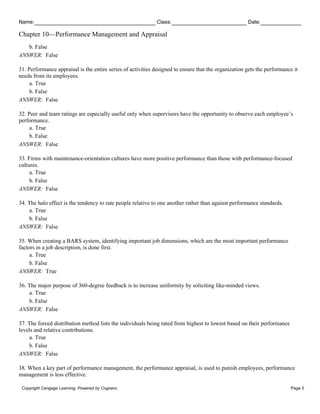
Subjective Short Answer
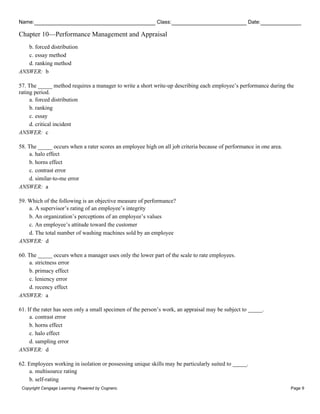
1. Discuss supervisory rating of subordinates.
ANSWER: The most widely used means of rating employees is based on the assumption that the immediate supervisor is
the person most qualified to evaluate an employee’s performance realistically and fairly. To help provide
accurate evaluations, some supervisors keep records of employees' performance so that they can reference
these notes when rating performance. For instance, a sales manager might periodically observe a salesperson’s
interactions with clients and make notes so that constructive performance feedback can be provided at a later
date.
2. Describe the features required in an effective performance management system.
ANSWER: To be effective, a performance management system, including the performance appraisal processes, should be:
• beneficial as a development tool;
• useful as an administrative tool;
• legal and job related;
• viewed as generally fair by employees;
• effective in documenting employee performance; and
• clear about who are high, average, and low performers.
3. Define performance management. What should a performance management system do?
ANSWER: Performance management is a series of activities designed to ensure that the organization gets the performance
it needs from its employees. At a minimum a performance management system should do the following:
• Make clear what the organization expects.
• Document performance for personnel records.
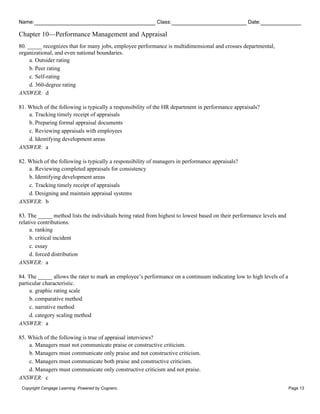
• Identify areas of success and needed development.
• Provide performance information to employees.
4. What is multisource rating?
ANSWER: Multisource rating, or 360-degree feedback, has grown in popularity in organizations. Multisource feedback
recognizes that for many jobs, employee performance is multidimensional and crosses departmental,
organizational, and even national boundaries. Therefore, information needs to be collected from many sources
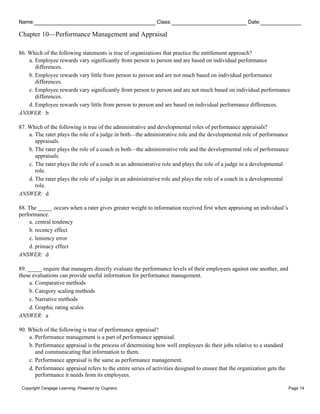
to adequately and fairly evaluate an incumbent’s performance in one of these jobs.
5. What are the common employee performance measures?
ANSWER: Performance criteria vary from job to job, but common employee performance measures include the
following:
• Quantity of output
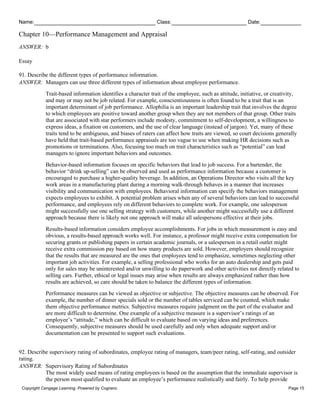
• Quality of output
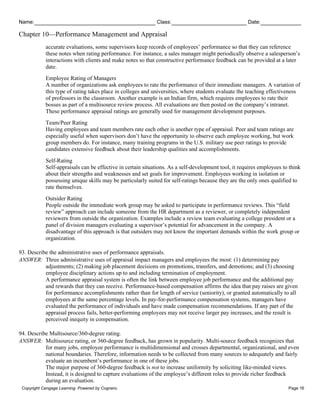
• Timeliness of output
• Presence/attendance on the job
• Efficiency of work completed
• Effectiveness of work completed
6. Discuss the administrative and developmental uses of performance appraisals.
ANSWER: Organizations generally use performance appraisals in two potentially conflicting ways. One use is to provide
a measure of performance for consideration in making pay or other administrative decisions about employees.
This administrative role often creates stress for managers doing the appraisals and the employees being
evaluated, because the rater is placed in the role of judge. The other use focuses on the development of
6.
Name: Class: Date:
Chapter10—Performance Management and Appraisal
Copyright Cengage Learning. Powered by Cognero. Page 2
individuals. In this role, the manager acts more as a counselor and coach than as a judge. The developmental
performance appraisal emphasizes current training and development needs, as well as planning employees’
future opportunities and career directions.
7. Describe the entitlement approach and the performance-driven approach.
ANSWER: Some corporate cultures are based on an entitlement approach, meaning that adequate performance and
stability dominate the organization. Employee rewards vary little from person to person and are not much
based on individual performance differences. As a result, performance appraisal activities are seen as having
few ties to performance and being primarily a “bureaucratic exercise.”
At the other end of the spectrum is a performance-driven organizational culture focused on results and
contributions. In this context, performance evaluations link results to employee compensation and
development.
8. Describe subjective and objective measures of performance appraisals.
ANSWER: Performance measures can be viewed as objective or subjective. The objective measures can be observed. For
example, the number of dinner specials sold or the number of tables serviced can be counted, which make
them objective performance metrics. Subjective measures require judgment on the part of the evaluator and
are more difficult to determine.
9. Define performance standards.
ANSWER: Performance standards define the expected levels of employee performance. Sometimes they are labeled
benchmarks, goals, or targets—depending on the approach taken. Realistic, measurable, clearly understood
performance standards benefit both organizations and employees.
10. Define behaviorally anchored rating scales.
ANSWER: Behaviorally anchored rating scales describe specific examples of job behavior which are then measured
against a performance scale.
True / False
11. One concern of multisource rating is that those peers who rate poor-performing coworkers tend to inflate the ratings so
that the peers themselves can get higher overall evaluation results in return.
a. True
b. False
ANSWER: True
12. With the ranking method, the ratings of employees’ performance are distributed along a bell-shaped curve.
a. True
b. False
ANSWER: False
13. Employee attitude is classified as trait-based information.
a. True
b. False
ANSWER: True
14. Menu up-selling by a waiter is classified as behavior-based information.
7.
Name: Class: Date:
Chapter10—Performance Management and Appraisal
Copyright Cengage Learning. Powered by Cognero. Page 3
a. True
b. False
ANSWER: True
15. The leniency error occurs when ratings of all employees fall at the high end of the scale.
a. True
b. False
ANSWER: True
16. The performance management process starts by identifying the strategic goals an organization needs to accomplish to
remain competitive and profitable.
a. True
b. False
ANSWER: True
17. A major concern for managers in performance management is how to emphasize the positive aspects of the
employee’s performance while still discussing ways to make needed improvements.
a. True
b. False
ANSWER: True
18. In the critical incident method, the manager keeps a written record of both highly favorable and unfavorable actions
performed by an employee during the entire rating period.
a. True
b. False
ANSWER: True
19. The developmental function of performance appraisals can identify areas in which the employee might wish to grow.
a. True
b. False
ANSWER: True
20. Development of performance standards is typically the first stage of management by objectives.
a. True
b. False
ANSWER: False
21. The entitlement approach of organizational culture links performance evaluations to employee compensation and
development.
a. True
b. False
ANSWER: False
22. A disadvantage of the outsider rating approach is that outsiders may not know the important demands within the work
group or organization.
8.
Name: Class: Date:
Chapter10—Performance Management and Appraisal
Copyright Cengage Learning. Powered by Cognero. Page 4
a. True
b. False
ANSWER: True
23. Both numerical and nonnumerical performance standards can be established.
a. True
b. False
ANSWER: True
24. The contrast error occurs when a rater scores an employee high on all job criteria because of performance in one area.
a. True
b. False
ANSWER: False
25. The category scaling method allows the rater to mark an employee’s performance on a continuum indicating low to
high levels of a particular characteristic.
a. True
b. False
ANSWER: False
26. Companies must only use multisource feedback primarily as an administrative tool.
a. True
b. False
ANSWER: False
27. The recency effect occurs when a rater gives greater weight to information received first when appraising an
individual’s performance.
a. True
b. False
ANSWER: False
28. The administrative role of performance appraisals often creates stress for managers doing the appraisals and the
employees being evaluated, because the rater is placed in the role of judge.
a. True
b. False
ANSWER: True
29. A supervisor’s rating of an employee’s attitude is classified as an objective measure of performance.
a. True
b. False
ANSWER: False
30. An informal appraisal is used when a system is in place to report managerial impressions and observations on
employee performance and feature a regular time interval.
a. True
9.
Name: Class: Date:
Chapter10—Performance Management and Appraisal
Copyright Cengage Learning. Powered by Cognero. Page 5
b. False
ANSWER: False
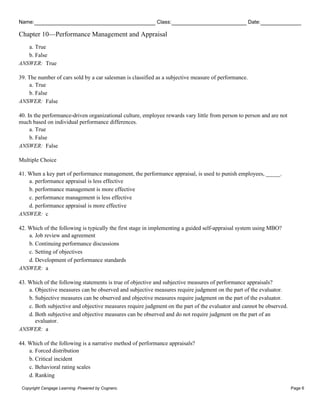
31. Performance appraisal is the entire series of activities designed to ensure that the organization gets the performance it
needs from its employees.
a. True
b. False
ANSWER: False
32. Peer and team ratings are especially useful only when supervisors have the opportunity to observe each employee’s
performance.
a. True
b. False
ANSWER: False
33. Firms with maintenance-orientation cultures have more positive performance than those with performance-focused
cultures.
a. True
b. False
ANSWER: False
34. The halo effect is the tendency to rate people relative to one another rather than against performance standards.
a. True
b. False
ANSWER: False
35. When creating a BARS system, identifying important job dimensions, which are the most important performance
factors in a job description, is done first.
a. True
b. False
ANSWER: True
36. The major purpose of 360-degree feedback is to increase uniformity by soliciting like-minded views.
a. True
b. False
ANSWER: False
37. The forced distribution method lists the individuals being rated from highest to lowest based on their performance
levels and relative contributions.
a. True
b. False
ANSWER: False
38. When a key part of performance management, the performance appraisal, is used to punish employees, performance
management is less effective.
10.
Name: Class: Date:
Chapter10—Performance Management and Appraisal
Copyright Cengage Learning. Powered by Cognero. Page 6
a. True
b. False
ANSWER: True
39. The number of cars sold by a car salesman is classified as a subjective measure of performance.
a. True
b. False
ANSWER: False
40. In the performance-driven organizational culture, employee rewards vary little from person to person and are not
much based on individual performance differences.
a. True
b. False
ANSWER: False
Multiple Choice
41. When a key part of performance management, the performance appraisal, is used to punish employees, _____.
a. performance appraisal is less effective
b. performance management is more effective
c. performance management is less effective
d. performance appraisal is more effective
ANSWER: c
42. Which of the following is typically the first stage in implementing a guided self-appraisal system using MBO?
a. Job review and agreement
b. Continuing performance discussions
c. Setting of objectives
d. Development of performance standards
ANSWER: a
43. Which of the following statements is true of objective and subjective measures of performance appraisals?
a. Objective measures can be observed and subjective measures require judgment on the part of the evaluator.
b. Subjective measures can be observed and objective measures require judgment on the part of the evaluator.
c. Both subjective and objective measures require judgment on the part of the evaluator and cannot be observed.
d. Both subjective and objective measures can be observed and do not require judgment on the part of an
evaluator.
ANSWER: a
44. Which of the following is a narrative method of performance appraisals?
a. Forced distribution
b. Critical incident
c. Behavioral rating scales
d. Ranking
11.
Name: Class: Date:
Chapter10—Performance Management and Appraisal
Copyright Cengage Learning. Powered by Cognero. Page 7
ANSWER: b
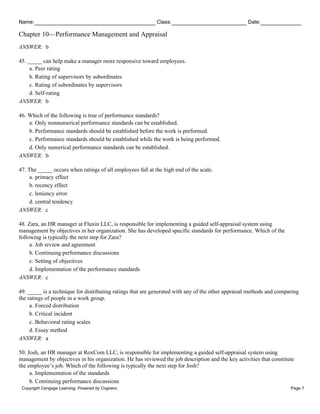
45. _____ can help make a manager more responsive toward employees.
a. Peer rating
b. Rating of supervisors by subordinates
c. Rating of subordinates by supervisors
d. Self-rating
ANSWER: b
46. Which of the following is true of performance standards?
a. Only nonnumerical performance standards can be established.
b. Performance standards should be established before the work is performed.
c. Performance standards should be established while the work is being performed.
d. Only numerical performance standards can be established.
ANSWER: b
47. The _____ occurs when ratings of all employees fall at the high end of the scale.
a. primacy effect
b. recency effect
c. leniency error
d. central tendency
ANSWER: c
48. Zara, an HR manager at Fluxin LLC, is responsible for implementing a guided self-appraisal system using
management by objectives in her organization. She has developed specific standards for performance. Which of the
following is typically the next step for Zara?
a. Job review and agreement
b. Continuing performance discussions
c. Setting of objectives
d. Implementation of the performance standards
ANSWER: c
49. _____ is a technique for distributing ratings that are generated with any of the other appraisal methods and comparing
the ratings of people in a work group.
a. Forced distribution
b. Critical incident
c. Behavioral rating scales
d. Essay method
ANSWER: a
50. Josh, an HR manager at RoxCom LLC, is responsible for implementing a guided self-appraisal system using
management by objectives in his organization. He has reviewed the job description and the key activities that constitute
the employee’s job. Which of the following is typically the next step for Josh?
a. Implementation of the standards
b. Continuing performance discussions
12.
Name: Class: Date:
Chapter10—Performance Management and Appraisal
Copyright Cengage Learning. Powered by Cognero. Page 8
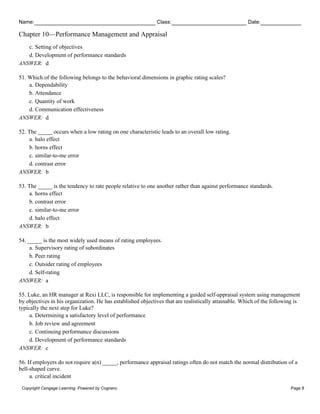
c. Setting of objectives
d. Development of performance standards
ANSWER: d
51. Which of the following belongs to the behavioral dimensions in graphic rating scales?
a. Dependability
b. Attendance
c. Quantity of work
d. Communication effectiveness
ANSWER: d
52. The _____ occurs when a low rating on one characteristic leads to an overall low rating.
a. halo effect
b. horns effect
c. similar-to-me error
d. contrast error
ANSWER: b
53. The _____ is the tendency to rate people relative to one another rather than against performance standards.
a. horns effect
b. contrast error
c. similar-to-me error
d. halo effect
ANSWER: b
54. _____ is the most widely used means of rating employees.
a. Supervisory rating of subordinates
b. Peer rating
c. Outsider rating of employees
d. Self-rating
ANSWER: a
55. Luke, an HR manager at Rexi LLC, is responsible for implementing a guided self-appraisal system using management
by objectives in his organization. He has established objectives that are realistically attainable. Which of the following is
typically the next step for Luke?
a. Determining a satisfactory level of performance
b. Job review and agreement
c. Continuing performance discussions
d. Development of performance standards
ANSWER: c
56. If employers do not require a(n) _____, performance appraisal ratings often do not match the normal distribution of a
bell-shaped curve.
a. critical incident
13.
Name: Class: Date:
Chapter10—Performance Management and Appraisal
Copyright Cengage Learning. Powered by Cognero. Page 9
b. forced distribution
c. essay method
d. ranking method
ANSWER: b
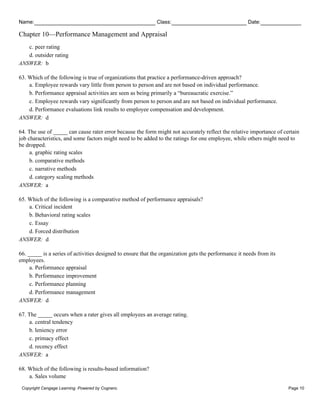
57. The _____ method requires a manager to write a short write-up describing each employee’s performance during the
rating period.
a. forced distribution
b. ranking
c. essay
d. critical incident
ANSWER: c
58. The _____ occurs when a rater scores an employee high on all job criteria because of performance in one area.
a. halo effect
b. horns effect
c. contrast error
d. similar-to-me error
ANSWER: a
59. Which of the following is an objective measure of performance?
a. A supervisor’s rating of an employee’s integrity
b. An organization’s perceptions of an employee’s values
c. An employee’s attitude toward the customer
d. The total number of washing machines sold by an employee
ANSWER: d
60. The _____ occurs when a manager uses only the lower part of the scale to rate employees.
a. strictness error
b. primacy effect
c. leniency error
d. recency effect
ANSWER: a
61. If the rater has seen only a small specimen of the person’s work, an appraisal may be subject to _____.
a. contrast error
b. horns effect
c. halo effect
d. sampling error
ANSWER: d
62. Employees working in isolation or possessing unique skills may be particularly suited to _____.
a. multisource rating
b. self-rating
14.
Name: Class: Date:
Chapter10—Performance Management and Appraisal
Copyright Cengage Learning. Powered by Cognero. Page 10
c. peer rating
d. outsider rating
ANSWER: b
63. Which of the following is true of organizations that practice a performance-driven approach?
a. Employee rewards vary little from person to person and are not based on individual performance.
b. Performance appraisal activities are seen as being primarily a “bureaucratic exercise.”
c. Employee rewards vary significantly from person to person and are not based on individual performance.
d. Performance evaluations link results to employee compensation and development.
ANSWER: d
64. The use of _____ can cause rater error because the form might not accurately reflect the relative importance of certain
job characteristics, and some factors might need to be added to the ratings for one employee, while others might need to
be dropped.
a. graphic rating scales
b. comparative methods
c. narrative methods
d. category scaling methods
ANSWER: a
65. Which of the following is a comparative method of performance appraisals?
a. Critical incident
b. Behavioral rating scales
c. Essay
d. Forced distribution
ANSWER: d
66. _____ is a series of activities designed to ensure that the organization gets the performance it needs from its
employees.
a. Performance appraisal
b. Performance improvement
c. Performance planning
d. Performance management
ANSWER: d
67. The _____ occurs when a rater gives all employees an average rating.
a. central tendency
b. leniency error
c. primacy effect
d. recency effect
ANSWER: a
68. Which of the following is results-based information?
a. Sales volume
15.
Name: Class: Date:
Chapter10—Performance Management and Appraisal
Copyright Cengage Learning. Powered by Cognero. Page 11
b. Customer satisfaction
c. Initiative
d. Teamwork
ANSWER: a
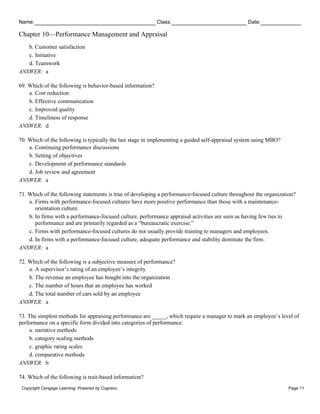
69. Which of the following is behavior-based information?
a. Cost reduction
b. Effective communication
c. Improved quality
d. Timeliness of response
ANSWER: d
70. Which of the following is typically the last stage in implementing a guided self-appraisal system using MBO?
a. Continuing performance discussions
b. Setting of objectives
c. Development of performance standards
d. Job review and agreement
ANSWER: a
71. Which of the following statements is true of developing a performance-focused culture throughout the organization?
a. Firms with performance-focused cultures have more positive performance than those with a maintenance-
orientation culture.
b. In firms with a performance-focused culture, performance appraisal activities are seen as having few ties to
performance and are primarily regarded as a “bureaucratic exercise.”
c. Firms with performance-focused cultures do not usually provide training to managers and employees.
d. In firms with a performance-focused culture, adequate performance and stability dominate the firm.
ANSWER: a
72. Which of the following is a subjective measure of performance?
a. A supervisor’s rating of an employee’s integrity
b. The revenue an employee has bought into the organization
c. The number of hours that an employee has worked
d. The total number of cars sold by an employee
ANSWER: a
73. The simplest methods for appraising performance are _____, which require a manager to mark an employee’s level of
performance on a specific form divided into categories of performance.
a. narrative methods
b. category scaling methods
c. graphic rating scales
d. comparative methods
ANSWER: b
74. Which of the following is trait-based information?
16.
Name: Class: Date:
Chapter10—Performance Management and Appraisal
Copyright Cengage Learning. Powered by Cognero. Page 12
a. Dispositions
b. Verbal persuasion
c. Units produced
d. Customer satisfaction
ANSWER: a
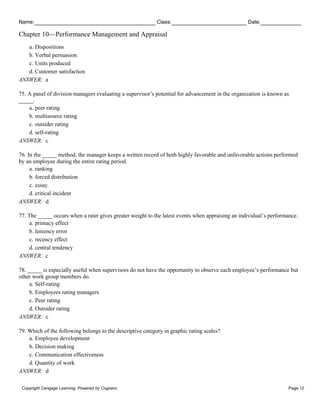
75. A panel of division managers evaluating a supervisor’s potential for advancement in the organization is known as
_____.
a. peer rating
b. multisource rating
c. outsider rating
d. self-rating
ANSWER: c
76. In the _____ method, the manager keeps a written record of both highly favorable and unfavorable actions performed
by an employee during the entire rating period.
a. ranking
b. forced distribution
c. essay
d. critical incident
ANSWER: d
77. The _____ occurs when a rater gives greater weight to the latest events when appraising an individual’s performance.
a. primacy effect
b. leniency error
c. recency effect
d. central tendency
ANSWER: c
78. _____ is especially useful when supervisors do not have the opportunity to observe each employee’s performance but
other work group members do.
a. Self-rating
b. Employees rating managers
c. Peer rating
d. Outsider rating
ANSWER: c
79. Which of the following belongs to the descriptive category in graphic rating scales?
a. Employee development
b. Decision making
c. Communication effectiveness
d. Quantity of work
ANSWER: d
17.
Name: Class: Date:
Chapter10—Performance Management and Appraisal
Copyright Cengage Learning. Powered by Cognero. Page 13
80. _____ recognizes that for many jobs, employee performance is multidimensional and crosses departmental,
organizational, and even national boundaries.
a. Outsider rating
b. Peer rating
c. Self-rating
d. 360-degree rating
ANSWER: d
81. Which of the following is typically a responsibility of the HR department in performance appraisals?
a. Tracking timely receipt of appraisals
b. Preparing formal appraisal documents
c. Reviewing appraisals with employees
d. Identifying development areas
ANSWER: a
82. Which of the following is typically a responsibility of managers in performance appraisals?
a. Reviewing completed appraisals for consistency
b. Identifying development areas
c. Tracking timely receipt of appraisals
d. Designing and maintain appraisal systems
ANSWER: b
83. The _____ method lists the individuals being rated from highest to lowest based on their performance levels and
relative contributions.
a. ranking
b. critical incident
c. essay
d. forced distribution
ANSWER: a
84. The _____ allows the rater to mark an employee’s performance on a continuum indicating low to high levels of a
particular characteristic.
a. graphic rating scale
b. comparative method
c. narrative method
d. category scaling method
ANSWER: a
85. Which of the following is true of appraisal interviews?
a. Managers must not communicate praise or constructive criticism.
b. Managers must communicate only praise and not constructive criticism.
c. Managers must communicate both praise and constructive criticism.
d. Managers must communicate only constructive criticism and not praise.
ANSWER: c
18.
Name: Class: Date:
Chapter10—Performance Management and Appraisal
Copyright Cengage Learning. Powered by Cognero. Page 14
86. Which of the following statements is true of organizations that practice the entitlement approach?
a. Employee rewards vary significantly from person to person and are based on individual performance
differences.
b. Employee rewards vary little from person to person and are not much based on individual performance
differences.
c. Employee rewards vary significantly from person to person and are not much based on individual performance
differences.
d. Employee rewards vary little from person to person and are based on individual performance differences.
ANSWER: b
87. Which of the following is true of the administrative and developmental roles of performance appraisals?
a. The rater plays the role of a judge in both—the administrative role and the developmental role of performance
appraisals.
b. The rater plays the role of a coach in both—the administrative role and the developmental role of performance
appraisals.
c. The rater plays the role of a coach in an administrative role and plays the role of a judge in a developmental
role.
d. The rater plays the role of a judge in an administrative role and plays the role of a coach in a developmental
role.
ANSWER: d
88. The _____ occurs when a rater gives greater weight to information received first when appraising an individual’s
performance.
a. central tendency
b. recency effect
c. leniency error
d. primacy effect
ANSWER: d
89. _____ require that managers directly evaluate the performance levels of their employees against one another, and
these evaluations can provide useful information for performance management.
a. Comparative methods
b. Category scaling methods
c. Narrative methods
d. Graphic rating scales
ANSWER: a
90. Which of the following is true of performance appraisal?
a. Performance management is a part of performance appraisal.
b. Performance appraisal is the process of determining how well employees do their jobs relative to a standard
and communicating that information to them.
c. Performance appraisal is the same as performance management.
d. Performance appraisal refers to the entire series of activities designed to ensure that the organization gets the
performance it needs from its employees.
19.
Name: Class: Date:
Chapter10—Performance Management and Appraisal
Copyright Cengage Learning. Powered by Cognero. Page 15
ANSWER: b
Essay
91. Describe the different types of performance information.
ANSWER: Managers can use three different types of information about employee performance.
Trait-based information identifies a character trait of the employee, such as attitude, initiative, or creativity,
and may or may not be job related. For example, conscientiousness is often found to be a trait that is an
important determinant of job performance. Allophilia is an important leadership trait that involves the degree
to which employees are positive toward another group when they are not members of that group. Other traits
that are associated with star performers include modesty, commitment to self-development, a willingness to
express ideas, a fixation on customers, and the use of clear language (instead of jargon). Yet, many of these
traits tend to be ambiguous, and biases of raters can affect how traits are viewed, so court decisions generally
have held that trait-based performance appraisals are too vague to use when making HR decisions such as
promotions or terminations. Also, focusing too much on trait characteristics such as “potential” can lead
managers to ignore important behaviors and outcomes.
Behavior-based information focuses on specific behaviors that lead to job success. For a bartender, the
behavior “drink up-selling” can be observed and used as performance information because a customer is
encouraged to purchase a higher-quality beverage. In addition, an Operations Director who visits all the key
work areas in a manufacturing plant during a morning walk-through behaves in a manner that increases
visibility and communication with employees. Behavioral information can specify the behaviors management
expects employees to exhibit. A potential problem arises when any of several behaviors can lead to successful
performance, and employees rely on different behaviors to complete work. For example, one salesperson
might successfully use one selling strategy with customers, while another might successfully use a different
approach because there is likely not one approach will make all salespersons effective at their jobs.
Results-based information considers employee accomplishments. For jobs in which measurement is easy and
obvious, a results-based approach works well. For instance, a professor might receive extra compensation for
securing grants or publishing papers in certain academic journals, or a salesperson in a retail outlet might
receive extra commission pay based on how many products are sold. However, employers should recognize
that the results that are measured are the ones that employees tend to emphasize, sometimes neglecting other
important job activities. For example, a selling professional who works for an auto dealership and gets paid
only for sales may be uninterested and/or unwilling to do paperwork and other activities not directly related to
selling cars. Further, ethical or legal issues may arise when results are always emphasized rather than how
results are achieved, so care should be taken to balance the different types of information.
Performance measures can be viewed as objective or subjective. The objective measures can be observed. For
example, the number of dinner specials sold or the number of tables serviced can be counted, which make
them objective performance metrics. Subjective measures require judgment on the part of the evaluator and
are more difficult to determine. One example of a subjective measure is a supervisor’s ratings of an
employee’s “attitude,” which can be difficult to evaluate based on varying ideas and preferences.
Consequently, subjective measures should be used carefully and only when adequate support and/or
documentation can be presented to support such evaluations.
92. Describe supervisory rating of subordinates, employee rating of managers, team/peer rating, self-rating, and outsider
rating.
ANSWER: Supervisory Rating of Subordinates
The most widely used means of rating employees is based on the assumption that the immediate supervisor is
the person most qualified to evaluate an employee’s performance realistically and fairly. To help provide
20.
Name: Class: Date:
Chapter10—Performance Management and Appraisal
Copyright Cengage Learning. Powered by Cognero. Page 16
accurate evaluations, some supervisors keep records of employees’ performance so that they can reference
these notes when rating performance. For instance, a sales manager might periodically observe a salesperson’s
interactions with clients and make notes so that constructive performance feedback can be provided at a later
date.
Employee Rating of Managers
A number of organizations ask employees to rate the performance of their immediate managers. A variation of
this type of rating takes place in colleges and universities, where students evaluate the teaching effectiveness
of professors in the classroom. Another example is an Indian firm, which requires employees to rate their
bosses as part of a multisource review process. All evaluations are then posted on the company’s intranet.
These performance appraisal ratings are generally used for management development purposes.
Team/Peer Rating
Having employees and team members rate each other is another type of appraisal. Peer and team ratings are
especially useful when supervisors don’t have the opportunity to observe each employee working, but work
group members do. For instance, many training programs in the U.S. military use peer ratings to provide
candidates extensive feedback about their leadership qualities and accomplishments.
Self-Rating
Self-appraisals can be effective in certain situations. As a self-development tool, it requires employees to think
about their strengths and weaknesses and set goals for improvement. Employees working in isolation or
possessing unique skills may be particularly suited for self-ratings because they are the only ones qualified to
rate themselves.
Outsider Rating
People outside the immediate work group may be asked to participate in performance reviews. This “field
review” approach can include someone from the HR department as a reviewer, or completely independent
reviewers from outside the organization. Examples include a review team evaluating a college president or a
panel of division managers evaluating a supervisor’s potential for advancement in the company. A
disadvantage of this approach is that outsiders may not know the important demands within the work group or
organization.
93. Describe the administrative uses of performance appraisals.
ANSWER: Three administrative uses of appraisal impact managers and employees the most: (1) determining pay
adjustments; (2) making job placement decisions on promotions, transfers, and demotions; and (3) choosing
employee disciplinary actions up to and including termination of employment.
A performance appraisal system is often the link between employee job performance and the additional pay
and rewards that they can receive. Performance-based compensation affirms the idea that pay raises are given
for performance accomplishments rather than for length of service (seniority), or granted automatically to all
employees at the same percentage levels. In pay-for-performance compensation systems, managers have
evaluated the performance of individuals and have made compensation recommendations. If any part of the
appraisal process fails, better-performing employees may not receive larger pay increases, and the result is
perceived inequity in compensation.
94. Describe Multisource/360-degree rating.
ANSWER: Multisource rating, or 360-degree feedback, has grown in popularity. Multi-source feedback recognizes that
for many jobs, employee performance is multidimensional and crosses departmental, organizational, and even
national boundaries. Therefore, information needs to be collected from many sources to adequately and fairly
evaluate an incumbent’s performance in one of these jobs.
The major purpose of 360-degree feedback is not to increase uniformity by soliciting like-minded views.
Instead, it is designed to capture evaluations of the employee’s different roles to provide richer feedback
during an evaluation.
21.
Name: Class: Date:
Chapter10—Performance Management and Appraisal
Copyright Cengage Learning. Powered by Cognero. Page 17
Significant administrative time and paperwork are required to request, obtain, and summarize feedback from
multiple raters. Using electronic systems for the information can greatly reduce the administrative demands of
multisource ratings and increase the effectiveness (i.e., privacy and expediency) of the process.
95. Describe the different types of rater errors.
ANSWER: There are many possible sources of error in the performance appraisal process. One of the major sources is the
rater. Although completely eliminating errors is impossible, making raters aware of potential errors and biases
helps.
Recency and Primacy Effects
The recency effect occurs when a rater gives greater weight to recent events when appraising an individual’s
performance. Examples include giving a student a course grade on the basis of only the student’s performance
in the last week of class or giving a drill press operator a high rating even though the operator made the
assigned quota only in the last two weeks of the rating period. Another time related issue is the primacy effect,
which occurs when a rater gives greater weight to information received first when appraising an individual’s
performance.
Central Tendency, Leniency, and Strictness Errors
Ask students and they will tell you about the professors who tend to grade easier or harder. A manager may
develop a similar rating pattern. Appraisers who rate all employees within a narrow range in the middle of the
scale (i.e., rate everyone as “average”) commit a central tendency error, giving even outstanding and poor
performers an “average” rating.
Rating patterns also may exhibit leniency or strictness. The leniency error occurs when ratings of all
employees fall at the high end of the scale. To avoid conflict, managers often rate employees higher than they
should. This “ratings boost” is especially likely when no manager or HR representative reviews the completed
appraisals. The strictness error occurs when a manager uses only the lower part of the scale to rate employees.
Rater Bias
When a rater’s values or prejudices distort the rating, rater bias occurs. Such bias may be unconscious or quite
intentional. For example, a manager’s dislike of certain ethnic groups may cause distortion in appraisal
information for some people. Use of age, religion, seniority, sex, appearance, or other “classifications” may
also skew appraisal ratings if the appraisal process is not properly designed. A review of appraisal ratings by
higher-level managers may help correct this problem.
Halo and Horns Effects
The halo effect occurs when a rater scores an employee high on all job criteria because of performance in one
area of the assigned work responsibilities. For example, if a worker has few absences, the supervisor might
give the worker a high rating in all other areas of work, including quantity and quality of output, without really
thinking about the employee’s other characteristics separately. The opposite is the horns effect, which occurs
when a low rating on one characteristic leads to an overall low rating.
Contrast Error
Rating should be done using established standards. One problem is the contrast error, which is the tendency to
rate people relative to one another rather than against performance standards. For example, if everyone else
performs at a mediocre level, then a person performing only slightly better may be rated as “excellent”
because of the contrast effect. But in a group where many employees are performing well, the same person
might receive a lower rating. Although it may be appropriate to compare people at times, the performance
rating usually should reflect comparison against performance standards, not against other people.
Similar-to-Me/Different-from-Me Errors
Sometimes, raters are influenced by whether people demonstrate characteristics that are the same as or
different from their own qualities. For example, a manager with an MBA degree might give subordinates with
MBAs higher appraisals than those who have only earned bachelor’s degrees. The error comes in measuring
22.
Name: Class: Date:
Chapter10—Performance Management and Appraisal
Copyright Cengage Learning. Powered by Cognero. Page 18
an individual against another person rather than measuring how well the individual fulfills the expectations of
the job.
Sampling Error
If the rater has seen only a small sample of the person’s work, an appraisal may be subject to sampling error.
For example, assume that 95% of the reports prepared by an employee have been satisfactory, but a manager
has seen only the 5% that had errors. If the supervisor rates the person’s performance as “poor,” then a
sampling error has occurred. Ideally, the work being rated should be a broad and representative sample of all
the work completed by the employee.
96. Describe the developmental uses of performance appraisals.
ANSWER: For employees, appraisals can be a primary source of information and feedback that can help them improve
their performance. By identifying employees’ strengths, weaknesses, needs, and potential, supervisors can
provide employees feedback about their progress at work, discuss areas in which additional training may be
beneficial, and outline future developmental plans. Performance appraisal feedback is therefore well-
positioned to be a developmental tool.
Employees don’t always know where and how to perform better, and managers can’t expect significant
improvements if they do not provide enough developmental feedback. The purpose of performance feedback
is to reinforce satisfactory contributions and to address work deficiencies. The developmental function of
performance appraisal can also identify areas in which the employee might wish to grow. For example, in a
performance appraisal interview targeted exclusively to development, an employee found out that the only
factor keeping her from being considered for a management job in her firm was the lack of a working
knowledge of cost accounting. Her supervisor suggested that she consider taking some night courses at the
local college to help her develop these skills.
The use of teams provides a different set of circumstances for developmental appraisals. The manager may not
see all of an employee’s work, but the employee’s team members do, therefore enabling them to provide
important feedback. However, whether teams can handle administrative appraisals is still subject to debate,
and clearly some cannot manage the additional responsibility. When teams are allowed to design appraisal
systems, they tend to avoid making judgments and shy away from differential rewards. Thus, group appraisals
may be best suited for developmental purposes rather than administrative functions.
97. Describe performance-focused organizational cultures.
ANSWER: Organizational cultures can vary on many dimensions, one of which involves the degree to which performance
is emphasized. Some cultures are based on an entitlement approach, meaning that adequate performance and
stability dominate the organization. Employee rewards vary little from person to person and have little to do
with differences in individual performance. As a result, performance appraisal activities have few ties to
performance and are primarily a “bureaucratic exercise.”
At the other end of the spectrum is a performance-driven organizational culture, which focuses on the results
and contributions made by employees. In this context, performance evaluations link results to employee
compensation and development. There are benefits to developing a performance-focused culture throughout
the organization. This approach can be particularly useful when assessing top leaders because they are
required to improve the financial and operational performance of their organizations. By focusing on
performance improvements through development activities, it can also help a company avoid interventions by
activist investors who want to take over strategic planning and management through their ownership of shares.
However, a pay-for-performance approach can present several challenges to organizations. For example, pay-
for-performance plans used in organizations that usually have an entitlement philosophy are sometimes
perceived to create inequity, particularly if some employees get bonuses and others receive no extra
compensation. Tying bonuses to criteria such as employee performance may also been met with harsh
criticism because some claim that the process prevents teamwork in the workplace.
Despite these issues, it appears that a performance-based-pay culture is desirable. It is sometimes argued that
23.
Name: Class: Date:
Chapter10—Performance Management and Appraisal
Copyright Cengage Learning. Powered by Cognero. Page 19
companies are not doing enough about poor performers, and that failure to deal with poor performance is
unfair to those who work hard. Employees who are not taking care of their work responsibilities can become
combative over their poor performance. Managers need to address performance issues with a communication
trail that documents problems and holds individuals accountable.
98. Describe graphic rating scale.
ANSWER: The graphic rating scale allows the rater to mark an employee’s performance on a continuum indicating low to
high levels of a particular characteristic. Because of the straightforwardness of the process, graphic rating
scales are common in performance evaluations. Three aspects of performance can be appraised using graphic
rating scales: descriptive categories (such as quantity of work, attendance, and dependability), job duties
(taken from the job description), and behavioral dimensions (such as decision making, employee development,
and communication effectiveness).
Each of these types can be used for different jobs. How well employees meet established standards is often
expressed either numerically (e.g., 5, 4, 3, 2, 1) or verbally (e.g., “outstanding,” “meets standards,” “below
standards”). If two or more people are involved in the rating, they may find it difficult to agree on the exact
level of performance achieved relative to the standard in evaluating employee performance. Notice that each
level specifies performance standards or expectations to reduce variation in interpretations of the standards by
different supervisors and employees.
99. Discuss management by objectives.
ANSWER: Management by objectives (MBO) is a specific performance appraisal method that highlights the performance
goals that an individual and manager identify together. Each manager sets objectives derived from the overall
goals and objectives of the organization; however, MBO should not be a disguised means for a superior to
dictate the objectives of individual managers or employees. Other names for MBO include appraisal by
results, target coaching, work planning and review, performance objective setting, and mutual goal setting.
The goal setting that occurs as part of this process can be helpful in a variety of managerial functions.
MBO Process
Implementing a guided self-appraisal system using MBO is a four-stage process. The stages are as follows:
1. Job review and agreement: The employee and the superior review the job description and the key
activities that constitute the employee’s job. The idea is to agree on the exact makeup of the job.
2. Development of performance standards: Together, the employee and his or her superior develop
specific standards of performance and determine a satisfactory level of performance that is
specific and measurable. For example, a quota of selling five cars a month may be an appropriate
performance standard for a salesperson.
3. Setting of objectives: Together, the employee and the superior establish objectives that are
realistically attainable.
4. Continuing performance discussions: The employee and the superior use the objectives as a basis
for continuing discussions about the employee’s performance. Although a formal review session
may be scheduled, the employee and the supervisor do not necessarily wait until the appointed
time to discuss performance. Objectives can be mutually modified as warranted.
The MBO process seems to be most useful with managerial personnel and employees who have a fairly wide
range of flexibility and control over their jobs. When imposed on a rigid and autocratic management system,
MBO will often fail. Emphasizing penalties for not meeting objectives defeats the development and
participative nature of MBO. Based on the results of one study, a strong MBO system can also help
organizations generate a positive climate for goal setting.
24.
Name: Class: Date:
Chapter10—Performance Management and Appraisal
Copyright Cengage Learning. Powered by Cognero. Page 20
100. Describe the appraisal interview.
ANSWER: The appraisal interview presents both an opportunity and a challenge. It can be an emotional experience for
the manager and the employee because the manager must communicate both praise and constructive criticism.
A major concern for managers is how to emphasize the positive aspects of the employee’s performance while
still discussing ways to make needed improvements. If the interview is handled poorly, the employee may feel
resentment, which could lead to future performance problems. Consequently, a manager should clearly
communicate how an employee’s positive contributions have helped the organization perform well. When
poor performance must be discussed, managers could use a series of questions and discussion points that
enable employees to identify their own performance deficiencies and come up with useful plans for
performance improvement.
Employees often approach an appraisal interview with some concern. They may feel that discussions about
performance are both personal and important to their continued job success. At the same time, they want to
know how their managers view their performance.
sure that ProfessorJames would not himself admit that both these
statements are false. I think it is quite possible he would admit that
they are, and would say that he never meant either to assert or to
imply the contrary. He complains that some of the critics of
Pragmatism are unwilling to read any but the silliest of possible
meanings into the statements of Pragmatism; and, perhaps, he
would say that this is the case here. I certainly hope that he would. I
certainly hope he would say that these statements, to which I have
objected, are silly. For it does seem to me intensely silly to say that
we can verify all our true ideas; intensely silly to say that every one
of our true ideas is at some time useful; intensely silly to say that
every idea which is ever useful is true. I hope Professor James would
admit all these things to be silly, for if he and other Pragmatists
would admit even as much as this, I think a good deal would be
gained. But it by no means follows that because a philosopher would
admit a view to be silly, when it is definitely put before him, he has
not himself been constantly holding and implying that very view. He
may quite sincerely protest that he never has either held or implied
it, and yet he may all the time have been not only implying it but
holding it—vaguely, perhaps, but really. A man may assure us, quite
sincerely that he is not angry; he may really think that he is not, and
yet we may be able to judge quite certainly from what he says that
he really is angry. He may assure us quite sincerely that he never
meant anything to our discredit by what he said—that he was not
thinking of anything in the least discreditable to us, and yet it may
be plain from his words that he was actually condemning us very
severely. And so with a philosopher. He may protest, quite angrily,
when a view is put before him in other words than his own, that he
never either meant or implied any such thing, and yet it may be
possible to judge, from what he says, that this very view, wrapped
up in other words, was not only held by him but was precisely what
made his thoughts seem to him to be interesting and important.
Certainly he may quite often imply a given thing which, at another
time, he denies. Unless it were possible for a philosopher to do this,
there would be very little inconsistency in philosophy, and surely
everyone will admit that other philosophers are very often
27.
inconsistent. And soin this case, even if Professor James would say
that he never meant to imply the things to which I have been
objecting, yet in the case of two of these things, I cannot help
thinking that he does actually imply them—nay more, that he is
frequently actually vaguely thinking of them, and that his theory of
truth owes its interest, in very great part, to the fact that he is
implying them. In the case of the two views that all our true ideas
are useful, and that all our useful ideas are true, I think this is so,
and I do not mean merely that his words imply them. A man's words
may often imply a thing, when he himself is in no way, however
vaguely, thinking either of that thing or of anything which implies it;
he may simply have expressed himself unfortunately. But in the case
of the two views that all our true ideas are useful, and all our useful
ideas true, I do not think this is so with Professor James. I think that
his thoughts seem interesting to him and others, largely because he
is thinking, not merely of words, but of things which imply these two
views, in the very form in which I have objected to them. And I wish
now to give some reasons for thinking this.
Professor James certainly wishes to assert that there is some
connection between truth and utility. And the connection which I
have suggested that he has vaguely before his mind is this: that
every true idea is, at some time or other, useful, and conversely that
every idea, which is ever useful, is true. And I have urged that-there
are obvious objections to both these views. But now, supposing
Professor James does not mean to assert either of these two things,
what else can he mean to assert? What else can he mean, that
would account for the interest and importance he seems to attach to
his assertion of connection between truth and utility? Let us consider
the alternatives.
And, first of all, he might mean that most of our true ideas are
useful, and most of our useful ideas true. He might mean that most
of our true ideas are useful at some time or other; and even that
most of them are useful, whenever they actually occur. And he might
mean, moreover, that if we consider the whole range of ideas, which
are useful to us, we shall find that by far the greater number of
28.
them are trueones; that true ideas are far more often useful to us,
than those which are not true. And all this, I think, may be readily
admitted to be true. If this were all that he meant, I do not think
that anyone would be very anxious to dispute it. But is it conceivable
that this is all that he means? Is it conceivable that he should have
been so anxious to insist upon this admitted commonplace? Is it
conceivable that he should have been offering us this, and nothing
more, as a theory of what truth means, and a theory worth making
a fuss about, and being proud of? It seems to me quite
inconceivable that this should have been all that he meant. He must
have had something more than this in his mind. But, if so, what
more?
In the passage which I quoted at the beginning, as showing that he
does mean to assert that all useful ideas are true, he immediately
goes on to assert a qualification, which must now be noticed. "The
true," he says, "is only the expedient in the way of our thinking" (p.
222). But he immediately adds: "Expedient in the long run, and on
the whole, of course; for what meets expediently all the experience
in sight won't necessarily meet all further experiences equally
satisfactorily." Here, therefore, we have something else that he
might mean. What is expedient in the long run, he means to say, is
true. And what exactly does this mean? It seems to mean that an
idea, which is not true, may be expedient for some time. That is to
say, it may occur once, and be expedient then; and again, and be
expedient then; and so on, over a considerable period. But
(Professor James seems to prophesy) if it is not true, there will come
a time, when it will cease to be expedient. If it occurs again and
again over a long enough period, there will at last, if it is not true,
come a time when it will (for once at least) fail to be useful, and will
(perhaps he means) never be useful again. This is, 1 think, what
Professor James means in this passage. He means, I think, that
though an idea, which is not true, may for some time be repeatedly
expedient, there will at last come a time when its occurrence will,
perhaps, never be expedient again, certainly will, for a time, not be
generally expedient. And this a view which, it seems to me, may
29.
possibly be true.It is certainly possible that a time may come, in the
far future, when ideas, which are not true, will hardly ever, if ever,
be expedient. And this is all that Professor James seems here
positively to mean. He seems to mean that, if you take time enough,
false ideas will some day cease to be expedient. And it is very
difficult to be sure that this is not true; since it is very difficult to
prophesy as to what may happen in the far future. I am sure I hope
that this prophesy will come true. But in the meantime (Professor
James seems to admit) ideas, which are not true, may, for an
indefinitely long time, again and again be expedient. And is it
conceivable that a theory, which admits this, is all that he has meant
to assert? Is it conceivable that what interests him, in his theory of
truth, is merely the belief that, some day or other, false ideas will
cease to be expedient? "In the long run, of course," he says, as if
this were what he had meant all along. But I think it is quite plain
that this is not all that he has meant. This may be one thing which
he is anxious to assert, but it certainly does not explain the whole of
his interest in his theory of truth.
And, in fact, there is quite a different theory which he seems plainly
to have in his mind in other places. When Professor James says, "in
the long run, of course," he implies that ideas which are expedient
only for a short run, are very often not true. But in what he says
elsewhere he asserts the very opposite of this. He says elsewhere
that a belief is true "so long as to believe it is profitable to our lives"
(p. 75). That is to say, a belief will be true, so long as it is useful,
even if it is not useful in the long run! This is certainly quite a
different theory; and, strictly speaking, it implies that an idea, which
is useful even on one occasion, will be true. But perhaps this is only
a verbal implication. I think very likely that here Professor James
was only thinking of ideas, which can be said to have a run, though
only a comparatively short one—of ideas, that is, which are
expedient, not merely on one occasion, but for some time. That is to
say, the theory which he now suggests, is that ideas, which occur
again and again, perhaps to one man only, perhaps to several
different people, over some space of time are, if they are expedient
30.
on most occasionswithin that space of time, true. This is a view
which he is, I think, really anxious to assert; and if it were true, it
would, I think, be important. And it is difficult to find instances which
show, with certainty, that it is false. I believe that it is false; but it is
difficult to prove it, because, in the case of some ideas it is so
difficult to be certain that they ever were useful, and in the case of
others so difficult to be certain that they are not true. A belief such
as I spoke of before—the belief in eternal hell—is an instance. I
think this belief has been, for a long time, useful, and that yet it is
false. But it is, perhaps, arguable that it never has been useful; and
many people on the other hand, would still assert that it is true. It
cannot, therefore, perhaps, fairly be used as an instance of a belief,
which is certainly not true, and yet has for some time been useful.
But whether this view that all beliefs, which are expedient for some
time, are true, be true or false; can it be all that Professor James
means to assert? Can it constitute the whole of what interests him in
his theory of truth?
I do not think it can. I think it is plain that he has in his mind
something more than any of these alternatives, or than all of them
taken together. And I think so partly for the following reason. He
speaks from the outset as if he intended to tell us what distinguishes
true ideas from those which are not true; to tell us, that is to say,
not merely of some property which belongs to all our true ideas; nor
yet merely of some property, which belongs to none but true ideas;
but of some property which satisfies both these requirements at
once—which both belongs to all our true ideas, and also belongs to
none but true ones. Truth, he says to begin with, means the
agreement of our ideas with reality; and he adds "as falsity their
disagreement." And he explains that he is going to tell us what
property it is that is meant by these words "agreement with reality."
So again in the next passage which I quoted: "True ideas," he says
"are those that we can assimilate, validate, corroborate and verify."
But, he also adds, "False ideas are those that we cannot." And no
one, I think, could possibly speak in this way, who had not in his
head the intention of telling us what property it is which
31.
distinguishes true ideasfrom those which are not true, and which,
therefore, not only belongs to all ideas which are true, but also to
none that are not. And that he has this idea in his head and thinks
that the property of being "useful" or "paying" is such a property, is
again clearly shown by a later passage. "Our account of truth," he
says (p. 218) "is an account of truths in the plural, of processes of
leading, realised in rebus, and having only this quality in common,
that they pay." Only this quality in common! If this be so, the quality
must obviously be one, which is not shared by any ideas which are
not true; for, if true ideas have any quality in common at all, they
must have at least one such quality, which is not shared by those
which are not true. Plainly, therefore, Professor James is intending to
tell us of a property which belongs both to all true ideas and only to
true ideas. And this property, he says, is that of "paying." But now
let us suppose that he means by "paying," not "paying once at
least," but, according to the alternative he suggests, "paying in the
long run" or "paying for some time." Can he possibly have supposed
that these were properties which belonged both to all true ideas and
also to none but true ones? They may, perhaps, be properties which
belong to none but true ones. I doubt, as I have said, whether the
latter does; but still it is difficult to prove the opposite. But even if
we granted that they belong to none but true ones, surely it is only
too obvious that they do not fulfil the other requirement—that they
do not belong to nearly all true ones. Can anyone suppose that all
our true ideas pay "in the long run" or repeatedly for some time?
Surely it is plain that an enormous number do not for the simple
reason that an enormous number of them have no run at all, either
long or short, but occur but once, and never recur. I believe truly
that a certain book is on a particular shelf about 10.15 p.m. on
December 21st, 1907; and this true belief serves me well and helps
me to find it But the belief that that book is there at that particular
time occurs to no one else, and never again to me. Surely there are
thousands of useful true beliefs which, like this, are useful but once,
and never occur again; and it would, therefore, be preposterous to
say that every true idea is useful "in the long run" or repeatedly for
some time. If, therefore, we supposed Professor James to mean that
32.
"paying in thelong run" or "paying repeatedly over a considerable
period" were properties which belonged to all true ideas and to none
but true ones, we should be supposing him to mean something still
more monstrous than if we suppose him to mean that "paying at
least once" was such a property.
To sum up then:
I think there is no doubt that Professor James' interest in "the
pragmatist theory of truth" is largely due to the fact that he thinks it
tells us what distinguishes true ideas from those which are not true.
And he thinks the distinction is that true ideas "pay," and false ones
don't. The most natural interpretation of this view is: That every true
idea pays at least once; and that every idea, which pays at least
once, is true. These were the propositions I considered first, and I
gave reasons for thinking that both are false. But Professor James
suggested elsewhere that what he means by "paying" is "paying in
the long run." And here it seems possibly true that all ideas which
"pay in the long run" are true; but it is certainly false that all our
true ideas "pay in the long run," if by this be meant anything more
than "pay at least once." Again, he suggested that what he meant
by paying was "paying for some time." And here, again, even if it is
true (and it seems very doubtful) that all ideas which pay for some
time are true, it is certainly false that all our true ideas pay for some
time, if by this be meant anything more than that they pay "at least
once."
This, I think, is the simplest and most obvious objection to Professor
James' "instrumental" view of truth—the view that truth is what
"works," "pays," is "useful." He seems certainly to have in his mind
the idea that this theory tells us what distinguishes true ideas from
false ones, and to be interested in it mainly for this reason. He has
vaguely in his mind that he has told us of some property which
belongs to all true ideas and to none but true ones; and that this
property is that of "paying." And the objection is, that, whatever we
understand by "paying," whether "paying at least once," or "paying
in the long run," or "paying for some time," it seems certain that
33.
none of theseproperties will satisfy both requirements. As regards
the first, that of "paying at least once," it seems almost certain that
it satisfies neither: it is neither true that all our true ideas "pay at
least once," nor yet that every idea which pays at least once, is true.
On the contrary, many true ideas never pay at all; and many ideas,
which are not true, do pay on at least one occasion. And as regards
the others, "paying in the long run" and "paying for some time,"
even if these do belong to none but true ideas (and even this seems
very doubtful), they certainly neither of them satisfy the other
requirement—neither of them belong to all our true ideas. For, in
order that either of them may belong to an idea, that idea must pay
at least once; and, as we have seen, many true ideas do not pay
even once, and cannot, therefore, pay either in the long run or for
some time. And, moreover, many true ideas, which do pay on one
occasion, seem to pay on one occasion and one only.
And, if Professor James does not mean to assert any of these things,
what is there left for him to mean? There is left in the first place, the
theory that most of our true ideas do pay; and that most of the
ideas which pay are true. This seems to me to be true, and, indeed,
to be all that is certainly true in what he says. But is it conceivable
that this is all he has meant? Obviously, these assertions tell us of no
property at all which belongs to all true ideas, and to none but true
ones; and, moreover, it seems impossible that he should have been
so anxious to assert this generally admitted commonplace. What a
very different complexion his whole discussion would have worn, had
he merely asserted this—this quite clearly, and nothing but this,
while admitting openly that many true ideas do not pay, and that
many, which do pay, are not true!
And, besides this commonplace, there is only left for him to mean
two one-sided and doubtful assertions to the effect that certain
properties belong to none but true ideas. There is the assertion that
all ideas which pay in the long run are true, and the assertion that
all ideas which pay for some considerable time are true. And as to
the first, it may be true; but it may also be doubted, and Professor
James gives us no reason at all for thinking that it is true. Assuming
34.
that religious ideashave been useful in the past, is it quite certain
that they may not permanently continue to be useful, even though
they are false? That, in short, even though they are not true, they
nevertheless will be useful, not only for a time, but in the long run?
And as for the assertion that all ideas, which pay for a considerable
time, are true, this is obviously more doubtful still. Whether certain
religious ideas will or will not be useful in the long run, it seems
difficult to doubt that many of them have been useful for a
considerable time. And why should we be told dogmatically that all
of these are true? This, it seems to me, is by far the most interesting
assertion, which is left for Professor James to make, when we have
rejected the theory that the property of being useful belongs to all
true ideas, as well as to none but true ones. But he has given no
reason for asserting it. He seems, in fact, to base it merely upon the
general untenable theory, that utility belongs to all true ideas, and to
none but true ones; that this is what truth means.
These, then, seem to me the plainest and most obvious objections
to what Professor James says about the connection between truth
and utility. And there are only two further points, in what he says
under this head, that I wish to notice.
In the first place, we have hitherto been considering only whether it
is true, as a matter of empirical fact, that all our true ideas are
useful, and those which are not true, never. Professor James seems,
at least, to mean that, as a matter of fact, this is so; and I have only
urged hitherto that as a matter of fact, it is not so. But as we have
seen, he also asserts something more than this—he also asserts that
this property of utility is the only one which belongs to all our true
ideas. And this further assertion cannot possibly be true, if, as I have
urged, there are many true ideas which do not possess this
property; or if, as I have urged, many ideas, which do possess it, are
nevertheless not true. The objections already considered are, then,
sufficient to overthrow this further assertion also. If there are any
true ideas, which are not useful, or if any, which are useful, are not
true, it cannot be the case that utility is the only property which true
ideas have in common. There must be some property, other than
35.
utility, which iscommon to all true ideas; and a correct theory as to
what property it is that does belong to all true ideas, and to none
but true ones, is still to seek. The empirical objections, hitherto
given, are then sufficient objections to this further assertion also;
but they are not the only objections to it. There is another and still
more serious objection to the assertion that utility is the only
property which all true ideas have in common. For this assertion
does not merely imply that, as a matter of fact, all our true ideas
and none but true ideas are useful. It does, indeed, imply this; and
therefore the fact that these empirical assertions are not true is
sufficient to refute it. But it also implies something more. If utility
were the only property which all true ideas had in common, it would
follow not merely that all true ideas are useful, but also that any
idea, which was useful, would be true no matter what other
properties it might have or might fail to have. There can, I think, be
no doubt that Professor James does frequently speak as if this were
the case; and there is an independent and still more serious
objection to this implication. Even if it were true (as it is not) that all
our true ideas and none but true ideas are, as a matter of fact,
useful, we should still have a strong reason to object to the
statement that any idea, which was useful, would be true. For it
implies that if such an idea as mine, that Professor James exists, and
has certain thoughts, were useful, this idea would be true, even if no
such person as Professor James ever did exist. It implies that, if the
idea that I had the seven of diamonds in my hand at cards last
night, were useful, this idea would be true, even if, in fact, I did not
have that card in my hand. And we can, I think, see quite plainly
that this is not the case. With regard to some kinds of ideas, at all
events—ideas with regard to the existence of other people, or with
regard to past experiences of our own—it seems quite plain that
they would not be true, unless they "agreed with reality" in some
other sense than that which Professor James declares to be the only
one in which true ideas must agree with it. Even if my idea that
Professor James exists were to "agree with reality," in the sense
that, owing to it, I handled other realities better than I should have
done without it, it would, I think, plainly not be true, unless
36.
Professor James reallydid exist—unless he were a reality. And this, I
think, is one of the two most serious objections to what he seems to
hold about the connection of truth with utility. He seems to hold that
any idea, which was useful, would be true, no matter what other
properties it might fail to have. And with regard to some ideas, at all
events, it seems plain that they cannot be true, unless they have the
property that what they believe to exist, really does or did exist.
Beliefs in the existence of other people might be useful to me, even
if I alone existed; but, nevertheless, in such a case, they would not
be true.
And there is only one other point, in what Professor James says in
connection with the "instrumental" view of truth, upon which I wish
to remark. We have seen that he seems sometimes to hold that
beliefs are true, so long as they are "profitable to our lives." And this
implies, as we have seen, the doubtful proposition than any belief
which is useful for some length of time, is true. But this is not all
that it implies. It also implies that beliefs are true only so long as
they are profitable. Nor does Professor James appear to mean by
this that they occur, only so long as they are profitable. He seems to
hold, on the contrary, that beliefs, which are profitable for some
time, do sometimes finally occur at a time when they are not
profitable. He implies, therefore, that a belief, which occurs at
several different times, may be true at some of the times at which it
occurs, and yet untrue at others. I think there is no doubt that this
view is what he is sometimes thinking of. And this, we see,
constitutes a quite new view as to the connection between truth and
utility—a view quite different from any that we have hitherto
considered. This view asserts not that every true idea is useful at
some time, or in the long run, or for a considerable period; but that
the truth of an idea may come and go, as its utility comes and goes.
It admits that one and the same idea sometimes occurs at times
when it is useful, and sometimes at times when it is not; but it
maintains that this same idea is true, at those times when it is
useful, and not true, at those when it is not. And the fact that
Professor James seems to suggest this view, constitutes, I think, a
37.
second most seriousobjection to what he says about the connection
of truth and utility. It seems so obvious that utility is a property
which comes and goes—which belongs to a given idea at one time,
and does not belong to it at another, that anyone who says that the
true is the useful naturally seems not to be overlooking this obvious
fact, but to be suggesting that truth is a property which comes and
goes in the same way. It is, in this way I think, that the
"instrumental" view of truth is connected with the view that truth is
"mutable." Professor James does, I think, imply that truth is mutable
in just this sense—namely, that one and the same idea may be true
at some of the times at which it occurs, and not true at others, and
this is the view which I have next to consider.
(II)
Professor James seems to hold, generally, that "truth" is mutable.
And by this he seems sometimes to mean that an idea which, when
it occurs at one time, is true, may, when it occurs at another time,
not be true. He seems to hold that one and the same idea may be
true at one time and false at another. That it may be, for I do not
suppose he means that all ideas do actually undergo this change
from true to false. Many true ideas seem to occur but once, and, if
so, they, at least, will not actually be true at one time and false at
another, though, even with regard to these, perhaps Professor
James means to maintain that they might be false at another time, if
they were to occur at it. But I am not sure that he even means to
maintain this with regard to all our true ideas. Perhaps he does not
mean to say, with regard to all of them, even that they can change
from true to false. He speaks, generally, indeed, as if truth were
mutable; but, in one passage, he seems to insist that there is a
certain class of true ideas, none of which are mutable in this respect.
"Relations among purely mental ideas," he says (p. 209), "form
another sphere where true and false beliefs obtain, and here the
beliefs are absolute or unconditional. When they are true they bear
the name either of definitions or of principles. It is either a principle
or a definition that 1 and 1 make 2, that 2 and 1 make 3, and so on;
that white differs less from grey than it does from black; that when
38.
the cause beginsto act the effect also commences. Such
propositions hold of all possible 'ones,' of all conceivable 'whites,'
'greys,' and 'causes.' The objects here are mental objects. Their
relations are perceptually obvious at a glance, and no sense-
verification is necessary. Moreover, once true, always true, of those
same mental objects. Truth here has an 'eternal' character. If you
can find a concrete thing anywhere that is 'one' or 'white' or 'grey' or
an 'effect,' then your principles will everlastingly apply to it."
Professor James does seem here to hold that there are true ideas,
which once true, are always true. Perhaps, then, he does not hold
that all true ideas are mutable. Perhaps he does not even hold that
all true ideas, except ideas of this kind, are so. But he does seem to
hold at least that many of our true ideas are mutable. And even this
proposition seems to me to be disputable. It seems to me that there
is a sense in which it is the case with every true idea that, if once
true, it is always true. That is to say, that every idea, which is true
once, would be true at any other time at which it were to occur; and
that every idea which does occur more than once, if true once, is
true at every time at which it does occur. There seems to me, I say,
to be a sense in which this is so. And this seems to me to be the
sense in which it is most commonly and most naturally maintained
that all truths are "immutable." Professor James seems to mean to
deny it, even in this sense. He seems to me constantly to speak as if
there were no sense in which all truths are immutable. And I only
wish to point out what seems to me to be the plainest and most
obvious objection to such language.
And, first of all, there is one doctrine, which he seems to connect
with this of his that "truths are mutable," with regard to which I fully
agree with him. He seems very anxious to insist that reality is
mutable: that it does change, and that it is not irrational to hope
that in the future it will be different from and much better than it is
now. And this seems to me to be quite undeniable. It seems to me
quite certain that I do have ideas at one time which I did not have at
another; that change, therefore, does really occur. It seems to me
quite certain that in the future many things will be different from
39.
what they arenow; and I see no reason to think that they may not
be much better. There is much misery in the world now; and I think
it is quite possible that some day there will really be much less. This
view that reality is mutable, that facts do change, that some things
have properties at one time which they do not have at other times,
seems to me certainly true. And so far, therefore, as Professor James
merely means to assert this obvious fact, I have no objection to his
view. Some philosophers, I think, have really implied the denial of
this fact. All those who deny the reality of time do seem to me to
imply that nothing really changes or can change—that, in fact,
reality is wholly immutable. And so far as Professor James is merely
protesting against this view, I should, therefore, agree with him.
But I think it is quite plain that he does not mean merely this, when
he says that truth is mutable. No one would choose this way of
expressing himself if he merely meant to say that some things are
mutable. Truth, Professor James has told us, is a property of certain
of our ideas. And those of our ideas, which are true or false, are
certainly only a part of the Universe. Other things in the Universe
might, therefore, change, even if our ideas never changed in respect
of this property. And our ideas themselves do undoubtedly change in
some respects. A given idea exists in my mind at one moment and
does not exist in it at another. At one moment it is in my mind and
not in somebody else's, and at another in somebody else's and not
in mine. I sometimes think of the truth that twice two are four when
I am in one mood, and sometimes when I am in another. I
sometimes think of it in connection with one set of ideas and
sometimes in connection with another set. Ideas, then, are
constantly changing in some respects. They come and go; and at
one time they stand in a given relation to other things or ideas, to
which at another time they do not stand in that relation. In this
sense, any given idea may certainly have a property at one time
which it has not got at another time. All this seems obvious; and all
this cannot be admitted, without admitting that reality is mutable—
that some things change. But obviously it does not seem to follow
from this that there is no respect in which ideas are immutable. It
40.
does not seemto follow that because ideas, and other things,
change some of their properties, they necessarily change that one
which we are considering—namely, "truth." It does not follow that a
given idea, which has the property of truth at one time, ever exists
at any other time without having that property. And yet that this
does happen seems to be part of what is meant by saying that truth
is mutable. Plainly, therefore, to say this is to say something quite
different from saying that some things are mutable. Even, therefore,
if we admit that some things are mutable, it is still open to consider
whether truth is so. And this is what I want now to consider. Is it the
case that an idea which exists at one time, and is true then, ever
exists at any other time, without being true? Is it the case that any
idea ever changes from true to false? That it has the property of
being true on one of the occasions when it exists, and that it has not
this property, but that of being false instead, on some other occasion
when it exists?
In order to answer this question clearly, it is, I think, necessary to
make still another distinction. It does certainly seem to be true, in a
sense, that a given idea may be true on one occasion and false on
another. We constantly speak as if there were cases in which a given
thing was true on one occasion and false on another; and I think it
cannot be denied that, when we so speak, we are often expressing
in a perfectly proper and legitimate manner something which is
undeniably true. It is true now, I might say, that I am in this room;
but to-morrow this will not be true. It is true now that men are often
very miserable; but perhaps in some future state of society this will
not be true. These are perfectly natural forms of expression, and
what they express is something which certainly may be true. And yet
what they do apparently assert is that something or other, which is
true at one time, will not, or perhaps will not, be true at another. We
constantly use such expressions, which imply that what is true at
one time is not true at another; and it is certainly legitimate to use
them. And hence, I think, we must admit that, in a sense, it is true
that a thing may be true at one time which is not true at another; in
that sense, namely, in which we use these expressions. And it is, I
41.
think, also plainthat these things, which may be true at one time
and false at another, may, in a sense, be ideas. We might even say:
The idea that I am in this room, is true now; but to-morrow it will
not be true. We might say this without any strain on language. In
any ordinary book—indeed, in any philosophical book, where the
subject we are at present discussing was not being expressly
discussed—such expressions do, I think, constantly occur. And we
should pass them, without any objection. We should at once
understand what they meant, and treat them as perfectly natural
expressions of things undeniably true. We must, then, I think, admit
that, in a sense, an idea may be true at one time, and false at
another. The question is: In what sense? What is the truth for which
these perfectly legitimate expressions stand?
It seems to me that in all these cases, so far as we are not merely
talking of facts, but of true ideas, that the "idea" which we truly say
to be true at one time and false at another, is merely the idea of a
sentence—that is, of certain words. And we do undoubtedly call
words "true." The words "I am at a meeting of the Aristotelian
Society" are true, if I use them now; but if I use the same words to-
morrow, they would not be true. The words "George III is king of
England" were true in 1800, but they are not true now. That is to
say, a given set of words may undoubtedly be true at one time, and
false at another; and since we may have ideas of words as well as of
other things, we may, in this sense, say the same of certain of our
"ideas." We may say that some of our "ideas" (namely those of
words) are true at one time and not true at another.
But is it conceivable that Professor James merely meant to assert
that the same words are sometimes true at one time and false at
another? Can this be all he means by saying that truth is mutable? I
do not think it can possibly be so. No one, I think, in definitely
discussing the mutability of truth, could say that true ideas were
mutable, and yet mean (although he did not say so) that this
proposition applied solely to ideas of words. Professor James must, I
think, have been sometimes thinking that other ideas, and not
merely ideas of words, do sometimes change from true to false. And
42.
this is theproposition which I am concerned to dispute. It seems to
me that if we mean by an idea, not merely the idea of certain words,
but the kind of idea which words express, it is very doubtful whether
such an idea ever changes from true to false—whether any such
idea is ever true at one time and false at another.
And plainly, in the first place, the mere fact that the same set of
words, as in the instances I have given, really are true at one time
and false at another, does not afford any presumption that anything
which they stand for is true at one time and false at another. For the
same words may obviously be used in different senses at different
times; and hence though the same words, which formerly expressed
a truth, may cease to express one, that may be because they now
express a different idea, and not because the idea which they
formerly expressed has ceased to be true. And that, in instances
such as I have given, the words do change their meaning according
to the time at which they are uttered or thought of, is I think,
evident. If I use now the words "I am in this room," these words
certainly express (among other things) the idea that my being in this
room is contemporary with my present use of the words; and if I
were to use the same words to-morrow, they would express the idea
that my being in this room to-morrow, was contemporary with the
use of them then. And since my use of them then would not be the
same fact as my use of them now, they would certainly then express
a different idea from that which they express now. And in general,
whenever we use the present tense in its primary sense, it seems to
me plain that we do mean something different by it each time we
use it. We always mean (among other things) to express the idea
that a given event is contemporary with our actual use of it; and
since our actual use of it on one occasion is always a different fact
from our actual use of it on another, we express by it a different idea
each time we use it. And similarly with the past and future tenses. If
anybody had said in 1807 "Napoleon is dead," he would certainly
have meant by these words something different from what I mean
by them when I use them now. He would have meant that
Napoleon's death occurred at a time previous to his use of those
43.
words; and thiswould not have been true. But in this fact there is
nothing to show that if he had meant by them what I mean now, his
idea would not have been as true then as mine is now. And so, if I
say "It will rain to-morrow," these words have a different meaning
to-day from what they would have if I used them to-morrow. What
we mean by "to-morrow" is obviously a different day, when we use
the word on one day, from what we mean by it when we use it on
another. But in this there is nothing to show that if the idea, which I
now mean by "It will rain to-morrow," were to occur again to-
morrow, it would not be true then, if it is true now. All this is surely
very obvious. But, if we take account of it, and if we concentrate our
attention not on the words but on what is meant by them, is it so
certain that what we mean by them on any one occasion ever
changes from true to false? If there were to occur to me to-morrow
the very same idea which I now express by the words "I am in this
room," is it certain that this idea would not be as true then as it is
now? It is perhaps true that the whale of what I mean by such a
phrase as this never does recur. But part of it does, and that a part
which is true. Part of what I mean is Certainly identical with part of
what I should mean to-morrow by saying "I was in that room last
night." And this part would be as true then, as it is now. And is there
any part, which, if it were to recur at any time, would not then be
true, though it Is true now? In the case of all ideas or parts of ideas,
which ever do actually recur, can we find a single instance of one,
which is plainly true at one of the times when it occurs, and yet not
true at another? I cannot think of any such instance. And on the
other hand this very proposition that any idea (other than mere
words) which is true once, would be true at any time, seems to me
to be one of those truths of which Professor James has spoken as
having an "eternal," "absolute," "unconditional" character—as being
"perceptually obvious at a glance" and needing "no sense-
verification." Just as we know that, if a particular colour differs more
from black than from grey at one time, the same colour would differ
more from black than from grey at any time, so, it seems to me, we
can see that, if a particular idea is true at one time, the same idea
would be true at any time.
44.
It seems tome, then, that if we mean by an idea, not mere words,
but the kind of idea which words express, any idea, which is true at
one time when it occurs, would be true at any time when it were to
occur; and that this is so, even though it is an idea, which refers to
facts which are mutable. My being in this room is a fact which is
now, but which certainly has not been at every time and will not be
at every time. And the words "I am in this room," though they
express a truth now, would not have expressed one if I had used
them yesterday, and will not if I use them to-morrow. But if we
consider the idea which these words now express—namely, the idea
of the connection of my being in this room with this particular time—
it seems to me evident that anybody who had thought of that
connection at any time in the past, would have been thinking truly,
and that anybody who were to think of it at any time in the future
would be thinking truly. This seems to me to be the sense in which
truths are immutable—in which no idea can change from true to
false. And I think Professor James means to deny of truths generally,
if not of all truths, that they are immutable even in this sense. If he
does not mean this there seems nothing left for him to mean, when
he says that truths are mutable, except (1) that some facts are
mutable, and (2) that the same words may be true at one time and
false at another. And it seems to me impossible that he could speak
as he does, if he meant nothing more than these two things. I
believe, therefore, that he is really thinking that ideas which have
been once true (ideas, and not merely words) do sometimes
afterwards become false: that the very same idea is at one time true
and at another false. But he certainly gives no instance which shows
that this does ever occur. And how far does he mean his principle to
carry him? Does he hold that this idea that Julius Caesar was
murdered in the Senate-House, though true now, may, at some
future time cease to be true, if it should be more profitable to the
lives of future generations to believe that he died in his bed? Things
like this are what his words seem to imply; and, even if he does hold
that truths like this are not mutable, he never tries to tell us to what
kinds of truths he would limit mutability, nor how they differ from
such as this.
45.
(III)
Finally, there remainsthe view that "to an unascertainable extent
our truths are man-made products." And the only point I want to
make about this view may be put very briefly.
It is noticeable that all the instances which Professor James gives of
the ways in which, according to him, "our truths" are "made" are
instances of ways in which our beliefs come into existence. In many
of these ways, it would seem, false beliefs sometimes come into
existence as well as true ones; and I take it Professor James does
not always wish to deny this. False beliefs, I think he would say, are
just as much "man-made products" as true ones: it is sufficient for
his purpose if true beliefs do come into existence in the ways he
mentions. And the only point which seems to be illustrated by all
these instances, is that in all of them the existence of a true belief
does depend in some way or other upon the previous existence of
something in some man's mind. They are all of them cases in which
we may truly say: This man would not have had just that belief, had
not some man previously had such and such experiences, or
interests, or purposes. In some cases they are instances of ways in
which the existence of a particular belief in a man depends upon his
own previous experiences or interests or volitions. But this does not
seem to be the case in all. Professor James seems also anxious to
illustrate the point that one man's beliefs often depend upon the
previous experiences or interests or volitions of other men. And, as I
say, the only point which seems to be definitely illustrated in all
cases is that the existence of a true belief does depend, in some way
or other, upon something which has previously existed in some
man's mind. Almost any kind of dependence, it would seem, is
sufficient to illustrate Professor James' point.
And as regards this general thesis that almost all our beliefs, true as
well as false, depend, in some way or other, upon what has
previously been in some human mind, it will, I think, be readily
admitted. It is a commonplace, which, so far as I know, hardly
anyone would deny. If this is all that is to be meant by saying that
46.
our true beliefsare "man-made," it must, I think, be admitted that
almost all, If not quite all, really are man-made. And this is all that
Professor James' instances seem to me, in fact, to show.
But is this all that Professor James means, when he says that our
truths are man-made? Is it conceivable that he only means to insist
upon this undeniable, and generally admitted, commonplace? It
seems to me quite plain that this is not all that he means. I think he
certainly means to suggest that, from the fact that we "make" our
true beliefs, something else follows. And I think it is not hard to see
one thing more which he does mean. I think he certainly means to
suggest that we not only make our true beliefs, but also that we
make them true. At least as much as this is certainly naturally
suggested by his words. No one would persistently say that we make
our truths, unless he meant, at least, not merely that we make our
true beliefs, but also that we make them true—unless he meant not
merely that the existence of our true beliefs, but also that their
truth, depended upon human conditions. This, it seems to me, is
one consequence which Professor James means us to draw from the
commonplace that the existence of our true beliefs depends upon
human conditions. But does this consequence, in fact, follow from
that commonplace? From the fact that we make our true beliefs,
does it follow that we make them true?
In one sense, undoubtedly, even this does follow. If we say (as we
may say) that no belief can be true, unless it exists, then it follows
that, in a sense, the truth of a belief must always depend upon any
conditions upon which its existence depends. If, therefore, the
occurrence of a belief depends upon human conditions, so, too,
must its truth. If the belief had never existed, it would never have
been true; and therefore its truth must, in a sense, depend upon
human conditions in exactly the same degree in which its existence
depends upon them. This is obvious. But is this all that is meant? Is
this all that would be suggested to us by telling us that we make our
beliefs true?
47.
It is easyto see that it is not. I may have the belief that it will rain
to-morrow. And I may have "made" myself have this belief. It may
be the case that I should not have had it, but for peculiarities in my
past experiences, in my interests and my volitions. It may be the
case that I should not have had it, but for a deliberate attempt to
consider the question whether it will rain or not. This may easily
happen. And certainly this particular belief of mine would not have
been true, unless it existed. Its truth, therefore, depends, in a sense,
upon any conditions upon which its existence depends. And this
belief may be true. It will be true, if It does rain to-morrow. But, in
spite of all these reasons, would anyone think of saying that, in case
it is true, I had made it true? Would anyone say that I had had any
hand at all in making it true? Plainly no one would. We should say
that I had a hand in making it true, if and only If I had a hand in
making the rain fall. In every case in which we believe in the
existence of anything, past or future, we should say that we had
helped to make the belief true, if and only if we had helped to cause
the existence of the fact which, in that belief, we believed did exist
or would exist. Surely this is plain. I may believe that the sun will
rise to-morrow. And I may have had a hand in "making" this belief;
certainly it often depends for its existence upon what has been
previously in my mind. And if the sun does rise, my belief will have
been true. I have, therefore, had a hand in making a true belief. But
would anyone say that, therefore, I had a hand in making this belief
true? Certainly no one would. No one would say that anything had
contributed to make this belief true, except those conditions
(whatever they may be) which contributed to making the sun
actually rise.
It is plain, then, that by "making a belief true," we mean something
quite different from what Professor James means by "making" that
belief. Conditions which have a hand in making a given true belief,
may (it appears) have no hand at all in making it true; and
conditions which have a hand in making it true may have no hand at
all in making it. Certainly this is how we use the words. We should
never say that we had made a belief true, merely because we had
48.
made the belief.But now, which of these two things does Professor
James mean? Does he mean merely the accepted commonplace that
we make our true beliefs, in the sense that almost all of them
depend for their existence on what has been previously in some
human mind? Or does he mean also that we make them true—that
their truth also depends on what has been previously in some
human mind?
I cannot help thinking that he has the latter, and not only the former
in his mind. But, then, what does this involve? If his instances of
"truth-making" are to be anything to the purpose, it should mean
that, whenever I have a hand in causing one of my own beliefs, I
always have to that extent a hand in making it true. That, therefore,
I have a hand in actually making the sun rise, the wind blow, and
the rain fall, whenever I cause my beliefs in these things. Nay, more,
it should mean that, whenever I "make" a true belief about the past,
I must have had a hand in making this true. And if so, then certainly
I must have had a hand in causing the French Revolution, in causing
my father's birth, in making Professor James write this book.
Certainly he implies that some man or other must have helped in
causing almost every event, in which any man ever truly believed.
That it was we who made the planets revolve round the sun, who
made the Alps rise, and the floor of the Pacific sink—all these things,
and others like them, seem to be involved. And it is these
consequences which seem to me to justify a doubt whether, in fact
"our truths are to an unascertainable extent man-made." That some
of our truths are man-made—indeed, a great many—I fully admit.
We certainly do make some of our beliefs true. The Secretary
probably had a belief that I should write this paper, and I have made
his belief true by writing it. Men certainly have the power to alter the
world to a certain extent; and, so far as they do this, they certainly
"make true" any beliefs, which are beliefs in the occurrence of these
alterations. But I can see no reason for supposing that they "make
true" nearly all those of their beliefs which are true. And certainly
the only reason which Professor James seems to give for believing
this—namely, that the existence of almost all their beliefs depends
49.
on them—seems tobe no reason for it at all. For unquestionably a
man does not "make true" nearly every belief whose existence
depends on him; and if so, the question which of their beliefs and
how many, men do "make true" must be settled by quite other
considerations.
In conclusion, I wish to sum up what seems to me to be the most
important points about this "pragmatist theory of truth," as Professor
James represents it. It seems to me that, in what he says about it,
he has in his mind some things which are true and others which are
false; and I wish to tabulate separately the principal ones which I
take to be true, and the principal ones which I take to be false. The
true ones seem to me to be these:—
That most of our true beliefs are useful to us; and that most of the
beliefs that are useful to us are true.
That the world really does change in some respects; that facts exist
at one time, which didn't and won't exist at others; and that hence
the world may be better at some future time than it is now or has
been in the past.
That the very same words may be true at one time and false at
another—that they may express a truth at one time and a falsehood
at another.
That the existence of most, if not all, of our beliefs, true as well as
false, does depend upon previous events in our mental history; that
we should never have had the particular beliefs we do have, had not
our previous mental history been such as it was.
That the truth, and not merely the existence, of some of our beliefs,
does depend upon us. That we really do make some alterations in
the world, and that hence we do help to "make true" all those of our
beliefs which are beliefs in the existence of these alterations.
To all of these propositions I have no objection to offer. And they
seem to me to be generally admitted commonplaces. A certain class
of philosophers do, indeed, imply the denial of every one of them—
namely, those philosophers who deny the reality of time. And I think
50.
that part ofProfessor James' object is to protest against the views of
these philosophers. All of these propositions do constitute a protest
against such views; and so far they might be all that Professor
James meant to assert. But I do not think that anyone, fairly reading
through what he says, could get the impression that these things,
and nothing more, were what he had in his mind. What gives colour
and interest to what he says, seems to be obviously something quite
different. And, if we try to find out what exactly the chief things are
which give his discussion its colour and interest, it seems to me we
may distinguish that what he has in his mind, wrapped up in more or
less ambiguous language, are the following propositions, to all of
which I have tried to urge what seem to me the most obvious
objections:—
That utility is a property which distinguishes true beliefs from those
which are not true; that, therefore, all true beliefs are useful, and all
beliefs, which are useful, are true—by "utility" being sometimes
meant "utility on at least one occasion," sometimes "utility in the
long run," sometimes "utility for some length of time."
That all beliefs which are useful for some length of time are true.
That utility is the only property which all true beliefs have in
common: that, therefore, if it were useful to me to believe in
Professor James' existence, this belief would be true, even if he
didn't exist; and that, if it were not useful to me to believe this, the
belief would be false, even if he did.
That the beliefs, which we express by words, and not merely the
words themselves, may be true at one time and not true at another;
and that this is a general rule, though perhaps there may be some
exceptions.
That whenever the existence of a belief depends to some extent on
us, then also the truth of that belief depends to some extent on us;
in the sense in which this implies, that, when the existence of my
belief that a shower will fall depends upon me, then, if this belief is
true, I must have had a hand in making the shower fall: that,