Human Resource Management 3rd Edition Stewart Solutions Manual
Human Resource Management 3rd Edition Stewart Solutions Manual
Human Resource Management 3rd Edition Stewart Solutions Manual
Human Resource Management 3rd Edition Stewart Solutions Manual
Human Resource Management 3rd Edition Stewart Solutions Manual
1.
Instant TestBank Access,One Click Away – Begin at testbankfan.com
Human Resource Management 3rd Edition Stewart
Solutions Manual
https://testbankfan.com/product/human-resource-
management-3rd-edition-stewart-solutions-manual/
OR CLICK BUTTON
DOWLOAD NOW
Get Instant TestBank Download – Browse at https://testbankfan.com
2.
Recommended digital products(PDF, EPUB, MOBI) that
you can download immediately if you are interested.
Human Resource Management 3rd Edition Stewart Test Bank
https://testbankfan.com/product/human-resource-management-3rd-edition-
stewart-test-bank/
testbankfan.com
Human Resource Management 3rd Edition Hartel Solutions
Manual
https://testbankfan.com/product/human-resource-management-3rd-edition-
hartel-solutions-manual/
testbankfan.com
Human Resource Management 3rd Edition Lussier Test Bank
https://testbankfan.com/product/human-resource-management-3rd-edition-
lussier-test-bank/
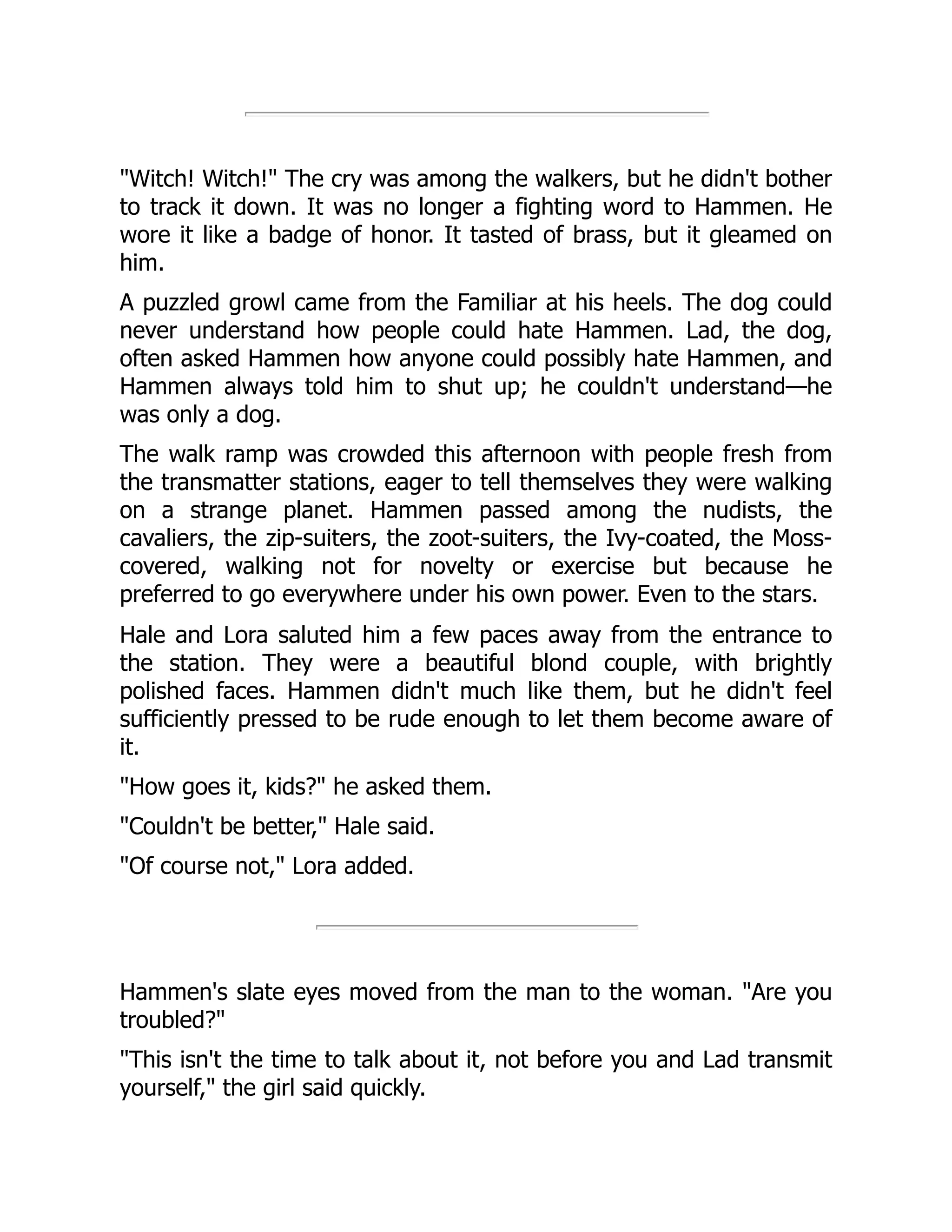
testbankfan.com
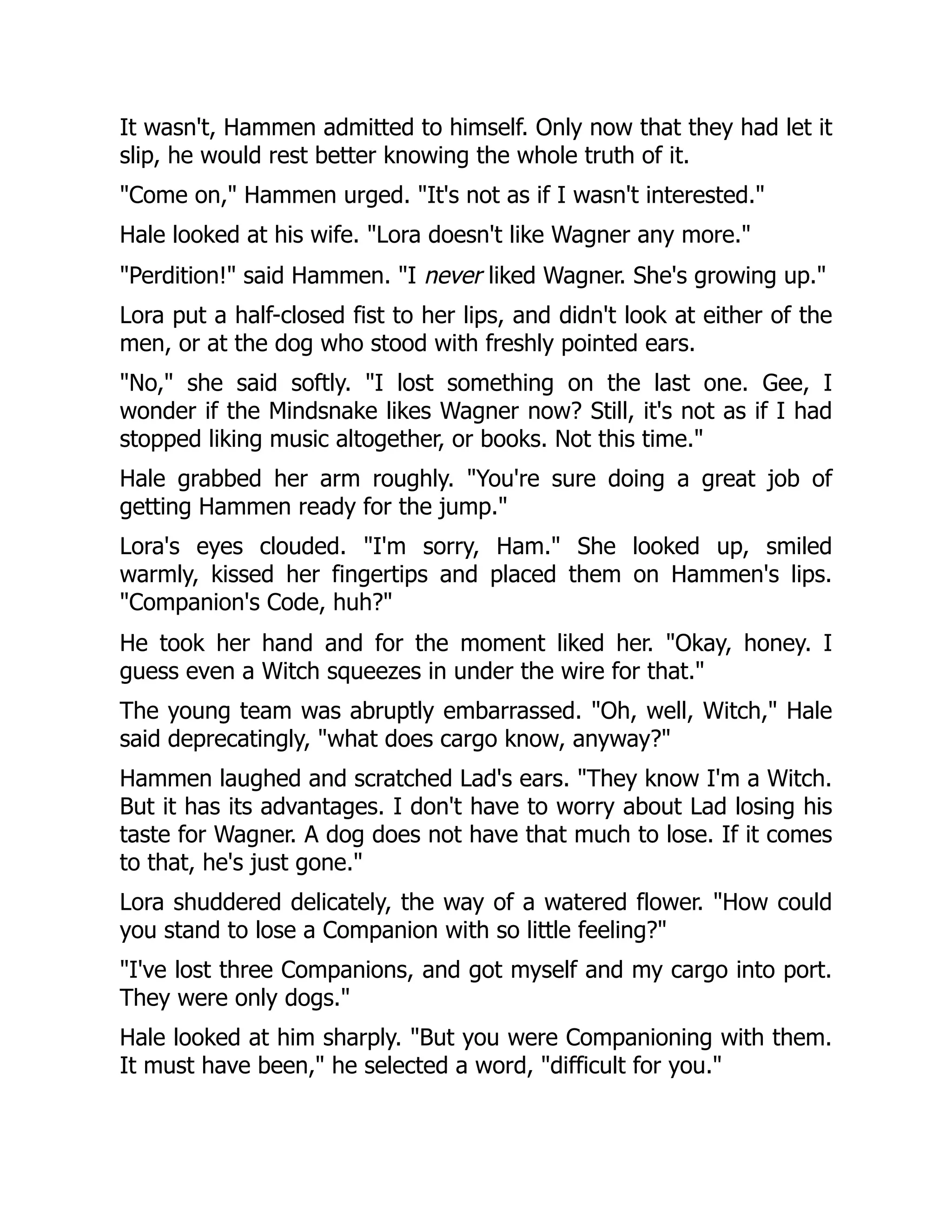
Operations Management 11th Edition Heizer Solutions Manual
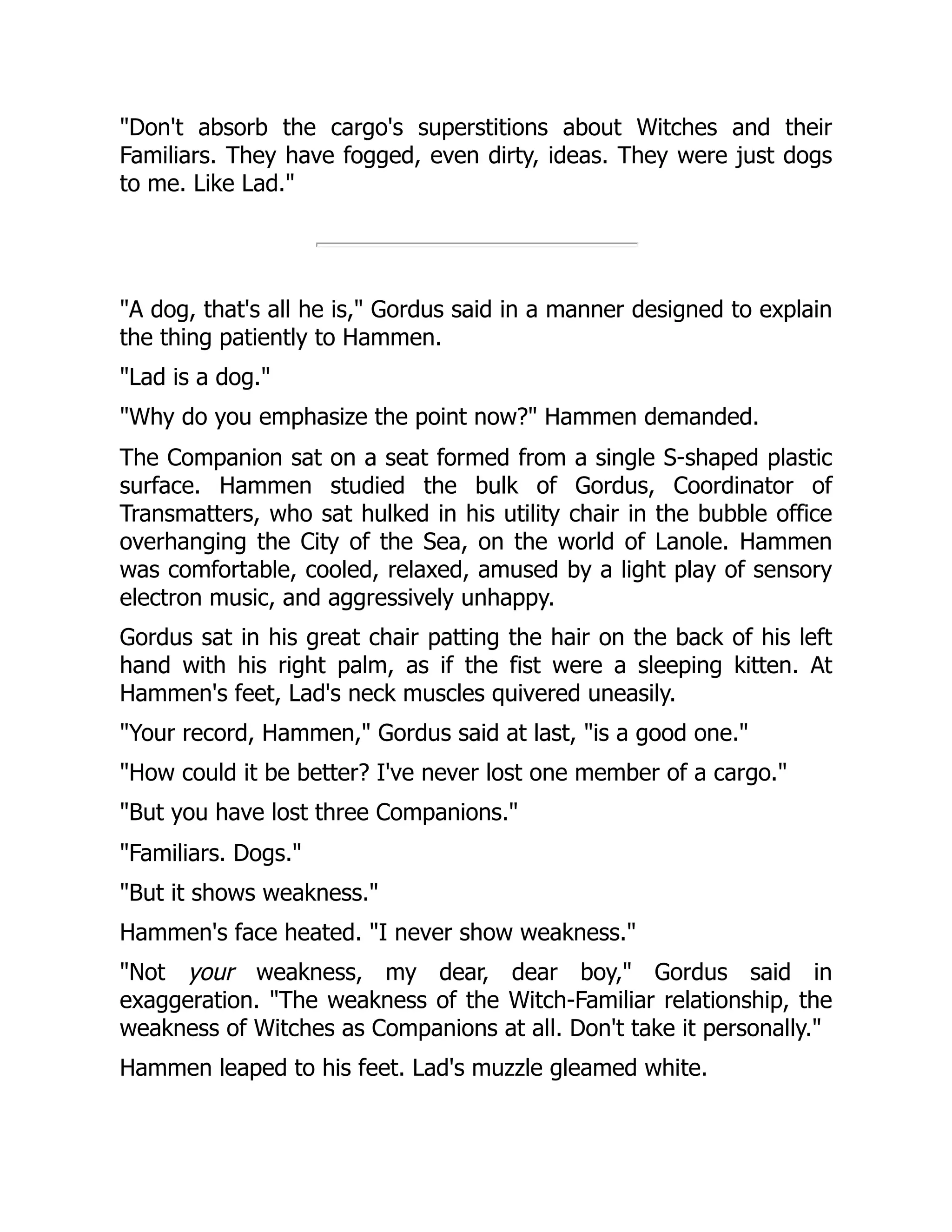
https://testbankfan.com/product/operations-management-11th-edition-
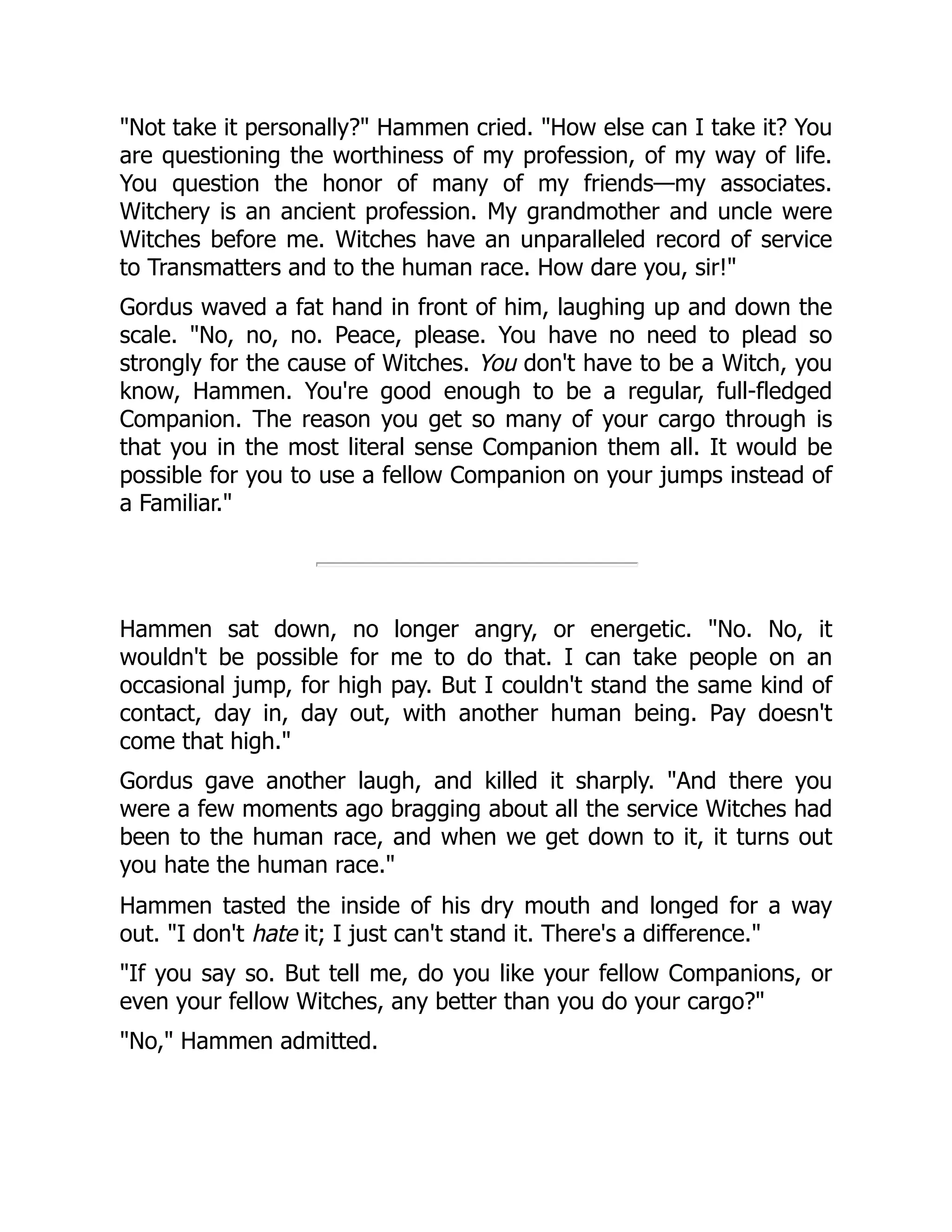
heizer-solutions-manual/
testbankfan.com
3.
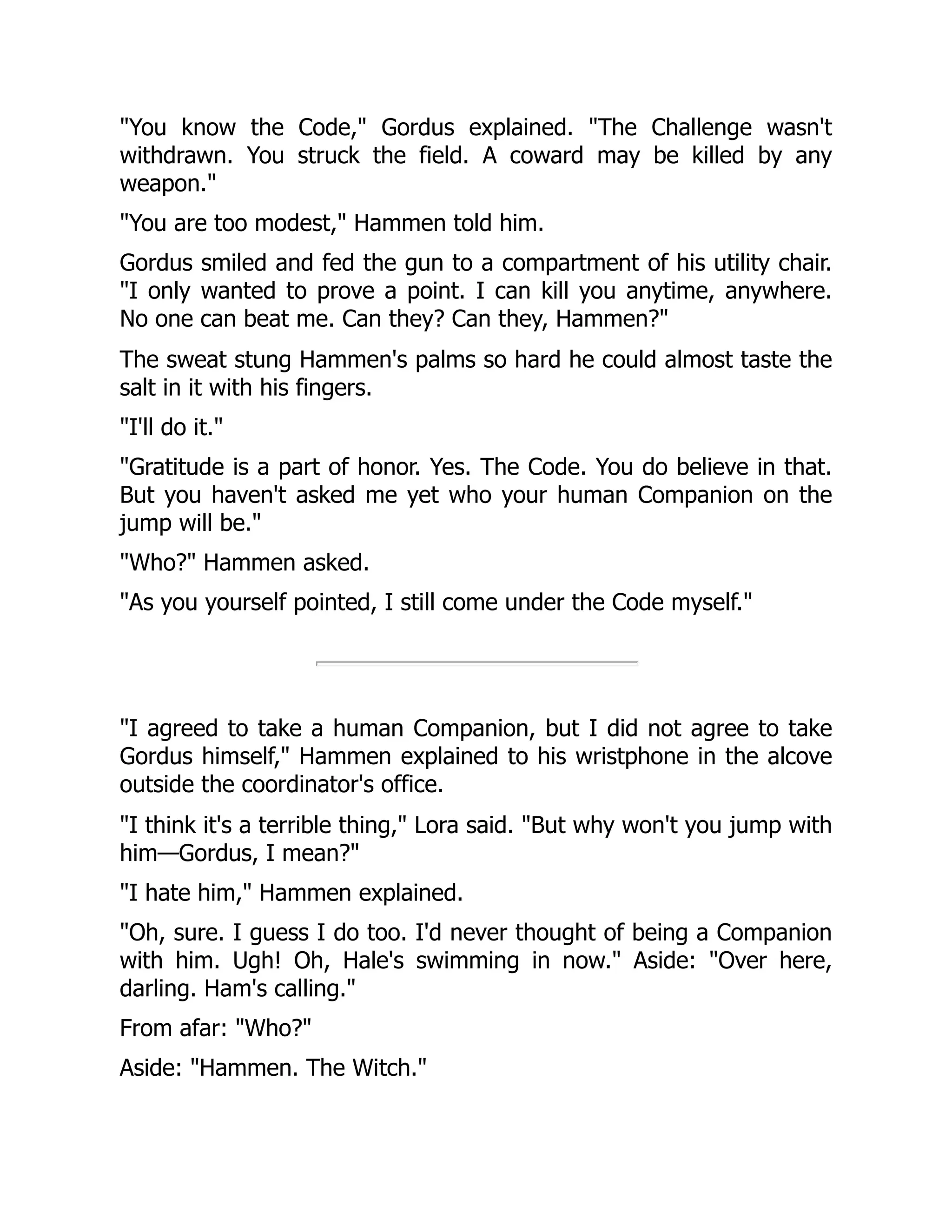
Business Law Textand Cases Legal Ethical Global and
Corporate Environment 12th Edition Clarkson Solutions
Manual
https://testbankfan.com/product/business-law-text-and-cases-legal-
ethical-global-and-corporate-environment-12th-edition-clarkson-
solutions-manual/
testbankfan.com
First Course in Mathematical Modeling 5th Edition Giordano
Solutions Manual
https://testbankfan.com/product/first-course-in-mathematical-
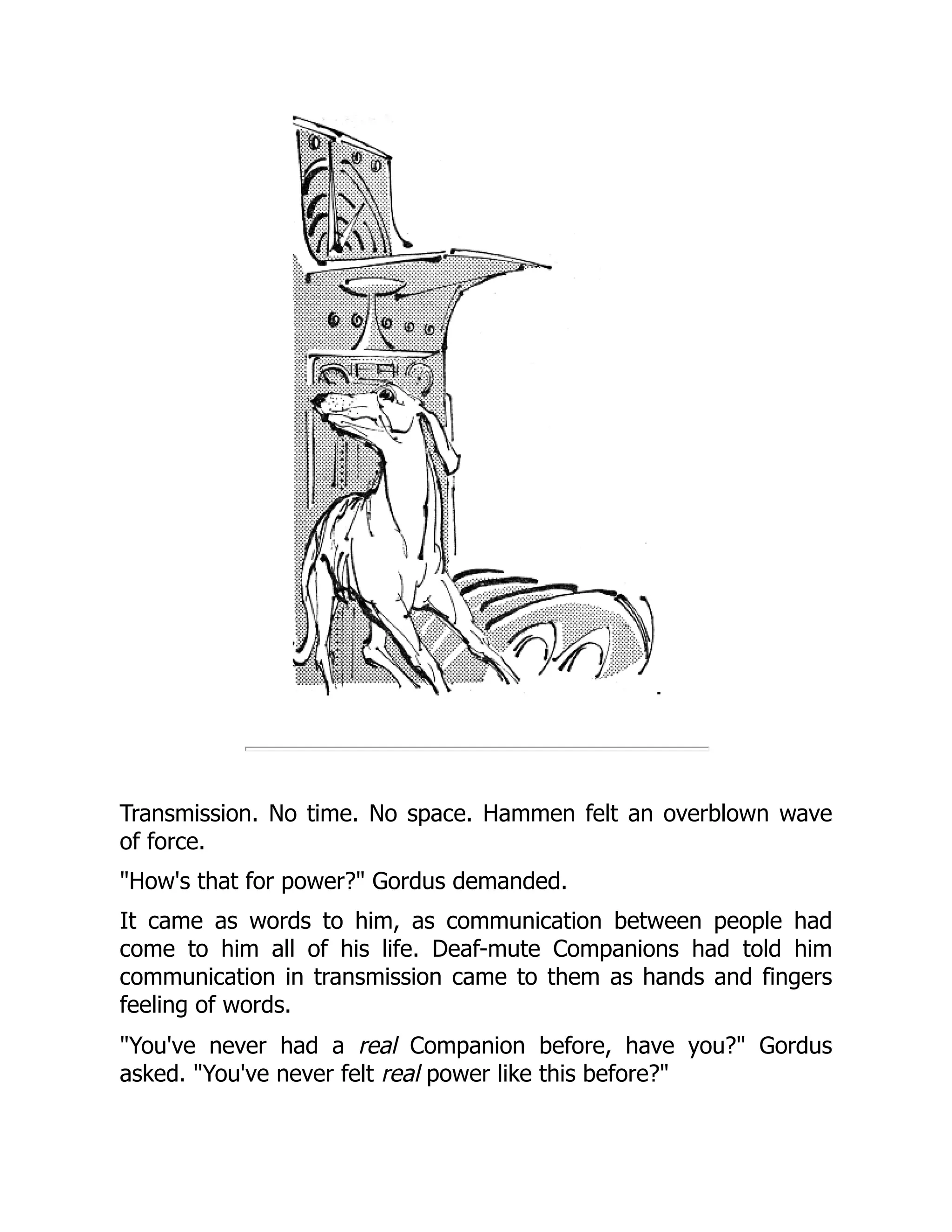
modeling-5th-edition-giordano-solutions-manual/
testbankfan.com
Enduring Vision A History of the American People 8th
Edition Boyer Test Bank
https://testbankfan.com/product/enduring-vision-a-history-of-the-
american-people-8th-edition-boyer-test-bank/
testbankfan.com
Operations Management Processes and Supply Chains 12th
Edition Krajewski Test Bank
https://testbankfan.com/product/operations-management-processes-and-
supply-chains-12th-edition-krajewski-test-bank/
testbankfan.com
Employee Benefits 5th Edition Martocchio Test Bank
https://testbankfan.com/product/employee-benefits-5th-edition-
martocchio-test-bank/
testbankfan.com
4.
Organic Chemistry 12thEdition Solomons Test Bank
https://testbankfan.com/product/organic-chemistry-12th-edition-
solomons-test-bank/
testbankfan.com
5.
Chapter 7
Managing EmployeeRetention and Separation
Chapter 7 Learning Objectives
1. Explain how employee retention and separation align with overall HR strategy.
2. Explain the employee turnover process and describe methods that an organization can use to
reduce undesirable turnover.
3. Discuss the potential benefits and problems associated with employee layoffs.
4. Describe effective methods of employee discipline, including the principles of due process
and the actions of progressive discipline.
5. Describe effective methods for dismissing employees from an organization.
Chapter 7 Outline
7.1 How Can Strategic Employee Retention and Separation Make an Organization
Effective? (pages 252-254)
• Employees are a primary asset of almost every organization.
✓ Replacing an employee who quits costs an organization between one and two times the
annual salary of the position.
✓ Employee retention is a set of actions designed to keep good employees.
➢ Ensuring that nonproductive employees don’t continue with the organization is often
just as important as retaining productive workers.
➢ Changes in economic conditions and product demand sometimes force organizations
to reduce size of workforce.
✓ Employee separation is the process of efficiently and fairly terminating workers.
7.2 How Are Employee Retention and Separation Strategic? (pages 254-256)
• Strategic Emphasis on Employee Retention (pages 254-255)
✓ Retaining good employees is the essence of internal labor orientation.
➢ Competitive advantage comes from developing loyal workforce that consistently
excels at satisfying customer demands.
➢ Loyal Soldier HR strategy: Internal labor orientation and cost reduction strategy.
➢ Committed Expert HR strategy: Internal labor orientation and differentiation
strategy.
➢ Employee retention is not as critical for external labor orientation.
➢ For Bargain Laborer HR strategy, separations are seen as a necessary consequence of
combining entry-level work with relatively low wages.
➢ For Free Agent HR strategy, those who leave can be replaced by individuals with
more up-to-date knowledge and skills.
• Strategic Emphasis on Employee Separation (page 255-256)
✓ Employee separations are an important part of differentiation strategy.
6.
➢ Differentiators relyon highly skilled employees.
➢ Committed Expert HR strategy focuses on terminating low performers.
➢ Free Agent HR strategy benefits from frequently replacing employees with others
who bring new skills and a fresh perspective.
✓ Managing employee separation is not as important as cost reduction strategies: Loyal
Soldier HR and Bargain Laborer HR strategies.
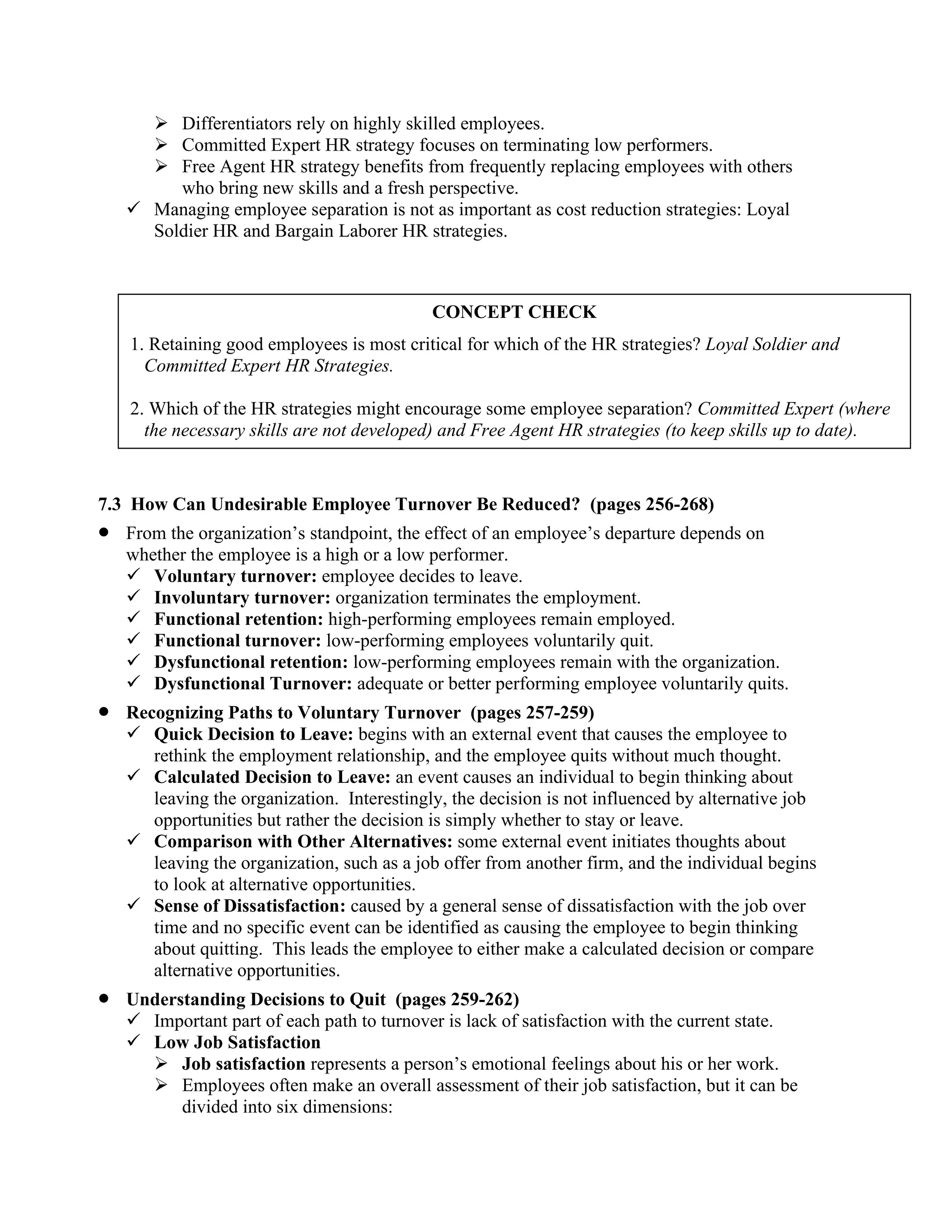
7.3 How Can Undesirable Employee Turnover Be Reduced? (pages 256-268)
• From the organization’s standpoint, the effect of an employee’s departure depends on
whether the employee is a high or a low performer.
✓ Voluntary turnover: employee decides to leave.
✓ Involuntary turnover: organization terminates the employment.
✓ Functional retention: high-performing employees remain employed.
✓ Functional turnover: low-performing employees voluntarily quit.
✓ Dysfunctional retention: low-performing employees remain with the organization.
✓ Dysfunctional Turnover: adequate or better performing employee voluntarily quits.
• Recognizing Paths to Voluntary Turnover (pages 257-259)
✓ Quick Decision to Leave: begins with an external event that causes the employee to
rethink the employment relationship, and the employee quits without much thought.
✓ Calculated Decision to Leave: an event causes an individual to begin thinking about
leaving the organization. Interestingly, the decision is not influenced by alternative job
opportunities but rather the decision is simply whether to stay or leave.
✓ Comparison with Other Alternatives: some external event initiates thoughts about
leaving the organization, such as a job offer from another firm, and the individual begins
to look at alternative opportunities.
✓ Sense of Dissatisfaction: caused by a general sense of dissatisfaction with the job over
time and no specific event can be identified as causing the employee to begin thinking
about quitting. This leads the employee to either make a calculated decision or compare
alternative opportunities.
• Understanding Decisions to Quit (pages 259-262)
✓ Important part of each path to turnover is lack of satisfaction with the current state.
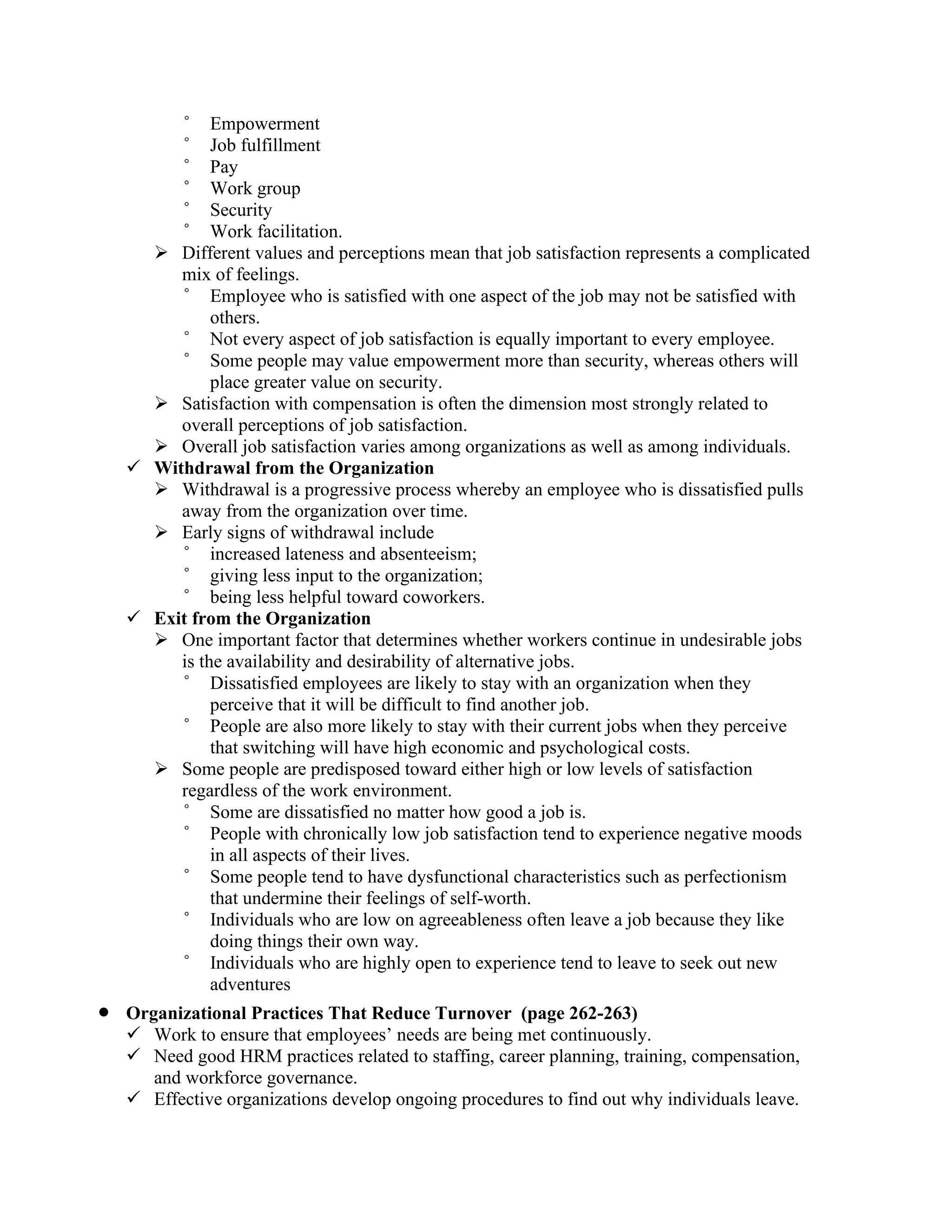
✓ Low Job Satisfaction
➢ Job satisfaction represents a person’s emotional feelings about his or her work.
➢ Employees often make an overall assessment of their job satisfaction, but it can be
divided into six dimensions:
CONCEPT CHECK
1. Retaining good employees is most critical for which of the HR strategies? Loyal Soldier and
Committed Expert HR Strategies.
2. Which of the HR strategies might encourage some employee separation? Committed Expert (where
the necessary skills are not developed) and Free Agent HR strategies (to keep skills up to date).
7.
° Empowerment
° Jobfulfillment
° Pay
° Work group
° Security
° Work facilitation.
➢ Different values and perceptions mean that job satisfaction represents a complicated
mix of feelings.
° Employee who is satisfied with one aspect of the job may not be satisfied with
others.
° Not every aspect of job satisfaction is equally important to every employee.
° Some people may value empowerment more than security, whereas others will
place greater value on security.
➢ Satisfaction with compensation is often the dimension most strongly related to
overall perceptions of job satisfaction.
➢ Overall job satisfaction varies among organizations as well as among individuals.
✓ Withdrawal from the Organization
➢ Withdrawal is a progressive process whereby an employee who is dissatisfied pulls
away from the organization over time.
➢ Early signs of withdrawal include
° increased lateness and absenteeism;
° giving less input to the organization;
° being less helpful toward coworkers.
✓ Exit from the Organization
➢ One important factor that determines whether workers continue in undesirable jobs
is the availability and desirability of alternative jobs.
° Dissatisfied employees are likely to stay with an organization when they
perceive that it will be difficult to find another job.
° People are also more likely to stay with their current jobs when they perceive
that switching will have high economic and psychological costs.
➢ Some people are predisposed toward either high or low levels of satisfaction
regardless of the work environment.
° Some are dissatisfied no matter how good a job is.
° People with chronically low job satisfaction tend to experience negative moods
in all aspects of their lives.
° Some people tend to have dysfunctional characteristics such as perfectionism
that undermine their feelings of self-worth.
° Individuals who are low on agreeableness often leave a job because they like
doing things their own way.
° Individuals who are highly open to experience tend to leave to seek out new
adventures
• Organizational Practices That Reduce Turnover (page 262-263)
✓ Work to ensure that employees’ needs are being met continuously.
✓ Need good HRM practices related to staffing, career planning, training, compensation,
and workforce governance.
✓ Effective organizations develop ongoing procedures to find out why individuals leave.
8.
✓ Each employeewho leaves should have an exit interview where the interviewer tries to
determine why the employee decided to quit.
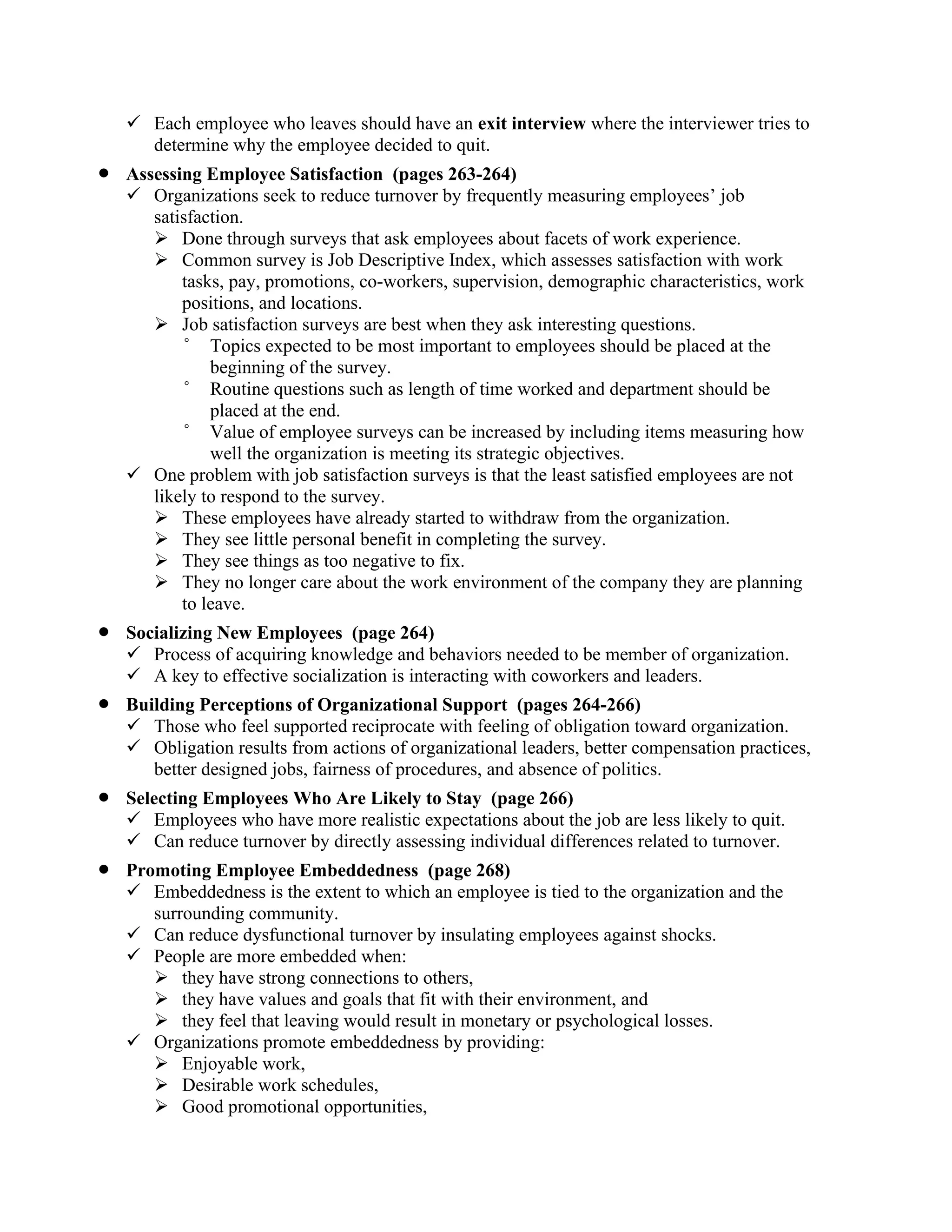
• Assessing Employee Satisfaction (pages 263-264)
✓ Organizations seek to reduce turnover by frequently measuring employees’ job
satisfaction.
➢ Done through surveys that ask employees about facets of work experience.
➢ Common survey is Job Descriptive Index, which assesses satisfaction with work
tasks, pay, promotions, co-workers, supervision, demographic characteristics, work
positions, and locations.
➢ Job satisfaction surveys are best when they ask interesting questions.
° Topics expected to be most important to employees should be placed at the
beginning of the survey.
° Routine questions such as length of time worked and department should be
placed at the end.
° Value of employee surveys can be increased by including items measuring how
well the organization is meeting its strategic objectives.
✓ One problem with job satisfaction surveys is that the least satisfied employees are not
likely to respond to the survey.
➢ These employees have already started to withdraw from the organization.
➢ They see little personal benefit in completing the survey.
➢ They see things as too negative to fix.
➢ They no longer care about the work environment of the company they are planning
to leave.
• Socializing New Employees (page 264)
✓ Process of acquiring knowledge and behaviors needed to be member of organization.
✓ A key to effective socialization is interacting with coworkers and leaders.
• Building Perceptions of Organizational Support (pages 264-266)
✓ Those who feel supported reciprocate with feeling of obligation toward organization.
✓ Obligation results from actions of organizational leaders, better compensation practices,
better designed jobs, fairness of procedures, and absence of politics.
• Selecting Employees Who Are Likely to Stay (page 266)
✓ Employees who have more realistic expectations about the job are less likely to quit.
✓ Can reduce turnover by directly assessing individual differences related to turnover.
• Promoting Employee Embeddedness (page 268)
✓ Embeddedness is the extent to which an employee is tied to the organization and the
surrounding community.
✓ Can reduce dysfunctional turnover by insulating employees against shocks.
✓ People are more embedded when:
➢ they have strong connections to others,
➢ they have values and goals that fit with their environment, and
➢ they feel that leaving would result in monetary or psychological losses.
✓ Organizations promote embeddedness by providing:
➢ Enjoyable work,
➢ Desirable work schedules,
➢ Good promotional opportunities,
9.
➢ Good benefits,
➢Encouraging employees to build positive social relationships with coworkers,
➢ Encouraging employees to work in teams.
➢ Company sponsored service projects and athletic teams build similar relationships.
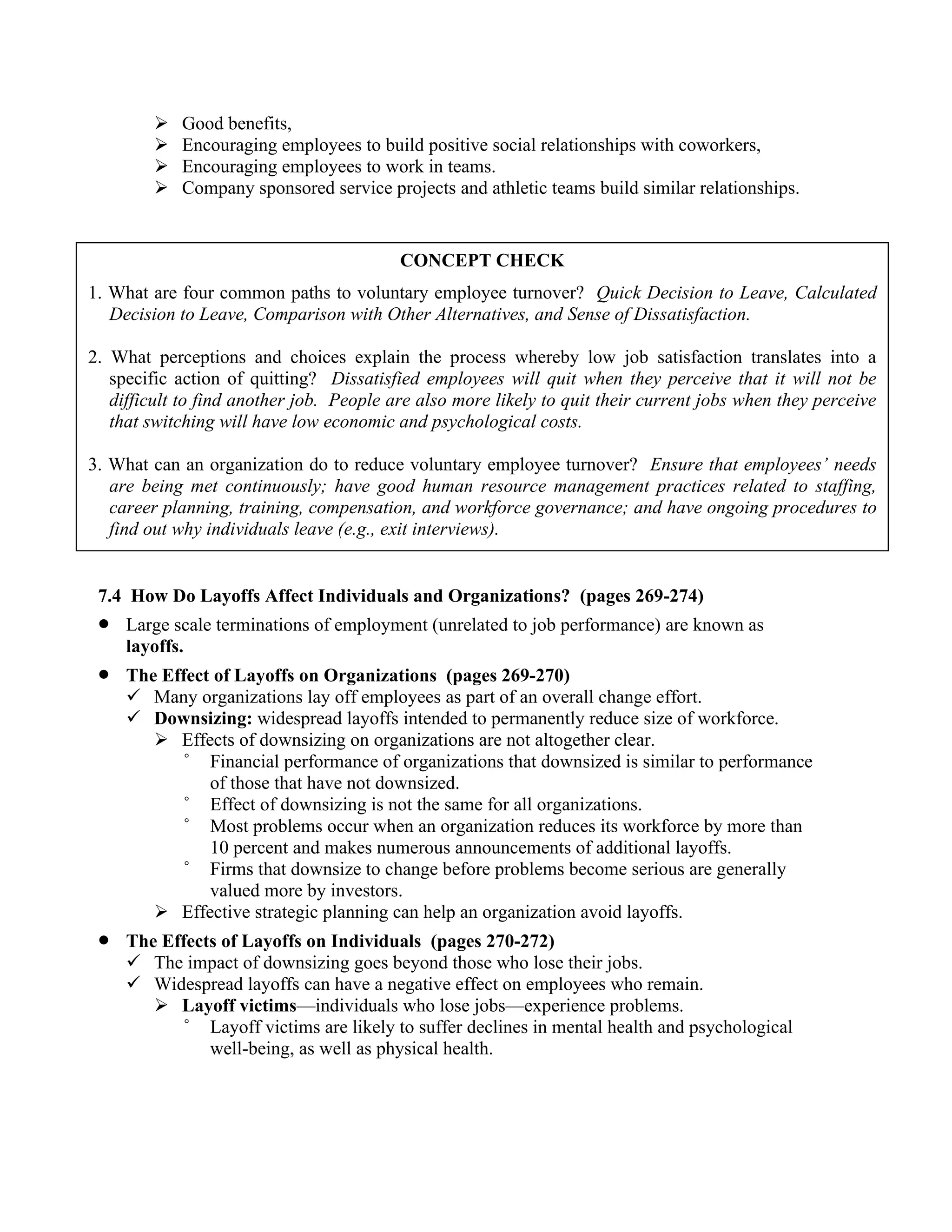
7.4 How Do Layoffs Affect Individuals and Organizations? (pages 269-274)
• Large scale terminations of employment (unrelated to job performance) are known as
layoffs.
• The Effect of Layoffs on Organizations (pages 269-270)
✓ Many organizations lay off employees as part of an overall change effort.
✓ Downsizing: widespread layoffs intended to permanently reduce size of workforce.
➢ Effects of downsizing on organizations are not altogether clear.
° Financial performance of organizations that downsized is similar to performance
of those that have not downsized.
° Effect of downsizing is not the same for all organizations.
° Most problems occur when an organization reduces its workforce by more than
10 percent and makes numerous announcements of additional layoffs.
° Firms that downsize to change before problems become serious are generally
valued more by investors.
➢ Effective strategic planning can help an organization avoid layoffs.
• The Effects of Layoffs on Individuals (pages 270-272)
✓ The impact of downsizing goes beyond those who lose their jobs.
✓ Widespread layoffs can have a negative effect on employees who remain.
➢ Layoff victims—individuals who lose jobs—experience problems.
° Layoff victims are likely to suffer declines in mental health and psychological
well-being, as well as physical health.
CONCEPT CHECK
1. What are four common paths to voluntary employee turnover? Quick Decision to Leave, Calculated
Decision to Leave, Comparison with Other Alternatives, and Sense of Dissatisfaction.
2. What perceptions and choices explain the process whereby low job satisfaction translates into a
specific action of quitting? Dissatisfied employees will quit when they perceive that it will not be
difficult to find another job. People are also more likely to quit their current jobs when they perceive
that switching will have low economic and psychological costs.
3. What can an organization do to reduce voluntary employee turnover? Ensure that employees’ needs
are being met continuously; have good human resource management practices related to staffing,
career planning, training, compensation, and workforce governance; and have ongoing procedures to
find out why individuals leave (e.g., exit interviews).
10.
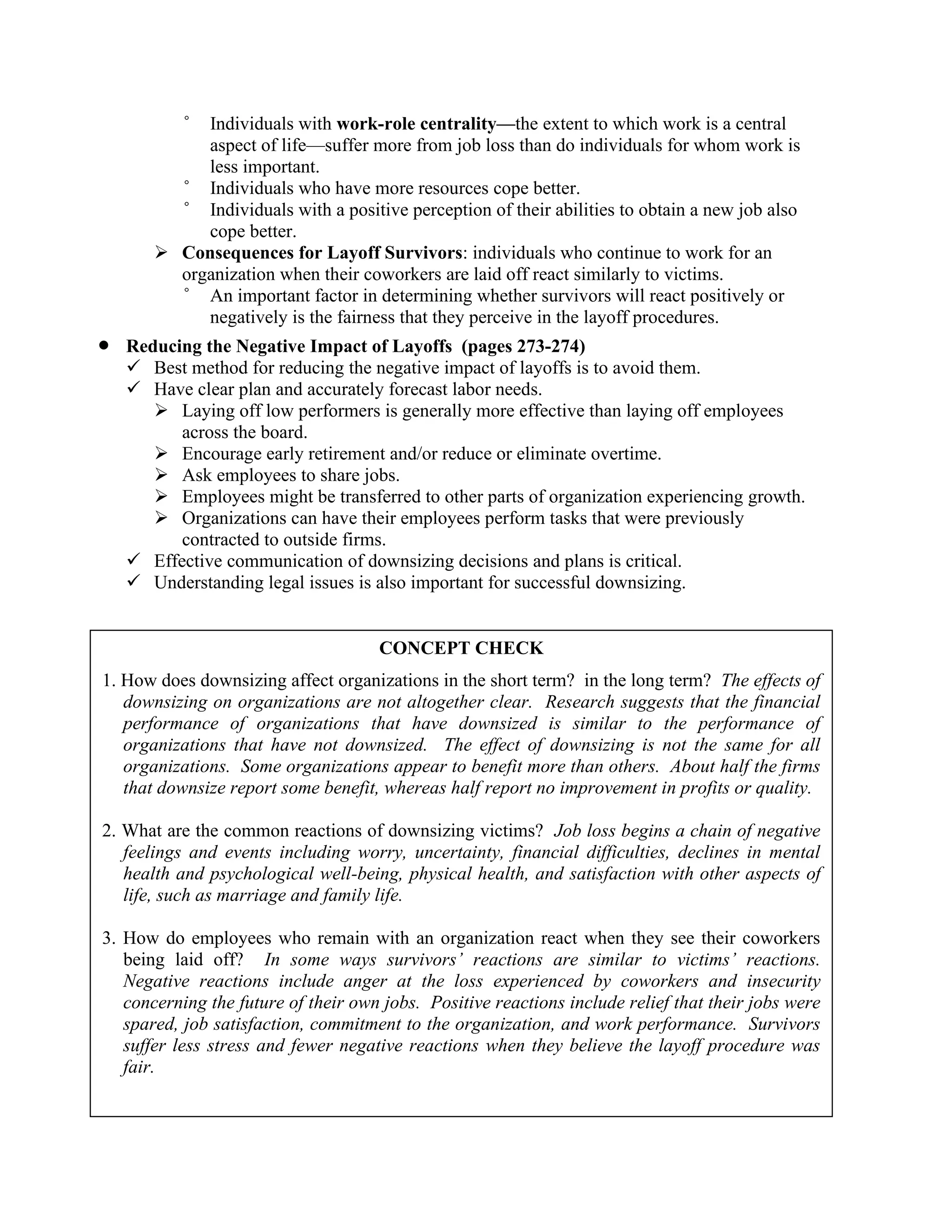
° Individuals withwork-role centrality—the extent to which work is a central
aspect of life—suffer more from job loss than do individuals for whom work is
less important.
° Individuals who have more resources cope better.
° Individuals with a positive perception of their abilities to obtain a new job also
cope better.
➢ Consequences for Layoff Survivors: individuals who continue to work for an
organization when their coworkers are laid off react similarly to victims.
° An important factor in determining whether survivors will react positively or
negatively is the fairness that they perceive in the layoff procedures.
• Reducing the Negative Impact of Layoffs (pages 273-274)
✓ Best method for reducing the negative impact of layoffs is to avoid them.
✓ Have clear plan and accurately forecast labor needs.
➢ Laying off low performers is generally more effective than laying off employees
across the board.
➢ Encourage early retirement and/or reduce or eliminate overtime.
➢ Ask employees to share jobs.
➢ Employees might be transferred to other parts of organization experiencing growth.
➢ Organizations can have their employees perform tasks that were previously
contracted to outside firms.
✓ Effective communication of downsizing decisions and plans is critical.
✓ Understanding legal issues is also important for successful downsizing.
CONCEPT CHECK
1. How does downsizing affect organizations in the short term? in the long term? The effects of
downsizing on organizations are not altogether clear. Research suggests that the financial
performance of organizations that have downsized is similar to the performance of
organizations that have not downsized. The effect of downsizing is not the same for all
organizations. Some organizations appear to benefit more than others. About half the firms
that downsize report some benefit, whereas half report no improvement in profits or quality.
2. What are the common reactions of downsizing victims? Job loss begins a chain of negative
feelings and events including worry, uncertainty, financial difficulties, declines in mental
health and psychological well-being, physical health, and satisfaction with other aspects of
life, such as marriage and family life.
3. How do employees who remain with an organization react when they see their coworkers
being laid off? In some ways survivors’ reactions are similar to victims’ reactions.
Negative reactions include anger at the loss experienced by coworkers and insecurity
concerning the future of their own jobs. Positive reactions include relief that their jobs were
spared, job satisfaction, commitment to the organization, and work performance. Survivors
suffer less stress and fewer negative reactions when they believe the layoff procedure was
fair.
11.
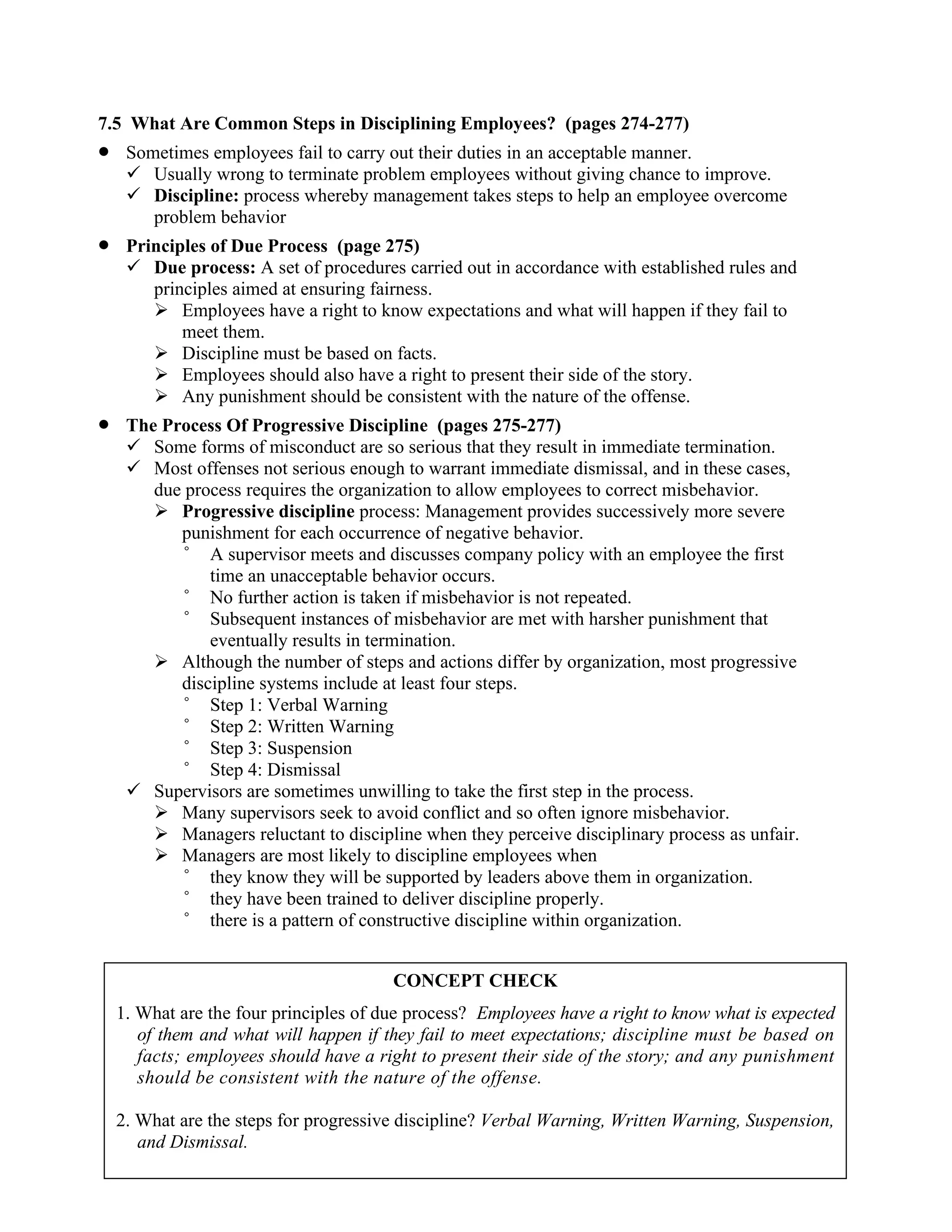
7.5 What AreCommon Steps in Disciplining Employees? (pages 274-277)
• Sometimes employees fail to carry out their duties in an acceptable manner.
✓ Usually wrong to terminate problem employees without giving chance to improve.
✓ Discipline: process whereby management takes steps to help an employee overcome
problem behavior
• Principles of Due Process (page 275)
✓ Due process: A set of procedures carried out in accordance with established rules and
principles aimed at ensuring fairness.
➢ Employees have a right to know expectations and what will happen if they fail to
meet them.
➢ Discipline must be based on facts.
➢ Employees should also have a right to present their side of the story.
➢ Any punishment should be consistent with the nature of the offense.
• The Process Of Progressive Discipline (pages 275-277)
✓ Some forms of misconduct are so serious that they result in immediate termination.
✓ Most offenses not serious enough to warrant immediate dismissal, and in these cases,
due process requires the organization to allow employees to correct misbehavior.
➢ Progressive discipline process: Management provides successively more severe
punishment for each occurrence of negative behavior.
° A supervisor meets and discusses company policy with an employee the first
time an unacceptable behavior occurs.
° No further action is taken if misbehavior is not repeated.
° Subsequent instances of misbehavior are met with harsher punishment that
eventually results in termination.
➢ Although the number of steps and actions differ by organization, most progressive
discipline systems include at least four steps.
° Step 1: Verbal Warning
° Step 2: Written Warning
° Step 3: Suspension
° Step 4: Dismissal
✓ Supervisors are sometimes unwilling to take the first step in the process.
➢ Many supervisors seek to avoid conflict and so often ignore misbehavior.
➢ Managers reluctant to discipline when they perceive disciplinary process as unfair.
➢ Managers are most likely to discipline employees when
° they know they will be supported by leaders above them in organization.
° they have been trained to deliver discipline properly.
° there is a pattern of constructive discipline within organization.
CONCEPT CHECK
1. What are the four principles of due process? Employees have a right to know what is expected
of them and what will happen if they fail to meet expectations; discipline must be based on
facts; employees should have a right to present their side of the story; and any punishment
should be consistent with the nature of the offense.
2. What are the steps for progressive discipline? Verbal Warning, Written Warning, Suspension,
and Dismissal.
12.
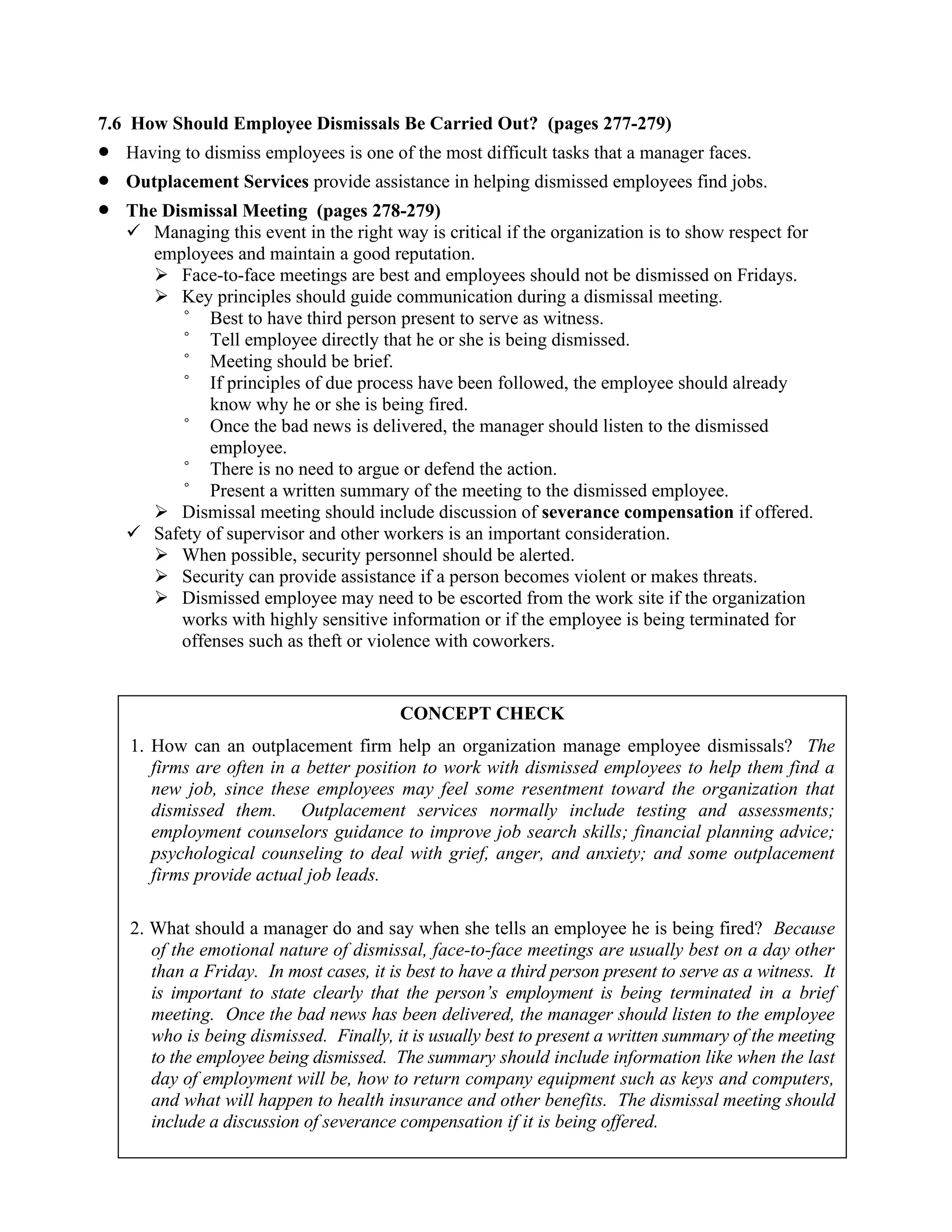
7.6 How ShouldEmployee Dismissals Be Carried Out? (pages 277-279)
• Having to dismiss employees is one of the most difficult tasks that a manager faces.
• Outplacement Services provide assistance in helping dismissed employees find jobs.
• The Dismissal Meeting (pages 278-279)
✓ Managing this event in the right way is critical if the organization is to show respect for
employees and maintain a good reputation.
➢ Face-to-face meetings are best and employees should not be dismissed on Fridays.
➢ Key principles should guide communication during a dismissal meeting.
° Best to have third person present to serve as witness.
° Tell employee directly that he or she is being dismissed.
° Meeting should be brief.
° If principles of due process have been followed, the employee should already
know why he or she is being fired.
° Once the bad news is delivered, the manager should listen to the dismissed
employee.
° There is no need to argue or defend the action.
° Present a written summary of the meeting to the dismissed employee.
➢ Dismissal meeting should include discussion of severance compensation if offered.
✓ Safety of supervisor and other workers is an important consideration.
➢ When possible, security personnel should be alerted.
➢ Security can provide assistance if a person becomes violent or makes threats.
➢ Dismissed employee may need to be escorted from the work site if the organization
works with highly sensitive information or if the employee is being terminated for
offenses such as theft or violence with coworkers.
CONCEPT CHECK
1. How can an outplacement firm help an organization manage employee dismissals? The
firms are often in a better position to work with dismissed employees to help them find a
new job, since these employees may feel some resentment toward the organization that
dismissed them. Outplacement services normally include testing and assessments;
employment counselors guidance to improve job search skills; financial planning advice;
psychological counseling to deal with grief, anger, and anxiety; and some outplacement
firms provide actual job leads.
2. What should a manager do and say when she tells an employee he is being fired? Because
of the emotional nature of dismissal, face-to-face meetings are usually best on a day other
than a Friday. In most cases, it is best to have a third person present to serve as a witness. It
is important to state clearly that the person’s employment is being terminated in a brief
meeting. Once the bad news has been delivered, the manager should listen to the employee
who is being dismissed. Finally, it is usually best to present a written summary of the meeting
to the employee being dismissed. The summary should include information like when the last
day of employment will be, how to return company equipment such as keys and computers,
and what will happen to health insurance and other benefits. The dismissal meeting should
include a discussion of severance compensation if it is being offered.
13.
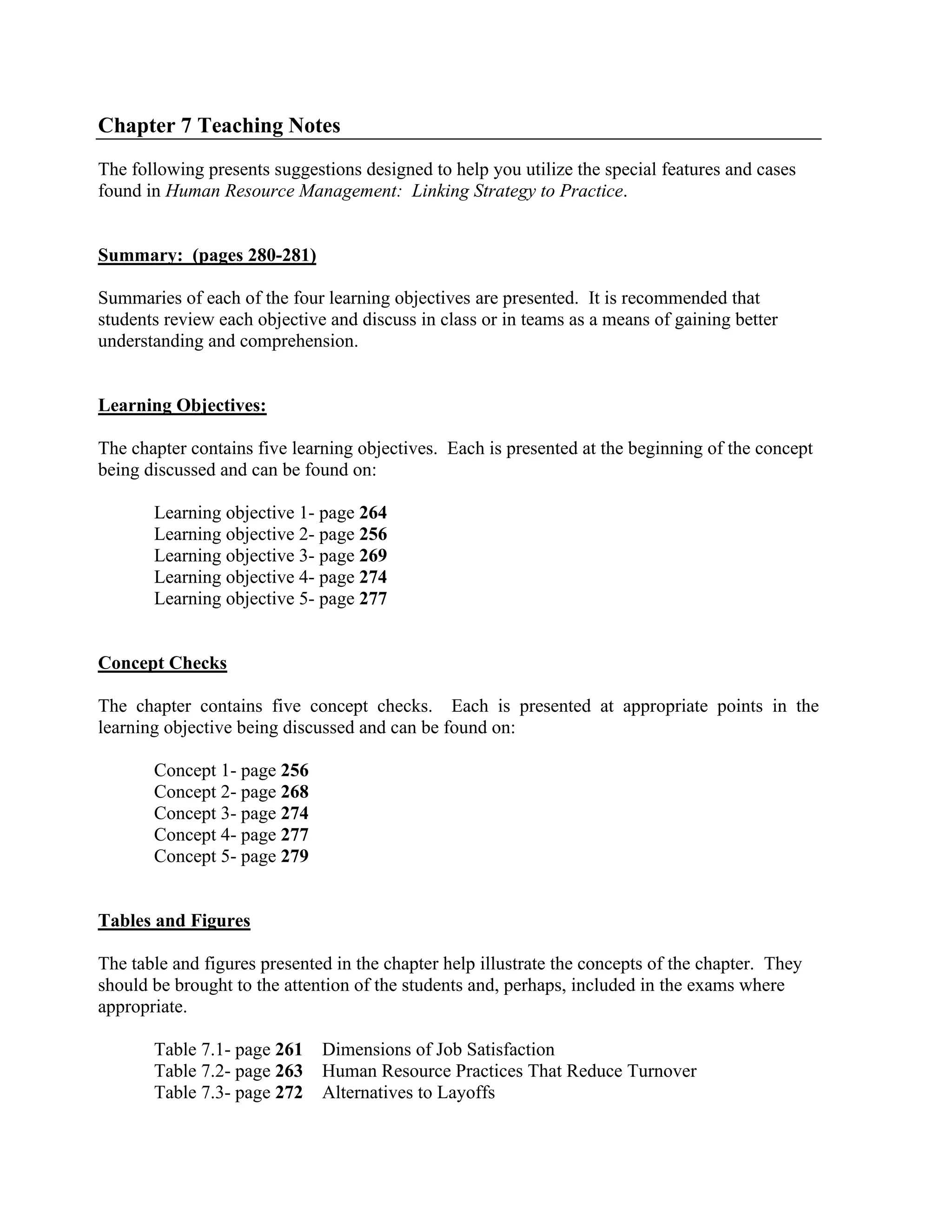
Chapter 7 TeachingNotes
The following presents suggestions designed to help you utilize the special features and cases
found in Human Resource Management: Linking Strategy to Practice.
Summary: (pages 280-281)
Summaries of each of the four learning objectives are presented. It is recommended that
students review each objective and discuss in class or in teams as a means of gaining better
understanding and comprehension.
Learning Objectives:
The chapter contains five learning objectives. Each is presented at the beginning of the concept
being discussed and can be found on:
Learning objective 1- page 264
Learning objective 2- page 256
Learning objective 3- page 269
Learning objective 4- page 274
Learning objective 5- page 277
Concept Checks
The chapter contains five concept checks. Each is presented at appropriate points in the
learning objective being discussed and can be found on:
Concept 1- page 256
Concept 2- page 268
Concept 3- page 274
Concept 4- page 277
Concept 5- page 279
Tables and Figures
The table and figures presented in the chapter help illustrate the concepts of the chapter. They
should be brought to the attention of the students and, perhaps, included in the exams where
appropriate.
Table 7.1- page 261 Dimensions of Job Satisfaction
Table 7.2- page 263 Human Resource Practices That Reduce Turnover
Table 7.3- page 272 Alternatives to Layoffs
14.
Table 7.4- page273 Minimizing the Negative Effects of Layoffs
Figure 7.1- page 255 Strategic Retention and Separation of Employees
Figure 7.2- page 257 Types of Employee Turnover and Retention
Figure 7.3- page 259 Paths to Decisions to Quit
Figure 7.4- page 260 How Job Satisfaction Leads to Quitting
Figure 7.5- page 271 Coping with Job Loss and Unemployment
Figure 7.6- page 272 Responses of Layoff Survivors
Figure 7.7- page 276 Steps for Progressive Discipline
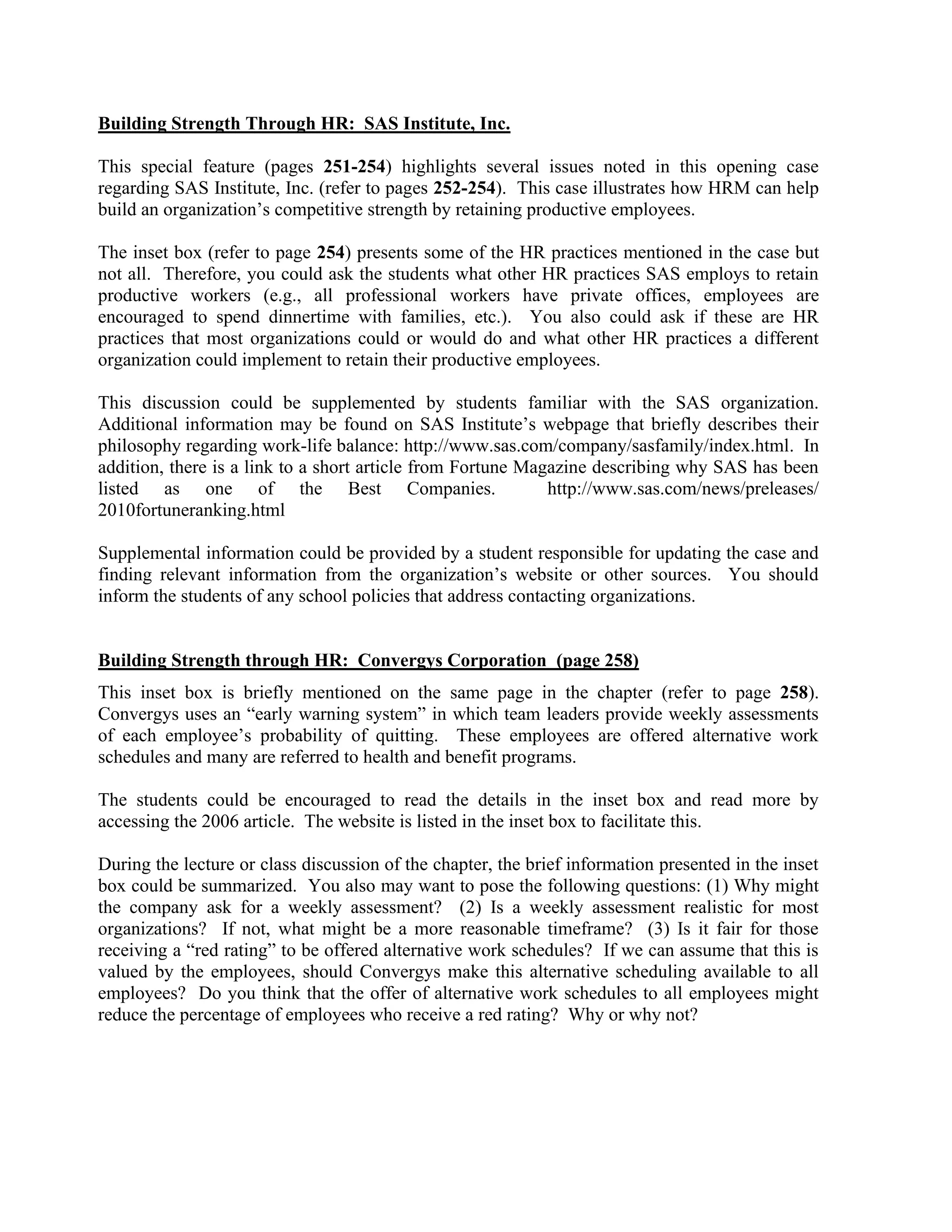
A Manager’s Perspective (page 250-251), What do you think? (page 251), and A
Manager’s Perspective Revisited (page 279-280)
The chapter starts with a short scenario where Angela is thinking about her position as
restaurant manager. She recalls how three people in two months have quit with little or no
advance notice. She is also dreading a discipline meeting that might result in her firing a
worker. Five true/false questions related to this scenario and the chapter topics are noted on
page 251 and answered on page 279.
Discussion of the chapter could start by posing these questions and asking for the class to vote
on which questions are true through a show of hands, thumbs-up/thumbs-down, clickers, or
paper copies of the questions. To keep student interest, the methods for identifying true
answers should be varied.
The activity could be repeated near the end of the chapter discussion. At that time, students
could be asked if they agree with the answers. The students also could be asked to identify
what additional questions Rithica should ask.
During the discussion of the chapter material, you could refer to the questions noting that a
certain section or discussion point addresses one or more of the questions.
For some chapters, you may wish to address the questions at the end of discussing the chapter.
In this case, you may want to bring the students’ attention to these questions informing the
students that they will be asked to answer the questions near the end of the chapter discussion.
At that time, students (individually or in groups) could be asked to explain why the answers are
true or false. Students also could add questions to the list and briefly explain why they think a
new question should be asked. This could be done as a class or in smaller groups. If done in
smaller groups, each group could be asked to briefly report on an aspect of their discussion.
Of course, one or more of the questions or more detailed versions of the questions could be
included in an exam. If included in an exam, students should be warned that these questions
might be part of the exam.
15.
Building Strength ThroughHR: SAS Institute, Inc.
This special feature (pages 251-254) highlights several issues noted in this opening case
regarding SAS Institute, Inc. (refer to pages 252-254). This case illustrates how HRM can help
build an organization’s competitive strength by retaining productive employees.
The inset box (refer to page 254) presents some of the HR practices mentioned in the case but
not all. Therefore, you could ask the students what other HR practices SAS employs to retain
productive workers (e.g., all professional workers have private offices, employees are
encouraged to spend dinnertime with families, etc.). You also could ask if these are HR
practices that most organizations could or would do and what other HR practices a different
organization could implement to retain their productive employees.
This discussion could be supplemented by students familiar with the SAS organization.
Additional information may be found on SAS Institute’s webpage that briefly describes their
philosophy regarding work-life balance: http://www.sas.com/company/sasfamily/index.html. In
addition, there is a link to a short article from Fortune Magazine describing why SAS has been
listed as one of the Best Companies. http://www.sas.com/news/preleases/
2010fortuneranking.html
Supplemental information could be provided by a student responsible for updating the case and
finding relevant information from the organization’s website or other sources. You should
inform the students of any school policies that address contacting organizations.
Building Strength through HR: Convergys Corporation (page 258)
This inset box is briefly mentioned on the same page in the chapter (refer to page 258).
Convergys uses an “early warning system” in which team leaders provide weekly assessments
of each employee’s probability of quitting. These employees are offered alternative work
schedules and many are referred to health and benefit programs.
The students could be encouraged to read the details in the inset box and read more by
accessing the 2006 article. The website is listed in the inset box to facilitate this.
During the lecture or class discussion of the chapter, the brief information presented in the inset
box could be summarized. You also may want to pose the following questions: (1) Why might
the company ask for a weekly assessment? (2) Is a weekly assessment realistic for most
organizations? If not, what might be a more reasonable timeframe? (3) Is it fair for those
receiving a “red rating” to be offered alternative work schedules? If we can assume that this is
valued by the employees, should Convergys make this alternative scheduling available to all
employees? Do you think that the offer of alternative work schedules to all employees might
reduce the percentage of employees who receive a red rating? Why or why not?
16.
Overview of Activity
IdentifyHR practices utilized by Convergys Corporation that could reduce turnover of
productive workers. Note: Convergys Corporation has been consistently listed by Fortune as
one of the “The 100 Best Companies to Work for in America.” Thus, the organization’s
website presents adequate information regarding relevant HR practices.
Exercise:
Refer to the inset box Building Strength through HR: Convergys Corporation found on page
258. Convergys uses an “early warning system” in which team leaders provide weekly
assessments of each employee’s probability of quitting. These employees are offered
alternative work schedules and many are referred to health and benefit programs.
The students could be encouraged to read the details in the inset box and read more by
accessing the 2006 article. The website is http://money.cnn.com/magazines/fortune/
mostadmired/. Then they can identify various HR practices that the text authors have identified
as potentially helpful to reduce turnover of productive workers. You should encourage the
students to consider such practices as the organization’s culture, recruiting and selection
techniques, benefits, etc.
Alternate Approaches to the Exercise:
Students could compare and contrast HR practices utilized in various organizations that could
be used to retain productive workers. Many of the organizations listed in Fortune’s top 20 of
“The 100 Best Companies to Work for in America” have helpful websites.
Links to relevant information
http://money.cnn.com/magazines/fortune/mostadmired/
http://www.convergys.com/company/company-overview.php
http://money.cnn.com/magazines/fortune/bestcompanies/2007/
Technology in HR: Computerized Orientation Programs (page 265)
This inset box briefly addresses costs and benefits of computerized orientation programs.
The brief information presented in this box could be referred to during a lecture. Students can
be asked for their experiences with online orientation or training. The students could be asked
to speculate on reasons for the lower job satisfaction and organizational commitment of those
employees who received the computer-based orientation and how these negative outcomes
could be reduced.
The effectiveness of orientation programs (e.g., computerized, live, hybrid) could be researched
by students.
17.
Building Strength ThroughHR: FreshDirect (page 266)
This inset box briefly addresses how FreshDirect (an online grocer) reduced their turnover rate
of over 200 percent to 75 percent.
After summarizing the information from the inset box, the students could be asked the
following questions: (1) Is it realistic to tie a portion of the managers’ pay to turnover rates in
their departments? (2) What behaviors might FreshDirect be expecting from managers when a
portion of their pay is linked to turnover rates in their departments? (3) Should managers be
held responsible for turnover that is not directly attributable to organizational factors (e.g.,
family moves, illness, internal transfers, etc.)? (4) How could employee reasons for turnover be
tracked if some types of turnover will not be affected by managers?
How Do We Know? Are Coworkers Contagious? (page 267)
This inset box is mentioned on the same page of the text (refer to page 267). Researchers
Felps, Mitchell, Hekman, Lee, Holtom, and Harman conducted two studies to answer two
questions; 1) does having embedded coworkers make an employee more likely to be an
embedded worker, and 2) does working with people who are looking for other jobs also
influence other workers to also look for new jobs.
The researchers found that in the first study, an individual employee was less likely to quit if his
coworkers were embedded in their jobs and in the second study, coworkers who were less
embedded were more active in searching for other jobs.
The information reported in the inset box could be part of a lecture or class discussion. Students
could be asked to speculate about their own coworkers’ perceived embeddedness or about the
embeddedness of coworkers at previous jobs. Every effort should be made to discuss the
situations without mentioning individual names.
Other ways to address this information could be through a short written assignment or a more
in-depth research paper on embeddedness and its impact on employee and organizational
performance.
How Do We Know? Do Managers Think Discipline Is Fair? (page 277)
This inset box is mentioned on the same page of the text (refer to page 277). Researchers asked
62 experienced HR managers to rate whether instances of discipline familiar to the managers
were fair. The researchers concluded that managers perceive discipline as fair when the
employee knew the offending behavior was wrong and expected punishment. The managers
also felt that the discipline was fair when the consequence was appropriate.
One way to address this information could be through a discussion, short written assignment, or
a more in-depth research paper on disciplining and its impact on employee and organizational
performance. One written assignment could involve the students contrasting and comparing
18.
progressive discipline andpositive discipline approaches. Among other differences, positive
discipline advocates replacing the term “warning” with “reminder” and having the supervisor
counsel the employee during the first three steps. The final step (termination) is the same as
progressive discipline. Sources include: D. Grote, “Discipline without Punishment,” Across the
Board, September 2001), pp. 52-57, and J. Kay, “Vantage Point,” Nursing Management, UK,
(June 2004), p. 8.
KEY TERMS (pages 281-282)
Discipline 274
Downsizing 269
Due process 274
Dysfunctional turnover 257
Embeddedness 267
Employee retention 252
Employee separation 252
Exit interview 263
Involuntary turnover 257
Job satisfaction 260
Layoffs 268
Layoff survivors 271
Layoff victims 270
Outplacement services 277
Perceived organizational support 264
Progressive discipline 275
Severance compensation 278
Socialization 264
Voluntary turnover 257
Withdrawal 261
Work-role centrality 270
DISCUSSION QUESTIONS (page 282)
1. How can SAS compete with other software firms when its employees appear to
work less than the employees at competing firms? Answer: They could identify the
lower performers and try to learn why they are less productive. SAS also could
benchmark best practices in regard to HR practices that might identify higher
performing job candidates and that encourage higher productivity.
2. Do you think a fast-food restaurant such as Arby’s would benefit from reducing
turnover of cooks and cashiers? Answer: Perhaps. Arguments could be made
either way. What could the company reasonably do to encourage employees to
stay? Answer: Some of what they do might depend on what they learn from the
employees. Arby’s may find that their workers want some job enrichment, flex-time,
opportunities to do community work on company time, etc. What problems might
occur if employees stayed for longer periods of time? Problems might include: low
morale, low productivity, high absenteeism, low job satisfaction, low customer
19.
service, etc.
3. Doyou think the university you attend makes a concerted effort to dismiss low-
performing workers? Students’ answers will vary. How does the university’s
approach to dismissing low performers affect overall services for students? Student
answers might include low morale, poorly taught classes, poor advising, etc.
4. What are some specific events that might cause you to leave an organization
without having found a different job? Students’ answers will vary.
5. Which dimensions of job satisfaction are most important to you? Would you accept
less pay to work in a job with better coworkers? How important is doing work that
you find enjoyable? Students’ answers will vary.
6. What things keep you embedded in your current situation? Are there personal and
family factors that encourage you to keep your life as it is? Can you identify social
relationships that might influence you to avoid moving to another university or a
different job? Students’ answers will vary.
7. Why do you think organizations that lay off workers frequently fail to improve their
long term performance? Answer: A main reason most likely is that they are doing a
poor job of strategic planning and HR planning.
8. Some people who have been layoff victims look back on the experience as one of
the best things in their lives. Why might a victim say such a thing several years
after the layoff? Answers will vary. They might include that they found a better job
that was less stressful and more rewarding with, perhaps, better job security. They
also may have gained valuable experience in termination meetings that they can
share with their new companies.
9. Can you identify a time when a low-performing individual has not been disciplined
by a leader? How did the lack of discipline affect the poor performer? How did it
affect other workers or team members? Students’ answers will vary.
10. As a manager, what would you say to a person whom you were firing? Answer: Get
right to the point, telling the person that she or he has been dismissed. Then, listen
to her or him. Also you would explain the termination process (what happens next),
outplacement firm services, and severance pay.
EXAMPLE CASE: Apparel Inc. (pages 282-283)
Questions
1. What are some ways that managers might cope with negative emotions when they are
forced to lay off employees? Answer: Training the managers in proper discipline
techniques, developing fair procedures, and making sure the organization has a
constructive discipline structure, including that the managers know that they will be
supported by leaders). Students may also mention stress management techniques or
talking to HR professionals or other managers about their feelings.
This ebook isfor the use of anyone anywhere in the United States
and most other parts of the world at no cost and with almost no
restrictions whatsoever. You may copy it, give it away or re-use it
under the terms of the Project Gutenberg License included with this
ebook or online at www.gutenberg.org. If you are not located in the
United States, you will have to check the laws of the country where
you are located before using this eBook.
Title: Mindsnake
Author: Jim Harmon
Illustrator: Bob Ritter
Release date: December 17, 2019 [eBook #60946]
Most recently updated: October 17, 2024
Language: English
Credits: Produced by Greg Weeks, Mary Meehan and the Online
Distributed Proofreading Team at http://www.pgdp.net
*** START OF THE PROJECT GUTENBERG EBOOK MINDSNAKE ***
27.
Let them thinkanything they wished of
him and his dog. All that mattered was
the black thought slithering of the ...
MINDSNAKE
28.
By JIM HARMON
[Transcriber'sNote: This etext was produced from
Worlds of If Science Fiction, November 1960.
Extensive research did not uncover any evidence that
the U.S. copyright on this publication was renewed.]
29.
"Witch! Witch!" Thecry was among the walkers, but he didn't bother
to track it down. It was no longer a fighting word to Hammen. He
wore it like a badge of honor. It tasted of brass, but it gleamed on
him.
A puzzled growl came from the Familiar at his heels. The dog could
never understand how people could hate Hammen. Lad, the dog,
often asked Hammen how anyone could possibly hate Hammen, and
Hammen always told him to shut up; he couldn't understand—he
was only a dog.
The walk ramp was crowded this afternoon with people fresh from
the transmatter stations, eager to tell themselves they were walking
on a strange planet. Hammen passed among the nudists, the
cavaliers, the zip-suiters, the zoot-suiters, the Ivy-coated, the Moss-
covered, walking not for novelty or exercise but because he
preferred to go everywhere under his own power. Even to the stars.
Hale and Lora saluted him a few paces away from the entrance to
the station. They were a beautiful blond couple, with brightly
polished faces. Hammen didn't much like them, but he didn't feel
sufficiently pressed to be rude enough to let them become aware of
it.
"How goes it, kids?" he asked them.
"Couldn't be better," Hale said.
"Of course not," Lora added.
Hammen's slate eyes moved from the man to the woman. "Are you
troubled?"
"This isn't the time to talk about it, not before you and Lad transmit
yourself," the girl said quickly.
30.
It wasn't, Hammenadmitted to himself. Only now that they had let it
slip, he would rest better knowing the whole truth of it.
"Come on," Hammen urged. "It's not as if I wasn't interested."
Hale looked at his wife. "Lora doesn't like Wagner any more."
"Perdition!" said Hammen. "I never liked Wagner. She's growing up."
Lora put a half-closed fist to her lips, and didn't look at either of the
men, or at the dog who stood with freshly pointed ears.
"No," she said softly. "I lost something on the last one. Gee, I
wonder if the Mindsnake likes Wagner now? Still, it's not as if I had
stopped liking music altogether, or books. Not this time."
Hale grabbed her arm roughly. "You're sure doing a great job of
getting Hammen ready for the jump."
Lora's eyes clouded. "I'm sorry, Ham." She looked up, smiled
warmly, kissed her fingertips and placed them on Hammen's lips.
"Companion's Code, huh?"
He took her hand and for the moment liked her. "Okay, honey. I
guess even a Witch squeezes in under the wire for that."
The young team was abruptly embarrassed. "Oh, well, Witch," Hale
said deprecatingly, "what does cargo know, anyway?"
Hammen laughed and scratched Lad's ears. "They know I'm a Witch.
But it has its advantages. I don't have to worry about Lad losing his
taste for Wagner. A dog does not have that much to lose. If it comes
to that, he's just gone."
Lora shuddered delicately, the way of a watered flower. "How could
you stand to lose a Companion with so little feeling?"
"I've lost three Companions, and got myself and my cargo into port.
They were only dogs."
Hale looked at him sharply. "But you were Companioning with them.
It must have been," he selected a word, "difficult for you."
31.
"Don't absorb thecargo's superstitions about Witches and their
Familiars. They have fogged, even dirty, ideas. They were just dogs
to me. Like Lad."
"A dog, that's all he is," Gordus said in a manner designed to explain
the thing patiently to Hammen.
"Lad is a dog."
"Why do you emphasize the point now?" Hammen demanded.
The Companion sat on a seat formed from a single S-shaped plastic
surface. Hammen studied the bulk of Gordus, Coordinator of
Transmatters, who sat hulked in his utility chair in the bubble office
overhanging the City of the Sea, on the world of Lanole. Hammen
was comfortable, cooled, relaxed, amused by a light play of sensory
electron music, and aggressively unhappy.
Gordus sat in his great chair patting the hair on the back of his left
hand with his right palm, as if the fist were a sleeping kitten. At
Hammen's feet, Lad's neck muscles quivered uneasily.
"Your record, Hammen," Gordus said at last, "is a good one."
"How could it be better? I've never lost one member of a cargo."
"But you have lost three Companions."
"Familiars. Dogs."
"But it shows weakness."
Hammen's face heated. "I never show weakness."
"Not your weakness, my dear, dear boy," Gordus said in
exaggeration. "The weakness of the Witch-Familiar relationship, the
weakness of Witches as Companions at all. Don't take it personally."
Hammen leaped to his feet. Lad's muzzle gleamed white.
32.
"Not take itpersonally?" Hammen cried. "How else can I take it? You
are questioning the worthiness of my profession, of my way of life.
You question the honor of many of my friends—my associates.
Witchery is an ancient profession. My grandmother and uncle were
Witches before me. Witches have an unparalleled record of service
to Transmatters and to the human race. How dare you, sir!"
Gordus waved a fat hand in front of him, laughing up and down the
scale. "No, no, no. Peace, please. You have no need to plead so
strongly for the cause of Witches. You don't have to be a Witch, you
know, Hammen. You're good enough to be a regular, full-fledged
Companion. The reason you get so many of your cargo through is
that you in the most literal sense Companion them all. It would be
possible for you to use a fellow Companion on your jumps instead of
a Familiar."
Hammen sat down, no longer angry, or energetic. "No. No, it
wouldn't be possible for me to do that. I can take people on an
occasional jump, for high pay. But I couldn't stand the same kind of
contact, day in, day out, with another human being. Pay doesn't
come that high."
Gordus gave another laugh, and killed it sharply. "And there you
were a few moments ago bragging about all the service Witches had
been to the human race, and when we get down to it, it turns out
you hate the human race."
Hammen tasted the inside of his dry mouth and longed for a way
out. "I don't hate it; I just can't stand it. There's a difference."
"If you say so. But tell me, do you like your fellow Companions, or
even your fellow Witches, any better than you do your cargo?"
"No," Hammen admitted.
33.
"Good. Then wecan stop this foolish talk about the Witches' service
to mankind, since you don't give a damn about either Witches or
mankind. You care only about one Witch; your interests are entirely
self-interests. Correct?"
"Yes."
"Good. Better. Now I suppose you are not entirely satisfied with the
benefits you now receive as a Witch? You would like more money,
pleasure, power, prestige? You have ambition, greed, hunger,
desire?"
"Yes."
"Fine. I didn't think you had altogether ceased to be human. Then I
can tell you that the Transmitter Service has to perform its most
important mission, and you are thought to be the best man for it."
"Most important mission?" said Hammen. "Best man?"
Gordus became happy. "Those are questions? But I can't tell you the
answers. Not yet. First, you must promise us the added protection of
taking a human Companion for this assignment."
"Why should I want to do that, Gordus?"
"Because I have promised that you would, and I never fail."
Hammen stood for the second time. "Sorry. Not a good enough
reason for me."
Gordus' face splintered into confusion. "But as your superior, as your
coordinator, I order you to take a human Companion for this
assignment."
"Gordus," Hammen said, "you were once a Companion yourself."
"When I was younger, while my wife was alive."
"Then rescind your order or I'll kill you—under the Code, in a duel."
34.
Gordus sneered. "Ihave never been beaten."
"Obviously," Hammen said. He didn't point out anything about his
own status.
"No."
It was a final thing.
"Are you armed at this instant?"
The coordinator shook his heavy head.
"Then I plead grievance and choose weapons. Appeal?"
The other shrugged. "Choose."
Hammen was breathing deeply and regularly, in preparation. "Before
this is closed, I want to remind you that the Law and the Code both
state that no one can interfere in the relationship between a Team."
"Doesn't apply," Gordus said. "The act of '97 recognized the
Companionship of Witches, but it did not extend the privilege to
Familiars. Naturally not. You are a Companion and I could not
separate you from a human Companion, but I can order you to
break from Lad."
"That isn't just."
"I know. But we're talking about law, not justice."
"Do you wish aid from your fellow Companion?" Hammen asked.
"In later years, I have often wished for it, but my formal reply: No."
"Then," Hammen said, "I name our weapon as the body. The time,
this instant. I can kill you easily with my bare hands, and Lad will
help with his teeth."
An eyebrow-hedged ridge of fat above Gordus' left eye angled. "Use
the dog and you'll get in trouble."
"Not before a Companions' Court. But if you so state your
preference, I'll only use my own body."
35.
"Hammen, about thismatter," the coordinator said. "I'll think about
it."
"An hour," Hammen said, and turned on his heel.
"Hammen," Gordus called out.
Hammen looked back to face a leveled destruction gun.
36.
"You know theCode," Gordus explained. "The Challenge wasn't
withdrawn. You struck the field. A coward may be killed by any
weapon."
"You are too modest," Hammen told him.
Gordus smiled and fed the gun to a compartment of his utility chair.
"I only wanted to prove a point. I can kill you anytime, anywhere.
No one can beat me. Can they? Can they, Hammen?"
The sweat stung Hammen's palms so hard he could almost taste the
salt in it with his fingers.
"I'll do it."
"Gratitude is a part of honor. Yes. The Code. You do believe in that.
But you haven't asked me yet who your human Companion on the
jump will be."
"Who?" Hammen asked.
"As you yourself pointed, I still come under the Code myself."
"I agreed to take a human Companion, but I did not agree to take
Gordus himself," Hammen explained to his wristphone in the alcove
outside the coordinator's office.
"I think it's a terrible thing," Lora said. "But why won't you jump with
him—Gordus, I mean?"
"I hate him," Hammen explained.
"Oh, sure. I guess I do too. I'd never thought of being a Companion
with him. Ugh! Oh, Hale's swimming in now." Aside: "Over here,
darling. Ham's calling."
From afar: "Who?"
Aside: "Hammen. The Witch."
37.
"Why didn't yousay so?" Into the phone: "Hi, fellow. What can we
do to you?"
"You can do a lot for me."
"For you, huh? That comes high, you know. What'll it be?"
Hammen retold his story, and finished with, "That's why I called you
two. I need a human Companion, anybody other than Gordus."
A slithering of voice, then faint, but distinct, from Lora: "I couldn't
do it and I can't let you do it. Afterward, whichever of us, it would
be as if I were no better than a dog."
Hammen stared ahead of him at the alcove wall.
"Ham," Hale said, "why did you come to us with this?"
"You were friends of mine," Hammen said.
"No."
"No?"
"We aren't friends of yours, Ham," Hale said patiently. "We're just
acquaintances of yours. We'd like to help you out, but not enough to
split our team for you. Surely you've got some real friends, people
you look better to than us.... Hell, man, don't you know what a
friend is?"
Hammen thought of it. "I suppose not."
"But there must be someone," Hale said in embarrassment, "a
woman."
"I know a woman Witch on another world. We make love together
sometimes. But I know her only well enough to know better than to
ask favors of her."
"There are lots of Witches," Hale said in nervous exasperation. "One
of them is bound to Companion with you on a thing like this."
Ham touched his fingers to his wrist. "I think not. No other Witch is
going to help me set a precedent to put them out of the trade."
38.
"But the Code!"Hale said furiously. "Surely you can count on your
fellow Witches under the Code."
"Why? I couldn't count on my fellow Companions under the Code,"
said Hammen, and pressed his wristphone into silence.
Hammen stepped from the alcove back into Gordus' office to find a
lovely golden woman groveling at the coordinator's feet. The
coordinator was smiling at the pleasure of the thing.
"What's this?" Hammen demanded.
"Cargo," Gordus said.
"Is she ill?"
"Mad."
"Then she can't be transmitted. No one could hold together a
disintegrating personality in transmission," Hammen said.
"It will be difficult. Unprecedentedly difficult. That is why it will take
the two of us acting as Companions to bring her safely to Earth."
"Why is it so important that she get to Earth?"
"Ask her," Gordus suggested.
Hammen glanced down and saw Lad nosing pointedly at the woman.
Often he forgot that the dog was constantly at his side. His eyes
lifted up to the woman.
She had fine features, impressive blonde hair, and she was wrapped
in a frazzled blanket, indigo rubbed away to white threads here and
there.
"What's your name, woman?" Hammen asked.
"I know what it is."
"Of course you do," he said sharply, "but I don't."
39.
"I know youdon't."
"There isn't much that you don't know, is there?"
"I know everything," she confessed humbly, honey eyes down.
Hammen whirled to Gordus. "What do they want with her on Earth?"
The coordinator gestured eloquently. "She knows everything. Do you
think they know everything on Earth? Don't believe propaganda.
There are things she can tell them."
Hammen looked again to the creature huddled on the floor. "What
could she tell anyone?"
"There are words buried in any conglomeration of letters. Confusion
is the basis of all codes. There is always a cipher for any code."
Hammen exhaled. "Never mind. What do I care what they want with
her? All right, I'll try to take her through. You don't want me to use
the dog?"
"No. It won't do."
"Then let me take her alone. I could do it this once."
"Negative. Besides, need I remind you that you have already
graciously agreed to take a human Companion?"
"And," Hammen said ponderously, "I can't get any Companion other
than you to go with me."
"You can't? Sad. But why wouldn't I be acceptable?"
"I hate your soul."
"No doubt," Gordus sighed. "But I believe you said you hated all
people."
"I can't stand people, only some people especially do I hate."
"I see. But surely it is only a small difference in degree, not kind,
between the contempt and aversion you hold for humanity at large
and that which you hold for me. Surely that difference is too small to
cause you to break your word, given under the Code."
40.
"I suppose itis." The words tasted bad in his mouth. "Very well. I'll
transmit with you."
"Of course you will," the coordinator said smoothly.
"Are you ready to transmit now?"
"Of course we are."
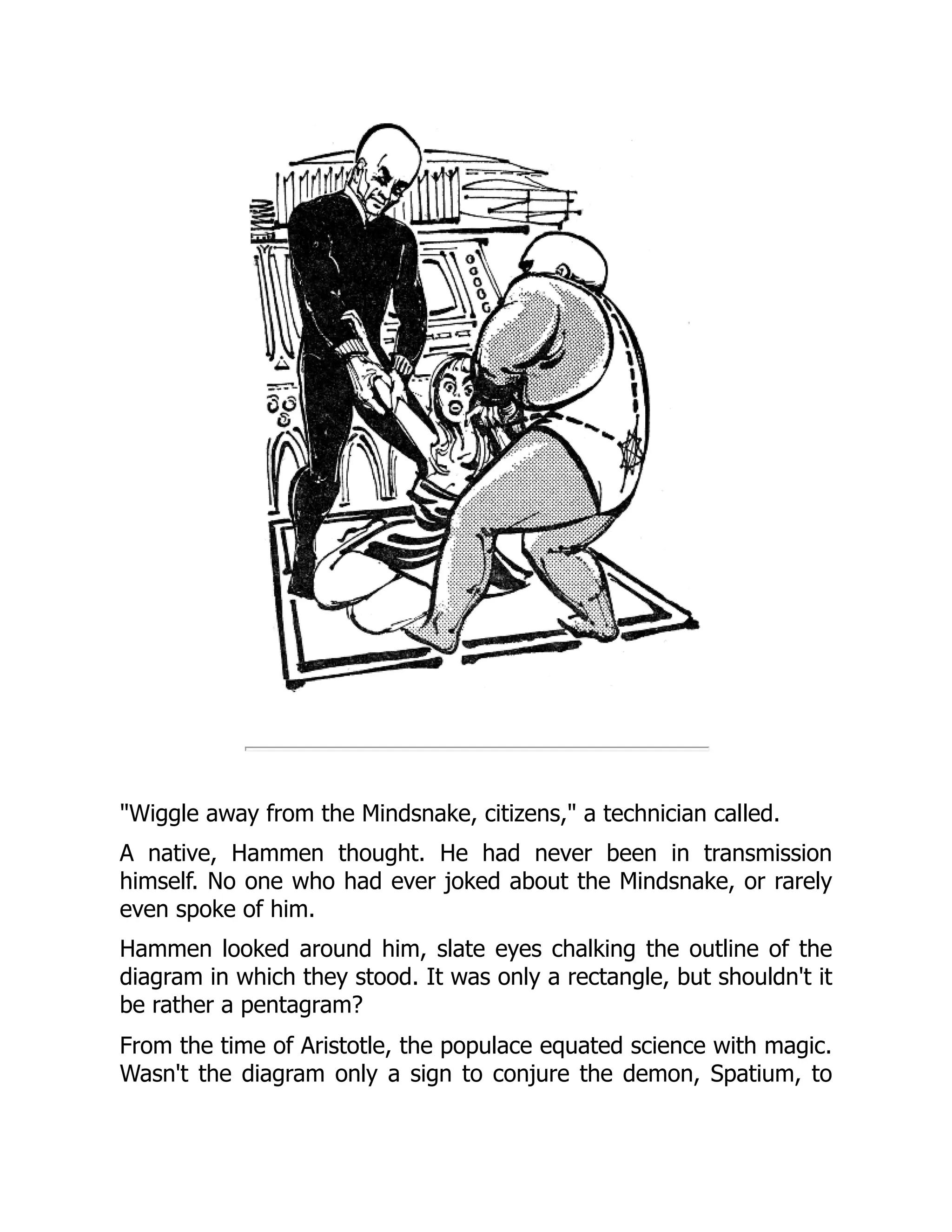
Hammen stood within the platform diagram with Gordus and the
woman. Beyond the boundaries stood the technicians, one at the
control mosaic, the other holding to the neck of Lad, who suffered it
under orders.
41.
"Wiggle away fromthe Mindsnake, citizens," a technician called.
A native, Hammen thought. He had never been in transmission
himself. No one who had ever joked about the Mindsnake, or rarely
even spoke of him.
Hammen looked around him, slate eyes chalking the outline of the
diagram in which they stood. It was only a rectangle, but shouldn't it
be rather a pentagram?
From the time of Aristotle, the populace equated science with magic.
Wasn't the diagram only a sign to conjure the demon, Spatium, to
42.
do the boonof transporting his servants across the void without
decay of time?
No. Instantaneous transmission of matter wasn't magic. It had
always been a part of folklore as teleportation, but just as machines
had been made to duplicate the legendary feats of human
extrasensory perception, machines made to let men speak over
great distances to duplicate the strange voices of mystics, and
machines made that would indeed show strange visions over vast
expanses, science had made the Transmatter for null-time object
displacement.
Transmatters were a logical, progressive theoretical implementation.
If electrical impulses could recreate patterns first in sound, then in
light, it followed relentlessly that someday some form of impulses
would be found to recreate matter. Energy and matter were only
different forms of one unity.
Fortunately, matter duplication had come before matter
transmission. As the researches of Phillips established, an exact
duplicate is not the original.
A duplication of a man is only a duplicate, not the original, unless
the elan vital, the spirit, the soul, is transmitted, for it cannot be
duplicated. A duplicated man is a perfect robot, capable of memory
and learning, and developing into a human being in time. But it is
not a human being immediately, and it can never become the
original of the duplicate. Every human viewpoint is unique and
irreplaceable.
Duplication of matter was uneconomical. The power outlay was too
great, the equipment too costly to build and operate. So
transportation by transmission was investigated. Again, it was too
expensive except for very great distances, trips of light-years to
worlds established over the generations by the spaceships which had
reached virtual light-speed and could not go beyond it.
43.
Personalities of transmitteesgot lost among the stars.
Transmitted poets arrived with a dim itch for a brutal fight, due to
some residue of glandular acid from a parting insult affecting their
birth trauma on the new world.
Great conductors solidified, hating music.
Competent engineers were imported with an infantile urge toward
lyric verse.
And the Companions came into being as a profession.
Men with will power, psionic abilities, strength of character. You
could call it what you liked, depending on your profession, your
politics, your religion. At any rate, men (and women) who could hold
human personalities together on the long, instantaneous voyage
through null space.
But still some personalities drifted away.
Or, some darkly superstitious people suggested, were they sucked
away?
They were.
Personalities in transmission were being captured by an intelligent
entity, unimaginably vast in size, which some believed used the
movements of galaxies as the synapse responses of its brain.
It was a vast entity, but not a very intelligent one, due to the square
of signal decay and noise over light-years. Moreover, it was
psychopathic. From contact with human minds, it had decided it
was, or would become (it was obviously confused on the point) the
god of the humans.
It proposed to do this by eventually incorporating all intelligence into
itself. But, seemingly, only intelligences in transmission were soft
enough for the Mindsnake to get a hold on.
The Companions were harder-shelled.
But the Mindsnake grew stronger.
44.
And Companions begantraveling with other Companions, as teams,
to resist the Mindsnake.
And there came a class of Companions who did not need the help of
any other man or woman, but only a touchstone of reality,
something familiar of Earth—the mind of a dog or a cat or some
other animal. Familiars. So was born the Corps of Witches.
And here, Hammen wondered, was this where the Witches came to
an end?
He looked at the bulging head of Gordus. He couldn't see inside it.
Maybe there would ultimately be men who could, but he could only
contact other minds when they were taken off the level of matter
and energy, and placed in null-space. Where there is no space, there
can be no barriers.
There was nothing but confusion in the woman's mind if he could
touch it. Nothing but boredom and routine in the minds of the
technicians.
Hammen's eyes moved to the dog. He suddenly decided Lad looked
sad. But dogs have human facial muscles, and it would be
impossible between a man and a dog for one to look into the other's
mind, while they weren't in transmission.
Uselessly, he permitted himself to wish Lad was going with him....
The heavy shoulder muscles of the dog ripped him free from the
technician's grasp and Lad threw himself across the diagram line as
the coordinants of the transmatter phased.
45.
Transmission. No time.No space. Hammen felt an overblown wave
of force.
"How's that for power?" Gordus demanded.
It came as words to him, as communication between people had
come to him all of his life. Deaf-mute Companions had told him
communication in transmission came to them as hands and fingers
feeling of words.
"You've never had a real Companion before, have you?" Gordus
asked. "You've never felt real power like this before?"
46.
"Power? I've heardmembers of the cargo scream as loud from terror
and horror. We don't scream in transmission, Coordinator. Let the
Snake sleep."
"Power," the coordinator repeated. "I always held my cargo together
with power."
"When you were a Companion, the Snake wasn't as strong as it is
now. Quiet, please."
Hammen felt out for his Familiar. A tail wagged somewhere. A head
cocked to one side in puzzlement, concern. What wasn't a hand
petted that which wasn't a head.
"Just us—just the two of us—to see after the woman," Gordus said
with a leer in his voice.
Didn't he know about Lad crossing the diagram? Hadn't he seen?
"You sound as if you were about to suggest we team up and rape
her. It's hardly practicable here."
"But that's it, Hammen! That's it! I want to rape her mind!"
"Go away, Gordus. I don't believe in you. Nobody really makes a
career out of being that swinish."
"My profession is power, Hammen. I find your attitude
unprofessional."
Hammen reached out for the girl. "What do you want from her?"
"She knows everything, Hammen. Don't you want to know
everything?"
"No," Hammen said. "I'd never be able to remember it."
The girl was retreating from them. Had she been snagged by the
Mindsnake? No. Only drift. Hammen threw an anchor into her,
47.
braced himself againsthis Familiar, and pulled. She came apart at
the seams and flew off in all directions, gibbering.
He raced after all the pieces of the woman at a practiced, steady trot
and gathered them all in. He made a rough boundary and
compartmentalized her.
For an instant, he looked through the jumble that was her mind.
Sensuality, sloth, greed, hate, envy, pride, hunger, death wish—it
was the usual human pattern well enough, but they were letters that
spelled out no words. It would be impossible to find any information
in that psychic junk heap.
Deftly, Hammen turned Gordus back on.
"... must know. You'll have to help me, Hammen."
"Why must I?"
"Simplicity. You must. We stay here until you do. You can't close the
transmission without me, and I will not do it until you help me pick
the woman's mind. We can wait forever until you decide to do as I
order. There is no time here."
Gordus was a blind old man stumbling in the dark. He hadn't seen
Lad join them inside the diagram. He probably wasn't even aware
that Hammen had the woman under tow.
"Listen to me, Gordus. That about there being 'no time' here is a
mathematical abstraction. Practically, it has its limitations. There is
some flow of some kind of duration here, otherwise our questions
and answers would come at the same time."
"What are you trying to teach me?" Gordus demanded. "I was a
Companion before you were born."
"But then the Mindsnake wasn't so active or so powerful. If the
'duration' of our transmission is too long, he'll get a clear fix on us—
and that will be that."
"I'll risk that. Will you?"
48.
"No," Hammen said."You're a fool out here in transmission. You
don't know what you're doing. What do you expect of me?"
"Link with me, Companion, as you should. Help me gain her
knowledge."
Hammen knew that he was being asked to help gain access to
information intended for the Federation authorities on Earth. But he
rarely thought of himself as a Federal, and he knew very few worlds
would allow extradition of him on a Federal charge. At the moment,
he was mainly concerned with saving himself and his cargo from the
Mindsnake. As distasteful as it was, Gordus was a part of his cargo,
and a man had to have a few ideals. Gordus was not qualified to be
a Companion after the generations of growth of the Mindsnake. He
was only a pitiful fool now. (How long before the Snake gets so big I
will not be qualified? How long before no one is qualified? How long
before the Snake comes out of null-space and stalks the planets?)
Hammen shrugged and joined Gordus.
They struck for the mind of the woman.
Her name, they warned, Isodel.
They found that out, and incredibly, more.
In some way Gordus' mind paralleled the girl's. There was much of a
kind about them, and Gordus could piece together the fragments of
her identity. But then he was reaching down for something, and he
prestidigitated it up and out of sight.
Hammen realized that Gordus had succeeded in getting what he
wanted and in keeping it from him. He was less of a doddering old
fool than he appeared.
"What was that?" Hammen demanded. "What did you take?"
He tried to shake it loose from the coordinator.
49.
"Let go ofme!" Gordus cried out in immaterial indignity.
Hammen released him.
Completely.
Gordus screamed soundlessly as he retreated toward infinity.
"Shall I catch you?" Hammen asked.
The scream changed in pitch.
The Witch brought him back.
"You stayed," Gordus said. "Somehow you stayed. That dog.
Somehow you've got your damned Familiar with you, haven't you,
Witch?"
"No," Hammen lied fluently. "Only feeble minds like yours require a
contact. Shall I tell you something about Witches? The Familiars are
a deception. We don't need them at all. We are lone wolves."
"Wolves, are you? So now I know what your grandmother before
you was."
Hammen laughed.
And sobered.
"What did you take, Gordus?" he demanded.
"What do you know about her?" asked Gordus.
"Her name is Isodel."
"Isodel Van Der Lies."
"I've heard of her. Somewhere," Hammen said hesitantly.
"A great theoretician," the coordinator explained sullenly. "Probably
the first authentic female genius of the race of man. On a par with
Plato, Shakespeare, Newton, Einstein."
50.
"What theory ofhers were you after?" Hammen pursued.
"A method of destroying the Mindsnake."
"You want to take the credit from her."
"I want only to take the theory from her, Hammen."
"You mean you don't want the Mindsnake to be destroyed. You are
afraid its destruction would mean the end of the Companion Corps
which you head."
"Not at all. I only want the theory so I can reverse it. Once you
know how to destroy the Mindsnake, you also know how to create
one. You see, I intend to become another Mindsnake, one who
knows too much of destruction to ever be destroyed."
"Listen carefully, Gordus," Hammen said with infinite care. "You're ill.
You don't know what you're talking about. It can't be done."
"The ultimate dream—ultimate power."
"That's pure psychosis, Gordus!"
"Is it? Watch how easily I begin to grow. I have the woman's mind
now."
It was true.
The poor, mad genius woman was gone.
"Stop it, Coordinator. You don't know what you're doing!"
Hammen tried to reach him.
"That's it, that's it. Come ahead, my boy. I'm becoming a Mindsnake.
Now I am a Mindsnake. Come ahead. Let me swallow you next."
"You fool," Hammen broadcast. "You are the Mindsnake now. Don't
you think anyone's ever wanted power before? Won't you let
yourself remember how it was when you were a Companion? This is
how it always happens. You've let yourself be swallowed by the
Snake. You ran right into its jaws."
"No." Gordus thought furiously. "I—"
51.
Welcome to OurBookstore - The Ultimate Destination for Book Lovers
Are you passionate about testbank and eager to explore new worlds of
knowledge? At our website, we offer a vast collection of books that
cater to every interest and age group. From classic literature to
specialized publications, self-help books, and children’s stories, we
have it all! Each book is a gateway to new adventures, helping you
expand your knowledge and nourish your soul
Experience Convenient and Enjoyable Book Shopping Our website is more
than just an online bookstore—it’s a bridge connecting readers to the
timeless values of culture and wisdom. With a sleek and user-friendly
interface and a smart search system, you can find your favorite books
quickly and easily. Enjoy special promotions, fast home delivery, and
a seamless shopping experience that saves you time and enhances your
love for reading.
Let us accompany you on the journey of exploring knowledge and
personal growth!
testbankfan.com







![This ebook is for the use of anyone anywhere in the United States
and most other parts of the world at no cost and with almost no
restrictions whatsoever. You may copy it, give it away or re-use it
under the terms of the Project Gutenberg License included with this
ebook or online at www.gutenberg.org. If you are not located in the
United States, you will have to check the laws of the country where
you are located before using this eBook.
Title: Mindsnake
Author: Jim Harmon
Illustrator: Bob Ritter
Release date: December 17, 2019 [eBook #60946]
Most recently updated: October 17, 2024
Language: English
Credits: Produced by Greg Weeks, Mary Meehan and the Online
Distributed Proofreading Team at http://www.pgdp.net
*** START OF THE PROJECT GUTENBERG EBOOK MINDSNAKE ***](https://image.slidesharecdn.com/15536-250315103004-8f623eb9/75/Human-Resource-Management-3rd-Edition-Stewart-Solutions-Manual-25-2048.jpg)


![By JIM HARMON
[Transcriber's Note: This etext was produced from
Worlds of If Science Fiction, November 1960.
Extensive research did not uncover any evidence that
the U.S. copyright on this publication was renewed.]](https://image.slidesharecdn.com/15536-250315103004-8f623eb9/75/Human-Resource-Management-3rd-Edition-Stewart-Solutions-Manual-28-2048.jpg)