














Maximizing retention and
  minimizing attrition


   by Toronto Training and HR

           April 2012
3-4     Introduction to Toronto Training and HR
           5-7     Measures

Contents   8-9
           10-12
           13-14
                   Costing labour turnover
                   Improving the experience of new starters
                   The employee turnover decision process
           15-16   Areas to consider that can reduce attrition
           17-18   Enriching a job
           19-20   Why do people leave?
           21-22   Developing an employee retention
                   strategy
           23-24   What plays an significant role in employee
                   retention?
           25-31   Questions to ask
           32-33   Levels of attachment
           34-35   Why focus on reducing labour turnover?
           36-37   Primary paths to turnover
           38-39   Additional predictors of turnover
           40-41   Effective practices to boost retention
           42-43   Using pay as a tool
           44-45   Broad-based strategies
           46-47   Doing the groundwork
           48-49   Dealing with some common problems
           50-51   Avoiding terminations
           52-55   Case studies
           56-57   Conclusion and questions
Introduction


     Page 3
Introduction to Toronto Training
            and HR
• Toronto Training and HR is a specialist training and human
  resources consultancy headed by Timothy Holden
• 10 years in banking
• 10 years in training and human resources
• Freelance practitioner since 2006
• The core services provided by Toronto Training and HR are:
              - Training event design
              - Training event delivery
              - Reducing costs
              - Saving time
              - Improving employee engagement & morale
              - Services for job seekers

                            Page 4
Measures


   Page 5
Measures 1 of 2
Employee turnover


                    Page 6
Measures 2 of 2
Retention


                  Page 7
Costing labour turnover


          Page 8
Costing labour turnover
MAJOR CATEGORIES OF COSTS
Administration of the resignation
Recruitment and selection costs, including
administration
Covering the post during the period in which there
is a vacancy
Induction training for the new employee


                      Page 9
Improving the experience
    of new starters


          Page 10
Improving the experience of
      new starters 1 of 2
Regular updating of induction procedures
Direct consultation with new recruits about how to
improve induction
Keeping improvement of induction on the
organizational agenda
Making use of several communication methods
Including job-related training as part of the
orientation program


                      Page 11
Improving the experience of
      new starters 2 of 2
Producing an accompanying ‘welcome’ resource
pack
Involving senior managers in orientation sessions
Covering informal rules and norms as well as the
formal ones


                      Page 12
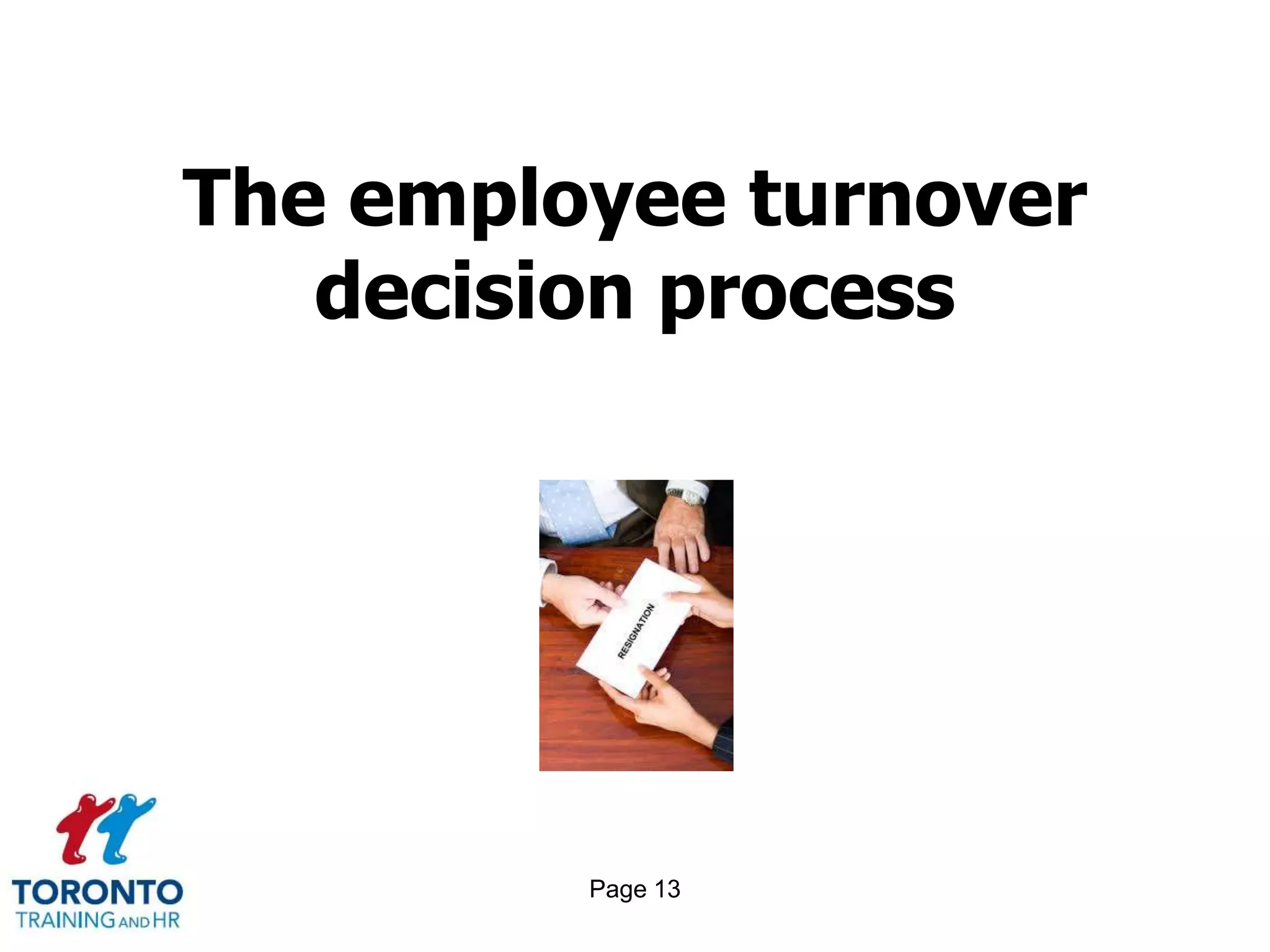
The employee turnover
   decision process


         Page 13
The employee turnover decision
          process
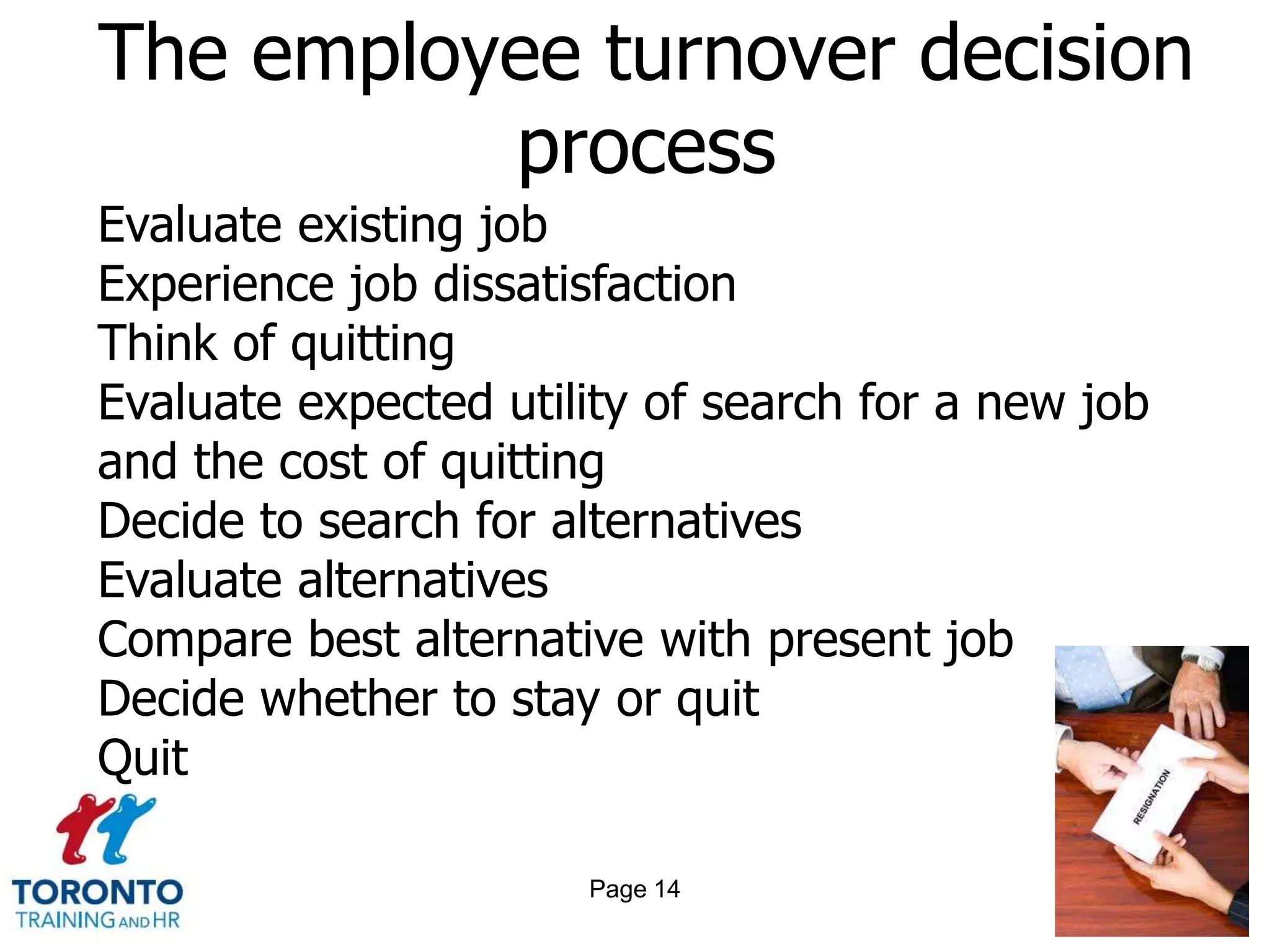
Evaluate existing job
Experience job dissatisfaction
Think of quitting
Evaluate expected utility of search for a new job
and the cost of quitting
Decide to search for alternatives
Evaluate alternatives
Compare best alternative with present job
Decide whether to stay or quit
Quit

                      Page 14
Areas to consider that can
     reduce attrition


           Page 15
Areas to consider that can
         reduce attrition
Realistic job previews
Job enrichment
Workspace characteristics
Induction practices
Leader-member exchange
Employee selection
Reward practices
Demographic diversity
Managing inter-role conflict


                       Page 16
Enriching a job


      Page 17
Enriching a job
SIGNIFICANT PERCEPTIONS OF JOBS BY JOB-
HOLDERS:
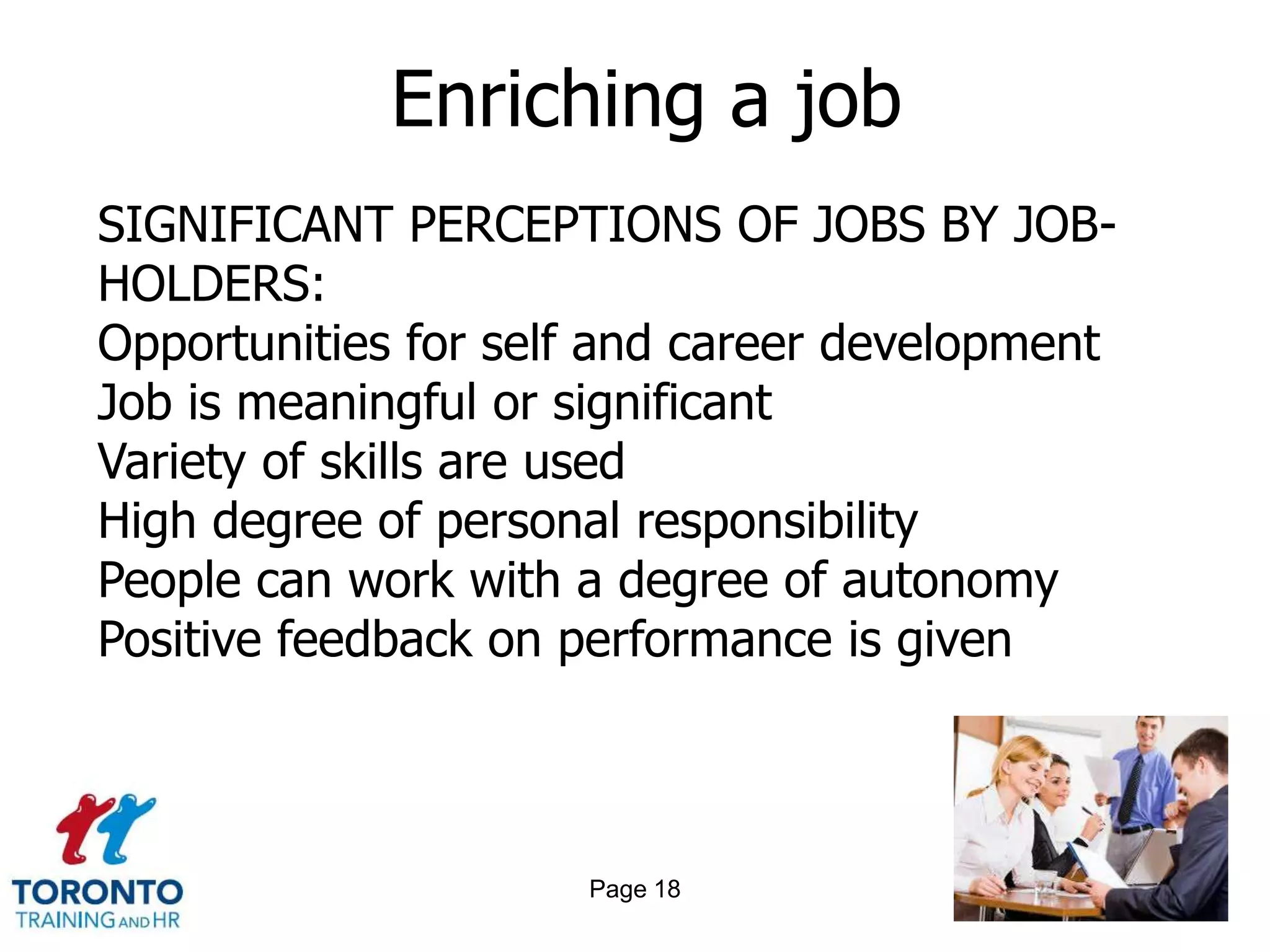
Opportunities for self and career development
Job is meaningful or significant
Variety of skills are used
High degree of personal responsibility
People can work with a degree of autonomy
Positive feedback on performance is given


                     Page 18
Why do people leave?


        Page 19
Why do people leave?
Increase job satisfaction
Attain better pay and benefits
Learn new things


                      Page 20
Developing an employee
  retention strategy


         Page 21
Developing an employee
        retention strategy
Why are employees are leaving?
What is the impact that employee turnover has on
the organization, including the associated costs?


                     Page 22
What plays a significant
  role in employee
      retention?


          Page 23
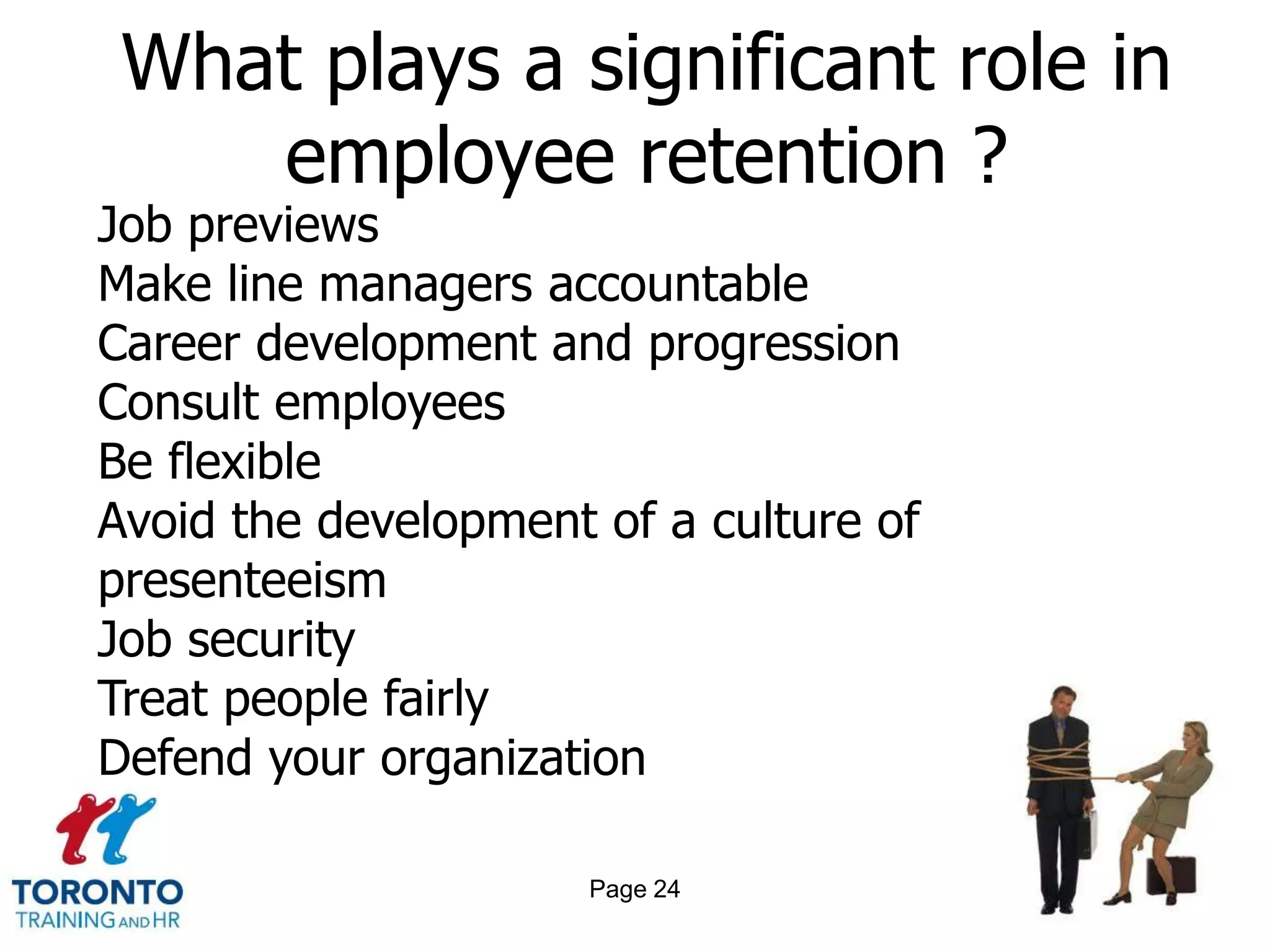
What plays a significant role in
    employee retention ?
Job previews
Make line managers accountable
Career development and progression
Consult employees
Be flexible
Avoid the development of a culture of
presenteeism
Job security
Treat people fairly
Defend your organization

                      Page 24
Questions to ask


      Page 25
Questions to ask 1 of 6
If currently employed, how much effort would you
be willing to expend in looking for a new job?


                     Page 26
Questions to ask 2 of 6
ANSWERS
None. I’m happy here
Maybe 20% effort – If a friend recommended a
promising position to me, I’d go for the interview
Perhaps 40% effort – I’d poke around the job
boards, maybe send in a few resumes
At least 60% effort – I’d spend every spare second
looking for a new job
Easily 80% – I have to get out of here and will do
whatever it takes

                      Page 27
Questions to ask 3 of 6
WHAT CAN WE LEARN FROM THE QUESTION?
Level of employee engagement on the job right
now
Level of employee distraction from the task at
hand
Just how broken the company culture has
become


                     Page 28
Questions to ask 4 of 6
Rank the following in terms of importance to
you:
Learning opportunities – I want to constantly be
learning or doing something new
Growth opportunities – I want to be able to move
up in my career
Meaningful work – I want to know that I’m
contributing to something greater


                     Page 29
Questions to ask 5 of 6
Rank the following in terms of importance to
you:
Frequent recognition and feedback – I want to
know when I’m doing well and when I need to
improve
A good relationship with my manager – I want to
be confident and unafraid at work
Compensation and benefits – I need to know that
I’m paid fairly for my work


                     Page 30
Questions to ask 6 of 6
WHAT CAN HR LEARN FROM THIS?
In aggregate, where the organization may need to
invest more budget
On an individual basis, what would be most
engaging for the employee
An understanding of where the organization may
not be able to meet an employee’s needs, paving
the way for more effective talent management and
honest conversations


                     Page 31
Levels of attachment


        Page 32
Levels of attachment
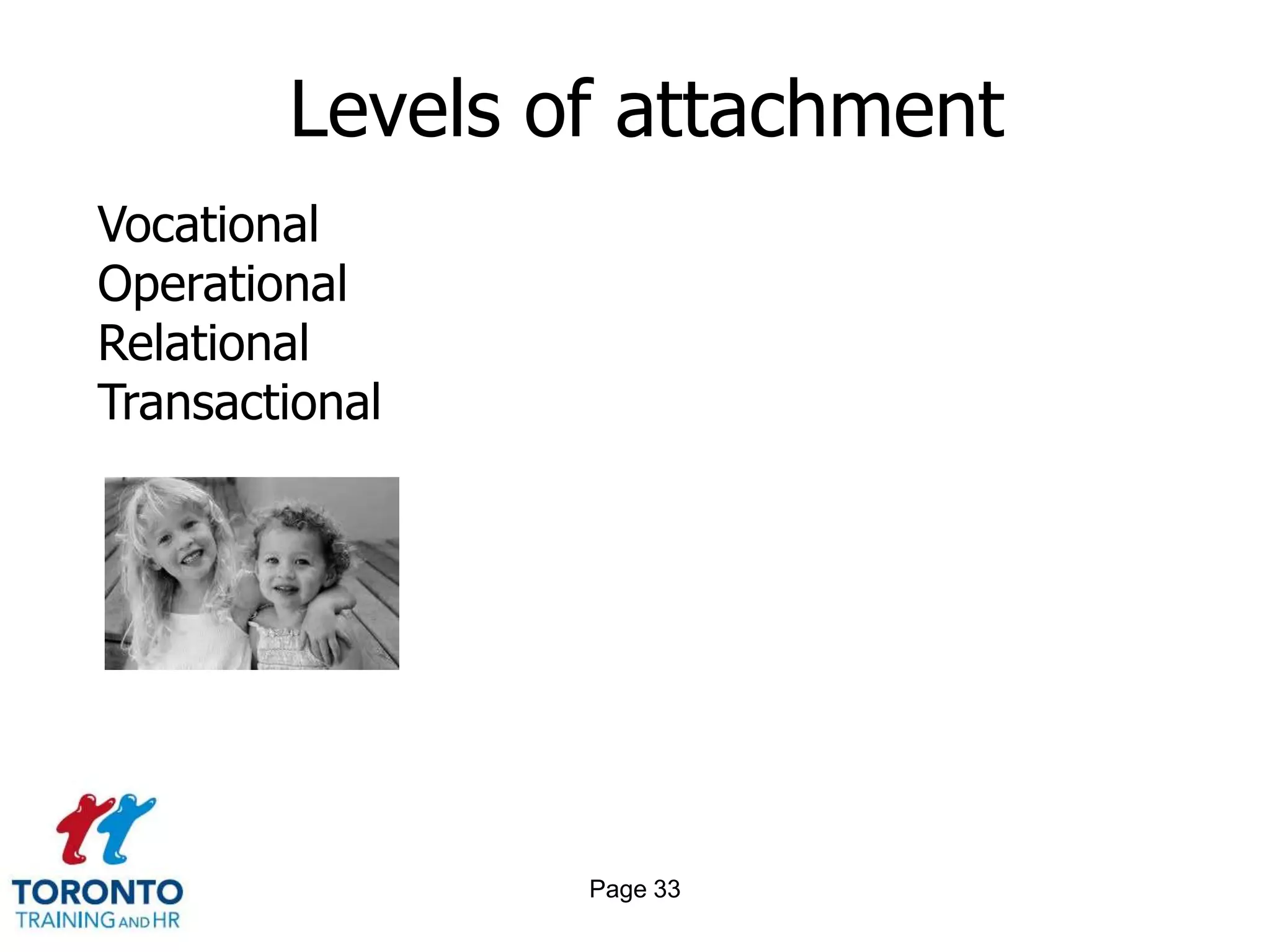
Vocational
Operational
Relational
Transactional


                Page 33
Why focus on reducing
  labour turnover?


         Page 34
Why focus on reducing labour
          turnover?
It is costly
It affects the performance of the organization
It may become increasingly difficult to manage as
the availability of skilled employees decreases in
the future


                      Page 35
Primary paths to turnover


           Page 36
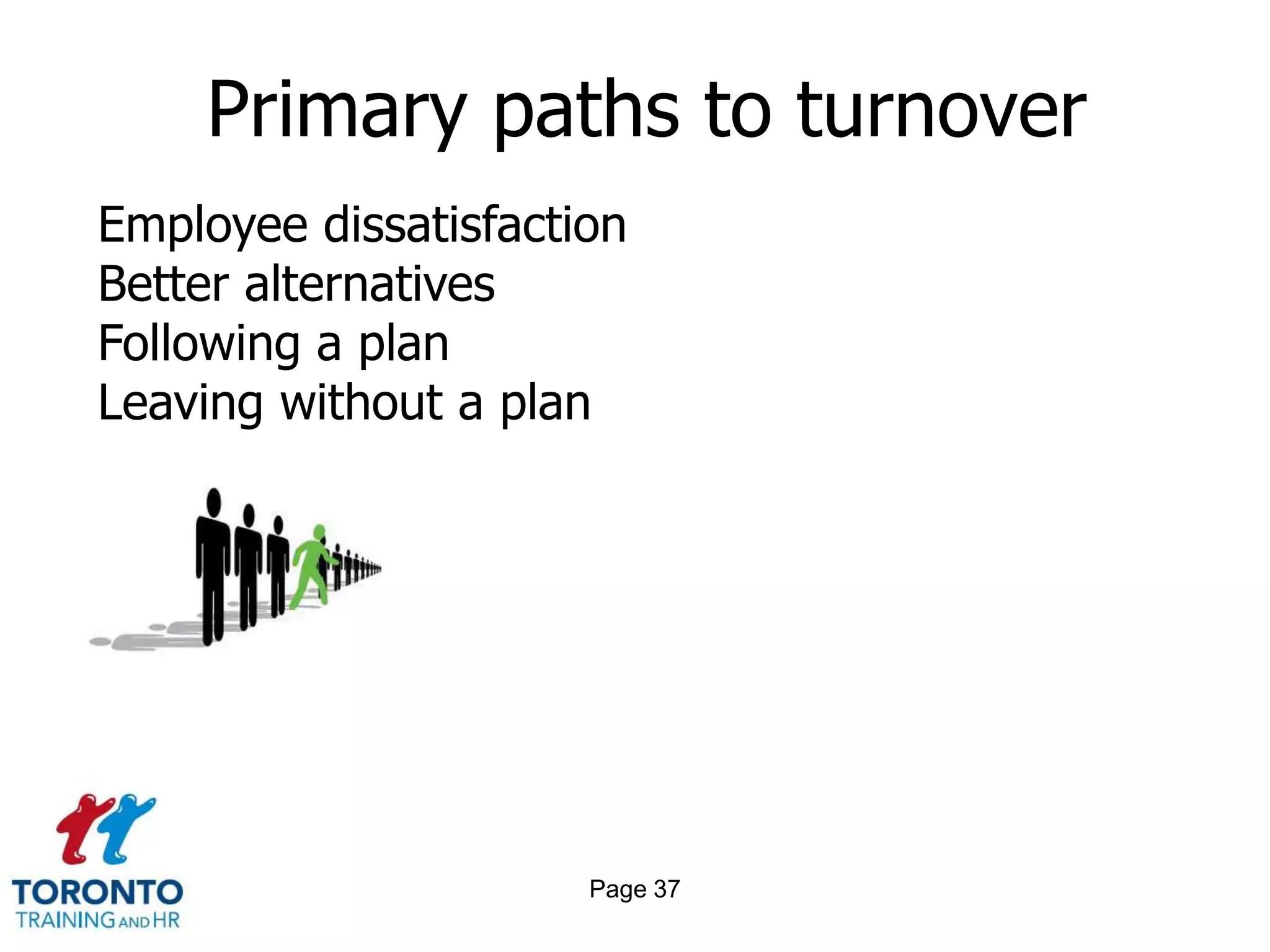
Primary paths to turnover
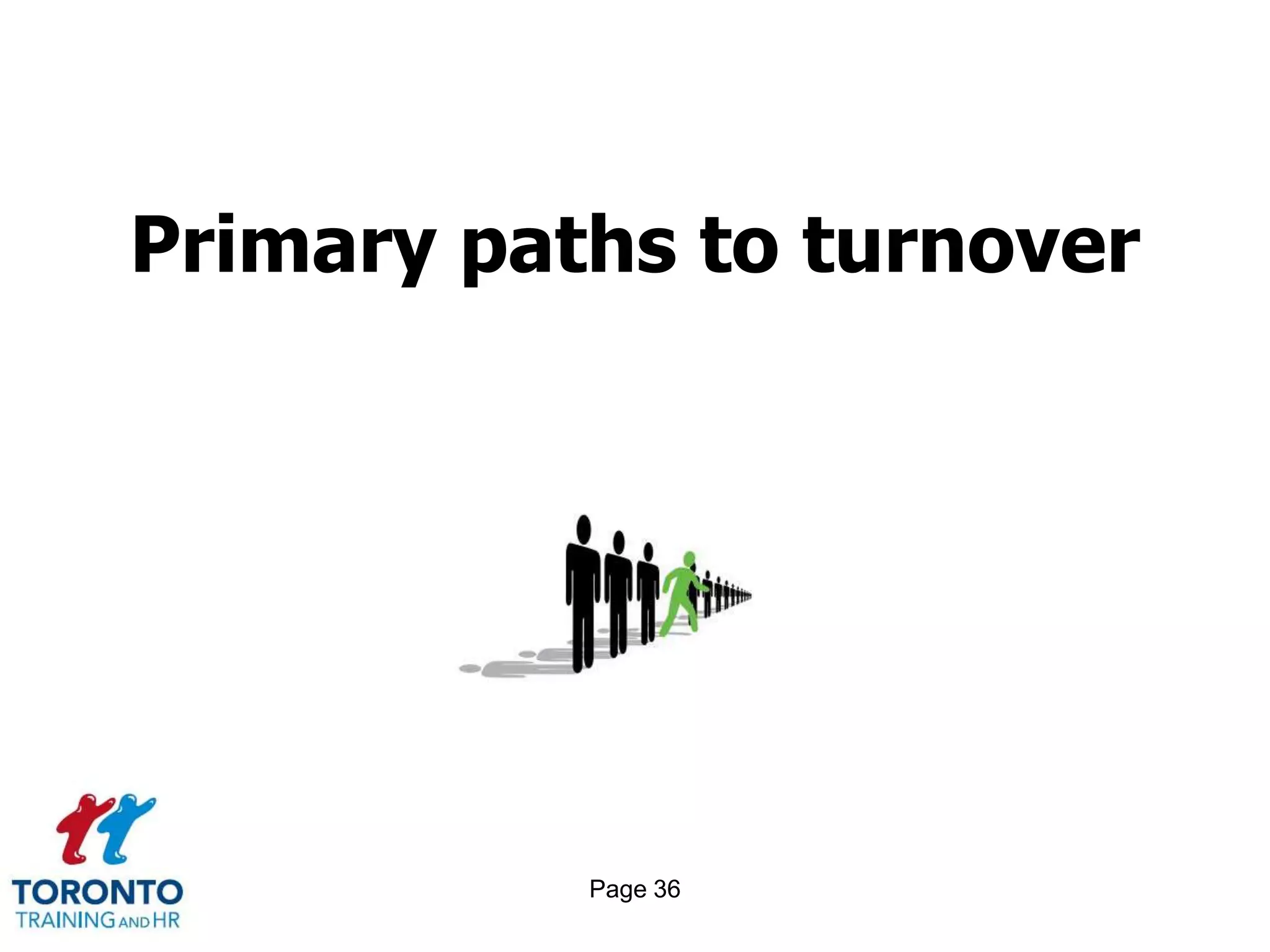
Employee dissatisfaction
Better alternatives
Following a plan
Leaving without a plan


                      Page 37
Additional predictors of
       turnover


          Page 38
Additional predictors of turnover
Organizational commitment and job satisfaction
Quality of the employee-supervisor relationship
Role clarity
Job design
Workgroup cohesion


                      Page 39
Effective practices to
   boost retention


         Page 40
Effective practices to boost
             retention
Recruitment
Selection
Socialization
Training and development
Compensation and benefits
Supervision
Employee engagement


                    Page 41
Using pay as a tool


        Page 42
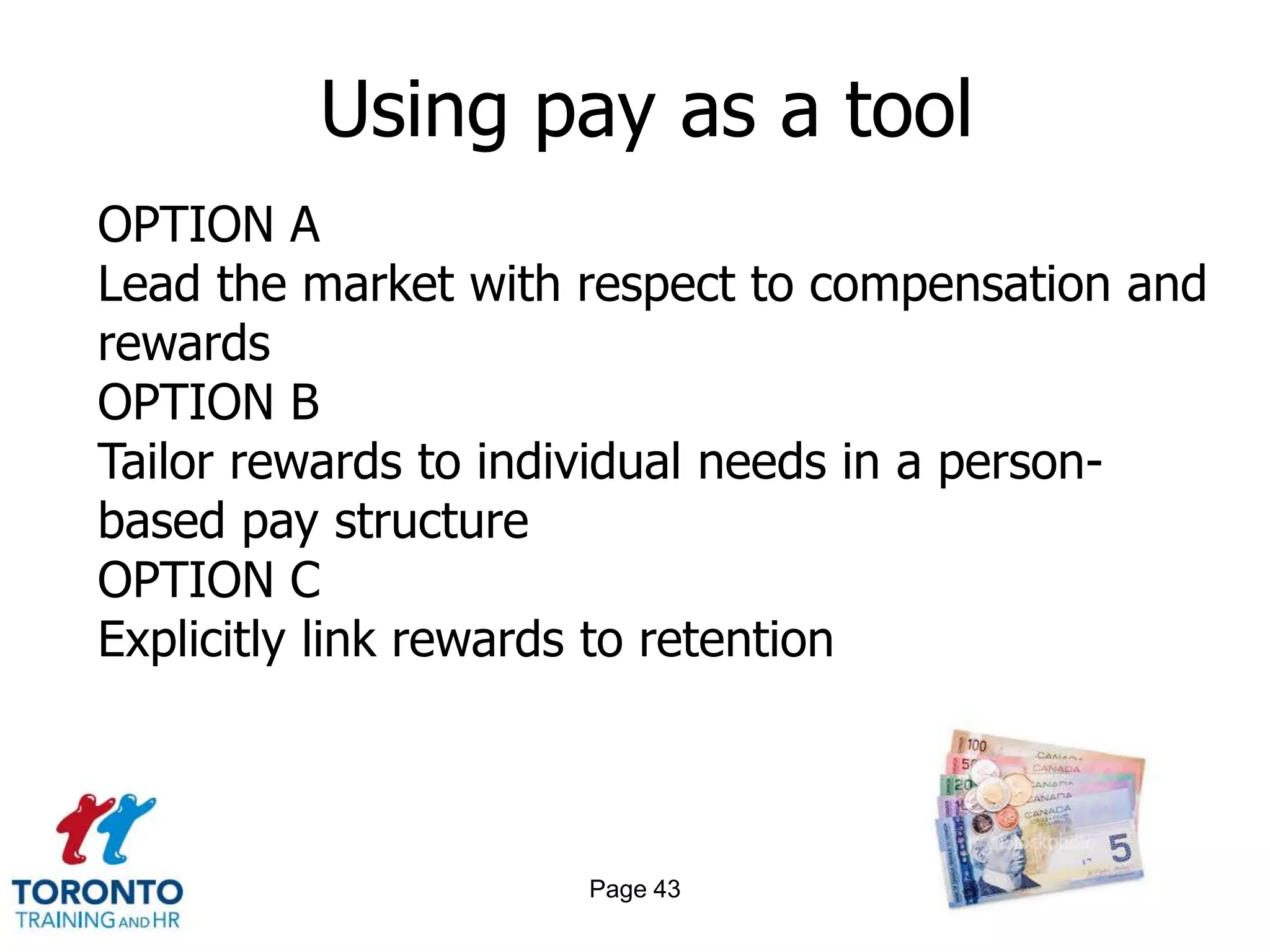
Using pay as a tool
OPTION A
Lead the market with respect to compensation and
rewards
OPTION B
Tailor rewards to individual needs in a person-
based pay structure
OPTION C
Explicitly link rewards to retention


                     Page 43
Broad-based strategies


         Page 44
Broad-based strategies
Retention research
Best practice
Benchmarking surveys


                       Page 45
Doing the groundwork


        Page 46
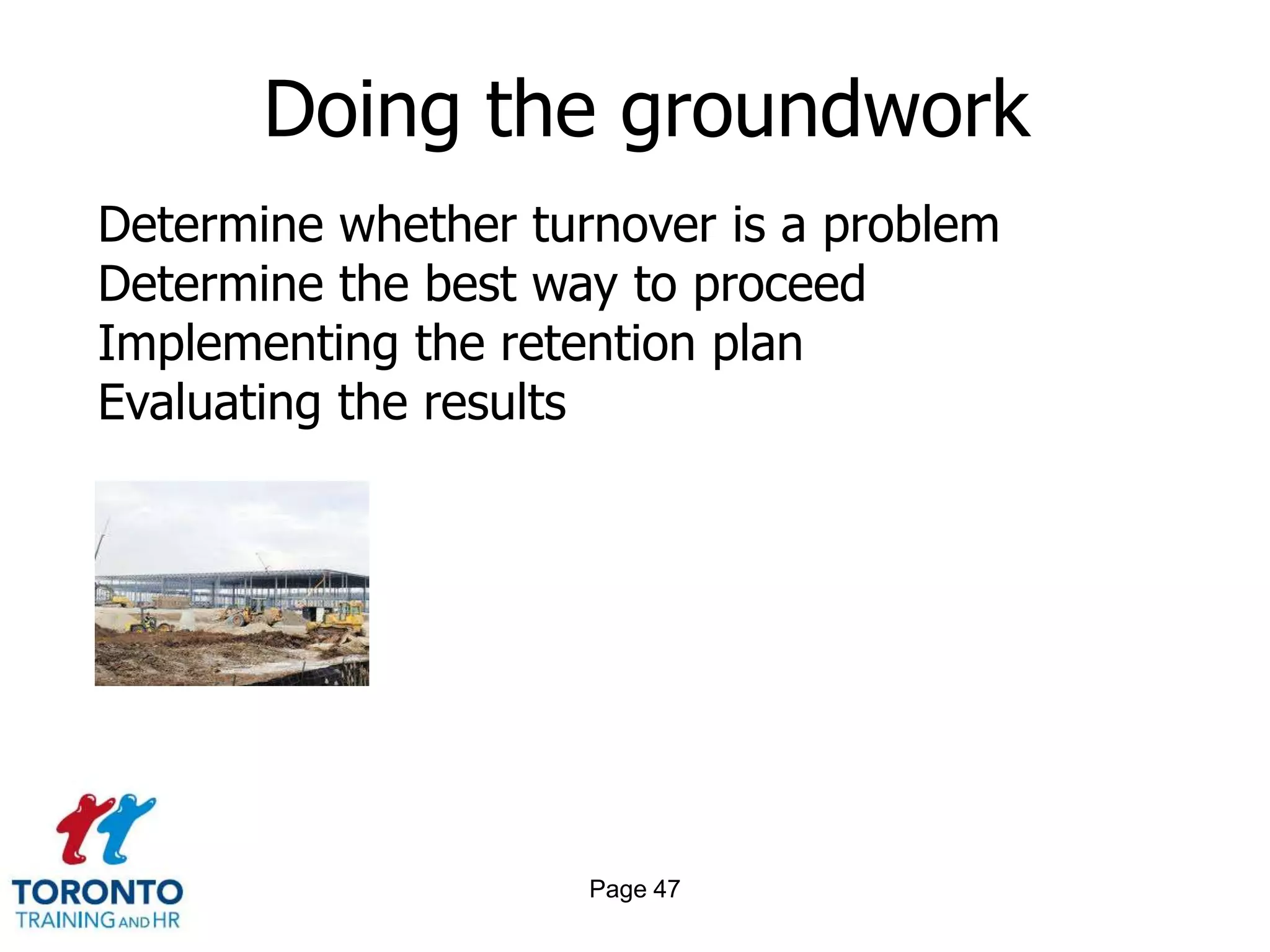
Doing the groundwork
Determine whether turnover is a problem
Determine the best way to proceed
Implementing the retention plan
Evaluating the results


                     Page 47
Dealing with some
common problems


       Page 48
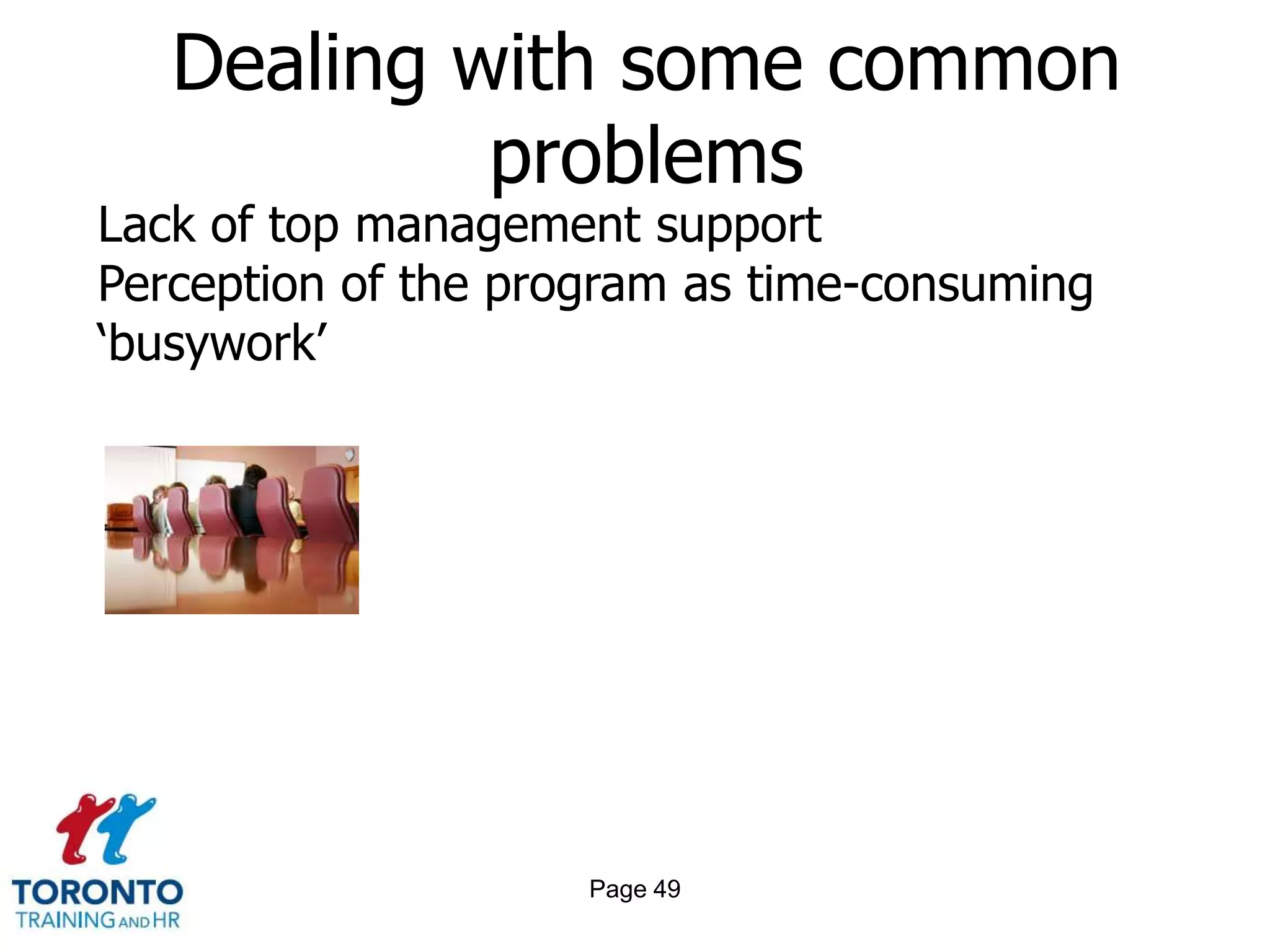
Dealing with some common
            problems
Lack of top management support
Perception of the program as time-consuming
‘busywork’


                     Page 49
Avoiding terminations


         Page 50
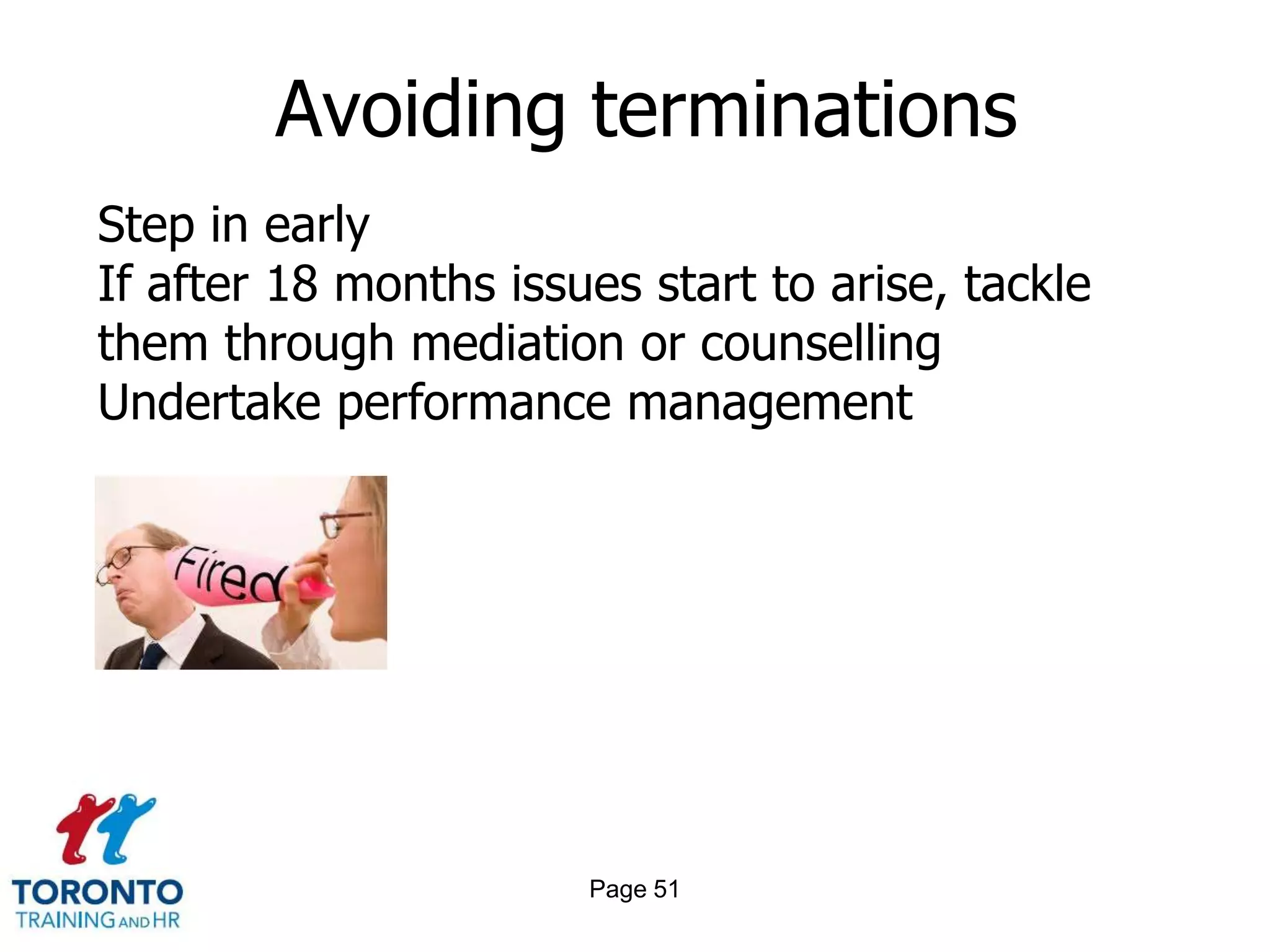
Avoiding terminations
Step in early
If after 18 months issues start to arise, tackle
them through mediation or counselling
Undertake performance management


                       Page 51
Case study A


    Page 52
Case study A


    Page 53
Case study B


    Page 54
Case study B


    Page 55
Conclusion and questions


          Page 56
Conclusion and questions
Summary
Videos
Questions


               Page 57

Maximizing retention and minimizing attrition April 2012

  • 1.
    Maximizing retention and minimizing attrition by Toronto Training and HR April 2012
  • 2.
    3-4 Introduction to Toronto Training and HR 5-7 Measures Contents 8-9 10-12 13-14 Costing labour turnover Improving the experience of new starters The employee turnover decision process 15-16 Areas to consider that can reduce attrition 17-18 Enriching a job 19-20 Why do people leave? 21-22 Developing an employee retention strategy 23-24 What plays an significant role in employee retention? 25-31 Questions to ask 32-33 Levels of attachment 34-35 Why focus on reducing labour turnover? 36-37 Primary paths to turnover 38-39 Additional predictors of turnover 40-41 Effective practices to boost retention 42-43 Using pay as a tool 44-45 Broad-based strategies 46-47 Doing the groundwork 48-49 Dealing with some common problems 50-51 Avoiding terminations 52-55 Case studies 56-57 Conclusion and questions
  • 3.
  • 4.
    Introduction to TorontoTraining and HR • Toronto Training and HR is a specialist training and human resources consultancy headed by Timothy Holden • 10 years in banking • 10 years in training and human resources • Freelance practitioner since 2006 • The core services provided by Toronto Training and HR are: - Training event design - Training event delivery - Reducing costs - Saving time - Improving employee engagement & morale - Services for job seekers Page 4
  • 5.
    Measures Page 5
  • 6.
    Measures 1 of2 Employee turnover Page 6
  • 7.
    Measures 2 of2 Retention Page 7
  • 8.
  • 9.
    Costing labour turnover MAJORCATEGORIES OF COSTS Administration of the resignation Recruitment and selection costs, including administration Covering the post during the period in which there is a vacancy Induction training for the new employee Page 9
  • 10.
    Improving the experience of new starters Page 10
  • 11.
    Improving the experienceof new starters 1 of 2 Regular updating of induction procedures Direct consultation with new recruits about how to improve induction Keeping improvement of induction on the organizational agenda Making use of several communication methods Including job-related training as part of the orientation program Page 11
  • 12.
    Improving the experienceof new starters 2 of 2 Producing an accompanying ‘welcome’ resource pack Involving senior managers in orientation sessions Covering informal rules and norms as well as the formal ones Page 12
  • 13.
    The employee turnover decision process Page 13
  • 14.
    The employee turnoverdecision process Evaluate existing job Experience job dissatisfaction Think of quitting Evaluate expected utility of search for a new job and the cost of quitting Decide to search for alternatives Evaluate alternatives Compare best alternative with present job Decide whether to stay or quit Quit Page 14
  • 15.
    Areas to considerthat can reduce attrition Page 15
  • 16.
    Areas to considerthat can reduce attrition Realistic job previews Job enrichment Workspace characteristics Induction practices Leader-member exchange Employee selection Reward practices Demographic diversity Managing inter-role conflict Page 16
  • 17.
  • 18.
    Enriching a job SIGNIFICANTPERCEPTIONS OF JOBS BY JOB- HOLDERS: Opportunities for self and career development Job is meaningful or significant Variety of skills are used High degree of personal responsibility People can work with a degree of autonomy Positive feedback on performance is given Page 18
  • 19.
    Why do peopleleave? Page 19
  • 20.
    Why do peopleleave? Increase job satisfaction Attain better pay and benefits Learn new things Page 20
  • 21.
    Developing an employee retention strategy Page 21
  • 22.
    Developing an employee retention strategy Why are employees are leaving? What is the impact that employee turnover has on the organization, including the associated costs? Page 22
  • 23.
    What plays asignificant role in employee retention? Page 23
  • 24.
    What plays asignificant role in employee retention ? Job previews Make line managers accountable Career development and progression Consult employees Be flexible Avoid the development of a culture of presenteeism Job security Treat people fairly Defend your organization Page 24
  • 25.
  • 26.
    Questions to ask1 of 6 If currently employed, how much effort would you be willing to expend in looking for a new job? Page 26
  • 27.
    Questions to ask2 of 6 ANSWERS None. I’m happy here Maybe 20% effort – If a friend recommended a promising position to me, I’d go for the interview Perhaps 40% effort – I’d poke around the job boards, maybe send in a few resumes At least 60% effort – I’d spend every spare second looking for a new job Easily 80% – I have to get out of here and will do whatever it takes Page 27
  • 28.
    Questions to ask3 of 6 WHAT CAN WE LEARN FROM THE QUESTION? Level of employee engagement on the job right now Level of employee distraction from the task at hand Just how broken the company culture has become Page 28
  • 29.
    Questions to ask4 of 6 Rank the following in terms of importance to you: Learning opportunities – I want to constantly be learning or doing something new Growth opportunities – I want to be able to move up in my career Meaningful work – I want to know that I’m contributing to something greater Page 29
  • 30.
    Questions to ask5 of 6 Rank the following in terms of importance to you: Frequent recognition and feedback – I want to know when I’m doing well and when I need to improve A good relationship with my manager – I want to be confident and unafraid at work Compensation and benefits – I need to know that I’m paid fairly for my work Page 30
  • 31.
    Questions to ask6 of 6 WHAT CAN HR LEARN FROM THIS? In aggregate, where the organization may need to invest more budget On an individual basis, what would be most engaging for the employee An understanding of where the organization may not be able to meet an employee’s needs, paving the way for more effective talent management and honest conversations Page 31
  • 32.
  • 33.
  • 34.
    Why focus onreducing labour turnover? Page 34
  • 35.
    Why focus onreducing labour turnover? It is costly It affects the performance of the organization It may become increasingly difficult to manage as the availability of skilled employees decreases in the future Page 35
  • 36.
    Primary paths toturnover Page 36
  • 37.
    Primary paths toturnover Employee dissatisfaction Better alternatives Following a plan Leaving without a plan Page 37
  • 38.
    Additional predictors of turnover Page 38
  • 39.
    Additional predictors ofturnover Organizational commitment and job satisfaction Quality of the employee-supervisor relationship Role clarity Job design Workgroup cohesion Page 39
  • 40.
    Effective practices to boost retention Page 40
  • 41.
    Effective practices toboost retention Recruitment Selection Socialization Training and development Compensation and benefits Supervision Employee engagement Page 41
  • 42.
    Using pay asa tool Page 42
  • 43.
    Using pay asa tool OPTION A Lead the market with respect to compensation and rewards OPTION B Tailor rewards to individual needs in a person- based pay structure OPTION C Explicitly link rewards to retention Page 43
  • 44.
  • 45.
    Broad-based strategies Retention research Bestpractice Benchmarking surveys Page 45
  • 46.
  • 47.
    Doing the groundwork Determinewhether turnover is a problem Determine the best way to proceed Implementing the retention plan Evaluating the results Page 47
  • 48.
    Dealing with some commonproblems Page 48
  • 49.
    Dealing with somecommon problems Lack of top management support Perception of the program as time-consuming ‘busywork’ Page 49
  • 50.
  • 51.
    Avoiding terminations Step inearly If after 18 months issues start to arise, tackle them through mediation or counselling Undertake performance management Page 51
  • 52.
  • 53.
  • 54.
  • 55.
  • 56.
  • 57.