Human Resource Management 3rd Edition Stewart Solutions Manual
Human Resource Management 3rd Edition Stewart Solutions Manual
Human Resource Management 3rd Edition Stewart Solutions Manual
Human Resource Management 3rd Edition Stewart Solutions Manual
Human Resource Management 3rd Edition Stewart Solutions Manual
1.
Visit https://testbankmall.com todownload the full version and
browse more test banks or solution manuals
Human Resource Management 3rd Edition Stewart
Solutions Manual
_____ Press the link below to begin your download _____
https://testbankmall.com/product/human-resource-
management-3rd-edition-stewart-solutions-manual/
Access testbankmall.com now to download high-quality
test banks or solution manuals
2.
We believe theseproducts will be a great fit for you. Click
the link to download now, or visit testbankmall.com
to discover even more!
Human Resource Management 15th Edition Dessler Solutions
Manual
https://testbankmall.com/product/human-resource-management-15th-
edition-dessler-solutions-manual/
Human Resource Management Noe 8th Edition Solutions Manual
https://testbankmall.com/product/human-resource-management-noe-8th-
edition-solutions-manual/
Human Resource Management Dessler 13th Edition Solutions
Manual
https://testbankmall.com/product/human-resource-management-
dessler-13th-edition-solutions-manual/
Test Bank for Concepts for Nursing Practice 2nd Edition by
Giddens
https://testbankmall.com/product/test-bank-for-concepts-for-nursing-
practice-2nd-edition-by-giddens/
3.
Lehne’s Pharmacology forNursing Care, 2015 9e Test Bank
https://testbankmall.com/product/lehnes-pharmacology-for-nursing-
care-2015-9e-test-bank/
2015 Gerontologic Nursing, 5e Test Bank
https://testbankmall.com/product/2015-gerontologic-nursing-5e-test-
bank/
Solution Manual for Financial Analysis with Microsoft
Excel, 7th Edition
https://testbankmall.com/product/solution-manual-for-financial-
analysis-with-microsoft-excel-7th-edition/
Solution Manual for MIS Cases Solving Small Business
Scenarios Using Application Software 2nd by Gardner
https://testbankmall.com/product/solution-manual-for-mis-cases-
solving-small-business-scenarios-using-application-software-2nd-by-
gardner/
Solution Manual for Fundamental Accounting Principles 23rd
Edition By Wild
https://testbankmall.com/product/solution-manual-for-fundamental-
accounting-principles-23rd-edition-by-wild/
4.
Solution Manual forInternational Business: The New
Realities, 4th Edition, S. Tamer Cavusgil
https://testbankmall.com/product/solution-manual-for-international-
business-the-new-realities-4th-edition-s-tamer-cavusgil/
5.
➢ Economic environmentincludes interest rates and new job creation.
➢ Political environment includes laws and the positions of elected officials, as well as
legal changes related to international trade.
➢ Technological change involves trends such as improving manufacturing technologies
and increased availability of information.
6.
➢ Effective strategyformulation begins with information about threats and
opportunities outside the organization.
✓ Assessing Internal Capabilities (i.e., organization’s internal resources and capabilities
categorized as strengths/areas of high capability and weaknesses/areas of low capability).
➢ Most strengths and weaknesses can be thought of in terms of the resources that an
organization has. Some are tangible, such as money and equipment; others are
intangible, such as reputation. From a resource-based view of organizations,
resources—including human resources—are true strengths when they are both
valuable and rare.
➢ Gathering information about HR capabilities is therefore a vital part of an effective
assessment of organizational strengths and weaknesses.
• Analyzing Information and Making Decisions (pages 46-48)
✓ Step 1: Build collective intuition occurs when a group of people meet together often to
discuss the information that has been gathered.
✓ Step 2: Stimulate conflict occurs when different opinions are considered.
✓ Step 3: Maintain appropriate pace refers to keeping decisions as part of a flexible
timeline.
✓ Step 4: Diffuse politics occurs when a group begins with a common goal and no one
person dominates the discussion.
CONCEPT CHECK
1. What are the three steps in the strategy formulation process? Gather information, analyze
information and make decision, and implement the decision.
2. What are some components of an organization’s external environment? Features of the
environment might include the number of businesses hiring people in your field, the number
of other new graduates looking for similar jobs, and the geographic location of potential
employers. Demographic and cultural trends include population growth, the age distribution
of the population, the percentage of women in the workforce, and changes in the relative
sizes of ethnic groups. The economic environment includes interest rates and new job
creation, whereas the political environment includes laws and the positions of elected officials.
Among the potential threats and opportunities in these areas are legal changes related to
international trade and changes in inflation and interest rates. An especially important aspect
of current organizational environments is technological change. Trends such as improving
manufacturing technologies and increased availability of information create opportunities for
some organizations and threats for others.
3. Why does HRM represent an important potential strength for organizations? The ability to
attract and keep high-quality employees represents a strength for the organization only when
high-quality employees are hard to find. Human resource management is critical because
high-quality employees are relatively rare. Effective ways to attract and keep employees do,
in fact, represent sources of internal strength that can give an organization a competitive
advantage. Human resource practices also must provide something that is difficult to imitate
and for which there is no substitute.
7.
4. What foursteps are necessary for effective decision making? Build collective intuition,
stimulate conflict, maintain an appropriate pace, and diffuse politics.
2.3 What Are Common Competitive Business Strategies? (pages 48-52)
• Competitive business strategies involve four types:
✓ Corporate-level strategy concerns the different businesses and diversity of products and
services that an organization produces.
✓ Business-level strategy concerns how an organization, or part of an organization, will
compete with other organizations that produce similar goods or services.
✓ Cost leadership strategy seeks to produce goods and services inexpensively. The key to
the cost-leadership strategy is in controlling expenses.
✓ Differentiation strategy seeks to produce goods and services that are somehow superior
to the goods and services provided by competitors; their goal is to create unique value for
which customers are willing to pay a higher price. The key to the differentiation strategy
is to create value that is perceived as high enough to warrant a higher price.
✓ Combination strategy
➢ Organization can pursue both cost leadership and differentiation but can create cost
structure that does not allow them to produce goods and services at lowest cost.
➢ Most organizations must choose one or the other approach and make strategic
decisions accordingly.
° Primary cost leadership strategy should seek to differentiate only as long as doing
so does not harm its ability to be the lowest-cost producer.
° Primary differentiation strategy should seek to reduce costs wherever possible.
CONCEPT CHECK
1. What are the basic characteristics of the cost leadership strategy? Goal is to become highly
efficient, which will allow organization to create value by producing goods and services at
lower cost.
2. What are the main features of the differentiation strategy? Seek to produce goods and
services that are somehow superior to the goods and services provided by competitors; their
goal is to create unique value for which customers are willing to pay a higher price.
2.4 What Are Basic Approaches to HR Strategy? (pages 52-59)
• The continued success of organizations depends on their possessing capabilities that
competitors cannot easily copy.
✓ Effective HRM capabilities are difficult to copy because effectiveness comes not from a
single practice but from a number of related practices.
✓ Social relationships that arise from HR practices are also extremely difficult to copy.
✓ HR capabilities are sources of potentially sustainable competitive advantage.
• HR practices build capability by encouraging employees to fill certain roles.
✓ A role is a set of behaviors characteristic of a person in a particular setting.
8.
✓ Employee rolesare strongly influenced by the cues, or signals, that an organization
provides.
➢ Large pay differences are meant to cue competition and innovation among employees
whereas other organizations use group rewards to cue cooperative behavior.
➢ Roles become stronger as a variety of HR practices combine to consistently cue the
desired behaviors.
➢ The result is a complex process that is difficult for other organizations to duplicate.
• Research has identified consistent patterns of good HRM. Researchers have taken two basic
approaches in investigating HR patterns.
✓ The Universalistic Approach (pages 53-55)
➢ Seeks to identify methods of managing people that are effective for all organizations.
➢ HR practices are most effective when bundled together into internally consistent
clusters.
° Sets of HR practices that are internally consistent and that reinforce each other are
known as HR bundles.
° A single effective HR practice provides only limited benefits unless it is
combined with other effective practices.
One bundle is based on control strategy: primary focus of HR practices is
standardization and efficiency.
Second bundle is based on commitment strategy: primary focus of practices
is to empower workers and build strong sense of loyalty and commitment.
° Strong research conclusion from universalistic approach is that organizations
should adopt a commitment strategy.
° Commitment strategy is often summarized as HR bundle that encourages high
involvement.
✓ The Contingency Approach (pages 56-59)
➢ Seeks to align people management practices with competitive business strategies.
➢ Two key differences in organizations: cost leadership or a differentiation strategy and
whether they have an internal or an external labor orientation.
° Cost Leadership versus Differentiation
Organizations with cost leadership strategy focus their efforts on increasing
efficiency and hire generalists who work in a variety of different positions.
➢ Cost leadership strategy with a focus on tightly controlled processes
makes sense when organization knows exactly what it wants people to do.
➢ Result is mass production of standardized goods or services at lowest cost.
Organizations using differentiation strategy focus their HR efforts on
innovation and quality enhancement.
➢ Employees in these organizations are often specialists.
➢ Rather than seeking to control processes, organization concentrates on
outcomes.
➢ Works best when organizations produce customized goods or services.
° Internal Versus External Orientation
Internal labor orientation seeks to make its own talent and keep employees
for a long time. The primary goal is to identify people who will have long
careers within the organization.
➢ Strengths
9.
▪ Predict whatskills and capabilities will be available to them in future.
▪ Employees build strong relationships with one another, so
coordination and cooperation are high.
▪ Save money by reducing expenses for recruiting, interviewing, and
hiring employees.
➢ Weaknesses
▪ Long-term commitments make it difficult to adapt.
▪ Changes in strategic direction are complicated because workers have
outdated skills and bureaucratic structures are inflexible.
External labor orientation seeks to buy talent.
➢ Hire people who already have the needed skills and in many cases keep
them for only short period of time. The primary goal is to identify people
who are able to contribute without additional training.
➢ Strengths
▪ Flexibility (organization can respond quickly to changing conditions).
▪ Workers trained by universities or other employers can be quickly
added in areas that demand new skills.
▪ Labor costs are not fixed and total number of employees can easily be
increased or decreased.
➢ Weaknesses
▪ Lack of consistency.
▪ Employees are essentially shared with other organizations.
▪ Employees do not provide a unique competitive advantage.
CONCEPT CHECK
1. How does the contingency approach to HR management differ from the universalistic
approach? The Contingency Approach seeks to align people management practices with
competitive business strategies while the Universalistic Approach seeks to identify methods
of managing people that are effective for all organizations.
2. What HR practices are associated with cost reduction strategies? Differentiation strategies?
Organizations with a cost leadership strategy focus their efforts on increasing efficiency and
hire generalists who work in a variety of different positions. Other practices include control
work processes and carefully define employee tasks, specifically prescribe appropriate
behaviors, and mass production of standardized goods or services at the lowest possible
cost. Organizations using a differentiation strategy focus their human resource efforts on
innovation and quality enhancement. Employees in these organizations are often specialists.
They have more choice about how things should be done and are held accountable for the
goods and services they produce. Rather than seeking to control processes, the organization
concentrates on outcomes. Best process for completing work is often unknown, and employees
are expected to continually look for different ways of doing things. Unique customer
expectations require employees to change their actions to best serve each client.
3. What are the differences between an internal labor orientation and an external labor
10.
orientation? See Table2.3. Internal labor orientation seeks to make its own talent and to
keep employees for long periods of time while external labor orientation seeks to buy talent.
2.5 What Are Common HR Strategies? (pages 60-63)
• Internal/Cost HR Strategy: The Loyal Soldier (pages 60-61)
✓ Combining an internal orientation with a cost leadership strategy results in a Loyal
Soldier HR strategy (emphasis on long-term employees with a focus on reducing costs).
➢ Design work so that employees have broad roles and perform a variety of tasks.
° People are recruited and hired because they fit the organization culture and
because of their potential to become loyal employees.
° Efforts are made to satisfy the needs of employees and build a strong bond that
reduces the likelihood of employee turnover.
° Hire people early in their careers and provide them with extensive training in a
number of different skills.
➢ Careers often include a number of very different positions, with promotions often
made into positions that are not closely related to previous experiences.
➢ Performance appraisals are designed to facilitate cooperation rather than competition.
➢ Compensation includes long-term incentives and benefits and is often linked to the
overall performance of the organization.
✓ Unions are frequently observed in these organizations.
• External/Cost HR Strategy: The Bargain Laborer (page 61-62)
✓ Combining an external orientation with a cost leadership strategy results in a Bargain
Laborer HR strategy (emphasis on short-term employees with a focus on reducing costs).
➢ Emphasis is on obtaining employees who do not demand high wages.
➢ Design work so that managers can tightly control employee efforts.
➢ Each employee is given clearly defined tasks that can be learned easily.
➢ People are recruited and hired to perform simple tasks that do not require clearly
developed skills.
➢ Little attention is paid to meeting long-term needs of employees.
➢ Performance appraisal focuses on day-to-day feedback; rarely incorporates formal
measures.
➢ Training is mostly limited to on-the-job techniques that teach specific methods for
completing particular tasks.
➢ Compensation is frequently based on hours worked, and benefits and long-term
incentives are minimal.
✓ The lack of consistency among employees tends to make unions somewhat rare in
organizations that pursue cost efficiency through an external labor orientation.
• Internal/Differentiation HR Strategy: The Committed Expert (page 62)
✓ Combining internal orientation with differentiation strategy results in Committed Expert
HR strategy (emphasis on long-term employees with focus on producing unique goods
and services.)
➢ Hire and retain employees who specialize in performing certain tasks and are a
potential fit with the organizational culture.
11.
➢ Design workso that employees have a great deal of freedom to innovate and to
improve methods of completing tasks.
➢ Performance appraisals designed to balance cooperation and competition among
employees.
➢ Careers generally include numerous promotions into similar jobs with increasing
responsibility.
➢ Employees receive long-term training that helps them develop strong expertise.
➢ Compensation is relatively high and usually includes a good benefits package that ties
employees to the organization.
• External/Differentiation HR Strategy: The Free Agent (page 62-63)
✓ Combining external orientation with differentiation strategy forms Free Agent HR
Strategy (combines emphasis on short-term employees with focus on producing unique
goods and services).
➢ Hiring people who have critical skills but who are not necessarily expected to remain
with the organization for a long period of time.
➢ Design work so that employees have extensive responsibility within specific areas
and substantial freedom to decide how to go about their work.
➢ Long-term commitments are avoided, and no efforts are made to encourage strong
attachments between employees and the organization.
➢ They are not led to expect long-term careers in the organization.
➢ Higher-level positions are frequently given to people from outside the organization.
➢ Performance appraisal focuses on outcomes and results.
➢ Training is rare.
➢ Short-term compensation is usually high, which is necessary if the organization is to
obtain people with top skills.
➢ Pay is linked specifically to individual performance results, and benefits and long-
term compensation packages are avoided.
✓ Rarely see unions in these organizations.
CONCEPT CHECK
1. What two HR strategies are associated with cost leadership strategy? How do these two HR
strategies differ? Combining internal orientation with cost leadership strategy results in
Loyal Soldier HR strategy (emphasis on long-term employees with a focus on reducing
costs.) Combining external orientation with cost leadership strategy results in Bargain
Laborer HR strategy (emphasis on short-term employees with a focus on reducing costs.)
2. What two HR strategies are associated with the differentiation strategy? How do these two
HR strategies differ? Combining internal orientation with differentiation strategy results in
Committed Expert HR strategy (emphasis on long-term employees with focus on producing
unique goods and services). Combining external orientation with differentiation strategy
forms Free Agent HR Strategy (combines emphasis on short-term employees with focus on
producing unique goods and services).
12.
2.6 How DoHR Strategies Align with Competitive Business Strategies? (pages 63-66)
• Organizations with a cost leadership competitive strategy are expected to do best when
they have either a Bargain Laborer or Loyal Soldier strategy.
• Organizations with a competitive business strategy of differentiation are expected to do best
when they have either a Committed Expert or Free Agent HR strategy.
• Research supporting the contingency perspective (pages 64-65)
✓ Many organizations do have HR strategies that fit their competitive strategies.
✓ Organizations are more successful when they broadly adapt their HR practices to fit their
competitive strategies.
✓ Organizations with a cost leadership or differentiation strategy do perform better when
they have a matching human resource strategy.
• Putting it all together (pages 66)
✓ Although there are important exceptions, many organizations improve their long-term
success when they adopt an internal labor orientation.
➢ Organizations using internal orientation develop strong bonds with employees
➢ Research suggests that organizations with a cost leadership competitive strategy excel
when they follow a Loyal Soldier HR strategy.
➢ Similarly, organizations with a differentiation competitive strategy excel when they
use a Committed Expert strategy.
CONCEPT CHECK
1. In what ways does research support the contingency approach to HR management?
Although research related to this question does not always use the four human resource
strategies, the results are mostly supportive. Firms benefit from having human resource
practices that support their overall strategy. For instance, law firms with a competitive
strategy of expanding into new markets, which is consistent with a strategy of
differentiation, have been shown to perform better when they hire and retain highly
skilled lawyers. Call centers with a competitive strategy of customizing responses to
customers—also, consistent with differentiation—perform better when their human
resource practices ensure good training and high pay. Overall, this line of research
confirms that organizations perform better when they use human resource practices that
help them secure and motivate employees who have skills that match their approaches
for providing value to customers.
2. How does the commitment strategy fit with the contingency approach? The commitment
strategy is similar in many ways to the internal labor orientation of the contingency
approach.
Chapter 2 Teaching Notes
The following presents suggestions designed to help you utilize the special features and cases
found in Human Resource Management: Linking Strategy to Practice.
13.
Summary: (pages 67-68)
Summariesof each of the five learning objectives are presented. It is recommended that students
review each objective and discuss in class or in teams as a means of gaining better understanding
and comprehension.
Learning Objectives:
The chapter contains five learning objectives. Each is presented at the beginning of the concept
being discussed and can be found on:
Learning objective 1- page 42
Learning objective 2- page 48
Learning objective 3- page 52
Learning objective 4- page 60
Learning objective 5- page 63
Concept Checks
The chapter contains five concept checks. Each is presented at appropriate points in the learning
objective being discussed and can be found on:
Concept 1- page 48
Concept 2- page 52
Concept 3- page 59
Concept 4- page 63
Concept 5- page 66
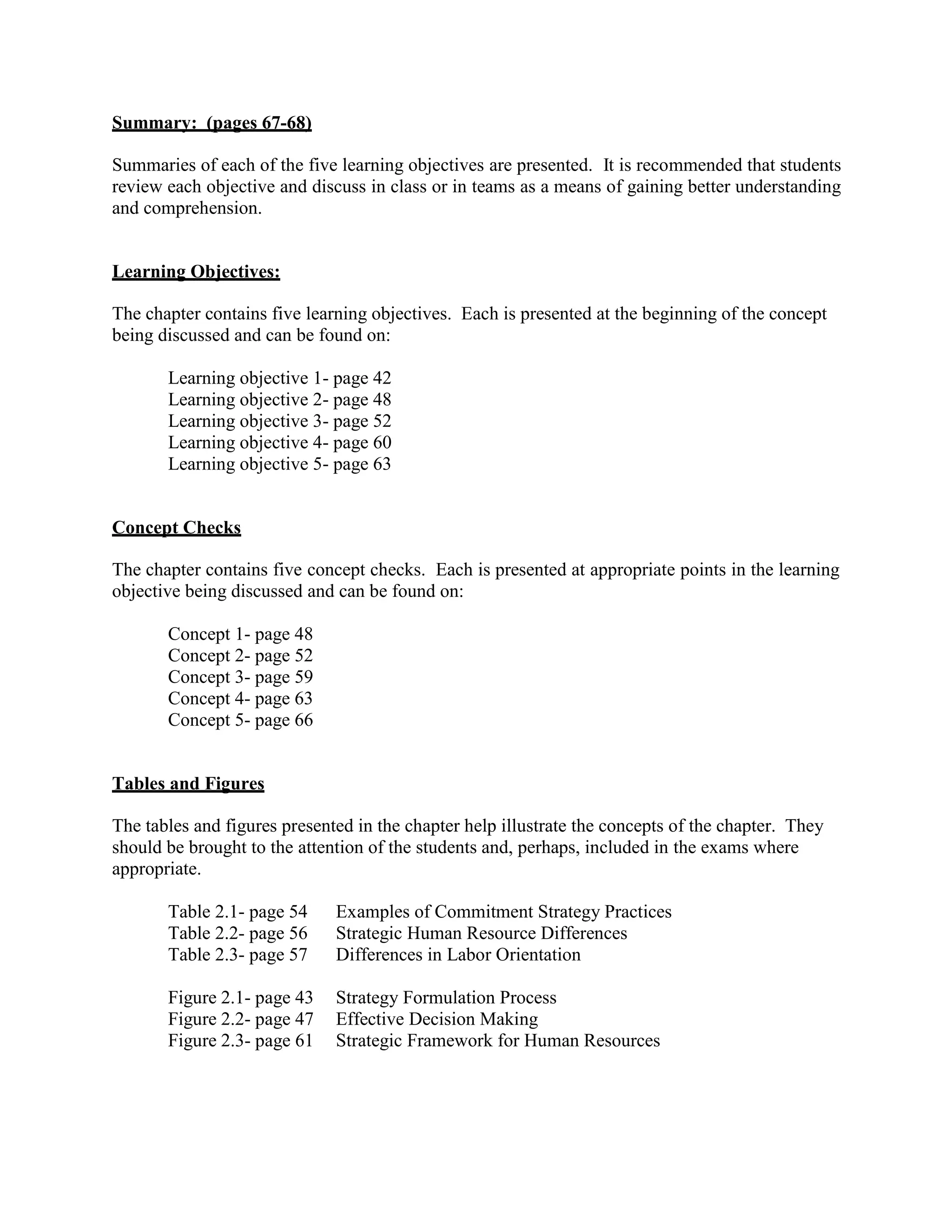
Tables and Figures
The tables and figures presented in the chapter help illustrate the concepts of the chapter. They
should be brought to the attention of the students and, perhaps, included in the exams where
appropriate.
Table 2.1- page 54 Examples of Commitment Strategy Practices
Table 2.2- page 56 Strategic Human Resource Differences
Table 2.3- page 57 Differences in Labor Orientation
Figure 2.1- page 43 Strategy Formulation Process
Figure 2.2- page 47 Effective Decision Making
Figure 2.3- page 61 Strategic Framework for Human Resources
14.
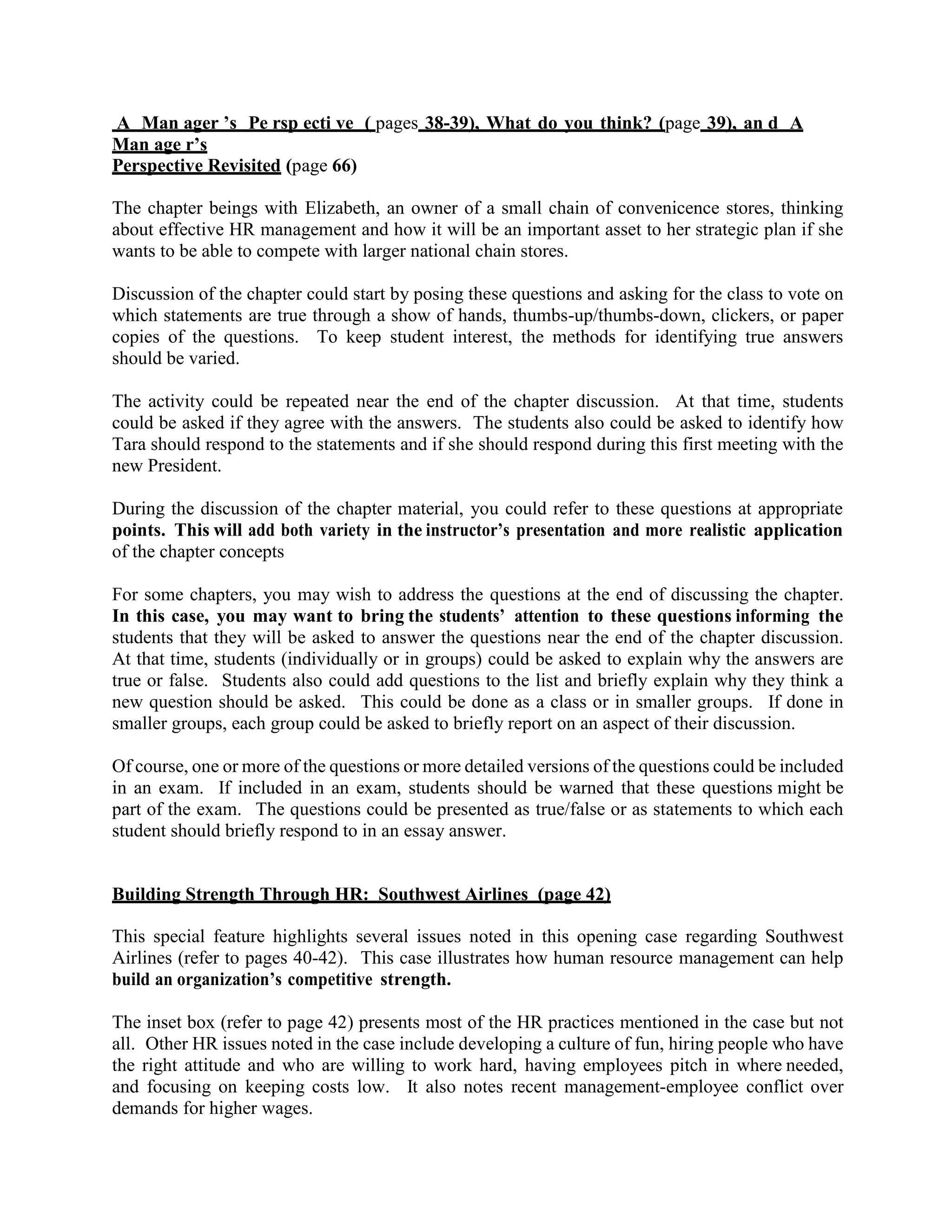
A Man ager’s Pe rsp ecti ve ( pages 38-39), What do you think? (page 39), an d A
Man age r’s
Perspective Revisited (page 66)
The chapter beings with Elizabeth, an owner of a small chain of convenicence stores, thinking
about effective HR management and how it will be an important asset to her strategic plan if she
wants to be able to compete with larger national chain stores.
Discussion of the chapter could start by posing these questions and asking for the class to vote on
which statements are true through a show of hands, thumbs-up/thumbs-down, clickers, or paper
copies of the questions. To keep student interest, the methods for identifying true answers
should be varied.
The activity could be repeated near the end of the chapter discussion. At that time, students
could be asked if they agree with the answers. The students also could be asked to identify how
Tara should respond to the statements and if she should respond during this first meeting with the
new President.
During the discussion of the chapter material, you could refer to these questions at appropriate
points. This will add both variety in the instructor’s presentation and more realistic application
of the chapter concepts
For some chapters, you may wish to address the questions at the end of discussing the chapter.
In this case, you may want to bring the students’ attention to these questions informing the
students that they will be asked to answer the questions near the end of the chapter discussion.
At that time, students (individually or in groups) could be asked to explain why the answers are
true or false. Students also could add questions to the list and briefly explain why they think a
new question should be asked. This could be done as a class or in smaller groups. If done in
smaller groups, each group could be asked to briefly report on an aspect of their discussion.
Of course, one or more of the questions or more detailed versions of the questions could be included
in an exam. If included in an exam, students should be warned that these questions might be
part of the exam. The questions could be presented as true/false or as statements to which each
student should briefly respond to in an essay answer.
Building Strength Through HR: Southwest Airlines (page 42)
This special feature highlights several issues noted in this opening case regarding Southwest
Airlines (refer to pages 40-42). This case illustrates how human resource management can help
build an organization’s competitive strength.
The inset box (refer to page 42) presents most of the HR practices mentioned in the case but not
all. Other HR issues noted in the case include developing a culture of fun, hiring people who have
the right attitude and who are willing to work hard, having employees pitch in where needed,
and focusing on keeping costs low. It also notes recent management-employee conflict over
demands for higher wages.
15.
Most students knowof Southwest Airlines and many may have flown with the airline.
Therefore, you could ask the students what other HR practices may help Southwest be a low cost
leader with loyal employees and customers. This discussion could be supplemented with
information found on Southwest’s webpage: http://www.southwest.com/. Southwest’s website
is informative but it takes several clicks to get to details. It is presented mostly in black print on
white background so it is not visually stimulating.
Supplemental information also could be provided by a student responsible for updating the case
and finding relevant information from the organization’s website or other sources. If you elect to
have the students provide information, you should inform the students of any school policies that
address contacting organizations.
At this point in the semester, guided class, group discussion, or briefly mentioning the case in a
mini-lecture should adequately introduce the chapter topics and establish relevance. Additional
ways to address the opening cases could include individual students or teams of students presenting
the main points and how the case answers the opening question of that section. These opening
cases also could be used as starting points for a more comprehensive assignment due later in
the term or semester.
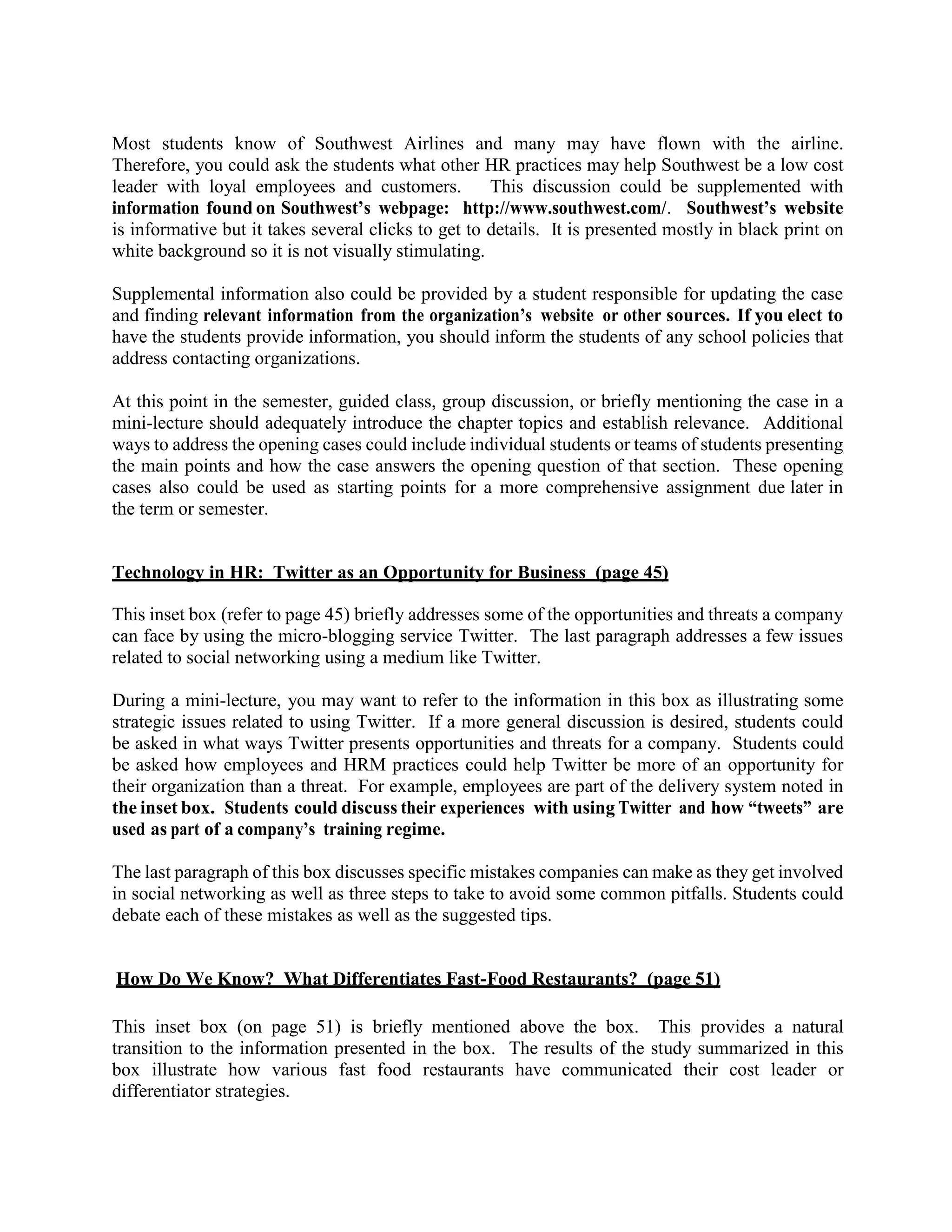
Technology in HR: Twitter as an Opportunity for Business (page 45)
This inset box (refer to page 45) briefly addresses some of the opportunities and threats a company
can face by using the micro-blogging service Twitter. The last paragraph addresses a few issues
related to social networking using a medium like Twitter.
During a mini-lecture, you may want to refer to the information in this box as illustrating some
strategic issues related to using Twitter. If a more general discussion is desired, students could
be asked in what ways Twitter presents opportunities and threats for a company. Students could
be asked how employees and HRM practices could help Twitter be more of an opportunity for
their organization than a threat. For example, employees are part of the delivery system noted in
the inset box. Students could discuss their experiences with using Twitter and how “tweets” are
used as part of a company’s training regime.
The last paragraph of this box discusses specific mistakes companies can make as they get involved
in social networking as well as three steps to take to avoid some common pitfalls. Students could
debate each of these mistakes as well as the suggested tips.
How Do We Know? What Differentiates Fast-Food Restaurants? (page 51)
This inset box (on page 51) is briefly mentioned above the box. This provides a natural
transition to the information presented in the box. The results of the study summarized in this
box illustrate how various fast food restaurants have communicated their cost leader or
differentiator strategies.
16.
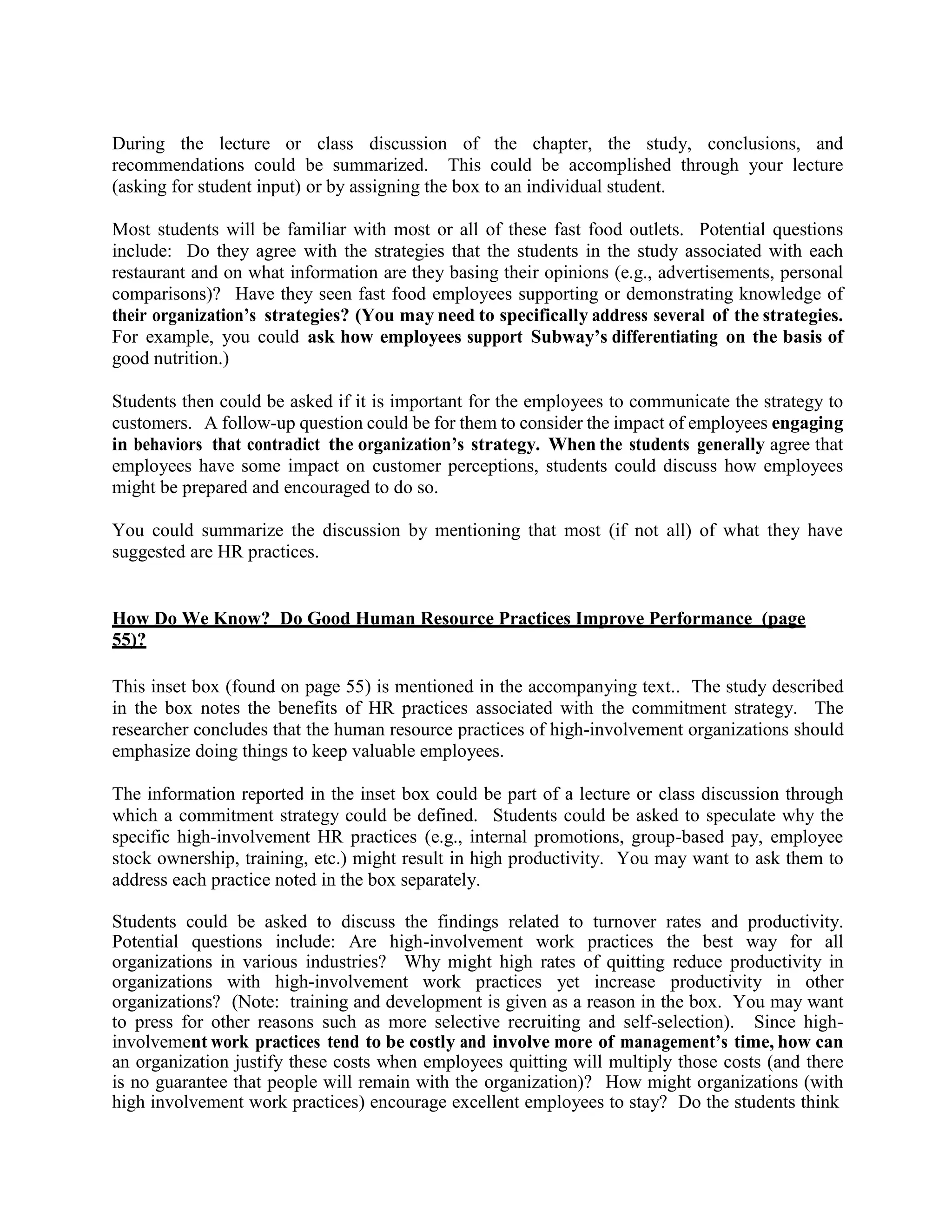
During the lectureor class discussion of the chapter, the study, conclusions, and
recommendations could be summarized. This could be accomplished through your lecture
(asking for student input) or by assigning the box to an individual student.
Most students will be familiar with most or all of these fast food outlets. Potential questions
include: Do they agree with the strategies that the students in the study associated with each
restaurant and on what information are they basing their opinions (e.g., advertisements, personal
comparisons)? Have they seen fast food employees supporting or demonstrating knowledge of
their organization’s strategies? (You may need to specifically address several of the strategies.
For example, you could ask how employees support Subway’s differentiating on the basis of
good nutrition.)
Students then could be asked if it is important for the employees to communicate the strategy to
customers. A follow-up question could be for them to consider the impact of employees engaging
in behaviors that contradict the organization’s strategy. When the students generally agree that
employees have some impact on customer perceptions, students could discuss how employees
might be prepared and encouraged to do so.
You could summarize the discussion by mentioning that most (if not all) of what they have
suggested are HR practices.
How Do We Know? Do Good Human Resource Practices Improve Performance (page
55)?
This inset box (found on page 55) is mentioned in the accompanying text.. The study described
in the box notes the benefits of HR practices associated with the commitment strategy. The
researcher concludes that the human resource practices of high-involvement organizations should
emphasize doing things to keep valuable employees.
The information reported in the inset box could be part of a lecture or class discussion through
which a commitment strategy could be defined. Students could be asked to speculate why the
specific high-involvement HR practices (e.g., internal promotions, group-based pay, employee
stock ownership, training, etc.) might result in high productivity. You may want to ask them to
address each practice noted in the box separately.
Students could be asked to discuss the findings related to turnover rates and productivity.
Potential questions include: Are high-involvement work practices the best way for all
organizations in various industries? Why might high rates of quitting reduce productivity in
organizations with high-involvement work practices yet increase productivity in other
organizations? (Note: training and development is given as a reason in the box. You may want
to press for other reasons such as more selective recruiting and self-selection). Since high-
involvement work practices tend to be costly and involve more of management’s time, how can
an organization justify these costs when employees quitting will multiply those costs (and there
is no guarantee that people will remain with the organization)? How might organizations (with
high involvement work practices) encourage excellent employees to stay? Do the students think
17.
that many whoquit organizations without high-involvement practices had lower productivity (than
those who did not quit) because they were frustrated by the lack of high-involvement practices?
(Note: this could lead to a discussion of whether all employees prefer high- involvement work
practices. Those employees with low growth needs or more of a Theory X orientation would not.)
Finally, you may want to ask the students if a study of 190 New Zealand organizations
generalizes to U.S. employees or employees in other countries. You also could address whether
the sample size is adequate and if their answers would depend on the types and sizes of
organizations included in the study.
Building Strength Through HR: Fenmarc Produce Ltd (page 58)
As noted on page 58 of this chapter, this inset box (refer to page 58) illustrates how Fenmarc
Produce has benefited from emphasizing an internal labor orientation. Their website
(http://www.fenmarc.com/) is very colorful and illustrates the concepts noted in the box. The
“Fenmarc Culture” link lists the six key principles noted in the box. Their website also includes
a video, their history and awards, community involvement, map, and pictures of employees.
Their philosophy is found on most pages.
You could show the video (if internet is available in classroom), ask students what appears to be
Fenmarc’s strategy (Cost Leadership), how each of the six key principles might help Fenmarc
keep costs low and profits high, and which HR strategy appears to be consistent with their six
key principles and cost leadership (Loyal Soldier) and why. You could finish by asking the
students if these key principles could work in organizations (and for all types of people) in the
U.S. and other countries or if they are specific to the United Kingdom. You also could ask if
they’d like to work for a company like Fenmarc.
A web-based assignment is described at the end of this chapter found in the Instructors’ Manual.
How Do We Know? Do Human Resource Practices Influence Customer Service? (page 65)
This inset box asks the questions: Why is the customer service at some banks better than others?
Is it by chance, or do successful banks encourage specific actions to assure that employees meet
the needs of customers?
Samuel Aryee, Fred Walumbwa, Emmanuel Seidu, and Lilian Otaye sought answers to this
question by obtaining data from 37 branches of 2 different banks located in Ghana.
Human resource practices that emphasize decentralized decision making, service quality–focused
feedback, extensive service training, and performance contingent compensation increase feelings
of empowerment. Empowerment results in increased customer service performance for both
individuals and bank branches.
18.
The authors concludedthat effective human resource practices do indeed represent an
effective method for pursuing a strategy of providing excellent service.
SUMMARY (pages 67-68)
A short summary of each of the chapter’s five learning objectives is presented on pages 67 – 68.
Each learning objective question emphasizes the key points needed to understand each question
and concept involved.
KEY TERMS (page 69)
Bargain Laborer HR strategy 61
Business-level strategy 48
Committed Expert HR strategy 53
Commitment strategy 62
Competitive business strategy 42
Contingency approach 53
Control strategy 53
Corporate-level strategy 48
Cost leadership strategy 48
Differentiation strategy 48
External environment 43
External labor orientation 57
Free Agent HR strategy 62
Human resource bundles 53
Human resource strategy 42
Internal labor orientation 57
Loyal Soldier HR strategy 60
Opportunities 43
Strategy 42
Strengths 44
Threats 43
Universalistic approach 53
Weaknesses 44
DISCUSSION QUESTIONS (page 69)
1. Why are effective human resource practices often a better competitive resource than
equipment and buildings? Answer: HR practices involve acquiring and motivating
employees. A strategy is only effective if an organization has the talent needed to carry it
out. Since our focus is on human resource management, we will concentrate on this part of
the value chain. Effective management of people can be a source of internal strength.
19.
HRM is criticalbecause high-quality employees are relatively rare.
2. What are some external opportunities and threats that you think organizations will face in
the next 10 years? What types of organizations will benefit most? Students’ answers
regarding the future may vary. Generally, the organizations that will benefit are those who
are effective in monitoring the external and internal environments and meet the needs of
current and future customers.
3. Why can groups be more effective than individuals for making decisions? Answer:
Various individuals have differing views, insights, information, etc. which (when shared
and discussed) should result in decisions that consider as many elements as possible.
Furthermore, one part of effective strategy formulation is to encourage decision makers
not to agree with one another too quickly. Making sure that the team of decision makers
includes people with different backgrounds can help in this regard. Experienced managers
and younger managers, for example, bring different insights to the decision-making
process, as do marketing personnel and operations personnel.
4. What are the primary differences between a cost leadership and a differentiation strategy?
Answer: Cost leadership emphasizes efficiency and minimizing costs. This allows the
organization to create value by producing goods and services at lower cost. Differentiators
seek to produce goods and services that are somehow superior to the goods and services
provided by competitors; their goal is to create unique value for which customers are willing
to pay a higher price. In contrast to cost leaders, differentiators reward innovation, individual
performance, and results and outcomes, which results in some competition among employees.
5. What are the key elements of the commitment strategy from the universalistic approach?
Why does this approach generally contribute to success for organizations? Answer: The
primary focus of practices in the commitment strategy is to empower workers and build a
strong sense of loyalty and commitment. This strategy typically involves extensive recruiting
and careful screening of recruits, employee involvement groups, widespread training,
widespread use of incentive pay, and high teamwork. This strategy fosters a strong sense of
cooperation between employees and managers, which results in higher productivity and
generally higher quality goods and services.
6. What human resource practices might be associated with a cost reduction emphasis? What
practices might be associated with a differentiation emphasis? Answer: Organizations with
a cost leadership strategy focus their efforts on increasing efficiency and hire generalists who
work in a variety of different positions. Other practices include controlling work processes
and carefully defining employee tasks, specifically prescribing appropriate behaviors, and
mass producing of standardized goods or services at the lowest possible cost.
Organizations using a differentiation strategy focus their human resource efforts on
innovation and quality enhancement. Employees in these organizations are often
specialists. They have more choice about how things should be done and are held
accountable for the goods and services they produce. Rather than seeking to control
processes, the organization concentrates on outcomes. Best process for completing work is
often unknown, and employees are expected to continually look for different ways of doing
things. Unique customer expectations require employees to change their actions to best
serve each client.
20.
7. What arethe strengths and weaknesses of internal and external labor orientations? Answer:
Strengths of the Internal Labor Orientation include predicting what skills and capabilities will
be available to them in the future; employees building strong relationships with one another
(high coordination and cooperation); and saving money by reducing expenses for recruiting,
interviewing, and hiring employees. Weaknesses include long-term commitments make it
difficult to adapt, changes in strategic direction are complicated because workers have
outdated skills, long-term commitments make it difficult for organizations to replace workers
whose skills are not up to date, and bureaucratic structures are inflexible. Strengths of the
External labor Orientation include flexibility, workers trained by universities or other
employers can be quickly added in areas that demand new skills, labor costs are not fixed,
and the total number of employees can easily be increased or decreased. Weaknesses
include weak relationship between organization and its employees, employees work because
they are paid and not necessarily because they are loyal, employees usually do not develop a
strong feeling of attachment to the organization, and employees do not provide a unique
competitive advantage.
8. Choose a company where someone you know works. Which of the four human resource
strategies do you think is most common in the company? Student answers will vary.
9. What are the key elements of the four human resource strategies: Loyal Soldier, Bargain
Laborer, Committed Expert, and Free Agent? Answer: Loyal Soldier combines emphasis on
long term employees with a focus on reducing costs, Bargain Laborer combines an emphasis
on short-term employees with a focus on reducing costs, Committed Expert combines an
emphasis on long-term employees with a focus on producing unique goods and services, and
Free agent combines an emphasis on short-term employees with a focus on producing unique
goods and services.
10. The chapter text pointed out that a majority of organizations have a human resource strategy
that fits their competitive strategy. What should an organization do if the strategies don’t
match? Answer: Such an organization should consider reassessing its human resource
strategy to align with its competitive strategy to optimize its performance.
EXAMPLE CASE: United Parcel Service (page 69-70)
Questions
1. How do practices such as internal promotion and assignment of broad job duties help UPS
achieve its competitive business strategy? Answer: The managers have to make thousands of
decisions in the field to keep things moving. In order to make these decisions in the most
efficient and effective manner, they need to know how the system of UPS works together and
how one decision will affect other aspects of UPS. The experience with UPS and broad job
duties helps reduce the learning curve and the chances of improving the system.
2. How do the human resource practices at UPS help build teamwork? Answer: The HR
practices noted in the above question help in that people recognize that their work will be
rewarded. The sharing of the wealth, emphasis on fairness, inclusiveness, and coaching also
21.
help in thatthe employees see the value of working together. Furthermore, they are given
the tools (through inclusiveness, coaching, etc) to contribute to the team. Another factor is
that managers know a lot of functional areas requiring interaction with people from various
orientations, a better understanding of those orientations, and willingness of those in various
areas to work with each other.
3. Why are training and experience so important at UPS? Answer: As noted above, training and
experience are important for efficiency and effectiveness in a demanding work environment.
Many decisions have to be made quickly with the least amount of negative impact on the UPS
system and customers. Knowing one’s job and the organization also allows everyone to
make quick, effective decisions, interact with customers and employees with a positive attitude,
and help UPS be successful in achieving its strategy.
DISCUSSION CASE: Mountain Bank (page 70-71)
Questions
1. What competitive business strategy do you recommend for Mountain Bank? Answer:
Differentiation.
2. Based on the universalistic approach and commitment strategy, what types of human
resource practices do you recommend for Mountain Bank with respect to its tellers? Answer:
For any of the following HR practices that Mountain Bank has not already implemented, they
should add: broader job responsibilities, meaningful tasks, job rotation, inclusive decision
making, high levels of responsibility, building employee confidence, two-way communication,
quality-of-life surveys, and encourage suggestions, extensive new employee training, formal
training for everyone (full- and part-time), multiple job skill development, pay for performance,
higher levels of pay, ownership forms of pay such as stock, highly selective recruiting of full-
and part-time tellers, identification of skilled workers, and long-term relationships with
employees. They also should consider keeping some of the successful tellers as tellers rather
than transferring them to another job. They could give them the opportunity to be lead
persons or give them a different title (e.g., Senior Teller, Master Teller) or supervisors
of the part-time and floating employees. Perhaps the more experienced tellers should
be included as floaters (even if they have been transferred to customer service positions).
3. Which of the four human resource strategies do you recommend for Mountain Bank with
respect to its tellers? Why? Answer: Committed Expert HR strategy because they want to
hire and retain employees who are specialists and innovators. They also want people who fit
their organizational culture (of excellent customer service, cooperation, and coordination) and
that have the aptitude for becoming experts in particular areas (e.g., corporate banking). They
typically hire people early in their careers and give them long-term training that helps
employees develop strong expertise. The bank will need to make several changes to achieve
this strategy, including increasing their base pay and paying for performance.
22.
ADDITIONAL WEB-BASED ACTIVITIES
Overviewof activity
Refer back to the inset box on page 58 describing how Fenmarc Produce has benefited from
emphasizing an internal labor orientation. This activity gives students the opportunity to
investigate and justify Fenmarc’s practices.
Exercise:
As noted previously, Fenmarc’s website (http://www.fenmarc.com/) is very colorful and
illustrates the concepts described in the inset box on page 58. Through Fenmarc’s website,
students could describe how Fenmarc appears to be implementing each of their six key
principles, Cost Leadership strategy, internal labor orientation, and Loyal Soldier HR strategy.
Their philosophy is found on most pages.
Alternate Approaches to the Exercise:
Students could compare Fenmarc to an organization found in the top ten of the 100 best companies
in America. (refer back to the “How Do We Know” inset box on page 12). Fenmarc’s
six key principles could provide the basis for comparison.
Links to relevant information
The organization’s website (http://www.fenmarc.com/) provides the information needed for the
students to accomplish this exercise.
with active linksor immediate access to the full terms of the Project
Gutenberg™ License.
1.E.6. You may convert to and distribute this work in any binary,
compressed, marked up, nonproprietary or proprietary form,
including any word processing or hypertext form. However, if you
provide access to or distribute copies of a Project Gutenberg™ work
in a format other than “Plain Vanilla ASCII” or other format used in
the official version posted on the official Project Gutenberg™ website
(www.gutenberg.org), you must, at no additional cost, fee or
expense to the user, provide a copy, a means of exporting a copy, or
a means of obtaining a copy upon request, of the work in its original
“Plain Vanilla ASCII” or other form. Any alternate format must
include the full Project Gutenberg™ License as specified in
paragraph 1.E.1.
1.E.7. Do not charge a fee for access to, viewing, displaying,
performing, copying or distributing any Project Gutenberg™ works
unless you comply with paragraph 1.E.8 or 1.E.9.
1.E.8. You may charge a reasonable fee for copies of or providing
access to or distributing Project Gutenberg™ electronic works
provided that:
• You pay a royalty fee of 20% of the gross profits you derive
from the use of Project Gutenberg™ works calculated using the
method you already use to calculate your applicable taxes. The
fee is owed to the owner of the Project Gutenberg™ trademark,
but he has agreed to donate royalties under this paragraph to
the Project Gutenberg Literary Archive Foundation. Royalty
payments must be paid within 60 days following each date on
which you prepare (or are legally required to prepare) your
periodic tax returns. Royalty payments should be clearly marked
as such and sent to the Project Gutenberg Literary Archive
Foundation at the address specified in Section 4, “Information
25.
about donations tothe Project Gutenberg Literary Archive
Foundation.”
• You provide a full refund of any money paid by a user who
notifies you in writing (or by e-mail) within 30 days of receipt
that s/he does not agree to the terms of the full Project
Gutenberg™ License. You must require such a user to return or
destroy all copies of the works possessed in a physical medium
and discontinue all use of and all access to other copies of
Project Gutenberg™ works.
• You provide, in accordance with paragraph 1.F.3, a full refund of
any money paid for a work or a replacement copy, if a defect in
the electronic work is discovered and reported to you within 90
days of receipt of the work.
• You comply with all other terms of this agreement for free
distribution of Project Gutenberg™ works.
1.E.9. If you wish to charge a fee or distribute a Project Gutenberg™
electronic work or group of works on different terms than are set
forth in this agreement, you must obtain permission in writing from
the Project Gutenberg Literary Archive Foundation, the manager of
the Project Gutenberg™ trademark. Contact the Foundation as set
forth in Section 3 below.
1.F.
1.F.1. Project Gutenberg volunteers and employees expend
considerable effort to identify, do copyright research on, transcribe
and proofread works not protected by U.S. copyright law in creating
the Project Gutenberg™ collection. Despite these efforts, Project
Gutenberg™ electronic works, and the medium on which they may
be stored, may contain “Defects,” such as, but not limited to,
incomplete, inaccurate or corrupt data, transcription errors, a
copyright or other intellectual property infringement, a defective or
26.
damaged disk orother medium, a computer virus, or computer
codes that damage or cannot be read by your equipment.
1.F.2. LIMITED WARRANTY, DISCLAIMER OF DAMAGES - Except for
the “Right of Replacement or Refund” described in paragraph 1.F.3,
the Project Gutenberg Literary Archive Foundation, the owner of the
Project Gutenberg™ trademark, and any other party distributing a
Project Gutenberg™ electronic work under this agreement, disclaim
all liability to you for damages, costs and expenses, including legal
fees. YOU AGREE THAT YOU HAVE NO REMEDIES FOR
NEGLIGENCE, STRICT LIABILITY, BREACH OF WARRANTY OR
BREACH OF CONTRACT EXCEPT THOSE PROVIDED IN PARAGRAPH
1.F.3. YOU AGREE THAT THE FOUNDATION, THE TRADEMARK
OWNER, AND ANY DISTRIBUTOR UNDER THIS AGREEMENT WILL
NOT BE LIABLE TO YOU FOR ACTUAL, DIRECT, INDIRECT,
CONSEQUENTIAL, PUNITIVE OR INCIDENTAL DAMAGES EVEN IF
YOU GIVE NOTICE OF THE POSSIBILITY OF SUCH DAMAGE.
1.F.3. LIMITED RIGHT OF REPLACEMENT OR REFUND - If you
discover a defect in this electronic work within 90 days of receiving
it, you can receive a refund of the money (if any) you paid for it by
sending a written explanation to the person you received the work
from. If you received the work on a physical medium, you must
return the medium with your written explanation. The person or
entity that provided you with the defective work may elect to provide
a replacement copy in lieu of a refund. If you received the work
electronically, the person or entity providing it to you may choose to
give you a second opportunity to receive the work electronically in
lieu of a refund. If the second copy is also defective, you may
demand a refund in writing without further opportunities to fix the
problem.
1.F.4. Except for the limited right of replacement or refund set forth
in paragraph 1.F.3, this work is provided to you ‘AS-IS’, WITH NO
OTHER WARRANTIES OF ANY KIND, EXPRESS OR IMPLIED,
27.
INCLUDING BUT NOTLIMITED TO WARRANTIES OF
MERCHANTABILITY OR FITNESS FOR ANY PURPOSE.
1.F.5. Some states do not allow disclaimers of certain implied
warranties or the exclusion or limitation of certain types of damages.
If any disclaimer or limitation set forth in this agreement violates the
law of the state applicable to this agreement, the agreement shall be
interpreted to make the maximum disclaimer or limitation permitted
by the applicable state law. The invalidity or unenforceability of any
provision of this agreement shall not void the remaining provisions.
1.F.6. INDEMNITY - You agree to indemnify and hold the Foundation,
the trademark owner, any agent or employee of the Foundation,
anyone providing copies of Project Gutenberg™ electronic works in
accordance with this agreement, and any volunteers associated with
the production, promotion and distribution of Project Gutenberg™
electronic works, harmless from all liability, costs and expenses,
including legal fees, that arise directly or indirectly from any of the
following which you do or cause to occur: (a) distribution of this or
any Project Gutenberg™ work, (b) alteration, modification, or
additions or deletions to any Project Gutenberg™ work, and (c) any
Defect you cause.
Section 2. Information about the Mission
of Project Gutenberg™
Project Gutenberg™ is synonymous with the free distribution of
electronic works in formats readable by the widest variety of
computers including obsolete, old, middle-aged and new computers.
It exists because of the efforts of hundreds of volunteers and
donations from people in all walks of life.
Volunteers and financial support to provide volunteers with the
assistance they need are critical to reaching Project Gutenberg™’s
goals and ensuring that the Project Gutenberg™ collection will
28.
remain freely availablefor generations to come. In 2001, the Project
Gutenberg Literary Archive Foundation was created to provide a
secure and permanent future for Project Gutenberg™ and future
generations. To learn more about the Project Gutenberg Literary
Archive Foundation and how your efforts and donations can help,
see Sections 3 and 4 and the Foundation information page at
www.gutenberg.org.
Section 3. Information about the Project
Gutenberg Literary Archive Foundation
The Project Gutenberg Literary Archive Foundation is a non-profit
501(c)(3) educational corporation organized under the laws of the
state of Mississippi and granted tax exempt status by the Internal
Revenue Service. The Foundation’s EIN or federal tax identification
number is 64-6221541. Contributions to the Project Gutenberg
Literary Archive Foundation are tax deductible to the full extent
permitted by U.S. federal laws and your state’s laws.
The Foundation’s business office is located at 809 North 1500 West,
Salt Lake City, UT 84116, (801) 596-1887. Email contact links and up
to date contact information can be found at the Foundation’s website
and official page at www.gutenberg.org/contact
Section 4. Information about Donations to
the Project Gutenberg Literary Archive
Foundation
Project Gutenberg™ depends upon and cannot survive without
widespread public support and donations to carry out its mission of
increasing the number of public domain and licensed works that can
be freely distributed in machine-readable form accessible by the
widest array of equipment including outdated equipment. Many
29.
small donations ($1to $5,000) are particularly important to
maintaining tax exempt status with the IRS.
The Foundation is committed to complying with the laws regulating
charities and charitable donations in all 50 states of the United
States. Compliance requirements are not uniform and it takes a
considerable effort, much paperwork and many fees to meet and
keep up with these requirements. We do not solicit donations in
locations where we have not received written confirmation of
compliance. To SEND DONATIONS or determine the status of
compliance for any particular state visit www.gutenberg.org/donate.
While we cannot and do not solicit contributions from states where
we have not met the solicitation requirements, we know of no
prohibition against accepting unsolicited donations from donors in
such states who approach us with offers to donate.
International donations are gratefully accepted, but we cannot make
any statements concerning tax treatment of donations received from
outside the United States. U.S. laws alone swamp our small staff.
Please check the Project Gutenberg web pages for current donation
methods and addresses. Donations are accepted in a number of
other ways including checks, online payments and credit card
donations. To donate, please visit: www.gutenberg.org/donate.
Section 5. General Information About
Project Gutenberg™ electronic works
Professor Michael S. Hart was the originator of the Project
Gutenberg™ concept of a library of electronic works that could be
freely shared with anyone. For forty years, he produced and
distributed Project Gutenberg™ eBooks with only a loose network of
volunteer support.
30.
Project Gutenberg™ eBooksare often created from several printed
editions, all of which are confirmed as not protected by copyright in
the U.S. unless a copyright notice is included. Thus, we do not
necessarily keep eBooks in compliance with any particular paper
edition.
Most people start at our website which has the main PG search
facility: www.gutenberg.org.
This website includes information about Project Gutenberg™,
including how to make donations to the Project Gutenberg Literary
Archive Foundation, how to help produce our new eBooks, and how
to subscribe to our email newsletter to hear about new eBooks.
31.
Welcome to ourwebsite – the perfect destination for book lovers and
knowledge seekers. We believe that every book holds a new world,
offering opportunities for learning, discovery, and personal growth.
That’s why we are dedicated to bringing you a diverse collection of
books, ranging from classic literature and specialized publications to
self-development guides and children's books.
More than just a book-buying platform, we strive to be a bridge
connecting you with timeless cultural and intellectual values. With an
elegant, user-friendly interface and a smart search system, you can
quickly find the books that best suit your interests. Additionally,
our special promotions and home delivery services help you save time
and fully enjoy the joy of reading.
Join us on a journey of knowledge exploration, passion nurturing, and
personal growth every day!
testbankmall.com