Five
PROGRAMME: Bachelor of Science in Food and Agribusiness
COURSE UNIT: Human Resource Management
NAME: KABILA JONATHAN OBBO
Monday, August 30, 2021
INTRODUCTION
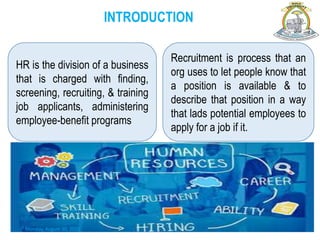
HR is the division of a business
that is charged with finding,
screening, recruiting, & training
job applicants, administering
employee-benefit programs
Recruitment is process that an
org uses to let people know that
a position is available & to
describe that position in a way
that lads potential employees to
apply for a job if it.
Monday, August 30, 2021
1(a)i. INTERNET RECRUITMENT (E-recruitment)
Is the use of web-based technology in finding & hiring the
qualified candidate for a job opening, in a timely & cost effective
manner
E-recruitment involves automation through out as follows:
Organizations put job vacancies on the internet
Interested candidates react with their resumes electronically
Electronic screening of resumes & intelligent matching system
Applicants with relevant profile for the job are contacted online
Interviews are conducted online
Discussions are thereafter held through telephone, e-mail.
Terms are agreed & offers are made & accepted.
Monday, August 30, 2021
The fundamental of e- Recruitment
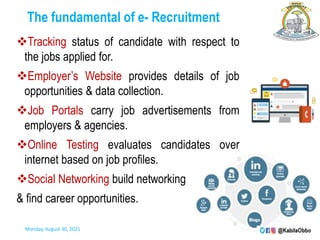
Tracking status of candidate with respect to
the jobs applied for.
Employer’s Website provides details of job
opportunities & data collection.
Job Portals carry job advertisements from
employers & agencies.
Online Testing evaluates candidates over
internet based on job profiles.
Social Networking build networking
& find career opportunities.
Monday, August 30, 2021
Pros & Cons of e-recruitment
Pros of e-recruitment
Cost & time effective
User friendly
Reaches bigger audience
Enables dynamic content
Immediacy
Cons of e-recruitment
High volume of
responses (unsuitable
candidates)
Technology issues
Not suitable for senior
positions
Monday, August 30, 2021
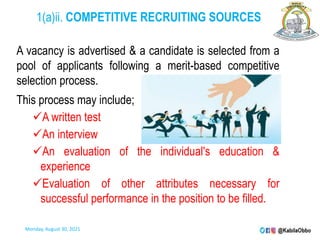
1(a)ii. COMPETITIVE RECRUITING SOURCES
A vacancy is advertised & a candidate is selected from a
pool of applicants following a merit-based competitive
selection process.
This process may include;
A written test
An interview
An evaluation of the individual's education &
experience
Evaluation of other attributes necessary for
successful performance in the position to be filled.
Monday, August 30, 2021
Appointment Methods
Merit Promotion: Used to consider current & former
federal employees for positions on the basis of personal
merit. Positions are usually filled through competition with
applicants being evaluated & ranked for positions.
Noncompetitive Action: It is an appointment (established
by law or Ex Order) to a position in the competitive
service. Selection from an open competitive examination.
Delegated Examining (DE): It applies to competitive
examining only. The OPM grants to agencies to fill
competitive civil service jobs with applicants applying from
outside the federal workforce.
Monday, August 30, 2021
1(a)iii. CREATIVE RECRUITING
The creative methods of recruitment used include;
Open-ended job postings
Is a job posting that will not
have any job specification,
description, or position.
“Hire for attitude & train for
skills”.
It creates & adds employer
brand image. But, people
can fake their attitude
during interactions with the
company representatives.
Gamification
Is a process of engaging
individual in games which
challenges the individual on
certain skills which is
necessary to do that type of
job.
Complete tasks that are
typically assigned to that
position. E.g. Sama Source.
Also helps in effective
marketing.
Monday, August 30, 2021
CREATIVE RECRUITING
Go on the field
The recruiters get to know
work ethic of an individual
once he starts working & if
the candidate forged his
strengths during interview,
it’s simply too late.
So the org should find out
opportunities where they can
actually gauge the work
ethic of an individual.
other digital tools
 Survey monkeys is used
to standardize resumes.
(develop template in the
digital tool & send to
candidates).
 Google Hangouts is
used to highlight jobs &
then engage with
potential candidates
Monday, August 30, 2021
1(a)iv. EMPLOYMENT AGENCIES
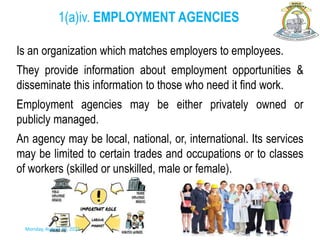
Is an organization which matches employers to employees.
They provide information about employment opportunities &
disseminate this information to those who need it find work.
Employment agencies may be either privately owned or
publicly managed.
An agency may be local, national, or, international. Its services
may be limited to certain trades and occupations or to classes
of workers (skilled or unskilled, male or female).
Monday, August 30, 2021
Types of employment Agencies
Temporary agency
employment
 The worker is employed
by the temporary work
agency, & then hired out to
perform work at user
company.
 There is no employment
r/ship btn temporary
agency worker & the user
company.
 Hiring firm pays fees to
agency, which pays wages
Private employment agency
Is an enterprise, independent
of public authorities, which
provides services for matching
offers of & applications for
employment.
Provide information that do
not aim to match specific
employment offers &
applications.
Agencies cannot charge
workers for finding work.
Monday, August 30, 2021
Function of an Employment Agency
For employers, it can take the grunt work out of human
resources.
When a business needs a specific person for a job, it'll contract
with a personnel placement services firm (recruiter).
Staffing agency provide skilled employees to work on a
temporary basis when a business needs somebody for a few
months.
For job seekers, an employment agency can be the ticket to
getting that full-time job.
Offer free training in a variety of skill-building tools, such as
software programs & computer skills.
Monday, August 30, 2021
1(a)v. EQUITY IN RECRUITMENT
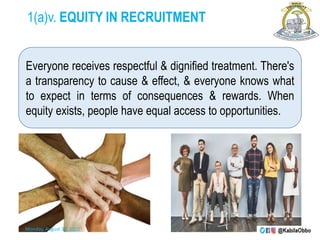
Everyone receives respectful & dignified treatment. There's
a transparency to cause & effect, & everyone knows what
to expect in terms of consequences & rewards. When
equity exists, people have equal access to opportunities.
Monday, August 30, 2021
Guidelines for Equity in Recruitment &
Selection process
Defining the need for appointment: Requirements &
responsibilities of the position should be evaluated to ensure
they relate to current & future needs, including increasing
representation of equity group employees (Māori group).
Recruitment & selection panel membership: It ensures
recruitment & selection panels have appropriate membership
striving for gender balance & ethnic diversity.
Advertising: Plans for advertising should identify special
actions to attract members of underrepresented groups.
Shortlisting: The Committee needs to have consensus about
standards for evaluation. For academic positions, the
candidate’s ability to act as a role model for Māori & equity
groups should be considered.
Monday, August 30, 2021
Guidelines for Equity in Recruitment &
Selection process
Interviewing applicants: Prepared questions will be agreed
prior to the interview with the same questions asked of all
applicants.
Recruitment to non-advertised positions: Temporary
vacancies may be filled without advertising.
• Making the appointment: When negotiating a salary ensure
fairness & relativity with other employees, taking “equivalent”
qualifications into account.
• Feedback: If an unsuccessful applicant is interested in
feedback about their interview, they should discuss these with
the hiring manager & selection panel.
Monday, August 30, 2021
1(a)vi. STRATEGIC RECRUITMENT
Involves locating & attracting the ‘right’ potential candidates to
the ‘right’ job openings.
Recruitment begins with identifying HR requirements & ends
with receiving applications.
It involves determining where qualified applicants can be
found & choosing a specific means of attracting potential
employees.
It immediately precedes to selection process (attracting
qualified & interested candidates who have capacity to
generate a sustainable competitive advantage for the org).
Monday, August 30, 2021
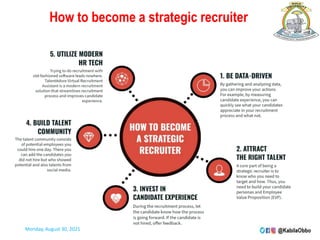
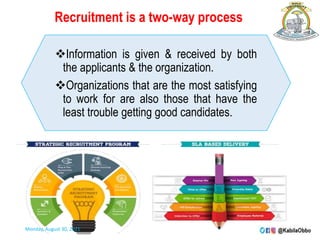
How to become a strategic recruiter
Monday, August 30, 2021
Recruitment is a two-way process
Information is given & received by both
the applicants & the organization.
Organizations that are the most satisfying
to work for are also those that have the
least trouble getting good candidates.
Monday, August 30, 2021
1(b). LEGAL CONSIDERATIONS IN WORK
FORCE REDUCTION
WARN Act “Worker Adjustment & Retraining Notification Act”:
This is a federal law that has regulations on how organization
should provide notice to employees that will be let go during a
reduction in force.
ADEA “Age Discrimination in Employment Act”: This law
protects workers over the age of forty from being discriminated
against on the sole basis of age.
ADEA prohibits an employer from refusing to hire, firing, or
discriminating against an employee age 40 or older, solely on
the basis of age.
Monday, August 30, 2021
Legal considerations in work force reduction
COBRA “Consolidated Omnibus Budget Reconciliation Act”:
It gives employees the right to pay premiums for & keep the
group health insurance that they would otherwise lose after
they reduce their work hours, quit their jobs or lose their jobs.
So it could cause legal issues if the employees that have
been let go do not receive all the proper documentation to
set up COBRA.
FMLA “Family & Medical Leave Act”: It allows employees to
take up to 12 weeks of unpaid leave each year. This becomes
tricky if you have an employee out on FMLA while you are
conducting a reduction in force.
Organization can layoff someone on FMLA if the reason for
laying them off is not related to them being on FMLA
Monday, August 30, 2021
Legal considerations in work force reduction
USERRA (Uniformed Services Employment and
Reemployment Rights): This law provides protection for
employees at your company who take leave from work to
participate in our government’s military. The law requires that
your organization provide the same employment after the
employee gets back from service that they had before.
Worker’s Compensation: If you layoff an employee because
they are on worker’s compensation, it may result into a lawsuit.
But, being on worker’s compensation does not make an
employee immune from being affected in a reduction in force.
So, if you can provide a valid business reason for their position
to be eliminated, it should mitigate legal concerns.
Monday, August 30, 2021
Legal considerations in work force reduction
EEOC (Equal Employment Opportunity Commission):
Protects employees in protected classes from being
discriminated against. It enforces federal laws that make it
illegal to discriminate against a job applicant or an employee
because of race, color, religion, sex, age, disability.
Legal issues can be avoided by making sure that you don’t
have a disproportionate amount of employees in any one
class being affected by your layoff. To do this, make sure that
the percentage of a protected class in the group of
employees being affected is the same percentage that class
holds in your overall workforce.
Monday, August 30, 2021
CONCLUSION
During Human Resource Recruiting, it is so critical to
ensure;
 strategic recruiting
 Human Resource planning
through making;
 strategic recruiting decisions
 considering diversity & affirmative action
For example
the female representation on recruitment committees.
Monday, August 30, 2021
References
1. Mathis, R.L., J.H. Jackson and S.R. Valentine. 2013. Human
Resource Management. 14th Edition. Cengage Learning.
ISBN-10: 1133953107. 688 pg
2. McAfee R.B., Fottler M.D and Nkomo S.M. 2007. Human
Resource Management: Cases, Exercises, Incidents and
Skills Builders
3. Wanous, J. P. (1992). Organizational Entry: Recruitment,
Selection, Orientation, and Socialization of Newcomers.
Prentice Hall.
4. Zientara, P. 2014. Human Resource Management in
Emerging Economies. Routledge. ISBN-10: 1138787132.
214 pg
Monday, August 30, 2021
THANK YOU

Human resource management

  • 1.
    Five PROGRAMME: Bachelor ofScience in Food and Agribusiness COURSE UNIT: Human Resource Management NAME: KABILA JONATHAN OBBO Monday, August 30, 2021
  • 2.
    INTRODUCTION HR is thedivision of a business that is charged with finding, screening, recruiting, & training job applicants, administering employee-benefit programs Recruitment is process that an org uses to let people know that a position is available & to describe that position in a way that lads potential employees to apply for a job if it. Monday, August 30, 2021
  • 3.
    1(a)i. INTERNET RECRUITMENT(E-recruitment) Is the use of web-based technology in finding & hiring the qualified candidate for a job opening, in a timely & cost effective manner E-recruitment involves automation through out as follows: Organizations put job vacancies on the internet Interested candidates react with their resumes electronically Electronic screening of resumes & intelligent matching system Applicants with relevant profile for the job are contacted online Interviews are conducted online Discussions are thereafter held through telephone, e-mail. Terms are agreed & offers are made & accepted. Monday, August 30, 2021
  • 4.
    The fundamental ofe- Recruitment Tracking status of candidate with respect to the jobs applied for. Employer’s Website provides details of job opportunities & data collection. Job Portals carry job advertisements from employers & agencies. Online Testing evaluates candidates over internet based on job profiles. Social Networking build networking & find career opportunities. Monday, August 30, 2021
  • 5.
    Pros & Consof e-recruitment Pros of e-recruitment Cost & time effective User friendly Reaches bigger audience Enables dynamic content Immediacy Cons of e-recruitment High volume of responses (unsuitable candidates) Technology issues Not suitable for senior positions Monday, August 30, 2021
  • 6.
    1(a)ii. COMPETITIVE RECRUITINGSOURCES A vacancy is advertised & a candidate is selected from a pool of applicants following a merit-based competitive selection process. This process may include; A written test An interview An evaluation of the individual's education & experience Evaluation of other attributes necessary for successful performance in the position to be filled. Monday, August 30, 2021
  • 7.
    Appointment Methods Merit Promotion:Used to consider current & former federal employees for positions on the basis of personal merit. Positions are usually filled through competition with applicants being evaluated & ranked for positions. Noncompetitive Action: It is an appointment (established by law or Ex Order) to a position in the competitive service. Selection from an open competitive examination. Delegated Examining (DE): It applies to competitive examining only. The OPM grants to agencies to fill competitive civil service jobs with applicants applying from outside the federal workforce. Monday, August 30, 2021
  • 8.
    1(a)iii. CREATIVE RECRUITING Thecreative methods of recruitment used include; Open-ended job postings Is a job posting that will not have any job specification, description, or position. “Hire for attitude & train for skills”. It creates & adds employer brand image. But, people can fake their attitude during interactions with the company representatives. Gamification Is a process of engaging individual in games which challenges the individual on certain skills which is necessary to do that type of job. Complete tasks that are typically assigned to that position. E.g. Sama Source. Also helps in effective marketing. Monday, August 30, 2021
  • 9.
    CREATIVE RECRUITING Go onthe field The recruiters get to know work ethic of an individual once he starts working & if the candidate forged his strengths during interview, it’s simply too late. So the org should find out opportunities where they can actually gauge the work ethic of an individual. other digital tools  Survey monkeys is used to standardize resumes. (develop template in the digital tool & send to candidates).  Google Hangouts is used to highlight jobs & then engage with potential candidates Monday, August 30, 2021
  • 10.
    1(a)iv. EMPLOYMENT AGENCIES Isan organization which matches employers to employees. They provide information about employment opportunities & disseminate this information to those who need it find work. Employment agencies may be either privately owned or publicly managed. An agency may be local, national, or, international. Its services may be limited to certain trades and occupations or to classes of workers (skilled or unskilled, male or female). Monday, August 30, 2021
  • 11.
    Types of employmentAgencies Temporary agency employment  The worker is employed by the temporary work agency, & then hired out to perform work at user company.  There is no employment r/ship btn temporary agency worker & the user company.  Hiring firm pays fees to agency, which pays wages Private employment agency Is an enterprise, independent of public authorities, which provides services for matching offers of & applications for employment. Provide information that do not aim to match specific employment offers & applications. Agencies cannot charge workers for finding work. Monday, August 30, 2021
  • 12.
    Function of anEmployment Agency For employers, it can take the grunt work out of human resources. When a business needs a specific person for a job, it'll contract with a personnel placement services firm (recruiter). Staffing agency provide skilled employees to work on a temporary basis when a business needs somebody for a few months. For job seekers, an employment agency can be the ticket to getting that full-time job. Offer free training in a variety of skill-building tools, such as software programs & computer skills. Monday, August 30, 2021
  • 13.
    1(a)v. EQUITY INRECRUITMENT Everyone receives respectful & dignified treatment. There's a transparency to cause & effect, & everyone knows what to expect in terms of consequences & rewards. When equity exists, people have equal access to opportunities. Monday, August 30, 2021
  • 14.
    Guidelines for Equityin Recruitment & Selection process Defining the need for appointment: Requirements & responsibilities of the position should be evaluated to ensure they relate to current & future needs, including increasing representation of equity group employees (Māori group). Recruitment & selection panel membership: It ensures recruitment & selection panels have appropriate membership striving for gender balance & ethnic diversity. Advertising: Plans for advertising should identify special actions to attract members of underrepresented groups. Shortlisting: The Committee needs to have consensus about standards for evaluation. For academic positions, the candidate’s ability to act as a role model for Māori & equity groups should be considered. Monday, August 30, 2021
  • 15.
    Guidelines for Equityin Recruitment & Selection process Interviewing applicants: Prepared questions will be agreed prior to the interview with the same questions asked of all applicants. Recruitment to non-advertised positions: Temporary vacancies may be filled without advertising. • Making the appointment: When negotiating a salary ensure fairness & relativity with other employees, taking “equivalent” qualifications into account. • Feedback: If an unsuccessful applicant is interested in feedback about their interview, they should discuss these with the hiring manager & selection panel. Monday, August 30, 2021
  • 16.
    1(a)vi. STRATEGIC RECRUITMENT Involveslocating & attracting the ‘right’ potential candidates to the ‘right’ job openings. Recruitment begins with identifying HR requirements & ends with receiving applications. It involves determining where qualified applicants can be found & choosing a specific means of attracting potential employees. It immediately precedes to selection process (attracting qualified & interested candidates who have capacity to generate a sustainable competitive advantage for the org). Monday, August 30, 2021
  • 17.
    How to becomea strategic recruiter Monday, August 30, 2021
  • 18.
    Recruitment is atwo-way process Information is given & received by both the applicants & the organization. Organizations that are the most satisfying to work for are also those that have the least trouble getting good candidates. Monday, August 30, 2021
  • 19.
    1(b). LEGAL CONSIDERATIONSIN WORK FORCE REDUCTION WARN Act “Worker Adjustment & Retraining Notification Act”: This is a federal law that has regulations on how organization should provide notice to employees that will be let go during a reduction in force. ADEA “Age Discrimination in Employment Act”: This law protects workers over the age of forty from being discriminated against on the sole basis of age. ADEA prohibits an employer from refusing to hire, firing, or discriminating against an employee age 40 or older, solely on the basis of age. Monday, August 30, 2021
  • 20.
    Legal considerations inwork force reduction COBRA “Consolidated Omnibus Budget Reconciliation Act”: It gives employees the right to pay premiums for & keep the group health insurance that they would otherwise lose after they reduce their work hours, quit their jobs or lose their jobs. So it could cause legal issues if the employees that have been let go do not receive all the proper documentation to set up COBRA. FMLA “Family & Medical Leave Act”: It allows employees to take up to 12 weeks of unpaid leave each year. This becomes tricky if you have an employee out on FMLA while you are conducting a reduction in force. Organization can layoff someone on FMLA if the reason for laying them off is not related to them being on FMLA Monday, August 30, 2021
  • 21.
    Legal considerations inwork force reduction USERRA (Uniformed Services Employment and Reemployment Rights): This law provides protection for employees at your company who take leave from work to participate in our government’s military. The law requires that your organization provide the same employment after the employee gets back from service that they had before. Worker’s Compensation: If you layoff an employee because they are on worker’s compensation, it may result into a lawsuit. But, being on worker’s compensation does not make an employee immune from being affected in a reduction in force. So, if you can provide a valid business reason for their position to be eliminated, it should mitigate legal concerns. Monday, August 30, 2021
  • 22.
    Legal considerations inwork force reduction EEOC (Equal Employment Opportunity Commission): Protects employees in protected classes from being discriminated against. It enforces federal laws that make it illegal to discriminate against a job applicant or an employee because of race, color, religion, sex, age, disability. Legal issues can be avoided by making sure that you don’t have a disproportionate amount of employees in any one class being affected by your layoff. To do this, make sure that the percentage of a protected class in the group of employees being affected is the same percentage that class holds in your overall workforce. Monday, August 30, 2021
  • 23.
    CONCLUSION During Human ResourceRecruiting, it is so critical to ensure;  strategic recruiting  Human Resource planning through making;  strategic recruiting decisions  considering diversity & affirmative action For example the female representation on recruitment committees. Monday, August 30, 2021
  • 24.
    References 1. Mathis, R.L.,J.H. Jackson and S.R. Valentine. 2013. Human Resource Management. 14th Edition. Cengage Learning. ISBN-10: 1133953107. 688 pg 2. McAfee R.B., Fottler M.D and Nkomo S.M. 2007. Human Resource Management: Cases, Exercises, Incidents and Skills Builders 3. Wanous, J. P. (1992). Organizational Entry: Recruitment, Selection, Orientation, and Socialization of Newcomers. Prentice Hall. 4. Zientara, P. 2014. Human Resource Management in Emerging Economies. Routledge. ISBN-10: 1138787132. 214 pg Monday, August 30, 2021
  • 25.
    Monday, August 30,2021 THANK YOU