Human Resource Information Systems 2nd Edition Kavanagh Test Bank
Human Resource Information Systems 2nd Edition Kavanagh Test Bank
Human Resource Information Systems 2nd Edition Kavanagh Test Bank
Human Resource Information Systems 2nd Edition Kavanagh Test Bank
Human Resource Information Systems 2nd Edition Kavanagh Test Bank
1.
Human Resource InformationSystems 2nd Edition
Kavanagh Test Bank install download
https://testbankfan.com/product/human-resource-information-
systems-2nd-edition-kavanagh-test-bank/
Download more testbank from https://testbankfan.com
2.
We believe theseproducts will be a great fit for you. Click
the link to download now, or visit testbankfan.com
to discover even more!
Human Resource Information Systems 3rd Edition Kavanagh
Test Bank
https://testbankfan.com/product/human-resource-information-
systems-3rd-edition-kavanagh-test-bank/
Human Resource Information Systems 3rd Edition Kavanagh
Solutions Manual
https://testbankfan.com/product/human-resource-information-
systems-3rd-edition-kavanagh-solutions-manual/
Human Resource Information Systems Basics Applications
and Future Directions 4th Edition Kavanagh Test Bank
https://testbankfan.com/product/human-resource-information-
systems-basics-applications-and-future-directions-4th-edition-
kavanagh-test-bank/
Human Resource Information Systems Basics Applications
and Future Directions 4th Edition Kavanagh Solutions
Manual
https://testbankfan.com/product/human-resource-information-
systems-basics-applications-and-future-directions-4th-edition-
kavanagh-solutions-manual/
3.
M Information Systems2nd Edition Baltzan Test Bank
https://testbankfan.com/product/m-information-systems-2nd-
edition-baltzan-test-bank/
Accounting Information Systems 2nd Edition Richardson
Test Bank
https://testbankfan.com/product/accounting-information-
systems-2nd-edition-richardson-test-bank/
M Information Systems 2nd Edition Paige Baltza Test
Bank
https://testbankfan.com/product/m-information-systems-2nd-
edition-paige-baltza-test-bank/
Strategic Human Resource Management Canadian 2nd
Edition Noe Test Bank
https://testbankfan.com/product/strategic-human-resource-
management-canadian-2nd-edition-noe-test-bank/
Introduction to Information Systems 2nd Edition
Patricia Wallace Test Bank
https://testbankfan.com/product/introduction-to-information-
systems-2nd-edition-patricia-wallace-test-bank/
4.
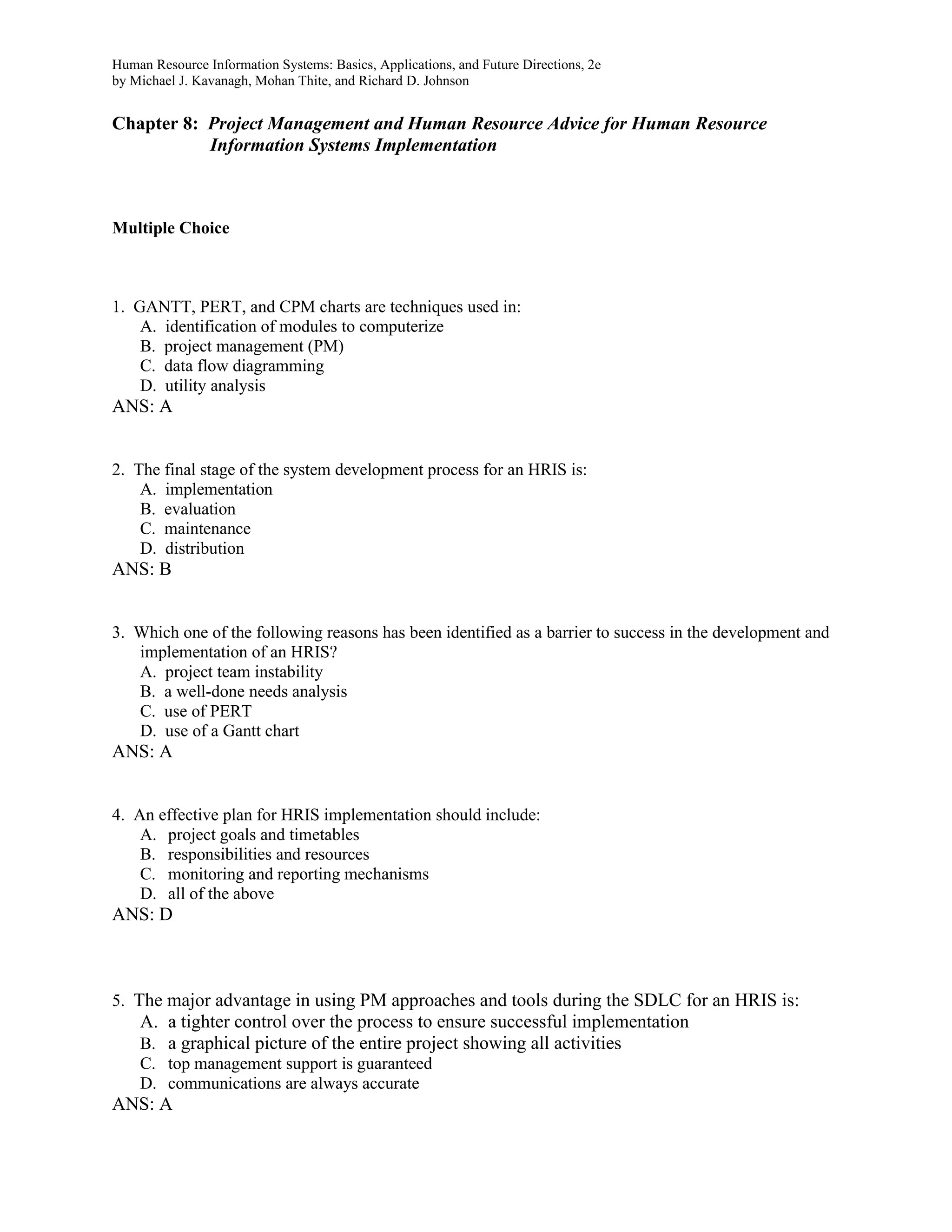
Human Resource InformationSystems: Basics, Applications, and Future Directions, 2e
by Michael J. Kavanagh, Mohan Thite, and Richard D. Johnson
Chapter 8: Project Management and Human Resource Advice for Human Resource
Information Systems Implementation
Multiple Choice
1. GANTT, PERT, and CPM charts are techniques used in:
A. identification of modules to computerize
B. project management (PM)
C. data flow diagramming
D. utility analysis
ANS: A
2. The final stage of the system development process for an HRIS is:
A. implementation
B. evaluation
C. maintenance
D. distribution
ANS: B
3. Which one of the following reasons has been identified as a barrier to success in the development and
implementation of an HRIS?
A. project team instability
B. a well-done needs analysis
C. use of PERT
D. use of a Gantt chart
ANS: A
4. An effective plan for HRIS implementation should include:
A. project goals and timetables
B. responsibilities and resources
C. monitoring and reporting mechanisms
D. all of the above
ANS: D
5. The major advantage in using PM approaches and tools during the SDLC for an HRIS is:
A. a tighter control over the process to ensure successful implementation
B. a graphical picture of the entire project showing all activities
C. top management support is guaranteed
D. communications are always accurate
ANS: A
5.
Human Resource InformationSystems: Basics, Applications, and Future Directions, 2e
by Michael J. Kavanagh, Mohan Thite, and Richard D. Johnson
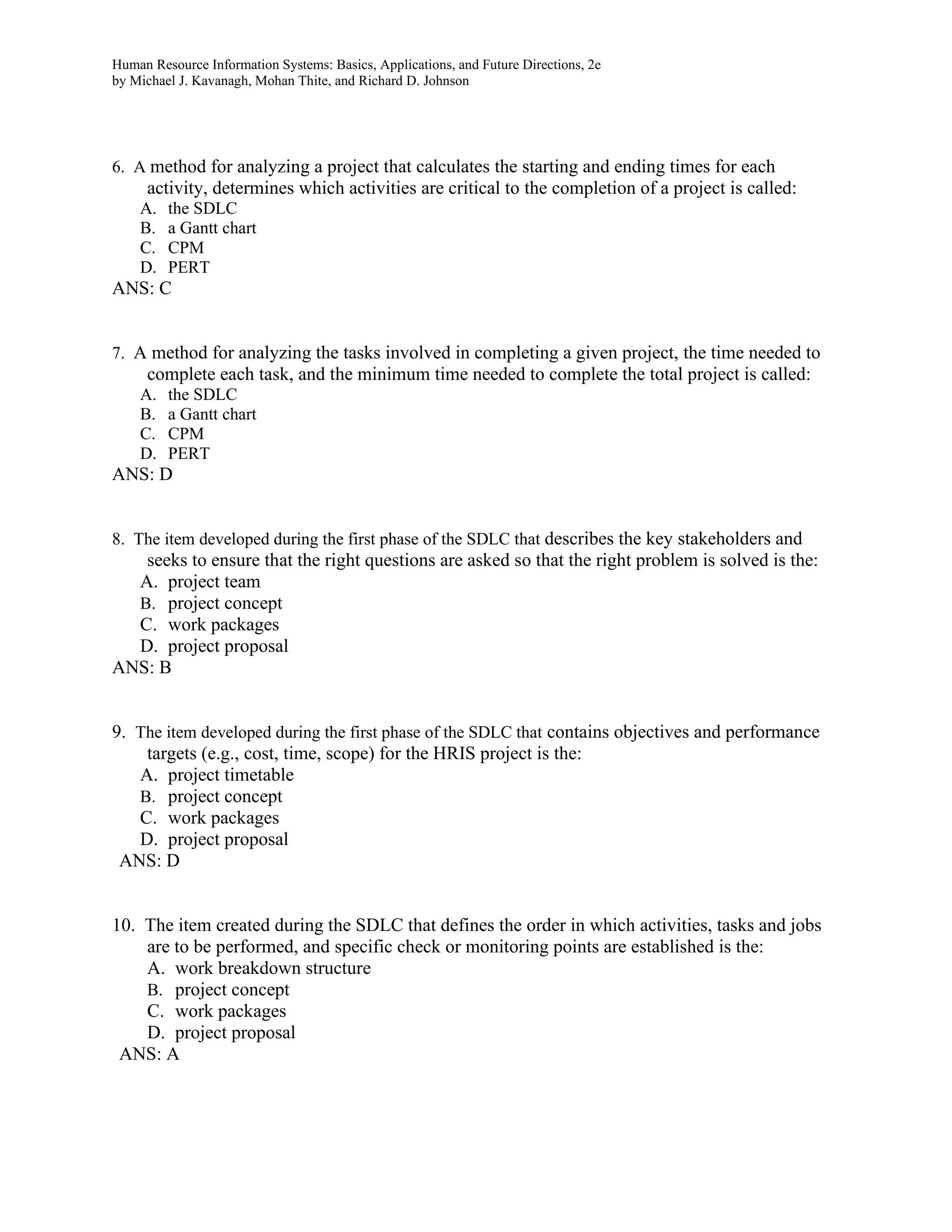
6. A method for analyzing a project that calculates the starting and ending times for each
activity, determines which activities are critical to the completion of a project is called:
A. the SDLC
B. a Gantt chart
C. CPM
D. PERT
ANS: C
7. A method for analyzing the tasks involved in completing a given project, the time needed to
complete each task, and the minimum time needed to complete the total project is called:
A. the SDLC
B. a Gantt chart
C. CPM
D. PERT
ANS: D
8. The item developed during the first phase of the SDLC that describes the key stakeholders and
seeks to ensure that the right questions are asked so that the right problem is solved is the:
A. project team
B. project concept
C. work packages
D. project proposal
ANS: B
9. The item developed during the first phase of the SDLC that contains objectives and performance
targets (e.g., cost, time, scope) for the HRIS project is the:
A. project timetable
B. project concept
C. work packages
D. project proposal
ANS: D
10. The item created during the SDLC that defines the order in which activities, tasks and jobs
are to be performed, and specific check or monitoring points are established is the:
A. work breakdown structure
B. project concept
C. work packages
D. project proposal
ANS: A
6.
Human Resource InformationSystems: Basics, Applications, and Future Directions, 2e
by Michael J. Kavanagh, Mohan Thite, and Richard D. Johnson
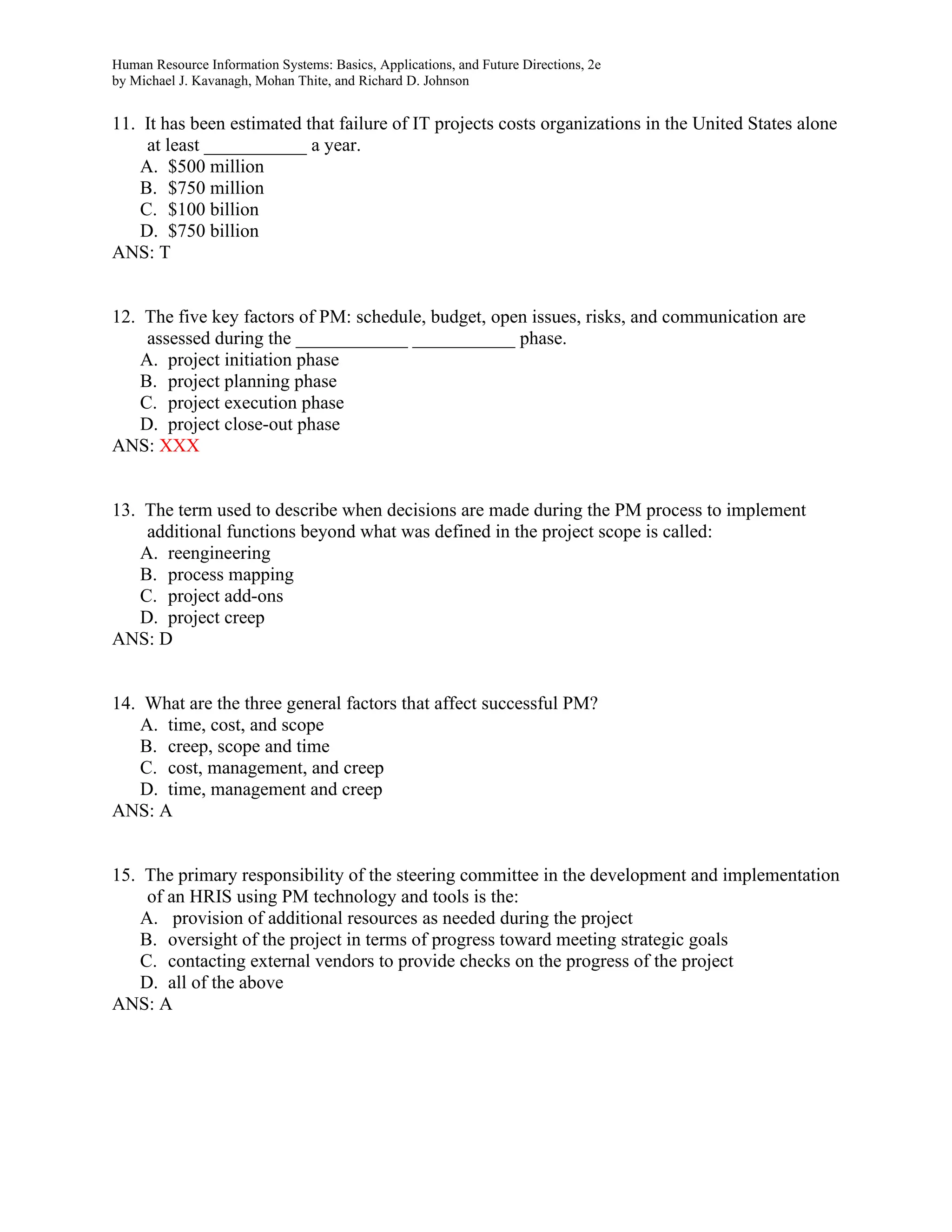
11. It has been estimated that failure of IT projects costs organizations in the United States alone
at least ___________ a year.
A. $500 million
B. $750 million
C. $100 billion
D. $750 billion
ANS: T
12. The five key factors of PM: schedule, budget, open issues, risks, and communication are
assessed during the ____________ ___________ phase.
A. project initiation phase
B. project planning phase
C. project execution phase
D. project close-out phase
ANS: XXX
13. The term used to describe when decisions are made during the PM process to implement
additional functions beyond what was defined in the project scope is called:
A. reengineering
B. process mapping
C. project add-ons
D. project creep
ANS: D
14. What are the three general factors that affect successful PM?
A. time, cost, and scope
B. creep, scope and time
C. cost, management, and creep
D. time, management and creep
ANS: A
15. The primary responsibility of the steering committee in the development and implementation
of an HRIS using PM technology and tools is the:
A. provision of additional resources as needed during the project
B. oversight of the project in terms of progress toward meeting strategic goals
C. contacting external vendors to provide checks on the progress of the project
D. all of the above
ANS: A
7.
Human Resource InformationSystems: Basics, Applications, and Future Directions, 2e
by Michael J. Kavanagh, Mohan Thite, and Richard D. Johnson
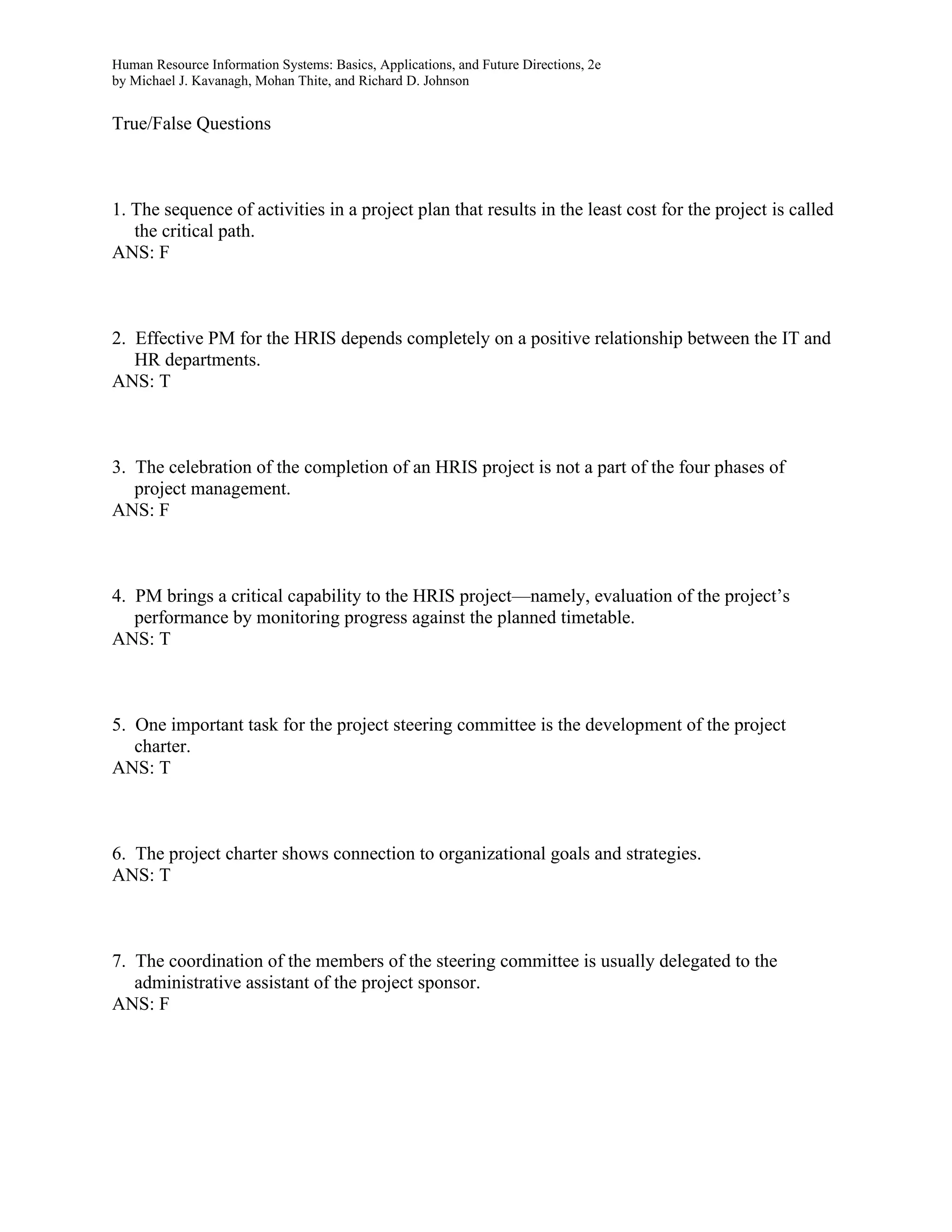
True/False Questions
1. The sequence of activities in a project plan that results in the least cost for the project is called
the critical path.
ANS: F
2. Effective PM for the HRIS depends completely on a positive relationship between the IT and
HR departments.
ANS: T
3. The celebration of the completion of an HRIS project is not a part of the four phases of
project management.
ANS: F
4. PM brings a critical capability to the HRIS project—namely, evaluation of the project’s
performance by monitoring progress against the planned timetable.
ANS: T
5. One important task for the project steering committee is the development of the project
charter.
ANS: T
6. The project charter shows connection to organizational goals and strategies.
ANS: T
7. The coordination of the members of the steering committee is usually delegated to the
administrative assistant of the project sponsor.
ANS: F
8.
Human Resource InformationSystems: Basics, Applications, and Future Directions, 2e
by Michael J. Kavanagh, Mohan Thite, and Richard D. Johnson
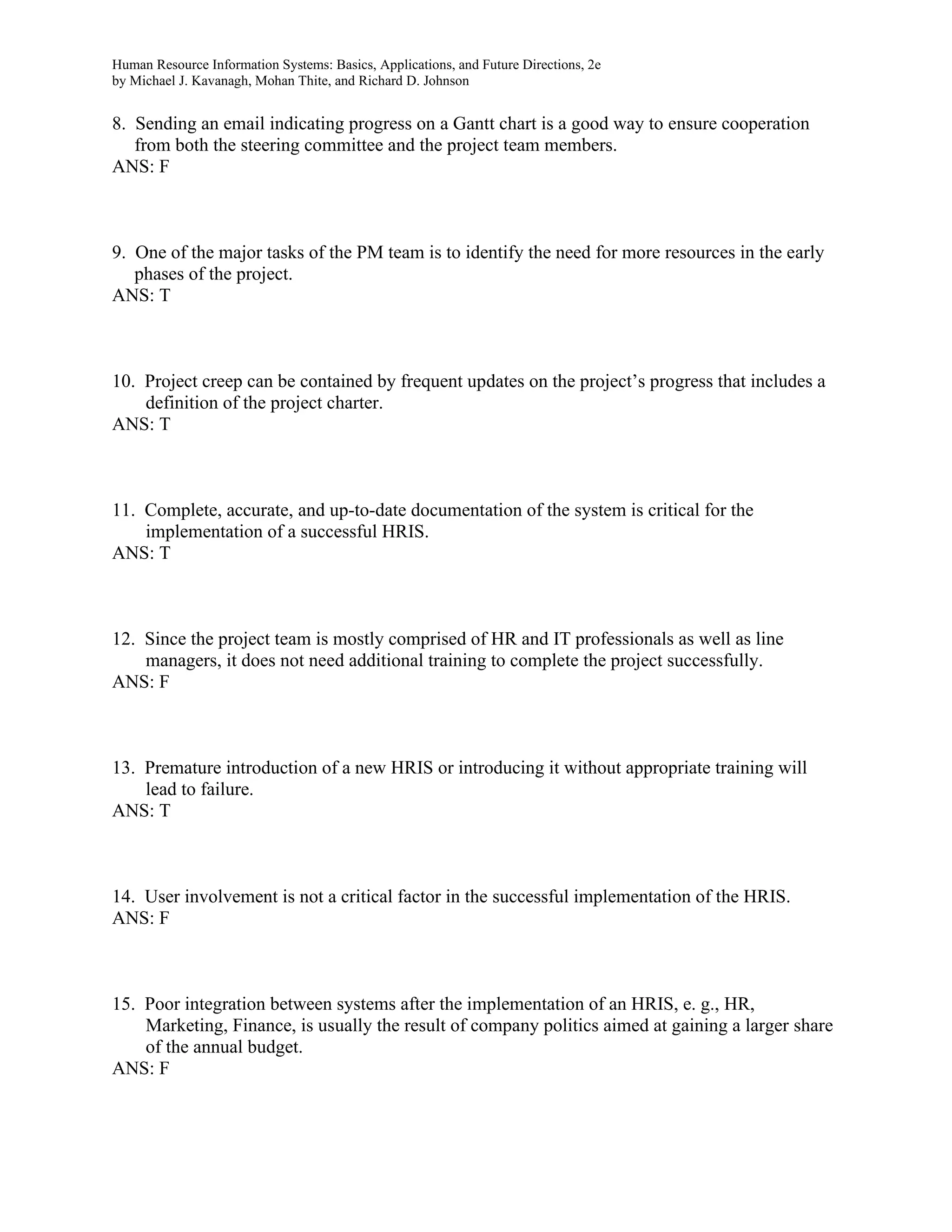
8. Sending an email indicating progress on a Gantt chart is a good way to ensure cooperation
from both the steering committee and the project team members.
ANS: F
9. One of the major tasks of the PM team is to identify the need for more resources in the early
phases of the project.
ANS: T
10. Project creep can be contained by frequent updates on the project’s progress that includes a
definition of the project charter.
ANS: T
11. Complete, accurate, and up-to-date documentation of the system is critical for the
implementation of a successful HRIS.
ANS: T
12. Since the project team is mostly comprised of HR and IT professionals as well as line
managers, it does not need additional training to complete the project successfully.
ANS: F
13. Premature introduction of a new HRIS or introducing it without appropriate training will
lead to failure.
ANS: T
14. User involvement is not a critical factor in the successful implementation of the HRIS.
ANS: F
15. Poor integration between systems after the implementation of an HRIS, e. g., HR,
Marketing, Finance, is usually the result of company politics aimed at gaining a larger share
of the annual budget.
ANS: F
9.
Human Resource InformationSystems: Basics, Applications, and Future Directions, 2e
by Michael J. Kavanagh, Mohan Thite, and Richard D. Johnson
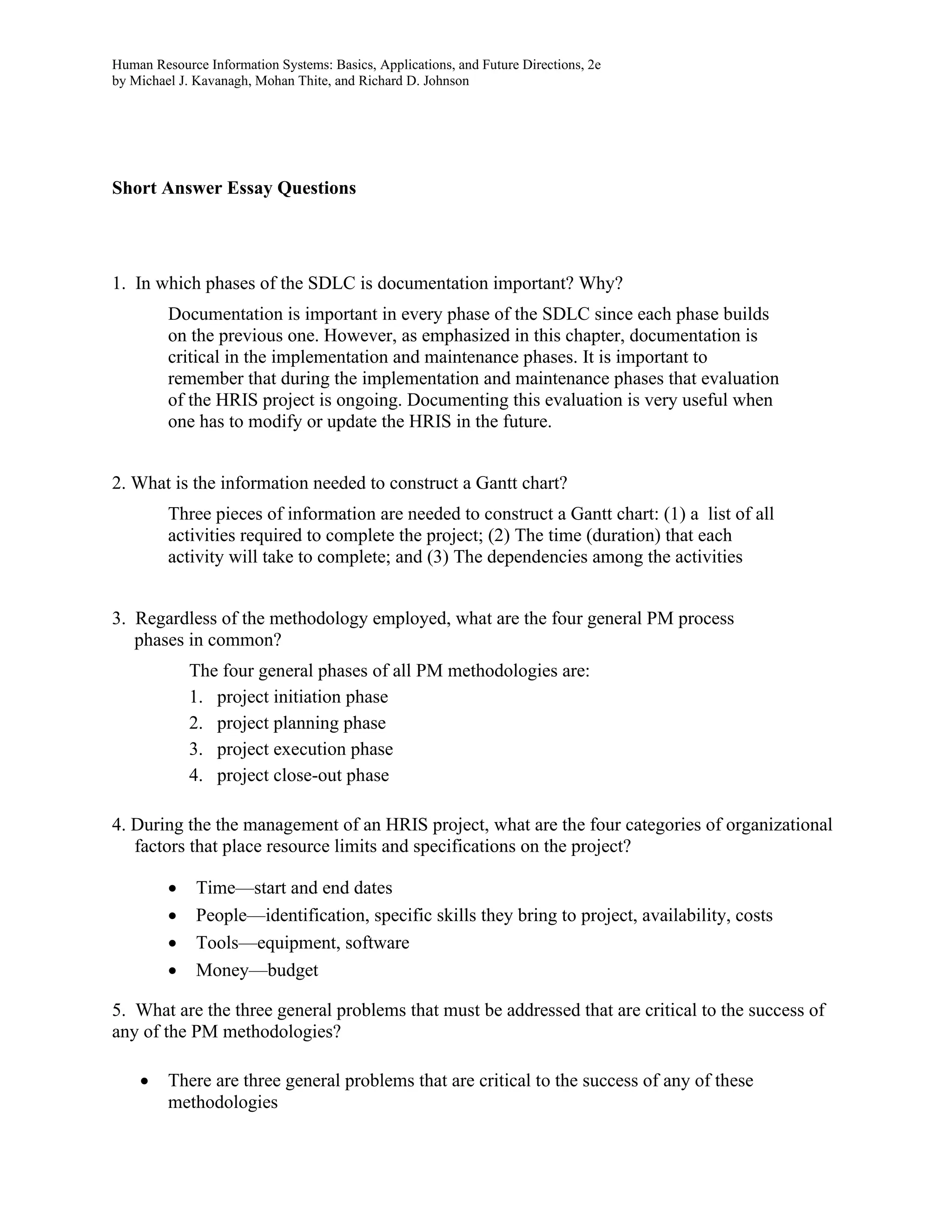
Short Answer Essay Questions
1. In which phases of the SDLC is documentation important? Why?
Documentation is important in every phase of the SDLC since each phase builds
on the previous one. However, as emphasized in this chapter, documentation is
critical in the implementation and maintenance phases. It is important to
remember that during the implementation and maintenance phases that evaluation
of the HRIS project is ongoing. Documenting this evaluation is very useful when
one has to modify or update the HRIS in the future.
2. What is the information needed to construct a Gantt chart?
Three pieces of information are needed to construct a Gantt chart: (1) a list of all
activities required to complete the project; (2) The time (duration) that each
activity will take to complete; and (3) The dependencies among the activities
3. Regardless of the methodology employed, what are the four general PM process
phases in common?
The four general phases of all PM methodologies are:
1. project initiation phase
2. project planning phase
3. project execution phase
4. project close-out phase
4. During the the management of an HRIS project, what are the four categories of organizational
factors that place resource limits and specifications on the project?
• Time—start and end dates
• People—identification, specific skills they bring to project, availability, costs
• Tools—equipment, software
• Money—budget
5. What are the three general problems that must be addressed that are critical to the success of
any of the PM methodologies?
• There are three general problems that are critical to the success of any of these
methodologies
10.
Human Resource InformationSystems: Basics, Applications, and Future Directions, 2e
by Michael J. Kavanagh, Mohan Thite, and Richard D. Johnson
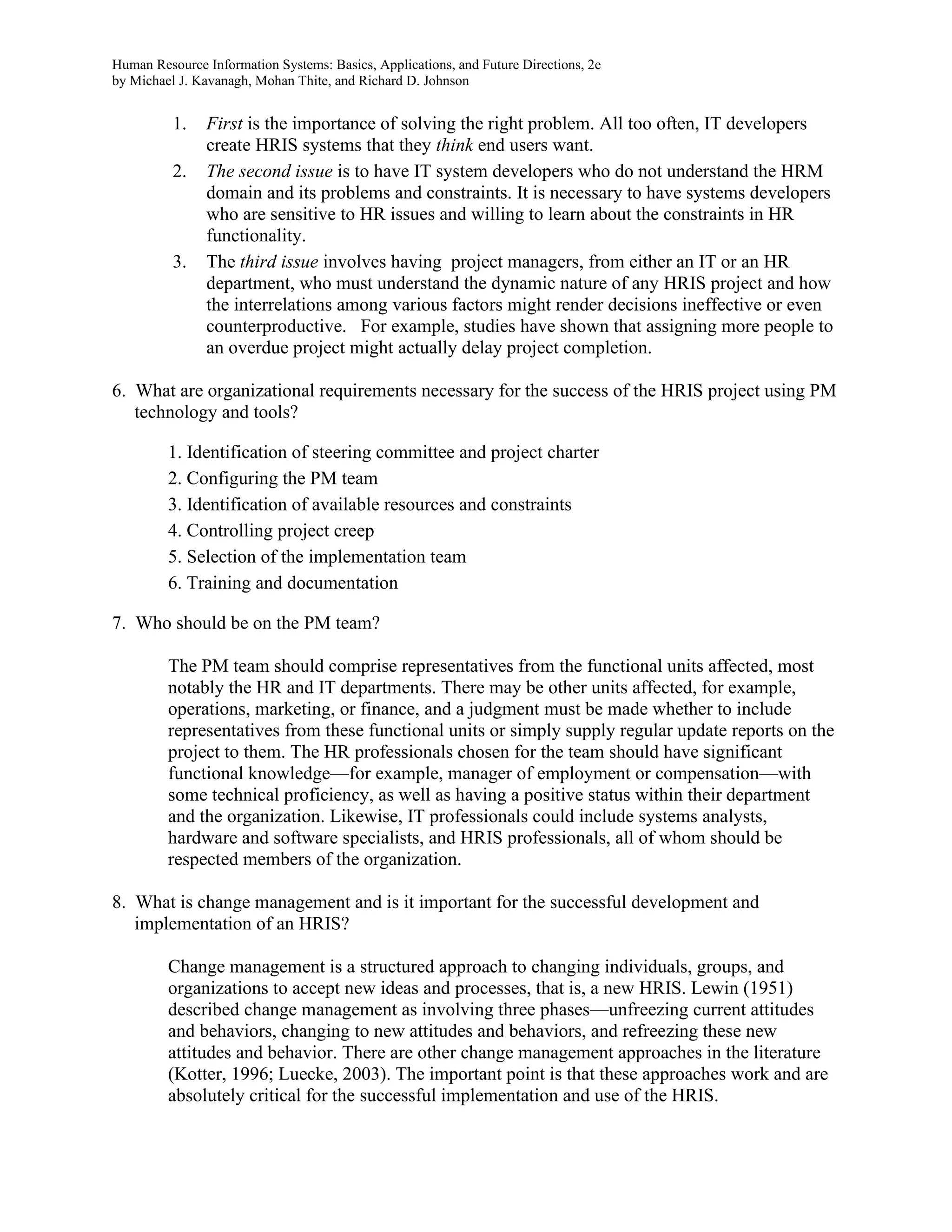
1. First is the importance of solving the right problem. All too often, IT developers
create HRIS systems that they think end users want.
2. The second issue is to have IT system developers who do not understand the HRM
domain and its problems and constraints. It is necessary to have systems developers
who are sensitive to HR issues and willing to learn about the constraints in HR
functionality.
3. The third issue involves having project managers, from either an IT or an HR
department, who must understand the dynamic nature of any HRIS project and how
the interrelations among various factors might render decisions ineffective or even
counterproductive. For example, studies have shown that assigning more people to
an overdue project might actually delay project completion.
6. What are organizational requirements necessary for the success of the HRIS project using PM
technology and tools?
1. Identification of steering committee and project charter
2. Configuring the PM team
3. Identification of available resources and constraints
4. Controlling project creep
5. Selection of the implementation team
6. Training and documentation
7. Who should be on the PM team?
The PM team should comprise representatives from the functional units affected, most
notably the HR and IT departments. There may be other units affected, for example,
operations, marketing, or finance, and a judgment must be made whether to include
representatives from these functional units or simply supply regular update reports on the
project to them. The HR professionals chosen for the team should have significant
functional knowledge—for example, manager of employment or compensation—with
some technical proficiency, as well as having a positive status within their department
and the organization. Likewise, IT professionals could include systems analysts,
hardware and software specialists, and HRIS professionals, all of whom should be
respected members of the organization.
8. What is change management and is it important for the successful development and
implementation of an HRIS?
Change management is a structured approach to changing individuals, groups, and
organizations to accept new ideas and processes, that is, a new HRIS. Lewin (1951)
described change management as involving three phases—unfreezing current attitudes
and behaviors, changing to new attitudes and behaviors, and refreezing these new
attitudes and behavior. There are other change management approaches in the literature
(Kotter, 1996; Luecke, 2003). The important point is that these approaches work and are
absolutely critical for the successful implementation and use of the HRIS.
11.
Human Resource InformationSystems: Basics, Applications, and Future Directions, 2e
by Michael J. Kavanagh, Mohan Thite, and Richard D. Johnson
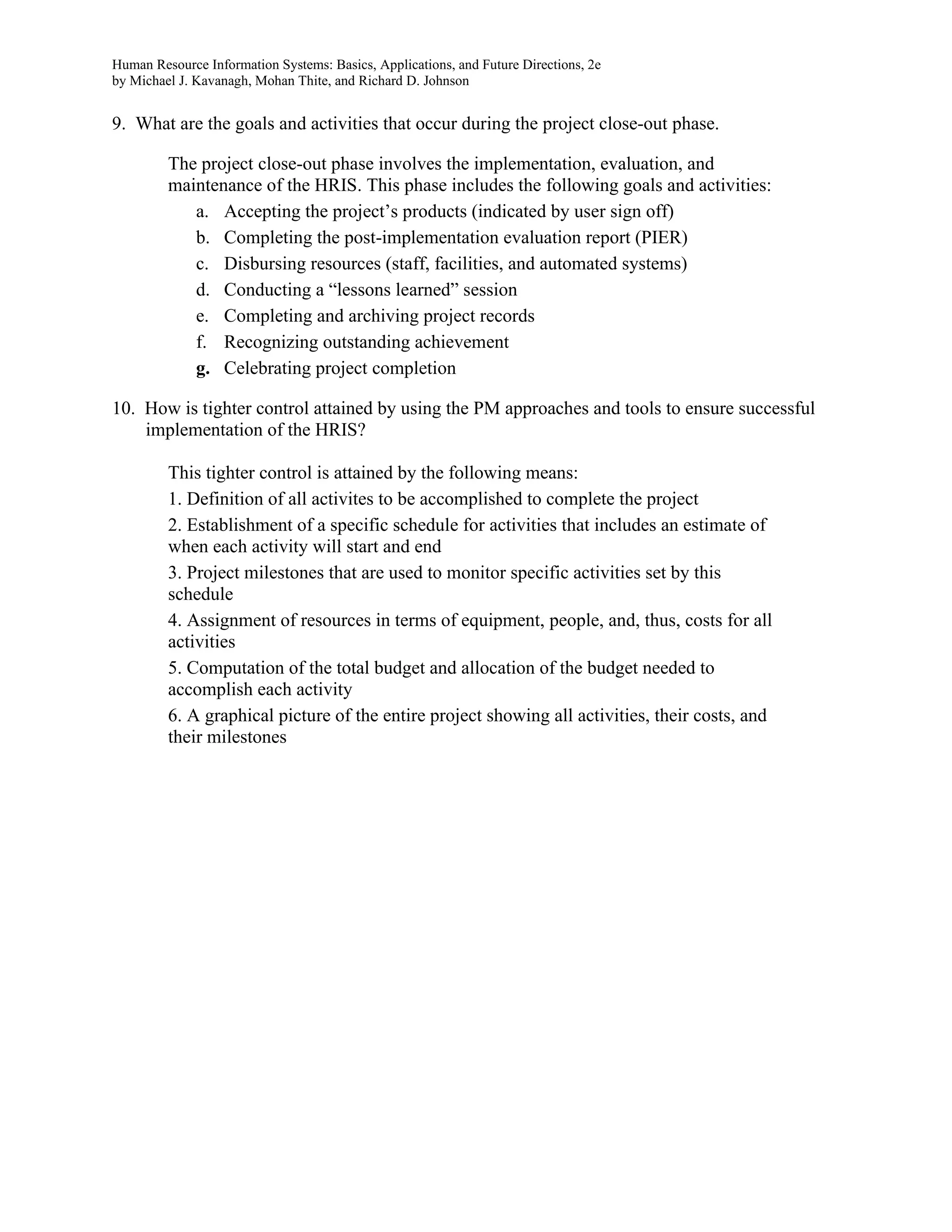
9. What are the goals and activities that occur during the project close-out phase.
The project close-out phase involves the implementation, evaluation, and
maintenance of the HRIS. This phase includes the following goals and activities:
a. Accepting the project’s products (indicated by user sign off)
b. Completing the post-implementation evaluation report (PIER)
c. Disbursing resources (staff, facilities, and automated systems)
d. Conducting a “lessons learned” session
e. Completing and archiving project records
f. Recognizing outstanding achievement
g. Celebrating project completion
10. How is tighter control attained by using the PM approaches and tools to ensure successful
implementation of the HRIS?
This tighter control is attained by the following means:
1. Definition of all activites to be accomplished to complete the project
2. Establishment of a specific schedule for activities that includes an estimate of
when each activity will start and end
3. Project milestones that are used to monitor specific activities set by this
schedule
4. Assignment of resources in terms of equipment, people, and, thus, costs for all
activities
5. Computation of the total budget and allocation of the budget needed to
accomplish each activity
6. A graphical picture of the entire project showing all activities, their costs, and
their milestones
The dress shewore, though it shrouded, it did not conceal the
proportions of her figure. The full, swelling bust and the slender
waist could be discerned; nor were her robes so sweeping but that a
fairy foot might have been discovered peeping from beneath them. A
glittering veil had been thrown carelessly over her luxuriant auburn
curls, but this she had put back with her delicate hand, and, as her
cheek rested on that dimpled hand, she seemed too bright a thing to
be profaned by the touch of sorrow; grief should have found a less
transcendent temple in which to spread its sombre mantle.
“What is left me now,” she whispered to herself, as if pursuing a
train of thought, “but to die, or, within the gloomy walls of a cloister,
to endeavor to forget this world by offering myself up a sacrifice to
heaven.”
“Not so, my child,” an unexpected voice observed, as a stately
female stepped from the shade, and seated herself beside Camilla;
“Heaven needs not such a sacrifice at thy hands, or at mine.”
“My mother!” exclaimed the lair girl, “I knew not thou wert
present,” and bending her head to the parental bosom, she gave
vent to her feelings in stifled sobs.
“Fie, Camilla!” the mother said, as she passed her hand
affectionately over the glossy ringlets, “this is unworthy of thy race.
Thou art a Donati, my child, and should have more iron in thy nature
than to bend, like a willow-wand, before every storm; besides, all is
not lost yet; Buondlemonte may still be thy husband.”
“Never!” replied Camilla; “I would not have it so now. Within
three days he weds Francesca Amedi.”
“Not if I can prevent it!” exclaimed the elder lady. “He shall not
sully his nobleness, or add to the o’ergrown pride of that arrogant
house by mating with the haughty Francesca. This night—this hour—
he hies hither to harken to my counsels; and if I have power to
move him, he leaves not this palace till he is thy plighted husband.”
Camilla knelt at her mother’s feet, and clasping her hands, she
turned her tearful eyes to that mother’s face.
14.
“In mercy, spareme!” she said; “I would not wed an unwilling
lord—I would not do a wrong even to a member of the house of
Amedi.”
“Thou art a foolish child,” her mother replied; “thou shalt neither
wed a reluctant lord, nor do a wrong to living soul. If wrong there be
in aught I counsel, it rests with me, and I fear not to brave the
consequences.”
Camilla was about to speak, but her mother interrupted her.
“I tell thee, timid flutterer,” she said, “Buondlemonte loves thee. I
know him, even as if he were my own child—he loves thee, and thee
alone. An ancient compact, wrung from the weakness of his father,
is all that binds him to Francesca Amedi. Between them there is no
shadow of affection. Her swollen pride is not akin to tenderness, and
he could not love a being whose nature, like hers, is fierce,
revengeful and fiend-like.”
Again Camilla was about to interpose, but her mother stopped
her.
“Hear me out,” she said. “Buondlemonte’s interest and
inclination, as well as ours, require that he should abandon all
thoughts of that unholy union, and take thee to wife. In all, save
hypocritical appearances, the Amedi are his enemies—enemies in
religion, enemies in disposition. He is frank, open, generous and
noble; and they are cold, selfish, subtle and malignant. His faith is
pure, and, like us, he sustains the cause of our holy church; while
they are Ghibellines—little better than schismatics—and in their
hearts detest all who think not with them. If ’twere not a virtue to
humble the pride of this presumptuous family, it would at least be a
charity to preserve the peace of the noble youth, by disconcerting so
ill-assorted a match.”
Once more Camilla attempted to be heard, but again she was
interrupted.
“I will hear no reply,” her mother said: “I cannot be moved by
arguments from the course I intend to pursue. Thou knowest me
tender and indulgent, but at the same time resolute and determined.
15.
Thy happiness andhis demand the policy I adopt; let me not hear
thee therefore murmur against it. I go now,” she observed, rising
from her seat, “to meet him I would make thy husband: bide thou
here till my return.”
As she concluded she left the apartment.
Camilla, at the thought of meeting Buondlemonte, and the
circumstances, instinctively drew her veil over her burning cheeks.
“It is not I, Francesca,” she murmured, “who plots against thy
peace; it is not I, Buondlemonte, who seeks to make thee swerve
from thy knightly faith!”
For the space of half an hour Camilla Donati remained in a state
of timorous apprehension and painful thought; at the expiration of
that period, however, the door of the apartment she occupied again
opened, and her mother re-entered. This time she was not alone—
Buondlemonte was with her. His handsome countenance was flushed
with excitement; the color mantled in his cheeks, and an unusual
lustre danced in his bright eyes.
No sooner did his gaze rest on the maiden’s form than he rushed
forward, and, bending his knee before her, took her unresisting hand
and pressed it again and again to his lips.
“Dearest Camilla!” he exclaimed, in a whispered voice, “even thus
have I dreamed of thee in my wanderings! even thus have I knelt
before thee, and, unrebuked by a reproachful look, pressed thy
gentle hand.”
The elder lady approached her daughter, and raising the veil
which concealed her beautiful features she addressed
Buondlemonte.
“This,” she said, as Buondlemonte’s ravished sight wandered
from the flushing cheeks to the closed lids and trembling lips, “this is
the bride I had reserved for thee. From childhood she has loved
thee, and loves thee still.”
Buondlemonte’s enraptured exclamations prevented Camilla’s
piteous appeal to her mother from being heard.
16.
“From childhood shehas been the star I have worshiped,” he
replied, and rising to a seat beside her, his arm encircled her delicate
waist. “None other,” he exclaimed with enthusiasm, as his eyes
devoured the unfolding beauties which momentarily developed
themselves, “none other shall claim the bride who has been reserved
for me. If she will accept the homage of a heart that is all her own,
my wedded wife she shall be before two suns have gilded the
eastern sky.”
The burning blushes were on Camilla’s cheeks, and the tears
gushed from her eyes, but her breath came quick and her heart
throbbed strangely.
“Speak, dearest Camilla!” Buondlemonte whispered; “let me
know from thy own lips that my passion is not unrequited—say that
thou lovest me!”
“Oh, Buondlemonte!” Camilla articulated, in a low voice, “think of
Francesca—think of her family.”
“To wed her would be a union on which nor heaven nor earth
could smile,” he replied. “Dearest Camilla, Francesca loves me not,
and I do not love her; her family are my aversion—there is no
kindred, no sympathy between us. This night, if thou dost love me
still, this night I will revoke the ill-advised bond that linked my
destiny with Francesca Amedi’s, and to-morrow’s night shall see us
happily wedded.”
Small blame was it to Camilla that she yielded to the entreaties,
nay, the commands of her mother, and the moving solicitations of
her lover. Her heart, too, was an advocate against herself. For some
time she resisted the persuasive music which was poured into her
ear, but at length she breathed in whispered accents the words that
united her fate to Buondlemonte’s.
The rest of the evening, to the lovers, passed like the brief
existence of a moment; yet its lapse had afforded an eternity of
happiness. It had given birth to a world of pleasant recollections.
Ere he slept that night, Buondlemonte dispatched his friend
Guiseppo Leoni to Jacopa Amedi, to inform him of the step he had
17.
taken. Disclaiming allintention to offend, he pleaded his early
passion in palliation of his apparent fickleness, and alleged that the
uncongeniality between Francesca and himself could be prolific of
naught but discord and unhappiness.
——
18.
CHAPTER VI.
The dawnof the morrow found the Amedi family awake and
stirring; and every member of it breathing deep and terrible
vengeance against the faithless Buondlemonte. Late as it was when
Guiseppo Leoni delivered the unpleasant communication of which he
was the bearer, messengers had been dispatched to all the relatives
of the house, to summon them to a council, which was fixed to meet
at an early hour in the morning.
When Francesca Amedi learned what had happened her towering
form grew more erect, her dark eyes flashed forth unutterable
thoughts, and, as she grasped tightly the jeweled dagger that hung
from her girdle, she muttered between her set teeth —
“He would not learn how deeply I could have loved, but he shall
feel—he and his puny minion—how bitterly I can hate, and how
fearfully I can avenge!”
“He is not married yet,” her brother menacingly observed.
“The saints be praised for that,” she replied; “There shall be more
guests at the wedding than are bidden.”
She retired to her own apartment, and after a long interview with
her principal attendant she gave directions that no one should be
admitted to see her, and that no summons, from any source, should
be communicated to her.
——
19.
CHAPTER VII.
The councilhad assembled at the Amedi palace. In a spacious
apartment a crowd of men sat together. There were dark frowns
upon their countenances, and, at intervals, angry exclamations
escaped from their lips, as the cause of their convocation was dwelt
upon with malignant emphasis and vehement declamation by Jacopa
Amedi.
“What,” he asked, after having recapitulated the facts, “should be
the fate of him, who, casting aside the honor of knighthood and
manhood, violates his plighted word, showers disgraceful contumely
upon our house, and offers deadliest insult to Amedi’s daughter?”
“Death!” replied a solitary voice, as the door of the apartment
opened, and a stranger stood at the threshold.
The eyes of all were turned with wonder in the direction from
which the voice proceeded. No one present appeared to know the
stranger.
The intruder gazed around unrebuked by the inquiring looks that
were bent upon him, and as his eye met the speaker’s, he repeated
the ominous word which had startled the assembled group.
He was a youth of fine appearance; slight in form, but of a lofty
bearing, with a handsome countenance, and full, large, searching,
dark eyes. His dress was of sable velvet. Upon his head he wore a
cap, surmounted with two black plumes, and at his side there hung
a sombre-cased rapier, the hilt of which glittered with diamonds.
“Death!” he repeated, as he glanced deliberately from one
individual to another, “death should be the doom of him who,
traitorous to love and false to honor, pays back the affection of a
betrothed wife with withering scorn, and upon the dignity of a noble
house tramples with profane and sacrilegious tread!”
Jacopa Amedi advanced from the position he had occupied, and
confronted the new comer.
20.
“Whoe’er thou art,sir stranger,” he said, “thou hast mistaken the
place for thy reception. This is a meeting only of the relatives of our
house—thou canst not claim kindred with the Amedi.”
“I am,” the youth replied, “of noble birth—a Ghibelline—a friend
to thy family and cause, and an enemy—a deadly enemy—to
Buondlemonte and the Donati. Thy wrongs are the wrongs of all
who hate the Guelphs, and affect every noble in the land. Me they
have united to thee by an indissoluble bond, and I proclaim again
that death—death unannounced—should be the fate launched at the
treacherous Buondlemonte!”
There was a wild energy in the stranger’s voice, and as he spoke,
his dark eyes gleamed with demoniacal fire.
“For thy noble sympathy thou art entitled to our thanks, and hast
them,” Jacopa Amedi observed, in reply; “but still we must entreat
thy absence; a stranger may not be admitted to our counsels.”
“Not though he tenders thy honor as dearly as though he were
himself an Amedi?” the young man asked hurriedly.
Jacopa bowed a negative.
“My name may change thy thought,” the youth remarked, as he
approached Jacopa, and, as the latter inclined his ear, whispered a
single sentence to him.
Jacopa Amedi started back in amazement, and gazed for a
moment as if he had been paralyzed.
“Thou! thou!” he exclaimed, as a grim smile settled upon his
features.
The stranger placed his gloved finger upon his lip to advise
caution; and Jacopa, warned by the signal, restrained the
expressions to which he had been about to give utterance.
“This,” he said, as he took the other’s hand and led him forward,
while a gloomy frown supplanted the smile upon his own
countenance, “this is as it should be; there is nobility enough in the
act to make thee a worthy partaker in our deliberations.”
21.
Saying this, hemade a place for him among the rest, and
vouched to the company for his right to be present.
The consultation was continued, but Jacopa Amedi ceased to
take the lead in it. The stranger, as if by magic, exerted a controlless
influence over every one. He spoke, and all listened with breathless
attention to his lava-like words. He proposed and his suggestions
were adopted without a dissenting voice. He named himself the
leader of an enterprise in contemplation, and he was selected by
acclamation.
“Who,” he asked, after an hour had been spent in consultation,
“is informed of the period when this faithless lord leads his dainty
bride to the altar?”
“I have taken care to learn that,” Baptista Amedi replied. “An
hour after vespers the priest pronounces the marriage sacrament in
the chapel of the palace.”
“Then at vespers,” the stranger said, as he rose from his place,
“meet me here again, prepared as we have agreed; till then let us
teach ourselves discretion.”
——
22.
CHAPTER VIII.
The hourof vespers had passed, and Camilla Donati sat alone
with Buondlemonte. She was attired for the altar, and in her bridal
robes outrivaled e’en her own loveliness. Yet she was sad with all
her beauty, and amidst all the aids to happiness that surrounded her.
A cloud shaded her fair brow, and the rosy lips sought in vain to
wreath themselves in smiles.
“Thou art grave, dear Camilla!” Buondlemonte said, speaking in a
subdued tone; “dost thou repent thy promise to be mine?”
She turned her beautiful eyes, liquid with tenderness and trusting
affection, to his, and placed her snowy hand lightly upon his
shoulder,
“Dost thou think it?” she asked.
“Forgive me!” he replied; “I only meant to banish thy sad
thoughts, and make thee gay.”
“I should be happy,” she said, as his arm stole round her waist,
“but yet I cannot feel so. Thy form is ever in my thought, and bliss
smiles at thy side, yet when I seek to clasp it in my embrace, a dark
phantom interposes, and with a hollow laugh, mocks my baffled
purpose. In the air there is a murmuring dirge, and thy voice swells
with sepulchral sound. I cannot feel happy,” she said; “an icy
coldness settles round my heart.”
“Let love,” he replied, “banish it from thence. Thou shall not yield
thy soul up to sickly fancies. ’Tis part of mine, dear Camilla, and
must take its hue from the cheerful coloring of its other half. Thy
fears for my safety have faded the rose-tint from thy cheeks, but
within an hour—when the holy father has performed the sacred rite,
and thou art mine own—thou wilt smile at the fantastic thoughts
that now make thee look so grave.”
“Would that the rite were over, and safely so!” Camilla fervently
whispered, as she turned aside her blushing face.
23.
The wish seemeduttered only to be answered, for at that
moment her mother entered the apartment to summon the couple
to the chapel.
“The priest is at the altar,” she said, “and the guests await the
presence of the bridegroom and his bride.”
Buondlemonte rose, and supporting Camilla on his arm, passed
into an adjoining room, where Guiseppo Leoni and the maidens who
were to officiate as bridemaids, were assembled.
The wedding-party passed from the palace to the chapel. The
lamps were all lighted, and beneath the arched roof a gay crowd
was collected. Jewels glittered, rich silks rustled, lofty plumes waved,
and happy smiles circulated on every side.
When Camilla and Buondlemonte appeared, the crowd fell back,
and opened a passage for them to the altar, where for a moment
they stood—the admiration of every beholder—till the ceremony
should commence.
The holy man commenced the marriage-service, and propounded
to the parties concerned, the questions which the church directs
shall be put on such occasions. Those addressed to Camilla were
answered in a low, musical voice, while Buondlemonte made his
responses boldly and with pride.
The ceremony was over—they were man and wife. A happy smile
already diffused itself over the countenance of the bride, and the
priest raised his hand to pronounce the benediction; but he spoke
not. His attention was arrested by voices elevated in anger, and
sounds of rude strife at the entrance of the chapel.
All turned to inquire the cause of this interruption, and as they
did so, the huge doors were forced back upon their hinges, and a
band of armed men, with weapons bared, rushed up the tesselated
aisle toward the altar. At their head was the youthful stranger who
had appeared that morning at the Amedi palace. In his hand
gleamed a naked poignard; his plumed cap had fallen from his head,
and upon his shoulders there fell a luxuriant mass of long, dark hair.
His eyes were bloodshot, and his voice sounded hoarse and
24.
unnatural as hecalled upon those who came after, to follow him.
Casting with desperate strength all impediments aside, he paused
not in his course until he stood fronting Buondlemonte.
The latter had drawn his sword, but Camilla Donati threw herself
impulsively before him to shelter his person with her own; the
stranger took advantage of the act of devotion, and burying his
poignard up to the hilt in Buondlemonte’s body, he exclaimed,
“Die, traitor! even in thy act of treachery!”
The unfortunate young nobleman fell to the ground weltering in
his own blood; and Camilla, with a shriek of heart-piercing agony,
sunk fainting and prostrate upon his body.
The stranger gazed for an instant at the harrowing sight before
him, then bent his knee beside Buondlemonte, and said, in a voice
which already was touched with remorse,
“Buondlemonte, thou hast grievously wronged Francesca Amedi,
and she has been her own avenger!”
The dying noble turned an inquiring glance upon the speaker,
and with difficulty recognized the person of Francesca in the
habiliments of the stranger.
“Thou art indeed avenged,” he murmured, in a weak voice, as he
endeavored to embrace his fainting bride.
“Thou hadst canceled my hopes of happiness,” she said, as she
rose to her feet, “and I have put the seal to the act by destroying
thine!”
With a solemn step she stalked from the chapel, protected by
those who had supported her; while Buondlemonte, after breathing
a prayer to Heaven for Camilla’s peace, resigned his soul into the
hands of its author.
It would be too melancholy a task to detail the particulars that
followed this unhappy bridal. A few words will be sufficient to explain
all that is necessary.
Camilla Donati, after many months, recovered from the fearful
shock she had received in seeing her lover slain; but this world had
25.
ceased to delighther. She entered a convent, and in the course of
time became its abbess. Francesca Amedi had accomplished her
vengeance, but with its accomplishment she had ensured her own
misery. With the vulture, remorse, ever preying upon her heart, she
knew but one wish, and that was for death, while she lacked the
power to terminate her own existence and solve the problem of
eternity. After a vain effort to secure forgetfulness by mingling in
society, she, too, retired from the world, and within the walls of the
same convent over which Camilla Donati presided, she became a
nun.
The death of Buondlemonte added virulence to the wars of the
Guelphs and Ghibellines; and many generations passed away before
the families of Amedi and Donati became reconciled.
26.
A SUNBEAM.
———
BY ALBERTM. NOYES.
———
A sunbeam flashed from its azure throne,
O’er the bright and the beautiful earth to roam;
And it left a plume from its glist’ning wings
Where’er it traced its wanderings.
It tipped the bough of an old oak tree
With its joyous ray, and in their glee
A myriad host that were slumb’ring there
Came glancing forth in the morning air.
Then off like a flash it sped away,
And next it touched with a diamond ray
A lofty spire, as it rose upon high,
Till it looked like a star in an azure sky.
Again it flew, and this joyous beam
Flashed o’er the breast of a rippling stream;
And a bridge of trembling light it gave
To the sparkling crests of the dimpled wave.
I mused awhile—and lo! I heard
The joyous song of a bright-winged bird;
It had caught the flash of that morning ray
As it sped to its bower of love away.
27.
And bathed ina flood of golden light
It looked like a rainbow spirit bright,
By an angel hand sent down to unfurl
The banner of peace to a sinful world.
And a thousand voices rose on high,
As its gliding form flew swiftly by;
Each bright and beautiful thing of earth
Awoke to hail its heavenly birth.
Sweet beam, said I, oh! how I’d love,
Like thee, the bright green earth to rove;
To shine o’er the hearts of pale despair
And kindle a glow of rapture there.
Just then, a darkling cloud flew by,
And shadowed the face of the azure sky;
I looked for this beautiful child of the dawn
But its glory had faded, its brightness had gone!
And I thought how much like Life did seem
The fate of this bright yet transient beam;
In glory it rose with the morn’s first breath,
At eve it was shadowed in darkness and death.
28.
LONG AGO.
Long agoa blue-eyed cherub
In my arms
Softly lay and sweetly smiled—
Spotless, holy, undefiled—
And my troubled heart beguiled
With its charms.
Long ago, on angel’s pinion,
To my breast
Came a gentle, timid dove—
Stole the treasure of my love—
Upward soared, no more to rove
From its nest.
Long ago my seraph maiden
Took her flight
From a dreary, darkling world—
She her radiant wings unfurled,
And the heavenly gates of pearl
Shut my sight.
Long ago the angel reaper
Cruel sore
Gave my heart its keenest blow,
Made my tears of anguish flow,
Bid me onward weeping go—
Evermore.
29.
Long ago thefair world faded
In mine eyes,
And I burn to clasp that child.
With a love more fondly wild
Than when first she sweetly smiled
From the skies.
Long ago one lock I severed
From her brow,
And that sunny little tress
In its shining loveliness—
To my heart I fondly press
Ever now.
In my dreams I meet the maiden—
Passing fair
Far beyond the frost and snow
Doth my lovely flow’ret blow—
And my tears no longer flow
For her there.
E. H.
30.
THE TWO WORLDS.
———
BYHENRY B. HIRST.
———
Like the contented peasant of the vale,
Dreams it the world and never looks beyond.
Lowell.
There was an humble village lad
Who thought the round, revolving world,
Mountains and plains and streams and skies,
Lay in the compass of his eyes.
The symphonies of the leafy woods,
The melodies of the murmuring brooks,
Mingling—like light, or songs of spheres —
Contented his untutored ears.
Confined between gigantic hills,
The little hamlet, where he dwell,
Never imagined land more blest
Than that where it had made its nest.
And so our simple village boy,
With thoughtless urchins like himself,
Chatting with brooks and birds and flowers,
Ran swiftly through his childish hours.
31.
But manhood, likea shadow, rose
And stood before his growing eyes —
With aspirations, such as start
To being in the ambitious heart.
Somehow—he knew not whence it came —
The fancy of a nobler world
Than that in which his soul now pined,
Trembled, like moonlight, on his mind.
Habit, however, made his home
So very dear; he sadly threw
The thought aside, and, turning back,
Pursued his old accustomed track.
Nevertheless, the glowing dream
Followed his steps with pleading eyes,
Filling his heart, wherever he went,
With unaccustomed discontent.
But one day hunting in the hills
He saw a chamois mount a peak,
Which seemed—its summit was so high —
To melt and mingle with the sky.
Urged by the instinct of the chase,
He slowly crept from crag to crag
Until he reached the dizzy height
Where last the chamois met his sight.
Before him, in the morning sun,
Stretching away from sky to sky,
Brighter than even his soul had dreamed.
His other world before him gleamed.
32.
Behind him laythe little vale
Where he had spent his youthful hours;
There was the cottage where he dwelt —
The shrine at which he always knelt.
And over-shadowing the brook,
He saw the weeping-willow stand,
Where, but the night before, he met
His loving, lovely young Florette.
But fairer than his maiden love,
And lovelier than his native glen,
Inviting him with novel charms,
His fairy world held out its arms.
The Old yields always to the New,
And so the youth with just such steps
As one would run to meet a bride,
Ran lightly down the mountain side.
Day after day, year after year,
He wandered in his golden world:
A shadow-hunter he became: —
The Shadow which he sought was Fame.
But Age, who walks on velvet feet,
Followed his footsteps like a wolf,
And when the fame he sought was won,
He only saw the setting sun.
Cold as his native granite rocks,
And hard, had grown the wanderer’s heart:
For many weary, desolate years
His eyes had lost the power of tears.
33.
The name hisgenius had acquired,
The wealth which Fortune had bestowed,
Instead of pleasure gave him pain:
Sadness was in his heart and brain.
The great are friendless: he was great:
His very fortune hedged him round
And shut him from the love of all;
He could not leap the lofty wall.
But somehow, like an angel’s tear,
The memory of his early home
Fell on his heart: he saw the glen
He loved so in his youth again.
A wan and worn and wrinkled man
He stood upon his native hills:
There was each old familiar spot;
There stood his silent shepherd cot.
Downward with trembling, painful steps
The wanderer took his lonely way:
Like one who wakens from a dream
He stood beside the mournful stream.
Above him, in a green old age,
He saw a weeping-willow trail
Its murmuring leaves; and at its foot
A single rose had taken root.
It grew upon a grassy mound,
At head of which a rustic cross
Pointed to heaven;—there last he met —
There last he clasped the fair Florette.
34.
The old man’seyes were full of tears,
As, like a penitent child, he knelt
And sobbed and prayed in pale despair:
Next day a maiden found him there.
The hillock where reposed his form
Was circled by his feeble arms:
Pale, pitying Death his seal had set
On love, and laid him with Florette.
35.
A RECEPTION MORNING:
ORPEOPLE IN GLASS HOUSES, ETC.
———
BY F. E. F., AUTHOR OF “A MARRIAGE OF CONVENIENCE,” ETC.
———
Je m’oublie,
Tu t’oublies,
Il ou elle s’oublis, etc.
Verb S’oublier.
“Why were you not at Elliot’s last night, Mrs. Fortesque?” asked
Mrs. Lyman.
“We do not visit,” replied Mrs. Fortesque, with a slight shade of
mortification.
“Not visit!” repeated her friend in an accent of surprise, and
fixing her eyes as she spoke with a prolonged look of astonishment
that caused Mrs. Fortesque to color. “Is it possible! It was an elegant
party—very select—the handsomest I have been at this winter.
Indeed, the party of the season.”
“It could scarcely surpass Rawley’s,” said Mrs. Fortesque with
smothered indignation. “I am sure there was nothing spared there,
and their house is larger than Elliot’s.”
“Yes. But it was such a jam at Rawley’s,” replied Mrs. Lyman, in
the tone of one oppressed even by the recollection of the crowd
—“and such a mêlée—all sorts of people! This paying off debts in
this way is, in my opinion, very vulgar. Now at Elliot’s it was so
different. Just every body you would wish to meet and no more.
Room to see and be seen—and the ladies so beautifully dressed—no
crowd—every thing elegant and recherché.”
“The dressing at Rawley’s was as elegant as possible,” remarked
Mrs. Fortesque, evidently piqued that the party she had just been