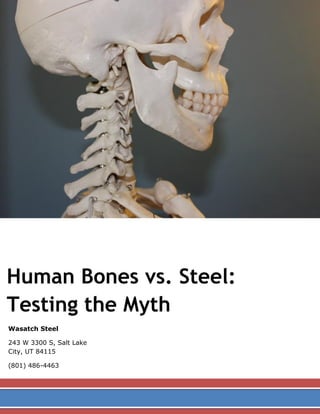
Human Bones vs. Steel:
Testing the Myth
Wasatch Steel
243 W 3300 S, Salt Lake
City, UT 84115
(801) 486-4463
When something is made of steel, it gives off a sense of indestructibility. It’s the main
reason most infantries in open battle scramble for cover when an enemy tank approaches.
Steel’s strength is without question in today’s society—if it’s not as strong as we know it,
monuments like the Eiffel Tower wouldn’t be built, or skyscrapers wouldn’t use steel support
beams to prop them up.
Still, not a lot of people know of something that can beat steel in terms of strength, pound
for pound. And one can’t really blame them, since that rival to steel is none other than
human bone.
Pound For Pound: Steel
First up, testing steel. On its own, it’s quite strong, and at times, words don’t even do it
justice. Steel’s wind resistance is nothing short of excellent. If a building is using steel for its
framework, it can withstand winds up to 170 mph. In context, winds of that strength can be
found in an F5 hurricane, which is literally the strongest, most catastrophic hurricane
possible.
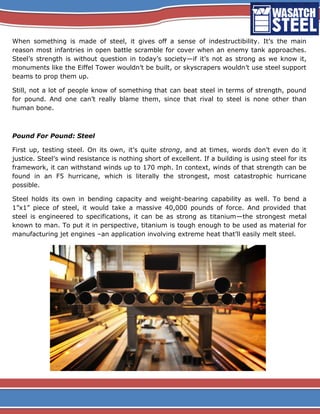
Steel holds its own in bending capacity and weight-bearing capability as well. To bend a
1”x1” piece of steel, it would take a massive 40,000 pounds of force. And provided that
steel is engineered to specifications, it can be as strong as titanium—the strongest metal
known to man. To put it in perspective, titanium is tough enough to be used as material for
manufacturing jet engines –an application involving extreme heat that’ll easily melt steel.
Pound for Pound: Human Bone
Now, how in the world is human bone stronger than steel? Here’s a quick figure: a cubic inch
of bone can support 19,000 lbs. of weight, or even more. That’s equivalent to the weight of
five conventional pickup trucks. Such strength also makes human bone four times stronger
than concrete.
There are other statistics that prove the overall strength of human bone. A study of several
professional martial artists found out that experts can hit with a force as much as 9,000
newtons, which is equal to a little over a ton of force. One ton is equal to 2000 pounds, and a
cubic inch of bone can support 19,000—a mammoth of a difference.
Why Steel Still Wins
But, the numbers pertaining to the strength of human bone is rarely universal. For instance,
breaking a brick with a single karate chop is utterly impossible without the right technique,
angle, and speed. Steel is, by far, miles ahead in terms of complete, overall strength. Given
the right circumstances, one can easily fracture any bone in his body.
Steel’s merits lie in various qualities. It provides long-term, consistent performance; doesn’t
expand or contract due to moisture; doesn’t warp, split, crack or creep; and its isotropic
nature (possessing similar dimensional properties in all directions) gives it the durability to be
an industrial mainstay.
Sources:
http://www.wasatchsteel.com
http://www.livescience.com/6040-brute-force-humans-punch.html
http://www.buildusingsteel.org/why-choose-steel/durability.aspx

Human Bones vs. Steel: Testing the Myth

  • 1.
    Human Bones vs.Steel: Testing the Myth Wasatch Steel 243 W 3300 S, Salt Lake City, UT 84115 (801) 486-4463
  • 2.
    When something ismade of steel, it gives off a sense of indestructibility. It’s the main reason most infantries in open battle scramble for cover when an enemy tank approaches. Steel’s strength is without question in today’s society—if it’s not as strong as we know it, monuments like the Eiffel Tower wouldn’t be built, or skyscrapers wouldn’t use steel support beams to prop them up. Still, not a lot of people know of something that can beat steel in terms of strength, pound for pound. And one can’t really blame them, since that rival to steel is none other than human bone. Pound For Pound: Steel First up, testing steel. On its own, it’s quite strong, and at times, words don’t even do it justice. Steel’s wind resistance is nothing short of excellent. If a building is using steel for its framework, it can withstand winds up to 170 mph. In context, winds of that strength can be found in an F5 hurricane, which is literally the strongest, most catastrophic hurricane possible. Steel holds its own in bending capacity and weight-bearing capability as well. To bend a 1”x1” piece of steel, it would take a massive 40,000 pounds of force. And provided that steel is engineered to specifications, it can be as strong as titanium—the strongest metal known to man. To put it in perspective, titanium is tough enough to be used as material for manufacturing jet engines –an application involving extreme heat that’ll easily melt steel.
  • 3.
    Pound for Pound:Human Bone Now, how in the world is human bone stronger than steel? Here’s a quick figure: a cubic inch of bone can support 19,000 lbs. of weight, or even more. That’s equivalent to the weight of five conventional pickup trucks. Such strength also makes human bone four times stronger than concrete. There are other statistics that prove the overall strength of human bone. A study of several professional martial artists found out that experts can hit with a force as much as 9,000 newtons, which is equal to a little over a ton of force. One ton is equal to 2000 pounds, and a cubic inch of bone can support 19,000—a mammoth of a difference. Why Steel Still Wins But, the numbers pertaining to the strength of human bone is rarely universal. For instance, breaking a brick with a single karate chop is utterly impossible without the right technique, angle, and speed. Steel is, by far, miles ahead in terms of complete, overall strength. Given the right circumstances, one can easily fracture any bone in his body. Steel’s merits lie in various qualities. It provides long-term, consistent performance; doesn’t expand or contract due to moisture; doesn’t warp, split, crack or creep; and its isotropic nature (possessing similar dimensional properties in all directions) gives it the durability to be an industrial mainstay.
  • 4.