How to learn to build
your own PHP framework
    Bridging the gap between PHP, OOP and Software Architecture

                             Pham Cong Dinh (a.k.a pcdinh)
                                      Software Developer


                                                  Hanoi PHP Day - December 2008
                                                                  Hanoi - Vietnam


                         Copyright © Pham Cong Dinh. All rights un-reserved.
How to develop your own framework                        Introduction


Introduction
   A foundation member of JavaVietnam since 2003
    (http://www.javavietnam.org)
   A foundation member of PHPVietnam Discussion Group since 2004
    (http://groups.google.com/group/phpvietnam)
   Lead web developer with World’Vest Base Inc.
   Java is my first love since 1999
   PHP is my real lover since 2003. I love the way PHP community
    works
   Sometimes I works on Python, Ruby, Erlang
   I am a strong believer in dynamic programming languages,
    JavaScript, web standards, convergence of web as a platform and
    Outsourcing 2.0
   I spent 2 years to play with my framework named Pone (PHP One)

                                                   2
How to develop your own framework                                Introduction


Objectives
   Where is PHP now? It is changing.
       Enterprise oriented: which is driven by Yahoo, Facebook, Zend,
       Sun/MySQL, Oracle, OmniTI … PHP is too big. It can not just be
       ignored
       Object Oriented Programming adoption
       Increased complexity of web applications
       Web vs. Adobe Air, MS Silverlight, JavaFX, Google Native Client
       Trends Will Move Applications to the Web: Consumer Innovation Setting
       the Pace, Rise of the Power Collaborator, New Economics of Scale for
       IT, Barriers to Adoption Are Falling
       Scale-out wins
   Understanding what framework designers think
   Building up shared mindsets
   Providing food for thought
                                                         3
How to develop your own framework                 Introduction


Agenda – 40 slides

   Making judgments
   Top notch frameworks and their shortcomings
   A broader view on your framework
   Lessons to learn


                                            4
How to develop your own framework


                  Making judgments

• Common wisdom: Reinventing the wheel
• Good
    –   You know it inside and out
    –   You control its pace
    –   It fits your needs. Sometimes, your need is unique
    –   It teaches you how the world around you works
    –   License: This is why GPL is sometime a bad thing
• Bad
    –   You may not as good as other ones
    –   No community
    –   No outside contributors
    –   Reinventing the square wheel
                                                             5
How to develop your own framework


              Making judgments

• To develop a framework is just like to set up a business
• Think of your limitation: time, resources, knowledge to
  build/test/document/maintain your own mental baby
• Know your team: how to train them
• Know the market: known frameworks in the market.
  Sometimes your needs are satisfied to some extent in several
  little-known frameworks
• Starts with pencil and paper: its components and how they
  interact
• Starts with API: learn how to design an API first
• You never do it right from day one

                                                             6
How to develop your own framework


              Know the market

• CakePHP shortcomings
• Zend Framework shortcomings
• Third party frameworks shortcomings


                                        7
How to develop your own framework


        Know the market - CakePHP

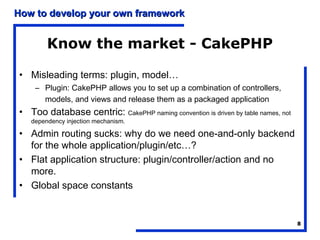
• Misleading terms: plugin, model…
    – Plugin: CakePHP allows you to set up a combination of controllers,
      models, and views and release them as a packaged application
• Too database centric: CakePHP naming convention is driven by table names, not
   dependency injection mechanism.

• Admin routing sucks: why do we need one-and-only backend
  for the whole application/plugin/etc…?
• Flat application structure: plugin/controller/action and no
  more.
• Global space constants


                                                                                  8
How to develop your own framework


       Know the market - CakePHP

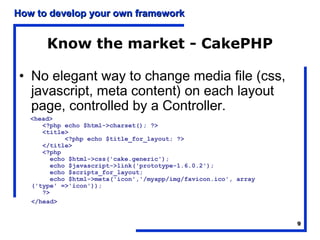
• No elegant way to change media file (css,
  javascript, meta content) on each layout
  page, controlled by a Controller.
   <head>
      <?php echo $html->charset(); ?>
      <title>
             <?php echo $title_for_layout; ?>
      </title>
      <?php
         echo $html->css('cake.generic');
         echo $javascript->link('prototype-1.6.0.2');
         echo $scripts_for_layout;
         echo $html->meta('icon','/myapp/img/favicon.ico', array
   ('type' =>'icon'));
      ?>
   </head>


                                                                   9
How to develop your own framework


      Know the market - CakePHP

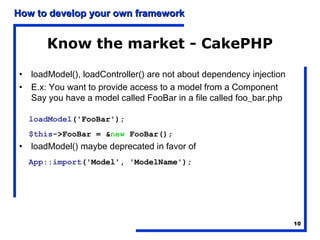
• loadModel(), loadController() are not about dependency injection
• E.x: You want to provide access to a model from a Component
  Say you have a model called FooBar in a file called foo_bar.php

  loadModel('FooBar');
  $this->FooBar = &new FooBar();
• loadModel() maybe deprecated in favor of
  App::import('Model', 'ModelName');


                                                                     10
How to develop your own framework


        Know the market - CakePHP

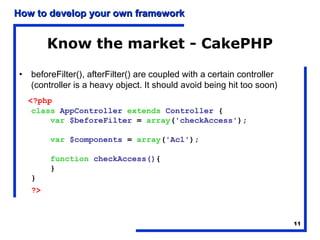
• beforeFilter(), afterFilter() are coupled with a certain controller
  (controller is a heavy object. It should avoid being hit too soon)
  <?php
   class AppController extends Controller {
       var $beforeFilter = array('checkAccess');

        var $components = array('Acl');

        function checkAccess(){
        }
   }
   ?>


                                                                        11
How to develop your own framework


       Know the market - CakePHP

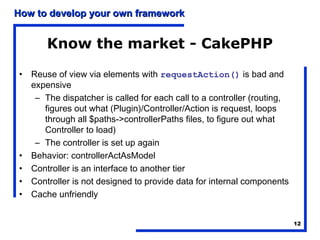
• Reuse of view via elements with requestAction() is bad and
  expensive
   – The dispatcher is called for each call to a controller (routing,
     figures out what (Plugin)/Controller/Action is request, loops
     through all $paths->controllerPaths files, to figure out what
     Controller to load)
   – The controller is set up again
• Behavior: controllerActAsModel
• Controller is an interface to another tier
• Controller is not designed to provide data for internal components
• Cache unfriendly


                                                                        12
How to develop your own framework


         Know the market - CakePHP

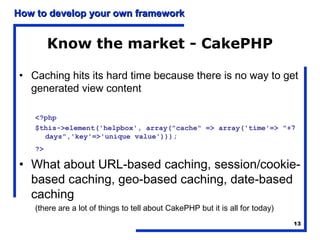
• Caching hits its hard time because there is no way to get
  generated view content

    <?php
    $this->element('helpbox', array("cache" => array('time'=> "+7
      days",'key'=>'unique value')));
    ?>

• What about URL-based caching, session/cookie-
  based caching, geo-based caching, date-based
  caching
    (there are a lot of things to tell about CakePHP but it is all for today)
                                                                                13
How to develop your own framework


   Know the market – Zend Framework

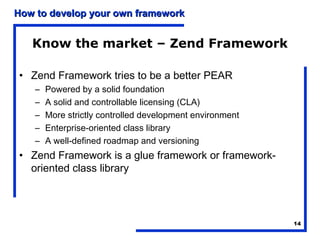
• Zend Framework tries to be a better PEAR
    –   Powered by a solid foundation
    –   A solid and controllable licensing (CLA)
    –   More strictly controlled development environment
    –   Enterprise-oriented class library
    –   A well-defined roadmap and versioning
• Zend Framework is a glue framework or framework-
  oriented class library


                                                           14
How to develop your own framework


   Know the market – Zend Framework

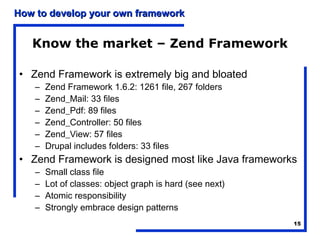
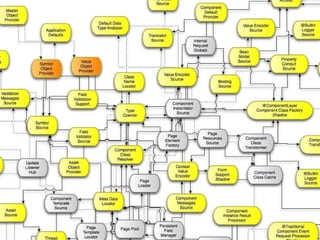
• Zend Framework is extremely big and bloated
    –   Zend Framework 1.6.2: 1261 file, 267 folders
    –   Zend_Mail: 33 files
    –   Zend_Pdf: 89 files
    –   Zend_Controller: 50 files
    –   Zend_View: 57 files
    –   Drupal includes folders: 33 files
• Zend Framework is designed most like Java frameworks
    –   Small class file
    –   Lot of classes: object graph is hard (see next)
    –   Atomic responsibility
    –   Strongly embrace design patterns
                                                          15
How to develop your own framework


                                    16
How to develop your own framework


    Know the market – Zend Framework

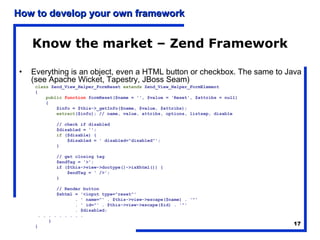
•   Everything is an object, even a HTML button or checkbox. The same to Java
    (see Apache Wicket, Tapestry, JBoss Seam)
     class Zend_View_Helper_FormReset extends Zend_View_Helper_FormElement
     {
         public function formReset($name = '', $value = 'Reset', $attribs = null)
         {
             $info = $this->_getInfo($name, $value, $attribs);
             extract($info); // name, value, attribs, options, listsep, disable

            // check if disabled
            $disabled = '';
            if ($disable) {
                $disabled = ' disabled="disabled"';
            }

            // get closing tag
            $endTag = '>';
            if ($this->view->doctype()->isXhtml()) {
                $endTag = ' />';
            }

             // Render button
             $xhtml = '<input type="reset"'
                    . ' name="' . $this->view->escape($name) . '"'
                    . ' id="' . $this->view->escape($id) . '"'
                    . $disabled;
      . . . . . . . . .
          }
     }                                                                              17
How to develop your own framework


   Know the market – Zend Framework

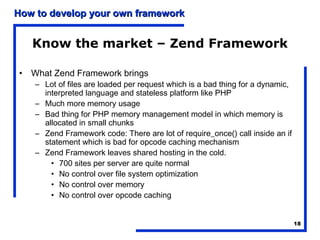
• What Zend Framework brings
    – Lot of files are loaded per request which is a bad thing for a dynamic,
      interpreted language and stateless platform like PHP
    – Much more memory usage
    – Bad thing for PHP memory management model in which memory is
      allocated in small chunks
    – Zend Framework code: There are lot of require_once() call inside an if
      statement which is bad for opcode caching mechanism
    – Zend Framework leaves shared hosting in the cold.
        • 700 sites per server are quite normal
        • No control over file system optimization
        • No control over memory
        • No control over opcode caching


                                                                                18
How to develop your own framework


   Know the market – Zend Framework

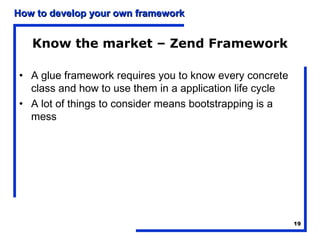
• A glue framework requires you to know every concrete
  class and how to use them in a application life cycle
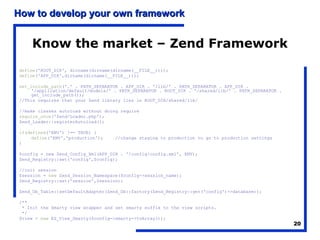
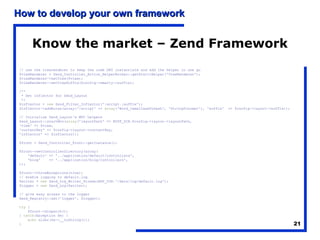
• A lot of things to consider means bootstrapping is a
  mess


                                                          19
How to develop your own framework


    Know the market – Zend Framework
define('ROOT_DIR', dirname(dirname(dirname(__FILE__))));
define('APP_DIR',dirname(dirname(__FILE__)));

set_include_path('.' . PATH_SEPARATOR . APP_DIR . '/lib/' . PATH_SEPARATOR . APP_DIR .
     '/application/default/models/' . PATH_SEPARATOR . ROOT_DIR . '/shared/lib/' . PATH_SEPARATOR .
     get_include_path());
//This requires that your Zend library lies in ROOT_DIR/shared/lib/

//make classes autoload without doing require
require_once('Zend/Loader.php');
Zend_Loader::registerAutoload();

if(defined('ENV') !== TRUE) {
     define('ENV','production');    //change staging to production to go to production settings
}

$config = new Zend_Config_Xml(APP_DIR . '/config/config.xml', ENV);
Zend_Registry::set('config',$config);

//init session
$session = new Zend_Session_Namespace($config->session_name);
Zend_Registry::set('session',$session);

Zend_Db_Table::setDefaultAdapter(Zend_Db::factory(Zend_Registry::get('config')->database));

/**
 * Init the Smarty view wrapper and set smarty suffix to the view scripts.
 */
$view = new EZ_View_Smarty($config->smarty->toArray());
                                                                                                      20
How to develop your own framework


      Know the market – Zend Framework
// use the viewrenderer to keep the code DRY instantiate and add the helper in one go
$viewRenderer = Zend_Controller_Action_HelperBroker::getStaticHelper('ViewRenderer');
$viewRenderer->setView($view);
$viewRenderer->setViewSuffix($config->smarty->suffix);

/**
 * Set inflector for Zend_Layout
 */
$inflector = new Zend_Filter_Inflector(':script.:suffix');
$inflector->addRules(array(':script' => array('Word_CamelCaseToDash', 'StringToLower'), 'suffix'   => $config->layout->suffix));

// Initialise Zend_Layout's MVC helpers
Zend_Layout::startMvc(array('layoutPath' => ROOT_DIR.$config->layout->layoutPath,
'view' => $view,
'contentKey' => $config->layout->contentKey,
'inflector' => $inflector));

$front = Zend_Controller_Front::getInstance();

$front->setControllerDirectory(array(
    'default' => '../application/default/controllers',
    'blog'    => '../application/blog/controllers',
));

$front->throwExceptions(true);
// enable logging to default.log
$writer = new Zend_Log_Writer_Stream(APP_DIR.'/data/log/default.log');
$logger = new Zend_Log($writer);

// give easy access to the logger
Zend_Registry::set('logger', $logger);

try {
    $front->dispatch();
} catch(Exception $e) {
    echo nl2br($e->__toString());
}                                                                                                                                  21
How to develop your own framework


   Know the market – Zend Framework

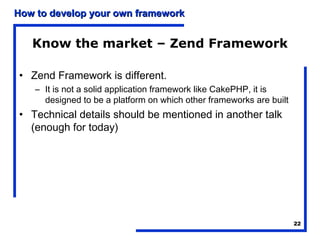
• Zend Framework is different.
    – It is not a solid application framework like CakePHP, it is
      designed to be a platform on which other frameworks are built
• Technical details should be mentioned in another talk
  (enough for today)


                                                                      22
How to develop your own framework


      A broader view on your framework

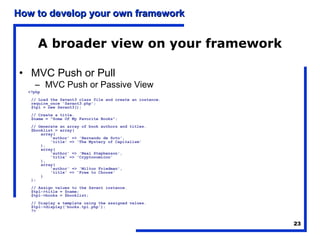
• MVC Push or Pull
    – MVC Push or Passive View
  <?php
   // Load the Savant3 class file and create an instance.
   require_once 'Savant3.php';
   $tpl = new Savant3();
   // Create a title.
   $name = "Some Of My Favorite Books";
   // Generate an array of book authors and titles.
   $booklist = array(
       array(
           'author' => 'Hernando de Soto',
           'title' => 'The Mystery of Capitalism'
       ),
       array(
           'author' => 'Neal Stephenson',
           'title' => 'Cryptonomicon'
       ),
       array(
           'author' => 'Milton Friedman',
           'title' => 'Free to Choose'
       )
   );
   // Assign values to the Savant instance.
   $tpl->title = $name;
   $tpl->books = $booklist;
   // Display a template using the assigned values.
   $tpl->display('books.tpl.php');
   ?>


                                                            23
How to develop your own framework


    A broader view on your framework

• MVC Push or Pull
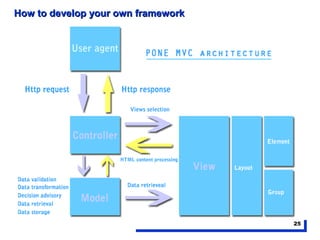
    – MVC Pull or so-called HMVC (see next): break a big controller
      into small ones


                                                                      24
How to develop your own framework


 A broader view on your framework


                                    25
How to develop your own framework


                                    26
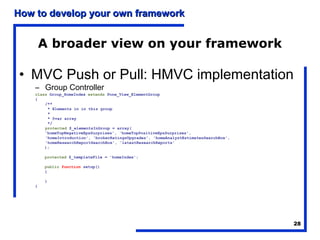
How to develop your own framework


    A broader view on your framework

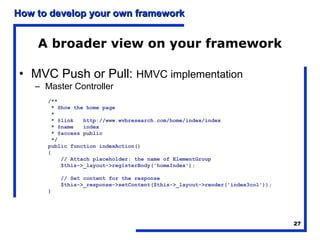
• MVC Push or Pull: HMVC implementation
    – Master Controller
       /**
        * Show the home page
        *
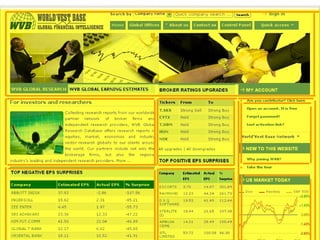
        * @link   http://www.wvbresearch.com/home/index/index
        * @name   index
        * @access public
        */
       public function indexAction()
       {
           // Attach placeholder: the name of ElementGroup
           $this->_layout->registerBody('homeIndex');

           // Set content for the response
           $this->_response->setContent($this->_layout->render('index3col'));
       }


                                                                                27
How to develop your own framework


        A broader view on your framework

• MVC Push or Pull: HMVC implementation
    – Group Controller
    class Group_HomeIndex extends Pone_View_ElementGroup
    {
        /**
         * Elements in in this group
         *
         * @var array
         */
        protected $_elementsInGroup = array(
        'homeTopNegativeEpsSurprises', 'homeTopPositiveEpsSurprises',
        'homeIntroduction', 'brokerRatingsUpgrades', 'homeAnalystEstimatesSearchBox',
        'homeResearchReportSearchBox', 'latestResearchReports'
        );

        protected $_templateFile = 'homeIndex';

        public function setup()
        {

        }
    }


                                                                                        28
How to develop your own framework


        A broader view on your framework

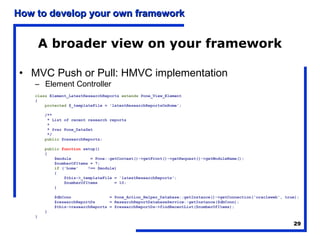
• MVC Push or Pull: HMVC implementation
    – Element Controller
    class Element_LatestResearchReports extends Pone_View_Element
    {
        protected $_templateFile = 'latestResearchReportsOnHome';

        /**
         * List of recent research reports
         *
         * @var Pone_DataSet
         */
        public $researchReports;

        public function setup()
        {
            $module        = Pone::getContext()->getFront()->getRequest()->getModuleName();
            $numberOfItems = 7;
            if ('home'    !== $module)
            {
                $this->_templateFile = 'latestResearchReports';
                $numberOfItems       = 10;
            }

            $dbConn                = Pone_Action_Helper_Database::getInstance()->getConnection('oracleweb', true);
            $researchReportDs      = ResearchReportDatabaseService::getInstance($dbConn);
            $this->researchReports = $researchReportDs->findRecentList($numberOfItems);
        }
    }
                                                                                                               29
How to develop your own framework


    A broader view on your framework

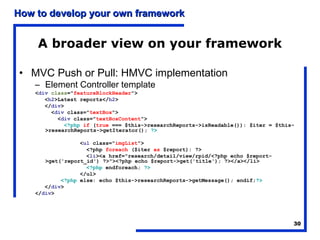
• MVC Push or Pull: HMVC implementation
    – Element Controller template
    <div class="featureBlockHeader">
       <h2>Latest reports</h2>
       </div>
         <div class="textBox">
           <div class="textBoxContent">
              <?php if (true === $this->researchReports->isReadable()): $iter = $this-
       >researchReports->getIterator(); ?>

                  <ul class="imgList">
                    <?php foreach ($iter as $report): ?>
                    <li><a href="research/detail/view/rpid/<?php echo $report-
       >get('report_id') ?>"><?php echo $report->get('title'); ?></a></li>
                    <?php endforeach; ?>
                  </ul>
            <?php else: echo $this->researchReports->getMessage(); endif;?>
       </div>
    </div>


                                                                                     30
How to develop your own framework


    A broader view on your framework

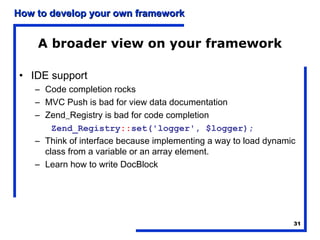
• IDE support
    – Code completion rocks
    – MVC Push is bad for view data documentation
    – Zend_Registry is bad for code completion
        Zend_Registry::set('logger', $logger);
    – Think of interface because implementing a way to load dynamic
      class from a variable or an array element.
    – Learn how to write DocBlock


                                                                  31
How to develop your own framework


    A broader view on your framework

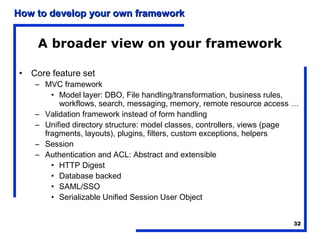
• Core feature set
    – MVC framework
        • Model layer: DBO, File handling/transformation, business rules,
          workflows, search, messaging, memory, remote resource access …
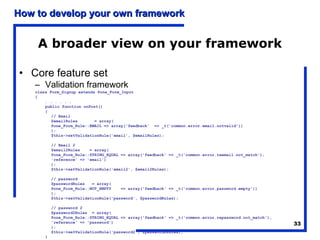
    – Validation framework instead of form handling
    – Unified directory structure: model classes, controllers, views (page
      fragments, layouts), plugins, filters, custom exceptions, helpers
    – Session
    – Authentication and ACL: Abstract and extensible
        • HTTP Digest
        • Database backed
        • SAML/SSO
        • Serializable Unified Session User Object


                                                                        32
How to develop your own framework


     A broader view on your framework

• Core feature set
    – Validation framework
    class Form_Signup extends Pone_Form_Input
    {
        . . . . . .
        public function onPost()
        {
           // Email
           $emailRules       = array(
           Pone_Form_Rule::EMAIL => array('feedback' => _t('common.error.email.notvalid'))
           );
           $this->setValidationRule('email', $emailRules);

            // Email 2
            $email2Rules    = array(
            Pone_Form_Rule::STRING_EQUAL => array('feedback' => _t('common.error.reemail.not_match'),
            'reference' => 'email')
            );
            $this->setValidationRule('email2', $email2Rules);

            // password
            $passwordRules   = array(
            Pone_Form_Rule::NOT_EMPTY    => array('feedback' => _t('common.error.password.empty'))
            );
            $this->setValidationRule('password', $passwordRules);

            // password 2
            $password2Rules = array(
            Pone_Form_Rule::STRING_EQUAL => array('feedback' => _t('common.error.repassword.not_match'),
            'reference' => 'password')                                                                     33
            );
            $this->setValidationRule('password2', $password2Rules);
        }
How to develop your own framework


    A broader view on your framework

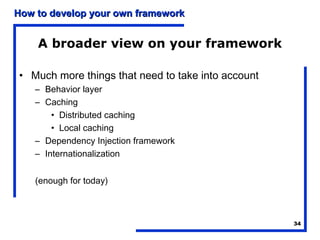
• Much more things that need to take into account
    – Behavior layer
    – Caching
        • Distributed caching
        • Local caching
    – Dependency Injection framework
    – Internationalization


    (enough for today)


                                                    34
How to develop your own framework


                         Lessons to learn

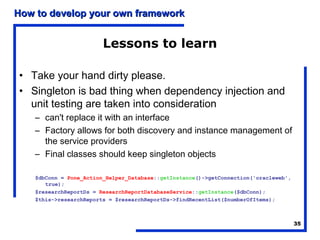
• Take your hand dirty please.
• Singleton is bad thing when dependency injection and
  unit testing are taken into consideration
    – can't replace it with an interface
    – Factory allows for both discovery and instance management of
      the service providers
    – Final classes should keep singleton objects

    $dbConn = Pone_Action_Helper_Database::getInstance()->getConnection('oracleweb',
       true);
    $researchReportDs = ResearchReportDatabaseService::getInstance($dbConn);
    $this->researchReports = $researchReportDs->findRecentList($numberOfItems);


                                                                                       35
How to develop your own framework


                      Lessons to learn

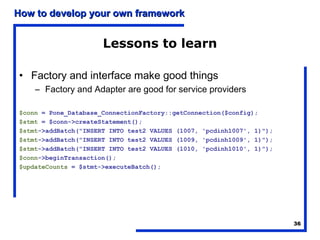
• Factory and interface make good things
    – Factory and Adapter are good for service providers

$conn = Pone_Database_ConnectionFactory::getConnection($config);
$stmt = $conn->createStatement();
$stmt->addBatch("INSERT INTO test2 VALUES (1007, 'pcdinh1007', 1)");
$stmt->addBatch("INSERT INTO test2 VALUES (1009, 'pcdinh1009', 1)");
$stmt->addBatch("INSERT INTO test2 VALUES (1010, 'pcdinh1010', 1)");
$conn->beginTransaction();
$updateCounts = $stmt->executeBatch();


                                                                       36
How to develop your own framework


                      Lessons to learn

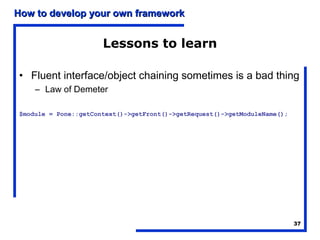
• Fluent interface/object chaining sometimes is a bad thing
    – Law of Demeter

$module = Pone::getContext()->getFront()->getRequest()->getModuleName();


                                                                           37
How to develop your own framework


                 Lessons to learn

• Don’t think DAO or ActiveRecord, think Domain
  Respository


                                                  38
How to develop your own framework


                    Lessons to learn

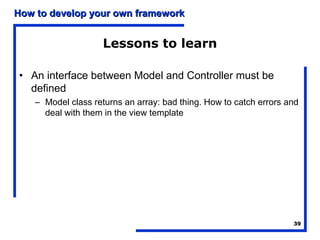
• An interface between Model and Controller must be
  defined
    – Model class returns an array: bad thing. How to catch errors and
      deal with them in the view template


                                                                    39
How to develop your own framework


                                    Lessons to learn

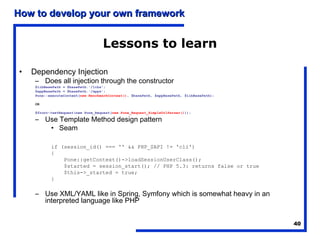
•   Dependency Injection
     – Does all injection through the constructor
     $libBasePath = $basePath.'/libs';
     $appBasePath = $basePath.'/apps';
     Pone::executeContext(new BenchmarkContext(), $basePath, $appBasePath, $libBasePath);

     OR

     $front->setRequest(new Pone_Request(new Pone_Request_SimpleUrlParser()));

     – Use Template Method design pattern
        • Seam

            if (session_id() === '' && PHP_SAPI != 'cli')
            {
                Pone::getContext()->loadSessionUserClass();
                $started = session_start(); // PHP 5.3: returns false or true
                $this->_started = true;
            }

     – Use XML/YAML like in Spring, Symfony which is somewhat heavy in an
       interpreted language like PHP


                                                                                            40
How to develop your own framework


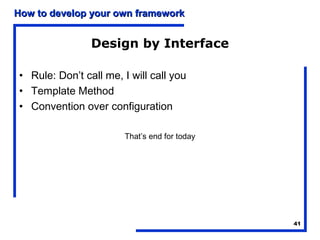
                Design by Interface

• Rule: Don’t call me, I will call you
• Template Method
• Convention over configuration

                        That’s end for today


                                               41
How to develop your own framework


                    Thanks you

• Any question?


                                    42

Howtobuildyourownframework

  • 1.
    How to learnto build your own PHP framework Bridging the gap between PHP, OOP and Software Architecture Pham Cong Dinh (a.k.a pcdinh) Software Developer Hanoi PHP Day - December 2008 Hanoi - Vietnam Copyright © Pham Cong Dinh. All rights un-reserved.
  • 2.
    How to developyour own framework Introduction Introduction  A foundation member of JavaVietnam since 2003 (http://www.javavietnam.org)  A foundation member of PHPVietnam Discussion Group since 2004 (http://groups.google.com/group/phpvietnam)  Lead web developer with World’Vest Base Inc.  Java is my first love since 1999  PHP is my real lover since 2003. I love the way PHP community works  Sometimes I works on Python, Ruby, Erlang  I am a strong believer in dynamic programming languages, JavaScript, web standards, convergence of web as a platform and Outsourcing 2.0  I spent 2 years to play with my framework named Pone (PHP One) 2
  • 3.
    How to developyour own framework Introduction Objectives  Where is PHP now? It is changing. Enterprise oriented: which is driven by Yahoo, Facebook, Zend, Sun/MySQL, Oracle, OmniTI … PHP is too big. It can not just be ignored Object Oriented Programming adoption Increased complexity of web applications Web vs. Adobe Air, MS Silverlight, JavaFX, Google Native Client Trends Will Move Applications to the Web: Consumer Innovation Setting the Pace, Rise of the Power Collaborator, New Economics of Scale for IT, Barriers to Adoption Are Falling Scale-out wins  Understanding what framework designers think  Building up shared mindsets  Providing food for thought 3
  • 4.
    How to developyour own framework Introduction Agenda – 40 slides  Making judgments  Top notch frameworks and their shortcomings  A broader view on your framework  Lessons to learn 4
  • 5.
    How to developyour own framework Making judgments • Common wisdom: Reinventing the wheel • Good – You know it inside and out – You control its pace – It fits your needs. Sometimes, your need is unique – It teaches you how the world around you works – License: This is why GPL is sometime a bad thing • Bad – You may not as good as other ones – No community – No outside contributors – Reinventing the square wheel 5
  • 6.
    How to developyour own framework Making judgments • To develop a framework is just like to set up a business • Think of your limitation: time, resources, knowledge to build/test/document/maintain your own mental baby • Know your team: how to train them • Know the market: known frameworks in the market. Sometimes your needs are satisfied to some extent in several little-known frameworks • Starts with pencil and paper: its components and how they interact • Starts with API: learn how to design an API first • You never do it right from day one 6
  • 7.
    How to developyour own framework Know the market • CakePHP shortcomings • Zend Framework shortcomings • Third party frameworks shortcomings 7
  • 8.
    How to developyour own framework Know the market - CakePHP • Misleading terms: plugin, model… – Plugin: CakePHP allows you to set up a combination of controllers, models, and views and release them as a packaged application • Too database centric: CakePHP naming convention is driven by table names, not dependency injection mechanism. • Admin routing sucks: why do we need one-and-only backend for the whole application/plugin/etc…? • Flat application structure: plugin/controller/action and no more. • Global space constants 8
  • 9.
    How to developyour own framework Know the market - CakePHP • No elegant way to change media file (css, javascript, meta content) on each layout page, controlled by a Controller. <head> <?php echo $html->charset(); ?> <title> <?php echo $title_for_layout; ?> </title> <?php echo $html->css('cake.generic'); echo $javascript->link('prototype-1.6.0.2'); echo $scripts_for_layout; echo $html->meta('icon','/myapp/img/favicon.ico', array ('type' =>'icon')); ?> </head> 9
  • 10.
    How to developyour own framework Know the market - CakePHP • loadModel(), loadController() are not about dependency injection • E.x: You want to provide access to a model from a Component Say you have a model called FooBar in a file called foo_bar.php loadModel('FooBar'); $this->FooBar = &new FooBar(); • loadModel() maybe deprecated in favor of App::import('Model', 'ModelName'); 10
  • 11.
    How to developyour own framework Know the market - CakePHP • beforeFilter(), afterFilter() are coupled with a certain controller (controller is a heavy object. It should avoid being hit too soon) <?php class AppController extends Controller { var $beforeFilter = array('checkAccess'); var $components = array('Acl'); function checkAccess(){ } } ?> 11
  • 12.
    How to developyour own framework Know the market - CakePHP • Reuse of view via elements with requestAction() is bad and expensive – The dispatcher is called for each call to a controller (routing, figures out what (Plugin)/Controller/Action is request, loops through all $paths->controllerPaths files, to figure out what Controller to load) – The controller is set up again • Behavior: controllerActAsModel • Controller is an interface to another tier • Controller is not designed to provide data for internal components • Cache unfriendly 12
  • 13.
    How to developyour own framework Know the market - CakePHP • Caching hits its hard time because there is no way to get generated view content <?php $this->element('helpbox', array("cache" => array('time'=> "+7 days",'key'=>'unique value'))); ?> • What about URL-based caching, session/cookie- based caching, geo-based caching, date-based caching (there are a lot of things to tell about CakePHP but it is all for today) 13
  • 14.
    How to developyour own framework Know the market – Zend Framework • Zend Framework tries to be a better PEAR – Powered by a solid foundation – A solid and controllable licensing (CLA) – More strictly controlled development environment – Enterprise-oriented class library – A well-defined roadmap and versioning • Zend Framework is a glue framework or framework- oriented class library 14
  • 15.
    How to developyour own framework Know the market – Zend Framework • Zend Framework is extremely big and bloated – Zend Framework 1.6.2: 1261 file, 267 folders – Zend_Mail: 33 files – Zend_Pdf: 89 files – Zend_Controller: 50 files – Zend_View: 57 files – Drupal includes folders: 33 files • Zend Framework is designed most like Java frameworks – Small class file – Lot of classes: object graph is hard (see next) – Atomic responsibility – Strongly embrace design patterns 15
  • 16.
    How to developyour own framework 16
  • 17.
    How to developyour own framework Know the market – Zend Framework • Everything is an object, even a HTML button or checkbox. The same to Java (see Apache Wicket, Tapestry, JBoss Seam) class Zend_View_Helper_FormReset extends Zend_View_Helper_FormElement { public function formReset($name = '', $value = 'Reset', $attribs = null) { $info = $this->_getInfo($name, $value, $attribs); extract($info); // name, value, attribs, options, listsep, disable // check if disabled $disabled = ''; if ($disable) { $disabled = ' disabled="disabled"'; } // get closing tag $endTag = '>'; if ($this->view->doctype()->isXhtml()) { $endTag = ' />'; } // Render button $xhtml = '<input type="reset"' . ' name="' . $this->view->escape($name) . '"' . ' id="' . $this->view->escape($id) . '"' . $disabled; . . . . . . . . . } } 17
  • 18.
    How to developyour own framework Know the market – Zend Framework • What Zend Framework brings – Lot of files are loaded per request which is a bad thing for a dynamic, interpreted language and stateless platform like PHP – Much more memory usage – Bad thing for PHP memory management model in which memory is allocated in small chunks – Zend Framework code: There are lot of require_once() call inside an if statement which is bad for opcode caching mechanism – Zend Framework leaves shared hosting in the cold. • 700 sites per server are quite normal • No control over file system optimization • No control over memory • No control over opcode caching 18
  • 19.
    How to developyour own framework Know the market – Zend Framework • A glue framework requires you to know every concrete class and how to use them in a application life cycle • A lot of things to consider means bootstrapping is a mess 19
  • 20.
    How to developyour own framework Know the market – Zend Framework define('ROOT_DIR', dirname(dirname(dirname(__FILE__)))); define('APP_DIR',dirname(dirname(__FILE__))); set_include_path('.' . PATH_SEPARATOR . APP_DIR . '/lib/' . PATH_SEPARATOR . APP_DIR . '/application/default/models/' . PATH_SEPARATOR . ROOT_DIR . '/shared/lib/' . PATH_SEPARATOR . get_include_path()); //This requires that your Zend library lies in ROOT_DIR/shared/lib/ //make classes autoload without doing require require_once('Zend/Loader.php'); Zend_Loader::registerAutoload(); if(defined('ENV') !== TRUE) { define('ENV','production'); //change staging to production to go to production settings } $config = new Zend_Config_Xml(APP_DIR . '/config/config.xml', ENV); Zend_Registry::set('config',$config); //init session $session = new Zend_Session_Namespace($config->session_name); Zend_Registry::set('session',$session); Zend_Db_Table::setDefaultAdapter(Zend_Db::factory(Zend_Registry::get('config')->database)); /** * Init the Smarty view wrapper and set smarty suffix to the view scripts. */ $view = new EZ_View_Smarty($config->smarty->toArray()); 20
  • 21.
    How to developyour own framework Know the market – Zend Framework // use the viewrenderer to keep the code DRY instantiate and add the helper in one go $viewRenderer = Zend_Controller_Action_HelperBroker::getStaticHelper('ViewRenderer'); $viewRenderer->setView($view); $viewRenderer->setViewSuffix($config->smarty->suffix); /** * Set inflector for Zend_Layout */ $inflector = new Zend_Filter_Inflector(':script.:suffix'); $inflector->addRules(array(':script' => array('Word_CamelCaseToDash', 'StringToLower'), 'suffix' => $config->layout->suffix)); // Initialise Zend_Layout's MVC helpers Zend_Layout::startMvc(array('layoutPath' => ROOT_DIR.$config->layout->layoutPath, 'view' => $view, 'contentKey' => $config->layout->contentKey, 'inflector' => $inflector)); $front = Zend_Controller_Front::getInstance(); $front->setControllerDirectory(array( 'default' => '../application/default/controllers', 'blog' => '../application/blog/controllers', )); $front->throwExceptions(true); // enable logging to default.log $writer = new Zend_Log_Writer_Stream(APP_DIR.'/data/log/default.log'); $logger = new Zend_Log($writer); // give easy access to the logger Zend_Registry::set('logger', $logger); try { $front->dispatch(); } catch(Exception $e) { echo nl2br($e->__toString()); } 21
  • 22.
    How to developyour own framework Know the market – Zend Framework • Zend Framework is different. – It is not a solid application framework like CakePHP, it is designed to be a platform on which other frameworks are built • Technical details should be mentioned in another talk (enough for today) 22
  • 23.
    How to developyour own framework A broader view on your framework • MVC Push or Pull – MVC Push or Passive View <?php // Load the Savant3 class file and create an instance. require_once 'Savant3.php'; $tpl = new Savant3(); // Create a title. $name = "Some Of My Favorite Books"; // Generate an array of book authors and titles. $booklist = array( array( 'author' => 'Hernando de Soto', 'title' => 'The Mystery of Capitalism' ), array( 'author' => 'Neal Stephenson', 'title' => 'Cryptonomicon' ), array( 'author' => 'Milton Friedman', 'title' => 'Free to Choose' ) ); // Assign values to the Savant instance. $tpl->title = $name; $tpl->books = $booklist; // Display a template using the assigned values. $tpl->display('books.tpl.php'); ?> 23
  • 24.
    How to developyour own framework A broader view on your framework • MVC Push or Pull – MVC Pull or so-called HMVC (see next): break a big controller into small ones 24
  • 25.
    How to developyour own framework A broader view on your framework 25
  • 26.
    How to developyour own framework 26
  • 27.
    How to developyour own framework A broader view on your framework • MVC Push or Pull: HMVC implementation – Master Controller /** * Show the home page * * @link http://www.wvbresearch.com/home/index/index * @name index * @access public */ public function indexAction() { // Attach placeholder: the name of ElementGroup $this->_layout->registerBody('homeIndex'); // Set content for the response $this->_response->setContent($this->_layout->render('index3col')); } 27
  • 28.
    How to developyour own framework A broader view on your framework • MVC Push or Pull: HMVC implementation – Group Controller class Group_HomeIndex extends Pone_View_ElementGroup { /** * Elements in in this group * * @var array */ protected $_elementsInGroup = array( 'homeTopNegativeEpsSurprises', 'homeTopPositiveEpsSurprises', 'homeIntroduction', 'brokerRatingsUpgrades', 'homeAnalystEstimatesSearchBox', 'homeResearchReportSearchBox', 'latestResearchReports' ); protected $_templateFile = 'homeIndex'; public function setup() { } } 28
  • 29.
    How to developyour own framework A broader view on your framework • MVC Push or Pull: HMVC implementation – Element Controller class Element_LatestResearchReports extends Pone_View_Element { protected $_templateFile = 'latestResearchReportsOnHome'; /** * List of recent research reports * * @var Pone_DataSet */ public $researchReports; public function setup() { $module = Pone::getContext()->getFront()->getRequest()->getModuleName(); $numberOfItems = 7; if ('home' !== $module) { $this->_templateFile = 'latestResearchReports'; $numberOfItems = 10; } $dbConn = Pone_Action_Helper_Database::getInstance()->getConnection('oracleweb', true); $researchReportDs = ResearchReportDatabaseService::getInstance($dbConn); $this->researchReports = $researchReportDs->findRecentList($numberOfItems); } } 29
  • 30.
    How to developyour own framework A broader view on your framework • MVC Push or Pull: HMVC implementation – Element Controller template <div class="featureBlockHeader"> <h2>Latest reports</h2> </div> <div class="textBox"> <div class="textBoxContent"> <?php if (true === $this->researchReports->isReadable()): $iter = $this- >researchReports->getIterator(); ?> <ul class="imgList"> <?php foreach ($iter as $report): ?> <li><a href="research/detail/view/rpid/<?php echo $report- >get('report_id') ?>"><?php echo $report->get('title'); ?></a></li> <?php endforeach; ?> </ul> <?php else: echo $this->researchReports->getMessage(); endif;?> </div> </div> 30
  • 31.
    How to developyour own framework A broader view on your framework • IDE support – Code completion rocks – MVC Push is bad for view data documentation – Zend_Registry is bad for code completion Zend_Registry::set('logger', $logger); – Think of interface because implementing a way to load dynamic class from a variable or an array element. – Learn how to write DocBlock 31
  • 32.
    How to developyour own framework A broader view on your framework • Core feature set – MVC framework • Model layer: DBO, File handling/transformation, business rules, workflows, search, messaging, memory, remote resource access … – Validation framework instead of form handling – Unified directory structure: model classes, controllers, views (page fragments, layouts), plugins, filters, custom exceptions, helpers – Session – Authentication and ACL: Abstract and extensible • HTTP Digest • Database backed • SAML/SSO • Serializable Unified Session User Object 32
  • 33.
    How to developyour own framework A broader view on your framework • Core feature set – Validation framework class Form_Signup extends Pone_Form_Input { . . . . . . public function onPost() { // Email $emailRules = array( Pone_Form_Rule::EMAIL => array('feedback' => _t('common.error.email.notvalid')) ); $this->setValidationRule('email', $emailRules); // Email 2 $email2Rules = array( Pone_Form_Rule::STRING_EQUAL => array('feedback' => _t('common.error.reemail.not_match'), 'reference' => 'email') ); $this->setValidationRule('email2', $email2Rules); // password $passwordRules = array( Pone_Form_Rule::NOT_EMPTY => array('feedback' => _t('common.error.password.empty')) ); $this->setValidationRule('password', $passwordRules); // password 2 $password2Rules = array( Pone_Form_Rule::STRING_EQUAL => array('feedback' => _t('common.error.repassword.not_match'), 'reference' => 'password') 33 ); $this->setValidationRule('password2', $password2Rules); }
  • 34.
    How to developyour own framework A broader view on your framework • Much more things that need to take into account – Behavior layer – Caching • Distributed caching • Local caching – Dependency Injection framework – Internationalization (enough for today) 34
  • 35.
    How to developyour own framework Lessons to learn • Take your hand dirty please. • Singleton is bad thing when dependency injection and unit testing are taken into consideration – can't replace it with an interface – Factory allows for both discovery and instance management of the service providers – Final classes should keep singleton objects $dbConn = Pone_Action_Helper_Database::getInstance()->getConnection('oracleweb', true); $researchReportDs = ResearchReportDatabaseService::getInstance($dbConn); $this->researchReports = $researchReportDs->findRecentList($numberOfItems); 35
  • 36.
    How to developyour own framework Lessons to learn • Factory and interface make good things – Factory and Adapter are good for service providers $conn = Pone_Database_ConnectionFactory::getConnection($config); $stmt = $conn->createStatement(); $stmt->addBatch("INSERT INTO test2 VALUES (1007, 'pcdinh1007', 1)"); $stmt->addBatch("INSERT INTO test2 VALUES (1009, 'pcdinh1009', 1)"); $stmt->addBatch("INSERT INTO test2 VALUES (1010, 'pcdinh1010', 1)"); $conn->beginTransaction(); $updateCounts = $stmt->executeBatch(); 36
  • 37.
    How to developyour own framework Lessons to learn • Fluent interface/object chaining sometimes is a bad thing – Law of Demeter $module = Pone::getContext()->getFront()->getRequest()->getModuleName(); 37
  • 38.
    How to developyour own framework Lessons to learn • Don’t think DAO or ActiveRecord, think Domain Respository 38
  • 39.
    How to developyour own framework Lessons to learn • An interface between Model and Controller must be defined – Model class returns an array: bad thing. How to catch errors and deal with them in the view template 39
  • 40.
    How to developyour own framework Lessons to learn • Dependency Injection – Does all injection through the constructor $libBasePath = $basePath.'/libs'; $appBasePath = $basePath.'/apps'; Pone::executeContext(new BenchmarkContext(), $basePath, $appBasePath, $libBasePath); OR $front->setRequest(new Pone_Request(new Pone_Request_SimpleUrlParser())); – Use Template Method design pattern • Seam if (session_id() === '' && PHP_SAPI != 'cli') { Pone::getContext()->loadSessionUserClass(); $started = session_start(); // PHP 5.3: returns false or true $this->_started = true; } – Use XML/YAML like in Spring, Symfony which is somewhat heavy in an interpreted language like PHP 40
  • 41.
    How to developyour own framework Design by Interface • Rule: Don’t call me, I will call you • Template Method • Convention over configuration That’s end for today 41
  • 42.
    How to developyour own framework Thanks you • Any question? 42

Editor's Notes

  • #4 You need to think different. You can not see it in a 1999 manner. Java purist mindsets are obsolete