






HOW TO WRITE A
RESEARCH THESIS?
Asif Nawaz
Mphill Microbiology
Aust
What is a Thesis?
A thesis or dissertation is a document
submitted by a candidate for an academic
degree presenting the research and findings.
WHY WRITE A THESIS:
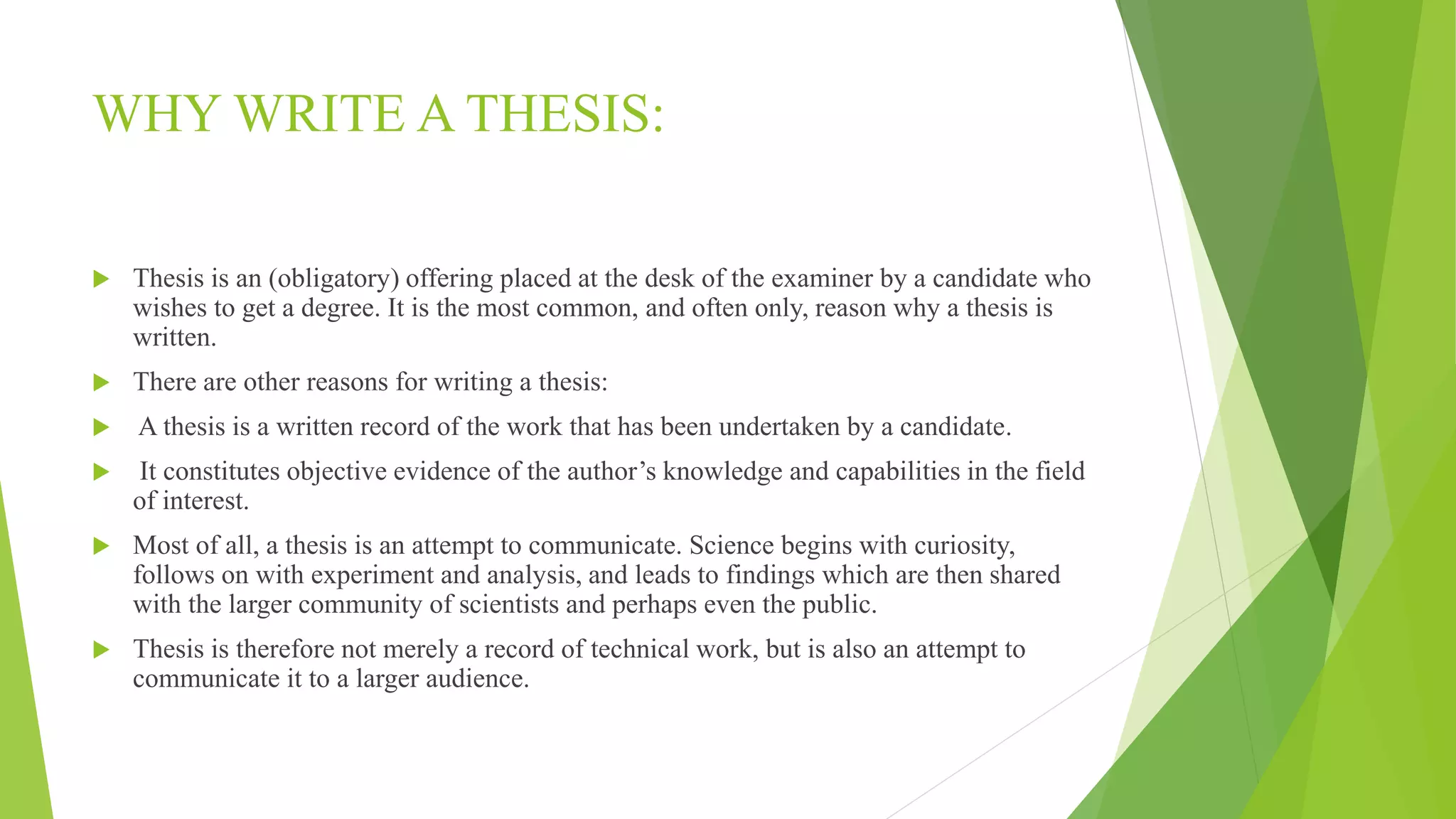
 Thesis is an (obligatory) offering placed at the desk of the examiner by a candidate who
wishes to get a degree. It is the most common, and often only, reason why a thesis is
written.
 There are other reasons for writing a thesis:
 A thesis is a written record of the work that has been undertaken by a candidate.
 It constitutes objective evidence of the author’s knowledge and capabilities in the field
of interest.
 Most of all, a thesis is an attempt to communicate. Science begins with curiosity,
follows on with experiment and analysis, and leads to findings which are then shared
with the larger community of scientists and perhaps even the public.
 Thesis is therefore not merely a record of technical work, but is also an attempt to
communicate it to a larger audience.
DIFFERENCE BETWEEN UNDERGRADUATE
AND POSTGRADUATE THESIS:
 Essentially, undergraduate study (bachelors) is the first
type of study undertaken at university level, introducing
students to the knowledge and skills required within a
specific discipline.
 Postgraduate study (masters) is a step up from
undergraduate study, requiring a more advanced level of
understanding, greater independent study, and more
specialised knowledge
UNDERGRADUATE THESIS
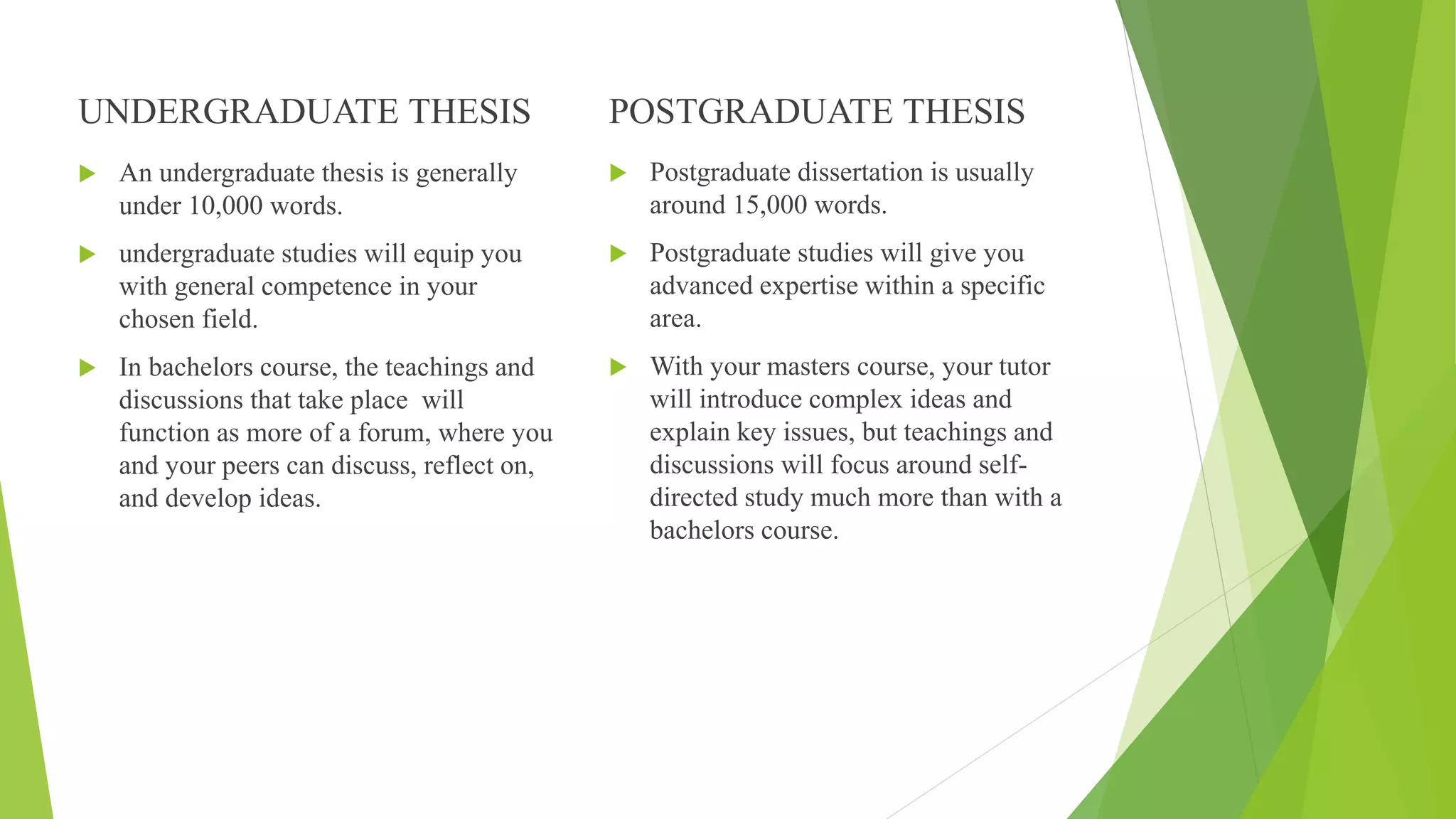
 An undergraduate thesis is generally
under 10,000 words.
 undergraduate studies will equip you
with general competence in your
chosen field.
 In bachelors course, the teachings and
discussions that take place will
function as more of a forum, where you
and your peers can discuss, reflect on,
and develop ideas.
POSTGRADUATE THESIS
 Postgraduate dissertation is usually
around 15,000 words.
 Postgraduate studies will give you
advanced expertise within a specific
area.
 With your masters course, your tutor
will introduce complex ideas and
explain key issues, but teachings and
discussions will focus around self-
directed study much more than with a
bachelors course.
What is in the Thesis:
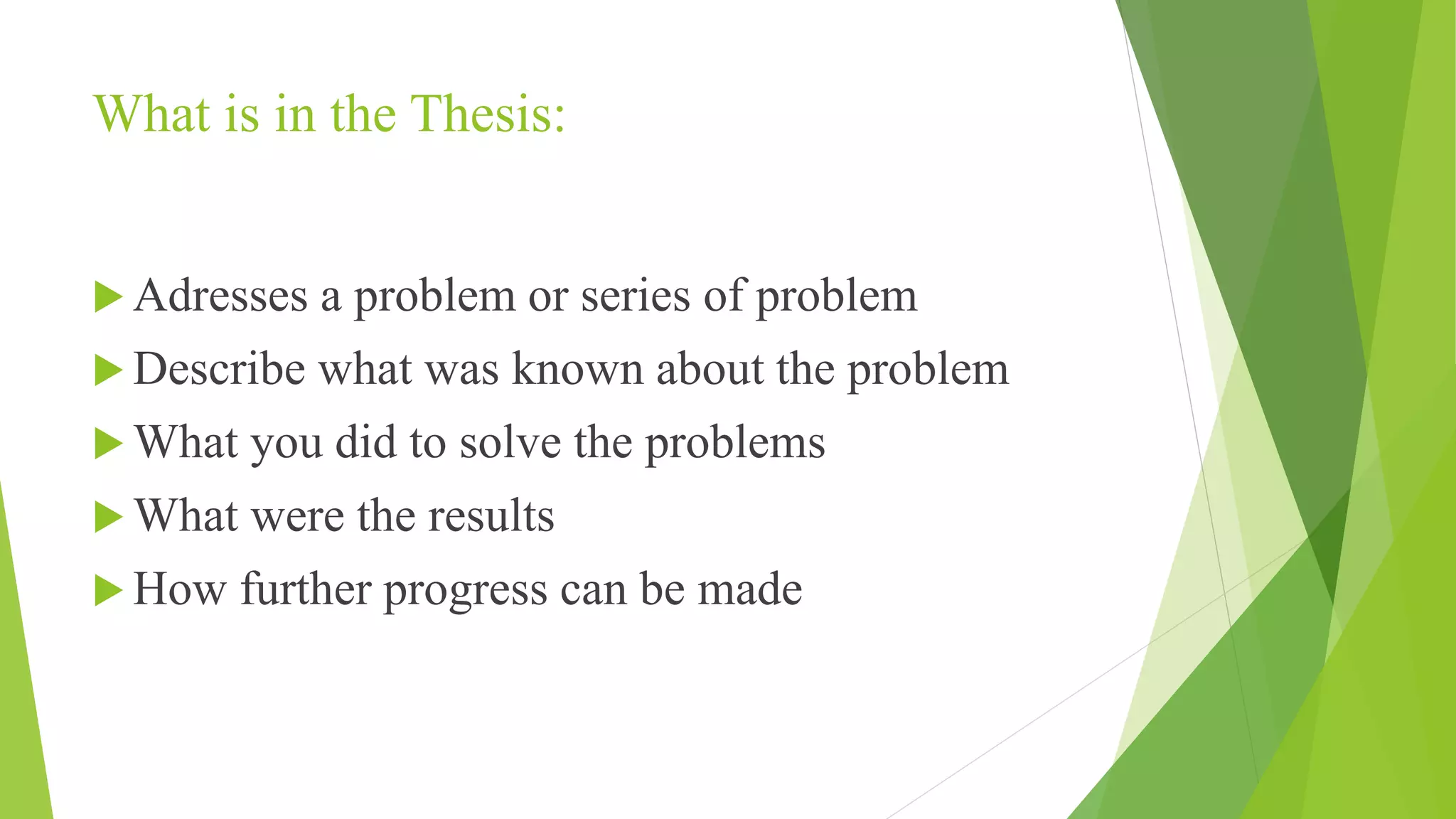
 Adresses a problem or series of problem
 Describe what was known about the problem
 What you did to solve the problems
 What were the results
 How further progress can be made
STRUCTURE OF THE THESIS:
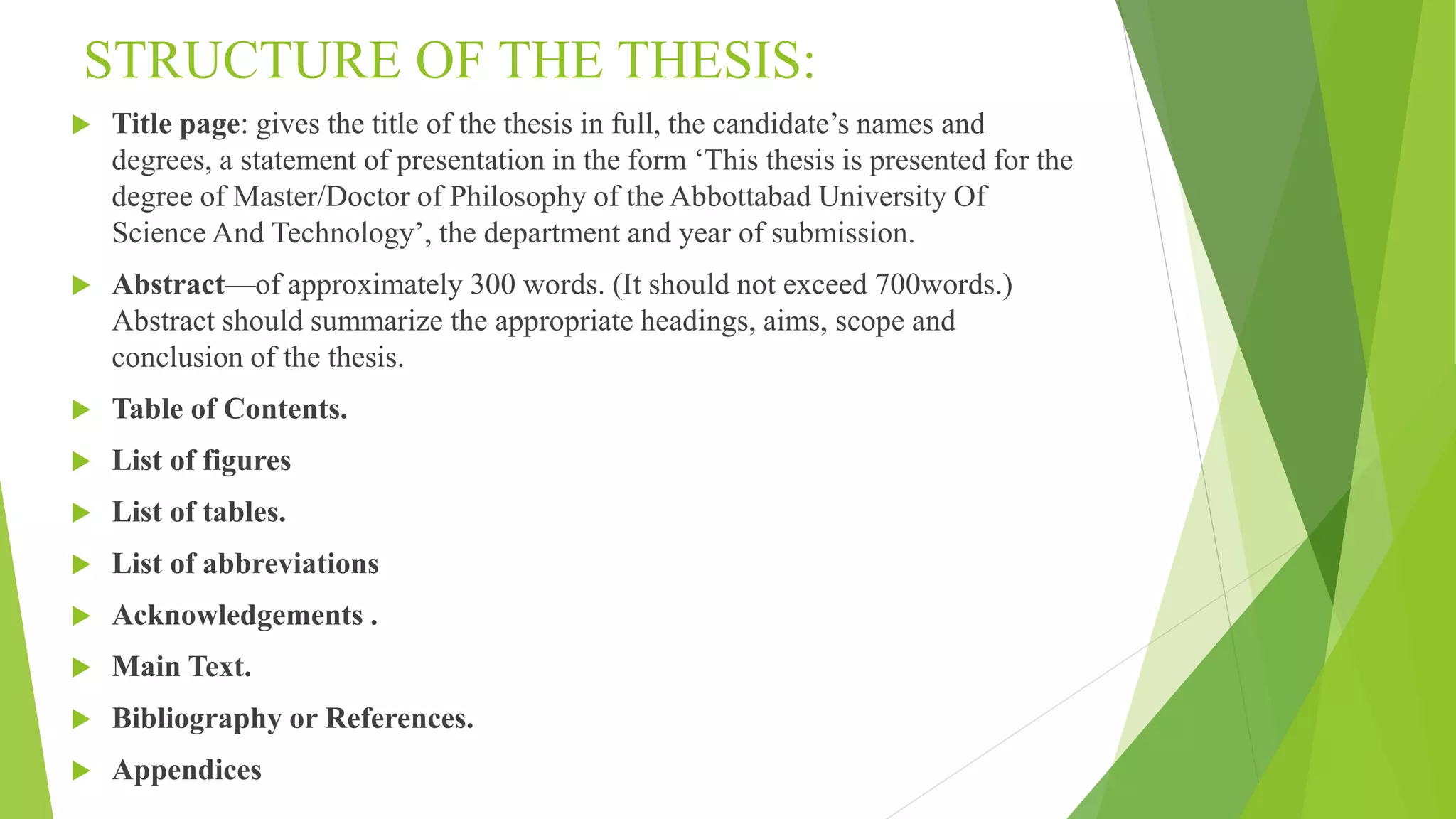
 Title page: gives the title of the thesis in full, the candidate’s names and
degrees, a statement of presentation in the form ‘This thesis is presented for the
degree of Master/Doctor of Philosophy of the Abbottabad University Of
Science And Technology’, the department and year of submission.
 Abstract—of approximately 300 words. (It should not exceed 700words.)
Abstract should summarize the appropriate headings, aims, scope and
conclusion of the thesis.
 Table of Contents.
 List of figures
 List of tables.
 List of abbreviations
 Acknowledgements .
 Main Text.
 Bibliography or References.
 Appendices
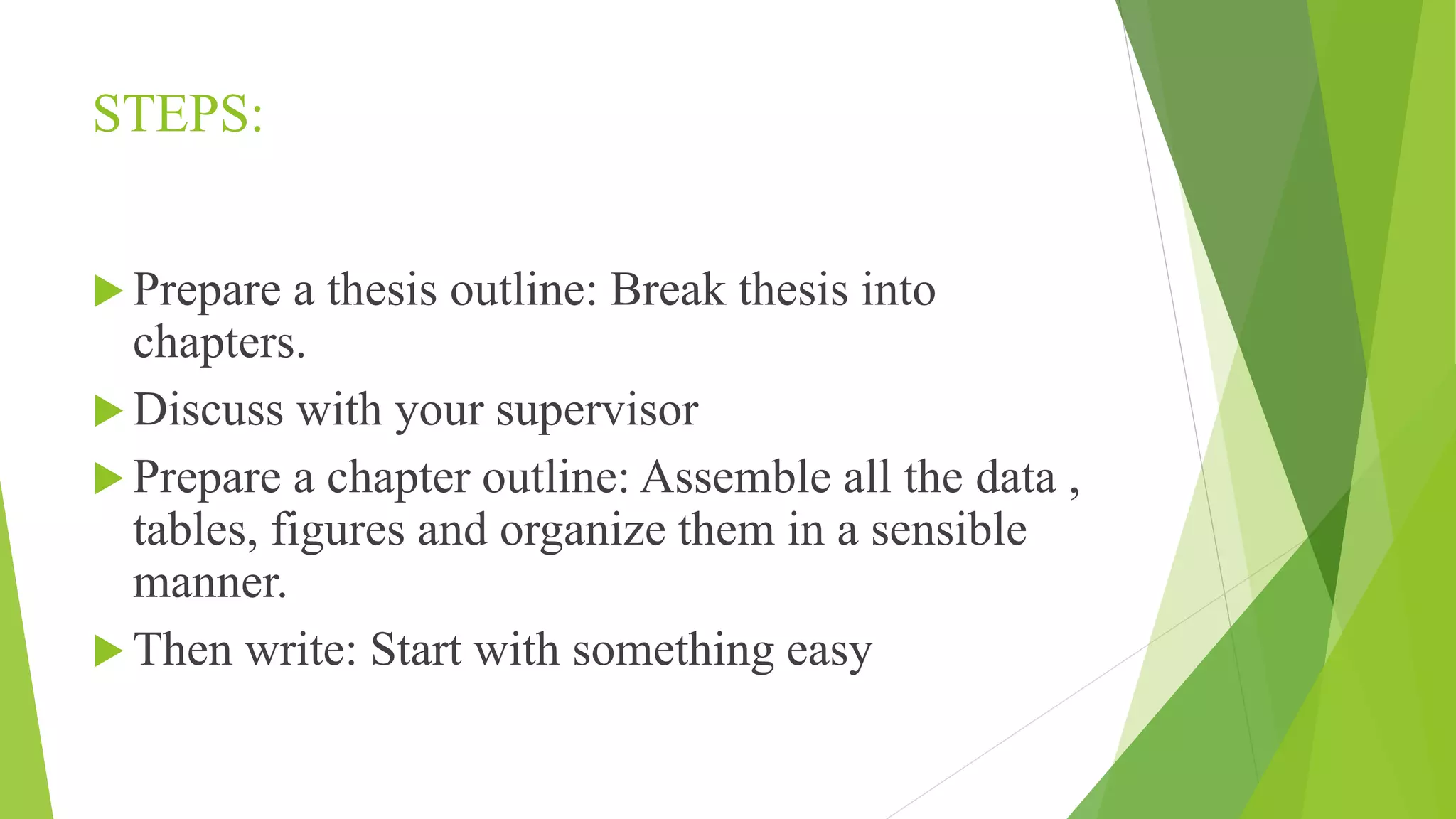
STEPS:
 Prepare a thesis outline: Break thesis into
chapters.
 Discuss with your supervisor
 Prepare a chapter outline: Assemble all the data ,
tables, figures and organize them in a sensible
manner.
 Then write: Start with something easy
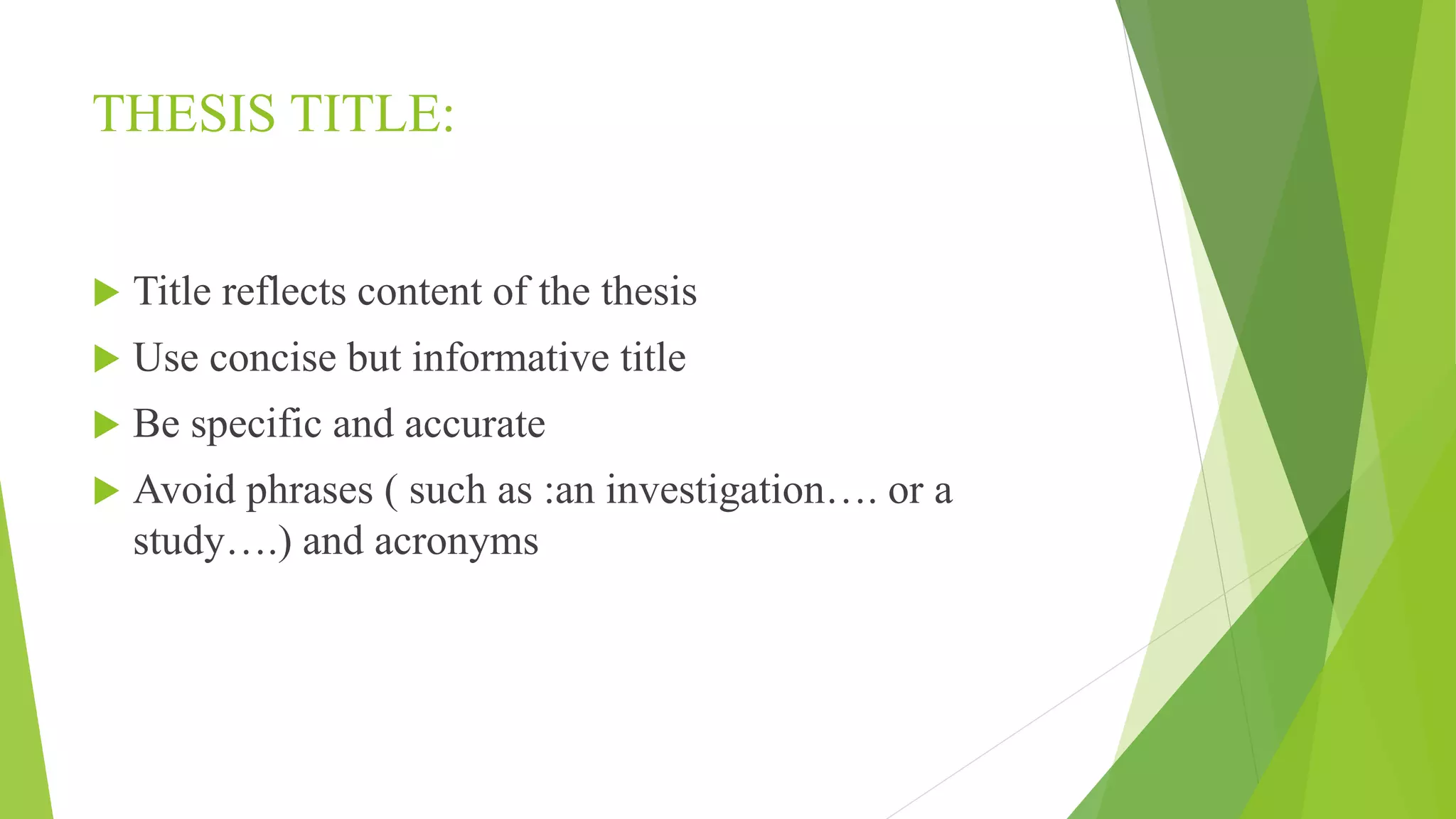
THESIS TITLE:
 Title reflects content of the thesis
 Use concise but informative title
 Be specific and accurate
 Avoid phrases ( such as :an investigation…. or a
study….) and acronyms
CHAPTERS OF THE THESIS:
1. INTRODUCTION
2. LITERATURE REVIEW
3. MATERIALS AND METHODOLOGY
4. RESULTS
5. DISCUSSION AND CONCLUSION
6. REFERENCES
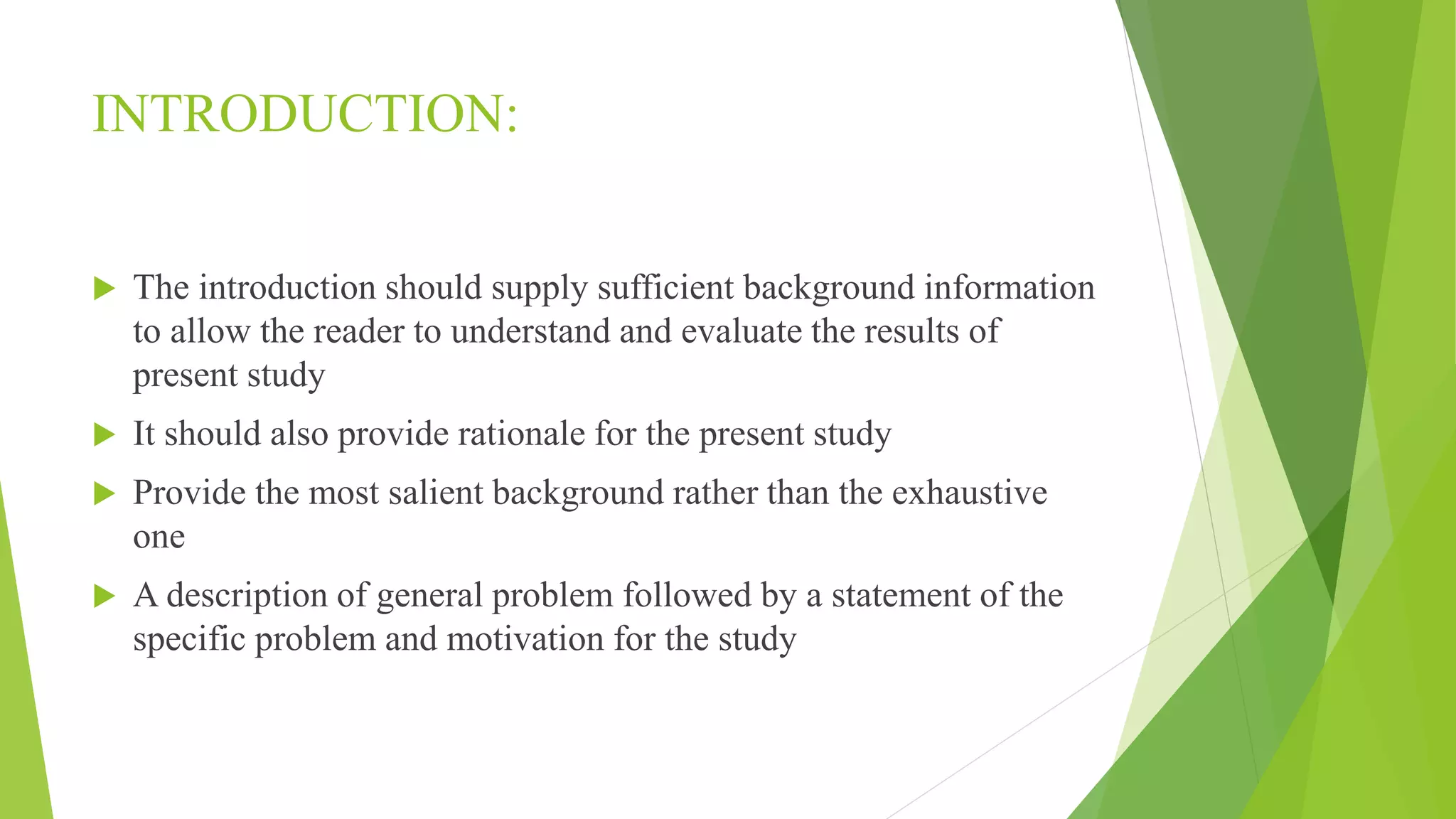
INTRODUCTION:
 The introduction should supply sufficient background information
to allow the reader to understand and evaluate the results of
present study
 It should also provide rationale for the present study
 Provide the most salient background rather than the exhaustive
one
 A description of general problem followed by a statement of the
specific problem and motivation for the study
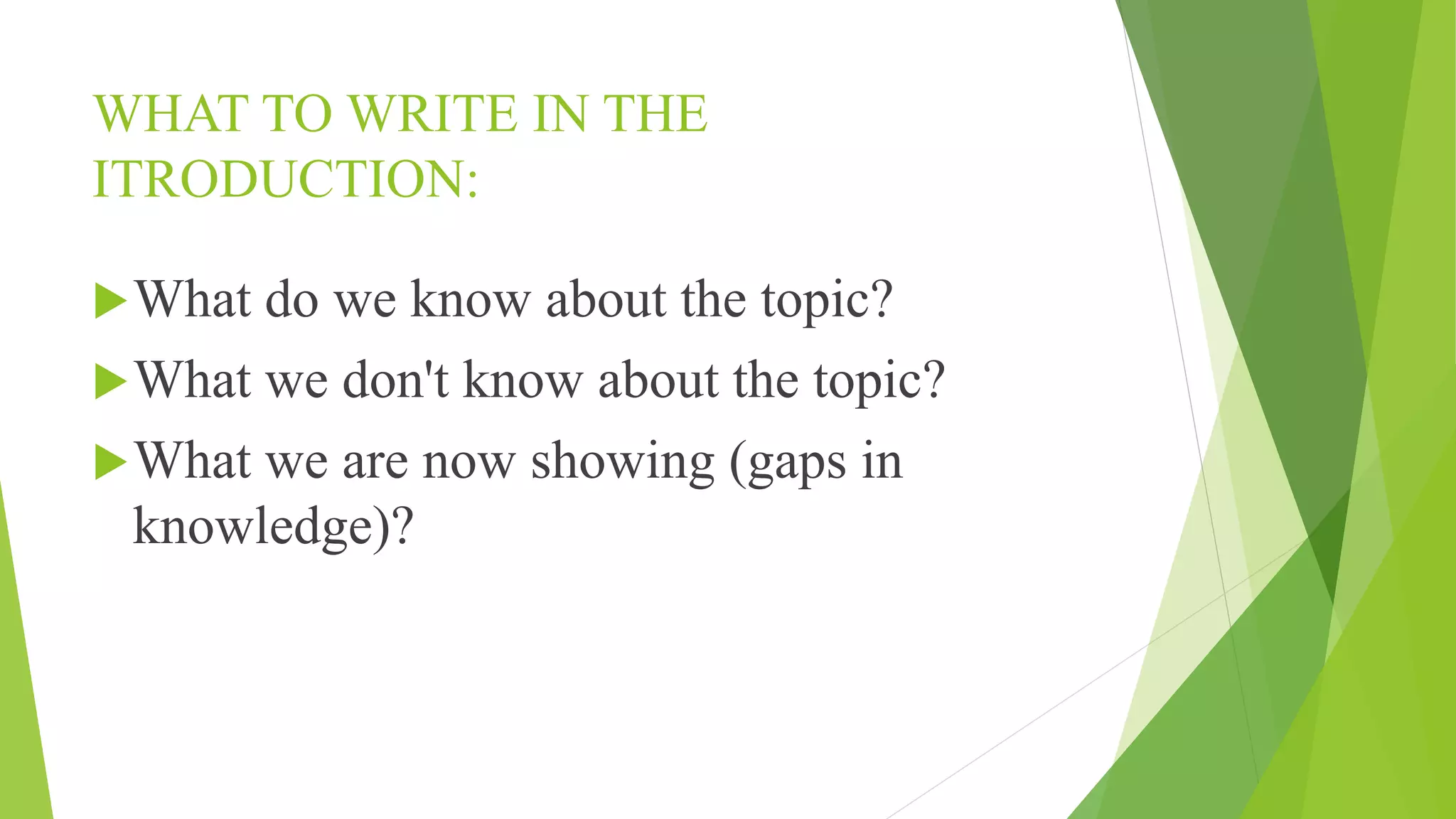
WHAT TO WRITE IN THE
ITRODUCTION:
What do we know about the topic?
What we don't know about the topic?
What we are now showing (gaps in
knowledge)?
A GOOD INTRODUCTION:
 FIRST PARAGRAPH: Should provide a brief background in
present tense to establish context, relevance, or nature of the
problem, question or purpose.
 SECOND PARAGRAPH: Importance of the problem and
unclear issues
 THE LAST PARAGRAPH: Hypothesis , main objectives and
purpose of the study
LITERATURE REVIEW:
 A systematic method for identifying, evaluating and interpreting
the work produced by researchers, scholars and practitioners
 It is the synthesis of published work
 Be selective
 State the current state of the theory
 How far back? Masters = 10 years back, PhD= further back
 Avoid verbosity
 Brief but focused
COMPONENTS OF LIT.REVIEW:
1. BACKGROUND INFORMATION:
 Introduce topic
 Describe scope and organization
 Review past and present literature
 Clarify purpose
2. THEORY:
 All research has precedent
 Integrate key points and make appropriate inferences
 Be aware of relationship to your topic
3. CRITICAL APPRAISAL/SYNTHESIS:
 Not just a list of work of others
 Identify issues highlighted
 Highlight differences ad similarities
 Identify consensus
MATERIALS AND METHODOLOGY:
 Enlist the materials used
 Provide detailed methodology used to construct
the experiment
 Provide sufficient details but it is not expected to
be written like a lab manual
 Describe control used
 Highlight critical steps or precautions
RESULTS:
 It contains all of the data to support the hypothesis that was proposed in the
introduction
 It serves to weave a coherent story and must communicate the findings to the
reader in a logical, transparent manner.
 Data presentation : graph and tables
 Tables can be used to describe numeric values
 Figures are better for conveying trends or proportions
 Graphs, charts, photographs and drawings can quickly convey the primary
findings of research
DISCUSSION:
To communicate the significance of your
findings
To indicate how the support experimental
hypothesis
To describe how these results advance the
field of study
HOW TO WRITE DISCUSSION:
 HOW THOROUGH IS YOUR DISCUSSION?
1. Have the main point from results been picked for
discussion?
2. Are there links made to the literature?
3. Is there enough evidence in your data to attempt at
theory building and reconceptualization of the
problems?
4. Are there speculations? Are the well grounded?
CONCLUSION:
 What is the strongest and most important statement that you can make from your
observation?
 Refer back to problem posed and describe the conclusions that you reached from
carrying out this investigation?
 Summarize new observations, new interpretations and new insights that have resulted
from the present work?
 What are the contributions of new knowledge that your thesis makes?
 Does your work suggest any interesting further avenues?
 Are there ways to improve your work by future researchers?
ABSTRACT:
 Identify major objectives and conclusions
 Identify phrases and keywords in methodology sections
 Identify the major results from result section/discussion
 Assemble the above information into a single paragraph
 State your hypothesis or method used in first sentence
 Omit background information, literature review and description of methods
 Remove extra phrases and words
 Revise the paragraph so that it only conveys essential information
 Check to see if it meet the guidelines
 Discuss with your supervisor whether it makes a sense or not
 The end of abstract is as important as beginning. state the implications of your study
REFERENCES:
 When citing a reference from your reference list, please use the
following conventions. Put in parentheses the author(s) last
names, the year separated by commas.
 For one author, use the author's last name and year separated by a
comma. For example: (Walters, 1994) or (Austin, 1996).
 For two authors, use their last names separated by commas and
with an ampersand "&" before the very last name in the list, then
the year separated by a comma. For example: (Li & Crane, 1993)
 For more than two authors, use the first author's last name and "et
al." For example: (Walters, et al., 1992)
 Create a list of references, one for each item cited in the paper, in a section called
"References".
 This section goes at the end of your thesis.
 The references are to be alphabetized by the fist author's last name, or (if no author is
listed) the organization or title. If you cite more than one paper by the same first author,
sort them by year of publication, earliest year first. Do not use footnotes for citations.
 Single-space the entries in your list of references.
 Start at the left margin for the first line of each bibliography entry. Each additional line
of each entry should be indented a reasonable amount. Separate the entries with a blank
line.
 Do not number the references. Doing so means you have to renumber all the references
whenever you insert a new reference.
 example; Armstrong, P. and Keevil, S. (1991). Magnetic resonance imaging-2: Clinical
uses. British Medical Journal 303(2), 105-109
 Online software's can also be used to generate references such as: Zotero, Mendeley,
EndNote, RefWorks, Citavi, PaperPile, JabRef.
How to write a research thesis

How to write a research thesis

  • 1.
    HOW TO WRITEA RESEARCH THESIS? Asif Nawaz Mphill Microbiology Aust
  • 2.
    What is aThesis? A thesis or dissertation is a document submitted by a candidate for an academic degree presenting the research and findings.
  • 3.
    WHY WRITE ATHESIS:  Thesis is an (obligatory) offering placed at the desk of the examiner by a candidate who wishes to get a degree. It is the most common, and often only, reason why a thesis is written.  There are other reasons for writing a thesis:  A thesis is a written record of the work that has been undertaken by a candidate.  It constitutes objective evidence of the author’s knowledge and capabilities in the field of interest.  Most of all, a thesis is an attempt to communicate. Science begins with curiosity, follows on with experiment and analysis, and leads to findings which are then shared with the larger community of scientists and perhaps even the public.  Thesis is therefore not merely a record of technical work, but is also an attempt to communicate it to a larger audience.
  • 4.
    DIFFERENCE BETWEEN UNDERGRADUATE ANDPOSTGRADUATE THESIS:  Essentially, undergraduate study (bachelors) is the first type of study undertaken at university level, introducing students to the knowledge and skills required within a specific discipline.  Postgraduate study (masters) is a step up from undergraduate study, requiring a more advanced level of understanding, greater independent study, and more specialised knowledge
  • 5.
    UNDERGRADUATE THESIS  Anundergraduate thesis is generally under 10,000 words.  undergraduate studies will equip you with general competence in your chosen field.  In bachelors course, the teachings and discussions that take place will function as more of a forum, where you and your peers can discuss, reflect on, and develop ideas. POSTGRADUATE THESIS  Postgraduate dissertation is usually around 15,000 words.  Postgraduate studies will give you advanced expertise within a specific area.  With your masters course, your tutor will introduce complex ideas and explain key issues, but teachings and discussions will focus around self- directed study much more than with a bachelors course.
  • 6.
    What is inthe Thesis:  Adresses a problem or series of problem  Describe what was known about the problem  What you did to solve the problems  What were the results  How further progress can be made
  • 7.
    STRUCTURE OF THETHESIS:  Title page: gives the title of the thesis in full, the candidate’s names and degrees, a statement of presentation in the form ‘This thesis is presented for the degree of Master/Doctor of Philosophy of the Abbottabad University Of Science And Technology’, the department and year of submission.  Abstract—of approximately 300 words. (It should not exceed 700words.) Abstract should summarize the appropriate headings, aims, scope and conclusion of the thesis.  Table of Contents.  List of figures  List of tables.  List of abbreviations  Acknowledgements .  Main Text.  Bibliography or References.  Appendices
  • 8.
    STEPS:  Prepare athesis outline: Break thesis into chapters.  Discuss with your supervisor  Prepare a chapter outline: Assemble all the data , tables, figures and organize them in a sensible manner.  Then write: Start with something easy
  • 9.
    THESIS TITLE:  Titlereflects content of the thesis  Use concise but informative title  Be specific and accurate  Avoid phrases ( such as :an investigation…. or a study….) and acronyms
  • 10.
    CHAPTERS OF THETHESIS: 1. INTRODUCTION 2. LITERATURE REVIEW 3. MATERIALS AND METHODOLOGY 4. RESULTS 5. DISCUSSION AND CONCLUSION 6. REFERENCES
  • 11.
    INTRODUCTION:  The introductionshould supply sufficient background information to allow the reader to understand and evaluate the results of present study  It should also provide rationale for the present study  Provide the most salient background rather than the exhaustive one  A description of general problem followed by a statement of the specific problem and motivation for the study
  • 12.
    WHAT TO WRITEIN THE ITRODUCTION: What do we know about the topic? What we don't know about the topic? What we are now showing (gaps in knowledge)?
  • 13.
    A GOOD INTRODUCTION: FIRST PARAGRAPH: Should provide a brief background in present tense to establish context, relevance, or nature of the problem, question or purpose.  SECOND PARAGRAPH: Importance of the problem and unclear issues  THE LAST PARAGRAPH: Hypothesis , main objectives and purpose of the study
  • 14.
    LITERATURE REVIEW:  Asystematic method for identifying, evaluating and interpreting the work produced by researchers, scholars and practitioners  It is the synthesis of published work  Be selective  State the current state of the theory  How far back? Masters = 10 years back, PhD= further back  Avoid verbosity  Brief but focused
  • 15.
    COMPONENTS OF LIT.REVIEW: 1.BACKGROUND INFORMATION:  Introduce topic  Describe scope and organization  Review past and present literature  Clarify purpose
  • 16.
    2. THEORY:  Allresearch has precedent  Integrate key points and make appropriate inferences  Be aware of relationship to your topic 3. CRITICAL APPRAISAL/SYNTHESIS:  Not just a list of work of others  Identify issues highlighted  Highlight differences ad similarities  Identify consensus
  • 17.
    MATERIALS AND METHODOLOGY: Enlist the materials used  Provide detailed methodology used to construct the experiment  Provide sufficient details but it is not expected to be written like a lab manual  Describe control used  Highlight critical steps or precautions
  • 18.
    RESULTS:  It containsall of the data to support the hypothesis that was proposed in the introduction  It serves to weave a coherent story and must communicate the findings to the reader in a logical, transparent manner.  Data presentation : graph and tables  Tables can be used to describe numeric values  Figures are better for conveying trends or proportions  Graphs, charts, photographs and drawings can quickly convey the primary findings of research
  • 19.
    DISCUSSION: To communicate thesignificance of your findings To indicate how the support experimental hypothesis To describe how these results advance the field of study
  • 20.
    HOW TO WRITEDISCUSSION:  HOW THOROUGH IS YOUR DISCUSSION? 1. Have the main point from results been picked for discussion? 2. Are there links made to the literature? 3. Is there enough evidence in your data to attempt at theory building and reconceptualization of the problems? 4. Are there speculations? Are the well grounded?
  • 21.
    CONCLUSION:  What isthe strongest and most important statement that you can make from your observation?  Refer back to problem posed and describe the conclusions that you reached from carrying out this investigation?  Summarize new observations, new interpretations and new insights that have resulted from the present work?  What are the contributions of new knowledge that your thesis makes?  Does your work suggest any interesting further avenues?  Are there ways to improve your work by future researchers?
  • 22.
    ABSTRACT:  Identify majorobjectives and conclusions  Identify phrases and keywords in methodology sections  Identify the major results from result section/discussion  Assemble the above information into a single paragraph  State your hypothesis or method used in first sentence  Omit background information, literature review and description of methods  Remove extra phrases and words  Revise the paragraph so that it only conveys essential information  Check to see if it meet the guidelines  Discuss with your supervisor whether it makes a sense or not  The end of abstract is as important as beginning. state the implications of your study
  • 23.
    REFERENCES:  When citinga reference from your reference list, please use the following conventions. Put in parentheses the author(s) last names, the year separated by commas.  For one author, use the author's last name and year separated by a comma. For example: (Walters, 1994) or (Austin, 1996).  For two authors, use their last names separated by commas and with an ampersand "&" before the very last name in the list, then the year separated by a comma. For example: (Li & Crane, 1993)  For more than two authors, use the first author's last name and "et al." For example: (Walters, et al., 1992)
  • 24.
     Create alist of references, one for each item cited in the paper, in a section called "References".  This section goes at the end of your thesis.  The references are to be alphabetized by the fist author's last name, or (if no author is listed) the organization or title. If you cite more than one paper by the same first author, sort them by year of publication, earliest year first. Do not use footnotes for citations.  Single-space the entries in your list of references.  Start at the left margin for the first line of each bibliography entry. Each additional line of each entry should be indented a reasonable amount. Separate the entries with a blank line.  Do not number the references. Doing so means you have to renumber all the references whenever you insert a new reference.  example; Armstrong, P. and Keevil, S. (1991). Magnetic resonance imaging-2: Clinical uses. British Medical Journal 303(2), 105-109  Online software's can also be used to generate references such as: Zotero, Mendeley, EndNote, RefWorks, Citavi, PaperPile, JabRef.