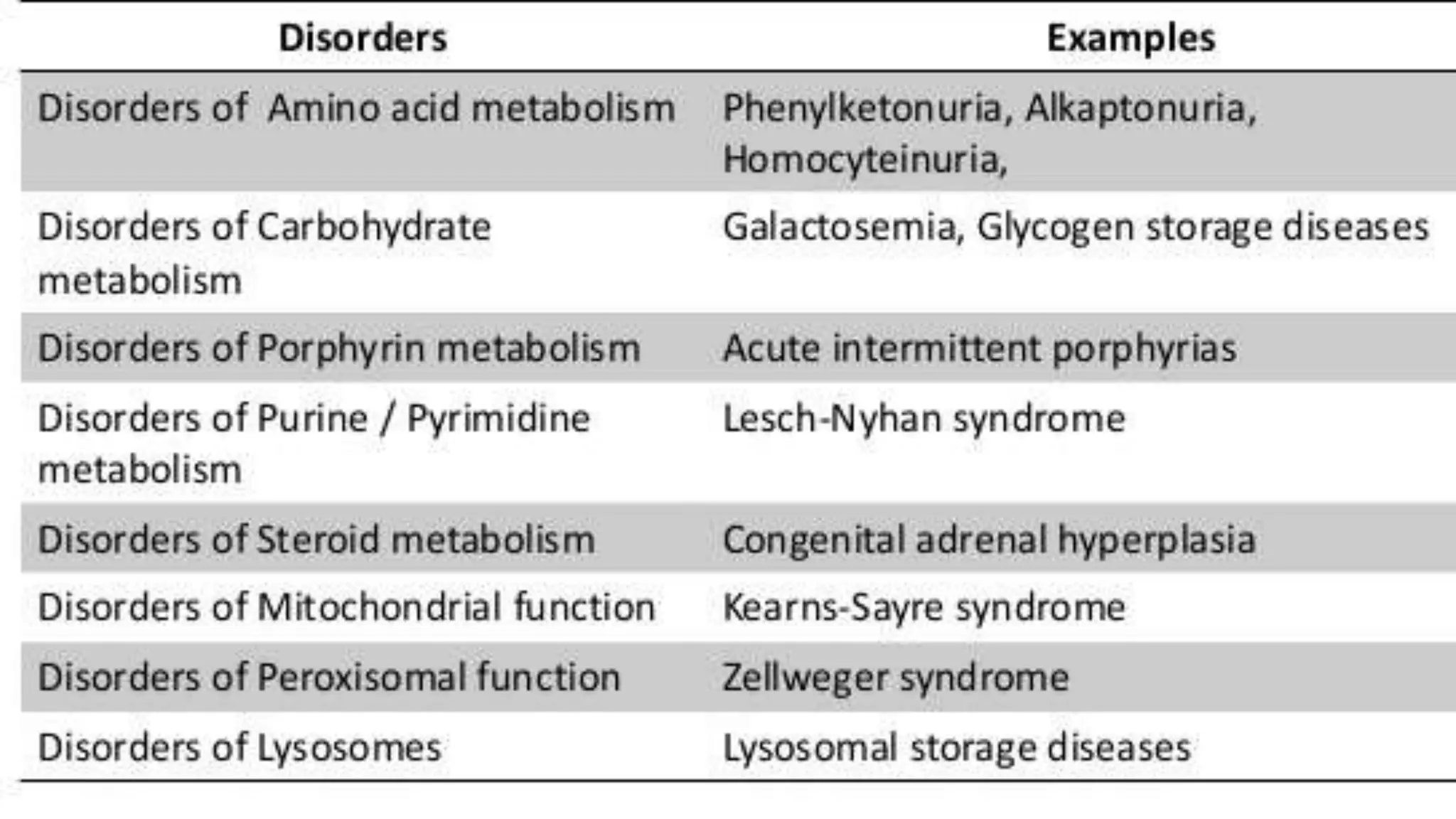
Good morning
Have a nice day to all
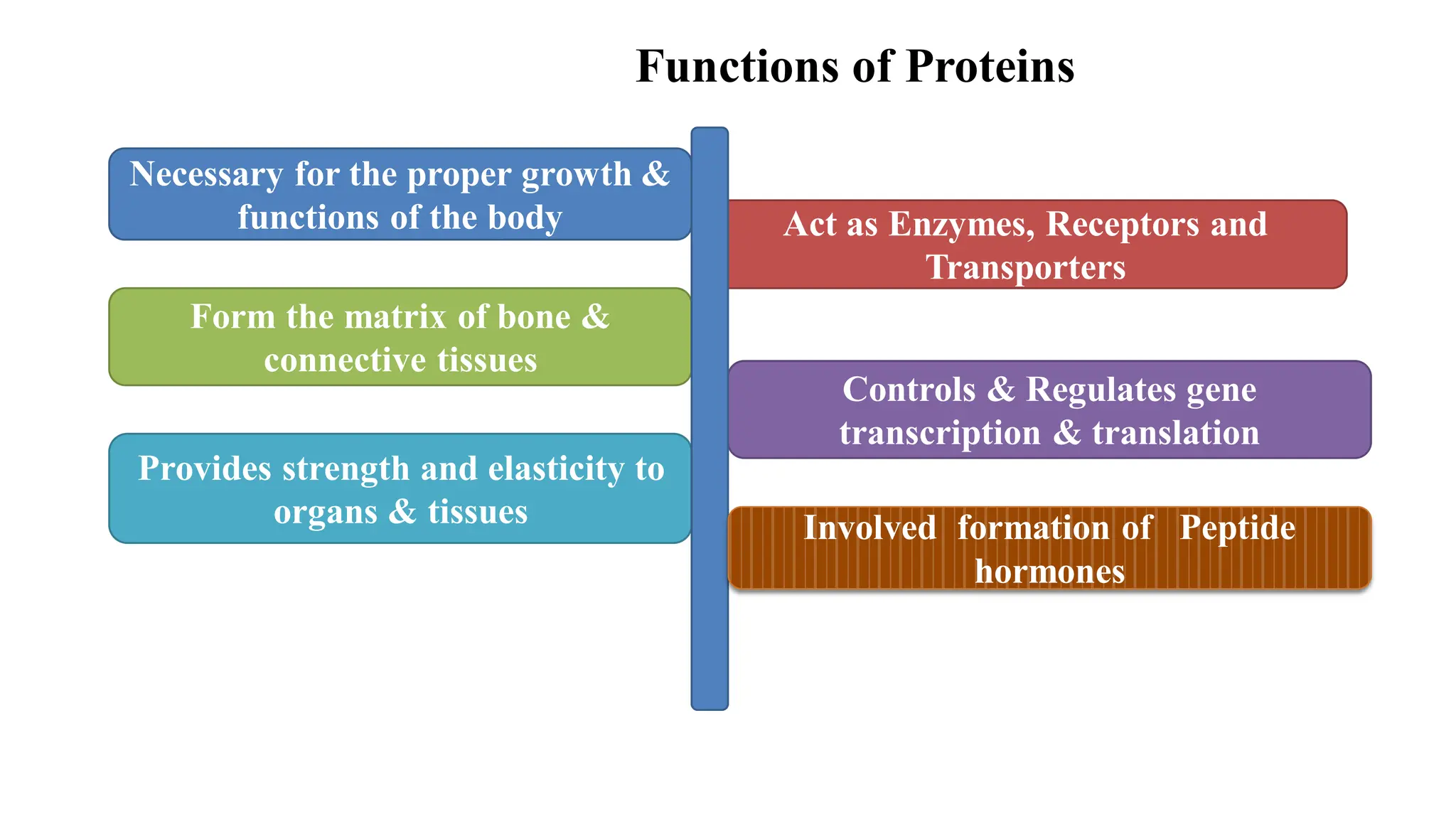
PROTEINS
Large, complex molecules formed by amino acids.
Component of every cell in the body
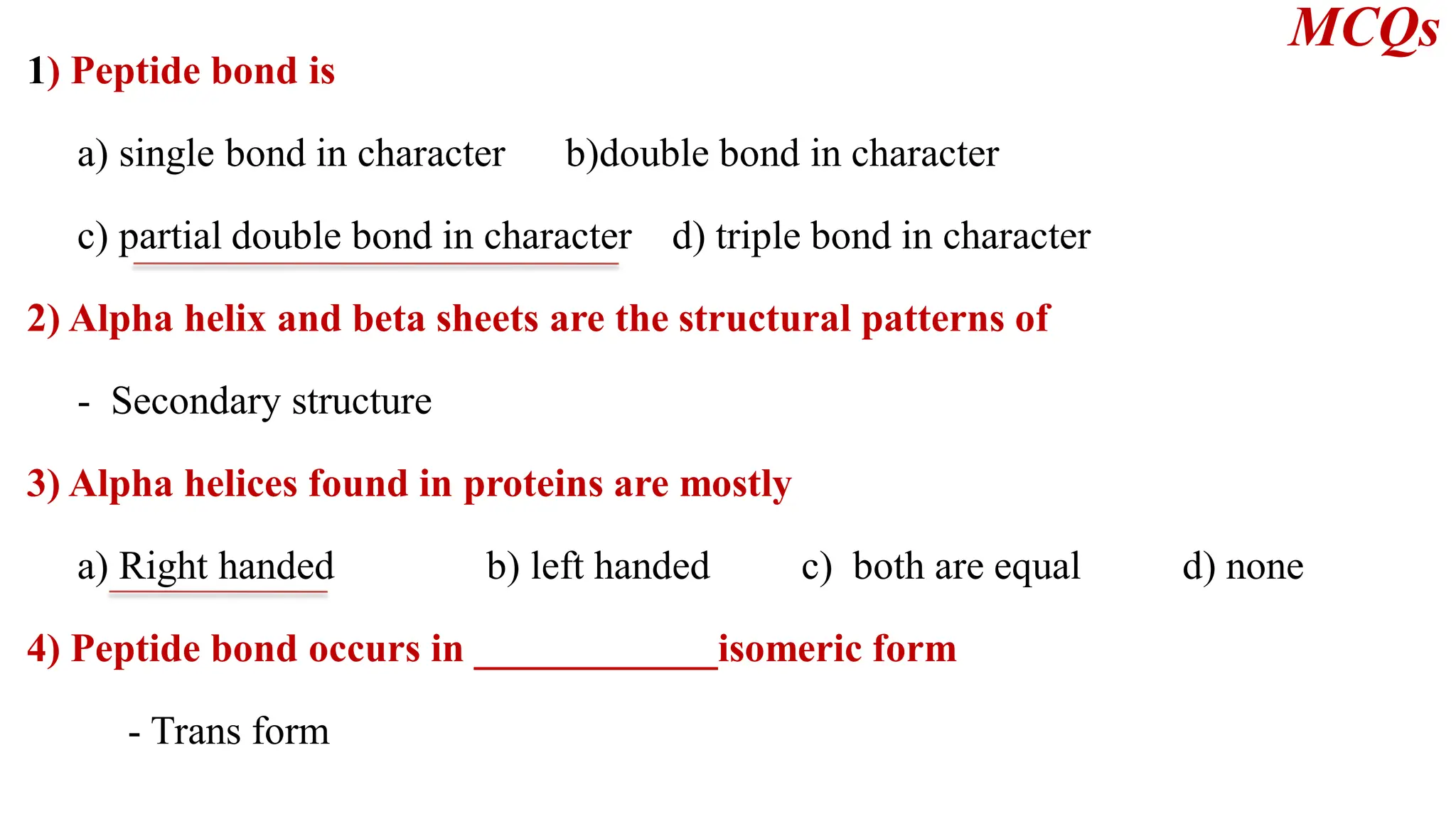
Functions of Proteins
Controls & Regulates gene
transcription & translation
Provides strength and elasticity to
organs & tissues
Form the matrix of bone &
connective tissues
Act as Enzymes, Receptors and
Transporters
Necessary for the proper growth &
functions of the body
Involved formation of Peptide
hormones
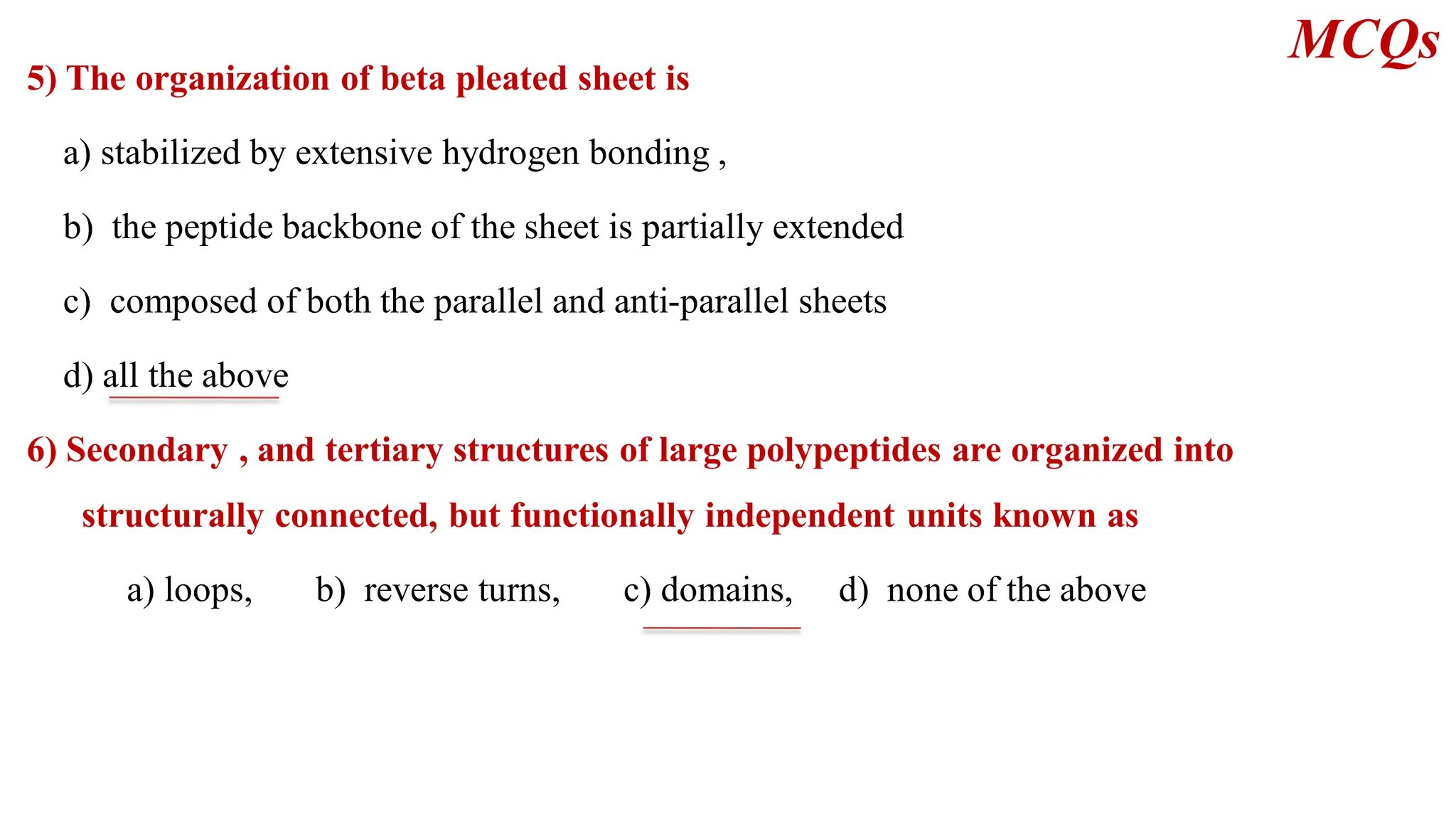
1) Peptide bond is
a) single bond in character b)double bond in character
c) partial double bond in character d) triple bond in character
2) Alpha helix and beta sheets are the structural patterns of
- Secondary structure
3) Alpha helices found in proteins are mostly
a) Right handed b) left handed c) both are equal d) none
4) Peptide bond occurs in ____________isomeric form
- Trans form
MCQs
5) The organization of beta pleated sheet is
a) stabilized by extensive hydrogen bonding ,
b) the peptide backbone of the sheet is partially extended
c) composed of both the parallel and anti-parallel sheets
d) all the above
6) Secondary , and tertiary structures of large polypeptides are organized into
structurally connected, but functionally independent units known as
a) loops, b) reverse turns, c) domains, d) none of the above
MCQs
CLASSIFICATION
OF
PROTEINS
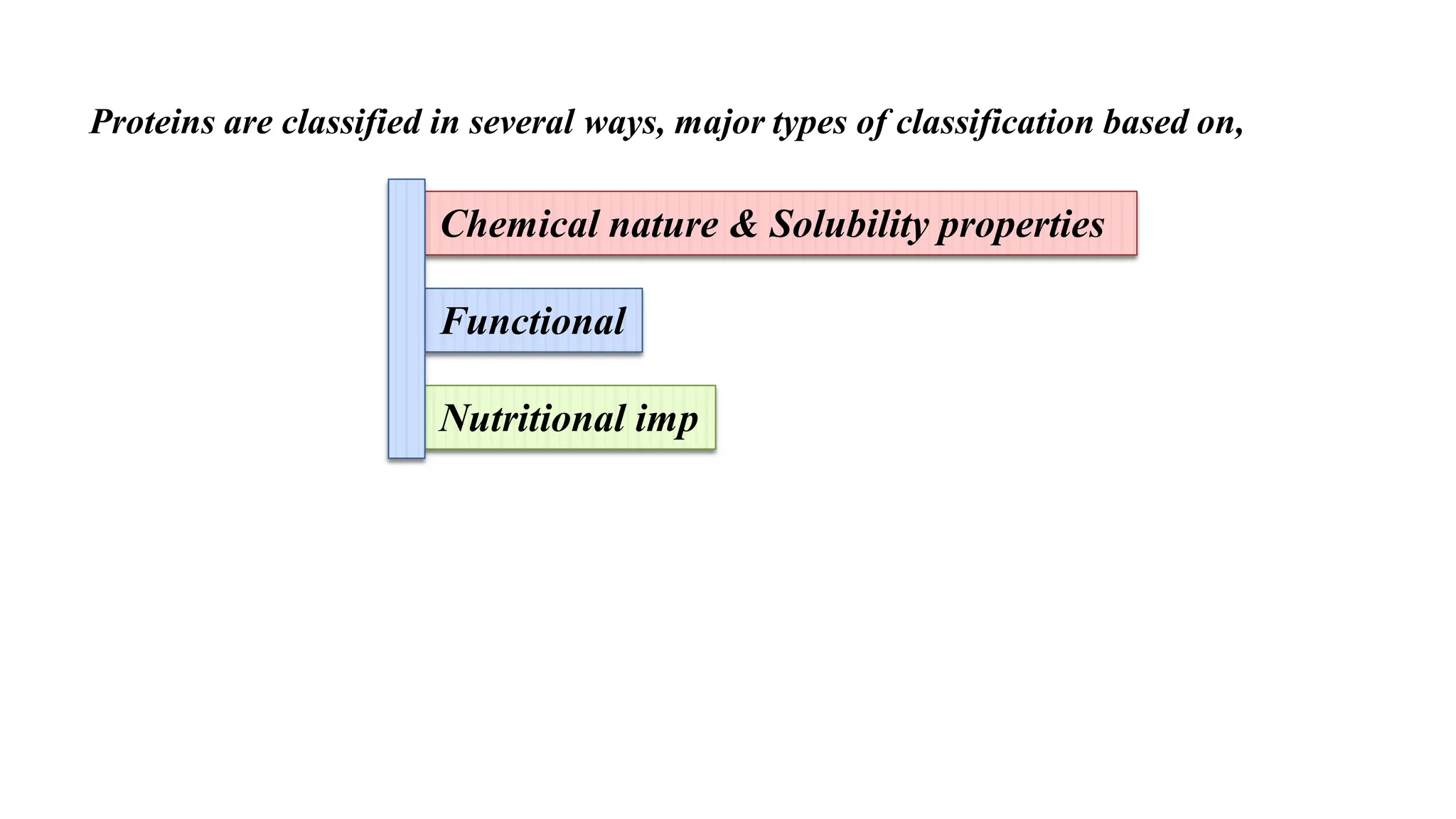
Functional
Chemical nature & Solubility properties
Nutritional imp
Proteins are classified in several ways, major types of classification based on,
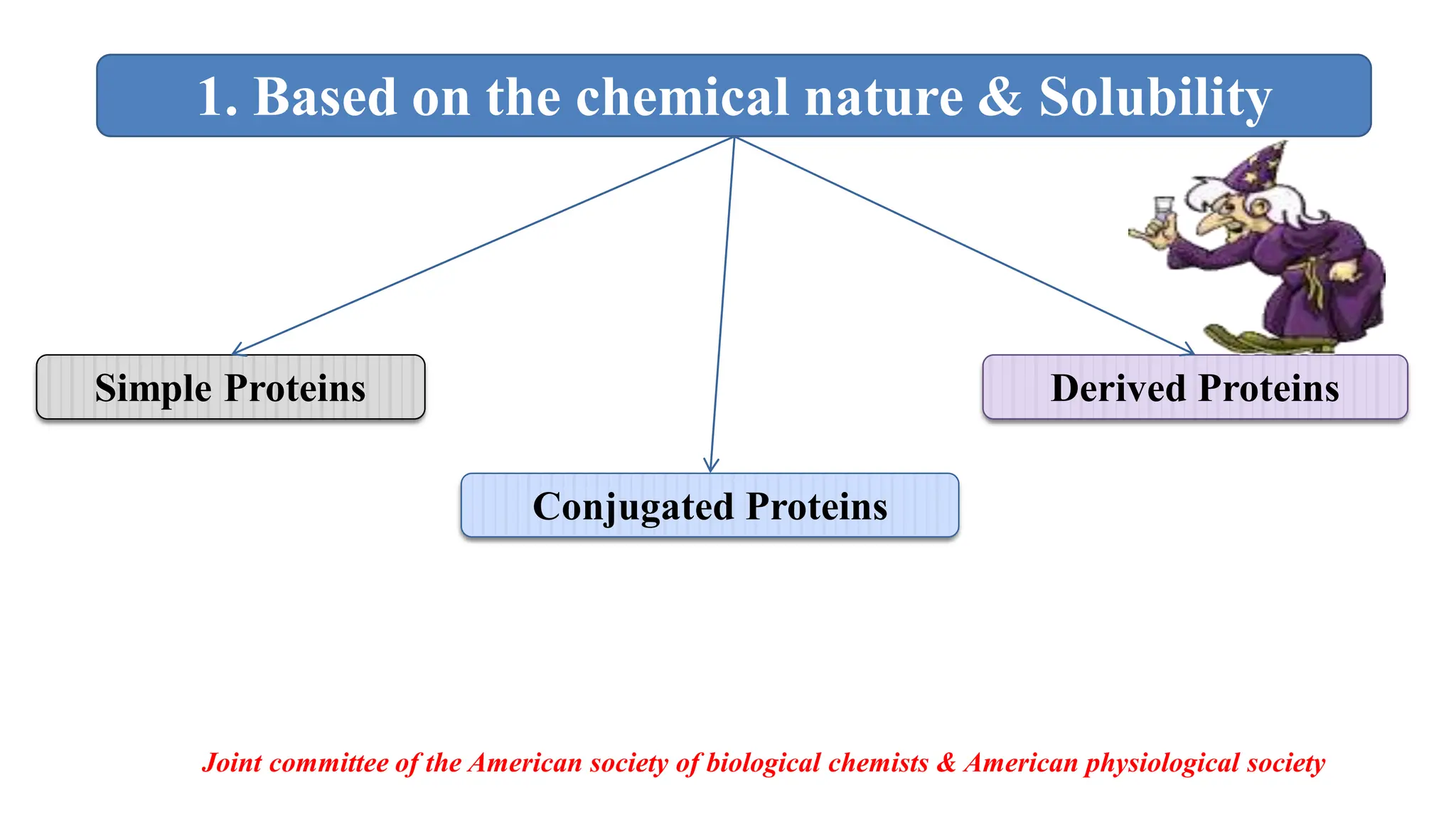
Simple Proteins
Conjugated Proteins
Derived Proteins
1. Based on the chemical nature & Solubility
Joint committee of the American society of biological chemists & American physiological society
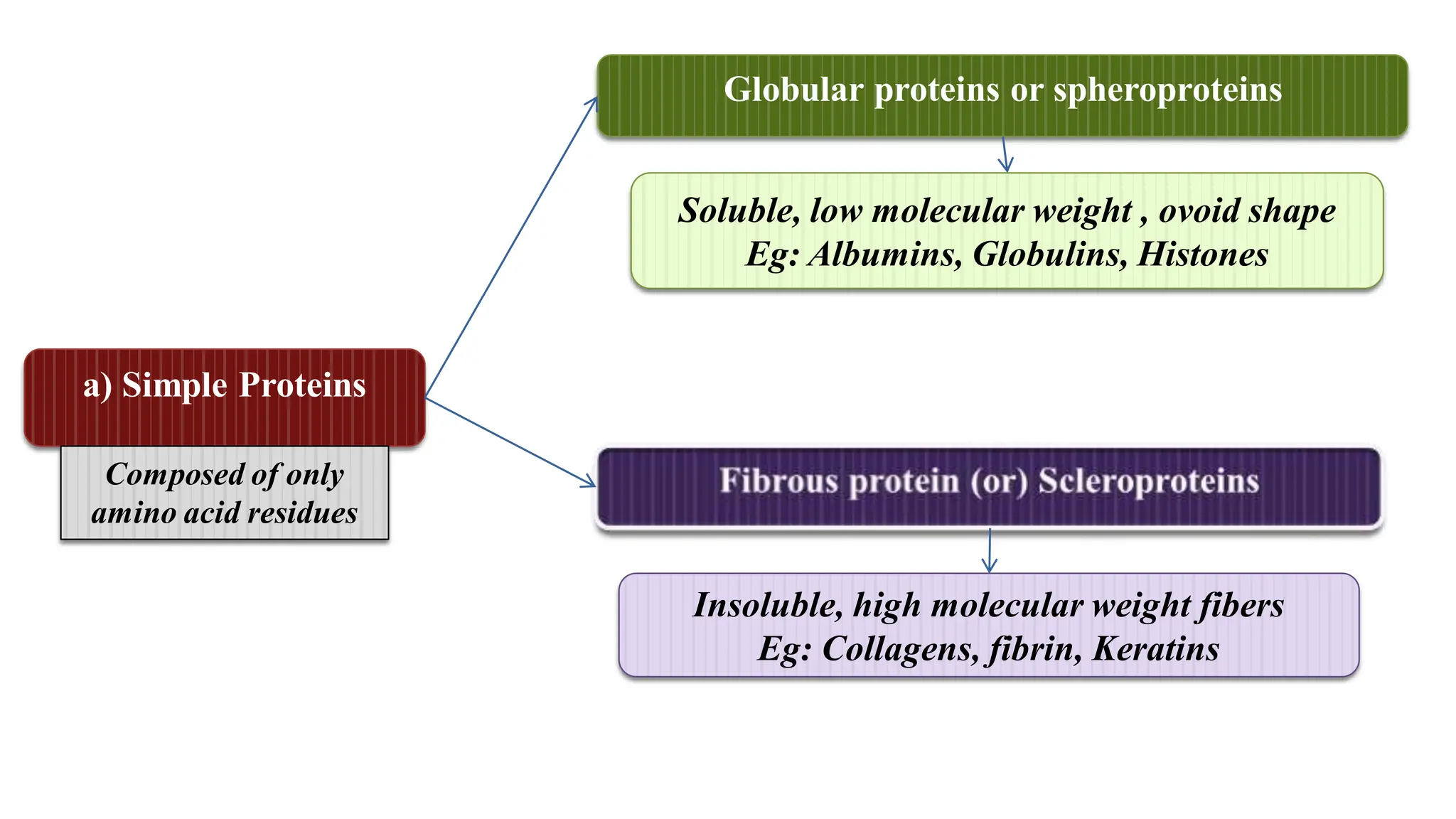
Globular proteins or spheroproteins
a) Simple Proteins
Insoluble, high molecular weight fibers
Eg: Collagens, fibrin, Keratins
Soluble, low molecular weight , ovoid shape
Eg: Albumins, Globulins, Histones
Composed of only
amino acid residues
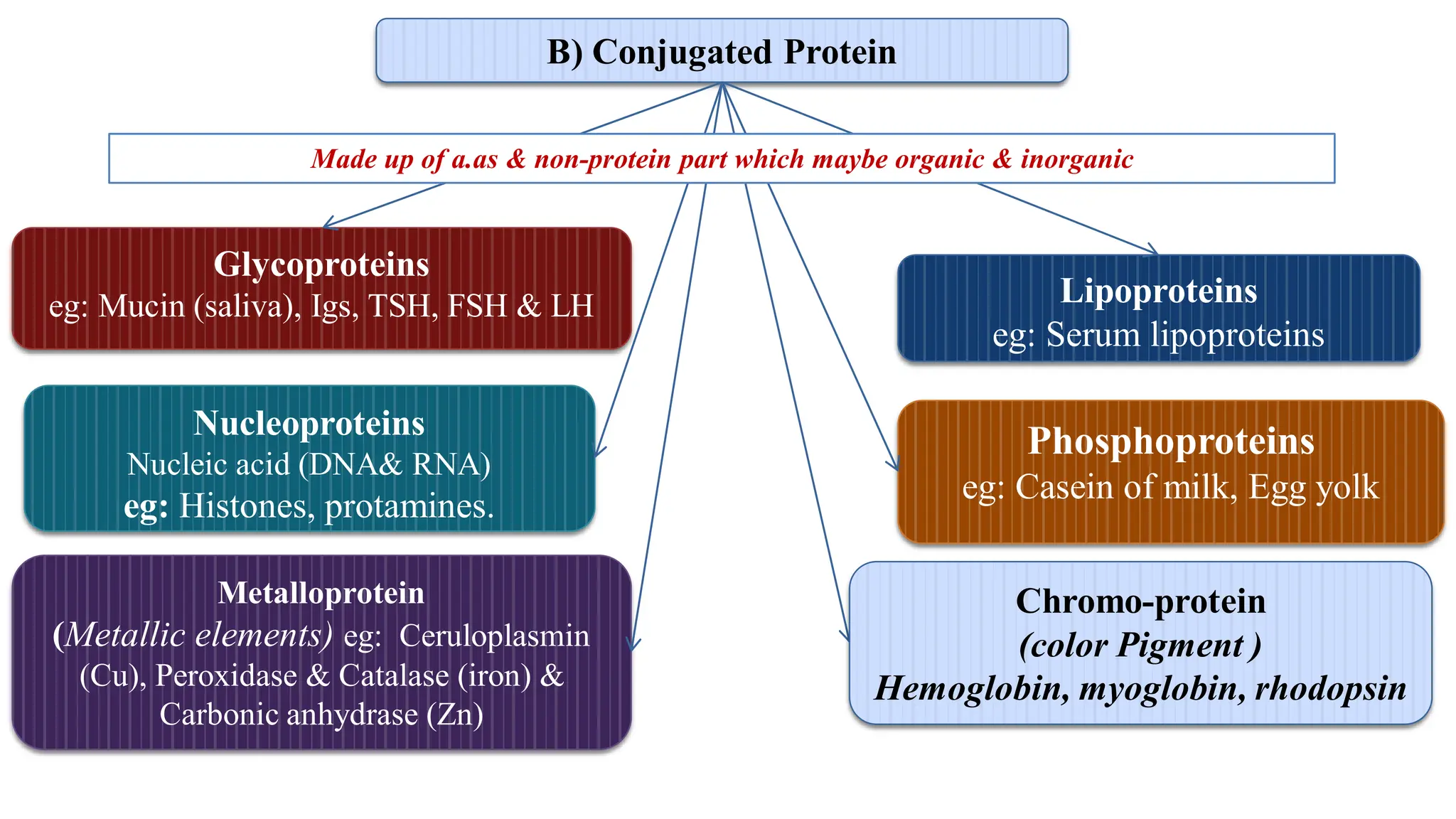
Glycoproteins
eg: Mucin (saliva), Igs, TSH, FSH & LH Lipoproteins
eg: Serum lipoproteins
B) Conjugated Protein
Nucleoproteins
Nucleic acid (DNA& RNA)
eg: Histones, protamines.
Phosphoproteins
eg: Casein of milk, Egg yolk
Metalloprotein
(Metallic elements) eg: Ceruloplasmin
(Cu), Peroxidase & Catalase (iron) &
Carbonic anhydrase (Zn)
Made up of a.as & non-protein part which maybe organic & inorganic
Chromo-protein
(color Pigment )
Hemoglobin, myoglobin, rhodopsin
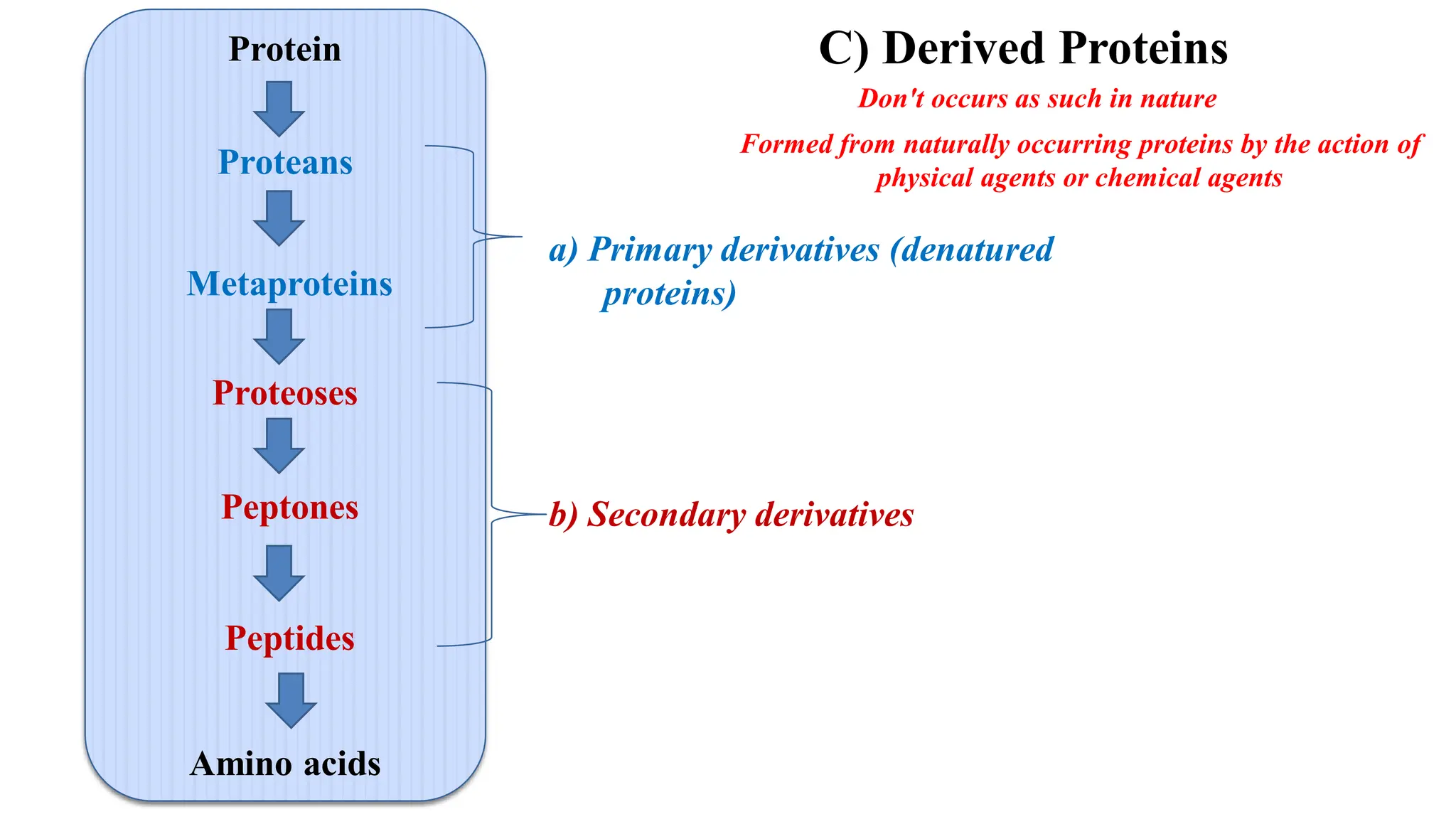
Protein
Proteans
Metaproteins
Proteoses
Peptones
Peptides
Amino acids
a) Primary derivatives (denatured
proteins)
b) Secondary derivatives
C) Derived Proteins
Don't occurs as such in nature
Formed from naturally occurring proteins by the action of
physical agents or chemical agents
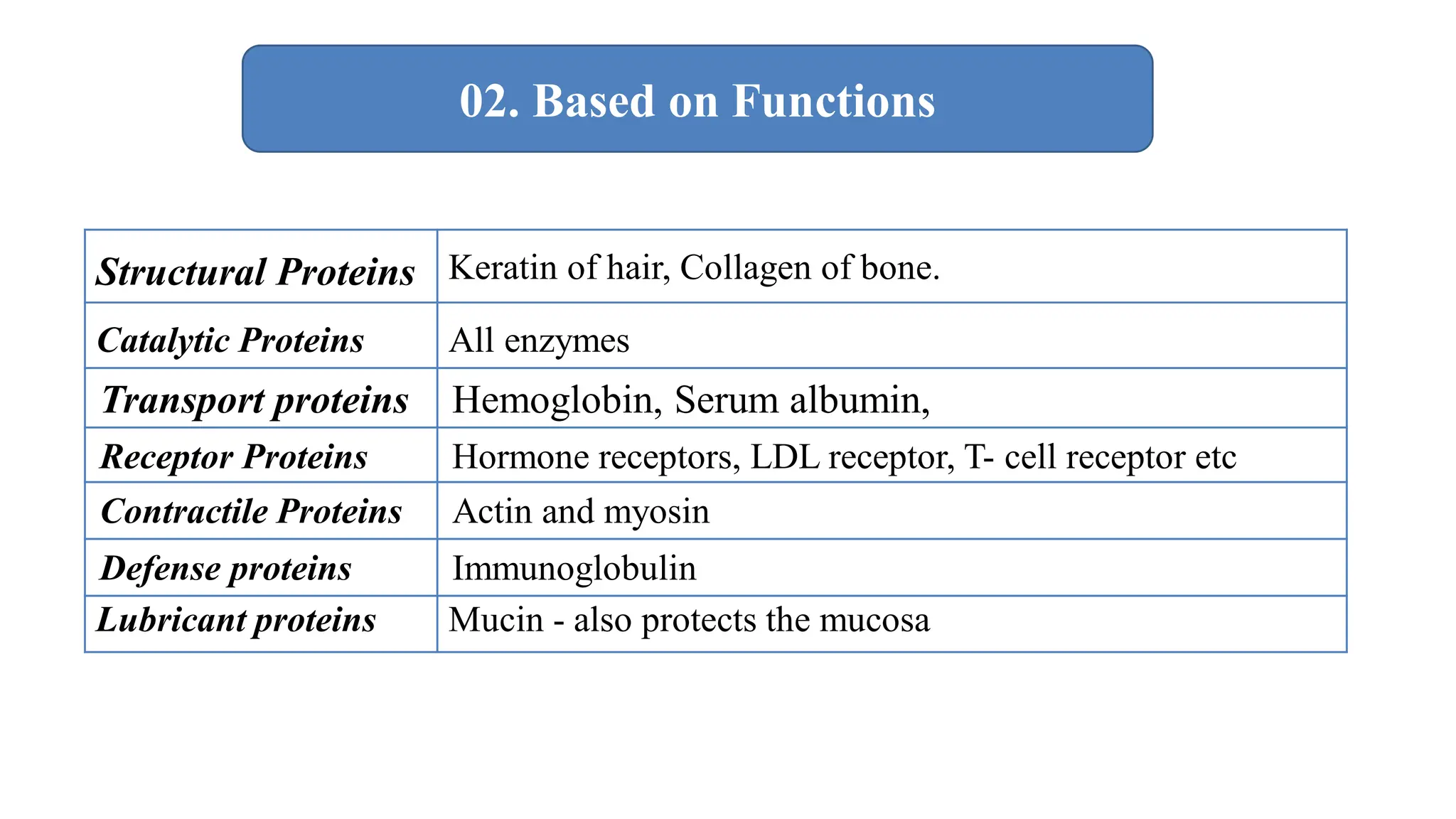
Structural Proteins Keratin of hair, Collagen of bone.
Catalytic Proteins All enzymes
Transport proteins Hemoglobin, Serum albumin,
Receptor Proteins Hormone receptors, LDL receptor, T- cell receptor etc
Contractile Proteins Actin and myosin
Defense proteins Immunoglobulin
Lubricant proteins Mucin - also protects the mucosa
02. Based on Functions
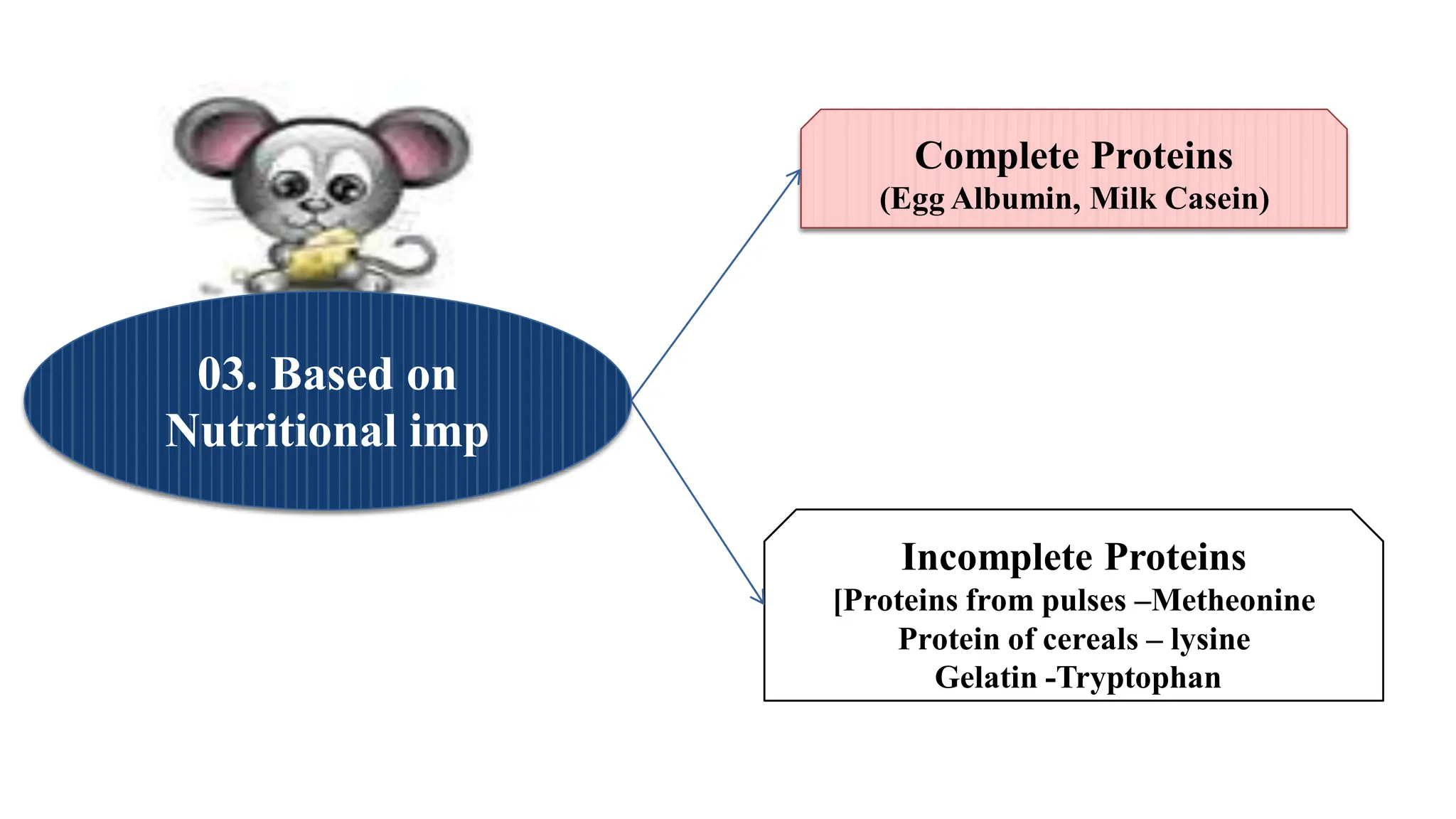
Complete Proteins
(Egg Albumin, Milk Casein)
Incomplete Proteins
[Proteins from pulses –Metheonine
Protein of cereals – lysine
Gelatin -Tryptophan
03. Based on
Nutritional imp
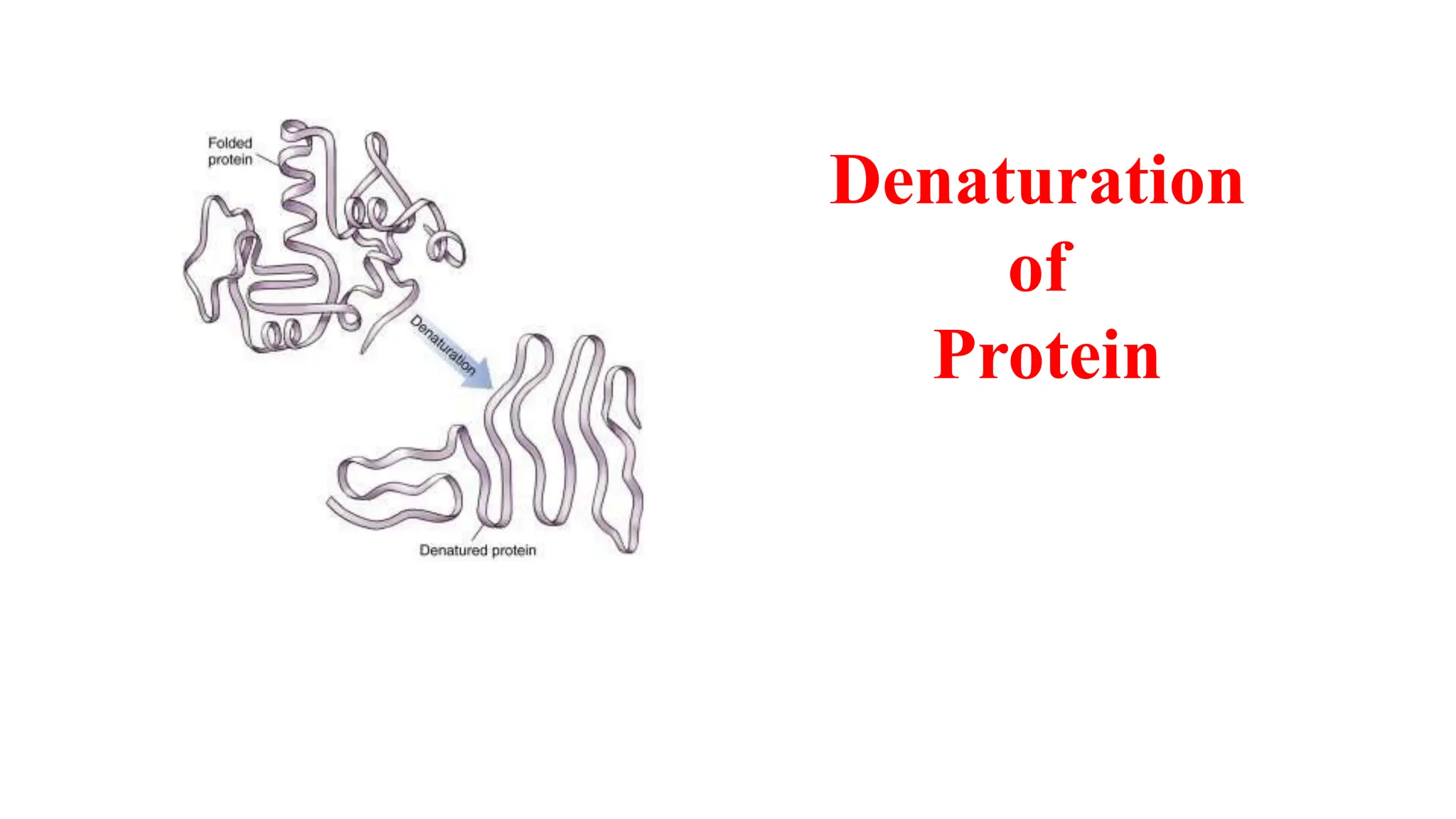
Denaturation
of
Protein
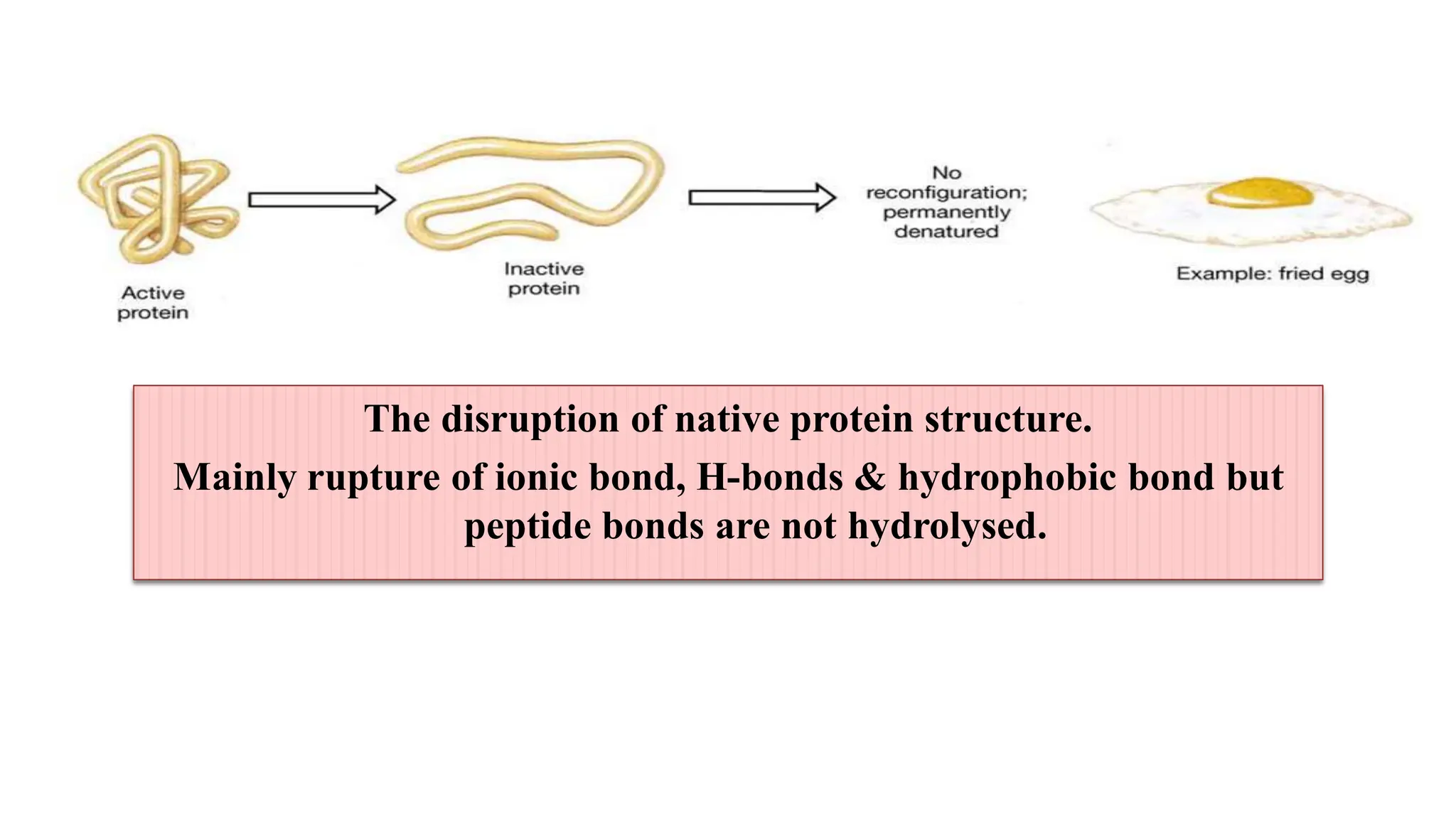
The disruption of native protein structure.
Mainly rupture of ionic bond, H-bonds & hydrophobic bond but
peptide bonds are not hydrolysed.
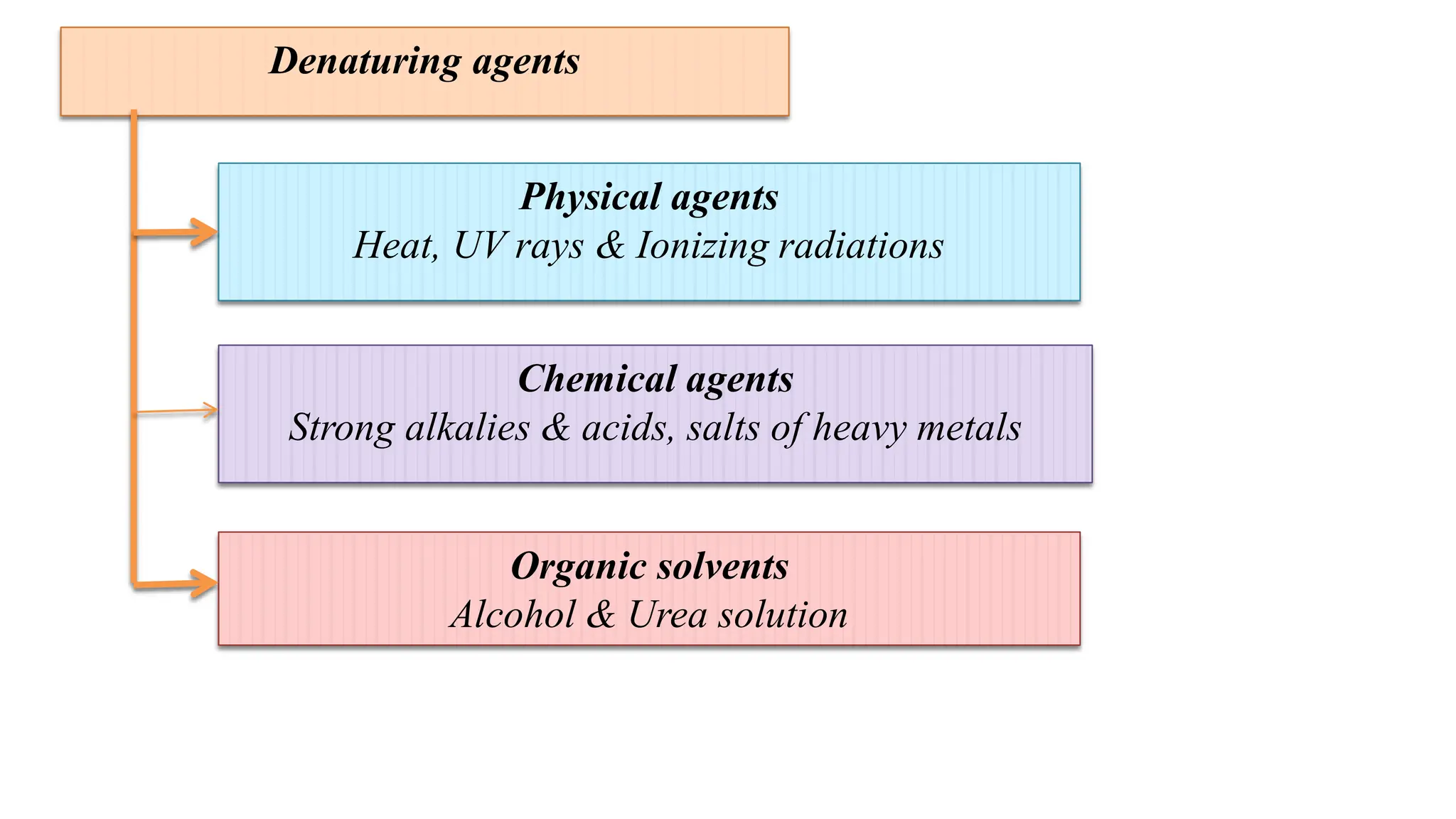
Denaturing agents
Physical agents
Heat, UV rays & Ionizing radiations
Chemical agents
Strong alkalies & acids, salts of heavy metals
Organic solvents
Alcohol & Urea solution
Denaturation of protein leads to.
• It loses its biological activities
• It is usually irreversible
• Decrease in solubility & increase in precipitability.
• Denatured proteins will have more exposed areas for enzymatic action (cooked foods are
more easily are easily digested and cannot be crystallized).
Structure & Functional Relationship
of proteins
Three dimensional structural conformation provides & maintains the functional
characteristics that dependent on the primary structure.
Any difference in the primary structure may produce a protein, which cannot serve
its function.
Enzymes
• All are proteins catalyst of chemical reaction in biological systems
• Increase the rate of chemical reactions taking place within living cells
without participating in the reaction.
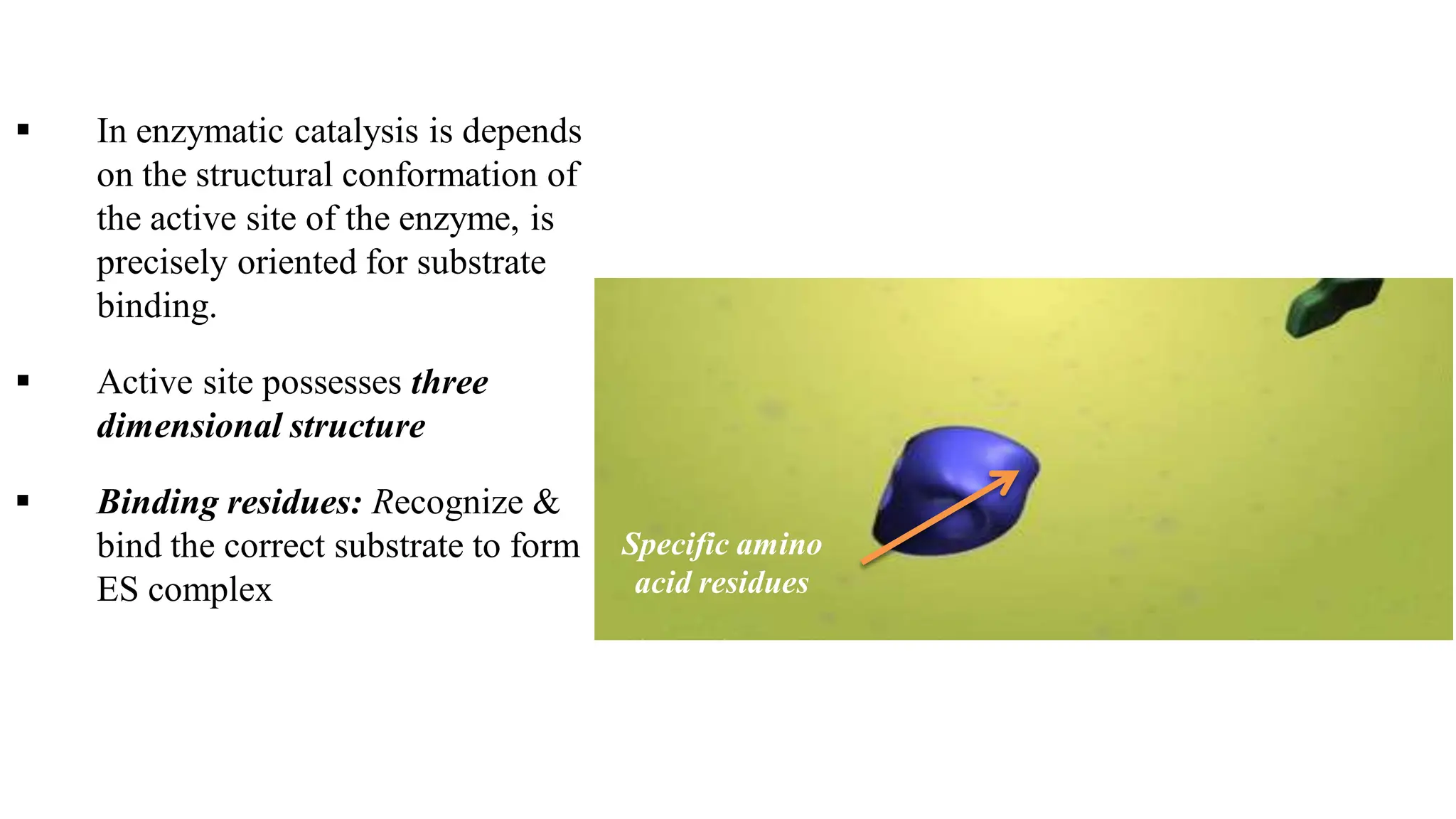
 In enzymatic catalysis is depends
on the structural conformation of
the active site of the enzyme, is
precisely oriented for substrate
binding.
 Active site possesses three
dimensional structure
 Binding residues: Recognize &
bind the correct substrate to form
ES complex
Specific amino
acid residues
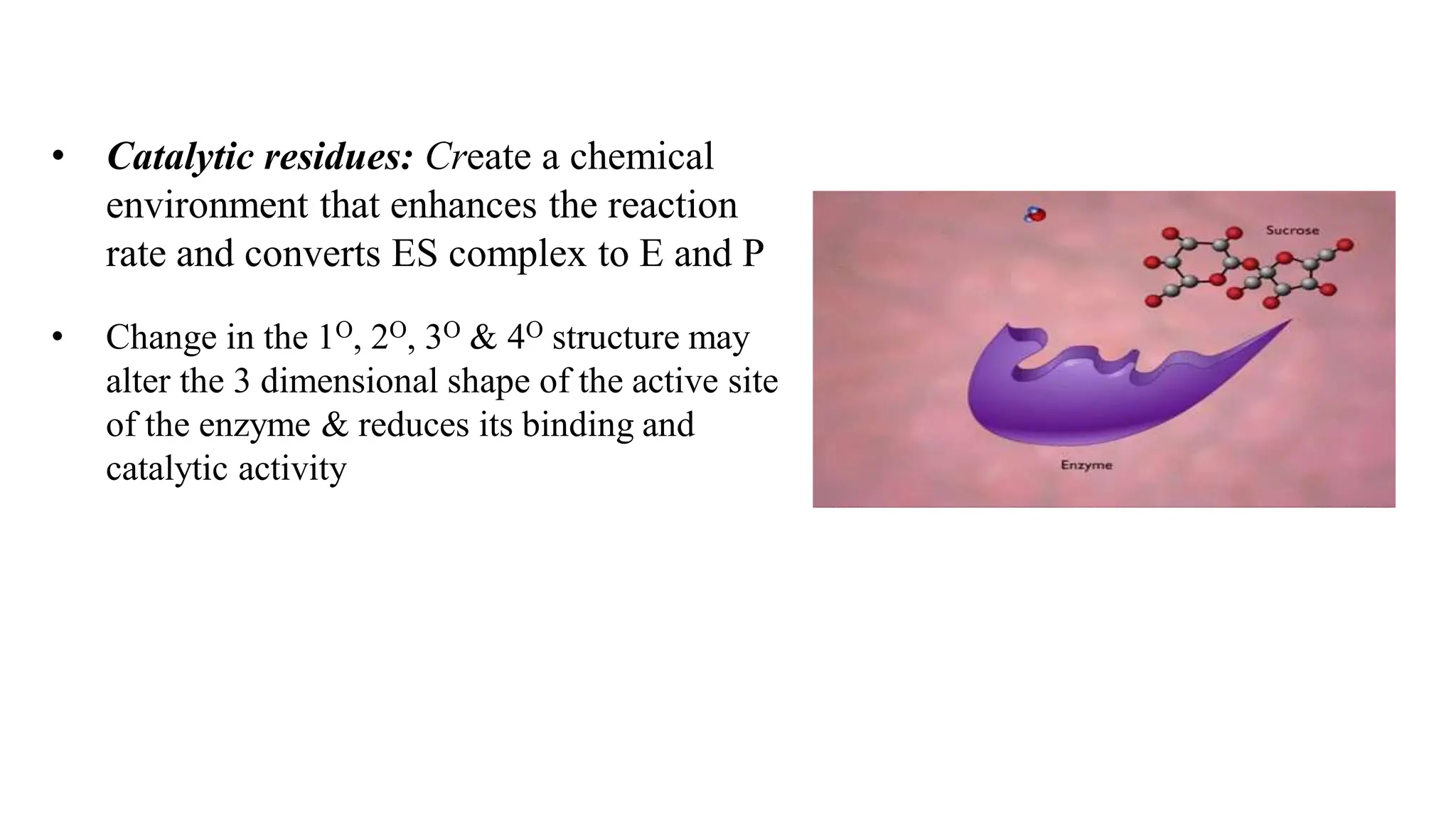
• Catalytic residues: Create a chemical
environment that enhances the reaction
rate and converts ES complex to E and P
• Change in the 1O, 2O, 3O & 4O structure may
alter the 3 dimensional shape of the active site
of the enzyme & reduces its binding and
catalytic activity
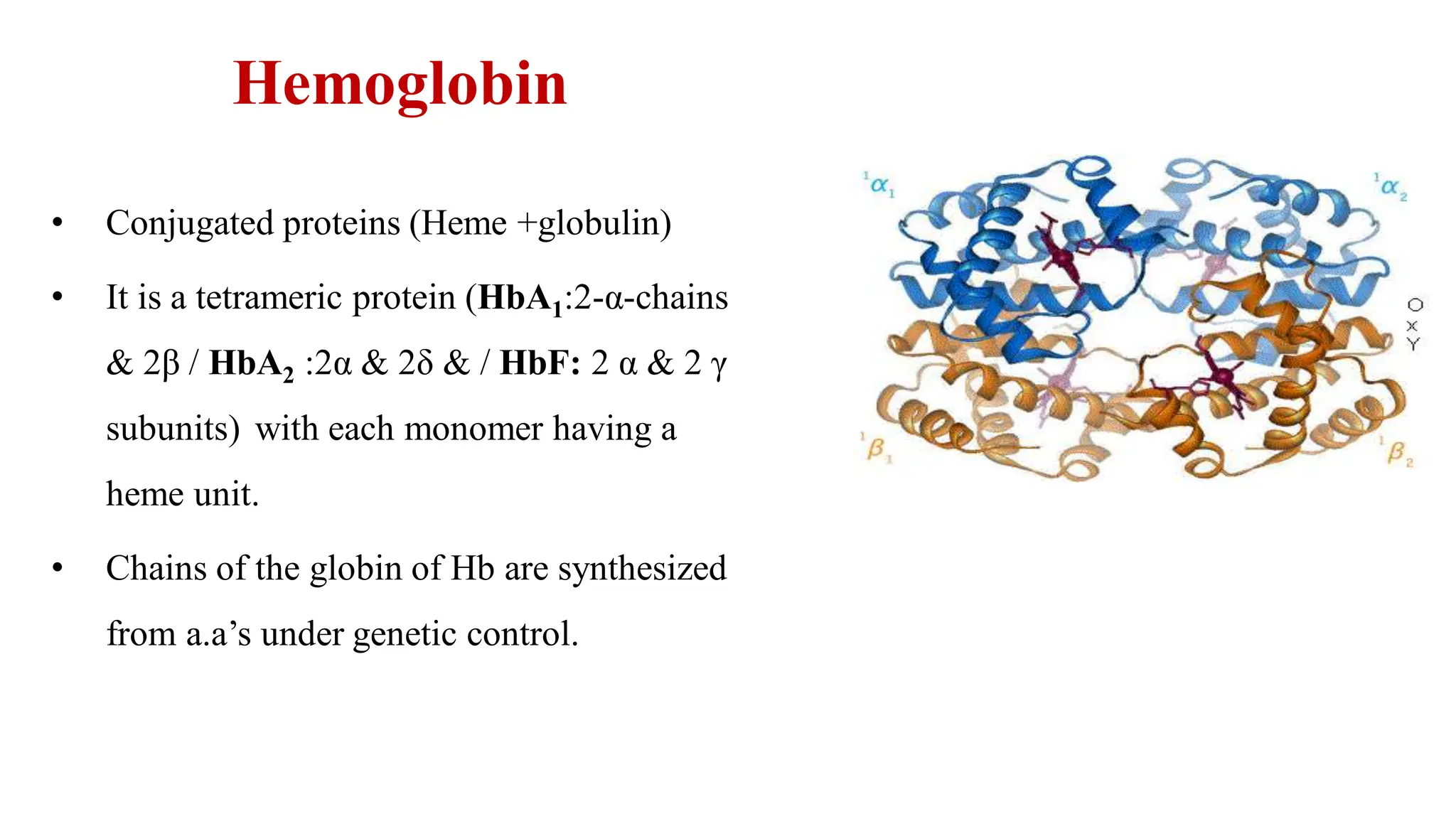
Hemoglobin
• Conjugated proteins (Heme +globulin)
• It is a tetrameric protein (HbA1:2-α-chains
& 2β / HbA2 :2α & 2δ & / HbF: 2 α & 2 γ
subunits) with each monomer having a
heme unit.
• Chains of the globin of Hb are synthesized
from a.a’s under genetic control.
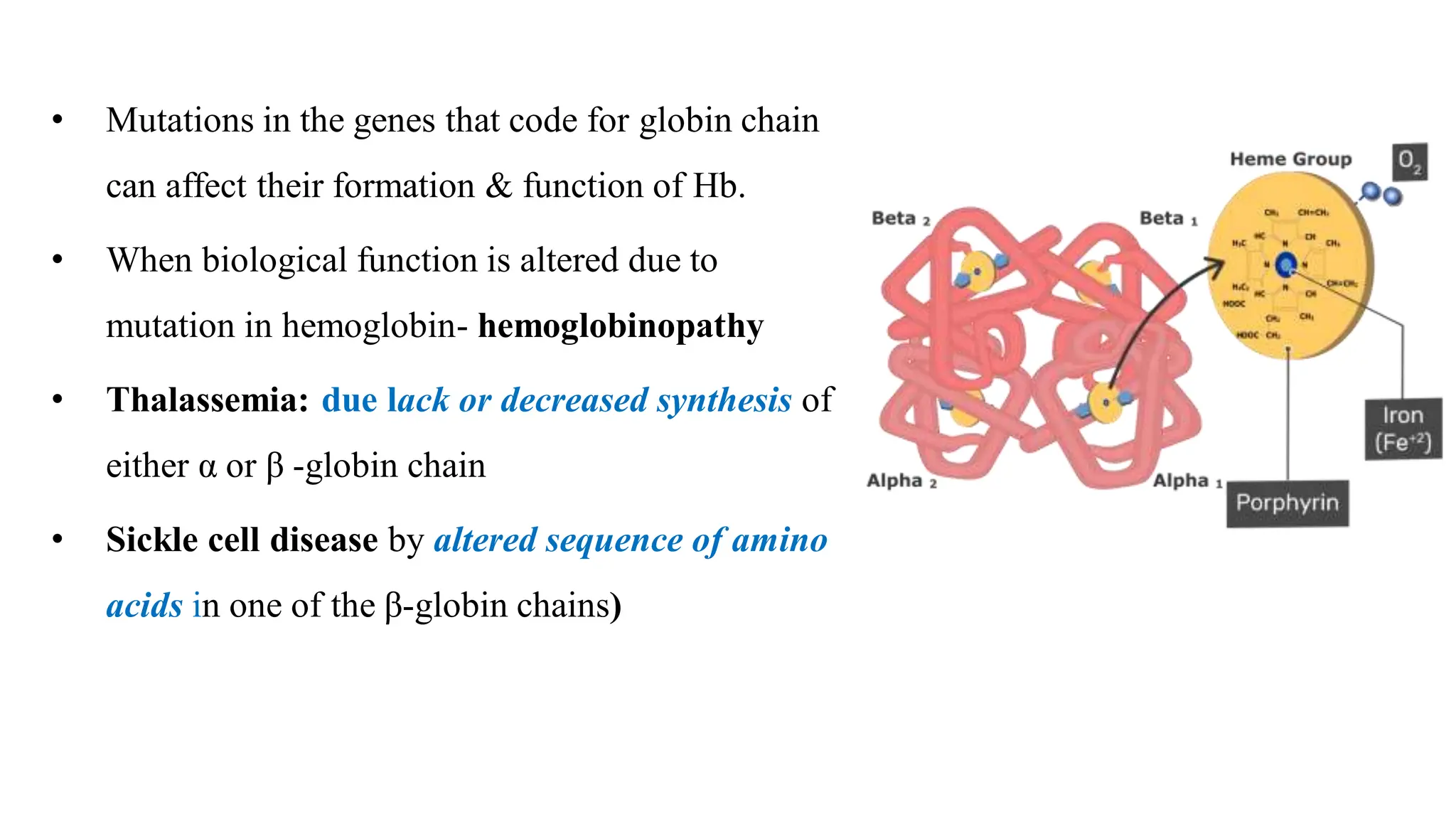
• Mutations in the genes that code for globin chain
can affect their formation & function of Hb.
• When biological function is altered due to
mutation in hemoglobin- hemoglobinopathy
• Thalassemia: due lack or decreased synthesis of
either α or β -globin chain
• Sickle cell disease by altered sequence of amino
acids in one of the β-globin chains)
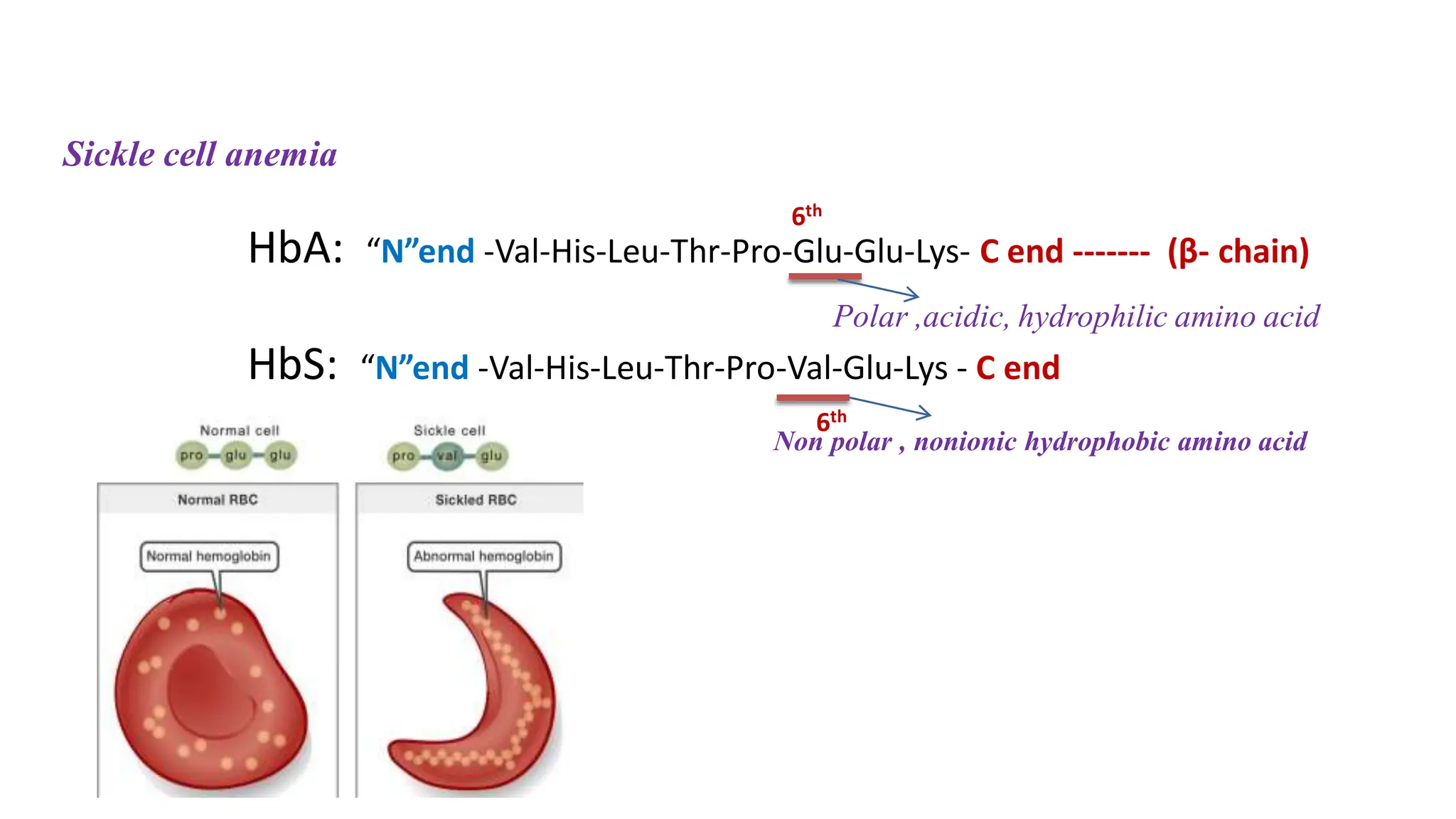
HbA: “N”end -Val-His-Leu-Thr-Pro-Glu-Glu-Lys- C end ------- (β- chain)
HbS: “N”end -Val-His-Leu-Thr-Pro-Val-Glu-Lys - C end
6th
Non polar , nonionic hydrophobic amino acid
Polar ,acidic, hydrophilic amino acid
Sickle cell anemia
6th

classification & denaturation and structural -functional relationship of Proteins

classification & denaturation and structural -functional relationship of Proteins

  • 1.
    Good morning Have anice day to all
  • 2.
    PROTEINS Large, complex moleculesformed by amino acids. Component of every cell in the body
  • 3.
    Functions of Proteins Controls& Regulates gene transcription & translation Provides strength and elasticity to organs & tissues Form the matrix of bone & connective tissues Act as Enzymes, Receptors and Transporters Necessary for the proper growth & functions of the body Involved formation of Peptide hormones
  • 4.
    1) Peptide bondis a) single bond in character b)double bond in character c) partial double bond in character d) triple bond in character 2) Alpha helix and beta sheets are the structural patterns of - Secondary structure 3) Alpha helices found in proteins are mostly a) Right handed b) left handed c) both are equal d) none 4) Peptide bond occurs in ____________isomeric form - Trans form MCQs
  • 5.
    5) The organizationof beta pleated sheet is a) stabilized by extensive hydrogen bonding , b) the peptide backbone of the sheet is partially extended c) composed of both the parallel and anti-parallel sheets d) all the above 6) Secondary , and tertiary structures of large polypeptides are organized into structurally connected, but functionally independent units known as a) loops, b) reverse turns, c) domains, d) none of the above MCQs
  • 6.
  • 7.
    Functional Chemical nature &Solubility properties Nutritional imp Proteins are classified in several ways, major types of classification based on,
  • 8.
    Simple Proteins Conjugated Proteins DerivedProteins 1. Based on the chemical nature & Solubility Joint committee of the American society of biological chemists & American physiological society
  • 9.
    Globular proteins orspheroproteins a) Simple Proteins Insoluble, high molecular weight fibers Eg: Collagens, fibrin, Keratins Soluble, low molecular weight , ovoid shape Eg: Albumins, Globulins, Histones Composed of only amino acid residues
  • 10.
    Glycoproteins eg: Mucin (saliva),Igs, TSH, FSH & LH Lipoproteins eg: Serum lipoproteins B) Conjugated Protein Nucleoproteins Nucleic acid (DNA& RNA) eg: Histones, protamines. Phosphoproteins eg: Casein of milk, Egg yolk Metalloprotein (Metallic elements) eg: Ceruloplasmin (Cu), Peroxidase & Catalase (iron) & Carbonic anhydrase (Zn) Made up of a.as & non-protein part which maybe organic & inorganic Chromo-protein (color Pigment ) Hemoglobin, myoglobin, rhodopsin
  • 11.
    Protein Proteans Metaproteins Proteoses Peptones Peptides Amino acids a) Primaryderivatives (denatured proteins) b) Secondary derivatives C) Derived Proteins Don't occurs as such in nature Formed from naturally occurring proteins by the action of physical agents or chemical agents
  • 12.
    Structural Proteins Keratinof hair, Collagen of bone. Catalytic Proteins All enzymes Transport proteins Hemoglobin, Serum albumin, Receptor Proteins Hormone receptors, LDL receptor, T- cell receptor etc Contractile Proteins Actin and myosin Defense proteins Immunoglobulin Lubricant proteins Mucin - also protects the mucosa 02. Based on Functions
  • 13.
    Complete Proteins (Egg Albumin,Milk Casein) Incomplete Proteins [Proteins from pulses –Metheonine Protein of cereals – lysine Gelatin -Tryptophan 03. Based on Nutritional imp
  • 14.
  • 15.
    The disruption ofnative protein structure. Mainly rupture of ionic bond, H-bonds & hydrophobic bond but peptide bonds are not hydrolysed.
  • 16.
    Denaturing agents Physical agents Heat,UV rays & Ionizing radiations Chemical agents Strong alkalies & acids, salts of heavy metals Organic solvents Alcohol & Urea solution
  • 17.
    Denaturation of proteinleads to. • It loses its biological activities • It is usually irreversible • Decrease in solubility & increase in precipitability. • Denatured proteins will have more exposed areas for enzymatic action (cooked foods are more easily are easily digested and cannot be crystallized).
  • 18.
    Structure & FunctionalRelationship of proteins Three dimensional structural conformation provides & maintains the functional characteristics that dependent on the primary structure. Any difference in the primary structure may produce a protein, which cannot serve its function.
  • 19.
    Enzymes • All areproteins catalyst of chemical reaction in biological systems • Increase the rate of chemical reactions taking place within living cells without participating in the reaction.
  • 20.
     In enzymaticcatalysis is depends on the structural conformation of the active site of the enzyme, is precisely oriented for substrate binding.  Active site possesses three dimensional structure  Binding residues: Recognize & bind the correct substrate to form ES complex Specific amino acid residues
  • 21.
    • Catalytic residues:Create a chemical environment that enhances the reaction rate and converts ES complex to E and P • Change in the 1O, 2O, 3O & 4O structure may alter the 3 dimensional shape of the active site of the enzyme & reduces its binding and catalytic activity
  • 23.
    Hemoglobin • Conjugated proteins(Heme +globulin) • It is a tetrameric protein (HbA1:2-α-chains & 2β / HbA2 :2α & 2δ & / HbF: 2 α & 2 γ subunits) with each monomer having a heme unit. • Chains of the globin of Hb are synthesized from a.a’s under genetic control.
  • 24.
    • Mutations inthe genes that code for globin chain can affect their formation & function of Hb. • When biological function is altered due to mutation in hemoglobin- hemoglobinopathy • Thalassemia: due lack or decreased synthesis of either α or β -globin chain • Sickle cell disease by altered sequence of amino acids in one of the β-globin chains)
  • 25.
    HbA: “N”end -Val-His-Leu-Thr-Pro-Glu-Glu-Lys-C end ------- (β- chain) HbS: “N”end -Val-His-Leu-Thr-Pro-Val-Glu-Lys - C end 6th Non polar , nonionic hydrophobic amino acid Polar ,acidic, hydrophilic amino acid Sickle cell anemia 6th