RNA interference
Asif Nawaz
MPhil (Microbiology)
AUST
RNAi Glossary
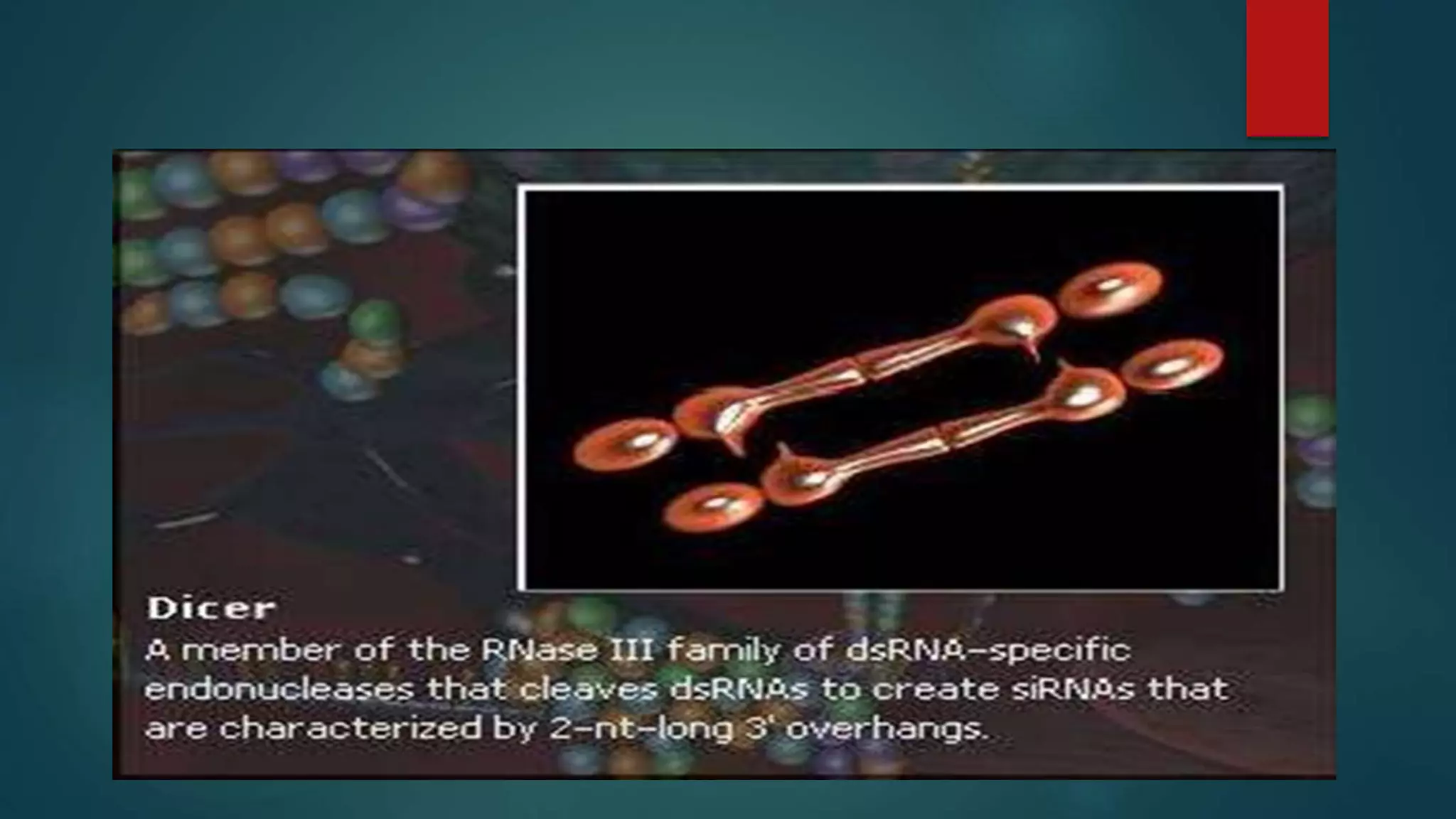
Dicer :
Dicer is a member of the RNase III family of nucleases that specifically cleave
double-stranded RNAs. Dicer processes long dsRNA into siRNA of 21-23 nt.
Interferon :
A small and highly potent molecule that functions in an autocrine and paracrine
manner, and that induces cells to resist viral replication. This term is related to RNA
because in mammals introduction of dsRNA longer than 30 nt induces a sequence-
nonspecific interferon response.
Micro-RNA :
Micro-RNAs (miRNA) are single-stranded RNAs of 22-nt that are processed from ~70-
nt hairpin RNA precursors by Rnase III nuclease Dicer. Similar to siRNA, miRNA
can silence gene activity via destruction of homologous mRNA in plants or blocking its
translation in plants and animals.
Post-Transcriptional Gene Silencing :
Post-transcriptional gene silencing (PTGS) is a sequence-specific RNA degradation
system designed to act as an anti-viral defense mechanism. A form of PTGS triggered
by transgenic DNA, called co-suppression, was initially described in plants and a
related phenomenon, termed quelling, was later observed in the filamentous fungus
Neurospora crassa
Ribozyme :
Ribozymes are RNA molecules that act as enzymes in the absence of proteins.
RNA Interference :
RNA Interference (RNAi), a term coined by Fire et al in 1998, is a phenomenon that small
double-stranded RNA (referred as small interference RNA or siRNA) can induce efficient
sequence-specific silence of gene expression.
RNA-Directed DNA Methylation :
RNA-directed DNA methylation (RdDM) is an RNA directed silencing mechanism found
in plants. Similar to RNA interference (RNAi), RdDM requires a double-strand RNA that
is cut into short 21-26-nt fragments. DNA sequences homologous to these short RNAs are
then methylated and silenced.
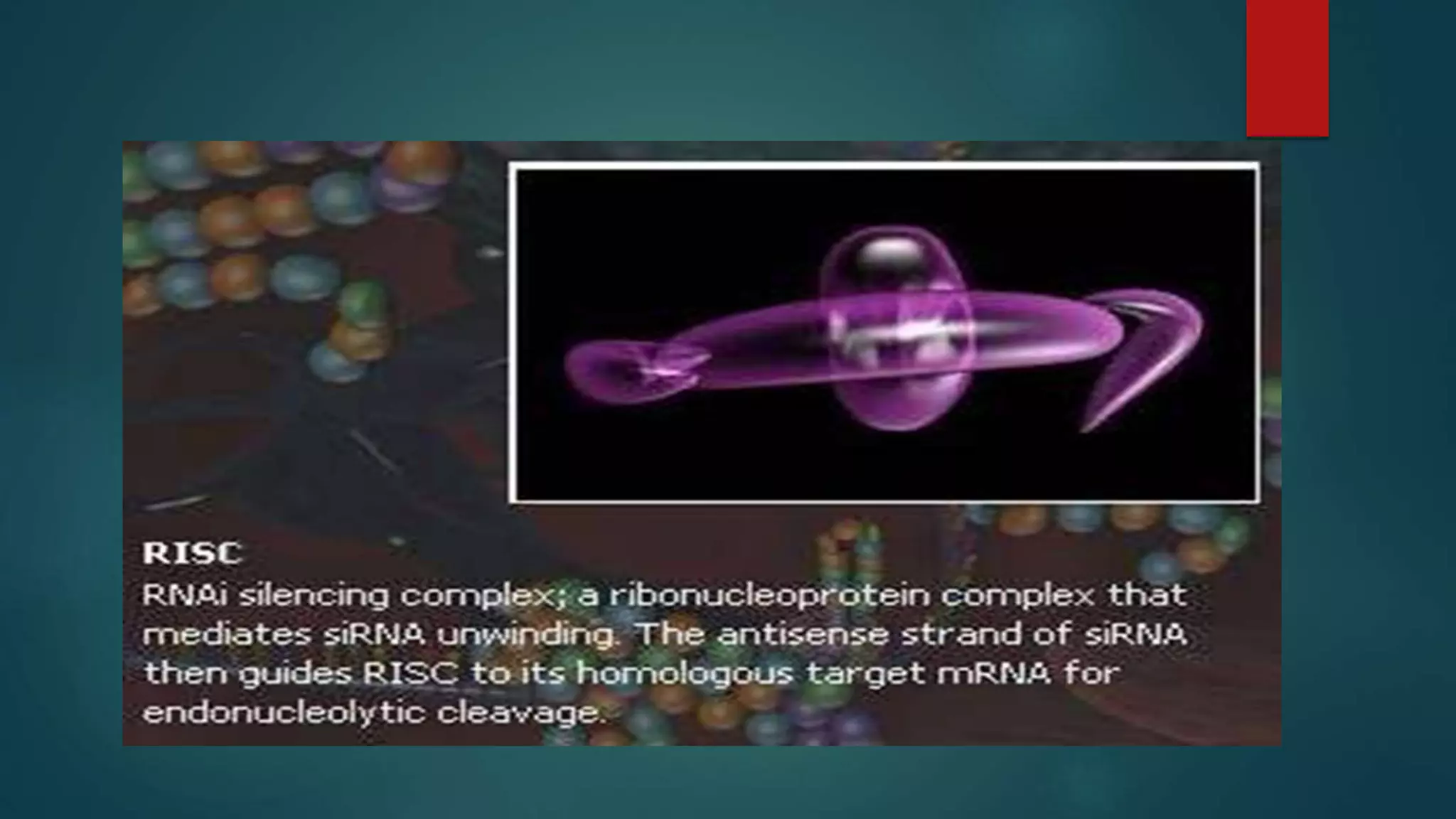
RNA-Induced Silencing Complex :
RNA-induced silencing complex (RISC) is an siRNA-directed endonuclease, catalyzing
cleavage of a single phosphodiester bond on the RNA target.
RNAi Trigger :
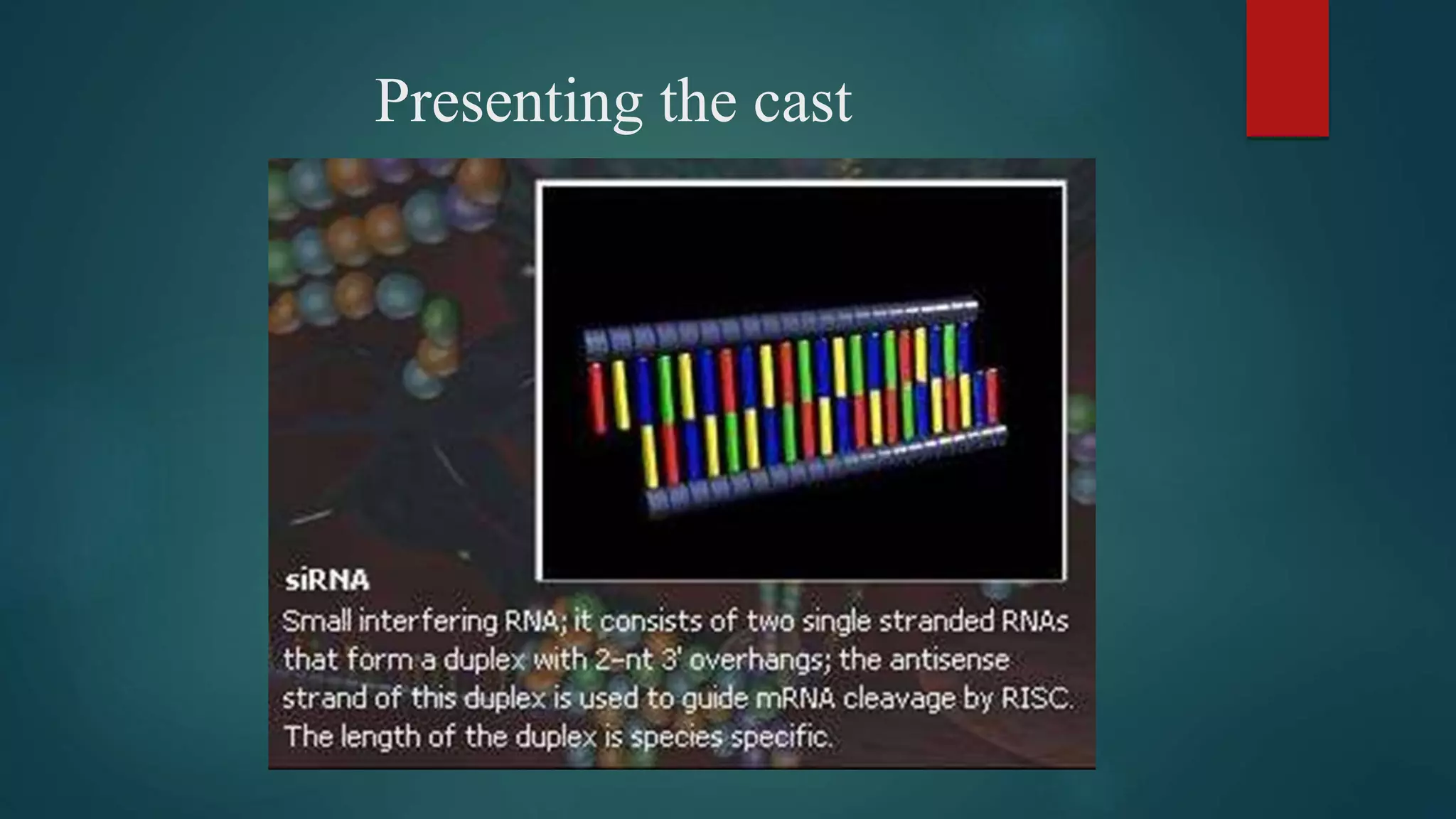
RNAi triggers are double-stranded RNAs containing 21-23 nt sense and antisens strands
hybridized to have 2 nt overhangs at both 3' ends.
Small Interfering RNA :
Small Interfering RNA (siRNA) is 21-23-nt double-strand RNA. It guides the cleavage and
degradation of its cognate RNA.
Helicase :
Enzyme responsible for unwinding double stranded molecule
What is RNAi?
RNA interference (RNAi) is an evolutionally highly
conserved process of post-transcriptional gene silencing
(PTGS) by which double stranded RNA (dsRNA) causes
sequence-specific degradation of mRNAsequences.
It was first discovered in 1998 by Andrew Fire and Craig
Mello in the nematode worm Caenorhabditis elegans and
later found in a wide variety of organisms, including
mammals.
RNAi is a conserved mechanism
RNAi is a universal, omnipresent conserved
mechanism in eukaryotic cells.
The cellular mechanism of RNAi Predates
evolutionary divergence of plants and worms.
Key proteins involved in RNAi in disparate
organisms are highly conserved.
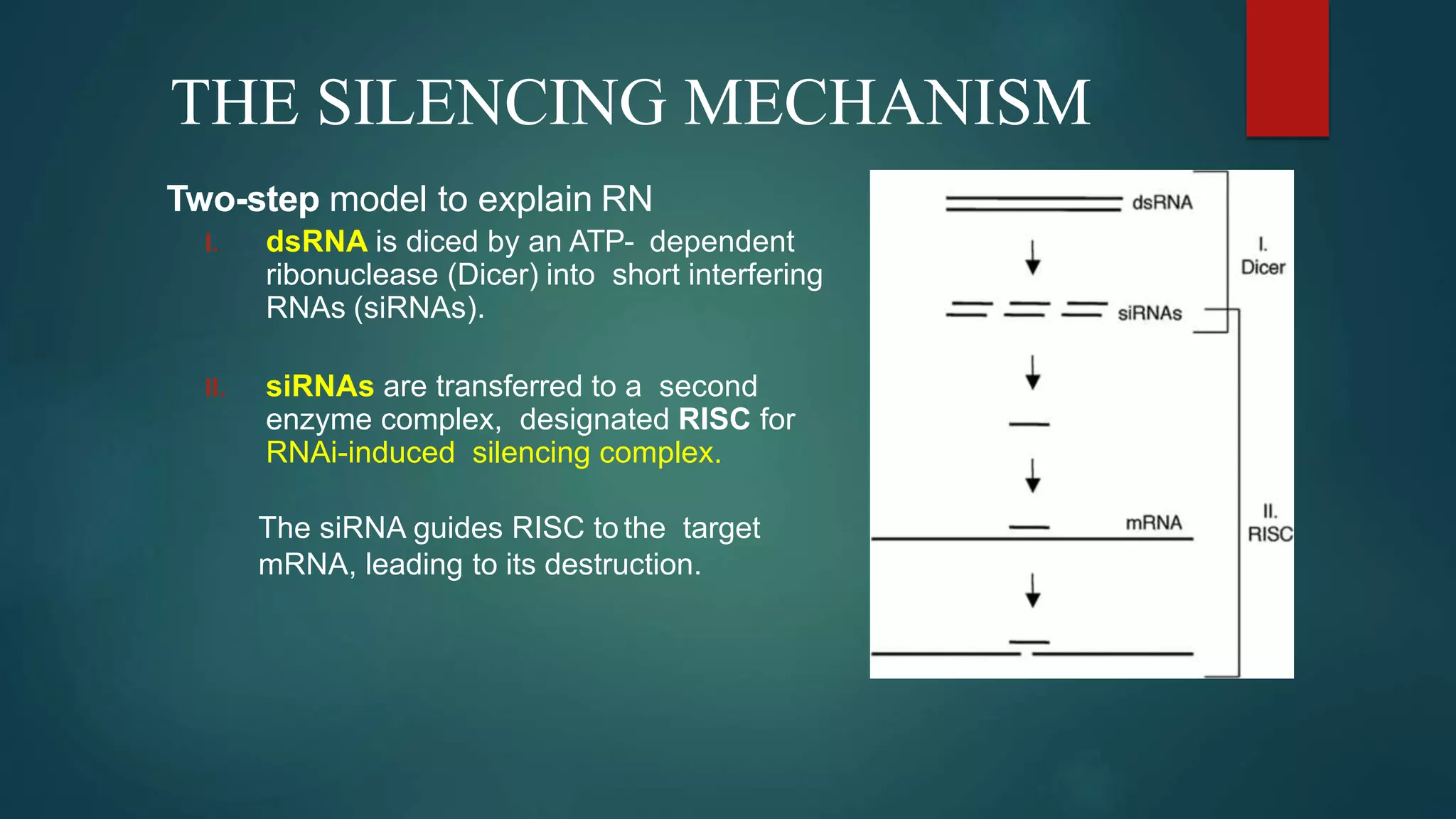
THE SILENCING MECHANISM
Two-step model to explain RN
I. dsRNA is diced by an ATP- dependent
ribonuclease (Dicer) into short interfering
RNAs (siRNAs).
II. siRNAs are transferred to a second
enzyme complex, designated RISC for
RNAi-induced silencing complex.
The siRNA guides RISC to the target
mRNA, leading to its destruction.
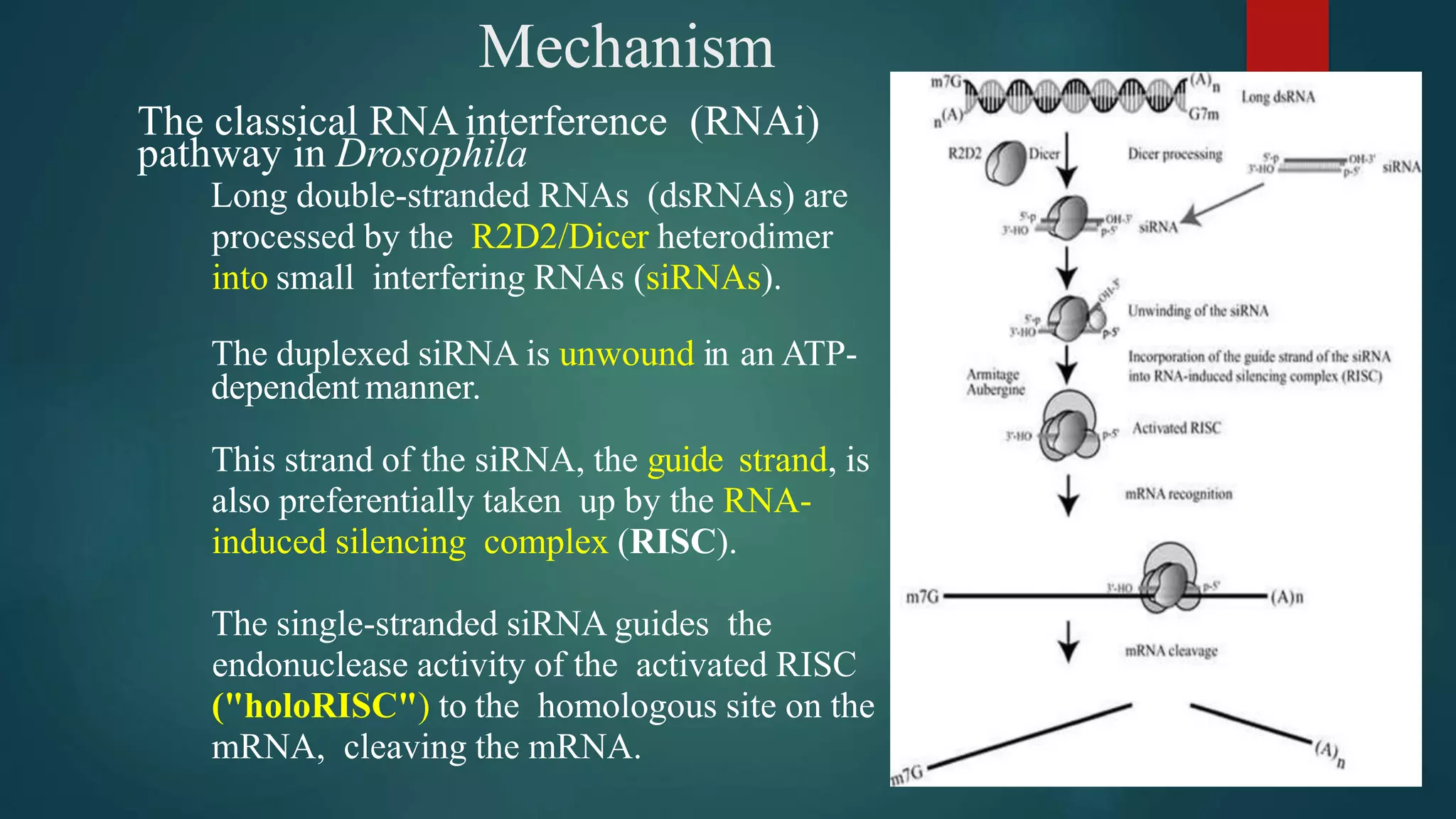
Mechanism
The classical RNAinterference (RNAi)
pathway in Drosophila
Long double-stranded RNAs (dsRNAs) are
processed by the R2D2/Dicer heterodimer
into small interfering RNAs (siRNAs).
The duplexed siRNA is unwound in an ATP-
dependent manner.
This strand of the siRNA, the guide strand, is
also preferentially taken up by the RNA-
induced silencing complex (RISC).
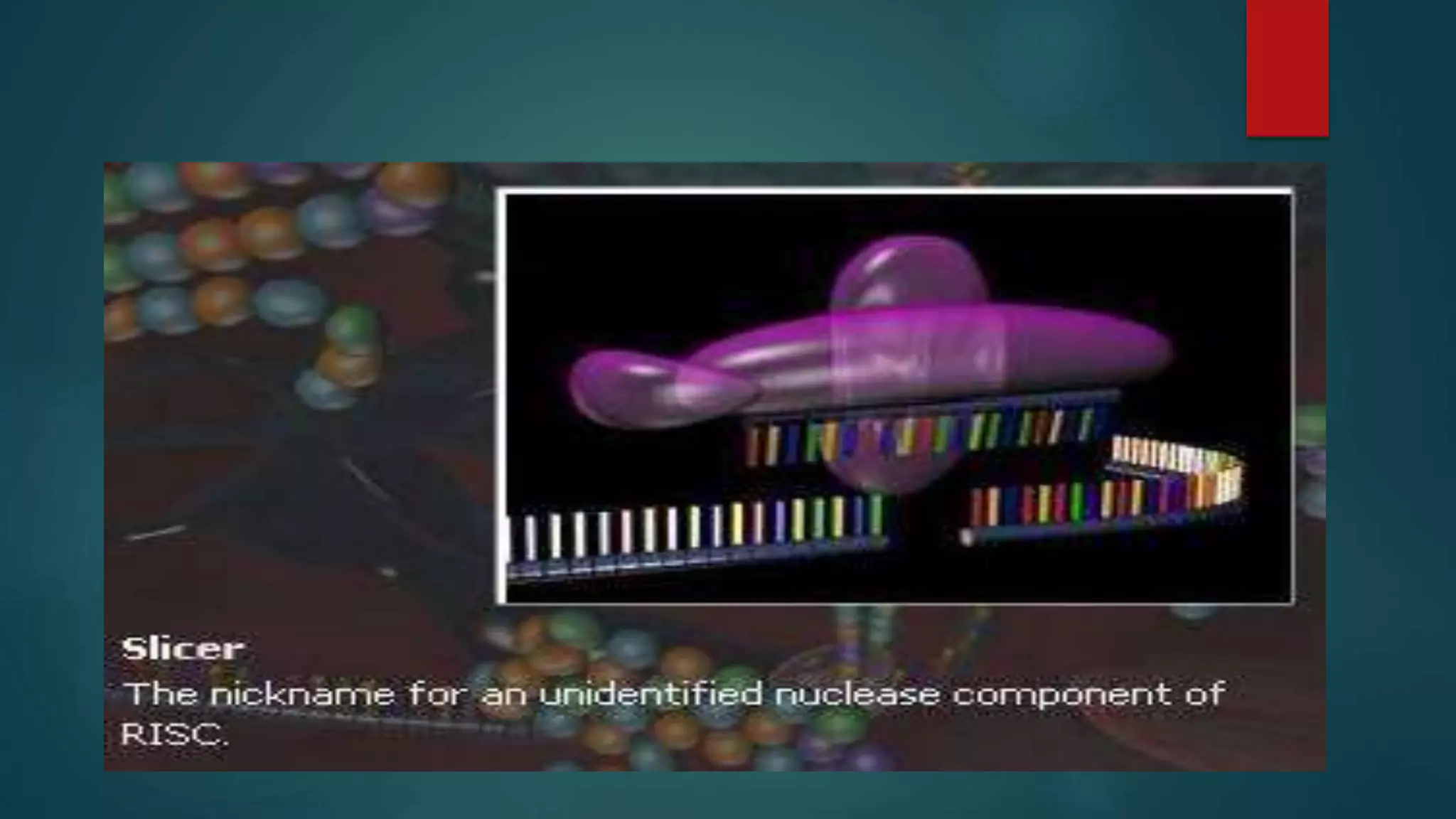
The single-stranded siRNA guides the
endonuclease activity of the activated RISC
("holoRISC") to the homologous site on the
mRNA, cleaving the mRNA.
RNAAmplification:
A small amount of dsRNA can silence a vast
amount of target mRNA in C. elegans.
Mechanistic explanations for this observations:
Each siRNA fragment can target the homologousmRNA
Catalytic mechanism: each siRNA fragment can be used several times.
RNA directed RNAsynthesis
Immunity vs RANi
 RNAi is used as a form of primitive immunity to protect
the genome from invasion by exogenous nucleic acids
introduced by mobile genetic elements, such as viruses
and transposons.
mRNAi vs siRNA
miRNA: microRNA:
Encoded by endogenous genes.
Hairpin precursors - pre-miRNAs
The pre-miRNAs are hairpins with imperfect complementarity in their stems and frequent bulges,
mismatches and G:U wobble base pairings.
Recognize multiple targets:
siRNA: short-interfering RNA.
Mostly exogenous origin.
dsRNAprecursors
May be target specific
Discovered in different ways:
Similar biogenesis
Share common pathway components and outcomes
Understanding of miRNA comes from research on siRNA andvice
versa
Maybe current understanding does not allow us to distinguish them
miRNApathway
The miRNApathway
pri-miRNA
processed by Drosha to become the p
miRNA.
exported to the cytoplasm by Exportin
cleaved by the R2D2/Dicer heterodim
into the mature miRNA.
The miRNA is loaded into RISC and guides it
to sites on the mRNA that have only partial
sequence complementarity the miRNA,
leading to repression of translation.
Presenting the cast
RANi (RNA interference)

RANi (RNA interference)

  • 1.
  • 3.
    RNAi Glossary Dicer : Diceris a member of the RNase III family of nucleases that specifically cleave double-stranded RNAs. Dicer processes long dsRNA into siRNA of 21-23 nt. Interferon : A small and highly potent molecule that functions in an autocrine and paracrine manner, and that induces cells to resist viral replication. This term is related to RNA because in mammals introduction of dsRNA longer than 30 nt induces a sequence- nonspecific interferon response. Micro-RNA : Micro-RNAs (miRNA) are single-stranded RNAs of 22-nt that are processed from ~70- nt hairpin RNA precursors by Rnase III nuclease Dicer. Similar to siRNA, miRNA can silence gene activity via destruction of homologous mRNA in plants or blocking its translation in plants and animals. Post-Transcriptional Gene Silencing : Post-transcriptional gene silencing (PTGS) is a sequence-specific RNA degradation system designed to act as an anti-viral defense mechanism. A form of PTGS triggered by transgenic DNA, called co-suppression, was initially described in plants and a related phenomenon, termed quelling, was later observed in the filamentous fungus Neurospora crassa Ribozyme : Ribozymes are RNA molecules that act as enzymes in the absence of proteins.
  • 4.
    RNA Interference : RNAInterference (RNAi), a term coined by Fire et al in 1998, is a phenomenon that small double-stranded RNA (referred as small interference RNA or siRNA) can induce efficient sequence-specific silence of gene expression. RNA-Directed DNA Methylation : RNA-directed DNA methylation (RdDM) is an RNA directed silencing mechanism found in plants. Similar to RNA interference (RNAi), RdDM requires a double-strand RNA that is cut into short 21-26-nt fragments. DNA sequences homologous to these short RNAs are then methylated and silenced. RNA-Induced Silencing Complex : RNA-induced silencing complex (RISC) is an siRNA-directed endonuclease, catalyzing cleavage of a single phosphodiester bond on the RNA target. RNAi Trigger : RNAi triggers are double-stranded RNAs containing 21-23 nt sense and antisens strands hybridized to have 2 nt overhangs at both 3' ends. Small Interfering RNA : Small Interfering RNA (siRNA) is 21-23-nt double-strand RNA. It guides the cleavage and degradation of its cognate RNA. Helicase : Enzyme responsible for unwinding double stranded molecule
  • 5.
    What is RNAi? RNAinterference (RNAi) is an evolutionally highly conserved process of post-transcriptional gene silencing (PTGS) by which double stranded RNA (dsRNA) causes sequence-specific degradation of mRNAsequences. It was first discovered in 1998 by Andrew Fire and Craig Mello in the nematode worm Caenorhabditis elegans and later found in a wide variety of organisms, including mammals.
  • 6.
    RNAi is aconserved mechanism RNAi is a universal, omnipresent conserved mechanism in eukaryotic cells. The cellular mechanism of RNAi Predates evolutionary divergence of plants and worms. Key proteins involved in RNAi in disparate organisms are highly conserved.
  • 7.
    THE SILENCING MECHANISM Two-stepmodel to explain RN I. dsRNA is diced by an ATP- dependent ribonuclease (Dicer) into short interfering RNAs (siRNAs). II. siRNAs are transferred to a second enzyme complex, designated RISC for RNAi-induced silencing complex. The siRNA guides RISC to the target mRNA, leading to its destruction.
  • 8.
    Mechanism The classical RNAinterference(RNAi) pathway in Drosophila Long double-stranded RNAs (dsRNAs) are processed by the R2D2/Dicer heterodimer into small interfering RNAs (siRNAs). The duplexed siRNA is unwound in an ATP- dependent manner. This strand of the siRNA, the guide strand, is also preferentially taken up by the RNA- induced silencing complex (RISC). The single-stranded siRNA guides the endonuclease activity of the activated RISC ("holoRISC") to the homologous site on the mRNA, cleaving the mRNA.
  • 9.
    RNAAmplification: A small amountof dsRNA can silence a vast amount of target mRNA in C. elegans. Mechanistic explanations for this observations: Each siRNA fragment can target the homologousmRNA Catalytic mechanism: each siRNA fragment can be used several times. RNA directed RNAsynthesis
  • 10.
    Immunity vs RANi RNAi is used as a form of primitive immunity to protect the genome from invasion by exogenous nucleic acids introduced by mobile genetic elements, such as viruses and transposons.
  • 11.
    mRNAi vs siRNA miRNA:microRNA: Encoded by endogenous genes. Hairpin precursors - pre-miRNAs The pre-miRNAs are hairpins with imperfect complementarity in their stems and frequent bulges, mismatches and G:U wobble base pairings. Recognize multiple targets: siRNA: short-interfering RNA. Mostly exogenous origin. dsRNAprecursors May be target specific Discovered in different ways: Similar biogenesis Share common pathway components and outcomes Understanding of miRNA comes from research on siRNA andvice versa Maybe current understanding does not allow us to distinguish them
  • 12.
    miRNApathway The miRNApathway pri-miRNA processed byDrosha to become the p miRNA. exported to the cytoplasm by Exportin cleaved by the R2D2/Dicer heterodim into the mature miRNA. The miRNA is loaded into RISC and guides it to sites on the mRNA that have only partial sequence complementarity the miRNA, leading to repression of translation.
  • 13.