How to Think about Information 1st Edition Dan Schiller
How to Think about Information 1st Edition Dan Schiller
How to Think about Information 1st Edition Dan Schiller
How to Think about Information 1st Edition Dan Schiller
How to Think about Information 1st Edition Dan Schiller
1.
How to Thinkabout Information 1st Edition Dan
Schiller download
https://ebookname.com/product/how-to-think-about-information-1st-
edition-dan-schiller/
Get Instant Ebook Downloads – Browse at https://ebookname.com
2.
Instant digital products(PDF, ePub, MOBI) available
Download now and explore formats that suit you...
How to Think About Algorithms 1st Edition Jeff Edmonds
https://ebookname.com/product/how-to-think-about-algorithms-1st-
edition-jeff-edmonds/
Essaying the Past How to Read Write and Think about
History 2nd Edition Jim Cullen
https://ebookname.com/product/essaying-the-past-how-to-read-
write-and-think-about-history-2nd-edition-jim-cullen/
How to Think Logically 1st Edition Gary Seay
https://ebookname.com/product/how-to-think-logically-1st-edition-
gary-seay/
21st Century Sexualities Contemporary Issues in Health
Education and Rights 1st Edition Gilbert Herdt
https://ebookname.com/product/21st-century-sexualities-
contemporary-issues-in-health-education-and-rights-1st-edition-
gilbert-herdt/
3.
Winning Your PersonalInjury Claim 2nd Edition Winning
Your Personal Injury Claim Evan K. Aidman
https://ebookname.com/product/winning-your-personal-injury-
claim-2nd-edition-winning-your-personal-injury-claim-evan-k-
aidman/
Sociology 5th Edition Giddens
https://ebookname.com/product/sociology-5th-edition-giddens/
Ion and Molecule Transport in Lysosomes 1st Edition
Bruno Gasnier (Editor)
https://ebookname.com/product/ion-and-molecule-transport-in-
lysosomes-1st-edition-bruno-gasnier-editor/
Histories of the Holocaust 1st Edition Dan Stone
https://ebookname.com/product/histories-of-the-holocaust-1st-
edition-dan-stone/
Organic and Biochemistry for Today 8th Edition Spencer
L. Seager
https://ebookname.com/product/organic-and-biochemistry-for-
today-8th-edition-spencer-l-seager/
4.
Nuclear physics experimentaland theoretical Second
Edition Hans
https://ebookname.com/product/nuclear-physics-experimental-and-
theoretical-second-edition-hans/
6.
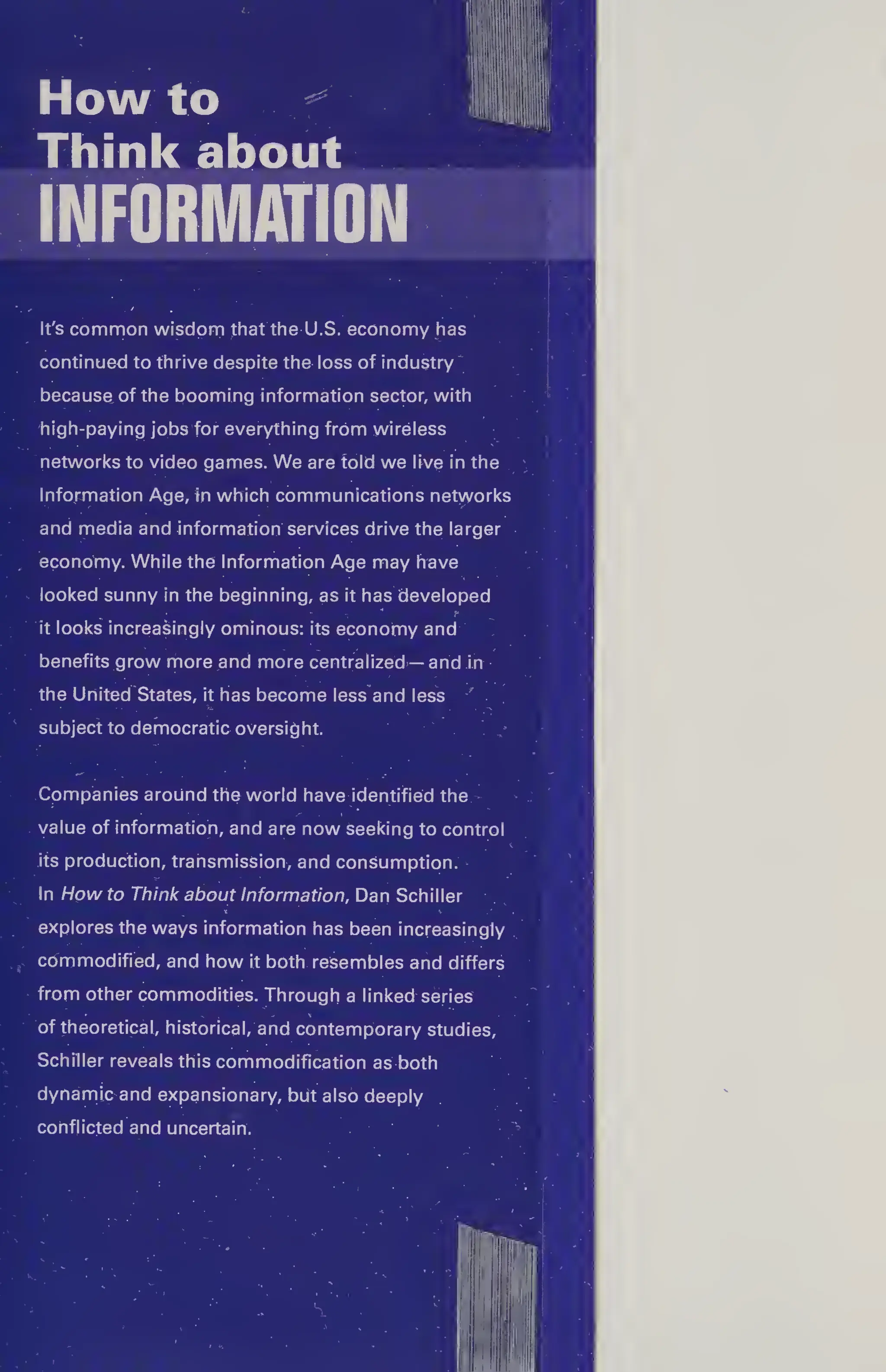
How to
Think about
INFORMATION
It'scommon wisdom that the U.S. economy has
continued to thrive despite the loss of industry
because of the booming information sector, with
high-paying jobs for everything from wireless
networks to video games. We are told we live in the
Information Age, tn which communications networks
and media and information services drive the larger
economy. While the Information Age may have
looked sunny in the beginning, as it has developed
... - " - - * ' f
it looks increasingly ominous: its economy and
benefits grow more and more centralized — and in
the United States, it has become less and less
subject to democratic oversight.
Companies around the world have identified the
value of information, and are now seeking to control
its production, transmission, and consumption.
In Howto Think about Information, Dan Schiller
explores the ways information has been increasingly
commodified, and how it both resembles and differs
from other commodities. Through a linked series
of theoretical, historical, and contemporary studies,
Schiller reveals this commodification as both
dynamic and expansionary, but also deeply
conflicted and uncertain.
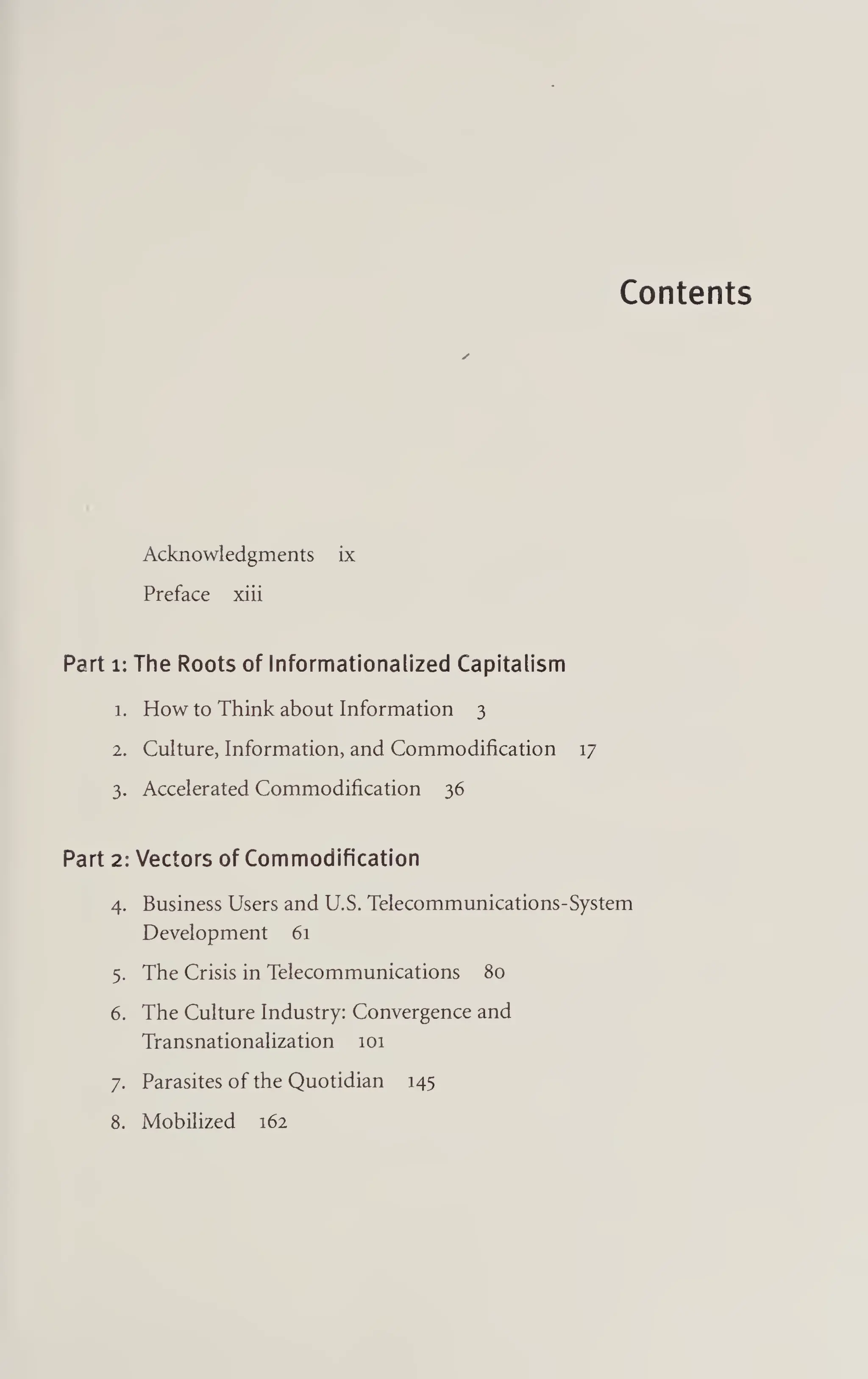
Contents
Acknowledgments ix
Preface xiii
Part1: The Roots of Informationalized Capitalism
1. How to Think about Information 3
2. Culture, Information, and Commodification 17
3. Accelerated Commodification 36
Part 2: Vectors of Commodification
4. Business Users and U.S. Telecommunications-System
Development 61
5. The Crisis in Telecommunications 80
6. The Culture Industry: Convergence and
Transnationalization 101
7. Parasites of the Quotidian 145
8. Mobilized 162
16.
Part 3: Polesof Market Growth, or a Deepening Crisis?
9. Open Questions about China, Information, and the
World Economy 177
Notes 199
Index 261
17.
Acknowledgments
The spirit ofthis work, and three of its chapters, germinated in writ¬
ings undertaken for Le Monde diplomatique. Warm thanks to the creators of
this great voice of critical reason and, especially, to Serge Halimi and Ignacio
Ramonet.
Intellectual nourishment came from an extended community of colleagues
at the University of Illinois at Urbana-Champaign. I am especially grateful
to Chip Bruce, Noshir Contractor, Leigh Estabrook, Kirk Freudenberg, Bob
McChesney, Maria Mastronardi, John Nerone, Jan Pieterse, Boyd Rayward,
Christian Sandvig, Linda Smith, Inger Stole, John Unsworth, and Bruce
Williams.
Three research assistants provided invaluable aid: Jason Kozlowski, Dr. Dal
Yong Jin, and Yu Hong. Graduate students, especially Han Dong, Dr. Kelly
Gates, Dr. Marie Leger, John Martirano, Victor Pickard, Ben Scott, and Dan
Wright, were generous in sharing their thinking.
Exchanges of different kinds with Andrew Calabrese, Edward Herman,
Steve Jackson, Rick Maxwell, Toby Miller, Vincent Mosco, Zaharom Nain,
Manjunath Pendakur, Lorna Peterson, Greig de Peuter, Ellen Seiter, Lora
Taub, Pradip Thomas, and Janet Wasko were indispensable. Yuezhi Zhao’s
suggestions and advice clarified basic issues and helped gain for this book a
wider readership.
It is a pleasure to thank Dr. Willis Regier, director of the University of
Illinois Press, for the generosity and care with which he has tended this
project.
18.
X • ACKNOWLEDGMENTS
Familymembers strengthened the work of writing, as always. Thanks to
Susan Davis for inspiration and supportive criticism. Thanks to Lucy Schiller
and Ethan Schiller for making room for me to finish and for giving me so
many important things to think about. Thanks to Anita Schiller for com¬
ments on portions of this text and for bibliographic suggestions. Thanks to
Zach Schiller for news clippings and for a bottomless well of enlightening
and sometimes hilarious stories.
Scholarly research presentations resulted in valuable clarifications, even
as they also helped me to relate this work to the wider world. I am grateful
for invitations proffered by Andrew Calabrese, Zhenzhi Guo, Max Duenas-
Guzman, Jyotsna Kapur, Melanie Kimball, Raffaele Laudani, and Lora Taub
to present research at the University of Colorado at Boulder, the Beijing
Broadcasting Institute, the Central University of Tijuana, Southern Illinois
University, SUNY Buffalo, the University of Siena, and Muhlenberg College.
Valuable also were presentations to the University of Illinois Institute of
Communication Research Seminar on Communications, Culture, and Pol¬
icy; and the University of Illinois Program on Arms Control, Disarmament,
and International Security. Appearances as a guest on Bob McChesney’s
WILL-based radio show, “Media Matters,” helped crystallize my views about
telecommunications.
Chapter 1 is a slightly revised version of “How to Think about Informa¬
tion,” in The Political Economy ofInformation, ed. Vincent Mosco and Janet
Wasko (Madison: University of Wisconsin Press, 1988), 27-43.
Acknowledgment is made to Critical Studies in Mass Communication for
permission to use material from “From Culture to Information and Back
Again: Commoditization as a Route to Knowledge,” Critical Studies in Mass
Communication 11.1 (March 1994): 93-115. See www.tandf.co.uk/journals.
Chapter 3 draws on “Digital Capitalism 2001: The Corporate Common¬
wealth of Information,” in A Companion to Media Studies, ed. Angharad N.
Valdivia (Oxford: Blackwell Publishing, 2003), 137-56.
Acknowledgment is made to Hampton Press for permission to use a modi¬
fied version of “Business Users and the Internet in Historical Perspective,”
in The Media and Marketization, ed. Graham Murdock and Janet Wasko
(Cresskill, N.J.: Hampton Press, forthcoming).
Chapter 5 draws on “Telecommunications, les echecs d’une revolution,”
Le Monde diplomatique 50.592 (July 2003): 28-29; and “The Telecom Crisis,”
Dissent (Winter 2003): 66-70.
Chapter 7 draws on “Des parasites dans notre quotidien,” Le Monde diplo¬
matique 48.566 (May 2001): 12-13.
19.
ACKNOWLEDGMENTS XI
Chapter 8draws on “Esclaves du portable,” Le Monde diplomatique 52.611
(February 2005): 1, 22-23.
Acknowledgment is made to Sage Publications for permission to use mate¬
rial published in “Poles of Market Growth? Open Questions about China,
Information, and the World Economy,” Global Media and Communications
1.1 (2005): 79-103-
Preface
Through a linkedseries of theoretical, historical, and contemporary
studies, How to Think about Information engages transformative political-
economic changes occurring throughout the realm of information technol¬
ogy and culture.
What justification is there for such a project? Is it not passe? “Informa¬
tion,” after all, was such a nineties thing, and the Internet bubble is but a
fading memory. A glance at the New York Times confirms that the subject
has diminished in significance; in 2005, the nation’s journal of record ceased
titling its Monday business section “The Information Industries.” Official
discourse has evidently moved on.
Interestingly, however, information has not merely been forgotten but
explicitly rejected. Where pundits a decade ago insisted that information was
the new fulcrum of corporate strategy, by the mid-2000S they are emphasiz¬
ing with equal certitude that such claims were misplaced. Nicholas G. Carr,
the former executive editor of the Harvard Business Review, inquired: Does
IT Matter?x His answer is a resounding, “Not any more.” From the other
direction, the Left, a strangely congruent revision has materialized. After
the New Economy bids emphatic good riddance to the seeming pipe dreams
offered by adherents of the so-called information society.2
Skepticism is warranted, and revisions of accepted wisdom are needed;
this book contains both. However, I contend that, just as the earlier embrace
of information was facile, its dismissal has been too hasty. If we wish to
understand the motive force and direction of contemporary society, it is still
necessary to think about information carefully and in an extended way. The
22.
XiV PREFACE
status ofinformation continues to be elusive because it was never adequately
apprehended, either by proponents of information-society theory or their
mainstream critics. Questions about information’s contemporary structural
role therefore remain as significant, and problematic, as they did before the
deflation of the Internet bubble.
I argue that, for definite reasons, political and economic elites assigned
mounting strategic importance to information beginning around 1970. This
was nothing less than an endeavor to renew the encompassing process of
market expansion by generating around information a new and expansionary
pole of growth for capitalism. If information’s significance for this project
has dimmed—which is debatable—we should try to learn why. And if it has
not, what then? In either case, changes occurring around information have
worked their way deep into the economy and society, and these changes
demand to be surveyed.
By now it should be apparent that, in this work, “information” operates as
a kind of shorthand to include the converging fields of culture, media, and
telecommunications. These areas are not identical. In the pages that follow,
I untangle some of the semantic intricacies that bind and separate “culture”
and “information,” and I detail aspects of the process of convergence that is
bringing them together. I argue throughout that this inclusive perspective
on information holds out the prospect of crucial insights.
We are living through a transition into an informationalized capitalism. As
a consequence of policies adopted beginning around 1970, a long-standing
process of commodification—the growth of wage labor to produce com¬
modities and of market mechanisms to distribute them—has gripped the
global information and communications sector. At the same time, com¬
munications and information have come to infuse the more encompassing
process of capitalist development.
Basic questions must be asked about this process. What provoked this his¬
torical phase-change? How are culture, communications, and information
being restructured and repositioned, and how have these changes impacted
the overall political economy? What are the political ramifications of the
emergent informational emphasis? Will information succeed in rescuing the
market economy from stagnation?
How to Think about Information offers, in part 1, an initial explication
of the complex process of commodification that now weaves through the
informational and cultural realm. Chapter 1 frames contemporary think¬
ing about information in the context of political economy. In chapter 2,
arguments about information are further specified and situated historically;
23.
PREFACE XV
here itbecomes important to examine the overlaps and differences between
“information” and “culture.” Chapter 3 extends the analysis by locating the
contemporary political and economic importance of information specifically
in the accelerated commodification that commenced around 1970. Acceler¬
ated commodification unleashed dramatic policy changes in intellectual
property law, ownership and control of information resources, and telecom-
munications-system development to sustain rapid growth of private property
in information. It also helped deepen an already worrisome antidemocratic
tendency. ✓
In part 2,1 analyze the commodification process in several specific contexts.
Chapters 4 and 5 focus on telecommunications networks and services, to lay
bare how these “critical infrastructures” have been altered and to what effect.
Established opinion notwithstanding, this history cannot be read solely from
the supply side—that is, as a straight-line function of the telecommunications
carriers’ strategy and structure. Nor has the logic of network reorganization
been benevolent or free of conflict. After detailing the neglected but pivotal
role played by business users in telecommunications-system development
in chapter 4,1 show in chapter 5 that the liberalized policies they demanded
led to a damaging political-economic crisis.
Chapters 6 and 7 redirect attention to the more widely familiar domain
of culture. Through an extended appraisal of the rapidly changing culture
industry, transformative developments in technology and political-economic
structure are assessed. Accelerated commodification in this sphere has engen¬
dered not only growing “convergence,” which erodes divisions between media
long separated as a matter of deliberate policy, but also a transnationalizing
capital logic. Far from deviating from these trends, Internet systems and ser¬
vices incarnate them. New directions of growth in the sponsor system, the
culture industry’s long-established institutional patron, are then canvassed.
Chapter 8 takes up the explosive growth of wireless technology. I show that,
drawing alike on necessity and desire, wireless extends a long-standing and
often disabling trend in our social organization that Raymond Williams calls
“mobile privatization.”
In chapter 9, many ofthese themes are united in a different context, through
analysis of the reintegration of China into the world market system. Examin¬
ing how the most dynamic region of the world economy has combined with
its most dynamic industry sector allows us to return to an overarching ques¬
tion: Has a solution been found for one of capitalism’s most deep-seated and
intractable problems, its continuing tendency toward economic stagnation
as a result of overproduction?
24.
XVI PREFACE
This book,which synthesizes work produced over a period of twenty years,
engages processes that continue to be alive, incomplete, and fraught with
conflicts and contradictions. I have simply attempted to frame some of the
key issues and to sketch some provisional answers. For better or worse, how
to think about information remains in vital ways an open question.
1
How to Think
,about Information
In 1982, the American Express company heralded its elevation into
the select group of thirty corporations that comprise the Dow Jones Indus¬
trial Index as follows:
Our product is information—information that charges airline tickets, hotel
rooms, dining out, the newest fashions, and even figures mailing costs for a
travel magazine; information that grows money funds, buys and sells equi¬
ties, and manages mergers; information that pays life insurance annuities,
figures pricing for collision coverage, and creates and pays mortgages; infor¬
mation that schedules entertainment on cable television and electronically
guards houses; information that changes kroners into guilders, figures tax
rates in Bermuda, and helps put financing together for the ebb and flow of
world trade.1
American Express was not unique. Companies engaged in making and sell¬
ing entertainment, banking, communications, data processing, engineer¬
ing, advertising, law, and other information-intensive services have played
an increasingly critical role in overall U.S. investment, employment, and
international trade. Major manufacturers such as General Motors, McDon¬
nell Douglas, and General Electric were diversifying into information either
through in-house activities, commercial provision, or both. An administra¬
tive discipline known as “information resource management” was finding
broad application across the business world. This discipline treats informa¬
tion “as a resource like other resources such as money, personnel, and prop¬
erty, which have values and costs and are used in achieving program goals.”2
399.
400.
401.
402.
403.
404.
405.
406.
407.
408.
409.
410.
411.
the French missionaryM. Coillard.
Theophilus Hahn, Tsuni-Goam, the Supreme Being of the
Khoi-Khoi (London, 1881), p. 106.
W. H. I. Bleek and L. C. Lloyd, Specimens of Bushman
Folklore (London, 1911), p. 373.
Rev. H. Cole, “Notes on the Wagogo of German East Africa,”
Journal of the Anthropological Institute, xxxii. (1902) p.
318.
Sir Harry Johnston, The Uganda Protectorate, Second
Edition (London, 1904), ii. 787.
Rev. J. Macdonald, Light in Africa, Second Edition (London,
1890), p. 174; id., in Journal of the Anthropological
Institute, xix. (1890) p. 282.
Rev. H. Callaway, Religious System of the Amazulu, p. 438,
note 16.
O. Baumann, Usambara und seine Nachbargebiete (Berlin,
1891), p. 128.
Sir H. H. Johnston, British Central Africa (London, 1897), p.
438; J. Buchanan, The Shire Highlands, p. 138.
M. W. H. Beech, The Suk, their Language and Folklore
(Oxford, 1911), p. 11.
J. Shooter, The Kafirs of Natal and the Zulu Country
(London, 1857), p. 399.
A. B. Ellis, The Ewe-speaking Peoples of the Slave Coast of
West Africa (London, 1890), p. 99.
M. Merker, Rechtsverhältnisse und Sitten der Wadschagga
(Gotha, 1902), p. 38 (Petermanns Mitteilungen,
Ergänzungsheft, No. 138).
Rev. H. Callaway, Nursery Tales, Traditions, and Histories of
the Zulus (Natal and London, 1868), p. 175 note.
32.
412.
413.
414.
415.
416.
417.
418.
419.
420.
421.
422.
423.
Ovid, Metam. vii.271 sqq. As to the supposed longevity of
deer and crows, see L. Stephani, in Compte Rendu de la
Commission Archéologique (St. Petersburg), 1863, pp. 140
sq., and my note on Pausanias, viii. 10. 10.
Pliny, Nat. Hist. viii. 119.
Porphyry, De Abstinentia, ii. 48: οἱ γοῦν ζώων μαντικῶν
ψυχὰς δέξασθαι βουλόμενοι εἰς ἑαυτούς, τὰ κυριώτατα
μόρια καταπιόντες, οἷον καρδίας κοράκων ἢ ἀσπαλάκων ἢ
ἱεράκων, ἔχουσι παριοῦσαν τὴν ψυχὴν καὶ χρηματίζουσαν
ὡς θεὸν καὶ εἰσιοῦσαν εἰς αὐτοὺς ἄμα τῇ ἐνθέσει τῇ τοῦ
σώματος. Pliny also mentions the custom of eating the
heart of a mole, raw and palpitating, as a means of
acquiring skill in divination (Nat. Hist. xxx. 19).
Spenser St. John, Life in the Forests of the Far East, Second
Edition (London, 1863), i. 186, 206.
W. H. Furness, Home-life of Borneo Head-hunters
(Philadelphia, 1902), p. 71; compare id., pp. 166 sq.
Rev. J. Batchelor, The Ainu and their Folk-lore (London,
1901), pp. 511-513.
Rev. J. Batchelor, op. cit. p. 337.
W. Crooke, Popular Religion and Folk-lore of Northern India
(Westminster, 1896), i. 279.
Bossu, Nouveaux Voyages aux Indes occidentales (Paris,
1768), i. 112.
H. R. Schoolcraft, Indian Tribes of the United States, ii.
(Philadelphia, 1853) pp. 79 sq.
J. G. F. Riedel, De sluik- en kroesharige rassen tusschen
Selebes en Papua (The Hague, 1886), pp. 10, 262.
James Chalmers, Pioneering in New Guinea (London,
1887), p. 166.
33.
424.
425.
426.
427.
428.
429.
430.
431.
432.
433.
434.
435.
436.
Journal of theAnthropological Institute, xxiv. (1895) p. 179.
E. T. Dalton, Descriptive Ethnology of Bengal (Calcutta,
1872), p. 33.
Proceedings of the Royal Geographical Society, N.S., viii.
(1886) p. 307.
J. Henderson, “The Medicine and Medical Practice of the
Chinese,” Journal of the North China Branch of the Royal
Asiatic Society, New Series, i. (Shanghai, 1865) pp. 35 sq.
Compare Mrs. Bishop, Korea and her Neighbours (London,
1898), i. 79.
Mrs. S. S. Allison, “Account of the Similkameen Indians of
British Columbia,” Journal of the Anthropological Institute,
xxi. (1892) p. 313.
P. E. Müller on Saxo Grammaticus, Historia Danica
(Copenhagen, 1839-1858), vol. ii. p. 60.
Die Edda, übersetzt von K. Simrock8 (Stuttgart, 1882), pp.
180, 309.
Pliny, Hist. Natur. x. 137, xxix. 72.
Philostratus, Vita Apollonii, i. 20, iii. 9.
Saxo Grammaticus, Historia Danica, ed. P. E. Müller
(Copenhagen, 1839-1858), i. 193 sq.
P. E. Müller, note in his edition of Saxo Grammaticus, vol. ii.
p. 146.
A. Wuttke, Der deutsche Volksaberglaube2 (Berlin, 1869),
p. 110, § 153; J. V. Grohmann, Aberglauben und Gebräuche
aus Böhmen und Mähren (Prague and Leipsic, 1864), p.
230, § 1658.
Grimm, Kinder- und Hausmärchen, No. 17; id., Deutsche
Sagen2 (Berlin, 1865-1866), No. 132 (vol. i. pp. 174-176);
34.
437.
438.
439.
440.
441.
442.
A. Kuhn undW. Schwartz, Norddeutsche Sagen, Märchen
und Gebräuche (Leipsic, 1848), p. 154; A. Waldau,
Böhmisches Märchenbuch (Prague, 1860), pp. 13 sqq.; Von
Alpenburg, Mythen und Sagen Tirols (Zurich, 1857), pp.
302 sqq.; W. von Schulenburg, Wendische Volkssagen und
Gebräuche aus dem Spreewald (Leipsic, 1880), p. 96; P.
Sébillot, Traditions et Superstitions de la Haute-Bretagne
(Paris, 1882), ii. 224; W. Grant Stewart, The Popular
Superstitions and Festive Amusements of the Highlanders
of Scotland, New Edition (London, 1851), pp. 53, 56; J. F.
Campbell, Popular Tales of the West Highlands, New Edition
(Paisley and London, 1890), No. 47, vol. ii. pp. 377 sqq.; E.
Prym und A. Socin, Syrische Sagen und Maerchen
(Göttingen, 1881), pp. 150 sq. On the serpent in relation to
the acquisition by men of the language of animals, see
further my article, “The Language of Animals,” The
Archaeological Review, i. (1888) pp. 166 sqq. Sometimes
serpents have been thought to impart a knowledge of the
language of animals voluntarily by licking the ears of the
seer. See Apollodorus, Bibliotheca, i. 9. 11 sq.; Porphyry, De
abstinentia, iii. 4.
A. Leared, Morocco and the Moors (London, 1876), p. 281.
M. Quedenfelt, “Aberglaube und halb-religiöse Bruderschaft
bei den Marokkanarn,” Verhandlungen der Berliner
Gesellschaft für Anthropologie, Ethnologie und
Urgeschichte, 1886, p. 682 (bound up with the Zeitschrift
für Ethnologie, xviii. 1886).
H. Vambery, Das Türkenvolk (Leipsic, 1885), p. 218.
Charlevoix, Histoire de la Nouvelle France (Paris, 1744), vi.
8.
P. J. Veth, “De leer der Signatuur,” Internationales Archiv für
Ethnographie, vii. (1894) pp. 140 sq.
35.
443.
444.
445.
446.
447.
448.
449.
450.
451.
452.
453.
R. W. Felkin,“Notes on the For Tribe of Central Africa,”
Proceedings of the Royal Society of Edinburgh, xiii. (1884-
1886) p. 218.
Rev. J. Macdonald, “Manners, Customs, etc., of the South
African Tribes,” Journal of the Anthropological Institute, xx.
(1891) p. 116; id., Light in Africa (London, 1890), p. 212.
Compare Rev. E. Casalis, The Basutos (London, 1861), pp.
257 sq.; Dudley Kidd, The Essential Kafir (London, 1904),
p. 309.
Rev. J. Macdonald, in Journal of the Anthropological
Institute, xx. (1891) p. 138; id., Light in Africa, p. 220.
H. Schinz, Deutsch Südwest-Afrika (Oldenburg and Leipsic,
preface dated 1891), p. 320.
J. Macdonald, “East Central African Customs,” Journal of the
Anthropological Institute, xxii. (1893) p. 111. Compare J.
Buchanan, The Shire Highlands, p. 138; Sir H. H. Johnston,
British Central Africa (London, 1897), p. 438.
A. C. Hollis, The Nandi (Oxford, 1909), p. 27.
Rev. H. Cole, “Notes on the Wagogo of German East Africa,”
Journal of the Anthropological Institute, xxxii. (1902) p.
318.
Rev. J. L. Wilson, Western Africa (London, 1856), pp. 167
sq.
A. B. Ellis, The Ewe-speaking Peoples of the Slave Coast
(London, 1890), pp. 99 sq.
A. B. Ellis, The Yoruba-speaking Peoples of the Slave Coast
(London, 1894), p. 69.
A. Caulin, Historia Coro-graphica natural y evangelica dela
Nueva Andalucia (1779), p. 98.
A. de Herrera, General History of the vast Continent and
Islands of America, translated by Capt. J. Stevens (London,
36.
454.
455.
456.
457.
458.
459.
460.
461.
462.
463.
464.
465.
1725-1726), vi. 187.
F.de Castelnau, Expédition dans les parties centrales de
l'Amérique du Sud (Paris, 1850-1851), iv. 382.
James Adair, History of the American Indians (London,
1775), p. 135.
Rev. J. Roscoe, “Notes on the Manners and Customs of the
Baganda,” Journal of the Anthropological Institute, xxxi.
(1901) pp. 129 sq.; id., “Further Notes on the Manners and
Customs of the Baganda,” Journal of the Anthropological
Institute, xxxii. (1902) p. 45.
E. W. Nelson, “The Eskimo about Bering Strait,” Eighteenth
Annual Report of the Bureau of American Ethnology, Part i.
(Washington, 1899) p. 328.
E. Clement, “Ethnographical Notes on the Western
Australian Aborigines,” Internationales Archiv für
Ethnographie, xvi. (1904) p. 8.
O. Opigez, “Aperçu général sur la Nouvelle-Calédonie,”
Bulletin de la Société de Géographie (Paris), vii. Série, vii.
(1886) p. 433.
A. W. Howitt, Native Tribes of South-East Australia (London,
1904), p. 753.
A. W. Howitt, op. cit. p. 752.
S. Gason, in Journal of the Anthropological Institute, xxiv.
(1895) p. 172.
Rev. W. Ridley, Kamilaroi (Sydney, 1875), p. 160.
Annales de la Propagation de la Foi, xi. (Lyons, 1838-1839)
p. 258.
J. Henderson, “The Medicine and Medical Practice of the
Chinese,” Journal of the North China Branch of the Royal
Asiatic Society, New Series, i. (Shanghai, 1865) pp. 35 sq.
37.
466.
467.
468.
469.
470.
471.
472.
473.
474.
475.
476.
A. C. Kruyt,“Het koppensnellen der Toradja's van Midden-
Celebes, en zijne Beteekenis,” Verslagen en Mededeelingen
der koninklijke Akademie van Wetenschappen, Afdeeling
Letterkunde, Vierde Reeks, iii. (Amsterdam, 1899) p. 201.
N. Adriani en A. C. Kruijt, “Van Posso naar Mori,”
Mededeelingen van wege het Nederlandsche
Zendelinggenootschap, xliv. (1900) p. 162.
F. Blumentritt, “Der Ahnencultus und die religiösen
Anschauungen der Malaien des Philippinen-Archipels,”
Mittheilungen der Wiener Geograph. Gesellschaft, 1882, p.
154; id., Versuch einer Ethnographie der Philippinen
(Gotha, 1882), p. 32 (Petermann's Mittheilungen,
Ergänzungsheft, No. 67).
Ch. Keysser, “Aus dem Leben der Kaileute,” in R. Neuhauss's
Deutsch Neu-Guinea, iii. (Berlin, 1911) p. 131.
L. Magyar, Reisen in Süd-Afrika in den Jahren 1849-1857
(Buda-Pesth and Leipsic, 1859), pp. 273-276.
Rev. J. Shooter, The Kafirs of Natal (London, 1857), p. 216.
Rev. H. Callaway, Nursery Tales, Traditions and Histories of
the Zulus (Natal and London, 1868), p. 163 note.
A. C. Haddon, “The Ethnography of the Western Tribe of
Torres Straits,” Journal of the Anthropological Institute, xix.
(1890) p. 414, compare p. 312; Reports of the Cambridge
Anthropological Expedition to Torres Straits, v. (Cambridge,
1904) p. 301.
A. C. Haddon, op. cit. p. 420; Reports of the Cambridge
Anthropological Expedition to Torres Straits, v. (Cambridge,
1904) pp. 301 sq.
S. J. Hickson, A Naturalist in North Celebes (London, 1889),
p. 216.
38.
477.
478.
479.
480.
481.
482.
483.
484.
485.
R. Taylor, TeIka a Maui, or New Zealand and its
Inhabitants, Second Edition (London, 1870), p. 352.
Compare ibid. p. 173; W. Ellis, Polynesian Researches,
Second Edition (London, 1831-1836), i. 358; J. Dumont
D'Urville, Voyage autour du Monde et à la recherche de la
Pérouse sur la corvette Astrolabe (Paris, 1832-1833), ii.
547; E. Tregear, “The Maoris of New Zealand,” Journal of
the Anthropological Institute, xix. (1890) p. 108.
A. C. Kruyt, “Het koppensnellen der Toradja's van Midden-
Celebes, en zijne Beteekenis,” Verslagen en Mededeelingen
der koninklijke Akademie van Wetenschappen, Afdeeling
Letterkunde, Vierde Reeks, iii. (Amsterdam, 1899) p. 166.
The Spectator, No. 316, March 3, 1712; Gibbon, Decline
and Fall, ch. lxvii.
Ph. Paulitschke, Ethnographie Nordost-Afrikas: die geistige
Cultur der Danâkil, Galla und Somâl (Berlin, 1896), p. 56.
For examples of the blood-covenant see H. C. Trumbull,
The Blood Covenant (London, 1887). The custom is
particularly common in Africa.
Rev. J. H. Bernau, Missionary Labours in British Guiana
(London, 1847), pp. 57 sq.; R Schomburgk, Reisen in
Britisch-Guiana (Leipsic, 1847-1848), ii. 497.
A. C. Hollis, The Nandi (Oxford, 1909), p. 27.
A. G. Leonard, The Lower Niger and its Tribes (London,
1906), pp. 180, 181 sq.
Mrs. Leslie Milne, Shans at Home (London, 1910), p. 192.
The Kukis of north-eastern India believe that the ghost of
an animal as well as of a man will haunt its slayer and drive
him mad unless he performs a ceremony called ai. For
example, a man who has killed a tiger must dress himself
up as a woman, put flints into the tiger's mouth, and eat
39.
486.
487.
488.
489.
490.
491.
492.
493.
494.
eggs himself, afterwhich he makes a speech to the tiger
and gives it three cuts over the head with a sword. During
this performance the principal performer must keep
perfectly grave. Should he accidentally laugh, he says, “The
porcupine laughed,” referring to a real porcupine which he
carries in his arms for the purpose. See Lieut.-Colonel J.
Shakespeare, “The Kuki-Lushai Clans,” Journal of the Royal
Anthropological Institute, xxxix. (1909) pp. 380 sq.
J. Dumont D'Urville, Voyage autour du Monde et à la
recherche de la Pérouse (Paris, 1832-1833), iii. 305.
Vincenzo Dorsa, La Tradizione greco-latina negli usi e nelle
credenze popolari della Calabria Citeriore (Cosenza, 1884),
p. 138.
F. de Castelnau, Expédition dans les parties centrales de
l'Amérique du Sud (Paris, 1850-1851), iv. 382.
Some of the evidence has already been cited by me in
Psyche's Task, pp. 56-58.
A. R. Wallace, Travels on the Amazon and Rio Negro,
Second Edition (London, 1889), ch. xvii. pp. 346 sq.
R. Southey, History of Brazil, iii. (London, 1819) p. 722.
R. Southey, op. cit. iii. 204.
A. de Herrera, The General History of the Vast Continent
and Islands of America, translated by Capt. John Stevens
(London, 1725-1726), iv. 45.
A. Reich und F. Stegelmann, “Bei den Indianern des
Urubamba und des Envira,” Globus, lxxxiii. (1903) p. 137.
On similar custom practised by the American Indians see
further De la Borde, Relation de l'Origine, Mœurs,
Coustumes, Religion, Guerres et Voyages des Caraibes
Sauvages, p. 37 (forming part of the Recueil de divers
Voyages faits en Afrique et en l'Amerique, Paris, 1684); J. F.
40.
495.
496.
497.
498.
499.
500.
501.
502.
Lafitau, Mœurs desSauvages Ameriquains (Paris, 1724), ii.
444-446; A. N. Cabeça de Vaca, Relation et Naufrages
(Paris, 1837), p. 109 (in Ternaux Compans' Voyages,
Relations et Mémoires originaux pour servir à l'Histoire de la
Découverte de l'Amérique); R. Southey, History of Brazil, i.
(Second Edition, London, 1822), Supplemental Notes, p.
xxxvi.; F. de Castelnau, Expédition dans les parties centrales
de l'Amérique du Sud (Paris, 1850-1851), iv. 380; J. G.
Müller, Geschichte der amerikanischen Urreligionen (Bâle,
1867), pp. 289 sq.; H. A. Coudreau, La France Équinoxiale
(Paris, 1887), ii. 173; Theodor Koch, “Die Anthropophagie
der südamerikanischen Indianer,” Internationales Archiv für
Ethnographie, xii. (1899) pp. 78-110; Th. Koch-Grünberg,
Zwei Jahre unter den Indianern (Berlin, 1909-1910), ii. 152.
Some Indians of Guiana rubbed their limbs with water in
which the ashes of their dead were mingled. See A. Biet,
Voyage de la France Equinoxiale en l'Isle de Cayenne (Paris,
1664), p. 392.
Aulus Gellius, Noctes Atticae, x. 18; Valerius Maximus, iv. 6.
5.
C. Gouldsbury and H. Sheane, The Great Plateau of
Northern Rhodesia (London, 1911), p. 55.
See above, p. 154 sqq.
Rev. E. Casalis, The Basutos, (London, 1861), pp. 256 sq.
E. Holub, Sieben Jahre in Süd Afrika (Vienna, 1881), ii. 361.
See above, p. 148.
J. Macdonald, “Manners, Customs, etc., of South African
Tribes,” Journal of the Anthropological Institute, xx. (1891)
p. 133. The Barolong, a Bechuana tribe, observe a custom
of this sort. See W. Joest, “Bei den Barolong,” Das Ausland,
16th June 1884, p. 464.
41.
503.
504.
505.
506.
507.
508.
509.
510.
511.
512.
Col. Maclean, ACompendium of Kafir Laws and Customs
(Cape Town, 1866), p. 82.
Father Porte, “Les reminiscences d'un missionnaire du
Basutoland,” Les Missions Catholiques, xxviii. (1896) p. 149.
Dudley Kidd, Savage Childhood (London, 1906), p. 70,
compare p. 43.
Lieut. H. Pope-Hennessy, “Notes on the Jukos and other
Tribes of the Middle Benue,” Anthropological Reviews and
Miscellanea, p. (30); appended to Journal of the
Anthropological Institute, xxx. (1900).
Rev. H. Callaway, Religious System of the Amazulu, pp.
380-382.
Col. Maclean, A Compendium of Kafir Laws and Customs
(Cape Town, 1866), pp. 83 sq.
Du Tertre, Histoire generale des Isles de S. Christophe, de
la Guadeloupe, de la Martinique et autres dans l'Amerique
(Paris, 1654), pp. 417 sq.; id., Histoire generale des Antilles
(Paris, 1667-1671), ii. 377; Rochefort, Histoire Naturelle et
Morale des Iles Antilles2 (Rotterdam, 1665), p. 556.
R. Brough Smith, Aborigines of Victoria (Melbourne and
London, 1878), i. p. xxix., ii. 313; A. W. Howitt, Native
Tribes of South-East Australia (London, 1904), pp. 367 sqq.
Rev. W. Ridley, Kamilaroi (Sydney, 1875), p. 160.
A. W. Howitt, Native Tribes of South-East Australia (London,
1904), pp. 467, 468.
J. Chalmers and W. W. Gill, Work and Adventure in New
Guinea (London, 1885), pp. 130, 265, 308; J. G. F. Riedel,
De sluik- en kroesharige rassen tusschen Selebes en Papua
(The Hague, 1886), p. 308; Rev. J. Sibree, The Great
African Island (London, 1880), p. 241. Other or the same
peoples sometimes drink the juices of the decaying bodies
42.
513.
514.
515.
516.
517.
518.
519.
520.
of their kinsfolk,doubtless for a similar reason. See Reports
of the Cambridge Anthropological Expedition to Torres
Straits, vi. (Cambridge, 1906) p. 159; J. Chalmers and W.
Gill, op. cit. pp. 27, 265; Ch. Wilkes, Narrative of the United
States Exploring Expedition, New Edition (New York, 1851),
ii. 139; J. G. F. Riedel, op. cit. p. 267; A. Bastian,
Indonesien, ii. (Berlin, 1885) p. 95; id., Die Völker des
Ostlichen Asien, v. (Jena, 1869) p. 91; P. J. Veth, Borneo's
Westerafdeeling (Zaltbommel, 1854-1856), ii. 270; J.
Jacobs, Eenigen Tijd onder de Baliers (Batavia, 1883), p.
53.
Rev. J. L. Wilson, Western Africa (London, 1856), p. 394.
Mgr. Le Roy, “Les Pygmées,” Les Missions Catholiques, xxix.
(1897) p. 210.
“Mourning for the Dead among the Digger Indians,” Journal
of the Anthropological Institute, iii. (1874) p. 530.
E. H. Man, Aboriginal Inhabitants of the Andaman Islands,
p. 66.
Jerome Becker, La Vie en Afrique (Paris and Brussels,
1887), ii. 366.
Th. Koch-Grünberg, Zwei Jahre unter den Indianern (Berlin,
1909-1910), ii. 153.
T. Arbousset et F. Daumas, Voyage d'Exploration au Nord-
est de la Colonie du Cap de Bonne-Espérance (Paris, 1842),
pp. 349 sq.
Spencer and Gillen, Native Tribes of Central Australia
(London, 1899), pp. 204 sq. Men of other totem clans also
partake of their totems sacramentally at these Intichiuma
ceremonies (Spencer and Gillen, op. cit. pp. 202-206). As to
the Intichiuma ceremonies, see The Magic Art and the
Evolution of Kings, i. 85 sqq. Another Central Australian
mode of communicating qualities by external application is
43.
521.
522.
523.
524.
525.
526.
527.
seen in thecustom of beating boys on the calves of their
legs with the leg-bone of an eagle-hawk; strength is
supposed to pass thereby from the bone into the boy's leg.
See Spencer and Gillen, op. cit. p. 472; Report on the Work
of the Horn Scientific Expedition to Central Australia, Part iv.
(London and Melbourne, 1896), p. 180.
Manuscrit Ramirez, Histoire de l'Origine des Indiens qui
habitent la Nouvelle Espagne selon leurs traditions, publié
par D. Charnay (Paris, 1903), pp. 171-173; J. de Acosta,
Natural and Moral History of the Indies (Hakluyt Society,
London, 1880), ii. 364-367; E. Seler, Altmexikanische
Studien, ii. (Berlin, 1899), pp. 43 sq. (Veröffentlichungen
aus dem königlichen Museum für Völkerkunde).
Dudley Kidd, Savage Childhood (London, 1906), pp. 12 sq.
Dudley Kidd, op. cit. pp. 20 sq.
On the custom of eating a god, see also a paper by Felix
Liebrecht, “Der aufgegessene Gott,” Zur Volkskunde
(Heilbronn, 1879), pp. 436-439; and especially W. R. Smith,
article “Sacrifice,” Encyclopaedia Britannica, Ninth Edition,
vol. xxi. pp. 137 sq. On wine as the blood of a god, see
Taboo and the Perils of the Soul, pp. 248 sqq.
Cicero, De natura deorum, iii. 16. 41.
This does not refer to the Californian peninsula, which is an
arid and treeless wilderness of rock and sand.
Father Geronimo Boscana, “Chinigchinich; a historical
account of the origin, customs, and traditions of the Indians
at the missionary establishment of St. Juan Capistrano, Alta
California,” appended to Alfred Robinson's Life in California
(New York, 1846), pp. 291 sq.; H. H. Bancroft, Native Races
of the Pacific States, iii. 168. The mission station of San
Juan Capistrano is described by R. H. Dana (Two Years
before the Mast, chaps. xviii. and xxiv.). A favourable
44.
picture of themissions is drawn by H. von Langsdorf (Reise
um die Welt, Frankfort, 1812, ii. pp. 134 sqq.), by Duflos de
Mofras (“Fragment d'un Voyage en Californie,” Bulletin de la
Société de Géographie (Paris), ii. Série, xix. (1843) pp. 9-
13), and by a writer (H. H.) in The Century Magazine, May,
1883, pp. 2-18. But the severe discipline of the Spanish
monks is noticed by other travellers. We are told that the
Indians laboured during the day in the fields to support
their Spanish masters, were driven to church twice or thrice
a day to hear service in a language which they did not
understand, and at night were shut up in crowded and
comfortless barracks, without windows and without beds.
When the monks desired to make new proselytes, or rather
to capture new slaves, they called in the aid of the soldiery,
who attacked the Indian villages by night, lassoed the
fugitives, and dragged them back at their horses' tails to
slavery in the missions. See O. von Kotzebue, Reise um die
Welt (Weimar, 1830), ii. 42 sqq.; F. W. Beechey, Narrative of
a Voyage to the Pacific and Beering's Strait (London, 1831),
ii. chap. i.; A. Schabelski, “Voyage aux colonies russes de
l'Amérique,” Bulletin de la Société de Géographie (Paris), ii.
Série, iv. (1835) pp. 216-218. A poet has described with
prosaic accuracy the pastoral crook by which these good
shepherds brought back their strayed lambs to the spiritual
fold:—
“Six horses sprang across the level ground
As six dragoons in open order dashed;
Above their heads the lassos circled round,
In every eye a pious fervour flashed;
They charged the camp, and in one moment more
They lassoed six and reconverted four.”
(Bret Harte, Friar Pedro's Ride.)
45.
528.
529.
530.
531.
532.
533.
534.
In the versesinscribed The Angelus, heard at the Mission
Dolores, 1868, and beginning
“Bells of the Past, whose long-forgotten music
Still fills the wide expanse,”
the same poet shews that he is not insensible to the
poetical side of those old Spanish missions, which have
long passed away.
G. Turner, Samoa (London, 1884), p. 21. Compare id., pp.
26, 61.
Herodotus, ii. 42. The custom has been already referred to
above, p. 41.
Ed. Meyer, Geschichte des Alterthums,2 i. 2 (Stuttgart and
Berlin, 1909), p. 73 § 180. Compare Sir J. G. Wilkinson,
Manners and Customs of the Ancient Egyptians (London,
1878), iii. 1 sqq.
Above, p. 36.
Above, p. 170; vol. i. p. 285.
The Italmens of Kamtchatka, at the close of the fishing
season, used to make the figure of a wolf out of grass. This
figure they carefully kept the whole year, believing that it
wedded with their maidens and prevented them from giving
birth to twins; for twins were esteemed a great misfortune.
See G. W. Steller, Beschreibung von dem Lande
Kamtschatka (Frankfort and Leipsic, 1774), pp. 327 sq.
According to Chr. Hartknoch (Dissertat. histor. de variis
rebus Prussicis, p. 163; Alt- und neues Preussen, Frankfort
and Leipsic, 1684, p. 161) the image of the old Prussian
god Curcho was annually renewed. But see W. Mannhardt,
Die Korndämonen (Berlin, 1868), p. 27.
46.
535.
536.
537.
538.
539.
540.
See The MagicArt and the Evolution of Kings, vol. ii. pp. 70
sq.
T. J. Hutchinson, Impressions of Western Africa (London,
1858), pp. 196 sq. The writer does not expressly state that
a serpent is killed annually, but his statement implies it.
Dr. Tautain, “Notes sur les croyances et pratiques
religieuses des Banmanas,” Revue d'Ethnographie, iii.
(1885) p. 397. Compare Totemism and Exogamy, ii. 543 sq.
Varro in Priscian, x. 32, vol. i. p. 524, ed. Keil; Pliny, Nat.
Hist. vii. 14. Pliny's statement is to be corrected by Varro's.
When I wrote The Golden Bough originally I said that in
these three cases “the animal slain probably is, or once
was, a totem.” But this seems to me less probable now
than it did then. In regard to the Californian custom in
particular, there appears to be no good evidence that within
the area now occupied by the United States totemism was
practised by any tribes to the west of the Rocky Mountains.
See H. Hale, United States Exploring Expedition,
Ethnography and Philology (Philadelphia, 1846), p. 199;
George Gibbs, in Contributions to North American
Ethnology (Washington, 1877), i. 184; S. Powers, Tribes of
California (Washington, 1877), p. 5; A. S. Gatschet, The
Klamath Indians of South-western Oregon (Washington,
1890), vol. i. p. cvi. “California and Oregon seem never to
have had any gentes or phratries” (A. S. Gatschet in a letter
to me, dated November 5th, 1888). Beyond the very
doubtful case cited in the text, I know of no evidence that
totemism exists in Fernando Po.
Frank H. Cushing, “My Adventures in Zuñi,” The Century
Illustrated Monthly Magazine, May 1883, pp. 45 sq.
Mr. Cushing, indeed, while he admits that the ancestors of
the Zuni may have believed in transmigration, says, “Their
belief, to-day, however, relative to the future life is
47.
541.
542.
543.
544.
545.
546.
547.
spiritualistic.” But theexpressions in the text seem to leave
no room for doubting that the transmigration into turtles is
a living article of Zuni faith.
H. R. Schoolcraft, Indian Tribes of the United States
(Philadelphia, 1853-1856), iv. 86. On the totem clans of the
Moquis, see J. G. Bourke, Snake-Dance of the Moquis of
Arizona (London, 1884), pp. 116 sq., 334 sqq.
For this information I am indebted to the kindness of the
late Captain J. G. Bourke, 3rd Cavalry, U.S. Army, author of
the work mentioned in the preceding note. In his letter
Captain Bourke gave a list of fourteen totem clans of Zuni,
which he received on the 20th of May 1881 from Pedro
Dino (?), Governor of Zuni.
It should be observed, however, that Mr. Cushing omits to
say whether or not the persons who performed the
ceremony described by him had the turtle for their totem. If
they had not, the ceremony need not have had anything to
do with totemism.
See Adonis, Attis, Osiris, Second Edition, pp. 301-318.
Mrs. Matilda Coxe Stevenson, “The Zuñi Indians,” Twenty-
Third Annual Report of the Bureau of American Ethnology
(Washington, 1904), pp. 148-162.
B. Scheube, “Der Baerencultus und die Baerenfeste der
Ainos,” Mittheilungen der deutschen Gesellschaft b. S. und
S. Ostasiens (Yokohama), Heft xxii. p. 45.
We are told that the Aino have gods for almost every
conceivable object, and that the word kamui “has various
shades of meaning, which vary if used before or after
another word, and according to the object to which it is
applied.” “When the term kamui is applied to good objects,
it expresses the quality of usefulness, beneficence, or of
being exalted or divine. When applied to supposed evil
48.
548.
549.
550.
551.
552.
553.
554.
555.
556.
557.
558.
gods, it indicatesthat which is most to be feared and
dreaded. When applied to devils, reptiles, and evil diseases,
it signifies what is most hateful, abominable, and repulsive.
When applied as a prefix to animals, fish or fowl, it
represents the greatest or fiercest, or the most useful for
food or clothing. When applied to persons, it is sometimes
expressive of goodness, but more often is a mere title of
respect and reverence.” See the Rev. J. Batchelor, The Ainu
of Japan (London, 1892), pp. 245-251; id., The Ainu and
their Folk-lore (London, 1901), pp. 581 sq. Thus the Aino
kamui appears to mean nearly the same as the Dacotan
wakan, as to which see Taboo and the Perils of the Soul, p.
225, note.
W. Martin Wood, “The Hairy Men of Yesso,” Transactions of
the Ethnological Society of London, N.S., iv. (1866) p. 36.
J. J. Rein, Japan (Leipsic, 1881-1886), i. 446.
H. von Siebold, Ethnologische Studien über die Aino auf der
Insel Yesso (Berlin, 1881), p. 26.
Miss Isabella L. Bird, Unbeaten Tracks in Japan (new
edition, 1885), p. 275.
W. Martin Wood, l.c.
Rev. J. Batchelor, The Ainu and their Folk-lore, p. 471.
Miss I. L. Bird, op. cit. p. 269.
B. Scheube, Die Ainos, p. 4 (reprinted from Mittheilungen d.
deutsch. Gesell. b. S. und S. Ostasiens, Yokohama).
B. Scheube, “Baerencultus,” etc., p. 45; W. Joest, in
Verhandlungen der Berliner Gesellschaft für Anthropologie,
Ethnologie und Urgeschichte, 1882, p. 188.
W. Martin Wood, l.c.
Rev. J. Batchelor, The Ainu and their Folk-lore (London,
1901), pp. 476 sq. As to the inao see below, p. 186, note.
49.
559.
560.
561.
562.
563.
564.
565.
566.
567.
Miss I. L.Bird, op. cit. p. 277.
B. Scheube, Die Ainos, p. 15; H. von Siebold, op. cit. p. 26;
W. Martin Wood, l.c.; J. J. Rein, Japan, i. 447; Von Brandt,
“The Ainos and Japanese,” Journal of the Anthropological
Institute, iii. (1874) p. 134; Miss Bird, op. cit. pp. 275, 276;
Rev. J. Batchelor, The Ainu and their Folk-lore, pp. 495 sq.
B. Scheube, Die Ainos, pp. 15, 16; Von Brandt, l.c.; Rev. J.
Batchelor, The Ainu and their Folk-lore, pp. 352-354, 504
sq.
B. Scheube, Die Ainos, p. 16.
Rev. J. Batchelor, The Ainu and their Folk-lore, pp. 8-10. E.
Reclus (Nouvelle Géographie Universelle, vii. 755) mentions
a (Japanese?) legend which attributes the hairiness of the
Ainos to the suckling of their first ancestor by a bear. But in
the absence of other evidence this is no proof of totemism.
B. Scheube, “Der Baerencultus und die Baerenfeste der
Ainos,” p. 45; Rev. J. Batchelor, The Ainu and their Folk-
lore, pp. 483-485. Mr. Batchelor formerly doubted or denied
that the Aino women suckle the bear cubs (The Ainu of
Japan, p. 173); but since then he has repeatedly seen them
do it. Once, while he was preaching, a cub was being
passed round among all the young women present and
suckled by each in turn.
J. J. Rein, Japan (Leipsic, 1881-1886), i. 447.
B. Scheube, “Der Baerencultus und die Baerenfeste der
Ainos,” p. 45; Rev. J. Batchelor, The Ainu and their Folk-
lore, pp. 485 sq.
Rev. J. Batchelor, The Ainu and their Folk-lore, pp. 486-496.
The killing of the bear is described somewhat differently by
Miss I. L. Bird (Unbeaten Tracks in Japan, New Edition,
1885, pp. 276 sq.), but she did not witness the ceremony.
She tells us that at Usu, on Volcano Bay, when the bear is
50.
568.
569.
being killed, theAino shout, “We kill you, O bear! Come
back soon into an Aino.” According to Dr. Siebold, a very
respectable authority, the bear's own heart is frequently
offered to the dead beast to assure him that he is still in life
(Ethnologische Studien über die Aino auf der Insel Yesso, p.
26). This, however, is denied by Dr. Scheube, who says that
the heart is eaten (“Baerencultus,” p. 50 note). The custom
may vary in different places.
B. Scheube, “Der Baerencultus und die Baerenfeste der
Ainos,” Mittheilungen der deutschen Gesellschaft b. S. und
S. Ostasiens (Yokohama), Heft xxii. pp. 46 sqq.
B. Scheube, “Baerencultus,” etc., p. 46; id., Die Ainos, p.
15; Miss I. L. Bird, op. cit. pp. 273 sq. As to these whittled
wands (inao), which are so conspicuous about the Aino
huts, see the Rev. J. Batchelor, The Ainu and their Folk-lore,
pp. 89-95. He remarks (p. 92): “I have often insisted both
in my lectures and also in my writings that the Ainu do not
worship their inao, but that they make them as offerings to
the deities, and set them up as signs showing reverence
towards them. This, I must now remark, is true but in part,
for while some of the ordinary or less important kinds are
not worshipped, there are several others which are. Those
not worshipped may almost always be regarded as
offerings and charms pure and simple, while those which
are worshipped must generally be regarded as messengers
sent to the higher deities.” On the whole Mr. Batchelor
would describe the inao as fetishes of various degrees of
power. See further P. Labbé, Un bagne Russe, l'Isle de
Sakhaline (Paris, 1903), pp. 194 sq., who compares the use
of these whittled sticks to the use of holy candles among
Roman Catholics. In Borneo the search for camphor is
attended by many superstitions; among other things, when
the searchers have found a tree which promises to yield
much camphor “they plant near their hut a stake, whereof
the outer surface has been cut into curled shavings and
51.
570.
571.
572.
573.
574.
tufts down thesides and at the top” (W. H. Furness, Home-
life of Borneo Head-hunters, Philadelphia, 1902, p. 168).
According to some ancient authorities, the old Italians
worshipped peeled sticks as gods or as the images of gods;
however, the statement seems no better than an
etymological guess to explain the word delubrum. See
Festus, s.v. “Delubrum,” p. 73, ed. C. O. Müller; Servius on
Virgil, Aen. ii. 225.
“Ieso-Ki, ou description de l'île d'Iesso, avec une notice sur
la révolte de Samsay-in, composée par l'interprète
Kannemon,” printed in Malte-Brun's Annales des Voyages,
xxiv. (Paris, 1814) p. 154.
P. Labbé, Un Bagne Russe, l'Isle de Sakhaline (Paris, 1903),
pp. 227, 232-258. The Gilyaks of Saghalien similarly keep
and sacrifice bears; but the ceremonies are simpler, and
they treat the animals with less respect than the Aino. See
P. Labbé, op. cit. pp. 261-267.
They inhabit the banks of the lower Amoor and the north of
Saghalien. See E. G. Ravenstein, The Russians on the Amur
(London, 1861), p. 389.
“Notes on the River Amur and the Adjacent Districts,”
translated from the Russian, Journal of the Royal
Geographical Society, xxviii. (1858) p. 396.
Compare the custom of pinching a frog before cutting off
his head; see The Magic Art and the Evolution of Kings, ii.
86. In Japan sorceresses bury a dog in the earth, tease
him, then cut off his head and put it in a box to be used in
magic. See A. Bastian, Die Culturländer des alten Amerika
(Berlin, 1878), i. 475 note, who adds “wie im ostindischen
Archipelago die Schutzseele gereizt wird.” He probably
refers to the Batta Pang-hulu-balang. See H. von
Rosenberg, Der Malayische Archipel (Leipsic, 1878), pp. 59
sq.; W. Ködding, “Die Batakschen Götter,” Allgemeine
52.
575.
576.
577.
578.
579.
580.
581.
Missions-Zeitschrift, xii. (1885)pp. 478 sq.; J. B. Neumann,
“Het Pane-en Bila-stroomgebied op het eiland Sumatra,” in
Tijdschrift van het Nederlandsch Aardrijkskundig
Genootschap, Tweede Serie, dl. iii. (1886) Afdeeling, meer
uitgebreide artikelen, No. 2, p. 306; Van Dijk, in Tijdschrift
voor Indische Taal- Land- en Volkenkunde, xxxviii. (1895)
pp. 307 sq.
W. Joest, in B. Scheube, Die Ainos, p. 17; J. Deniker, “Les
Ghiliaks d'après les derniers renseignements,” Revue
d'Ethnographie, ii. (1883) pp. 307 sq. (on the authority of
Mr. Seeland); Internationales Archiv für Ethnologie, i.
(1888) p. 102 (on the authority of Captain Jacobsen);
Archiv für Anthropologie, xxvi. (1900) p. 796 (abstract of a
Russian work on the Gilyaks by Dr. Seland or Seeland).
What exactly is meant by “dancing as bears” (“tanzen beide
Geschlechter Reigentänze, wie Bären,” Joest, l.c.) does not
appear.
L. von Schrenck, Reisen und Forschungen im Amur-lande
(St. Petersburg, 1891), iii. 696-731.
L. Sternberg, “Die Religion der Giljaken,” Archiv für
Religionswissenschaft, viii. (1905) pp. 260-274.
E. G. Ravenstein, The Russians on the Amur (London,
1861), pp. 379 sq.; T. W. Atkinson, Travels in the Regions of
the Upper and Lower Amoor (London, 1860), pp. 482 sq.
E. H. Fraser, “The Fish-skin Tartars,” Journal of the China
Branch of the Royal Asiatic Society for the year 1891-1892,
New Series, xxvi. 36-39. L. von Schrenck describes a bear-
feast which he witnessed in 1855 among the Oltscha
(Reisen und Forschungen im Amur-lande, iii. 723-728). The
Oltscha are probably the same as the Orotchis.
The Magic Art and the Evolution of Kings, ii. 59 sqq.
53.
582.
583.
584.
585.
586.
587.
588.
589.
590.
591.
592.
593.
594.
Rev. J. Batchelor,The Ainu and their Folk-lore, pp. 492,
493, 495, 496.
Op. cit. p. 482. Mr. Batchelor says “totem gods.”
Op. cit. pp. 580 sqq.
See above, pp. 188 sq.
This account of the attitude of the Gilyaks to the bear, and
of their reasons for holding the festival, is the one given by
Mr. Leo Sternberg. See his articles, “Die Religion der
Giljaken,” Archiv für Religionswissenschaft, viii. (1905) pp.
273 sq., 456-458. He speaks of the bear as a minor deity
(“Er selbst ist ja eine Gottheit, wenn auch eine kleine”). Mr.
Sternberg and Mr. Batchelor, two of the best-informed
writers on the subject, agree in denying that the slaughter
of the bear at the festival is a sacrifice to the gods. See L.
Sternberg, op. cit. p. 457; Rev. J. Batchelor, The Ainu and
their Folk-lore, p. 482. As to the belief of the Gilyaks in evil
spirits, which menace and destroy the life of man, see L.
Sternberg, op. cit. pp. 460 sqq.
Rev. J. Batchelor, The Ainu and their Folk-lore, pp. 410-415.
Rev. J. Batchelor, op. cit. pp. 432 sq.
Rev. J. Batchelor, op. cit. p. 438.
See above, pp. 183, 184, 196.
Rev. J. Batchelor, The Ainu and their Folk-lore, p. 479.
Rev. J. Batchelor, op. cit. pp. 481, 482.
L. Sternberg, “Die Religion der Giljaken,” Archiv für
Religionswissenschaft, viii. (1905) p. 272.
E. F. im Thurn, Among the Indians of Guiana (London,
1883), p. 350.
J. Mooney, “Myths of the Cherokee,” Nineteenth Annual
Report of the Bureau of American Ethnology, Part i.
54.
595.
596.
597.
598.
599.
600.
601.
602.
603.
604.
(Washington, 1900) p.261.
Rev. John Heckewelder, “An Account of the History,
Manners, and Customs of the Indian Nations who once
inhabited Pennsylvania and the neighbouring States,”
Transactions of the Historical and Literary Committee of the
American Philosophical Society, vol. i. (Philadelphia, 1819)
pp. 247 sq.
J. J. M. de Groot, The Religious System of China, iv.
(Leyden, 1901) pp. 157 sq.
John Campbell, Travels in South Africa, being a Narrative of
a Second Journey in the Interior of that Country (London,
1822), ii. 34.
L. Sternberg, “Die Religion der Giljaken,” Archiv für
Religionswissenschaft, viii. (1905) p. 248.
I. Petroff, Report on the Population, Industries, and
Resources of Alaska, p. 145.
Above, p. 141.
A. C. Haddon, “The Ethnography of the Western Tribe of
Torres Straits,” Journal of the Anthropological Institute, xix.
(1890) p. 393; id., Head-hunters (London, 1901), p. 133;
Reports of the Cambridge Anthropological Expedition to
Torres Straits, v. (Cambridge, 1904) p. 166.
Miss Alice C. Fletcher, The Import of the Totem, a Study
from the Omaha Tribe, p. 6 (paper read before the
American Association for the Advancement of Science,
August 1897).
James Teit, “The Thompson Indians of British Columbia,” p.
356 (The Jesup North Pacific Expedition. Memoir of the
American Museum of Natural History, April 1900).
K. von den Steinen, Unter den Naturvölkern Zentral-
Brasiliens (Berlin, 1894), pp. 352 sq., 512. The Chambioa
55.
Welcome to ourwebsite – the ideal destination for book lovers and
knowledge seekers. With a mission to inspire endlessly, we offer a
vast collection of books, ranging from classic literary works to
specialized publications, self-development books, and children's
literature. Each book is a new journey of discovery, expanding
knowledge and enriching the soul of the reade
Our website is not just a platform for buying books, but a bridge
connecting readers to the timeless values of culture and wisdom. With
an elegant, user-friendly interface and an intelligent search system,
we are committed to providing a quick and convenient shopping
experience. Additionally, our special promotions and home delivery
services ensure that you save time and fully enjoy the joy of reading.
Let us accompany you on the journey of exploring knowledge and
personal growth!
ebookname.com