How to Scale Monetization Globally
© 2020 MGI Research, LLC
mgiresearch.com
Disclaimer: Information is furnished on an as is basis. No war‐
ranty, written or implied as to the accuracy of the data. Not re‐
sponsible for typographical or reproduction errors.
AGILE MONETIZATION STRATEGIES
How to Scale Monetization Globally
Strategies for Global Business Growth ∙ February, 2020
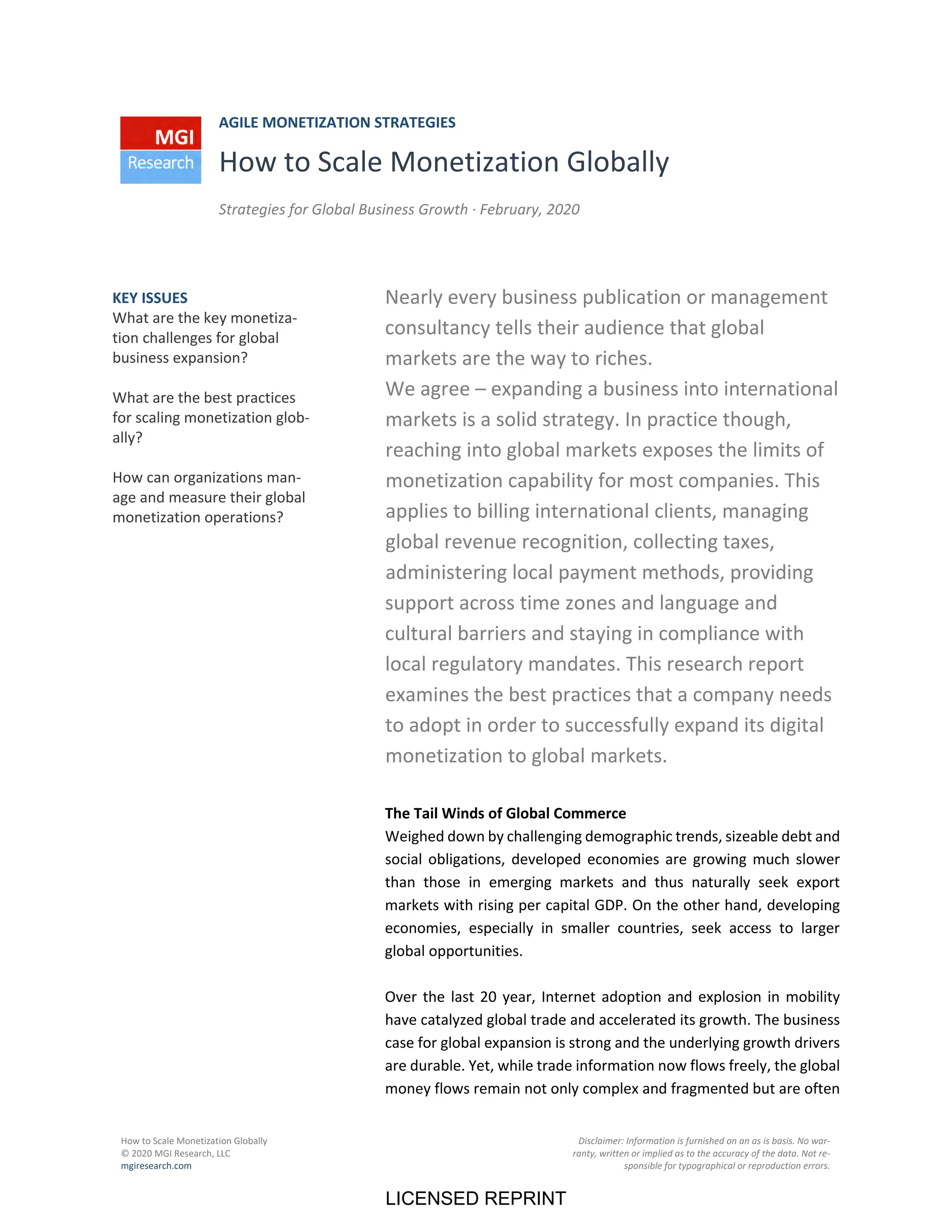
Nearly every business publication or management
consultancy tells their audience that global
markets are the way to riches.
We agree – expanding a business into international
markets is a solid strategy. In practice though,
reaching into global markets exposes the limits of
monetization capability for most companies. This
applies to billing international clients, managing
global revenue recognition, collecting taxes,
administering local payment methods, providing
support across time zones and language and
cultural barriers and staying in compliance with
local regulatory mandates. This research report
examines the best practices that a company needs
to adopt in order to successfully expand its digital
monetization to global markets.
The Tail Winds of Global Commerce
Weighed down by challenging demographic trends, sizeable debt and
social obligations, developed economies are growing much slower
than those in emerging markets and thus naturally seek export
markets with rising per capital GDP. On the other hand, developing
economies, especially in smaller countries, seek access to larger
global opportunities.
Over the last 20 year, Internet adoption and explosion in mobility
have catalyzed global trade and accelerated its growth. The business
case for global expansion is strong and the underlying growth drivers
are durable. Yet, while trade information now flows freely, the global
money flows remain not only complex and fragmented but are often
KEY ISSUES
What are the key monetiza‐
tion challenges for global
business expansion?
What are the best practices
for scaling monetization glob‐
ally?
How can organizations man‐
age and measure their global
monetization operations?
LICENSED REPRINT
AGILE MONETIZATION STRATEGIES
HOW TO SCALE MONETIZATION GLOBALLY
Strategies for Global Business Growth ∙ February, 2020
How to Scale Monetization Globally
© 2020 MGI Research, LLC
mgiresearch.com 2
Disclaimer: Information is furnished on an as is
basis. No warranty, written or implied as to the
accuracy of the data. Not responsible for typo‐
graphical or reproduction errors.
a serious gating factor to success in international expansion. Most
companies simply lack the tools and the expertise in taking even basic
digital subscriptions to global markets.
In theory nearly every CEO understands that there are international
markets with interest in their offerings. This is especially true for
organizations offerings digital goods and services. In practice,
executing a global expansion strategy even for offerings that do not
require physical inventory and shipping is quite challenging.
MGI Research estimates that amongst digitally‐focused US‐based
businesses attempting a first‐time global expansion, nearly 70%
either fail or experience meaningful delays and cost overruns.
How can organizations prepare themselves effectively for a global
push? We recommend that companies contemplating a global
expansion should conduct a review of their international
monetization capability. The assessment should focus on the
following key questions:
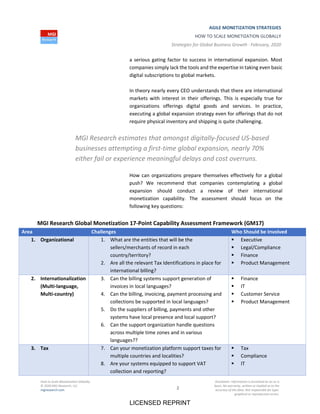
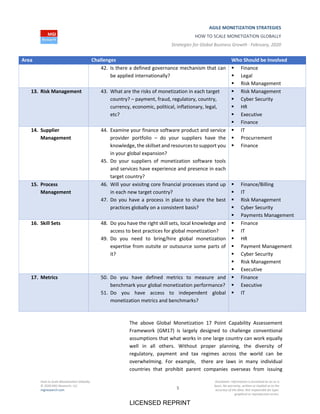
MGI Research Global Monetization 17‐Point Capability Assessment Framework (GM17)
Area Challenges Who Should be Involved
1. Organizational 1. What are the entities that will be the
sellers/merchants of record in each
country/territory?
2. Are all the relevant Tax Identifications in place for
international billing?
 Executive
 Legal/Compliance
 Finance
 Product Management
2. Internationalization
(Multi‐language,
Multi‐country)
3. Can the billing systems support generation of
invoices in local languages?
4. Can the billing, invoicing, payment processing and
collections be supported in local languages?
5. Do the suppliers of billing, payments and other
systems have local presence and local support?
6. Can the support organization handle questions
across multiple time zones and in various
languages??
 Finance
 IT
 Customer Service
 Product Management
3. Tax 7. Can your monetization platform support taxes for
multiple countries and localities?
8. Are your systems equipped to support VAT
collection and reporting?
 Tax
 Compliance
 IT
LICENSED REPRINT
AGILE MONETIZATION STRATEGIES
HOW TO SCALE MONETIZATION GLOBALLY
Strategies for Global Business Growth ∙ February, 2020
How to Scale Monetization Globally
© 2020 MGI Research, LLC
mgiresearch.com 3
Disclaimer: Information is furnished on an as is
basis. No warranty, written or implied as to the
accuracy of the data. Not responsible for typo‐
graphical or reproduction errors.
Area Challenges Who Should be Involved
9. Are there systems in place to validate tax
identifications globally?
10. Can your systems accurately determine which taxes
apply for each line item on an invoice? e.g. location
specific taxes?
11. Are your finance systems equiped to handle inter‐
country tax calculations, e.g. special customs fees,
transport fees, etc?
12. Does your tax calculation engine support handling
of exempt, dounble taxation, and other complex
international tax rules?
4. Payments 13. Can your monetization platform handle local pay‐
ment methods in each target geography?
14. Can your monetization platform support payment
processing in all target countries?
15. Can your systems handle both incoming and out‐
going payments? (Pay‐In and Pay‐Out) in each ge‐
ography?
16. Is your payment infrastructure robust enough to
handle multiple payment gateways?
17. Does your payment infrastructure support backup
payment gateways in each geography?
18. Do you have provisions in place to handle payment
processing risks?
19. Do you have a process in place for handling pay‐
ment fraud?
 Finance/Billing
 Collections
 Payments Processing
 IT
 Cyber security
 Risk Management
5. Billing &
E‐Commerce
20. Can your Billing system support your organizational
hierarchy? Can international subsidiaries generate
local invoices? Can business, revenue and tax rules
be defined and managed based on geography?
21. Does your billing system allow for invoice customi‐
zation to enable layouts that are acceptable in each
target country?
22. Can the billing system support invoices in local cur‐
rency? In multiple currencies?
23. Does the financial system have robust capabilities
for multi‐currency and multi‐entity handling?
24. Can the financial system support real‐time and his‐
torical currency conversion?
25. Do your e‐Commerce and Merchant of Record
(MoR) or Seller of Record (SoR) platforms support
global expansion and at what cost?
 Finance/Billing
 Collections
LICENSED REPRINT
AGILE MONETIZATION STRATEGIES
HOW TO SCALE MONETIZATION GLOBALLY
Strategies for Global Business Growth ∙ February, 2020
How to Scale Monetization Globally
© 2020 MGI Research, LLC
mgiresearch.com 4
Disclaimer: Information is furnished on an as is
basis. No warranty, written or implied as to the
accuracy of the data. Not responsible for typo‐
graphical or reproduction errors.
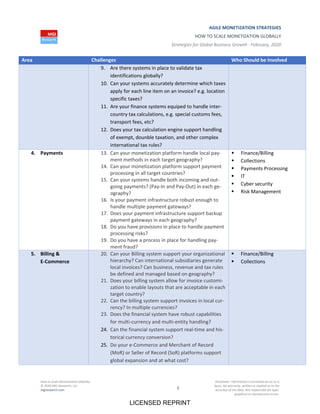
Area Challenges Who Should be Involved
6. Master Data
Management
(MDM)
26. Can your financial and billing systems support
multi‐entity management (billing addresses, service
addresses, organization addresses, divisional hier‐
archies)?
27. Can product and pricing catalogs be easily localized
and if needed managed locally?
 Product Management
 IT/Data Architecture
 Analytics
 Finance
 Cyber Security
7. Revenue
Management
28. Is your Automated Revenue Management system
equipped to handle international revenues?
29. Is revenue going to be recognized and reported lo‐
cally, globally or both?
30. Do your billing and revenue recognition systems
have the capabilities to handle historical currency
conversion rates?
31. Have you stress‐tested your ERP systems for inter‐
national revenue handling and consolidation in‐
cluding order changes, cancellations, revenue de‐
lays, organizational changes?
32. Have your auditors been engaged in the global ex‐
pansion review process?
 Finance
 Compliance
 Audit
 External Audit Firm
 Legal
8. Customer Service 33. Does the customer service function have the right
tools, process, and staff to deal with multiple time
zones, multiple languages and cultures?
34. How will customer service be organized for dealing
with questions on international billing, payments,
refunds, taxes?
35. What training will be needed in order for customer
service to deal with international expansion?
 Sales/Channel + Partner
Management
 Finance
 IT
9. Channel
Management
36. Can your finance and billing ecosystem handle
global monetization in a multi‐tier channel context?
 Sales/Channel + Partner
Management
 Finance
 IT
10. Order Management 37. Are your order management systems and pro‐
cesses able to handle international deliveries, pro‐
visioning and fulfillment?
38. Are your customer service processes and internal
support prepared to deal with international aspects
of order management?
 Operations
 Sales
 Finance
 IT
11. Compliance 39. Is there a complete list of regulatory mandates that
would affect monetization in every target country?
e.g. export controls, sanctions, boycotts, foreign as‐
set controls, revenue disclosures?
40. What are the implications of international privacy,
revenue reporting and tax compliance mandates?
 Legal/Regulatory
 Risk Management
 Cyber Security & IT
 Executive
 Finance
12. Governance 41. How will decisions affecting each specific country be
made?
 Executive
 HR
LICENSED REPRINT
AGILE MONETIZATION STRATEGIES
HOW TO SCALE MONETIZATION GLOBALLY
Strategies for Global Business Growth ∙ February, 2020
How to Scale Monetization Globally
© 2020 MGI Research, LLC
mgiresearch.com 5
Disclaimer: Information is furnished on an as is
basis. No warranty, written or implied as to the
accuracy of the data. Not responsible for typo‐
graphical or reproduction errors.
Area Challenges Who Should be Involved
42. Is there a defined governance mechanism that can
be applied internationally?
 Finance
 Legal
 Risk Management
13. Risk Management 43. What are the risks of monetization in each target
country? – payment, fraud, regulatory, country,
currency, economic, political, inflationary, legal,
etc?
 Risk Management
 Cyber Security
 HR
 Executive
 Finance
14. Supplier
Management
44. Examine your finance software product and service
provider portfolio – do your suppliers have the
knowledge, the skillset and resources to support you
in your global expansion?
45. Do your suppliers of monetization software tools
and services have experience and presence in each
target country?
 IT
 Procurrement
 Finance
15. Process
Management
46. Will your exisitng core financial processes stand up
in each new target country?
47. Do you have a process in place to share the best
practices globally on a consistent basis?
 Finance/Billing
 IT
 Risk Management
 Cyber Security
 Payments Management
16. Skill Sets 48. Do you have the right skill sets, local knowledge and
access to best practices for global monetization?
49. Do you need to bring/hire global monetization
expertise from outsite or outsource some parts of
it?
 Finance
 IT
 HR
 Payment Management
 Cyber Security
 Risk Management
 Executive
17. Metrics 50. Do you have defined metrics to measure and
benchmark your global monetization performance?
51. Do you have access to independent global
monetization metrics and benchmarks?
 Finance
 Executive
 IT
The above Global Monetization 17 Point Capability Assessement
Framework (GM17) is largely designed to challenge conventional
assumptions that what works in one large country can work equally
well in all others. Without proper planning, the diversity of
regulatory, payment and tax regimes across the world can be
overwhelming. For example, there are laws in many individual
countries that prohibit parent companies overseas from issuing
LICENSED REPRINT
AGILE MONETIZATION STRATEGIES
HOW TO SCALE MONETIZATION GLOBALLY
Strategies for Global Business Growth ∙ February, 2020
How to Scale Monetization Globally
© 2020 MGI Research, LLC
mgiresearch.com 6
Disclaimer: Information is furnished on an as is
basis. No warranty, written or implied as to the
accuracy of the data. Not responsible for typo‐
graphical or reproduction errors.
explicit edicts to local affiliates. Some geographies are now
experimenting with essentially a real‐time reporting of revenues and
tax calculations (Spain, Brazil). And then there are the local payment
methods and payment processing options. Simply assuming that
everyone around the world can pay via a credit card and therefore it
will all work – that can lead to severe disapointments. Processing
entities handling payments from foreign addresses can be easily
tripped up and result in exceptions and manual management. On the
other hand, customers facing an unfamilar payment method, foreign
terminology or a portal that looks out of place, are likely to abandon
a transaction. For example, processing a European credit card by a US
payment gateway can bring up a variety of issues and delays.
The friction in payment management often leads companies into a
well‐hidden financial black hole – The Revenue Leakage. MGI defines
revenue leakage as the gap between what a company is entitled to
under the rules of a contract and what it actually is able to invoice for
and collect.
MGI Research estimates that in North America, revenue leakage averages
between 3% and 7% of annual revenues.
MGI Research estimates that for the planning period of 2020 to 2025
international revenue leakage will on average be at least 50% higher than
domestic revenue leakage.
MGI Research expects that between 2020 and 2025, organizations that
modernize their global monetization systems and adapt best practices will see
a 30‐40% reduction in revenue leakage domestically and 50‐60% reduction in
revenue leakage internationally.
Our recommendation is that before embarking on a fully fledged
international expansion, organizations should be using a methodical
approach to self‐assessment of their global monetization capabilities.
Today, piece parts of GM17 exists in most F1000 companies but
smaller organizations tend to employ a more improvised approach.
We are already seeing a number of leading organizations adopt a
GM17‐like approach to international launches, especially with digital
services launching globally.
LICENSED REPRINT
AGILE MONETIZATION STRATEGIES
HOW TO SCALE MONETIZATION GLOBALLY
Strategies for Global Business Growth ∙ February, 2020
How to Scale Monetization Globally
© 2020 MGI Research, LLC
mgiresearch.com 7
Disclaimer: Information is furnished on an as is
basis. No warranty, written or implied as to the
accuracy of the data. Not responsible for typo‐
graphical or reproduction errors.
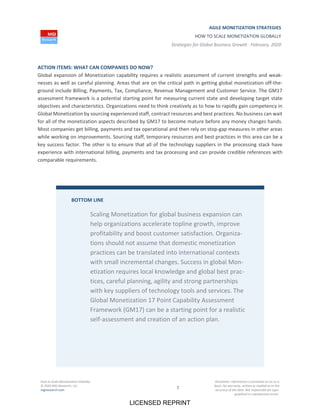
ACTION ITEMS: WHAT CAN COMPANIES DO NOW?
Global expansion of Monetization capability requires a realistic assessment of current strengths and weak‐
nesses as well as careful planning. Areas that are on the critical path in getting global monetization off‐the‐
ground include Billing, Payments, Tax, Compliance, Revenue Management and Customer Service. The GM17
assessment framework is a potential starting point for measuring current state and developing target state
objectives and characteristics. Organizations need to think creatively as to how to rapidly gain competency in
Global Monetization by sourcing experienced staff, contract resources and best practices. No business can wait
for all of the monetization aspects described by GM17 to become mature before any money changes hands.
Most companies get billing, payments and tax operational and then rely on stop‐gap measures in other areas
while working on improvements. Sourcing staff, temporary resources and best practices in this area can be a
key success factor. The other is to ensure that all of the technology suppliers in the processing stack have
experience with international billing, payments and tax processing and can provide credible references with
comparable requirements.
BOTTOM LINE
Scaling Monetization for global business expansion can
help organizations accelerate topline growth, improve
profitability and boost customer satisfaction. Organiza‐
tions should not assume that domestic monetization
practices can be translated into international contexts
with small incremental changes. Success in global Mon‐
etization requires local knowledge and global best prac‐
tices, careful planning, agility and strong partnerships
with key suppliers of technology tools and services. The
Global Monetization 17 Point Capability Assessment
Framework (GM17) can be a starting point for a realistic
self‐assessment and creation of an action plan.
LICENSED REPRINT

How to Scale Monetization Globally

  • 1.
    How to ScaleMonetization Globally © 2020 MGI Research, LLC mgiresearch.com Disclaimer: Information is furnished on an as is basis. No war‐ ranty, written or implied as to the accuracy of the data. Not re‐ sponsible for typographical or reproduction errors. AGILE MONETIZATION STRATEGIES How to Scale Monetization Globally Strategies for Global Business Growth ∙ February, 2020 Nearly every business publication or management consultancy tells their audience that global markets are the way to riches. We agree – expanding a business into international markets is a solid strategy. In practice though, reaching into global markets exposes the limits of monetization capability for most companies. This applies to billing international clients, managing global revenue recognition, collecting taxes, administering local payment methods, providing support across time zones and language and cultural barriers and staying in compliance with local regulatory mandates. This research report examines the best practices that a company needs to adopt in order to successfully expand its digital monetization to global markets. The Tail Winds of Global Commerce Weighed down by challenging demographic trends, sizeable debt and social obligations, developed economies are growing much slower than those in emerging markets and thus naturally seek export markets with rising per capital GDP. On the other hand, developing economies, especially in smaller countries, seek access to larger global opportunities. Over the last 20 year, Internet adoption and explosion in mobility have catalyzed global trade and accelerated its growth. The business case for global expansion is strong and the underlying growth drivers are durable. Yet, while trade information now flows freely, the global money flows remain not only complex and fragmented but are often KEY ISSUES What are the key monetiza‐ tion challenges for global business expansion? What are the best practices for scaling monetization glob‐ ally? How can organizations man‐ age and measure their global monetization operations? LICENSED REPRINT
  • 2.
    AGILE MONETIZATION STRATEGIES HOWTO SCALE MONETIZATION GLOBALLY Strategies for Global Business Growth ∙ February, 2020 How to Scale Monetization Globally © 2020 MGI Research, LLC mgiresearch.com 2 Disclaimer: Information is furnished on an as is basis. No warranty, written or implied as to the accuracy of the data. Not responsible for typo‐ graphical or reproduction errors. a serious gating factor to success in international expansion. Most companies simply lack the tools and the expertise in taking even basic digital subscriptions to global markets. In theory nearly every CEO understands that there are international markets with interest in their offerings. This is especially true for organizations offerings digital goods and services. In practice, executing a global expansion strategy even for offerings that do not require physical inventory and shipping is quite challenging. MGI Research estimates that amongst digitally‐focused US‐based businesses attempting a first‐time global expansion, nearly 70% either fail or experience meaningful delays and cost overruns. How can organizations prepare themselves effectively for a global push? We recommend that companies contemplating a global expansion should conduct a review of their international monetization capability. The assessment should focus on the following key questions: MGI Research Global Monetization 17‐Point Capability Assessment Framework (GM17) Area Challenges Who Should be Involved 1. Organizational 1. What are the entities that will be the sellers/merchants of record in each country/territory? 2. Are all the relevant Tax Identifications in place for international billing?  Executive  Legal/Compliance  Finance  Product Management 2. Internationalization (Multi‐language, Multi‐country) 3. Can the billing systems support generation of invoices in local languages? 4. Can the billing, invoicing, payment processing and collections be supported in local languages? 5. Do the suppliers of billing, payments and other systems have local presence and local support? 6. Can the support organization handle questions across multiple time zones and in various languages??  Finance  IT  Customer Service  Product Management 3. Tax 7. Can your monetization platform support taxes for multiple countries and localities? 8. Are your systems equipped to support VAT collection and reporting?  Tax  Compliance  IT LICENSED REPRINT
  • 3.
    AGILE MONETIZATION STRATEGIES HOWTO SCALE MONETIZATION GLOBALLY Strategies for Global Business Growth ∙ February, 2020 How to Scale Monetization Globally © 2020 MGI Research, LLC mgiresearch.com 3 Disclaimer: Information is furnished on an as is basis. No warranty, written or implied as to the accuracy of the data. Not responsible for typo‐ graphical or reproduction errors. Area Challenges Who Should be Involved 9. Are there systems in place to validate tax identifications globally? 10. Can your systems accurately determine which taxes apply for each line item on an invoice? e.g. location specific taxes? 11. Are your finance systems equiped to handle inter‐ country tax calculations, e.g. special customs fees, transport fees, etc? 12. Does your tax calculation engine support handling of exempt, dounble taxation, and other complex international tax rules? 4. Payments 13. Can your monetization platform handle local pay‐ ment methods in each target geography? 14. Can your monetization platform support payment processing in all target countries? 15. Can your systems handle both incoming and out‐ going payments? (Pay‐In and Pay‐Out) in each ge‐ ography? 16. Is your payment infrastructure robust enough to handle multiple payment gateways? 17. Does your payment infrastructure support backup payment gateways in each geography? 18. Do you have provisions in place to handle payment processing risks? 19. Do you have a process in place for handling pay‐ ment fraud?  Finance/Billing  Collections  Payments Processing  IT  Cyber security  Risk Management 5. Billing & E‐Commerce 20. Can your Billing system support your organizational hierarchy? Can international subsidiaries generate local invoices? Can business, revenue and tax rules be defined and managed based on geography? 21. Does your billing system allow for invoice customi‐ zation to enable layouts that are acceptable in each target country? 22. Can the billing system support invoices in local cur‐ rency? In multiple currencies? 23. Does the financial system have robust capabilities for multi‐currency and multi‐entity handling? 24. Can the financial system support real‐time and his‐ torical currency conversion? 25. Do your e‐Commerce and Merchant of Record (MoR) or Seller of Record (SoR) platforms support global expansion and at what cost?  Finance/Billing  Collections LICENSED REPRINT
  • 4.
    AGILE MONETIZATION STRATEGIES HOWTO SCALE MONETIZATION GLOBALLY Strategies for Global Business Growth ∙ February, 2020 How to Scale Monetization Globally © 2020 MGI Research, LLC mgiresearch.com 4 Disclaimer: Information is furnished on an as is basis. No warranty, written or implied as to the accuracy of the data. Not responsible for typo‐ graphical or reproduction errors. Area Challenges Who Should be Involved 6. Master Data Management (MDM) 26. Can your financial and billing systems support multi‐entity management (billing addresses, service addresses, organization addresses, divisional hier‐ archies)? 27. Can product and pricing catalogs be easily localized and if needed managed locally?  Product Management  IT/Data Architecture  Analytics  Finance  Cyber Security 7. Revenue Management 28. Is your Automated Revenue Management system equipped to handle international revenues? 29. Is revenue going to be recognized and reported lo‐ cally, globally or both? 30. Do your billing and revenue recognition systems have the capabilities to handle historical currency conversion rates? 31. Have you stress‐tested your ERP systems for inter‐ national revenue handling and consolidation in‐ cluding order changes, cancellations, revenue de‐ lays, organizational changes? 32. Have your auditors been engaged in the global ex‐ pansion review process?  Finance  Compliance  Audit  External Audit Firm  Legal 8. Customer Service 33. Does the customer service function have the right tools, process, and staff to deal with multiple time zones, multiple languages and cultures? 34. How will customer service be organized for dealing with questions on international billing, payments, refunds, taxes? 35. What training will be needed in order for customer service to deal with international expansion?  Sales/Channel + Partner Management  Finance  IT 9. Channel Management 36. Can your finance and billing ecosystem handle global monetization in a multi‐tier channel context?  Sales/Channel + Partner Management  Finance  IT 10. Order Management 37. Are your order management systems and pro‐ cesses able to handle international deliveries, pro‐ visioning and fulfillment? 38. Are your customer service processes and internal support prepared to deal with international aspects of order management?  Operations  Sales  Finance  IT 11. Compliance 39. Is there a complete list of regulatory mandates that would affect monetization in every target country? e.g. export controls, sanctions, boycotts, foreign as‐ set controls, revenue disclosures? 40. What are the implications of international privacy, revenue reporting and tax compliance mandates?  Legal/Regulatory  Risk Management  Cyber Security & IT  Executive  Finance 12. Governance 41. How will decisions affecting each specific country be made?  Executive  HR LICENSED REPRINT
  • 5.
    AGILE MONETIZATION STRATEGIES HOWTO SCALE MONETIZATION GLOBALLY Strategies for Global Business Growth ∙ February, 2020 How to Scale Monetization Globally © 2020 MGI Research, LLC mgiresearch.com 5 Disclaimer: Information is furnished on an as is basis. No warranty, written or implied as to the accuracy of the data. Not responsible for typo‐ graphical or reproduction errors. Area Challenges Who Should be Involved 42. Is there a defined governance mechanism that can be applied internationally?  Finance  Legal  Risk Management 13. Risk Management 43. What are the risks of monetization in each target country? – payment, fraud, regulatory, country, currency, economic, political, inflationary, legal, etc?  Risk Management  Cyber Security  HR  Executive  Finance 14. Supplier Management 44. Examine your finance software product and service provider portfolio – do your suppliers have the knowledge, the skillset and resources to support you in your global expansion? 45. Do your suppliers of monetization software tools and services have experience and presence in each target country?  IT  Procurrement  Finance 15. Process Management 46. Will your exisitng core financial processes stand up in each new target country? 47. Do you have a process in place to share the best practices globally on a consistent basis?  Finance/Billing  IT  Risk Management  Cyber Security  Payments Management 16. Skill Sets 48. Do you have the right skill sets, local knowledge and access to best practices for global monetization? 49. Do you need to bring/hire global monetization expertise from outsite or outsource some parts of it?  Finance  IT  HR  Payment Management  Cyber Security  Risk Management  Executive 17. Metrics 50. Do you have defined metrics to measure and benchmark your global monetization performance? 51. Do you have access to independent global monetization metrics and benchmarks?  Finance  Executive  IT The above Global Monetization 17 Point Capability Assessement Framework (GM17) is largely designed to challenge conventional assumptions that what works in one large country can work equally well in all others. Without proper planning, the diversity of regulatory, payment and tax regimes across the world can be overwhelming. For example, there are laws in many individual countries that prohibit parent companies overseas from issuing LICENSED REPRINT
  • 6.
    AGILE MONETIZATION STRATEGIES HOWTO SCALE MONETIZATION GLOBALLY Strategies for Global Business Growth ∙ February, 2020 How to Scale Monetization Globally © 2020 MGI Research, LLC mgiresearch.com 6 Disclaimer: Information is furnished on an as is basis. No warranty, written or implied as to the accuracy of the data. Not responsible for typo‐ graphical or reproduction errors. explicit edicts to local affiliates. Some geographies are now experimenting with essentially a real‐time reporting of revenues and tax calculations (Spain, Brazil). And then there are the local payment methods and payment processing options. Simply assuming that everyone around the world can pay via a credit card and therefore it will all work – that can lead to severe disapointments. Processing entities handling payments from foreign addresses can be easily tripped up and result in exceptions and manual management. On the other hand, customers facing an unfamilar payment method, foreign terminology or a portal that looks out of place, are likely to abandon a transaction. For example, processing a European credit card by a US payment gateway can bring up a variety of issues and delays. The friction in payment management often leads companies into a well‐hidden financial black hole – The Revenue Leakage. MGI defines revenue leakage as the gap between what a company is entitled to under the rules of a contract and what it actually is able to invoice for and collect. MGI Research estimates that in North America, revenue leakage averages between 3% and 7% of annual revenues. MGI Research estimates that for the planning period of 2020 to 2025 international revenue leakage will on average be at least 50% higher than domestic revenue leakage. MGI Research expects that between 2020 and 2025, organizations that modernize their global monetization systems and adapt best practices will see a 30‐40% reduction in revenue leakage domestically and 50‐60% reduction in revenue leakage internationally. Our recommendation is that before embarking on a fully fledged international expansion, organizations should be using a methodical approach to self‐assessment of their global monetization capabilities. Today, piece parts of GM17 exists in most F1000 companies but smaller organizations tend to employ a more improvised approach. We are already seeing a number of leading organizations adopt a GM17‐like approach to international launches, especially with digital services launching globally. LICENSED REPRINT
  • 7.
    AGILE MONETIZATION STRATEGIES HOWTO SCALE MONETIZATION GLOBALLY Strategies for Global Business Growth ∙ February, 2020 How to Scale Monetization Globally © 2020 MGI Research, LLC mgiresearch.com 7 Disclaimer: Information is furnished on an as is basis. No warranty, written or implied as to the accuracy of the data. Not responsible for typo‐ graphical or reproduction errors. ACTION ITEMS: WHAT CAN COMPANIES DO NOW? Global expansion of Monetization capability requires a realistic assessment of current strengths and weak‐ nesses as well as careful planning. Areas that are on the critical path in getting global monetization off‐the‐ ground include Billing, Payments, Tax, Compliance, Revenue Management and Customer Service. The GM17 assessment framework is a potential starting point for measuring current state and developing target state objectives and characteristics. Organizations need to think creatively as to how to rapidly gain competency in Global Monetization by sourcing experienced staff, contract resources and best practices. No business can wait for all of the monetization aspects described by GM17 to become mature before any money changes hands. Most companies get billing, payments and tax operational and then rely on stop‐gap measures in other areas while working on improvements. Sourcing staff, temporary resources and best practices in this area can be a key success factor. The other is to ensure that all of the technology suppliers in the processing stack have experience with international billing, payments and tax processing and can provide credible references with comparable requirements. BOTTOM LINE Scaling Monetization for global business expansion can help organizations accelerate topline growth, improve profitability and boost customer satisfaction. Organiza‐ tions should not assume that domestic monetization practices can be translated into international contexts with small incremental changes. Success in global Mon‐ etization requires local knowledge and global best prac‐ tices, careful planning, agility and strong partnerships with key suppliers of technology tools and services. The Global Monetization 17 Point Capability Assessment Framework (GM17) can be a starting point for a realistic self‐assessment and creation of an action plan. LICENSED REPRINT