How To
Perform User
Research NEXT
1/17
NEXT
2/17
User research is used to understand the user’s
needs, behaviors, experience and motivations
through various qualitative and quantitative methods
to inform the process of solving for user’s problems.
What is user
research
WHY IS USER
RESEARCH SO
IMPORTANT?
User research helps
uncover important and
useful insights about the
user and their needs.
Until you know your user
and their needs, emotions,
feelings, struggles etc, you
won’t be able to deliver a
great user experience.
3/17 NEXT
Benefit of builds an
emotional
connection
The benefit of this is
that it builds an
emotional connection
between the user and
the product. Users feel
their needs are being
met and are more likely
to continue using the
product.
NEXT
4/17
Why are we achieving a certain goal?
How are we going to achieve this goal?
What’s the outcome of achieving this
goal?
Three important questions:
NEXT
HOW TO APPROACH USER
RESEARCH
Be specific
Be focused and relevant to what you’re trying to understand
Make them practical with the resources you have
Make them actionable
Be flexible and don’t worry about which method to use
5/17
NEXT
Types of research
methods and when
to use them
Stages of the product life
cycle
Quantitative vs.
qualitative
Attitudinal vs. behavioral
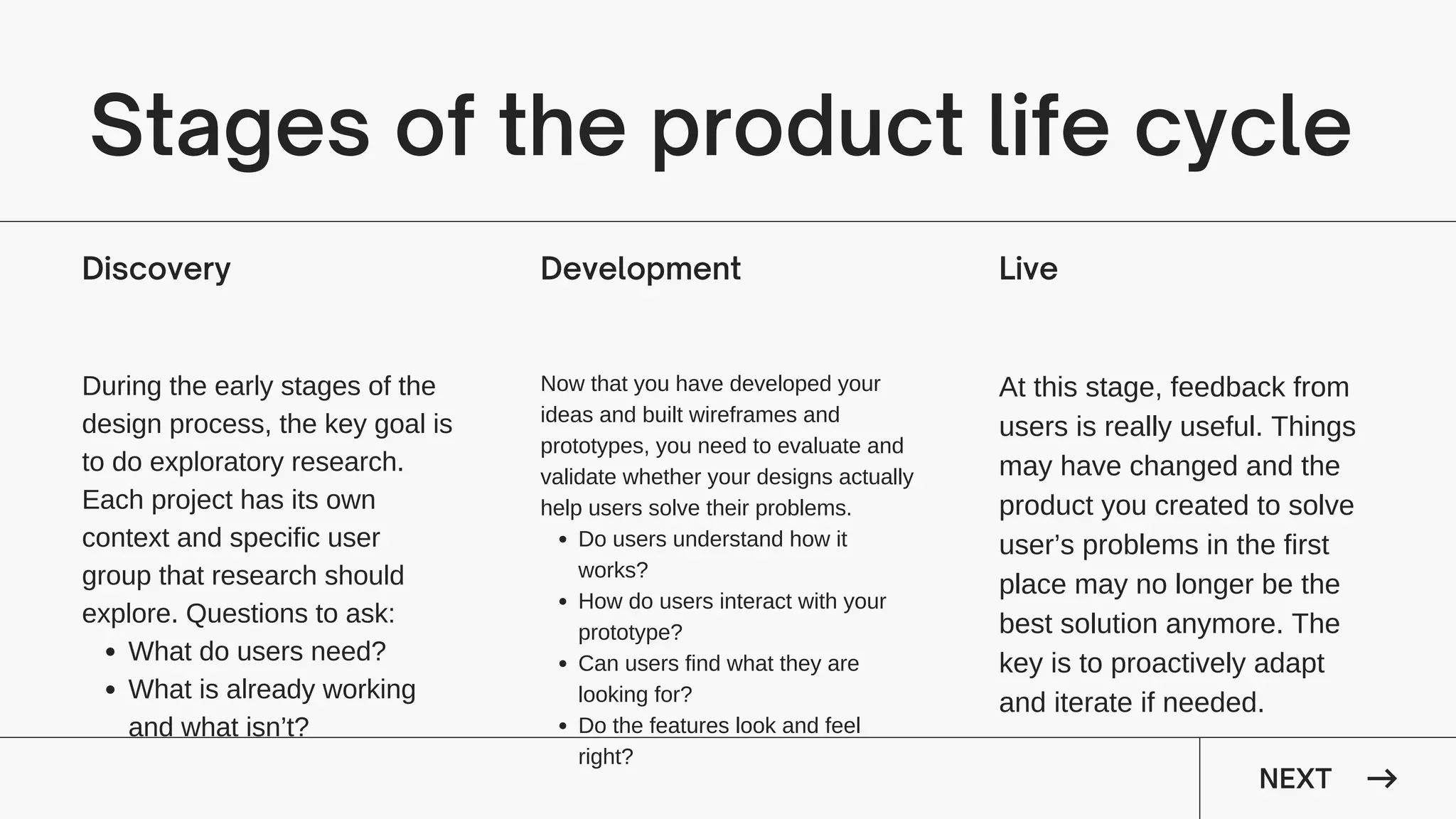
Stages of the product life cycle
Discovery
What do users need?
What is already working
and what isn’t?
During the early stages of the
design process, the key goal is
to do exploratory research.
Each project has its own
context and specific user
group that research should
explore. Questions to ask:
Development
Do users understand how it
works?
How do users interact with your
prototype?
Can users find what they are
looking for?
Do the features look and feel
right?
Now that you have developed your
ideas and built wireframes and
prototypes, you need to evaluate and
validate whether your designs actually
help users solve their problems.
Live
At this stage, feedback from
users is really useful. Things
may have changed and the
product you created to solve
user’s problems in the first
place may no longer be the
best solution anymore. The
key is to proactively adapt
and iterate if needed.
NEXT
QUANTITATIVE
NEXT
Quantitative research is used to understand the
‘what’. This type of research can be measured
numerically.
For example, “How many people visited a store over
a week” or “What percentage of users clicked this
button”.
This type of research explores large sample sizes of
data to identify trends and patterns.
Qualitative Qualitative research
explores user’s attitudes,
behaviors, and opinions. It
provides key insights into
understanding the context
behind why trends and
patterns arise.
NEXT
Attitudinal
Attitudinal research seeks to assess why users have particular attitudes
and feelings towards an experience. For instance, whether users enjoy
using your product or not.
NEXT
BEHAVIORAL
It’s important to know that
what users say and do are
often different, which is
why you should aim to do a
mixture of attitudinal and
behavioral research.
Behavioral research
focuses on what users do
with the product in
question. This could be to
find out how users navigate
through a site.
Examples include A/B
testing, eye-tracking, click-
stream analysis and
usability studies.
17/17
Website
www.nupurandworld.com

How to perform user research

  • 1.
  • 2.
    NEXT 2/17 User research isused to understand the user’s needs, behaviors, experience and motivations through various qualitative and quantitative methods to inform the process of solving for user’s problems. What is user research
  • 3.
    WHY IS USER RESEARCHSO IMPORTANT? User research helps uncover important and useful insights about the user and their needs. Until you know your user and their needs, emotions, feelings, struggles etc, you won’t be able to deliver a great user experience. 3/17 NEXT
  • 4.
    Benefit of buildsan emotional connection The benefit of this is that it builds an emotional connection between the user and the product. Users feel their needs are being met and are more likely to continue using the product. NEXT 4/17 Why are we achieving a certain goal? How are we going to achieve this goal? What’s the outcome of achieving this goal? Three important questions:
  • 5.
    NEXT HOW TO APPROACHUSER RESEARCH Be specific Be focused and relevant to what you’re trying to understand Make them practical with the resources you have Make them actionable Be flexible and don’t worry about which method to use 5/17
  • 6.
    NEXT Types of research methodsand when to use them Stages of the product life cycle Quantitative vs. qualitative Attitudinal vs. behavioral
  • 7.
    Stages of theproduct life cycle Discovery What do users need? What is already working and what isn’t? During the early stages of the design process, the key goal is to do exploratory research. Each project has its own context and specific user group that research should explore. Questions to ask: Development Do users understand how it works? How do users interact with your prototype? Can users find what they are looking for? Do the features look and feel right? Now that you have developed your ideas and built wireframes and prototypes, you need to evaluate and validate whether your designs actually help users solve their problems. Live At this stage, feedback from users is really useful. Things may have changed and the product you created to solve user’s problems in the first place may no longer be the best solution anymore. The key is to proactively adapt and iterate if needed. NEXT
  • 8.
    QUANTITATIVE NEXT Quantitative research isused to understand the ‘what’. This type of research can be measured numerically. For example, “How many people visited a store over a week” or “What percentage of users clicked this button”. This type of research explores large sample sizes of data to identify trends and patterns.
  • 9.
    Qualitative Qualitative research exploresuser’s attitudes, behaviors, and opinions. It provides key insights into understanding the context behind why trends and patterns arise.
  • 10.
    NEXT Attitudinal Attitudinal research seeksto assess why users have particular attitudes and feelings towards an experience. For instance, whether users enjoy using your product or not.
  • 11.
    NEXT BEHAVIORAL It’s important toknow that what users say and do are often different, which is why you should aim to do a mixture of attitudinal and behavioral research. Behavioral research focuses on what users do with the product in question. This could be to find out how users navigate through a site. Examples include A/B testing, eye-tracking, click- stream analysis and usability studies.
  • 12.