INTRODUCTION
In marketing, packagingrefers to the science, art, and technology of
designing, producing, and enclosing or protecting a product to facilitate its
distribution, storage, sale, and use. It serves as a crucial first point of contact
for consumers, performing key functions such as product protection, brand
promotion, product identification, and communication of brand value
through its design, graphics, and physical materials.
3.
MEANING
Packaging is thescience, art and technology of enclosing or protecting products
for distribution, storage, sale, and use. Packaging also refers to the process of
designing, evaluating, and producing packages. Packaging can be described as a
coordinated system of preparing goods for transport, warehousing, logistics, sale,
and end use. Packaging contains, protects, preserves, transports, informs, and
sells.In many countries it is fully integrated into government, business,
institutional, industrial, and for personal use.
4.
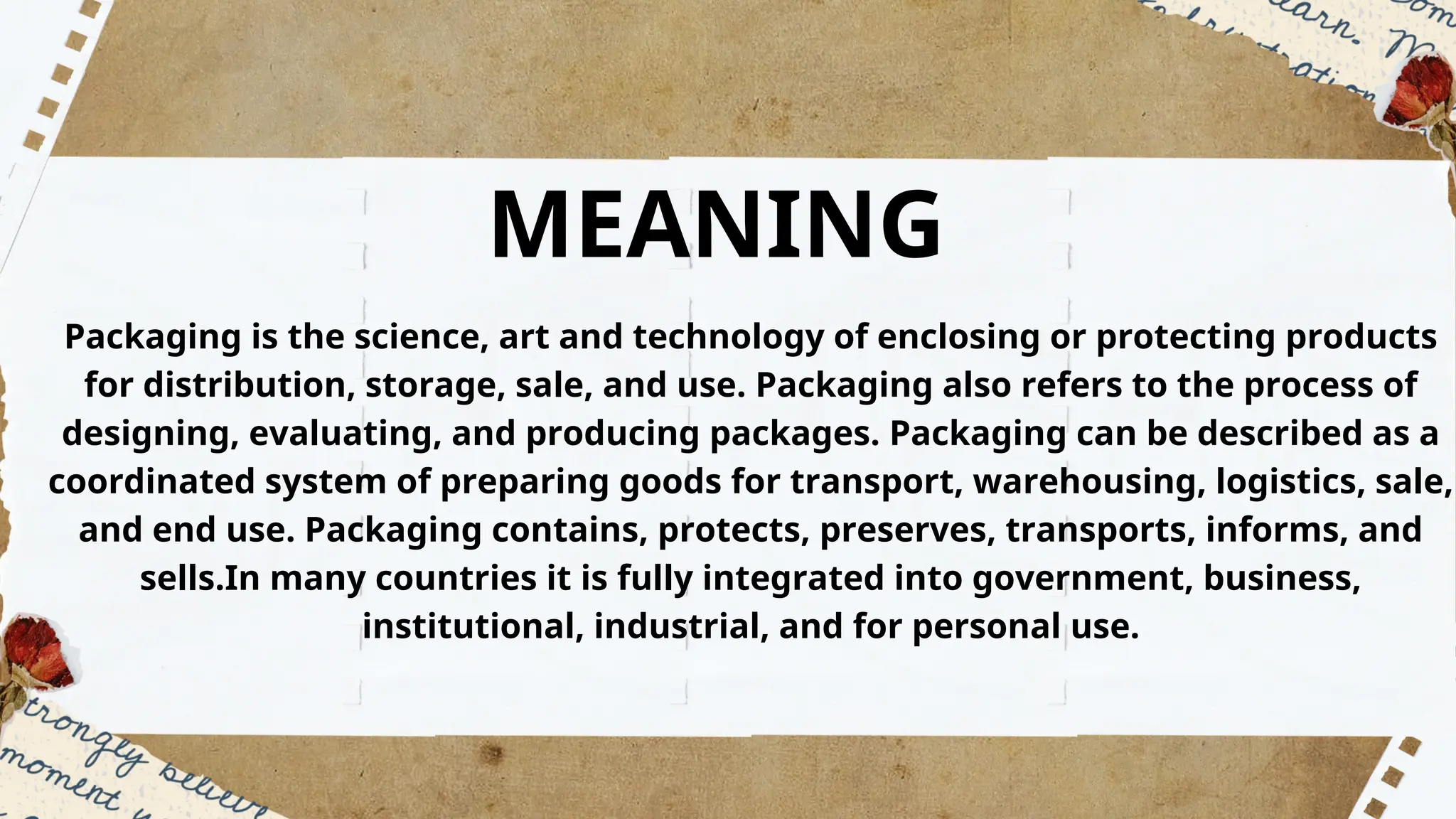
Most of thebusiness firms produce quality goods.
Packaging is done to protect quality, features, utility etc.
This also saves products from different risk or damage.
After the products have been produced, they need to be
transported to target markets. For this purpose, they are
properly packed according to their nature. If packing
could not be properly done, they may be damaged,
ruined or broken. So, the main objective of packaging is
to protect products.
CONVENIENCE:
OBJECTIVES:
PROTECTION
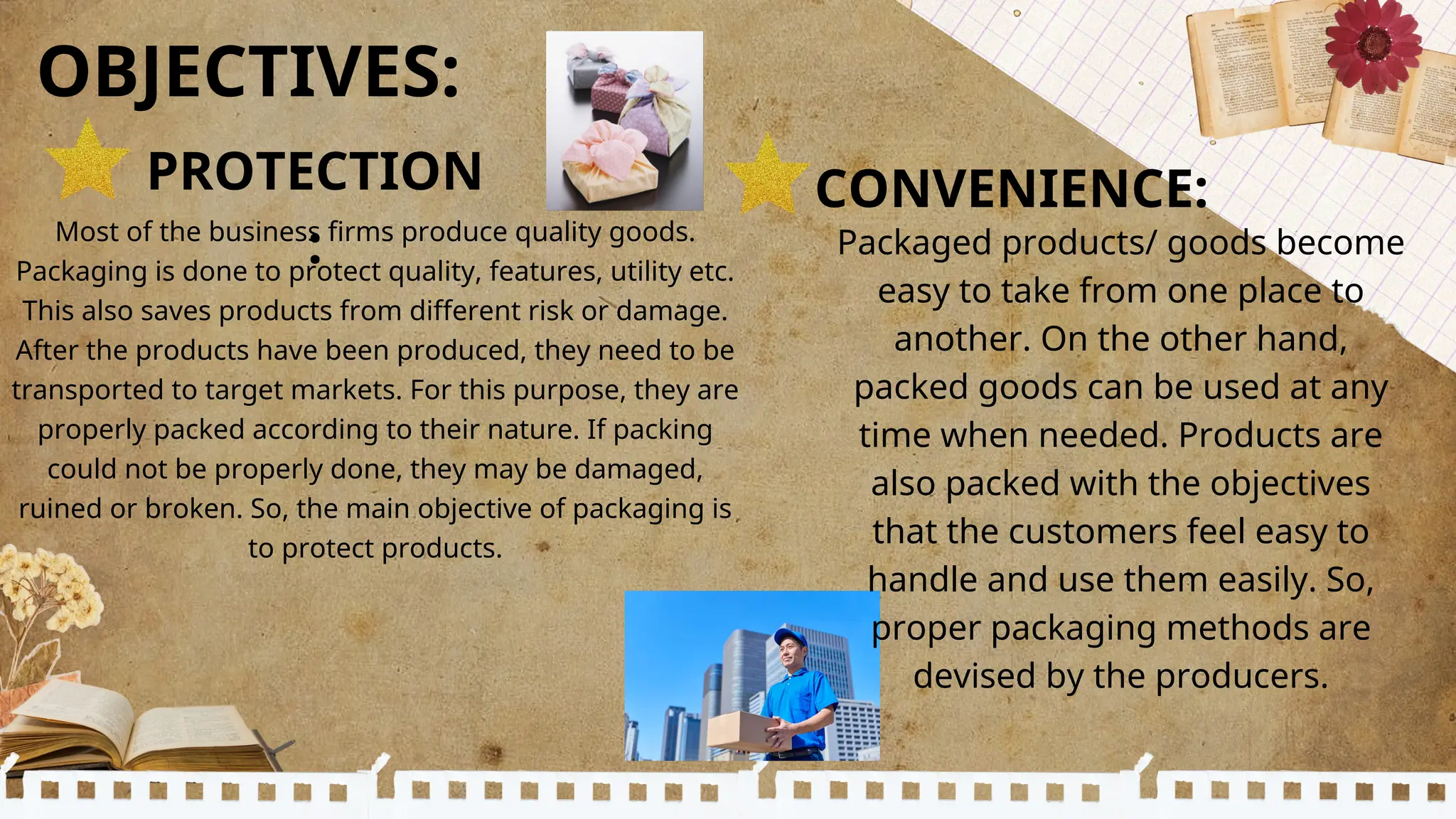
: Packaged products/ goods become
easy to take from one place to
another. On the other hand,
packed goods can be used at any
time when needed. Products are
also packed with the objectives
that the customers feel easy to
handle and use them easily. So,
proper packaging methods are
devised by the producers.
5.
COMMON IDENTIFICATION:
Besides brand,other instructions and information
are also written on packs. Producer’s name,
production date, usable duration, expiry date, suing
methods etc. are written on packs. Composition of
the packed products is also given on it. So, important
information about the product can be obtained from
pack. In this way, every packaging gives introduction
of the product with which the customers feel easy to
take decision to buy or not to buy.
HELPS IN SELLING:
Packaging aids selling by acting as a
powerful advertising and branding tool,
creating a positive first impression,
differentiating products from competitors,
and conveying key information to
consumers. Effective packaging can
influence purchasing decisions, build
brand recognition, convey brand values,
and enhance the customer's overall
experience, ultimately driving sales and
increasing perceived value.
6.
It must attractattention.
It must sell the product quickly – What is it?
What use? How much
It must build confidence.
It must look clean and sanitary.
It must be convenient to handle, to carry out
of the store, and to use.
It must look like good value.
CHARACTERISTICS
7.
It must looklike a fast seller.
It must deserve a preferred display
It must minimize the clerk’s time
It must be convenient to stock and display.
It must prevent spoilage during the selling
period
It must resist soiling
CHARACTERISTICS
8.
TYPES OF PACKAGE
*Dualuse package
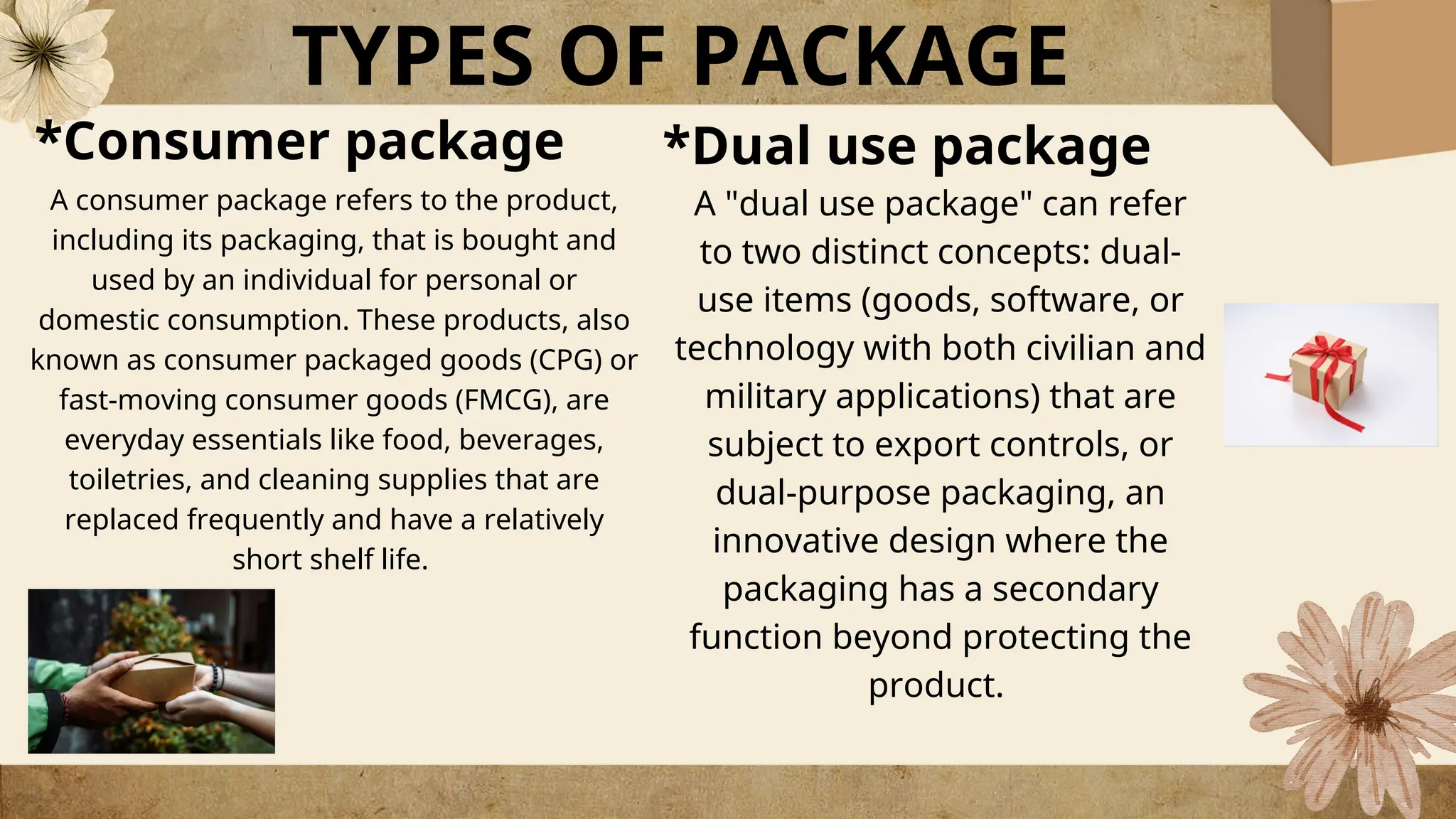
A consumer package refers to the product,
including its packaging, that is bought and
used by an individual for personal or
domestic consumption. These products, also
known as consumer packaged goods (CPG) or
fast-moving consumer goods (FMCG), are
everyday essentials like food, beverages,
toiletries, and cleaning supplies that are
replaced frequently and have a relatively
short shelf life.
A "dual use package" can refer
to two distinct concepts: dual-
use items (goods, software, or
technology with both civilian and
military applications) that are
subject to export controls, or
dual-purpose packaging, an
innovative design where the
packaging has a secondary
function beyond protecting the
product.
*Consumer package
9.
*Bulk package *Industrialpackage
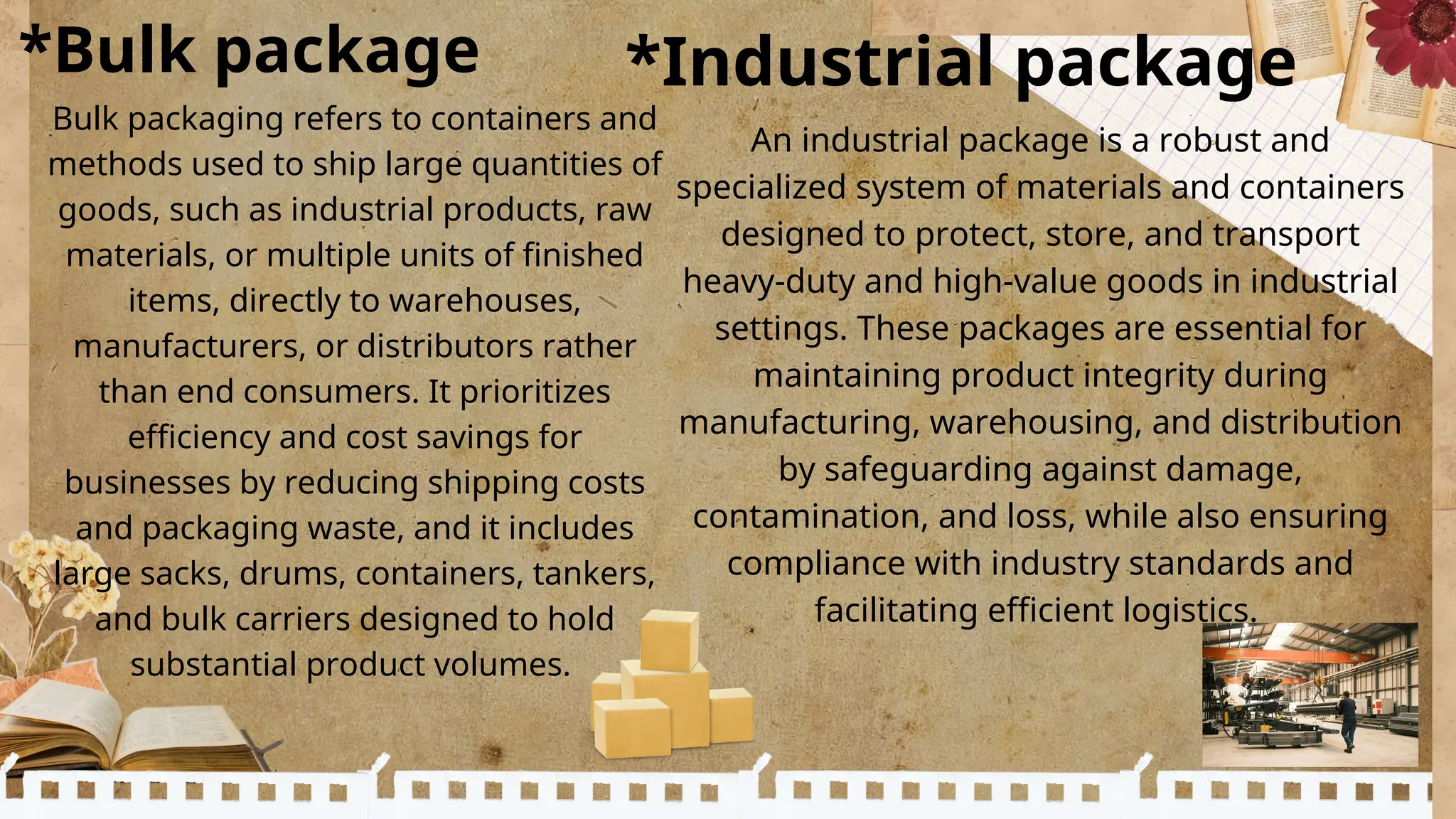
Bulk packaging refers to containers and
methods used to ship large quantities of
goods, such as industrial products, raw
materials, or multiple units of finished
items, directly to warehouses,
manufacturers, or distributors rather
than end consumers. It prioritizes
efficiency and cost savings for
businesses by reducing shipping costs
and packaging waste, and it includes
large sacks, drums, containers, tankers,
and bulk carriers designed to hold
substantial product volumes.
An industrial package is a robust and
specialized system of materials and containers
designed to protect, store, and transport
heavy-duty and high-value goods in industrial
settings. These packages are essential for
maintaining product integrity during
manufacturing, warehousing, and distribution
by safeguarding against damage,
contamination, and loss, while also ensuring
compliance with industry standards and
facilitating efficient logistics.
10.
#Need for protection#Product differentiation
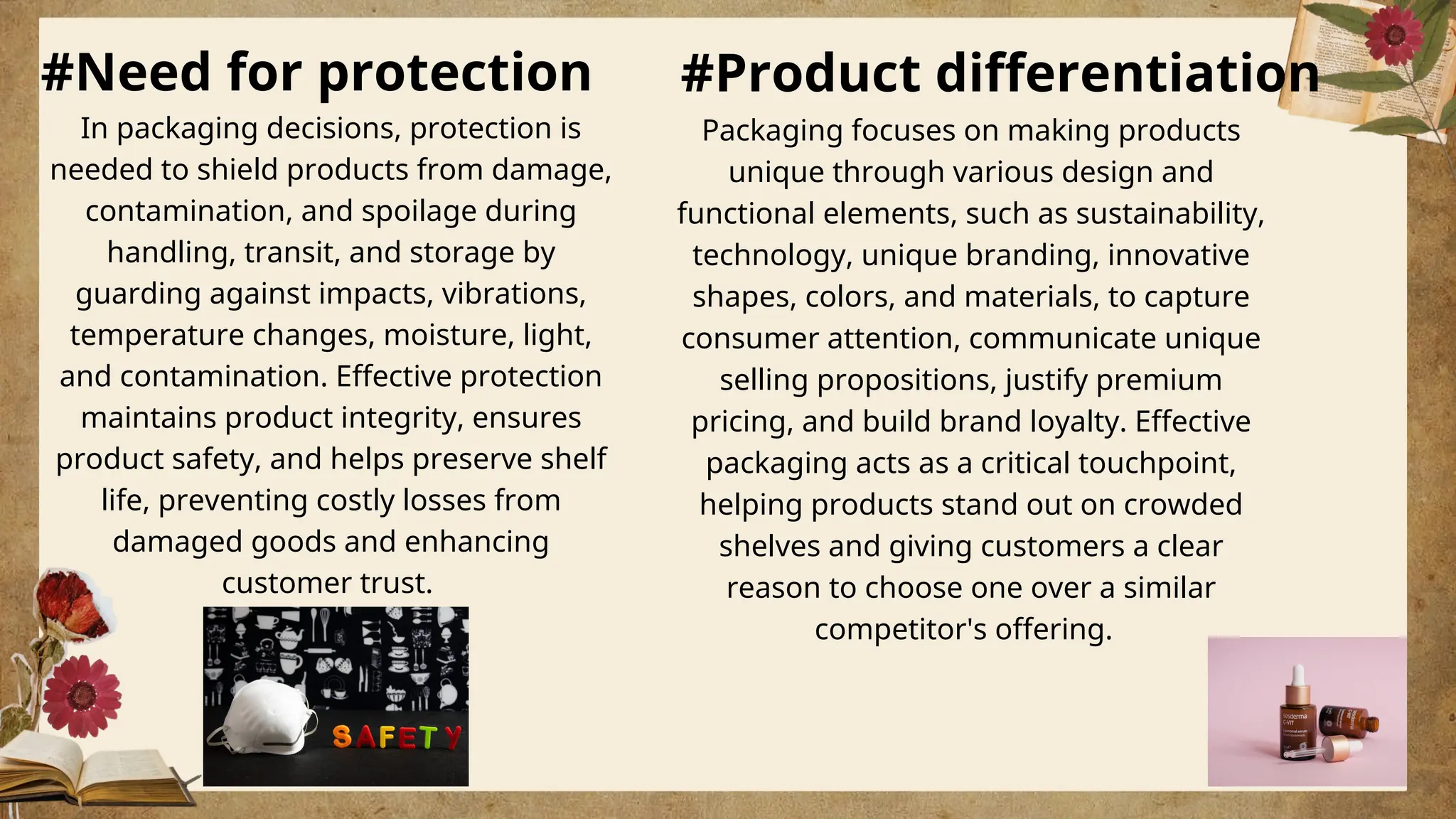
In packaging decisions, protection is
needed to shield products from damage,
contamination, and spoilage during
handling, transit, and storage by
guarding against impacts, vibrations,
temperature changes, moisture, light,
and contamination. Effective protection
maintains product integrity, ensures
product safety, and helps preserve shelf
life, preventing costly losses from
damaged goods and enhancing
customer trust.
Packaging focuses on making products
unique through various design and
functional elements, such as sustainability,
technology, unique branding, innovative
shapes, colors, and materials, to capture
consumer attention, communicate unique
selling propositions, justify premium
pricing, and build brand loyalty. Effective
packaging acts as a critical touchpoint,
helping products stand out on crowded
shelves and giving customers a clear
reason to choose one over a similar
competitor's offering.
11.
#Package cost #Packagedesign
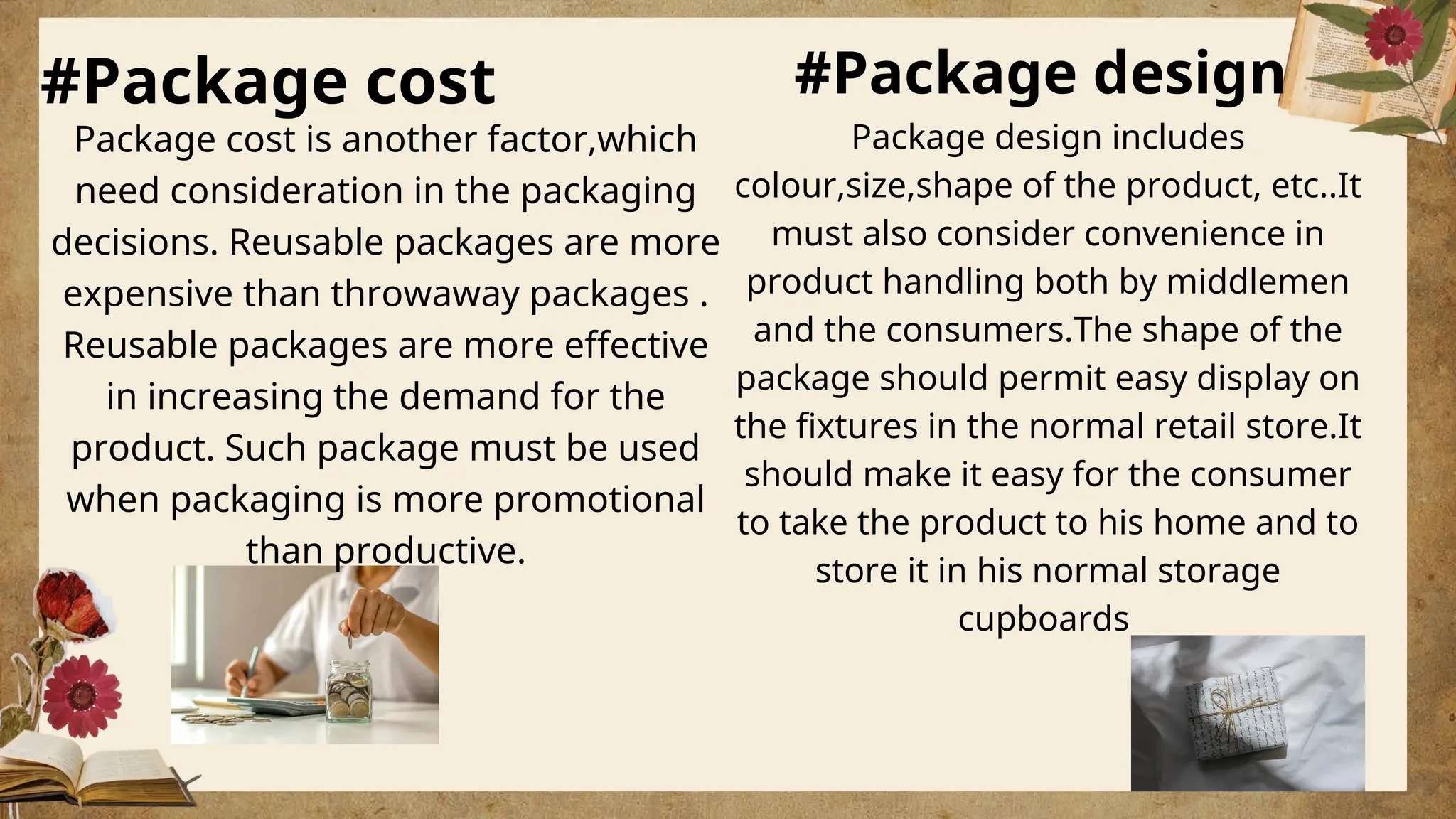
Package cost is another factor,which
need consideration in the packaging
decisions. Reusable packages are more
expensive than throwaway packages .
Reusable packages are more effective
in increasing the demand for the
product. Such package must be used
when packaging is more promotional
than productive.
Package design includes
colour,size,shape of the product, etc..It
must also consider convenience in
product handling both by middlemen
and the consumers.The shape of the
package should permit easy display on
the fixtures in the normal retail store.It
should make it easy for the consumer
to take the product to his home and to
store it in his normal storage
cupboards
12.
#Package size
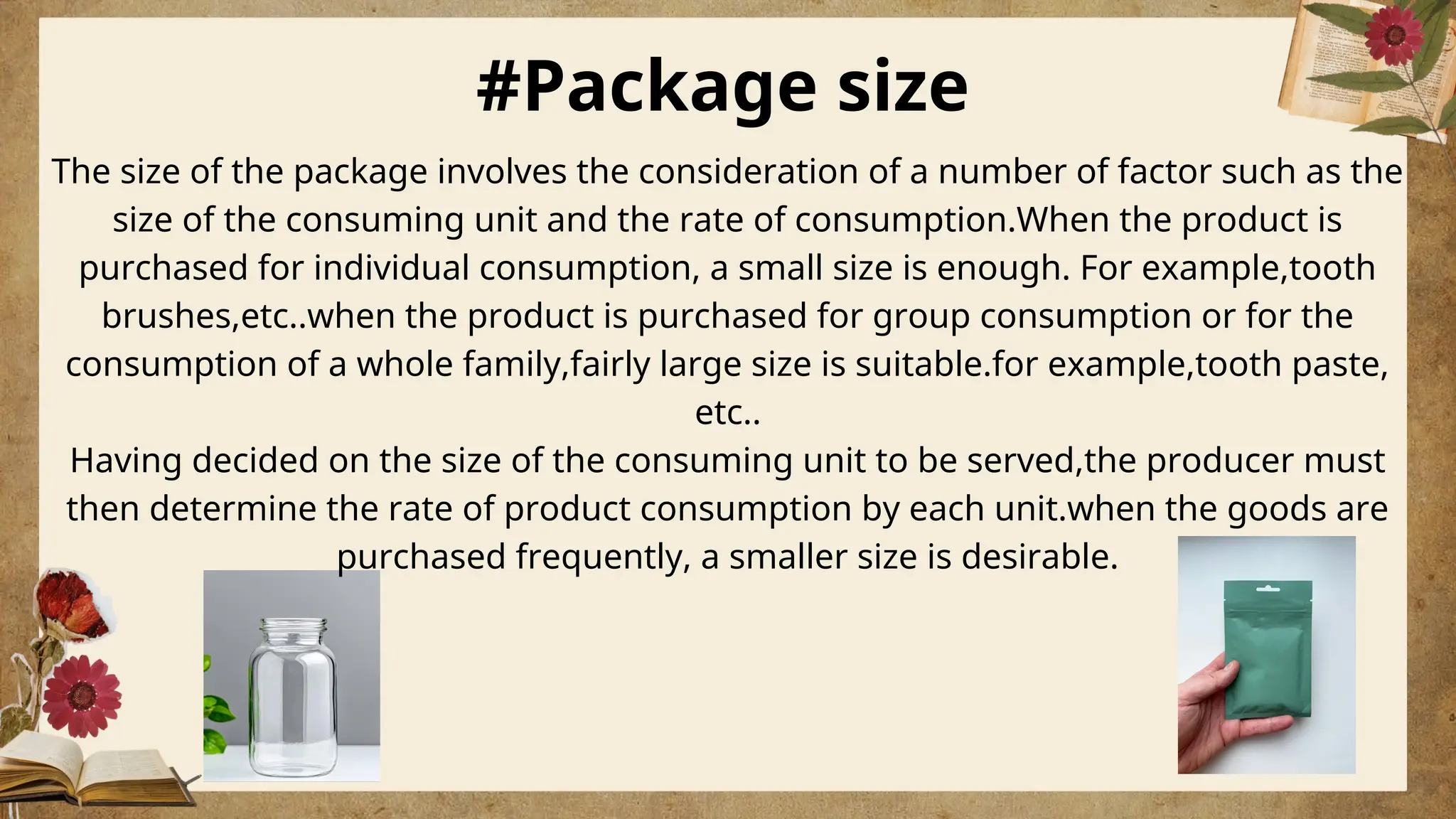
The sizeof the package involves the consideration of a number of factor such as the
size of the consuming unit and the rate of consumption.When the product is
purchased for individual consumption, a small size is enough. For example,tooth
brushes,etc..when the product is purchased for group consumption or for the
consumption of a whole family,fairly large size is suitable.for example,tooth paste,
etc..
Having decided on the size of the consuming unit to be served,the producer must
then determine the rate of product consumption by each unit.when the goods are
purchased frequently, a smaller size is desirable.
13.
A - Creatingthe attension
I- creating an interest
D- Creating desire to purchase
the product
A- Compelling the customer's
to take action
S- Giving customer satisfaction
14.
1. Assembling andarranging the contents in the desired form.
2. Identifying the contents, the brand, and the manufacturer.
3. Protecting the contents from the production line through final use.
4. Providing a suitable product mix including size, weights, price, grades, and packages.
5. Facilitating retailer’s display.
6. Facilitating transportation, storage, and warehouse handling.
15.
7. Enabling thedisplay of contents.
8. Encouraging repurchase.
9. Facilitating compliance with legal requirements.
10. Providing opportunity and space for advertising.
11. Protecting the contents from various kinds of damage such as:
Mechanical handling damage,Product loss,Pilferage,
Contamination by dirt, dust, or moisture,
Chemical changes and
misuse, etc.
12. Facilitating storage convenience.
16.
CONCLUSION
Packaging is anindispensable, multi-faceted tool for businesses, serving
not only to protect products from damage and spoilage but also to act as a
primary marketing and branding element that influences consumer
decisions. Effective packaging also provides crucial information, enhances
convenience for users, and, increasingly, is a key component of corporate
responsibility and sustainability efforts.