HOW TO MANAGE A VIRTUAL LIBRARY?
Muñoz-Gonzalez, L.; Juan-Quilis, V.
Biblioteca Virtual del Sistema Sanitario Público de Andalucía. Sevilla, Spain
laura.munoz.gonzalez@juntadeandalucia.es
Introduction
A Health Virtual Library for Andalusia:

 • 100 000 Health Professionals
   100,000
 • 41 Hospitals
 • 1,500 Primary HealthCare Centers
 • 28 Research/Training Centers

Objectives:
Did it reach…

A cost reduction?                         Economies of Scale?                       Efficiency?


Methods:
   Hospitals have not been allowed to subscribe any resources.
   Services have been set up for the whole System.
   A remote access system has been created.
   Tools to give more visibility to the Public Health System have been developed.
   Negotiation techniques have changed as the BV-SSPA is stronger than individual hospitals.

Results:
  Rationalization of the subscription investment as the overlap is eliminated.
   Access to every professional of the Health System, not only for the ones from big hospitals.
   Establishment of several important scientific services for the whole territory of Andalusia: Document
   Supply Service, Institutional Repository, E-learning.
   Implementation of Web 2.0 and Social Media.

Conclusions:


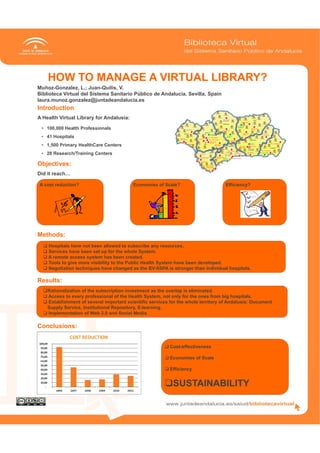
                                                         Cost-effectiveness

                                                         Economies of Scale

                                                         Efficiency


                                                        SUSTAINABILITY

How to manage a virtual library?

  • 1.
    HOW TO MANAGEA VIRTUAL LIBRARY? Muñoz-Gonzalez, L.; Juan-Quilis, V. Biblioteca Virtual del Sistema Sanitario Público de Andalucía. Sevilla, Spain laura.munoz.gonzalez@juntadeandalucia.es Introduction A Health Virtual Library for Andalusia: • 100 000 Health Professionals 100,000 • 41 Hospitals • 1,500 Primary HealthCare Centers • 28 Research/Training Centers Objectives: Did it reach… A cost reduction? Economies of Scale? Efficiency? Methods:  Hospitals have not been allowed to subscribe any resources.  Services have been set up for the whole System.  A remote access system has been created.  Tools to give more visibility to the Public Health System have been developed.  Negotiation techniques have changed as the BV-SSPA is stronger than individual hospitals. Results: Rationalization of the subscription investment as the overlap is eliminated.  Access to every professional of the Health System, not only for the ones from big hospitals.  Establishment of several important scientific services for the whole territory of Andalusia: Document Supply Service, Institutional Repository, E-learning.  Implementation of Web 2.0 and Social Media. Conclusions:  Cost-effectiveness  Economies of Scale  Efficiency SUSTAINABILITY