How to Learn Automation Testing: A
Beginner-Friendly Roadmap
Your complete guide to mastering automation testing from scratch and
launching a successful career in quality assurance.
Why Automation Testing Matters Today
Speed & Efficiency
Automation testing dramatically
accelerates software delivery by
running repetitive test cases in minutes
instead of hours, enabling faster
release cycles.
Enhanced Accuracy
Improves test coverage and eliminates
human error, ensuring consistent
results across thousands of test
scenarios4essential for modern CI/CD
pipelines.
The Best of Both Worlds
While manual testing remains vital for
exploratory and usability testing,
automation is the future for efficiency
and scalability in quality assurance.
Step 1: Master the Basics of Software Testing
Building a strong foundation in manual testing concepts is crucial before diving
into automation. Understanding how software is developed and tested provides
essential context.
1 SDLC & STLC Fundamentals
Learn how software development and testing lifecycles work together
from requirements to deployment.
2 Core Testing Types
Master functional, regression, smoke, integration, and system testing
methodologies.
3 Test Artifacts
Get comfortable creating test cases, test plans, bug reports, and
traceability matrices.
4 Essential Tools
Start with JIRA for bug tracking and TestRail for test management to
understand workflows.
Step 2: Learn a Programming
Language
Automation scripts require programming skills to interact with applications and
validate behavior. Choose a language and commit to daily practice.
1
Choose Your Language
Start with beginner-friendly options like Python (simple syntax,
extensive libraries) or JavaScript (ubiquitous in web
development).
2
Core Concepts
Focus on fundamentals: syntax, data types, loops, conditionals,
functions, and Object-Oriented Programming (OOP) principles.
3
Practice Daily
Build muscle memory through coding challenges on platforms
like HackerRank, LeetCode, or Codewars4even 30 minutes daily
makes a difference.
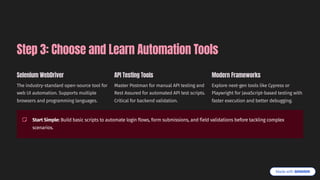
Step 3: Choose and Learn Automation Tools
Selenium WebDriver
The industry-standard open-source tool for
web UI automation. Supports multiple
browsers and programming languages.
API Testing Tools
Master Postman for manual API testing and
Rest Assured for automated API test scripts.
Critical for backend validation.
Modern Frameworks
Explore next-gen tools like Cypress or
Playwright for JavaScript-based testing with
faster execution and better debugging.
Start Simple: Build basic scripts to automate login flows, form submissions, and field validations before tackling complex
scenarios.
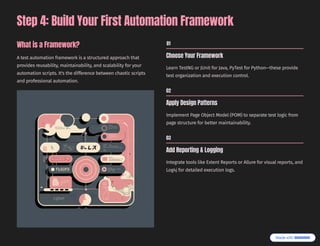
Step 4: Build Your First Automation Framework
What is a Framework?
A test automation framework is a structured approach that
provides reusability, maintainability, and scalability for your
automation scripts. It's the difference between chaotic scripts
and professional automation.
01
Choose Your Framework
Learn TestNG or JUnit for Java, PyTest for Python4these provide
test organization and execution control.
02
Apply Design Patterns
Implement Page Object Model (POM) to separate test logic from
page structure for better maintainability.
03
Add Reporting & Logging
Integrate tools like Extent Reports or Allure for visual reports, and
Log4j for detailed execution logs.
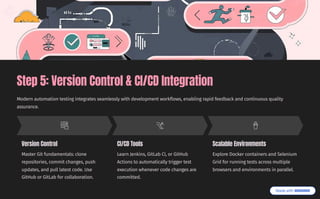
Step 5: Version Control & CI/CD Integration
Modern automation testing integrates seamlessly with development workflows, enabling rapid feedback and continuous quality
assurance.
Version Control
Master Git fundamentals: clone
repositories, commit changes, push
updates, and pull latest code. Use
GitHub or GitLab for collaboration.
CI/CD Tools
Learn Jenkins, GitLab CI, or GitHub
Actions to automatically trigger test
execution whenever code changes are
committed.
Scalable Environments
Explore Docker containers and Selenium
Grid for running tests across multiple
browsers and environments in parallel.
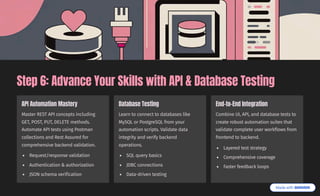
Step 6: Advance Your Skills with API & Database Testing
API Automation Mastery
Master REST API concepts including
GET, POST, PUT, DELETE methods.
Automate API tests using Postman
collections and Rest Assured for
comprehensive backend validation.
Request/response validation
Authentication & authorization
JSON schema verification
Database Testing
Learn to connect to databases like
MySQL or PostgreSQL from your
automation scripts. Validate data
integrity and verify backend
operations.
SQL query basics
JDBC connections
Data-driven testing
End-to-End Integration
Combine UI, API, and database tests to
create robust automation suites that
validate complete user workflows from
frontend to backend.
Layered test strategy
Comprehensive coverage
Faster feedback loops
Step 7: Practice, Projects & Career Tips
Build Your Portfolio
Real-World Projects
Automate complete workflows: user registration systems, e-
commerce shopping carts, booking applications, or social media
features.
Showcase Your Work
Upload all projects to GitHub with clear README files,
documentation, and well-structured code to impress potential
employers.
Community Engagement
Join QA communities on LinkedIn, Reddit, and Stack Overflow.
Contribute to open-source testing projects to gain experience.
Interview Preparation
Practice coding challenges, automation scenarios, and be ready to
explain your framework architecture and design decisions.
Pro Tip: Quality over quantity4one well-
documented, comprehensive automation
framework is worth more than multiple
incomplete projects.
Your Automation Testing Journey
Starts Now
Start with Fundamentals
Build a strong foundation in
manual testing concepts before
automating. Understanding the
"why" behind testing makes you
a better automation engineer.
Practice Consistently
Daily coding practice and hands-
on work with automation tools
create lasting skills. Set aside
dedicated time each day for
learning and building.
Stay Current
Automation testing evolves
rapidly with new tools,
frameworks, and best practices.
Embrace continuous learning
through courses, blogs, and
conferences.
Your Gateway to a
Rewarding Tech Career
Automation testing skills are in high demand across industries. Take the first
step today4your future in quality assurance starts with a single line of code.
Accelerate Your Career in
Automation Testing
Our tailored courses and comprehensive services are designed to equip you
with the in-demand skills needed to thrive in the modern tech landscape. From
foundational principles to advanced frameworks, we provide practical, expert-
led training that opens doors to new opportunities.
Explore Our Courses
Contact Us

How-to-Learn-Automation-Testing-A-Beginner-Friendly-Roadmap.pdf

  • 1.
    How to LearnAutomation Testing: A Beginner-Friendly Roadmap Your complete guide to mastering automation testing from scratch and launching a successful career in quality assurance.
  • 2.
    Why Automation TestingMatters Today Speed & Efficiency Automation testing dramatically accelerates software delivery by running repetitive test cases in minutes instead of hours, enabling faster release cycles. Enhanced Accuracy Improves test coverage and eliminates human error, ensuring consistent results across thousands of test scenarios4essential for modern CI/CD pipelines. The Best of Both Worlds While manual testing remains vital for exploratory and usability testing, automation is the future for efficiency and scalability in quality assurance.
  • 3.
    Step 1: Masterthe Basics of Software Testing Building a strong foundation in manual testing concepts is crucial before diving into automation. Understanding how software is developed and tested provides essential context. 1 SDLC & STLC Fundamentals Learn how software development and testing lifecycles work together from requirements to deployment. 2 Core Testing Types Master functional, regression, smoke, integration, and system testing methodologies. 3 Test Artifacts Get comfortable creating test cases, test plans, bug reports, and traceability matrices. 4 Essential Tools Start with JIRA for bug tracking and TestRail for test management to understand workflows.
  • 4.
    Step 2: Learna Programming Language Automation scripts require programming skills to interact with applications and validate behavior. Choose a language and commit to daily practice. 1 Choose Your Language Start with beginner-friendly options like Python (simple syntax, extensive libraries) or JavaScript (ubiquitous in web development). 2 Core Concepts Focus on fundamentals: syntax, data types, loops, conditionals, functions, and Object-Oriented Programming (OOP) principles. 3 Practice Daily Build muscle memory through coding challenges on platforms like HackerRank, LeetCode, or Codewars4even 30 minutes daily makes a difference.
  • 5.
    Step 3: Chooseand Learn Automation Tools Selenium WebDriver The industry-standard open-source tool for web UI automation. Supports multiple browsers and programming languages. API Testing Tools Master Postman for manual API testing and Rest Assured for automated API test scripts. Critical for backend validation. Modern Frameworks Explore next-gen tools like Cypress or Playwright for JavaScript-based testing with faster execution and better debugging. Start Simple: Build basic scripts to automate login flows, form submissions, and field validations before tackling complex scenarios.
  • 6.
    Step 4: BuildYour First Automation Framework What is a Framework? A test automation framework is a structured approach that provides reusability, maintainability, and scalability for your automation scripts. It's the difference between chaotic scripts and professional automation. 01 Choose Your Framework Learn TestNG or JUnit for Java, PyTest for Python4these provide test organization and execution control. 02 Apply Design Patterns Implement Page Object Model (POM) to separate test logic from page structure for better maintainability. 03 Add Reporting & Logging Integrate tools like Extent Reports or Allure for visual reports, and Log4j for detailed execution logs.
  • 7.
    Step 5: VersionControl & CI/CD Integration Modern automation testing integrates seamlessly with development workflows, enabling rapid feedback and continuous quality assurance. Version Control Master Git fundamentals: clone repositories, commit changes, push updates, and pull latest code. Use GitHub or GitLab for collaboration. CI/CD Tools Learn Jenkins, GitLab CI, or GitHub Actions to automatically trigger test execution whenever code changes are committed. Scalable Environments Explore Docker containers and Selenium Grid for running tests across multiple browsers and environments in parallel.
  • 8.
    Step 6: AdvanceYour Skills with API & Database Testing API Automation Mastery Master REST API concepts including GET, POST, PUT, DELETE methods. Automate API tests using Postman collections and Rest Assured for comprehensive backend validation. Request/response validation Authentication & authorization JSON schema verification Database Testing Learn to connect to databases like MySQL or PostgreSQL from your automation scripts. Validate data integrity and verify backend operations. SQL query basics JDBC connections Data-driven testing End-to-End Integration Combine UI, API, and database tests to create robust automation suites that validate complete user workflows from frontend to backend. Layered test strategy Comprehensive coverage Faster feedback loops
  • 9.
    Step 7: Practice,Projects & Career Tips Build Your Portfolio Real-World Projects Automate complete workflows: user registration systems, e- commerce shopping carts, booking applications, or social media features. Showcase Your Work Upload all projects to GitHub with clear README files, documentation, and well-structured code to impress potential employers. Community Engagement Join QA communities on LinkedIn, Reddit, and Stack Overflow. Contribute to open-source testing projects to gain experience. Interview Preparation Practice coding challenges, automation scenarios, and be ready to explain your framework architecture and design decisions. Pro Tip: Quality over quantity4one well- documented, comprehensive automation framework is worth more than multiple incomplete projects.
  • 10.
    Your Automation TestingJourney Starts Now Start with Fundamentals Build a strong foundation in manual testing concepts before automating. Understanding the "why" behind testing makes you a better automation engineer. Practice Consistently Daily coding practice and hands- on work with automation tools create lasting skills. Set aside dedicated time each day for learning and building. Stay Current Automation testing evolves rapidly with new tools, frameworks, and best practices. Embrace continuous learning through courses, blogs, and conferences. Your Gateway to a Rewarding Tech Career Automation testing skills are in high demand across industries. Take the first step today4your future in quality assurance starts with a single line of code.
  • 11.
    Accelerate Your Careerin Automation Testing Our tailored courses and comprehensive services are designed to equip you with the in-demand skills needed to thrive in the modern tech landscape. From foundational principles to advanced frameworks, we provide practical, expert- led training that opens doors to new opportunities. Explore Our Courses Contact Us