HOW TO GET THROUGH
EVICTION PROCESS
Franco Simone, Esq
Simone & Associates
3702 4th Avenue
San Diego, CA 92103
Telephone: (619) 235-6180
landlordslegalcenter.com
HOW DO I TERMINATE A
TENANCY?
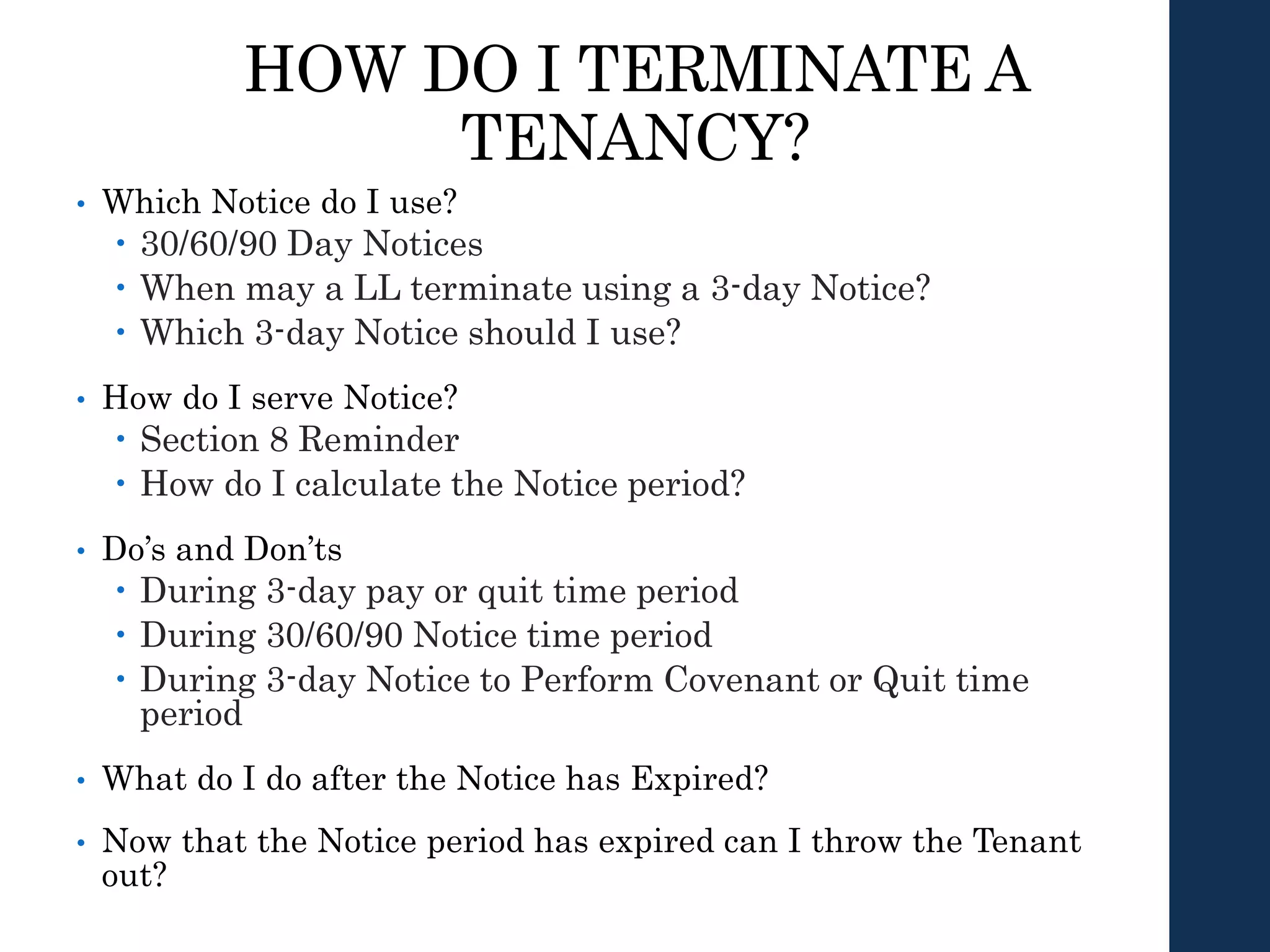
• Which Notice do I use?
 30/60/90 Day Notices
 When may a LL terminate using a 3-day Notice?
 Which 3-day Notice should I use?
• How do I serve Notice?
 Section 8 Reminder
 How do I calculate the Notice period?
• Do’s and Don’ts
 During 3-day pay or quit time period
 During 30/60/90 Notice time period
 During 3-day Notice to Perform Covenant or Quit time
period
• What do I do after the Notice has Expired?
• Now that the Notice period has expired can I throw the Tenant
out?
WHICH NOTICE DO I USE TO
TERMINATE THE TENANCY?
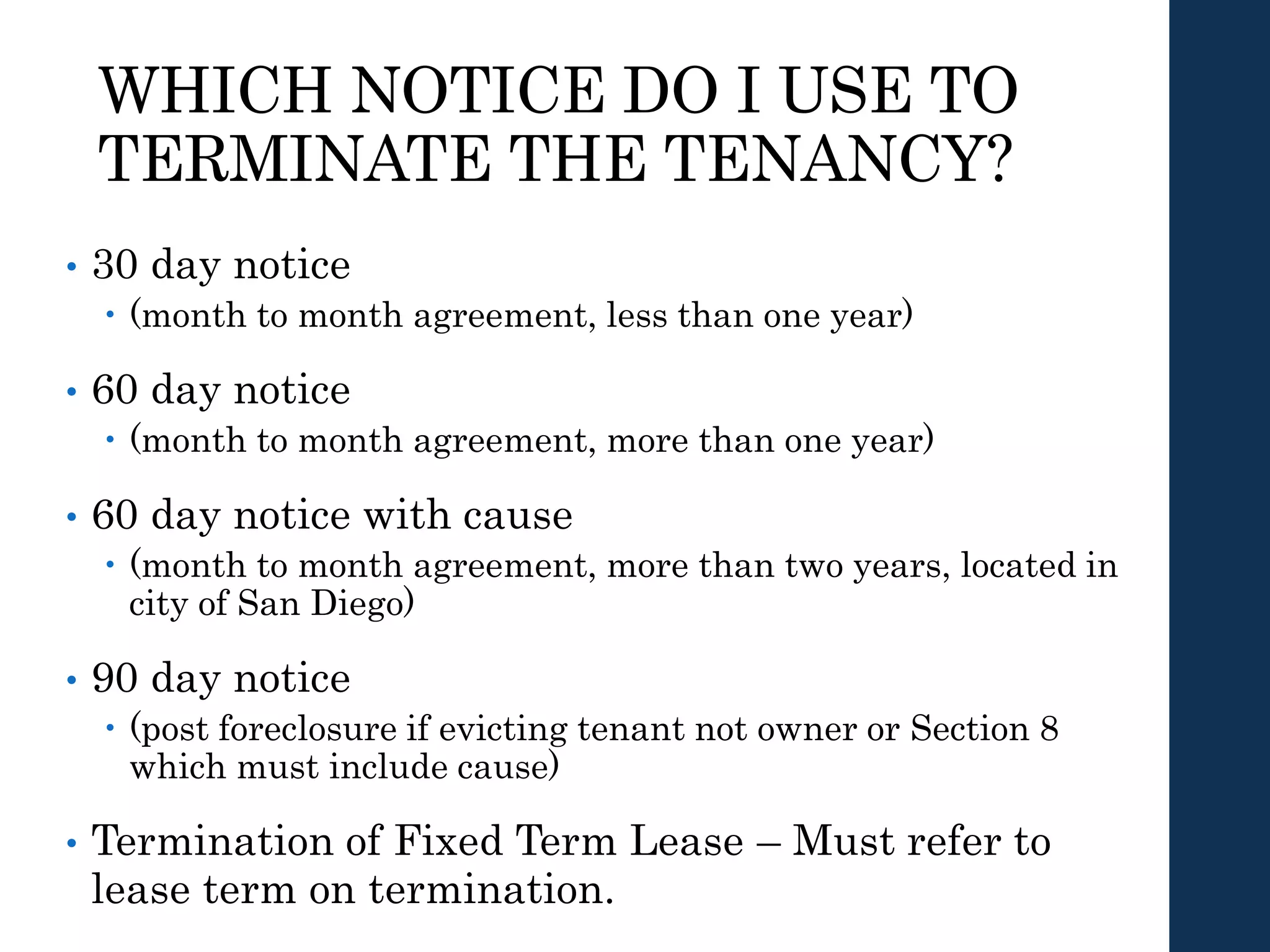
• 30 day notice
 (month to month agreement, less than one year)
• 60 day notice
 (month to month agreement, more than one year)
• 60 day notice with cause
 (month to month agreement, more than two years, located in
city of San Diego)
• 90 day notice
 (post foreclosure if evicting tenant not owner or Section 8
which must include cause)
• Termination of Fixed Term Lease – Must refer to
lease term on termination.
WHEN DO I USE A 3-DAY
NOTICE?
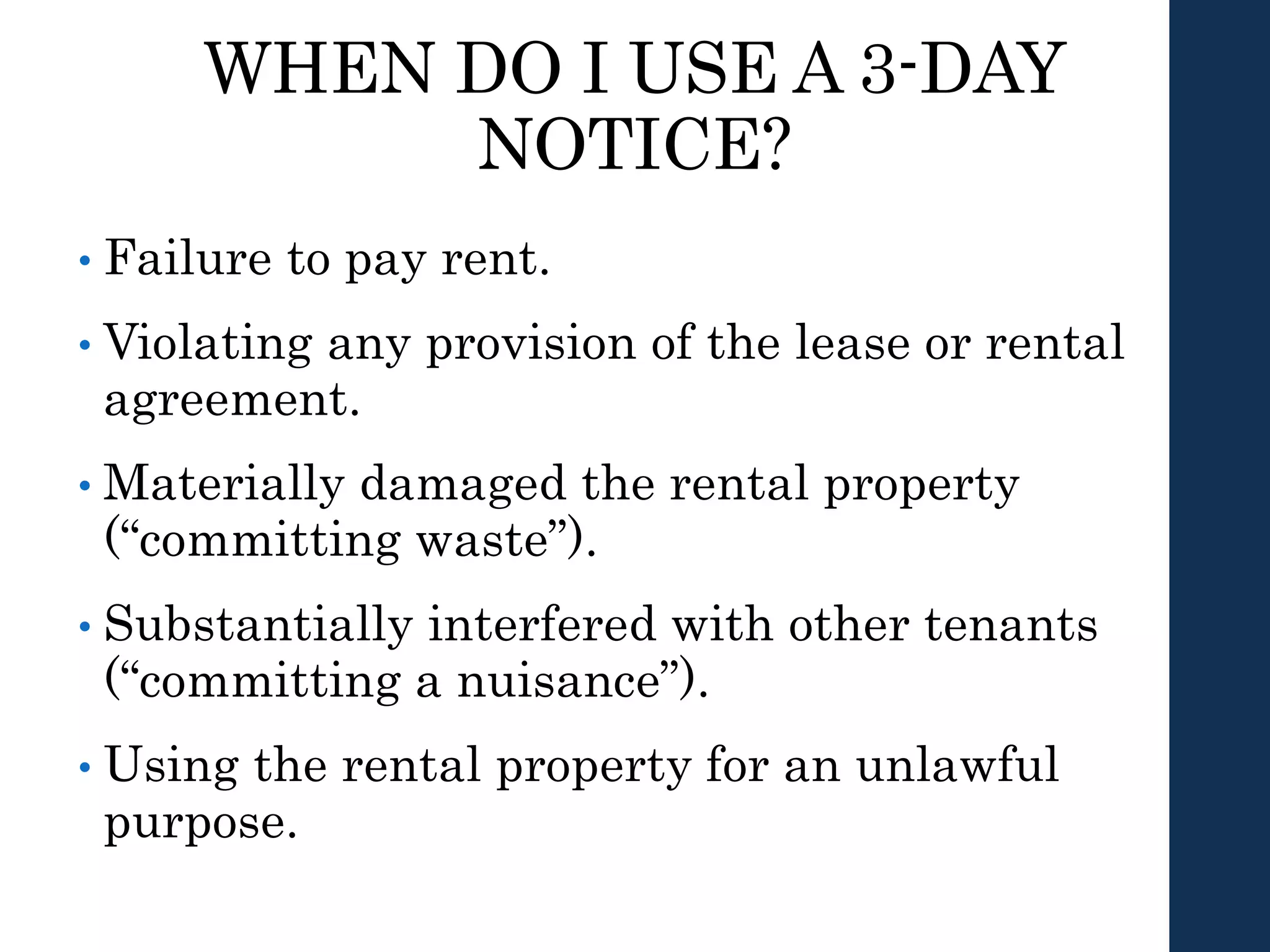
• Failure to pay rent.
• Violating any provision of the lease or rental
agreement.
• Materially damaged the rental property
(“committing waste”).
• Substantially interfered with other tenants
(“committing a nuisance”).
• Using the rental property for an unlawful
purpose.
WHICH 3-DAY NOTICE SHOULD
I USE?
• 3-Day Notice To Pay Rent Or Quit
• 3-Day Notice To Perform Covenant
Or Quit
• 3-Day Notice To Quit (nuisance,
waste or unlawful acts)
HOW DO I SERVE THE NOTICE?
• Personal Service
Notice handed directly to one of the named tenants.
 If you cannot personally serve the tenant at the residence but you know
his/her place of employment you must attempt service at their place of
employment. Make sure you check the rental application for employment
information.
• Substituted Service
If named tenants are unavailable for personal service at the
premises or place of employment, notice may be handed to a
person over the age of 18 at either site and mailed to that site
(must get name or physical description).
• Service by Posting and Mailing
If unable to serve personally or by substitution, notice may be
posted on the front door and mailed first-class to the premises.
SECTION 8 TENANTS
ADDITIONAL REQUIREMENTS
All notices served to Section 8 tenants
must also be served on the Section 8
case representatives on the same day
the notice is served on the tenants.
HOW DO I CALCULATE THE 3-DAY
NOTICE PERIOD?
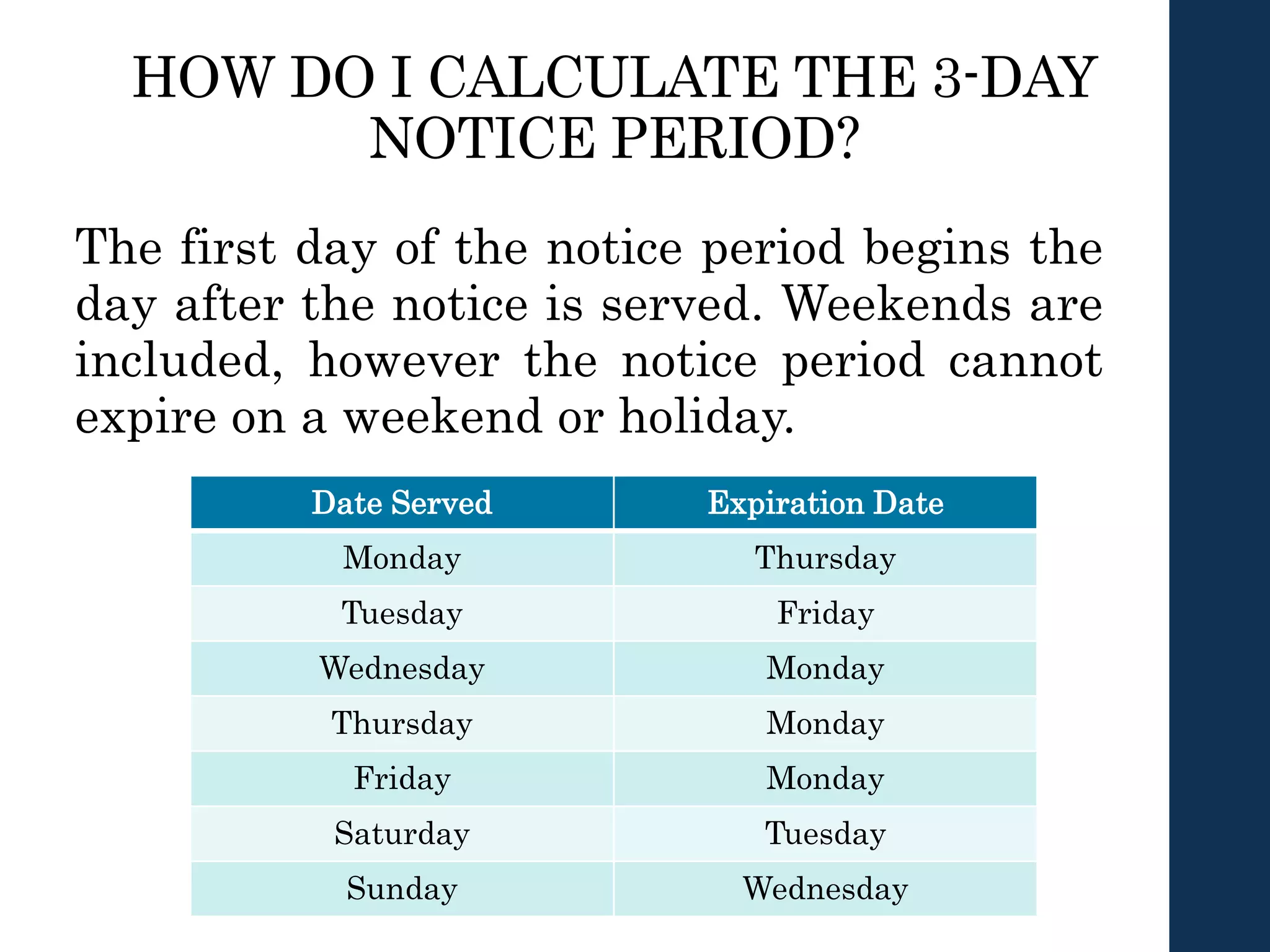
The first day of the notice period begins the
day after the notice is served. Weekends are
included, however the notice period cannot
expire on a weekend or holiday.
Date Served Expiration Date
Monday Thursday
Tuesday Friday
Wednesday Monday
Thursday Monday
Friday Monday
Saturday Tuesday
Sunday Wednesday
DO’S AND DON’TS DURING
THE 3-DAY PAY OR QUIT
TIME PERIOD
• DO accept full rent payment if it is offered within 3-
day notice period.
• DON’T accept partial payments if you want to
proceed with the unlawful detainer.
• DON’T agree to allow the tenant to pay or remain
in possession beyond the notice period since it will
be considered a waiver of the Notice.
• DO go to small claims court if the tenant vacates
within the 3-day period & DON’T use the unlawful
detainer process.
DO’S AND DON’TS DURING THE
30/60/90 DAY NOTICE TIME
PERIOD
• DO accept Rent up to expiration of
notice.
• DON’T accept any rent beyond the
expiration of the notice period.
 Be careful with prorated amounts due for partial months.
• DO inform tenant of right to initial and
final move-out inspection.
DO’S & DON’TS DURING THE 3-DAY
NOTICE TO PERFORM COVENANT
OR QUIT TIME PERIOD
• DO accept payment if offered in full for a monetary
breach.
• DO allow tenant to cure breach.
• DON’T accept payment after the 3-day period.
• DON’T make yourself unavailable to communicate
with the tenant during this period.
WHAT DO I DO AFTER THE
NOTICE HAS EXPIRED?
• Verify the Tenant is still in possession of the
premises.
• Verify the Tenant has/has not complied with
the notice.
 Has owner or agent accepted any rent payment?
(3-day pay or quit)
 Has breach been cured? (Notice of inspection may
be necessary)
• Has notice been cancelled or waived?
NOW THAT THE NOTICE PERIOD
HAS EXPIRED CAN I THROW THE
TENANT OUT?
• Landlord MUST use court proceedings to
evict the tenant. The landlord CANNOT
use self-help methods to force the tenant
out.
Examples:
 Physically remove or lockout the tenant
 Cut off utilities
 Remove outside windows or doors
 Seize the tenant’s belongings
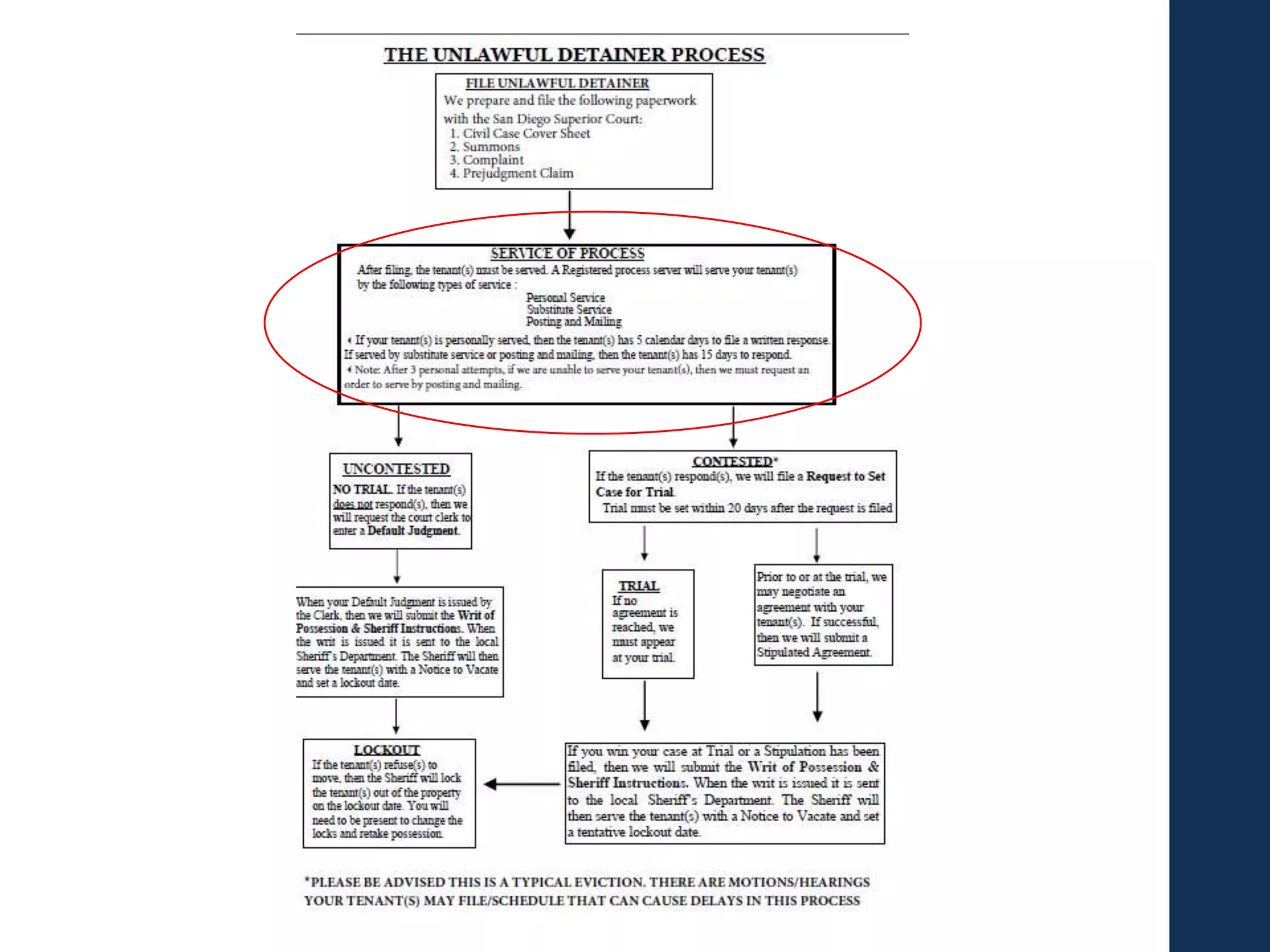
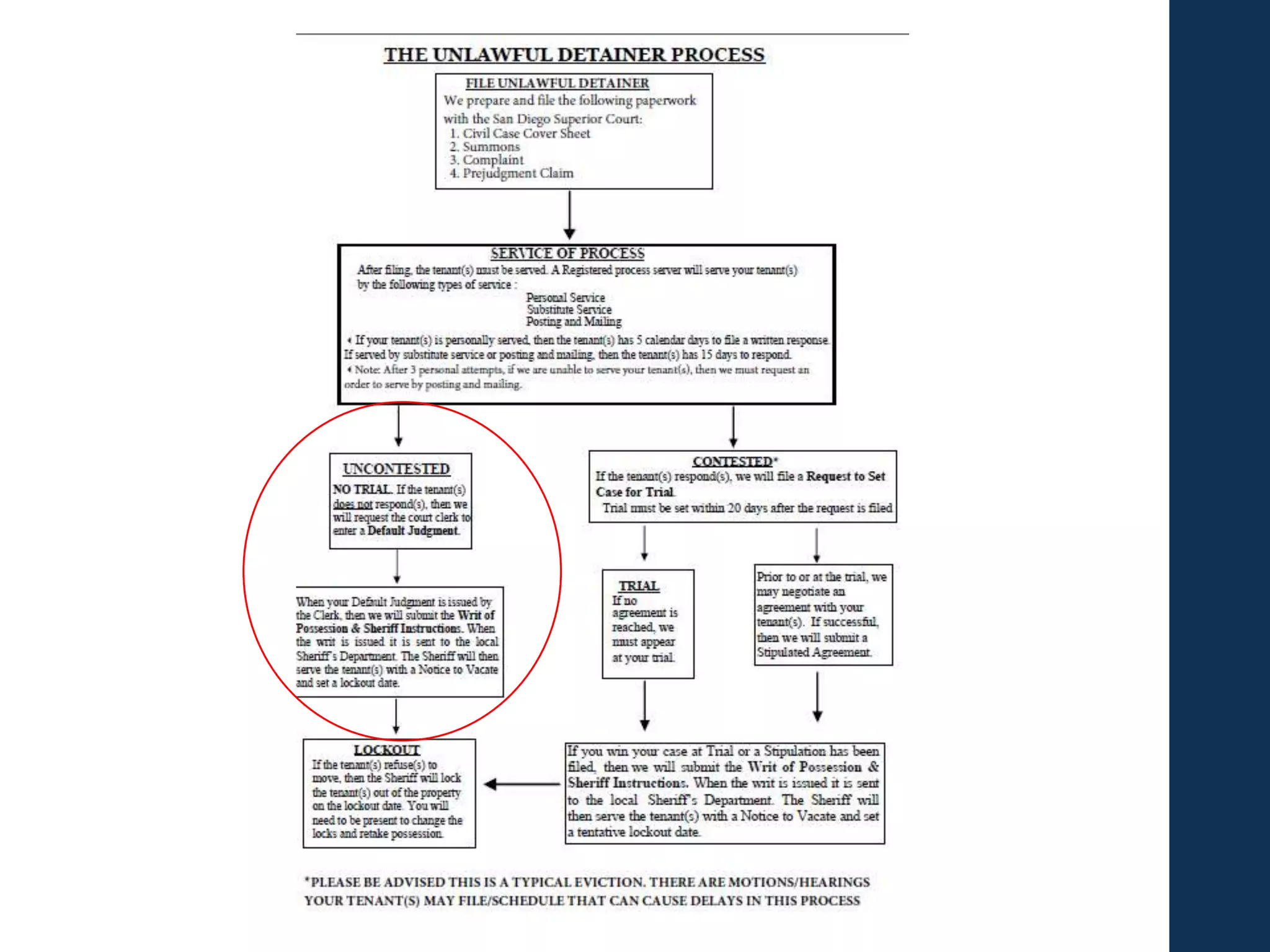
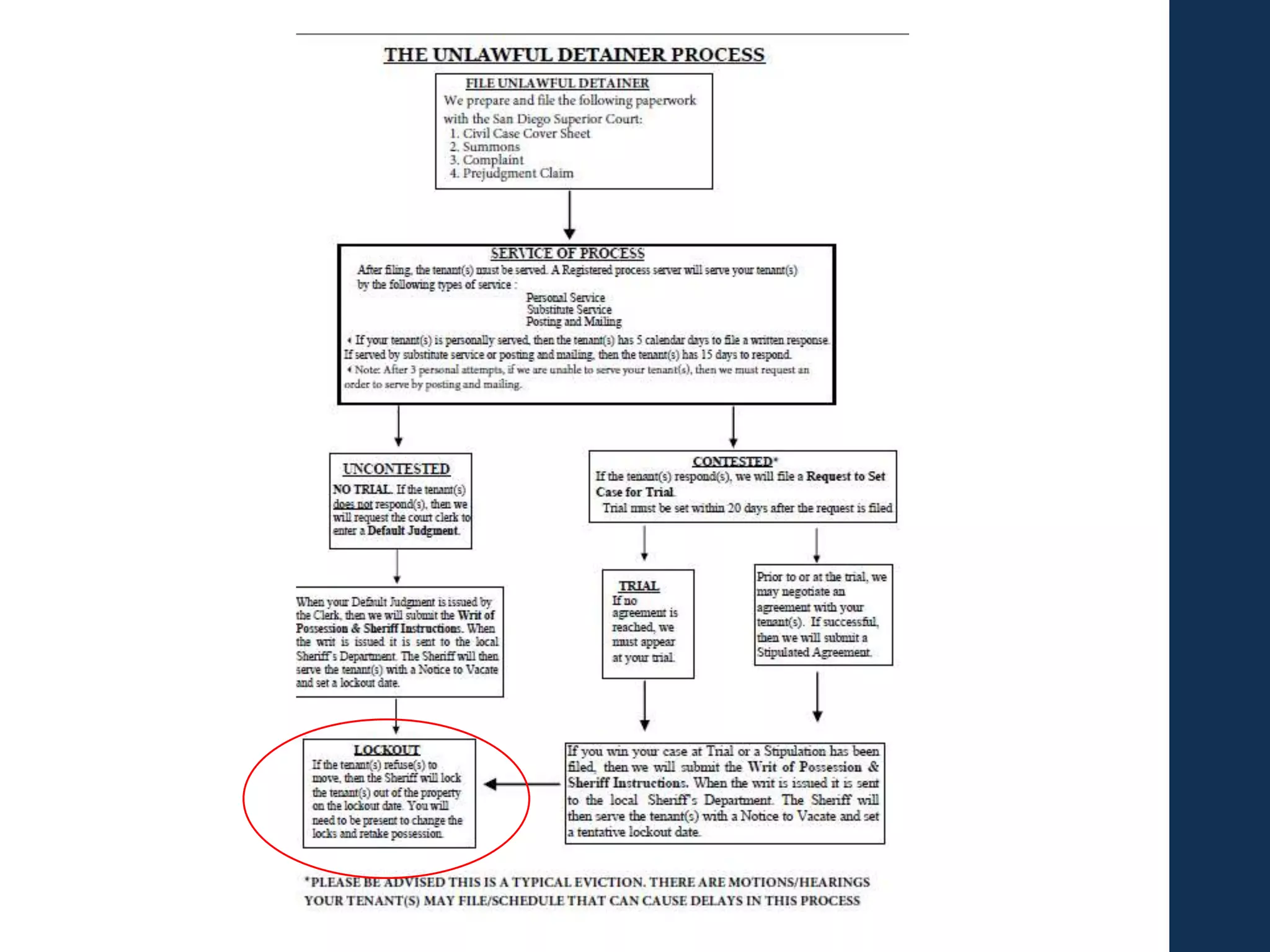
WHAT IS AN UNLAWFUL DETAINER?
• An unlawful detainer is a “summary”
court procedure to evict a tenant.
 If uncontested, 4-8 weeks
 If contested, 6-10 weeks
It includes:
 Filing of summons and complaint/prejudgment
claim of right to possession
 Service of process-tenants/“unknown occupants”
 Request for entry of default or request for trial
 Trial or default judgment
 Lockout
 Money judgment
What do I need to file an unlawful
detainer?
• Documents needed:
 Rental Agreement/Lease (if written)
 Rent Increases
 Notice
 Declaration of Service
• Summons and Complaint
 Owner must be named as Plaintiff, however
manager may appear at any necessary hearings
including trial.
 Complaint must be verified by owner, officer of
corporation, partner, or attorney (Attorney may
verify the complaint only when the owner is absent
from the county where the complaint is filed.)
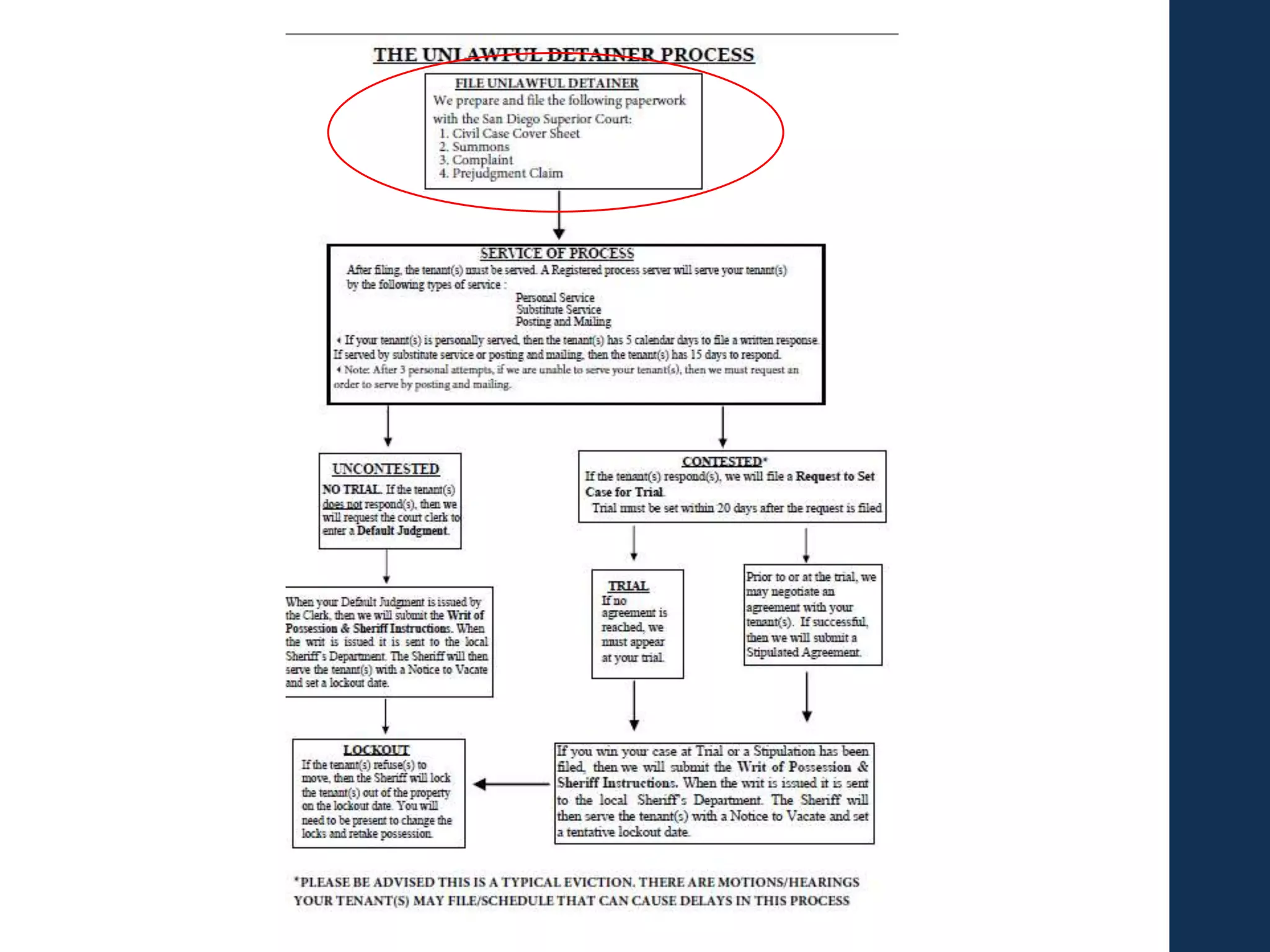
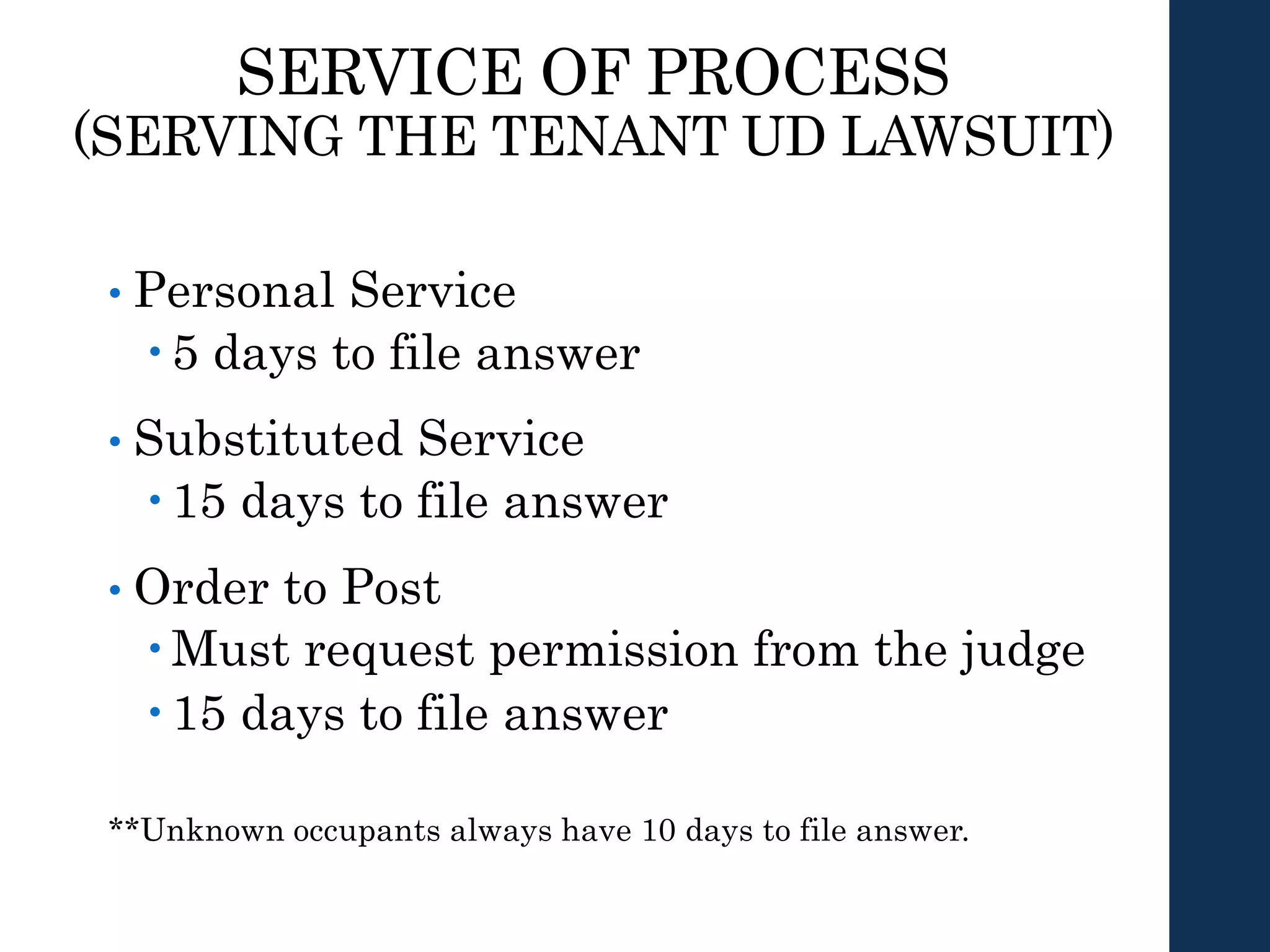
SERVICE OF PROCESS
(SERVING THE TENANT UD LAWSUIT)
• Personal Service
 5 days to file answer
• Substituted Service
 15 days to file answer
• Order to Post
 Must request permission from the judge
 15 days to file answer
**Unknown occupants always have 10 days to file answer.
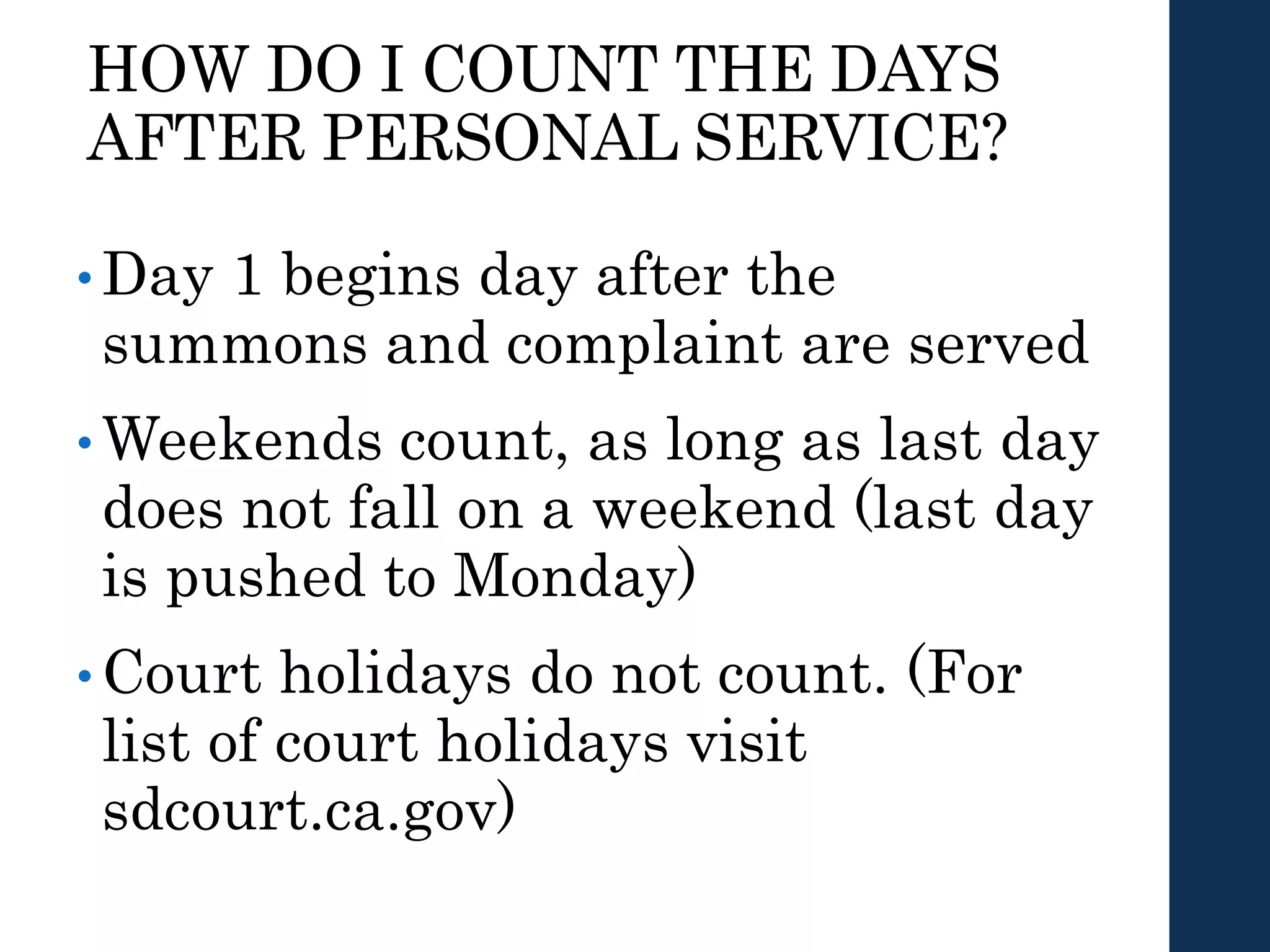
HOW DO I COUNT THE DAYS
AFTER PERSONAL SERVICE?
• Day 1 begins day after the
summons and complaint are served
• Weekends count, as long as last day
does not fall on a weekend (last day
is pushed to Monday)
• Court holidays do not count. (For
list of court holidays visit
sdcourt.ca.gov)
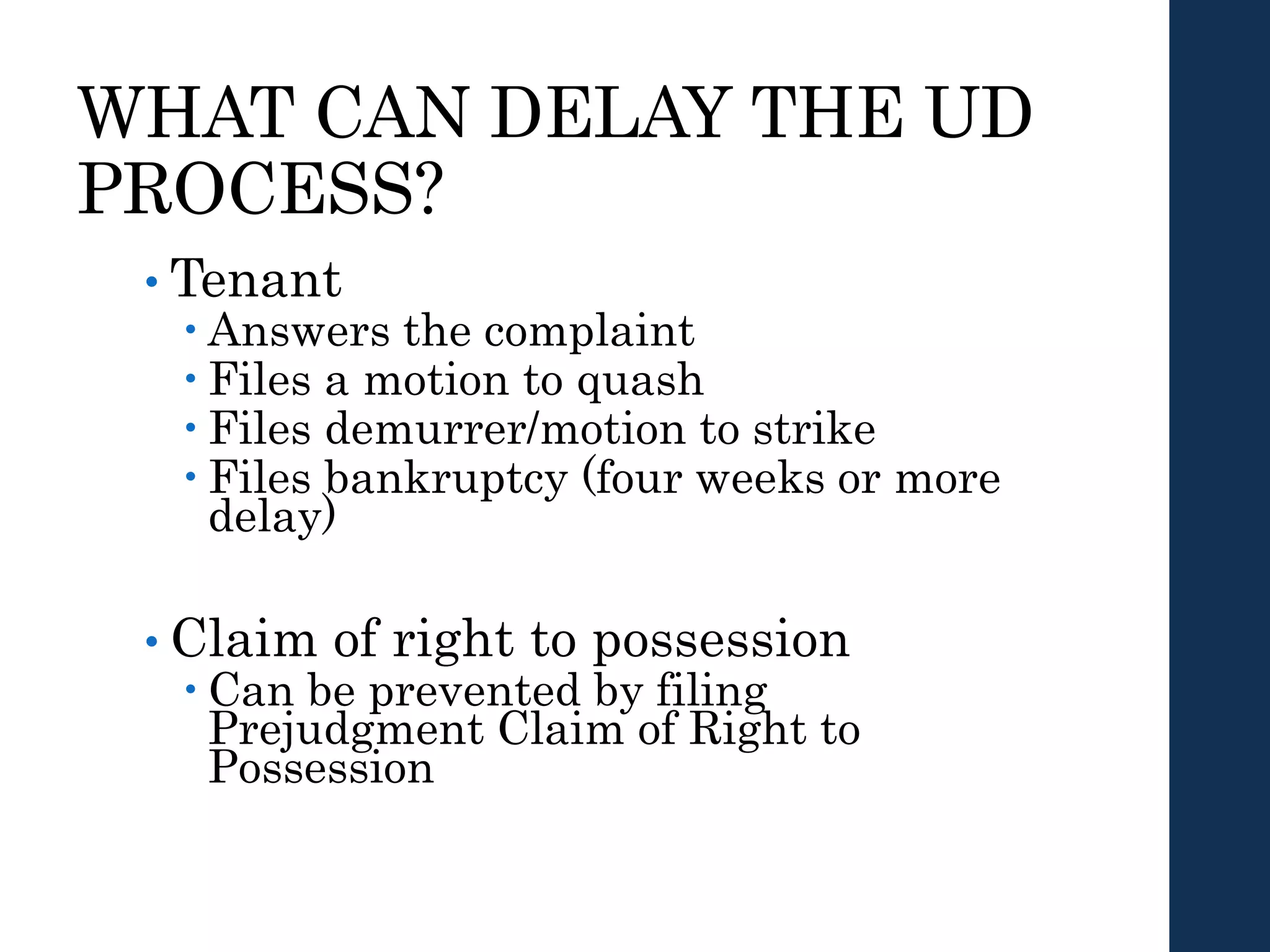
WHAT CAN DELAY THE UD
PROCESS?
• Tenant
 Answers the complaint
 Files a motion to quash
 Files demurrer/motion to strike
 Files bankruptcy (four weeks or more
delay)
• Claim of right to possession
 Can be prevented by filing
Prejudgment Claim of Right to
Possession
WHAT HAPPENS IF TENANT
FAILS TO RESPOND?
•Request for Entry of Default
Tenant has not yet filed an
answer.
Prevents tenant from contesting
unlawful detainer in court.
WHEN CAN I GET A JUDGMENT
FOR POSSESSION BY DEFAULT?
•All defendants must be defaulted
or dismissed.
•Judgment for possession only.
•Processed by court clerk, no trial
appearance necessary.
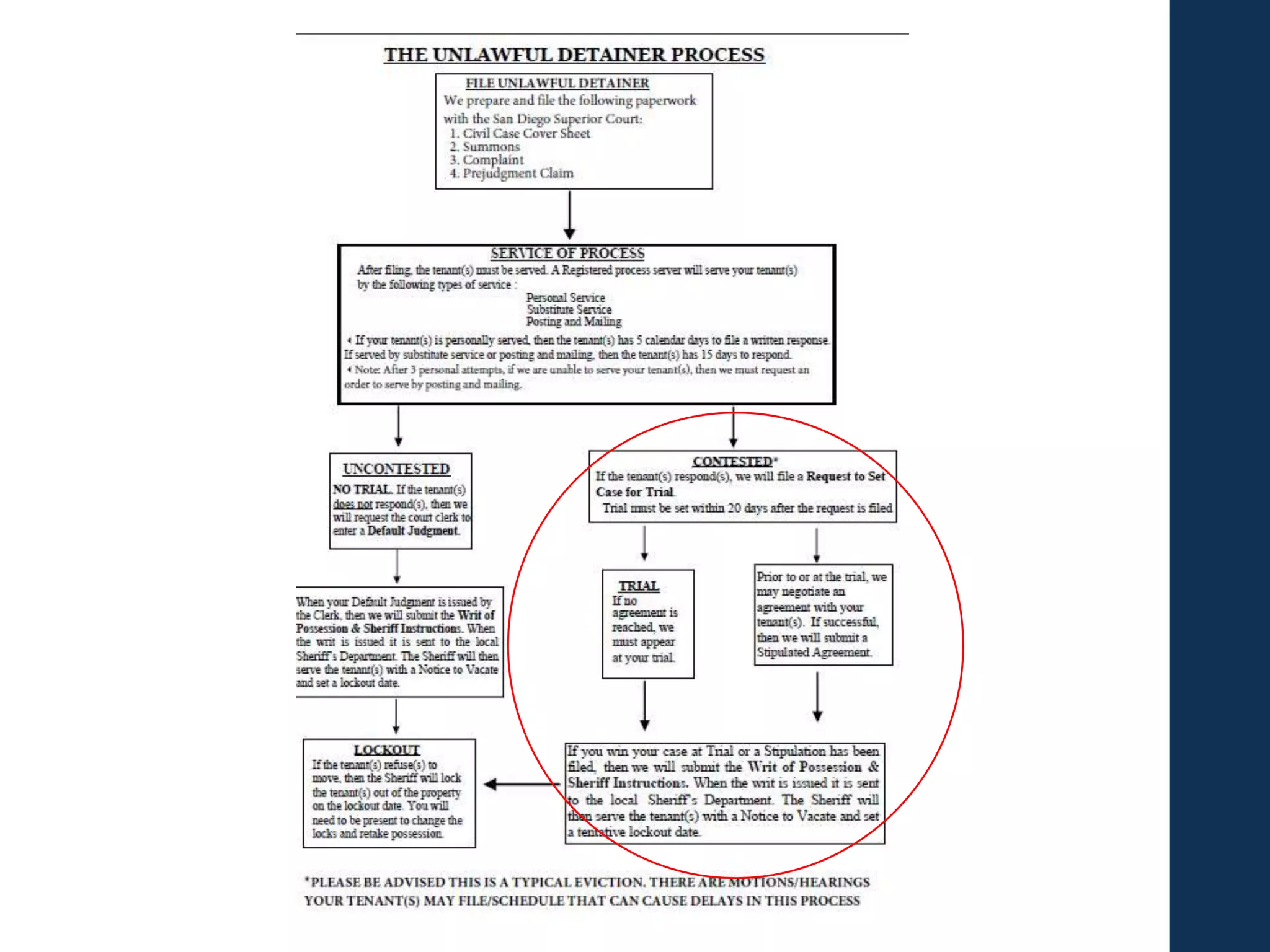
IF TENANT ANSWERS, WHAT
HAPPENS NEXT?
• Request to set the case for trial
 Case must now be set for trial. (Trial must be set within 20
days of request)
• Items you will need to bring to trial:
 Original rental agreement/lease
 Original notice served on tenant
 Declaration/proof of service of notice
 Rent ledger
 Witnesses (if necessary)
 Any other documents you may have concerning tenancy
(previous notices, e-mails, move-in/move-out checklist,
invoices, etc.)
WHAT HAPPENS AT TRIAL?
• Case is argued in open court (Judge
will render judgment in favor of
landlord or tenant or take matter
under submission)
• Parties enter into a stipulated
judgment
 Landlord and tenant come to mutual
agreement which is made the order of
the court (Examples: pay and stay, pay
and vacate)
WHAT HAPPENS AFTER
JUDGMENT IS ENTERED?
• Writ of possession is issued
 Order from the Court to the Sheriff’s
Department to perform the lockout.
• Lockout Scheduled
 Tenant is notified no less than 5 days prior to
lockout.
 Day before lockout Sheriff will call you with an
approximate time they will arrive at your
property to restore possession.
WHAT HAPPENS AT LOCKOUT?
• Sheriff’s Department gives tentative lockout
date to the landlord and/or attorney’s office.
(approximate date)
• The Sheriff will call you 24 hours before the
lockout date with the exact time. Be
available by phone the day before the
lockout.
• Be on time the day of lockout.
• Be ready to change locks (call locksmith if
necessary, Sheriff will not change locks for
you).
WHAT DO I DO WITH
BELONGINGS LEFT BEHIND
BY THE TENANT?
• If items less than $700, LL must wait 15
days then may dispose of the items.
• If items are more than $700, LL must sell
items at public auction
• Can charge a “reasonable storage fee”
• LL can move the items to another storage
space
• Take pictures and inventory
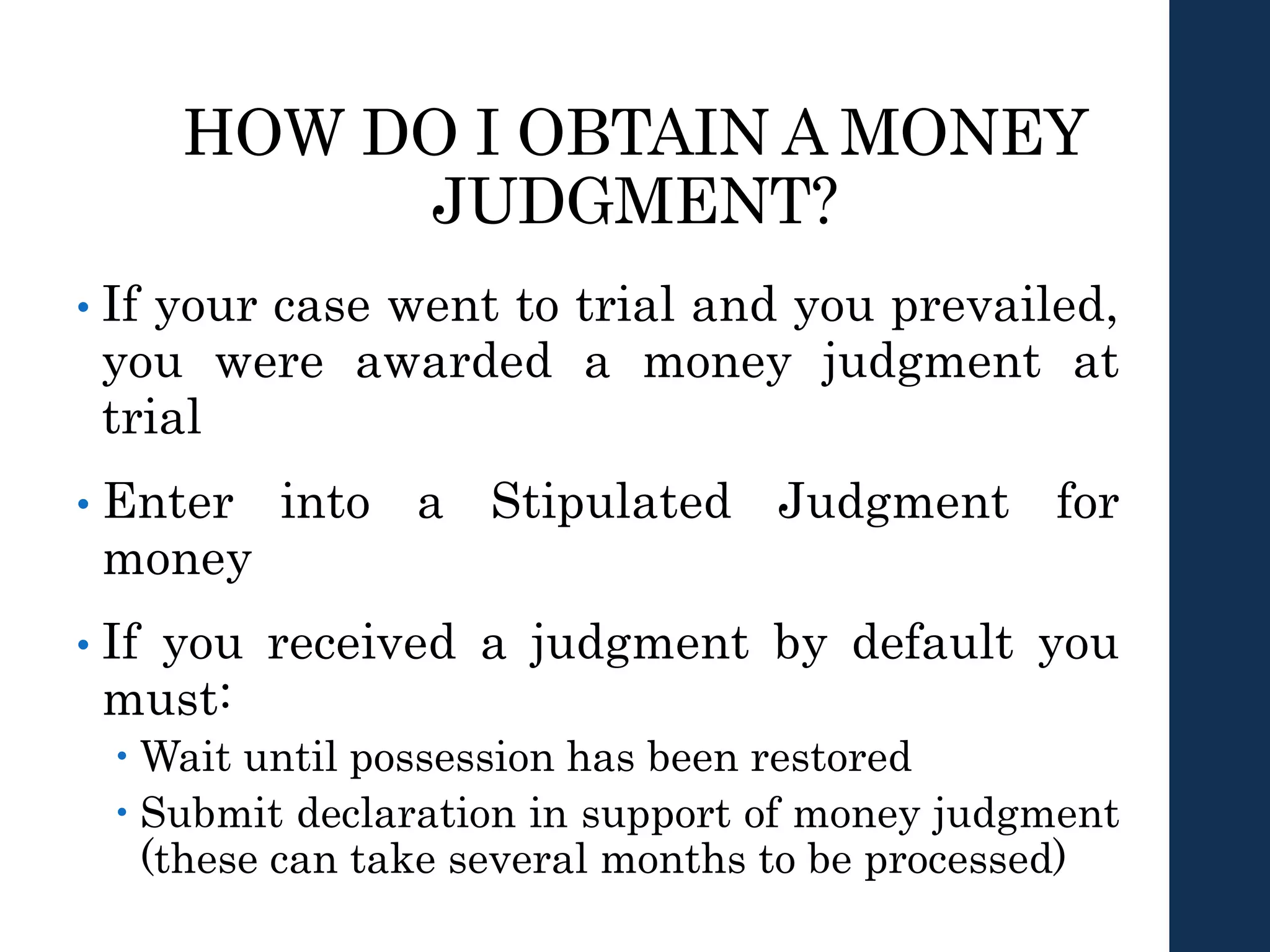
HOW DO I OBTAIN A MONEY
JUDGMENT?
• If your case went to trial and you prevailed,
you were awarded a money judgment at
trial
• Enter into a Stipulated Judgment for
money
• If you received a judgment by default you
must:
 Wait until possession has been restored
 Submit declaration in support of money judgment
(these can take several months to be processed)
WHAT MONIES AM I
ENTITLED TO?
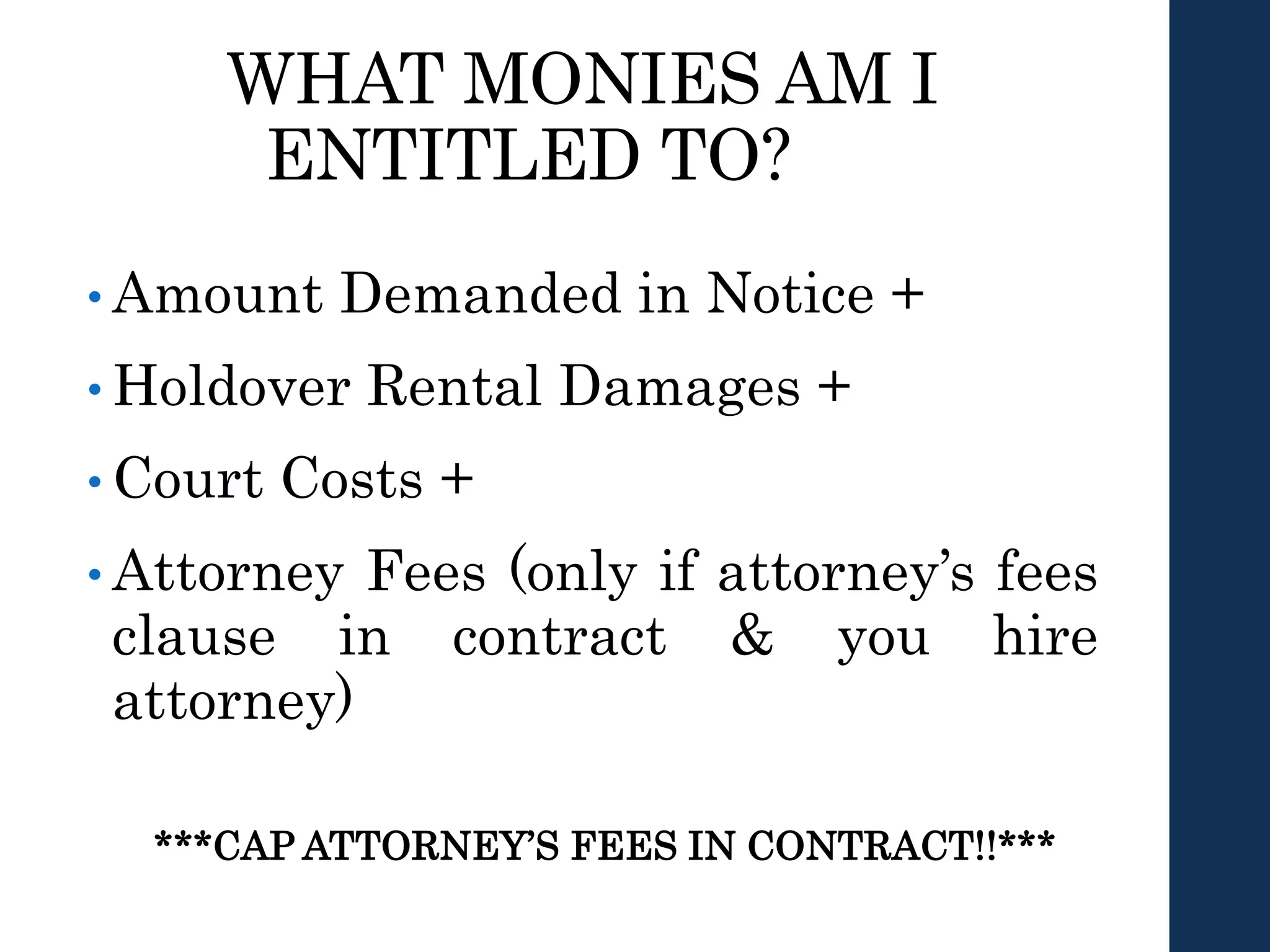
• Amount Demanded in Notice +
• Holdover Rental Damages +
• Court Costs +
• Attorney Fees (only if attorney’s fees
clause in contract & you hire
attorney)
***CAP ATTORNEY’S FEES IN CONTRACT!!***
HOW DO I COLLECT MY
MONEY?
•Wage Garnishment
•Bank Levy
•“Till Tap”
•Record Abstract of Judgment
Judgment is valid for 10 years.
Accrues interest at the rate of
10% per year.
Questions
HOW TO GET THROUGH
EVICTION PROCESS
Franco Simone, Esq
Simone & Associates
3702 4th Avenue
San Diego, CA 92103
Telephone: (619) 235-6180
landlordslegalcenter.com

How to Get Through Eviction Process

  • 1.
    HOW TO GETTHROUGH EVICTION PROCESS Franco Simone, Esq Simone & Associates 3702 4th Avenue San Diego, CA 92103 Telephone: (619) 235-6180 landlordslegalcenter.com
  • 2.
    HOW DO ITERMINATE A TENANCY? • Which Notice do I use?  30/60/90 Day Notices  When may a LL terminate using a 3-day Notice?  Which 3-day Notice should I use? • How do I serve Notice?  Section 8 Reminder  How do I calculate the Notice period? • Do’s and Don’ts  During 3-day pay or quit time period  During 30/60/90 Notice time period  During 3-day Notice to Perform Covenant or Quit time period • What do I do after the Notice has Expired? • Now that the Notice period has expired can I throw the Tenant out?
  • 3.
    WHICH NOTICE DOI USE TO TERMINATE THE TENANCY? • 30 day notice  (month to month agreement, less than one year) • 60 day notice  (month to month agreement, more than one year) • 60 day notice with cause  (month to month agreement, more than two years, located in city of San Diego) • 90 day notice  (post foreclosure if evicting tenant not owner or Section 8 which must include cause) • Termination of Fixed Term Lease – Must refer to lease term on termination.
  • 4.
    WHEN DO IUSE A 3-DAY NOTICE? • Failure to pay rent. • Violating any provision of the lease or rental agreement. • Materially damaged the rental property (“committing waste”). • Substantially interfered with other tenants (“committing a nuisance”). • Using the rental property for an unlawful purpose.
  • 5.
    WHICH 3-DAY NOTICESHOULD I USE? • 3-Day Notice To Pay Rent Or Quit • 3-Day Notice To Perform Covenant Or Quit • 3-Day Notice To Quit (nuisance, waste or unlawful acts)
  • 6.
    HOW DO ISERVE THE NOTICE? • Personal Service Notice handed directly to one of the named tenants.  If you cannot personally serve the tenant at the residence but you know his/her place of employment you must attempt service at their place of employment. Make sure you check the rental application for employment information. • Substituted Service If named tenants are unavailable for personal service at the premises or place of employment, notice may be handed to a person over the age of 18 at either site and mailed to that site (must get name or physical description). • Service by Posting and Mailing If unable to serve personally or by substitution, notice may be posted on the front door and mailed first-class to the premises.
  • 7.
    SECTION 8 TENANTS ADDITIONALREQUIREMENTS All notices served to Section 8 tenants must also be served on the Section 8 case representatives on the same day the notice is served on the tenants.
  • 8.
    HOW DO ICALCULATE THE 3-DAY NOTICE PERIOD? The first day of the notice period begins the day after the notice is served. Weekends are included, however the notice period cannot expire on a weekend or holiday. Date Served Expiration Date Monday Thursday Tuesday Friday Wednesday Monday Thursday Monday Friday Monday Saturday Tuesday Sunday Wednesday
  • 9.
    DO’S AND DON’TSDURING THE 3-DAY PAY OR QUIT TIME PERIOD • DO accept full rent payment if it is offered within 3- day notice period. • DON’T accept partial payments if you want to proceed with the unlawful detainer. • DON’T agree to allow the tenant to pay or remain in possession beyond the notice period since it will be considered a waiver of the Notice. • DO go to small claims court if the tenant vacates within the 3-day period & DON’T use the unlawful detainer process.
  • 10.
    DO’S AND DON’TSDURING THE 30/60/90 DAY NOTICE TIME PERIOD • DO accept Rent up to expiration of notice. • DON’T accept any rent beyond the expiration of the notice period.  Be careful with prorated amounts due for partial months. • DO inform tenant of right to initial and final move-out inspection.
  • 11.
    DO’S & DON’TSDURING THE 3-DAY NOTICE TO PERFORM COVENANT OR QUIT TIME PERIOD • DO accept payment if offered in full for a monetary breach. • DO allow tenant to cure breach. • DON’T accept payment after the 3-day period. • DON’T make yourself unavailable to communicate with the tenant during this period.
  • 12.
    WHAT DO IDO AFTER THE NOTICE HAS EXPIRED? • Verify the Tenant is still in possession of the premises. • Verify the Tenant has/has not complied with the notice.  Has owner or agent accepted any rent payment? (3-day pay or quit)  Has breach been cured? (Notice of inspection may be necessary) • Has notice been cancelled or waived?
  • 13.
    NOW THAT THENOTICE PERIOD HAS EXPIRED CAN I THROW THE TENANT OUT? • Landlord MUST use court proceedings to evict the tenant. The landlord CANNOT use self-help methods to force the tenant out. Examples:  Physically remove or lockout the tenant  Cut off utilities  Remove outside windows or doors  Seize the tenant’s belongings
  • 14.
    WHAT IS ANUNLAWFUL DETAINER? • An unlawful detainer is a “summary” court procedure to evict a tenant.  If uncontested, 4-8 weeks  If contested, 6-10 weeks It includes:  Filing of summons and complaint/prejudgment claim of right to possession  Service of process-tenants/“unknown occupants”  Request for entry of default or request for trial  Trial or default judgment  Lockout  Money judgment
  • 16.
    What do Ineed to file an unlawful detainer? • Documents needed:  Rental Agreement/Lease (if written)  Rent Increases  Notice  Declaration of Service • Summons and Complaint  Owner must be named as Plaintiff, however manager may appear at any necessary hearings including trial.  Complaint must be verified by owner, officer of corporation, partner, or attorney (Attorney may verify the complaint only when the owner is absent from the county where the complaint is filed.)
  • 18.
    SERVICE OF PROCESS (SERVINGTHE TENANT UD LAWSUIT) • Personal Service  5 days to file answer • Substituted Service  15 days to file answer • Order to Post  Must request permission from the judge  15 days to file answer **Unknown occupants always have 10 days to file answer.
  • 19.
    HOW DO ICOUNT THE DAYS AFTER PERSONAL SERVICE? • Day 1 begins day after the summons and complaint are served • Weekends count, as long as last day does not fall on a weekend (last day is pushed to Monday) • Court holidays do not count. (For list of court holidays visit sdcourt.ca.gov)
  • 20.
    WHAT CAN DELAYTHE UD PROCESS? • Tenant  Answers the complaint  Files a motion to quash  Files demurrer/motion to strike  Files bankruptcy (four weeks or more delay) • Claim of right to possession  Can be prevented by filing Prejudgment Claim of Right to Possession
  • 22.
    WHAT HAPPENS IFTENANT FAILS TO RESPOND? •Request for Entry of Default Tenant has not yet filed an answer. Prevents tenant from contesting unlawful detainer in court.
  • 23.
    WHEN CAN IGET A JUDGMENT FOR POSSESSION BY DEFAULT? •All defendants must be defaulted or dismissed. •Judgment for possession only. •Processed by court clerk, no trial appearance necessary.
  • 25.
    IF TENANT ANSWERS,WHAT HAPPENS NEXT? • Request to set the case for trial  Case must now be set for trial. (Trial must be set within 20 days of request) • Items you will need to bring to trial:  Original rental agreement/lease  Original notice served on tenant  Declaration/proof of service of notice  Rent ledger  Witnesses (if necessary)  Any other documents you may have concerning tenancy (previous notices, e-mails, move-in/move-out checklist, invoices, etc.)
  • 26.
    WHAT HAPPENS ATTRIAL? • Case is argued in open court (Judge will render judgment in favor of landlord or tenant or take matter under submission) • Parties enter into a stipulated judgment  Landlord and tenant come to mutual agreement which is made the order of the court (Examples: pay and stay, pay and vacate)
  • 28.
    WHAT HAPPENS AFTER JUDGMENTIS ENTERED? • Writ of possession is issued  Order from the Court to the Sheriff’s Department to perform the lockout. • Lockout Scheduled  Tenant is notified no less than 5 days prior to lockout.  Day before lockout Sheriff will call you with an approximate time they will arrive at your property to restore possession.
  • 29.
    WHAT HAPPENS ATLOCKOUT? • Sheriff’s Department gives tentative lockout date to the landlord and/or attorney’s office. (approximate date) • The Sheriff will call you 24 hours before the lockout date with the exact time. Be available by phone the day before the lockout. • Be on time the day of lockout. • Be ready to change locks (call locksmith if necessary, Sheriff will not change locks for you).
  • 30.
    WHAT DO IDO WITH BELONGINGS LEFT BEHIND BY THE TENANT? • If items less than $700, LL must wait 15 days then may dispose of the items. • If items are more than $700, LL must sell items at public auction • Can charge a “reasonable storage fee” • LL can move the items to another storage space • Take pictures and inventory
  • 31.
    HOW DO IOBTAIN A MONEY JUDGMENT? • If your case went to trial and you prevailed, you were awarded a money judgment at trial • Enter into a Stipulated Judgment for money • If you received a judgment by default you must:  Wait until possession has been restored  Submit declaration in support of money judgment (these can take several months to be processed)
  • 32.
    WHAT MONIES AMI ENTITLED TO? • Amount Demanded in Notice + • Holdover Rental Damages + • Court Costs + • Attorney Fees (only if attorney’s fees clause in contract & you hire attorney) ***CAP ATTORNEY’S FEES IN CONTRACT!!***
  • 33.
    HOW DO ICOLLECT MY MONEY? •Wage Garnishment •Bank Levy •“Till Tap” •Record Abstract of Judgment Judgment is valid for 10 years. Accrues interest at the rate of 10% per year.
  • 34.
  • 35.
    HOW TO GETTHROUGH EVICTION PROCESS Franco Simone, Esq Simone & Associates 3702 4th Avenue San Diego, CA 92103 Telephone: (619) 235-6180 landlordslegalcenter.com