How to create a Secure
Network Architecture
For Small Businesses?
Introduction
As technology evolves, threats aiming
to compromise critical information
and disrupt business operations are
becoming increasingly sophisticated.
A robust and well-designed network
architecture is essential for protecting
the security, integrity, and availability
of important data.
How to Design a
Secure Network
Architecture
For Your Small
Business?
Define Your Network
Requirements
Start by determining the type
and amount of data your
business deals with,
considering the sensitivity and
importance of the information.
Consider how many users and
devices will access the
network, both on-site and
remotely.
Identify the essential
applications and services for
your business operations. Also,
consider future growth and the
potential need for scalability.
Choose Your
Network
Topology
For small organizations aiming to establish a
secure network architecture, a centralized
network topology is often an excellent choice.
Placing firewalls and intrusion prevention
systems at the central hub ensures
centralized protection against potential
threats.
Centralized network management simplifies
the overall administration of the network,
which is particularly advantageous for small
businesses with limited IT resources.
Start by clearly defining and
communicating comprehensive
security policies that cover
acceptable network use, data
protection practices, and strict
user access limitations.
Implement strong
authentication measures like
multi-factor authentication and
periodically review and modify
user access rights to align with
evolving roles and
responsibilities.
Employ network segmentation
to isolate sensitive data,
thereby reducing the impact of
potential breaches amd
emphasize the use of Virtual
Private Networks
Implement Your Network
Security Policies
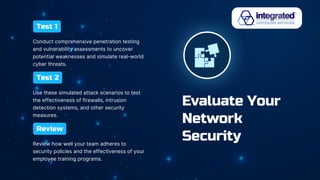
Test 1
Conduct comprehensive penetration testing
and vulnerability assessments to uncover
potential weaknesses and simulate real-world
cyber threats.
Test 2
Use these simulated attack scenarios to test
the effectiveness of firewalls, intrusion
detection systems, and other security
measures.
Review
Review how well your team adheres to
security policies and the effectiveness of your
employee training programs.
Evaluate Your
Network
Security
Maintain And Update
Your Network Security
Review and update access
controls, authentication
systems, and encryption
protocols regularly to keep up
with new threats and industry
best practices.
Create a proactive
maintenance schedule that
includes patching and
updating all network
equipment, software, and
security measures.
Consistent upgrades not only
improve the overall security
posture but also reflect a
commitment to protecting sensitive
information and maintaining client
and stakeholder trust in your small
business.
Working with seasoned cybersecurity
experts or engaging reputable IT consulting
firms can offer valuable insights and
specialized solutions.
These professionals are equipped to
perform in-depth risk assessments,
establish robust security policies, and
implement advanced technologies to shield
your network from emerging threats.
Their expertise ensures that your business
not only meets industry standards but also
confidently maneuvers through the
complex IT landscape
Get Expert Advice
And Support
Contact Us
(201) 365-9716
www.icssnj.com

How to create a secure network architecture.pdf

  • 1.
    How to createa Secure Network Architecture For Small Businesses?
  • 2.
    Introduction As technology evolves,threats aiming to compromise critical information and disrupt business operations are becoming increasingly sophisticated. A robust and well-designed network architecture is essential for protecting the security, integrity, and availability of important data.
  • 3.
    How to Designa Secure Network Architecture For Your Small Business?
  • 4.
    Define Your Network Requirements Startby determining the type and amount of data your business deals with, considering the sensitivity and importance of the information. Consider how many users and devices will access the network, both on-site and remotely. Identify the essential applications and services for your business operations. Also, consider future growth and the potential need for scalability.
  • 5.
    Choose Your Network Topology For smallorganizations aiming to establish a secure network architecture, a centralized network topology is often an excellent choice. Placing firewalls and intrusion prevention systems at the central hub ensures centralized protection against potential threats. Centralized network management simplifies the overall administration of the network, which is particularly advantageous for small businesses with limited IT resources.
  • 6.
    Start by clearlydefining and communicating comprehensive security policies that cover acceptable network use, data protection practices, and strict user access limitations. Implement strong authentication measures like multi-factor authentication and periodically review and modify user access rights to align with evolving roles and responsibilities. Employ network segmentation to isolate sensitive data, thereby reducing the impact of potential breaches amd emphasize the use of Virtual Private Networks Implement Your Network Security Policies
  • 7.
    Test 1 Conduct comprehensivepenetration testing and vulnerability assessments to uncover potential weaknesses and simulate real-world cyber threats. Test 2 Use these simulated attack scenarios to test the effectiveness of firewalls, intrusion detection systems, and other security measures. Review Review how well your team adheres to security policies and the effectiveness of your employee training programs. Evaluate Your Network Security
  • 8.
    Maintain And Update YourNetwork Security Review and update access controls, authentication systems, and encryption protocols regularly to keep up with new threats and industry best practices. Create a proactive maintenance schedule that includes patching and updating all network equipment, software, and security measures. Consistent upgrades not only improve the overall security posture but also reflect a commitment to protecting sensitive information and maintaining client and stakeholder trust in your small business.
  • 9.
    Working with seasonedcybersecurity experts or engaging reputable IT consulting firms can offer valuable insights and specialized solutions. These professionals are equipped to perform in-depth risk assessments, establish robust security policies, and implement advanced technologies to shield your network from emerging threats. Their expertise ensures that your business not only meets industry standards but also confidently maneuvers through the complex IT landscape Get Expert Advice And Support
  • 10.