DATAMITES™
Python Course in Dehradun
Toll Free Number: 1800-313-3434
How to Build a Career as a
Python Developer from Scratch
Starting a career as a Python developer can be your gateway into
the tech world. Python’s readability and versatility make it one
of the most beginner-friendly languages today. Whether you
dream of building web apps, automating workflows, or diving
into data science, Python opens doors across industries. This
guide will walk you through the path from zero experience to
job-ready, highlighting critical skills, tools, and strategic choices
that will accelerate your journey. If you're serious about
becoming a developer, start here—right now.
Is Python a Good First
Language? Why?
Yes—Python is an excellent first language. Its clean syntax
mirrors plain English, making it easier to understand and write.
You’ll grasp programming concepts faster without being bogged
down by complex syntax. Python is also in high demand across
industries, from automation and web development to AI and
finance. Learning it first helps you build a strong coding
foundation, allowing you to pivot into other languages or
domains with ease later on.
Education Pathways: CS Degree
vs Bootcamp vs Self-Taught
Each path has value—what matters is your learning style and
discipline. A CS degree offers depth and theory but takes years.
Bootcamps are intensive, practical, and faster. Self-taught paths
are flexible and cost-effective but require high motivation.
Regardless of the route, employers care about your skills,
projects, and ability to solve problems. Combine your path with
consistent practice, real projects, and an active GitHub profile to
stand out in the job market.
Step-by-Step Roadmap (0–2
Years)
0–6 Months: Learn Python fundamentals, practice with small
scripts, explore basic projects.
6–12 Months: Dive into object-oriented programming, data
structures, algorithms, and start using Git. Build a few complete
projects.
12–18 Months: Learn web frameworks or data libraries based on
your interest. Start contributing to open source.
18–24 Months: Polish your portfolio, sharpen interview skills,
and apply to internships or junior roles. Continuously build,
learn, and network.
Importance of GitHub & Open
Source Contributions
Your GitHub is your digital resume. Consistent commits, clean
code, and well-documented projects show potential employers
your dedication and growth. Open-source contributions build
credibility, improve your coding skills, and connect you with
real-world developers. Even small bug fixes or documentation
edits matter. It’s not about being perfect—it’s about showing up,
learning, and improving in public. Let your GitHub speak for
your ability and commitment.
Choosing a Specialization
Python offers many paths: web development, data science,
automation, machine learning, and more. Try a few beginner
projects in different areas to see what excites you. Once you've
found your niche, go deep—learn the tools, frameworks, and
workflows used in that domain. Specializing helps you stand out
in job applications and interviews. General knowledge is great,
but focused skills are what get you hired.
Networking & Online Presence
(LinkedIn, Dev.to, Medium)
A strong online presence opens doors. Share your projects, write
about your learning journey, and engage in developer
communities. Platforms like LinkedIn, blogs, and coding forums
let you connect with mentors, recruiters, and peers. Keep your
profiles professional and up to date. A well-written post or
project showcase can attract the right kind of attention—and
even land you a job opportunity before you apply.
Interview Preparation Resources
Prepare for interviews by practicing coding problems, reviewing
Python fundamentals, and understanding common algorithms.
Build mock projects and rehearse explaining them clearly. Learn
about system design if applying for backend roles. Simulate
interviews with peers or mentors to gain confidence. The more
you practice solving problems and articulating your thought
process, the better you'll perform. Treat interview prep as a skill
—develop it systematically and intentionally.
Common Mistakes & How to
Avoid Them
Avoid learning too many tools at once—depth beats breadth.
Don’t neglect the basics; solid fundamentals make advanced
topics easier. Skipping documentation or copying code without
understanding slows real growth. Also, avoid building only
tutorial-based projects—create your own. Not showcasing your
work or engaging in the community can make you invisible. Be
consistent, reflect often, and stay curious. Progress comes from
focused effort over time.
Conclusion
Becoming a Python developer isn’t about being the smartest—
it’s about being persistent, curious, and consistent. The path is
full of challenges, but each one is a step forward. Build real
projects, keep learning, contribute to the community, and share
your journey. With clarity and effort, a rewarding tech career is
within your reach. Start now, and in two years or less, you could
be working in a field you love.
Why is DATAMITES the best choice for a
Python Course?
DataMites Institute helps learners build job-ready skills in data
and analytics. They offer practical courses in Data Science,
Python, Machine Learning, Data Analytics, R Programming, and
Data Mining. With hands-on projects, real-world case studies,
and globally recognized certifications, their training is designed
to match industry needs. Courses are available both online and
in classrooms, led by experienced professionals to help students
succeed in today’s tech-driven world.
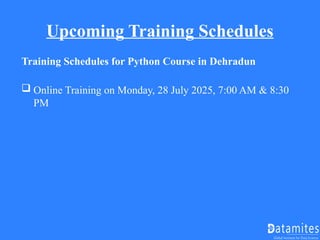
Upcoming Training Schedules
Training Schedules for Python Course in Dehradun
 Online Training on Monday, 28 July 2025, 7:00 AM & 8:30
PM
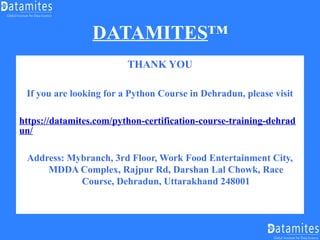
DATAMITES™
THANK YOU
If you are looking for a Python Course in Dehradun, please visit
https://datamites.com/python-certification-course-training-dehrad
un/
Address: Mybranch, 3rd Floor, Work Food Entertainment City,
MDDA Complex, Rajpur Rd, Darshan Lal Chowk, Race
Course, Dehradun, Uttarakhand 248001

How to Build a Career as a Python Developer from Scratch.pptx

  • 1.
    DATAMITES™ Python Course inDehradun Toll Free Number: 1800-313-3434
  • 2.
    How to Builda Career as a Python Developer from Scratch Starting a career as a Python developer can be your gateway into the tech world. Python’s readability and versatility make it one of the most beginner-friendly languages today. Whether you dream of building web apps, automating workflows, or diving into data science, Python opens doors across industries. This guide will walk you through the path from zero experience to job-ready, highlighting critical skills, tools, and strategic choices that will accelerate your journey. If you're serious about becoming a developer, start here—right now.
  • 3.
    Is Python aGood First Language? Why? Yes—Python is an excellent first language. Its clean syntax mirrors plain English, making it easier to understand and write. You’ll grasp programming concepts faster without being bogged down by complex syntax. Python is also in high demand across industries, from automation and web development to AI and finance. Learning it first helps you build a strong coding foundation, allowing you to pivot into other languages or domains with ease later on.
  • 4.
    Education Pathways: CSDegree vs Bootcamp vs Self-Taught Each path has value—what matters is your learning style and discipline. A CS degree offers depth and theory but takes years. Bootcamps are intensive, practical, and faster. Self-taught paths are flexible and cost-effective but require high motivation. Regardless of the route, employers care about your skills, projects, and ability to solve problems. Combine your path with consistent practice, real projects, and an active GitHub profile to stand out in the job market.
  • 5.
    Step-by-Step Roadmap (0–2 Years) 0–6Months: Learn Python fundamentals, practice with small scripts, explore basic projects. 6–12 Months: Dive into object-oriented programming, data structures, algorithms, and start using Git. Build a few complete projects. 12–18 Months: Learn web frameworks or data libraries based on your interest. Start contributing to open source. 18–24 Months: Polish your portfolio, sharpen interview skills, and apply to internships or junior roles. Continuously build, learn, and network.
  • 6.
    Importance of GitHub& Open Source Contributions Your GitHub is your digital resume. Consistent commits, clean code, and well-documented projects show potential employers your dedication and growth. Open-source contributions build credibility, improve your coding skills, and connect you with real-world developers. Even small bug fixes or documentation edits matter. It’s not about being perfect—it’s about showing up, learning, and improving in public. Let your GitHub speak for your ability and commitment.
  • 7.
    Choosing a Specialization Pythonoffers many paths: web development, data science, automation, machine learning, and more. Try a few beginner projects in different areas to see what excites you. Once you've found your niche, go deep—learn the tools, frameworks, and workflows used in that domain. Specializing helps you stand out in job applications and interviews. General knowledge is great, but focused skills are what get you hired.
  • 8.
    Networking & OnlinePresence (LinkedIn, Dev.to, Medium) A strong online presence opens doors. Share your projects, write about your learning journey, and engage in developer communities. Platforms like LinkedIn, blogs, and coding forums let you connect with mentors, recruiters, and peers. Keep your profiles professional and up to date. A well-written post or project showcase can attract the right kind of attention—and even land you a job opportunity before you apply.
  • 9.
    Interview Preparation Resources Preparefor interviews by practicing coding problems, reviewing Python fundamentals, and understanding common algorithms. Build mock projects and rehearse explaining them clearly. Learn about system design if applying for backend roles. Simulate interviews with peers or mentors to gain confidence. The more you practice solving problems and articulating your thought process, the better you'll perform. Treat interview prep as a skill —develop it systematically and intentionally.
  • 10.
    Common Mistakes &How to Avoid Them Avoid learning too many tools at once—depth beats breadth. Don’t neglect the basics; solid fundamentals make advanced topics easier. Skipping documentation or copying code without understanding slows real growth. Also, avoid building only tutorial-based projects—create your own. Not showcasing your work or engaging in the community can make you invisible. Be consistent, reflect often, and stay curious. Progress comes from focused effort over time.
  • 11.
    Conclusion Becoming a Pythondeveloper isn’t about being the smartest— it’s about being persistent, curious, and consistent. The path is full of challenges, but each one is a step forward. Build real projects, keep learning, contribute to the community, and share your journey. With clarity and effort, a rewarding tech career is within your reach. Start now, and in two years or less, you could be working in a field you love.
  • 12.
    Why is DATAMITESthe best choice for a Python Course? DataMites Institute helps learners build job-ready skills in data and analytics. They offer practical courses in Data Science, Python, Machine Learning, Data Analytics, R Programming, and Data Mining. With hands-on projects, real-world case studies, and globally recognized certifications, their training is designed to match industry needs. Courses are available both online and in classrooms, led by experienced professionals to help students succeed in today’s tech-driven world.
  • 13.
    Upcoming Training Schedules TrainingSchedules for Python Course in Dehradun  Online Training on Monday, 28 July 2025, 7:00 AM & 8:30 PM
  • 14.
    DATAMITES™ THANK YOU If youare looking for a Python Course in Dehradun, please visit https://datamites.com/python-certification-course-training-dehrad un/ Address: Mybranch, 3rd Floor, Work Food Entertainment City, MDDA Complex, Rajpur Rd, Darshan Lal Chowk, Race Course, Dehradun, Uttarakhand 248001