HOW MUCH YOUR RELATIVE
CHURN RATE
MATTERS
Your churn rate shows the overall health of your business.
See how two Recurly customers - one with rapid sales
growth and high churn, the other with slower sales growth
and lower churn - compare in value over time.
Your business is in a “drag race” with competitors to come out on top. How your
churn rate differs from your competitors’ can tell you a lot about the relative
health of your business and theirs.
Annuity revenue streams are made more or less attractive by the speed with which they ‘decay’. In
the world of SaaS and other subscription models, this ‘decay’ is a powerful reflection of how well
you are delivering a service that satisfies your customers over a period of time. Deliver a great
product or service and your customers will stick around. If you don’t deliver, your customers leave,
and your business becomes less efficient.
Churn is One of the Most Sensitive Variables Impacting
the Value of a Subscription Business
Your business is in
a “drag race” with
competitors to
come out on top.
2HOW MUCH YOUR RELATIVE CHURN RATE MATTERS
Churn Is a Summary Health Indicator
Focusing on subscriber churn alone is like studying the emissions from the
tailpipe of your car. Churn tells you when there’s a problem, but you need to look
farther up in the system to figure out the source.
When you look for the source of a problem, you’re likely to be reminded that it’s better products,
services, and experiences that capture the loyalty and share of wallet of customers over time.
Churn rates provide a brutal indicator of the sum total of all of these important elements. You
can monitor your churn rate for signs as to how well your company is delivering value over time.
Monitoring your churn rate can help you fix all kinds of problems with your business.
However, it’s important to always maintain a healthy dose of paranoia and ask yourself NOT just
how well your own company is performing on a period over period basis against ‘yourself’. More
importantly, you need to ask how well your company is performing against your competitors.
Ultimately, you’re drag racing with the companies that you compete with. In this drag race, your
relative/competitive churn rate is a matter of life or death.
Here at Recurly, we observe churn characteristics for thousands of companies and see many
interesting characteristics emerge. For this post, we’re going to focus on two real companies which
are competing head-to-head in the same market for the same customers.
“Think of relative/
competitive churn
as a matter of life
or death.”
3HOW MUCH YOUR RELATIVE CHURN RATE MATTERS
This Is a ‘Drag Race’ Between Two Similar Companies
We’ll focus on churn as the predictive indicator of the outcome.
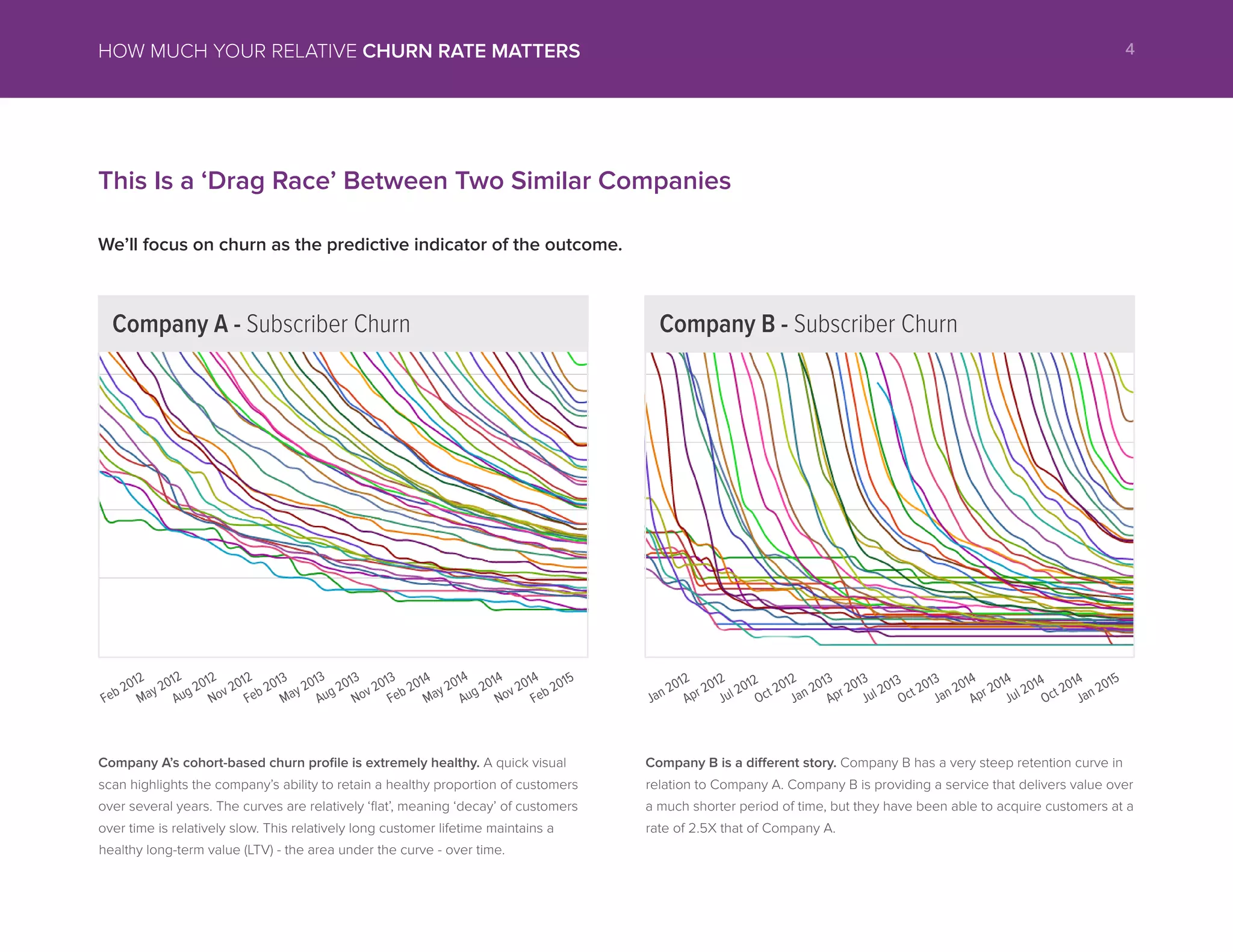
Company A’s cohort-based churn profile is extremely healthy. A quick visual
scan highlights the company’s ability to retain a healthy proportion of customers
over several years. The curves are relatively ‘flat’, meaning ‘decay’ of customers
over time is relatively slow. This relatively long customer lifetime maintains a
healthy long-term value (LTV) - the area under the curve - over time.
Company B is a different story. Company B has a very steep retention curve in
relation to Company A. Company B is providing a service that delivers value over
a much shorter period of time, but they have been able to acquire customers at a
rate of 2.5X that of Company A.
Company B - Subscriber ChurnCompany A - Subscriber Churn
Feb 2012
Jan 2012
May 2012
Apr 2012
Aug 2012
Jul 2012
Nov 2012
Oct 2012
Feb 2013
Jan 2013
May 2013
Apr 2013
Aug 2013
Jul 2013
Nov 2013
Oct 2013
Feb 2014
Jan 2014
May 2014
Apr 2014
Aug 2014
Jul 2014
Nov 2014
Oct 2014
Feb 2015
Jan 2015
4HOW MUCH YOUR RELATIVE CHURN RATE MATTERS
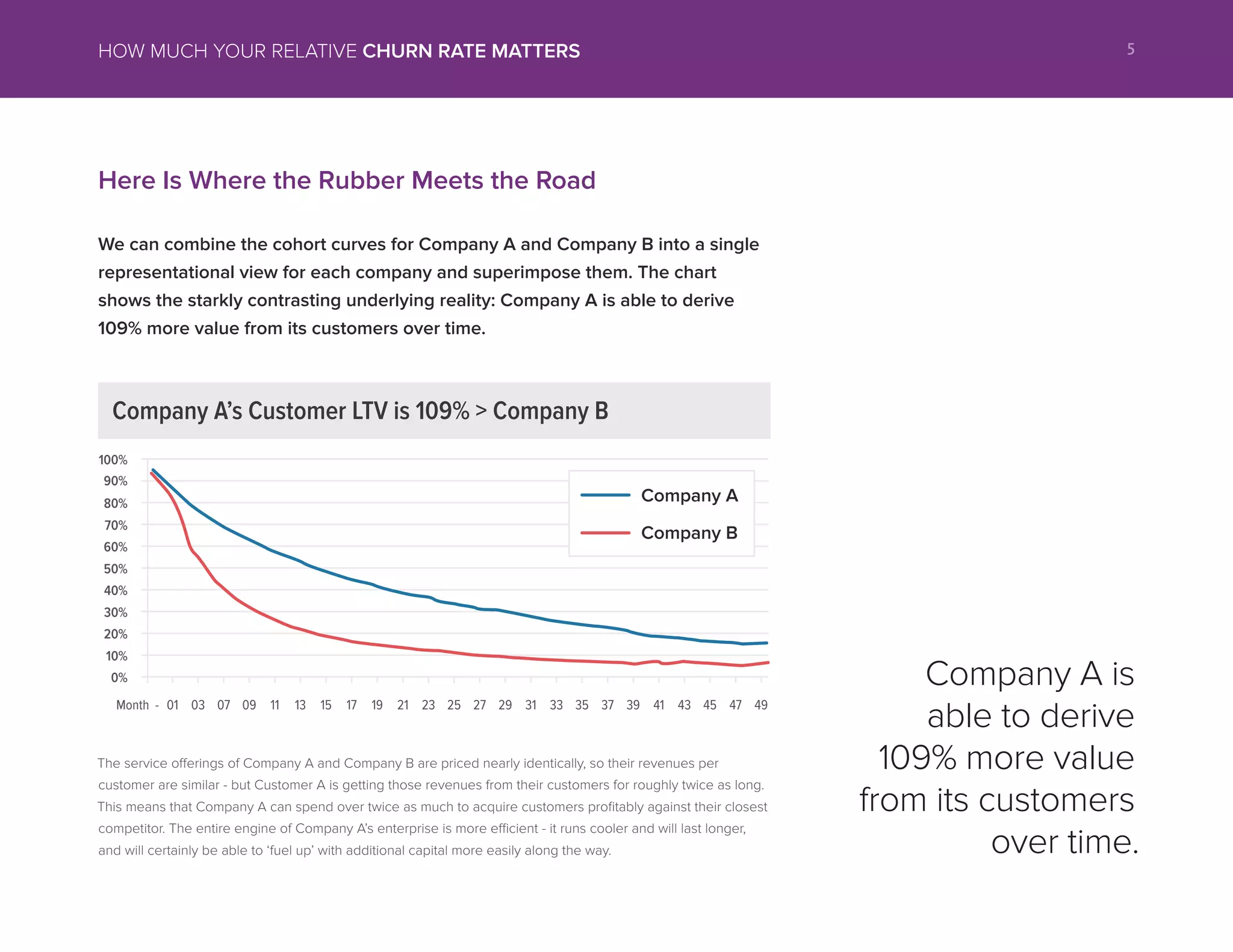
We can combine the cohort curves for Company A and Company B into a single
representational view for each company and superimpose them. The chart
shows the starkly contrasting underlying reality: Company A is able to derive
109% more value from its customers over time.
Here Is Where the Rubber Meets the Road
Company A’s Customer LTV is 109% > Company B
The service offerings of Company A and Company B are priced nearly identically, so their revenues per
customer are similar - but Customer A is getting those revenues from their customers for roughly twice as long.
This means that Company A can spend over twice as much to acquire customers profitably against their closest
competitor. The entire engine of Company A’s enterprise is more efficient - it runs cooler and will last longer,
and will certainly be able to ‘fuel up’ with additional capital more easily along the way.
100%
90%
80%
70%
60%
50%
40%
30%
20%
10%
0%
01 03 07 09 11 13 15 17 19 21 23 25 27 29 31 33 35 37 39 41 43 45 47 49Month -
Company A is
able to derive
109% more value
from its customers
over time.
Company A
Company B
5HOW MUCH YOUR RELATIVE CHURN RATE MATTERS
Recurly provides enterprise-class recurring billing management for thousands
of subscription-based businesses worldwide.
Contact our team today to see if Recurly is the right fit for your business.
+1.844.732.8759 sales@recurly.com
© 2015 Recurly, Inc. All rights reserved.

HOW MUCH YOUR RELATIVE CHURN RATE MATTERS

  • 1.
    HOW MUCH YOURRELATIVE CHURN RATE MATTERS Your churn rate shows the overall health of your business. See how two Recurly customers - one with rapid sales growth and high churn, the other with slower sales growth and lower churn - compare in value over time.
  • 2.
    Your business isin a “drag race” with competitors to come out on top. How your churn rate differs from your competitors’ can tell you a lot about the relative health of your business and theirs. Annuity revenue streams are made more or less attractive by the speed with which they ‘decay’. In the world of SaaS and other subscription models, this ‘decay’ is a powerful reflection of how well you are delivering a service that satisfies your customers over a period of time. Deliver a great product or service and your customers will stick around. If you don’t deliver, your customers leave, and your business becomes less efficient. Churn is One of the Most Sensitive Variables Impacting the Value of a Subscription Business Your business is in a “drag race” with competitors to come out on top. 2HOW MUCH YOUR RELATIVE CHURN RATE MATTERS
  • 3.
    Churn Is aSummary Health Indicator Focusing on subscriber churn alone is like studying the emissions from the tailpipe of your car. Churn tells you when there’s a problem, but you need to look farther up in the system to figure out the source. When you look for the source of a problem, you’re likely to be reminded that it’s better products, services, and experiences that capture the loyalty and share of wallet of customers over time. Churn rates provide a brutal indicator of the sum total of all of these important elements. You can monitor your churn rate for signs as to how well your company is delivering value over time. Monitoring your churn rate can help you fix all kinds of problems with your business. However, it’s important to always maintain a healthy dose of paranoia and ask yourself NOT just how well your own company is performing on a period over period basis against ‘yourself’. More importantly, you need to ask how well your company is performing against your competitors. Ultimately, you’re drag racing with the companies that you compete with. In this drag race, your relative/competitive churn rate is a matter of life or death. Here at Recurly, we observe churn characteristics for thousands of companies and see many interesting characteristics emerge. For this post, we’re going to focus on two real companies which are competing head-to-head in the same market for the same customers. “Think of relative/ competitive churn as a matter of life or death.” 3HOW MUCH YOUR RELATIVE CHURN RATE MATTERS
  • 4.
    This Is a‘Drag Race’ Between Two Similar Companies We’ll focus on churn as the predictive indicator of the outcome. Company A’s cohort-based churn profile is extremely healthy. A quick visual scan highlights the company’s ability to retain a healthy proportion of customers over several years. The curves are relatively ‘flat’, meaning ‘decay’ of customers over time is relatively slow. This relatively long customer lifetime maintains a healthy long-term value (LTV) - the area under the curve - over time. Company B is a different story. Company B has a very steep retention curve in relation to Company A. Company B is providing a service that delivers value over a much shorter period of time, but they have been able to acquire customers at a rate of 2.5X that of Company A. Company B - Subscriber ChurnCompany A - Subscriber Churn Feb 2012 Jan 2012 May 2012 Apr 2012 Aug 2012 Jul 2012 Nov 2012 Oct 2012 Feb 2013 Jan 2013 May 2013 Apr 2013 Aug 2013 Jul 2013 Nov 2013 Oct 2013 Feb 2014 Jan 2014 May 2014 Apr 2014 Aug 2014 Jul 2014 Nov 2014 Oct 2014 Feb 2015 Jan 2015 4HOW MUCH YOUR RELATIVE CHURN RATE MATTERS
  • 5.
    We can combinethe cohort curves for Company A and Company B into a single representational view for each company and superimpose them. The chart shows the starkly contrasting underlying reality: Company A is able to derive 109% more value from its customers over time. Here Is Where the Rubber Meets the Road Company A’s Customer LTV is 109% > Company B The service offerings of Company A and Company B are priced nearly identically, so their revenues per customer are similar - but Customer A is getting those revenues from their customers for roughly twice as long. This means that Company A can spend over twice as much to acquire customers profitably against their closest competitor. The entire engine of Company A’s enterprise is more efficient - it runs cooler and will last longer, and will certainly be able to ‘fuel up’ with additional capital more easily along the way. 100% 90% 80% 70% 60% 50% 40% 30% 20% 10% 0% 01 03 07 09 11 13 15 17 19 21 23 25 27 29 31 33 35 37 39 41 43 45 47 49Month - Company A is able to derive 109% more value from its customers over time. Company A Company B 5HOW MUCH YOUR RELATIVE CHURN RATE MATTERS
  • 6.
    Recurly provides enterprise-classrecurring billing management for thousands of subscription-based businesses worldwide. Contact our team today to see if Recurly is the right fit for your business. +1.844.732.8759 sales@recurly.com © 2015 Recurly, Inc. All rights reserved.