How Google Works ???
What exactly Google is??? Distributed Network Of Thousands Of Low-cost Computers Parallel Processing  Googlebot  A Web Crawler That Finds And Fetches Web Pages.  The Indexer  The Query Processor
Googlebot Google's Web Crawler Finds and retrieves pages on the web and hands them off to the Google indexer  Googlebot consists of many computers requesting and fetching pages much more quickly than you can with your web browser  - thousands of them in A single second It functions much like your web browser, by sending A request to A web server for A web page, downloading the entire page, then handing it off to Google's indexer.
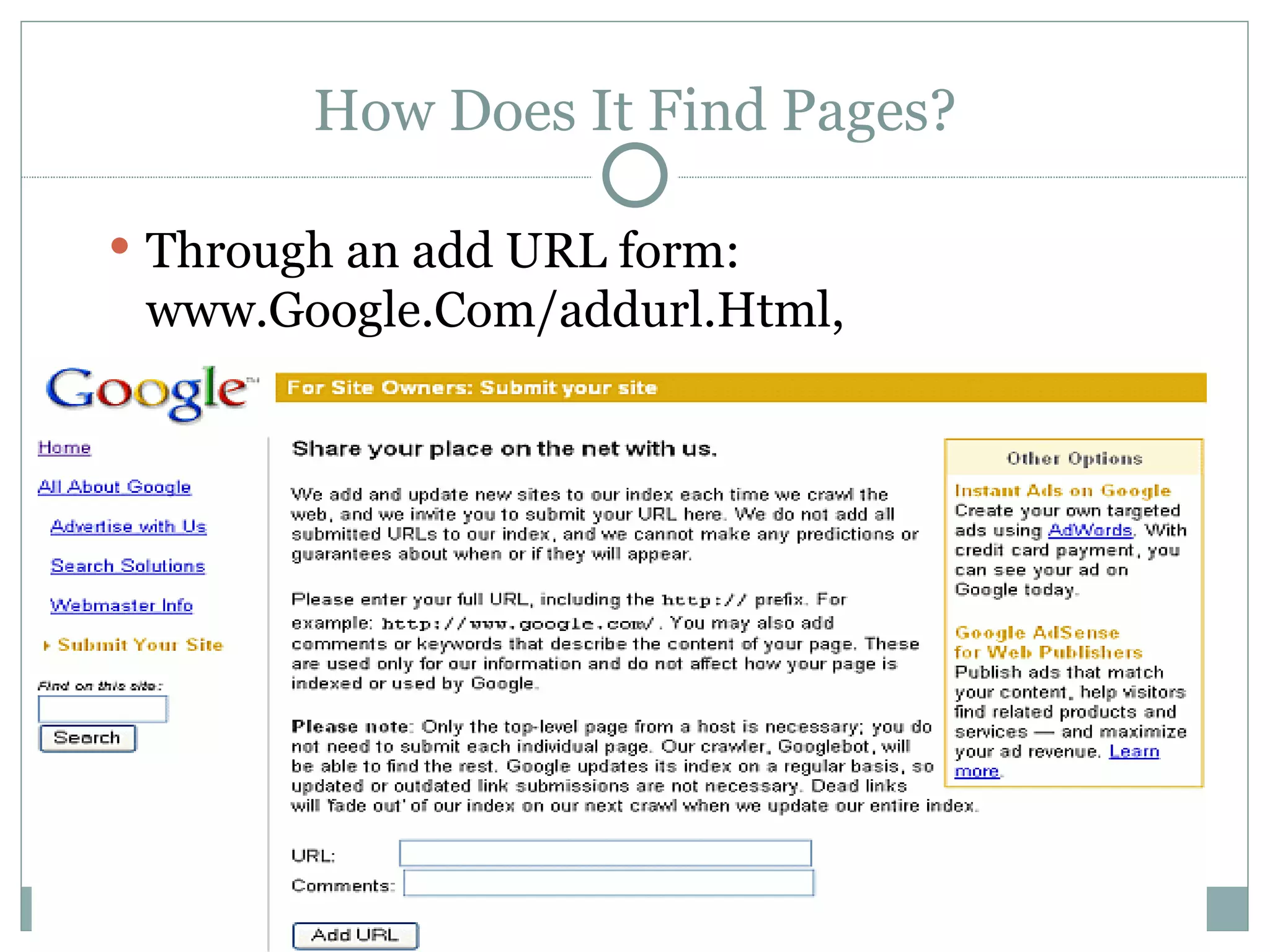
How Does It Find Pages? Through an add URL form:  www.Google.Com/addurl.Html,
When googlebot fetches a page, it culls all the links appearing on the page and adds them to a queue for subsequent crawling.  Deep crawling
Challenges  Googlebot sends out simultaneous requests for thousands of pages, the queue of "visit soon" URLs must be constantly examined and compared with URLs already in Google's index.  Googlebot must determine how often to revisit a page  Google continuously recrawls popular frequently changing web pages at a rate roughly proportional to how often the pages change. Such crawls keep an index current and are known as  fresh crawls   Newspaper pages
Google's Indexer   Index is sorted alphabetically by search term, with each index entry storing a list of documents in which the term appears and the location within the text where it occurs  To improve search performance, google ignores (doesn't index) common words called  stop words  (such as  the ,  is ,  on ,  or ,  of ,  how ,  why , as well as certain single digits and single letters  The indexer also ignores some punctuation and multiple spaces, as well as converting all letters to lowercase, to improve google's performance
Google's Query Processor   Several parts, including the user interface (search box), the "engine" that evaluates queries and matches them to relevant documents, and the results formatter.  Google gives more priority to pages that have search terms near each other and in the same order as the query  Google indexes html code in addition to the text on the page, users can restrict searches on the basis of where query words appear, e.G., In the title, in the URL, in the body, and in links to the page, options offered by the advanced-search page and search operators.
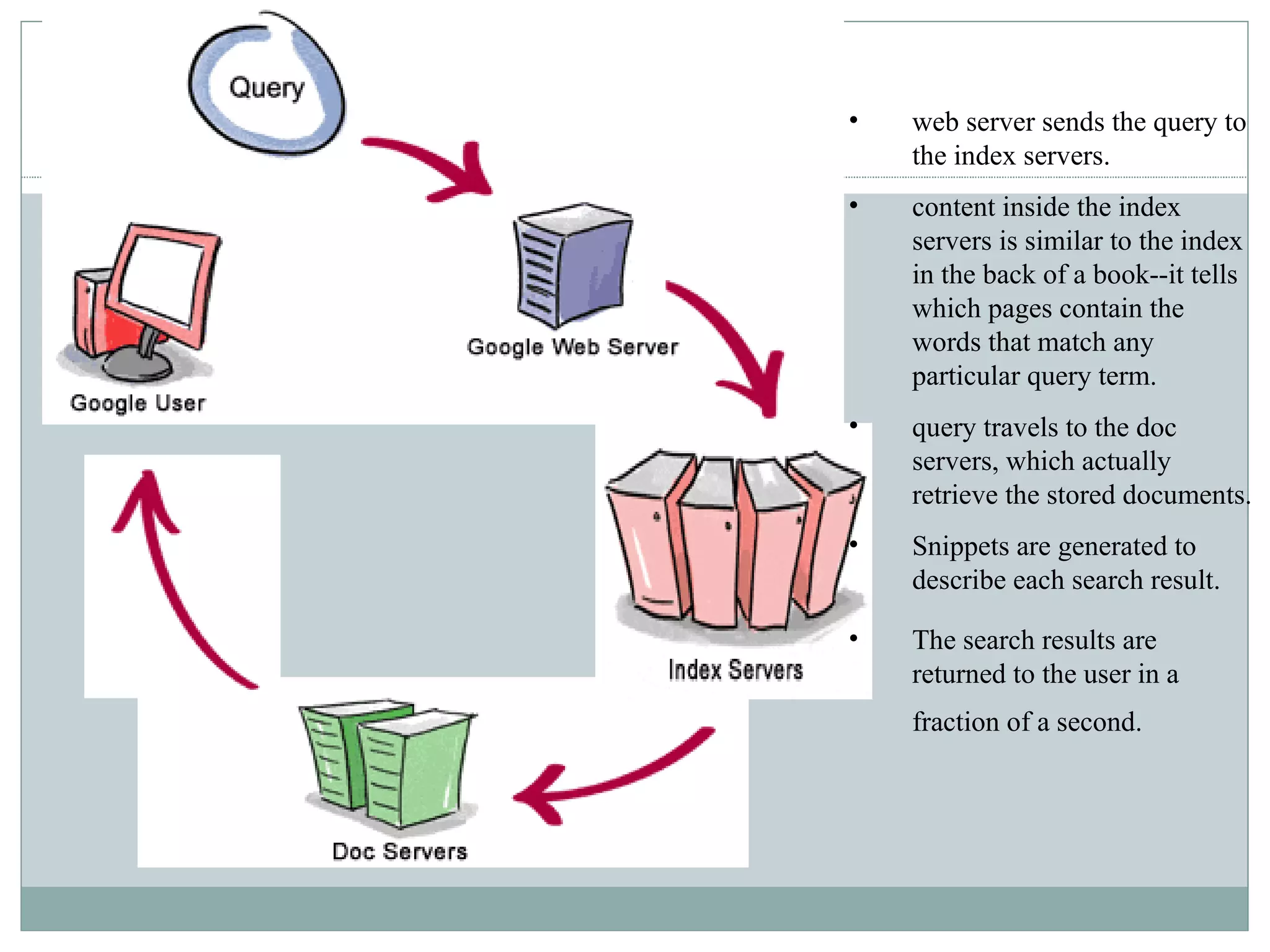
web server sends the query to the index servers.  content inside the index servers is similar to the index in the back of a book--it tells which pages contain the words that match any particular query term.  query travels to the doc servers, which actually retrieve the stored documents. Snippets are generated to describe each search result.  The search results are returned to the user in a fraction of a second.

How Google WOrks?

  • 1.
  • 2.
    What exactly Googleis??? Distributed Network Of Thousands Of Low-cost Computers Parallel Processing Googlebot A Web Crawler That Finds And Fetches Web Pages. The Indexer The Query Processor
  • 3.
    Googlebot Google's WebCrawler Finds and retrieves pages on the web and hands them off to the Google indexer Googlebot consists of many computers requesting and fetching pages much more quickly than you can with your web browser - thousands of them in A single second It functions much like your web browser, by sending A request to A web server for A web page, downloading the entire page, then handing it off to Google's indexer.
  • 4.
    How Does ItFind Pages? Through an add URL form: www.Google.Com/addurl.Html,
  • 5.
    When googlebot fetchesa page, it culls all the links appearing on the page and adds them to a queue for subsequent crawling. Deep crawling
  • 6.
    Challenges Googlebotsends out simultaneous requests for thousands of pages, the queue of "visit soon" URLs must be constantly examined and compared with URLs already in Google's index. Googlebot must determine how often to revisit a page Google continuously recrawls popular frequently changing web pages at a rate roughly proportional to how often the pages change. Such crawls keep an index current and are known as fresh crawls Newspaper pages
  • 7.
    Google's Indexer Index is sorted alphabetically by search term, with each index entry storing a list of documents in which the term appears and the location within the text where it occurs To improve search performance, google ignores (doesn't index) common words called stop words (such as the , is , on , or , of , how , why , as well as certain single digits and single letters The indexer also ignores some punctuation and multiple spaces, as well as converting all letters to lowercase, to improve google's performance
  • 8.
    Google's Query Processor Several parts, including the user interface (search box), the "engine" that evaluates queries and matches them to relevant documents, and the results formatter. Google gives more priority to pages that have search terms near each other and in the same order as the query Google indexes html code in addition to the text on the page, users can restrict searches on the basis of where query words appear, e.G., In the title, in the URL, in the body, and in links to the page, options offered by the advanced-search page and search operators.
  • 9.
    web server sendsthe query to the index servers. content inside the index servers is similar to the index in the back of a book--it tells which pages contain the words that match any particular query term. query travels to the doc servers, which actually retrieve the stored documents. Snippets are generated to describe each search result. The search results are returned to the user in a fraction of a second.