Accounting Concepts
 
GOING CONCERN Concept Enterprise will continue in operation long enough to carry out its existing objectives. Implications:  depreciation and amortization are used, plant assets recorded at cost instead of liquidation value, items are labeled as fixed or long-term.
REVENUE RECOGNITION Revenue recognition principle dictates that revenue should be recognized in the accounting period in which it is earned. When a sale is involved, revenue  is recognized at the point of sale.
Money Measurement Concept:  only transaction data expressed in terms of money can be included in the accounting records Example:  employee satisfaction and percent of international employees are not transactions that should be included in the financial records. .  Customer Satisfaction  Percentage of International Employees  Salaries  paid Should be included in accounting records
The  cost principle  dictates that  assets be recorded at their cost . Cost is used because it is both relevant and reliable. 1)  Cost is  relevant  because it represents  a)   the  price paid,  b)  the assets sacrificed, or  c)  the  commitment made at the date of  acquisition. 2)  Cost is  reliable  because it is  a)   objectively  measurable,  b)  factual, and  c)  verifiable. COST Concept
Expense recognition  is traditionally tied to  revenue recognition . referred to as the  matching principle   dictates that expenses be matched with revenues in the period in which efforts are made to generate revenues. MATCHING  Concept
Dual aspect concept This concept sets up for us the basic accounting equation from which financial statements are derived.   The Accounting Equation states that "total assets = total liabilities and equities" 
Accounting period concept
Accrual concept The effects of transactions and other events are recognized when they occur (and not as cash or its equivalent is received or paid) and they are recorded in the accounting records and reported in the financial statements of the periods to which they relate.
Example : Accrual Concept Company A has received cash of Rs.40,000 from his customers. However, the company actually has done all work satisfactorily and the customers have acknowledged the work done which the company can billed for another Rs.20,000. Furthermore, the expenses for the Rs.20,000 work-done has been taken up into the books of account. Based on this concept, the company has actually completed all work done, also, the work done have being acknowledged by the customers, hence income of Rs.60,000 should be taken up and not just the cash received.
Objective Evidence concept Every transaction should be supported by Business documents as they act as valid proof . It prevents Errors & Frauds It eliminates scope of personal biasness.
Conventions Materiality relates to an item’s impact on a firm’s  overall financial condition  and  operations . Conservatism  dictates that when in doubt, choose the method that will be the least likely to overstate  assets  and  income
Requires that circumstances and events that make a difference to financial statement users be disclosed. Compliance with the full disclosure principle 1)   data in the financial statements   2)   notes that accompanying the statements Summary of significant accounting policies  usually the first note to the financial statements FULL DISCLOSURE
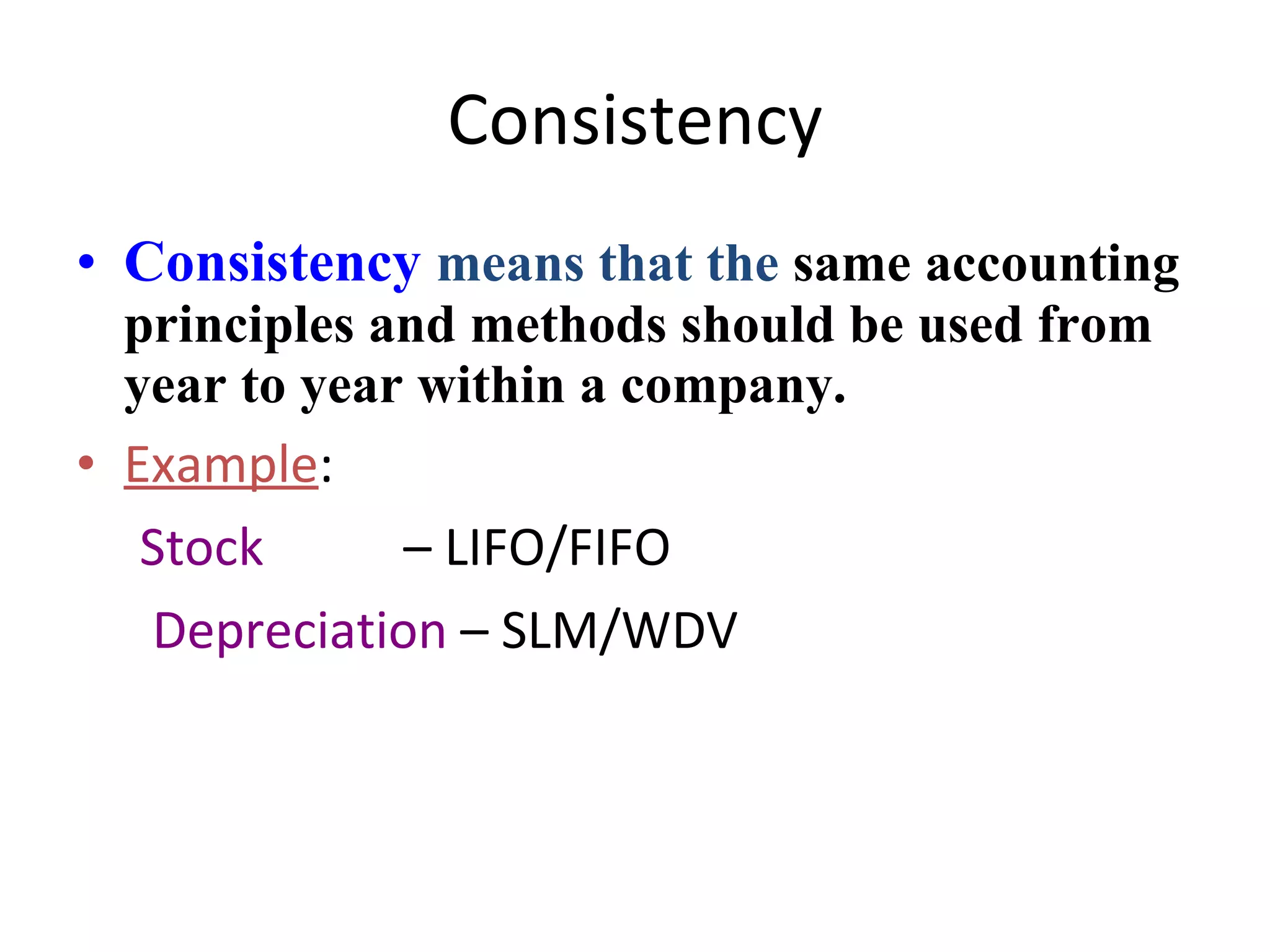
Consistency Consistency   means that the  same accounting principles and methods should be used from year to year within a company. Example : Stock   – LIFO/FIFO Depreciation  – SLM/WDV

Acc princ

  • 1.
  • 2.
  • 3.
    GOING CONCERN ConceptEnterprise will continue in operation long enough to carry out its existing objectives. Implications: depreciation and amortization are used, plant assets recorded at cost instead of liquidation value, items are labeled as fixed or long-term.
  • 4.
    REVENUE RECOGNITION Revenuerecognition principle dictates that revenue should be recognized in the accounting period in which it is earned. When a sale is involved, revenue is recognized at the point of sale.
  • 5.
    Money Measurement Concept: only transaction data expressed in terms of money can be included in the accounting records Example: employee satisfaction and percent of international employees are not transactions that should be included in the financial records. . Customer Satisfaction Percentage of International Employees Salaries paid Should be included in accounting records
  • 6.
    The costprinciple dictates that assets be recorded at their cost . Cost is used because it is both relevant and reliable. 1) Cost is relevant because it represents a) the price paid, b) the assets sacrificed, or c) the commitment made at the date of acquisition. 2) Cost is reliable because it is a) objectively measurable, b) factual, and c) verifiable. COST Concept
  • 7.
    Expense recognition is traditionally tied to revenue recognition . referred to as the matching principle dictates that expenses be matched with revenues in the period in which efforts are made to generate revenues. MATCHING Concept
  • 8.
    Dual aspect conceptThis concept sets up for us the basic accounting equation from which financial statements are derived.  The Accounting Equation states that "total assets = total liabilities and equities" 
  • 9.
  • 10.
    Accrual concept Theeffects of transactions and other events are recognized when they occur (and not as cash or its equivalent is received or paid) and they are recorded in the accounting records and reported in the financial statements of the periods to which they relate.
  • 11.
    Example : AccrualConcept Company A has received cash of Rs.40,000 from his customers. However, the company actually has done all work satisfactorily and the customers have acknowledged the work done which the company can billed for another Rs.20,000. Furthermore, the expenses for the Rs.20,000 work-done has been taken up into the books of account. Based on this concept, the company has actually completed all work done, also, the work done have being acknowledged by the customers, hence income of Rs.60,000 should be taken up and not just the cash received.
  • 12.
    Objective Evidence conceptEvery transaction should be supported by Business documents as they act as valid proof . It prevents Errors & Frauds It eliminates scope of personal biasness.
  • 13.
    Conventions Materiality relatesto an item’s impact on a firm’s overall financial condition and operations . Conservatism dictates that when in doubt, choose the method that will be the least likely to overstate assets and income
  • 14.
    Requires that circumstancesand events that make a difference to financial statement users be disclosed. Compliance with the full disclosure principle 1) data in the financial statements 2) notes that accompanying the statements Summary of significant accounting policies usually the first note to the financial statements FULL DISCLOSURE
  • 15.
    Consistency Consistency means that the same accounting principles and methods should be used from year to year within a company. Example : Stock – LIFO/FIFO Depreciation – SLM/WDV