How AI Truly Learns: The Core
Process
AI doesn’t “learn” like humans do, but it mimics the learning process through data and
algorithms. At its core, AI learns by identifying patterns in large datasets and then making
predictions or decisions based on that learning. Here’s how it works:
1. Training with Data (Learning from Experience)
• How it works: AI models start out as blank slates (just like a student on the
fi
rst day of school).
They need to be trained on large amounts of data—this data can be anything from text, images,
audio, or numbers. For instance, if you want to train an AI to recognize cats, you feed it thousands of
pictures of cats along with the label “cat.”
• Key Idea: The AI model looks for patterns in the data. In the cat example, it might learn that cats
have pointy ears, whiskers, and certain shapes or textures. Over time, it gets better at recognizing
these features and distinguishing cats from other animals.
• Types of Data:
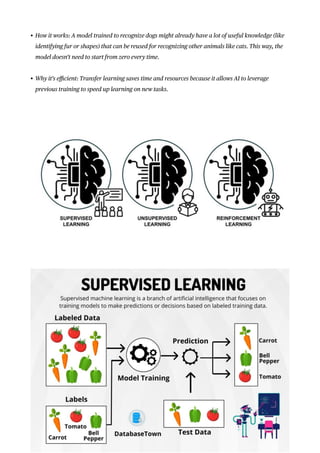
• Labeled Data: This is when the data has speci
fi
c answers or labels (like a photo with the label
“cat”). This is called supervised learning.
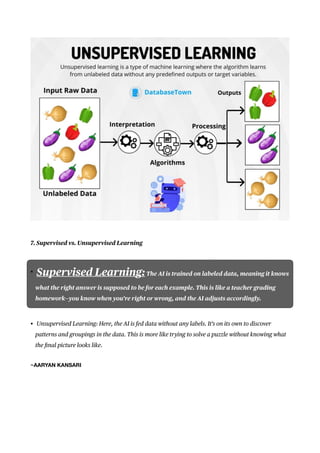
• Unlabeled Data: Sometimes, the data doesn’t have labels. The AI needs to
fi
nd patterns on its own—
this is called unsupervised learning.
2. Neural Networks (AI’s Brain)
• What it is: A neural network is essentially AI’s brain. It’s a complex system that mimics how human
neurons work. Each neuron in this network processes a tiny bit of information and passes it to the
next one, making the model more complex and capable of understanding bigger, more intricate
patterns.
• How it works: When you give an AI model data (like pictures or text), it
fl
ows through di
ff
erent
layers of these neurons. Each layer processes the data di
ff
erently—some layers might focus on edges
or lines in an image, while others might focus on colors or textures.
• Why it’s important: These neurons work together to learn more detailed and abstract features as
they go deeper, enabling the AI to make smarter decisions.
3. Backpropagation (Learning from Mistakes)
• What it is: Once an AI makes a prediction (for example, whether an image is a cat or not), it
compares the prediction to the correct answer. If it’s wrong, the AI uses a process called
backpropagation to adjust itself.
• How it works: Think of it like learning to throw a basketball. If you miss the hoop, you adjust your
technique for the next throw. AI does something similar—after each incorrect prediction, the model
tweaks its internal parameters (called weights and biases) to get closer to the right answer next
time.
• Key takeaway: This process happens thousands or millions of times during training, allowing the
AI to gradually improve its accuracy over time.
4. Reinforcement Learning (Trial and Error)
• What it is: Reinforcement learning is a special kind of learning where the AI learns by interacting
with its environment and receiving rewards or penalties based on its actions.
• How it works: Imagine training a dog to sit. Every time the dog sits, it gets a treat (reward). Over
time, the dog learns that sitting gets it something good. AI works similarly in reinforcement
learning. The AI tries di
ff
erent actions, and if it does something good (like winning a game), it gets a
reward and will repeat that behavior.
• Applications: This type of learning is used for tasks like game-playing AI (think about how AI
mastered chess or Go), robotics, or even self-driving cars that learn from navigating through
di
ff
erent environments.
5. Transfer Learning (Using Pre-learned Knowledge)
• What it is: Instead of learning from scratch every time, AI can use transfer learning, which means
taking knowledge from one task and applying it to another. It’s like knowing how to ride a bicycle
and using that balance skill to help you learn how to skateboard faster.
• How it works: A model trained to recognize dogs might already have a lot of useful knowledge (like
identifying fur or shapes) that can be reused for recognizing other animals like cats. This way, the
model doesn’t need to start from zero every time.
• Why it’s e
ffi
cient: Transfer learning saves time and resources because it allows AI to leverage
previous training to speed up learning on new tasks.
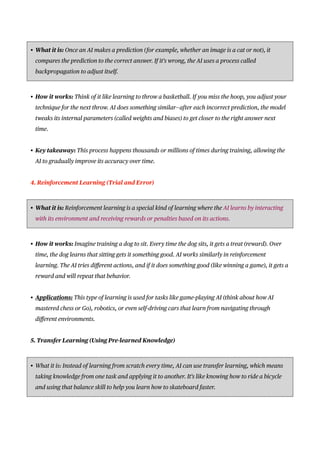
7. Supervised vs. Unsupervised Learning
• Supervised Learning:The AI is trained on labeled data, meaning it knows
what the right answer is supposed to be for each example. This is like a teacher grading
homework—you know when you’re right or wrong, and the AI adjusts accordingly.
• Unsupervised Learning: Here, the AI is fed data without any labels. It’s on its own to discover
patterns and groupings in the data. This is more like trying to solve a puzzle without knowing what
the
fi
nal picture looks like.
~AARYAN KANSARI

How artificial intelligence learns?.pdf.

  • 1.
    How AI TrulyLearns: The Core Process AI doesn’t “learn” like humans do, but it mimics the learning process through data and algorithms. At its core, AI learns by identifying patterns in large datasets and then making predictions or decisions based on that learning. Here’s how it works:
  • 2.
    1. Training withData (Learning from Experience) • How it works: AI models start out as blank slates (just like a student on the fi rst day of school). They need to be trained on large amounts of data—this data can be anything from text, images, audio, or numbers. For instance, if you want to train an AI to recognize cats, you feed it thousands of pictures of cats along with the label “cat.” • Key Idea: The AI model looks for patterns in the data. In the cat example, it might learn that cats have pointy ears, whiskers, and certain shapes or textures. Over time, it gets better at recognizing these features and distinguishing cats from other animals. • Types of Data: • Labeled Data: This is when the data has speci fi c answers or labels (like a photo with the label “cat”). This is called supervised learning. • Unlabeled Data: Sometimes, the data doesn’t have labels. The AI needs to fi nd patterns on its own— this is called unsupervised learning. 2. Neural Networks (AI’s Brain) • What it is: A neural network is essentially AI’s brain. It’s a complex system that mimics how human neurons work. Each neuron in this network processes a tiny bit of information and passes it to the next one, making the model more complex and capable of understanding bigger, more intricate patterns. • How it works: When you give an AI model data (like pictures or text), it fl ows through di ff erent layers of these neurons. Each layer processes the data di ff erently—some layers might focus on edges or lines in an image, while others might focus on colors or textures. • Why it’s important: These neurons work together to learn more detailed and abstract features as they go deeper, enabling the AI to make smarter decisions. 3. Backpropagation (Learning from Mistakes)
  • 3.
    • What itis: Once an AI makes a prediction (for example, whether an image is a cat or not), it compares the prediction to the correct answer. If it’s wrong, the AI uses a process called backpropagation to adjust itself. • How it works: Think of it like learning to throw a basketball. If you miss the hoop, you adjust your technique for the next throw. AI does something similar—after each incorrect prediction, the model tweaks its internal parameters (called weights and biases) to get closer to the right answer next time. • Key takeaway: This process happens thousands or millions of times during training, allowing the AI to gradually improve its accuracy over time. 4. Reinforcement Learning (Trial and Error) • What it is: Reinforcement learning is a special kind of learning where the AI learns by interacting with its environment and receiving rewards or penalties based on its actions. • How it works: Imagine training a dog to sit. Every time the dog sits, it gets a treat (reward). Over time, the dog learns that sitting gets it something good. AI works similarly in reinforcement learning. The AI tries di ff erent actions, and if it does something good (like winning a game), it gets a reward and will repeat that behavior. • Applications: This type of learning is used for tasks like game-playing AI (think about how AI mastered chess or Go), robotics, or even self-driving cars that learn from navigating through di ff erent environments. 5. Transfer Learning (Using Pre-learned Knowledge) • What it is: Instead of learning from scratch every time, AI can use transfer learning, which means taking knowledge from one task and applying it to another. It’s like knowing how to ride a bicycle and using that balance skill to help you learn how to skateboard faster.
  • 4.
    • How itworks: A model trained to recognize dogs might already have a lot of useful knowledge (like identifying fur or shapes) that can be reused for recognizing other animals like cats. This way, the model doesn’t need to start from zero every time. • Why it’s e ffi cient: Transfer learning saves time and resources because it allows AI to leverage previous training to speed up learning on new tasks.
  • 5.
    7. Supervised vs.Unsupervised Learning • Supervised Learning:The AI is trained on labeled data, meaning it knows what the right answer is supposed to be for each example. This is like a teacher grading homework—you know when you’re right or wrong, and the AI adjusts accordingly. • Unsupervised Learning: Here, the AI is fed data without any labels. It’s on its own to discover patterns and groupings in the data. This is more like trying to solve a puzzle without knowing what the fi nal picture looks like. ~AARYAN KANSARI