Hot Tips for Radiant Heated
           Floors
Staying Warm With Radiant
       Floor Heating


Radiant floor heating sounds almost as
good as it feels. The word radiant conjures
up warm images, and the actual product
creates warm homes.
Radiant Heating Not New
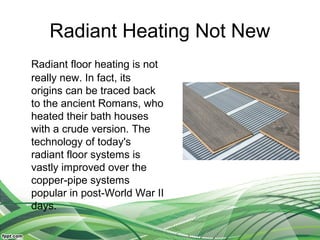
Radiant floor heating is not
really new. In fact, its
origins can be traced back
to the ancient Romans, who
heated their bath houses
with a crude version. The
technology of today's
radiant floor systems is
vastly improved over the
copper-pipe systems
popular in post-World War II
days.
Radiant Heating Not New
Interest in radiant floor systems
waned in the 1960's because of
problems, expenses and
limitations associated with the
copper-pipe systems. In the
late 1970's, when synthetic
rubber and plastic tubing was
developed, radiant floor
systems began making a
comeback.
How Radiant Floor Systems
          Works
Radiant floor systems work by
heating mass, not air. Not only
does the floor stay warm and
toasty, the heat is transmitted to
the furniture and, eventually, to
the people who inhabit the
house.
How Radiant Floor Systems
          Works
The heart of a radiant floor system is the boiler, which is
fueled by a conventional source such as natural gas.
The hot water circulates through sturdy synthetic plastic
or rubber tubing back to the boiler. The tubing actually
looks like, and is almost as flexible as, a garden hose.
The systems have an automatic fill level that draws
water from the home's main water source to compensate
for the one to two gallons of water that evaporates each
year.
How Radiant Floor Systems
          Works
The tubing or hose commonly is
installed in grout beds for tile
and rock surface floors . It can
be stapled to the top of frame
floors and covered with some
type of stone, brick or concrete.
The hose also can be installed
on the underside of plywood
subfloors. Foil-back insulation
under the hose creates the
needed "mass" in subfloors.
Radiant Floor Systems Costs


While radiant floor heating is now
technologically improved, it's still not
cheap.
Radiant Floor Systems Costs
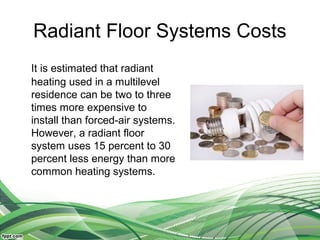
It is estimated that radiant
heating used in a multilevel
residence can be two to three
times more expensive to
install than forced-air systems.
However, a radiant floor
system uses 15 percent to 30
percent less energy than more
common heating systems.
Radiant Floor Systems Costs

Estimating costs for radiant
heat systems is very difficult
because the quality and price of
the plastic or rubber tubing
varies, and every application is
different. Average cost for
equipment and labor is about
$5 to $7.50 per square foot.
Energy Savings
As far as energy savings, it
depends on the individual and
the application.
Radiant systems can be divided
into several zones governed by
separate thermostats. Some
homeowners request different
zones for the master bedroom
and master bath.
Energy Savings
You can have rooms set
at lower temperatures
than with forced air,
because the heat stays
at about person level
instead of rising to the
ceiling.
Energy Savings

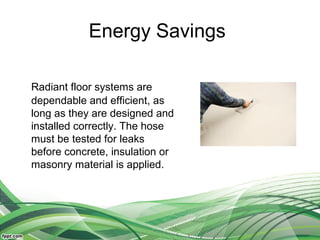
Radiant floor systems are
dependable and efficient, as
long as they are designed and
installed correctly. The hose
must be tested for leaks
before concrete, insulation or
masonry material is applied.
Radiant floor systems are not compatible
with central air-conditioning systems, but
new technology is in the works. Solar
energy sometimes can be combined with
radiant heating.
Further Reading…

Beautiful Heat is a group of expert technicians
and installers committed to education about
radiant floor heating. Visit
http://www.beautifulheat.com/homeowners today
to learn more.

Hot tips for radiant heated floors

  • 1.
    Hot Tips forRadiant Heated Floors
  • 2.
    Staying Warm WithRadiant Floor Heating Radiant floor heating sounds almost as good as it feels. The word radiant conjures up warm images, and the actual product creates warm homes.
  • 3.
    Radiant Heating NotNew Radiant floor heating is not really new. In fact, its origins can be traced back to the ancient Romans, who heated their bath houses with a crude version. The technology of today's radiant floor systems is vastly improved over the copper-pipe systems popular in post-World War II days.
  • 4.
    Radiant Heating NotNew Interest in radiant floor systems waned in the 1960's because of problems, expenses and limitations associated with the copper-pipe systems. In the late 1970's, when synthetic rubber and plastic tubing was developed, radiant floor systems began making a comeback.
  • 5.
    How Radiant FloorSystems Works Radiant floor systems work by heating mass, not air. Not only does the floor stay warm and toasty, the heat is transmitted to the furniture and, eventually, to the people who inhabit the house.
  • 6.
    How Radiant FloorSystems Works The heart of a radiant floor system is the boiler, which is fueled by a conventional source such as natural gas. The hot water circulates through sturdy synthetic plastic or rubber tubing back to the boiler. The tubing actually looks like, and is almost as flexible as, a garden hose. The systems have an automatic fill level that draws water from the home's main water source to compensate for the one to two gallons of water that evaporates each year.
  • 7.
    How Radiant FloorSystems Works The tubing or hose commonly is installed in grout beds for tile and rock surface floors . It can be stapled to the top of frame floors and covered with some type of stone, brick or concrete. The hose also can be installed on the underside of plywood subfloors. Foil-back insulation under the hose creates the needed "mass" in subfloors.
  • 8.
    Radiant Floor SystemsCosts While radiant floor heating is now technologically improved, it's still not cheap.
  • 9.
    Radiant Floor SystemsCosts It is estimated that radiant heating used in a multilevel residence can be two to three times more expensive to install than forced-air systems. However, a radiant floor system uses 15 percent to 30 percent less energy than more common heating systems.
  • 10.
    Radiant Floor SystemsCosts Estimating costs for radiant heat systems is very difficult because the quality and price of the plastic or rubber tubing varies, and every application is different. Average cost for equipment and labor is about $5 to $7.50 per square foot.
  • 11.
    Energy Savings As faras energy savings, it depends on the individual and the application. Radiant systems can be divided into several zones governed by separate thermostats. Some homeowners request different zones for the master bedroom and master bath.
  • 12.
    Energy Savings You canhave rooms set at lower temperatures than with forced air, because the heat stays at about person level instead of rising to the ceiling.
  • 13.
    Energy Savings Radiant floorsystems are dependable and efficient, as long as they are designed and installed correctly. The hose must be tested for leaks before concrete, insulation or masonry material is applied.
  • 14.
    Radiant floor systemsare not compatible with central air-conditioning systems, but new technology is in the works. Solar energy sometimes can be combined with radiant heating.
  • 15.
    Further Reading… Beautiful Heatis a group of expert technicians and installers committed to education about radiant floor heating. Visit http://www.beautifulheat.com/homeowners today to learn more.