10/02/2012 Slide 1
Hot Socket Issues
Follow-up and Management
Presented by Rob Reese
TESCO – The Eastern Specialty Company
with special thanks to L+G who sponsored much
of the research presented here today
for MEA 2018
Slide 2
Topics
A Quick Review
What is a Hot Socket?
Root Causes of Hot Sockets?
Roundtable Discussion
Your Main Defenses
Responding to a Hot Socket
Slide 3
What is a Hot Socket
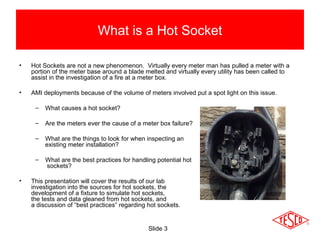
• Hot Sockets are not a new phenomenon. Virtually every meter man has pulled a meter with a
portion of the meter base around a blade melted and virtually every utility has been called to
assist in the investigation of a fire at a meter box.
• AMI deployments because of the volume of meters involved put a spot light on this issue.
– What causes a hot socket?
– Are the meters ever the cause of a meter box failure?
– What are the things to look for when inspecting an
existing meter installation?
– What are the best practices for handling potential hot
sockets?
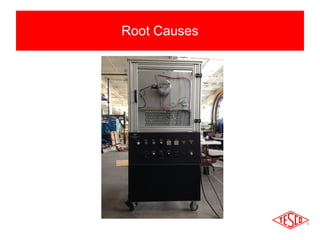
• This presentation will cover the results of our lab
investigation into the sources for hot sockets, the
development of a fixture to simulate hot sockets,
the tests and data gleaned from hot sockets, and
a discussion of “best practices” regarding hot sockets.
Slide 4
Root Causes
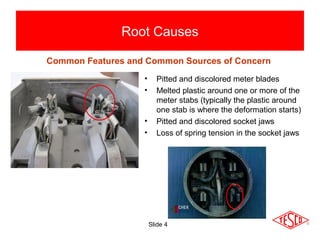
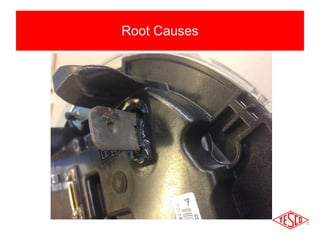
• Pitted and discolored meter blades
• Melted plastic around one or more of the
meter stabs (typically the plastic around
one stab is where the deformation starts)
• Pitted and discolored socket jaws
• Loss of spring tension in the socket jaws
Common Features and Common Sources of Concern
Root Causes
Root Causes
Slide 7
Root Causes
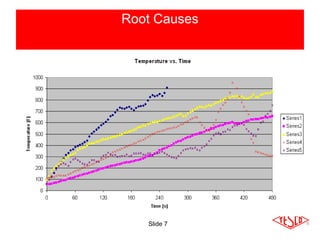
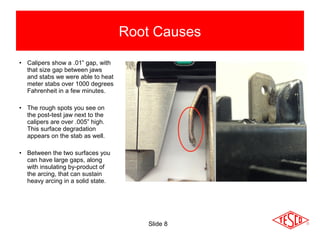
• Calipers show a .01” gap, with
that size gap between jaws
and stabs we were able to heat
meter stabs over 1000 degrees
Fahrenheit in a few minutes.
• The rough spots you see on
the post-test jaw next to the
calipers are over .005” high.
This surface degradation
appears on the stab as well.
• Between the two surfaces you
can have large gaps, along
with insulating by-product of
the arcing, that can sustain
heavy arcing in a solid state.
Root Causes
Slide 8
Slide 9
Root Causes
There are three necessary ingredients to create a hot socket (Note: We are
not suggesting that we have simulated or even understand all causes for all
hot sockets and meter related fires, but rather that we have simulated and
understand the causes behind most hot sockets and meter related fires);
• Loss of jaw tension in at least
one of the socket jaws.
• Vibration (or other catalyst
to initiate arcing)
• Minimal load present
Slide 10
Root Causes
Slide 11
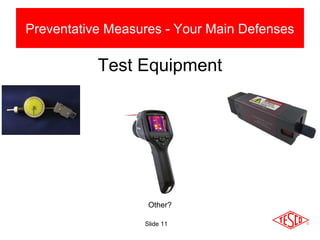
Preventative Measures - Your Main Defenses
Test Equipment
Other?
Slide 12
Preventative Measures - Your Main Defenses
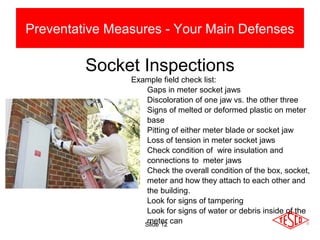
Socket Inspections
Example field check list:
Gaps in meter socket jaws
Discoloration of one jaw vs. the other three
Signs of melted or deformed plastic on meter
base
Pitting of either meter blade or socket jaw
Loss of tension in meter socket jaws
Check condition of wire insulation and
connections to meter jaws
Check the overall condition of the box, socket,
meter and how they attach to each other and
the building.
Look for signs of tampering
Look for signs of water or debris inside of the
meter can
Slide 13
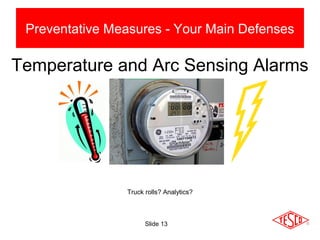
Preventative Measures - Your Main Defenses
Temperature and Arc Sensing Alarms
Truck rolls? Analytics?
Slide 14
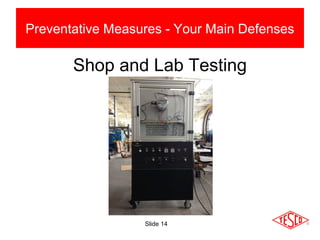
Preventative Measures - Your Main Defenses
Shop and Lab Testing
Slide 15
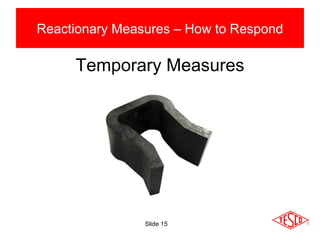
Reactionary Measures – How to Respond
Temporary Measures
Slide 16
Reactionary Measures – How to Respond
Permanent Measures
Slide 17
Questions and Discussion
Rob Reese
TESCO – The Eastern Specialty Company
Bristol, PA
215-310-8809 (cell)
1-800-762-8211
This presentation can also be found under Meter
Conferences and Schools on the TESCO web site:
www.tesco-advent.com
Note: Special Thanks to L+G who sponsored much of the
research presented as part of this presentation

Hot Sockets - Follow Up and Management

  • 1.
    10/02/2012 Slide 1 HotSocket Issues Follow-up and Management Presented by Rob Reese TESCO – The Eastern Specialty Company with special thanks to L+G who sponsored much of the research presented here today for MEA 2018
  • 2.
    Slide 2 Topics A QuickReview What is a Hot Socket? Root Causes of Hot Sockets? Roundtable Discussion Your Main Defenses Responding to a Hot Socket
  • 3.
    Slide 3 What isa Hot Socket • Hot Sockets are not a new phenomenon. Virtually every meter man has pulled a meter with a portion of the meter base around a blade melted and virtually every utility has been called to assist in the investigation of a fire at a meter box. • AMI deployments because of the volume of meters involved put a spot light on this issue. – What causes a hot socket? – Are the meters ever the cause of a meter box failure? – What are the things to look for when inspecting an existing meter installation? – What are the best practices for handling potential hot sockets? • This presentation will cover the results of our lab investigation into the sources for hot sockets, the development of a fixture to simulate hot sockets, the tests and data gleaned from hot sockets, and a discussion of “best practices” regarding hot sockets.
  • 4.
    Slide 4 Root Causes •Pitted and discolored meter blades • Melted plastic around one or more of the meter stabs (typically the plastic around one stab is where the deformation starts) • Pitted and discolored socket jaws • Loss of spring tension in the socket jaws Common Features and Common Sources of Concern
  • 5.
  • 6.
  • 7.
  • 8.
    • Calipers showa .01” gap, with that size gap between jaws and stabs we were able to heat meter stabs over 1000 degrees Fahrenheit in a few minutes. • The rough spots you see on the post-test jaw next to the calipers are over .005” high. This surface degradation appears on the stab as well. • Between the two surfaces you can have large gaps, along with insulating by-product of the arcing, that can sustain heavy arcing in a solid state. Root Causes Slide 8
  • 9.
    Slide 9 Root Causes Thereare three necessary ingredients to create a hot socket (Note: We are not suggesting that we have simulated or even understand all causes for all hot sockets and meter related fires, but rather that we have simulated and understand the causes behind most hot sockets and meter related fires); • Loss of jaw tension in at least one of the socket jaws. • Vibration (or other catalyst to initiate arcing) • Minimal load present
  • 10.
  • 11.
    Slide 11 Preventative Measures- Your Main Defenses Test Equipment Other?
  • 12.
    Slide 12 Preventative Measures- Your Main Defenses Socket Inspections Example field check list: Gaps in meter socket jaws Discoloration of one jaw vs. the other three Signs of melted or deformed plastic on meter base Pitting of either meter blade or socket jaw Loss of tension in meter socket jaws Check condition of wire insulation and connections to meter jaws Check the overall condition of the box, socket, meter and how they attach to each other and the building. Look for signs of tampering Look for signs of water or debris inside of the meter can
  • 13.
    Slide 13 Preventative Measures- Your Main Defenses Temperature and Arc Sensing Alarms Truck rolls? Analytics?
  • 14.
    Slide 14 Preventative Measures- Your Main Defenses Shop and Lab Testing
  • 15.
    Slide 15 Reactionary Measures– How to Respond Temporary Measures
  • 16.
    Slide 16 Reactionary Measures– How to Respond Permanent Measures
  • 17.
    Slide 17 Questions andDiscussion Rob Reese TESCO – The Eastern Specialty Company Bristol, PA 215-310-8809 (cell) 1-800-762-8211 This presentation can also be found under Meter Conferences and Schools on the TESCO web site: www.tesco-advent.com Note: Special Thanks to L+G who sponsored much of the research presented as part of this presentation