Definition
Hortatory Exposition Textis a type of argumentative text that aims to persuade
the readers or listeners to accept the writer’s opinion and to do or not to do
something. It presents a thesis, followed by logical arguments, and ends with a
recommendation. This text is commonly used in academic contexts, speeches,
debates, articles, and opinion pieces.
Hortatory Exposition Text adalah jenis teks argumentatif yang
bertujuan untuk meyakinkan dan membujuk pembaca agar menerima
pendapat penulis serta melakukan atau tidak melakukan sesuatu.
Teks ini berisi tesis, diikuti argumen-argumen logis, dan ditutup
dengan rekomendasi. Teks ini banyak digunakan dalam konteks
akademik, pidato, debat, dan artikel opini
5.
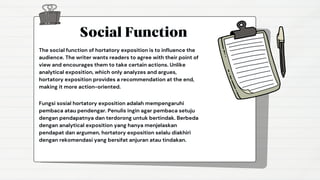
Social Function
The socialfunction of hortatory exposition is to influence the
audience. The writer wants readers to agree with their point of
view and encourages them to take certain actions. Unlike
analytical exposition, which only analyzes and argues,
hortatory exposition provides a recommendation at the end,
making it more action-oriented.
Fungsi sosial hortatory exposition adalah mempengaruhi
pembaca atau pendengar. Penulis ingin agar pembaca setuju
dengan pendapatnya dan terdorong untuk bertindak. Berbeda
dengan analytical exposition yang hanya menjelaskan
pendapat dan argumen, hortatory exposition selalu diakhiri
dengan rekomendasi yang bersifat anjuran atau tindakan.
6.
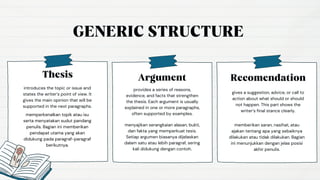
provides a seriesof reasons,
evidence, and facts that strengthen
the thesis. Each argument is usually
explained in one or more paragraphs,
often supported by examples.
gives a suggestion, advice, or call to
action about what should or should
not happen. This part shows the
writer’s final stance clearly.
GENERIC STRUCTURE
Thesis
introduces the topic or issue and
states the writer’s point of view. It
gives the main opinion that will be
supported in the next paragraphs.
Argument Recomendation
memperkenalkan topik atau isu
serta menyatakan sudut pandang
penulis. Bagian ini memberikan
pendapat utama yang akan
didukung pada paragraf-paragraf
berikutnya.
memberikan saran, nasihat, atau
ajakan tentang apa yang sebaiknya
dilakukan atau tidak dilakukan. Bagian
ini menunjukkan dengan jelas posisi
akhir penulis.
menyajikan serangkaian alasan, bukti,
dan fakta yang memperkuat tesis.
Setiap argumen biasanya dijelaskan
dalam satu atau lebih paragraf, sering
kali didukung dengan contoh.
7.
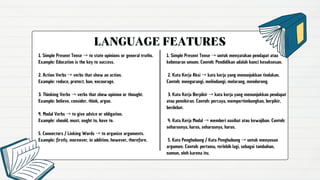
LANGUAGE FEATURES
1. SimplePresent Tense →to state opinions or general truths.
Example: Education is the key to success.
2. Action Verbs →verbs that show an action.
Example: reduce, protect, ban, encourage.
3. Thinking Verbs →verbs that show opinion or thought.
Example: believe, consider, think, argue.
4. Modal Verbs →to give advice or obligation.
Example: should, must, ought to, have to.
5. Connectors / Linking Words →to organize arguments.
Example: firstly, moreover, in addition, however, therefore.
1. Simple Present Tense →untuk menyatakan pendapat atau
kebenaran umum. Contoh: Pendidikan adalah kunci kesuksesan.
2. Kata Kerja Aksi →kata kerja yang menunjukkan tindakan.
Contoh: mengurangi, melindungi, melarang, mendorong.
3. Kata Kerja Berpikir →kata kerja yang menunjukkan pendapat
atau pemikiran. Contoh: percaya, mempertimbangkan, berpikir,
berdebat.
4. Kata Kerja Modal →memberi nasihat atau kewajiban. Contoh:
seharusnya, harus, seharusnya, harus.
5. Kata Penghubung / Kata Penghubung →untuk menyusun
argumen. Contoh: pertama, terlebih lagi, sebagai tambahan,
namun, oleh karena itu.
8.
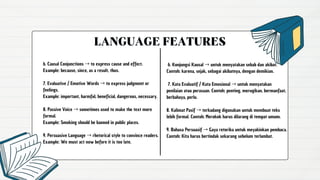
LANGUAGE FEATURES
6. KonjungsiKausal →untuk menyatakan sebab dan akibat.
Contoh: karena, sejak, sebagai akibatnya, dengan demikian.
7. Kata Evaluatif / Kata Emosional →untuk menyatakan
penilaian atau perasaan. Contoh: penting, merugikan, bermanfaat,
berbahaya, perlu.
8. Kalimat Pasif →terkadang digunakan untuk membuat teks
lebih formal. Contoh: Merokok harus dilarang di tempat umum.
9. Bahasa Persuasif →Gaya retorika untuk meyakinkan pembaca.
Contoh: Kita harus bertindak sekarang sebelum terlambat.
6. Causal Conjunctions →to express cause and effect.
Example: because, since, as a result, thus.
7. Evaluative / Emotive Words →to express judgment or
feelings.
Example: important, harmful, beneficial, dangerous, necessary.
8. Passive Voice →sometimes used to make the text more
formal.
Example: Smoking should be banned in public places.
9. Persuasive Language →rhetorical style to convince readers.
Example: We must act now before it is too late.
9.
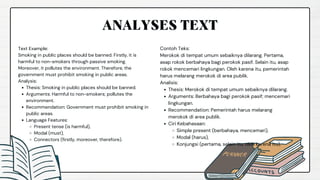
ANALYSES TEXT
Text Example:
Smokingin public places should be banned. Firstly, it is
harmful to non-smokers through passive smoking.
Moreover, it pollutes the environment. Therefore, the
government must prohibit smoking in public areas.
Analysis:
Thesis: Smoking in public places should be banned.
Arguments: Harmful to non-smokers; pollutes the
environment.
Recommendation: Government must prohibit smoking in
public areas.
Language Features:
Present tense (is harmful),
Modal (must),
Connectors (firstly, moreover, therefore).
Contoh Teks:
Merokok di tempat umum sebaiknya dilarang. Pertama,
asap rokok berbahaya bagi perokok pasif. Selain itu, asap
rokok mencemari lingkungan. Oleh karena itu, pemerintah
harus melarang merokok di area publik.
Analisis:
Thesis: Merokok di tempat umum sebaiknya dilarang.
Arguments: Berbahaya bagi perokok pasif; mencemari
lingkungan.
Recommendation: Pemerintah harus melarang
merokok di area publik.
Ciri Kebahasaan:
Simple present (berbahaya, mencemari),
Modal (harus),
Konjungsi (pertama, selain itu, oleh karena itu).




![Modul Ajar KBC SKI Kelas 6 MI [MODULKELAS.COM]](https://cdn.slidesharecdn.com/ss_thumbnails/modulajarkbcskikelas6mimodulkelas-260207160743-753abfd0-thumbnail.jpg?width=640&height=640&fit=bounds)


